

Rasch Analysis of the Profiles of Occupational Engagement in people with Severe mental illness (POES) instrument
Open accessThe DOI matches its Crossref record; 49 of the 50 references it cites were found in a registry or an index.
Abstract
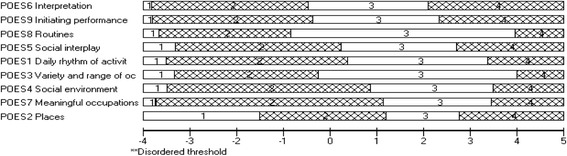
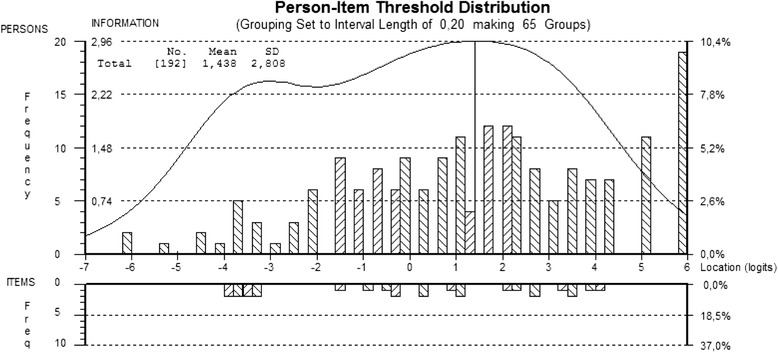
PURPOSE: The Profiles of Occupational Engagement in people with Severe mental illness (POES) instrument was developed to study time use profiles of occupations and measure the extent they are characterized by engagement. However, the dimensional factors are not known. The aim of the present study was to establish the internal construct validity of the POES using the Rasch measurement model. METHODS: A sample of 192 outpatients in Sweden was administered the POES and data were subjected to Rasch analysis. RESULTS: The POES showed good fit to the Rasch model after accommodation for local dependency. The nine items had high reliability as measured by person separation index, and no threshold disordering was present. Differential item functioning analysis showed no significant differences across groups of age, sex, diagnosis, or country of origin. CONCLUSION: The POES is a unidimensional scale that represents a continuum of occupational engagement. The transformed POES sum score can be used on an interval scale to measure status and changes in occupational engagement in mental health practice and research.
Overview
The claims and statistics of this paper haven’t been checked yet.
Free: it reads the open-access text and checks the first 5 claims that cite a source we can check. Create a free account to check every claim.
Integrity signals
Registry
Cites
Statistics
Figures
Verification
Claims the paper makes
The claims and statistics of this paper haven’t been checked yet.
Free: it reads the open-access text and checks the first 5 claims that cite a source we can check. Create a free account to check every claim.
Claims other papers make about this one
Each is checked against this paper’s own text: does it say what the citing paper says it does?
The source backs part of the claim, not all of it — or backs it for a different population, condition or comparison.
In the citing paper
“Four studies reported the development and psychometric testing of the Profiles of Occupational Engagement in people with schizophrenia (POES) (36–38).”
From Contributions of a time use perspective in community mental health practice: a scoping review (2024) · cites this paper as [38]
Experimental — accuracy not yet measuredThe cited source says what the claim attributes to it.
In the citing paper
“The POES was reported to have good interrater reliability, construct validity, and utility in understanding individuals’ level of engagement, wellbeing, functioning and social participation (36–38).”
From Contributions of a time use perspective in community mental health practice: a scoping review (2024) · cites this paper as [38]
The cited source says what the claim attributes to it.
In the citing paper
“The POES also allows the rating of activity engagement across nine key areas: 1) daily balance of activity and rest; 2) geographical location; 3) variety and range of activities; 4) social environment; 5) social interactions, 6) individuals’ experiences and interpretations; 7) meaningfulness of activities and/or contribution to wellbeing; 8) daily routines; and 9) initiating performance.”
From Contributions of a time use perspective in community mental health practice: a scoping review (2024) · cites this paper as [38]
In the citing paper
“has been found to be a valid and reliable instrument for measuring activity engagement [38–40].”
In the citing paper
“The POES instrument has been found to have good internal construct validity and inter-rater agreement engagement [31, 32].”
From Exploring mediators of the recovery process over time among mental health service users, using a mixed model regression analysis based on cluster RCT data (2020) · cites this paper as [32]
Self-check
Percentages, sums and reported differences re-computed from the paper’s own numbers.
The self-check needs the paper’s full text.
Citations
Cites
The Brief Psychiatric Rating Scale.
Overall, J. E., & Gorham, D. R. (1962) · Psychological Reports · doi:10.2466/pr0.1962.10.3.799 · Cited by 11,090
Probabilistic Models for Some Intelligence and Attainment Tests
(1961) · Information and Control · doi:10.1016/s0019-9958(61)80061-2 · Cited by 6,939
A Rasch model for partial credit scoring
Masters, G. N. (1982) · Psychometrika · doi:10.1007/bf02296272 · Cited by 3,782 · cited 1×
“The Rasch measurement model, Partial Credit version [32], was used to analyze the psychometric properties of the POES using RUMM 2030 software [33].”
MethodDifferential Item Functioning.
Gudgeon, A. C., Holland, P. W., & Wainer, H. (1994) · The Statistician · doi:10.2307/2348590 · Cited by 2,091
Fett, A.-K. J., Viechtbauer, W., Dominguez, M.-D.-G., Penn, D. L., van Os, J., & Krabbendam, L. (2011) · Neuroscience & Biobehavioral Reviews · doi:10.1016/j.neubiorev.2010.07.001 · Cited by 1,833 · cited 1×
“Together, these items underscore the occupational engagement construct, especially since social skills and processing of social environment are significantly related to daily functioning [42] and role functioning in the community [40].”
Funnekotter, B. (2005) · Eureka! · doi:10.1017/9789048505418.012 · Cited by 1,666
Tennant, A., & Conaghan, P. G. (2007) · Arthritis Care & Research · doi:10.1002/art.23108 · Cited by 1,638
Model of Human Occupation: Theory and Application
Kielhofner, G. (2002) · Cited by 1,566
The Person-Environment-Occupation Model: A Transactive Approach to Occupational Performance
Law, M., Cooper, B., Strong, S., Stewart, D., Rigby, P., & Letts, L. (1996) · Canadian Journal of Occupational Therapy · doi:10.1177/000841749606300103 · Cited by 1,550 · cited 1×
“In this way, a horizontal segment in the diary represents dimensions of the occupational, environmental, and personal domains of occupational performance [31].”
Andrich, D. (1988) · doi:10.4135/9781412985598 · Cited by 1,345
Model of Human Occupation: Theory and Application
Trakoli, A. (2010) · Occupational Medicine · doi:10.1093/occmed/kqq002 · Cited by 1,247 · cited 3×
“In this sense, the POES has the same architecture as the Worker Role Interview (WRI) or the Work Environment Impact Scale (WEIS) [30].”
(2002) · PubMed · Cited by 953
Quantitative Applications in the Social Sciences: Multiattribute Evaluation
Rand, G. K. (1983) · Journal of the Operational Research Society · doi:10.1057/jors.1983.225 · Cited by 837
Item Clusters and Computerized Adaptive Testing: A Case for Testlets
Wainer, H., & Kiely, G. L. (1987) · Journal of Educational Measurement · doi:10.1111/j.1745-3984.1987.tb00274.x · Cited by 630
Definition and prevalence of severe and persistent mental illness
Ruggeri, M., Leese, M., Thornicroft, G., Bisoffi, G., & Tansella, M. (2000) · British Journal of Psychiatry · doi:10.1192/bjp.177.2.149 · Cited by 552 · cited 2×
“In this study, severe mental illness refers to having a psychosis or severe psychiatric disability that extends over at least two years [26].”
Application of Rasch Analysis in the Development and Application of Quality of Life Instruments
Tennant, A., McKenna, S. P., & Hagell, P. (2004) · Value in Health · doi:10.1111/j.1524-4733.2004.7s106.x · Cited by 448 · cited 1×
“Mathematical psychometric approaches supplement traditional psychometric testing [17].”
MethodStudies in social psychology in World War II
Division, E. (1949) · Princeton University Press eBooks · Cited by 382
Using the Rasch model in nursing research: An introduction and illustrative example
Hagquist, C., Bruce, M., & Gustavsson, J. P. (2009) · International Journal of Nursing Studies · doi:10.1016/j.ijnurstu.2008.10.007 · Cited by 370 · cited 2×
“The Rasch measurement model helps to disclose a lack of variance that is not easily detected with traditional psychometric testing [19].”
Application of the Person-Environment-Occupation Model: A practical Tool
Strong, S., Rigby, P., Stewart, D., Law, M., Letts, L., & Cooper, B. (1999) · Canadian Journal of Occupational Therapy · doi:10.1177/000841749906600304 · Cited by 328
GUIDELINES TO STATISTICAL EVALUATION OF DATA FROM RATING SCALES AND QUESTIONNAIRES
Svensson, E. (2001) · Journal of Rehabilitation Medicine · doi:10.1080/165019701300006542 · Cited by 306 · cited 1×
“This is a limitation since health outcomes are frequently used for evaluation of clinical trials where valid change scores and access to parametric statistics are required [16].”
BackgroundFinne, E., Reinehr, T., Schaefer, A., Winkel, K., & Kolip, P. (2013) · Health and Quality of Life Outcomes · doi:10.1186/1477-7525-11-1 · Cited by 295
Time Use Research in the Social Sciences
(2002) · Springer eBooks · doi:10.1007/b107540 · Cited by 255
Untangling Occupation and Activity
Pierce, D. (2001) · The American Journal of Occupational Therapy · doi:10.5014/ajot.55.2.138 · Cited by 249 · cited 1×
“Occupation refers to our doing in time and place, all activities we occupy ourselves with and not only work [2].”
(2012) · Routledge eBooks · doi:10.4324/9780203357811 · Cited by 220
Marais, I., & Andrich, D. (2008) · PubMed · Cited by 196
Bejerholm, U., & Eklund, M. (2007) · American Journal of Occupational Therapy · doi:10.5014/ajot.61.1.21 · Cited by 163 · cited 5×
“Moreover, occupational engagement involves interpretation and comprehension that emanates from experience, a process that forms the basis for ongoing occupational engagement and a cyclical means of maintaining a sense of self and well-being [1, 9].”
InfluentialSelf-citationLundgren-Nilsson, Å., Jonsdottir, I. H., Ahlborg, G., & Tennant, A. (2013) · Health and Quality of Life Outcomes · doi:10.1186/1477-7525-11-2 · Cited by 149 · cited 1×
“, dependency between items), the items were combined or summed into a “testlet” (super item) [37, 38].”
Self-citationTime use and occupational performance among persons with schizophrenia
Bejerholm, U., & Eklund, M. (2004) · Occupational Therapy in Mental Health · doi:10.1300/j004v20n01_02 · Cited by 142 · cited 3×
“The POES was developed with qualitative research based on time use in relation to the constructs of occupational performance [8] and occupational engagement [6, 9].”
Self-citationPerspectives in Human Occupation Participation in Life
Kramer, P. S., Hinojosa, J., & Royeen, C. B. (2003) · Medical Entomology and Zoology · Cited by 140
Individual placement and support in Sweden—A randomized controlled trial
Bejerholm, U., Areberg, C., Hofgren, C., Sandlund, M., & Rinaldi, M. (2015) · Nordic Journal of Psychiatry · doi:10.3109/08039488.2014.929739 · Cited by 138 · cited 1×
“Two data sets were used [10, 27].”
Self-citationSocial/Communication Skills, Cognition, and Vocational Functioning in Schizophrenia
Dickinson, D., Bellack, A. S., & Gold, J. M. (2007) · Schizophrenia Bulletin · doi:10.1093/schbul/sbl067 · Cited by 137 · cited 3×
“The ability to cognitively store information and interpret what is happening socially in occupations is important to the ability to interact socially [40].”
BackgroundPast and present issues in Rasch analysis: The Functional Independence Measure (FIMâ„¢) revisited
Lundgren-Nilsson, Ã., & Tennant, A. (2011) · Journal of Rehabilitation Medicine · doi:10.2340/16501977-0871 · Cited by 136
Self-citationEdgelow, M., & Krupa, T. (2011) · American Journal of Occupational Therapy · doi:10.5014/ajot.2011.001313 · Cited by 125 · cited 1×
“However, in a pilot randomized controlled 12week trial with 24 participants of the effectiveness of an intervention entitled “Action Over Inertia”, no changes in occupational engagement were detected [14].”
Engagement in occupations among men and women with schizophrenia
Bejerholm, U., & Eklund, M. (2006) · Occupational Therapy International · doi:10.1002/oti.210 · Cited by 97 · cited 3×
“The POES was developed with qualitative research based on time use in relation to the constructs of occupational performance [8] and occupational engagement [6, 9].”
Self-citationBejerholm, U., Hansson, L., & Eklund, M. (2006) · British Journal of Occupational Therapy · doi:10.1177/030802260606900203 · Cited by 91 · cited 8×
“The POES was developed with qualitative research based on time use in relation to the constructs of occupational performance [8] and occupational engagement [6, 9].”
InfluentialSelf-citationOccupational Balance in People With Schizophrenia
Bejerholm, U. (2010) · Occupational Therapy in Mental Health · doi:10.1080/01642120802642197 · Cited by 75 · cited 1×
“ment is related to better quality of life, mastery, internal locus of control, fewer symptoms [1], occupational balance [10], increased work motivation [11], and empowerment”
Self-citationA scoping review of time-use research in occupational therapy and occupational science
Hunt, E., & McKay, E. A. (2014) · Scandinavian Journal of Occupational Therapy · doi:10.3109/11038128.2014.934918 · Cited by 69
Kurzban, S. A., Davis, L., & Brekke, J. S. (2010) · Current Psychiatry Reports · doi:10.1007/s11920-010-0129-3 · Cited by 64 · cited 1×
“People with schizophrenia commonly misinterpret social cues and have difficulty communicating effectively with others [41].”
Areberg, C., & Bejerholm, U. (2013) · Scandinavian Journal of Occupational Therapy · doi:10.3109/11038128.2013.765911 · Cited by 62
Self-citationEmpowerment in supported employment research and practice: Is it relevant?
Bejerholm, U., & Björkman, T. (2011) · International Journal of Social Psychiatry · doi:10.1177/0020764010376606 · Cited by 61 · cited 1×
“Cross-sectional studies show that a higher level of occupational engagement is related to better quality of life, mastery, internal locus of control, fewer symptoms [1], occupational balance [10], increased work motivation [11], and empowerment [12].”
Self-citationBejerholm, U., & Eklund, M. (2006) · Nordic Journal of Psychiatry · doi:10.1080/08039480600636239 · Cited by 57
Self-citationFactors related to the return to work potential in persons with severe mental illness
Bejerholm, U., & Areberg, C. (2014) · Scandinavian Journal of Occupational Therapy · doi:10.3109/11038128.2014.889745 · Cited by 55
Self-citationQuality of life and the use of time theory and measurement
Harvey, A. S. (1993) · Journal of Occupational Science · doi:10.1080/14427591.1993.9686381 · Cited by 41 · cited 1×
“The connection between time use and health is fundamental [3, 4].”
Perspectives in human occupation
Kramer, P., Hinojosa, J., & Royeen, C. B. (2015) · Cited by 23
Rasch Analysis of the Mental Health Recovery Measure
Chang, Y., Ailey, S. H., Heller, T., & Chen, M. (2013) · American Journal of Occupational Therapy · doi:10.5014/ajot.2013.007492 · Cited by 16 · cited 1×
“Over the past 20 years, Rasch analysis has been increasingly used in health sciences for development and evaluation of questionnaires, scales and measures [20, 21].”
MethodLundgren‐Nilsson, Å., Dencker, A., Jakobsson, S., Taft, C., & Tennant, A. (2014) · Value in Health · doi:10.1016/j.jval.2014.02.010 · Cited by 10 · cited 1×
“In addition to the groups mentioned, diagnosis groups are included in the present DIF analysis as is consistent with previous research [25].”
ResultSelf-citationRasch analysis: valid, useful,or both?
Tesio, L. (2008) · PubMed · Cited by 6
Comment on “Commentary on: Past and present issues in Rasch analysis: The FIM revisited”
Lundgren‐Nilsson, Å., & Tennant, A. H. (2011) · Journal of Rehabilitation Medicine · doi:10.2340/16501977-0895 · Cited by 4
Self-citationTime Budget Methodology in Social Science Research
Ujimoto, K. V. (2002) · Springer eBooks · doi:10.1007/0-306-47155-8_11 · Cited by 3
Research works printed but not linked: 2
- Andrich D Lyne A Sheridan B Luo G RUMM 2030 2010 Perth, W Australia RUMM Laboratory Ltd
- Nunnally JC Psychometric Theory 1978 New York McGrawHill
Cited by
Eklund, M., Orban, K., Argentzell, E., Bejerholm, U., Tjörnstrand, C., Erlandsson, L.-K., & Håkansson, C. (2017) · Scandinavian Journal of Occupational Therapy · doi:10.1080/11038128.2016.1224271 · Cited by 140
“This way, an engagement profile is generated [85,86].”
BackgroundSelf-citationEklund, M., Tjörnstrand, C., Sandlund, M., & Argentzell, E. (2017) · BMC Psychiatry · doi:10.1186/s12888-017-1524-7 · Cited by 93
“The POES consists of a diary that covers the past 24 h and has four columns; for the activity performed, the social context, the geographical context and reflections/feelings.”
MethodInfluentialPersonal recovery within positive psychiatry
Bejerholm, U., & Roe, D. (2018) · Nordic Journal of Psychiatry · doi:10.1080/08039488.2018.1492015 · Cited by 84
Self-citationFactors related to the return to work potential in persons with severe mental illness
Bejerholm, U., & Areberg, C. (2014) · Scandinavian Journal of Occupational Therapy · doi:10.3109/11038128.2014.889745 · Cited by 55
Self-citationJohanson, S., & Bejerholm, U. (2017) · Disability and Rehabilitation · doi:10.1080/09638288.2016.1211758 · Cited by 37
“Regarding the indicated ceiling effect when using the POES instrument in people with affective disorders, it is a signal to further assess occupational engagement according to POES, in relation to various target groups, as discussed in a previous study.[51] Furthermore, the aim of the present study was not to analyze…”
BackgroundMethodSelf-citation
Metadata
- Authors
- Bejerholm, U., & Lundgren-Nilsson, Å.
- Affiliations
- Lund University (SE)
- Corresponding author
- Bejerholm, Ulrika
- ORCID
- Bejerholm, Ulrika
- Venue
- Health and Quality of Life Outcomes
- Published
- 2015-08-19
- Volume
- 13
- Issue
- 1
- Pages
- 130-130
- ISSN
- 1477-7525 (ISSN-L)
- PMC
- PMC4543458
- OpenAlex
- W1936619443
- Cited by
- 39
- References
- 50
- Citations by year
- 2026: 5 · 2025: 3 · 2024: 5 · 2023: 7 · 2021: 1 · 2020: 3 · 2019: 4 · 2018: 1 · 2017: 6 · 2016: 3
- FWCI
- 10.55
- Type
- journal article
- Language
- en
- Open access
- gold
- doi.org
- Licence
- cc-by
- Locations
- Health and Quality of Life Outcomes (publishedVersion, cc-by)
- Europe PMC (PubMed Central) (publishedVersion, cc-by)
- PubMed Central (publishedVersion, cc-by)
- PubMed (publishedVersion)
- Lund University Publications (Lund University) (submittedVersion, other-oa)
- Funders
- Swedish Research Council for Health, Working Life and Welfare (2008–0146)
- Topics
- Health Sciences › Health Professions › Occupational Therapy › Occupational Therapy Practice and Research
- Social Sciences › Decision Sciences › Management Science and Operations Research › Psychometric Methodologies and Testing
- Health Sciences › Medicine › Psychiatry and Mental health › Schizophrenia research and treatment
- Keywords
- occupational engagement, severe mental illness, construct validity, Rasch analysis, differential item functioning, unidimensionality, scale development, mental health practice
- MeSH terms
- Adult, Mental Disorders, Female, Humans, Male, Mental Health, Middle Aged, Occupations, Psychometrics, Quality of Life, Surveys and Questionnaires, Sweden, Reproducibility of Results, Sickness Impact Profile
About these checks
Registry, retraction, Cites and statistics results are computed, not judged, with one exception: a printed reference that no index lists is read once by a model before it counts as a citation error. Claims are extracted by a model and kept only when their quote appears verbatim in the text; each cited source is then checked, with a model’s help, for whether it says what the claim relies on. Those verdicts can be wrong — read the claim’s quote and the cited source before relying on one.
Statistics and arithmetic are recomputed, not judged.
Confidence bands are shown only for fields calibrated on our annotated test set. None is calibrated yet, so no band is shown.
What counts as a claim ›How we measure confidence ›How we check this ›
Are you an author, or do you see a problem with this page? Request a review
Data sources
Bibliographic data: Semantic Scholar, OpenAlex, Crossref.
Contains information from the Semantic Scholar Academic Graph Datasets, made available under the ODC Attribution License (ODC-BY 1.0).
Semantic Scholar’s data is described in: Kinney, R., et al. (2023). The Semantic Scholar Open Data Platform. arXiv:2301.10140.
