

The share of ultra-processed foods and the overall nutritional quality of diets in the US: evidence from a nationally representative cross-sectional study
Open accessThe DOI matches its Crossref record; 43 of the 43 references it cites were found in a registry or an index.
Abstract
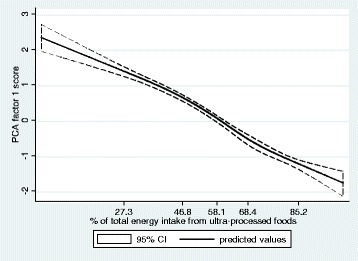
BACKGROUND: Recent population dietary studies indicate that diets rich in ultra-processed foods, increasingly frequent worldwide, are grossly nutritionally unbalanced, suggesting that the dietary contribution of these foods largely determines the overall nutritional quality of contemporaneous diets. Yet, these studies have focused on individual nutrients (one at a time) rather than the overall nutritional quality of the diets. Here we investigate the relationship between the energy contribution of ultra-processed foods in the US diet and its content of critical nutrients, individually and overall. METHODS: We evaluated dietary intakes of 9,317 participants from 2009 to 2010 NHANES aged 1+ years. Food items were classified into unprocessed or minimally processed foods, processed culinary ingredients, processed foods, and ultra-processed foods. First, we examined the average dietary content of macronutrients, micronutrients, and fiber across quintiles of the energy contribution of ultra-processed foods. Then, we used Principal Component Analysis (PCA) to identify a nutrient-balanced dietary pattern to enable the assessment of the overall nutritional quality of the diet. Linear regression was used to explore the association between the dietary share of ultra-processed foods and the balanced-pattern PCA factor score. The scores were thereafter categorized into tertiles, and their distribution was examined across ultra-processed food quintiles. All models incorporated survey sample weights and were adjusted for age, sex, race/ethnicity, family income, and educational attainment. RESULTS: The average content of protein, fiber, vitamins A, C, D, and E, zinc, potassium, phosphorus, magnesium, and calcium in the US diet decreased significantly across quintiles of the energy contribution of ultra-processed foods, while carbohydrate, added sugar, and saturated fat contents increased. An inverse dose-response association was found between ultra-processed food quintiles and overall dietary quality measured through a nutrient-balanced-pattern PCA-derived factor score characterized by being richer in fiber, potassium, magnesium and vitamin C, and having less saturated fat and added sugars. CONCLUSIONS: This study suggests that decreasing the dietary share of ultra-processed foods is a rational and effective way to improve the nutritional quality of US diets.
Overview
The claims and statistics of this paper haven’t been checked yet.
Free: it reads the open-access text and checks the first 5 claims that cite a source we can check. Create a free account to check every claim.
Integrity signals
Registry
Cites
Statistics
Figures
Verification
Claims the paper makes
The claims and statistics of this paper haven’t been checked yet.
Free: it reads the open-access text and checks the first 5 claims that cite a source we can check. Create a free account to check every claim.
Claims other papers make about this one
Each is checked against this paper’s own text: does it say what the citing paper says it does?
The source backs part of the claim, not all of it — or backs it for a different population, condition or comparison.
In the citing paper
“Moreover, refined sugars constitute approximately 20% of caloric intake.”
From The oral microbiome: Role of key organisms and complex networks in oral health and disease (2021) · cites this paper as [252]
Experimental — accuracy not yet measuredIn the citing paper
“In the United States, carbohydrates constitute > 50% of total energy intake, with refined cereal grains representing > 85% of total cereal grains consumed.”
From The oral microbiome: Role of key organisms and complex networks in oral health and disease (2021) · cites this paper as [252]
Self-check
Percentages, sums and reported differences re-computed from the paper’s own numbers.
The self-check needs the paper’s full text.
Citations
Cites
Sontrop, J. M., Dixon, S. N., Garg, A. X., Buendia-Jimenez, I., Dohein, O., Huang, S.-H. S., & Clark, W. F. (2013) · American Journal of Nephrology · doi:10.1159/000350377 · Cited by 5,871
Dietary pattern analysis: a new direction in nutritional epidemiology
Hu, F. B. (2002) · Current Opinion in Lipidology · doi:10.1097/00041433-200202000-00002 · Cited by 4,029 · cited 2×
“linear combinations of them referred to as “components” and which maximize the explained variance [19, 42].”
BackgroundMoshfegh, A. J., Rhodes, D. G., Baer, D. J., Murayi, T., Clemens, J. C., Rumpler, W. V., Paul, D. R., Sebastian, R. S., Kuczynski, K. J., Ingwersen, L. A., et al. (2008) · The American Journal of Clinical Nutrition · doi:10.1093/ajcn/88.2.324 · Cited by 1,982
Ultra‐processed products are becoming dominant in the global food system
Monteiro, C. A., Moubarac, J. ‐., Cannon, G., Ng, S. W., & Popkin, B. (2013) · Obesity Reviews · doi:10.1111/obr.12107 · Cited by 1,827
Self-citationMoodie, R., Stuckler, D., Monteiro, C., Sheron, N., Neal, B., Thamarangsi, T., Lincoln, P., & Casswell, S. (2013) · The Lancet · doi:10.1016/s0140-6736(12)62089-3 · Cited by 1,663
Self-citationNational health and nutrition examination survey: analytic guidelines, 1999-2010.
Cl, J., Paulose‐Ram, R., Ogden, C. L., Carroll, Kruszon‐Moran, D., Dohrmann, S. M., & Curtin, L. R. (2013) · PubMed · Cited by 1,522
USDA National Nutrient Database for Standard Reference, Release 22
(2018) · Cited by 1,285
Monteiro, C. A., Levy, R. B., Claro, R. M., de Castro, I. R. R., & Cannon, G. (2010) · Public Health Nutrition · doi:10.1017/s1368980010003241 · Cited by 1,060 · cited 1×
“Our investigation was based on total effective individual consumption data, rather than on household purchasing data [7, 10, 47], which do not evaluate the fraction of wasted food or purchases at restaurants.”
MethodSelf-citationDietary patterns and health outcomes
Kant, A. K. (2004) · Journal of the American Dietetic Association · doi:10.1016/j.jada.2004.01.010 · Cited by 1,028 · cited 1×
“The PCA method also has limitations such as subjective decisions regarding the number of extracted components, method of rotation, naming of components, and cutoffs for factor loadings [23, 31, 49].”
MethodA new classification of foods based on the extent and purpose of their processing
Monteiro, C. A., Levy, R. B., Claro, R. M., Castro, I. R. R. D., & Cannon, G. (2010) · Cadernos de Saúde Pública · doi:10.1590/s0102-311x2010001100005 · Cited by 991 · cited 2×
“We classified all recorded food items (N = 280,132 Food Codes) according to Nova, a food classification based on the extent and purpose of industrial food processing [4, 17].”
BackgroundMethodSelf-citation
Research works printed but not linked: 3
- FAO. Guidelines on the collection of information on food processing through food consumption surveys. Rome: FAO; 2015.
- Diet and health: implication for reducing chronic disease risk. National Academy Press, Washington, DC; 1989.
- Monteiro CA, Cannon G, Levy RB, Claro R, Moubarac JC, Martins AP, Louzada ML, Baraldi L, Canella D. The Food System. Processing. The big issue for disease, good health, well-being. World Nutr. 2012;3:527–69. www.wphna.org (accessed Jan 2017).
Cited by
Items 401–500 of 582
Microbiota Interactions With Processed Foods, Food Additives and Metabolic Disorders
Miclotte, L., & de Wiele, T. V. (2021) · Elsevier eBooks · doi:10.1016/b978-0-12-819265-8.00092-9 · Cited by 4
Cediel, G. (2022) · Revista de la Facultad de Medicina · doi:10.15446/revfacmed.v71n1.94256 · Cited by 7
Food and beverage combinations : Sommeliers' perspectives and consumer patterns in Sweden
Scander, H. (2019) · Örebro University Library (Örebro University) · Cited by 11
Role of Flavonoids in Sepsis: Advances and Future ProspectsPreprint
Esmail, S. O., & Sahlan, A. Z. (2024) · Preprints.org · doi:10.20944/preprints202405.1306.v1 · Cited by 2
Kesaite, V., Chavez‐Ugalde, Y., White, M. J., & Adams, J. M. (2024) · medRxiv · doi:10.1101/2024.08.27.24312650 · Cited by 3
Refrigerator ownership and the nutrition-health trade-off: evidence from Chinese households
Zheng, M., Cai, R., Zhang, L., & Xu, K. (2025) · Frontiers in Nutrition · doi:10.3389/fnut.2025.1620134 · Cited by 2
Trømborg, Å. S., Vik, J. O., Carlsen, M. H., & Carlsen, H. (2025) · Food & Nutrition Research · doi:10.29219/fnr.v69.12986 · Cited by 3
“Highly processed foods often have a less ideal nutrient profile compared to minimally processed foods, being for example energy dense, high in sugar and sodium, low in dietary fiber and high in saturated fat (7, 8, 17–19).”
Burak, L. C. (2025) · Health Food & Biotechnology · doi:10.36107/hfb.2025.i2.s258 · Cited by 3
Baric, A., Flannagan, L. E., Martinez, E., Bauer, A., & Christoforou, A. (2026) · Nutrition and Health · doi:10.1177/02601060261433154 · Cited by 3
Neoliberalism, Power Relations, Ethics, and Global Health
Benatar, S. R., Upshur, R. E. G., & Gill, S. R. (2021) · Cambridge University Press eBooks · doi:10.1017/9781108692137.018 · Cited by 3
Andrade, G. C., Julia, C., Deschamps, V., Srour, B., Herçberg, S., Kesse‐Guyot, E., Allès, B., Chazelas, E., Deschasaux, M., Touvier, M., et al. (2022) · Journal of Public Health · doi:10.1007/s10389-022-01693-4 · Cited by 4
Inadequate intake of vitamins and minerals among high-school pupils in the Moroccan Rif region
Mokhtari, O. E., Anzid, K., Levy-Desroches, S., López, P. M., Cherkaoui, M., & Hilali, A. (2022) · Mediterranean Journal of Nutrition and Metabolism · doi:10.3233/mnm-211509 · Cited by 2
Food promotion in supermarket promotional circulars: an analysis of the cover and internal content
de Oliveira, A. S. D., da Silva, A. C. F., Medina, D., Silva, T. S., Brito, F. D. S. B., & Moreira, C. C. (2022) · Research Society and Development · doi:10.33448/rsd-v11i7.29899 · Cited by 1
“This trend is seen in different countries (Crovetto & Uauy, 2012; Martins et al., 2013; Monteiro et al., 2013; Moubarac et al., 2014; PAHO, 2019).”
BackgroundZapata, M. E., Rovirosa, A., & Carmuega, E. (2023) · Archivos Argentinos de Pediatria · doi:10.5546/aap.2022-02861.eng · Cited by 11
Almaamari, S., Al‐Jawaldeh, A., Ghammari, I. A., Shammakhi, S. A., Aamri, J. A., & Ati, J. E. (2024) · Foods · doi:10.3390/foods13050787 · Cited by 3
de Vos, E. S., Mulders, A. G. M. G. J., Koning, A. H. J., SMIT, H. S., van Rossem, L., & Steegers‐Theunissen, R. P. M. (2024) · Clinical Nutrition · doi:10.1016/j.clnu.2024.09.033 · Cited by 3
Hochverarbeitete Lebensmittel und Gesundheit: Differenzieren statt dämonisieren
Smollich, M., & Wefers, D. (2024) · Aktuelle Ernährungsmedizin · doi:10.1055/a-2302-9323 · Cited by 2
Ultra-processed food intake is associated with low diet quality in young adult college students
Larcom, A. B., Lofgren, I. E., Delmonico, M. J., Missimer, A., & Melanson, K. J. (2024) · Journal of American College Health · doi:10.1080/07448481.2024.2404945 · Cited by 2
“61 Inverse associations have also been found between DQ and UPF intake using a posteriori assessments of DQ. Martinez-Steele et al. 44 found an inverse, dose-response relationship between the quintile of UPF intake and DQ as determined by principal component analysis.”
InfluentialAn exploration of potential risk factors for gastroschisis using decision tree learning
Petersen, J. M., Gradus, J. L., Werler, M. M., & Parker, S. E. (2024) · Annals of Epidemiology · doi:10.1016/j.annepidem.2024.12.004 · Cited by 3
Gill, S. R., Bakker, I., & Wamsley, D. (2021) · Cambridge University Press eBooks · doi:10.1017/9781108692137.019 · Cited by 4
Ready-meal consumption in older people: association with obesity and dietary intake
MAPT, G. D., Soriano, G., Barreto, P. D. S., Rolland, Y., Plessz, M., Goisser, S., Guyonnet, S., Fougère, B., Vellas, B. J., Andrieu, S., et al. (2018) · Aging Clinical and Experimental Research · doi:10.1007/s40520-018-1043-5 · Cited by 5
Adesão ao tratamento dietético para o emagrecimento: da teoria à prática
Torres, A. (2019) · Revista Brasileira de Nutrição Funcional · doi:10.32809/2176-4522.43.78.05 · Cited by 2
Popkin, B. M. (2020) · American Journal of Clinical Nutrition · doi:10.1093/ajcn/nqaa419 · Cited by 3
Self-citationChallenging the Global Extractive Order: A Global Health Justice Imperative
Schrecker, T., Birn, A., & Aguilera, M. (2021) · Cambridge University Press eBooks · doi:10.1017/9781108692137.020 · Cited by 2
Household disorder and blood pressure in mother–child dyads: A brief report.
Martin, S. L., Phillips, S. R., Barry, V. G., Cedillo, Y. E., Bahorski, J. S., Callahan, M. L., Garvey, W. T., & Chandler-Laney, P. C. (2022) · Journal of Family Psychology · doi:10.1037/fam0001032 · Cited by 3
Crovetto, M., & Sepúlveda, M. J. (2022) · Journal of preventive medicine and hygiene · doi:10.15167/2421-4248/jpmh2022.63.3.2486 · Cited by 9
Jarvis, S., & Malik, V. (2023) · Journal of the Indian Institute of Science · doi:10.1007/s41745-023-00358-9 · Cited by 2
Kim, M. (2024) · Korean Journal of Human Ecology · doi:10.5934/kjhe.2023.33.3.427 · Cited by 2
Eaton, J. (2020) · Open Scholarship Institutional Repository (Washington University in St. Louis) · doi:10.7936/kgvt-v980 · Cited by 6
Wiecha, J. L., & Muth, M. K. (2021) · American Journal of Evaluation · doi:10.1177/1098214020979782 · Cited by 2
“Consumption of ultraprocessed foods is inversely associated with dietary quality (Martı́nez Steele et al., 2017).”
BackgroundSocietal Determinants and Determination of Health
Birn, A., & Kumar, R. (2021) · Cambridge University Press eBooks · doi:10.1017/9781108692137.003 · Cited by 3
Animals, the Environment, and Global Health
Benatar, D. (2021) · Cambridge University Press eBooks · doi:10.1017/9781108692137.025 · Cited by 2
Bellatti, A. (2018) · British Journal of Sports Medicine · doi:10.1136/bjsports-2017-098642 · Cited by 2
Leffa, P. D. S. (2021) · Elsevier eBooks · doi:10.1016/b978-0-12-821848-8.00009-3 · Cited by 5
Huybrechts, I., Rauber, F., Nicolas, G., Casagrande, C., Kliemann, N., Wedekind, R., Biessy, C., Scalbert, A., Touvier, M., Aleksandrova, K., et al. (2023) · Frontiers in Nutrition · doi:10.3389/fnut.2023.1207555 · Cited by 4
Self-citationReimold, A. E., Hall, M. G., Rummo, P. E., Duffy, E. W., Gonzalez, D., & Taillie, L. S. (2024) · medRxiv · doi:10.1101/2024.02.12.24302688 · Cited by 4
“Specific to the US, the majority of individuals consume too few fruits, vegetables, and associated fiber, and too many ultra-processed foods high in sugar, sodium, and saturated fat [156-158].”
BackgroundLuong, R., Ribeiro, R. V., Hirani, V., Simpson, S. J., Couteur, D. G. L., Raubenheimer, D., & Gosby, A. K. (2023) · Public Health Nutrition · doi:10.1017/s1368980023001726 · Cited by 1
“…of National Health and Nutrition Examination Survey data that protein %E intake was inversely associated with ultra-processed food %E intake, whilst carbohydrate %E, added sugar %E, saturated fat %E and total energy intakes were positively associated with ultra-processed food %E intakes (2,5) .”
Plant-based foods and drinks: solutions to improve human nutrition
Pierucci, A. P. T. R., & Franca, P. A. P. (2024) · Elsevier eBooks · doi:10.1016/b978-0-443-16017-2.00024-3 · Cited by 1
Martins, Z. E., Silva, M., Machado, J. C. D. C., & Ferreira, I. M. P. L. V. O. (2024) · Royal Society of Chemistry eBooks · doi:10.1039/bk9781839166655-00488 · Cited by 2
Kelly, A. L., Baugh, M. E., Ahrens, M., Valle, A. N., Sullivan, R. M., Oster, M. E., Fowler, M. E., Carter, B. E., Davy, B. M., Hanlon, A. L., et al. (2024) · Contemporary Clinical Trials · doi:10.1016/j.cct.2024.107717 · Cited by 1
Chakraborty, A., & Shah, J. (2025) · Archives of Public Health · doi:10.1186/s13690-025-01510-w · Cited by 1
Dufault, R. (2025) · World Journal of Experimental Medicine · doi:10.5493/wjem.v15.i2.101555 · Cited by 3
Jayaswal, R., Frank, S. M., Steele, E. M., Rose, D. D., & Taillie, L. S. (2025) · Current Developments in Nutrition · doi:10.1016/j.cdnut.2025.107460 · Cited by 1
“In addition to accounting for a high proportion of dietary GHGE, UPF intake has been correlated with increased risk of obesity, type 2 diabetes, certain cancers, and cardiovascular disease [19 – 22].”
Tian, T., Hong, T., Tian, T., He, Y., Wang, X., Qian, L., Deng, S., Jin, H., Jiang, M., Fan, J., et al. (2025) · Human Nutrition & Metabolism · doi:10.1016/j.hnm.2025.200339 · Cited by 2
Perceptions Regarding Healthy Eating Based on Concept Mapping
Yeo, G., & Oh, J. (2025) · Nutrients · doi:10.3390/nu17182941 · Cited by 2
Trejo-Domínguez, A., Benítez, L., Crovetto, F., Casas, R. M., Youssef, L., Larroya, M., Ruiz-León, A. M., Nakaki, A., Genero, M., Casas, I., et al. (2026) · American Journal of Clinical Nutrition · doi:10.1016/j.ajcnut.2026.101255 · Cited by 2
“Furthermore, our findings contrast from those in the United States and Canada, where almost 80% of total energy intake is from UPF consumption [38,39], with cookies, pastries, and sugar-sweetened beverages being the most consumed UPF.”
Ulm, C., Hill, F., Mills, S. D., Chelius, C., & Hecht, E. M. (2026) · Child and Adolescent Psychiatry and Mental Health · doi:10.1186/s13034-026-01079-4 · Cited by 2
“Unhealthy foods are typically high in refined carbohydrates, added sugar, saturated fat, sodium, and low in fiber, protein, and most vitamins and minerals [3, 4].”
Tucker, A. C., Martínez-Steele, E., Caulfield, L. E., Rebholz, C. M., & Wolfson, J. A. (2026) · Journal of Nutrition · doi:10.1016/j.tjnut.2026.101561 · Cited by 2
Self-citationAlmoraie, N. M., & Alomari, W. D. (2026) · Frontiers in Nutrition · doi:10.3389/fnut.2026.1800945 · Cited by 1
de Oliveira, N. M., Schincaglia, R. M., Carneiro, L. B. V., Lacerda, E. M. D. A., Crispim, S. P., Berti, T. L., dos Santos, I. N., Lepsch, J., Farias, D. R., Alves‐Santos, N. H., et al. (2026) · British Journal Of Nutrition · doi:10.1017/s0007114526107508 · Cited by 1
The Grounded Minds Consortium: Researching the soil, gut, brain, and mind connection
Robinson, J. M., Fernández‐Rodríguez, R., Enez, A., Martin, A. M., Keating, D. J., Cavagnaro, T. R., Liddicoat, C., Marx, W., Breed, M. F., Ryan, F. J., et al. (2026) · Nutritional Psychiatry · doi:10.1016/j.nupsyc.2026.100023 · Cited by 1
Abar, L., O’Connell, C. P., Hong, H. G., Herrick, K., Kahle, L., Lerman, J., Liao, L. M., Zhang, X., Zhang, X., Zhao, L., et al. (2026) · PLoS Medicine · doi:10.1371/journal.pmed.1005251 · Cited by 1
(2020) · Journal of Virology and Mycology · doi:10.29011/2688-8750.100018 · Cited by 1
Justice and Global Health: Planetary Considerations
ten Have, H. (2021) · Cambridge University Press eBooks · doi:10.1017/9781108692137.026 · Cited by 1
The International Arms Trade and Global Health
Kennedy, J., McCoy, D., & Gafton, J. (2021) · Cambridge University Press eBooks · doi:10.1017/9781108692137.014 · Cited by 1
Asalu, G. A., Axame, W. K., Manu, A., Laar, A. K., & Aryeetey, R. (2022) · African Journal of Food Agriculture Nutrition and Development · doi:10.18697/ajfand.107.21780 · Cited by 1
(2019) · International Journal of Sports and Physical Education · doi:10.20431/2454-6380.0504003
Republication : Aliments ultra-transformés : le système NOVA est-il robuste ?
Braesco, V., Souchon, I., Sauvant, P., Haurogné, T., Maillot, M., Féart, C., & Darmon, N. (2022) · Cahiers de Nutrition et de Diététique · doi:10.1016/j.cnd.2022.04.003 · Cited by 3
Martin, Ș. A., & Martin-Hadmaș, R. M. (2023) · Children · doi:10.3390/children10101714 · Cited by 2
“Recent studies have indicated that consumption of heavily processed foods can lead to reduced nutrient intake, while simultaneously raising caloric consumption [8].”
BackgroundElfassy, T., Juul, F., Mesa, R. A., Palaniappan, L. P., Srinivasan, M., & Yi, S. S. (2023) · Research on Aging · doi:10.1177/01640275231222928 · Cited by 3
“These data are consistent with other studies of Western populations showing that in the U.S., Canada, and Britain, UPF consumption accounts for 50% – 60% of the energy content (Juul et al., 2018; Mart´ ı nez Steele et al., 2016, 2017, 2019; Pagliai et al., 2021).”
ResultHealth Hazards of Ultra-Processed Foods and The Challenges Facing Humanity
Wu, Q. (2023) · Highlights in Science Engineering and Technology · doi:10.54097/hset.v66i.11622 · Cited by 1
“In contrast, carbs, caloric sweeteners, and saturated fat increased content [6].”
BackgroundKemp, K. L., Lewis, B. E., Naik, A. R., & Uhley, V. E. (2024) · AJP Advances in Physiology Education · doi:10.1152/advan.00115.2023 · Cited by 2
Soil ecology, food systems, and organic waste: the critical network nobody is talking about
Perler, B. K. (2024) · Frontiers in Soil Science · doi:10.3389/fsoil.2024.1403795 · Cited by 3
Savor the Flavor: Diet, Taste, and Nutrition
Dus, M. (2024) · Oxford University Press eBooks · doi:10.1093/oso/9780190671051.003.0039 · Cited by 2
Miguel‐Berges, M. L., Flores‐Barrantes, P., Altaba, I. I., Santaliestra-Pasías, A. M., Samper, P., Moreno, L. A., & Rodríguez, G. (2020) · Child and Adolescent Obesity · doi:10.1080/2574254x.2020.1776054 · Cited by 1
“Evidence from observational studies previously showed that a diet rich in energy-dense foods and fizzy drinks is associated with poorer diet quality (Martinez Steele et al. 2017), hypertension (Mendonca et al. 2017), metabolic syndrome and obesity (Monteiro et al. 2011).”
BackgroundInternational Human Rights Law and the Social Determinants of Health
Forman, L. (2021) · Cambridge University Press eBooks · doi:10.1017/9781108692137.009 · Cited by 2
Evaluating Global Health Impact and Increasing Access to Essential Medicines
Hassoun, N. (2021) · Cambridge University Press eBooks · doi:10.1017/9781108692137.034 · Cited by 1
Mass Migration and Health in the Anthropocene Epoch
Straehle, C. (2021) · Cambridge University Press eBooks · doi:10.1017/9781108692137.024 · Cited by 1
Health Systems and Health and Healthcare Reform
McKee, M. (2021) · Cambridge University Press eBooks · doi:10.1017/9781108692137.006 · Cited by 1
Global Health Governance for Developing Sustainability
Ruggiero, E. D. (2021) · Cambridge University Press eBooks · doi:10.1017/9781108692137.037 · Cited by 1
Debt, Structural Adjustment, and Health
Rudin, J., & Sanders, D. M. (2021) · Cambridge University Press eBooks · doi:10.1017/9781108692137.013 · Cited by 2
The Health Impact Fund: How to Make New Medicines Accessible to All
Pogge, T. W. (2021) · Cambridge University Press eBooks · doi:10.1017/9781108692137.033 · Cited by 1
Dwyer, J. (2021) · Cambridge University Press eBooks · doi:10.1017/9781108692137.038 · Cited by 1
Responsibility for Global Health
Buchanan, A. E., & DeCamp, M. W. (2021) · Cambridge University Press eBooks · doi:10.1017/9781108692137.010 · Cited by 3
State of Global Health in a Radically Unequal World: Patterns and Prospects
Schrecker, T., & Labonté, R. (2021) · Cambridge University Press eBooks · doi:10.1017/9781108692137.002 · Cited by 3
Caloric and Lipid Profiles in the Spanish Population of North Africa
Mohatar-Barba, M., López-Olivares, M., Fernández-Gómez, E., Luque-Vara, T., Linares-Manrique, M., & Enrique-Mirón, C. (2022) · Foods · doi:10.3390/foods11081140 · Cited by 1
“Bad eating habits are more and more frequent among global population and are characterised by a lack of fruits and vegetables and high consumption of saturated fats and foods high in added sugars [4].”
BackgroundThe Determinants of Discretionary Front-of-Package Food Labelling
Christoforou, A. (2017) · TSpace (University of Toronto) · Cited by 1
Machado, P. P. (2019) · Digital Library of Theses and Dissertations (Universidade de São Paulo) · doi:10.11606/t.6.2019.tde-13092019-123522 · Cited by 4
Nutrition training for medical professionals: where do we begin?
Broadley, I., White, R., & Jaffee, A. (2022) · British Journal of Cardiology · doi:10.5837/bjc.2022.028 · Cited by 2
Towards sustainable Dutch diets : From research to policy
Vellinga, R. E. (2024) · doi:10.18174/644521 · Cited by 1
Alimentos ultraprocessados e a qualidade nutricional das dietas dos EUA
Steele, E. M. (2017) · Digital Library of Theses and Dissertations (Universidade de São Paulo) · doi:10.11606/t.6.2017.tde-19062017-135838
Hiner, A. (2017) · Nursing Critical Care · doi:10.1097/01.ccn.0000527218.03934.56
Sobieski, E., Sobieski, J., & Milner, R. (2019) · Elsevier eBooks · doi:10.1016/b978-0-323-66130-0.00003-x
Whyte, K. (2019) · Columbia Academic Commons (Columbia University) · doi:10.7916/d8-fg29-xc95 · Cited by 1
“Not surprisingly, ultra-processed foods contributed to the majority of the dietary share (about 50-60%).(52) In addition, when that share was further analyzed as quintiles, proportions of energy from different macronutrient groups varied, with the highest ultra-processed food consumption also consuming the largest pro…”
BackgroundMethodInfluentialHEALTHY FOR WHOM – CONSUMERS OR THE FOOD AND BEVERAGE INDUSTRY?
Holla, R., & Gupta, A. (2019) · World Nutrition · doi:10.26596/wn.201910276-86 · Cited by 1
Rossetti, F. X. (2019) · Digital Library of Theses and Dissertations (Universidade de São Paulo) · doi:10.11606/t.11.2019.tde-06092019-113128
市町村国保の特定健診受診者における家庭内・家庭外別食塩摂取源 -神奈川県真鶴町の事例-
小岩井馨, 武見, ゆ., 林, 芙., 緒方, 裕., 坂口, 景., 嶋田, 雅., 川畑, 輝., 野藤, 悠., & 中村, 正. (2019) · 日本健康教育学会誌 · doi:10.11260/kenkokyoiku.27.13 · Cited by 3
Challenging the global extractive order: A global health justice imperative
Schrecker, T., Birn, A.-E., & Aguilera, M. (2021) · Newcastle University ePrints (Newcastle Univesity) · doi:10.25405/ncl.34390107
The Environment, Ethics, and Health
Resnik, D. B. (2021) · Cambridge University Press eBooks · doi:10.1017/9781108692137.022
Bioethics and Global Child Health
Denburg, A., & Daneman, D. (2021) · Cambridge University Press eBooks · doi:10.1017/9781108692137.011
Teaching Global Health Ethics: An Ecological Perspective
Elton, S., & Cole, D. C. (2021) · Cambridge University Press eBooks · doi:10.1017/9781108692137.039 · Cited by 1
Geopolitics, Disease, and Inequalities in Emerging Economies
Gómez, E. J. (2021) · Cambridge University Press eBooks · doi:10.1017/9781108692137.017 · Cited by 1
Les aliments ultratransformés, un concept utile, mais mal utilisé
Braesco, V. (2021) · Pratiques en nutrition · doi:10.1016/j.pranut.2021.03.004 · Cited by 1
Takaara, D. (2021) · Digital Library of Theses and Dissertations (Universidade de São Paulo) · doi:10.11606/d.17.2021.tde-09042021-102544
Ahmadi, S. M. (2021) · The Atrium (University of Guelph) · Cited by 3
Andrade, G. C. (2021) · Digital Library of Theses and Dissertations (Universidade de São Paulo) · doi:10.11606/t.5.2021.tde-08092021-104715
Вырожденные задачи синтеза систем управления линейными дискретными объектами
Львович, Б. А. (2009) · Проблемы управления · Cited by 1
Diet Quality and Micronutrient Intake in Long-Term Weight Loss Maintainers
Pascual, R. W. (2019) · DigitalCommons - CalPoly (California State Polytechnic University) · doi:10.15368/theses.2019.81
METABOLIC SYNDROME & ITS DIETARY MANAGEMENT; A REVIEW
Aslam, M., Shahroz, R. A., Ramzan, S., Ali, S., Shehzad, F., Shafi, A., Ajmal, K., Rehman, N., Iqbal, S., Tanveer, S., et al. (2021) · Pakistan BioMedical Journal · doi:10.54393/pbmj.v4i2.124
Development and Validation of a Food Systems Knowledge and Attitudes Survey for College Students
Allison, C., Colby, S. E., Zhou, W., & Hellwinckel, C. (2022) · Journal of Hunger & Environmental Nutrition · doi:10.1080/19320248.2022.2036667
Metadata
- Authors
- Martínez Steele, E., Popkin, B. M., Swinburn, B., & Monteiro, C. A.
- Affiliations
- University of North Carolina at Chapel Hill (US)
- University of Auckland (NZ)
- Universidade de São Paulo (BR)
- Corresponding author
- Swinburn, Boyd
- Venue
- Population Health Metrics
- Published
- 2017-02-14
- Volume
- 15
- Issue
- 1
- Pages
- 6-6
- ISSN
- 1478-7954 (ISSN-L)
- PMC
- PMC5307821
- OpenAlex
- W2588919095
- Cited by
- 585
- References
- 43
- Citations by year
- 2026: 38 · 2025: 59 · 2024: 78 · 2023: 52 · 2022: 78 · 2021: 111 · 2020: 53 · 2019: 65 · 2018: 29 · 2017: 19
- FWCI
- 42.56
- Type
- journal article
- Language
- en
- Open access
- gold
- doi.org
- Licence
- cc-by
- Locations
- Population Health Metrics (publishedVersion, cc-by)
- PubMed Central (publishedVersion, cc-by)
- PubMed (publishedVersion)
- Portuguese National Funding Agency for Science, Research and Technology (RCAAP Project by FCT) (publishedVersion)
- Figshare (submittedVersion, cc-by)
- ResearchSpace (University of Auckland) (submittedVersion, cc-by)
- Funders
- Conselho Nacional de Desenvolvimento Científico e Tecnológico (443477/2014-0)
- Fundação de Amparo à Pesquisa do Estado de São Paulo (2015/14900-9)
- Topics
- Health Sciences › Medicine › Public Health, Environmental and Occupational Health › Consumer Attitudes and Food Labeling
- Health Sciences › Medicine › Public Health, Environmental and Occupational Health › Nutritional Studies and Diet
- Life Sciences › Agricultural and Biological Sciences › Food Science › Food Nutrient Composition and Product Development
- Keywords
- ultra-processed foods, diet quality, energy contribution, nutrient balance, macronutrients, micronutrients, dietary fiber, added sugars, saturated fat, NHANES
- MeSH terms
- Adolescent, Adult, Aged, Energy Intake, Child, Child, Preschool, Cross-Sectional Studies, Diet, Dietary Fiber, Dietary Proteins, Feeding Behavior, Female, Food Handling, Humans, Infant, Male, Middle Aged, Nutrition Surveys, Nutritive Value, Linear Models, Micronutrients, Principal Component Analysis, Young Adult, Fast Foods
About these checks
Registry, retraction, Cites and statistics results are computed, not judged, with one exception: a printed reference that no index lists is read once by a model before it counts as a citation error. Claims are extracted by a model and kept only when their quote appears verbatim in the text; each cited source is then checked, with a model’s help, for whether it says what the claim relies on. Those verdicts can be wrong — read the claim’s quote and the cited source before relying on one.
Statistics and arithmetic are recomputed, not judged.
Confidence bands are shown only for fields calibrated on our annotated test set. None is calibrated yet, so no band is shown.
What counts as a claim ›How we measure confidence ›How we check this ›
Are you an author, or do you see a problem with this page? Request a review
Data sources
Bibliographic data: Semantic Scholar, OpenAlex, Crossref.
Contains information from the Semantic Scholar Academic Graph Datasets, made available under the ODC Attribution License (ODC-BY 1.0).
Semantic Scholar’s data is described in: Kinney, R., et al. (2023). The Semantic Scholar Open Data Platform. arXiv:2301.10140.
