

Apps to promote physical activity among adults: a review and content analysis
Open accessThe DOI matches its Crossref record; 21 of the 21 references it cites were found in a registry or an index.
Abstract
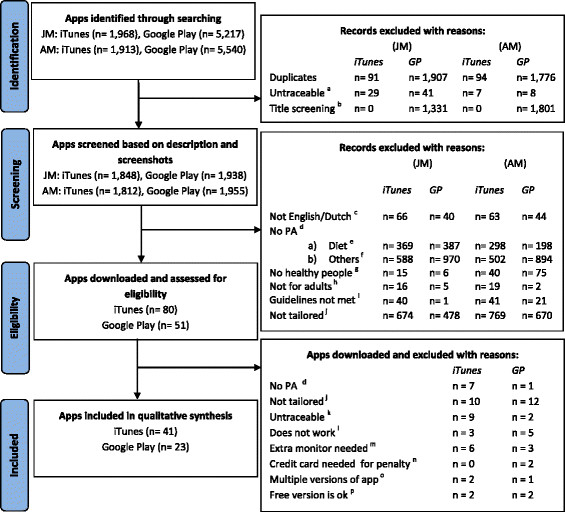
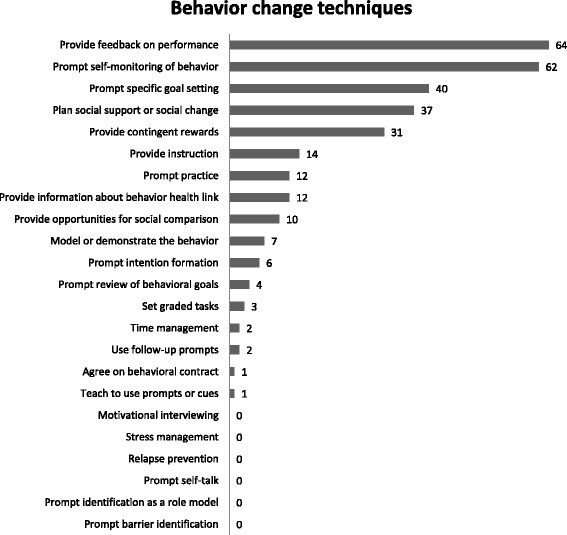
BACKGROUND: In May 2013, the iTunes and Google Play stores contained 23,490 and 17,756 smartphone applications (apps) categorized as Health and Fitness, respectively. The quality of these apps, in terms of applying established health behavior change techniques, remains unclear. METHODS: The study sample was identified through systematic searches in iTunes and Google Play. Search terms were based on Boolean logic and included AND combinations for physical activity, healthy lifestyle, exercise, fitness, coach, assistant, motivation, and support. Sixty-four apps were downloaded, reviewed, and rated based on the taxonomy of behavior change techniques used in the interventions. Mean and ranges were calculated for the number of observed behavior change techniques. Using nonparametric tests, we compared the number of techniques observed in free and paid apps and in iTunes and Google Play. RESULTS: On average, the reviewed apps included 5 behavior change techniques (range 2-8). Techniques such as self-monitoring, providing feedback on performance, and goal-setting were used most frequently, whereas some techniques such as motivational interviewing, stress management, relapse prevention, self-talk, role models, and prompted barrier identification were not. No differences in the number of behavior change techniques between free and paid apps, or between the app stores were found. CONCLUSIONS: The present study demonstrated that apps promoting physical activity applied an average of 5 out of 23 possible behavior change techniques. This number was not different for paid and free apps or between app stores. The most frequently used behavior change techniques in apps were similar to those most frequently used in other types of physical activity promotion interventions.
Overview
The claims and statistics of this paper haven’t been checked yet.
Free: it reads the open-access text and checks the first 5 claims that cite a source we can check. Create a free account to check every claim.
Integrity signals
Registry
Cites
Statistics
Figures
Verification
Claims the paper makes
The claims and statistics of this paper haven’t been checked yet.
Free: it reads the open-access text and checks the first 5 claims that cite a source we can check. Create a free account to check every claim.
Claims other papers make about this one
Each is checked against this paper’s own text: does it say what the citing paper says it does?
In the citing paper
“Developing mHealth interventions in multidisciplinary teams is a best practice approach recommended by many researchers [45-47].”
From Theory-Based Design and Development of a Socially Connected, Gamified Mobile App for Men About Breastfeeding (Milk Man) (2016) · cites this paper as [46]
Self-check
Percentages, sums and reported differences re-computed from the paper’s own numbers.
The self-check needs the paper’s full text.
Citations
Cites
Ezzati, M., López, A. D., Rodgers, A., & Murray, C. J. L. (2004) · Cited by 3,319
A taxonomy of behavior change techniques used in interventions
Abraham, C., & Michie, S. (2008) · Health Psychology · doi:10.1037/0278-6133.27.3.379 · Cited by 2,525 · cited 12×
“Previous reviews that applied Abraham and Michie’s taxonomy [14] to assess the number of behavior change techniques used in non-app interventions identified on average 6–8 behavior change techniques [14,15,22].”
BackgroundMethodInfluentialWebb, T. L., Joseph, J., Yardley, L., & Michie, S. (2010) · Journal of Medical Internet Research · doi:10.2196/jmir.1376 · Cited by 2,517 · cited 7×
“Although we found that the average number of behavior change techniques used in apps was lower than previously reported for other types of physical activity promotion, the most frequently used types of behavior change techniques used were similar [7,15,22].”
BackgroundMethodInfluentialEffective techniques in healthy eating and physical activity interventions: A meta-regression.
Michie, S., Abraham, C., Whittington, C., McAteer, J., & Gupta, S. (2009) · Health Psychology · doi:10.1037/a0016136 · Cited by 2,229 · cited 8×
“Previous reviews that applied Abraham and Michie’s taxonomy [14] to assess the number of behavior change techniques used in non-app interventions identified on average 6–8 behavior change techniques [14,15,22].”
BackgroundMethodInfluentialHealth behavior models in the age of mobile interventions: are our theories up to the task?
Riley, W. T., Rivera, D. E., Atienza, A. A., Nilsen, W., Allison, S. M., & Mermelstein, R. (2011) · Translational Behavioral Medicine · doi:10.1007/s13142-011-0021-7 · Cited by 978 · cited 1×
“The application of smartphones and apps in health behavior interventions are growing rapidly, however little has been published about the interventions using the new technology to provide real-time feedback [25].”
BackgroundOne size does not fit all: the case for tailoring print materials
Kreuter, M. W., Strecher, V. J., & Glassman, B. (1999) · Annals of Behavioral Medicine · doi:10.1007/bf02895958 · Cited by 831 · cited 1×
“, feedback based on the user’s own characteristics [10]) and advice is more likely to be effective than generic information about physical activity [9,11,12].”
BackgroundGriffiths, F., Lindenmeyer, A., Powell, J., Lowe, P., & Thorogood, M. (2006) · Journal of Medical Internet Research · doi:10.2196/jmir.8.2.e10 · Cited by 820 · cited 1×
“Many advantages of using the Internet as a delivery mode apply to smartphone apps too: constantly accessible, adjustable to the needs of the user [13], able to provide (computer-) tailored feedback, large reach and interactive”
BackgroundInterventions for promoting physical activity
Foster, C., Hillsdon, M., Thorogood, M., Kaur, A., & Wedatilake, T. (2005) · Cochrane Database of Systematic Reviews · doi:10.1002/14651858.cd003180.pub2 · Cited by 692
A meta-analysis of web-delivered tailored health behavior change interventions
Lustria, M. L. A., Noar, S. M., Cortese, J., Van Stee, S. K., Glueckauf, R. L., & Lee, J. (2013) · Journal of Health Communication · doi:10.1080/10810730.2013.768727 · Cited by 689 · cited 1×
“, feedback based on the user’s own characteristics [10]) and advice is more likely to be effective than generic information about physical activity [9,11,12].”
BackgroundA Review of eHealth Interventions for Physical Activity and Dietary Behavior Change
Norman, G. J., Zabinski, M. F., Adams, M. A., Rosenberg, D. E., Yaroch, A. L., & Atienza, A. A. (2007) · American Journal of Preventive Medicine · doi:10.1016/j.amepre.2007.05.007 · Cited by 605 · cited 2×
“This technology offers the opportunity for ecological momentary assessment (EMA) and makes it feasible to provide timely messages based on the user’s location [23,24].”
BackgroundMethod
Research works printed but not linked: 1
- http://whqlibdoc.who.int/publications/2010/9789241599979_eng.pdf World Health Organization: Global Recommendations on Physical Activity for Health. [] 26180873
Cited by
Items 301–400 of 542
Geng, L., Jiang, G., Yu, L., Xu, Y., Huang, W., Chen, Z., Qi, X., Zhang, T., & Zhao, M. (2023) · JMIR mhealth and uhealth · doi:10.2196/50226 · Cited by 10
“This is higher than the findings of previous research, which reported an average of 4.2 [50,51] and 7.0 [52] BCTs for apps promoting PA in adults.”
BackgroundResultInfluentialAgnes, T., Nayak, U. U., Kulkarni, M. M., & Maiya, A. G. (2024) · Journal of Taibah University Medical Sciences · doi:10.1016/j.jtumed.2024.10.001 · Cited by 11
“31 The review examined various metrics, including those associated with physical activity and diabetes.”
BackgroundPrabhu, G., Kuklyte, J., Gualano, L., Venkataraman, K., Ahmadi, A., Duff, O., Walsh, D. M. J., Woods, C. B., O'Connor, N. E., & Moran, K. (2018) · Lecture notes of the Institute for Computer Sciences, Social Informatics and Telecommunications Engineering · doi:10.1007/978-3-319-98551-0_3 · Cited by 9
“In a review of applications to promote physical activity among adults, providing feedback and self-monitoring were the most frequently used techniques [7].”
BackgroundSmartwatch Use Among Older Adults: Findings from Two Large Surveys
Seifert, A. (2020) · Lecture notes in computer science · doi:10.1007/978-3-030-50252-2_28 · Cited by 12
Lee, D. (2021) · Frontiers in Psychology · doi:10.3389/fpsyg.2021.635105 · Cited by 9
Panattil, S. J., George, A., & Joy, M. M. (2021) · Health Marketing Quarterly · doi:10.1080/07359683.2021.1995639 · Cited by 10
“Such platforms have been used for health and wellness promotion (DeSmet et al., 2014; Middelweerd et al., 2014), physical rehabilitation and management of diseases (Mart (cid:1) ı nez-P (cid:1) erez et al., 2013; Theng et al., 2015) and education and training of healthcare and medical professionals…”
MethodCompetitive influences of running applications on training habits
Shei, R. (2018) · The Physician and Sportsmedicine · doi:10.1080/00913847.2018.1483696 · Cited by 8
CluStream-GT: Online Clustering for Personalization in the Health Domain
Grua, E. M., Hoogendoorn, M., Malavolta, I., Lago, P., & Eiben, A. E. (2019) · IEEE/WIC/ACM International Conference on Web Intelligence · doi:10.1145/3350546.3352529 · Cited by 8
“3352529 such as sport trackers [10] or apps to battle depression [11] .”
BackgroundChaudry, B., Islam, A., & Matthieu, M. M. (2022) · JMIR Formative Research · doi:10.2196/30640 · Cited by 12
Online Sharing of Physical Activity: Does It Accelerate the Impact of a Health Promotion Program?
Manzoor, A. F., Mollee, J. S., Araújo, E. F. D. M., van Halteren, A., & Klein, M. C. A. (2016) · doi:10.1109/bdcloud-socialcom-sustaincom.2016.40 · Cited by 8
“A systematic review of apps that promote physical activity has shown that even though most apps apply only a few behavior change techniques [14] [15], a majority of these apps (approximately 58”
BackgroundSelf-citationDyck, D. V., D’Haese, S., Plaete, J., Bourdeaudhuij, I. D., Deforche, B. I., & Cardon, G. (2018) · Health & Social Care in the Community · doi:10.1111/hsc.12679 · Cited by 10
Need for Cognition Among Users of Self-Monitoring Systems for Physical Activity: Survey Study
Halttu, K., & B, H. O.-K. A. (2021) · JMIR Formative Research · doi:10.2196/23968 · Cited by 11
“Currently, self-monitoring is the most common BCT among mobile apps designed to support physical activity [5] and health behavior change [6] and in health interventions [7], and it is the core function of activity trackers [8,9].”
Self-Regulatory Self-Efficacy, Action Control, and Planning: There's an App for That!
Bassett-Gunter, R. L., & Chang, A. (2015) · Telemedicine Journal and e-Health · doi:10.1089/tmj.2015.0061 · Cited by 9
“31,35 Although there is some research to support the effectiveness of certain devices, 36 the evidence is fairly limited.”
Evolving Frontier: A Review of the Role of Mobile Medical Application Prescribing
Daifi, C., Bahrami, S., Kaakeh, R., & Kaakeh, Y. (2016) · Journal of Pharmacy Technology · doi:10.1177/8755122516633873 · Cited by 7
The two sides of sedentary behavior
da Costa, B. G. G., Chaput, J., & da Silva, K. S. (2022) · journal of physical education · doi:10.4025/jphyseduc.v33i1.3312 · Cited by 12
“Pokémon Go has caused an increase in physical activity on a large scale upon its release,(41) and several other apps are available for promoting physical activity.(42) Sitting has been linked to unhealthy outcomes and premature mortality,(4,9) and given the fact that many people spend too much time sitting uninterrupt…”
BackgroundReflection during goal setting: An analysis of popular personal informatics apps
Ekhtiar, T., Gouveia, R., Karahanoğlu, A., & Ludden, G. (2022) · Proceedings of DRS · doi:10.21606/drs.2022.787 · Cited by 7
Exercit@rt mobile: Monitoring of pulmonar rehabilitation in COPD
Pereira, M., Almeida, A. M., & Caixinha, H. J. M. (2016) · International Conference on Technology and Innovation in Sports, Health and Wellbeing (TISHW) · doi:10.1109/tishw.2016.7847771 · Cited by 7
“Although more research is needed, there are some evidences that mHealth causes a behavioural change making people to exercise more[13], through the following approaches: providing feedback on performance; prompting self-monitoring of behaviour; prompting specific goal setting; and providing opportunities for social co…”
BackgroundDeveloping a Calorie Counter Fitness App for Smartphones
Adewumi, A., Olatunde, G., Misra, S., Maskeliūnas, R., & Damaševičius, R. (2018) · Advances in intelligent systems and computing · doi:10.1007/978-3-319-74980-8_3 · Cited by 9
Measuring the Influence of a Persuasive Application to Promote Physical Activity.
Haque, S., Isomursu, M., Kangas, M., & Jämsä, T. J. (2018) · Cited by 15
Scaling Science-Based Approaches Beyond the Clinic
Wojtanowski, A. C., & Foster, G. D. (2019) · Springer eBooks · doi:10.1007/978-3-030-25173-4_13 · Cited by 7
Dalayya, S., Elsaid, S. T. F. A., Ng, K. H., Song, T. L., & Lim, J. B. Y. (2023) · Human Behavior and Emerging Technologies · doi:10.1155/2023/8005764 · Cited by 11
Berglind, D., Nyberg, G., Willmer, M., Persson, M., Wells, M. B., & Forsell, Y. (2018) · Trials · doi:10.1186/s13063-018-2646-z · Cited by 9
“The app is the number-one-ranked pedometer app at the app/google app store and comprises several behavior-change techniques, which is important when promoting PA [18].”
BackgroundHealth Behavior Change in HCI: Trends, Patterns, and OpportunitiesPreprint
Wang, Y., Fadhil, A., & Reiterer, H. (2019) · arXiv (Cornell University) · doi:10.48550/arxiv.1901.10449 · Cited by 14
“used for informing intervention development [64,65] and identifying the effective ingredients in intervention studies for health behavior change [24,33,58,71] and products (i.e., health-oriented apps [17,20,23,60] and wearables [54]). The word cloud in Figure 2 shows the relative use frequencies of BCTs used in 405 st…”
Murphy, M. L., Lubans, D. R., Cohen, K. E., Robards, S. L., Wilczynska, M., Kennedy, S. G., James, E. L., Brown, W. J., Courneya, K. S., Sigal, R. J., et al. (2019) · Contemporary Clinical Trials · doi:10.1016/j.cct.2019.01.007 · Cited by 11
von Winckelmann, C., Vanherle, R., Schreurs, L., Hoogmartens, O., Salaets, H., Spiegeleer, J. D., Sabbe, M. B., & Beullens, K. (2025) · JMIR Human Factors · doi:10.2196/69934 · Cited by 9
“Most of these apps enable users to monitor their health by, for instance, tracking their steps or creating personalized diet plans [3,4].”
Mas, A. M., Sampol, P. P., & Conti, J. V. (2016) · Retos · doi:10.47197/retos.v0i29.36019 · Cited by 14
An Inquiry into Goal-Setting Practices with Physical Activity Trackers
Konstanti, C., & Karapanos, E. (2018) · CHI Conference Extended Abstracts on Human Factors in Computing Systems (CHI EA) · doi:10.1145/3170427.3188663 · Cited by 9
“along with feedback on performance and selfmonitoring [1, 3, 5].”
BackgroundTowards personalised molecular feedback for weight loss
Tejpal, S., Sanghera, N., Manoharan, V., Planas-Iglesias, J., Myler, K., & Klein‐Seetharaman, J. (2019) · BMC Obesity · doi:10.1186/s40608-019-0237-5 · Cited by 6
A review of mobile applications to enhance coaching in occupational therapy
Setoguchi, M., Motruk, S., Frank, V., & Kessler, D. (2020) · British Journal of Occupational Therapy · doi:10.1177/0308022620905524 · Cited by 6
Personalized Digital Fitness Coach
Rothkrantz, L. J. M. (2021) · International Conference on Computer Systems and Technologies (CompSysTech) · doi:10.1145/3472410.3472412 · Cited by 6
Kim, J. Y., Kim, K. J., Kim, K. J., Choi, J., Seo, J., Lee, J.-B., Bae, J. H., Kim, N. H., Kim, H. Y., Lee, S.-K., et al. (2023) · Journal of Medical Internet Research · doi:10.2196/45975 · Cited by 6
“The continuous monitoring and data recording associated with wearable devices can lead to apprehension and resistance among users, particularly in groups like North Korean refugees who may have historical reasons to mistrust authorities or systems [25].”
Kim, J.-H., & Kim, Y. J. (2022) · Sport in Society · doi:10.1080/17430437.2022.2130050 · Cited by 7
“From an international level of academic research, it highlights the impact on users to consume influencer endorsed products through YouTube influencers’ reliable product reviews (Nandagiri and Philip 2018).”
BackgroundHamper, A., Wendt, J., Zagel, C., & Bodendorf, F. (2016) · Hawaii International Conference on System Sciences (HICSS) · doi:10.1109/hicss.2016.418 · Cited by 8
“Currently, health and fitness applications on the market are not based on theoretical behavior change constructs at all [16].”
BackgroundAmamentação e tecnologias mHealth: análise dos aplicativos móveis para tablets e smartphones
Guimarães, C. M. D. S., Imamura, M. E., Richter, S. M., & Monteiro, J. C. D. S. (2018) · Revista Eletrônica de Enfermagem · doi:10.5216/ree.v20.48578 · Cited by 6
“permite a realização de atendimento e de cuidado com avaliação e resposta imediatas, favorecendo assim uma assistência mais efetiva(9).”
BackgroundRhea, C. K., Felsberg, D. T., & Maher, J. P. (2018) · American Journal of Health Education · doi:10.1080/19325037.2018.1473177 · Cited by 8
“…on pain monitoring and management 9-12 ; the prevention, detection, and management of cancer 13,14 ; physical activity monitoring and intervention 3,15-17 ; weight management 18 ; diabetes management 19,20 ; stress management 21,22 ; smoking cessation 23 ; and the prevention of cardiovascular…”
BackgroundFuente-Vidal, A., Guerra-Balic, M., Noguera, O. R., Jerez‐Roig, J., & Montané, J. (2022) · International Journal of Environmental Research and Public Health · doi:10.3390/ijerph191610214 · Cited by 6
“Informal data suggest that 26% of apps are used only once after downloading and only 26% of users access the app more than ten times [20].”
BackgroundCheung, D. S. T., Kwok, T. W. H., Liu, S., Rhodes, R. E., Chiang, C., & Lin, C. (2024) · Internet Interventions · doi:10.1016/j.invent.2024.100730 · Cited by 6
“A review rated a total of 64 mobile apps for promoting PA in the general public based on the taxonomy of BCTs, and found the average number of BCTs used was 5 (range 2 – 8) (Middelweerd et al., 2014), whereas our app applied a total of 16 BCTs.”
BackgroundMethodUse of Mobile Fitness-Related Applications and Active Video Games in High-School Youth
Sas-Nowosielski, K., Szopa-Wiśnios, S., & Kowalczyk, A. (2016) · Polish Journal of Sport and Tourism · doi:10.1515/pjst-2016-0022 · Cited by 5
“perform exercise, or helping motivate the exerciser by such selfregulatory strategies as goal setting [2, 3, 4].”
BackgroundAdamakis, M. (2017) · Journal of Mobile Technology in Medicine · doi:10.7309/jmtm.6.1.4 · Cited by 5
User Acceptance of Real-Life Personalized Coaching in Social Fitness Apps
Simoski, B., Klein, M. C. A., van Halteren, A., & Bal, H. E. (2019) · International Conference on Pervasive Computing Technologies for Healthcare · doi:10.1145/3329189.3329205 · Cited by 5
“Previous research have raised concerns on the way tness apps are designed, with most of them lacking evidence-based methods and not following medical (health) guidance [16, 19].”
BackgroundQuality evaluation of smartphone applications for physical activity promotion
Lee, J. B., & Woo, H. (2019) · 보건교육·건강증진학회지 · doi:10.14367/kjhep.2019.36.4.67 · Cited by 5
A bibliometric analysis of COVID-19 and physical activity
Zhang, Y., Chen, M., Liu, C., Zhang, Z., & Fu, X. (2022) · Medicine · doi:10.1097/md.0000000000030779 · Cited by 9
“[49] Electronic information technology[41] to take online fitness classes at the right time, such as low - and moderate-intensity resistance exercises,[50] reduce sedentary time, make exercise more interactive and fun, and help the body relax through post-exercise meditation and deep breathing.”
BackgroundEvaluation of an App to Support Healthy Living by Older Adults
Haslinda, Z., Sani, A., & Petrie, H. (2017) · Electronic workshops in computing · doi:10.14236/ewic/hci2017.42 · Cited by 7
“A review paper on behaviour change techniques of 64 apps on iTunes and Google Play also confirmed that providing feedback on performance is the most frequently used technique to promote health behaviour change (Middelweerd et al., 2014).”
BackgroundImproving Quality of Interaction with the Mobility Services Through the Gamification Approach
Volpi, V., Parente, G. A., Pifferi, G., Opromolla, A., & Medaglia, C. (2018) · Interacción · doi:10.1007/978-3-319-91250-9_38 · Cited by 6
Using the Onitor ® Track for weight loss: A mixed methods study among overweight and obese women
Buchan, K., & Morgan, H. M. (2019) · Health Informatics Journal · doi:10.1177/1460458219890790 · Cited by 5
Special issue on supporting a healthier lifestyle with e-coaching systems
Beun, R. J., Anderson, J. H., Ham, J. R. C., Klein, M. C. A., Roefs, A., & Westerink, J. H. D. M. (2017) · Personal and Ubiquitous Computing · doi:10.1007/s00779-017-1029-x · Cited by 5
Mähs, M., Pithan, J. S., Bergmann, I., Gabrys, L., Graf, J., Hölzemann, A., Van Laerhoven, K., Otto-Hagemann, S., Popescu, M. L., Schwermann, L., et al. (2022) · Trials · doi:10.1186/s13063-022-06550-z · Cited by 4
Musaoğlu, Ö., Işık, Ö., & Çiçek, G. (2024) · Spor ve Performans Araştırmaları Dergisi · doi:10.17155/omuspd.1526274 · Cited by 5
Implementing a Digital Physical Activity Intervention for Older Adults: Qualitative Study
Boxall, C., Dennison, L., Miller, S., Joseph, J. A., Morton, K., Corser, J., Kesten, J. M., Electicwala, A., Western, M. J., Lim, S. E. R., et al. (2025) · JMIR Aging · doi:10.2196/64953 · Cited by 6
“These features set it apart from other available PA websites and apps [14-16].”
Takano, K., Oba, T., Katahira, K., & Kimura, K. (2026) · INQUIRY The Journal of Health Care Organization Provision and Financing · doi:10.1177/00469580261442400 · Cited by 5
White Paper: Games for Health for Children—Current Status and Needed Research
Baranowski, T., Blumberg, F. C., Buday, R., Fiellin, L. E., Green, C. S., Kato, P. M., Lu, A. S., Maloney, E. K., Mellecker, R. R., Morrill, B. A., et al. (2015) · Cited by 4
Lin, J., Wurst, R., Paganini, S., Hohberg, V., Kinkel, S., Göhner, W., Ramsenthaler, C., & Fuchs, R. (2020) · Trials · doi:10.1186/s13063-020-04438-4 · Cited by 6
Lau, N., O’Daffer, A., Yi‐Frazier, J. P., & Rosenberg, A. R. (2021) · Journal of Medical Internet Research · doi:10.2196/27105 · Cited by 4
“Thus, the majority of existing systematic app searches (and thus app content and quality assessments) span Apple and Android platforms only [33,34,38-40].”
BackgroundMacPherson, M., Merry, K. J., Locke, S., & Jung, M. E. (2022) · Journal of Technology in Behavioral Science · doi:10.1007/s41347-022-00253-7 · Cited by 4
“Self-monitoring is a commonly used feature in mHealth fitness apps (Bardus et al., 2016; Middelweerd et al., 2014) and is a behavior change technique in which a person monitors and records their behaviors (Michie et al.”
MethodHung, J., Brugaletta, S., & Spratt, J. (2022) · European Heart Journal Supplements · doi:10.1093/eurheartjsupp/suac055 · Cited by 4
“With swathes of data now continuously collected by wearables, what value is added to the individual and to the population? Though intuitive benefit might be inferred, there is mixed evidence as to whether wearables make a significant difference to patient outcomes, and some concerns about the reliability of using cons…”
BackgroundLach, E., Szewczenko, A. M., Chuchnowska, I., Bursiewicz, N., Benek, I., Widzisz-Pronobis, S., Bal, D., Elsner, K., Sanigórska, M., Sutor, M., et al. (2023) · Sensors · doi:10.3390/s23031602 · Cited by 5
Ristow, N., Rocholl, M., Wilke, A., John, S. M., & Ludewig, M. (2023) · Translational Behavioral Medicine · doi:10.1093/tbm/ibad081 · Cited by 5
Ali, N. A., Hudson, J., Stratton, G., Mullins, J. M., & Sahoo, D. R. (2024) · BMJ Open · doi:10.1136/bmjopen-2024-084645 · Cited by 5
“38 39 Furthermore, Rosenberg et al 40 carried out an intervention study using wrist-worn wearable activity trackers (WATs; electronic wearable technologies used to track PA and SB) to provide vibrations after every 15 min to cue breaks to sedentary time during the entire day along with health…”
Janssen, M., van den Heuvel, R., Megens, C., Lévy, P., & Vos, S. B. (2018) · Conference of the International Sports Engineering Association (ISEA) · doi:10.3390/proceedings2060297 · Cited by 4
“For example, in recent years there has been an exponential increase in the availability and use of sports and physical activity-related monitoring devices [5,6].”
BackgroundPREventive Care Infrastructure based On Ubiquitous Sensing (PRECIOUS): A Study Protocol
Castellano‐Tejedor, C., Moreno, J., Ciudin, A., Parramón, G., & Lusilla, P. (2017) · JMIR Research Protocols · doi:10.2196/resprot.6973 · Cited by 4
“Thus, these apps try to bring empowerment, joy, engagement, and to offer a social connection to an otherwise rather dull self-management task [10-12].”
French, C., McKenzie, Y. A., Stanmore, E., & Burden, S. T. (2024) · Journal of Aging and Physical Activity · doi:10.1123/japa.2023-0449 · Cited by 4
Homo smartphonus: Psychological Aspects of Smartphone Use—A Literature Review
Sorokowski, P., & Sobczak, M. (2025) · Multimodal Technologies and Interaction · doi:10.3390/mti9080083 · Cited by 4
A Wellness Mobile Application for Smart Health
Rao, B. N. K. (2023) · Advances in wireless technologies and telecommunication book series · doi:10.4018/978-1-6684-8582-8.ch002 · Cited by 3
Ping, X., Zhu, B., & Saenghiran, T. (2024) · Lecture notes in computer science · doi:10.1007/978-3-031-60458-4_9 · Cited by 5
Colmenero, B. R. R. (2023) · Retos · doi:10.47197/retos.v50.98385 · Cited by 7
Mobile health technologies to improve walking distance in people with intermittent claudication
Elfghi, M., Dunne, D., Jones, J. L., Gibson, I., Flaherty, G. T., McEvoy, J. W., Sultan, S., Jordan, F., & Tawfick, W. A. (2024) · Cochrane Database of Systematic Reviews · doi:10.1002/14651858.cd014717.pub2 · Cited by 8
The ground truth is out there: Challenges with using pervasive technologies for behavior change
Cleland, I., Nugent, C., & Lee, S. (2016) · International Conference on Pervasive Computing Technologies for Healthcare · doi:10.4108/eai.16-5-2016.2263823 · Cited by 3
“Apps which facilitate these functions have been associated with greater effectiveness [4].”
BackgroundDevelopment and Implementation of Mobile Gear for Skier Training System
Kim, Y. W., & Choi, S.-R. (2017) · International Journal of Software Engineering & Applications · doi:10.5121/ijsea.2017.8102 · Cited by 3
Ostojic, M., Chung, J., Mattia, M. D., Furlonger, B., Busacca, M. L., & Chittleborough, P. (2018) · Journal of Psychologists and Counsellors in Schools · doi:10.1017/jgc.2018.4 · Cited by 3
Effect of efitbuddy on promoting physical activity and motivation in college students
Zhang, P., Fu, Y., Burns, R. D., & Godin, S. (2018) · Journal of Human Sport and Exercise · doi:10.14198/jhse.2018.134.08 · Cited by 3
“Due to this, there is currently a lack of scientific support behind the theory that promoting physical activity through smart phone applications is an effective way to promote physical activity (Coughlin et al., 2016; Middelweerd et al., 2014).”
BackgroundYuasa, T., Harada, F., & Shimakawa, H. (2022) · International Journal of Environmental Research and Public Health · doi:10.3390/ijerph19031668 · Cited by 3
“On the other hand, few functions provide information through health behaviors [5].”
BackgroundTung, C.-Y., Chang, C.-C., Jian, J.-W., Du, Y.-S., & Wu, C.-T. (2022) · Informatics for Health and Social Care · doi:10.1080/17538157.2022.2042303 · Cited by 6
“Most behavior change techniques in WHT are goal setting, self-monitoring, and receiving feedback on performance.(11,12) Further, WHT can help individuals to change their behavior.”
MethodKuru, H. (2018) · Springer eBooks · doi:10.1007/978-3-319-73135-3_3 · Cited by 6
Intervention development for exercise promotion at active charity events in the UK
Jones, B. A., Munir, F., Harris, P. S., Bhatnagar, P., & Stevinson, C. D. (2020) · Health Promotion International · doi:10.1093/heapro/daaa012 · Cited by 3
Introduction to focused issue on mHealth and social media interventions for cancer
Coughlin, S. S. (2016) · mHealth · doi:10.21037/mhealth.2016.11.01 · Cited by 4
Maberry, S. (2016) · Louisiana State University · doi:10.31390/gradschool_dissertations.3803 · Cited by 5
Little, M. A., Volotinen, S., Sanderson, B., Huopaniemi, U., Mowlem, F. D., Olt, J., & Byrom, B. (2021) · bioRxiv (Cold Spring Harbor Laboratory) · doi:10.1101/2021.10.21.465337 · Cited by 4
“…on both Apple (Apple Inc., Cuper-tino, CA, USA) and Google (Alphabet Inc., Mountain View, CA, USA) platforms focused on personal health and fitness [Middelweerd et al., 2014], many of which leverage the inbuilt sensors (such as the accelerometer and GPS) to provide valuable features such as…”
BackgroundTang, Y., Gierc, M., La, H., Liu, S., Lam, R. W., Puterman, E., & Faulkner, G. (2025) · PLOS One · doi:10.1371/journal.pone.0321958 · Cited by 2
Aplicativos de smartphones e atividades físicas: contribuições e limitações
Verzani, R. H., & Serapião, A. B. D. S. (2020) · Pensar a Prática · doi:10.5216/rpp.v23.59569 · Cited by 10
Video moves you: Randomized field experiment shows how in-app videos increase exercise
Riedl, C., & Pauwels, K. H. (2025) · Journal of Business Research · doi:10.1016/j.jbusres.2025.115461 · Cited by 2
Berendsen, B., Golsteijn, R. H. J., Lechner, L., Bolman, C. A. W., & Peels, D. A. (2025) · Contemporary Clinical Trials Communications · doi:10.1016/j.conctc.2025.101516 · Cited by 3
“The latter is promising for health promotion, especially when combined with effective behavior change techniques in interventions [41,42].”
Elloumi, L., Meijerink, M., van Beijnum, B.-J. F., & Hermens, H. J. (2017) · Communications in computer and information science · doi:10.1007/978-3-319-54717-6_22 · Cited by 2
The assessment of functionalities of mobile applications supporting physical activity
Tubek, A., & Duplaga, M. (2018) · Homo Politicus (Academy of Humanities and Economics in Lodz) · Cited by 2
Riyanti, R., Kusmaedi, N., & Ma’mun, A. (2019) · Jurnal Penelitian Pendidikan · doi:10.17509/jpp.v19i3.22333 · Cited by 4
An Investigation of the Level of E-health Literacy in South Africa
Posiliti, D., & Cilliers, L. (2019) · Kalpa publications in computing · doi:10.29007/jjrb · Cited by 4
System Usability Survey for Mobile Application for Horse Training Program
Rosman, A. A., & Latip, H. F. M. (2022) · Journal of Human Centered Technology · doi:10.11113/humentech.v1n1.10 · Cited by 2
“Mobile applications are easily accessible, have a broad variety of features, such as interactive solutions and input opportunities [3].”
BackgroundRole of Mobile Apps in the Health Care Department
Sharma, A., Jain, S., & Yadav, R. L. (2023) · International Journal of Advanced Research in Science Communication and Technology · doi:10.48175/ijarsct-10711 · Cited by 2
Delemere, E., & Maguire, R. (2023) · IEEE International Symposium on Technology and Society (ISTAS) · doi:10.1109/istas57930.2023.10306058 · Cited by 2
“As such, some of the measures may not translate fully to apps [48], [49].”
BackgroundDoes Technology Affect Nutrition Education Perspectives?
BAŞAR, H. B. A., & Bilici, S. (2023) · Artuklu International Journal of Health Sciences · doi:10.58252/artukluder.1363153 · Cited by 3
Welhausen, C. A., & Bivens, K. M. (2019) · ACM International Conference on Design of Communication (SIGDOC) · doi:10.1145/3328020.3353953 · Cited by 2
Peran Aplikasi M-Health Dalam Promosi Kesehatan Aktivitas Fisik
Siregar, I. A., & Rahman, L. O. A. (2020) · Jurnal Kesehatan · doi:10.46815/jkanwvol8.v9i1.86 · Cited by 5
Physical Activity and Sedentary Behaviour in the Digital Workspace
Thompson, A. (2020) · Springer eBooks · doi:10.1007/978-3-030-60283-3_8 · Cited by 2
König, L. M. (2025) · Springer series on epidemiology and public health · doi:10.1007/978-3-031-90154-6_19 · Cited by 1
Kheirdoust, A., Habibi, M. R. M., Emadzadeh, A., Esfehani, A. J., Amiri, F. S. A. S. E., Ghaddaripouri, K., & Eslami, S. (2025) · BMC Health Services Research · doi:10.1186/s12913-025-13534-7 · Cited by 7
“However, despite their potential, the extent to which mHealth apps leverage evidence-based strategies remain inconsistent [14–16].”
Furlonger, B., Chung, J., Ostojic, M., Busacca, M. L., Moore, D. W., Anderson, A., Phillips, K. J., & D’Souza, L. (2020) · The Educational and Developmental Psychologist · doi:10.1017/edp.2020.3 · Cited by 2
Personalized and Contextualized Persuasion System for Older Adults’ Physical Activity Promoting
Aloulou, H., Aloulou, H., Abdulrazak, B., & Kacem, A. H. (2020) · Lecture notes in computer science · doi:10.1007/978-3-030-51517-1_12 · Cited by 2
“In [9], authors identi fi ed 64 apps to promote physical activity among adults.”
BackgroundSuherman, A., Sultoni, K., & Jajat, J. (2021) · Journal of Engineering Research · doi:10.36909/jer.asseee.16057 · Cited by 4
“Nonetheless smartphone applications that promote PA are very popular (Middelweerd et al., 2014) thus providing opportunities to improve an active lifestyle.”
BackgroundActivity Trackers Influencing Motivation and Awareness: Study Among Fitness Centre Members
Kettunen, E., Kari, T., Chasandra, M., Critchley, W., & Doğan, U. (2017) · doi:10.18690/978-961-286-043-1.21 · Cited by 4
“Health behaviour change interventions tend to be more effective if they are firmly connected with a health behaviour change theory (Middelweerd et al., 2014).”
BackgroundInfluentialArts, D., Kromkamp, L., & Vos, S. B. (2019) · Lecture notes in computer science · doi:10.1007/978-3-030-29390-1_25 · Cited by 5
“In the past five years, the market of so-called wearables has grown exponentially, partly due to developments in IT and sensor technology (3,4).”
Metadata
- Authors
- Middelweerd, A., Mollee, J. S., van der Wal, C. N., Brug, J., & te Velde, S. J.
- Affiliations
- Amsterdam Public Health (NL)
- Vrije Universiteit Amsterdam (NL)
- Venue
- International Journal of Behavioral Nutrition and Physical Activity
- Published
- 2014-07-25
- Volume
- 11
- Issue
- 1
- Pages
- 97-97
- ISSN
- 1479-5868 (ISSN-L)
- PMC
- PMC4132213
- OpenAlex
- W2139141017
- Cited by
- 546
- References
- 21
- Citations by year
- 2026: 17 · 2025: 21 · 2024: 22 · 2023: 40 · 2022: 53 · 2021: 50 · 2020: 71 · 2019: 67 · 2018: 66 · 2017: 53 · 2016: 58 · 2015: 26 · 2014: 1
- FWCI
- 83.09
- Type
- journal article
- Language
- en
- Open access
- gold
- doi.org
- Locations
- International Journal of Behavioral Nutrition and Physical Activity (publishedVersion, cc-by)
- Europe PMC (PubMed Central) (publishedVersion, cc-by)
- PubMed Central (publishedVersion, cc-by)
- PubMed (publishedVersion)
- Amsterdam UMC (VU Amsterdam) - Institutional Repository (publishedVersion)
- Pure Amsterdam UMC (submittedVersion)
- VU Research Portal (submittedVersion, other-oa)
- Data Archiving and Networked Services (DANS) (submittedVersion, other-oa)
- Data Archiving and Networked Services (DANS) (submittedVersion)
- Funders
- Stichting voor de Technische Wetenschappen
- Topics
- Health Sciences › Health Professions › General Health Professions › Mobile Health and mHealth Applications
- Health Sciences › Medicine › Public Health, Environmental and Occupational Health › Physical Activity and Health
- Social Sciences › Psychology › Applied Psychology › Digital Mental Health Interventions
- Keywords
- mobile health apps, physical activity promotion, behaviour change techniques, mobile application, self-monitoring, goal setting, performance feedback, free vs paid apps, health behavior change
- MeSH terms
- Health Promotion, Humans, Motivation, Motor Activity, Software, Health Behavior, Cell Phone
About these checks
Registry, retraction, Cites and statistics results are computed, not judged, with one exception: a printed reference that no index lists is read once by a model before it counts as a citation error. Claims are extracted by a model and kept only when their quote appears verbatim in the text; each cited source is then checked, with a model’s help, for whether it says what the claim relies on. Those verdicts can be wrong — read the claim’s quote and the cited source before relying on one.
Statistics and arithmetic are recomputed, not judged.
Confidence bands are shown only for fields calibrated on our annotated test set. None is calibrated yet, so no band is shown.
What counts as a claim ›How we measure confidence ›How we check this ›
Are you an author, or do you see a problem with this page? Request a review
Data sources
Bibliographic data: Semantic Scholar, OpenAlex, Crossref.
Contains information from the Semantic Scholar Academic Graph Datasets, made available under the ODC Attribution License (ODC-BY 1.0).
Semantic Scholar’s data is described in: Kinney, R., et al. (2023). The Semantic Scholar Open Data Platform. arXiv:2301.10140.
