

Apps to promote physical activity among adults: a review and content analysis
Open accessThe DOI matches its Crossref record; 21 of the 21 references it cites were found in a registry or an index.
Abstract
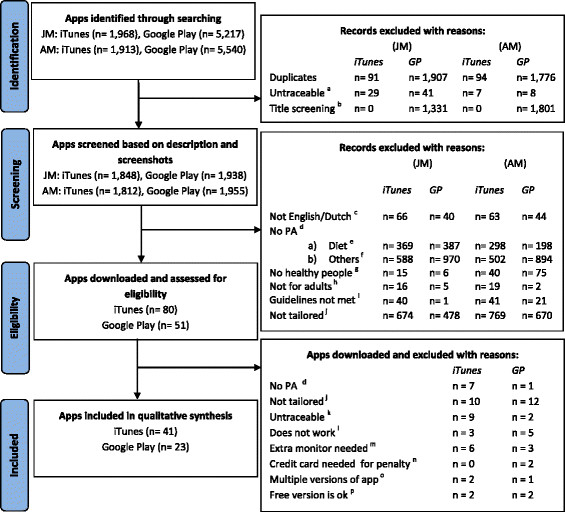
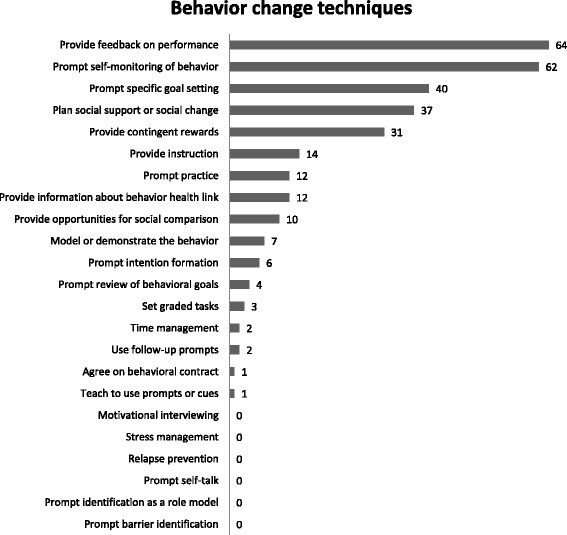
BACKGROUND: In May 2013, the iTunes and Google Play stores contained 23,490 and 17,756 smartphone applications (apps) categorized as Health and Fitness, respectively. The quality of these apps, in terms of applying established health behavior change techniques, remains unclear. METHODS: The study sample was identified through systematic searches in iTunes and Google Play. Search terms were based on Boolean logic and included AND combinations for physical activity, healthy lifestyle, exercise, fitness, coach, assistant, motivation, and support. Sixty-four apps were downloaded, reviewed, and rated based on the taxonomy of behavior change techniques used in the interventions. Mean and ranges were calculated for the number of observed behavior change techniques. Using nonparametric tests, we compared the number of techniques observed in free and paid apps and in iTunes and Google Play. RESULTS: On average, the reviewed apps included 5 behavior change techniques (range 2-8). Techniques such as self-monitoring, providing feedback on performance, and goal-setting were used most frequently, whereas some techniques such as motivational interviewing, stress management, relapse prevention, self-talk, role models, and prompted barrier identification were not. No differences in the number of behavior change techniques between free and paid apps, or between the app stores were found. CONCLUSIONS: The present study demonstrated that apps promoting physical activity applied an average of 5 out of 23 possible behavior change techniques. This number was not different for paid and free apps or between app stores. The most frequently used behavior change techniques in apps were similar to those most frequently used in other types of physical activity promotion interventions.
Overview
The claims and statistics of this paper haven’t been checked yet.
Free: it reads the open-access text and checks the first 5 claims that cite a source we can check. Create a free account to check every claim.
Integrity signals
Registry
Cites
Statistics
Figures
Verification
Claims the paper makes
The claims and statistics of this paper haven’t been checked yet.
Free: it reads the open-access text and checks the first 5 claims that cite a source we can check. Create a free account to check every claim.
Claims other papers make about this one
Each is checked against this paper’s own text: does it say what the citing paper says it does?
In the citing paper
“Developing mHealth interventions in multidisciplinary teams is a best practice approach recommended by many researchers [45-47].”
From Theory-Based Design and Development of a Socially Connected, Gamified Mobile App for Men About Breastfeeding (Milk Man) (2016) · cites this paper as [46]
Self-check
Percentages, sums and reported differences re-computed from the paper’s own numbers.
The self-check needs the paper’s full text.
Citations
Cites
Ezzati, M., López, A. D., Rodgers, A., & Murray, C. J. L. (2004) · Cited by 3,319
A taxonomy of behavior change techniques used in interventions
Abraham, C., & Michie, S. (2008) · Health Psychology · doi:10.1037/0278-6133.27.3.379 · Cited by 2,525 · cited 12×
“Previous reviews that applied Abraham and Michie’s taxonomy [14] to assess the number of behavior change techniques used in non-app interventions identified on average 6–8 behavior change techniques [14,15,22].”
BackgroundMethodInfluentialWebb, T. L., Joseph, J., Yardley, L., & Michie, S. (2010) · Journal of Medical Internet Research · doi:10.2196/jmir.1376 · Cited by 2,517 · cited 7×
“Although we found that the average number of behavior change techniques used in apps was lower than previously reported for other types of physical activity promotion, the most frequently used types of behavior change techniques used were similar [7,15,22].”
BackgroundMethodInfluentialEffective techniques in healthy eating and physical activity interventions: A meta-regression.
Michie, S., Abraham, C., Whittington, C., McAteer, J., & Gupta, S. (2009) · Health Psychology · doi:10.1037/a0016136 · Cited by 2,229 · cited 8×
“Previous reviews that applied Abraham and Michie’s taxonomy [14] to assess the number of behavior change techniques used in non-app interventions identified on average 6–8 behavior change techniques [14,15,22].”
BackgroundMethodInfluentialHealth behavior models in the age of mobile interventions: are our theories up to the task?
Riley, W. T., Rivera, D. E., Atienza, A. A., Nilsen, W., Allison, S. M., & Mermelstein, R. (2011) · Translational Behavioral Medicine · doi:10.1007/s13142-011-0021-7 · Cited by 978 · cited 1×
“The application of smartphones and apps in health behavior interventions are growing rapidly, however little has been published about the interventions using the new technology to provide real-time feedback [25].”
BackgroundOne size does not fit all: the case for tailoring print materials
Kreuter, M. W., Strecher, V. J., & Glassman, B. (1999) · Annals of Behavioral Medicine · doi:10.1007/bf02895958 · Cited by 831 · cited 1×
“, feedback based on the user’s own characteristics [10]) and advice is more likely to be effective than generic information about physical activity [9,11,12].”
BackgroundGriffiths, F., Lindenmeyer, A., Powell, J., Lowe, P., & Thorogood, M. (2006) · Journal of Medical Internet Research · doi:10.2196/jmir.8.2.e10 · Cited by 820 · cited 1×
“Many advantages of using the Internet as a delivery mode apply to smartphone apps too: constantly accessible, adjustable to the needs of the user [13], able to provide (computer-) tailored feedback, large reach and interactive”
BackgroundInterventions for promoting physical activity
Foster, C., Hillsdon, M., Thorogood, M., Kaur, A., & Wedatilake, T. (2005) · Cochrane Database of Systematic Reviews · doi:10.1002/14651858.cd003180.pub2 · Cited by 692
A meta-analysis of web-delivered tailored health behavior change interventions
Lustria, M. L. A., Noar, S. M., Cortese, J., Van Stee, S. K., Glueckauf, R. L., & Lee, J. (2013) · Journal of Health Communication · doi:10.1080/10810730.2013.768727 · Cited by 689 · cited 1×
“, feedback based on the user’s own characteristics [10]) and advice is more likely to be effective than generic information about physical activity [9,11,12].”
BackgroundA Review of eHealth Interventions for Physical Activity and Dietary Behavior Change
Norman, G. J., Zabinski, M. F., Adams, M. A., Rosenberg, D. E., Yaroch, A. L., & Atienza, A. A. (2007) · American Journal of Preventive Medicine · doi:10.1016/j.amepre.2007.05.007 · Cited by 605 · cited 2×
“This technology offers the opportunity for ecological momentary assessment (EMA) and makes it feasible to provide timely messages based on the user’s location [23,24].”
BackgroundMethod
Research works printed but not linked: 1
- http://whqlibdoc.who.int/publications/2010/9789241599979_eng.pdf World Health Organization: Global Recommendations on Physical Activity for Health. [] 26180873
Cited by
Items 101–200 of 542
Mollee, J. S., Middelweerd, A., Kurvers, R., & Klein, M. C. A. (2017) · Personal and Ubiquitous Computing · doi:10.1007/s00779-017-1023-3 · Cited by 66
“Behavior change techniques that were often included in apps were selfmonitoring, providing feedback on performance and goalsetting [15].”
BackgroundSelf-citationNewby, K. V., Teah, G. E., Cooke, R. W. I., Li, X., Brown, K., Salisbury-Finch, B., Kwah, K., Bartle, N. C., Curtis, K., Fulton, E. A., et al. (2020) · Health Psychology Review · doi:10.1080/17437199.2019.1705873 · Cited by 69
Chen, J., Lieffers, J. R. L., Bauman, A. E., Hanning, R. M., & Allman-Farinelli, M. A. (2017) · JMIR mhealth and uhealth · doi:10.2196/mhealth.6945 · Cited by 71
Lynch, C., Bird, S., Lythgo, N., & Selva-Raj, I. (2020) · American Journal of Health Promotion · doi:10.1177/0890117119895204 · Cited by 58
“An increase in smartphone ownership,(8) a proliferation of fitness applications (apps),(9) and the development of popular low-cost wearable fitness trackers (FTs) designed to monitor PA can all be used to help individuals become more physically active.(10-12) The potential of technology to increase levels of activity…”
BackgroundTurner-McGrievy, G. M., Hales, S. B., Schoffman, D. E., Valafar, H., Brazendale, K., Weaver, R. G., Beets, M. W., Wirth, M. D., Shivappa, N., Mandes, T., et al. (2017) · Translational Behavioral Medicine · doi:10.1007/s13142-016-0448-y · Cited by 58
The role of smartphones in encouraging physical activity in adults
Stuckey, M., Carter, S., & Knight, E. (2017) · International Journal of General Medicine · doi:10.2147/ijgm.s134095 · Cited by 57
Park, S., Kim, H. J., Kim, S. Y., Rhee, S. Y., Woo, H. G., Lim, H., Cho, W., & Yon, D. K. (2023) · JAMA Network Open · doi:10.1001/jamanetworkopen.2023.16930 · Cited by 60
Examining the impacts of fitness app features on user well-being
Hu, J., He, W., Zhang, J., & Song, J. (2023) · Information & Management · doi:10.1016/j.im.2023.103796 · Cited by 68
College Students’ Mobile Telephone Use Is Positively Associated With Sedentary Behavior
Barkley, J. E., Lepp, A., & Salehi-Esfahani, S. (2016) · American Journal of Lifestyle Medicine · doi:10.1177/1559827615594338 · Cited by 72
“Finally, cell phones provide access to an increasing variety of applications (“apps”) that are designed to increase physical activity and/or reduce sedentary behavior and while the actual efficacy of these “apps” is not well studied, there is evidence that the content of many of these “apps” is rooted in established b…”
BackgroundBarkley, J. E., Lepp, A., Santo, A. S., Glickman, E. L., & Dowdell, B. T. (2020) · Computers in Human Behavior · doi:10.1016/j.chb.2020.106313 · Cited by 66
Evaluating an mHealth App for Health and Well-Being at Work: Mixed-Method Qualitative Study
de Korte, E. M., Wiezer, N., Janssen, J. H., Vink, P., & Kraaij, W. (2018) · JMIR mHealth and uHealth · doi:10.2196/mhealth.6335 · Cited by 54
“Finally, it can support a participative role of users, while enhancing their responsibility over their own health and performance [18-23].”
BackgroundMobile applications, physical activity, and health promotion
Basto, P. S., & Ferreira, P. (2025) · BMC Health Services Research · doi:10.1186/s12913-025-12489-z · Cited by 70
Thirumalai, M., Rimmer, J. H., Johnson, G., Wilroy, J., Young, H., Mehta, T. S., & Lai, B. W. (2018) · JMIR mhealth and uhealth · doi:10.2196/10181 · Cited by 59
“Components of SCT include self-regulation or monitoring, goal-setting, informational advice, and role-modeling [22,23].”
BackgroundRelationship Between Air Quality and Outdoor Exercise Behavior in China: a Novel Mobile-Based Study
Hu, L., Zhu, L., Xu, Y., Lyu, J., Imm, K. R., & Yang, L. (2017) · International Journal of Behavioral Medicine · doi:10.1007/s12529-017-9647-2 · Cited by 52
Wang, Y., Fadhil, A., Lange, J.-P., & Reiterer, H. (2019) · JMIR Research Protocols · doi:10.2196/resprot.8055 · Cited by 66
“The behavior change technique (BCT) taxonomy [8] and persuasive system design (PSD) principles [9] are two widely used taxonomies in DHI research [10-13].”
Behavior Change Techniques Incorporated in Fitness Trackers: Content Analysis
Chia, G. L. C., Anderson, A., & McLean, L. A. (2019) · JMIR mHealth and uHealth · doi:10.2196/12768 · Cited by 50
“This app was chosen as it was found to contain the highest number of BCTs in a review of apps to promote physical activity in adults [56].”
Sun, R.-T., Han, W., Chang, H., & Shaw, M. J. (2021) · JMIR mhealth and uhealth · doi:10.2196/19941 · Cited by 60
“For example, a study conducted by Middelweerd et al [17] reviewed 64 of 41,246 mHealth apps available on Google Play and iTunes stores and suggested that techniques such as self-monitoring, receiving feedback on performance, and setting goals were most frequently used for persuasion.”
ResultA systematic review of intention to use fitness apps (2020–2023)
Sánchez, S. A., Fernández, J. G., & Puyana, M. G. (2023) · Humanities and Social Sciences Communications · doi:10.1057/s41599-023-02011-3 · Cited by 78
mHealth Interventions for Exercise and Risk Factor Modification in Cardiovascular Disease
Maddison, R., Rawstorn, J. C., Islam, S. M. S., Ball, K., Tighe, S. A., Gant, N., Whittaker, R., & Chow, C. K. (2019) · Exercise and Sport Sciences Reviews · doi:10.1249/jes.0000000000000185 · Cited by 58
Monteiro-Guerra, F., Signorelli, G. R., Rivera-Romero, O., Zubiete, E. D., & Caulfield, B. (2020) · JMIR mhealth and uhealth · doi:10.2196/18867 · Cited by 58
“The growing demand for cost-effective alternatives to help people reach their personal activity targets, paired with the advancements in mobile monitoring technologies, has increased interest in the research and development of mobile PA coaching apps and interventions [9-11].”
BackgroundSporrel, K., Nibbeling, N., Wang, S., Ettema, D., & Simons, M. (2021) · JMIR mHealth and uHealth · doi:10.2196/16282 · Cited by 47
“These taxonomies allow for a clear and consistent description of interventions [13], and they have been frequently adopted for designing and evaluating interventions for behavior change [14-18].”
MethodDesign Strategies for Gamified Physical Activity Applications for Older Adults
Kappen, D. L., Nacke, L. E., Gerling, K., & Tsotsos, L. E. (2016) · Hawaii International Conference on System Sciences (HICSS) · doi:10.1109/hicss.2016.166 · Cited by 61
“While the above helps to promote PA, mobile apps also promote such activities using smartphones and focus on individually tailored feedback and advice [32].”
BackgroundAn evaluation of behaviour change techniques in health and lifestyle mobile applications
Antezana, G., Venning, A., Blake, V., Smith, D., Winsall, M., Orlowski, S., & Bidargaddi, N. P. (2018) · Health Informatics Journal · doi:10.1177/1460458218813726 · Cited by 63
Apart we ride together: The motivations behind users of mixed-reality sports
Westmattelmann, D., Grotenhermen, J.-G., Sprenger, M., Rand, W. M., & Schewe, G. (2021) · Journal of Business Research · doi:10.1016/j.jbusres.2021.05.044 · Cited by 65
Belmon, L. S., Middelweerd, A., Velde, S. J. T., & Brug, J. (2015) · JMIR mhealth and uhealth · doi:10.2196/mhealth.4383 · Cited by 51
“Middelweerd and colleagues [14] observed that the BCTs most frequently used in apps were self-regulation techniques (eg, goal setting, self-monitoring, and feedback on performance); furthermore, Direito et al [13] reported similar results.”
Self-citationBaretta, D., Bondaronek, P., Direito, A., & Steca, P. (2019) · Digital Health · doi:10.1177/2055207619862706 · Cited by 61
“This is similar to previous studies that assessed the presence of BCTs in PA apps.(9,12) It is important that specific plans are set to facilitate the effectiveness of goal-setting strategies Table 3.”
ResultEvaluation of mobile applications related to nutrition
Braz, V. N., & Lopes, M. H. B. D. M. (2018) · Public Health Nutrition · doi:10.1017/s136898001800109x · Cited by 49
“A study((14)) investigating fifty-seven apps involving behaviour change techniques”
BackgroundDevelopment and usability testing of mobile application on diet and oral health
Muhamat, N. A., Hasan, R., Saddki, N., Arshad, M., & Ahmad, M. (2021) · PLoS ONE · doi:10.1371/journal.pone.0257035 · Cited by 61
Yang, M., Duan, Y., Liang, W., Peiris, D. L. I. H. K., & Baker, J. S. (2023) · International Journal of Environmental Research and Public Health · doi:10.3390/ijerph20021560 · Cited by 47
Smartphone Application Versus Pedometer to Promote Physical Activity in Prostate Cancer Patients
Lee, B. J., Park, Y. H., Lee, J. Y., Kim, S. J., Jang, Y., & Lee, J. I. (2019) · Telemedicine Journal and e-Health · doi:10.1089/tmj.2018.0233 · Cited by 45
Dias, S. B., Oikonomidis, Y., Diniz, J. A., Baptista, F., Carnide, F., Bensenousi, A., Botana, J. M., Tsatsou, D., Stefanidis, K., Gymnopoulos, L. P., et al. (2022) · Frontiers in Nutrition · doi:10.3389/fnut.2022.898031 · Cited by 52
“Nevertheless, careful evaluation of the underlying “science” of such mobile apps is needed, to ensure that their characteristics and functionalities really reflect evidence-/theory-based principles of behavior change, maximizing, and their effectiveness (12, 124, 125).”
BackgroundLipowski, M., & Zaleski, Z. (2015) · Health Psychology Report · doi:10.5114/hpr.2015.49462 · Cited by 45
Halttu, K., & B, H. O.-K. A. (2017) · Human-Computer Interaction · doi:10.1080/07370024.2017.1283227 · Cited by 53
“Commercial products have also been criticized for not being based on any scientifically proven behavioral change methodology (Azar et al., 2013) and for only using a few of the available methods (Middelweerd, Mollee, van der Wal, Brug, & Te Velde, 2014).”
Methodde Korte, E., Wiezer, N. M., Roozeboom, M. B., Vink, P., & Kraaij, W. (2018) · JMIR mhealth and uhealth · doi:10.2196/mhealth.6363 · Cited by 51
Wang, T., Ren, M., Shen, Y., Zhu, X., Zhang, X., Gao, M., Chen, X., Zhao, A., Shi, Y., Wei-zhong, C., et al. (2019) · JMIR mhealth and uhealth · doi:10.2196/12606 · Cited by 46
“With the development of the internet and mobile phones, the number of mobile phone apps for improving physical activity has been increasing in recent years [18].”
BackgroundQuality of Physical Activity Apps: Systematic Search in App Stores and Content Analysis
Paganini, S., Terhorst, Y., Sander, L., Catic, S., Balci, S., Küchler, A., Schultchen, D., Plaumann, K., Sturmbauer, S. C., Krämer, L. V., et al. (2021) · JMIR mhealth and uhealth · doi:10.2196/22587 · Cited by 51
“Previous reviews evaluating apps for physical activity [15,16,29] assessed BCTs that are common to many health behavior theories [21].”
BackgroundMethodResultInfluentialActive2Gether: A Personalized m-Health Intervention to Encourage Physical Activity
Klein, M. C. A., Manzoor, A., & Mollee, J. S. (2017) · Sensors · doi:10.3390/s17061436 · Cited by 42
“One of the distinct features of the system is that it implements evidence-based behavior change techniques, unlike most apps that are currently available in the app stores [9].”
Self-citationUsability Testing of a Smartphone Application for Delivering Qigong Training
Cheung, D. S. T., Or, C. K. L., So, M. K. P., & Tiwari, A. (2018) · Journal of Medical Systems · doi:10.1007/s10916-018-1048-9 · Cited by 41
Silva, A. G., Simões, P., Queirós, A., Rodrigues, M. J. F., & Rocha, N. P. (2020) · Journal of Medical Systems · doi:10.1007/s10916-019-1506-z · Cited by 46
“Mobile apps, which are easily available at low or no cost, can provide to virtually everyone that owns a smartphone an estimate of the physical activity performed [8, 9].”
BackgroundAllicock, M. A., Kendzor, D. E., Sedory, A., Gabriel, K. P., Swartz, M. D., Thomas, P., Yudkin, J. S., & Rivers, A. (2020) · Journal of Racial and Ethnic Health Disparities · doi:10.1007/s40615-020-00767-x · Cited by 42
“mHealth technology makes it possible to deliver interventions that are interactive and responsive to the user’s needs in real time [18, 26, 39].”
BackgroundHaque, M. S., Kangas, M., & Jämsä, T. (2019) · JMIR Formative Research · doi:10.2196/15083 · Cited by 39
“However, mHealth apps are not generally grounded in behavior change theories [13-15].”
BackgroundLiu, S., & Willoughby, J. F. (2018) · Journal of Health Communication · doi:10.1080/10810730.2018.1455768 · Cited by 38
“Many self-monitoring-based popular fitness apps use goal-setting as a key strategy to promote compliance and adherence to the apps (Middelweerd et al., 2014).”
BackgroundPromoting Physical Activity in a Primary Care Practice: Overcoming the Barriers
Jones, M., Bright, P., Hansen, L., Ihnatsenka, O., & Carek, P. J. (2019) · American Journal of Lifestyle Medicine · doi:10.1177/1559827619867693 · Cited by 51
“More recently, smart phones have the ability to greatly influence behavior and may be useful in increasing the level of physical activity in patients.(42,45) Apps are constantly accessible to and adjustable for the user.”
BackgroundImproving Adherence in Automated e-Coaching
Beun, R. J., Brinkman, W., Fitrianie, S., Griffioen-Both, F., Horsch, C. H. G., Lancee, J., & Spruit, S. (2016) · Lecture notes in computer science · doi:10.1007/978-3-319-31510-2_24 · Cited by 47
“Today over 100,000 health apps exist in the Apple and Google stores that support all types of health related activities, but a major problem is that a proliferation of consumer health care applications arises regardless of real user needs [21].”
Hayman, M., Alfrey, K.-L., Cannon, S., Alley, S., Rebar, A. L., Williams, S., Short, C. E., Altazan, A., Comardelle, N., Currie, S., et al. (2021) · JMIR mHealth and uHealth · doi:10.2196/23649 · Cited by 39
“This approach has been applied in similar app reviews and content analyses [15,23,24].”
MethodCarter, S., Green, J., & Speed, E. (2018) · Sociology Compass · doi:10.1111/soc4.12572 · Cited by 49
“…“persuasive technologies” (Fritz et al., 2014): that is, they are explicitly intended to change the user’s behaviour, utilising one or more techniques such as goal setting, providing feedback on performance or self-monitoring (Middelweerd et al., 2014; Conroy et al., 2014; Bort-Roig et al., 2014.)”
MethodVos, S. B., Janssen, M., Goudsmit, J., Lauwerijssen, C., & Brombacher, A. (2016) · Procedia Engineering · doi:10.1016/j.proeng.2016.06.311 · Cited by 47
“Consistent with the development towards more recreational and unorganized sports participation, there has been an exponential increase in the availability and use of sports and health related monitoring devices, such as smartphone applications, activity trackers and sports watches [1,2].”
Simões, P., Silva, A. G., Amaral, J., Queirós, A., Rocha, N. P., & Rodrigues, M. J. F. (2018) · JMIR mhealth and uhealth · doi:10.2196/11281 · Cited by 40
“This is consistent with previous reviews that found the mean number of behavioral change techniques per app to range between 4 and 8 [10-13,24].”
BackgroundResultChoudhary, S., Thomas, N., Ellenberger, J., Srinivasan, G., & Cohen, R. (2022) · JMIR Formative Research · doi:10.2196/37736 · Cited by 46
“Middleweerd et al [23] found that the use of digital tools for physical health monitoring, such as fitness-based smartphone apps, was becoming increasingly popular.”
BackgroundGamification and Oral Health in Children and Adolescents: Scoping Review
Moreira, R., Silveira, A., Sequeira, T., Durão, N., Lourenço, J., Cascais, I., Cabral, R., & Taveira‐Gomes, T. (2024) · Interactive Journal of Medical Research · doi:10.2196/35132 · Cited by 72
“Patient adherence to a smartphone app is more effective because of the ability to customize reminders and prompts, constant accessibility, adjustability to the user, ability to provide tailored feedback, widespread use, and interactive features [63,72,73].”
BackgroundGuo, Y. M., Bian, J., Leavitt, T., Vincent, H. K., Zalm, L. V., Teurlings, T., Smith, M. D., & Modave, F. P. (2017) · Journal of Medical Internet Research · doi:10.2196/jmir.6976 · Cited by 43
“There is preliminary evidence that these apps can be used effectively to improve health-related behaviors for a variety of chronic conditions [22,24-40].”
A Mobile Application for Exercise Intervention in People Living with HIV
Bonato, M., Turrini, F., Zan, V. D., Meloni, A., PLEBANI, M., Brambilla, E., Giordani, A., VITOBELLO, C., Caccia, R., Piacentini, M. F., et al. (2019) · Medicine & Science in Sports & Exercise · doi:10.1249/mss.0000000000002125 · Cited by 42
The impact of digital technology development on sitting time across Europe
Moreno‐Llamas, A., Mayor, J. G., & Sánchez, E. D. L. C. (2020) · Technology in Society · doi:10.1016/j.techsoc.2020.101406 · Cited by 45
Huang, G., & Zhou, E. (2018) · Health Communication · doi:10.1080/10410236.2018.1500434 · Cited by 41
“One stream studies apps by analyzing the behavior change techniques commonly used by fitness mobile apps (e.g., Conroy, Yang, & Maher, 2014; Middelweerd, Mollee, Van Der Wal, Brug, & Te Velde, 2014).”
BackgroundMethodSport and fitness app uses: a review of humanities and social science perspectives
Soulé, B., Marchant, G., & Verchère, R. (2021) · European Journal for Sport and Society · doi:10.1080/16138171.2021.1918896 · Cited by 47
Bricca, A., Pellegrini, A., Zangger, G., Ahler, J. R., Jäger, M., & Skou, S. T. (2022) · JMIR mhealth and uhealth · doi:10.2196/33168 · Cited by 40
“Apps may offer an opportunity to improve the lifestyles of patients with chronic conditions through, for example, self-monitoring and behavior change by providing access to personalized support and motivation anytime [15,16].”
BackgroundFrie, K., Hartmann‐Boyce, J., Jebb, S. A., Albury, C., Nourse, R., & Aveyard, P. N. (2017) · JMIR mhealth and uhealth · doi:10.2196/mhealth.8791 · Cited by 44
“In several app reviews, researchers have criticized the limited extent to which mHealth app features are grounded in evidence [2-7].”
BackgroundBehavior change techniques in mobile applications for sedentary behavior
Dunn, E. E., Gainforth, H. L., & Robertson-Wilson, J. E. (2018) · DIGITAL HEALTH · doi:10.1177/2055207618785798 · Cited by 35
“Middelweerd et al. 18 and Direito et al. 17 coded apps by using them, Yang et al. 19 inspected the apps, and Conroy et al. 16 coded for the presence of BCTs using the app description.”
BackgroundMethodInfluentialWunsch, K., Eckert, T., Fiedler, J., Cleven, L., Niermann, C. Y. N., Reiterer, H., Renner, B., & Wöll, A. (2020) · JMIR Research Protocols · doi:10.2196/20534 · Cited by 40
“Reviews on mHealth interventions indicate that the strategies or the central “building blocks” of app-based interventions mainly encompass 4 behavior change technique clusters [37], namely, goal setting, feedback and self-monitoring, information, and social support provision, which coincide with successful conventiona…”
Continuance intention in running apps: the moderating effect of relationship norms
Cheng, L., Huang, H.-L., & Lai, C.-C. (2021) · International Journal of Sports Marketing and Sponsorship · doi:10.1108/ijsms-08-2020-0143 · Cited by 43
Sun, L., Wang, Y., Greene, B., Xiao, Q., Jiao, C., Ji, M., & Wu, Y. (2017) · BMC Medical Informatics and Decision Making · doi:10.1186/s12911-017-0446-0 · Cited by 33
“In May 2013, iTunes and Google Play offered 875,683 and 696,527 active apps, respectively, and 41,246 of these were categorized as health and fitness [10].”
BackgroundAlSwayied, G., Guo, H., Rookes, T., Frost, R., & Hamilton, F. L. (2022) · JMIR mhealth and uhealth · doi:10.2196/40271 · Cited by 42
“Of the 93 BCTs in the taxonomy, Middelweerd et al [52] and Bondaronek et al [53] found that, on average, only 5 and 7 BCTs were used among 64 and 65 commercially available PA apps reviewed, respectively.”
MethodIncreasing mobile health application usage among Generation Z members: evidence from the UTAUT model
Aydın, G. (2023) · International Journal of Pharmaceutical and Healthcare Marketing · doi:10.1108/ijphm-02-2021-0030 · Cited by 48
Infusing behavior science into large language models for activity coaching
Hegde, N., Vardhan, M., Nathani, D., Rosenzweig, E., Speed, C. A., Karthikesalingam, A., & Seneviratne, M. G. (2024) · PLOS Digital Health · doi:10.1371/journal.pdig.0000431 · Cited by 44
Short, C. E., Finlay, A., Sanders, I., & Maher, C. A. (2018) · BMC Health Services Research · doi:10.1186/s12913-017-2818-7 · Cited by 40
“There are hundreds of physical activity related apps available in app stores, which vary considerably in their focus, approach to behaviour change and overall quality [27].”
BackgroundResultEhn, M., Johansson, A., & Revenäs, Å. (2019) · International Journal of Environmental Research and Public Health · doi:10.3390/ijerph16132418 · Cited by 40
“For example, BCTs for relapse prevention and prompt barrier identification are most often not included in mobile applications [49].”
BackgroundDeSmet, A., Bourdeaudhuij, I. D., CHASTIN, S. F. M., Crombez, G., Maddison, R., & Cardon, G. (2019) · JMIR mhealth and uhealth · doi:10.2196/15707 · Cited by 44
“used was inspired by previous scorings of mobile health apps [28,39,40] but was designed specifically for PA and diet interventions [38,49].”
MethodFreene, N., van Berlo, S., McManus, M., Mair, T., & Davey, R. (2020) · JMIR Formative Research · doi:10.2196/17359 · Cited by 37
“The development of smartphone apps has been extensive in recent years, with many targeting healthy behaviors, including encouraging physical activity, offering health and exercise monitoring, motivation, and education [12,13].”
BackgroundBopp, M., Sims, D., Matthews, S. A., Rovniak, L. S., Poole, E. S., & Colgan, J. C. (2016) · Journal of Transport & Health · doi:10.1016/j.jth.2016.02.007 · Cited by 38
Physical Activity Promotion Tools in the Portuguese Primary Health Care: An Implementation Research
Mendes, R., Silva, M. N., Silva, C. S., Marques, A., Godinho, C. I. A., Tomás, R., Agostinho, M., Madeira, S. G., Rebelo‐Marques, A., Martins, H., et al. (2020) · International Journal of Environmental Research and Public Health · doi:10.3390/ijerph17030815 · Cited by 42
Adu, M. D., Malabu, U. H., Malau‐Aduli, A. E. O., Drovandi, A. D., & Malau‐Aduli, B. S. (2020) · JMIR mhealth and uhealth · doi:10.2196/17802 · Cited by 48
Bearne, L., Sekhon, M., Grainger, R., La, A., Shamali, M., Amirova, A., Godfrey, E. L., & White, C. M. (2020) · JMIR mhealth and uhealth · doi:10.2196/18495 · Cited by 33
Smith, R., Michalopoulou, M., Reid, H. A. B., Payne, S., Wango, Y. N., Kenworthy, Y., Román, C., Santos, M., Hirst, J. E., & Mackillop, L. H. (2022) · BMC Pregnancy and Childbirth · doi:10.1186/s12884-022-04539-9 · Cited by 41
“Stage 3: intervention content Based on the four chosen intervention functions (Education, Enablement, Persuasion and Training), there were a total of 28 listed BCTs which were reported as frequently used, and a total of 63 BCTs reported as less frequently used [34].”
BackgroundInfluentialCock, N. D., Vangeel, J., Lachat, C. K., Beullens, K., Vervoort, L., Goossens, L., Maes, L., Deforche, B. I., Henauw, S. D., Braet, C., et al. (2017) · JMIR mhealth and uhealth · doi:10.2196/mhealth.6005 · Cited by 48
“With this increase, health-related apps have become widely spread [10,13-15].”
InfluentialLai, B. W., Wilroy, J., Young, H., Howell, J., Rimmer, J. H., Mehta, T. S., & Thirumalai, M. (2019) · JMIR Formative Research · doi:10.2196/11689 · Cited by 35
“Common examples of these techniques include goal setting, self-monitoring, performance feedback, and social networking [6,7].”
Strava as a discursive field of practice: Technological affordances and mediated cycling motivations
Rivers, D. J. (2019) · Discourse Context & Media · doi:10.1016/j.dcm.2019.100345 · Cited by 44
Aydın, G., & Silahtaroğlu, G. (2021) · PLoS ONE · doi:10.1371/journal.pone.0244302 · Cited by 40
“Several studies indicated that the costs associated with mobile app use are a barrier to adoption [9,10,35,36].”
BackgroundClaes, J., Buys, R., Woods, C. B., Briggs, A. H., Geue, C., Aitken, M. L., Moyna, N. M., Moran, K., McCaffrey, N., Chouvarda, I., et al. (2017) · BMJ Open · doi:10.1136/bmjopen-2017-016781 · Cited by 37
“Substantial evidence indicates that telerehabilitation interventions are more effective when they incorporate a behaviour change module such as self-monitoring, providing feedback on performance, goal-setting and rewards.(34) Behaviour change techniques based on the taxonomy developed by Michie and colleagues(14) will…”
MethodLee, D., Frey, G. C., Min, A., Kim, B., Cothran, D. J., Bellini, S., Han, K., & Shih, P. C. (2020) · Health Informatics Journal · doi:10.1177/1460458220952909 · Cited by 30
Identifying and Evaluating User Requirements for Smartphone Group Fitness Applications
Luhanga, E. T., Hippocrate, A. A. E., Suwa, H., Arakawa, Y., & Yasumoto, K. (2018) · IEEE Access · doi:10.1109/access.2018.2793844 · Cited by 32
COVID-19: Assessing the impact of lockdown on recreational athletes
Martin, A. M., Champ, F. M., & Franklin, Z. C. (2021) · Psychology of sport and exercise · doi:10.1016/j.psychsport.2021.101978 · Cited by 32
“The increase in participants’ exercise overall, combined with the increased use of online workouts and fitness apps, supports research suggesting technological applications might help to stimulate exercise (Middelweerd et al., 2014) and that the use of fitness apps positively affects individual’s attitudes and physica…”
Ng, K., Tynjälä, J., & Kokko, S. P. (2017) · JMIR mhealth and uhealth · doi:10.2196/mhealth.6940 · Cited by 33
“Moreover, the apps are a popular tool used by adults in the mainstream population [27].”
MethodDallinga, J. M., Janssen, M., van der Werf, J., Walravens, R., Vos, S. B., & Deutekom, M. D. L. F. (2018) · JMIR mhealth and uhealth · doi:10.2196/mhealth.9459 · Cited by 39
“Some studies have examined if and how many behavior change techniques (BCT’s) are applied in current health– or PA–related apps by using an app taxonomy of Abraham and Michie [26-30].”
InfluentialMenhas, R., Qin, L., Saqib, Z. A., & Younas, M. S. (2023) · Frontiers in Public Health · doi:10.3389/fpubh.2023.1170645 · Cited by 28
Hotwani, K., Sharma, K., Nagpal, D. I., Lamba, G., & Chaudhari, P. (2019) · European Archives of Paediatric Dentistry · doi:10.1007/s40368-019-00457-1 · Cited by 31
Whitsel, L. P., Bantham, A., Jarrin, R., Sanders, L., & Stoutenberg, M. (2020) · Progress in Cardiovascular Diseases · doi:10.1016/j.pcad.2020.12.006 · Cited by 29
Tavares, B. F., Pires, I. M., Marques, G., García, N. M., Zdravevski, E., Lameski, P., Trajkovik, V., & Jevremović, A. (2020) · Information · doi:10.3390/info11070343 · Cited by 31
“[37,45,54,58,62] x x [42,48,49,51–53, 55, 63 ] x x x On the one hand, several studies support the effectiveness of mobile applications to promote physical activity [69–71].”
BackgroundGhahfarokhi, A. D., Vosadi, E., Barzegar, H., & Saatchian, V. (2022) · Biological Research For Nursing · doi:10.1177/10998004221099556 · Cited by 30
“Besides, advancements in smartphone apps make it possible to utilize a mix of various behavior alteration approaches to enhance physical activity (Middelweerd et al., 2014).”
BackgroundHohberg, V., Fuchs, R., Gerber, M., Künzler, D., Paganini, S., & Faude, O. (2022) · Sports Medicine - Open · doi:10.1186/s40798-022-00489-w · Cited by 27
“In contrast to Web-based interventions, app-based interventions have the advantage of being available to users constantly and regardless of location [32, 86].”
BackgroundTeng, X., & Bao, Z. (2022) · International Journal of Sports Marketing and Sponsorship · doi:10.1108/ijsms-06-2021-0123 · Cited by 29
Choi, J., Chung, C., & Woo, H. (2021) · International Journal of Environmental Research and Public Health · doi:10.3390/ijerph18073496 · Cited by 33
Lai, N. M., Lim, Y. S., Chaiyakunapruk, N., Lee, S. W. H., Liabsuetrakul, T., Sabbir, M., Mahmud, S. M. H., Siddiqi, U. R., Ahmed, T., Hasan, F. U. L., et al. (2025) · Child and Adolescent Mental Health · doi:10.1111/camh.70022 · Cited by 31
Plaete, J., Bourdeaudhuij, I. D., Verloigne, M., & Crombez, G. (2016) · PeerJ · doi:10.7717/peerj.1666 · Cited by 27
“438 In this way, tailored feedback and follow-up can be provided at the appropriate time and place, 439 adjusted for individual users(Middelweerd et al. 2014).”
BackgroundDurst, J., Roesel, I., Sudeck, G., Sassenberg, K., & Krauß, I. (2020) · Journal of Medical Internet Research · doi:10.2196/18233 · Cited by 26
“foundation of digital interventions is often not very well-developed [26].”
BackgroundSun, Y., & Yuan, Z. (2024) · Virtual Reality · doi:10.1007/s10055-024-00959-4 · Cited by 29
“While research in exercise apps has considered this aspects (Higgins 2016; Middelweerd et al. 2014), with AREAs have incorporated the new characteristics of AR, there is little literature to discuss how these new characteristics will affect user behavior in a mature theoretical framework at present.”
Johnson, M. J., Turek, J., Dornfeld, C., Drews, J., & Hansen, N. (2016) · Digital Health · doi:10.1177/2055207616652747 · Cited by 25
“Because mobile phones are more likely to be carried throughout the day, the value of smartphones as a medium for measuring and influencing physical activity in real time has been amplified.(3,4,7,8) Advantages of smartphone use in physical activity research include increasing participant recruitment and compliance; tr…”
BackgroundWunsch, K., Fiedler, J., Hubenschmid, S., Reiterer, H., Renner, B., & Wöll, A. (2024) · JMIR mhealth and uhealth · doi:10.2196/51201 · Cited by 31
“…blocks of app-based interventions mainly encompassed 4 behavior change technique (BCT) clusters [47], including goal setting, feedback and self-monitoring, information, and social support provision, which coincides with successful conventional individual and group-based interventions [44,48,49].”
BackgroundWilczynska, M., Lubans, D. R., Cohen, K. E., Smith, J. J., Robards, S. L., & Plotnikoff, R. C. (2016) · Contemporary Clinical Trials · doi:10.1016/j.cct.2016.06.013 · Cited by 24
“The limitation of the Apps is that the vast majority do not include the theory-grounded behavior change strategies to help in overcoming cognitive barriers related to PA behavior [55].”
BackgroundDegroote, L., Plaete, J., Bourdeaudhuij, I. D., Verloigne, M., Stappen, V. V., Meester, A. D., Poppe, L., der Mispel, C. V., & Crombez, G. (2018) · International Journal of Environmental Research and Public Health · doi:10.3390/ijerph15020228 · Cited by 25
“Therefore, the use of pedometer-based smartphone apps on mobile devices, for example, may help increase completion rates [38,39,43,44].”
BackgroundMcClelland, G. T., & Fitzgerald, M. (2018) · Health Education Journal · doi:10.1177/0017896918773790 · Cited by 29
“…a lack of social networking (Abroms et al., 2011; Wang et al., 2014; West et al., 2012) and the failure to utilise behaviour change theory (Abroms et al., 2011; Direito et al., 2014; Klein et al., 2014; Lyzwinski, 2014; Middelweerd et al., 2014; Rosser and Eccleston, 2011; Wang et al., 2014).”
Background
Metadata
- Authors
- Middelweerd, A., Mollee, J. S., van der Wal, C. N., Brug, J., & te Velde, S. J.
- Affiliations
- Amsterdam Public Health (NL)
- Vrije Universiteit Amsterdam (NL)
- Venue
- International Journal of Behavioral Nutrition and Physical Activity
- Published
- 2014-07-25
- Volume
- 11
- Issue
- 1
- Pages
- 97-97
- ISSN
- 1479-5868 (ISSN-L)
- PMC
- PMC4132213
- OpenAlex
- W2139141017
- Cited by
- 546
- References
- 21
- Citations by year
- 2026: 17 · 2025: 21 · 2024: 22 · 2023: 40 · 2022: 53 · 2021: 50 · 2020: 71 · 2019: 67 · 2018: 66 · 2017: 53 · 2016: 58 · 2015: 26 · 2014: 1
- FWCI
- 83.09
- Type
- journal article
- Language
- en
- Open access
- gold
- doi.org
- Locations
- International Journal of Behavioral Nutrition and Physical Activity (publishedVersion, cc-by)
- Europe PMC (PubMed Central) (publishedVersion, cc-by)
- PubMed Central (publishedVersion, cc-by)
- PubMed (publishedVersion)
- Amsterdam UMC (VU Amsterdam) - Institutional Repository (publishedVersion)
- Pure Amsterdam UMC (submittedVersion)
- VU Research Portal (submittedVersion, other-oa)
- Data Archiving and Networked Services (DANS) (submittedVersion, other-oa)
- Data Archiving and Networked Services (DANS) (submittedVersion)
- Funders
- Stichting voor de Technische Wetenschappen
- Topics
- Health Sciences › Health Professions › General Health Professions › Mobile Health and mHealth Applications
- Health Sciences › Medicine › Public Health, Environmental and Occupational Health › Physical Activity and Health
- Social Sciences › Psychology › Applied Psychology › Digital Mental Health Interventions
- Keywords
- mobile health apps, physical activity promotion, behaviour change techniques, mobile application, self-monitoring, goal setting, performance feedback, free vs paid apps, health behavior change
- MeSH terms
- Health Promotion, Humans, Motivation, Motor Activity, Software, Health Behavior, Cell Phone
About these checks
Registry, retraction, Cites and statistics results are computed, not judged, with one exception: a printed reference that no index lists is read once by a model before it counts as a citation error. Claims are extracted by a model and kept only when their quote appears verbatim in the text; each cited source is then checked, with a model’s help, for whether it says what the claim relies on. Those verdicts can be wrong — read the claim’s quote and the cited source before relying on one.
Statistics and arithmetic are recomputed, not judged.
Confidence bands are shown only for fields calibrated on our annotated test set. None is calibrated yet, so no band is shown.
What counts as a claim ›How we measure confidence ›How we check this ›
Are you an author, or do you see a problem with this page? Request a review
Data sources
Bibliographic data: Semantic Scholar, OpenAlex, Crossref.
Contains information from the Semantic Scholar Academic Graph Datasets, made available under the ODC Attribution License (ODC-BY 1.0).
Semantic Scholar’s data is described in: Kinney, R., et al. (2023). The Semantic Scholar Open Data Platform. arXiv:2301.10140.
