

Apps to promote physical activity among adults: a review and content analysis
Open accessThe DOI matches its Crossref record; 21 of the 21 references it cites were found in a registry or an index.
Abstract
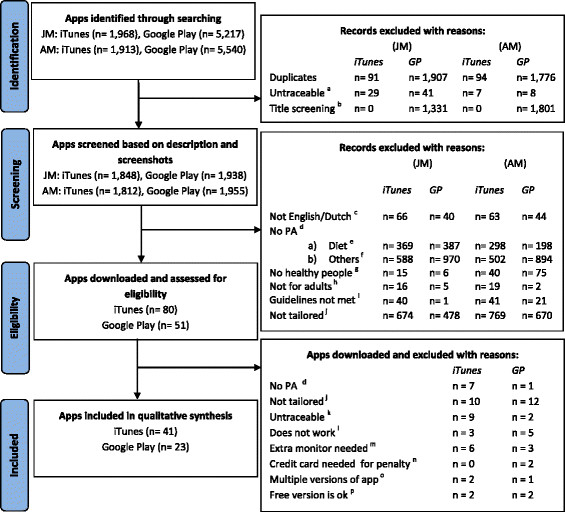
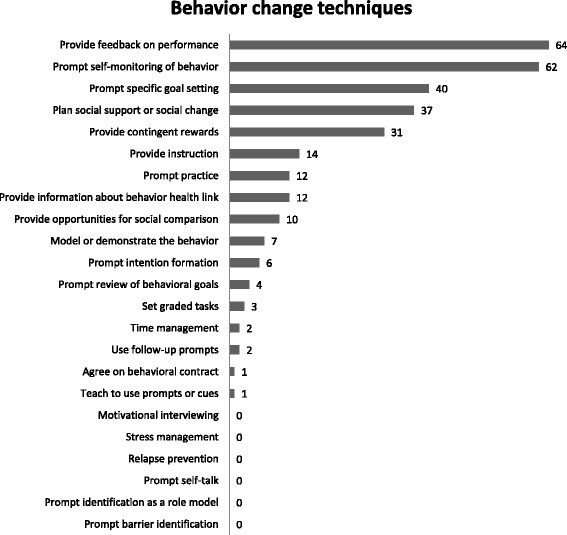
BACKGROUND: In May 2013, the iTunes and Google Play stores contained 23,490 and 17,756 smartphone applications (apps) categorized as Health and Fitness, respectively. The quality of these apps, in terms of applying established health behavior change techniques, remains unclear. METHODS: The study sample was identified through systematic searches in iTunes and Google Play. Search terms were based on Boolean logic and included AND combinations for physical activity, healthy lifestyle, exercise, fitness, coach, assistant, motivation, and support. Sixty-four apps were downloaded, reviewed, and rated based on the taxonomy of behavior change techniques used in the interventions. Mean and ranges were calculated for the number of observed behavior change techniques. Using nonparametric tests, we compared the number of techniques observed in free and paid apps and in iTunes and Google Play. RESULTS: On average, the reviewed apps included 5 behavior change techniques (range 2-8). Techniques such as self-monitoring, providing feedback on performance, and goal-setting were used most frequently, whereas some techniques such as motivational interviewing, stress management, relapse prevention, self-talk, role models, and prompted barrier identification were not. No differences in the number of behavior change techniques between free and paid apps, or between the app stores were found. CONCLUSIONS: The present study demonstrated that apps promoting physical activity applied an average of 5 out of 23 possible behavior change techniques. This number was not different for paid and free apps or between app stores. The most frequently used behavior change techniques in apps were similar to those most frequently used in other types of physical activity promotion interventions.
Overview
The claims and statistics of this paper haven’t been checked yet.
Free: it reads the open-access text and checks the first 5 claims that cite a source we can check. Create a free account to check every claim.
Integrity signals
Registry
Cites
Statistics
Figures
Verification
Claims the paper makes
The claims and statistics of this paper haven’t been checked yet.
Free: it reads the open-access text and checks the first 5 claims that cite a source we can check. Create a free account to check every claim.
Claims other papers make about this one
Each is checked against this paper’s own text: does it say what the citing paper says it does?
In the citing paper
“Developing mHealth interventions in multidisciplinary teams is a best practice approach recommended by many researchers [45-47].”
From Theory-Based Design and Development of a Socially Connected, Gamified Mobile App for Men About Breastfeeding (Milk Man) (2016) · cites this paper as [46]
Self-check
Percentages, sums and reported differences re-computed from the paper’s own numbers.
The self-check needs the paper’s full text.
Citations
Cites
Ezzati, M., López, A. D., Rodgers, A., & Murray, C. J. L. (2004) · Cited by 3,319
A taxonomy of behavior change techniques used in interventions
Abraham, C., & Michie, S. (2008) · Health Psychology · doi:10.1037/0278-6133.27.3.379 · Cited by 2,525 · cited 12×
“Previous reviews that applied Abraham and Michie’s taxonomy [14] to assess the number of behavior change techniques used in non-app interventions identified on average 6–8 behavior change techniques [14,15,22].”
BackgroundMethodInfluentialWebb, T. L., Joseph, J., Yardley, L., & Michie, S. (2010) · Journal of Medical Internet Research · doi:10.2196/jmir.1376 · Cited by 2,517 · cited 7×
“Although we found that the average number of behavior change techniques used in apps was lower than previously reported for other types of physical activity promotion, the most frequently used types of behavior change techniques used were similar [7,15,22].”
BackgroundMethodInfluentialEffective techniques in healthy eating and physical activity interventions: A meta-regression.
Michie, S., Abraham, C., Whittington, C., McAteer, J., & Gupta, S. (2009) · Health Psychology · doi:10.1037/a0016136 · Cited by 2,229 · cited 8×
“Previous reviews that applied Abraham and Michie’s taxonomy [14] to assess the number of behavior change techniques used in non-app interventions identified on average 6–8 behavior change techniques [14,15,22].”
BackgroundMethodInfluentialHealth behavior models in the age of mobile interventions: are our theories up to the task?
Riley, W. T., Rivera, D. E., Atienza, A. A., Nilsen, W., Allison, S. M., & Mermelstein, R. (2011) · Translational Behavioral Medicine · doi:10.1007/s13142-011-0021-7 · Cited by 978 · cited 1×
“The application of smartphones and apps in health behavior interventions are growing rapidly, however little has been published about the interventions using the new technology to provide real-time feedback [25].”
BackgroundOne size does not fit all: the case for tailoring print materials
Kreuter, M. W., Strecher, V. J., & Glassman, B. (1999) · Annals of Behavioral Medicine · doi:10.1007/bf02895958 · Cited by 831 · cited 1×
“, feedback based on the user’s own characteristics [10]) and advice is more likely to be effective than generic information about physical activity [9,11,12].”
BackgroundGriffiths, F., Lindenmeyer, A., Powell, J., Lowe, P., & Thorogood, M. (2006) · Journal of Medical Internet Research · doi:10.2196/jmir.8.2.e10 · Cited by 820 · cited 1×
“Many advantages of using the Internet as a delivery mode apply to smartphone apps too: constantly accessible, adjustable to the needs of the user [13], able to provide (computer-) tailored feedback, large reach and interactive”
BackgroundInterventions for promoting physical activity
Foster, C., Hillsdon, M., Thorogood, M., Kaur, A., & Wedatilake, T. (2005) · Cochrane Database of Systematic Reviews · doi:10.1002/14651858.cd003180.pub2 · Cited by 692
A meta-analysis of web-delivered tailored health behavior change interventions
Lustria, M. L. A., Noar, S. M., Cortese, J., Van Stee, S. K., Glueckauf, R. L., & Lee, J. (2013) · Journal of Health Communication · doi:10.1080/10810730.2013.768727 · Cited by 689 · cited 1×
“, feedback based on the user’s own characteristics [10]) and advice is more likely to be effective than generic information about physical activity [9,11,12].”
BackgroundA Review of eHealth Interventions for Physical Activity and Dietary Behavior Change
Norman, G. J., Zabinski, M. F., Adams, M. A., Rosenberg, D. E., Yaroch, A. L., & Atienza, A. A. (2007) · American Journal of Preventive Medicine · doi:10.1016/j.amepre.2007.05.007 · Cited by 605 · cited 2×
“This technology offers the opportunity for ecological momentary assessment (EMA) and makes it feasible to provide timely messages based on the user’s location [23,24].”
BackgroundMethod
Research works printed but not linked: 1
- http://whqlibdoc.who.int/publications/2010/9789241599979_eng.pdf World Health Organization: Global Recommendations on Physical Activity for Health. [] 26180873
Cited by
Items 501–542 of 542
Wang, T., Zhou, X. P., & Ruo ying, H. E. (2025) · doi:10.2196/preprints.74215
A positive spiral effect of M-health app videos
Oh, J., Kim, H., Kim, S., & Koh, B. (2025) · Electronic Markets · doi:10.1007/s12525-025-00773-z
“…instructions, feedback, goal setting, and social support (Conroy et al., 2014; Direito et al., 2014; Gimpel et al., 2021; Khaghani-Far et al., 2016; Middelweerd et al., 2014); however, possible differences in effects of each of these functions on physical activity were not controlled in these…”
Framing the Development of a Gamified App for m-Health and Well-Being
Dagnino, F. M., Salvo, N. D., Goldberg, J., Sturm, N., Djokic, G., & Kłapa, Ł. (2025) · European Conference on Games Based Learning · doi:10.34190/ecgbl.19.1.4017
“…increasing availability of smart technology devices (smartphones, smartwatches, etc.) has facilitated seamless healthcare interventions; a broad range of applications to monitor and manage one's own health and well-being have been developed (Martínez-Pérez et al., 2013; Middelweerd et al., 2014).”
Patient-targeted smartphone applications for pain management: A review of brazilian app markets
Favrat, C. M. N., Fernandez, J., Nogueira, L. A. C., Meziat‐Filho, N., & dos Reis, F. J. J. (2025) · Brazilian Journal of Physical Therapy · doi:10.1016/j.bjpt.2025.101262
Song, G.-G., Kim, K., & Kim, J. (2025) · Asia-pacific Journal of Convergent Research Interchange · doi:10.47116/apjcri.2025.10.37
Ramdani, S., Benkaddour, N. E. H., & Haddiya, I. (2025) · Springer eBooks · doi:10.1007/978-3-032-00125-2_8
Erdoğan, G. (2025) · Pamukkale Journal of Sport Sciences · doi:10.54141/psbd.1773732 · Cited by 1
Pearson, E., Prapavessis, H., Higgins, C., Petrella, R., White, L., & Mitchell, M. (2020) · Figshare · doi:10.6084/m9.figshare.13257522
Pearson, E., Prapavessis, H., Higgins, C., Petrella, R., White, L., & Mitchell, M. (2020) · Figshare · doi:10.6084/m9.figshare.13257510
Pearson, E., Prapavessis, H., Higgins, C., Petrella, R., White, L., & Mitchell, M. (2020) · Figshare · doi:10.6084/m9.figshare.13257519
Pearson, E., Prapavessis, H., Higgins, C., Petrella, R., White, L., & Mitchell, M. (2020) · Figshare · doi:10.6084/m9.figshare.13257531
Pearson, E., Prapavessis, H., Higgins, C., Petrella, R., White, L., & Mitchell, M. (2020) · Figshare · doi:10.6084/m9.figshare.13257528
Hohberg, V., Fuchs, R., Gerber, M., Künzler, D., Paganini, S., & Faude, O. (2022) · Figshare · doi:10.6084/m9.figshare.20408886
Pearson, E., Prapavessis, H., Higgins, C., Petrella, R., White, L., & Mitchell, M. (2020) · Figshare · doi:10.6084/m9.figshare.13257516
Pearson, E., Prapavessis, H., Higgins, C., Petrella, R., White, L., & Mitchell, M. (2020) · Figshare · doi:10.6084/m9.figshare.13257525
Arredondo, E. M., Haughton, J., Ayala, G. X., Slymen, D. J., Sallis, J. F., Perez, L. G., Serrano, N., Ryan, S., Valdivia, R., Lopez, N. V., et al. (2022) · Figshare · doi:10.6084/m9.figshare.20408782
Pearson, E., Prapavessis, H., Higgins, C., Petrella, R., White, L., & Mitchell, M. (2020) · Figshare · doi:10.6084/m9.figshare.13257507
Hohberg, V., Fuchs, R., Gerber, M., Künzler, D., Paganini, S., & Faude, O. (2022) · Figshare · doi:10.6084/m9.figshare.20408880
Arredondo, E. M., Haughton, J., Ayala, G. X., Slymen, D. J., Sallis, J. F., Perez, L. G., Serrano, N., Ryan, S., Valdivia, R., Lopez, N. V., et al. (2022) · Figshare · doi:10.6084/m9.figshare.20408779
Hohberg, V., Fuchs, R., Gerber, M., Künzler, D., Paganini, S., & Faude, O. (2022) · Figshare · doi:10.6084/m9.figshare.20408883
Pearson, E., Prapavessis, H., Higgins, C., Petrella, R., White, L., & Mitchell, M. (2020) · Figshare · doi:10.6084/m9.figshare.13257513
Desenvolvimento de um aplicativo para avaliação física em smartphones – MHelth for you®
Gomes, J. L. S. M., & Reis, A. D. (2025) · Cadernos de Educação Tecnologia e Sociedade · doi:10.14571/brajets.v18.n3.678-689
Wiczkowski, D., Sobchynskyi, M., Kiełbaszewska, I., Kowalczuk, D., Turlej, K., Lazitskaya, D., Kasianik, W., Milasheuskaya, V., Miraniuk, K., Myrny, A., et al. (2025) · International Journal of Innovative Technologies in Social Science · doi:10.31435/ijitss.4(48).2025.4448
Zhou, X., Tongyao, W. A. N. G., Zhang, L., & Chen, Q. (2026) · JMIR Research Protocols · doi:10.2196/80214
“Similarly, a systematic review by Middelweerd et al [32] evaluated 41 apps in iTunes and 23 apps in Google Play, identifying goal setting, self-monitoring, and feedback on performance as common approaches to promote intention to behavioral alteration.”
Martínez, E. O. P., & Pineda, P. A. O. (2026) · HOLOPRAXIS Revista de Ciencia Tecnología e Innovación · doi:10.61154/holopraxis.v10i1.4392 · Cited by 2
Scholl, M., Lendt, C., Appelbaum, S., Biallas, B., Brenk-Franz, K., Chermette, C., Frank, F., Gawlik, A., Giesen, L., Heßbrügge, M., et al. (2026) · Journal of Medical Internet Research · doi:10.2196/80895
“Accordingly, DHIs have already been used in rehabilitation [10], medication adherence [11], and chronic disease management [12-15], as well as in the promotion of healthy lifestyles [16,17].”
Burin-Chu, S., Agbangla, N. F., Caby, I., & Bossede, F. (2026) · BMJ Open · doi:10.1136/bmjopen-2025-114665
“52 Coding will follow predefined operational criteria derived from the constructs of both approaches.”
Quantified-Self : valeur expérientielle et co-creation de valeur dans le marketing social
Quero, C. (2018) · theses.fr (ABES) · doi:10.70675/b6b5274cz202cz40f1z8cb4zec28d8316b38 · Cited by 1
Boumhaouad, H. (2023) · theses.fr (ABES) · doi:10.70675/192b84f0z7fc1z48e0zb042z2d71bb541a44 · Cited by 2
Kim, H., Park, Y. S., & Chun, H. (2026) · doi:10.2196/preprints.97578
Dulaud, P. (2022) · theses.fr (ABES) · doi:10.70675/92f27dc3zdcf2z45a9za3cdza6a78f0fe99a
Arabic Wellness Apps in the MENA Region and Saudi Arabia: Current Evidence and Systematic Evaluation
Almulhem, J. A., & Aldekhyyel, R. N. (2026) · Healthcare · doi:10.3390/healthcare14111496
“…daily targets; app tailoring was identified when customized workout plans were generated; progress sharing was considered present when achievements could be communicated to others; and rewards were identified when the app provided badges, milestone notifications, or congratulatory feedback [38].”
Gamification elements and their impacts on physical activity: a systematic review
Hidayat, A., Prabandari, Y. S., Agustiningsih, D., & Sabirin, R. M. (2026) · Sport Sciences for Health · doi:10.1007/s11332-026-01798-3
“Gamified interventions often help users stay engaged with the activities they are supposed to do, leading to better adherence and more consistent participation over time [11, 12].”
Wu, Z.-X., & Chen, C. (2026) · Lecture notes in computer science · doi:10.1007/978-3-032-29175-2_9
Storyboard-Based Rankings of 30 Behavior-Change Strategies to Promote Walking
Takahashi, M., & Sato, T. (2026) · Lecture notes in computer science · doi:10.1007/978-3-032-30083-6_12
Morer, J., Lacuesta, R., & Ferrer, A. (2023) · Revista de la Asociación Interacción Persona Ordenador (AIPO) · doi:10.65234/interaccion.95
“…como estrategias potenciales a explorar para proporcionar esta conexión salud usuario de manera que se propicie ese cambio en el comportamiento (Middelweerd et al., 2014), dado que son intervenciones más rentables y también más escalables al poder aplicarlas en grupos de gran tamaño al igual…”
Sagarna, L. J. D. U., Muñoz-Llerena, A., Fernández, J. G., & Cepeda‐Carrión, G. (2026) · International Journal of Human-Computer Interaction · doi:10.1080/10447318.2026.2693620
Zeng, Y., Fang, S., Liang, Y., & Hu, Y. (2026) · Frontiers in Public Health · doi:10.3389/fpubh.2026.1849754
“…technologies have been proposed as a potential means to mitigate such discrepancies, as supported by studies on medication adherence apps (24) and physical activity apps (44), which highlight how technology can lower implementation barriers and enhance the delivery of behavior change strategies.”
Patel, R. K., Adekanbi, J., Orji, R., & Oyebode, O. (2026) · SeGAH ... IEEE ... International Conference on Serious Games and Applications for Health/IEEE International Conference on Serious Games and Applications for Health · doi:10.1109/segah69272.2026.11653330
“Studies employing strategies from these frameworks and theories in health contexts have found that systems that incorporate multiple PSD strategies tend to produce stronger engagement and behavioural outcomes than those relying on a single strategy [12].”
InfluentialIm, C.-H., & Woo, M. (2026) · Health Policy and Technology · doi:10.1016/j.hlpt.2026.101322
Executive Functions and Self-Regulation Strategies in a Sustained Behavioral Self-Regulation Task
Libersat, S., & Meiran, N. (2026) · Journal of Intelligence · doi:10.3390/jintelligence14110283
Futhep, N., Leelarungrayub, J., & Kamnardsiri, T. (2026) · Informatics · doi:10.3390/informatics13110185
Metadata
- Authors
- Middelweerd, A., Mollee, J. S., van der Wal, C. N., Brug, J., & te Velde, S. J.
- Affiliations
- Amsterdam Public Health (NL)
- Vrije Universiteit Amsterdam (NL)
- Venue
- International Journal of Behavioral Nutrition and Physical Activity
- Published
- 2014-07-25
- Volume
- 11
- Issue
- 1
- Pages
- 97-97
- ISSN
- 1479-5868 (ISSN-L)
- PMC
- PMC4132213
- OpenAlex
- W2139141017
- Cited by
- 546
- References
- 21
- Citations by year
- 2026: 17 · 2025: 21 · 2024: 22 · 2023: 40 · 2022: 53 · 2021: 50 · 2020: 71 · 2019: 67 · 2018: 66 · 2017: 53 · 2016: 58 · 2015: 26 · 2014: 1
- FWCI
- 83.09
- Type
- journal article
- Language
- en
- Open access
- gold
- doi.org
- Locations
- International Journal of Behavioral Nutrition and Physical Activity (publishedVersion, cc-by)
- Europe PMC (PubMed Central) (publishedVersion, cc-by)
- PubMed Central (publishedVersion, cc-by)
- PubMed (publishedVersion)
- Amsterdam UMC (VU Amsterdam) - Institutional Repository (publishedVersion)
- Pure Amsterdam UMC (submittedVersion)
- VU Research Portal (submittedVersion, other-oa)
- Data Archiving and Networked Services (DANS) (submittedVersion, other-oa)
- Data Archiving and Networked Services (DANS) (submittedVersion)
- Funders
- Stichting voor de Technische Wetenschappen
- Topics
- Health Sciences › Health Professions › General Health Professions › Mobile Health and mHealth Applications
- Health Sciences › Medicine › Public Health, Environmental and Occupational Health › Physical Activity and Health
- Social Sciences › Psychology › Applied Psychology › Digital Mental Health Interventions
- Keywords
- mobile health apps, physical activity promotion, behaviour change techniques, mobile application, self-monitoring, goal setting, performance feedback, free vs paid apps, health behavior change
- MeSH terms
- Health Promotion, Humans, Motivation, Motor Activity, Software, Health Behavior, Cell Phone
About these checks
Registry, retraction, Cites and statistics results are computed, not judged, with one exception: a printed reference that no index lists is read once by a model before it counts as a citation error. Claims are extracted by a model and kept only when their quote appears verbatim in the text; each cited source is then checked, with a model’s help, for whether it says what the claim relies on. Those verdicts can be wrong — read the claim’s quote and the cited source before relying on one.
Statistics and arithmetic are recomputed, not judged.
Confidence bands are shown only for fields calibrated on our annotated test set. None is calibrated yet, so no band is shown.
What counts as a claim ›How we measure confidence ›How we check this ›
Are you an author, or do you see a problem with this page? Request a review
Data sources
Bibliographic data: Semantic Scholar, OpenAlex, Crossref.
Contains information from the Semantic Scholar Academic Graph Datasets, made available under the ODC Attribution License (ODC-BY 1.0).
Semantic Scholar’s data is described in: Kinney, R., et al. (2023). The Semantic Scholar Open Data Platform. arXiv:2301.10140.
