

Apps to promote physical activity among adults: a review and content analysis
Open accessThe DOI matches its Crossref record; 21 of the 21 references it cites were found in a registry or an index.
Abstract
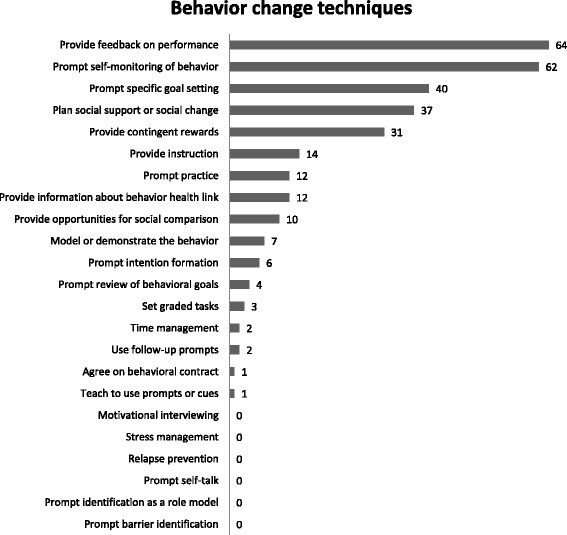
BACKGROUND: In May 2013, the iTunes and Google Play stores contained 23,490 and 17,756 smartphone applications (apps) categorized as Health and Fitness, respectively. The quality of these apps, in terms of applying established health behavior change techniques, remains unclear. METHODS: The study sample was identified through systematic searches in iTunes and Google Play. Search terms were based on Boolean logic and included AND combinations for physical activity, healthy lifestyle, exercise, fitness, coach, assistant, motivation, and support. Sixty-four apps were downloaded, reviewed, and rated based on the taxonomy of behavior change techniques used in the interventions. Mean and ranges were calculated for the number of observed behavior change techniques. Using nonparametric tests, we compared the number of techniques observed in free and paid apps and in iTunes and Google Play. RESULTS: On average, the reviewed apps included 5 behavior change techniques (range 2-8). Techniques such as self-monitoring, providing feedback on performance, and goal-setting were used most frequently, whereas some techniques such as motivational interviewing, stress management, relapse prevention, self-talk, role models, and prompted barrier identification were not. No differences in the number of behavior change techniques between free and paid apps, or between the app stores were found. CONCLUSIONS: The present study demonstrated that apps promoting physical activity applied an average of 5 out of 23 possible behavior change techniques. This number was not different for paid and free apps or between app stores. The most frequently used behavior change techniques in apps were similar to those most frequently used in other types of physical activity promotion interventions.
Overview
The claims and statistics of this paper haven’t been checked yet.
Free: it reads the open-access text and checks the first 5 claims that cite a source we can check. Create a free account to check every claim.
Integrity signals
Registry
Cites
Statistics
Figures
Verification
Claims the paper makes
The claims and statistics of this paper haven’t been checked yet.
Free: it reads the open-access text and checks the first 5 claims that cite a source we can check. Create a free account to check every claim.
Claims other papers make about this one
Each is checked against this paper’s own text: does it say what the citing paper says it does?
In the citing paper
“Developing mHealth interventions in multidisciplinary teams is a best practice approach recommended by many researchers [45-47].”
From Theory-Based Design and Development of a Socially Connected, Gamified Mobile App for Men About Breastfeeding (Milk Man) (2016) · cites this paper as [46]
Self-check
Percentages, sums and reported differences re-computed from the paper’s own numbers.
The self-check needs the paper’s full text.
Citations
Cites
Ezzati, M., López, A. D., Rodgers, A., & Murray, C. J. L. (2004) · Cited by 3,319
A taxonomy of behavior change techniques used in interventions
Abraham, C., & Michie, S. (2008) · Health Psychology · doi:10.1037/0278-6133.27.3.379 · Cited by 2,525 · cited 12×
“Previous reviews that applied Abraham and Michie’s taxonomy [14] to assess the number of behavior change techniques used in non-app interventions identified on average 6–8 behavior change techniques [14,15,22].”
BackgroundMethodInfluentialWebb, T. L., Joseph, J., Yardley, L., & Michie, S. (2010) · Journal of Medical Internet Research · doi:10.2196/jmir.1376 · Cited by 2,517 · cited 7×
“Although we found that the average number of behavior change techniques used in apps was lower than previously reported for other types of physical activity promotion, the most frequently used types of behavior change techniques used were similar [7,15,22].”
BackgroundMethodInfluentialEffective techniques in healthy eating and physical activity interventions: A meta-regression.
Michie, S., Abraham, C., Whittington, C., McAteer, J., & Gupta, S. (2009) · Health Psychology · doi:10.1037/a0016136 · Cited by 2,229 · cited 8×
“Previous reviews that applied Abraham and Michie’s taxonomy [14] to assess the number of behavior change techniques used in non-app interventions identified on average 6–8 behavior change techniques [14,15,22].”
BackgroundMethodInfluentialHealth behavior models in the age of mobile interventions: are our theories up to the task?
Riley, W. T., Rivera, D. E., Atienza, A. A., Nilsen, W., Allison, S. M., & Mermelstein, R. (2011) · Translational Behavioral Medicine · doi:10.1007/s13142-011-0021-7 · Cited by 978 · cited 1×
“The application of smartphones and apps in health behavior interventions are growing rapidly, however little has been published about the interventions using the new technology to provide real-time feedback [25].”
BackgroundOne size does not fit all: the case for tailoring print materials
Kreuter, M. W., Strecher, V. J., & Glassman, B. (1999) · Annals of Behavioral Medicine · doi:10.1007/bf02895958 · Cited by 831 · cited 1×
“, feedback based on the user’s own characteristics [10]) and advice is more likely to be effective than generic information about physical activity [9,11,12].”
BackgroundGriffiths, F., Lindenmeyer, A., Powell, J., Lowe, P., & Thorogood, M. (2006) · Journal of Medical Internet Research · doi:10.2196/jmir.8.2.e10 · Cited by 820 · cited 1×
“Many advantages of using the Internet as a delivery mode apply to smartphone apps too: constantly accessible, adjustable to the needs of the user [13], able to provide (computer-) tailored feedback, large reach and interactive”
BackgroundInterventions for promoting physical activity
Foster, C., Hillsdon, M., Thorogood, M., Kaur, A., & Wedatilake, T. (2005) · Cochrane Database of Systematic Reviews · doi:10.1002/14651858.cd003180.pub2 · Cited by 692
A meta-analysis of web-delivered tailored health behavior change interventions
Lustria, M. L. A., Noar, S. M., Cortese, J., Van Stee, S. K., Glueckauf, R. L., & Lee, J. (2013) · Journal of Health Communication · doi:10.1080/10810730.2013.768727 · Cited by 689 · cited 1×
“, feedback based on the user’s own characteristics [10]) and advice is more likely to be effective than generic information about physical activity [9,11,12].”
BackgroundA Review of eHealth Interventions for Physical Activity and Dietary Behavior Change
Norman, G. J., Zabinski, M. F., Adams, M. A., Rosenberg, D. E., Yaroch, A. L., & Atienza, A. A. (2007) · American Journal of Preventive Medicine · doi:10.1016/j.amepre.2007.05.007 · Cited by 605 · cited 2×
“This technology offers the opportunity for ecological momentary assessment (EMA) and makes it feasible to provide timely messages based on the user’s location [23,24].”
BackgroundMethod
Research works printed but not linked: 1
- http://whqlibdoc.who.int/publications/2010/9789241599979_eng.pdf World Health Organization: Global Recommendations on Physical Activity for Health. [] 26180873
Cited by
Items 401–500 of 542
The impact of mHealth interventions
Britt, R. K., Maddox, J., Kanthawala, S., & Hayes, J. L. (2020) · Elsevier eBooks · doi:10.1016/b978-0-12-816958-2.00012-5 · Cited by 2
Mobile health technologies to improve walking distance in people with intermittent claudication
Elfghi, M., Dunne, D., Jones, J. L., Gibson, I., Flaherty, G. T., McEvoy, J. W., Sultan, S., Jordan, F., & Tawfick, W. A. (2021) · Cochrane Database of Systematic Reviews · doi:10.1002/14651858.cd014717 · Cited by 3
Easton, L. (2018) · KU ScholarWorks (University of Kansas) · Cited by 3
Human–Animal Interaction in the Aging Boom
Johnson, R. A., Bibbo, J. L., & Harvey, L. P. (2019) · Elsevier eBooks · doi:10.1016/b978-0-12-815395-6.00020-1 · Cited by 1
Rocholl, M., Ristow, N., Scheufler, F., Nordheider, K., Skudlik, C., John, S. M., Ludewig, M., & Wilke, A. (2025) · Trials · doi:10.1186/s13063-025-09295-7 · Cited by 3
“Evidence suggests that the ability to set goals is an important element in behaviour change apps [3, 5, 12, 13, 75].”
Diálogos entre Educação Física e Tecnologias
Verzani, R. H., Morão, K. G., Bagni, G., Machado, A. A., & Serapião, A. B. D. S. (2019) · Revista de Saúde Digital e Tecnologias Educacionais · doi:10.36517/resdite.v4.n2.2019.a5 · Cited by 2
Symons, M., Vandebosch, H., & Poels, K. (2024) · BMC Public Health · doi:10.1186/s12889-023-17464-z · Cited by 3
“In other words, as opposed to exclusively relying on behaviour change techniques [99, 100], applications should focus more on specific barriers, such as cognitive fatigue, and integrate specific solutions within their messages, such as humour, which respond to those barriers.”
BackgroundSymons, M., Rahmani, M. H., Rudnicki, K., Cutello, C. A., Poels, K., & Vandebosch, H. (2024) · Health Communication · doi:10.1080/10410236.2024.2427336 · Cited by 1
“These messages may or may not be based on existing literature (Middelweerd et al., 2014).”
Czerska, I. (2024) · EUROPEAN RESEARCH STUDIES JOURNAL · doi:10.35808/ersj/3641 · Cited by 4
Plotnikoff, R. C., Murphy, M., Wilczynska, M., Courneya, K. S., Brown, W. J., Sigal, R. J., & Lubans, D. R. (2024) · Journal of Physical Activity and Health · doi:10.1123/jpah.2024-0195 · Cited by 1
Kalampoki, A., Ntzani, E., Asimakopoulos, A., Liberopoulos, E. N., Tentolouris, N., Anastasiou, G., Adamidis, P. S., Kotsa, K., & Rizos, E. C. (2024) · Nutrients · doi:10.3390/nu17010135 · Cited by 1
Ormel, H. L., van Zutphen, E. H., van der Schoot, G. G. F., Gietema, J. A., & Walenkamp, A. (2025) · Journal of Cancer Survivorship · doi:10.1007/s11764-025-01862-w · Cited by 2
“Conveniently, behavioural change techniques to stimulate a healthy lifestyle are integrated well into the RunKeeper app [30], e.g. by self-monitoring PA with GPS or stopwatch, sending daily reminders to get active again, competing with friends, recording progress, goal setting, and personal records.”
Sumarno, S., Ndayisenga, J., & Nohantiya, P. (2024) · Jurnal Pendidikan Jasmani Indonesia · doi:10.21831/jpji.v20i2.78134 · Cited by 3
How Mobile Exercise Apps Support Behavior Change—and What Exercise Professionals Should Know
Reiner, S. L. (2025) · ACSMʼs Health & Fitness Journal · doi:10.1249/fit.0000000000001112 · Cited by 2
An Exploratory Study on Digital Fitness and Physical Activity Habit Formation at Home in Spain
Sagarna, L. J. D. U., Fernández, J. G., & Cepeda‐Carrión, G. (2026) · Lecture notes in networks and systems · doi:10.1007/978-3-032-10731-2_32 · Cited by 1
Aydın, A. E. (2026) · BMC Psychology · doi:10.1186/s40359-026-04693-1 · Cited by 1
“…one study found a positive relationship between physical goals and introjected regulation [20], others reported that when exercise goals lack strength or personal significance, individuals may rely on controlled motivations that do not reinforce enduring behavioral change or amotivation [21, 22].”
Lin, Y., Zhu, W., & Hong, B. (2026) · Frontiers in Public Health · doi:10.3389/fpubh.2026.1873007 · Cited by 1
“Because the CGSS2023 item measures overall frequency rather than content-speci(cid:277)c use, the present study cannot distinguish exercise-oriented from entertainment-oriented internet use (21–23).”
Electronic Interaction in the Sphere of Physical Culture and Sports Services in Russia
Aleksina, A. O., Chernovа, D. V., & Aleksin, A. Y. (2019) · Advances in intelligent systems and computing · doi:10.1007/978-3-030-11367-4_68 · Cited by 1
Calvillo‐Arbizu, J., Roa, L. M., & Reina‐Tosina, J. (2019) · World Congress on Medical Physics and Biomedical Engineering, September 7 - 12, 2009, Munich, Germany · doi:10.1007/978-3-030-31635-8_144 · Cited by 1
Feasibility and outcomes from development and testing of a health behavior theory-based fitness app
Herrmann, L. K., & Blackstone, S. R. (2020) · Health Technology · doi:10.21037/ht-20-17 · Cited by 2
“Given the mixed results of studies looking at behavior change techniques instead of full theories (11,12,22), apps should link constructs to create behavior change.”
BackgroundA New Model to Motivate Older Adults to Participate in Physical Activities
Guan, J., Zitkus, E., de Bont, C. J. P. M., & Dong, H. (2021) · Lecture notes in networks and systems · doi:10.1007/978-3-030-80829-7_51 · Cited by 1
Studi Literatur Digitalisasi Model 5A untuk Pengendalian Obesitas Saat Pandemi COVID-19
Pramesuari, F. D., Wibowo, D. A., Lie, E. C., & Christanti, J. (2021) · Praxis Jurnal Sains Teknologi Masyarakat dan Jejaring · doi:10.24167/praxis.v4i1.3382 · Cited by 2
Byun, H., Chiu, W., & Bae, J.-S. (2021) · IGI Global eBooks · doi:10.4018/978-1-7998-7707-3.ch004 · Cited by 2
Using text messages to support recovering substance misusers
McClelland, G. T., Duffy, P., & Davda, P. (2018) · British Journal of Healthcare Management · doi:10.12968/bjhc.2018.24.9.440 · Cited by 1
Convergent Validity Evidence of Smartphone-based Physical Activity Measures in Free-living
이미영, & 최지엽 (2017) · The Korean Journal of Measurement and Evaluation in Physical Education and Sports Science · doi:10.21797/ksme.2017.19.4.006 · Cited by 1
Apps to prescribe therapeutic exercise among rehabilitating adults: a systematic review
Sancho-Garcia, S., Diego, S. S.-D., & Medina-Porqueres, I. (2020) · The Journal of Sports Medicine and Physical Fitness · doi:10.23736/s0022-4707.19.09601-4 · Cited by 1
Health Promotion and Chronic Disease Prevention with eHealth Technology in the General Population
Paige, S. R. (2020) · Springer eBooks · doi:10.1007/978-3-030-30892-6_16 · Cited by 4
A content analysis of popular diet, fitness, and weight self-tracking mobile apps on Google Play
Tham, A., Kim, L. G., VictorySean, Chen, Y., Zheng, K., & Eikey, E. V. (2020) · Illinois Digital Environment for Access to Learning and Scholarship (University of Illinois at Urbana-Champaign) · Cited by 1
Influence of Mobile Apps on Household Saving-Spending Behavior
Deb, R., Mahto, P. K., & Deka, L. (2020) · Advances in wireless technologies and telecommunication book series · doi:10.4018/978-1-7998-3045-0.ch010 · Cited by 3
Huang, D., Lai, S.-C., Lo, L., Hong, T.-H., & Chiou, W. (2020) · Lecture notes in computer science · doi:10.1007/978-3-030-60114-0_45 · Cited by 1
Zhang, P., Burns, R. D., Fu, Y., Godin, S., Li, Z., & Zhang, X. (2021) · International Journal of Kinesiology in Higher Education · doi:10.1080/24711616.2020.1866467 · Cited by 1
“…because smartphone applications are relatively new tools in physical activity interventions, little research has been published to data on the content and effectiveness of physical activity apps, especially targeted on college students (Middelweerd, Mollee, Van der Wal, Brug, & TeVelde, 2014).”
BackgroundLet’s build an app for that: Challenges and lessons learned in exercise oncology
Ester, M., Dreger, J., Subnis, U. B., Pathak, S., & Culos-Reed, S. N. (2021) · Communications in Kinesiology · doi:10.51224/cik.v1i2.37 · Cited by 3
Panattil, S. J., George, A., & Joy, M. M. (2022) · Advances in business strategy and competitive advantage book series · doi:10.4018/978-1-7998-9223-6.ch005 · Cited by 2
Analysis of Web and Mobile Apps for Monitoring of Childhood Physical Activity
Sharif, R., Zafar, H., Vellinga, A., Flaherty, G. T., & Sharif, F. (2022) · International Journal of Digital Health · doi:10.29337/ijdh.42 · Cited by 1
Bäccman, C., & Wästlund, E. (2022) · South Florida Journal of Development · doi:10.46932/sfjdv3n6-020 · Cited by 2
The COVID-19 Pandemic and Moderate-to-vigorous Physical Activity among Daegu Citizens
Jin, S. H. (2023) · Journal of Health Informatics and Statistics · doi:10.21032/jhis.2023.48.4.330 · Cited by 1
Testing Fitness-Related Phone Application Technology in Physical Activity Classes
Simonton, A. (2016) · Louisiana State University · doi:10.31390/gradschool_theses.2744 · Cited by 1
“It has also been determined that a fitness-related app uses five behavior change techniques on average, and that they have the potential of effectively promoting engagement in PA (Middelweerd, Mollee, van der Wal, Brug, & Te Velde, 2014).”
BackgroundZuhaibi, K. A. (2018) · Nottingham ePrints (University of Nottingham) · Cited by 2
Guimarães, C. M. D. S. (2020) · Digital Library of Theses and Dissertations (Universidade de São Paulo) · doi:10.11606/t.22.2020.tde-20032020-135317 · Cited by 2
Personalization of Wearable-Based Exergames with Continuous Player Modeling
Zhao, Z. (2019) · Carleton University's Institutional Repository (MacOdrum Library, Carleton University) · doi:10.22215/etd/2019-13795 · Cited by 2
Smartphone apps for type 2 diabetes self-management and medication adherence : a multi-method study
Huang, Z. (2020) · DR-NTU (Nanyang Technological University) · doi:10.32657/10356/137883 · Cited by 2
Lin, S. (2020) · DR-NTU (Nanyang Technological University) · doi:10.32657/10356/151433 · Cited by 1
Berendsen, B. (2016) · Research Publications (Maastricht University) · doi:10.26481/dis.20160624bbb · Cited by 4
Ondersteuning van therapietrouw via smartphone: ervaringen met patiëntenwerving
Klein, M. C. A., & van Wissen, A. (2015) · TSG - Tijdschrift voor gezondheidswetenschappen · doi:10.1007/s12508-015-0056-0
“000.(2) Hoewel de functionaliteit van deze apps een grote variëteit kent, geldt voor het overgrote deel dat ze de verzamelde gegevens niet interpreteren, maar slechts generieke informatie bieden.”
BackgroundICT-mediated Community Coaching to Improve Physical Activity
Elloumi, L., Meijerink, M., van Beijnum, B.-J. F., & Hermens, H. J. (2016) · International Joint Conference on Biomedical Engineering Systems and Technologies (BIOSTEC) · doi:10.5220/0005821301320142
“One possible target group is people with chronic condition given the increased awareness and evidences about the importance of physical activity for prevention and treatment (Lin et al., 2006; Middelweerd, 2014; Kreuter and Strecher, 1996).”
BackgroundLieffers, J. R. L. (2016) · UWSpace (University of Waterloo)
Internet and Social Network as Health/Physical Activity Information Sources
Esteves, D., Pinheiro, P. G., O’Hara, K., & Brás, R. M. M. (2016) · IGI Global eBooks · doi:10.4018/978-1-4666-9978-6.ch049
Physical activity interventions
Ussher, M. (2001) · Cambridge University Press eBooks · doi:10.1017/cbo9780511543579.083
Investigating how health apps influence college students’ health behavior
Kamanga, U. (2016) · K-State Research Exchange (Kansas State University)
Jenkins, R. T. (2016) · Research Commons (University of Waikato) · Cited by 2
Reinwald, F., Schauppenlehner, T., Mairinger, F., Bittner, I., Höglhammer, A., Diketmüller, R., & Damyanovic, D. (2015) · REAL CORP Repository (University of Southampton)
Innovative Technologien für gesundes Altern
Seebode, J., & Bathelt, F. (2017) · Public Health Forum · doi:10.1515/pubhef-2016-2159
Activity trackers and fitness centre members : motivation and awareness
Kettunen, E. (2017) · Jyväskylä University Digital Archive (University of Jyväskylä)
Novel sedentary behaviour measurement methods: application for self-monitoring in adults
Sanders, J. P. (2017) · Loughborough University Institutional Repository (Loughborough University)
Universal Physical Fitness Testing for United States Guardians Afloat
Press, M. J. (2016) · Ike Skelton Combined Arms Research Library (CARL) Digital Library (US Army Combined Arms Center)
A Study on Compliance Gaining Strategy in Mobile Application for Promoting Physical Activity
임하진 (2015) · Seoul National University Open Repository (Seoul National University)
Fradianto, S. I. F. I., & TJPRC (2017) · International Journal of Medicine and Pharmaceutical Sciences · doi:10.24247/ijmpsfeb201801
“This is explained by a study conducted by Middelweerd et al (2014), in which the study explains that, the application of physical activity promotion used an average of 5 of 23 in behavioral change techniques.”
MethodImproving Global Health With Smartphone Technology: A Decade in Review of mHealth Initiatives
Nimkar, S., & Gilles, E. E. (2018) · International Journal of E-Health and Medical Communications · doi:10.4018/ijehmc.2018070101 · Cited by 3
Ünal, P., Cavdar, S. K., Temizel, T. T., Eren, P. E., & Iyengar, M. S. (2018) · Springer eBooks · doi:10.1007/978-3-319-73135-3_7
MUSICAL EXERCISE FOR PEOPLE WITH VISUAL IMPAIRMENTS
Khan, R. A. (2017) · doi:10.37099/mtu.dc.etdr/513
“The number of such applications is also huge [18].”
BackgroundFormalization of Behavior Change Theories to Accomplish a Health Behavior
Manzoor, A., Halepoto, I. A., Khokhar, S., Hussain, N., & Sulleman, M. (2018) · International Journal of Advanced Computer Science and Applications · doi:10.14569/ijacsa.2018.090522
“A smartphone is an inherently a personalized device and therefore it seems to be a well suited medium to implement BCTs and deliver tailored messages, although there is not much research done to check the effectiveness of mHealth based tailored messages [15].”
BackgroundEffects of prompts on the frequency of app use: A stress management app for perinatal mental health
Singh, S. (2018) · Research Commons (University of Waikato)
Guede-Fernández, F. (2018) · UPCommons institutional repository (Universitat Politècnica de Catalunya) · doi:10.5821/dissertation-2117-121196
“Por eso existe un interés en el diseño de sistemas que permitan evaluar el nivel de actividad f́ısica de la persona [146].”
BackgroundAdolescent Chronic Stress: Brain Function and Treatment for Depression and Anxiety
McKain, D. (2018) · Advances in psychology, mental health, and behavioral studies (APMHBS) book series · doi:10.4018/978-1-5225-7513-9.ch002 · Cited by 1
Fitness interactive technology in promoting exercise performance and adherence.
Labbé, E. E., Huennekens, A. O., & Naylor, P. D. (2019) · American Psychological Association eBooks · doi:10.1037/0000124-015
Goyal, G., & Sharma, S. (2019) · International Journal of Current Microbiology and Applied Sciences · doi:10.20546/ijcmas.2019.802.266
Carter, D. D., Robinson, K., Forbes, J., Walsh, J. C., & Hayes, S. (2019) · HRB Open Research · doi:10.12688/hrbopenres.12910.1
Morrissey, E. C. (2018) · Arrow@dit (Dublin Institute of Technology) · doi:10.13025/17288
Tankovich, W. A. (2019) · Scholarship & Creative Works - Digital UNC a service of University Libraries (University of Northern Colorado)
PAIE: A Personal Activity Intelligence Estimator in the Cloud
Shi, Y., Du, F., Zhang, Y., Li, Z., & Zhang, T. (2019) · Lecture notes in computer science · doi:10.1007/978-3-030-32813-9_9
Metabolic profiling and identification of biomarkers for weight loss
Tejpal, S. (2026) · Warwick Research Archive Portal (University of Warwick) · doi:10.82444/warw.33804382
Hillier, R. P. (2021) · ERA: Education and Research Archive (University of Alberta) · doi:10.7939/r3-be0w-y741
Be active: a food-based dietary guideline for elderly South Africans
Saha, S., Oldewage-Theron, W. H., & Napier, C. E. (2021) · South African Journal of Clinical Nutrition · doi:10.1080/16070658.2021.1947038 · Cited by 1
“There is some evidence that using different mobility-supporting phone apps may promote behaviour change towards PA among elderly.(64) In addition, social support structures can help the elderly to be engaged in community networks as greater social support promotes PA in the elderly, even in diversified situations such…”
BackgroundPhysical activity and cardiovascular disease risk in women with polycystic ovary syndrome
Woodward, A. (2021) · Sheffield Hallam University · doi:10.7190/shu-thesis-00398 · Cited by 2
Weiß, T., & Strahringer, S. (2021) · Complex Systems Informatics and Modeling Quarterly · doi:10.7250/csimq.2021-28.02
Usage of Mobile Apps to support Active Transportation: Scoping Review (Preprint)Preprint
Siriaporn, N., de Nazelle, A. J., Maignant, G., Staccini, P., & Vuillemin, A. (2021) · doi:10.2196/preprints.34527
Apolo, V. A. T. (2022) · Gredos (University of Salamanca) · doi:10.14201/gredos.149561 · Cited by 3
Dallinga, J. M., Janssen, M., van der Werf, J., Walravens, R., Vos, S. B., & Deutekom, M. D. L. F. (2017) · doi:10.2196/preprints.9459.a
Improving Global Health With Smartphone Technology: A Decade in Review of mHealth Initiatives
Nimkar, S., & Gilles, E. E. (2019) · IGI Global eBooks · doi:10.4018/978-1-5225-7909-0.ch004
Eine empirische Analyse der Antezedenzien von Indoor-Cycling-Plattformen
Westmattelmann, D., Eysel, N., Stoffers, B., Grotenhermen, J.-G., & Schewe, G. (2021) · Sport und Gesellschaft · doi:10.1515/sug-2021-0030
Benefits of Mobile Applications in the Healthcare Industry
Nastas, V. (2022) · International Conference on Electronics, Communications and Computing (IC|ECCO) · doi:10.52326/ic-ecco.2021/sec.05
نموذج تدخل رقمی مقترح "Rigow" لتعزیز الممارسة الریاضیة والصحیة
الله, أ. م. أ. ج., & محمد, ف. ر. أ. ا. (2021) · مجلة أسيوط لعلوم وفنون التربية الرياضية · doi:10.21608/jprr.2021.254710
Coulibaly, S. (2022) · Queensland University of Technology · doi:10.5204/thesis.eprints.236175 · Cited by 1
Mobile Health, Behavior Change
de Bruijn, G., Liu, S., & Rhodes, R. E. (2022) · The International Encyclopedia of Health Communication · doi:10.1002/9781119678816.iehc0788
Sofro, Z. M., Wasityastuti, W., Wibowo, R. A., Sabirin, R. M., Siswanto, S., Setiawan, J., & Agustiningsih, D. (2022) · Journal of the Medical Sciences (Berkala Ilmu Kedokteran) · doi:10.19106/jmedsci005404202210 · Cited by 1
Gupt, S., Yadav, M., Verma, S., Mishra, A., & Shahi, A. (2022) · International Journal of Research Publication and Reviews · doi:10.55248/gengpi.2022.31216
Guo, Y. M., & Bian, J. (2023) · Elsevier eBooks · doi:10.1016/b978-0-323-99271-8.00007-3
Self‐care for coronavirus disease through electronic health technologies: A scoping review
Asadi, F., Rahimi, F., Ghaderkhany, S., & Almasi, S. (2023) · Health Science Reports · doi:10.1002/hsr2.1122
Eine empirische Analyse der Antezedenzien von Indoor-Cycling-Plattformen
Westmattelmann, D., Eysel, N., Stoffers, B., Grotenhermen, J.-G., & Schewe, G. (2022) · Sport und Gesellschaft · doi:10.1515/sug-2022-0018
Viselhető technológia használat a Debreceni Egyetem hallgatói körében
Ráthonyi, G., Ráthonyi-Ódor, K., Szabados, G. N., Bács, Z., & Bába, É. B. (2023) · International Journal of Engineering and Management Sciences · doi:10.21791/ijems.2023.1.5
Brunet, J., Sharma, S., Price, J., & Black, M. (2023) · JMIR Formative Research · doi:10.2196/48301
“Key motivational and behavior change techniques were selected and embedded into the emails on the basis of previous studies and their relation to SDT [20,43,44].”
Selection of Smartphone App Function in the Physical Activity of College Students
李, 俊. (2023) · Statistics and Applications · doi:10.12677/sa.2023.125121
Measuring the "Phubbing" Effect: Passive Smartphone Leisure Behavior and Individual IncomePreprint
Yang, K., Ding, X., & Hu, D. (2023) · SSRN Electronic Journal · doi:10.2139/ssrn.4633146
Improving Motivation to Support Physical Activity Through Fitness App in China: A Co-design Approach
Zhou, J., Jung, J., & Kueh, C. (2023) · Lecture notes in computer science · doi:10.1007/978-3-031-48041-6_44
How Physically Active are University Students in Saudi Arabia?
Alhurishi, S. A. (2023) · Journal of High Institute of Public Health · doi:10.21608/jhiph.2023.329509
“…– which use behavioral techniques that might assist in practicing physical activity such as self-monitoring, feedback on performance, and goal-setting (24) – seems to be especially prominent over the short term (25), so applications must be designed that sustain user engagement over time (25) .”
BackgroundAlhurishi, S. A. (2024) · Journal of High Institute of Public Health · doi:10.21608/jhiph.2024.337921 · Cited by 3
(2022) · Presses universitaires de Grenoble eBooks · doi:10.3917/pug.perri.2022.01.0213
Metadata
- Authors
- Middelweerd, A., Mollee, J. S., van der Wal, C. N., Brug, J., & te Velde, S. J.
- Affiliations
- Amsterdam Public Health (NL)
- Vrije Universiteit Amsterdam (NL)
- Venue
- International Journal of Behavioral Nutrition and Physical Activity
- Published
- 2014-07-25
- Volume
- 11
- Issue
- 1
- Pages
- 97-97
- ISSN
- 1479-5868 (ISSN-L)
- PMC
- PMC4132213
- OpenAlex
- W2139141017
- Cited by
- 546
- References
- 21
- Citations by year
- 2026: 17 · 2025: 21 · 2024: 22 · 2023: 40 · 2022: 53 · 2021: 50 · 2020: 71 · 2019: 67 · 2018: 66 · 2017: 53 · 2016: 58 · 2015: 26 · 2014: 1
- FWCI
- 83.09
- Type
- journal article
- Language
- en
- Open access
- gold
- doi.org
- Locations
- International Journal of Behavioral Nutrition and Physical Activity (publishedVersion, cc-by)
- Europe PMC (PubMed Central) (publishedVersion, cc-by)
- PubMed Central (publishedVersion, cc-by)
- PubMed (publishedVersion)
- Amsterdam UMC (VU Amsterdam) - Institutional Repository (publishedVersion)
- Pure Amsterdam UMC (submittedVersion)
- VU Research Portal (submittedVersion, other-oa)
- Data Archiving and Networked Services (DANS) (submittedVersion, other-oa)
- Data Archiving and Networked Services (DANS) (submittedVersion)
- Funders
- Stichting voor de Technische Wetenschappen
- Topics
- Health Sciences › Health Professions › General Health Professions › Mobile Health and mHealth Applications
- Health Sciences › Medicine › Public Health, Environmental and Occupational Health › Physical Activity and Health
- Social Sciences › Psychology › Applied Psychology › Digital Mental Health Interventions
- Keywords
- mobile health apps, physical activity promotion, behaviour change techniques, mobile application, self-monitoring, goal setting, performance feedback, free vs paid apps, health behavior change
- MeSH terms
- Health Promotion, Humans, Motivation, Motor Activity, Software, Health Behavior, Cell Phone
About these checks
Registry, retraction, Cites and statistics results are computed, not judged, with one exception: a printed reference that no index lists is read once by a model before it counts as a citation error. Claims are extracted by a model and kept only when their quote appears verbatim in the text; each cited source is then checked, with a model’s help, for whether it says what the claim relies on. Those verdicts can be wrong — read the claim’s quote and the cited source before relying on one.
Statistics and arithmetic are recomputed, not judged.
Confidence bands are shown only for fields calibrated on our annotated test set. None is calibrated yet, so no band is shown.
What counts as a claim ›How we measure confidence ›How we check this ›
Are you an author, or do you see a problem with this page? Request a review
Data sources
Bibliographic data: Semantic Scholar, OpenAlex, Crossref.
Contains information from the Semantic Scholar Academic Graph Datasets, made available under the ODC Attribution License (ODC-BY 1.0).
Semantic Scholar’s data is described in: Kinney, R., et al. (2023). The Semantic Scholar Open Data Platform. arXiv:2301.10140.
