

The DOI matches its Crossref record; 152 of the 152 references it cites were found in a registry or an index.
Parental correlates in child and adolescent physical activity: a meta-analysis
Open accessAbstract
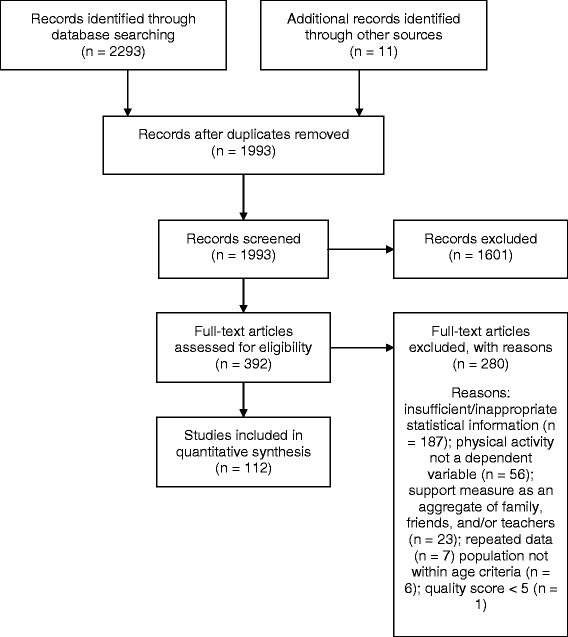
OBJECTIVE: Physical activity (PA) has a profound impact on health and development in children. Parental behaviors (i.e., modeling and support) represent an obvious important factor in child PA. The purpose of this paper was to provide a comprehensive meta-analysis that overcomes the limitations of prior narrative reviews and quantitative reviews with small samples. METHODS: Ten major databases were used in the literature search. One-hundred and fifteen studies passed the eligibility criteria. Both fixed and random effects models with correction for sampling and measurement error were examined in the analysis. Moderator analyses investigating the effects of child's developmental age, study design, parental gender, measurement of child PA, and quality rating were performed. RESULTS: Based on the random effects model, the results showed that parental modeling was weakly associated with child PA (summary r = .16, 95% CI .09-.24) and none of the proposed moderators were significant. Separate analyses examining the moderating effects of parental gender and boys' PA found that that father-son PA modeling (r = .29, 95% CI .21-.36) was significantly higher compared to mother-son PA (r = .19, 95% CI .14-.23; p < .05). However, parental gender did not moderate the relationship between parental modeling and girls' PA (p > .05). The random effects model indicated an overall moderate effect size for the parental support and child PA relationship (summary r = .38, 95% CI .30-.46). Here, the only significant moderating variable was the measurement of child PA (objective: r = .20, 95% CI .13-.26; reported: r = .46, 95% CI .37-.55; p < .01). CONCLUSIONS: Parental support and modeling relate to child PA, yet our results revealed a significant degree of heterogeneity among the studies that could not be explained well by our proposed moderators.
Overview
The claims and statistics of this paper haven’t been checked yet.
Run the check — free, no account needed. It reads the open-access text and checks the sources it cites.
Integrity signals
Registry
Cites
Statistics
Figures
Verification
Claims the paper makes
The claims and statistics of this paper haven’t been checked yet.
Run the check — free, no account needed. It reads the open-access text and checks the sources it cites.
Claims other papers make about this one
Each is checked against this paper’s own text: does it say what the citing paper says it does?
In the citing paper
“Encouragement and modelling by peers, friends and parents are factors that motivate children and adolescents to participate in physical activity or achieve recommended levels of physical activity.97–104”
From Physical activity and health in Chinese children and adolescents: expert consensus statement (2020) (2020) · cites this paper as [98]
Self-check
Percentages, sums and reported differences re-computed from the paper’s own numbers.
The self-check needs the paper’s full text.
Citations
Cites
Preferred Reporting Items for Systematic Reviews and Meta-Analyses: the PRISMA statement
Moher, D., Liberati, A., Tetzlaff, J., Altman, D. G., & for the PRISMA Group (2009) · BMJ · doi:10.1136/bmj.b2535 · Cited by 83,823
Preferred reporting items for systematic reviews and meta-analyses: the PRISMA Statement.
(2009) · PubMed Central · Cited by 44,859
Applied Multiple Regression/Correlation Analysis for the Behavioral Sciences
Cohen, P., Cohen, P., West, S. G., & Aiken, L. S. (2014) · Psychology Press eBooks · doi:10.4324/9781410606266 · Cited by 20,870
Preferred Reporting Items for Systematic Reviews and Meta-Analyses: The PRISMA Statement
Moher, D., Liberati, A., Tetzlaff, J., & Altman, D. G. (2009) · Journal of Clinical Epidemiology · doi:10.1016/j.jclinepi.2009.06.005 · Cited by 19,575
Duval, S., & Tweedie, R. (2000) · Biometrics · doi:10.1111/j.0006-341x.2000.00455.x · Cited by 14,099 · cited 1×
“To assess the extent of publication bias in our samples, Rosenthal’s classic fail-safe N [33] and Duval and Tweedie’s Trim and Fill procedures [34,35] were conducted.”
Method‘Small Changes' to Diet and Physical Activity Behaviors for Weight Management
Hills, A. P., Byrne, N. M., Lindstrom, R. C., & Hill, J. O. (2013) · Obesity Facts · doi:10.1159/000345030 · Cited by 9,526
(1985) · Europe PMC (PubMed Central) · Cited by 9,143
The file drawer problem and tolerance for null results.
Rosenthal, R. (1979) · Psychological Bulletin · doi:10.1037/0033-2909.86.3.638 · Cited by 9,068 · cited 1×
“To assess the extent of publication bias in our samples, Rosenthal’s classic fail-safe N [33] and Duval and Tweedie’s Trim and Fill procedures [34,35] were conducted.”
MethodCohen, J. (1992) · Psychological Bulletin · doi:10.1037//0033-2909.112.1.155 · Cited by 8,771
Downs, S. H., & Black, N. (1998) · Journal of Epidemiology and Community Health · doi:10.1136/jech.52.6.377 · Cited by 8,252 · cited 1×
“To assess the potential risk of bias and methodological quality, each study was critically appraised using an adapted version of Downs and Black’s [28] 22-item assessment tool.”
Method
Research works printed but not linked: 2
- Mota J. Parents’ physical activity behaviors and children's physical activity. J Hum Mov Stud. 1998;35:89–100.
- Klesges RC. The FATS: an observational system for assessing physical activity in children and associated parent behavior. Behav Assess. 1984;6:333–45.
Cited by
Sorted by citations
Items 101–200 of 539
Lawler, M., Heary, C., Shorter, G. W., & Nixon, E. (2021) · International Journal of Sport and Exercise Psychology · doi:10.1080/1612197x.2021.1891118 · Cited by 26
“…parental encouragement, spectatorship, transportation and co-participation in PA should form an essential element of interventions targeting increased MVPA participation among adolescents, particularly girls who are less physically active than boys (Reimers et al., 2019; Yao & Rhodes, 2015).”
BackgroundDo family environment factors play a role in adolescents' involvement in organized activities?
Baďura, P., Gecková, A. M., Sigmundová, D., Sigmund, E., van Dijk, J. V., & Reijneveld, S. (2017) · Journal des adolescens · doi:10.1016/j.adolescence.2017.05.017 · Cited by 26
A systematic review of methods to measure family co‐participation in physical activity
Uijtdewilligen, L., Brown, H. E., Müller‐Riemenschneider, F., Lim, Y. W., Brage, S., & van Sluijs, E. M. F. (2017) · Obesity Reviews · doi:10.1111/obr.12589 · Cited by 26
Accelerometer Bluetooth proximity validation in parents and early years children
Kuzik, N., & Carson, V. (2018) · Measurement in Physical Education and Exercise Science · doi:10.1080/1091367x.2018.1442335 · Cited by 26
“Parental modeling is a well-accepted potential mechanism for parent–child aggregation of health behaviors, including physical activity and sedentary behavior (Davison et al., 2013; Trost & Loprinzi, 2011; Yao & Rhodes, 2015).”
BackgroundKruk, M., Zarychta, K., Horodyska, K., Boberska, M., Scholz, U., Radtke, T., & Łuszczyńska, A. (2018) · Psychology and Health · doi:10.1080/08870446.2018.1489049 · Cited by 25
“Unfortunately, the majority of children and adults do not meet MVPA recommendations (World Health Organization [WHO], 2017; Yao & Rhodes, 2015).”
BackgroundRomero, C., Dorado-Suárez, A., Jiménez-Zazo, F., Castro-Lemus, N., & Aznar, S. (2020) · International Journal of Environmental Research and Public Health · doi:10.3390/ijerph17155371 · Cited by 40
“In these studies, when analyzing the gender effect, a strong relationship was found between father and son, whereas no effect was reported between mother and their sons and/or daughters [14].”
BackgroundCheung, A. T., Li, W. H. C., Ho, L. L. K., Chan, G. C. F., & Chung, J. O. K. (2020) · Patient Education and Counseling · doi:10.1016/j.pec.2020.11.009 · Cited by 32
Alhammadi, K., Santos-Roldán, L. M., & Cabeza‐Ramírez, L. J. (2021) · Foods · doi:10.3390/foods10030688 · Cited by 25
Määttä, S., Ray, C., Vepsäläinen, H., Lehto, E., Kaukonen, R., Ylönen, A., & Roos, E. (2018) · International Journal of Environmental Research and Public Health · doi:10.3390/ijerph15020366 · Cited by 25
“A greater role of parents may be expected among pre-school-aged children’s daily activity choices due to children’s early developmental stages [26].”
BackgroundInfluentialMartins, J., Marques, A., Peralta, M., Palmeira, A. L., & da Costa, F. C. (2017) · Retos · doi:10.47197/retos.v0i31.53505 · Cited by 24
“Several reviews (Edwardson & Gorely, 2010; Gustafson & Lawson, 2006; Laird et al., 2016; Yao & Rhodes, 2015) and reviews of reviews (Bauman et al., 2012; Biddle et al., 2011; Sterdt et al., 2011) focused on analysing parents’ influence, showed consistently that parents’ support was an important…”
BackgroundInfluentialDowda, M. C., Saunders, R. P., Colabianchi, N., Dishman, R. K., McIver, K. L., & Pate, R. R. (2020) · Journal of Physical Activity and Health · doi:10.1123/jpah.2019-0137 · Cited by 24
Ha, A. S. C., Chan, W., & Ng, J. Y. Y. (2020) · International Journal of Environmental Research and Public Health · doi:10.3390/ijerph17124459 · Cited by 24
“Indeed, children’s PA development hinges on parental PA development [23,25,44,49], so it is still worthwhile for researchers to investigate the PA development of parents first as in the present investigation.”
BackgroundSedentary Time and Physical Activity Associations Between Child Care Educators and Children
Carson, V., Adamo, K. B., Ogden, N., Goldfield, G. S., Okely, A. D., Kuzik, N., Crozier, M., Hunter, S., & Predy, M. (2020) · American Journal of Preventive Medicine · doi:10.1016/j.amepre.2019.11.016 · Cited by 24
Gillison, F., Standage, M., Cumming, S. P., Zakrzewski-Fruer, J. K., Rouse, P. C., & Katzmarzyk, P. T. (2017) · Psychology of sport and exercise · doi:10.1016/j.psychsport.2017.07.004 · Cited by 23
“First, in terms of measurement as the use of objective versus subjective (self-report) measures has been shown to be related to study outcomes (Yao & Rhodes, 2015).”
BackgroundForss, K. S., & Stjernberg, L. (2019) · Frontiers in Public Health · doi:10.3389/fpubh.2019.00294 · Cited by 23
“Previous research has shown that parents have a strong impact on children’s PA behaviors through role-modeling and direct involvement (11, 12); however, most research focuses on how mothers influence children’s PA, and little is known about the role of fathers (27).”
BackgroundKu, B., MacDonald, M., Hatfield, B. E., & Gunter, K. B. (2020) · Disability and health journal · doi:10.1016/j.dhjo.2020.100910 · Cited by 23
Sigmund, E., Sigmundová, D., Baďura, P., Voráčová, J., Vladimír, H., Hollein, T., Pavelka, J., Půžová, Z., & Kalman, M. (2020) · BMC Public Health · doi:10.1186/s12889-020-8336-2 · Cited by 23
Motivating parent support for physical activity: the role of framed persuasive messages
Bassett-Gunter, R. L., Stone, R. C., Jarvis, J. E., & Latimer‐Cheung, A. E. (2017) · Health Education Research · doi:10.1093/her/cyx059 · Cited by 22
“encouragement) [8, 9] and regulatory support (i.”
Niermann, C. Y. N., Wagner, P., Ziegeldorf, A., & Wulff, H. (2020) · Journal of Family Studies · doi:10.1080/13229400.2020.1773901 · Cited by 22
“While there is overwhelming evidence for the importance of parental support for children’s physical activity (e.g. Yao & Rhodes, 2015) our understanding of determinants and predictors of parental support is lacking (Rhodes et al., 2013).”
BackgroundCheung, A. T., Li, W. H. C., Ho, L. L. K., Chan, G., Lam, H. S., & Chung, J. O. K. (2022) · JAMA Network Open · doi:10.1001/jamanetworkopen.2022.14600 · Cited by 22
Cao, J., Wang, K., Shi, Y.-H., Pan, Y.-Q., Lyu, M., & Ji, Y. (2023) · BMC Public Health · doi:10.1186/s12889-023-16422-z · Cited by 23
“…but potentially distinctive effects in different types of social support, such that the effect sizes in the associations between parental encouragement and child physical activity were bigger than those observed in the associations between instrumental support and child physical activity [61].”
ResultBassett-Gunter, R. L., Ruscitti, R. J., Latimer‐Cheung, A. E., & Fraser-Thomas, J. L. (2017) · Research in Developmental Disabilities · doi:10.1016/j.ridd.2017.02.016 · Cited by 22
Physical Activity and Sedentary Behaviors of Young Children: Trends from 2009 to 2018
Venetsanou, F., Emmanouılıdou, K., Kouli, O., Bebetsos, E., Comoutos, N., & Kambas, A. (2020) · International Journal of Environmental Research and Public Health · doi:10.3390/ijerph17051645 · Cited by 22
“Among the factors that are associated with young children’s health behaviors, parents seem to be among the most crucial, being not only “gatekeepers” but also role models for their offspring [24].”
BackgroundWang, J., Sheng-yong, W., Chen, X., Xu, B., Wang, J., Yang, Y., Ruan, W., Gao, P., Li, X., Xie, T., et al. (2024) · BMC Public Health · doi:10.1186/s12889-024-19795-x · Cited by 21
“…enhance children’s athletic performance and Prior research has emphasized the significant influence of parental behavior on children’s PA levels [43], our SEM analysis further elucidates that family environment scores positively correlate with LPA levels but negatively correlate with MVPA…”
BackgroundNeshteruk, C. D., Mazzucca, S., Vaughn, A., Jones, D. J., & Ward, D. S. (2020) · Preventive Medicine Reports · doi:10.1016/j.pmedr.2020.101068 · Cited by 23
“…examining the effect of physical activity parenting on children’s physical activity showed that overall parent support of children’s physical activity (i.e., a combination of practices) had a larger effect compared to individual practices on children’s physical activity (Yao and Rhodes, 2015).”
BackgroundZaborskis, A., Kavaliauskienė, A., Eriksson, C., Klemera, E., Dimitrova, E., Melkumova, M., & Husárová, D. (2021) · International Journal of Environmental Research and Public Health · doi:10.3390/ijerph182312739 · Cited by 21
Matana, A., Franić, I., Hozo, E. R., Burger, A., & Boljat, P. (2022) · Nutrients · doi:10.3390/nu14020302 · Cited by 24
Physical Activity of Parents of Children with Autism Spectrum Disorder
Haegele, J. A., Lee, J., & Chang, S. H. (2016) · International Journal of Disability Development and Education · doi:10.1080/1034912x.2016.1232375 · Cited by 22
“…the adults with whom they spend the majority of their day (Quinlan, Rhodes, Blanchard, naylor, & Warburton, 2015). for example, a recent meta-analysis demonstrated an association between parental modelling (parent physical activity) and children physical activity participation (yao & Rhodes, 2015).”
BackgroundSharps, M. A., Thomas, E., & Blissett, J. M. (2019) · Appetite · doi:10.1016/j.appet.2019.104457 · Cited by 21
Rhodes, R. E., Quinlan, A., Naylor, P., Warburton, D. E. R., & Blanchard, C. M. (2021) · Journal of Sports Sciences · doi:10.1080/02640414.2021.1877460 · Cited by 24
“…research to demonstrate that parental support (e.g., encouragement, logistical support, co-physical activity) is linked to child PA (Hutchens & Lee, 2018; Yao & Rhodes, 2015), yet there is extremely limited, and mixed evidence about familybased predictors and mediators of child PA in interventions.”
BackgroundSelf-citationKepper, M. M., Staiano, A. E., Katzmarzyk, P. T., Reis, R. S., Eyler, A. A., Griffith, D. M., Kendall, M. L., Elbanna, B., Denstel, K. D., & Broyles, S. T. (2020) · Health & Place · doi:10.1016/j.healthplace.2020.102292 · Cited by 20
Lian, Y., Peijie, C., Wang, K., Zhang, T., Liu, H., Jinxin, Y., Wen-yun, L., & Luo, J. (2021) · Frontiers in Psychology · doi:10.3389/fpsyg.2021.697358 · Cited by 27
“found that family support has a significant impact on children’s physical activities, and family as the starting point of children’s sports participation there was the strongest correlation between their support for children’s physical activity attitude and children’s sports (Craggs et al., 2011; Yao and Rhodes, 2015;…”
BackgroundHa, A. S. C., Jia, J., Ng, F. F., & Ng, J. Y. Y. (2022) · Psychology of sport and exercise · doi:10.1016/j.psychsport.2022.102297 · Cited by 24
Liu, Y., Ge, X., Li, H., Zhang, E., Hu, F., Cai, Y., & Xiang, M. (2023) · Frontiers in Public Health · doi:10.3389/fpubh.2023.1175439 · Cited by 24
“Findings from a review demonstrate a weak positive association between parental and children’s physical activity levels (20).”
BackgroundLaukkanen, A., Pesola, A. J., Finni, T. J., & Sääkslahti, A. (2017) · Research Quarterly for Exercise and Sport · doi:10.1080/02701367.2017.1329924 · Cited by 20
“…levels seem to not be a prerequisite for children’s PA nor is parents’ own inactivity a primary barrier for children’s PA (e.g., Iannotti et al., 2005; Yao & Rhodes, 2015), but it is the case that physically active parents tend to more often support children’s PA (Dowda et al., 2011; Loprinzi &…”
BackgroundPengpid, S., & Peltzer, K. (2018) · Journal of Human Behavior in the Social Environment · doi:10.1080/10911359.2018.1507861 · Cited by 20
“…study findings (e.g., Ahmed et al., 2016; Cutler, Flood, Hannan, & Neumark-Sztainer, 2011; Pearson, Atkin, Biddle, Gorely, & Edwardson, 2010; Yao & Rhodes, 2015), this study found that higher parental involvement scores were positively correlated with the consumption of fruits and vegetables and…”
BackgroundClifford, S. A., Gillespie, A. N., Olds, T., Grobler, A. C., & Wake, M. A. (2019) · BMJ Open · doi:10.1136/bmjopen-2018-023698 · Cited by 20
Salway, R., Emm-Collison, L., Sebire, S. J., Thompson, J. L., Lawlor, D. A., & Jago, R. (2019) · International Journal of Environmental Research and Public Health · doi:10.3390/ijerph16244889 · Cited by 25
“Parental factors, including a higher socio-economic position and parental support of physical activity, such as encouragement or the provision of transport, have also been shown to be associated with child MVPA [12].”
BackgroundRodríguez‐Rodríguez, F., Huertas‐Delgado, F. J., Barranco-Ruíz, Y., Aranda-Balboa, M. J., & Chillón, P. (2020) · International Journal of Environmental Research and Public Health · doi:10.3390/ijerph17186864 · Cited by 20
“However, previously a positive association was found for fathers–boys and mothers–girls PA [41], but the stronger correlation was observed for father–boy PA, and there was a lighter association for mothers–boys and mothers–girls PA [42].”
BackgroundPerceptions of Inclusivity: The Canadian 24-Hour Movement Guidelines for Children and Youth
Handler, L., Tennant, E. M., Faulkner, G., & Latimer‐Cheung, A. E. (2018) · Adapted Physical Activity Quarterly · doi:10.1123/apaq.2017-0190 · Cited by 20
Moss, S., & Gu, X. (2022) · International Journal of Environmental Research and Public Health · doi:10.3390/ijerph191911968 · Cited by 24
Gavin, J. F., Mcbrearty, M., Malo, K., Abravanel, M., & Moudrakovski, T. (2016) · International journal of exercise science · doi:10.70252/ydga7242 · Cited by 20
Gut, V., Schmid, J., & Conzelmann, A. (2020) · BMC Public Health · doi:10.1186/s12889-020-08617-5 · Cited by 19
Chicote‐López, J., Sos, A. A., Gallardo, L. O., & García‐González, L. (2017) · Journal of Community Psychology · doi:10.1002/jcop.21945 · Cited by 25
“Recently, in a meta-analysis, Yao and Rhodes (2015) concluded that parental support is the most sizeable correlate to adolescents’ PA in relation to social influences from parents.”
BackgroundLee, A. M., & Cardel, M. I. (2018) · American Journal of Lifestyle Medicine · doi:10.1177/1559827618815449 · Cited by 19
Horodyska, K., Boberska, M., Kruk, M., Szczuka, Z., Wiggers, J., Wolfenden, L., Scholz, U., Radtke, T., & Łuszczyńska, A. (2019) · International Journal of Behavioral Medicine · doi:10.1007/s12529-019-09780-9 · Cited by 18
Sex-Specific Transmission of Anxiety Disorders From Parents to Offspring
Pavlová, B., Bagnell, A. L., Cumby, J., Vallis, E. H., Abidi, S., Lovas, D. A., Propper, L., Alda, M., & Uher, R. (2022) · JAMA Network Open · doi:10.1001/jamanetworkopen.2022.20919 · Cited by 19
Simpson, R. F., Hesketh, K. R., Crozier, S., Baird, J., Cooper, C. C., Godfrey, K. M., Harvey, N. C., Westgate, K. L., Inskip, H. M., & van Sluijs, E. M. F. (2022) · PLoS ONE · doi:10.1371/journal.pone.0276964 · Cited by 23
Parental support of children’s physical activity in Hong Kong
Leung, K. M., Chung, P., & Kim, S. (2016) · European Physical Education Review · doi:10.1177/1356336x16645235 · Cited by 17
“In addition, the results suggest the importance of implementing family-based and children–parent interventions to promote children’s PA in the future (Yao and Rhodes, 2015).”
BackgroundResultInfluentialNoonan, R. J., Fairclough, S. J., Knowles, Z. R., & Boddy, L. M. (2017) · BMC Public Health · doi:10.1186/s12889-017-4232-9 · Cited by 18
“Family-based PA interventions that encourage PA co-participation be-tween children and parents [35, 36] and among siblings [37] may yield beneficial effects as both are associated with higher child PA. Understanding the PA patterns of families is necessary for designing effective family-based PA…”
Sigmund, E., Sigmundová, D., Baďura, P., & Gecková, A. M. (2018) · BMC Public Health · doi:10.1186/s12889-018-5582-7 · Cited by 17
“The plethora of studies confirm the influential role of parents on the PA of their children through a variety of mechanisms, including parents taking responsibility for PA care [33], support [8, 35, 36], encouragement [7], and engagement [33].”
BackgroundResultInfluentialAguilar-Farías, N., Martino-Fuentealba, P., & Chandía-Poblete, D. (2020) · Retos · doi:10.47197/retos.v37i37.71142 · Cited by 21
“Several correlates have been described in the literature for PA at different intensities, sedentary and screen time, and sleeping time (Chaput et al., 2015; Sterdt, Liersch, & Walter, 2014; Wilkie, Standage, Gillison, Cumming, & Katzmarzyk, 2018; Yao & Rhodes, 2015).”
BackgroundMethodDowda, M. C., Dishman, R. K., Saunders, R. P., & Pate, R. R. (2021) · Sports Medicine and Health Science · doi:10.1016/j.smhs.2021.02.004 · Cited by 16
Ross, A. B., Quinlan, A., Blanchard, C. M., Naylor, P., Warburton, D. E. R., & Rhodes, R. E. (2022) · Journal of Child and Family Studies · doi:10.1007/s10826-022-02466-z · Cited by 17
“…children to and from activities, participating in activities with children and providing encouragement to their children; all of which have consistently and positively been associated with PA in children (Gustafson & Rhodes, 2006; McMinn et al., 2013; Sterdt et al., 2014; Yao & Rhodes, 2015).”
BackgroundSelf-citationCultivation and Enabling Effects of Social Support and Self-Efficacy in Parent–Child Dyads
Banik, A., Zarychta, K., Knoll, N., & Łuszczyńska, A. (2021) · Annals of Behavioral Medicine · doi:10.1093/abm/kaab004 · Cited by 18
Sigmund, E., Baďura, P., Vokáčová, J., & Sigmundová, D. (2016) · International Journal of Environmental Research and Public Health · doi:10.3390/ijerph13070740 · Cited by 17
“In addition, for families with preschool children, we did not find gender-specific tendency for PA (closer relationship between father-son than the father-daughter), which was sometimes evident among families with schoolchildren [25,28,54] and adolescents [25,54,55].”
BackgroundBassett-Gunter, R. L., Tanna, S., Arbour‐Nicitopoulos, K. P., Rhodes, R. E., & Leo, J. (2020) · European Journal of Adapted Physical Activity · doi:10.5507/euj.2020.008 · Cited by 18
“Meta-analytic eujapa.upol.cz evidence indicates there is a medium-sized effect between parent PA support and child PA (Yao & Rhodes, 2015).”
BackgroundSelf-citationShirazipour, C. H., Latimer‐Cheung, A. E., & Arbour‐Nicitopoulos, K. P. (2015) · Research in Developmental Disabilities · doi:10.1016/j.ridd.2015.08.001 · Cited by 17
Zhang, Y., Davey, C. S., Larson, N., & Reicks, M. M. (2019) · Appetite · doi:10.1016/j.appet.2019.104364 · Cited by 15
Determinants of student’s physical activity: a 12-month follow-up study in Ningxia province
Huang, W., Shi, X., Wang, Y., Li, X., Gao, P., Lu, J., & Zhuang, J. (2021) · BMC Public Health · doi:10.1186/s12889-021-10525-1 · Cited by 19
García‐Cervantes, L., D’Haese, S., Izquierdo‐Gómez, R., Moledo, C. P., Fernández‐Santos, J. R., Cardon, G., & Veiga, Ó. L. (2016) · Journal of Physical Activity and Health · doi:10.1123/jpah.2015-0415 · Cited by 15
Differing views regarding diet and physical activity: adolescents versus parents’ perspectives
Azar, K. M. J., Halley, M. C., Lv, N., Wulfovich, S., Gillespie, K., Liang, L. R., & Rosas, L. G. (2020) · BMC Pediatrics · doi:10.1186/s12887-020-02038-4 · Cited by 15
Parental influence on children’s physical activity in urban green spaces
Akpınar, A., & Cankurt, M. (2015) · Forestist · doi:10.17099/jffiu.38834 · Cited by 16
Ruedl, G., Niedermeier, M., Posch, M., Kirschner, W., Wirnitzer, K., Cocca, A., & Greier, K. (2022) · Journal of Sports Sciences · doi:10.1080/02640414.2022.2038874 · Cited by 14
“…sedentary behaviours through role modelling (being active themselves), material support (financial, logistic, co-participation) and encouragement (Yao and Rhodes, 2015; Xu et al., 2015; 2017 Bringolf-Isler et al., 2018; D Rodrigues et al., 2018) E.g., in a 30-year study by Kaseva et al. (2017),…”
Cornelius, C., Fedewa, A. L., & Toland, M. D. (2020) · Health Psychology Report · doi:10.5114/hpr.2020.99002 · Cited by 17
Are Family Physical Activity Habits Passed on to Their Children?
Zovko, V., Djuric, S., Sember, V., & Jurak, G. (2021) · Frontiers in Psychology · doi:10.3389/fpsyg.2021.741735 · Cited by 25
“In addition, a recent meta-analysis showed that parent-child PA correlates were greater with objective measurement than with self-reported questionnaires (Yao and Rhodes, 2015), resulting in more objective and reliable results of PA.”
BackgroundMaltby, A. M., Vanderloo, L. M., & Tucker, P. (2018) · Maternal and Child Health Journal · doi:10.1007/s10995-018-2474-5 · Cited by 14
The Relationship Between Physical Activity Level of Parents and That of Their Adolescent Children
Yoon, H. J., Lee, S. A., Ju, Y. J., Nam, J. Y., & Park, E. (2018) · Journal of Physical Activity and Health · doi:10.1123/jpah.2017-0123 · Cited by 14
Jiang, S., Zeng, N., Ng, J. Y. Y., Chong, K. H., Zeng, T., Leung, S. K. Y., & Ha, A. S. C. (2025) · Journal of sport and health science/Journal of Sport and Health Science · doi:10.1016/j.jshs.2025.101085 · Cited by 28
“21 Additionally, parental involvement, parenting styles, and the overall home setting are critical in fostering healthy lifestyle habits during children’s important developmental stage.”
Yaffe, Y., & Levental, O. (2023) · Current Psychology · doi:10.1007/s12144-023-04931-4 · Cited by 15
“Recent reviews have concluded that such parental practices and efforts affecting children’s PA may contribute to cultivating actual PA among children and adolescents (Edwardson & Gorely, 2010; Yao & Rhodes, 2015), especially the parental practices of support and encouragement of PA and PA modeling.”
InfluentialHartson, K. R., Gance‐Cleveland, B., Amura, C. R., & Schmiege, S. J. (2018) · Journal of Pediatric Nursing · doi:10.1016/j.pedn.2018.01.019 · Cited by 13
“…their child's behaviors, specifically for PA (parental role modeling r = 0.16, 95% CI = 0.09–0.24; parental support r = 0.38, 95% CI = 0.30–0.46) (Yao & Rhodes, 2015), and for fruit and vegetable intake (rs = 0.44–0.57, p b .001) (Vanhala, Laitinen, Kaikkonen, Keinanen-Kiukaanniemi, &…”
BackgroundInfluentialKnowledge of the Adult and Youth 2008 Physical Activity Guidelines for Americans
Hyde, E. T., Omura, J. D., Watson, K. B., Fulton, J. E., & Carlson, S. A. (2019) · Journal of Physical Activity and Health · doi:10.1123/jpah.2018-0143 · Cited by 13
Grant, S. J., Beauchamp, M. R., Blanchard, C. M., Carson, V., Gardner, B., Warburton, D. E. R., & Rhodes, R. E. (2020) · BMC Public Health · doi:10.1186/s12889-020-09465-z · Cited by 13
Self-citationYang, X., Kukko, T., Hirvensalo, M. H., Biddle, S., Rovio, S., Pahkala, K., Hutri‐Kähönen, N., Raitakari, O. T., & Tammelin, T. (2021) · Scandinavian Journal of Medicine and Science in Sports · doi:10.1111/sms.14066 · Cited by 13
Bowling, A. B., Frazier, J. A., Staiano, A. E., Broder‐Fingert, S., & Curtin, C. (2022) · Frontiers in Psychiatry · doi:10.3389/fpsyt.2022.875181 · Cited by 13
Johnson, A. M., Tandon, P. S., Hafferty, K. R., Senturia, K., Garrett, K., Bollinger, B. J., & Kroshus, E. (2022) · Health Education Research · doi:10.1093/her/cyac036 · Cited by 13
Temperament and Physical Activity in Childhood
Song, M., CORWYN, R. F., Bradley, R. H., & Lumeng, J. C. (2017) · Journal of Physical Activity and Health · doi:10.1123/jpah.2016-0633 · Cited by 13
Pengpid, S., & Peltzer, K. (2016) · ASR Chiang Mai University Journal of Social Sciences and Humanities · doi:10.12982/cmujasr.2016.0007 · Cited by 13
Emm-Collison, L., Jago, R., Salway, R., Thompson, J. L., & Sebire, S. J. (2019) · Psychology of sport and exercise · doi:10.1016/j.psychsport.2019.04.007 · Cited by 17
Impact of body mass index and socio-economic status on motor development in children and adolescents
Kakebeeke, T. H., Chaouch, A., Caflisch, J., Knaier, E., Rousson, V., & Jenni, O. G. (2021) · European Journal of Pediatrics · doi:10.1007/s00431-021-03945-z · Cited by 19
Zarychta, K., Banik, A., Kuliś, E., Boberska, M., Radtke, T., Chan, C. K. Y., & Łuszczyńska, A. (2020) · Frontiers in Psychology · doi:10.3389/fpsyg.2020.00161 · Cited by 12
Laukkanen, A., Sääkslahti, A., & Aunola, K. (2020) · International Journal of Environmental Research and Public Health · doi:10.3390/ijerph17072315 · Cited by 23
“, concrete behavioral strategies employed by parents to influence their children’s PA) account for one of the few identified consistent correlates [3], and they have been identified as a determinant [4] of children’s PA.”
BackgroundScott-Andrews, K. Q., Miller, A. L., Templin, T. J., Hasson, R. E., & Robinson, L. E. (2022) · Frontiers in Public Health · doi:10.3389/fpubh.2021.720083 · Cited by 12
“Parents play an integral role in influencing health behaviors in their children, as they have the most contact hours in and control of their child’s lives (26, 27).”
BackgroundBrown, H. E., Corder, K. L., Atkin, A. J., & van Sluijs, E. M. F. (2017) · Preventive Medicine Reports · doi:10.1016/j.pmedr.2017.03.012 · Cited by 12
Child and parental physical activity: Is there an association with young children activity?
Voukia, C., Voutsina, I., Venetsanou, F., & Kambas, A. (2018) · Central European Journal of Public Health · doi:10.21101/cejph.a5043 · Cited by 12
“paying the fees for their child participation (11, 12).”
BackgroundInfluentialInteractive Dyadic Physical Activity and Spatial Proximity Patterns in 2-Year-Olds and Their Parents
McCullough, A. K., Duch, H., & Garber, C. E. (2018) · Children · doi:10.3390/children5120167 · Cited by 14
“To our knowledge, this study is the first to use a dyadic analysis statistical methodology to analyze dyadic physical activity [4,9], as such parameter estimates were appropriately and necessarily adjusted for interdependent relationships between child and parent signals [23].”
BackgroundMethodHohmann, A., Yuan, X., Schmitt, M., Zhang, H., Pietzonka, M., & Siener, M. (2021) · Children · doi:10.3390/children8050391 · Cited by 12
Jiang, Y., Xiao, H., & Yang, F. (2023) · Frontiers in Public Health · doi:10.3389/fpubh.2023.992539 · Cited by 11
Rhodes, R. E., Banik, A., Szczuka, Z., Aulbach, M. B., DeSmet, A., Durand, H., Gatting, L., Green, J., Hillison, E. Z., Masaryk, R., et al. (2024) · Journal of Physical Activity and Health · doi:10.1123/jpah.2024-0113 · Cited by 13
Self-citationBrennan, C., Streight, E., Cheng, S., & Rhodes, R. E. (2025) · International Journal of Behavioral Nutrition and Physical Activity · doi:10.1186/s12966-025-01778-9 · Cited by 18
“Thus, given the important role parental support plays in children’s PA behaviors [19, 111], in particular regarding co-activity [112], future interventions should focus on strengthening parental PA and PA support behaviors via social cognitive and/or other approaches that target PA identity…”
Self-citationPohybová aktivita a tělesná zdatnost českých adolescentů v kontextu zastavěného prostředí
Rubín, L., Mitáš, J., Dygrýn, J., Vorlíček, M., Nykodým, J., Řepka, E., Feltlová, D., Suchomel, A., Klimtová, H., Valach, P., et al. (2018) · doi:10.5507/ftk.18.24454511 · Cited by 11
Correlates of physical activity in fifth-grade students in Ho Chi Minh City, Vietnam
To, Q. G., Gallegos, D., Dung, D. V., Tran, H. T. M., To, K. G., Wharton, L., & Trost, S. G. (2020) · Sports Medicine and Health Science · doi:10.1016/j.smhs.2020.02.002 · Cited by 11
Herbert, J., Matłosz, P., Martínez‐Rodríguez, A., Przednówek, K., Asif, M., & Wyszyńska, J. (2022) · International Journal of Environmental Research and Public Health · doi:10.3390/ijerph19094999 · Cited by 11
Pediatric-Adapted Liking Survey (PALS): A Diet and Activity Screener in Pediatric Care
Vosburgh, K. L., Smith, S. R., Oldman, S., Huedo-Medina, T. B., & Duffy, V. B. (2019) · Nutrients · doi:10.3390/nu11071641 · Cited by 11
“Parent modeling and support, including co-activity, can improve PA in children [47].”
BackgroundKepper, M. M., Staiano, A. E., Katzmarzyk, P. T., Reis, R. S., Eyler, A. A., Griffith, D. M., Kendall, M. L., Elbanna, B., Denstel, K. D., & Broyles, S. T. (2019) · International Journal of Environmental Research and Public Health · doi:10.3390/ijerph16203853 · Cited by 11
“, money for registration fees, transportation to activities, or equipment), but they may also limit their child’s ability to be physically active [24,25].”
Backgroundla Torre‐Cruz, M. J. D., López-Serrano, S., Ruiz‐Ariza, A., & López, E. J. M. (2019) · Educational Psychology · doi:10.1080/01443410.2019.1620921 · Cited by 18
“These findings are consistent with those previously obtained by other researchers (Cheng, Mendonça, & de Farias-J unior, 2014; Schoeppe, Liersch, R€obl, Krauth, & Walter, 2016; Silva et al., 2014; Yao & Rhodes, 2015).”
ResultLarsen, H., Hermans, R. C. J., Kayabal, S., Renders, C. M., & Vrijkotte, T. G. M. (2023) · Eating Behaviors · doi:10.1016/j.eatbeh.2023.101775 · Cited by 10
Dong, M., Niu, M., Jiang, Z., Choi, Y., & Li, N. (2025) · Frontiers in Psychology · doi:10.3389/fpsyg.2024.1539415 · Cited by 10
Christófaro, D. G. D., Andersen, L. B., de Andrade, S. M., de Barros, M. V. G., Saraiva, B. T. C., Fernandes, R. A., & Ritti‐Dias, R. M. (2018) · Jornal de Pediatria (Versão em Português) · doi:10.1016/j.jpedp.2017.08.003 · Cited by 10
Wang, W.-C., Ding, M., Strohmaier, S., Schernhammer, E. S., Sun, Q., Chavarro, J. E., & Tiemeier, H. W. (2022) · Psychological Medicine · doi:10.1017/s0033291722003257 · Cited by 10
“…parents passively influencing their children ’ s behaviors, parenting style, monitoring, and content could also considerably impact offspring ’ s healthy lifestyles throughout childhood, adolescence, and even adulthood through guidance and joint activities (Larsen et al., 2015; Yao & Rhodes, 2015).”
Background
Metadata
- Authors
- Yao, C. A., & Rhodes, R. E.
- Affiliations
- University of Victoria (CA)
- Corresponding author
- Yao, Christopher A
- Venue
- International Journal of Behavioral Nutrition and Physical Activity
- Published
- 2015-02-11
- Volume
- 12
- Issue
- 1
- Pages
- 10-10
- ISSN
- 1479-5868 (ISSN-L)
- PMC
- PMC4363182
- OpenAlex
- W2159936916
- Cited by
- 540
- References
- 151
- Citations by year
- 2026: 53 · 2025: 51 · 2024: 48 · 2023: 53 · 2022: 56 · 2021: 47 · 2020: 86 · 2019: 37 · 2018: 37 · 2017: 34 · 2016: 29 · 2015: 7
- FWCI
- 4.39
- Type
- journal article
- Language
- en
- Open access
- gold
- doi.org
- Locations
- International Journal of Behavioral Nutrition and Physical Activity (publishedVersion, cc-by)
- PubMed Central (publishedVersion, cc-by)
- PubMed (publishedVersion)
- UVic’s Research and Learning Repository (University of Victoria) (submittedVersion, public-domain)
- Topics
- Health Sciences › Medicine › Public Health, Environmental and Occupational Health › Physical Activity and Health
- Health Sciences › Medicine › Public Health, Environmental and Occupational Health › Obesity, Physical Activity, Diet
- Social Sciences › Psychology › Developmental and Educational Psychology › Children's Physical and Motor Development
- Keywords
- children's physical activity, adolescent physical activity, parental role modeling, parental support, parental gender
- MeSH terms
- Adolescent, Adolescent Behavior, Child, Child Behavior, Female, Humans, Male, Motor Activity, Parents, Social Support, Health Behavior, Exercise, Parenting
About these checks
Registry, retraction, Cites and statistics results are computed, not judged, with one exception: a printed reference that no index lists is read once by a model before it counts as a citation error. Claims are extracted by a model and kept only when their quote appears verbatim in the text; each cited source is then checked, with a model’s help, for whether it says what the claim relies on. Those verdicts can be wrong — read the claim’s quote and the cited source before relying on one.
Statistics and arithmetic are recomputed, not judged.
Confidence bands are shown only for fields calibrated on our annotated test set. None is calibrated yet, so no band is shown.
What counts as a claim ›How we measure confidence ›How we check this ›
Are you an author, or do you see a problem with this page? Request a review
