

The DOI matches its Crossref record; 152 of the 152 references it cites were found in a registry or an index.
Parental correlates in child and adolescent physical activity: a meta-analysis
Open accessAbstract
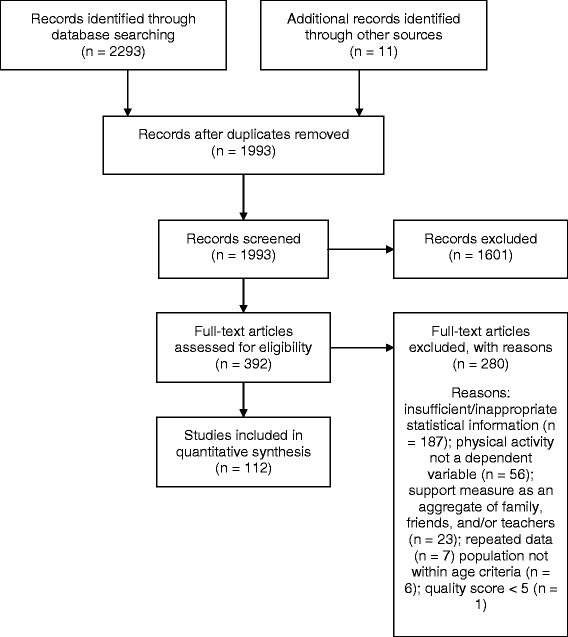
OBJECTIVE: Physical activity (PA) has a profound impact on health and development in children. Parental behaviors (i.e., modeling and support) represent an obvious important factor in child PA. The purpose of this paper was to provide a comprehensive meta-analysis that overcomes the limitations of prior narrative reviews and quantitative reviews with small samples. METHODS: Ten major databases were used in the literature search. One-hundred and fifteen studies passed the eligibility criteria. Both fixed and random effects models with correction for sampling and measurement error were examined in the analysis. Moderator analyses investigating the effects of child's developmental age, study design, parental gender, measurement of child PA, and quality rating were performed. RESULTS: Based on the random effects model, the results showed that parental modeling was weakly associated with child PA (summary r = .16, 95% CI .09-.24) and none of the proposed moderators were significant. Separate analyses examining the moderating effects of parental gender and boys' PA found that that father-son PA modeling (r = .29, 95% CI .21-.36) was significantly higher compared to mother-son PA (r = .19, 95% CI .14-.23; p < .05). However, parental gender did not moderate the relationship between parental modeling and girls' PA (p > .05). The random effects model indicated an overall moderate effect size for the parental support and child PA relationship (summary r = .38, 95% CI .30-.46). Here, the only significant moderating variable was the measurement of child PA (objective: r = .20, 95% CI .13-.26; reported: r = .46, 95% CI .37-.55; p < .01). CONCLUSIONS: Parental support and modeling relate to child PA, yet our results revealed a significant degree of heterogeneity among the studies that could not be explained well by our proposed moderators.
Overview
The claims and statistics of this paper haven’t been checked yet.
Run the check — free, no account needed. It reads the open-access text and checks the sources it cites.
Integrity signals
Registry
Cites
Statistics
Figures
Verification
Claims the paper makes
The claims and statistics of this paper haven’t been checked yet.
Run the check — free, no account needed. It reads the open-access text and checks the sources it cites.
Claims other papers make about this one
Each is checked against this paper’s own text: does it say what the citing paper says it does?
In the citing paper
“Encouragement and modelling by peers, friends and parents are factors that motivate children and adolescents to participate in physical activity or achieve recommended levels of physical activity.97–104”
From Physical activity and health in Chinese children and adolescents: expert consensus statement (2020) (2020) · cites this paper as [98]
Self-check
Percentages, sums and reported differences re-computed from the paper’s own numbers.
The self-check needs the paper’s full text.
Citations
Cites
Preferred Reporting Items for Systematic Reviews and Meta-Analyses: the PRISMA statement
Moher, D., Liberati, A., Tetzlaff, J., Altman, D. G., & for the PRISMA Group (2009) · BMJ · doi:10.1136/bmj.b2535 · Cited by 83,823
Preferred reporting items for systematic reviews and meta-analyses: the PRISMA Statement.
(2009) · PubMed Central · Cited by 44,859
Applied Multiple Regression/Correlation Analysis for the Behavioral Sciences
Cohen, P., Cohen, P., West, S. G., & Aiken, L. S. (2014) · Psychology Press eBooks · doi:10.4324/9781410606266 · Cited by 20,870
Preferred Reporting Items for Systematic Reviews and Meta-Analyses: The PRISMA Statement
Moher, D., Liberati, A., Tetzlaff, J., & Altman, D. G. (2009) · Journal of Clinical Epidemiology · doi:10.1016/j.jclinepi.2009.06.005 · Cited by 19,575
Duval, S., & Tweedie, R. (2000) · Biometrics · doi:10.1111/j.0006-341x.2000.00455.x · Cited by 14,099 · cited 1×
“To assess the extent of publication bias in our samples, Rosenthal’s classic fail-safe N [33] and Duval and Tweedie’s Trim and Fill procedures [34,35] were conducted.”
Method‘Small Changes' to Diet and Physical Activity Behaviors for Weight Management
Hills, A. P., Byrne, N. M., Lindstrom, R. C., & Hill, J. O. (2013) · Obesity Facts · doi:10.1159/000345030 · Cited by 9,526
(1985) · Europe PMC (PubMed Central) · Cited by 9,143
The file drawer problem and tolerance for null results.
Rosenthal, R. (1979) · Psychological Bulletin · doi:10.1037/0033-2909.86.3.638 · Cited by 9,068 · cited 1×
“To assess the extent of publication bias in our samples, Rosenthal’s classic fail-safe N [33] and Duval and Tweedie’s Trim and Fill procedures [34,35] were conducted.”
MethodCohen, J. (1992) · Psychological Bulletin · doi:10.1037//0033-2909.112.1.155 · Cited by 8,771
Downs, S. H., & Black, N. (1998) · Journal of Epidemiology and Community Health · doi:10.1136/jech.52.6.377 · Cited by 8,252 · cited 1×
“To assess the potential risk of bias and methodological quality, each study was critically appraised using an adapted version of Downs and Black’s [28] 22-item assessment tool.”
Method
Research works printed but not linked: 2
- Mota J. Parents’ physical activity behaviors and children's physical activity. J Hum Mov Stud. 1998;35:89–100.
- Klesges RC. The FATS: an observational system for assessing physical activity in children and associated parent behavior. Behav Assess. 1984;6:333–45.
Cited by
Sorted by citations
Items 501–539 of 539
Boerdijk, L., Hesketh, K. D., Renders, C. M., Downing, K. L., & Verswijveren, S. J. J. M. (2026) · Frontiers in Digital Health · doi:10.3389/fdgth.2026.1720371
“In early childhood, parents play a central role in shaping children’s daily routines, activity opportunities, and behavioral norms (27).”
Weight Self-Stigma and Home Physical Activity in Adolescents: A Moderated Mediation Model
Zhou, Q., Song, B., Guo, W., & Zhang, Q. (2026) · Psychological Reports · doi:10.1177/00332941261428083
Hollman, H., Davenport, M. H., Liu, S., & Rhodes, R. E. (2026) · International Journal of Sport and Exercise Psychology · doi:10.1080/1612197x.2026.2628577
Self-citationAn asset-based approach to Latinx youth health: Internal assets and the role of social support
León, A., & Benner, A. D. (2026) · Child Development · doi:10.1093/chidev/aacag021
Ferreira, F., Dowd, K., Coffey, A., Cardon, G., Iliano, E., Dygrýn, J., Pelclová, J., Palmeira, A. L., & de Geus, E. J. C. (2026) · Open Research Europe · doi:10.12688/openreseurope.21538.2
Sadia, F., Frank-Wilson, A. W., Patel, N. B., Bélanger, M. F., BRUSSONI, M. J., Faulkner, G., Gunnell, K. E., Tremblay, M. S., & Larouche, R. (2026) · Applied Physiology, Nutrition, and Metabolism · doi:10.1139/apnm-2025-0213
Holesovsky, C. D., Groves, C. I., Yin, Z., Akopian, D., Liang, Y., Parra-Medina, D. M., & Brown, D. M. Y. (2026) · Hispanic Journal of Behavioral Sciences · doi:10.1177/07399863261427987
“Multiple reviews have found weak or no evidence of associations between parental modeling and child physical activity, with studies often showing stronger relationships for parental support compared to modeling (Sterdt et al., 2014; Trost & Loprinzi, 2011; Yao & Rhodes, 2015).”
InfluentialZhang, H., Yu, R., yin, Y., Sun, F., Hamzah, S. H., & Qi, Y. (2026) · BMC Public Health · doi:10.1186/s12889-026-26842-2
“Guidelines for PA in several developed countries emphasize that family caregivers, through verbal encouragement and joint participation, can play an important role in enhancing children’s involvement in PA [26–28].”
Bernal, C. M. M. (2020) · theses.fr (ABES) · doi:10.70675/fbf2f2f2z3773z49c7zab5dz8e20a3c8eedf
Food Advertising and Its Role in Forming Unhealthy Eating Habits in Children
Saha, N. (2026) · Emerald Group Publishing Limited eBooks · doi:10.1108/978-1-80455-694-820261003
Ojukwu, C. P., Judith, O. C., Fatai, K. E., Onyekwelu, A. I., Eleje, C. U., & Ekowa, J. L. (2026) · Research Square · doi:10.21203/rs.3.rs-8921294/v1
Luo, L., Huang, F., Tahir, S. R., Shao, H., & Li, B. (2026) · Frontiers in Public Health · doi:10.3389/fpubh.2026.1796300
“These dimensions may be statistically associated with physical activity through various contextual mechanisms, including access to facilities, parental involvement, and the transmission of health-related values (22).”
The Effects of Family Sports on Mental Health in Children and Adolescents: A Meta-Analysis
Peng, S., Li, C., Wang, J., & Wang, S. (2026) · Behavioral Sciences · doi:10.3390/bs16050776
“…and external constraints, facilitating the initiation and maintenance of physical activity (Y. Jiang & Xiao, 2024; Rhodes et al., 2010, 2020b; Yao & Rhodes, 2015); Compared to simple modeling, comprehensive support that includes emotional support and behavioral guidance is more effective in…”
InfluentialParents’ physical literacy is associated with children’s physical activity through parental support
MATSUNAGA, M., Matsui, M., Toyama, K., Someya, Y., Kawata, Y., Kito, T., Nakamura, E., Shoji, H., & Suzuki, K. (2026) · BMC Public Health · doi:10.1186/s12889-026-27914-z
Yaffe, Y., Ben-Eli, M., Huri, O., & Levental, O. (2026) · Advances in Neurodevelopmental Disorders · doi:10.1007/s41252-026-00503-2
Ojukwu, C. P., Judith, O. C., Onyekwelu, A. I., Eleje, C. U., Ekowa, J. L., & Fatai, K. E. (2026) · medRxiv · doi:10.64898/2026.05.30.26354500
Ούρδα, Δ., Karatzioti, M., Koutsokosta, M., Gregoriadis, A., & Barkoukis, V. (2026) · Children · doi:10.3390/children13060763
“Yao and Rhodes [3] have noted that a significant number of children are not engaging in sufficient levels of physical activity to reap the benefits associated with regular participation in physical activity.”
Rodríguez-Muñoz, S., Gallardo, L. O., Esteban-Torres, D., Moreno-Doña, A., & Sos, A. A. (2026) · The Spanish Journal of Psychology · doi:10.1017/sjp.2026.10031
“In contexts such as Spain and Chile, where family involvement in child development is culturally significant, engaging both mothers and fathers in youth PA promotion strategies could enhance their effectiveness (Yao & Rhodes, 2015).”
Merellano-Navarro, E., Morán-Toloza, A., Casanova-Genaro, V., Venegas-Moya, D., Bruneau-Chávez, J., Giakoni-Ramírez, F., Pasten-Hernández, P., & Godoy-Cumillaf, A. E. R. (2026) · Journal of Transport & Health · doi:10.1016/j.jth.2026.102365
Silva, C. E. L. E., dos Santos, A. G., Dias, J. V., Andrade-Lima, A., de Barros, M. V. G., Germano-Soares, A. H., & Farah, B. Q. (2026) · Revista Brasileira de Atividade Física & Saúde · doi:10.12820/rbafs.31e0445
Alonso-Martínez, L., Ramírez‐Vélez, R., Duncan, M. J., Izquierdo, M., & Alonso-Martínez, A. M. (2026) · Journal of Exercise Science & Fitness · doi:10.1016/j.jesf.2026.200494
“8,9 Importantly, parental MVPA volume may be an imprecise proxy for the proximal family processes that structure preschoolers' movement opportunities (e.g., co-participation, transportation to activities, access to outdoor play, and limits on recreational screen time).”
KORUCUK, M., & Onur, T. D. (2026) · Göbeklitepe eğitim ve spor bilimleri dergisi. · doi:10.70631/gesd.1940156
Ferreira, F. S. D. C., Dowd, K., Coffey, A., Cardon, G., Iliano, E., Dygrýn, J., Pelclová, J., Palmeira, A. L., & de Geus, E. J. C. (2026) · Open Research Europe · doi:10.12688/openreseurope.21538.3
Lee, A., Manankil-Lakusta, A. T. K., & Rhodes, R. E. (2026) · Behavioral Sciences · doi:10.3390/bs16071172
“Parental support was then defined as encouragement, logistical support, and co-participation (Pyper et al., 2016; Rhodes et al., 2020b; Yao & Rhodes, 2015), with concrete examples such as emphasizing fun, creating activity opportunities, validating movement as a family priority, and joining the…”
InfluentialSelf-citationLiu, S., Liu, T., Ma, H., Yin, Z., Zhu, C., & Cheng, W. (2026) · Frontiers in Psychology · doi:10.3389/fpsyg.2026.1853224 · Cited by 1
“First, perceived parental emotional warmth is a key family antecedent that shapes an individual’s physical activity behavior (Yao and Rhodes, 2015).”
Cortés, I. V., Valdivia, K. E., Quijada-Mateluna, N., Rivas-Valenzuela, J., Jorquera-Aguilera, C., & Rodríguez‐Rodríguez, F. (2026) · Behavioral Sciences · doi:10.3390/bs16091476
Ferreira, F. S. D. C., Dowd, K., Coffey, A., Cardon, G., Iliano, E., Dygrýn, J., Pelclová, J., Palmeira, A. L., & de Geus, E. J. C. (2026) · Open Research Europe · doi:10.12688/openreseurope.21538.4
Ojukwu, C. P., Judith, O. C., Onyekwelu, A. I., Eleje, C. U., Ekowa, J. L., & Fatai, K. E. (2026) · PLoS ONE · doi:10.1371/journal.pone.0351523
“Previous evidence suggests that children whose parents actively encourage or participate in physical activity with them are more likely to engage consistently in active behaviours [12].”
Medeiros, H. V., Hoffman, J. A., Lifter, K., & Briesch, A. M. (2026) · Early Childhood Education Journal · doi:10.1007/s10643-026-02354-x
Косач, В. Ю., Пересецкая, О. В., Овчинникова, В. А., Zhelnina, A. A., & Парпулова, С. И. (2026) · Смоленский медицинский альманах · doi:10.37903/sma.2026.2.4
Watkins, J. M., Goss, J. M., Mehls, K. D., Marshall, A., Dlugonski, D., & Downs, D. S. (2026) · Frontiers in Public Health · doi:10.3389/fpubh.2026.1970725
Lee, S.-M., & Kim, K.-R. (2026) · Korean Journal of Leisure, Recreation & Park · doi:10.26446/kjlrp.2026.9.50.3.175
Wang, J., Wu, S., Liang, Y., Yang, Y., Zhu, Z., Liu, Y., 曹, 振., Tang, Y., Chen, P., & Zhuang, J. (2026) · Journal of Adolescent Health · doi:10.1016/j.jadohealth.2026.08.012
Zhang, Y., Pan, X., Gao, Y., Li, M., Jiang, L., Zhao, D., Chen, J., Wang, C., Zhao, X., & Hu, H. (2026) · Frontiers in Psychology · doi:10.3389/fpsyg.2026.1898292
Ferreira, F., Carraça, E. V., Mascarenhas, M., & Palmeira, A. L. (2026) · Journal of Physical Activity and Health · doi:10.1123/jpah.2025-0421
Li, H., Zhao, W., Hu, X., Wan, F., Dong, P., & Zhang, W. (2026) · Frontiers in Public Health · doi:10.3389/fpubh.2026.1880097
“…parental health beliefs and literacy, general parenting practices and warmth, co-participation and shared family routines, active transportation and screen-time rules, provision of activity opportunities such as enrollment in sport programs, and heritable fitness-related traits (9, 14, 15).”
Dou, L., Chen, H., & Lu, E. (2026) · PeerJ · doi:10.7717/peerj.21871
“PS encompasses the various mechanisms through which parents in fl uence their children ’ s behavioral development ( Beets, Cardinal & Alderman, 2010 ) and has been identi fi ed as a key determinant of PA participation among adolescents ( Yao & Rhodes, 2015 ).”
Metadata
- Authors
- Yao, C. A., & Rhodes, R. E.
- Affiliations
- University of Victoria (CA)
- Corresponding author
- Yao, Christopher A
- Venue
- International Journal of Behavioral Nutrition and Physical Activity
- Published
- 2015-02-11
- Volume
- 12
- Issue
- 1
- Pages
- 10-10
- ISSN
- 1479-5868 (ISSN-L)
- PMC
- PMC4363182
- OpenAlex
- W2159936916
- Cited by
- 540
- References
- 151
- Citations by year
- 2026: 53 · 2025: 51 · 2024: 48 · 2023: 53 · 2022: 56 · 2021: 47 · 2020: 86 · 2019: 37 · 2018: 37 · 2017: 34 · 2016: 29 · 2015: 7
- FWCI
- 4.39
- Type
- journal article
- Language
- en
- Open access
- gold
- doi.org
- Locations
- International Journal of Behavioral Nutrition and Physical Activity (publishedVersion, cc-by)
- PubMed Central (publishedVersion, cc-by)
- PubMed (publishedVersion)
- UVic’s Research and Learning Repository (University of Victoria) (submittedVersion, public-domain)
- Topics
- Health Sciences › Medicine › Public Health, Environmental and Occupational Health › Physical Activity and Health
- Health Sciences › Medicine › Public Health, Environmental and Occupational Health › Obesity, Physical Activity, Diet
- Social Sciences › Psychology › Developmental and Educational Psychology › Children's Physical and Motor Development
- Keywords
- children's physical activity, adolescent physical activity, parental role modeling, parental support, parental gender
- MeSH terms
- Adolescent, Adolescent Behavior, Child, Child Behavior, Female, Humans, Male, Motor Activity, Parents, Social Support, Health Behavior, Exercise, Parenting
About these checks
Registry, retraction, Cites and statistics results are computed, not judged, with one exception: a printed reference that no index lists is read once by a model before it counts as a citation error. Claims are extracted by a model and kept only when their quote appears verbatim in the text; each cited source is then checked, with a model’s help, for whether it says what the claim relies on. Those verdicts can be wrong — read the claim’s quote and the cited source before relying on one.
Statistics and arithmetic are recomputed, not judged.
Confidence bands are shown only for fields calibrated on our annotated test set. None is calibrated yet, so no band is shown.
What counts as a claim ›How we measure confidence ›How we check this ›
Are you an author, or do you see a problem with this page? Request a review
