

A review and content analysis of engagement, functionality, aesthetics, information quality, and change techniques in the most popular commercial apps for weight management
Open accessThe DOI matches its Crossref record; 43 of the 43 references it cites were found in a registry or an index.
Abstract
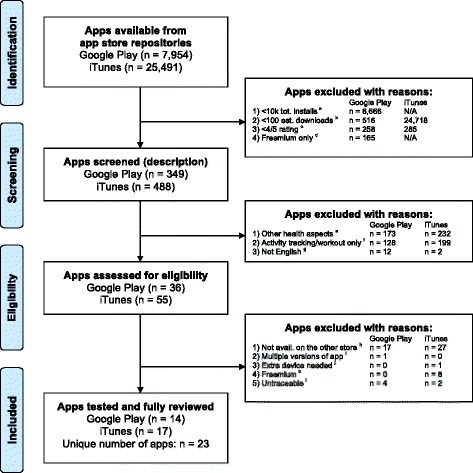
BACKGROUND: There are thousands of apps promoting dietary improvement, increased physical activity (PA) and weight management. Despite a growing number of reviews in this area, popular apps have not been comprehensively analysed in terms of features related to engagement, functionality, aesthetics, information quality, and content, including the types of change techniques employed. METHODS: The databases containing information about all Health and Fitness apps on GP and iTunes (7,954 and 25,491 apps) were downloaded in April 2015. Database filters were applied to select the most popular apps available in both stores. Two researchers screened the descriptions selecting only weight management apps. Features, app quality and content were independently assessed using the Mobile App Rating Scale (MARS) and previously-defined categories of techniques relevant to behaviour change. Inter-coder reliabilities were calculated, and correlations between features explored. RESULTS: Of the 23 popular apps included in the review 16 were free (70%), 15 (65%) addressed weight control, diet and PA combined; 19 (83%) allowed behavioural tracking. On 5-point MARS scales, apps were of average quality (Md = 3.2, IQR = 1.4); "functionality" (Md = 4.0, IQR = 1.1) was the highest and "information quality" (Md = 2.0, IQR = 1.1) was the lowest domain. On average, 10 techniques were identified per app (range: 1-17) and of the 34 categories applied, goal setting and self-monitoring techniques were most frequently identified. App quality was positively correlated with number of techniques included (rho = .58, p < .01) and number of "technical" features (rho = .48, p < .05), which was also associated with the number of techniques included (rho = .61, p < .01). Apps that provided tracking used significantly more techniques than those that did not. Apps with automated tracking scored significantly higher in engagement, aesthetics, and overall MARS scores. Those that used change techniques previously associated with effectiveness (i.e., goal setting, self-monitoring and feedback) also had better "information quality". CONCLUSIONS: Popular apps assessed have overall moderate quality and include behavioural tracking features and a range of change techniques associated with behaviour change. These apps may influence behaviour, although more attention to information quality and evidence-based content are warranted to improve their quality.
Overview
The claims and statistics of this paper haven’t been checked yet.
Free: it reads the open-access text and checks the first 5 claims that cite a source we can check. Create a free account to check every claim.
Integrity signals
Registry
Cites
Statistics
Figures
Verification
Claims the paper makes
The claims and statistics of this paper haven’t been checked yet.
Free: it reads the open-access text and checks the first 5 claims that cite a source we can check. Create a free account to check every claim.
Claims other papers make about this one
Each is checked against this paper’s own text: does it say what the citing paper says it does?
The source backs part of the claim, not all of it — or backs it for a different population, condition or comparison.
In the citing paper
“most commercial mobile apps for weight loss/management seem suboptimal in quality: inadequate scientific coverage, inaccurate weight-related information, lack important evidence-based features, do not involve health-care experts in their development process, overlook behavior change techniques, and have not undergone rigorous scientific testing [29–32]”
From Mobile Apps for the Management of Comorbid Overweight/Obesity and Depression/Anxiety: A Systematic Review (2020) · cites this paper as [31]
Experimental — accuracy not yet measuredThe cited source says what the claim attributes to it.
In the citing paper
“In addition, MARS has been diversely and widely used in evaluating smartphone-based health apps, for instance, pain management apps [31], weight management apps [32], diabetes management apps [33], and rheumatology apps [34,35].”
From Smartphone and mobile health apps for tinnitus: Systematic identification, analysis, and assessment (2020) · cites this paper as [32]
Self-check
Percentages, sums and reported differences re-computed from the paper’s own numbers.
The self-check needs the paper’s full text.
Citations
Cites
Michie, S., Richardson, M., Johnston, M., Abraham, C., Francis, J., Hardeman, W., Eccles, M. P., Cane, J., & Wood, C. E. (2013) · Annals of Behavioral Medicine · doi:10.1007/s12160-013-9486-6 · Cited by 7,629 · cited 1×
“Several systematic reviews of weight loss interventions in general have identified various techniques, which were associated with greater effectiveness [35].”
BackgroundSelf-citationNielsen, J. (1994) · Conference companion on Human factors in computing systems - CHI '94 · doi:10.1145/259963.260531 · Cited by 2,759
Carver, C. S., & Scheier, M. F. (1982) · Psychological Bulletin · doi:10.1037//0033-2909.92.1.111 · Cited by 2,650 · cited 1×
“From a psychological perspective, then, these apps generally target change mechanisms specified by Control Theory [47].”
BackgroundNielsen, J. (1995) · Conference companion on Human factors in computing systems - CHI '95 · doi:10.1145/223355.223730 · Cited by 2,620
A taxonomy of behavior change techniques used in interventions
Abraham, C., & Michie, S. (2008) · Health Psychology · doi:10.1037/0278-6133.27.3.379 · Cited by 2,525 · cited 3×
“, goal setting, self-monitoring, feedback [33, 37, 43]) were included in the analyses.”
BackgroundMethodSelf-citationMobile app rating scale: a new tool for assessing the quality of health mobile apps
Stoyanov, S. R., Hides, L., Kavanagh, D. J., Zelenko, O., Tjondronegoro, D., & Mani, M. (2015) · JMIR mHealth and uHealth · doi:10.2196/mhealth.3422 · Cited by 2,233 · cited 5×
“This instrument has been validated with mental health apps [40] but has not been applied to weight management apps.”
BackgroundMethodInfluentialMichie, S., Ashford, S., Sniehotta, F. F., Dombrowski, S. U., Bishop, A., & French, D. P. (2011) · Psychology & Health · doi:10.1080/08870446.2010.540664 · Cited by 1,756 · cited 2×
“Definitions were derived from taxonomies presenting definitions of technique types [33, 34] and 34 relevant categories were applied.”
BackgroundMethodFinding usability problems through heuristic evaluation
Nielsen, J. (1992) · Proceedings of the SIGCHI conference on Human factors in computing systems - CHI '92 · doi:10.1145/142750.142834 · Cited by 1,060 · cited 1×
“Additionally, the reviews assessing “usability” of apps provide evaluations based on heuristics for general user interfaces developed by Jacob Nielsen almost 20 years ago [38, 39], or use inductively-developed approaches [12, 17].”
BackgroundThe role of exercise and physical activity in weight loss and maintenance
Swift, D. L., Johannsen, N. M., Lavie, C. J., Earnest, C. P., & Church, T. S. (2014) · Progress in Cardiovascular Diseases · doi:10.1016/j.pcad.2013.09.012 · Cited by 855 · cited 1×
“Apps were included if they addressed “weight management”, which consists of both PA and dietary behavioural strategies [28], considering the limited role of PA and the predominant role of dietary strategies for effective weight loss [25, 27], and the importance of the combination of PA and diet for long-term effects o…”
BackgroundComputing Krippendorff's Alpha-Reliability
Krippendorff, K. (2011) · ScholarlyCommons (University of Pennsylvania) · Cited by 809
Research works printed but not linked: 1
- 44. Gwet KL. Handbook of inter-rater reliability: the definitive guide to measuring the extent of agreement among multiple raters, 3rd edition. 3rd ed. Gaithersburg: Advanced Analytics, LLC; 2012.
Cited by
Items 301–349 of 349
Bregenzer, A., & Jiménez, P. (2020) · Springer Reference Wirtschaft · doi:10.1007/978-3-658-17975-5_30-2
Bardus, M., Hamadeh, G., Hayek, B., & Kherfan, R. A. (2018) · doi:10.2196/preprints.9793.a
Self-citationDallinga, J. M., Janssen, M., van der Werf, J., Walravens, R., Vos, S. B., & Deutekom, M. D. L. F. (2017) · doi:10.2196/preprints.9459.a
Khazaee-Pool, M., Pashaei, T., & Ponnet, K. S. (2019) · doi:10.2196/preprints.16183
Improving Global Health With Smartphone Technology: A Decade in Review of mHealth Initiatives
Nimkar, S., & Gilles, E. E. (2019) · IGI Global eBooks · doi:10.4018/978-1-5225-7909-0.ch004
Salgado, T. M., Fedrigon, A., Omichinski, D. R., Meade, M. A., & Farris, K. B. (2017) · doi:10.2196/preprints.9527.a
Barzegari, S., Kia, A. S., Bardus, M., Stoyanov, S. R., Ghazisaeedi, M., & Rafizadeh, M. (2022) · doi:10.2196/preprints.42225
Self-citationSong, K. (2022) · Queensland University of Technology · doi:10.5204/thesis.eprints.235039
(2022) · Emerald Group Publishing Limited eBooks · doi:10.1108/978-1-83982-638-220221002
Hinojosa-Nogueira, D., Ortiz-Viso, B., Navajas-Porras, B., Pérez-Burillo, S., González-Vigil, V., Pastoriza, S., & Rufián‐Henares, J. Á. (2022) · doi:10.2196/preprints.44431
A Scoping Review: to Analyze Food Consumption Apps (Preprint)Preprint
Alammari, D., Alruhimi, M., Alkhunein, S., & Alabdulkarim, A. (2023) · doi:10.2196/preprints.45613
Shin, H., Lee, S., Lee, C., Kwon, M., Lee, J., & Lee, S. (2023) · doi:10.2196/preprints.46238
A Systematic Review of Korea’s Medication Management Mobile Application
Kim, S. K., Hwang, H. R., Lee, Y., & Kim, Y. (2023) · SAGE Open · doi:10.1177/21582440231192928 · Cited by 1
“The lack of technological knowledge and the inability to perform complex operations may be an obstacle to app-based medication management (Bardus et al., 2016 & Mohadisdudis & Ali, 2014).”
BackgroundOttinger, C., Gheith, R. H., Sharp, M. H., Davis, J. M., Lowery, R. P., & Wilson, J. M. (2024) · doi:10.2196/preprints.57232
Gür, F., & Ayan, V. (2024) · Research Square · doi:10.21203/rs.3.rs-4341463/v1 · Cited by 1
Kang, D. H., & Kim, S. I. (2024) · Journal of Next-generation Convergence Information Services Technology · doi:10.29056/jncist.2024.06.05
Persian Mobile Apps for Diabetic Patients: App Review and Evaluation Study
Khajouei, R., Tafazoli, M., Dehghan, H., Bitaraf, N., Jalali, N., & Mahmoodabadi, A. D. (2024) · Shiraz E-Medical Journal · doi:10.5812/semj-141192 · Cited by 1
“Consistent with previous studies on the quality and credibility of mobile apps (5, 6, 14), our results showed inadequate educational content in the evaluated apps.”
BackgroundResultInfluentialSaparamadu, A. A. D. N. S., Chan, Y. H., & Sharpe, A. (2024) · doi:10.2196/preprints.48828
The Main Features of Food Consumption Mobile Apps in Saudi Arabia: A Scoping Review
Alammari, D., Alruhimi, M., Alkhunein, S., & Alabdulkarim, A. (2024) · Journal of Food and Nutrition Research · doi:10.12691/jfnr-12-9-1
Yukang, X., & Zhu, L. (2023) · Cambridge University Press eBooks · doi:10.1017/9781107165250.002
Cyber Behavior of the Net Generation
Leung, L. W., & Chen, C. (2023) · Cambridge University Press eBooks · doi:10.1017/9781107165250.004
Awad, C., Martinek, A. J., Zou, C., Byrd, R. N., Ooi, H. J., Do, K., Young, H., Adhyaru, B. B., Idris, M. Y., & Arriaga, R. I. (2025) · doi:10.2196/preprints.75496
Behaviour change techniques, intervention features and usability of diet apps
Pavlicek, R., & Cradock, K. A. (2025) · Preventive Medicine Reports · doi:10.1016/j.pmedr.2025.103085 · Cited by 3
“The apps in this study reached a mean total MARS score of 3.8 which is greater than scores reported in youth-targeted diet and physical activity (3.6) (Schoeppe et al., 2017) or weight-management apps (3.1) (Bardus et al., 2016).”
InfluentialHealth technology for all: examining health apps and wearables use through the lens of (in)equality
Bao, H. (2025) · DR-NTU (Nanyang Technological University) · doi:10.32657/10356/183350
Habib-Mourad, C., Maliha, C., Kassis, A. N., Tailfeathers, D., Bardus, M., Haji, E. A., AlTarazi, L., Totah, S., & Hwalla, N. C. (2025) · medRxiv · doi:10.1101/2025.05.18.25327873
Self-citationHossain, M. S., Islam, F., Ferdous, S., & Okely, A. D. (2025) · medRxiv · doi:10.1101/2025.06.23.25330164
La información sobre salud en la esfera digital
Castillo, S. S., Armayones, M., & Meléndez-Labrador, S. (2025) · INDEX COMUNICACIÓN · doi:10.62008/ixc/15/02lainfo · Cited by 3
Zengul, A. G., Thirumalai, M., Bertrand, B. M., Chandler-Laney, P. C., Rimmer, J. H., Hill, J. O., & Davis, E. N. (2025) · Disability and Rehabilitation Assistive Technology · doi:10.1080/17483107.2025.2548856
Fang, L., Huang, C., Lin, B., Lei, K., Zhou, J., Zhong, X., Liu, Y., & Liu, J. (2025) · JMIR mhealth and uhealth · doi:10.2196/66339 · Cited by 1
“The above indicates that it is crucial to balance aesthetics and information quality when designing apps [59].”
Enhancing Child Digital Dietary Self-Monitoring via Positive Reinforcement: Proof-of-Concept Trial
León, L. G., Steeves, E. A., Reinbolt, J. A., Wyatt, T. H., & Raynor, H. A. (2025) · Nutrients · doi:10.3390/nu17213341
The Silence of Systems: Risks of Algorithmic Nutritional Exclusion in Hyperconnected Economies
Siminiuc, R., & Țurcanu, D. (2025) · RoEduNet Conference: Networking in Education and Research (RoEduNet) · doi:10.1109/roedunet68395.2025.11208303
“Testing was conducted between May 14 and June 9, 2025 (Europe/Chisinau timezone, UTC+3), using macOS 10.15.7 and Chrome browser version 137.0.0.0, in order to eliminate platform variability [20], [21], [22].”
InfluentialRamdani, S., Benkaddour, N. E. H., & Haddiya, I. (2025) · Springer eBooks · doi:10.1007/978-3-032-00125-2_8
Jayapalan, N., John, J. A., Parayitam, S., & Xavier, M. F. (2025) · Journal of Marketing Communications · doi:10.1080/13527266.2025.2597283 · Cited by 2
Evaluation of medical education mobile apps with MARS and MARuL in a TPACK informed model
Rezaei, M. S., Owrangi, S., & Jafari, S. (2025) · Scientific Reports · doi:10.1038/s41598-025-31973-4
Saito, Y., Kikuchi, N., Watanabe, K., Nakamura, S., & Narimatsu, H. (2025) · JMIR Human Factors · doi:10.2196/63123
“Self-monitoring is one of the most commonly used behavioral change techniques in health apps [51].”
Domhardt, M., Messner, E.-M., Eder, A.-S., Engler, S., Sander, L., Baumeister, H., & Terhorst, Y. (2021) · Figshare · doi:10.6084/m9.figshare.16614635
Nicholas, J. C., Ntoumanis, N., Smith, B. J., Quested, E., Stamatakis, E., & Thøgersen‐Ntoumani, C. (2021) · Figshare · doi:10.6084/m9.figshare.13627502
Ford, K., Bellis, M. A., Judd, N., Griffith, N., & Hughes, K. (2022) · Figshare · doi:10.6084/m9.figshare.20047164
Nicholas, J. C., Ntoumanis, N., Smith, B. J., Quested, E., Stamatakis, E., & Thøgersen‐Ntoumani, C. (2021) · Figshare · doi:10.6084/m9.figshare.13627505
Bayram, H. M., & Öztürkcan, A. (2025) · doi:10.2196/preprints.83664
Salgado, P. D. O., Keenan, G. M., Chianca, T. C. M., de Carvalho, M. R., Sarkisian, B. C., Domingos, C. S., de Castro, A. A., de Souza, S. F., Boscarol, G. T., Tannure, M. C., et al. (2026) · CIN Computers Informatics Nursing · doi:10.1097/cin.0000000000001489
Sharpe, A., Chan, Y. H., & Saparamadu, A. A. D. N. S. (2026) · JMIR mhealth and uhealth · doi:10.2196/48828
Habib-Mourad, C., Maliha, C., Kassis, A. N., Tailfeathers, D., Bardus, M., Haji, E. A., AlTarazi, L., Totah, S., & Hwalla, N. C. (2026) · PLoS ONE · doi:10.1371/journal.pone.0325583
“The importance of parental engagement in child health interventions is well documented, with evidence showing positive associations with nutrition and physical activity outcomes across socioeconomic contexts [26–31].”
Self-citationAslani, N., Abhari, S., Garavand, A., & Shiri, Z. (2026) · Journal of Education and Health Promotion · doi:10.4103/jehp.jehp_1594_24
“2016, [31] MARS was used to evaluate weight control apps.”
Dianti, N. R., Tillmann, J., Heye, A.-L., Wiesheu, P., Kufeld, N., Maas, M., Klassen, O., Völkel, K., Weckbecker, K., & Münster, E. (2026) · Journal of Public Health · doi:10.1007/s10389-026-02783-3
Functional Analysis and Quality Assessment of Mobile Applications for Managing Alcohol Use Disorder
이양미, & Seo, J. M. (2026) · International Journal of Addiction Nursing · doi:10.1097/jan.0000000000000672
“Quality assessments will enable consumers to select high-quality content rationally (Bardus et al., 2016; Colbert et al., 2020; Jiang et al., 2019), whereas functionality analyses will help them identify and better utilize the features they require (Choi et al., 2018; Gong et al., 2020; Myers et…”
Abdulla, A. D., Sas, C., & Doherty, G. J. (2026) · JMIR mhealth and uhealth · doi:10.2196/84755
“From an HCI perspective, exploring these functionalities is beneficial as we can infer design principles and identify how we can improve the future design of such apps [4,33-35 , 37”
Liu, P., Wang, F., & Yang, C. (2026) · JMIR mhealth and uhealth · doi:10.2196/88896
“…[61], and apps for men who have sex with men in China [39], as well as in the Korean [46] and Arabic [62] MARS validations, in reviews of depression apps in German app stores [34] and of commercial weight-management apps [63], and in the 2 published MARS-based evaluations of HIV/AIDS apps [37,38].”
Metadata
- Authors
- Bardus, M., van Beurden, S. B., Smith, J. R., & Abraham, C.
- Affiliations
- University of Exeter (GB)
- Corresponding author
- Bardus, Marco
- Venue
- International Journal of Behavioral Nutrition and Physical Activity
- Published
- 2016-03-10
- Volume
- 13
- Issue
- 1
- Pages
- 35-35
- ISSN
- 1479-5868 (ISSN-L)
- PMC
- PMC4785735
- OpenAlex
- W2296522110
- Cited by
- 350
- References
- 43
- Citations by year
- 2026: 10 · 2025: 33 · 2024: 23 · 2023: 30 · 2022: 38 · 2021: 52 · 2020: 39 · 2019: 36 · 2018: 44 · 2017: 36 · 2016: 9
- FWCI
- 7.95
- Type
- journal article
- Language
- en
- Open access
- gold
- doi.org
- Licence
- cc-by
- Locations
- International Journal of Behavioral Nutrition and Physical Activity (publishedVersion, cc-by)
- Europe PMC (PubMed Central) (publishedVersion, cc-by)
- PubMed Central (publishedVersion, cc-by)
- PubMed (publishedVersion)
- Open Research Exeter (University of Exeter) (publishedVersion, cc-by)
- University of Birmingham Research Portal (University of Birmingham) (publishedVersion, other-oa)
- Minerva Access (University of Melbourne) (submittedVersion, cc-by)
- Own your potential (DEAKIN) (submittedVersion)
- Figshare (submittedVersion, cc-by)
- Figshare (submittedVersion)
- Funders
- Schweizerischer Nationalfonds zur Förderung der Wissenschaftlichen Forschung (CH) (152290)
- Topics
- Health Sciences › Health Professions › General Health Professions › Mobile Health and mHealth Applications
- Social Sciences › Psychology › Applied Psychology › Digital Mental Health Interventions
- Physical Sciences › Computer Science › Human-Computer Interaction › Innovative Human-Technology Interaction
- Keywords
- mobile health apps, app quality, behaviour change techniques, self-monitoring, goal setting, feedback, information quality, app functionality, app aesthetics, user engagement, dietary improvement, physical activity, behavioral tracking, Mobile App Rating Scale, evidence-based content, health information quality, fitness apps, diet apps, exercise apps
- MeSH terms
- Body Weight Maintenance, Commerce, Diet, Esthetics, Humans, Obesity, Health Behavior, Exercise, Mobile Applications
About these checks
Registry, retraction, Cites and statistics results are computed, not judged, with one exception: a printed reference that no index lists is read once by a model before it counts as a citation error. Claims are extracted by a model and kept only when their quote appears verbatim in the text; each cited source is then checked, with a model’s help, for whether it says what the claim relies on. Those verdicts can be wrong — read the claim’s quote and the cited source before relying on one.
Statistics and arithmetic are recomputed, not judged.
Confidence bands are shown only for fields calibrated on our annotated test set. None is calibrated yet, so no band is shown.
What counts as a claim ›How we measure confidence ›How we check this ›
Are you an author, or do you see a problem with this page? Request a review
Data sources
Bibliographic data: Semantic Scholar, OpenAlex, Crossref.
Contains information from the Semantic Scholar Academic Graph Datasets, made available under the ODC Attribution License (ODC-BY 1.0).
Semantic Scholar’s data is described in: Kinney, R., et al. (2023). The Semantic Scholar Open Data Platform. arXiv:2301.10140.
