

The DOI matches its Crossref record; 44 of the 44 references it cites were found in a registry or an index; 12 of the 68 sources its claims cite were checked for support.
Proportion of children meeting recommendations for 24-hour movement guidelines and associations with adiposity in a 12-country study
Open accessAbstract
BACKGROUND: The Canadian 24-h movement guidelines were developed with the hope of improving health and future health outcomes in children and youth. The purpose of this study was to evaluate adherence to the 3 recommendations most strongly associated with health outcomes in new 24-h movement guidelines and their relationship with adiposity (obesity and body mass index z-score) across countries participating in the International Study of Childhood Obesity, Lifestyle and the Environment (ISCOLE). METHODS: ) was calculated, and BMI z-scores were computed using age- and sex-specific reference data from the World Health Organization. Obesity was defined as a BMI z-score > +2 SD. Meeting the overall 24-h movement guidelines was defined as: 9 to 11 h/night of sleep, ≤2 h/day of screen time, and at least 60 min/day of MVPA. Age, sex, highest parental education and unhealthy diet pattern score were included as covariates in statistical models. Associations between meeting vs. not meeting each single recommendation (and combinations) with obesity were assessed with odds ratios calculated using generalized linear mixed models. A linear mixed model was used to examine the differences in BMI z-scores between children meeting vs. not meeting the different combinations of recommendations. RESULTS: The global prevalence of children meeting the overall recommendations (all three behaviors) was 7%, with children from Australia and Canada showing the highest adherence (15%). Children meeting the three recommendations had lower odds ratios for obesity compared to those meeting none of the recommendations (OR = 0.28, 95% CI 0.18-0.45). Compared to not meeting the 24-h movement recommendations either independently or combined, meeting them was significantly associated with a lower BMI z-score. Whenever the MVPA recommendation was included in the analysis the odds ratios for obesity were lower. CONCLUSIONS: For ISCOLE participants meeting these 3 healthy movement recommendations the odds ratios of being obese or having high BMI z-scores were lower. However, only a small percentage of children met all recommendations. Future efforts should aim to find promising ways to increase daily physical activity, reduce screen time, and ensure an adequate night's sleep in children. TRIAL REGISTRATION: The International Study of Childhood Obesity, Lifestyle and the Environment (ISCOLE) was registered at ClinicalTrials.gov (Identifier NCT01722500) (October 29, 2012).
Overview
AI snapshot
Written from the paper’s full text.
TL;DR
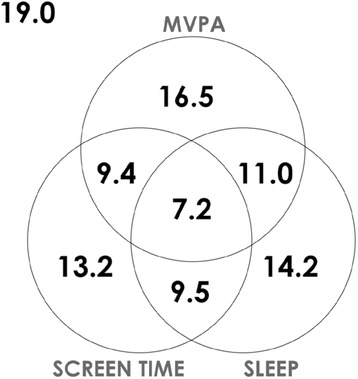
In 6,128 children aged 9–11 years from 12 ISCOLE countries, only 7.2% met all three 24-hour movement guidelines (MVPA, screen time, sleep), and meeting all three was associated with lower odds of obesity (OR 0.28, 95% CI 0.18–0.45) and lower BMI z-score. MVPA was the single recommendation most strongly associated with lower obesity odds.
Key findings
- Overall adherence to all three recommendations was 7.2%; the highest site prevalences were Australia (14.9%) and Canada (14.0%), and the lowest was China (1.5%).
- Children meeting all three recommendations had lower odds of obesity than those meeting none: total sample OR 0.28 (95% CI 0.18–0.45); boys OR 0.38 (95% CI 0.22–0.64); girls OR 0.11 (95% CI 0.04–0.35). The paper states children meeting the three recommendations were 72% less likely to be obese than those who did not meet them.
- Meeting any single recommendation was generally associated with lower obesity odds, especially MVPA: total sample OR 0.45 (95% CI 0.38–0.52) for MVPA, OR 0.67 (95% CI 0.58–0.77) for sleep, and OR 0.86 (95% CI 0.75–0.98) for screen time.
- Meeting all three recommendations was associated with the lowest BMI z-score: total sample 0.01 vs 0.49 for not meeting; boys 0.07 vs 0.58; girls −0.05 vs 0.41.
Methods
- Cross-sectional analysis of ISCOLE data collected September 2011–December 2013 from 6,128 children aged 9–11 years across 12 countries. From 7,372 ISCOLE participants, exclusions were invalid accelerometry (n = 1,214), missing screen time (n = 25), and missing BMI (n = 5).
- MVPA and sleep duration were assessed with 24-hour waist-worn Actigraph GT3X+ accelerometry; screen time was self-reported; height and weight were measured, BMI was calculated, and BMI z-scores used WHO age- and sex-specific reference data. Obesity was BMI z-score > +2 SD. Meeting guidelines was defined as 9–11 h/night sleep, ≤2 h/day screen time, and ≥60 min/day MVPA.
- Associations with obesity were assessed with odds ratios from generalized linear mixed models; differences in BMI z-scores were examined with linear mixed models. Models adjusted for age, sex, highest parental education, and unhealthy diet pattern score; study sites were fixed effects and schools nested within sites were random effects.
Limitations
- Stated in the paper: the cross-sectional design precludes cause-and-effect associations; possible residual confounding by unmeasured variables; sleep duration was analyzed without a measure of sleep quality; screen time was self-reported; and findings have limited generalizability to the whole population.
- Evident in the text: participants excluded for missing data had significantly higher BMI z-scores (0.61) than those included (0.46), suggesting possible selection bias; within-site samples were not intended to be nationally representative.
- Evident in the text: analyses by study site were not possible due to lack of statistical power for certain combinations of movement behaviors.
Model-written summary. Check it against the paper before relying on it.
Integrity signals
Registry
Cites
Statistics
Figures
Verification
Claims the paper makes
28 Own result · 27 Not checked yet · 14 Own method · 4 Own interpretation · 3 Partly supported · 1 Supported so far · 1 No basis given · accuracy not yet measured
The cited sources support only part of this claim — read each source’s verdict below.
In the paper
“Isolated adherence to MVPA, screen time and sleep duration recommendations have been associated with lower adiposity indicators in children and adolescents [3, 5–10].”
§ Proportion of children meeting recommendations for 24-hour movement guidelines and associations with adiposity in a 12-country study > Background
What the sources say
- Partly supportedcites [3] Chaput JP, Gray CE, Poitras VJ, Carson V, Gruber R, Olds T, Weiss SK, Connor Gorber S, Kho ME, Sampson M, Belanger K, Eryuzlu S, Callender L, Tremblay MS. Systematic review of the relationships between sleep duration and health indicators in school-aged children and youth. Appl Physiol Nutr Metab. 2016;41(6 Suppl 3):S266–82. sourceExperimental — accuracy not yet measured
The Adiposity section reports that longer sleep was consistently associated with lower adiposity indicators in children and youth. It does not establish that meeting a specific sleep-duration recommendation, rather than simply sleeping longer, is associated with lower adiposity; it also does not assess isolated adherence to MVPA or screen-time recommendations. (LLM, conf=0.82)
- Partly supportedcites [5] Griffiths LJ, Sera F, Cortina-Borja M, Law C, Ness A, Dezateux C. Objectively measured physical activity and sedentary time: cross-sectional and prospective associations with adiposity in the Millennium Cohort Study. BMJ Open. 2016;6(4):e010366. sourceExperimental — accuracy not yet measured
The Results (page unavailable) associate more MVPA with lower body and fat mass in 7-year-old children; the prospective association was present only in boys. The paper analyzes activity levels rather than adherence to MVPA recommendations, and it does not establish that meeting screen-time or sleep-duration recommendations is associated with lower adiposity. (LLM, conf=0.87)
- Partly supportedcites [6] Riso EM, Kull M, Mooses K, Hannus A, Jürimäe J. Objectively measured physical activity levels and sedentary time in 7-9-year-old Estonian schoolchildren: independent associations with body composition parameters. BMC Public Health. 2016;16:346. sourceExperimental — accuracy not yet measured
The Discussion reports that higher MVPA was independently associated with lower adiposity in 7–9-year-old children. It does not establish an association for adherence to screen-time or sleep-duration recommendations, and its own findings do not extend to adolescents. The reported MVPA association concerns activity levels rather than a direct comparison of children who did and did not meet the recommendation. (LLM, conf=0.88)
- Partly supportedcites [7] Marques A, Minderico C, Martins S, Palmeira A, Ekelund U, Sardinha LB. Cross-sectional and prospective associations between moderate to vigorous physical activity and sedentary time with adiposity in children. Int J Obes (Lond). 2016;40(1):28–33. sourceExperimental — accuracy not yet measured
The Results and Discussion report that more MVPA was associated with lower adiposity in children. The study measured MVPA and sedentary time as continuous variables, not adherence to recommendations; it did not assess sleep-duration recommendations or establish that meeting screen-time recommendations was associated with lower adiposity. Its participants were children, so it does not directly support the extension to adolescents. (LLM, conf=0.88)
- Partly supportedcites [8] Poitras VJ, Gray CE, Borghese MM, Carson V, Chaput JP, Janssen I, Katzmarzyk PT, Pate RR, Connor Gorber S, Kho ME, Sampson M, Tremblay MS. Systematic review of the relationships between objectively measured physical activity and health indicators in school-aged children and youth. Appl Physiol Nutr Metab. 2016;41(6 Suppl 3):S197–239. sourceExperimental — accuracy not yet measured
The Discussion reports favourable associations between meeting the ≥60-minute daily MVPA guideline and adiposity in children and youth. It does not report that meeting screen-time or sleep-duration recommendations is associated with lower adiposity; those parts of the sentence are not supported by this source. (LLM, conf=0.88)
- Not checked yetcites [9] Carson V, Hunter S, Kuzik N, Gray CE, Poitras VJ, Chaput JP, et al. Systematic review of sedentary behaviour and health indicators in school-aged children and youth: an update. Appl Physiol Nutr Metab. 2016;41(6 Suppl 3):S240–65. source
- Partly supportedcites [10] van Ekris E, Altenburg TM, Singh AS, Proper KI, Heymans MW, Chinapaw MJ. An evidence-update on the prospective relationship between childhood sedentary behaviour and biomedical health indicators: a systematic review and meta-analysis. Obes Rev. 2016; doi: 10.1111/obr.12426 sourceExperimental — accuracy not yet measured
The Anthropometrics section reports evidence of a relationship between screen time and BMI or overweight/obesity in children and adolescents. It does not establish that meeting a screen-time recommendation is associated with lower adiposity, or report corresponding findings for isolated adherence to MVPA and sleep-duration recommendations. The Discussion cautions that the screen-time findings need confirmation by more high-quality studies. (LLM, conf=0.86)
plaincorrelational- Asserted: passes — The authors put it forward as true.
- Checkable: passes — It can be checked against evidence.
- Load-bearing: passes — The paper’s conclusions depend on it.
- Based: passes — The paper gives a reason why it holds.
- Partly supported
A result the paper reports from its own data — it cites no other source for it, so there is none to check. The quote shows it is in the paper.
In the paper
“The mean overall adherence to the MVPA, screen time and sleep time recommendations were 44, 39 and 42%, respectively.”
- Also stated in: § Results · plain
“| All sites | 19.0 | 44.1 | 39.3 | 41.9 | 16.6 | 18.2 | 16.7 | 7.2 |”
§ Proportion of children meeting recommendations for 24-hour movement guidelines and associations with adiposity in a 12-country study > Results
plain- Asserted: passes — The authors put it forward as true.
- Checkable: passes — It can be checked against evidence.
- Load-bearing: unclear — It is unclear whether the paper’s conclusions depend on it.
- Based: passes — The paper gives a reason why it holds.
- Also stated in: § Results · plain
A result the paper reports from its own data — it cites no other source for it, so there is none to check. The quote shows it is in the paper.
In the paper
“Nineteen percent of the overall sample met none of the recommendations.”
- Also stated in: § Results · plain
“| All sites | 19.0 | 44.1 | 39.3 | 41.9 | 16.6 | 18.2 | 16.7 | 7.2 |”
§ Proportion of children meeting recommendations for 24-hour movement guidelines and associations with adiposity in a 12-country study > Results
plain- Asserted: passes — The authors put it forward as true.
- Checkable: passes — It can be checked against evidence.
- Load-bearing: unclear — It is unclear whether the paper’s conclusions depend on it.
- Based: passes — The paper gives a reason why it holds.
- Also stated in: § Results · plain
A result the paper reports from its own data — it cites no other source for it, so there is none to check. The quote shows it is in the paper.
In the paper
“The global prevalence of children meeting the overall recommendations (all three behaviors) was 7%, with children from Australia and Canada showing the highest adherence (15%).”
- Also stated in: § Results · plain
“| All sites | 19.0 | 44.1 | 39.3 | 41.9 | 16.6 | 18.2 | 16.7 | 7.2 |”
- Also stated in: § Conclusions · plain
“However, only a small percentage of children met all recommendations.”
§ Proportion of children meeting recommendations for 24-hour movement guidelines and associations with adiposity in a 12-country study > Abstract > Results
plainn = 6,128- Asserted: passes — The authors put it forward as true.
- Checkable: passes — It can be checked against evidence.
- Load-bearing: passes — The paper’s conclusions depend on it.
- Based: passes — The paper gives a reason why it holds.
- Rests on an assumption: The Canadian 24-h movement guidelines thresholds (9–11 h/night sleep, ≤2 h/day screen time, ≥60 min/day MVPA) are appropriate for children in all 12 ISCOLE countries.
- Also stated in: § Results · plain
A result the paper reports from its own data — it cites no other source for it, so there is none to check. The quote shows it is in the paper.
In the paper
“The mean overall adherence to the MVPA, screen time and sleep time recommendations were 44, 39 and 42%, respectively.”
- Also stated in: § Results · plain
“| All sites | 19.0 | 44.1 | 39.3 | 41.9 | 16.6 | 18.2 | 16.7 | 7.2 |”
§ Proportion of children meeting recommendations for 24-hour movement guidelines and associations with adiposity in a 12-country study > Results
plain- Asserted: passes — The authors put it forward as true.
- Checkable: passes — It can be checked against evidence.
- Load-bearing: unclear — It is unclear whether the paper’s conclusions depend on it.
- Based: passes — The paper gives a reason why it holds.
- Also stated in: § Results · plain
A result the paper reports from its own data — it cites no other source for it, so there is none to check. The quote shows it is in the paper.
In the paper
“When meeting only one of the recommendations, the adherence to the MVPA recommendation was the one that was associated with the lowest BMI z-score.”
§ Proportion of children meeting recommendations for 24-hour movement guidelines and associations with adiposity in a 12-country study > Results
plaincorrelational- Asserted: passes — The authors put it forward as true.
- Checkable: passes — It can be checked against evidence.
- Load-bearing: unclear — It is unclear whether the paper’s conclusions depend on it.
- Based: passes — The paper gives a reason why it holds.
- Rests on an assumption: The Canadian 24-h movement guidelines thresholds (9–11 h/night sleep, ≤2 h/day screen time, ≥60 min/day MVPA) are appropriate for children in all 12 ISCOLE countries.
- Rests on an assumption: Exclusion of participants with missing data did not materially bias the associations between movement behaviors and adiposity.
- Rests on an assumption: The main analyses had sufficient statistical power to detect the reported associations.
A result the paper reports from its own data — it cites no other source for it, so there is none to check. The quote shows it is in the paper.
In the paper
“Adherence to any combination of two recommendations resulted in lower odds ratios of being obese compared to children not meeting the recommendations.”
§ Proportion of children meeting recommendations for 24-hour movement guidelines and associations with adiposity in a 12-country study > Results
plaincorrelational- Asserted: passes — The authors put it forward as true.
- Checkable: passes — It can be checked against evidence.
- Load-bearing: passes — The paper’s conclusions depend on it.
- Based: passes — The paper gives a reason why it holds.
- Rests on an assumption: The Canadian 24-h movement guidelines thresholds (9–11 h/night sleep, ≤2 h/day screen time, ≥60 min/day MVPA) are appropriate for children in all 12 ISCOLE countries.
- Rests on an assumption: Exclusion of participants with missing data did not materially bias the associations between movement behaviors and adiposity.
- Rests on an assumption: The main analyses had sufficient statistical power to detect the reported associations.
A result the paper reports from its own data — it cites no other source for it, so there is none to check. The quote shows it is in the paper.
In the paper
“The figure clearly shows that there is very little co-occurrence of movement behaviors in this sample of children.”
§ Proportion of children meeting recommendations for 24-hour movement guidelines and associations with adiposity in a 12-country study > Results
boostedn = 6,128- Asserted: passes — The authors put it forward as true.
- Checkable: passes — It can be checked against evidence.
- Load-bearing: unclear — It is unclear whether the paper’s conclusions depend on it.
- Based: passes — The paper gives a reason why it holds.
A result the paper reports from its own data — it cites no other source for it, so there is none to check. The quote shows it is in the paper.
In the paper
“Meeting the 24-h guidelines was associated with having the lowest BMI z-score in boys (0.07) and girls (−0.05).”
§ Proportion of children meeting recommendations for 24-hour movement guidelines and associations with adiposity in a 12-country study > Results
plaincorrelational- Asserted: passes — The authors put it forward as true.
- Checkable: passes — It can be checked against evidence.
- Load-bearing: passes — The paper’s conclusions depend on it.
- Based: passes — The paper gives a reason why it holds.
- Rests on an assumption: The Canadian 24-h movement guidelines thresholds (9–11 h/night sleep, ≤2 h/day screen time, ≥60 min/day MVPA) are appropriate for children in all 12 ISCOLE countries.
- Rests on an assumption: Exclusion of participants with missing data did not materially bias the associations between movement behaviors and adiposity.
- Rests on an assumption: The main analyses had sufficient statistical power to detect the reported associations.
- It may state two separate claims as one. 22
- Probably not a substantial claim. 26
- The quote only partly states this claim. 1
The cited sources support only part of this claim — read each source’s verdict below.
In the paper
“In addition, most of the studies have been conducted in developed countries and only a few have included a multi-country analysis [16–18].”
§ Proportion of children meeting recommendations for 24-hour movement guidelines and associations with adiposity in a 12-country study > Background
What the sources say
- Partly supportedcites [16] Fernández-Alvira JM, te Velde SJ, De Bourdeaudhuij I, Bere E, Manios Y, Kovacs E, et al. Parental education associations with children’s body composition: mediation effects of energy balance-related behaviors within the ENERGY-project. Int J Behav Nutr Phys Act. 2013;10:80. sourceExperimental — accuracy not yet measured
The Methods (Study population and design; page unavailable) describe this study as an analysis of children in seven European countries, and the Discussion calls its sample multinational. That supports citing it as an example of a multi-country study in developed countries. Our copy does not establish that most studies were conducted in developed countries or that only a few were multi-country. (LLM, conf=0.78)
- Partly supportedcites [17] Wijnhoven TM, van Raaij JM, Yngve A, Sjöberg A, Kunešová M, Duleva V, et al. WHO European Childhood Obesity Surveillance Initiative: health-risk behaviours on nutrition and physical activity in 6-9-year-old schoolchildren. Public Health Nutr. 2015;18(17):3108–24. sourceExperimental — accuracy not yet measured
The Discussion (page unavailable in our copy) identifies six European-wide studies and contrasts them with country-specific studies, offering some support for the claim that relatively few studies use multi-country data. It does not say that most studies on the topic were conducted in developed countries, or establish a worldwide count of multi-country analyses. (LLM, conf=0.76)
- Partly supportedcites [18] Kovács E, Hunsberger M, Reisch L, Gwozdz W, Eiben G, De Bourdeaudhuij I, Russo P, Veidebaum T, Hadjigeorgiou C, Sieri S, Moreno LA, Pigeot I, Ahrens W, Pohlabeln H, Molnár D, IDEFICS consortium. Adherence to combined lifestyle factors and their contribution to obesity in the IDEFICS study. Obes Rev. 2015;16 Suppl 2:138–50. sourceExperimental — accuracy not yet measured
The Study subjects section describes a study of children in eight European countries, so this paper provides an example of a multi-country analysis in developed countries. It does not establish that most studies on the topic were conducted in developed countries or that only a few included multi-country analyses; the Introduction’s reference to developed countries concerns reports of obesity plateauing, not the distribution of studies on this topic. (LLM, conf=0.77)
plain- Asserted: passes — The authors put it forward as true.
- Checkable: passes — It can be checked against evidence.
- Load-bearing: passes — The paper’s conclusions depend on it.
- Based: passes — The paper gives a reason why it holds.
It may state two separate claims as one.
- Partly supported
The sources with a verdict support this claim; the rest weren’t checked yet, have no full text we could read, or their verdicts aren’t rated yet.
In the paper
“Although there is no clear consensus about how to define light-intensity activities by accelerometry [37, 38]”
§ Proportion of children meeting recommendations for 24-hour movement guidelines and associations with adiposity in a 12-country study > Discussion
What the sources say
- Not checked yetcites [37] Vanhelst J, Béghin L, Salleron J, Ruiz JR, Ortega FB, Ottevaere C, Molnar D, Kafatos A, Manios Y, Widhalm K, Casajus JA, Mauro B, Sjöström M, Gottrand F. Impact of the choice of threshold on physical activity patterns in free living conditions among adolescents measured using a uniaxial accelerometer: the HELENA study. J Sports Sci. 2014;32(2):110–5. source
- Supportedcites [38] Lee IM, Shiroma EJ. Using accelerometers to measure physical activity in large-scale epidemiological studies: issues and challenges. Br J Sports Med. 2014;48(3):197–201. source
In “Challenges related to data analyses” (page not specified), the paper says accelerometer cutpoints are used to classify activity by intensity and that there is no consensus on the correct cutpoints. That supports the claim about the lack of a clear accelerometric definition for light-intensity activity. (LLM, conf=0.88)
plain- Asserted: passes — The authors put it forward as true.
- Checkable: passes — It can be checked against evidence.
- Load-bearing: fails — The paper’s conclusions may not depend on it.
- Based: passes — The paper gives a reason why it holds.
Probably not a substantial claim. The paper’s conclusions may not depend on it.
The cited sources support only part of this claim — read each source’s verdict below.
In the paper
“This is in line with current recommendations and previous research showing that MVPA, screen time and sleep duration are the components of the 24-h day that are more strongly associated with obesity and other health outcomes [2, 4, 11, 14].”
§ Proportion of children meeting recommendations for 24-hour movement guidelines and associations with adiposity in a 12-country study > Discussion
What the sources say
- Partly supportedcites [2] Chaput JP, Carson V, Gray CE, Tremblay MS. Importance of all movement behaviors in a 24 hour period for overall health. Int J Environ Res Public Health. 2014;11(12):12575–81. sourceExperimental — accuracy not yet measured
The Introduction links MVPA, screen-based sedentary behavior and sleep duration to health outcomes, including obesity. But it does not say these three are more strongly associated with outcomes than other parts of the 24-hour day; the Conclusions instead emphasize health benefits across all components, including light physical activity. Page numbers are not available in our copy. (LLM, conf=0.86)
- Not checked yetcites [4] Tremblay MS, Carson V, Chaput JP, Connor Gorber S, Dinh T, Duggan M, et al. Canadian 24-Hour Movement Guidelines for Children and Youth: An Integration of Physical Activity, Sedentary Behaviour, and Sleep. Appl Physiol Nutr Metab. 2016;41(6 Suppl 3):S311–27. source
- Partly supportedcites [11] Saunders TJ, Gray CE, Poitras VJ, Chaput JP, Janssen I, Katzmarzyk PT, et al. Combinations of physical activity, sedentary behaviour and sleep: relationships with health indicators in school-aged children and youth. Appl Physiol Nutr Metab. 2016;41(6 Suppl 3):S283–93. sourceExperimental — accuracy not yet measured
The Adiposity section reports lower adiposity with combinations of higher physical activity, lower sedentary behaviour and longer sleep, and greater obesity odds when fewer steps/day, screen-time and sleep guidelines were met. The Discussion says benefits were most consistently associated with physical activity, especially MVPA. It does not establish that screen time and sleep duration, alongside MVPA, are each more strongly associated with obesity and other health outcomes than other components of the 24-hour day. (LLM, conf=0.85)
- Not checked yetcites [14] Carson V, Chaput J-P, Janssen I, Tremblay MS. Health associations with meeting new 24-hour movement guidelines for Canadian children and youth. Prev Med. (in press).
boostedcorrelational- Asserted: passes — The authors put it forward as true.
- Checkable: passes — It can be checked against evidence.
- Load-bearing: passes — The paper’s conclusions depend on it.
- Based: passes — The paper gives a reason why it holds.
Probably not a substantial claim. It may state two separate claims as one.
- Partly supported
A result the paper reports from its own data — it cites no other source for it, so there is none to check. The quote shows it is in the paper.
In the paper
“with children from Australia and Canada showing the highest adherence (15%)”
- Also stated in: § Results · plain
“Regarding the adherence to the 24-h movement guidelines, the countries with the highest prevalence to the overall recommendations were Australia and Canada (15 and 14% of the sample, respectively); the lowest adherence was found in China (2%).”
§ Proportion of children meeting recommendations for 24-hour movement guidelines and associations with adiposity in a 12-country study > Abstract > Results
plain- Asserted: passes — The authors put it forward as true.
- Checkable: passes — It can be checked against evidence.
- Load-bearing: unclear — It is unclear whether the paper’s conclusions depend on it.
- Based: passes — The paper gives a reason why it holds.
It may state two separate claims as one.
- Rests on an assumption: The Canadian 24-h movement guidelines thresholds (9–11 h/night sleep, ≤2 h/day screen time, ≥60 min/day MVPA) are appropriate for children in all 12 ISCOLE countries.
- Also stated in: § Results · plain
A result the paper reports from its own data — it cites no other source for it, so there is none to check. The quote shows it is in the paper.
In the paper
“Brazil, Portugal and the USA (29% each) were the countries with the highest prevalence of adherence to none of the recommendations, and Australia showed the lowest percentage of non-adherence (7%).”
§ Proportion of children meeting recommendations for 24-hour movement guidelines and associations with adiposity in a 12-country study > Results
plain- Asserted: passes — The authors put it forward as true.
- Checkable: passes — It can be checked against evidence.
- Load-bearing: unclear — It is unclear whether the paper’s conclusions depend on it.
- Based: passes — The paper gives a reason why it holds.
It may state two separate claims as one.
A result the paper reports from its own data — it cites no other source for it, so there is none to check. The quote shows it is in the paper.
In the paper
“The population with highest adherence to the MVPA guideline was found in Finland (61%) and the population with the lowest adherence was found in China (15%).”
§ Proportion of children meeting recommendations for 24-hour movement guidelines and associations with adiposity in a 12-country study > Results
plain- Asserted: passes — The authors put it forward as true.
- Checkable: passes — It can be checked against evidence.
- Load-bearing: unclear — It is unclear whether the paper’s conclusions depend on it.
- Based: passes — The paper gives a reason why it holds.
It may state two separate claims as one.
A result the paper reports from its own data — it cites no other source for it, so there is none to check. The quote shows it is in the paper.
In the paper
“The highest adherence to the sleep time recommendation was found in Australia and the UK (76%), and the lowest was found in Portugal (18%).”
§ Proportion of children meeting recommendations for 24-hour movement guidelines and associations with adiposity in a 12-country study > Results
plain- Asserted: passes — The authors put it forward as true.
- Checkable: passes — It can be checked against evidence.
- Load-bearing: unclear — It is unclear whether the paper’s conclusions depend on it.
- Based: passes — The paper gives a reason why it holds.
It may state two separate claims as one.
A result the paper reports from its own data — it cites no other source for it, so there is none to check. The quote shows it is in the paper.
In the paper
“Except for the screen time recommendation in boys and girls separately, the adherence to a single recommendation resulted in a lower odds ratio of being obese, especially when adhering to the MVPA recommendation.”
§ Proportion of children meeting recommendations for 24-hour movement guidelines and associations with adiposity in a 12-country study > Results
plaincorrelational- Asserted: passes — The authors put it forward as true.
- Checkable: passes — It can be checked against evidence.
- Load-bearing: passes — The paper’s conclusions depend on it.
- Based: passes — The paper gives a reason why it holds.
It may state two separate claims as one.
- Rests on an assumption: The Canadian 24-h movement guidelines thresholds (9–11 h/night sleep, ≤2 h/day screen time, ≥60 min/day MVPA) are appropriate for children in all 12 ISCOLE countries.
- Rests on an assumption: Exclusion of participants with missing data did not materially bias the associations between movement behaviors and adiposity.
- Rests on an assumption: The main analyses had sufficient statistical power to detect the reported associations.
A result the paper reports from its own data — it cites no other source for it, so there is none to check. The quote shows it is in the paper.
In the paper
“The highest and lowest proportion of the population meeting the screen time guideline was found in India (62%) and Brazil (24%), respectively.”
§ Proportion of children meeting recommendations for 24-hour movement guidelines and associations with adiposity in a 12-country study > Results
plain- Asserted: passes — The authors put it forward as true.
- Checkable: passes — It can be checked against evidence.
- Load-bearing: unclear — It is unclear whether the paper’s conclusions depend on it.
- Based: passes — The paper gives a reason why it holds.
It may state two separate claims as one.
A result the paper reports from its own data — it cites no other source for it, so there is none to check. The quote shows it is in the paper.
In the paper
“However, the MVPA recommendation was the single recommendation associated with the lowest overall odds ratios for obesity.”
- Also stated in: § Discussion · plain
“Our study also showed that children not meeting the MVPA guideline showed the highest odds ratios for obesity.”
§ Proportion of children meeting recommendations for 24-hour movement guidelines and associations with adiposity in a 12-country study > Discussion
plaincorrelational- Asserted: passes — The authors put it forward as true.
- Checkable: passes — It can be checked against evidence.
- Load-bearing: passes — The paper’s conclusions depend on it.
- Based: passes — The paper gives a reason why it holds.
It may state two separate claims as one. The quote only partly states this claim.
- Also stated in: § Discussion · plain
In the paper
“A low proportion of children from China, India and the USA met the recommendation of being physically active at least 60 min per day, data in line with the 15 to 28% prevalence coming from the International Children’s Accelerometry database [36].”
§ Proportion of children meeting recommendations for 24-hour movement guidelines and associations with adiposity in a 12-country study > Discussion
What the sources say
- Not checked yetcites [36] Cooper AR, Goodman A, Page AS, Sherar LB, Esliger DW, van Sluijs EM, et al. Objectively measured physical activity and sedentary time in youth: the International Children’s Accelerometry Database (ICAD). Int J Behav Nutr Phys Act. 2015;12:113. source
plain- Asserted: passes — The authors put it forward as true.
- Checkable: passes — It can be checked against evidence.
- Load-bearing: unclear — It is unclear whether the paper’s conclusions depend on it.
- Based: passes — The paper gives a reason why it holds.
It may state two separate claims as one.
A result the paper reports from its own data — it cites no other source for it, so there is none to check. The quote shows it is in the paper.
In the paper
“there was a trend showing similar results across all the countries in the study (data not shown)”
§ Proportion of children meeting recommendations for 24-hour movement guidelines and associations with adiposity in a 12-country study > Discussion
hedged- Asserted: passes — The authors put it forward as true.
- Checkable: passes — It can be checked against evidence.
- Load-bearing: passes — The paper’s conclusions depend on it.
- Based: passes — The paper gives a reason why it holds.
Probably not a substantial claim.
A result the paper reports from its own data — it cites no other source for it, so there is none to check. The quote shows it is in the paper.
In the paper
“It is concerning to see very low levels of adherence to the combined recommendations, especially in sites such as China, Portugal, the US and Brazil, which are the sites with the highest prevalence of obesity in ISCOLE.”
§ Proportion of children meeting recommendations for 24-hour movement guidelines and associations with adiposity in a 12-country study > Discussion
plaincorrelational- Asserted: passes — The authors put it forward as true.
- Checkable: passes — It can be checked against evidence.
- Load-bearing: passes — The paper’s conclusions depend on it.
- Based: passes — The paper gives a reason why it holds.
It may state two separate claims as one.
A result the paper reports from its own data — it cites no other source for it, so there is none to check. The quote shows it is in the paper.
In the paper
“Meeting all three movement behavior recommendations resulted in the lowest odds ratios for obesity, while meeting two guidelines was better than meeting one, and meeting one was better than meeting none.”
§ Proportion of children meeting recommendations for 24-hour movement guidelines and associations with adiposity in a 12-country study > Conclusions
plaincorrelational- Asserted: passes — The authors put it forward as true.
- Checkable: passes — It can be checked against evidence.
- Load-bearing: passes — The paper’s conclusions depend on it.
- Based: passes — The paper gives a reason why it holds.
It may state two separate claims as one.
None of the sources cited for this claim have been checked yet.
In the paper
“How combinations of these movements behaviors are associated with obesity is largely unknown as few studies have examined the influence of meeting specific movement behavior recommendation combinations and obesity, and only a subset have considered sleep duration as a health-related risk behavior in combined analyses [11–18].”
§ Proportion of children meeting recommendations for 24-hour movement guidelines and associations with adiposity in a 12-country study > Background
What the sources say
- Not checked yetcites [11] Saunders TJ, Gray CE, Poitras VJ, Chaput JP, Janssen I, Katzmarzyk PT, et al. Combinations of physical activity, sedentary behaviour and sleep: relationships with health indicators in school-aged children and youth. Appl Physiol Nutr Metab. 2016;41(6 Suppl 3):S283–93. source
- Not checked yetcites [12] Laurson KR, Lee JA, Gentile DA, Walsh DA, Eisenmann JC. Concurrent Associations between Physical Activity, Screen Time, and Sleep Duration with Childhood Obesity. ISRN Obes. 2014;. doi: 10.1155/2014/204540 . eCollection 2014. source
- Not checked yetcites [13] Laurson KR, Lee JA, Eisenmann JC. The cumulative impact of physical activity, sleep duration, and television time on adolescent obesity: 2011 Youth Risk Behavior Survey. J Phys Act Health. 2015;12(3):355–60. source
- Not checked yetcites [14] Carson V, Chaput J-P, Janssen I, Tremblay MS. Health associations with meeting new 24-hour movement guidelines for Canadian children and youth. Prev Med. (in press).
- Not checked yetcites [15] Pérez-Rodrigo C, Gil Á, González-Gross M, Ortega RM, Serra-Majem L, Varela-Moreiras G, et al. Clustering of Dietary Patterns, Lifestyles, and Overweight among Spanish Children and Adolescents in the ANIBES Study. Nutrients. 2015; doi: 10.3390/nu8010011 source
- Not checked yetcites [16] Fernández-Alvira JM, te Velde SJ, De Bourdeaudhuij I, Bere E, Manios Y, Kovacs E, et al. Parental education associations with children’s body composition: mediation effects of energy balance-related behaviors within the ENERGY-project. Int J Behav Nutr Phys Act. 2013;10:80. source
- Not checked yetcites [17] Wijnhoven TM, van Raaij JM, Yngve A, Sjöberg A, Kunešová M, Duleva V, et al. WHO European Childhood Obesity Surveillance Initiative: health-risk behaviours on nutrition and physical activity in 6-9-year-old schoolchildren. Public Health Nutr. 2015;18(17):3108–24. source
- Not checked yetcites [18] Kovács E, Hunsberger M, Reisch L, Gwozdz W, Eiben G, De Bourdeaudhuij I, Russo P, Veidebaum T, Hadjigeorgiou C, Sieri S, Moreno LA, Pigeot I, Ahrens W, Pohlabeln H, Molnár D, IDEFICS consortium. Adherence to combined lifestyle factors and their contribution to obesity in the IDEFICS study. Obes Rev. 2015;16 Suppl 2:138–50. source
plaincorrelational- Asserted: passes — The authors put it forward as true.
- Checkable: passes — It can be checked against evidence.
- Load-bearing: passes — The paper’s conclusions depend on it.
- Based: passes — The paper gives a reason why it holds.
It may state two separate claims as one.
What the paper did — it cites no source for this, so there is none to check. The quote shows it is in the paper.
In the paper
“By design, the within-site samples were not intended to be nationally representative.”
§ Proportion of children meeting recommendations for 24-hour movement guidelines and associations with adiposity in a 12-country study > Methods > Setting
plain- Asserted: passes — The authors put it forward as true.
- Checkable: passes — It can be checked against evidence.
- Load-bearing: passes — The paper’s conclusions depend on it.
- Based: passes — The paper gives a reason why it holds.
Probably not a substantial claim.
None of the sources cited for this claim have been checked yet.
In the paper
“This new algorithm produces more precise estimates of sleep duration than previous algorithms and captures total sleep time from sleep onset to the end of sleep, including all epochs and wakefulness after onset [24, 25].”
§ Proportion of children meeting recommendations for 24-hour movement guidelines and associations with adiposity in a 12-country study > Methods > Measurement of sleep duration and lifestyle behaviors
What the sources say
- Not checked yetcites [24] Barreira TV, Schuna Jr JM, Mire EF, Katzmarzyk PT, Chaput JP, Leduc G, et al. Identifying children’s nocturnal sleep using a 24-h waist accelerometry. Med Sci Sports Exerc. 2015;47:937–43. source
- Not checked yetcites [25] Tudor-Locke C, Barreira TV, Schuna Jr JM, Mire EF, Katzmarzyk PT. Fully automated waist-worn accelerometer algorithm for detecting children’s sleep-period time separate from 24-h physical activity or sedentary behaviors. Appl Physiol Nutr Metab. 2014;39:53–7. source
plaindirect- Asserted: passes — The authors put it forward as true.
- Checkable: passes — It can be checked against evidence.
- Load-bearing: fails — The paper’s conclusions may not depend on it.
- Based: passes — The paper gives a reason why it holds.
Probably not a substantial claim. The paper’s conclusions may not depend on it.
What the paper did — it cites no source for this, so there is none to check. The quote shows it is in the paper.
In the paper
“Of note, biological maturity was estimated using the maturity offset method in ISCOLE; however, because age and weight are included in the maturity offset calculation, biological maturity was not included as a covariate in our analyses.”
§ Proportion of children meeting recommendations for 24-hour movement guidelines and associations with adiposity in a 12-country study > Methods > Covariates
plain- Asserted: passes — The authors put it forward as true.
- Checkable: passes — It can be checked against evidence.
- Load-bearing: fails — The paper’s conclusions may not depend on it.
- Based: passes — The paper gives a reason why it holds.
Probably not a substantial claim. The paper’s conclusions may not depend on it.
In the paper
“Body weight and height were measured according to standardized procedures by trained ISCOLE staff [22].”
§ Proportion of children meeting recommendations for 24-hour movement guidelines and associations with adiposity in a 12-country study > Methods > Ascertainment of obesity
What the sources say
- Not checked yetcites [22] Katzmarzyk PT, Barreira TV, Broyles ST, Champagne CM, Chaput JP, Fogelholm M, et al. The International Study of Childhood Obesity, Lifestyle and the Environment (ISCOLE): design and methods. BMC Public Health. 2013;13:900. source
plain- Asserted: passes — The authors put it forward as true.
- Checkable: passes — It can be checked against evidence.
- Load-bearing: passes — The paper’s conclusions depend on it.
- Based: passes — The paper gives a reason why it holds.
Probably not a substantial claim.
In the paper
“Furthermore, self-report methods of quantifying screen time have been reported to have acceptable reliability and validity in children [29].”
§ Proportion of children meeting recommendations for 24-hour movement guidelines and associations with adiposity in a 12-country study > Methods > Measurement of sleep duration and lifestyle behaviors
What the sources say
- Not checked yetcites [29] Lubans DR, Hesketh K, Cliff DP, Barnett LM, Salmon J, Dollman J, et al. A systematic review of the validity and reliability of sedentary behaviour measures used with children and adolescents. Obes Rev. 2011;12:781–99. source
plain- Asserted: passes — The authors put it forward as true.
- Checkable: passes — It can be checked against evidence.
- Load-bearing: passes — The paper’s conclusions depend on it.
- Based: passes — The paper gives a reason why it holds.
Probably not a substantial claim. It may state two separate claims as one.
In the paper
“Although not tested individually in every participating country, the TV viewing time question was shown to have adequate reliability with a one week test-retest interval (Spearman correlation = 0.55–0.68) and validity as compared to 7-day TV time use logs (Spearman correlation = 0.47) [28].”
§ Proportion of children meeting recommendations for 24-hour movement guidelines and associations with adiposity in a 12-country study > Methods > Measurement of sleep duration and lifestyle behaviors
What the sources say
- Not checked yetcites [28] Schmitz KH, Harnack L, Fulton JE, Jacobs DR, Gao S, Lytle LA, et al. Reliability and validity of a brief questionnaire to assess television viewing and computer use by middle school children. J Sch Health. 2004;74:370–7. source
plaincorrelational- Asserted: passes — The authors put it forward as true.
- Checkable: passes — It can be checked against evidence.
- Load-bearing: unclear — It is unclear whether the paper’s conclusions depend on it.
- Based: passes — The paper gives a reason why it holds.
It may state two separate claims as one.
None of the sources cited for this claim have been checked yet.
In the paper
“The relationship of adherence to the 24-h movement guidelines with obesity had been previously evaluated in a sample of Canadian and US children and adolescents [12–14].”
§ Proportion of children meeting recommendations for 24-hour movement guidelines and associations with adiposity in a 12-country study > Discussion
What the sources say
- Not checked yetcites [12] Laurson KR, Lee JA, Gentile DA, Walsh DA, Eisenmann JC. Concurrent Associations between Physical Activity, Screen Time, and Sleep Duration with Childhood Obesity. ISRN Obes. 2014;. doi: 10.1155/2014/204540 . eCollection 2014. source
- Not checked yetcites [13] Laurson KR, Lee JA, Eisenmann JC. The cumulative impact of physical activity, sleep duration, and television time on adolescent obesity: 2011 Youth Risk Behavior Survey. J Phys Act Health. 2015;12(3):355–60. source
- Not checked yetcites [14] Carson V, Chaput J-P, Janssen I, Tremblay MS. Health associations with meeting new 24-hour movement guidelines for Canadian children and youth. Prev Med. (in press).
plaincorrelational- Asserted: passes — The authors put it forward as true.
- Checkable: passes — It can be checked against evidence.
- Load-bearing: fails — The paper’s conclusions may not depend on it.
- Based: passes — The paper gives a reason why it holds.
Probably not a substantial claim. The paper’s conclusions may not depend on it.
What the paper did — it cites no source for this, so there is none to check. The quote shows it is in the paper.
In the paper
“Models were presented for the total sample and by sex only; analyses by study site were not possible due to a lack of statistical power for certain combinations of movement behaviors.”
§ Proportion of children meeting recommendations for 24-hour movement guidelines and associations with adiposity in a 12-country study > Methods > Statistical analysis
plain- Asserted: passes — The authors put it forward as true.
- Checkable: passes — It can be checked against evidence.
- Load-bearing: fails — The paper’s conclusions may not depend on it.
- Based: passes — The paper gives a reason why it holds.
Probably not a substantial claim. The paper’s conclusions may not depend on it.
In the paper
“A standard protocol was used to collect data across all sites, and all study personnel underwent rigorous training and certification before and during the data collection to ensure the quality of data collected [22].”
§ Proportion of children meeting recommendations for 24-hour movement guidelines and associations with adiposity in a 12-country study > Methods > Setting
What the sources say
- Not checked yetcites [22] Katzmarzyk PT, Barreira TV, Broyles ST, Champagne CM, Chaput JP, Fogelholm M, et al. The International Study of Childhood Obesity, Lifestyle and the Environment (ISCOLE): design and methods. BMC Public Health. 2013;13:900. source
plain- Asserted: passes — The authors put it forward as true.
- Checkable: passes — It can be checked against evidence.
- Load-bearing: passes — The paper’s conclusions depend on it.
- Based: passes — The paper gives a reason why it holds.
Probably not a substantial claim. It may state two separate claims as one.
In the paper
“They found that children with an unhealthier physical activity-risk behavior score (defined as the combination of the use of inactive transportation going to and from school, going to a sports or dancing club less than 2 days/week, playing outside less than 1 h/day, engaging in screen time 2 or more hours/day, and a sleep duration lower than 9 h/day) were more likely to be obese than children with”
§ Proportion of children meeting recommendations for 24-hour movement guidelines and associations with adiposity in a 12-country study > Discussion
What the sources say
- Not checked yetcites [17] Wijnhoven TM, van Raaij JM, Yngve A, Sjöberg A, Kunešová M, Duleva V, et al. WHO European Childhood Obesity Surveillance Initiative: health-risk behaviours on nutrition and physical activity in 6-9-year-old schoolchildren. Public Health Nutr. 2015;18(17):3108–24. source
plaincorrelational- Asserted: passes — The authors put it forward as true.
- Checkable: passes — It can be checked against evidence.
- Load-bearing: fails — The paper’s conclusions may not depend on it.
- Based: passes — The paper gives a reason why it holds.
Probably not a substantial claim. The paper’s conclusions may not depend on it.
In the paper
“An unhealthier combination of low physical activity and poor diet was also more prevalent in girls, older children and those from lower socio-economic backgrounds [15].”
§ Proportion of children meeting recommendations for 24-hour movement guidelines and associations with adiposity in a 12-country study > Discussion
What the sources say
- Not checked yetcites [15] Pérez-Rodrigo C, Gil Á, González-Gross M, Ortega RM, Serra-Majem L, Varela-Moreiras G, et al. Clustering of Dietary Patterns, Lifestyles, and Overweight among Spanish Children and Adolescents in the ANIBES Study. Nutrients. 2015; doi: 10.3390/nu8010011 source
plaincorrelational- Asserted: passes — The authors put it forward as true.
- Checkable: passes — It can be checked against evidence.
- Load-bearing: fails — The paper’s conclusions may not depend on it.
- Based: passes — The paper gives a reason why it holds.
Probably not a substantial claim. The paper’s conclusions may not depend on it.
None of the sources cited for this claim have been checked yet.
In the paper
“some studies indicate that most children spend a large proportion of their awake time being active at low levels of intensity [39–41], especially girls [40].”
§ Proportion of children meeting recommendations for 24-hour movement guidelines and associations with adiposity in a 12-country study > Discussion
What the sources say
- Not checked yetcites [39] Collings PJ, Wijndaele K, Corder K, Westgate K, Ridgway CL, Dunn V, Goodyer I, Ekelund U, Brage S. Levels and patterns of objectively-measured physical activity volume and intensity distribution in UK adolescents: the ROOTS study. Int J Behav Nutr Phys Act. 2014;11:23. source
- Not checked yetcites [40] Ishii K, Shibata A, Adachi M, Nonoue K, Oka K. Gender and grade differences in objectively measured physical activity and sedentary behavior patterns among Japanese children and adolescents: a cross-sectional study. BMC Public Health. 2015;15:1254. source
- Not checked yetcites [41] Verloigne M, Van Lippevelde W, Maes L, Yıldırım M, Chinapaw M, Manios Y, Androutsos O, Kovács E, Bringolf-Isler B, Brug J, De Bourdeaudhuij I. Levels of physical activity and sedentary time among 10- to 12-year-old boys and girls across 5 European countries using accelerometers: an observational study within the ENERGY-project. Int J Behav Nutr Phys Act. 2012;9:34. source
hedgedcorrelational- Asserted: passes — The authors put it forward as true.
- Checkable: passes — It can be checked against evidence.
- Load-bearing: fails — The paper’s conclusions may not depend on it.
- Based: passes — The paper gives a reason why it holds.
Probably not a substantial claim. The paper’s conclusions may not depend on it. It may state two separate claims as one.
None of the sources cited for this claim have been checked yet.
In the paper
“behaviors most frequently related to negative health outcomes [8, 9].”
§ Proportion of children meeting recommendations for 24-hour movement guidelines and associations with adiposity in a 12-country study > Discussion
What the sources say
- Not checked yetcites [8] Poitras VJ, Gray CE, Borghese MM, Carson V, Chaput JP, Janssen I, Katzmarzyk PT, Pate RR, Connor Gorber S, Kho ME, Sampson M, Tremblay MS. Systematic review of the relationships between objectively measured physical activity and health indicators in school-aged children and youth. Appl Physiol Nutr Metab. 2016;41(6 Suppl 3):S197–239. source
- Not checked yetcites [9] Carson V, Hunter S, Kuzik N, Gray CE, Poitras VJ, Chaput JP, et al. Systematic review of sedentary behaviour and health indicators in school-aged children and youth: an update. Appl Physiol Nutr Metab. 2016;41(6 Suppl 3):S240–65. source
plaincorrelational- Asserted: passes — The authors put it forward as true.
- Checkable: passes — It can be checked against evidence.
- Load-bearing: fails — The paper’s conclusions may not depend on it.
- Based: passes — The paper gives a reason why it holds.
Probably not a substantial claim. The paper’s conclusions may not depend on it.
In the paper
“They identified a short sleeper inactive cluster that was most prevalent in Greece and contained the highest proportion of overweight and obese boys and girls.”
§ Proportion of children meeting recommendations for 24-hour movement guidelines and associations with adiposity in a 12-country study > Discussion
What the sources say
- Not checked yetcites [16] Fernández-Alvira JM, te Velde SJ, De Bourdeaudhuij I, Bere E, Manios Y, Kovacs E, et al. Parental education associations with children’s body composition: mediation effects of energy balance-related behaviors within the ENERGY-project. Int J Behav Nutr Phys Act. 2013;10:80. source
plaincorrelational- Asserted: passes — The authors put it forward as true.
- Checkable: passes — It can be checked against evidence.
- Load-bearing: fails — The paper’s conclusions may not depend on it.
- Based: passes — The paper gives a reason why it holds.
Probably not a substantial claim. The paper’s conclusions may not depend on it. It may state two separate claims as one.
A conclusion the paper draws from its own results — it cites no other source for it, so there is none to check. The quote shows it is in the paper.
In the paper
“stressing the importance of the 24-h movement recommendations to prevent obesity in all countries.”
§ Proportion of children meeting recommendations for 24-hour movement guidelines and associations with adiposity in a 12-country study > Discussion
plaindirect- Asserted: passes — The authors put it forward as true.
- Checkable: fails — It may be too vague to check against evidence.
- Load-bearing: passes — The paper’s conclusions depend on it.
- Based: passes — The paper gives a reason why it holds.
Probably not a substantial claim. It may be too vague to check against evidence.
In the paper
“Pérez-Rodrigo et al. [15] identified a combination of high physical activity level, low sedentary time and longer sleep time to be associated with a lower prevalence of obesity in a representative sample of Spanish children.”
§ Proportion of children meeting recommendations for 24-hour movement guidelines and associations with adiposity in a 12-country study > Discussion
What the sources say
- Not checked yetcites [15] Pérez-Rodrigo C, Gil Á, González-Gross M, Ortega RM, Serra-Majem L, Varela-Moreiras G, et al. Clustering of Dietary Patterns, Lifestyles, and Overweight among Spanish Children and Adolescents in the ANIBES Study. Nutrients. 2015; doi: 10.3390/nu8010011 source
plaincorrelational- Asserted: passes — The authors put it forward as true.
- Checkable: passes — It can be checked against evidence.
- Load-bearing: fails — The paper’s conclusions may not depend on it.
- Based: passes — The paper gives a reason why it holds.
Probably not a substantial claim. The paper’s conclusions may not depend on it.
None of the sources cited for this claim have been checked yet.
In the paper
“The results are similar to those found in the WHO analysis [17] where only 8% of children achieved the best classification in the physical activity-risk behavior score and the Canadian and US studies, with a range of compliance between 5 and 17% of the population [12–14].”
§ Proportion of children meeting recommendations for 24-hour movement guidelines and associations with adiposity in a 12-country study > Discussion
What the sources say
- Not checked yetcites [17] Wijnhoven TM, van Raaij JM, Yngve A, Sjöberg A, Kunešová M, Duleva V, et al. WHO European Childhood Obesity Surveillance Initiative: health-risk behaviours on nutrition and physical activity in 6-9-year-old schoolchildren. Public Health Nutr. 2015;18(17):3108–24. source
- Not checked yetcites [12] Laurson KR, Lee JA, Gentile DA, Walsh DA, Eisenmann JC. Concurrent Associations between Physical Activity, Screen Time, and Sleep Duration with Childhood Obesity. ISRN Obes. 2014;. doi: 10.1155/2014/204540 . eCollection 2014. source
- Not checked yetcites [13] Laurson KR, Lee JA, Eisenmann JC. The cumulative impact of physical activity, sleep duration, and television time on adolescent obesity: 2011 Youth Risk Behavior Survey. J Phys Act Health. 2015;12(3):355–60. source
- Not checked yetcites [14] Carson V, Chaput J-P, Janssen I, Tremblay MS. Health associations with meeting new 24-hour movement guidelines for Canadian children and youth. Prev Med. (in press).
plain- Asserted: passes — The authors put it forward as true.
- Checkable: passes — It can be checked against evidence.
- Load-bearing: unclear — It is unclear whether the paper’s conclusions depend on it.
- Based: passes — The paper gives a reason why it holds.
It may state two separate claims as one.
None of the sources cited for this claim have been checked yet.
In the paper
“The studies by Duncan et al. [34] and Danielzik et al. [35] were the first ones that examined the cumulative effects of multiple risk factors on adiposity in children.”
§ Proportion of children meeting recommendations for 24-hour movement guidelines and associations with adiposity in a 12-country study > Discussion
What the sources say
- Not checked yetcites [34] Duncan JS, Schofield G, Duncan EK, Rush EC. Risk factors for excess body fatness in New Zealand children. Asia Pac J Clin Nutr. 2008;17(1):138–47.
- Not checked yetcites [35] Danielzik S, Czerwinski-Mast M, Langnäse K, Dilba B, Müller MJ. Parental overweight, socioeconomic status and high birth weight are the major determinants of overweight and obesity in 5–7 y-old children: baseline data of the Kiel Obesity Prevention Study (KOPS). Int J Obes Relat Metab Disord. 2004;28(11):1494–502. source
plain- Asserted: passes — The authors put it forward as true.
- Checkable: passes — It can be checked against evidence.
- Load-bearing: fails — The paper’s conclusions may not depend on it.
- Based: passes — The paper gives a reason why it holds.
Probably not a substantial claim. The paper’s conclusions may not depend on it.
In the paper
“MVPA only accounts for a small proportion (<5%) of the 24-h period, with the remaining 95% dedicated to sleep, sedentary behavior and light-intensity activities [2].”
§ Proportion of children meeting recommendations for 24-hour movement guidelines and associations with adiposity in a 12-country study > Discussion
What the sources say
- Not checked yetcites [2] Chaput JP, Carson V, Gray CE, Tremblay MS. Importance of all movement behaviors in a 24 hour period for overall health. Int J Environ Res Public Health. 2014;11(12):12575–81. source
plain- Asserted: passes — The authors put it forward as true.
- Checkable: passes — It can be checked against evidence.
- Load-bearing: fails — The paper’s conclusions may not depend on it.
- Based: passes — The paper gives a reason why it holds.
Probably not a substantial claim. The paper’s conclusions may not depend on it. It may state two separate claims as one.
None of the sources cited for this claim have been checked yet.
In the paper
“Except for the study by Duncan et al. that was conducted in New Zealand [34], all of them were conducted in European countries, either analyzing selected samples [35], national samples [15] or multi-country data [16, 17].”
§ Proportion of children meeting recommendations for 24-hour movement guidelines and associations with adiposity in a 12-country study > Discussion
What the sources say
- Not checked yetcites [34] Duncan JS, Schofield G, Duncan EK, Rush EC. Risk factors for excess body fatness in New Zealand children. Asia Pac J Clin Nutr. 2008;17(1):138–47.
- Not checked yetcites [35] Danielzik S, Czerwinski-Mast M, Langnäse K, Dilba B, Müller MJ. Parental overweight, socioeconomic status and high birth weight are the major determinants of overweight and obesity in 5–7 y-old children: baseline data of the Kiel Obesity Prevention Study (KOPS). Int J Obes Relat Metab Disord. 2004;28(11):1494–502. source
- Not checked yetcites [15] Pérez-Rodrigo C, Gil Á, González-Gross M, Ortega RM, Serra-Majem L, Varela-Moreiras G, et al. Clustering of Dietary Patterns, Lifestyles, and Overweight among Spanish Children and Adolescents in the ANIBES Study. Nutrients. 2015; doi: 10.3390/nu8010011 source
plain- Asserted: passes — The authors put it forward as true.
- Checkable: passes — It can be checked against evidence.
- Load-bearing: fails — The paper’s conclusions may not depend on it.
- Based: passes — The paper gives a reason why it holds.
Probably not a substantial claim. The paper’s conclusions may not depend on it. It may state two separate claims as one.
In the paper
“The relationship between light-intensity physical activity and health outcomes is largely unknown, partly due to the difficulty of its quantification as many methods to measure physical activity are not precise enough to capture such activities [38].”
§ Proportion of children meeting recommendations for 24-hour movement guidelines and associations with adiposity in a 12-country study > Discussion
What the sources say
- Not checked yetcites [38] Lee IM, Shiroma EJ. Using accelerometers to measure physical activity in large-scale epidemiological studies: issues and challenges. Br J Sports Med. 2014;48(3):197–201. source
plain- Asserted: passes — The authors put it forward as true.
- Checkable: passes — It can be checked against evidence.
- Load-bearing: fails — The paper’s conclusions may not depend on it.
- Based: passes — The paper gives a reason why it holds.
Probably not a substantial claim. The paper’s conclusions may not depend on it. It may state two separate claims as one.
What the paper did — it cites no source for this, so there is none to check. The quote shows it is in the paper.
In the paper
“the analysis of sleep duration without a measure of sleep quality”
§ Proportion of children meeting recommendations for 24-hour movement guidelines and associations with adiposity in a 12-country study > Discussion
plain- Asserted: passes — The authors put it forward as true.
- Checkable: passes — It can be checked against evidence.
- Load-bearing: fails — The paper’s conclusions may not depend on it.
- Based: passes — The paper gives a reason why it holds.
Probably not a substantial claim. The paper’s conclusions may not depend on it.
What the paper did — it cites no source for this, so there is none to check. The quote shows it is in the paper.
In the paper
“the possibility of residual confounding by unmeasured variables”
§ Proportion of children meeting recommendations for 24-hour movement guidelines and associations with adiposity in a 12-country study > Discussion
hedged- Asserted: passes — The authors put it forward as true.
- Checkable: passes — It can be checked against evidence.
- Load-bearing: fails — The paper’s conclusions may not depend on it.
- Based: passes — The paper gives a reason why it holds.
Probably not a substantial claim. The paper’s conclusions may not depend on it.
What the paper did — it cites no source for this, so there is none to check. The quote shows it is in the paper.
In the paper
“the limited generalizability of our data to the whole population”
§ Proportion of children meeting recommendations for 24-hour movement guidelines and associations with adiposity in a 12-country study > Discussion
plain- Asserted: passes — The authors put it forward as true.
- Checkable: passes — It can be checked against evidence.
- Load-bearing: fails — The paper’s conclusions may not depend on it.
- Based: fails — The paper may give no reason why it holds.
Probably not a substantial claim. The paper’s conclusions may not depend on it. The paper may give no reason why it holds.
What the paper did — it cites no source for this, so there is none to check. The quote shows it is in the paper.
In the paper
“the use of a self-reported questionnaire to assess screen time”
§ Proportion of children meeting recommendations for 24-hour movement guidelines and associations with adiposity in a 12-country study > Discussion
plain- Asserted: passes — The authors put it forward as true.
- Checkable: passes — It can be checked against evidence.
- Load-bearing: fails — The paper’s conclusions may not depend on it.
- Based: passes — The paper gives a reason why it holds.
Probably not a substantial claim. The paper’s conclusions may not depend on it.
The paper relies on this without support.
The Canadian 24-h movement guidelines thresholds (9–11 h/night sleep, ≤2 h/day screen time, ≥60 min/day MVPA) are appropriate for children in all 12 ISCOLE countries.
“Meeting the overall 24-h movement guidelines was defined as: 9 to 11 h/night of sleep, ≤2 h/day of screen time, and at least 60 min/day of MVPA.”
“The 24-h movement guidelines recently developed in Canada represent a paradigm shift in thinking about movement behaviors [4] from a focus on a single specific movement behavior type (e.g., MVPA) to an integrated movement behavior model.”
The paper relies on this without support.
Exclusion of participants with missing data did not materially bias the associations between movement behaviors and adiposity.
“Participants excluded due to missing data had significantly higher BMI z-scores (0.61) compared to those included in the present analytical sample (0.46).”
The paper relies on this without support.
The main analyses had sufficient statistical power to detect the reported associations.
“Models were presented for the total sample and by sex only; analyses by study site were not possible due to a lack of statistical power for certain combinations of movement behaviors.”
The paper relies on this without support.
Self-reported screen time is a valid measure of screen time in all 12 participating countries.
“Although not tested individually in every participating country, the TV viewing time question was shown to have adequate reliability with a one week test-retest interval (Spearman correlation = 0.55–0.68) and validity as compared to 7-day TV time use logs (Spearman correlation = 0.47) [28].”
The paper relies on this without support.
How children distribute their time during the day may affect their total energy expenditure.
“How children distribute their time during the day may affect their total energy expenditure.”
The paper relies on this without support.
There are currently no specific recommendations for light-intensity activities or non-screen sedentary behaviors.
“Consequently, there are currently no specific recommendations for light-intensity activities or non-screen sedentary behaviors.”
Claims other papers make about this one
Each is checked against this paper’s own text: does it say what the citing paper says it does?
In the citing paper
“the prevalence of children and adolescents from different countries around the world who meet all three recommendations contained within the guidelines varies between 3 to 10% [18–23].”
Self-check
Percentages, sums and reported differences re-computed from the paper’s own numbers.
Each contradiction between two passages listed here was confirmed by an independent check.
Rated minor: it would not touch a result — a value no result rests on, a p-value that stays on the same side of the significance level, or a conflict that is clerical, resolved elsewhere in the paper, or outside its own findings.
In the paper
§ Proportion of children meeting recommendations for 24-hour movement guidelines and associations with adiposity in a 12-country study > Results
“The mean screen time was 2.9 h/day and ranged from 2 h/day in India to 3.4 h/day in the USA.”
§ Proportion of children meeting recommendations for 24-hour movement guidelines and associations with adiposity in a 12-country study > Results
“| Brazil (Sao Paulo) | 469 (48.6) | 10.5 (0.5) | 59.6 (26.3) | 3.9 (2.2)”
Rated minor: it would not touch a result — a value no result rests on, a p-value that stays on the same side of the significance level, or a conflict that is clerical, resolved elsewhere in the paper, or outside its own findings.
In the paper
§ Proportion of children meeting recommendations for 24-hour movement guidelines and associations with adiposity in a 12-country study > Abstract > Results
“children from Australia and Canada showing the highest adherence (15%)”
§ Proportion of children meeting recommendations for 24-hour movement guidelines and associations with adiposity in a 12-country study > Results
“| Canada (Ottawa) | 14.4 | 42.6 | 44.8 | 58.6 | 20.3 | 24.7 | 29.4 | 14.0 |”
Citations
Cites
Development of a WHO growth reference for school-aged children and adolescents
de Onis, M. (2007) · Bulletin of the World Health Organization · doi:10.2471/blt.07.043497 · Cited by 8,826
Small sample inference for fixed effects from restricted maximum likelihood
Kenward, M. G., & Roger, J. H. (1997) · Biometrics · doi:10.2307/2533558 · Cited by 4,552 · cited 1×
“The denominator degrees of freedom for statistical tests pertaining to fixed effects were calculated using the Kenward and Roger approximation [33].”
MethodNational Sleep Foundation's sleep time duration recommendations: methodology and results summary.
Hirshkowitz, M., Whiton, K., Albert, S. M., Alessi, C., Bruni, O., DonCarlos, L., Hazen, N., Herman, J., Katz, E. S., Kheirandish-Gozal, L., et al. (2015) · Sleep Health · doi:10.1016/j.sleh.2014.12.010 · Cited by 4,404 · cited 1×
“We also calculated the proportion of children meeting the weekly average MVPA (≥60 min/day), screen time (≤2 h/day), and sleep duration (9–11 h/night) [4, 32] recommendations, and combinations of these recommendations, by study site.”
MethodCalibration of two objective measures of physical activity for children
Evenson, K. R., Catellier, D. J., Gill, K., Ondrak, K. S., & McMurray, R. G. (2008) · Journal of Sports Sciences · doi:10.1080/02640410802334196 · Cited by 2,677 · cited 1×
“After exclusion of total sleep time and awake non-wear time (any sequence of ≥20 consecutive minutes of 0 activity counts), MVPA was defined as all activity ≥574 counts per 15 s [26].”
MethodPoitras, V. J., Gray, C. E., Borghese, M. M., Carson, V., Chaput, J.-P., Janssen, I., Katzmarzyk, P. T., Pate, R. R., Connor Gorber, S., Kho, M. E., et al. (2016) · Applied Physiology, Nutrition, and Metabolism · doi:10.1139/apnm-2015-0663 · Cited by 2,217 · cited 1×
“In addition to not meeting the minimum amount of recommended physical activity, the majority of the sample engaged in recreational screen time for more than 2 hours per day, behaviors most frequently related to negative health outcomes [8, 9].”
BackgroundSelf-citationSystematic review of sedentary behaviour and health indicators in school-aged children and youth.
Tremblay, M. S., LeBlanc, A. G., Kho, M. E., Saunders, T. J., Larouche, R., Colley, R. C., Goldfield, G., & Gorber, S. (2011) · International Journal of Behavioral Nutrition and Physical Activity · doi:10.1186/1479-5868-8-98 · Cited by 2,085
Self-citationTremblay, M. S., Carson, V., Chaput, J.-P., Connor Gorber, S., Dinh, T., Duggan, M., Faulkner, G., Gray, C. E., Gruber, R., Janson, K., et al. (2016) · Applied Physiology, Nutrition, and Metabolism · doi:10.1139/apnm-2016-0151 · Cited by 2,024 · cited 3×
“We also calculated the proportion of children meeting the weekly average MVPA (≥60 min/day), screen time (≤2 h/day), and sleep duration (9–11 h/night) [4, 32] recommendations, and combinations of these recommendations, by study site.”
BackgroundMethodResultSelf-citationCarson, V., Hunter, S., Kuzik, N., Gray, C. E., Poitras, V. J., Chaput, J.-P., Saunders, T. J., Katzmarzyk, P. T., Okely, A. D., Connor Gorber, S., et al. (2016) · Applied Physiology, Nutrition, and Metabolism · doi:10.1139/apnm-2015-0630 · Cited by 1,380 · cited 1×
“In addition to not meeting the minimum amount of recommended physical activity, the majority of the sample engaged in recreational screen time for more than 2 hours per day, behaviors most frequently related to negative health outcomes [8, 9].”
BackgroundSelf-citationChaput, J.-P., Gray, C. E., Poitras, V. J., Carson, V., Gruber, R., Olds, T., Weiss, S. K., Connor Gorber, S., Kho, M. E., Sampson, M., et al. (2016) · Applied Physiology, Nutrition, and Metabolism · doi:10.1139/apnm-2015-0627 · Cited by 898 · cited 1×
“However, adhering to such guidelines accounts for a low proportion of the overall 24-h period [2], and does not consider other movement behaviors also associated with health and obesity, such as screen time and sleeping habits [3].”
BackgroundSelf-citationCooper, A. R., Goodman, A., Page, A. S., Sherar, L. B., Esliger, D. W., van Sluijs, E. M., Andersen, L. B., Anderssen, S., Cardon, G., Davey, R., et al. (2015) · International Journal of Behavioral Nutrition and Physical Activity · doi:10.1186/s12966-015-0274-5 · Cited by 828 · cited 1×
“A low proportion of children from China, India and the USA met the recommendation of being physically active at least 60 min per day, data in line with the 15 to 28% prevalence coming from the International Children’s Accelerometry database [36].”
Background
Cited by
Sorted by citations
Items 201–300 of 366
Crotti, M., Rudd, J. R., Weaver, G., Roberts, S. J., O’Callaghan, L., Davies, K. F., & Foweather, L. (2021) · Measurement in Physical Education and Exercise Science · doi:10.1080/1091367x.2021.1901714 · Cited by 8
“…the globe, a significant proportion of children do not meet physical activity (PA) guidelines which advise that children should engage in at least 60 minutes of moderate-to-vigorous PA (MVPA) every day (Janssen & LeBlanc, 2010; Manyanga et al., 2019; Roman-Viñas et al., 2016; Tanaka et al., 2020).”
Malek, M. E., Norman, Å., Elinder, L. S., Patterson, E., & Nyberg, G. (2022) · Children · doi:10.3390/children9020248 · Cited by 7
“When looking internationally, device-measured estimates of children’s MVPA suggest that merely 45% of children meet the daily recommendation [6,7].”
BackgroundElfaki, F. A. E., Mukhayer, A. I. G., Moukhyer, M. E., Chandika, R. M., & Kremers, S. (2023) · International Journal of Environmental Research and Public Health · doi:10.3390/ijerph20095696 · Cited by 8
Salas‐González, M. D., Bermejo, L. M., González‐Rodríguez, L. G., Lozano-Estevan, M. D. C., Anta, R. M. O., & López-Sobaler, A. M. (2023) · Frontiers in Public Health · doi:10.3389/fpubh.2023.1146580 · Cited by 9
“In our study and in the bibliography, schoolchildren spend too much time on sedentary leisure (41) and less time than recommended on physical activity (39, 40).”
BackgroundPfledderer, C. D., Burkart, S. A., Dugger, R., Parker, H., von Klinggraeff, L., Okely, A. D., Weaver, R. G., & Beets, M. W. (2024) · Journal of Activity Sedentary and Sleep Behaviors · doi:10.1186/s44167-023-00041-5 · Cited by 7
“Achieving the 24hrG is linked with multiple health-related outcomes among youth, including adiposity [7], fitness [8], health-related quality of life [9, 10], mental, emotional, and social health [11, 12], dietary patterns [13], social-cognitive development [14, 15], and bone and skeletal health…”
BackgroundSkinner, A. M., BARKER, A. R., Moore, S. A., Soininen, S., Haapala, E. A., Väistö, J., Westgate, K. L., Brage, S., Lakka, T. A., & Vlachopoulos, D. (2024) · BMC Public Health · doi:10.1186/s12889-024-17711-x · Cited by 9
“%) at age 6 to 9 and age 9 to 11 years than in a 12-country study of children with mean age 10 years [70], though there are limited data in adolescents to compare to when the participants were age 15 to 17 years.”
BackgroundBenavente‐Marín, J. C., Barón-López, F. J., Barcenilla, B. G., Abril, G. L., Aguirre, J. M. R., Pérez‐Farinós, N., & Wärnberǵ, J. (2024) · PeerJ · doi:10.7717/peerj.16990 · Cited by 9
Active or Passive Commuter? Discrepancies in Cut-off Criteria among Adolescents
Casterad, J. Z., Corral-Abós, A., Estrada, S., Abós, Á., & Solana, A. A. (2019) · International Journal of Environmental Research and Public Health · doi:10.3390/ijerph16203796 · Cited by 7
“However, a vast body of international [4] and Spanish studies [5] showed that most adolescents do not meet international PA recommendations (i.”
BackgroundSantos, P. F., Iglesia, I., Muñiz-Pardos, B., Miguel‐Berges, M. L., Flores‐Barrantes, P., Moreno, L. A., & Rodrı́guez, G. (2021) · Children · doi:10.3390/children8050341 · Cited by 9
Quah, P. L., Loo, B. K. G., Razali, N. S., Razali, N. S., Teo, C. C., & Tan, K. H. (2021) · Annals of the Academy of Medicine Singapore · doi:10.47102/annals-acadmedsg.2021134 · Cited by 7
Urbanisation and fitness: worrying trends from China
LeBlanc, A. G., & Chaput, J. (2019) · The Lancet Child & Adolescent Health · doi:10.1016/s2352-4642(19)30303-7 · Cited by 7
Self-citationPeral‐Suárez, Á., Lombán, B. N., Cuadrado‐Soto, E., Sánchez, J. M. P., González‐Rodríguez, L. G., & Anta, R. M. O. (2020) · Nutrición Hospitalaria · doi:10.20960/nh.03127 · Cited by 8
“Estos resultados coinciden con los observados en otras investigaciones, en las que se ha puesto de relieve cómo los escolares que se adhieren a las guías de movimiento tienen un IMC más bajo y un menor riesgo de padecer sobrepeso u obesidad (26,33) aunque, al evaluar el riesgo de sobrepeso/ obesidad, el incumplimiento…”
BackgroundAdequate sleep duration among children and adolescents: a review of the Brazil's Report Card
Malheiros, L. E. A., Knebel, M. T. G., Lopes, M. V. V., de Mello, G. T., Filho, V. C. B., & da Silva, K. S. (2021) · Brazilian Journal of Kinanthropometry and Human Performance · doi:10.1590/1980-0037.2021v23e82644 · Cited by 6
“Therefore, age-based sleep guidelines have been created to prevent and reduce the burden of sleep deprivation (e.g., National Sleep Foundation—NSF from the USA 8 —and the Canadian 24-hour Movement Guidelines 9 ).”
24-H movement behaviors and visual impairment among Chinese adolescents with and without obesity
Luo, L. (2023) · Complementary Therapies in Clinical Practice · doi:10.1016/j.ctcp.2023.101823 · Cited by 6
Brady, S. M., Salway, R., Mariapun, J., Millard, L. A. C., Ramadas, A., Rizal, H., Skinner, A., Stone, C., Johnson, L., Su, T. T., et al. (2024) · PLoS ONE · doi:10.1371/journal.pone.0297102 · Cited by 6
“Existing studies report mean MVPA varied from less than 40 min/day in UK adolescents [19, 20], to more than 70 min/day in Mexican and Kenyan children and adolescents [18, 21].”
BackgroundResultInfluentialJulian, V., Bergsten, P., Ennequin, G., Forslund, A. H., Ahlström, H. K., Ciba, I., Dahlbom, M., Furthner, D., Gomahr, J., Kullberg, J., et al. (2022) · European Journal of Pediatrics · doi:10.1007/s00431-022-04539-z · Cited by 6
Parent-Reported Changes in Ontario Children’s Physical Activity Levels during the COVID-19 Pandemic
Szpunar, M., Bourke, M., Vanderloo, L. M., Bruijns, B. A., Truelove, S., Burke, S. M., Gilliland, J., Irwin, J. D., & Tucker, P. (2023) · Children · doi:10.3390/children10020221 · Cited by 6
“Despite existing targets, the prevalence of Canadian children meeting the movement guidelines pre-pandemic was low [12,21,22] and has further declined since March 2020 [23].”
BackgroundMacLeod, L., B̀ouchard, D. R., Hébert, J. J., Boudreau, J. G., & Sénéchal, M. (2020) · Scientific Reports · doi:10.1038/s41598-020-58089-1 · Cited by 6
Hossian, M., Nisar, M., Mielke, G. I., & Khan, A. (2025) · Health Promotion Journal of Australia · doi:10.1002/hpja.70021 · Cited by 5
“Outcomes included enhanced academic performance ( n = 4) [21, 22, 28, 29], higher quality of life ( n = 5) [7, 8, 27, 29, 30] and improved physical ( n = 8) [25, 26, 28, 29, 35–38] and mental ( n = 2) [28, 29] health.”
InfluentialAdherence to 24-h Movement Guidelines in children: a systematic review and meta-analysis
Du, C., Xu, M., Yang, X., Wang, H., Tong, Y., & Hou, S. (2025) · European Journal of Pediatrics · doi:10.1007/s00431-025-06308-0 · Cited by 6
“One study included participants from multiple countries [24].”
InfluentialAdherence to 24‐h movement behaviour guidelines in families with multiple children
Tooth, L. R., Mielke, G. I., & Moss, K. M. (2023) · Child Care Health and Development · doi:10.1111/cch.13213 · Cited by 5
“…together, ensuring that guidelines use simplified relatable examples of how to integrate adherent behaviours into daily life (Friel et al., 2020; Hollman et al., 2022; Jarvis et al., 2021; Latimer-Cheung et al., 2016; Olds et al., 2018; Roman-Viñas et al., 2016; Tapia-Serrano et al., 2022).”
BackgroundInfluentialXiang, X., & Jiang, H. (2024) · Complementary Therapies in Clinical Practice · doi:10.1016/j.ctcp.2024.101933 · Cited by 6
Liu, X., Drenowatz, C. J., Chen, S., Chen, S., Ma, Y., & Zhang, Y. (2025) · Journal of Science in Sport and Exercise · doi:10.1007/s42978-024-00316-6 · Cited by 5
Disconnected connections: The impact of technoference on adolescent emotions and behavior
Ali, T., & Iqbal, S. (2025) · Informatics in Medicine Unlocked · doi:10.1016/j.imu.2025.101621 · Cited by 6
(2021) · Archivos Argentinos de Pediatria · doi:10.5546/aap.2021.370 · Cited by 5
Weaver, A. A., Ness, B. M., Roman, D. P., Giampetruzzi, N., & Cleland, J. A. (2022) · International Journal of Sports Physical Therapy · doi:10.26603/001c.35668 · Cited by 5
Haapala, E. A., Widlund, A., Poikkeus, A., Lima, R. A., Brage, S., Pirjo Aunio, A., & Lakka, T. A. (2023) · Medicine & Science in Sports & Exercise · doi:10.1249/mss.0000000000003163 · Cited by 6
Naveed, S., Sallinen, T., Eloranta, A., Skog, H., Jalkanen, H., Brage, S., Ekelund, U., Pentikäinen, H., Savonen, K. P., Lakka, T. A., et al. (2023) · Scandinavian Journal of Medicine and Science in Sports · doi:10.1111/sms.14464 · Cited by 5
Howard, M., & Akhund, S. A. (2024) · International journal of child care and education policy/International journal of child care and education · doi:10.1186/s40723-024-00129-8 · Cited by 5
“Despite these favourable parental perceptions of ideal physical activity and screen time in the current study, low levels of adherence in previous studies suggest difficulties in achieving these targets (Department of Health, 2014; Roman-Vinas et al., 2016).”
BackgroundMethodResultInfluentialChristian, H. E., Nathan, A., Trost, S. G., Schipperijn, J., Boruff, B. J., Adams, E., George, P., Moore, H. L., & Henry, A. (2025) · Journal of Activity Sedentary and Sleep Behaviors · doi:10.1186/s44167-025-00078-8 · Cited by 6
Lu, Y., Yu, K., Zhai, M., et al. (2023) · Frontiers in Pediatrics · doi:10.3389/fped.2023.1202427 · Cited by 5
Zhang, Y., Yang, X., Yang, Z., Chi, X., & Chen, S. (2024) · PeerJ · doi:10.7717/peerj.17875 · Cited by 6
Pretorius, A., Wood, P. S., Becker, P., & Wenhold, F. A. M. (2022) · International Journal of Environmental Research and Public Health · doi:10.3390/ijerph19169912 · Cited by 4
“A qualitative survey, the International Study of Childhood Obesity, Lifestyle and Environment [34] School Audit Tool, ISAT [35], was used in this study to assess and describe the school built environment and aspects in the neighborhood linked to PA.”
BackgroundMethodInfluentialHall, A. E., Lane, C., Wolfenden, L., Wiggers, J. H., Sutherland, R., McCarthy, N., Jackson, R., Shoesmith, A., Lecathelinais, C., Reeves, P., et al. (2023) · International Journal of Behavioral Nutrition and Physical Activity · doi:10.1186/s12966-023-01498-y · Cited by 4
“International evidence suggests that for many countries less than 65% of children meet such guidelines [2, 3].”
BackgroundZhou, X., Ahmad, N. S., Khairani, A. Z., & Chen, Y. (2024) · Environment and Social Psychology · doi:10.54517/esp.v9i6.2509 · Cited by 4
“In recent years, an increasing number of studies have highlighted a positive association between adherence to 24-HMG and various health outcomes, including academic performance [22] , suicidality [23] , obesity [24] , superior global cognition [25] , and improved mental health status [26] .”
BackgroundMartins, J., Tapia‐Serrano, M. Á., Nogueira, T. L., & Miguel, P. A. S. (2024) · Scientific Reports · doi:10.1038/s41598-023-49227-6 · Cited by 5
Zhang, H., Sheng, J., Yue, X., Lou, H., Ban, X., Wu, W., Li, R., Gao, G., Wang, C., Lou, X., et al. (2024) · Child Care Health and Development · doi:10.1111/cch.13329 · Cited by 4
24-Hour Movement Guidelines: Descriptive Study with Overweight and Obese Low-Income Children
Bergmann, G. G., Gaya, A. R., Silva, L. R., da Cruz, J. H. D. B., Motta, T. C., Ferreira, G. D., & Pinheiro, E. D. S. (2023) · Journal of Movement & Health · doi:10.5027/jmh-vol20-issue2(2023)art183 · Cited by 4
Ávila‐García, M., Huertas‐Delgado, F. J., & Tercedor, P. (2021) · Sleep and Biological Rhythms · doi:10.1007/s41105-021-00323-y · Cited by 4
Twenty-Four-Hour Movement Behaviors, Fitness, and Adiposity in Preschoolers: A Network Analysis
Souza, A. R., Bandeira, P. F. R., da Silva, M. A. C., et al. (2023) · Obesities · doi:10.3390/obesities3010004 · Cited by 4
Prevalência de sobrepeso e obesidade em escolares de 7 a 10 anos e seus determinantes associados.
de Souza, L. M. O., Miraglia, F., da Silva, F. G., et al. (2020) · Saúde e Desenvolvimento Humano · doi:10.18316/sdh.v8i2.6231 · Cited by 4
Sejín, J. R. R., Arango-Paternina, C. M., Flórez-Pregonero, A., & Villada, F. A. P. (2025) · BMC Public Health · doi:10.1186/s12889-025-22646-y · Cited by 3
“…n = 26) [18, 20, 199–201, 203–213, 215, 217–219, 222, 224, 233, 234, 236], United Kingdom ( n = 13) [18, 20, 169–171, 179, 188, 190, 194, 233, 234, 236, 237], Spain ( n = 13) [177, 181, 183–187, 191, 192, 195–197, 235], Brazil ( n = 13) [18, 20, 225–227, 229–232, 234–236, 238], Finland ( n = 7)…”
Influentialvan Sluijs, E. M. F., Ekelund, U., Hallal, P. C., Hansen, B. H., Panter, J., Salmon, J., Sharp, S. J., Sherar, L. B., & Atkin, A. J. (2024) · Journal of Physical Activity and Health · doi:10.1123/jpah.2024-0044 · Cited by 3
Peltonen, H., Kukkonen, A. K., Korkalo, L., Fogelholm, M., Mäkelä, M. J., Erkkola, M., & Vepsäläinen, H. (2024) · BMC Pediatrics · doi:10.1186/s12887-024-05218-8 · Cited by 4
“Compared to ISCOLE children of other 11 countries, Finnish ISCOLE participants scored lowest on unhealthy dietary pattern [9] but had high levels of MVPA on average [11].”
InfluentialSelf-citationDecraene, M., Chong, K. H., Stanford, T., Dumuid, D., Cross, P. L., Cardon, G., Verbestel, V., Craemer, M. D., & Okely, A. D. (2025) · BMC Public Health · doi:10.1186/s12889-024-21217-x · Cited by 3
“…between these three behaviours and adiposity indicators (e.g. Body Mass Index (BMI), body fat percentage, waist circumference) in school-aged children (> 5 years), with a sufficient amount of sleep, less sedentary time and more PA related to more favourable adiposity outcomes [3, 6, 7].”
Gonçalves, L., Zanlorenci, S., Almeida, M. F. D. S., Vanhelst, J., & Silva, D. A. S. (2025) · PLoS ONE · doi:10.1371/journal.pone.0321103 · Cited by 4
“Although the contribution of 24-hour movement behaviors to overall health is well established [5,6], a review across 23 countries estimated that 19.21% of children and adolescents aged 3–18 did not meet the recommendations between 2016 and 2021 [7].”
InfluentialPhysical Function of Japanese Preadolescents during the COVID-19 Pandemic
Narahara, S., Ito, T., Ito, Y., Sugiura, H., Noritake, K., & Ochi, N. (2022) · Healthcare · doi:10.3390/healthcare10122553 · Cited by 3
“1% of preadolescent children met this recommendation [3].”
BackgroundSpeth, T. A., Rusak, B., Perrot, T. S., Côté, K. A., & Corkum, P. V. (2023) · Brain Sciences · doi:10.3390/brainsci13050772 · Cited by 3
Chua, T. B. K., Wong, J. X. W., Khng, K. H., & Chia, M. (2023) · ACPES Journal of Physical Education Sport and Health (AJPESH) · doi:10.15294/ajpesh.v3i1.70400 · Cited by 3
“…guidelines had favourable indicators for cardiometabolic health such as higher aerobic health, lower adiposity (Carson et al., 2017) and likelihood of obesity (Roman-Viñas et al., 2016) as well as mental, social, and emotional health (Sampasa-Kanyinga et al., 2021; Sampasa-Kanyinga et al., 2017).”
BackgroundGarcía, S. V., Velázquez, M. C., ́Agostino, A. E. D., Salto, D. J., Arenas, F. M. L., Cuozzo, S. V., Ballvé, L. P. D., & de Carvalho, T. D. (2023) · Revista de la Facultad de Ciencias Médicas de Córdoba · doi:10.31053/1853.0605.v80.n4.40343 · Cited by 3
Region of Murcia’s 2022 report card on physical activity for children and youth
López‐Gil, J. F., de Baranda, P. S., González-Gálvez, N., Vicéns, E. S., Valenzuela, A. V., Avellaneda, A., Avilés-Martínez, M. A., Barrancos, S. L., Delgado, M. D., Victoria‐Montesinos, D., et al. (2024) · Journal of Exercise Science & Fitness · doi:10.1016/j.jesf.2024.02.002 · Cited by 4
Fan, H., Fan, G., & Meng, J. (2025) · Frontiers in Public Health · doi:10.3389/fpubh.2025.1564423 · Cited by 4
Pretorius, A., Wood, P. S., Becker, P., & Wenhold, F. A. M. (2021) · Nutrients · doi:10.3390/nu13061983 · Cited by 4
“A descriptive audit of the two schools’ built environment and surrounding neighbourhoods was performed using the international study of childhood obesity, lifestyle and environment [30] school audit tool, ISAT [31].”
MethodLi, M., Sit, C. H. P., Wong, S. H. S., Wing, Y. K., Ng, C. K., Rudd, J. R., Chow, J. Y., & Sum, R. K. W. (2022) · Frontiers in Public Health · doi:10.3389/fpubh.2022.944423 · Cited by 3
Eckermann, S. D., Willan, A. R., Okely, A. D., Tremblay, M. S., & Coelli, T. (2021) · Journal of Public Health · doi:10.1007/s10389-021-01587-x · Cited by 3
“…health, academic achievement and cognition, mental health and quality of life, emotional regulation, and pro-social behaviours (Dumuid et al. 2018a, b; Katzmarzyk et al. 2013; Okely et al. 2017; Roman-Viñas et al. 2016; Saunders et al. 2016; Tremblay et al. 2016; Walsh et al. 2018; WHO 2017, 2019).”
BackgroundSelf-citationLife Habits of Children and Young People during Social Isolation Caused by the COVID-19 Pandemic
Ćurković, N., Lukačin, L., & Katavić, I. (2021) · Drustvena istrazivanja · doi:10.5559/di.30.2.05 · Cited by 5
Short-Term Muscle Power Is Related to Lower Limb Muscle Volume in Young Children
Obst, S. J., Florance, K., Heales, L., Job, S., & Barber, L. A. (2022) · Pediatric Exercise Science · doi:10.1123/pes.2021-0167 · Cited by 4
Engberg, E., Ojala, A., Paasio, H., Lahti, J. M. T., Koski, P., Vehviläinen-Julkunen, K. M., Korpelainen, R., Puhakka, S., Okely, A. D., & Roos, E. (2024) · Journal of Activity Sedentary and Sleep Behaviors · doi:10.1186/s44167-023-00042-4 · Cited by 5
“Data from partial monitoring days (i.e., 24 h period), as well as days with less than 10 h of valid waking wear time and 160 min of total sleep periods will be considered invalid and excluded from the analysis [87, 88].”
MethodAdams, E., Nathan, A., George, P., et al. (2024) · Children · doi:10.3390/children11040390 · Cited by 2
“However, a large proportion of young children do not meet daily physical activity recommendations [4–6].”
BackgroundXu, H., Phongsavan, P., Kerr, E. M., Simone, L., Rissel, C. E., & Wen, L. M. (2024) · Child Care Health and Development · doi:10.1111/cch.70002 · Cited by 2
Parnes, M. F., Gonzalez, E., Trần, N., Stein, M. A., Mendoza, J. A., & Tandon, P. S. (2025) · Journal of Physical Activity and Health · doi:10.1123/jpah.2024-0497 · Cited by 2
Dolley, D., Walter, C., du Randt, R., Pühse, U., Bosma, J., Aerts, A., Adams, L., Arnaiz, P., Degen, J., Gall, S., et al. (2022) · BMJ Open Sport & Exercise Medicine · doi:10.1136/bmjsem-2022-001336 · Cited by 2
Fillon, A., Fearnbach, N., Vieira, S., et al. (2023) · International Journal of Environmental Research and Public Health · doi:10.3390/ijerph20021089 · Cited by 2
Liu, X., Herold, F., Werneck, A. O., Chen, Y., Liu, Z., Taylor, A., Kramer, A. F., & Zou, L. (2024) · Mental health and physical activity · doi:10.1016/j.mhpa.2024.100597 · Cited by 2
Christófaro, D. G. D., Ferrari, G., Cucato, G. G., et al. (2024) · Scientific Reports · doi:10.1038/s41598-024-68063-w · Cited by 2
“Roman-Vinas et al. 16 demonstrated that only 7.2% of the children of twelve countries analysed in their study meet the 24-h movement guidelines.”
BackgroundInfluentialGuan, K., Herold, F., Owen, N. G., Cheval, B., Liu, Z., Gerber, M., Kramer, A. F., Taylor, A., Paoli, A. G. D., & Zou, L. (2024) · Complementary Therapies in Clinical Practice · doi:10.1016/j.ctcp.2024.101893 · Cited by 2
Zhang, D., Zhang, D., Yang, X., López‐Gil, J. F., & Chen, S. (2024) · Complementary Therapies in Clinical Practice · doi:10.1016/j.ctcp.2024.101903 · Cited by 4
Leung, Y. W., Lin, S. H., Li, J. W., & Capio, C. M. (2024) · Early Child Development and Care · doi:10.1080/03004430.2024.2434921 · Cited by 2
“For example, meeting the relevant guidelines has been found to reduce the risk of obesity in children (Roman-Viñas et al., 2016).”
Schibler, B. M., Kanne, S. M., Stoddard, G. J., & Carbone, P. S. (2025) · Journal of Autism and Developmental Disorders · doi:10.1007/s10803-025-06842-8 · Cited by 2
“…across the life-span in social-cognitive development, physical fitness, emotional health, quality of life, and cardiometabolic health (lower body mass index, systolic blood pressure, triglycerides and higher HDL cholesterol) (Carson et al., 2017; Rollo et al., 2020; Roman-Viñas et al., 2016).”
Longmuir, P. E., Prikryl, E. A., Rotz, H. L. L., et al. (2021) · Applied Physiology Nutrition and Metabolism · doi:10.1139/apnm-2020-1103 · Cited by 2
Aw, N. J., Chua, T. B. K., Tan, K. H., Loo, B. K. G., Quah, P. L., & Chia, M. (2022) · ACPES Journal of Physical Education Sport and Health (AJPESH) · doi:10.15294/ajpesh.v2i2.62356 · Cited by 3
“High ST are prevalent in higher-income countries as electronic devices are easily accessible to children (Roman-Viñas et al., 2016).”
BackgroundFung, H., Yeo, B. T. T., Chen, C., Lo, J. C., Chee, M., & Ong, J. (2022) · medRxiv · doi:10.1101/2022.03.23.22272692 · Cited by 3
Moore, S. A., Faulkner, G., Rhodes, R. E., BRUSSONI, M. J., Chulak-Bozzer, T., Ferguson, L. J., Mitra, R., O’Reilly, N., Spence, J. C., Vanderloo, L. M., et al. (2023) · doi:10.32920/23843853.v1 · Cited by 2
Self-citationAssociation between childhood screen exposure and pediatric obesity: a literature review
Vieira, L., & Costa, E. (2024) · Residência Pediátrica · doi:10.25060/residpediatr-2024.v14n2-1052 · Cited by 1
“Nevertheless, data from the United States show that only 32% of young people report spending less than two hours a day in front of a screen 4 .”
BackgroundGutiérrez-Hervás, A., Nova, E., Izquierdo‐Gómez, R., Veiga, Ó. L., Moledo, C. P., Castro‐Piñero, J., Marcos, A., & Gómez‐Martínez, S. (2024) · Nutrients · doi:10.3390/nu16223884 · Cited by 2
Reis, L. N., Reuter, C. P., Bergmann, G. G., Mota, J. A. P. S., Gaya, A. C. A., Bandeira, P. F. R., Schneiders, L. D. B., Fochesatto, C. F., Brand, C., & Gaya, A. R. (2024) · International Journal of Environmental Health Research · doi:10.1080/09603123.2024.2431235 · Cited by 1
“In a study conducted by Roman-Viñas et al. (2016)(Roman-Viñas et al. 2016) with children from 12 countries, it was demonstrated that only 7.2% complied with the recommendations; however, these same children had lower chances of developing obesity.”
InfluentialCompliance with the 24-hour movement guidelines and weight status: results from 40,970 adolescents
Su, Y. (2025) · Frontiers in Public Health · doi:10.3389/fpubh.2024.1472188 · Cited by 1
Effect of Physical Activity Participation on Lifestyle Habits and School Life Among Korean Children
An, S., Roh, S.-Y., & Kwon, J. (2025) · Children · doi:10.3390/children12050570 · Cited by 1
“Roman-Viñas et al. [30] investigated sleep duration among children from 12 countries and found that out of 7372 children, only 42% met this recommendation.”
Forrest, A., Buchan, D. S., Sculthorpe, N. F., Hayes, L. D., & Robinson, S. (2025) · Sports Medicine - Open · doi:10.1186/s40798-025-00898-7 · Cited by 5
“Despite this, research examining adherence to 24-hour movement guidelines in the UK remains limited [18–20].”
Byambaa, A., Chong, K. H., Jones, R. A., & Okely, A. D. (2025) · Journal of Sports Sciences · doi:10.1080/02640414.2025.2574192 · Cited by 3
“At least 10 hours of accelerometer wear time during the day and at least 160 minutes of total sleep time were required for a 24-hour day (from midnight to midnight) to be considered valid (Barreira et al., 2015; Migueles et al., 2017; Roman-Viñas et al., 2016).”
Health behaviours among adolescents with depression
Campisi, S. C., Burns, S., & Korczak, D. J. (2025) · Journal of Psychiatric Research · doi:10.1016/j.jpsychires.2025.12.004 · Cited by 3
Qian, H., Tan, J., Tang, J., & Zou, Y. (2025) · Frontiers in Public Health · doi:10.3389/fpubh.2025.1631277 · Cited by 1
Tan, S. Y. X., Edney, S. M., Padmapriya, N., Tan, S. L., Chong, Y. S., Tan, K. H., Yap, F., Godfrey, K., Lee, Y. S., Eriksson, J. G., et al. (2026) · BMJ Open · doi:10.1136/bmjopen-2025-105140 · Cited by 1
“7–9 11 Studies have also typically relied on self-reported assessments of movement behaviours 7 9 11 and/or were conducted in Western countries, 26–28 with evidence generated using datasets that may not reflect contemporary behaviours.”
Lin, Y., Hu, Z.-B., McDonald, S., Ding, K.-Q., Bian, G.-L., & Gong, Q. (2026) · BMC Public Health · doi:10.1186/s12889-026-26887-3 · Cited by 1
“Reports from previous studies are in accordance with our findings, which revealed that meeting the ST guideline was associated with lower risks of OB-related indicators whether or not PA and sleep guidelines were met [16, 17].”
InfluentialA scoping review of 24-h movement behaviours research in Chinese children and adolescents
Feng, Z., Lou, Y., Zhao, G., & Zhang, J. (2026) · Frontiers in Public Health · doi:10.3389/fpubh.2026.1801708 · Cited by 1
“A survey by Roman-Viñas et al. (37) on 6,128 children aged 9–11 years across 12 countries further revealed that the compliance rate of Chinese children and adolescents with 24-h movement behaviours is at a low level globally: the overall full compliance rate (2”
Health Promotion in Children and Adolescents through Sport and Physical Activities
Bianco, A. (2019) · MDPI eBooks · doi:10.3390/books978-3-03897-887-9 · Cited by 1
Saputra, A., Muzaffar, A., & Yusradinafi, Y. (2023) · PPSDP International Journal of Education · doi:10.59175/pijed.v2i2.103 · Cited by 1
Ding, H., Jiang, L., Seo, H., & Chun, B. (2025) · Journal of Sports Sciences · doi:10.1080/02640414.2025.2547160 · Cited by 2
“…al., 2022), the United States (Xihe Zhu et al., 2020),Japan (Tanaka et al., 2020), South Korea (Kim et al., 2020), the Czech Republic (Jakubec et al., 2020) and a multi-country study (Roman-Viñas et al., 2016), showed significant associations between guideline adherence and overweight/obesity risk.”
InfluentialCui, Z., Guo, H., Wang, Y., Ma, J., Chung, H. J., Wang, Q., Chia, M., & Kim, H. (2025) · Healthcare · doi:10.3390/healthcare13192411 · Cited by 1
“These healthy movement behaviors have been reported to be strongly associated with children’s immune systems, as well as their physical, psychological, and mental health [14–16].”
Emerging Technology Applications to Promote Physical Activity and Health
Gao, Z., & Lee, J. (2019) · MDPI eBooks · doi:10.3390/books978-3-03897-709-4 · Cited by 1
Outdoor movement education during COVID-19: What kindergarten teachers think
Tortella, P., Schembri, R., Coco, D., & Lipoma, M. (2021) · Autumn Conferences of Sports Science · doi:10.14198/jhse.2021.16.proc2.61 · Cited by 2
Yelizarova, O., Hozak, S. V., Stankevych, T. V., & Парац, А. (2021) · Actual problems of modern medicine · doi:10.26565/2617-409x-2021-7-04 · Cited by 1
SUNRISE Pilot Study: Canadian Surveillance Study of Movement Behaviours in the Early Years
Turner, E. (2020) · Carleton University's Institutional Repository (MacOdrum Library, Carleton University) · doi:10.22215/etd/2020-14018 · Cited by 1
Gonçalves, W. S. F., Byrne, R., de Lira, P. I. C., Viana, M. T., & Trost, S. G. (2021) · Research Square · doi:10.21203/rs.3.rs-199019/v1 · Cited by 1
Xanthakos, S. A. (2019) · Elsevier eBooks · doi:10.1016/b978-0-12-801238-3.66048-8 · Cited by 1
Moore, S. A., Faulkner, G., Rhodes, R. E., BRUSSONI, M. J., Chulak-Bozzer, T., Ferguson, L. J., Mitra, R., O’Reilly, N., Spence, J. C., Vanderloo, L. M., et al. (2023) · doi:10.32920/23843853 · Cited by 1
Self-citationPfledderer, C. D., Burkart, S. A., Dugger, R., Parker, H., von Klinggraeff, L., Okely, A. D., Weaver, R. G., & Beets, M. W. (2023) · medRxiv · doi:10.1101/2023.09.22.23295801 · Cited by 1
Kim, H. (2024) · Research Square · doi:10.21203/rs.3.rs-4709123/v1 · Cited by 1
Prävention der juvenilen Adipositas durch körperliche Aktivität
Graf, C. (2018) · Monatsschrift Kinderheilkunde · doi:10.1007/s00112-018-0460-z
Lankhorst, K. (2019) · Utrecht University Repository (Utrecht University) · doi:10.33540/476
Metadata
- Authors
- for the ISCOLE Research Group, Roman-Viñas, B., Chaput, J.-P., Katzmarzyk, P. T., Fogelholm, M., Lambert, E. V., Maher, C., Maia, J., Olds, T., Onywera, V., Sarmiento, O. L., Standage, M., Tudor-Locke, C., & Tremblay, M. S.
- Affiliations
- Children's Hospital of Eastern Ontario (CA)
- Pennington Biomedical Research Center (US)
- University of Helsinki (FI)
- University of Cape Town (ZA)
- University of South Australia (AU)
- Kenyatta University (KE)
- Universidad de Los Andes (CO)
- University of Bath (GB)
- Corresponding author
- Tremblay, Mark S.
- ORCID
- Venue
- International Journal of Behavioral Nutrition and Physical Activity
- Published
- 2016-11-25
- Volume
- 13
- Issue
- 1
- Pages
- 123-123
- ISSN
- 1479-5868 (ISSN-L)
- PMC
- PMC5123420
- OpenAlex
- W2555900862
- Semantic Scholar
- 70f8d2a02fbd42b79118fcc959f4ea6d25c9ff0f
- Cited by
- 368
- References
- 44
- Citations by year
- 2026: 14 · 2025: 31 · 2024: 43 · 2023: 51 · 2022: 60 · 2021: 65 · 2020: 56 · 2019: 24 · 2018: 18 · 2017: 6
- FWCI
- 15.87
- Type
- journal article
- Language
- en
- Open access
- gold
- doi.org
- Licence
- cc-by
- Locations
- International Journal of Behavioral Nutrition and Physical Activity (publishedVersion, cc-by)
- PubMed Central (publishedVersion, cc-by)
- PubMed (publishedVersion)
- Strathprints: The University of Strathclyde institutional repository (University of Strathclyde) (acceptedVersion)
- The University of Bath Online Publications Store (The University of Bath) (submittedVersion, cc-by)
- uO Research (University of Ottawa) (submittedVersion, public-domain)
- Työväentutkimus Vuosikirja (submittedVersion)
- Open University of Cape Town (University of Cape Town) (submittedVersion, cc-by)
- Open University of Cape Town (University of Cape Town) (submittedVersion)
- Leicester Research Archive (University of Leicester) (submittedVersion, cc-by)
- Pure (University of Bath) (submittedVersion, cc-by)
- UniSA Research Outputs Repository (University of South Australia) (submittedVersion, other-oa)
- Funders
- Coca-Cola (not applicable)
- Topics
- Health Sciences › Medicine › Public Health, Environmental and Occupational Health › Obesity, Physical Activity, Diet
- Health Sciences › Medicine › Public Health, Environmental and Occupational Health › Physical Activity and Health
- Social Sciences › Psychology › Experimental and Cognitive Psychology › Sleep and related disorders
- Keywords
- 24-hour movement guidelines, childhood obesity, BMI z-score, sleep duration, screen time, moderate-to-vigorous physical activity, guideline adherence, children and young people, cross-national comparison
- MeSH terms
- Australia, Body Weight, Canada, Child, Cross-Sectional Studies, Diet, Feeding Behavior, Female, Humans, Male, Sleep, Exercise, Body Mass Index, Prevalence, Odds Ratio, Guidelines as Topic, Adiposity, Sedentary Behavior, Self Report, Accelerometry, Pediatric Obesity
About these checks
Registry, retraction, Cites and statistics results are computed, not judged, with one exception: a printed reference that no index lists is read once by a model before it counts as a citation error. Claims are extracted by a model and kept only when their quote appears verbatim in the text; each cited source is then checked, with a model’s help, for whether it says what the claim relies on. Those verdicts can be wrong — read the claim’s quote and the cited source before relying on one.
A language model drew the claims from the paper on 2026-10-10, under version 3 of the claim definition (model deepseek-v4.1-flash, prompt extract-v3).
A second model labelled each claim on 2026-10-10 (model jev-1.13-20260917, definition revision gold-guideline-v0.2).
Cited sources are checked with a language model’s help (gpt-6-sol).
Statistics and arithmetic are recomputed, not judged.
Confidence bands are shown only for fields calibrated on our annotated test set. None is calibrated yet, so no band is shown.
What counts as a claim ›How we measure confidence ›How we check this ›
Are you an author, or do you see a problem with this page? Request a review
