

Effect of classroom-based physical activity interventions on academic and physical activity outcomes: a systematic review and meta-analysis
Open accessThe DOI matches its Crossref record; 74 of the 74 references it cites were found in a registry or an index.
Abstract
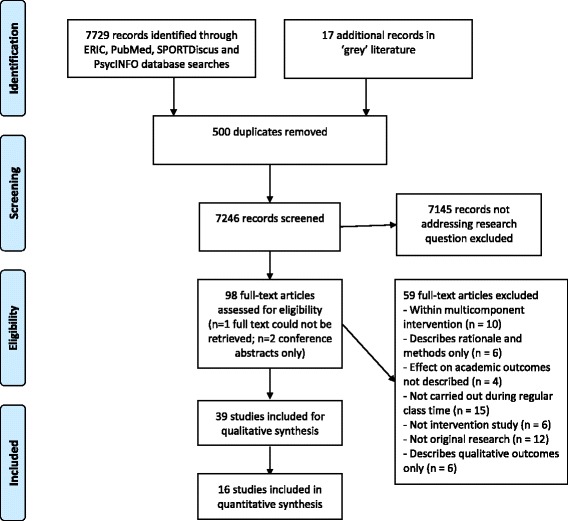
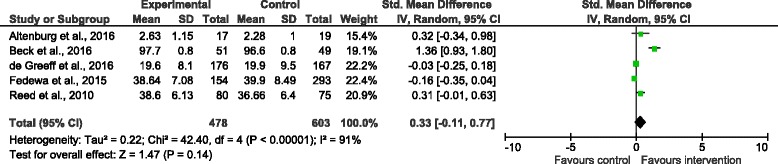
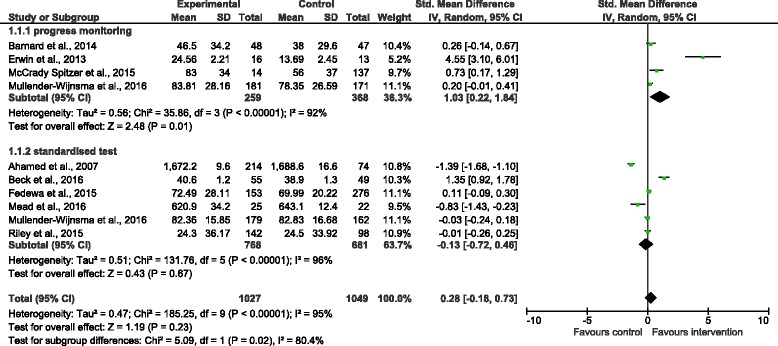
BACKGROUND: Physical activity is associated with many physical and mental health benefits, however many children do not meet the national physical activity guidelines. While schools provide an ideal setting to promote children's physical activity, adding physical activity to the school day can be difficult given time constraints often imposed by competing key learning areas. Classroom-based physical activity may provide an opportunity to increase school-based physical activity while concurrently improving academic-related outcomes. The primary aim of this systematic review and meta-analysis was to evaluate the impact of classroom-based physical activity interventions on academic-related outcomes. A secondary aim was to evaluate the impact of these lessons on physical activity levels over the study duration. METHODS: A systematic search of electronic databases (PubMed, ERIC, SPORTDiscus, PsycINFO) was performed in January 2016 and updated in January 2017. Studies that investigated the association between classroom-based physical activity interventions and academic-related outcomes in primary (elementary) school-aged children were included. Meta-analyses were conducted in Review Manager, with effect sizes calculated separately for each outcome assessed. RESULTS: Thirty-nine articles met the inclusion criteria for the review, and 16 provided sufficient data and appropriate design for inclusion in the meta-analyses. Studies investigated a range of academic-related outcomes including classroom behaviour (e.g. on-task behaviour), cognitive functions (e.g. executive function), and academic achievement (e.g. standardised test scores). Results of the meta-analyses showed classroom-based physical activity had a positive effect on improving on-task and reducing off-task classroom behaviour (standardised mean difference = 0.60 (95% CI: 0.20,1.00)), and led to improvements in academic achievement when a progress monitoring tool was used (standardised mean difference = 1.03 (95% CI: 0.22,1.84)). However, no effect was found for cognitive functions (standardised mean difference = 0.33 (95% CI: -0.11,0.77)) or physical activity (standardised mean difference = 0.40 (95% CI: -1.15,0.95)). CONCLUSIONS: Results suggest classroom-based physical activity may have a positive impact on academic-related outcomes. However, it is not possible to draw definitive conclusions due to the level of heterogeneity in intervention components and academic-related outcomes assessed. Future studies should consider the intervention period when selecting academic-related outcome measures, and use an objective measure of physical activity to determine intervention fidelity and effects on overall physical activity levels.
Overview
The claims and statistics of this paper haven’t been checked yet.
Free: it reads the open-access text and checks the first 5 claims that cite a source we can check. Create a free account to check every claim.
Integrity signals
Registry
Cites
Statistics
Figures


Verification
Claims the paper makes
The claims and statistics of this paper haven’t been checked yet.
Free: it reads the open-access text and checks the first 5 claims that cite a source we can check. Create a free account to check every claim.
Claims other papers make about this one
Each is checked against this paper’s own text: does it say what the citing paper says it does?
The source backs part of the claim, not all of it — or backs it for a different population, condition or comparison.
In the citing paper
“active classrooms, compared with traditional sedentary classrooms, had null [32] or medium [35] effects.”
From Physical Activity and Academic Achievement: An Umbrella Review (2020) · cites this paper as [32]
Experimental — accuracy not yet measuredThe source backs part of the claim, not all of it — or backs it for a different population, condition or comparison.
In the citing paper
“These improvements are relatively strong when considered in the broader field of physical activity interventions.”
From Effectiveness of wearable activity trackers to increase physical activity and improve health: a systematic review of systematic reviews and meta-analyses. (2022) · cites this paper as [69]
Experimental — accuracy not yet measured
Self-check
Percentages, sums and reported differences re-computed from the paper’s own numbers.
The self-check needs the paper’s full text.
Citations
Cites
‘Small Changes' to Diet and Physical Activity Behaviors for Weight Management
Hills, A. P., Byrne, N. M., Lindstrom, R., & Hill, J. O. (2013) · Obesity Facts · doi:10.1159/000345030 · Cited by 9,493
Physical Activity in the United States Measured by Accelerometer
TROIANO, R. P., BERRIGAN, D., DODD, K. W., MÂSSE, L. C., TILERT, T., & MCDOWELL, M. (2008) · Medicine & Science in Sports & Exercise · doi:10.1249/mss.0b013e31815a51b3 · Cited by 7,638
Janssen, I., & LeBlanc, A. G. (2010) · International Journal of Behavioral Nutrition and Physical Activity · doi:10.1186/1479-5868-7-40 · Cited by 4,829
Physical Activity for Cognitive and Mental Health in Youth: A Systematic Review of Mechanisms
Lubans, D., Richards, J., Hillman, C., Faulkner, G., Beauchamp, M., Nilsson, M., Kelly, P., Smith, J., Raine, L., & Biddle, S. (2016) · Pediatrics · doi:10.1542/peds.2016-1642 · Cited by 1,548
The relationship between physical activity and cognition in children: a meta-analysis
Sibley, B. A., & Etnier, J. L. (2003) · Pediatric Exercise Science · doi:10.1123/pes.15.3.243 · Cited by 1,308
Best, J. R., Miller, P. H., & Naglieri, J. A. (2011) · Learning and Individual Differences · doi:10.1016/j.lindif.2011.01.007 · Cited by 1,294 · cited 1×
“Executive functions, inhibition in particular, have been shown to be consistently related to academic achievement [34] and therefore were considered salient to teachers.”
BackgroundThe effect of exercise-induced arousal on cognitive task performance: a meta-regression analysis
Lambourne, K., & Tomporowski, P. (2010) · Brain Research · doi:10.1016/j.brainres.2010.03.091 · Cited by 1,105
Sallis, J. F., McKenzie, T. L., Alcaraz, J. E., Kolody, B., Faucette, N., & Hovell, M. F. (1997) · American Journal of Public Health · doi:10.2105/ajph.87.8.1328 · Cited by 914 · cited 1×
“Studies have shown interventions targeting these discrete periods may be effective in increasing children’s physical activity levels [7, 8], with the potential to contribute to up to 50% of the physical activity required to meet physical activity guidelines [9].”
BackgroundPhysical education, school physical activity, school sports and academic performance
Trudeau, F., & Shephard, R. J. (2008) · International Journal of Behavioral Nutrition and Physical Activity · doi:10.1186/1479-5868-5-10 · Cited by 879
Rasberry, C. N., Lee, S. M., Robin, L., Laris, B. A., Russell, L. A., Coyle, K. K., & Nihiser, A. J. (2011) · Preventive Medicine · doi:10.1016/j.ypmed.2011.01.027 · Cited by 709
Research works printed but not linked: 3
- Okely T Salmon J Vella S Cliff D Timperio A Tremblay M Trost S Shilton T Hinkley T Ridgers N Phillipson L Hesketh K Parrish A Janssen X Brown M Emmel J Marino N A systematic review to update the Australian physical activity guidelines for children and young people., Report prepared for the Australian Government Department of Health, Editor Canberra 2012 Australia Commonwealth of Australia
- Brickenkamp R Zillmer E d2 Test of Attention, in d2 Test 1998 Clark, Editors P.L. Ackerman and E
- Nunnally, J.C., Psychometric theory. McGraw-Hill series in psychology. 1967: New York, McGraw-Hill [1967].
Cited by
Items 101–200 of 689
Takehara, K., Ganchimeg, T., Kikuchi, A., Gundegmaa, L., Altantsetseg, L., Aoki, A., Fukuie, T., Suwabe, K., Bat-Erdene, S., Mikami, M., et al. (2019) · BMC Public Health · doi:10.1186/s12889-019-6986-8 · Cited by 30
Skage, I., & Dyrstad, S. M. (2019) · BMC Public Health · doi:10.1186/s12889-019-8021-5 · Cited by 42
“Physically active lessons are designed to increase children’s PA levels without reducing academic time by integrating PA into lessons in learning areas other than physical education (Watson et al., 2017).”
BackgroundRuz, R. P., Puga-González, M. E., Céspedes-Jiménez, Á., & Cabello‐Manrique, D. (2021) · International Journal of Environmental Research and Public Health · doi:10.3390/ijerph18073648 · Cited by 42
“), with this possibly having a very positive effect on behaviour [27], cognitive function and academic performance [26].”
BackgroundDensley, B., Calvert, H. G., Boedeker, P., & Turner, L. R. (2021) · International Journal of Environmental Research and Public Health · doi:10.3390/ijerph18094476 · Cited by 32
Broad, A. A., Bornath, D. P. D., Grisebach, D., McCarthy, S. F., Bryden, P. J., Robertson‐Wilson, J., & Hazell, T. J. (2021) · Research Quarterly for Exercise and Sport · doi:10.1080/02701367.2021.1980189 · Cited by 43
“CAB and physical activity levels in children (Carlson et al., 2015; Daly-Smith et al., 2018; Watson et al., 2017).”
BackgroundInfluentialLander, N., Koorts, H., Mazzoli, E., Moncrieff, K., & Salmon, J. (2019) · Pilot and Feasibility Studies · doi:10.1186/s40814-019-0507-5 · Cited by 33
Abdulla, A., Whipp, P. R., & Teo, T. P. (2021) · European Physical Education Review · doi:10.1177/1356336x211033696 · Cited by 42
Nally, S., Ridgers, N. D., Gallagher, A. M., MURPHY, M. H., Salmon, J., & Carlin, A. (2022) · Frontiers in Sports and Active Living · doi:10.3389/fspor.2022.789259 · Cited by 44
“Previous systematic reviews of PA interventions in schools found favorable effects of classroom movement breaks on increasing PA (Norris et al., 2015; Martin and Murtagh, 2017; Watson et al., 2017).”
BackgroundMcLoughlin, G. M., Sweeney, R., Liechty, L., Lee, J. A., Rosenkranz, R. R., & Welk, G. J. (2022) · Frontiers in Health Services · doi:10.3389/frhs.2022.881639 · Cited by 31
Physical Education: At the Centre of Physical Activity Promotion in Schools
Cale, L. (2023) · International Journal of Environmental Research and Public Health · doi:10.3390/ijerph20116033 · Cited by 60
“, the integration of physical activity into lessons in areas other than PE) is growing in popularity [15,16], the dual focus of PE on ‘learning to move and moving to learn’ provides a truly authentic and meaningful context for ‘moving’ for young people.”
BackgroundVerjans-Janssen, S. R. B., Gerards, S. M. P. L., Verhees, A. H., Kremers, S., Vos, S. B., Jansen, M. W. J., & van Kann, D. (2020) · International Journal of Environmental Research and Public Health · doi:10.3390/ijerph17030751 · Cited by 28
Åvitsland, A., Ohna, S. E., Dyrstad, S. M., Tjomsland, H. E., Lerum, Ø., & Leibinger, É. (2020) · Health Education · doi:10.1108/he-01-2020-0004 · Cited by 30
Verjans-Janssen, S. R. B., Gerards, S. M. P. L., Kremers, S., Vos, S. B., Jansen, M. W. J., & van Kann, D. (2020) · International Journal of Behavioral Nutrition and Physical Activity · doi:10.1186/s12966-020-01012-8 · Cited by 30
Woodforde, J., Alsop, T., Salmon, J., Gomersall, S. R., & Stylianou, M. (2021) · British Journal of Sports Medicine · doi:10.1136/bjsports-2021-104470 · Cited by 30
Robinson, K. J., Lubans, D. R., Mavilidi, M. F., Hillman, C. H., Benzing, V., Valkenborghs, S. R., Barker, D., & Riley, N. (2022) · Frontiers in Psychology · doi:10.3389/fpsyg.2022.811534 · Cited by 40
“Various types of interventions have been shown to foster the development of executive functions, including computerbased trainings, educational programs, and classroom-based physical activity breaks (Diamond and Lee, 2011; Watson et al., 2017; Tomporowski and Pesce, 2019).”
BackgroundResultInfluentialLander, N., Mazzoli, E., Cassar, S., Symington, N., & Salmon, J. (2020) · Children · doi:10.3390/children7110207 · Cited by 38
“Research has demonstrated that active pedagogy can benefit children’s cognition, classroom behaviour and academic behaviour [12], so this will need to be a priority in future Transform-Ed! research.”
BackgroundMazzoli, E., Salmon, J., Pesce, C., Teo, W., Rinehart, N., May, T., & Barnett, L. M. (2021) · Journal of Intellectual Disability Research · doi:10.1111/jir.12826 · Cited by 33
Mental Health and Positive Development Prevention Interventions: Overview of Systematic Reviews
Harrison, L., Sharma, N., Irfan, O., Zaman, M., Vaivada, T., & Bhutta, Z. A. (2022) · PEDIATRICS · doi:10.1542/peds.2021-053852g · Cited by 32
Ring‐Dimitriou, S., Krustrup, P., Coelho-e-Silva, M. J., Mota, J. A. P. S., Seabra, A., Rêgo, C., Mazur, A., Vlachopapadopoulou, E. A., Caroli, M., Frelut, M., et al. (2019) · Journal of sport and health science/Journal of Sport and Health Science · doi:10.1016/j.jshs.2019.01.007 · Cited by 29
A program evaluation of an in-school daily physical activity initiative for children and youth
Bremer, E., Graham, J. D., Veldhuizen, S., & Cairney, J. (2018) · BMC Public Health · doi:10.1186/s12889-018-5943-2 · Cited by 23
Daly-Smith, A., Hobbs, M., Morris, J. L., Defeyter, M. A., Resaland, G. K., & McKenna, J. (2021) · International Journal of Environmental Research and Public Health · doi:10.3390/ijerph18030990 · Cited by 34
“Five systematic reviews [29–31], two including a meta-analysis [32,33] support focusing on integrating more movement within curricular lessons, highlighting the potential of physically active learning (PAL) and classroom movement breaks (CMB) for increasing the levels of MVPA.”
BackgroundEmm-Collison, L., Cross, R., González, M. G., Watson, D. L., Foster, C. E., & Jago, R. (2022) · International Journal of Environmental Research and Public Health · doi:10.3390/ijerph19073993 · Cited by 37
“Over the last decade, there have been numerous efforts to minimise the decline in MVPA seen during primary school via school, family and community-based interventions, but these have had minimal effects on physical activity [11,12].”
BackgroundUnpacking physically active learning in education: a movement didaktikk approach in teaching?
Mandelid, M. B., Resaland, G. K., Lerum, Ø., Teslo, S. B., Chalkley, A. E., Singh, A. S., Bartholomew, J. B., Daly-Smith, A., Thurston, M. N., & Tjomsland, H. E. (2022) · Scandinavian Journal of Educational Research · doi:10.1080/00313831.2022.2148271 · Cited by 35
“While previous research on PAL has explained pupils ’ learning in physiological, behavioural, or cognitive terms (Norris et al., 2019; Watson et al., 2017), a didaktikk perspective has been somewhat taken for granted.”
BackgroundActive Schools in Europe—A Review of Empirical Findings
Bailey, R. P., Ríes, F., & Scheuer, C. (2023) · Sustainability · doi:10.3390/su15043806 · Cited by 37
“Five systematic reviews or meta-analyses of Active Breaks met the inclusion criteria [18,24–27].”
BackgroundInfusing Physical Activity into Early Childhood Classrooms: Guidance for Best Practices
McGowan, A. L., Chandler, M. C., & Gerde, H. K. (2023) · Early Childhood Education Journal · doi:10.1007/s10643-023-01532-5 · Cited by 64
“…movement throughout the school day—even in short bursts— enhances academic achievement, improves on-task behavior, and increases attention (Hillman et al., 2019; Howie et al., 2014, 2015; Mahar, 2011; Norris et al., 2020; Pontifex et al., 2013; Szabo-Reed et al., 2017, 2019; Watson et al., 2017).”
The Influence of Classroom Physical Activity Participation and Time on Task on Academic Achievement
Szabo‐Reed, A. N., Willis, E. A., Lee, J., Hillman, C. H., Washburn, R. A., & Donnelly, J. E. (2019) · Translational Journal of the American College of Sports Medicine · doi:10.1249/tjx.0000000000000087 · Cited by 32
Barbosa, M. A., Ortega‐Martínez, A., Carrasco‐Uribarren, A., & Calafat, C. B. (2022) · International Journal of Environmental Research and Public Health · doi:10.3390/ijerph192215409 · Cited by 35
Ayala, A. M. C., Sudholz, B., Salmon, J., Dunstan, D. W., Ridgers, N. D., Arundell, L., & Timperio, A. F. (2018) · PLoS ONE · doi:10.1371/journal.pone.0203938 · Cited by 31
Self-citationGAMBARAN AKTIFITAS FISIK DAN PERILAKU PASIF MAHASISWA PENDIDIKAN OLAHRAGA SELAMA PANDEMI COVID-19
Arief, N. A., Kuntjoro, B. F. T., & Suroto, S. (2020) · Multilateral Jurnal Pendidikan Jasmani dan Olahraga · doi:10.20527/multilateral.v19i2.9564 · Cited by 35
Teslo, S. B., Jenssen, E. S., Thurston, M. N., Mandelid, M. B., Resaland, G. K., Chalkley, A. E., & Tjomsland, H. E. (2023) · Teaching and Teacher Education · doi:10.1016/j.tate.2023.104377 · Cited by 34
Porter, A., Walker, R. A. J., House, D., Salway, R., Dawson, S., Ijaz, S., de Vocht, F., & Jago, R. (2024) · Frontiers in Public Health · doi:10.3389/fpubh.2024.1321167 · Cited by 40
Watson, A., Timperio, A. F., Brown, H. L., Hinkley, T., & Hesketh, K. D. (2019) · PLoS ONE · doi:10.1371/journal.pone.0209354 · Cited by 33
Self-citationFarbo, D., Maler, L. C., & Rhea, D. J. (2020) · International Journal of Environmental Research and Public Health · doi:10.3390/ijerph17238919 · Cited by 22
“Studies in these settings report a 2%–12% increase in MVPA during the school day and acute improvements in attention, classroom behavior, and academic achievement [23,24].”
BackgroundCarrasco‐Uribarren, A., Ortega‐Martínez, A., Barbosa, M. A., Cadellans-Arróniz, A., Cabanillas‐Barea, S., & Calafat, C. B. (2023) · International Journal of Environmental Research and Public Health · doi:10.3390/ijerph20021636 · Cited by 39
Stewart, G. L., Webster, C. A., Weaver, R. G., Stodden, D. F., Brian, A., Egan, C. A., Michael, R. D., Sacko, R. S., & Patey, M. J. (2019) · Evaluation and Program Planning · doi:10.1016/j.evalprogplan.2018.12.010 · Cited by 23
Schönbach, D. M. I., Altenburg, T. M., Chinapaw, M. J. M., Marques, A., & Demetriou, Y. (2019) · Systematic Reviews · doi:10.1186/s13643-019-1216-0 · Cited by 24
Setiawan, B., Rachmadtullah, R., & Iasha, V. (2020) · Jurnal Basicedu · doi:10.31004/basicedu.v4i4.484 · Cited by 21
Brandes, B., Busse, H., Sell, L., Christianson, L., & Brandes, M. (2021) · Preventive Medicine · doi:10.1016/j.ypmed.2021.106920 · Cited by 32
Pfledderer, C. D., Kwon, S., Strehli, I., Byun, W., & Burns, R. D. (2022) · International Journal of Environmental Research and Public Health · doi:10.3390/ijerph19063445 · Cited by 22
“In recent years, studies of play areas have taken an even broader approach, exploring relationships between physical activity interventions during recess [20,21] or the classroom [22].”
BackgroundSchmidt, S. K., Bratland‐Sanda, S., & Bongaardt, R. (2022) · Teaching and Teacher Education · doi:10.1016/j.tate.2022.103777 · Cited by 31
Keating, R., Ahern, S., Bisgood, L., Mernagh, K., Nicolson, G. H., & Barrett, E. M. (2022) · Journal of American College Health · doi:10.1080/07448481.2020.1847119 · Cited by 20
“ness and energy levels were reported in the student feedback, mirroring the positive responses of school-age students and employees to similar active break interventions within other settings.(18,21) As uninterrupted lecture-based sit-”
BackgroundBeyond Cognitive Load Theory: Why Learning Needs More than Memory Management
Sortwell, A., Gkintoni, E., Díaz-García, J., Ellerton, P., Ferraz, R., & Hine, G. (2026) · Brain Sciences · doi:10.3390/brainsci16010109 · Cited by 20
“While much of this evidence has been primarily focused on adults and the elderly, active learning, a form of combined cognitive and physical training, has also been positively correlated with greater academic and cognitive performance [57].”
Wolf, V. L. W., Samur-San-Martin, J. E., de Sousa, S. F., Santos, H. D. O., Folmann, A. G., Ribeiro, R. R., & Guerra‐Júnior, G. (2019) · Revista Paulista de Pediatria · doi:10.1590/1984-0462/;2019;37;1;00015 · Cited by 31
Burns, R. D., Bai, Y., Fu, Y., Pfledderer, C. D., & Brusseau, T. A. (2019) · International Journal of Environmental Research and Public Health · doi:10.3390/ijerph16234698 · Cited by 34
“Indeed, physical activity interventions employed during school hours, such as classroom activity breaks and/or enhanced physical activity/physical education curricula, have shown to yield significant benefits in classroom attention and classroom behavior [34,35].”
BackgroundSchlund, A., Reimers, A. K., Bucksch, J., Linder, S., & Demetriou, Y. (2021) · German Journal of Exercise and Sport Research · doi:10.1007/s12662-021-00724-8 · Cited by 25
Wiium, N. (2021) · Nutrients · doi:10.3390/nu13124432 · Cited by 31
Integrating wellness into curricula using the ten dimensions of wellness as a framework
Gawlik, K. S., Teall, A. M., Zeno, R., Newtz, C., Conrad, K., Kolcun, K., Bobek, H., Deerhake, A., Sullivan, K., Rengers, B., et al. (2023) · Journal of Professional Nursing · doi:10.1016/j.profnurs.2023.11.006 · Cited by 26
“Brief physical activity sessions integrated during classroom instruction have been shown to benefit academic performance and student engagement (Watson, Timperio, Brown, Best, & Hesketh, 2017).”
Cassar, S., Salmon, J., Timperio, A. F., Koch, S., & Koorts, H. (2020) · Health Education · doi:10.1108/he-05-2020-0031 · Cited by 26
Self-citationWang, H., Blake, H., & Chattopadhyay, K. (2021) · Frontiers in Public Health · doi:10.3389/fpubh.2021.610245 · Cited by 22
Shinde, S., Wang, D., & Fawzi, W. W. (2021) · Systematic Reviews · doi:10.1186/s13643-021-01756-9 · Cited by 24
González-Valero, G., Ruz, R. P., García-Molina, R., & Ubago-Jiménez, J. L. (2022) · Retos · doi:10.47197/retos.v44i0.91506 · Cited by 32
“The studies following that approach have found benefits in students’ PA, as well as in cognition, classroom performance and academic outcomes, and did not decrease PA in general, or influence school performance in any way (Bássoli et al., 2021; Naylor et al., 2015; Owen et al., 2016; Watson et al., 2017).”
BackgroundMasini, A., Marini, S., Ceciliani, A., Barone, G., Lanari, M., Gori, D., Bragonzoni, L., Toselli, S., Stagni, R., Bisi, M. C., et al. (2023) · Journal of Public Health · doi:10.1093/pubmed/fdad102 · Cited by 33
Hernández‐Elizondo, J., & Fonseca, A. S. (2018) · Estudios pedagógicos · doi:10.4067/s0718-07052018000200297 · Cited by 19
Understanding Elementary Classroom Teachers' Use of Movement Integration Resources
Webster, C. A., Starrett, A., Rehling, J., Chen, B., Beets, M. W., & Weaver, R. G. (2020) · Frontiers in Education · doi:10.3389/feduc.2020.00056 · Cited by 27
“and performance on standardized tests (Erwin et al., 2012; Watson et al., 2017).”
BackgroundReece, L. J., Foley, B. C., Bellew, W., Owen, K., Cushway, D., Srinivasan, N., Hamdorf, P. A., & Bauman, A. E. (2020) · Public Health Research & Practice · doi:10.17061/phrp30122006 · Cited by 20
Meli, A. M., Ali, A., Jalil, A. M. M., Yusof, H. M., & Tan, M. M. C. (2021) · Medicina · doi:10.3390/medicina58010057 · Cited by 28
“In support of these findings, a previous meta-analysis also found to demonstrate that physically active lessons are more effective than active breaks [5].”
BackgroundResultWalker, T. J., Szeszulski, J., Robertson, M. C., Cuccaro, P. M., & Fernández, M. E. (2022) · Evaluation and Program Planning · doi:10.1016/j.evalprogplan.2022.102051 · Cited by 32
Christian, D. L., Todd, C., Rance, J. Y., Stratton, G., Mackintosh, K. A., Rapport, F., & Brophy, S. T. (2020) · PLoS ONE · doi:10.1371/journal.pone.0230745 · Cited by 21
Implementation of physically active lessons: A 2-year follow-up
Skage, I., Ertesvåg, S. K., Roland, P., & Dyrstad, S. M. (2020) · Evaluation and Program Planning · doi:10.1016/j.evalprogplan.2020.101874 · Cited by 28
(2021) · doi:10.3390/su13115966 · Cited by 18
McCarthy, N., Hall, A. E., Shoesmith, A., Sutherland, R., Hodder, R. K., Campbell, E. M., & Nathan, N. (2021) · Preventive Medicine Reports · doi:10.1016/j.pmedr.2021.101418 · Cited by 23
“…Received 17 November 2020; Received in revised form 13 May 2021; Accepted 25 May 2021 Preventive Medicine Reports 23 (2021) 101418 breaks such as energizers (Watson et al., 2017), and during break times via organised activities or access to sports equipment (Erwin et al., 2012).”
BackgroundEmonson, C., Papadopoulos, N. V., Rinehart, N., Mantilla, A., Fuelscher, I. T., Boddy, L. M., Pesce, C., & McGillivray, J. (2022) · BMC Public Health · doi:10.1186/s12889-021-11990-4 · Cited by 31
Boat, R., Cooper, S. B., Carlevaro, F., Magno, F., Bardaglio, G., Musella, G., & Magistro, D. (2022) · International Journal of Environmental Research and Public Health · doi:10.3390/ijerph192416751 · Cited by 31
“Recent systematic reviews and metaanalyses have suggested that the inclusion of physically active academic lessons is an effective intervention strategy to increase physical activity [12], enhance academic achievement/educational outcomes [12,13], and improve classroom behavior [14].”
BackgroundMartín-Martínez, C., Valenzuela, P. L., Martinez‐Zamora, M. D., & Martínez‐de‐Quel, Ó. (2022) · Journal of science and medicine in sport · doi:10.1016/j.jsams.2022.12.007 · Cited by 31
Koorts, H., Timperio, A. F., Lonsdale, C., Ridgers, N. D., Lubans, D. R., Gatta, J. D., Bauman, A. E., Telford, A., Barnett, L. M., Lamb, K. E., et al. (2023) · BMJ Open · doi:10.1136/bmjopen-2023-078410 · Cited by 23
Self-citationBeyond “Brain Breaks”: A New Model for Integrating Classroom-Based Active Breaks
Lander, N., Ayala, A. M. C., Mazzoli, E., Lai, S. K., Orr, J., & Salmon, J. (2024) · Journal of Physical Education Recreation & Dance · doi:10.1080/07303084.2024.2308253 · Cited by 40
“Whole-of-school physical activity and sedentary behavior interventions provide practical, low-cost, and effective strategies to improve learning and well-being outcomes (Watson et al., 2017).”
Ruiz‐Ariza, A., López-Serrano, S., Mezcua-Hidalgo, A., López, E. J. M., & Abu-Helaiel, K. F. (2021) · Retos · doi:10.47197/retos.v0i39.78591 · Cited by 35
“Por otro lado, al igual que en nuestro trabajo usando pulsómetros como control, Watson et al. (2017) encontró que las intervenciones de AF en el aula condujeron a mejoras cuando se usó herramientas de monitoreo.”
BackgroundAhmed, K. R., Uddin, R., Kolbe-Alexander, T. L., & Khan, A. (2021) · Public Health · doi:10.1016/j.puhe.2021.02.011 · Cited by 24
Corder, K. L., Brown, H. E., Croxson, C. H. D., Jong, S. T., Sharp, S. J., Vignoles, A. F., Wilkinson, P. O., Wilson, E., & van Sluijs, E. M. F. (2021) · Public Health Research · doi:10.3310/phr09060 · Cited by 26
Self-citationErwin, H., Fedewa, A., Wilson, J., & Ahn, S. (2019) · Journal of Research in Childhood Education · doi:10.1080/02568543.2019.1646844 · Cited by 17
“If the PA intervention was less than a year in duration, progress-monitoring tools were necessary to capture the small amount of growth in students’ achievement outcomes (Watson et al., 2017).”
BackgroundGejl, A. K., Malling, A. S. B., Damsgaard, L., Nielsen, A. V., & Wienecke, J. (2021) · BMC Pediatrics · doi:10.1186/s12887-020-02430-0 · Cited by 22
Christiansen, L. B., Clausen, K. L. L., Smedegaard, S., & Skovgaard, T. (2021) · SAGE Open · doi:10.1177/21582440211000053 · Cited by 30
“The activities in this study can be described as active breaks without curricular focus (Watson et al., 2017).”
BackgroundAnico, S., Wilson, L. J., Eyre, E. L. J., & Smith, E. (2022) · Journal of Sports Sciences · doi:10.1080/02640414.2023.2174720 · Cited by 34
“…including improved; PA and/or Sedentary behaviours (M. B. Owen et al., 2014; Dobbins et al., 2001; Hynynen et al., 2016; Jones et al., 2020; Kriemler et al., 2011), Motivation (Dobbins et al., 2013; Kelso et al., 2020), MVPA (Nathan et al., 2018), and academic outcomes (Watson et al., 2017).”
BackgroundPodnar, H., Novak, D., & Radman, I. (2018) · Kinesiology · doi:10.26582/k.50.2.17 · Cited by 29
Effect of Integrated Physical Activities with Mathematics on Objectively Assessed Physical Activity
Vazou, S., Saint‐Maurice, P. F., Skrade, M. A. B., & Welk, G. J. (2018) · Children · doi:10.3390/children5100140 · Cited by 23
“Physical activity in the classroom is usually implemented as a short activity break (mainly as an energy booster) or through integration with academic subjects (to teach or practice academic concepts); it varies in intensity, and it typically lasts between 5 and 15 min [3,5].”
BackgroundFollow-Up Study Investigating the Effects of a Physically Active Academic Intervention
Mullender-Wijnsma, M., Hartman, E. E., de Greeff, J. W., Doolaard, S., Bosker, R., & Visscher, C. (2019) · Early Childhood Education Journal · doi:10.1007/s10643-019-00968-y · Cited by 24
The Effects of the ACTIVE VALUES Program on Psychosocial Aspects and Executive Functions
Jiménez-Parra, J. F., Belando‐Pedreño, N., & Valenzuela, A. V. (2022) · International Journal of Environmental Research and Public Health · doi:10.3390/ijerph20010595 · Cited by 24
Outdoor STEAM Education: Opportunities and Challenges
Correia, M., Ribeirinha, T., Beirante, D. A. A. D. P., Santos, R., Ramos, L., Dias, I. S., Luís, H., Catela, D. P. R., Galinha, S. M. G. A., Arrais, A., et al. (2024) · Education Sciences · doi:10.3390/educsci14070688 · Cited by 54
Effects of a before-school program on student physical activity levels
Cradock, A. L. I., Barrett, J. L., Taveras, E. M., Peabody, S., Flax, C. N., Giles, C. M., & Gortmaker, S. L. (2019) · Preventive Medicine Reports · doi:10.1016/j.pmedr.2019.100940 · Cited by 18
Saucedo‐Araujo, R. G., Chillón, P., López, I. J. P., & Barranco-Ruíz, Y. (2020) · International Journal of Environmental Research and Public Health · doi:10.3390/ijerph17145186 · Cited by 25
“In addition, there is evidence that PA in the classroom may have a positive impact on academic results [55], levels of concentration, memory, and classroom behaviors [71].”
BackgroundLópez, E. J. M., Ruiz‐Ariza, A., la Torre‐Cruz, M. J. D., & Suárez-Manzano, S. (2020) · Psicología Educativa · doi:10.5093/psed2020a16 · Cited by 30
“Although recent systematic reviews have investigated the impact of some PA interventions on cognition (Daly-Smith et al., 2018; Owen et al., 2018; Watson et al., 2017), we are not aware of any reviews that have analysed the specific short-and long-term effects of PAAL, ALB, AR or the combinations…”
BackgroundJones, G., Longbon, K., & Williams, S. (2022) · BMC Public Health · doi:10.1186/s12889-022-14647-y · Cited by 20
Gallé, F., Pecoraro, P., Calella, P., Cerullo, G., Imoletti, M., Mastantuono, T., Muscariello, E., Ricchiuti, R., Sensi, S., Sorrentino, C., et al. (2020) · International Journal of Environmental Research and Public Health · doi:10.3390/ijerph17186599 · Cited by 21
Dissemination of Thinking while Moving in Maths: Implementation Barriers and Facilitators
Riley, N., Mavilidi, M. F., Kennedy, S. G., Morgan, P. J., & Lubans, D. R. (2021) · Translational Journal of the American College of Sports Medicine · doi:10.1249/tjx.0000000000000148 · Cited by 21
Daly-Smith, A., Morris, J. L., Hobbs, M., & McKenna, J. (2019) · BMC Medicine · doi:10.1186/s12916-019-1335-4 · Cited by 16
Early Effects of the COVID-19 Pandemic on Physical Activity and Sedentary Behavior in U.S. ChildrenPreprint
Dunton, G. F., Do, B., & Wang, S. D. (2020) · doi:10.33774/coe-2020-q6pz0 · Cited by 16
Delgado-Floody, P., Carter-Thuillier, B., Guzmán-Guzmán, I. P., Latorrre-Román, P., & Caamaño-Navarrete, F. (2020) · International Journal of Educational Research · doi:10.1016/j.ijer.2020.101651 · Cited by 16
Mandelid, M. B., Dyngeland, E. H., Teslo, S. B., Lerum, Ø., Tjomsland, H. E., Jenssen, E. S., Eriksen, P. B., Wergeland, T. C., Sandal, M. Ø., Stein, H., et al. (2024) · Frontiers in Education · doi:10.3389/feduc.2024.1407542 · Cited by 17
Pupils’ experiences and perceptions of engagement during the Moving Maths programme
Sneck, S., Järvelä, S., Syväoja, H. J., & Tammelin, T. (2020) · Education 3-13 · doi:10.1080/03004279.2020.1857816 · Cited by 22
“There is evidence that PA interventions improve students’ time-on-task behaviour (Watson et al. 2017) and experiences of enjoyment”
BackgroundApproaching physically active learning as a multi, inter, and transdisciplinary research field
Mandelid, M. B. (2023) · Frontiers in Sports and Active Living · doi:10.3389/fspor.2023.1228340 · Cited by 26
“Indeed, research on classroombased PA and PAL seems to be no exception, as the research field utilises PA ubiquitously for health (5).”
BackgroundInfluentialBurns, R. D., Brusseau, T. A., & Fu, Y. (2018) · International Journal of Environmental Research and Public Health · doi:10.3390/ijerph15081764 · Cited by 19
Jiménez-Parra, J. F., Manzano-Sánchez, D., Foguet, O. C., Prat, Q., & Valenzuela, A. V. (2022) · Behavioral Sciences · doi:10.3390/bs12050153 · Cited by 19
“Second, the duration of the intervention was three months, which is below the suggestions of expert authors in TPSR [8,57,62] and AB [18], who have indicated the need to implement longitudinal programmes, longer than four”
BackgroundMethodDo Physical Activity, BMI, and Wellbeing Affect Logical Thinking?
Skurvydas, A., Lisinskienė, A., Majauskienė, D., Valančienė, D., Dadelienė, R., Fatkulina, N., & Šarkauskienė, A. (2022) · International Journal of Environmental Research and Public Health · doi:10.3390/ijerph19116631 · Cited by 17
Hartikainen, J., Haapala, E. A., Poikkeus, A., Sääkslahti, A., Laukkanen, A., Gao, Y., & Finni, T. J. (2022) · Learning Environments Research · doi:10.1007/s10984-022-09411-3 · Cited by 37
“In addition to potential health benefits, CPA also can have a positive impact on academic-related outcomes and students’ on-task behaviour (Goh et al., 2016; Watson et al., 2017).”
BackgroundPoulos, A., & Kulinna, P. H. (2022) · BMC Public Health · doi:10.1186/s12889-022-13991-3 · Cited by 23
Lestari, W. F., & Widayati, A. (2022) · AL-ISHLAH Jurnal Pendidikan · doi:10.35445/alishlah.v14i4.1329 · Cited by 15
“Meanwhile, Sardiman (2014) and Watson et al (2017) suggest that student learning activities are divided into physical activity and psychological activity.”
Macdonald, K., Milne, N., Pope, R., & Orr, R. M. (2020) · Early Childhood Education Journal · doi:10.1007/s10643-020-01076-y · Cited by 20
Melo, J. C. D. N., Tejada, J., Silva, E. C. M., Ywgne, J., Oliveira, D. N., Gandarela, L., & da Silva, D. R. P. (2025) · International Journal of Behavioral Nutrition and Physical Activity · doi:10.1186/s12966-025-01789-6 · Cited by 26
“These strategies have been suggested due to their low-cost nature [25, 26], and potential to reduce sedentary behavior [23, 24], increase physical activity levels [23, 24, 27], improve academic performance [24, 28], and yield promising results in cognitive outcomes such as inhibitory control…”
Moon, J., Webster, C. A., Herring, J., & Egan, C. A. (2020) · Journal of Positive Behavior Interventions · doi:10.1177/1098300720947034 · Cited by 22
“Indeed, in meta-analyses (e.g., Owen et al., 2016; Watson et al., 2017), extra physical activity opportunities—both academic-integrated and non-academicintegrated—led to increases in a range of academic-related outcomes (e.”
BackgroundResultGosselin, V., & Laberge, S. (2022) · BMC Public Health · doi:10.1186/s12889-022-12797-7 · Cited by 18
Metadata
- Authors
- Watson, A., Timperio, A., Brown, H., Best, K., & Hesketh, K. D.
- Affiliations
- Deakin University (AU)
- Corresponding author
- Hesketh, Kylie D.
- Venue
- International Journal of Behavioral Nutrition and Physical Activity
- Published
- 2017-08-25
- Volume
- 14
- Issue
- 1
- Pages
- 114-114
- ISSN
- 1479-5868 (ISSN-L)
- PMC
- PMC5574081
- OpenAlex
- W2750279836
- Cited by
- 689
- References
- 74
- Citations by year
- 2026: 60 · 2025: 76 · 2024: 97 · 2023: 86 · 2022: 96 · 2021: 97 · 2020: 81 · 2019: 59 · 2018: 34 · 2017: 1
- FWCI
- 5.87
- Type
- journal article
- Language
- en
- Open access
- gold
- doi.org
- Licence
- cc-by
- Locations
- International Journal of Behavioral Nutrition and Physical Activity (publishedVersion, cc-by)
- Europe PMC (PubMed Central) (publishedVersion, cc-by)
- PubMed Central (publishedVersion, cc-by)
- PubMed (publishedVersion)
- Adelaide Research & Scholarship (AR&S) (University of Adelaide) (submittedVersion, cc-by)
- DOAJ (DOAJ: Directory of Open Access Journals) (submittedVersion)
- Figshare (submittedVersion, cc-by)
- Funders
- National Heart Foundation of Australia (FT130100637, 100370, 100046)
- Deakin University
- Topics
- Health Sciences › Medicine › Public Health, Environmental and Occupational Health › Physical Activity and Health
- Health Sciences › Medicine › Public Health, Environmental and Occupational Health › School Health and Nursing Education
- Social Sciences › Psychology › Developmental and Educational Psychology › Children's Physical and Motor Development
- Keywords
- classroom physical activity, school-based physical activity intervention, academic performance, on-task behavior, off-task behavior, executive function, cognitive function, elementary school students, children's physical activity, intervention fidelity, progress monitoring, physical education classes, intervention intensity, intervention dosage, intervention heterogeneity
- MeSH terms
- Academic Success, Child, Cognition, Curriculum, Humans, Learning, Physical Education and Training, Schools, Students, Health Behavior, Exercise, Databases, Factual
About these checks
Registry, retraction, Cites and statistics results are computed, not judged, with one exception: a printed reference that no index lists is read once by a model before it counts as a citation error. Claims are extracted by a model and kept only when their quote appears verbatim in the text; each cited source is then checked, with a model’s help, for whether it says what the claim relies on. Those verdicts can be wrong — read the claim’s quote and the cited source before relying on one.
Statistics and arithmetic are recomputed, not judged.
Confidence bands are shown only for fields calibrated on our annotated test set. None is calibrated yet, so no band is shown.
What counts as a claim ›How we measure confidence ›How we check this ›
Are you an author, or do you see a problem with this page? Request a review
Data sources
Bibliographic data: Semantic Scholar, OpenAlex, Crossref.
Contains information from the Semantic Scholar Academic Graph Datasets, made available under the ODC Attribution License (ODC-BY 1.0).
Semantic Scholar’s data is described in: Kinney, R., et al. (2023). The Semantic Scholar Open Data Platform. arXiv:2301.10140.
