

Effect of classroom-based physical activity interventions on academic and physical activity outcomes: a systematic review and meta-analysis
Open accessThe DOI matches its Crossref record; 74 of the 74 references it cites were found in a registry or an index.
Abstract
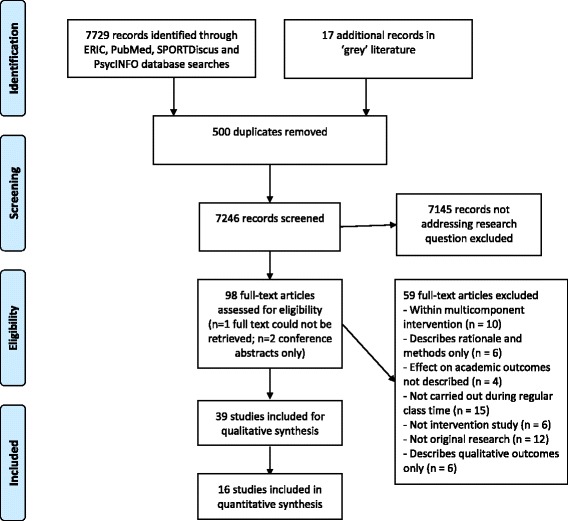
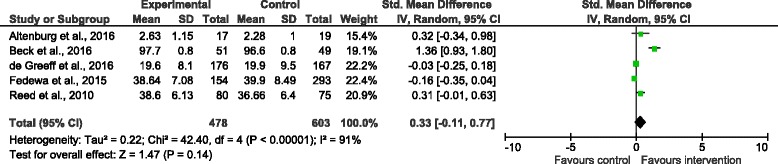
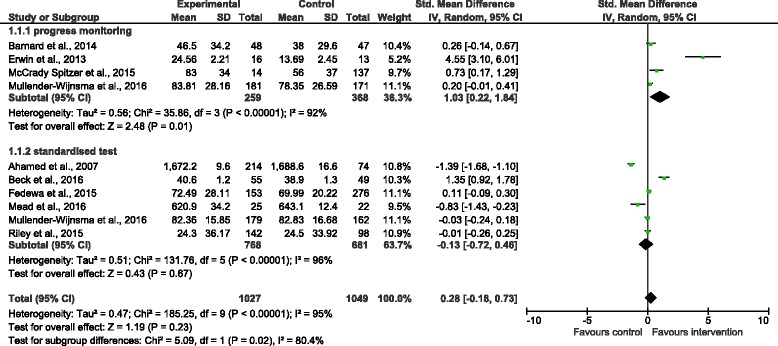
BACKGROUND: Physical activity is associated with many physical and mental health benefits, however many children do not meet the national physical activity guidelines. While schools provide an ideal setting to promote children's physical activity, adding physical activity to the school day can be difficult given time constraints often imposed by competing key learning areas. Classroom-based physical activity may provide an opportunity to increase school-based physical activity while concurrently improving academic-related outcomes. The primary aim of this systematic review and meta-analysis was to evaluate the impact of classroom-based physical activity interventions on academic-related outcomes. A secondary aim was to evaluate the impact of these lessons on physical activity levels over the study duration. METHODS: A systematic search of electronic databases (PubMed, ERIC, SPORTDiscus, PsycINFO) was performed in January 2016 and updated in January 2017. Studies that investigated the association between classroom-based physical activity interventions and academic-related outcomes in primary (elementary) school-aged children were included. Meta-analyses were conducted in Review Manager, with effect sizes calculated separately for each outcome assessed. RESULTS: Thirty-nine articles met the inclusion criteria for the review, and 16 provided sufficient data and appropriate design for inclusion in the meta-analyses. Studies investigated a range of academic-related outcomes including classroom behaviour (e.g. on-task behaviour), cognitive functions (e.g. executive function), and academic achievement (e.g. standardised test scores). Results of the meta-analyses showed classroom-based physical activity had a positive effect on improving on-task and reducing off-task classroom behaviour (standardised mean difference = 0.60 (95% CI: 0.20,1.00)), and led to improvements in academic achievement when a progress monitoring tool was used (standardised mean difference = 1.03 (95% CI: 0.22,1.84)). However, no effect was found for cognitive functions (standardised mean difference = 0.33 (95% CI: -0.11,0.77)) or physical activity (standardised mean difference = 0.40 (95% CI: -1.15,0.95)). CONCLUSIONS: Results suggest classroom-based physical activity may have a positive impact on academic-related outcomes. However, it is not possible to draw definitive conclusions due to the level of heterogeneity in intervention components and academic-related outcomes assessed. Future studies should consider the intervention period when selecting academic-related outcome measures, and use an objective measure of physical activity to determine intervention fidelity and effects on overall physical activity levels.
Overview
The claims and statistics of this paper haven’t been checked yet.
Free: it reads the open-access text and checks the first 5 claims that cite a source we can check. Create a free account to check every claim.
Integrity signals
Registry
Cites
Statistics
Figures


Verification
Claims the paper makes
The claims and statistics of this paper haven’t been checked yet.
Free: it reads the open-access text and checks the first 5 claims that cite a source we can check. Create a free account to check every claim.
Claims other papers make about this one
Each is checked against this paper’s own text: does it say what the citing paper says it does?
The source backs part of the claim, not all of it — or backs it for a different population, condition or comparison.
In the citing paper
“active classrooms, compared with traditional sedentary classrooms, had null [32] or medium [35] effects.”
From Physical Activity and Academic Achievement: An Umbrella Review (2020) · cites this paper as [32]
Experimental — accuracy not yet measuredThe source backs part of the claim, not all of it — or backs it for a different population, condition or comparison.
In the citing paper
“These improvements are relatively strong when considered in the broader field of physical activity interventions.”
From Effectiveness of wearable activity trackers to increase physical activity and improve health: a systematic review of systematic reviews and meta-analyses. (2022) · cites this paper as [69]
Experimental — accuracy not yet measured
Self-check
Percentages, sums and reported differences re-computed from the paper’s own numbers.
The self-check needs the paper’s full text.
Citations
Cites
‘Small Changes' to Diet and Physical Activity Behaviors for Weight Management
Hills, A. P., Byrne, N. M., Lindstrom, R., & Hill, J. O. (2013) · Obesity Facts · doi:10.1159/000345030 · Cited by 9,493
Physical Activity in the United States Measured by Accelerometer
TROIANO, R. P., BERRIGAN, D., DODD, K. W., MÂSSE, L. C., TILERT, T., & MCDOWELL, M. (2008) · Medicine & Science in Sports & Exercise · doi:10.1249/mss.0b013e31815a51b3 · Cited by 7,638
Janssen, I., & LeBlanc, A. G. (2010) · International Journal of Behavioral Nutrition and Physical Activity · doi:10.1186/1479-5868-7-40 · Cited by 4,829
Physical Activity for Cognitive and Mental Health in Youth: A Systematic Review of Mechanisms
Lubans, D., Richards, J., Hillman, C., Faulkner, G., Beauchamp, M., Nilsson, M., Kelly, P., Smith, J., Raine, L., & Biddle, S. (2016) · Pediatrics · doi:10.1542/peds.2016-1642 · Cited by 1,548
The relationship between physical activity and cognition in children: a meta-analysis
Sibley, B. A., & Etnier, J. L. (2003) · Pediatric Exercise Science · doi:10.1123/pes.15.3.243 · Cited by 1,308
Best, J. R., Miller, P. H., & Naglieri, J. A. (2011) · Learning and Individual Differences · doi:10.1016/j.lindif.2011.01.007 · Cited by 1,294 · cited 1×
“Executive functions, inhibition in particular, have been shown to be consistently related to academic achievement [34] and therefore were considered salient to teachers.”
BackgroundThe effect of exercise-induced arousal on cognitive task performance: a meta-regression analysis
Lambourne, K., & Tomporowski, P. (2010) · Brain Research · doi:10.1016/j.brainres.2010.03.091 · Cited by 1,105
Sallis, J. F., McKenzie, T. L., Alcaraz, J. E., Kolody, B., Faucette, N., & Hovell, M. F. (1997) · American Journal of Public Health · doi:10.2105/ajph.87.8.1328 · Cited by 914 · cited 1×
“Studies have shown interventions targeting these discrete periods may be effective in increasing children’s physical activity levels [7, 8], with the potential to contribute to up to 50% of the physical activity required to meet physical activity guidelines [9].”
BackgroundPhysical education, school physical activity, school sports and academic performance
Trudeau, F., & Shephard, R. J. (2008) · International Journal of Behavioral Nutrition and Physical Activity · doi:10.1186/1479-5868-5-10 · Cited by 879
Rasberry, C. N., Lee, S. M., Robin, L., Laris, B. A., Russell, L. A., Coyle, K. K., & Nihiser, A. J. (2011) · Preventive Medicine · doi:10.1016/j.ypmed.2011.01.027 · Cited by 709
Research works printed but not linked: 3
- Okely T Salmon J Vella S Cliff D Timperio A Tremblay M Trost S Shilton T Hinkley T Ridgers N Phillipson L Hesketh K Parrish A Janssen X Brown M Emmel J Marino N A systematic review to update the Australian physical activity guidelines for children and young people., Report prepared for the Australian Government Department of Health, Editor Canberra 2012 Australia Commonwealth of Australia
- Brickenkamp R Zillmer E d2 Test of Attention, in d2 Test 1998 Clark, Editors P.L. Ackerman and E
- Nunnally, J.C., Psychometric theory. McGraw-Hill series in psychology. 1967: New York, McGraw-Hill [1967].
Cited by
Items 501–600 of 689
Physical activity of children transitioning from kindegarten to primary school: A pilot study
Culková, D., & Dušková, V. (2024) · journal of physical education · doi:10.4025/jphyseduc.v35i1.3547 · Cited by 4
“Evidence is increasing to suggest that students who are physically active are more engaged with their classroom lessons 12,15,16 and there is a reduction of off-task classroom behavior and improvement of on-task classroom behavior 17 .”
BackgroundJúnior, N. R. T., Komagome, B. J., Jimenes, D. R., Schultz, C., Barbosa, C. P., & Berti, J. A. (2024) · journal of physical education · doi:10.4025/jphyseduc.v35i1.3548 · Cited by 2
“Além disso, estudos têm indicado que alterações morfológicas no plexo cardíaco podem comprometer seu funcionamento, e sua disfunção pode estar associada a graves condições, como o infarto do miocárdio 16-17 .”
Many roads to Rome? Cultivating physically active learning
Teslo, S. B., Chalkley, A. E., Jenssen, E. S., Glosvik, Ø., & Tjomsland, H. E. (2024) · Scandinavian Journal of Educational Research · doi:10.1080/00313831.2024.2419076 · Cited by 1
“PAL can be understood as integrating bodily movements into subject teaching (Watson et al., 2017), for example, by running relays while practising spelling (Daly-Smith et al., 2018) or recreating subject matter using gestures and whole-body movements (Madsen et al., 2020).”
Zhang, F., Erwin, H. E., & Beighle, A. E. (2024) · Journal of School Health · doi:10.1111/josh.13521 · Cited by 4
Santos, A. J., Baptista, L. C. P., Amoroso, J. P., Furtado, G. E., Teixeira, M., & Lima, C. (2025) · Education and human development · doi:10.5772/intechopen.1008145 · Cited by 2
Morava, A., Shirzad, A., Riesen, J. V., Shirzad, M., Elshawish, N., Alushaj, E., & Prapavessis, H. (2025) · PLoS ONE · doi:10.1371/journal.pone.0318222 · Cited by 2
Empowering students to practice leadership skills through physical activity breaks in the classroom
Mulhearn, S. C., Yu, H., & Kulinna, P. H. (2025) · Curriculum Studies in Health and Physical Education · doi:10.1080/25742981.2025.2473372 · Cited by 1
“Prior research has noted that the inclusion of PA breaks offers many benefits to the classroom such as improved behaviours, attention, and even academic achievement (Watson et al., 2017).”
Chesnais, N., Verret, C., & Cabagno, G. (2025) · Journal of Research in Childhood Education · doi:10.1080/02568543.2025.2472863 · Cited by 1
“These positive mixed results are congruent with the multiple benefits of CPAB demonstrated in the literature, such as effects on students’ behaviors or in-task involvement, executive functions, and academic motivation (Daly-Smith et al., 2018; Watson et al., 2017).”
Ferrara, G., Masini, A., & Mascherini, G. (2025) · Mental health and physical activity · doi:10.1016/j.mhpa.2025.100703 · Cited by 5
Janeaim, N., Intarakamhang, U., & Suwanwong, C. (2025) · International Journal of One Health · doi:10.14202/ijoh.2025.211-224 · Cited by 2
“Empirical findings consistently support the use of short, focused interventions for children’s health education [55, 56].”
Changes in cortical brain activity after active break in preschoolers: MOVI-HIIT study
Valdivieso-González, M., Sancho-Bielsa, F. J., García-Martínez, B., Martínez‐Rodrigo, A., Martínez, Ó. N., Redondo‐Tébar, A., & Sánchez‐López, M. (2025) · Frontiers in Sports and Active Living · doi:10.3389/fspor.2025.1529288 · Cited by 3
Li, W., Tang, Q., Yan, X., & Yan, B. (2025) · Frontiers in Public Health · doi:10.3389/fpubh.2025.1662196 · Cited by 1
Godwin, K. E., Moreno, A. J., Leroux, A. J., & Kaur, F. (2025) · Early Childhood Education Journal · doi:10.1007/s10643-025-01996-7 · Cited by 4
Nally, S., Carlin, A., Gallagher, A. M., Wilson, J. J., Lahart, I. M., Salmon, J., & MURPHY, M. H. (2025) · PLoS ONE · doi:10.1371/journal.pone.0335933 · Cited by 1
“Schools offer numerous opportunities for increasing PA, such as during recess/lunchtime [20], physical education (PE) lessons [21], classroom-based interventions [18,22]; and after-school programmes [23,24].”
Ortega-Benavent, N., Montalt-García, S., Romero-Martínez, J., Menescardi, C., Álvarez, O., Castillo, I., Queralt, A., Molina‐García, J., García‐Massó, X., & Estevan, I. (2025) · Journal of Sports Sciences · doi:10.1080/02640414.2025.2595412 · Cited by 2
“In addition, systematic reviews indicate that school-based PA interventions do not appear to negatively impact academic performance (Bedard et al., 2019; Wassenaar et al., 2020; Watson et al., 2017).”
Smith, J. J., Kennedy, S. G., Eather, N., Riley, N., & Lubans, D. R. (2025) · Pilot and Feasibility Studies · doi:10.1186/s40814-025-01751-0 · Cited by 1
“Teachers’ strong engagement with this component is consistent with a large body of research demonstrating the popularity of energis-ers [51, 52], as well as their benefits for student behaviour and academic performance [53].”
Syväoja, H. J., Takalo, S., Kukko, T., Salmela, N., Hakonen, H., Kulmala, J., Lindfors, H., Oksanen, H., Räsänen, P., Mäkitalo, K., et al. (2026) · JMIR Research Protocols · doi:10.2196/84601 · Cited by 3
“Current research supports increasing PA during the school day, including during academic lessons in children [10-12].”
YILDIZ, C. D. (2025) · Asian-Pacific Journal of Second and Foreign Language Education · doi:10.1186/s40862-025-00359-4 · Cited by 1
“Physically active learning has been incorporated into educational programs as a means to promote this agenda (Daly-Smith et al., 2020; Watson et al., 2017), highlighting a new teaching approach aligned with the concept of "actively learning."”
Johansen, J.-M., Mandelid, M. B., Reinboth, M. S., Resaland, G. K., & Bratland‐Sanda, S. (2026) · Research Quarterly for Exercise and Sport · doi:10.1080/02701367.2025.2599881 · Cited by 2
“…as increasing PA behavior in academic lessons (Daly-Smith et al., 2018; Martin & Murtagh, 2017; Norris et al., 2015) has also received increasing attention as a core component of WSA (Daly-Smith et al., 2020), alongside physically active breaks (Daly-Smith et al., 2018; Watson et al., 2017).”
Ouyang, Y., & Shi, Y. (2026) · Scientific Reports · doi:10.1038/s41598-025-33168-3 · Cited by 4
Classroom movement integration in the EdTech era: A conceptual exploration
Ha, T., Moon, J., Webster, C. A., & Goh, T. L. (2026) · Journal of Research on Technology in Education · doi:10.1080/15391523.2025.2601861 · Cited by 2
When and where to intervene: identifying key school segments to enhance adolescent physical activity
Gasser, M., Nadenbousch, A.-M., Egger, F., Kamer, M., Valkanover, S., & Schmidt, M. (2026) · Frontiers in Sports and Active Living · doi:10.3389/fspor.2026.1716537 · Cited by 1
“As the largest segment of the school day, classroom time is a key setting for potential PA accumulation (80).”
Wu, X., & Wang, X. (2026) · Frontiers in Psychology · doi:10.3389/fpsyg.2026.1738600 · Cited by 1
Public perceptions of school uniforms: A multi-method content analysis
Peden, B., Lane, C., Hall, A., Pollock, E. R., & Nathan, N. (2026) · Australian and New Zealand Journal of Public Health · doi:10.1016/j.anzjph.2026.100315 · Cited by 1
Outline: The Long-Term Impact of Exercise on Adolescent Growth and Development
Millán-Domingo, F., González, A. D. L. R., & Villa, M. A. C. (2026) · Advances in experimental medicine and biology · doi:10.1007/978-981-95-7000-3_16 · Cited by 1
Klimpki, T., Krieger, C., & Steinvoord, K. (2026) · Frontiers in Education · doi:10.3389/feduc.2026.1805646 · Cited by 4
Solas-Martínez, J. L., Marques, A., Loureiro, V., & Ruiz‐Ariza, A. (2026) · Review of Educational Research · doi:10.3102/00346543261469145 · Cited by 2
Ali, N., Ahmad, T., Shahzada, G., Wang, X., & Gao, F. (2026) · Frontiers in Education · doi:10.3389/feduc.2026.1877416 · Cited by 1
Romero-Naranjo, F. J. (2026) · Frontiers in Sports and Active Living · doi:10.3389/fspor.2026.1963569 · Cited by 3
“…evidence for effects of physical activity on mathematics performance and weaker evidence for other outcomes (44), small and heterogeneous effects of physically active lessons (45, 46), and a modest position for aerobic and resistance training among methods for improving executive functions (47).”
Jack Be Nimble and Jack Be Quick: Increasing Movement Competence in Early Childhood Settings
Hamilton, M., & Ahrens, J. (2019) · IntechOpen eBooks · doi:10.5772/intechopen.81181 · Cited by 2
Bekhechi, A. K., & Khiat, B. (2019) · Retos · doi:10.47197/retos.v36i36.67113 · Cited by 12
Ogrodnik, M., Halladay, J. E., Fenesi, B., Heisz, J. J., & Georgiades, K. (2020) · Journal of Physical Activity and Health · doi:10.1123/jpah.2020-0174 · Cited by 3
van Stryp, O., Africa, E. K., Kidd, M., & Duncan, M. J. (2021) · Education 3-13 · doi:10.1080/03004279.2021.1973058 · Cited by 2
“During active brain-breaks, children participate in a variety of PA in the classroom that provides an opportunity to take a short break from academic work and potentially increase their in-school PA levels (Salmon 2010; Watson et al. 2017).”
BackgroundSouza, L. M. D. S., Leite, L. B., Pereira, A. A. D. S., de Moura, A. G., de Oliveira, R. A. R., de Miranda, D. C., & Lavorato, V. N. (2021) · Research Society and Development · doi:10.33448/rsd-v10i17.24766 · Cited by 2
Sepúlveda-Martin, S., Martínez-González, L., Cigarroa, I., & Zapata-Lamana, R. (2022) · Pensar en Movimiento Revista de Ciencias del Ejercicio y la Salud · doi:10.15517/pensarmov.v20i1.45260 · Cited by 8
¿Puede el género influir en los efectos de un currículo basado en actividad física?
Ayuso, J. A. Z., Rico, E. R., & Villarroel, C. A. (2022) · Multidisciplinary Journal of Gender Studies · doi:10.17583/generos.7668 · Cited by 1
La ricreazione nella scuola primaria: lo abbiamo chiesto ai bambini
Marolla, F., Notte, M., Prisco, A., Renzi, D., & Tonucci, F. (2022) · QUADERNI ACP · doi:10.53141/qacp.2022.254-257 · Cited by 1
Teacher- Student Relationship of University Students in relation to their Academic Achievement
(2023) · International Research Journal of Modernization in Engineering Technology and Science · doi:10.56726/irjmets42562 · Cited by 3
Khorkova, M. (2023) · Теорія і методика фізичного виховання і спорту · doi:10.32652/tmfvs.2023.3.63-68 · Cited by 1
Zapatero, J. A. S. M., & Aroz, A. G. (2023) · Retos · doi:10.47197/retos.v50.97629 · Cited by 1
Musoke, S., & Mugiraneza, F. (2023) · Journal of Education · doi:10.53819/81018102t2222 · Cited by 1
Specific Interventions Targeting Sedentary Behaviour in Children and Adolescents
Salmon, J., Koorts, H., Arundell, L., & Timperio, A. F. (2023) · Springer series on epidemiology and public health · doi:10.1007/978-3-031-41881-5_17 · Cited by 2
Self-citationModern Systems and Algorithms for Enhanced Personal Well-being Data Management
Singh, S. A., Singh, R. R., & Rengarajan, A. (2023) · International Conference on Recent Advances in Science and Engineering Technology (ICRASET) · doi:10.1109/icraset59632.2023.10419946 · Cited by 1
“NLP techniques are used to extract valuable insights from unstructured data sources like medical notes and patient narratives [15].”
MethodEsmaeilzadeh, S., Hakala, P., Berg, P., Salmon, J., Rinne, T. E., & Pesola, A. J. (2024) · Journal of Activity Sedentary and Sleep Behaviors · doi:10.1186/s44167-024-00053-9 · Cited by 2
Irab, S. P., Flassy, M., Zainuri, A., Sinaga, E., Hidayat, R. R., Wandik, Y., & Putra, M. F. P. (2024) · Retos · doi:10.47197/retos.v58.107422 · Cited by 5
Xiao, D., Wang, R., & Wei, Y.-Q. (2024) · Applied Mathematics and Nonlinear Sciences · doi:10.2478/amns-2024-2574 · Cited by 1
Perrem, J. G. (2024) · Advances in educational marketing, administration, and leadership book series · doi:10.4018/979-8-3693-1455-5.ch015 · Cited by 5
Unveiling the association between 24-hour movement guidelines and academic engagement in adolescents
Miguel, P. A. S., López‐Gil, J. F., & Tapia‐Serrano, M. Á. (2024) · Pediatric Research · doi:10.1038/s41390-024-03663-w · Cited by 1
YILDIZ, C. D. (2024) · SAGE Open · doi:10.1177/21582440241302539 · Cited by 4
“This definition underscores the incorporation of movement and physical engagement into various academic disciplines, including but not limited to science or mathematics, as articulated by Watson et al. (2017).”
Associations Between Leisure Physical Activity and Mathematics Interest: A Longitudinal Analysis
Zhang, Y., Wang, L., Li, T., & Ma, X. (2024) · SAGE Open · doi:10.1177/21582440241305530 · Cited by 3
“It is well-established that physical activity (PA) benefits students’ health, cognitive function, and educational outcomes (Watson et al., 2017).”
A coordinator’s learning journey in implementing a Full-Service Community School in Australia
Tickle, N., Lee, J., Sperka, L., & Lewis, P. A. (2025) · Health Education Journal · doi:10.1177/00178969251334935 · Cited by 1
“Schools have recognised that young people who are physically active and mentally healthy perform better academically (Watson et al., 2017) and have thus been partnering with community services to provide additional academic, health, and well-being services to their students (Sanders et al., 2021).”
Physical activity and public health
Hadgraft, N. T., Owen, N. G., & Dempsey, P. C. (2021) · doi:10.1093/med/9780198816805.003.0063 · Cited by 1
Ruz, R. P., García-Molina, R., Cepero-González, M., & González, M. E. P. (2022) · IGI Global eBooks · doi:10.4018/978-1-6684-7468-6.ch023 · Cited by 2
Sacha (Renérus Barbara), V. J. (2020) · doi:10.26481/dis.20201019sv · Cited by 1
Rethinking Theories of Lesson Plan for Effective Teaching: A Case StudyPreprint
Iqbal, M. H., Siddiqie, S. A., & Mazid, M. A. (2021) · SSRN Electronic Journal · doi:10.2139/ssrn.3800865 · Cited by 1
Papasideris, M., Leatherdale, S. T., Battista, K., & Hall, P. A. (2019) · Research Square · doi:10.21203/rs.2.10654/v1 · Cited by 1
McLoughlin, G. M., Sweeney, R., Liechty, L., Lee, J. A., Rosenkranz, R. R., & Welk, G. J. (2021) · Research Square · doi:10.21203/rs.3.rs-647714/v1 · Cited by 1
Errisuriz, V. L., Dooley, E. E., Buford, K. G., Johnson, A. M., Jowers, E. M., & Bartholomew, J. B. (2020) · doi:10.21203/rs.3.rs-25468/v1 · Cited by 2
Deng, Q., Wu, C., & Yang, L. (2026) · International Journal of Behavioral Nutrition and Physical Activity · doi:10.1186/s12966-026-01936-7
“Classroom physical activity breaks strategies may take several forms [19], including active breaks, curriculum-aligned activities, and move-ment-based learning.”
InfluentialDanaher, S. E. (2018) · Digital Commons (Liberty University)
Bernardi, M. (2018) · City Research Online (City University London) · Cited by 1
Brain Boosters: Rejuvenate and Invigorate Your Students in Five Minutes or Less
Birky, B. (2019) · Strategies · doi:10.1080/08924562.2019.1637312
Does physical activity improve academic achievement and classroom behaviors in children?
Bean, M., Behunin, J., & Elting, M. (2020) · Evidence-Based Practice · doi:10.1097/ebp.0000000000000951
The relationship between adolescent physical activity, brain health, and academic achievement
Papasideris, M. (2020) · UWSpace (University of Waterloo)
Importance of Active Breaks in Early Childhood Education: A Proposal Intervention
Vicedo, J. C. P., & González-Férnandez, F. T. (2021) · Advances in early childhood and K-12 education · doi:10.4018/978-1-7998-7585-7.ch006 · Cited by 1
BallMatics Program - Basketball Court as a Middle-school Math Classroom: A Mixed Methods Study
Mandekic, C. (2021) · TSpace (University of Toronto)
Santamaría-Guzmán, K., Rodríguez-Hernández, M. G., & Moncada‐Jiménez, J. (2021) · International Journal of Physical Education Fitness and Sports · doi:10.34256/ijpefs2115 · Cited by 1
Åvitsland, A. (2020) · University of Stavanger eBooks · doi:10.31265/usps.68
Influence of Frequency and Time Implications on Efficacy of Primary School Active Break Programs
Mohammed, Z., Abdelkader, G., & Kherfane, M. H. (2021) · Ukraïnsʹkij žurnal medicini bìologìï ta sportu · doi:10.26693/jmbs06.05.465
“This model is more satisfactory than other models of increasing the daily physical activity of children during school hours [5].”
Tomasone, J. R., Janssen, I., Saunders, T. J., Duggan, M., Jones, R., Brouwers, M. C., Faulkner, G., Flood, S. M., Lane, K. N., Latimer‐Cheung, A. E., et al. (2022) · Promotion de la santé et prévention des maladies chroniques au Canada · doi:10.24095/hpcdp.42.4.05f · Cited by 1
Promuovere salute a scuola: prospettive didattiche del Progetto Regionale SBAM! in Puglia
Bellantonio, S., & Colella, D. (2019) · EXCELLENCE AND INNOVATION IN LEARNING AND TEACHING · doi:10.3280/exi2019-002004
Prävention und Gesundheitsförderung in weiterführenden Schulen
Demetriou, Y., & Sturm, D. J. (2020) · Springer Reference Pflege, Therapie, Gesundheit · doi:10.1007/978-3-662-55793-8_95-1
McLoughlin, G. M., Sweeney, R., Liechty, L., Lee, J. A., Rosenkranz, R. R., & Welk, G. J. (2021) · Research Square · doi:10.21203/rs.3.rs-647714/v2
Polo-Recuero, B. (2021) · UPM Digital Archive (Technical University of Madrid) · doi:10.20868/upm.thesis.66468 · Cited by 1
(2019) · לקסי-קיי · doi:10.54301/rtew9112
Implementation of physical activity recommendations among adolescents in school days
Frömel, K., Mitáš, J., Groffik, D., Jakubec, L., & Vorlíček, M. (2022) · Tělesná kultura · doi:10.5507/tk.2022.004
Fontealva, R. P., Ojeda, P. P., Hernández-Mosqueira, C., Santana, F. G., & Ibañez, K. (2022) · Archivos de medicina del deporte: revista de la Federación Española de Medicina del Deporte y de la Confederación Iberoamericana de Medicina del Deporte · doi:10.18176/archmeddeporte.00081 · Cited by 1
Huang, X., & Zhang, W. (2023) · Advances in Engineering Technology Research · doi:10.56028/aetr.3.1.633
School-Day Physical Activity and Academic Achievement: Mediators Among US Elementary Students
Elish, P. N., Bryan, C. S., Boedeker, P., Saksvig, E. R., Calvert, H. G., Kay, C. M., Meyer, A. M., & Gazmararian, J. A. (2023) · Translational Journal of the American College of Sports Medicine · doi:10.1249/tjx.0000000000000224
“Many studies also rely on self-reported questionnaires instead of objectively measured PA and do not account for PA intensity (15).”
BackgroundFu, Y., Burns, R. D., Constantino, N. L., Lopez, X., & Dryer, S. (2022) · International Journal of Physical Activity and Health · doi:10.18122/ijpah.010301.boisestate
Can Physical Activity Breaks Assist Mathematics Learning? A Domain Learning Theory Perspective
Wang, W.-Y., & Chen, A. (2023) · Journal of Teaching in Physical Education · doi:10.1123/jtpe.2022-0199 · Cited by 4
Jarnig, G., Kerbl, R., & van Poppel, M. N. M. (2023) · medRxiv · doi:10.1101/2023.02.22.23286304 · Cited by 1
“Our intervention goal was certainly not new; various different strategies have been used around the world to increase the amount of physical activity in the school settings [56] and different kinds of interventions have been used to achieve this goal [57].”
BackgroundKhodzinska, Y. Y., & Nechitaylo, Y. M. (2023) · Clinical & experimental pathology · doi:10.24061/1727-4338.xxi.4.82.2022.06
Kurniawan, A. D., Nopembri, S., Arianto, A. C., & Nurdin, U. (2023) · INTERNATIONAL JOURNAL OF MULTIDISCIPLINARY RESEARCH AND ANALYSIS · doi:10.47191/ijmra/v6-i4-36
Project Sabak Interventions and Students’ Problem Solving Skills in Mathematics
Estrada, R. M. (2023) · International Journal of Software & Hardware Research in Engineering · doi:10.26821/ijshre.11.5.2023.110410
McCarthy, N., Hall, A. E., Nathan, N., Sutherland, R., Campbell, L., Shoesmith, A., Gibson, E. R., Gardner, C., Neil‐Sztramko, S., & Hodder, R. K. (2023) · Research Square · doi:10.21203/rs.3.rs-3198161/v1 · Cited by 1
Albornoz-Guerrero, J., Guido, O. B., García-Merino, S., García-Pérez-de-Sevilla, G., Cigarroa, I., & Zapata‐Lamana, R. (2023) · Methods and Protocols · doi:10.3390/mps6050074 · Cited by 1
“The first corresponds to the time for carrying out the intervention because the schedules of educational centers are rigid and structured and could be affected by the integration of an intervention model inside the classroom within the school day [26].”
Backgroundรื่นอารมย์, ฐ. (2022) · Chula Digiverse · doi:10.58837/chula.the.2022.986 · Cited by 1
Daily physical activity in children enrolled in extracurricular activity
Leite, M. M. V., Barela, A. M. F., & Barela, J. Â. (2023) · journal of physical education · doi:10.4025/jphyseduc.v34i1.3429
Bigelow, H., Singh, S., & Fenesi, B. (2023) · Education Sciences · doi:10.3390/educsci13101060 · Cited by 1
Den Körper ins Spiel bringen: Das Heidelberger Modell der bewegten Lehre
Rupp, R., & Dold, C. (2023) · Springer eBooks · doi:10.1007/978-3-658-39863-7_13 · Cited by 4
Koodamara, N. K., Layek, D., Noronha, S. F., & Rao, R. (2023) · SSRN Electronic Journal · doi:10.2139/ssrn.4656832
de Antioquia, U., Valencia, M., Delgado, L. C., Universidad, C. E. S., Noriega, I., Al‐Khalil, K., Trejos‐Castillo, E., O’Boyle, M. W., Villanueva-Bonilla, C., Surcolombiana, U., et al. (2023) · Editorial Universidad Santiago de Cali eBooks · doi:10.35985/9786287604421 · Cited by 7
de Cali, U. S., Santander, Ó. A. E., Pérez, M. R., de Cali, U. S., Mesa, O. R. M., & Beltrán, I. E. M. (2023) · Editorial Universidad Santiago de Cali eBooks · doi:10.35985/9786287604421.9
Chen, Y., He, M., Tian, S., Jiang, Y. J., Zhang, Y., Lin, Y., Xing, Z., Nandakumar, K. S., & Tian, M. (2024) · Lupus · doi:10.1177/09612033231225347
“8 In another meta-analysis, one or more physical activity interventions that ranged in duration from a few minutes to nearly an hour had bene fi cial effects on school children ’ s attention and task performance.”
Backgroundباقبص, ح. ع. (2024) · المجلة العربية لعلوم الإعاقة والموهبة · doi:10.21608/jasht.2024.337381
Influência dos jogos e brincadeiras ativos na cognição de crianças: uma revisão sistemática
do Nascimento, T. A., Ribas, J. C. D. O., Ramos, I. A., Damasceno, V. D. O., & Costa, A. D. S. (2024) · journal of physical education · doi:10.4025/jphyseduc.v34i1.3446
Larsson, R., Ljung, E., Josefsson, S., & Ljung, T. (2024) · BMC Public Health · doi:10.1186/s12889-024-18509-7 · Cited by 5
“Additionally, previous research shows that PA can have positive effects on cognitive abilities and academic achievements [6, 7, 8].”
BackgroundRichards, A. B. (2024) · Cronfa (Swansea University) · doi:10.23889/suthesis.66169 · Cited by 1
Metadata
- Authors
- Watson, A., Timperio, A., Brown, H., Best, K., & Hesketh, K. D.
- Affiliations
- Deakin University (AU)
- Corresponding author
- Hesketh, Kylie D.
- Venue
- International Journal of Behavioral Nutrition and Physical Activity
- Published
- 2017-08-25
- Volume
- 14
- Issue
- 1
- Pages
- 114-114
- ISSN
- 1479-5868 (ISSN-L)
- PMC
- PMC5574081
- OpenAlex
- W2750279836
- Cited by
- 689
- References
- 74
- Citations by year
- 2026: 60 · 2025: 76 · 2024: 97 · 2023: 86 · 2022: 96 · 2021: 97 · 2020: 81 · 2019: 59 · 2018: 34 · 2017: 1
- FWCI
- 5.87
- Type
- journal article
- Language
- en
- Open access
- gold
- doi.org
- Licence
- cc-by
- Locations
- International Journal of Behavioral Nutrition and Physical Activity (publishedVersion, cc-by)
- Europe PMC (PubMed Central) (publishedVersion, cc-by)
- PubMed Central (publishedVersion, cc-by)
- PubMed (publishedVersion)
- Adelaide Research & Scholarship (AR&S) (University of Adelaide) (submittedVersion, cc-by)
- DOAJ (DOAJ: Directory of Open Access Journals) (submittedVersion)
- Figshare (submittedVersion, cc-by)
- Funders
- National Heart Foundation of Australia (FT130100637, 100370, 100046)
- Deakin University
- Topics
- Health Sciences › Medicine › Public Health, Environmental and Occupational Health › Physical Activity and Health
- Health Sciences › Medicine › Public Health, Environmental and Occupational Health › School Health and Nursing Education
- Social Sciences › Psychology › Developmental and Educational Psychology › Children's Physical and Motor Development
- Keywords
- classroom physical activity, school-based physical activity intervention, academic performance, on-task behavior, off-task behavior, executive function, cognitive function, elementary school students, children's physical activity, intervention fidelity, progress monitoring, physical education classes, intervention intensity, intervention dosage, intervention heterogeneity
- MeSH terms
- Academic Success, Child, Cognition, Curriculum, Humans, Learning, Physical Education and Training, Schools, Students, Health Behavior, Exercise, Databases, Factual
About these checks
Registry, retraction, Cites and statistics results are computed, not judged, with one exception: a printed reference that no index lists is read once by a model before it counts as a citation error. Claims are extracted by a model and kept only when their quote appears verbatim in the text; each cited source is then checked, with a model’s help, for whether it says what the claim relies on. Those verdicts can be wrong — read the claim’s quote and the cited source before relying on one.
Statistics and arithmetic are recomputed, not judged.
Confidence bands are shown only for fields calibrated on our annotated test set. None is calibrated yet, so no band is shown.
What counts as a claim ›How we measure confidence ›How we check this ›
Are you an author, or do you see a problem with this page? Request a review
Data sources
Bibliographic data: Semantic Scholar, OpenAlex, Crossref.
Contains information from the Semantic Scholar Academic Graph Datasets, made available under the ODC Attribution License (ODC-BY 1.0).
Semantic Scholar’s data is described in: Kinney, R., et al. (2023). The Semantic Scholar Open Data Platform. arXiv:2301.10140.
