

Effect of classroom-based physical activity interventions on academic and physical activity outcomes: a systematic review and meta-analysis
Open accessThe DOI matches its Crossref record; 74 of the 74 references it cites were found in a registry or an index.
Abstract
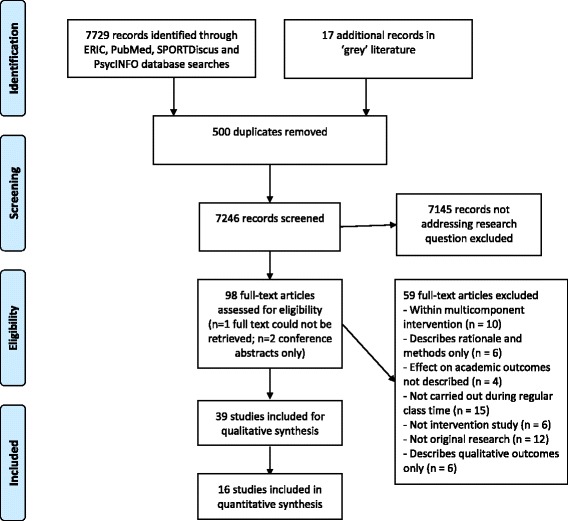
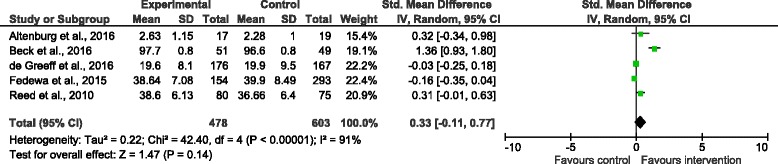
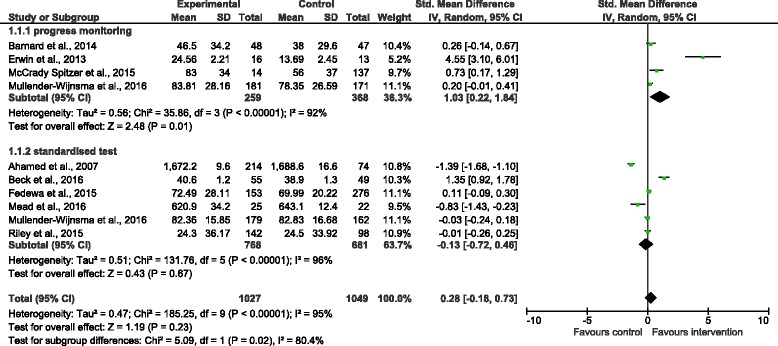
BACKGROUND: Physical activity is associated with many physical and mental health benefits, however many children do not meet the national physical activity guidelines. While schools provide an ideal setting to promote children's physical activity, adding physical activity to the school day can be difficult given time constraints often imposed by competing key learning areas. Classroom-based physical activity may provide an opportunity to increase school-based physical activity while concurrently improving academic-related outcomes. The primary aim of this systematic review and meta-analysis was to evaluate the impact of classroom-based physical activity interventions on academic-related outcomes. A secondary aim was to evaluate the impact of these lessons on physical activity levels over the study duration. METHODS: A systematic search of electronic databases (PubMed, ERIC, SPORTDiscus, PsycINFO) was performed in January 2016 and updated in January 2017. Studies that investigated the association between classroom-based physical activity interventions and academic-related outcomes in primary (elementary) school-aged children were included. Meta-analyses were conducted in Review Manager, with effect sizes calculated separately for each outcome assessed. RESULTS: Thirty-nine articles met the inclusion criteria for the review, and 16 provided sufficient data and appropriate design for inclusion in the meta-analyses. Studies investigated a range of academic-related outcomes including classroom behaviour (e.g. on-task behaviour), cognitive functions (e.g. executive function), and academic achievement (e.g. standardised test scores). Results of the meta-analyses showed classroom-based physical activity had a positive effect on improving on-task and reducing off-task classroom behaviour (standardised mean difference = 0.60 (95% CI: 0.20,1.00)), and led to improvements in academic achievement when a progress monitoring tool was used (standardised mean difference = 1.03 (95% CI: 0.22,1.84)). However, no effect was found for cognitive functions (standardised mean difference = 0.33 (95% CI: -0.11,0.77)) or physical activity (standardised mean difference = 0.40 (95% CI: -1.15,0.95)). CONCLUSIONS: Results suggest classroom-based physical activity may have a positive impact on academic-related outcomes. However, it is not possible to draw definitive conclusions due to the level of heterogeneity in intervention components and academic-related outcomes assessed. Future studies should consider the intervention period when selecting academic-related outcome measures, and use an objective measure of physical activity to determine intervention fidelity and effects on overall physical activity levels.
Overview
The claims and statistics of this paper haven’t been checked yet.
Free: it reads the open-access text and checks the first 5 claims that cite a source we can check. Create a free account to check every claim.
Integrity signals
Registry
Cites
Statistics
Figures


Verification
Claims the paper makes
The claims and statistics of this paper haven’t been checked yet.
Free: it reads the open-access text and checks the first 5 claims that cite a source we can check. Create a free account to check every claim.
Claims other papers make about this one
Each is checked against this paper’s own text: does it say what the citing paper says it does?
The source backs part of the claim, not all of it — or backs it for a different population, condition or comparison.
In the citing paper
“active classrooms, compared with traditional sedentary classrooms, had null [32] or medium [35] effects.”
From Physical Activity and Academic Achievement: An Umbrella Review (2020) · cites this paper as [32]
Experimental — accuracy not yet measuredThe source backs part of the claim, not all of it — or backs it for a different population, condition or comparison.
In the citing paper
“These improvements are relatively strong when considered in the broader field of physical activity interventions.”
From Effectiveness of wearable activity trackers to increase physical activity and improve health: a systematic review of systematic reviews and meta-analyses. (2022) · cites this paper as [69]
Experimental — accuracy not yet measured
Self-check
Percentages, sums and reported differences re-computed from the paper’s own numbers.
The self-check needs the paper’s full text.
Citations
Cites
‘Small Changes' to Diet and Physical Activity Behaviors for Weight Management
Hills, A. P., Byrne, N. M., Lindstrom, R., & Hill, J. O. (2013) · Obesity Facts · doi:10.1159/000345030 · Cited by 9,493
Physical Activity in the United States Measured by Accelerometer
TROIANO, R. P., BERRIGAN, D., DODD, K. W., MÂSSE, L. C., TILERT, T., & MCDOWELL, M. (2008) · Medicine & Science in Sports & Exercise · doi:10.1249/mss.0b013e31815a51b3 · Cited by 7,638
Janssen, I., & LeBlanc, A. G. (2010) · International Journal of Behavioral Nutrition and Physical Activity · doi:10.1186/1479-5868-7-40 · Cited by 4,829
Physical Activity for Cognitive and Mental Health in Youth: A Systematic Review of Mechanisms
Lubans, D., Richards, J., Hillman, C., Faulkner, G., Beauchamp, M., Nilsson, M., Kelly, P., Smith, J., Raine, L., & Biddle, S. (2016) · Pediatrics · doi:10.1542/peds.2016-1642 · Cited by 1,548
The relationship between physical activity and cognition in children: a meta-analysis
Sibley, B. A., & Etnier, J. L. (2003) · Pediatric Exercise Science · doi:10.1123/pes.15.3.243 · Cited by 1,308
Best, J. R., Miller, P. H., & Naglieri, J. A. (2011) · Learning and Individual Differences · doi:10.1016/j.lindif.2011.01.007 · Cited by 1,294 · cited 1×
“Executive functions, inhibition in particular, have been shown to be consistently related to academic achievement [34] and therefore were considered salient to teachers.”
BackgroundThe effect of exercise-induced arousal on cognitive task performance: a meta-regression analysis
Lambourne, K., & Tomporowski, P. (2010) · Brain Research · doi:10.1016/j.brainres.2010.03.091 · Cited by 1,105
Sallis, J. F., McKenzie, T. L., Alcaraz, J. E., Kolody, B., Faucette, N., & Hovell, M. F. (1997) · American Journal of Public Health · doi:10.2105/ajph.87.8.1328 · Cited by 914 · cited 1×
“Studies have shown interventions targeting these discrete periods may be effective in increasing children’s physical activity levels [7, 8], with the potential to contribute to up to 50% of the physical activity required to meet physical activity guidelines [9].”
BackgroundPhysical education, school physical activity, school sports and academic performance
Trudeau, F., & Shephard, R. J. (2008) · International Journal of Behavioral Nutrition and Physical Activity · doi:10.1186/1479-5868-5-10 · Cited by 879
Rasberry, C. N., Lee, S. M., Robin, L., Laris, B. A., Russell, L. A., Coyle, K. K., & Nihiser, A. J. (2011) · Preventive Medicine · doi:10.1016/j.ypmed.2011.01.027 · Cited by 709
Research works printed but not linked: 3
- Okely T Salmon J Vella S Cliff D Timperio A Tremblay M Trost S Shilton T Hinkley T Ridgers N Phillipson L Hesketh K Parrish A Janssen X Brown M Emmel J Marino N A systematic review to update the Australian physical activity guidelines for children and young people., Report prepared for the Australian Government Department of Health, Editor Canberra 2012 Australia Commonwealth of Australia
- Brickenkamp R Zillmer E d2 Test of Attention, in d2 Test 1998 Clark, Editors P.L. Ackerman and E
- Nunnally, J.C., Psychometric theory. McGraw-Hill series in psychology. 1967: New York, McGraw-Hill [1967].
Cited by
Items 301–400 of 689
Gužauskas, D., & Šukys, S. (2021) · Sustainability · doi:10.3390/su132313287 · Cited by 18
Zhou, J., Liu, H., Wen, H., Wang, X., Wang, Y., & Yang, T. (2022) · Frontiers in Psychology · doi:10.3389/fpsyg.2022.862666 · Cited by 16
Brandes, B., Sell, L., Buck, C., Busse, H., Zeeb, H., & Brandes, M. (2023) · International Journal of Behavioral Nutrition and Physical Activity · doi:10.1186/s12966-023-01497-z · Cited by 11
“PA promotion via schools normally offers one intervention to the school and many studies have been designed to investigate the effectiveness of one specific school-based intervention [6–8].”
BackgroundKlizienė, I., Čižauskas, G., Augustinienė, A., Sipavičienė, S., & Aleksandravičienė, R. (2020) · Sustainability · doi:10.3390/su12124922 · Cited by 13
“Classroom-based physical activity could positively make an impact on academic-related outcomes, including cognitive function, academic achievement, and classroom behavior [37].”
BackgroundMethodInfluentialLander, N., Mazzoli, E., Essiet, I. A., Telford, A., Ridley, K., Symington, N., & Salmon, J. (2023) · Frontiers in Education · doi:10.3389/feduc.2023.1093234 · Cited by 13
“A systematic review of school-based physical activity interventions concluded that they are an inexpensive, practical and timely means of improving academic outcomes (Watson et al., 2017).”
Background“I’m Doing Something Fun…”: Primary School Pupils’ Perceptions of Physically Active Lessons
Quarmby, T., Powell, D., & Daly-Smith, A. (2024) · Translational Journal of the American College of Sports Medicine · doi:10.1249/tjx.0000000000000256 · Cited by 12
Bellacicco, R., Capone, F., Sorrentino, C., & Martino, V. D. (2025) · Education Sciences · doi:10.3390/educsci15010047 · Cited by 28
“Future research should consider using more ecologically valid measurement instruments, such as systematic observations, teacher logs, and tasks that mimic curricular activities, to provide a more appropriate representation of real-world effects (Watson et al., 2017a).”
InfluentialRupp, R., Wallmann-Sperlich, B., & Bucksch, J. (2025) · BMC Public Health · doi:10.1186/s12889-025-22075-x · Cited by 15
“Studies from the school and working context underpin that physical activation during school lessons and during working time support cognitive functioning and performance [19–23].”
Physical activity levels during physical education in Spanish children
Huertas‐Delgado, F. J., Segura‐Jiménez, V., Ávila‐García, M., Cardon, G., & Tercedor, P. (2021) · Health Education Journal · doi:10.1177/0017896920988743 · Cited by 13
“There are multiple opportunities during the school-day in which to increase PA (e.g. recess (Coolkens et al., 2018; Verstraete et al., 2006), physical education [PE] lessons (Hollis et al., 2017; Ntoumanis, 2005), and classroom activities (Watson et al., 2017)].”
BackgroundRam, B., Foley, K., van Sluijs, E. M. F., Hargreaves, D. S., Viner, R., & Saxena, S. K. (2022) · BMJ Open · doi:10.1136/bmjopen-2022-061335 · Cited by 8
“20 22 For example, to assess children’s emotional health, one study may measure children’s ‘happiness’, while another may measure ‘depression’.”
Nielsen, J. V., Koch, S., & Skovgaard, T. (2023) · Health Promotion International · doi:10.1093/heapro/daac193 · Cited by 9
McLoughlin, G. M., Calvert, H. G., & Turner, L. R. (2023) · International Journal of Environmental Research and Public Health · doi:10.3390/ijerph20043646 · Cited by 9
Wang, Q., Qian, J., Pan, H., & Ju, Q. (2023) · Frontiers in Physiology · doi:10.3389/fphys.2023.1104018 · Cited by 15
“Lastly, future research can design tailored electronic and digital intervention programs for physical fitness (Watson et al., 2017), identify target populations for interventions, and promote the TABLE 2 Physical fitness results for athlete group and non-athlete group.”
BackgroundLee, U.-Y., & Joo, C.-H. (2024) · Journal of Exercise Rehabilitation · doi:10.12965/jer.2346628.314 · Cited by 7
“Previous studies reported that elementary school students’ physical activities were significantly related to academic achievements and physical fitness (Lambourne et al., 2013; Watson et al., 2017).”
BackgroundBandera-Campos, F. J., Grao‐Cruces, A., Camiletti‐Moirón, D., Martín‐Acosta, F., Muñoz-González, R., González-Pérez, M., Hermosa, A. R., Vaquero‐Solís, M., Moledo, C. P., & Sánchez‐Oliva, D. (2025) · Frontiers in Public Health · doi:10.3389/fpubh.2025.1565914 · Cited by 13
Fraile‐Μartinez, O., Montero, C. G., Fraile-Martinez, M., Pekarek, L., Barrena-Blázquez, S., López-González, L., Álvarez-Mon, M. Á., Pekarek, T., Casanova, C., Álvarez‐Mon, M., et al. (2025) · Frontiers in Education · doi:10.3389/feduc.2025.1541876 · Cited by 19
Pedagogical constraints of physical literacy based on cognitive load theory
Dudley, D. A., Dean, H., Cairney, J., & Bergen, P. V. (2020) · Prospects · doi:10.1007/s11125-020-09496-9 · Cited by 10
Muros, J. J. (2021) · Retos · doi:10.47197/retos.v0i41.86166 · Cited by 9
Student arousal, engagement, and emotion relative to Physical Education periods in school
Fogarty, J. S., Goodwill, A. M., Tan, A. L., & Tan, S. (2023) · Trends in Neuroscience and Education · doi:10.1016/j.tine.2023.100215 · Cited by 13
Romero-Martínez, J., Menescardi, C., García‐Massó, X., & Estevan, I. (2024) · Retos · doi:10.47197/retos.v52.100143 · Cited by 16
“Estos resultados van en línea con los de revisiones previas en el ámbito escolar como la de Watson et al. (2017), que clasificaron un 56% como “dé-bil”, un 36% como “moderado” y un 8% como “fuerte”.”
BackgroundInfluentialMohammed, Z., Kherfane, M. H., & Bouabdellah, S. (2021) · Retos · doi:10.47197/retos.v0i41.77808 · Cited by 7
Movement integration in academic classrooms; a focus on secondary students’ experiences
Romar, J., Enlund, M., Lind, S., & Björkgren, M. (2023) · Journal of Physical Education and Sport · doi:10.7752/jpes.2023.04115 · Cited by 30
Jeppesen, L. S., Damsgaard, L., Stolpe, M. N., Melcher, J. N. S., Wienecke, J., Nielsen, G., Smedegaard, S., Henriksen, A. H., Hansen, R. A., Hillman, C. H., et al. (2024) · BMC Pediatrics · doi:10.1186/s12887-024-04647-9 · Cited by 6
“Enhanced PA might have a positive impact not only on health and wellbeing [3, 19], but also on cognitive skills and academic performance [7, 8, 11–13 , 26 ].”
BackgroundFedewa, A. L., Mayo, M. R., Ahn, S., & Erwin, H. E. (2020) · Journal of Applied School Psychology · doi:10.1080/15377903.2020.1858380 · Cited by 7
“Further, most interventions are shorter in duration (approximately 6–12weeks as is convention for this area of research; Watson et al., 2017) and thus it is unclear what effects a longer, more sustainable intervention would have on the behaviors of typically developing and young children who are…”
BackgroundSimmons, T., Brinkley, A., Quarmby, T., Horner, L., Sherar, L. B., Hooper, O., & Kinnafick, F. (2024) · International Review of Sport and Exercise Psychology · doi:10.1080/1750984x.2024.2303773 · Cited by 9
“Physically active lessons can improve pupils ’ physical activity levels and aca-demic-related outcomes, such as engagement with learning, attainment, and cognitive functioning (Norris et al., 2015; Watson et al., 2017).”
Arenas, D., Bodi-Torralba, M., Oliver, A., Cantallops, J., Ponseti, F. J., Palou, P., Collado, J. A., Flórez, I., Galvez-Pol, A., Terrasa, J. L., et al. (2024) · Frontiers in Psychology · doi:10.3389/fpsyg.2024.1451731 · Cited by 14
Johansen, J.-M., Mandelid, M. B., Reinboth, M. S., Resaland, G. K., & Bratland‐Sanda, S. (2025) · Frontiers in Sports and Active Living · doi:10.3389/fspor.2024.1504704 · Cited by 9
Gökdere, F., Uylas, E., Çatıkkaş, F., Günay, E., Ceylan, H. İ., & Özgören, M. (2025) · Children · doi:10.3390/children12020208 · Cited by 9
Ούρδα, Δ., Skoufa, L., Brighi, A., Crone, D., Edwards, L. C., Failo, A., Fourlari, S., Huhtiniemi, M., Jaakkola, T. T., Raptis, G., et al. (2025) · Education Sciences · doi:10.3390/educsci15050560 · Cited by 12
Duarte-Anselmi, G., Barbosa, A. A. D. O., Ferrari, G., Pinheiro, A. C., Araneda‐Flores, J., Arancibia, D., & Pizarro-Quevedo, T. (2025) · Scientific Reports · doi:10.1038/s41598-025-19332-9 · Cited by 13
“These guidelines helped ensure a rigorous and equitable analysis of how interventions may differentially impact boys and girls (Supplementary Materials Appendix 12).”
InfluentialMoin, M., Farhan, Z., Naqvi, S. K., Lassi, Z. S., & Das, J. K. (2026) · Journal of Global Health · doi:10.7189/jogh.16.04112 · Cited by 11
Foley, K., Venkatraman, T. M., Ram, B., Ells, L. J., van Sluijs, E. M. F., Hargreaves, D. S., Greaves, F., Sharabiani, M. T. A., Viner, R., Bottle, A., et al. (2019) · BMJ Open · doi:10.1136/bmjopen-2019-031868 · Cited by 6
Nutter, S., Saunders, J. F., Brun, I., Exner‐Cortens, D., & Russell‐Mayhew, S. (2022) · Canadian Journal of Education / Revue canadienne de l éducation · doi:10.53967/cje-rce.v45i1.5033 · Cited by 9
“Engaging students of all ages in physical activity and healthy lifestyles is an important public health goal, with both significant benefits for the physical and mental health outcomes of students as well as improved academic performance (Bassett-Gunter et al., 2016; Watson et al., 2017).”
BackgroundXu, Y., Lin, N., Wu, C., Wen, X., Zhong, F., Ke-hong, Y., Li, S., & Huang, C. X. (2023) · Journal of Teaching in Physical Education · doi:10.1123/jtpe.2022-0175 · Cited by 10
Effects of two years of physically active lessons on cognitive indicators in children
Oliveira, D. N., Silva, E. C. M., Barboza, L. L. S., Thuany, M., Araújo, R. H. D. O., Silva, R. J. D. S., Gomes, T. N., Schmitz, H., Tejada, J., & da Silva, D. R. P. (2023) · Scientific Reports · doi:10.1038/s41598-023-35644-0 · Cited by 12
Pfledderer, C. D., Brown, D. M. Y., Ranjit, N., Springer, A. E., Malkani, R. I., Salvo, D., & Hoelscher, D. M. (2024) · Frontiers in Public Health · doi:10.3389/fpubh.2024.1352644 · Cited by 8
Gasser, M., Nadenbousch, A.-M., Egger, F., Kamer, M., Valkanover, S., & Schmidt, M. (2024) · BMC Pediatrics · doi:10.1186/s12887-024-05034-0 · Cited by 14
Jensen, O. E., Nielsen, A. V., Gejl, A. K., Rohde, R. A., Højberg, L. M., Damsgaard, L., Malling, A. S. B., Stevnsborg, E., Bugge, A., Poulsen, M., et al. (2025) · Educational Research Review · doi:10.1016/j.edurev.2025.100668 · Cited by 7
Brandes, B., Busse, H., Sell, L., Christianson, L., & Brandes, M. (2020) · BMJ Open · doi:10.1136/bmjopen-2020-037848 · Cited by 7
Weight, E. A., Harry, M. P., & Erwin, H. E. (2021) · Journal of Physical Activity and Health · doi:10.1123/jpah.2020-0263 · Cited by 6
Effects of Maths on the Move on Children’s Perspectives, Physical Activity, and Math Performance
Morris, J. L., Archbold, V. S. J., Bond, S. J., & Daly-Smith, A. (2022) · Translational Journal of the American College of Sports Medicine · doi:10.1249/tjx.0000000000000191 · Cited by 13
“Thus, empirical research has yet to sufficiently demonstrate the efficacy of PAL lessons in improving pupils’ learning (6,11).”
BackgroundMondragón, N. I., Berasategi, N., Ozamiz-Etxebarria, N., & Santamaría, M. D. (2022) · Children s Geographies · doi:10.1080/14733285.2022.2118030 · Cited by 6
“It has also been shown that physical activity improves academic performance (Watson et al. 2017) and, in fact, in this case, academic”
BackgroundImpact of an Interdisciplinary Educational Programme on Students’ Physical Activity and Fitness
Jiménez-Parra, J. F., & Valenzuela, A. V. (2023) · Healthcare · doi:10.3390/healthcare11091256 · Cited by 13
“[7]: (a) PA of short duration and any level of intensity (mainly MVPA) to break with the teaching dynamics, as a time-out from homework and to reduce sedentary lifestyles and physical inactivity of students (active breaks); and (b) PA directly related to curricular content (e.”
BackgroundMethodInfluentialCampagna, J., Czyszczon, K., Little, J., Selby, C., Wick, L., Ferreira, D., & Oriel, K. N. (2023) · Journal of Intellectual Disability Research · doi:10.1111/jir.13104 · Cited by 7
Simard, L., Bouchard, J., Lavallière, M., & Chevrette, T. (2023) · PLoS ONE · doi:10.1371/journal.pone.0294422 · Cited by 12
Aske, D. B., Chomitz, V. R., Liu, X., Arsenault, L. N., Bhalotra, S. M., & Acevedo‐García, D. (2018) · Journal of School Health · doi:10.1111/josh.12643 · Cited by 7
Feiler, K. E. (2018) · Pedagogy in Health Promotion · doi:10.1177/2373379918799770 · Cited by 7
Hodgin, K. L., von Klinggraeff, L., Dauenhauer, B. D., McMullen, J. M., Kuhn, A. P., Stoepker, P., & Carson, R. L. (2020) · Journal of Physical Activity and Health · doi:10.1123/jpah.2018-0711 · Cited by 7
Boedeker, P., Turner, L. R., Calvert, H. G., Kay, C. M., Meyer, A. M., Truett, C., & Gazmararian, J. A. (2021) · Contemporary Clinical Trials Communications · doi:10.1016/j.conctc.2021.100747 · Cited by 10
“smallest observed effects found in meta-analytic reviews of the relationship [35,36]), 40 schools with 6 teachers per school and 20 students per teacher yielded power of 100%.”
BackgroundMacdonald, K., Milne, N., Pope, R., & Orr, R. M. (2021) · Early Childhood Education Journal · doi:10.1007/s10643-021-01199-w · Cited by 14
“Conversely, mixed findings have been reported by studies investigating the use of PA breaks in the classroom, without an academic focus, on academic performance (Donnelly et al., 2016; Watson et al., 2017).”
BackgroundMovement, my favourite thing: children’s perceptions of movement integration in school
Egan, C. A., Orendorff, K. L., Merica, C. B., & Brush, C. J. (2024) · Curriculum Studies in Health and Physical Education · doi:10.1080/25742981.2024.2374321 · Cited by 7
“Evidence regarding during-school PA has received increased interest, with speci fi c attention to the positive outcomes that classroom-based movement (i.e. movement integration [MI]) has on school-aged young people inside and outside the school setting (Goh et al., 2016; Watson et al., 2017).”
Blending Technology with Classroom Movement Integration
Ha, T., Moon, J., & Webster, C. A. (2025) · Journal of Physical Education Recreation & Dance · doi:10.1080/07303084.2025.2533149 · Cited by 5
“…PA levels (Daly-Smith et al., 2018; Goh et al., 2019; Martin & Murtagh, 2015), academic achievement (Donnelly & Lambourne, 2011; Martin & Murtagh, 2017; Mavilidi et al., 2020), cognitive function (Daly-Smith et al., 2018; Watson et al., 2017), and behavioral outcomes (Carlson et al., 2015).”
Breheny, K., Frew, E. J., Williams, I., Passmore, S., & Coast, J. (2020) · International Journal of Environmental Research and Public Health · doi:10.3390/ijerph17239077 · Cited by 5
Teacher Classifications of Implementing Classroom Movement Integration in Elementary Schools
Moon, J., & Lee, D. (2023) · lnternational Electronic Journal of Elementary Education · doi:10.26822/iejee.2024.321 · Cited by 9
Delgado‐Floody, P., Cristi‐Montero, C., Jerez‐Mayorga, D., Ruiz‐Ariza, A., Guzmán‐Guzmán, I. P., Álvarez, C., López, M. G., Carter-Thuillier, B. I., & Navarrete, F. C. (2024) · Frontiers in Public Health · doi:10.3389/fpubh.2024.1426108 · Cited by 6
Queral, J., Wargers, A., Llauradó, E., Jansen, W., Solà, R., Tarro, L., & Mölenberg, F. J. M. (2024) · Nutrition Reviews · doi:10.1093/nutrit/nuae067 · Cited by 5
Ortega, F. Z., González-Valero, G., Ubago-Jiménez, J. L., & Melguizo-Ibáñez, E. (2025) · Revista de Psicodidáctica · doi:10.1016/j.psicod.2024.500163 · Cited by 8
TransformEd: an innovative model to support professional growth of pre-service teachers
Lander, N., Mazzoli, E., Orr, J., Verswijveren, S. J. J. M., Ayala, A. M. C., Brown, T. D., & Muir, T. (2025) · Teaching Education · doi:10.1080/10476210.2025.2462312 · Cited by 9
“Further complicating matters, children spend around 75% of their school day engaging in sedentary behaviour (Clemes et al., 2016; Watson et al., 2017; Webster et al., 2015), and prolonged sitting is pervasive in the classroom (Clemes et al., 2016), which has negative consequences for learning,…”
Walker, R. A. J., House, D., Porter, A., Salway, R., Kent-Saisch, S., Beets, M. W., Lubans, D. R., de Vocht, F., & Jago, R. (2025) · BMC Public Health · doi:10.1186/s12889-025-23471-z · Cited by 5
“Yet, para-doxically, there is evidence that suggests short physical activity breaks increase children’s on-task behaviour (i.e. the amount of time actively spent in the learning process) [59].”
Comprehensive exercise recommendations for pediatric asthma: an evidence synthesis
Xu, H., Lin, N., Bai, G., Liu, Y., Jia, X., Huang, C. X., Hu, L., Shao, H., Shang, Q.-Y., Zhang, L., et al. (2025) · World Journal of Pediatrics · doi:10.1007/s12519-025-00976-6 · Cited by 9
“At school, flexible physical education curricula, understanding of asthma by teachers, and their ability to manage emergencies are important to ensure children can participate safely [87, 88].”
Perceptions of Canadian Indigenous teachers and students on movement integration in the classroom
Kerpan, S., Humbert, M. L., & Abonyi, S. (2019) · The Australian Journal of Indigenous Education · doi:10.1017/jie.2019.1 · Cited by 6
“A body of compelling evidence is forming around the benefits of movement integration such as (a) improved academic outcomes, (b) improved on-task behaviour, (c) improved cognitive functioning, (d) increased moderate-to-vigorous physical activity, (e) reduction in sedentary time and (f) increased student enjoyment and…”
BackgroundFICHAS DE DESCANSOS ACTIVOS para Educación Infantil y Primaria. Guía para el profesorado
Mancha, U. D. C.-L., Sánchez‐López, M., López, L. M. G., & Hermosa, A. R. (2020) · Ediciones de la Universidad de Castilla-La Mancha eBooks · doi:10.18239/divulga_2020.04.00 · Cited by 6
Wind, J., Horst, F., Rizzi, N., John, A., Kurti, T., & Schöllhorn, W. I. (2021) · Frontiers in Behavioral Neuroscience · doi:10.3389/fnbeh.2021.731881 · Cited by 5
Silva, E. C. M., Barboza, L. L. S., Gandarela, L., Tejada, J., Schmitz, H., Gomes, T. N., Silva, R. J. D. S., Sardinha, L. B., & da Silva, D. R. P. (2022) · Research Quarterly for Exercise and Sport · doi:10.1080/02701367.2021.2020707 · Cited by 14
“In addition, studies on interventions with physically active lessons have shown promising effects on variables of total physical activity, and academic and cognitive performance of the children (Jones et al., 2020; Norris et al., 2020; Watson et al., 2017).”
BackgroundInfluentialPizà-Mir, B., Colio, B. B., Rodríguez‐García, L., & González-Férnandez, F. T. (2022) · Retos · doi:10.47197/retos.v45i0.92669 · Cited by 15
Bhat, M., Dehury, K., Chandrasekaran, B., Palaniswamy, H. P., & Arumugam, A. (2022) · Theoretical Issues in Ergonomics Science · doi:10.1080/1463922x.2022.2033877 · Cited by 4
“Decreasing sedentary time may reduce early cardiometabolic disease risk and improve cognitive and academic performance in adolescent and young adults (Ellis et al. 2019; Watson et al. 2019a; Watson et al. 2019b; Watson et al. 2017).”
BackgroundKuhn, A. P., Parker, E. A. D., Lane, H., Deitch, R., Wang, Y., Turner, L. R., & Hager, E. R. (2022) · Health Promotion Practice · doi:10.1177/15248399221136857 · Cited by 7
“CPA breaks have been shown to increase minutes of PA as well as time on task, effort, and attention in elementary and middle school students (Carlson et al., 2015; Donnelly et al., 2017; Katz et al., 2010; Watson et al., 2017; Weaver et al., 2018).”
BackgroundHaapala, E. A., Widlund, A., Poikkeus, A., Lima, R. A., Brage, S., Pirjo Aunio, A., & Lakka, T. A. (2023) · Medicine & Science in Sports & Exercise · doi:10.1249/mss.0000000000003163 · Cited by 15
“and miss the sensitivity to changes in learning progress (18).”
BackgroundHernández-Álvarez, E. D., Cobo, E. A., Cahalin, L. P., & Pamela Serón, S. (2023) · Frontiers in Public Health · doi:10.3389/fpubh.2023.1095146 · Cited by 6
Shen, B., Cui, G., & Bo, J. (2023) · Learning and Individual Differences · doi:10.1016/j.lindif.2023.102329 · Cited by 8
Toward a General Theory of Classroom Teachers’ Movement Integration
Webster, C. A. (2023) · Kinesiology Review · doi:10.1123/kr.2023-0013 · Cited by 9
Lobach, Y., Ramos, Ó. R., Ceballos, C. E. L., Romero-Ramos, N., Suárez, A. J. G., & Niznikowski, Т. (2023) · Retos · doi:10.47197/retos.v51.100863 · Cited by 11
“…distrac-tores; además este flujo de sangre, oxígeno y la expresión de ciertos marcadores bioquímicos como las citoquinas adicio-nales que llega al cerebro (Pedersen, 2019), como conse-cuencia de la AF puede beneficiar las funciones cognitivas en tareas que demandan atención (Watson et al., 2017).”
BackgroundMelguizo-Ibáñez, E., Puertas-Molero, P., González-Valero, G., & Alonso-Vargas, J. M. (2024) · Quest · doi:10.1080/00336297.2024.2419443 · Cited by 10
“Previously conducted reviews have found that shorter interventions are more likely to bring about improvements in academic performance (Peiris et al., 2022; Watson et al., 2017).”
InfluentialRanaei, A., Sany, S. B. T., Vahedian-Shahroodi, M., Sabahi, A., Tehrani, H., & Khajavi, A. (2025) · Frontiers in Public Health · doi:10.3389/fpubh.2025.1558210 · Cited by 7
Nathan, N., McCarthy, N., Hall, A. E., Shoesmith, A., Lane, C., Jackson, R., Sutherland, R., Groombridge, D., Reeves, P., Boyer, J., et al. (2022) · BMJ Open · doi:10.1136/bmjopen-2022-064692 · Cited by 8
Sánchez-Valdivia, N., del Pulgar, C. P., de Bont, J., Anguelovski, I., López‐Gay, A., Pistillo, A., Mas, M. T., & Duarte‐Salles, T. (2022) · International Journal of Environmental Research and Public Health · doi:10.3390/ijerph192013676 · Cited by 6
“, during breaktime, physical education classes, active transport from and to school, and extracurricular activities at school) [68].”
BackgroundThe Relationship between Monetary Incentives, Social Status, and Physical Activity
Gonzalez, N. I. V., Kee, J., Palma, M. A., & Pruitt, J. R. (2022) · Journal of Behavioral and Experimental Economics · doi:10.1016/j.socec.2023.102155 · Cited by 6
A Nonrandomized Pilot Implementation Trial of the CLASS PAL (Physically Active Learning) Project
Routen, A. C., Cale, L., Chalkley, A. E., Clemes, S. A., Edwardson, C. L., Glazebrook, C., Harrington, D. M., Khunti, K., Pearson, N., Salmon, J., et al. (2024) · Translational Journal of the American College of Sports Medicine · doi:10.1249/tjx.0000000000000261 · Cited by 7
Do You Want Your Students to Pay More Attention in Class? Try Dynamic Seating!
Rollo, S., Smith, S. T., & Harry Prapavessis, A. (2017) · Journal of Ergonomics · doi:10.4172/2165-7556.1000217 · Cited by 7
“Recently, Watson and colleagues [7] evaluated the impact of 39 classroom-based PA interventions on academic-related outcomes.”
BackgroundInfluentialEmonson, C., McGillivray, J., Kothe, E. J., Rinehart, N., & Papadopoulos, N. V. (2019) · International Journal of Environmental Research and Public Health · doi:10.3390/ijerph16245140 · Cited by 9
“However, while there are published reviews of general interventions to increase PA participation for children with disabilities [54–56] and mainstream classroom-based PA interventions [50,51], to the author’s knowledge, no review of class time PA programs implemented in specialist primary schools currently exists.”
BackgroundResultCollecting and Using Students’ Digital Well-Being Data in Multidisciplinary Teaching
Moilanen, H., Äyrämö, S., Jauhiainen, S., & Kankaanranta, M. (2018) · Education Research International · doi:10.1155/2018/3012079 · Cited by 6
Fiorilli, G., Claudio, G. D., Fonza, D. D., Baralla, F., Aquino, G., Martino, G. D., Valle, C. D., Centorbi, M., Calcagno, G., Buonsenso, A., et al. (2025) · Journal of Functional Morphology and Kinesiology · doi:10.3390/jfmk10040376 · Cited by 9
“ABs involve brief intervals, typically ranging from 5 to 15 min, of PA that is conducted within the classroom setting [7], integrated into the daily routine [6,8], and delivered by classroom teachers either between lessons or integrated into the lessons themselves [9].”
Frömel, K., Groffik, D., Heidler, J., Mitáš, J., & Pratt, M. (2024) · Journal of Teaching in Physical Education · doi:10.1123/jtpe.2024-0042 · Cited by 5
Molloy, C. S., Beatson, R. M., Harrop, C., Perini, N., & Goldfeld, S. R. (2024) · Research Papers in Education · doi:10.1080/02671522.2024.2414318 · Cited by 7
“Several reviews identified experimental primary studies conducted with children in Grades K-3 (Martin and Murtagh 2017; Norris et al. 2015; Sneck et al. 2019; Vetter et al. 2020; Watson et al. 2017).”
Hermosa, A. R., Sánchez‐Oliva, D., Grao‐Cruces, A., Medrano, M., González-Pérez, M., Martín‐Acosta, F., & Camiletti‐Moirón, D. (2025) · Translational Journal of the American College of Sports Medicine · doi:10.1249/tjx.0000000000000290 · Cited by 9
Black, M. M., Bruening, M. M., Carroll‐Scott, A., Dave, J. M., Ebi, K. L., Iannotti, L. L., Johnson, S. L., Ritchie, L. D., Jimenez, E. Y., Steiber, A. L., et al. (2025) · Journal of Nutrition · doi:10.1016/j.tjnut.2025.10.020 · Cited by 11
Reyes-Amigo, T., Grao‐Cruces, A., Sánchez‐Oliva, D., García‐Hermoso, A., Reyes‐Molina, D., Sepulveda, R. A. Y., Arancibia, J. E. O., Almonacid, J. G. H., Páez‐Herrera, J., Salinas-Gallardo, G., et al. (2025) · Frontiers in Public Health · doi:10.3389/fpubh.2025.1644819 · Cited by 9
Pfledderer, C. D., Burns, R. D., Byun, W., Carson, R. L., Welk, G. J., & Brusseau, T. A. (2021) · Journal of Physical Activity and Health · doi:10.1123/jpah.2021-0220 · Cited by 4
Reyes-Amigo, T., Ibarra-Mora, J., Aguilar-Farías, N., Gómez-Álvarez, N., Beltrán, H. C., Zapata‐Lamana, R., Almonacid, J. G. H., Páez‐Herrera, J., Sepulveda, R. A. Y., Cortés, G., et al. (2024) · Frontiers in Public Health · doi:10.3389/fpubh.2023.1243592 · Cited by 9
Ricci, J. M., Johnson-Shelton, D., & Westling, E. H. (2024) · Journal of Physical Activity and Health · doi:10.1123/jpah.2023-0422 · Cited by 5
Nazhira, F., Aunurrahman, A., Putri, F., Fauziah, E., Wicaksono, U., Ravita, V., Setiawan, E., & Berezhna, Y. (2024) · Health sport rehabilitation · doi:10.58962/hsr.2024.10.3.17-27 · Cited by 4
Ayuso, J. A. Z. (2020) · Revista Complutense de Educación · doi:10.5209/rced.65495 · Cited by 8
“…motiva algunas de las conclusiones de otras revisiones sobre el estado de esta cuestión, en las cuales se resalta el interés en profundizar en el conocimiento de los factores que pueden incrementar la efectividad de estas intervenciones en la escuela (Marques et al., 2017; Watson et al., 2017).”
BackgroundMotivation and self-efficacy influence in the academic performance of Secondary students-athletes
González-Férnandez, F. T., Baena‐Morales, S., Ramos-Pérez, D., & Oria, H. M. (2020) · Summer Conferences of Sports Science · doi:10.14198/jhse.2020.15.proc4.08 · Cited by 9
Errisuriz, V. L., Dooley, E. E., Burford, K., Johnson, A. M., Jowers, E. M., & Bartholomew, J. B. (2021) · Prevention Science · doi:10.1007/s11121-021-01233-8 · Cited by 9
Đurić, S., Bogataj, Š., Zovko, V., & Sember, V. (2021) · Frontiers in Public Health · doi:10.3389/fpubh.2021.778837 · Cited by 10
Factors Affecting Mental Illness and Social Stress in Students Using Fuzzy TOPSIS
Ibrahim, I., Mansor, N. H., & Bidin, J. (2022) · Journal of Computing Research and Innovation · doi:10.24191/jcrinn.v7i2.294 · Cited by 6
Chatzopoulos, D., Mouchou-Moutzouridou, E., Papadopoulos, P., Katsanis, G., & Panoutsakopoulos, V. (2023) · lnternational Electronic Journal of Elementary Education · doi:10.26822/iejee.2024.328 · Cited by 14
Peiris, D. L. I. H. K., Duan, Y., Vandelanotte, C., Liang, W., & Baker, J. S. (2024) · Frontiers in Public Health · doi:10.3389/fpubh.2024.1360210 · Cited by 8
McGann, J., Meegan, S., Woods, C. B., Murtagh, E., Duff, C., & Belton, S. (2020) · Irish Educational Studies · doi:10.1080/03323315.2020.1794926 · Cited by 6
“This is in line with a recent systematic analysis of the literature by Watson et al. (2017) who found that school-based PA initiatives have the capacity to support improvements in student PA levels.”
ResultAllison, N. G. (2020) · Journal of Perspectives in Applied Academic Practice · doi:10.14297/jpaap.v8i2.427 · Cited by 16
“Lastly, it should not be overlooked that students valued the inclusion of an exercise break, the benefits for attention being well-known (Watson et al., 2017).”
Metadata
- Authors
- Watson, A., Timperio, A., Brown, H., Best, K., & Hesketh, K. D.
- Affiliations
- Deakin University (AU)
- Corresponding author
- Hesketh, Kylie D.
- Venue
- International Journal of Behavioral Nutrition and Physical Activity
- Published
- 2017-08-25
- Volume
- 14
- Issue
- 1
- Pages
- 114-114
- ISSN
- 1479-5868 (ISSN-L)
- PMC
- PMC5574081
- OpenAlex
- W2750279836
- Cited by
- 689
- References
- 74
- Citations by year
- 2026: 60 · 2025: 76 · 2024: 97 · 2023: 86 · 2022: 96 · 2021: 97 · 2020: 81 · 2019: 59 · 2018: 34 · 2017: 1
- FWCI
- 5.87
- Type
- journal article
- Language
- en
- Open access
- gold
- doi.org
- Licence
- cc-by
- Locations
- International Journal of Behavioral Nutrition and Physical Activity (publishedVersion, cc-by)
- Europe PMC (PubMed Central) (publishedVersion, cc-by)
- PubMed Central (publishedVersion, cc-by)
- PubMed (publishedVersion)
- Adelaide Research & Scholarship (AR&S) (University of Adelaide) (submittedVersion, cc-by)
- DOAJ (DOAJ: Directory of Open Access Journals) (submittedVersion)
- Figshare (submittedVersion, cc-by)
- Funders
- National Heart Foundation of Australia (FT130100637, 100370, 100046)
- Deakin University
- Topics
- Health Sciences › Medicine › Public Health, Environmental and Occupational Health › Physical Activity and Health
- Health Sciences › Medicine › Public Health, Environmental and Occupational Health › School Health and Nursing Education
- Social Sciences › Psychology › Developmental and Educational Psychology › Children's Physical and Motor Development
- Keywords
- classroom physical activity, school-based physical activity intervention, academic performance, on-task behavior, off-task behavior, executive function, cognitive function, elementary school students, children's physical activity, intervention fidelity, progress monitoring, physical education classes, intervention intensity, intervention dosage, intervention heterogeneity
- MeSH terms
- Academic Success, Child, Cognition, Curriculum, Humans, Learning, Physical Education and Training, Schools, Students, Health Behavior, Exercise, Databases, Factual
About these checks
Registry, retraction, Cites and statistics results are computed, not judged, with one exception: a printed reference that no index lists is read once by a model before it counts as a citation error. Claims are extracted by a model and kept only when their quote appears verbatim in the text; each cited source is then checked, with a model’s help, for whether it says what the claim relies on. Those verdicts can be wrong — read the claim’s quote and the cited source before relying on one.
Statistics and arithmetic are recomputed, not judged.
Confidence bands are shown only for fields calibrated on our annotated test set. None is calibrated yet, so no band is shown.
What counts as a claim ›How we measure confidence ›How we check this ›
Are you an author, or do you see a problem with this page? Request a review
Data sources
Bibliographic data: Semantic Scholar, OpenAlex, Crossref.
Contains information from the Semantic Scholar Academic Graph Datasets, made available under the ODC Attribution License (ODC-BY 1.0).
Semantic Scholar’s data is described in: Kinney, R., et al. (2023). The Semantic Scholar Open Data Platform. arXiv:2301.10140.
