

Effect of classroom-based physical activity interventions on academic and physical activity outcomes: a systematic review and meta-analysis
Open accessThe DOI matches its Crossref record; 74 of the 74 references it cites were found in a registry or an index.
Abstract
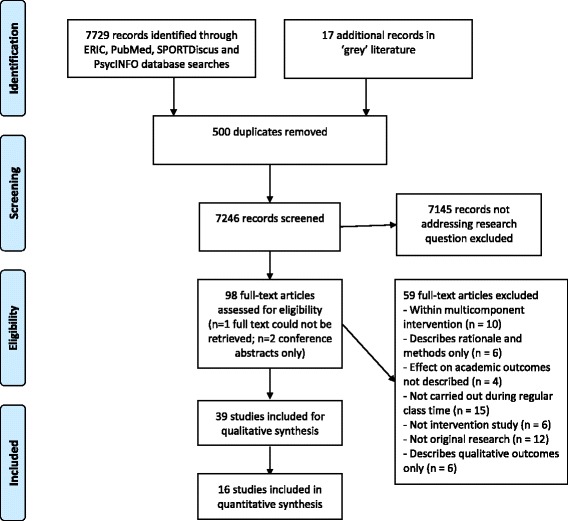
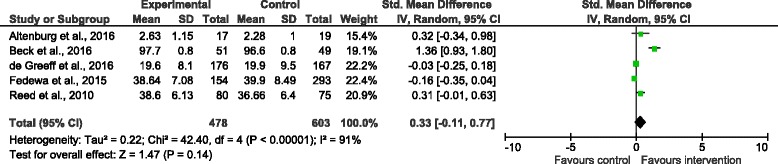
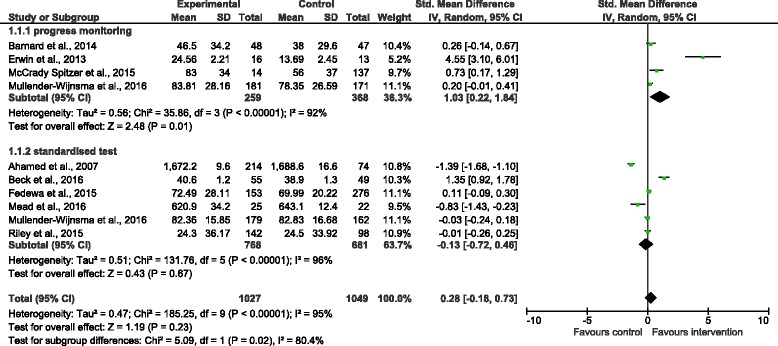
BACKGROUND: Physical activity is associated with many physical and mental health benefits, however many children do not meet the national physical activity guidelines. While schools provide an ideal setting to promote children's physical activity, adding physical activity to the school day can be difficult given time constraints often imposed by competing key learning areas. Classroom-based physical activity may provide an opportunity to increase school-based physical activity while concurrently improving academic-related outcomes. The primary aim of this systematic review and meta-analysis was to evaluate the impact of classroom-based physical activity interventions on academic-related outcomes. A secondary aim was to evaluate the impact of these lessons on physical activity levels over the study duration. METHODS: A systematic search of electronic databases (PubMed, ERIC, SPORTDiscus, PsycINFO) was performed in January 2016 and updated in January 2017. Studies that investigated the association between classroom-based physical activity interventions and academic-related outcomes in primary (elementary) school-aged children were included. Meta-analyses were conducted in Review Manager, with effect sizes calculated separately for each outcome assessed. RESULTS: Thirty-nine articles met the inclusion criteria for the review, and 16 provided sufficient data and appropriate design for inclusion in the meta-analyses. Studies investigated a range of academic-related outcomes including classroom behaviour (e.g. on-task behaviour), cognitive functions (e.g. executive function), and academic achievement (e.g. standardised test scores). Results of the meta-analyses showed classroom-based physical activity had a positive effect on improving on-task and reducing off-task classroom behaviour (standardised mean difference = 0.60 (95% CI: 0.20,1.00)), and led to improvements in academic achievement when a progress monitoring tool was used (standardised mean difference = 1.03 (95% CI: 0.22,1.84)). However, no effect was found for cognitive functions (standardised mean difference = 0.33 (95% CI: -0.11,0.77)) or physical activity (standardised mean difference = 0.40 (95% CI: -1.15,0.95)). CONCLUSIONS: Results suggest classroom-based physical activity may have a positive impact on academic-related outcomes. However, it is not possible to draw definitive conclusions due to the level of heterogeneity in intervention components and academic-related outcomes assessed. Future studies should consider the intervention period when selecting academic-related outcome measures, and use an objective measure of physical activity to determine intervention fidelity and effects on overall physical activity levels.
Overview
The claims and statistics of this paper haven’t been checked yet.
Free: it reads the open-access text and checks the first 5 claims that cite a source we can check. Create a free account to check every claim.
Integrity signals
Registry
Cites
Statistics
Figures


Verification
Claims the paper makes
The claims and statistics of this paper haven’t been checked yet.
Free: it reads the open-access text and checks the first 5 claims that cite a source we can check. Create a free account to check every claim.
Claims other papers make about this one
Each is checked against this paper’s own text: does it say what the citing paper says it does?
The source backs part of the claim, not all of it — or backs it for a different population, condition or comparison.
In the citing paper
“active classrooms, compared with traditional sedentary classrooms, had null [32] or medium [35] effects.”
From Physical Activity and Academic Achievement: An Umbrella Review (2020) · cites this paper as [32]
Experimental — accuracy not yet measuredThe source backs part of the claim, not all of it — or backs it for a different population, condition or comparison.
In the citing paper
“These improvements are relatively strong when considered in the broader field of physical activity interventions.”
From Effectiveness of wearable activity trackers to increase physical activity and improve health: a systematic review of systematic reviews and meta-analyses. (2022) · cites this paper as [69]
Experimental — accuracy not yet measured
Self-check
Percentages, sums and reported differences re-computed from the paper’s own numbers.
The self-check needs the paper’s full text.
Citations
Cites
‘Small Changes' to Diet and Physical Activity Behaviors for Weight Management
Hills, A. P., Byrne, N. M., Lindstrom, R., & Hill, J. O. (2013) · Obesity Facts · doi:10.1159/000345030 · Cited by 9,493
Physical Activity in the United States Measured by Accelerometer
TROIANO, R. P., BERRIGAN, D., DODD, K. W., MÂSSE, L. C., TILERT, T., & MCDOWELL, M. (2008) · Medicine & Science in Sports & Exercise · doi:10.1249/mss.0b013e31815a51b3 · Cited by 7,638
Janssen, I., & LeBlanc, A. G. (2010) · International Journal of Behavioral Nutrition and Physical Activity · doi:10.1186/1479-5868-7-40 · Cited by 4,829
Physical Activity for Cognitive and Mental Health in Youth: A Systematic Review of Mechanisms
Lubans, D., Richards, J., Hillman, C., Faulkner, G., Beauchamp, M., Nilsson, M., Kelly, P., Smith, J., Raine, L., & Biddle, S. (2016) · Pediatrics · doi:10.1542/peds.2016-1642 · Cited by 1,548
The relationship between physical activity and cognition in children: a meta-analysis
Sibley, B. A., & Etnier, J. L. (2003) · Pediatric Exercise Science · doi:10.1123/pes.15.3.243 · Cited by 1,308
Best, J. R., Miller, P. H., & Naglieri, J. A. (2011) · Learning and Individual Differences · doi:10.1016/j.lindif.2011.01.007 · Cited by 1,294 · cited 1×
“Executive functions, inhibition in particular, have been shown to be consistently related to academic achievement [34] and therefore were considered salient to teachers.”
BackgroundThe effect of exercise-induced arousal on cognitive task performance: a meta-regression analysis
Lambourne, K., & Tomporowski, P. (2010) · Brain Research · doi:10.1016/j.brainres.2010.03.091 · Cited by 1,105
Sallis, J. F., McKenzie, T. L., Alcaraz, J. E., Kolody, B., Faucette, N., & Hovell, M. F. (1997) · American Journal of Public Health · doi:10.2105/ajph.87.8.1328 · Cited by 914 · cited 1×
“Studies have shown interventions targeting these discrete periods may be effective in increasing children’s physical activity levels [7, 8], with the potential to contribute to up to 50% of the physical activity required to meet physical activity guidelines [9].”
BackgroundPhysical education, school physical activity, school sports and academic performance
Trudeau, F., & Shephard, R. J. (2008) · International Journal of Behavioral Nutrition and Physical Activity · doi:10.1186/1479-5868-5-10 · Cited by 879
Rasberry, C. N., Lee, S. M., Robin, L., Laris, B. A., Russell, L. A., Coyle, K. K., & Nihiser, A. J. (2011) · Preventive Medicine · doi:10.1016/j.ypmed.2011.01.027 · Cited by 709
Research works printed but not linked: 3
- Okely T Salmon J Vella S Cliff D Timperio A Tremblay M Trost S Shilton T Hinkley T Ridgers N Phillipson L Hesketh K Parrish A Janssen X Brown M Emmel J Marino N A systematic review to update the Australian physical activity guidelines for children and young people., Report prepared for the Australian Government Department of Health, Editor Canberra 2012 Australia Commonwealth of Australia
- Brickenkamp R Zillmer E d2 Test of Attention, in d2 Test 1998 Clark, Editors P.L. Ackerman and E
- Nunnally, J.C., Psychometric theory. McGraw-Hill series in psychology. 1967: New York, McGraw-Hill [1967].
Cited by
Physical Activity, Cognition, and Brain Outcomes: A Review of the 2018 Physical Activity Guidelines
ERICKSON, K. I., HILLMAN, C., STILLMAN, C. M., BALLARD, R. M., BLOODGOOD, B., CONROY, D. E., MACKO, R., MARQUEZ, D. X., PETRUZZELLO, S. J., & POWELL, K. E. (2019) · Medicine & Science in Sports & Exercise · doi:10.1249/mss.0000000000001936 · Cited by 1,214
Dunton, G. F., Do, B., & Wang, S. D. (2020) · BMC Public Health · doi:10.1186/s12889-020-09429-3 · Cited by 916
Ferguson, T., Olds, T., Curtis, R., Blake, H., Crozier, A. J., Dankiw, K., Dumuid, D., Kasai, D., O'Connor, E., Virgara, R., et al. (2022) · The Lancet Digital Health · doi:10.1016/s2589-7500(22)00111-x · Cited by 605
Neil-Sztramko, S. E., Caldwell, H., & Dobbins, M. (2021) · Cochrane Database of Systematic Reviews · doi:10.1002/14651858.cd007651.pub3 · Cited by 449
Cassar, S., Salmon, J., Timperio, A., Naylor, P.-J., van Nassau, F., Contardo Ayala, A. M., & Koorts, H. (2019) · International Journal of Behavioral Nutrition and Physical Activity · doi:10.1186/s12966-019-0876-4 · Cited by 304
Self-citationNorris, E., van Steen, T., Direito, A., & Stamatakis, E. (2020) · British Journal of Sports Medicine · doi:10.1136/bjsports-2018-100502 · Cited by 293
Daly-Smith, A. J., Zwolinsky, S., McKenna, J., Tomporowski, P. D., Defeyter, M. A., & Manley, A. (2018) · BMJ Open Sport & Exercise Medicine · doi:10.1136/bmjsem-2018-000341 · Cited by 293
“CMB involves short bursts of activity, often moderate to vigorous in nature, between periods of academic instruction.(7) PAL promotes PA by teaching (new) information through PA games or drill and practice of factual information.”
InfluentialWilhite, K., Booker, B., Huang, B.-H., Antczak, D., Corbett, L., Parker, P., Noetel, M., Rissel, C., Lonsdale, C., del Pozo Cruz, B., et al. (2023) · American Journal of Epidemiology · doi:10.1093/aje/kwac212 · Cited by 213
Sedentary Behavior and Public Health: Integrating the Evidence and Identifying Potential Solutions
Owen, N., Healy, G. N., Dempsey, P. C., Salmon, J., Timperio, A., Clark, B. K., Goode, A. D., Koorts, H., Ridgers, N. D., Hadgraft, N. T., et al. (2020) · Annual Review of Public Health · doi:10.1146/annurev-publhealth-040119-094201 · Cited by 206
“Watson and colleagues (126) reviewed 13 studies that implemented active lessons and 19 studies that delivered active breaks in the classroom.”
BackgroundSelf-citationMasini, A., Marini, S., Gori, D., Leoni, E., Rochira, A., & Dallolio, L. (2020) · Journal of Science and Medicine in Sport · doi:10.1016/j.jsams.2019.10.008 · Cited by 193
Physical Activity and Academic Achievement: An Umbrella Review
Barbosa, A., Whiting, S., Simmonds, P., Scotini Moreno, R., Mendes, R., & Breda, J. (2020) · International Journal of Environmental Research and Public Health · doi:10.3390/ijerph17165972 · Cited by 189
“…No No No Partial Yes Yes No Partial Yes Partial Yes No No No meta-analysis conducted No meta-analysis conducted No No No meta-analysis conducted No Watson et al., 2017 No Yes No PartialYes Yes No Yes Partial Yes Yes No Yes Yes Yes Yes No Yes Marques et al., 2017 No Yes No Yes Yes Yes PartialYes…”
BackgroundMethodInfluentialEgger, F., Benzing, V., Conzelmann, A., & Schmidt, M. (2019) · PLOS ONE · doi:10.1371/journal.pone.0212482 · Cited by 176
“Classroom-based PA seems to be a promising tool to enhance not only daily PA, but also EFs and academic achievement [24].”
MethodResultHow Lifestyle Factors Affect Cognitive and Executive Function and the Ability to Learn in Children
Jirout, J. J., LoCasale‐Crouch, J., Turnbull, K. L. P., Gu, Y., Mateus, M. C., Garzione, S., Evans, T. M., WELTMAN, A. L., & Kranz, S. (2019) · Nutrients · doi:10.3390/nu11081953 · Cited by 215
Macdonald, K., Milne, N., Orr, R., & Pope, R. (2018) · International Journal of Environmental Research and Public Health · doi:10.3390/ijerph15081603 · Cited by 136
“However, there is preliminary evidence to suggest that classroom-based PA, particularly with an academic focus, may have a positive impact on both academic performance and overall levels of PA [8,13,23,24].”
BackgroundResultInfluentialRethinking theories of lesson plan for effective teaching and learning
Iqbal, M. H., Siddiqie, S. A., & Mazid, M. A. (2021) · Social Sciences & Humanities Open · doi:10.1016/j.ssaho.2021.100172 · Cited by 238
Sember, V., Jurak, G., Kovač, M., Morrison, S. A., & Starc, G. (2020) · Frontiers in Public Health · doi:10.3389/fpubh.2020.00307 · Cited by 126
Mavilidi, M. F., Drew, R., Morgan, P. J., Lubans, D. R., Schmidt, M., & Riley, N. (2020) · Acta Paediatrica · doi:10.1111/apa.14892 · Cited by 124
“As such, physical activity included in the daily instruction does not detract from academic performance, but it may actually enhance it (5).”
BackgroundImplementing physically active learning: Future directions for research, policy, and practice
Daly-Smith, A., Quarmby, T., Archbold, V. S. J., Routen, A. C., Morris, J. L., Gammon, C., Bartholomew, J. B., Resaland, G. K., Llewellyn, B., Allman, R. M., et al. (2019) · Journal of sport and health science/Journal of Sport and Health Science · doi:10.1016/j.jshs.2019.05.007 · Cited by 152
“Evidence suggests that the implementation of PAL provides benefits for—or at least does no harm to—children’s PA, learning, attention, and enjoyment during class and weight status.(7,8) 10 More evidence is needed on the benefits and sustainability of different types of PAL (e.”
BackgroundEgger, F., Conzelmann, A., & Schmidt, M. (2018) · Psychology of sport and exercise · doi:10.1016/j.psychsport.2018.02.014 · Cited by 134
“Therefore, challenging physical activity breaks are likely to enhance cognitive functions to a greater degree (Watson et al., 2017).”
BackgroundVazou, S., Webster, C. A., Stewart, G. L., Candal, P., Egan, C. A., Pennell, A., & Russ, L. B. (2020) · Sports Medicine - Open · doi:10.1186/s40798-019-0218-8 · Cited by 134
Pesce, C., Vazou, S., Benzing, V., Álvarez‐Bueno, C., Anzeneder, S., Mavilidi, M. F., Leone, L., & Schmidt, M. (2021) · International Review of Sport and Exercise Psychology · doi:10.1080/1750984x.2021.1929404 · Cited by 120
Kuśnierz, C., Rogowska, A. M., & Pavlova, I. (2020) · International Journal of Environmental Research and Public Health · doi:10.3390/ijerph17165729 · Cited by 100
Schmidt, M., Benzing, V., Wallman-Jones, A., Mavilidi, M.-F., Lubans, D. R., & Paas, F. (2019) · Psychology of Sport and Exercise · doi:10.1016/j.psychsport.2018.12.017 · Cited by 99
Klizienė, I., Čižauskas, G., Sipavičienė, S., Aleksandravičienė, R., & Zaičenkovienė, K. (2021) · International Journal of Environmental Research and Public Health · doi:10.3390/ijerph18147536 · Cited by 177
“This involves classroom teachers incorporating physical activity into class time, either by integrating physical activity into physically active lessons, or adding short bursts of physical activity with curriculum-focused active breaks [50,51].”
BackgroundBedard, C., St John, L., Bremer, E., Graham, J. D., & Cairney, J. (2019) · PLOS ONE · doi:10.1371/journal.pone.0218633 · Cited by 89
Physically active academic lessons: acceptance, barriers and facilitators for implementation
Dyrstad, S. M., Kvalø, S. E., Alstveit, M., & Skage, I. (2018) · BMC Public Health · doi:10.1186/s12889-018-5205-3 · Cited by 127
Kuzik, N., da Costa, B. G. G., Hwang, Y., Verswijveren, S. J. J. M., Rollo, S., Tremblay, M. S., Bélanger, S. A., Carson, V., Davis, M. J., Hornby, S., et al. (2022) · International Journal of Behavioral Nutrition and Physical Activity · doi:10.1186/s12966-022-01258-4 · Cited by 118
“Some reviews examined any school-related intervention [19, 23], while the others were specific to recess [25], classrooms [22, 26], or standing desks in particular [20, 21, 24].”
BackgroundActive School Breaks and Students’ Attention: A Systematic Review with Meta-Analysis
Infantes-Paniagua, Á., Silva, A. F., Ramirez-Campillo, R., Sarmento, H., González-Fernández, F. T., González-Víllora, S., & Clemente, F. M. (2021) · Brain Sciences · doi:10.3390/brainsci11060675 · Cited by 74
“No control group Egger et al. (2019) [69] No proper CG: highly demanding cognitivelesson Fenesi et al. (2018) [70] No attention: self-reported mind wanderingquestion Flippin et al. (2020) [71] No AB Gonzalez et al. (2020) [72] Not written in English Grieco et al. (2016) [73] No attention: Time on task Howie et al. (20…”
BackgroundInfluentialNathan, N. K., Sutherland, R. L., Hope, K., McCarthy, N. J., Pettett, M., Elton, B., Jackson, R., Trost, S. G., Lecathelinais, C., Reilly, K., et al. (2020) · Journal of Physical Activity and Health · doi:10.1123/jpah.2019-0595 · Cited by 76
van den Berg, V., Saliasi, E., de Groot, R. H. M., Chinapaw, M. J. M., & Singh, A. S. (2019) · Frontiers in Psychology · doi:10.3389/fpsyg.2019.00174 · Cited by 110
Tähti, P., Mbay, T., Hakkarainen, A. M., Sääkslahti, A., & Aunio, P. (2021) · Preventive Medicine · doi:10.1016/j.ypmed.2021.106948 · Cited by 118
Mavilidi, M. F., Mason, C., Leahy, A. A., Kennedy, S. G., Eather, N., Hillman, C. H., Morgan, P. J., Lonsdale, C., Wade, L., Riley, N., et al. (2020) · Educational Psychology Review · doi:10.1007/s10648-020-09537-x · Cited by 81
Mannocci, A., D’Egidio, V., Backhaus, I., Federici, A., Sinopoli, A., Varela, A. R., Villari, P., & Torre, G. L. (2020) · International Journal of Environmental Research and Public Health · doi:10.3390/ijerph17103528 · Cited by 82
“95) but had a positive effect on improving on-task and reducing off-task classroom behavior [20].”
BackgroundWatson, A. J. L., Timperio, A., Brown, H., & Hesketh, K. D. (2019) · Journal of Science and Medicine in Sport · doi:10.1016/j.jsams.2018.09.232 · Cited by 64
Self-citationDaly-Smith, A., Morris, J. L., Norris, E., Williams, T. L., Archbold, V. S. J., Kallio, J., Tammelin, T., Singh, A. S., Mota, J. A. P. S., von Seelen, J., et al. (2021) · International Journal of Behavioral Nutrition and Physical Activity · doi:10.1186/s12966-021-01221-9 · Cited by 116
Korcz, A., Grzesiak, J., Laudańska–Krzemińska, I., Chin, M.-K., Edgınton, C. R., Mok, M. M. C., & Bronikowski, M. (2018) · International Journal of Environmental Research and Public Health · doi:10.3390/ijerph15020368 · Cited by 84
“The literature is supportive of the concept of using activity programs including significant amounts of PA in the classroom such as brain breaks to promoting increased levels of PA of children [36,37], for the improvement of cognition, attention, motivation, on-task behavior and academic outcomes [1,3,38,39].”
BackgroundWebster, C. A., Rink, J. E., Carson, R. L., Moon, J., & Gaudreault, K. L. (2020) · Kinesiology Review · doi:10.1123/kr.2019-0048 · Cited by 62
Quarmby, T., Daly-Smith, A., & Kime, N. H. (2018) · Education 3-13 · doi:10.1080/03004279.2018.1437462 · Cited by 62
“2006; Mahar 2011), enhance cognitive function and academic achievement (Donnelly and Lambourne 2011; Watson et al. 2017; Daly-Smith et al. 2018) and develop perceived competence and effort in the classroom (Vazou et al.”
BackgroundInfluentialMazzoli, E., Salmon, J., Teo, W., Pesce, C., He, J. L., Ben‐Soussan, T. D., & Barnett, L. M. (2021) · PLoS ONE · doi:10.1371/journal.pone.0253733 · Cited by 87
“Over the last few years, a number of studies have shown the effectiveness of these strategies in breaking up sitting and producing desirable health-related benefits [39,40].”
BackgroundPredictors of the Quality of Life of University Students: A Cross-Sectional Study
Arbués, E. R., Echániz-Serrano, E., Martínez-Abadía, B., Antón‐Solanas, I., Cobos-Rincón, A., Santolalla‐Arnedo, I., Juárez‐Vela, R., & Jerue, B. A. (2022) · International Journal of Environmental Research and Public Health · doi:10.3390/ijerph191912043 · Cited by 102
“In a similar vein, different studies have shown how physical activity can improve young people’s academic habits and skills and hence boost their academic performance [70,71].”
BackgroundSchmidt, S. K., Reinboth, M. S., Resaland, G. K., & Bratland‐Sanda, S. (2020) · International Journal of Environmental Research and Public Health · doi:10.3390/ijerph17030896 · Cited by 83
“PAL is the use of PA as a pedagogical tool for learning academic content in other subjects than physical education (PE) [18].”
BackgroundRuhland, S., & Lange, K. W. (2021) · Sports Medicine and Health Science · doi:10.1016/j.smhs.2021.08.003 · Cited by 118
Popeska, B., Jovanova-Mitkovska, S., Chin, M.-K., Edgınton, C. R., Mok, M. M. C., & Gontarev, S. (2018) · International Journal of Environmental Research and Public Health · doi:10.3390/ijerph15061127 · Cited by 68
“Several study reports support the positive effects of physical activity and active break on children learning and academic performance [4,34,66,71] and behavior in the class [22].”
BackgroundResultLatino, F., Tafuri, F., Saraiello, E., & Tafuri, D. (2023) · Nutrients · doi:10.3390/nu15092061 · Cited by 74
“In fact, it seemed that lower indices of self-concept and higher levels of BMI could interfere with scholastic functioning [79,80].”
BackgroundVetter, M., O'Connor, H. T., O’Dwyer, N., Chau, J. Y., & Orr, R. (2019) · Journal of science and medicine in sport · doi:10.1016/j.jsams.2019.12.019 · Cited by 85
Vasilopoulos, F., Jeffrey, H., Wu, Y., & Dumontheil, I. (2023) · Educational Psychology Review · doi:10.1007/s10648-023-09760-2 · Cited by 78
“, 2018; Takacs & Kassai, 2019), on-task behaviour (Álvarez-Bueno et al., 2017b; Watson et al., 2017) and mathematic performance (Álvarez-Bueno et al.”
BackgroundResultInfluentialMok, M. M. C., Chin, M.-K., Korcz, A., Popeska, B., Edgınton, C. R., Uzunöz, F. S., Podnar, H., Coetzee, D., Georgescu, L., Emeljanovas, A., et al. (2020) · International Journal of Environmental Research and Public Health · doi:10.3390/ijerph17051666 · Cited by 72
“Active breaks during school are effective at improving children’s cognitive function [12,15], academic achievement [11,13], and classroom behavior [24].”
BackgroundPeiris, D. L. I. H. K., Duan, Y., Vandelanotte, C., Liang, W., Yang, M., & Baker, J. S. (2022) · International Journal of Environmental Research and Public Health · doi:10.3390/ijerph19159479 · Cited by 46
Rosenkranz, R. R., Ridley, K., Guagliano, J. M., & Rosenkranz, S. K. (2021) · International Review of Sport and Exercise Psychology · doi:10.1080/1750984x.2021.1904434 · Cited by 66
“…of bodily movement into lessons (physically active lessons), the addition of short bursts of physical activity via curriculum-focused active breaks, and the use of active breaks (e.g. recess) that are unrelated to the curriculum (Donnelly et al., 2009; Drummy et al., 2016; Watson et al., 2017).”
BackgroundMuntaner‐Mas, A., Morales, J. S., Martínez‐de‐Quel, Ó., Lubans, D. R., & García‐Hermoso, A. (2023) · Scandinavian Journal of Medicine and Science in Sports · doi:10.1111/sms.14479 · Cited by 68
Robinson, K. J., Riley, N., Owen, K., Drew, R. J., Mavilidi, M. F., Hillman, C. H., Faigenbaum, A. D., García‐Hermoso, A., & Lubans, D. R. (2023) · Sports Medicine · doi:10.1007/s40279-023-01881-6 · Cited by 80
“A moderate amount of variance was evident in this finding, which could possibly be attributed to the [56, 57].”
BackgroundScience of sleep and sports performance – a scoping review
Chandrasekaran, B., Fernandes, S., & Davis, F. (2019) · Science & Sports · doi:10.1016/j.scispo.2019.03.006 · Cited by 63
Salmon, J., Arundell, L., Cerin, E., Ridgers, N. D., Hesketh, K. D., Daly, R. M., Dunstan, D. W., Brown, H. L., Gatta, J. D., Gatta, P. A. D., et al. (2022) · British Journal of Sports Medicine · doi:10.1136/bjsports-2022-105825 · Cited by 54
“…sitting by incorporating an active curriculum into class lessons (eg, ‘active mathematics’ 14 ), delivering guided activity breaks during class time 15 and changing the classroom environment (eg, height adjustable desks, activity permissive classrooms 16 ) have all had short-term beneficial…”
BackgroundSelf-citationPoulain, T., Peschel, T., Vogel, M., Jurkutat, A., & Kiess, W. (2018) · BMC Public Health · doi:10.1186/s12889-018-5489-3 · Cited by 43
Goldfield, G. S., Kenny, G. P., Prud’homme, D., Holčík, M., Alberga, A. S., Fahnestock, M. L., Cameron, J. D., Doucette, S. P., Hadjiyannakis, S., Tulloch, H. E., et al. (2018) · Physiology & Behavior · doi:10.1016/j.physbeh.2018.04.026 · Cited by 49
Effects of An Acute Physical Activity Break on Test Anxiety and Math Test Performance
Mavilidi, M. F., Ouwehand, K., Riley, N., Chandler, P., & PAAS, F. G. W. C. (2020) · International Journal of Environmental Research and Public Health · doi:10.3390/ijerph17051523 · Cited by 74
“, on-task behaviour, executive function skills, and academic achievement [40,50]).”
BackgroundSeljebotn, P. H., Skage, I., Riskedal, A., Olsen, M., Kvalø, S. E., & Dyrstad, S. M. (2018) · Preventive Medicine Reports · doi:10.1016/j.pmedr.2018.12.009 · Cited by 63
Ayala, A. M. C., Parker, K. E., Mazzoli, E., Lander, N., Ridgers, N. D., Timperio, A. F., Lubans, D. R., Abbott, G., Koorts, H., & Salmon, J. (2024) · Sports Medicine - Open · doi:10.1186/s40798-024-00688-7 · Cited by 62
“…activity is positively associated with academic outcomes, including cognitive skills (e.g., executive functioning, memory) [3], attitude (e.g., motivation, self-concept) [4], academic behaviour (e.g., on-task time, organization) [5], and academic achievement (e.g., standardized test scores) [6].”
BackgroundSelf-citationMavilidi, M. F., Lubans, D. R., Morgan, P. J., Miller, A. A., Eather, N., Karayanidis, F., Lonsdale, C., Noetel, M., Shaw, K. M., & Riley, N. (2019) · BMC Public Health · doi:10.1186/s12889-019-6635-2 · Cited by 60
Layne, T. E., Yli-Piipari, S. R., & Knox, T. (2020) · Education 3-13 · doi:10.1080/03004279.2020.1746820 · Cited by 54
“…PA breaks on cognitive function, broadly defined, concluded the effect to be inconsistent and relating to (a) the validity of measures (valid and reliable measures yielded larger effect sizes) and (b) the content of PA (cognitive tasks enhanced PA yielded larger effect sizes) (Watson et al. 2017).”
BackgroundMeal Pattern Analysis in Nutritional Science: Recent Methods and Findings
O’Hara, C., & Gibney, E. R. (2020) · Advances in Nutrition · doi:10.1093/advances/nmaa175 · Cited by 47
Supporting Teachers’ Implementation of Classroom-Based Physical Activity
Turner, L. R., Calvert, H. G., & Carlson, J. (2019) · Translational Journal of the American College of Sports Medicine · doi:10.1249/tjx.0000000000000098 · Cited by 50
Li, D., Wang, D., Zou, J., Li, C., Qian, H., Yan, J. H., & He, Y. (2023) · European Journal of Pediatrics · doi:10.1007/s00431-023-05009-w · Cited by 68
“[32], who conducted a metaanalysis examining the effect of classroom-based physical activity on academic performance.”
BackgroundMorris, J. L., Daly-Smith, A., Defeyter, M. A., McKenna, J., Zwolinsky, S., Lloyd, S., Fothergill, M. A., & Graham, P. (2019) · Pediatric Exercise Science · doi:10.1123/pes.2018-0128 · Cited by 41
Magistro, D., Cooper, S. B., Carlevaro, F., Marchetti, I., Magno, F., Bardaglio, G., & Musella, G. (2022) · Psychology of sport and exercise · doi:10.1016/j.psychsport.2022.102254 · Cited by 65
Watson, A., Timperio, A. F., Brown, H. L., & Hesketh, K. D. (2019) · BMC Public Health · doi:10.1186/s12889-019-6982-z · Cited by 43
Self-citationon behalf of MOVI group, Sánchez‐López, M., Hermosa, A. R., Redondo‐Tébar, A., Visier‐Alfonso, M. E., Jiménez‐López, E., Martínez-Andrés, M., Solera-Martínez, M., Soriano‐Cano, A., & Martínez‐Vizcaíno, V. (2019) · BMC Public Health · doi:10.1186/s12889-019-6742-0 · Cited by 39
Mavilidi, M. F., Lubans, D. R., Miller, A. A., Eather, N., Morgan, P. J., Lonsdale, C., Noetel, M., Karayanidis, F., Shaw, K. M., & Riley, N. (2020) · International Journal of Educational Research · doi:10.1016/j.ijer.2020.101592 · Cited by 45
Papadopoulos, N. V., Mantilla, A., Bussey, K., Emonson, C., OLIVE, L. S., McGillivray, J., Pesce, C., Lewis, S., & Rinehart, N. (2022) · Journal of School Health · doi:10.1111/josh.13196 · Cited by 60
Classroom‐based physical activity and math performance: Integrated physical activity or not?
Mavilidi, M. F., & Vazou, S. (2021) · Acta Paediatrica · doi:10.1111/apa.15860 · Cited by 63
Song, W., Feng, L., Wang, J.-W., Ma, F., Chen, J., Qu, S., & Luo, D. (2022) · Brain Sciences · doi:10.3390/brainsci12060762 · Cited by 60
“Early EFs have been shown to predict children’s physical and mental wellbeing [5], academic achievement, notably arithmetic and reading skills [6].”
BackgroundRüth, M., & Kaspar, K. (2020) · Entertainment Computing · doi:10.1016/j.entcom.2020.100372 · Cited by 55
Cichy, I., Kaczmarczyk, M., Wawrzyniak, S., Kruszwicka, A., Przybyła, T., Klichowski, M., & Rokita, A. (2020) · Frontiers in Psychology · doi:10.3389/fpsyg.2020.02194 · Cited by 52
The Comprehensive School Physical Activity Program: An Invited Review
Webster, C. A. (2022) · American Journal of Lifestyle Medicine · doi:10.1177/15598276221093543 · Cited by 49
Vetter, M., Orr, R., O’Dwyer, N., & O'Connor, H. T. (2020) · Journal of School Health · doi:10.1111/josh.12878 · Cited by 59
Müller, C. A., Otto, B., Sawitzki, V., Kanagalingam, P., Scherer, J.-S., & Lindberg, S. I. (2021) · Trends in Neuroscience and Education · doi:10.1016/j.tine.2021.100160 · Cited by 68
“maximizing time for academic outcome [31,69].”
BackgroundResultInfluentialTeslo, S. B., Thurston, M. N., Lerum, Ø., Mandelid, M. B., Jenssen, E. S., Resaland, G. K., & Tjomsland, H. E. (2023) · Teaching and Teacher Education · doi:10.1016/j.tate.2023.104113 · Cited by 47
Rollo, S., Crutchlow, L., Nagpal, T. S., Sui, W., & Prapavessis, H. (2018) · Learning Environments Research · doi:10.1007/s10984-018-9271-3 · Cited by 52
Mazzoli, E., Teo, W., Salmon, J., Pesce, C., He, J. L., Ben‐Soussan, T. D., & Barnett, L. M. (2019) · International Journal of Environmental Research and Public Health · doi:10.3390/ijerph16091482 · Cited by 43
“Simple and inexpensive classroom-based activities, such as active breaks, can help children and teachers preventing that most of the morning is spent sitting [30,71].”
BackgroundYiting, E., Yang, J., Shen, Y., & Quan, X. (2023) · International Journal of Environmental Research and Public Health · doi:10.3390/ijerph20064917 · Cited by 45
Mazzoli, E., Koorts, H., Salmon, J., Pesce, C., May, T., Teo, W., & Barnett, L. M. (2019) · Journal of sport and health science/Journal of Sport and Health Science · doi:10.1016/j.jshs.2019.01.002 · Cited by 40
“Overall, conducting active breaks in the classroom may contribute to children’s health by improving PA as well as creating moments throughout the day that may decrease mental pressure on children and improve their predisposition to learning.(29) We believe that the use of appropriately tailored cognitively challenging…”
BackgroundInfluentialLerum, Ø., Bartholomew, J. B., McKay, H. A., Resaland, G. K., Tjomsland, H. E., Anderssen, S. A., Leirhaug, P. E., & Moe, V. F. (2019) · Translational Journal of the American College of Sports Medicine · doi:10.1249/tjx.0000000000000104 · Cited by 45
“Previous classroom-based physical activity interventions have focused on easy to implement interventions that do not provide major innovation in teachers’ pedagogical practice (13,15).”
BackgroundBao, R., Qin, H., Memon, A. R., Chen, S., López‐Gil, J. F., Liu, S., Zou, L., & Cai, Y. (2024) · European Journal of Pediatrics · doi:10.1007/s00431-024-05461-2 · Cited by 42
“Academic-related outcomes refer to the broad terms including all factors related to academic achievement in the school context, which consist of three core components including classroom behaviours, cognitive function, and academic achievement [13, 14].”
Vazou, S., & Mavilidi, M. F. (2021) · Frontiers in Psychology · doi:10.3389/fpsyg.2021.729272 · Cited by 31
Exercise of Varying Durations: No Acute Effects on Cognitive Performance in Adolescents
van den Berg, V., Saliasi, E., Jolles, J., de Groot, R. H. M., Chinapaw, M. J. M., & Singh, A. S. (2018) · Frontiers in Neuroscience · doi:10.3389/fnins.2018.00672 · Cited by 36
“Besides evidence on the acute effects, meta-analyses of longitudinal studies have shown that engaging in structured PA sessions can have a neutral or positive effect on cognitive functioning in children, and certainly does not harm children’s performance (e.g., Li et al., 2017; Watson et al., 2017; de Greeff et al., 2…”
BackgroundExercise Intervention for Academic Achievement Among Children: A Randomized Controlled Trial
Takehara, K., Ganchimeg, T., Kikuchi, A., Gundegmaa, L., Лхагвасурэн, А., Aoki, A., Fukuie, T., Bat-Erdene, S., Suwabe, K., Mikami, M., et al. (2021) · PEDIATRICS · doi:10.1542/peds.2021-052808 · Cited by 39
Diet, exercise, and mental disorders − public health challenges of the future
Lange, K. W. (2018) · University of Regensburg Publication Server (University of Regensburg) · doi:10.5283/mnhd.12 · Cited by 34
Latino, F., Fischetti, F., Cataldi, S., Monacis, D., & Colella, D. (2021) · Sustainability · doi:10.3390/su13115812 · Cited by 40
“In fact, a large body of research has demonstrated that people who consistently train show greater problem solving and decision-making capabilities [42,43].”
BackgroundLerum, Ø., Tjomsland, H. E., Leirhaug, P. E., McKenna, J., Quarmby, T., Bartholomew, J. B., Jenssen, E. S., Daly-Smith, A., & Resaland, G. K. (2021) · Teaching and Teacher Education · doi:10.1016/j.tate.2021.103434 · Cited by 45
Beets, M. W., Weaver, R. G., Ioannidis, J. P. A., Pfledderer, C. D., Jones, A., von Klinggraeff, L., & Armstrong, B. (2023) · Systematic Reviews · doi:10.1186/s13643-023-02184-7 · Cited by 35
Effects of Cognitively Engaging Physical Activity on Preschool Children’s Cognitive Outcomes
Mavilidi, M. F., Pesce, C., Mazzoli, E., Bennett, S., PAAS, F. G. W. C., Okely, A. D., & Howard, S. J. (2022) · Research Quarterly for Exercise and Sport · doi:10.1080/02701367.2022.2059435 · Cited by 44
“…these barriers, classroom-based PA through the form of physically active lessons or active breaks has had promising effects on enhancing children’s cognitive outcomes and increasing their PA levels (Bedard et al., 2019; Mavilidi, Ruiter et al., 2018; Norris et al., 2019; Watson et al., 2017).”
BackgroundFrömel, K., Groffik, D., Mitáš, J., Gecková, A. M., & Csányi, T. (2020) · Frontiers in Public Health · doi:10.3389/fpubh.2020.527442 · Cited by 34
Graham, J. D., Bremer, E., Fenesi, B., & Cairney, J. (2021) · Frontiers in Pediatrics · doi:10.3389/fped.2021.688251 · Cited by 48
Kien, C., Grillich, L., Nußbaumer-Streit, B., & Schoberberger, R. (2018) · BMC Public Health · doi:10.1186/s12889-018-6284-x · Cited by 32
Comorbidity Among Chronic Physical Health Conditions and Neurodevelopmental Disorders in Childhood
King‐Dowling, S., Proudfoot, N. A., & Obeid, J. (2019) · Current Developmental Disorders Reports · doi:10.1007/s40474-019-00173-x · Cited by 33
Ayala, A. M. C., Salmon, J., Dunstan, D. W., Arundell, L., & Timperio, A. F. (2020) · Journal of sport and health science/Journal of Sport and Health Science · doi:10.1016/j.jshs.2020.04.002 · Cited by 35
“For example, research has shown that height-adjustable desks or active pedagogy in the school classroom can reduce and break up sitting and increase students’ energy expenditure(44) and physical activity.(45,46) Increasing adolescents’ MVPA to meet physical activity guidelines clearly should be the ultimate goal, but…”
BackgroundSelf-citationTraining Early Childhood Educators to Promote Children's Physical Activity
Mavilidi, M. F., Rigoutsos, S., & Venetsanou, F. (2021) · Early Childhood Education Journal · doi:10.1007/s10643-021-01191-4 · Cited by 36
Effectiveness of a school-based intervention on physical activity and screen time among adolescents
Ahmed, K. R., Kolbe-Alexander, T. L., & Khan, A. (2021) · Journal of science and medicine in sport · doi:10.1016/j.jsams.2021.10.007 · Cited by 34
School-based environment and physical activity in adolescents: A systematic review and meta-analysis
Wang, H., Pang, J., Yang, X., Jia, Y., Huang, X., Yu, L., & Hou, X. (2025) · Preventive Medicine · doi:10.1016/j.ypmed.2025.108221 · Cited by 53
School Health Policy Implementation: Facilitators and Challenges
Cygan, H., Tribbia, C., & Tully, J. (2019) · The Journal of School Nursing · doi:10.1177/1059840519846089 · Cited by 37
Metadata
- Authors
- Watson, A., Timperio, A., Brown, H., Best, K., & Hesketh, K. D.
- Affiliations
- Deakin University (AU)
- Corresponding author
- Hesketh, Kylie D.
- Venue
- International Journal of Behavioral Nutrition and Physical Activity
- Published
- 2017-08-25
- Volume
- 14
- Issue
- 1
- Pages
- 114-114
- ISSN
- 1479-5868 (ISSN-L)
- PMC
- PMC5574081
- OpenAlex
- W2750279836
- Cited by
- 689
- References
- 74
- Citations by year
- 2026: 60 · 2025: 76 · 2024: 97 · 2023: 86 · 2022: 96 · 2021: 97 · 2020: 81 · 2019: 59 · 2018: 34 · 2017: 1
- FWCI
- 5.87
- Type
- journal article
- Language
- en
- Open access
- gold
- doi.org
- Licence
- cc-by
- Locations
- International Journal of Behavioral Nutrition and Physical Activity (publishedVersion, cc-by)
- Europe PMC (PubMed Central) (publishedVersion, cc-by)
- PubMed Central (publishedVersion, cc-by)
- PubMed (publishedVersion)
- Adelaide Research & Scholarship (AR&S) (University of Adelaide) (submittedVersion, cc-by)
- DOAJ (DOAJ: Directory of Open Access Journals) (submittedVersion)
- Figshare (submittedVersion, cc-by)
- Funders
- National Heart Foundation of Australia (FT130100637, 100370, 100046)
- Deakin University
- Topics
- Health Sciences › Medicine › Public Health, Environmental and Occupational Health › Physical Activity and Health
- Health Sciences › Medicine › Public Health, Environmental and Occupational Health › School Health and Nursing Education
- Social Sciences › Psychology › Developmental and Educational Psychology › Children's Physical and Motor Development
- Keywords
- classroom physical activity, school-based physical activity intervention, academic performance, on-task behavior, off-task behavior, executive function, cognitive function, elementary school students, children's physical activity, intervention fidelity, progress monitoring, physical education classes, intervention intensity, intervention dosage, intervention heterogeneity
- MeSH terms
- Academic Success, Child, Cognition, Curriculum, Humans, Learning, Physical Education and Training, Schools, Students, Health Behavior, Exercise, Databases, Factual
About these checks
Registry, retraction, Cites and statistics results are computed, not judged, with one exception: a printed reference that no index lists is read once by a model before it counts as a citation error. Claims are extracted by a model and kept only when their quote appears verbatim in the text; each cited source is then checked, with a model’s help, for whether it says what the claim relies on. Those verdicts can be wrong — read the claim’s quote and the cited source before relying on one.
Statistics and arithmetic are recomputed, not judged.
Confidence bands are shown only for fields calibrated on our annotated test set. None is calibrated yet, so no band is shown.
What counts as a claim ›How we measure confidence ›How we check this ›
Are you an author, or do you see a problem with this page? Request a review
Data sources
Bibliographic data: Semantic Scholar, OpenAlex, Crossref.
Contains information from the Semantic Scholar Academic Graph Datasets, made available under the ODC Attribution License (ODC-BY 1.0).
Semantic Scholar’s data is described in: Kinney, R., et al. (2023). The Semantic Scholar Open Data Platform. arXiv:2301.10140.
