

Effect of classroom-based physical activity interventions on academic and physical activity outcomes: a systematic review and meta-analysis
Open accessThe DOI matches its Crossref record; 74 of the 74 references it cites were found in a registry or an index.
Abstract
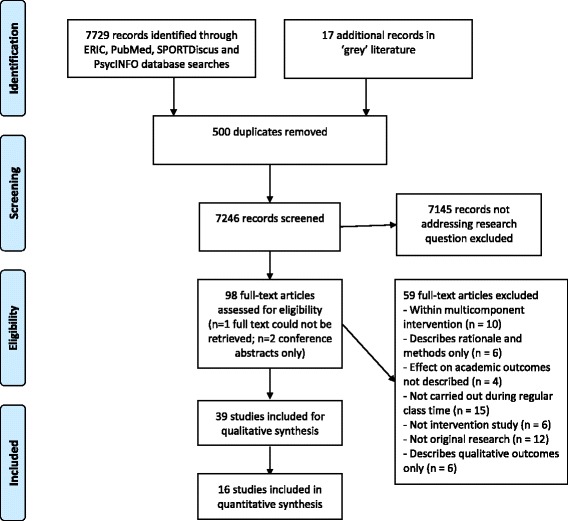
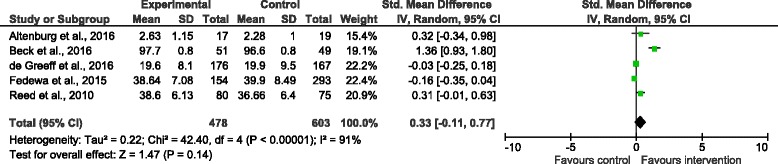
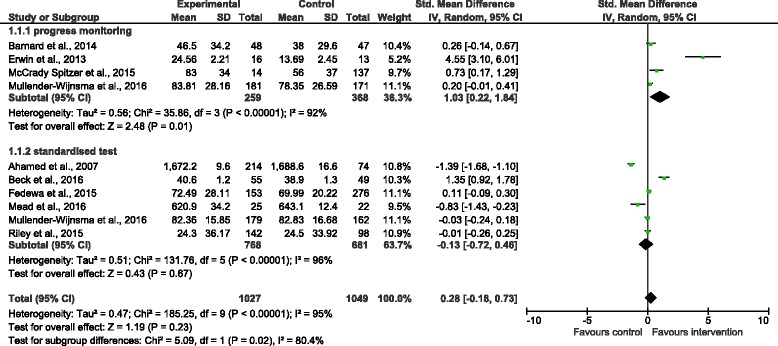
BACKGROUND: Physical activity is associated with many physical and mental health benefits, however many children do not meet the national physical activity guidelines. While schools provide an ideal setting to promote children's physical activity, adding physical activity to the school day can be difficult given time constraints often imposed by competing key learning areas. Classroom-based physical activity may provide an opportunity to increase school-based physical activity while concurrently improving academic-related outcomes. The primary aim of this systematic review and meta-analysis was to evaluate the impact of classroom-based physical activity interventions on academic-related outcomes. A secondary aim was to evaluate the impact of these lessons on physical activity levels over the study duration. METHODS: A systematic search of electronic databases (PubMed, ERIC, SPORTDiscus, PsycINFO) was performed in January 2016 and updated in January 2017. Studies that investigated the association between classroom-based physical activity interventions and academic-related outcomes in primary (elementary) school-aged children were included. Meta-analyses were conducted in Review Manager, with effect sizes calculated separately for each outcome assessed. RESULTS: Thirty-nine articles met the inclusion criteria for the review, and 16 provided sufficient data and appropriate design for inclusion in the meta-analyses. Studies investigated a range of academic-related outcomes including classroom behaviour (e.g. on-task behaviour), cognitive functions (e.g. executive function), and academic achievement (e.g. standardised test scores). Results of the meta-analyses showed classroom-based physical activity had a positive effect on improving on-task and reducing off-task classroom behaviour (standardised mean difference = 0.60 (95% CI: 0.20,1.00)), and led to improvements in academic achievement when a progress monitoring tool was used (standardised mean difference = 1.03 (95% CI: 0.22,1.84)). However, no effect was found for cognitive functions (standardised mean difference = 0.33 (95% CI: -0.11,0.77)) or physical activity (standardised mean difference = 0.40 (95% CI: -1.15,0.95)). CONCLUSIONS: Results suggest classroom-based physical activity may have a positive impact on academic-related outcomes. However, it is not possible to draw definitive conclusions due to the level of heterogeneity in intervention components and academic-related outcomes assessed. Future studies should consider the intervention period when selecting academic-related outcome measures, and use an objective measure of physical activity to determine intervention fidelity and effects on overall physical activity levels.
Overview
The claims and statistics of this paper haven’t been checked yet.
Free: it reads the open-access text and checks the first 5 claims that cite a source we can check. Create a free account to check every claim.
Integrity signals
Registry
Cites
Statistics
Figures


Verification
Claims the paper makes
The claims and statistics of this paper haven’t been checked yet.
Free: it reads the open-access text and checks the first 5 claims that cite a source we can check. Create a free account to check every claim.
Claims other papers make about this one
Each is checked against this paper’s own text: does it say what the citing paper says it does?
The source backs part of the claim, not all of it — or backs it for a different population, condition or comparison.
In the citing paper
“active classrooms, compared with traditional sedentary classrooms, had null [32] or medium [35] effects.”
From Physical Activity and Academic Achievement: An Umbrella Review (2020) · cites this paper as [32]
Experimental — accuracy not yet measuredThe source backs part of the claim, not all of it — or backs it for a different population, condition or comparison.
In the citing paper
“These improvements are relatively strong when considered in the broader field of physical activity interventions.”
From Effectiveness of wearable activity trackers to increase physical activity and improve health: a systematic review of systematic reviews and meta-analyses. (2022) · cites this paper as [69]
Experimental — accuracy not yet measured
Self-check
Percentages, sums and reported differences re-computed from the paper’s own numbers.
The self-check needs the paper’s full text.
Citations
Cites
‘Small Changes' to Diet and Physical Activity Behaviors for Weight Management
Hills, A. P., Byrne, N. M., Lindstrom, R., & Hill, J. O. (2013) · Obesity Facts · doi:10.1159/000345030 · Cited by 9,493
Physical Activity in the United States Measured by Accelerometer
TROIANO, R. P., BERRIGAN, D., DODD, K. W., MÂSSE, L. C., TILERT, T., & MCDOWELL, M. (2008) · Medicine & Science in Sports & Exercise · doi:10.1249/mss.0b013e31815a51b3 · Cited by 7,638
Janssen, I., & LeBlanc, A. G. (2010) · International Journal of Behavioral Nutrition and Physical Activity · doi:10.1186/1479-5868-7-40 · Cited by 4,829
Physical Activity for Cognitive and Mental Health in Youth: A Systematic Review of Mechanisms
Lubans, D., Richards, J., Hillman, C., Faulkner, G., Beauchamp, M., Nilsson, M., Kelly, P., Smith, J., Raine, L., & Biddle, S. (2016) · Pediatrics · doi:10.1542/peds.2016-1642 · Cited by 1,548
The relationship between physical activity and cognition in children: a meta-analysis
Sibley, B. A., & Etnier, J. L. (2003) · Pediatric Exercise Science · doi:10.1123/pes.15.3.243 · Cited by 1,308
Best, J. R., Miller, P. H., & Naglieri, J. A. (2011) · Learning and Individual Differences · doi:10.1016/j.lindif.2011.01.007 · Cited by 1,294 · cited 1×
“Executive functions, inhibition in particular, have been shown to be consistently related to academic achievement [34] and therefore were considered salient to teachers.”
BackgroundThe effect of exercise-induced arousal on cognitive task performance: a meta-regression analysis
Lambourne, K., & Tomporowski, P. (2010) · Brain Research · doi:10.1016/j.brainres.2010.03.091 · Cited by 1,105
Sallis, J. F., McKenzie, T. L., Alcaraz, J. E., Kolody, B., Faucette, N., & Hovell, M. F. (1997) · American Journal of Public Health · doi:10.2105/ajph.87.8.1328 · Cited by 914 · cited 1×
“Studies have shown interventions targeting these discrete periods may be effective in increasing children’s physical activity levels [7, 8], with the potential to contribute to up to 50% of the physical activity required to meet physical activity guidelines [9].”
BackgroundPhysical education, school physical activity, school sports and academic performance
Trudeau, F., & Shephard, R. J. (2008) · International Journal of Behavioral Nutrition and Physical Activity · doi:10.1186/1479-5868-5-10 · Cited by 879
Rasberry, C. N., Lee, S. M., Robin, L., Laris, B. A., Russell, L. A., Coyle, K. K., & Nihiser, A. J. (2011) · Preventive Medicine · doi:10.1016/j.ypmed.2011.01.027 · Cited by 709
Research works printed but not linked: 3
- Okely T Salmon J Vella S Cliff D Timperio A Tremblay M Trost S Shilton T Hinkley T Ridgers N Phillipson L Hesketh K Parrish A Janssen X Brown M Emmel J Marino N A systematic review to update the Australian physical activity guidelines for children and young people., Report prepared for the Australian Government Department of Health, Editor Canberra 2012 Australia Commonwealth of Australia
- Brickenkamp R Zillmer E d2 Test of Attention, in d2 Test 1998 Clark, Editors P.L. Ackerman and E
- Nunnally, J.C., Psychometric theory. McGraw-Hill series in psychology. 1967: New York, McGraw-Hill [1967].
Cited by
Items 401–500 of 689
White, M. L., Renfrow, M. S., Farley, R. S., Fuller, D. K., Eveland-Sayers, B. M., & Caputo, J. L. (2018) · International journal of exercise science · doi:10.70252/emtm9196 · Cited by 5
“found in their meta-analysis that classroom-based exercise interventions did not affect children’s PA levels (37).”
BackgroundCan school-based physical activity foster social mobility?
Gosselin, V., Boccanfuso, D., & Laberge, S. (2020) · Canadian Journal of Public Health · doi:10.17269/s41997-020-00375-6 · Cited by 6
“2019), improvements in academic achievement (Watson et al. 2017) and positive effects on classroom behaviour (Masini et al.”
BackgroundResultTiming of 24-hour movement behaviours: implications for practice, policy and research
Tomasone, J. R., Janssen, I., Saunders, T. J., Duggan, M., Jones, R. A. P., Brouwers, M. C., Faulkner, G., Flood, S. M., Lane, K. N., Latimer‐Cheung, A. E., et al. (2022) · Health Promotion and Chronic Disease Prevention in Canada · doi:10.24095/hpcdp.42.4.05 · Cited by 8
Bergen, T., Richards, J. A., Kira, G., Kim, A. H. M., Signal, L. N., & Mizdrak, A. (2024) · International Journal of Behavioral Nutrition and Physical Activity · doi:10.1186/s12966-024-01653-z · Cited by 7
“However, this study exemplifies how secondary-school PA interventions can have many multifaceted effects that collectively, may improve a range of wider social determinants of health such as education [55] or social inclusion [56].”
BackgroundOeckel, V. V., Vandendriessche, A., Deforche, B. I., Altenburg, T. M., Koobasi, M., Pauwels, N., & Verloigne, M. (2024) · Scandinavian Journal of Public Health · doi:10.1177/14034948241290854 · Cited by 8
“…as the majority of children and adolescents, regardless of their socio-economic or cultural background, spend a large proportion of their waking hours at school [4]. however, the effectiveness of school-based physical activity and sedentary behaviour interventions is currently unconvincing [5–7].”
Drollette, E. S., O’Brokta, M. M., Pasupathi, P. A., Cornwall, A. S., Slutsky‐Ganesh, A. B., & Etnier, J. L. (2025) · Psychology of sport and exercise · doi:10.1016/j.psychsport.2025.102847 · Cited by 3
Robles-Campos, A., Reyes‐Molina, D., Suazo, K. S. A. K., Cigarroa, I., Cárcamo-Oyarzún, J., Martínez-López, N., Pérez, M., Grao‐Cruces, A., Mota, J. A. P. S., Ruiz‐Ariza, A., et al. (2025) · Children · doi:10.3390/children12070820 · Cited by 5
“Consequently, ABs have demonstrated effectiveness in enhancing academic outcomes, making them an attractive strategy for teachers and schools [20].”
Ganakas, E., Salmon, J., Ma, J., Lamb, K. E., Barnett, L. M., Bauman, A. E., Telford, A., Ridgers, N. D., Timperio, A. F., & Koorts, H. (2025) · International Journal of Behavioral Nutrition and Physical Activity · doi:10.1186/s12966-025-01810-y · Cited by 4
“As such, ensuring the benefits of TransformUs Primary are well communicated and highlighting how active learning increases student engagement and academic outcomes [60] may be pertinent in these contexts.”
Self-citationLess is more: Qualitative insights into physically active learning in secondary math education
González-Pérez, M., Grao‐Cruces, A., Bandera-Campos, F. J., Chalkley, A. E., Camiletti‐Moirón, D., & Sánchez‐Oliva, D. (2025) · PLoS ONE · doi:10.1371/journal.pone.0336641 · Cited by 7
“However, in recent years, there has been a shift towards an innovative approach that integrates physical activity into the core subjects (excluding physical education), known as physically active learning (PAL) [15].”
Lander, N., Patterson, K. A. E., Lai, S. K., Martin-Alcaide, N., Orr, J., Weatherell, N., Beasy, K. M., & Salmon, J. (2025) · Frontiers in Sports and Active Living · doi:10.3389/fspor.2025.1719341 · Cited by 6
No Motor Costs of Physical Education with Eduball
Cichy, I., Kruszwicka, A., Przybyła, T., Rochatka, W., Wawrzyniak, S., Klichowski, M., & Rokita, A. (2022) · International Journal of Environmental Research and Public Health · doi:10.3390/ijerph192315430 · Cited by 7
Riley, N., Leahy, A. A., Eather, N., Verswijveren, S. J. J. M., & Lander, N. (2025) · Pilot and Feasibility Studies · doi:10.21203/rs.3.rs-3714149/v1 · Cited by 7
The Use of Physically Active Academic Lessons During the Transition to Face-to-Face Classes
Beserra, V., Nussbaum, M., Navarrete, M., Cabezas, N. G., & Alvares, D. (2024) · SAGE Open · doi:10.1177/21582440241255429 · Cited by 4
“…reviews (A. J. Daly-Smith et al., 2018; Martin & Murtagh, 2017; Norris et al., 2015), plus two that include meta-analyses (Norris et al., 2020; Watson et al., 2017) support the proposal to incorporate more physical activity into the classroom through physically active academic lessons or with…”
BackgroundKaranasios, S., & Παπαστεργίου, Μ. (2024) · Education and Information Technologies · doi:10.1007/s10639-024-12836-3 · Cited by 5
“In fact, physical activity interweaved with learning activities has been found to improve cognitive functions, on-task classroom behavior and academic achievement in school students (Kohl & Cook, 2013; Watson et al., 2017).”
Enhancing University Students’ Motivation in Basketball Courses through Tactical Games Model
Wang, J., Chee, C. S., & Samsudin, S. (2024) · Behavioral Sciences · doi:10.3390/bs14070515 · Cited by 13
Zapata‐Lamana, R., Robles-Campos, A., Reyes‐Molina, D., Rojas-Bravo, J., Salcedo, P., Chávez-Castillo, Y., Aguayo, J. G., Valdebenito-Villalobos, J., Arias, A. M., Sanhueza-Campos, C., et al. (2024) · Frontiers in Physiology · doi:10.3389/fphys.2024.1438555 · Cited by 12
Buen, R. J., Carcahente, C., Chu, P. D., & Limbo-Rivera, C. B. (2024) · Edu Sportivo/Edu Sportivo · doi:10.25299/esijope.2024.vol5(3).18082 · Cited by 8
On the Centrality of Physical/Motor Activities in Primary Education
Krevetzakis, E. (2019) · Journal of Advances in Education Research · doi:10.22606/jaer.2019.41003 · Cited by 5
“According to a review study and meta-analysis by Watson et al. (2017), physical activity may provide a practical, low-cost, and effective strategy to increase academic-related outcomes, especially positive effects on improving on-task and reducing off-task classroom behaviour.”
BackgroundCardiac Rehabilitation and Exercise Training
Tikkanen, A. Ú., & Gauthier, N. S. (2019) · Springer eBooks · doi:10.1007/978-3-030-16818-6_27 · Cited by 3
Community actions to prevent obesity in children and adolescents
Moreno, L. A., Ayala‐Marín, A. M., & Miguel‐Etayo, P. D. (2020) · Cahiers de Nutrition et de Diététique · doi:10.1016/j.cnd.2020.07.003 · Cited by 4
The Effects of Desk Cycles in Elementary Children’s Classroom Physical Activity: A Feasibility Study
Fedewa, A. L., Erwin, H. E., Ahn, S., & Alawadi, S. (2021) · Journal of Occupational Therapy Schools & Early Intervention · doi:10.1080/19411243.2021.1910608 · Cited by 3
“Increasing activity time for youth has also been associated with higher levels of academic outcomes, including academic achievement (e.g., standardized tests), academic behavior, and cognitive functioning (Fedewa & Ahn, 2011; Watson et al., 2017).”
O’Brien-Richardson, P. (2021) · Journal of Physical Activity and Health · doi:10.1123/jpah.2020-0020 · Cited by 4
Stapp, A. C., Prior, L. F., & Smith, C. H. (2021) · Teaching and Teacher Education · doi:10.1016/j.tate.2021.103472 · Cited by 5
Skage, I., Ertesvåg, S. K., & Dyrstad, S. M. (2022) · Teaching and Teacher Education · doi:10.1016/j.tate.2021.103575 · Cited by 7
Development of the Teacher Efficacy Toward Providing Physical Activity in the Classroom Scale
Centeio, E. E., Moore, E. W. G., Barcelona, J., McKown, H. B., Erwin, H. E., & Garn, A. C. (2022) · International Journal of Physical Activity and Health · doi:10.18122/ijpah1.1.4.boisestate · Cited by 8
“…create a culture of health within the school environment (Centeio et al., 2018; Brusseau et al., 2016; Chen & Gu, 2017; McKenzie et al, 2016), facilitate school-based best practices for PA promotion (Webster & Nesbitt, 2017), and develop effective advocates for schoolbased PA (Moore et al., 2018).”
BackgroundGoswami, N., Hansen, D., Gumze, G., Brix, B., Schmid‐Zalaudek, K., & Fredriksen, P. M. (2022) · Frontiers in Cardiovascular Medicine · doi:10.3389/fcvm.2022.820827 · Cited by 5
Reif, A., Hackl, M., Nimmerichter, A., Oesen, S., Tschan, H., Bachl, N., Triska, C., & Wessner, B. (2022) · Journal of Physical Activity and Health · doi:10.1123/jpah.2021-0790 · Cited by 3
The Evaluation and Fidelity of an Interdisciplinary Educational Programme
Jiménez-Parra, J. F., Manzano-Sánchez, D., & Valenzuela, A. V. (2022) · Sustainability · doi:10.3390/su142114456 · Cited by 7
A Three-Fold Integrated Perspective on Healthy Development: An Opinion Paper
Paoletti, P., PELLEGRINO, M. A., & Ben‐Soussan, T. D. (2023) · Brain Sciences · doi:10.3390/brainsci13060857 · Cited by 6
“Given that children spend most of their time in school, a feasible and effective way to reduce sitting time and sedentary behavior is performing classroom-based activities, such as active breaks [147].”
BackgroundCámara-Martínez, A., López, E. J. M., Suárez-Manzano, S., Loureiro, V., & Ruiz‐Ariza, A. (2023) · Retos · doi:10.47197/retos.v49.97957 · Cited by 22
Aspiranti, K. B., Michaliszyn, S. F., Dula, M. E., Tischner, C. M., & Fedewa, A. L. (2023) · Psychology in the Schools · doi:10.1002/pits.23000 · Cited by 3
Efecto agudo de descansos físicamente activos sobre la atención en adolescentes
Guillamón, A. R., & López, P. J. C. (2024) · Estudios sobre Educación · doi:10.15581/004.46.008 · Cited by 7
Aulbach, M. B., Puukko, S., Palsola, M., Haukkala, A., Sund, R., Vasankari, T. J., & Hankonen, N. E. (2023) · Psychology Health & Medicine · doi:10.1080/13548506.2023.2285734 · Cited by 3
“…time in schools is inevitable to achieve academic learning objectives, reducing the amount of sedentary time during the school day could even foster academic performance (Nelson & Gordon-Larsen, 2006; Watson et al., 2017), making schools ideal sites for interventions to reduce sedentary behavior.”
BackgroundAn analysis of the influence of physical activity break on primary school student fitness
Yudanto, Y., Hermawan, H. A., Nopembri, S., García-Jiménez, J. V., & Gani, I. (2024) · Retos · doi:10.47197/retos.v52.102306 · Cited by 12
“…activity breaks are class-based physical activities that can be done both inside and outside of the classroom; this activity has become one of the most widely used strategies in recent years to reduce children and adolescents' sedentary lifestyles (Watson, Timperio, Brown, Best, & Hesketh, 2017).”
BackgroundA precision-mapping approach to physical exercise interventions targeting cognitive function
Moreau, D., & Wiebels, K. (2024) · Progress in brain research · doi:10.1016/bs.pbr.2023.12.001 · Cited by 5
Portuguese School Teachers’ Perceptions of Physically Active Learning
Martins, C., Mota, J. A. P. S., Santos, J. C., Daly-Smith, A., Chalkley, A. E., Singh, A. S., Ottesen, C. L., Tammelin, T., Archbold, V. S. J., & Silva, P. (2024) · Translational Journal of the American College of Sports Medicine · doi:10.1249/tjx.0000000000000245 · Cited by 6
Meijers, V., Timmermans, A. C., Verheij, C. T. M., Smith, J., & Hartman, E. E. (2024) · Research in Developmental Disabilities · doi:10.1016/j.ridd.2024.104749 · Cited by 7
Ramos, L., Simões, V., & Franco, S. C. A. (2024) · Education Sciences · doi:10.3390/educsci14060637 · Cited by 17
Kell, S. (2024) · Teaching & Learning Inquiry The ISSOTL Journal · doi:10.20343/teachlearninqu.12.17 · Cited by 4
“Guided movement breaks are effective for increased learning in school settings (Camahalan and Ipock 2015; Fenesi et al. 2018; Mead et al. 2016; Mullins et al. 2019; Watson et al. 2017).”
Badiola, A., Ibañez, I., Fuentes, M., Yanci, J., Arruabarrena, O. U., & Iturricastillo, A. (2025) · Children · doi:10.3390/children12010100 · Cited by 5
Extracurricular physical exercise and self-education expectations among Chinese teenagers
Xiao, Q., & Tang, F. (2025) · Frontiers in Psychology · doi:10.3389/fpsyg.2025.1518100 · Cited by 6
The Effects of a Yearlong Recess Intervention on Body Fat Shifts in Elementary-Aged Children
Farbo, D. J., & Rhea, D. J. (2022) · International Journal of Child Health and Nutrition · doi:10.6000/1929-4247.2022.11.02.1 · Cited by 5
“All four types of interventions only report a 2-14% daily increase in MVPA, which equates to only about 210 minutes and still does not lead to children meeting the recommended amount of MVPA [12, 13, 15, 16].”
BackgroundDorling, H., Mwaanga, O., & Jones, M. A. (2020) · Education 3-13 · doi:10.1080/03004279.2020.1817968 · Cited by 9
“Despite no overall effect of PATL on physical activity 10 out of 11 PATL interventions reported small increases in physical activity and Watson et al. (2017) suggested further research was warranted.”
BackgroundGraham, L. J., & Macartney, B. (2012) · QUT ePrints (Queensland University of Technology) · Cited by 3
Physical Activity Interventions in School and their impact on Scholastic Performance
Ericsson, I. (2020) · Research & Investigations in Sports Medicine · doi:10.31031/rism.2020.06.000645 · Cited by 4
Integración del movimiento en el último curso de Educación Infantil: los espacios compartidos
Rodríguez, A. N., & Romance, R. (2022) · Revista Practicum · doi:10.24310/revpracticumrep.v7i1.13907 · Cited by 4
Chesnais, N., Cabagno, G., & Verret, C. (2023) · Journal of Research in Special Educational Needs · doi:10.1111/1471-3802.12587 · Cited by 3
la fuente, V. Á. D., & Espinoza, E. Á. (2022) · Revista ContexTO/Contexto · doi:10.54761/contexto.num8.32 · Cited by 2
Liu, Y., BARKER, A. R., Adlam, A., Li, M., Duncombe, S. L., Agbaje, A. O., Gu, Y., Zhou, H., & Williams, C. A. (2024) · Frontiers in Pediatrics · doi:10.3389/fped.2024.1458610 · Cited by 5
Packebush, T., Ahern, K., Brody, B., & Gunter, K. B. (2025) · Journal of School Health · doi:10.1111/josh.13531 · Cited by 3
Belenguer-Troya, A., Estevan, I., Romero-Martínez, J., Ortega-Benavent, N., Montalt-García, S., & Menescardi, C. (2025) · Journal of Motor Learning and Development · doi:10.1123/jmld.2025-0025 · Cited by 3
Morales‐Juárez, A., Alfaro, N., Fautsch-Macías, Y., Arts, M., Véliz, P., & Kroker-Lobos, M. F. (2025) · Nutrients · doi:10.3390/nu17213435 · Cited by 7
“In the long term, these interventions can lead to healthier and more productive children and adults, ultimately contributing to an increase in national gross domestic product [52].”
InfluentialMazzoli, E., Ayala, A. M. C., Koorts, H., Timperio, A. F., Lander, N., Lubans, D. R., Ridgers, N. D., Anderson, K. L. M., Cairney, J., Barnett, L. M., et al. (2025) · BMJ Open · doi:10.1136/bmjopen-2025-105311 · Cited by 2
“30 Research shows that these approaches are feasible and effective for implementation with children without disability, 31–33 but there is limited understanding of the feasibility, effectiveness and implementation of whole- of-school physical activity programmes on children and adolescents with…”
Self-citationPugliese, E., Forte, P., Matrisciano, C., Carlevaro, F., D’Anna, C., & Magistro, D. (2025) · Brain Sciences · doi:10.3390/brainsci15121283 · Cited by 6
“While prior research has indicated that physically active learning may improve academic performance, classroom behaviour, and general engagement, previous meta-analyses have found mixed or inconclusive evidence regarding the direct impact of such interventions on cognitive function [64–67].”
Dixon, S., Hettinga, F. J., McCullogh, N., & Tempest, G. D. (2025) · Journal of Sports Sciences · doi:10.1080/02640414.2025.2595408 · Cited by 2
“While many studies have examined the long-term effects of regular PA, schools often adopt PA breaks as a practical tool to support short-term classroom outcomes, such as attention and behaviour (Morris et al., 2019; Watson et al., 2017).”
Mandelid, M. B. (2026) · Frontiers in Sports and Active Living · doi:10.3389/fspor.2025.1712844 · Cited by 3
“Here, all definitions suggest that physical activity, at some level, is to be integrated into school activities such as “key learning areas” (28), “academic content” (26), and “core educational goals” (14).”
InfluentialGonzález-Pérez, M., Camiletti‐Moirón, D., Hermosa, A. R., Martín‐Acosta, F., Grao‐Cruces, A., & Sánchez‐Oliva, D. (2026) · BMC Public Health · doi:10.1186/s12889-026-26814-6 · Cited by 2
“This strategy aims to integrate PA into core subjects that are traditionally taught in a sedentary way by incorporating movement-based learning tasks and dynamics [15].”
Burns, R. D., Li, L., & Brusseau, T. A. (2019) · International Journal of Kinesiology in Higher Education · doi:10.1080/24711616.2019.1633709 · Cited by 3
Macdonald, K., Milne, N., Pope, R., & Orr, R. M. (2021) · International Journal of Environmental Research and Public Health · doi:10.3390/ijerph18073676 · Cited by 3
“However, notable limitations in the methodological quality of studies included in these reviews have been highlighted [18,20,21].”
BackgroundMethodYouth Perceptions of Sport-Confidence
Zuk, E. F., Maksymiw, K., Evanovich, J. M., McGarry, J. E., Root, H. J., & DiStefano, L. J. (2021) · The Journal of Strength and Conditioning Research · doi:10.1519/jsc.0000000000004108 · Cited by 4
“Physical activity promotional campaigns often focus on improving opportunities for children to be active; however,many initiatives do not result in long-term improvements in participation (6,34).”
BackgroundForseth, B. M., Ortega, A., Hibbing, P. R., Moon, M., Steel, C., Singh, M. N., Kollu, A., Miller, B., Miller, M., Staggs, V. S., et al. (2021) · Journal of Healthy Eating and Active Living · doi:10.51250/jheal.v1i4.31 · Cited by 3
“The finding that remote CBPA was effective for increasing children’s activity aligns with previous research showing the effectiveness of in-person CBPA (Eisenmann et al., 2008; Watson et al., 2017).”
BackgroundResultInfluentialHartikainen, J., Haapala, E. A., Sääkslahti, A., Poikkeus, A., & Finni, T. J. (2022) · International Journal of Environmental Research and Public Health · doi:10.3390/ijerph19138185 · Cited by 4
“During lessons it is possible to reduce and break up children’s prolonged sedentary behavior by multiple different classroom-based strategies, such as physically active lessons and active breaks with or without curriculum content [14].”
BackgroundCobos, G. D., Molins, M. G., Roig-Hierro, E., & González, C. (2021) · Revista Española de Educación Física y Deportes · doi:10.55166/reefd.vi435.1005 · Cited by 4
García, C. D. L. M., & Jarauta, E. P. (2022) · Revista de Investigación en Educación · doi:10.35869/reined.v20i2.4227 · Cited by 2
Sanmarchi, F., Scheier, L. M., Dallolio, L., Ricci, M., Longo, G., Ceciliani, A., & Masini, A. (2023) · Healthcare · doi:10.3390/healthcare11142092 · Cited by 2
Cognitive and Non-Cognitive Determinants of Academic Performance in Nursing
Amadi, J. N., Poblete, R., Obong, G. B., Irodi, C. C., & Irodi, N. C. (2023) · nternational Journal of Public Health Pharmacy and Pharmacology · doi:10.37745/ijphpp.15/vol8n43548 · Cited by 3
Polevoy, G. G., Fuentes-Barría, H., & Aguilera-Eguía, R. A. (2024) · Retos · doi:10.47197/retos.v52.101547 · Cited by 5
Kanayama, A., Siraj, I., Moeyaert, M., Steiner, K., Yu, E. C., Ereky‐Stevens, K., Iwasa, K., Ishikawa, M., Kahlon, M., Warnatsch, R., et al. (2024) · Campbell Systematic Reviews · doi:10.1002/cl2.1383 · Cited by 5
“For instance, some studies indicate that higher dosages may be more effective in interventions targeting executive function (Davis et al., 2007; Diamond, 2012; Tang et al., 2012; Watson et al., 2017).”
BackgroundLGBTQ+ Stigma and Health Effects: A Systematic Review of the Global Literature
Maltempi, H., Yu, Y. J., & Bruna, S. P. (2024) · Global Journal of Health Science · doi:10.5539/gjhs.v16n6p1 · Cited by 4
Martín, M. S., Sánchez, M., Moreno, E. M. O., & Navarro‐Mateu, F. (2024) · Cogent Education · doi:10.1080/2331186x.2024.2385785 · Cited by 9
Neural network-based prediction of college students’ physical fitness test scores
Hu, Y., Fan, T., & Wang, Z. (2024) · Applied Mathematics and Nonlinear Sciences · doi:10.2478/amns-2024-2436 · Cited by 3
Active Classrooms in School Curricula and Active Breaks
Hermosa, A. R., Sánchez‐Oliva, D., & Sánchez‐López, M. (2024) · Springer eBooks · doi:10.1007/978-3-031-65595-1_10 · Cited by 6
Physical Activity and Health Through Physical Education
Muntaner‐Mas, A. (2024) · Springer eBooks · doi:10.1007/978-3-031-65595-1_7 · Cited by 5
Egger, F., Gasser, M., Kamer, M., & Schmidt, M. (2024) · European Journal of Psychology and Educational Research · doi:10.12973/ejper.7.3.159 · Cited by 7
Umar, F., Misbah, M., Jannah, M., & Mahakeeta, A. (2024) · E3S Web of Conferences · doi:10.1051/e3sconf/202456804032 · Cited by 2
Ortega, F. Z., González-Valero, G., Ubago-Jiménez, J. L., & Melguizo-Ibáñez, E. (2025) · Revista de Psicodidáctica (English ed ) · doi:10.1016/j.psicoe.2025.500163 · Cited by 5
Farella, M., Sladeczek, I. E., & Groleau, D. (2025) · Education Sciences · doi:10.3390/educsci15030269 · Cited by 5
Hoy, B.-A., Feehely, M., Bi, M., Lam, M., Abdalmalak, A., & Fenesi, B. (2025) · Brain Sciences · doi:10.3390/brainsci15060623 · Cited by 2
“Educational classrooms that integrate physical activity into instructional time have also been shown to improve several outcomes for children with ADHD, including academic performance, school behavior, classroom engagement, motivation, and on-task behavior [39,40].”
Factors affecting first-grade pupils' physical activity during the school day: A pilot study
Culková, D., & Dušková, V. (2025) · Journal of Childhood Education & Society · doi:10.37291/2717638x.202562495 · Cited by 3
Perspectives on Physical Activity and Learning from Children With and Without ADHD
Hoy, B.-A., Steinberg, M. C., & Fenesi, B. (2025) · Sports · doi:10.3390/sports13080240 · Cited by 4
Prävention und Gesundheitsförderung in weiterführenden Schulen
Demetriou, Y., & Sturm, D. J. (2021) · Springer Reference Pflege, Therapie, Gesundheit · doi:10.1007/978-3-662-62426-5_95 · Cited by 2
Parents’ and Early Childhood Educators’ Perceptions on Movement and Learning Program Implementation
Mavilidi, M. F., Bennett, S., PAAS, F. G. W. C., Okely, A. D., & Vazou, S. (2021) · International Journal of Environmental Research and Public Health · doi:10.3390/ijerph182211913 · Cited by 7
Drozdowska, A., Jendrusch, G., Platen, P., Lücke, T., Kersting, M., & Sinningen, K. (2022) · Mind Brain and Education · doi:10.1111/mbe.12321 · Cited by 2
Guldager, J. D., Leppin, A., von Seelen, J., & Andersen, P. T. (2019) · Journal of Physical Activity and Health · doi:10.1123/jpah.2018-0583 · Cited by 2
Ayuso, J. A. Z. (2020) · Revista Iberoamericana de Ciencias de la Actividad Física y el Deporte · doi:10.24310/riccafd.2020.v9i2.6552 · Cited by 4
Kahan, D., & Evans, A. (2020) · American Journal of Health Education · doi:10.1080/19325037.2020.1822237 · Cited by 3
Contribuciones de la Neuropsicología a nivel educativo: un análisis teórico y reflexivo
Rhenals-Ramos, J. C. (2021) · Ciencia y Educación · doi:10.22206/cyed.2021.v5i3.pp117-127 · Cited by 11
Ma’arif, I., Nurhasan, N., Suroto, S., Setyawan, R., Basuki, B., Zen, M. Z., Prasetiyo, R., Saputra, Y. D., & Synthiawati, N. N. (2023) · Physical Education Theory and Methodology · doi:10.17309/tmfv.2023.1.08 · Cited by 9
Tingkat enjoyment peserta didik sekolah dasar terhadap physical activity break dalam pembelajaran
Gani, I., Yudanto, Y., Setyawan, H., & Rizkyanto, W. I. (2023) · TRIHAYU Jurnal Pendidikan Ke-SD-an · doi:10.30738/trihayu.v9i2.14500 · Cited by 4
Effect of Active Breaks on reading comprehension in a foreign language
Barrionuevo, E. F., González-Férnandez, F. T., & Prieto, J. V. (2023) · Porta Linguarum Revista Interuniversitaria de Didáctica de las Lenguas Extranjeras · doi:10.30827/portalin.vivii.29172 · Cited by 4
“On the one hand, in terms of relationship between exercise and cognitive improvement, these results are in line with the findings of other works that examine the effect of acute exercise as AB in cognition and academic performance (Daly-Smith et al., 2018, Watson et al., 2017).”
ResultCoe, S., Cossington, J., Collett, J., Meaney, A., Mavrommati, F., Ng, Y., Izadi, H., Wade, W., Pindus, D. M., Bushnell, O., et al. (2024) · Translational Exercise Biomedicine · doi:10.1515/teb-2024-2005 · Cited by 2
Ruz, R. P., García-Molina, R., Cepero-González, M., & González, M. E. P. (2021) · Advances in early childhood and K-12 education · doi:10.4018/978-1-7998-7585-7.ch007 · Cited by 2
Effects of Structured Physical Activity in Improving Memory Among School Going Underachievers
Vishnupriya, R., Srividya., G., & Kannan., D. (2022) · International Journal of Health Sciences and Research · doi:10.52403/ijhsr.20221111 · Cited by 2
Changes in frontal lobe size with age. A CT study in children.
Hiraiwa, M., Nonaka, C., Sekiyama, M., Mishima, M., Kobayashi, M., Abe, T., Fujii, R., & Yasukochi, H. (1986) · PubMed · Cited by 2
García, I. A. (2021) · UVaDOC UVaDOC University of Valladolid Documentary Repository (University of Valladolid) · doi:10.35376/10324/51836 · Cited by 4
The Cre@tive Expedition for science literacy
Andersen, R., Lekbo, S. S., Thomsen, L. B., Stephensen, L. M., & Christiansen, L. B. (2022) · doi:10.22323/1.418.0096 · Cited by 1
“The benefits of integrating physical activity into education and learning activities is supported by evidence [8].”
BackgroundNarrative Review of Predictors of Academic Performance in Nursing
Amadi, J. N., Poblete, R., Obong, G. B., Irodi, C. C., & Irodi, N. C. (2023) · International Journal of Nursing Midwife and Health Related Cases · doi:10.37745/ijnmh.15/vol9n32943 · Cited by 2
Patricie, N., Mugiraneza, F., & Mukamazimpaka, M. C. (2023) · Journal of Education · doi:10.53819/81018102t5270 · Cited by 2
Limitations in Sedentary Behaviour Research and Future Research Needs
Schmid, D., Jochem, C., & Leitzmann, M. F. (2023) · Springer series on epidemiology and public health · doi:10.1007/978-3-031-41881-5_29 · Cited by 2
Kuan, G., Chin, M., Kueh, Y. C., Sabo, A., Mok, M. M. C., Balasekaran, G., Chang, Y., Edgınton, C. R., Culpan, I., Popeska, B., et al. (2024) · Türk fizyoterapi ve rehabilitasyon dergisi · doi:10.21653/tjpr.1489761 · Cited by 1
Metadata
- Authors
- Watson, A., Timperio, A., Brown, H., Best, K., & Hesketh, K. D.
- Affiliations
- Deakin University (AU)
- Corresponding author
- Hesketh, Kylie D.
- Venue
- International Journal of Behavioral Nutrition and Physical Activity
- Published
- 2017-08-25
- Volume
- 14
- Issue
- 1
- Pages
- 114-114
- ISSN
- 1479-5868 (ISSN-L)
- PMC
- PMC5574081
- OpenAlex
- W2750279836
- Cited by
- 689
- References
- 74
- Citations by year
- 2026: 60 · 2025: 76 · 2024: 97 · 2023: 86 · 2022: 96 · 2021: 97 · 2020: 81 · 2019: 59 · 2018: 34 · 2017: 1
- FWCI
- 5.87
- Type
- journal article
- Language
- en
- Open access
- gold
- doi.org
- Licence
- cc-by
- Locations
- International Journal of Behavioral Nutrition and Physical Activity (publishedVersion, cc-by)
- Europe PMC (PubMed Central) (publishedVersion, cc-by)
- PubMed Central (publishedVersion, cc-by)
- PubMed (publishedVersion)
- Adelaide Research & Scholarship (AR&S) (University of Adelaide) (submittedVersion, cc-by)
- DOAJ (DOAJ: Directory of Open Access Journals) (submittedVersion)
- Figshare (submittedVersion, cc-by)
- Funders
- National Heart Foundation of Australia (FT130100637, 100370, 100046)
- Deakin University
- Topics
- Health Sciences › Medicine › Public Health, Environmental and Occupational Health › Physical Activity and Health
- Health Sciences › Medicine › Public Health, Environmental and Occupational Health › School Health and Nursing Education
- Social Sciences › Psychology › Developmental and Educational Psychology › Children's Physical and Motor Development
- Keywords
- classroom physical activity, school-based physical activity intervention, academic performance, on-task behavior, off-task behavior, executive function, cognitive function, elementary school students, children's physical activity, intervention fidelity, progress monitoring, physical education classes, intervention intensity, intervention dosage, intervention heterogeneity
- MeSH terms
- Academic Success, Child, Cognition, Curriculum, Humans, Learning, Physical Education and Training, Schools, Students, Health Behavior, Exercise, Databases, Factual
About these checks
Registry, retraction, Cites and statistics results are computed, not judged, with one exception: a printed reference that no index lists is read once by a model before it counts as a citation error. Claims are extracted by a model and kept only when their quote appears verbatim in the text; each cited source is then checked, with a model’s help, for whether it says what the claim relies on. Those verdicts can be wrong — read the claim’s quote and the cited source before relying on one.
Statistics and arithmetic are recomputed, not judged.
Confidence bands are shown only for fields calibrated on our annotated test set. None is calibrated yet, so no band is shown.
What counts as a claim ›How we measure confidence ›How we check this ›
Are you an author, or do you see a problem with this page? Request a review
Data sources
Bibliographic data: Semantic Scholar, OpenAlex, Crossref.
Contains information from the Semantic Scholar Academic Graph Datasets, made available under the ODC Attribution License (ODC-BY 1.0).
Semantic Scholar’s data is described in: Kinney, R., et al. (2023). The Semantic Scholar Open Data Platform. arXiv:2301.10140.
