

Effect of classroom-based physical activity interventions on academic and physical activity outcomes: a systematic review and meta-analysis
Open accessThe DOI matches its Crossref record; 74 of the 74 references it cites were found in a registry or an index.
Abstract
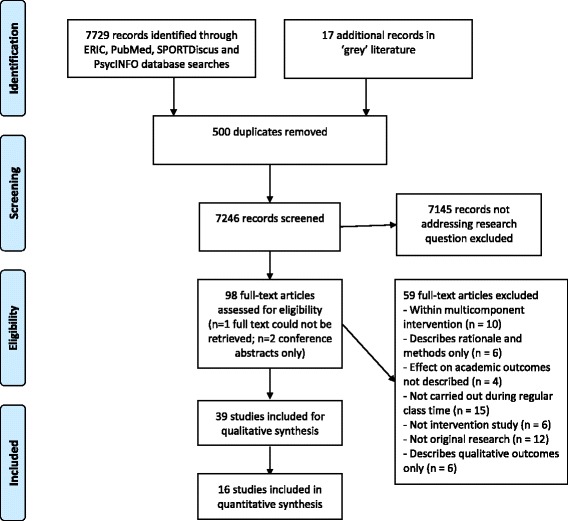
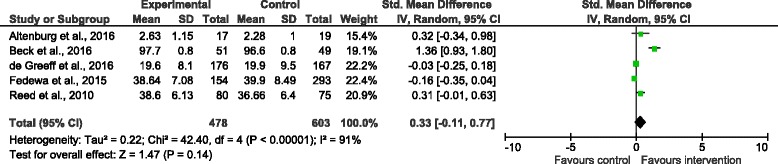
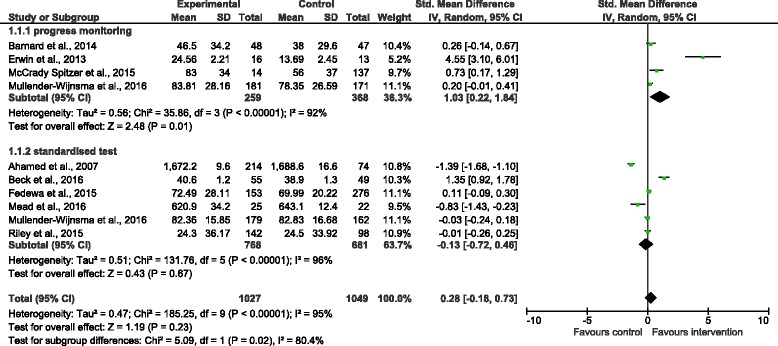
BACKGROUND: Physical activity is associated with many physical and mental health benefits, however many children do not meet the national physical activity guidelines. While schools provide an ideal setting to promote children's physical activity, adding physical activity to the school day can be difficult given time constraints often imposed by competing key learning areas. Classroom-based physical activity may provide an opportunity to increase school-based physical activity while concurrently improving academic-related outcomes. The primary aim of this systematic review and meta-analysis was to evaluate the impact of classroom-based physical activity interventions on academic-related outcomes. A secondary aim was to evaluate the impact of these lessons on physical activity levels over the study duration. METHODS: A systematic search of electronic databases (PubMed, ERIC, SPORTDiscus, PsycINFO) was performed in January 2016 and updated in January 2017. Studies that investigated the association between classroom-based physical activity interventions and academic-related outcomes in primary (elementary) school-aged children were included. Meta-analyses were conducted in Review Manager, with effect sizes calculated separately for each outcome assessed. RESULTS: Thirty-nine articles met the inclusion criteria for the review, and 16 provided sufficient data and appropriate design for inclusion in the meta-analyses. Studies investigated a range of academic-related outcomes including classroom behaviour (e.g. on-task behaviour), cognitive functions (e.g. executive function), and academic achievement (e.g. standardised test scores). Results of the meta-analyses showed classroom-based physical activity had a positive effect on improving on-task and reducing off-task classroom behaviour (standardised mean difference = 0.60 (95% CI: 0.20,1.00)), and led to improvements in academic achievement when a progress monitoring tool was used (standardised mean difference = 1.03 (95% CI: 0.22,1.84)). However, no effect was found for cognitive functions (standardised mean difference = 0.33 (95% CI: -0.11,0.77)) or physical activity (standardised mean difference = 0.40 (95% CI: -1.15,0.95)). CONCLUSIONS: Results suggest classroom-based physical activity may have a positive impact on academic-related outcomes. However, it is not possible to draw definitive conclusions due to the level of heterogeneity in intervention components and academic-related outcomes assessed. Future studies should consider the intervention period when selecting academic-related outcome measures, and use an objective measure of physical activity to determine intervention fidelity and effects on overall physical activity levels.
Overview
The claims and statistics of this paper haven’t been checked yet.
Free: it reads the open-access text and checks the first 5 claims that cite a source we can check. Create a free account to check every claim.
Integrity signals
Registry
Cites
Statistics
Figures


Verification
Claims the paper makes
The claims and statistics of this paper haven’t been checked yet.
Free: it reads the open-access text and checks the first 5 claims that cite a source we can check. Create a free account to check every claim.
Claims other papers make about this one
Each is checked against this paper’s own text: does it say what the citing paper says it does?
The source backs part of the claim, not all of it — or backs it for a different population, condition or comparison.
In the citing paper
“active classrooms, compared with traditional sedentary classrooms, had null [32] or medium [35] effects.”
From Physical Activity and Academic Achievement: An Umbrella Review (2020) · cites this paper as [32]
Experimental — accuracy not yet measuredThe source backs part of the claim, not all of it — or backs it for a different population, condition or comparison.
In the citing paper
“These improvements are relatively strong when considered in the broader field of physical activity interventions.”
From Effectiveness of wearable activity trackers to increase physical activity and improve health: a systematic review of systematic reviews and meta-analyses. (2022) · cites this paper as [69]
Experimental — accuracy not yet measured
Self-check
Percentages, sums and reported differences re-computed from the paper’s own numbers.
The self-check needs the paper’s full text.
Citations
Cites
‘Small Changes' to Diet and Physical Activity Behaviors for Weight Management
Hills, A. P., Byrne, N. M., Lindstrom, R., & Hill, J. O. (2013) · Obesity Facts · doi:10.1159/000345030 · Cited by 9,493
Physical Activity in the United States Measured by Accelerometer
TROIANO, R. P., BERRIGAN, D., DODD, K. W., MÂSSE, L. C., TILERT, T., & MCDOWELL, M. (2008) · Medicine & Science in Sports & Exercise · doi:10.1249/mss.0b013e31815a51b3 · Cited by 7,638
Janssen, I., & LeBlanc, A. G. (2010) · International Journal of Behavioral Nutrition and Physical Activity · doi:10.1186/1479-5868-7-40 · Cited by 4,829
Physical Activity for Cognitive and Mental Health in Youth: A Systematic Review of Mechanisms
Lubans, D., Richards, J., Hillman, C., Faulkner, G., Beauchamp, M., Nilsson, M., Kelly, P., Smith, J., Raine, L., & Biddle, S. (2016) · Pediatrics · doi:10.1542/peds.2016-1642 · Cited by 1,548
The relationship between physical activity and cognition in children: a meta-analysis
Sibley, B. A., & Etnier, J. L. (2003) · Pediatric Exercise Science · doi:10.1123/pes.15.3.243 · Cited by 1,308
Best, J. R., Miller, P. H., & Naglieri, J. A. (2011) · Learning and Individual Differences · doi:10.1016/j.lindif.2011.01.007 · Cited by 1,294 · cited 1×
“Executive functions, inhibition in particular, have been shown to be consistently related to academic achievement [34] and therefore were considered salient to teachers.”
BackgroundThe effect of exercise-induced arousal on cognitive task performance: a meta-regression analysis
Lambourne, K., & Tomporowski, P. (2010) · Brain Research · doi:10.1016/j.brainres.2010.03.091 · Cited by 1,105
Sallis, J. F., McKenzie, T. L., Alcaraz, J. E., Kolody, B., Faucette, N., & Hovell, M. F. (1997) · American Journal of Public Health · doi:10.2105/ajph.87.8.1328 · Cited by 914 · cited 1×
“Studies have shown interventions targeting these discrete periods may be effective in increasing children’s physical activity levels [7, 8], with the potential to contribute to up to 50% of the physical activity required to meet physical activity guidelines [9].”
BackgroundPhysical education, school physical activity, school sports and academic performance
Trudeau, F., & Shephard, R. J. (2008) · International Journal of Behavioral Nutrition and Physical Activity · doi:10.1186/1479-5868-5-10 · Cited by 879
Rasberry, C. N., Lee, S. M., Robin, L., Laris, B. A., Russell, L. A., Coyle, K. K., & Nihiser, A. J. (2011) · Preventive Medicine · doi:10.1016/j.ypmed.2011.01.027 · Cited by 709
Research works printed but not linked: 3
- Okely T Salmon J Vella S Cliff D Timperio A Tremblay M Trost S Shilton T Hinkley T Ridgers N Phillipson L Hesketh K Parrish A Janssen X Brown M Emmel J Marino N A systematic review to update the Australian physical activity guidelines for children and young people., Report prepared for the Australian Government Department of Health, Editor Canberra 2012 Australia Commonwealth of Australia
- Brickenkamp R Zillmer E d2 Test of Attention, in d2 Test 1998 Clark, Editors P.L. Ackerman and E
- Nunnally, J.C., Psychometric theory. McGraw-Hill series in psychology. 1967: New York, McGraw-Hill [1967].
Cited by
Items 601–689 of 689
Physical well-being of four-year-old learners and their readiness for Grade R.
Pewa, N. P. I. (2022) · ResearchSpace (University of KwaZulu-Natal) · doi:10.29086/10413/22899
Arifin, Z., Mulyana, B., Sutresna, N., Subarjah, H., & Pratama, K. W. (2024) · Jurnal SPORTIF Jurnal Penelitian Pembelajaran · doi:10.29407/js_unpgri.v10i1.22196 · Cited by 2
“Regardless, school is considered the ideal place to promote physical activity (Watson et al., 2017) and provide students with knowledge, skills, and behaviour along with the purpose of national education (Wang, 2023).”
Background«Det var som en espresso» – erfaringer med undervisning i bevegelse i høyere utdanning
Bauer, K. (2024) · Forskning og Forandring · doi:10.23865/fof.v7.5385
“Flere studier konkluderte med at elever som deltok i timer med fysisk aktivitet, viste raskere oppgavebehand-ling, økt fokus og bedre læringsresultater sammenlignet med tradisjonell undervisning uten bevegelse (Norris et al., 2019, s. 13; Watson et al., 2017, s. 6).”
BackgroundBibliometric Analysis of Scientific Production in School Physical Education
Gomes, R., Souza, N., & Crisp, A. (2023) · Journal of Sport Pedagogy & Research · doi:10.47863/efuc9727
Liu, P. (2024) · Applied Mathematics and Nonlinear Sciences · doi:10.2478/amns-2024-2425
Feng, Y. (2024) · Applied Mathematics and Nonlinear Sciences · doi:10.2478/amns-2024-2620
Teacher Implementation Profiles: A Response to Top-Down Mandate of Movement Integration
Beddoes, Z., Barcelona, J., & Castelli, D. M. (2024) · International Journal of Physical Activity and Health · doi:10.18122/ijpah.3.2.7.boisestate
“Ironically, implementing MI can improve student behaviors in the classroom and increase time on task related to academic learning time (Bartholomew et al., 2018; Carlson et al., 2013; Watson et al., 2017).”
BackgroundSamarasinghe, N., Nagpal, T. S., Barbeau, M. L., & Martin, C. M. (2024) · World Journal of Methodology · doi:10.5662/wjm.v15.i1.95985 · Cited by 1
Zhang, W., & Song, X. (2024) · Applied Mathematics and Nonlinear Sciences · doi:10.2478/amns-2024-2830
Leahy, A. A., Babic, M., Hansen, V., Eather, N., Smith, J. J., Costigan, S. A., & Lubans, D. R. (2024) · Journal of Teaching in Physical Education · doi:10.1123/jtpe.2024-0237 · Cited by 1
Ünal, F., Genç, A., Dünya, B. A., Durak, H. Y., & Büyükşahin, Y. (2025) · KIRŞEHİR EĞİTİM FAKÜLTESİ DERGİSİ · doi:10.29299/kefad.1535987 · Cited by 1
Estrategias institucionales autonómicas de promoción de la actividad física en los centros escolares
Sánchez-García, A. M., & Valcárcel, J. V. (2025) · Psychology Society & Education · doi:10.21071/pse.v17i1.17404 · Cited by 6
“…their students and should provide multiple opportunities for daily PA through Physical Education (PE) classes, break times, extracurricular activities, the commute to school, even by incorporating PA into classroom learning activities (García-Hermoso, 2024; Singh et al., 2017; Watson et al., 2017).”
Physical Activity and Its Relationship With National‐Based Examination Results Among Adolescents
Venugopal, V., Ismail, M. A., Mohamed, M. N. A., Chinna, K., Jalaludin, M. Y., Su, T. T., & Majid, H. A. (2025) · Journal of Adolescence · doi:10.1002/jad.12479 · Cited by 1
American Academy of Pediatrics (2025) · American Academy of PediatricsItasca, IL eBooks · doi:10.1542/9781610027700-ch12
Riley, N., Sanctuary, C. E., Drew, R. J., & Robinson, K. J. (2025) · Journal of Teaching in Physical Education · doi:10.1123/jtpe.2024-0268
Galan, Y. (2025) · Physical Culture and Sport Scientific Perspective · doi:10.31891/pcs.2025.1(1).38
Maloney, C. M. C., Atkin, A. J., Beaumont, L. C., Budzynski‐Seymour, E., & Warburton, V. E. (2025) · Obesity Reviews · doi:10.1111/obr.13943
The Argument About Time and Physical Activity: Physical Education is the Solution
Johnson, M. A. (2025) · Strategies · doi:10.1080/08924562.2025.2499423
Vedøy, I. B., Skulberg, K. R., Johansen, P. F., Tjomsland, H. E., & Thurston, M. N. (2025) · Frontiers in Sports and Active Living · doi:10.3389/fspor.2025.1543741 · Cited by 2
Estimated Energy Expenditure during Classroom-Based Physical Activity
Kahan, D., Thompson, H. R., Zielke, C., & Punzalan, B. E. (2025) · Translational Journal of the American College of Sports Medicine · doi:10.1249/tjx.0000000000000321
Thuc, D. C. (2025) · Polish Journal of Sport and Tourism · doi:10.2478/pjst-2025-0019
Ryan, S. T., Randle, M., Waqa, G., Stanley, R. M., Bissoonauth-Bedford, A., & Okely, A. D. (2025) · Health Promotion International · doi:10.1093/heapro/daaf169
Fiziksel Aktivite Teşvikinde Sınıf-Temelli Fiziksel Aktivite Uygulamaları (STFAU)
Özçakır, S. (2025) · Journal of Physical Education and Sports Studies · doi:10.55929/besad.1604692
Er, N., & Ünal, F. (2025) · Spor Bilimleri Dergisi · doi:10.17644/sbd.1724369 · Cited by 2
Derigny, T., Schnitzler, C., Gandrieau, J., Mekkaoui, L., & Potdevin, F. (2025) · Research Quarterly for Exercise and Sport · doi:10.1080/02701367.2025.2603519
“Social stigma, reduced self-efficacy and limited exposure to self-directed PA may have hindered their ability to explore or create new avenues for engagement (Watson et al., 2017).”
Larsson, R., Ljung, E., Josefsson, S., & Ljung, T. (2024) · Figshare · doi:10.6084/m9.figshare.26708984
Brandes, B., Sell, L., Buck, C., Busse, H., Zeeb, H., & Brandes, M. (2024) · Figshare · doi:10.6084/m9.figshare.26611439
Brandes, B., Sell, L., Buck, C., Busse, H., Zeeb, H., & Brandes, M. (2024) · Figshare · doi:10.6084/m9.figshare.26611451
Jeppesen, L. S., Damsgaard, L., Stolpe, M. N., Melcher, J. N. S., Wienecke, J., Nielsen, G., Smedegaard, S., Henriksen, A. H., Hansen, R. A., Hillman, C. H., et al. (2024) · Figshare · doi:10.6084/m9.figshare.26691193
Elish, P. N., Bryan, C. S., Boedeker, P., Calvert, H. G., Kay, C. M., Meyer, A. M., & Gazmararian, J. A. (2022) · Figshare · doi:10.6084/m9.figshare.20364978
Crooks, N., Alston, L., Nichols, M., Bolton, K., Allender, S., Fraser, P., Le, H., Bliss, J., Rennie, C., Orellana, L., et al. (2021) · Figshare · doi:10.6084/m9.figshare.14826220
MURPHY, M. H., O’Kane, S. M., Carlin, A., Lahart, I. M., Doherty, L. C., Jago, R., McDermott, G., Faulkner, M., & Gallagher, A. M. (2024) · Figshare · doi:10.6084/m9.figshare.25248943
Beets, M. W., Weaver, R. G., Ioannidis, J. P. A., Pfledderer, C. D., Jones, A., von Klinggraeff, L., & Armstrong, B. (2023) · Figshare · doi:10.6084/m9.figshare.22608331
Beets, M. W., Weaver, R. G., Ioannidis, J. P. A., Pfledderer, C. D., Jones, A., von Klinggraeff, L., & Armstrong, B. (2023) · Figshare · doi:10.6084/m9.figshare.22608328
Gosselin, V., & Laberge, S. (2022) · Figshare · doi:10.6084/m9.figshare.19305023
Crooks, N., Alston, L., Nichols, M., Bolton, K., Allender, S., Fraser, P., Le, H., Bliss, J., Rennie, C., Orellana, L., et al. (2021) · Figshare · doi:10.6084/m9.figshare.14826217
Brandes, B., Sell, L., Buck, C., Busse, H., Zeeb, H., & Brandes, M. (2024) · Figshare · doi:10.6084/m9.figshare.26611442
Brandes, B., Sell, L., Buck, C., Busse, H., Zeeb, H., & Brandes, M. (2024) · Figshare · doi:10.6084/m9.figshare.26611448
Crooks, N., Alston, L., Nichols, M., Bolton, K., Allender, S., Fraser, P., Le, H., Bliss, J., Rennie, C., Orellana, L., et al. (2021) · Figshare · doi:10.6084/m9.figshare.14826214
Brandes, B., Sell, L., Buck, C., Busse, H., Zeeb, H., & Brandes, M. (2024) · Figshare · doi:10.6084/m9.figshare.26611445
Jeppesen, L. S., Damsgaard, L., Stolpe, M. N., Melcher, J. N. S., Wienecke, J., Nielsen, G., Smedegaard, S., Henriksen, A. H., Hansen, R. A., Hillman, C. H., et al. (2024) · Figshare · doi:10.6084/m9.figshare.26691196
MURPHY, M. H., O’Kane, S. M., Carlin, A., Lahart, I. M., Doherty, L. C., Jago, R., McDermott, G., Faulkner, M., & Gallagher, A. M. (2024) · Figshare · doi:10.6084/m9.figshare.25248754
Kyriakides, E., Tsangaridou, N., Charalambous, C. Y., & Kyriakides, L. E. (2026) · Journal of Teaching in Physical Education · doi:10.1123/jtpe.2025-0018
Majauskienė, D., Aukštikalnis, T., Istomina, N., Valančienė, D., Dadelienė, R., Šidlauskienė, A., Strazdaite, E., Žilinskienė, R., Gintilienė, M., Šarkauskienė, A., et al. (2026) · Scientific Reports · doi:10.1038/s41598-026-37324-1
“A comprehensive systematic analysis suggested that classroom-based physical activity may positively impact academic outcomes 43 .”
Liu, Q., Dong, Q., Fang, Q., Oh, E., Jia, M., & Yang, D. (2026) · Frontiers in Psychology · doi:10.3389/fpsyg.2026.1760902 · Cited by 3
Adams, J. M. M. (2026) · Journal of Occupational Therapy Schools & Early Intervention · doi:10.1080/19411243.2026.2629370
Lander, N., Patterson, K. A. E., Eather, N., Robinson, K. J., Riley, N., Lai, S. K., Weatherell, N., Orr, J., & Salmon, J. (2026) · Frontiers in Sports and Active Living · doi:10.3389/fspor.2026.1748938 · Cited by 1
Weston, K. L., Burn, N., Goroski, A., Weston, M., Galna, B., Glossop, R., Patterson, M., Batten, H., Gordon, A., & Basterfield, L. (2026) · BMC Public Health · doi:10.1186/s12889-026-26543-w · Cited by 3
“While this observation was anecdotal and not formally quantified in our trial, they are key outcome considerations for future trials looking to maximise teacher-and school-management buy-in [99].”
Klimpki, T., & Heemsoth, T. (2026) · European Journal of Investigation in Health Psychology and Education · doi:10.3390/ejihpe16030042
“PAL is considered a highly beneficial concept for classroom teaching (Watson et al., 2017).”
‘I wish I could fly’ exploring children’s experiences with movement in physically active learning
Eriksen, P., Lerum, Ø., & Mandelid, M. B. (2026) · European Early Childhood Education Research Journal · doi:10.1080/1350293x.2026.2645034
Johnson, M. A. (2026) · Discover Education · doi:10.1007/s44217-025-01044-x · Cited by 1
Leukel, C., Lauber, B., Leuders, J., Hertel, S., & Taube, W. (2026) · Scientific Reports · doi:10.1038/s41598-026-45347-x · Cited by 1
“While aerobic/anaerobic exercise training has been extensively studied and demonstrated to improve both cognitive activity and academic achievement 8–10 , alternative forms of exercise such as balance training may offer equally or even greater improvements in cognitive function and academic…”
Spring, K. E., Feldt, C. W., Posey, M. P., Nauta, P., Chen, S., Shepherd, D. C., & Staiano, A. E. (2026) · JMIR Formative Research · doi:10.2196/83556
“In this study, the developed prototype program elicited similar physical activity responses to those elicited by traditional interventions [28], all while working with a digital learning tool that can be easily incorporated into the learning environment.”
Chesnais, N. (2022) · theses.fr (ABES) · doi:10.70675/23054c7czf8f9z4dd8z8065zb48659d16b4e · Cited by 2
Pozdnyakov, I., Несен, О., Kryventsova, I., Lutskyi, V., & Vintoniak, O. (2026) · Pedagogy of Health · doi:10.15561/health.2026.0202
Henriquez-Maquehue, F., Díez‐Fernández, A., Hermosa, A. R., Bermejo‐Cantarero, A., Martínez, Ó. N., Rodríguez-Martín, B., & Sánchez-López, M. (2026) · Frontiers in Digital Health · doi:10.3389/fdgth.2026.1829401
“Overall, these findings highlight the scarcity of methodologically robust studies examining the benefits of ABs, particularly in early childhood, an age group that has been scarcely addressed in this type of research (17).”
Bandera-Campos, F. J., Sánchez‐Oliva, D., González-Pérez, M., Martín‐Acosta, F., Camiletti‐Moirón, D., & Grao‐Cruces, A. (2026) · BMC Public Health · doi:10.1186/s12889-026-27718-1 · Cited by 3
“…PAL refers to the integration of movement-based activities into core academic subjects outside of Physical Education (e.g., Mathematics, History) [9], active break involves embedding short bouts of PA within regular classes [9], and active recess is aimed at fostering structured or unstructured…”
InfluentialGhani, R. B. A., Chung, P. L. W., & Khan, A. (2026) · Research Square · doi:10.21203/rs.3.rs-9774997/v1
Holik, I., Petrić, V., & Papak, P. P. (2026) · Education Sciences · doi:10.3390/educsci16060840
Sobolewski, K. M., Schaefer, L., Stoddart, A. L., Humbert, M. L., & ERLANDSON, M. C. (2026) · Journal of Teaching in Physical Education · doi:10.1123/jtpe.2025-0460
Al-Hazzaa, H. M., Amawi, A. T., Al-Shawabka, L. M., Alkhrissat, F. M., Dabayebeh, O. I., Albaradi, R. M., Alghwiri, A. A., Al-Saoud, H. A., & Dabayebeh, I. M. (2026) · Frontiers in Sports and Active Living · doi:10.3389/fspor.2026.1841128 · Cited by 1
“Such approach is likely to have a positive impact not only on the health and wellbeing of Jordanian adolescents, but also on their cognitive and academic performance, as indicated by studies published elsewhere (54 – 56).”
Hortelano, E. C., & Menescardi, C. (2026) · Sustainability and Sports Science Journal · doi:10.55860/wgle2937
“In addition, classroom-based physical activity interventions may have a positive effect on academic-related outcomes (Watson et al., 2017), while classroom exercise breaks of 10 and 20 minutes have also been associated with better mathematics performance compared with sedentary conditions (Howie et…”
Mudau, A., Alliance Kubayi, & Nthangeni, S. A. (2026) · African Journal for Physical Activity and Health Sciences (AJPHES) · doi:10.37597/ajphes.2026.32.2.3
The Influence of Sports on the Resistance to Educational Stress of the Body of Students
Khramtsov, P. I. (2026) · M Ya Studenikin Russian Pediatric Journal · doi:10.46563/2026-1-2-2045
Benkhelfa, A., Ram, B., Gullett, N., Cunningham, M., Sharabiani, M. T. A., Pallan, M. J., van Sluijs, E. M. F., Summerbell, C. D., Hillsdon, M. M., Siddiqui, N., et al. (2026) · PLoS ONE · doi:10.1371/journal.pone.0352283
“This may be partly due to the heterogeneity of intervention content and the variety of outcome assessment tools, such as those used to measure PA levels [46].”
Introducing the Updated Walk ‘n’ Talk 2.0: Dialogue in Motion
Bruno, L. E. (2026) · Strategies · doi:10.1080/08924562.2026.2663748
“Even brief interventions can result in measurable improvements in attention, focus, memory, and academic performance (Donnelly & Lambourne, 2011; Petrigna et al., 2022; Watson et al., 2017).”
Duan, Y., Peiris, D. L. I. H. K., Vandelanotte, C., & Liang, W. (2026) · Journal of Exercise Science & Fitness · doi:10.1016/j.jesf.2026.200498
“…moderation effects were analyzed, 18,29,57 (3) provided evidence on the use of shorter, curriculum-integrated IcPAB that would be feasible, 16,29,75 (4) fidelity and process evaluation mechanisms were followed, 16,29 (5) curriculum-based measures were used, 16,29 (6) objective measurements…”
InfluentialBeyond the Desk: Effects of the BALA+ Classroom-Based Intervention on Primary School Children
Belenguer-Troya, A., Montalt-García, S., Bisquert-Martínez, M. M., Menescardi, C., & Estevan, I. (2026) · Applied Sciences · doi:10.3390/app16147237
The Integral Role of Physical Activity in STEAM Education: Toward a Holistic Pedagogy
Ha, T., Paulson, L., Becerra, V., & Bell, J. A. (2026) · Quest · doi:10.1080/00336297.2026.2708933
Xiang, W., Wang, S., & Xiaobing, L. (2026) · Behavioral Sciences · doi:10.3390/bs16081345
“However, meta-analytic evidence indicates that physical activity does not impair academic achievement and may support it (Watson et al., 2017; D. Li et al., 2023).”
Siong, C. N., Yi, T. P., Kuan, G., & Cheng, K. Y. (2026) · Lecture notes in bioengineering · doi:10.1007/978-981-95-9653-9_5
Zamani‐Alavijeh, F., Saber, F., Mirzaei-Alavijeh, M., Heidari, Z., Mostafavi-Darani, F., & Kelishadi, R. (2026) · International Journal of Adolescence and Youth · doi:10.1080/02673843.2026.2720040
Li, C., Shangguan, Y., Zhong, Z., Zhou, R., Wang, H., & Li, D. (2026) · European Journal of Pediatrics · doi:10.1007/s00431-026-07341-3
“In addition, previous research has emphasized that the effects of active breaks may be moderated by intervention duration, implementation mode, and activity characteristics [56].”
InfluentialKURUÇELİK, M., & Civil, T. (2026) · Spor Eğitim Dergisi · doi:10.55238/seder.1926612
Koch, S., Nielsen, J. V., Krølner, R. F., Krustrup, P., & Skovgaard, T. (2026) · Global Implementation Research and Applications · doi:10.1007/s43477-026-00250-5
Feasibility study of the Strength in Numbers program in secondary school classroomsPreprint
Robinson, K. J., Lubans, D. R., Mavilidi, M. F., Parkes, R., Nihill, G. F., Leahy, A. A., Eather, N., Ersozlu, Z., Tse, A. C. Y., & Riley, N. (2026) · Research Square · doi:10.21203/rs.3.rs-10965522/v1
McLeod, B., Lai, S. K., Salmon, J., & Lander, N. (2026) · Frontiers in Sports and Active Living · doi:10.3389/fspor.2026.1942048
Brief moderate-intensity cycling, momentary nervousness, and mathematics performance in young adults
Ouwehand, K., Mavilidi, M. F., van Nooijen, C. C. A., Lindemann, O., de Koster, M., Schmidt, M., Zou, L., Qian, Y., de Koning, B. B., & Paas, F. (2026) · Frontiers in Psychology · doi:10.3389/fpsyg.2026.1824734
Sembiring, H. M. S. B., Benny Aprial, M., Sinulingga, K. F., & Tumanggor, S. (2026) · COMPETITOR Jurnal Pendidikan Kepelatihan Olahraga · doi:10.67322/cpjok.v18i2.1077
Burušić, J., Baić, M., Trajković, N., Pekas, D., & Vidranski, T. (2026) · Children · doi:10.3390/children13091267
“One study showed that classroom physical activity has a certain effect on improving academic performance, but no significant effect was found on cognitive function [8].”
Valencia-Pacheco, M. A., Garcías, V. V., Suazo, K. S. A. K., Gallegos-Abello, D., Lasserre-Laso, N., Robles-Campos, A., Reyes-Molina, D., Cigarroa, I., Soto-Sánchez, J. P., Rojas-Bravo, J., et al. (2026) · Frontiers in Public Health · doi:10.3389/fpubh.2026.1895830
The inhibitory control epidemic: A new framework for chronic disease prevention
Bigliassi, M., & Antonio, D. S. (2026) · New Ideas in Psychology · doi:10.1016/j.newideapsych.2026.101305
ÇEVİKER, A. P., & Karakaya, M. (2026) · Herkes için Spor ve Rekreasyon Dergisi · doi:10.56639/jsar.2006684
Ha, T., Moon, J., Paulson, L., Fan, X., & Bell, J. (2026) · European Physical Education Review · doi:10.1177/1356336x261492144
Students’ aerobic fitness, self-regulation, and mathematical performance in primary school
Kvalø, S. E., McClelland, M. M., Bru, E., & Dyrstad, S. M. (2026) · Frontiers in Sports and Active Living · doi:10.3389/fspor.2026.1916893
Zuccotti, G., Ascani, F. B., Romeo, A. F., PODiaCar Team, & Calcaterra, V. (2026) · Frontiers in Sports and Active Living · doi:10.3389/fspor.2026.1979089
“This integration may normalize movement within the learning process, while evidence from classroom-based interventions suggests that active breaks can increase physical activity and may support attention, on-task behavior, cognition, and selected academic outcomes (17, 18).”
Metadata
- Authors
- Watson, A., Timperio, A., Brown, H., Best, K., & Hesketh, K. D.
- Affiliations
- Deakin University (AU)
- Corresponding author
- Hesketh, Kylie D.
- Venue
- International Journal of Behavioral Nutrition and Physical Activity
- Published
- 2017-08-25
- Volume
- 14
- Issue
- 1
- Pages
- 114-114
- ISSN
- 1479-5868 (ISSN-L)
- PMC
- PMC5574081
- OpenAlex
- W2750279836
- Cited by
- 689
- References
- 74
- Citations by year
- 2026: 60 · 2025: 76 · 2024: 97 · 2023: 86 · 2022: 96 · 2021: 97 · 2020: 81 · 2019: 59 · 2018: 34 · 2017: 1
- FWCI
- 5.87
- Type
- journal article
- Language
- en
- Open access
- gold
- doi.org
- Licence
- cc-by
- Locations
- International Journal of Behavioral Nutrition and Physical Activity (publishedVersion, cc-by)
- Europe PMC (PubMed Central) (publishedVersion, cc-by)
- PubMed Central (publishedVersion, cc-by)
- PubMed (publishedVersion)
- Adelaide Research & Scholarship (AR&S) (University of Adelaide) (submittedVersion, cc-by)
- DOAJ (DOAJ: Directory of Open Access Journals) (submittedVersion)
- Figshare (submittedVersion, cc-by)
- Funders
- National Heart Foundation of Australia (FT130100637, 100370, 100046)
- Deakin University
- Topics
- Health Sciences › Medicine › Public Health, Environmental and Occupational Health › Physical Activity and Health
- Health Sciences › Medicine › Public Health, Environmental and Occupational Health › School Health and Nursing Education
- Social Sciences › Psychology › Developmental and Educational Psychology › Children's Physical and Motor Development
- Keywords
- classroom physical activity, school-based physical activity intervention, academic performance, on-task behavior, off-task behavior, executive function, cognitive function, elementary school students, children's physical activity, intervention fidelity, progress monitoring, physical education classes, intervention intensity, intervention dosage, intervention heterogeneity
- MeSH terms
- Academic Success, Child, Cognition, Curriculum, Humans, Learning, Physical Education and Training, Schools, Students, Health Behavior, Exercise, Databases, Factual
About these checks
Registry, retraction, Cites and statistics results are computed, not judged, with one exception: a printed reference that no index lists is read once by a model before it counts as a citation error. Claims are extracted by a model and kept only when their quote appears verbatim in the text; each cited source is then checked, with a model’s help, for whether it says what the claim relies on. Those verdicts can be wrong — read the claim’s quote and the cited source before relying on one.
Statistics and arithmetic are recomputed, not judged.
Confidence bands are shown only for fields calibrated on our annotated test set. None is calibrated yet, so no band is shown.
What counts as a claim ›How we measure confidence ›How we check this ›
Are you an author, or do you see a problem with this page? Request a review
Data sources
Bibliographic data: Semantic Scholar, OpenAlex, Crossref.
Contains information from the Semantic Scholar Academic Graph Datasets, made available under the ODC Attribution License (ODC-BY 1.0).
Semantic Scholar’s data is described in: Kinney, R., et al. (2023). The Semantic Scholar Open Data Platform. arXiv:2301.10140.
