

Effect of classroom-based physical activity interventions on academic and physical activity outcomes: a systematic review and meta-analysis
Open accessThe DOI matches its Crossref record; 74 of the 74 references it cites were found in a registry or an index.
Abstract
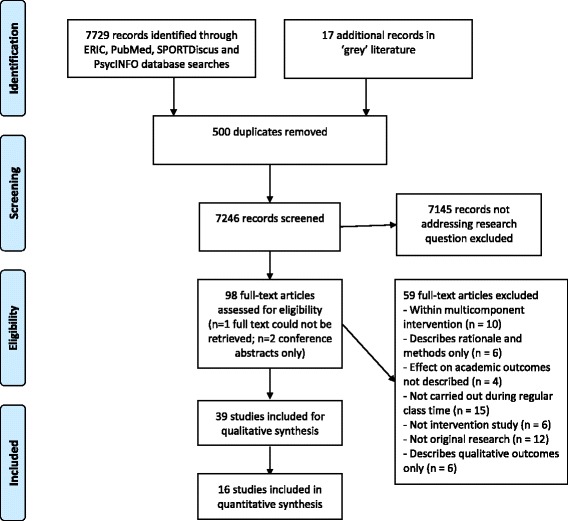
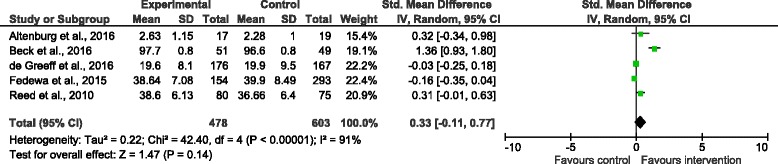
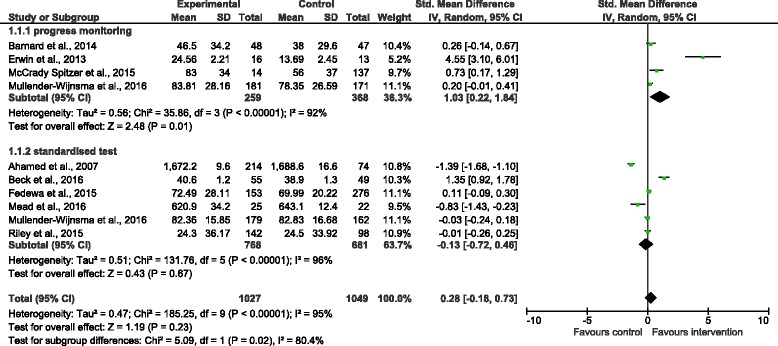
BACKGROUND: Physical activity is associated with many physical and mental health benefits, however many children do not meet the national physical activity guidelines. While schools provide an ideal setting to promote children's physical activity, adding physical activity to the school day can be difficult given time constraints often imposed by competing key learning areas. Classroom-based physical activity may provide an opportunity to increase school-based physical activity while concurrently improving academic-related outcomes. The primary aim of this systematic review and meta-analysis was to evaluate the impact of classroom-based physical activity interventions on academic-related outcomes. A secondary aim was to evaluate the impact of these lessons on physical activity levels over the study duration. METHODS: A systematic search of electronic databases (PubMed, ERIC, SPORTDiscus, PsycINFO) was performed in January 2016 and updated in January 2017. Studies that investigated the association between classroom-based physical activity interventions and academic-related outcomes in primary (elementary) school-aged children were included. Meta-analyses were conducted in Review Manager, with effect sizes calculated separately for each outcome assessed. RESULTS: Thirty-nine articles met the inclusion criteria for the review, and 16 provided sufficient data and appropriate design for inclusion in the meta-analyses. Studies investigated a range of academic-related outcomes including classroom behaviour (e.g. on-task behaviour), cognitive functions (e.g. executive function), and academic achievement (e.g. standardised test scores). Results of the meta-analyses showed classroom-based physical activity had a positive effect on improving on-task and reducing off-task classroom behaviour (standardised mean difference = 0.60 (95% CI: 0.20,1.00)), and led to improvements in academic achievement when a progress monitoring tool was used (standardised mean difference = 1.03 (95% CI: 0.22,1.84)). However, no effect was found for cognitive functions (standardised mean difference = 0.33 (95% CI: -0.11,0.77)) or physical activity (standardised mean difference = 0.40 (95% CI: -1.15,0.95)). CONCLUSIONS: Results suggest classroom-based physical activity may have a positive impact on academic-related outcomes. However, it is not possible to draw definitive conclusions due to the level of heterogeneity in intervention components and academic-related outcomes assessed. Future studies should consider the intervention period when selecting academic-related outcome measures, and use an objective measure of physical activity to determine intervention fidelity and effects on overall physical activity levels.
Overview
The claims and statistics of this paper haven’t been checked yet.
Free: it reads the open-access text and checks the first 5 claims that cite a source we can check. Create a free account to check every claim.
Integrity signals
Registry
Cites
Statistics
Figures


Verification
Claims the paper makes
The claims and statistics of this paper haven’t been checked yet.
Free: it reads the open-access text and checks the first 5 claims that cite a source we can check. Create a free account to check every claim.
Claims other papers make about this one
Each is checked against this paper’s own text: does it say what the citing paper says it does?
The source backs part of the claim, not all of it — or backs it for a different population, condition or comparison.
In the citing paper
“active classrooms, compared with traditional sedentary classrooms, had null [32] or medium [35] effects.”
From Physical Activity and Academic Achievement: An Umbrella Review (2020) · cites this paper as [32]
Experimental — accuracy not yet measuredThe source backs part of the claim, not all of it — or backs it for a different population, condition or comparison.
In the citing paper
“These improvements are relatively strong when considered in the broader field of physical activity interventions.”
From Effectiveness of wearable activity trackers to increase physical activity and improve health: a systematic review of systematic reviews and meta-analyses. (2022) · cites this paper as [69]
Experimental — accuracy not yet measured
Self-check
Percentages, sums and reported differences re-computed from the paper’s own numbers.
The self-check needs the paper’s full text.
Citations
Cites
‘Small Changes' to Diet and Physical Activity Behaviors for Weight Management
Hills, A. P., Byrne, N. M., Lindstrom, R., & Hill, J. O. (2013) · Obesity Facts · doi:10.1159/000345030 · Cited by 9,493
Physical Activity in the United States Measured by Accelerometer
TROIANO, R. P., BERRIGAN, D., DODD, K. W., MÂSSE, L. C., TILERT, T., & MCDOWELL, M. (2008) · Medicine & Science in Sports & Exercise · doi:10.1249/mss.0b013e31815a51b3 · Cited by 7,638
Janssen, I., & LeBlanc, A. G. (2010) · International Journal of Behavioral Nutrition and Physical Activity · doi:10.1186/1479-5868-7-40 · Cited by 4,829
Physical Activity for Cognitive and Mental Health in Youth: A Systematic Review of Mechanisms
Lubans, D., Richards, J., Hillman, C., Faulkner, G., Beauchamp, M., Nilsson, M., Kelly, P., Smith, J., Raine, L., & Biddle, S. (2016) · Pediatrics · doi:10.1542/peds.2016-1642 · Cited by 1,548
The relationship between physical activity and cognition in children: a meta-analysis
Sibley, B. A., & Etnier, J. L. (2003) · Pediatric Exercise Science · doi:10.1123/pes.15.3.243 · Cited by 1,308
Best, J. R., Miller, P. H., & Naglieri, J. A. (2011) · Learning and Individual Differences · doi:10.1016/j.lindif.2011.01.007 · Cited by 1,294 · cited 1×
“Executive functions, inhibition in particular, have been shown to be consistently related to academic achievement [34] and therefore were considered salient to teachers.”
BackgroundThe effect of exercise-induced arousal on cognitive task performance: a meta-regression analysis
Lambourne, K., & Tomporowski, P. (2010) · Brain Research · doi:10.1016/j.brainres.2010.03.091 · Cited by 1,105
Sallis, J. F., McKenzie, T. L., Alcaraz, J. E., Kolody, B., Faucette, N., & Hovell, M. F. (1997) · American Journal of Public Health · doi:10.2105/ajph.87.8.1328 · Cited by 914 · cited 1×
“Studies have shown interventions targeting these discrete periods may be effective in increasing children’s physical activity levels [7, 8], with the potential to contribute to up to 50% of the physical activity required to meet physical activity guidelines [9].”
BackgroundPhysical education, school physical activity, school sports and academic performance
Trudeau, F., & Shephard, R. J. (2008) · International Journal of Behavioral Nutrition and Physical Activity · doi:10.1186/1479-5868-5-10 · Cited by 879
Rasberry, C. N., Lee, S. M., Robin, L., Laris, B. A., Russell, L. A., Coyle, K. K., & Nihiser, A. J. (2011) · Preventive Medicine · doi:10.1016/j.ypmed.2011.01.027 · Cited by 709
Manly, T., Anderson, V., Nimmo‐Smith, I., Turner, A., Watson, P., & Robertson, I. H. (2001) · Journal of Child Psychology and Psychiatry · doi:10.1111/1469-7610.00806 · Cited by 693 · cited 1×
“Overall results showed studies that reported improvements in cognitive function used measures with moderate to high levels of reliability and validity [67, 68].”
ResultEffects of a classroom-based program on physical activity and on-task behavior
MAHAR, M. T., MURPHY, S. K., ROWE, D. A., GOLDEN, J., SHIELDS, A. T., & RAEDEKE, T. D. (2006) · Medicine & Science in Sports & Exercise · doi:10.1249/01.mss.0000235359.16685.a3 · Cited by 674 · cited 6×
“Curriculum-focussed active breaks: short bouts of physical activity that include curriculum content [25, 26].”
BackgroundInfluentialFedewa, A. L., & Ahn, S. (2011) · Research Quarterly for Exercise and Sport · doi:10.1080/02701367.2011.10599785 · Cited by 624
Singh, A. (2012) · Archives of Pediatrics & Adolescent Medicine · doi:10.1001/archpediatrics.2011.716 · Cited by 604
Donnelly, J. E., Greene, J. L., Gibson, C. A., Smith, B. K., Washburn, R. A., Sullivan, D. K., DuBose, K., Mayo, M. S., Schmelzle, K. H., Ryan, J. J., et al. (2009) · Preventive Medicine · doi:10.1016/j.ypmed.2009.07.022 · Cited by 595 · cited 10×
“Across studies there was a 2% to 16% increase in moderate- to vigorous- intensity physical activity during intervention lessons, [27, 28, 45, 60, 63], and 2% to 12% increase in school day moderate- to vigorous- intensity physical activity [27, 28, 58].”
BackgroundInfluentialClassroom-based physical activity, cognition, and academic achievement
Donnelly, J. E., & Lambourne, K. (2011) · Preventive Medicine · doi:10.1016/j.ypmed.2011.01.021 · Cited by 554
Implementation of school based physical activity interventions: A systematic review
Naylor, P.-J., Nettlefold, L., Race, D., Hoy, C., Ashe, M. C., Wharf Higgins, J., & McKay, H. A. (2015) · Preventive Medicine · doi:10.1016/j.ypmed.2014.12.034 · Cited by 550
Physical Activity and Student Performance at School
Taras, H. (2005) · Journal of School Health · doi:10.1111/j.1746-1561.2005.00026.x · Cited by 394
School-Based Physical Activity Does Not Compromise Children's Academic Performance
AHAMED, Y., MACDONALD, H., REED, K., NAYLOR, P.-J., LIU-AMBROSE, T., & MCKAY, H. (2007) · Medicine & Science in Sports & Exercise · doi:10.1249/01.mss.0000241654.45500.8e · Cited by 314 · cited 7×
“Physical activity outcomes Eleven studies examined the effect of classroom-based physical activity interventions on children’s physical activity levels using a range of measures, including questionnaire [35], direct observation [45], pedometer [25, 47, 52], and accelerometer [27, 28, 36, 47, 58, 60, 63].”
BackgroundInfluentialRidgers, N. D., Stratton, G., Fairclough, S. J., & Twisk, J. W. R. (2007) · Preventive Medicine · doi:10.1016/j.ypmed.2007.01.009 · Cited by 281 · cited 1×
“Studies have shown interventions targeting these discrete periods may be effective in increasing children’s physical activity levels [7, 8], with the potential to contribute to up to 50% of the physical activity required to meet physical activity guidelines [9].”
BackgroundLees, C., & Hopkins, J. (2013) · Preventing Chronic Disease · doi:10.5888/pcd10.130010 · Cited by 226 · cited 1×
“These findings are generally consistent with earlier reviews finding that overall physical activity level was either positively associated, or was not associated with academic-related outcomes [14, 15, 17].”
ResultExergaming immediately enhances children's executive function.
Best, J. R. (2012) · Developmental Psychology · doi:10.1037/a0026648 · Cited by 224
Physically active academic lessons in elementary children
Bartholomew, J. B., & Jowers, E. M. (2011) · Preventive Medicine · doi:10.1016/j.ypmed.2011.01.017 · Cited by 224
How active are our children? Findings from the Millennium Cohort Study
Griffiths, L. J., Cortina-Borja, M., Sera, F., Pouliou, T., Geraci, M., Rich, C., Cole, T. J., Law, C., Joshi, H., Ness, A. R., et al. (2013) · BMJ Open · doi:10.1136/bmjopen-2013-002893 · Cited by 212
Impact of short bouts of physical activity on attention-to-task in elementary school children
Mahar, M. T. (2011) · Preventive Medicine · doi:10.1016/j.ypmed.2011.01.026 · Cited by 202
Norris, E., Shelton, N., Dunsmuir, S., Duke-Williams, O., & Stamatakis, E. (2015) · Preventive Medicine · doi:10.1016/j.ypmed.2014.12.027 · Cited by 200 · cited 4×
“Narrative reviews [18–20], one systematic review [21] and two meta-analyses [22, 23] have explored the impact of classroom-based physical activity interventions on academic-related outcomes.”
BackgroundResultInfluentialClassroom-Based Physical Activity Breaks and Children's Attention: Cognitive Engagement Works!
Schmidt, M., Benzing, V., & Kamer, M. (2016) · Frontiers in Psychology · doi:10.3389/fpsyg.2016.01474 · Cited by 198 · cited 5×
“Curriculum-focussed active breaks: short bouts of physical activity that include curriculum content [25, 26].”
BackgroundInfluentialCarlson, J. A., Engelberg, J. K., Cain, K. L., Conway, T. L., Mignano, A. M., Bonilla, E. A., Geremia, C., & Sallis, J. F. (2015) · Preventive Medicine · doi:10.1016/j.ypmed.2015.08.006 · Cited by 191 · cited 6×
“Physical activity outcomes Eleven studies examined the effect of classroom-based physical activity interventions on children’s physical activity levels using a range of measures, including questionnaire [35], direct observation [45], pedometer [25, 47, 52], and accelerometer [27, 28, 36, 47, 58, 60, 63].”
BackgroundInfluentialMullender-Wijnsma, M. J., Hartman, E., de Greeff, J. W., Doolaard, S., Bosker, R. J., & Visscher, C. (2016) · Pediatrics · doi:10.1542/peds.2015-2743 · Cited by 187 · cited 4×
“Lessons ranged in duration from 30 to 60 min [27, 28, 32, 33, 60–64, 66] with most (8 out of 13) requiring participation three times per week [27, 28, 32, 33, 61, 62, 64, 66].”
BackgroundResultInfluentialReed, J. A., Einstein, G., Hahn, E., Hooker, S. P., Gross, V. P., & Kravitz, J. (2010) · Journal of Physical Activity and Health · doi:10.1123/jpah.7.3.343 · Cited by 178 · cited 5×
“Academic-related outcomes: Cognitive function Studies also assessed acute and chronic effects of classroom-based physical activity on a range of cognitive functions [24, 32, 37, 38, 40, 41, 46, 47, 49, 50, 54, 64].”
BackgroundResultInfluentialRoach, G. D., Dawson, D., & Lamond, N. (2006) · Chronobiology International · doi:10.1080/07420520601067931 · Cited by 174
Howie, E. K., Schatz, J., & Pate, R. R. (2015) · Research Quarterly for Exercise and Sport · doi:10.1080/02701367.2015.1039892 · Cited by 173 · cited 6×
“Seven out of 8 studies using a progress monitoring tool reported significant improvement in academic achievement following intervention periods ranging from 4 weeks to 1-year [40, 44, 53, 54, 60, 61, 66].”
BackgroundResultInfluentialJanssen, M., Chinapaw, M. J. M., Rauh, S. P., Toussaint, H. M., van Mechelen, W., & Verhagen, E. A. L. M. (2014) · Mental health and physical activity · doi:10.1016/j.mhpa.2014.07.001 · Cited by 170 · cited 8×
“amount of physical activity required to confer academic benefits) required to provide maximum effects on academic-related outcomes, by manipulating intensity [41], duration [39, 40], and frequency [49] of active break sessions.”
BackgroundInfluentialMcMullen, J., Kulinna, P., & Cothran, D. (2014) · Journal of Teaching in Physical Education · doi:10.1123/jtpe.2014-0062 · Cited by 168 · cited 2×
“These findings may encourage teachers to consider implementing classroom-based physical activity programs by alleviating concerns about reducing on-task behaviour due to the disruption to the classroom routine [10].”
BackgroundKatz, D. L., Cushman, D. M., Reynolds, J., Njike, V. Y., Treu, J. A., Walker, J., Smith, E., & Katz, C. S. (2010) · PubMed Central · Cited by 167
Ma, J. K., Le Mare, L., & Gurd, B. J. (2015) · Applied Physiology, Nutrition, and Metabolism · doi:10.1139/apnm-2014-0309 · Cited by 167 · cited 8×
“Academic-related outcomes: Cognitive function Studies also assessed acute and chronic effects of classroom-based physical activity on a range of cognitive functions [24, 32, 37, 38, 40, 41, 46, 47, 49, 50, 54, 64].”
BackgroundInfluentialMullender‐Wijnsma, M. J., Hartman, E., de Greeff, J. W., Bosker, R. J., Doolaard, S., & Visscher, C. (2015) · Journal of School Health · doi:10.1111/josh.12259 · Cited by 160 · cited 4×
“Lessons ranged in duration from 30 to 60 min [27, 28, 32, 33, 60–64, 66] with most (8 out of 13) requiring participation three times per week [27, 28, 32, 33, 61, 62, 64, 66].”
BackgroundInfluentialSchool day segmented physical activity patterns of high and low active children
Fairclough, S. J., Beighle, A., Erwin, H., & Ridgers, N. D. (2012) · BMC Public Health · doi:10.1186/1471-2458-12-406 · Cited by 158 · cited 1×
“Studies have shown interventions targeting these discrete periods may be effective in increasing children’s physical activity levels [7, 8], with the potential to contribute to up to 50% of the physical activity required to meet physical activity guidelines [9].”
BackgroundPhysically Active Academic Lessons and Time on Task: The Moderating Effect of Body Mass Index
GRIECO, L. A., JOWERS, E. M., & BARTHOLOMEW, J. B. (2009) · Medicine & Science in Sports & Exercise · doi:10.1249/mss.0b013e3181a61495 · Cited by 156 · cited 3×
“One study reported a nonsignificant increase in on-task classroom behaviour after intervention sessions, compared with control [55].”
BackgroundResultPhysical Activity and School Engagement in Youth: A Systematic Review and Meta-Analysis
Owen, K. B., Parker, P. D., Van Zanden, B., MacMillan, F., Astell-Burt, T., & Lonsdale, C. (2016) · Educational Psychologist · doi:10.1080/00461520.2016.1151793 · Cited by 153 · cited 2×
“However, results from those metaanalyses are limited by the small number of included studies [22, 23], the narrow range of potential academic-related outcomes assessed, the combination of findings among primary and secondary school students [22], and their recency [23].”
BackgroundMotor-Enriched Learning Activities Can Improve Mathematical Performance in Preadolescent Children
Beck, M. M., Lind, R. R., Geertsen, S. S., Ritz, C., Lundbye-Jensen, J., & Wienecke, J. (2016) · Frontiers in Human Neuroscience · doi:10.3389/fnhum.2016.00645 · Cited by 153 · cited 3×
“Lessons ranged in duration from 30 to 60 min [27, 28, 32, 33, 60–64, 66] with most (8 out of 13) requiring participation three times per week [27, 28, 32, 33, 61, 62, 64, 66].”
BackgroundHowie, E. K., Beets, M. W., & Pate, R. R. (2014) · Mental health and physical activity · doi:10.1016/j.mhpa.2014.05.002 · Cited by 129 · cited 4×
“showed on-task classroom behaviour significantly improved after the 10-min active break condition [39] and math scores were highest after the 10-min (ES = 0.”
BackgroundInfluentialRiley, N., Lubans, D. R., Morgan, P. J., & Young, M. D. (2014) · Journal of science and medicine in sport · doi:10.1016/j.jsams.2014.09.005 · Cited by 129 · cited 16×
“Okely T, Salmon J, Vella S, Cliff D, Timperio A, Tremblay M, Trost S, Shilton T, Hinkley T, Ridgers N, Phillipson L, Hesketh K, Parrish A, Janssen X, Brown M, Emmel J, Marino N, A systematic review to update the Australian physical activity guidelines for children and young people., Report prepared for the Australian…”
BackgroundInfluentialRiley, N., Lubans, D. R., Holmes, K., & Morgan, P. J. (2016) · Journal of Physical Activity and Health · doi:10.1123/jpah.2015-0046 · Cited by 125 · cited 17×
“Okely T, Salmon J, Vella S, Cliff D, Timperio A, Tremblay M, Trost S, Shilton T, Hinkley T, Ridgers N, Phillipson L, Hesketh K, Parrish A, Janssen X, Brown M, Emmel J, Marino N, A systematic review to update the Australian physical activity guidelines for children and young people., Report prepared for the Australian…”
BackgroundResultInfluentialde Greeff, J. W., Hartman, E., Mullender-Wijnsma, M. J., Bosker, R. J., Doolaard, S., & Visscher, C. (2016) · Health Education Research · doi:10.1093/her/cyv102 · Cited by 119 · cited 7×
“Academic-related outcomes: Cognitive function Studies also assessed acute and chronic effects of classroom-based physical activity on a range of cognitive functions [24, 32, 37, 38, 40, 41, 46, 47, 49, 50, 54, 64].”
BackgroundInfluentialErwin, H., Fedewa, A., Beighle, A., & Ahn, S. (2012) · Journal of Applied School Psychology · doi:10.1080/15377903.2012.643755 · Cited by 114 · cited 2×
“However, results from those metaanalyses are limited by the small number of included studies [22, 23], the narrow range of potential academic-related outcomes assessed, the combination of findings among primary and secondary school students [22], and their recency [23].”
BackgroundMa, J. K., Mare, L. L., & Gurd, B. J. (2014) · Applied Physiology, Nutrition, and Metabolism · doi:10.1139/apnm-2014-0125 · Cited by 111 · cited 6×
“Three received a strong quality rating score [32, 43, 58].”
BackgroundInfluentialMoving and Academic Learning Are Not Antagonists: Acute Effects on Executive Function and Enjoyment
Vazou, S., & Smiley-Oyen, A. (2014) · Journal of Sport and Exercise Psychology · doi:10.1123/jsep.2014-0035 · Cited by 110 · cited 1×
“Academic achievement: A child’s performance on school-related tasks; often reported via classroom grades, national standardised tests or progress monitoring tools [29], as well as self-reported perceived academic competence [30].”
BackgroundGrieco, L. A., Jowers, E. M., Errisuriz, V. L., & Bartholomew, J. B. (2016) · Preventive Medicine · doi:10.1016/j.ypmed.2016.05.021 · Cited by 103 · cited 3×
“Other physically active lessons were described as single lessons as part of pilot interventions [59, 63, 65], or stipulated physical activity time per week, rather than number of lessons per week [58].”
BackgroundStudent academic performance outcomes of a classroom physical activity ıntervention: A pilot study
Erwin, H. E., Fedewa, A. L., & Ahn, S. (2017) · lnternational Electronic Journal of Elementary Education · Cited by 100
Altenburg, T. M., Chinapaw, M. J. M., & Singh, A. S. (2016) · Journal of Science and Medicine in Sport · doi:10.1016/j.jsams.2015.12.003 · Cited by 94 · cited 10×
“amount of physical activity required to confer academic benefits) required to provide maximum effects on academic-related outcomes, by manipulating intensity [41], duration [39, 40], and frequency [49] of active break sessions.”
BackgroundInfluentialGray, C., Larouche, R., Barnes, J., Colley, R., Bonne, J., Arthur, M., Cameron, C., Chaput, J.-P., Faulkner, G., Janssen, I., et al. (2014) · International Journal of Environmental Research and Public Health · doi:10.3390/ijerph110606009 · Cited by 92
Does integrating physical activity in the elementary school classroom influence academic motivation?
Vazou, S., Gavrilou, P., Mamalaki, E., Papanastasiou, A., & Sioumala, N. (2012) · International Journal of Sport and Exercise Psychology · doi:10.1080/1612197x.2012.682368 · Cited by 92 · cited 3×
“Another study reported self-reported perceptions of academic competence improved during physically active lessons [56].”
BackgroundGoh, T. L., Hannon, J., Webster, C., Podlog, L., & Newton, M. (2016) · Journal of Physical Activity and Health · doi:10.1123/jpah.2015-0238 · Cited by 88 · cited 1×
“Regardless of type of classroom-based physical activity, the majority of studies (10 out of 12) showed participation in these programs had an acute effect on improving on-task classroom behaviour [25, 27, 28, 39, 52, 57, 62, 65] and reducing off-task behaviour [36, 43] However, evidence in the few studies with longer…”
BackgroundInstant Recess ® : A Practical Tool for Increasing Physical Activity During the School Day
Whitt-Glover, M. C., Ham, S. A., & Yancey, A. K. (2011) · Progress in Community Health Partnerships: Research, Education, and Action · doi:10.1353/cpr.2011.0031 · Cited by 84 · cited 6×
“Sample sizes ranged from 14 [60] to over 4500 participants [45], with sample sizes <300 in the majority of studies (n = 28) [24–28, 33, 35, 39–41, 43, 44, 46–51, 53, 55–57, 59–64].”
BackgroundInfluentialFedewa, A. L., Ahn, S., Erwin, H., & Davis, M. C. (2015) · School Psychology International · doi:10.1177/0143034314565424 · Cited by 76 · cited 4×
“Seven out of 8 studies using a progress monitoring tool reported significant improvement in academic achievement following intervention periods ranging from 4 weeks to 1-year [40, 44, 53, 54, 60, 61, 66].”
BackgroundResultInfluentialvan den Berg, V., Saliasi, E., de Groot, R. H. M., Jolles, J., Chinapaw, M. J. M., & Singh, A. S. (2016) · Frontiers in Psychology · doi:10.3389/fpsyg.2016.00723 · Cited by 73 · cited 5×
“hopping sequences to music [37, 38], and coordinative exercises [50].”
BackgroundInfluentialExercising attention within the classroom
HILL, L., WILLIAMS, J. H. G., AUCOTT, L., MILNE, J., THOMSON, J., GREIG, J., MUNRO, V., & MON‐WILLIAMS, M. (2010) · Developmental Medicine & Child Neurology · doi:10.1111/j.1469-8749.2010.03661.x · Cited by 70 · cited 5×
“hopping sequences to music [37, 38], and coordinative exercises [50].”
BackgroundResultInfluentialMullender-Wijnsma, M. J., Hartman, E., de Greeff, J. W., Bosker, R. J., Doolaard, S., & Visscher, C. (2015) · BMC Public Health · doi:10.1186/s12889-015-1745-y · Cited by 66 · cited 4×
“Lessons ranged in duration from 30 to 60 min [27, 28, 32, 33, 60–64, 66] with most (8 out of 13) requiring participation three times per week [27, 28, 32, 33, 61, 62, 64, 66].”
BackgroundInfluentialHaapala, E. (2012) · Baltic Journal of Health and Physical Activity · doi:10.2478/v10131-012-0007-y · Cited by 58
A Pilot Study of a Possible Effect from a Motor Task on Reading Performance
Uhrich, T. A., & Swalm, R. L. (2007) · Perceptual and Motor Skills · doi:10.2466/pms.104.3.1035-1041 · Cited by 57 · cited 2×
“Seven out of 8 studies using a progress monitoring tool reported significant improvement in academic achievement following intervention periods ranging from 4 weeks to 1-year [40, 44, 53, 54, 60, 61, 66].”
BackgroundWilson, A. N., Olds, T., Lushington, K., Petkov, J., & Dollman, J. (2016) · Acta Paediatrica · doi:10.1111/apa.13323 · Cited by 53 · cited 15×
“Okely T, Salmon J, Vella S, Cliff D, Timperio A, Tremblay M, Trost S, Shilton T, Hinkley T, Ridgers N, Phillipson L, Hesketh K, Parrish A, Janssen X, Brown M, Emmel J, Marino N, A systematic review to update the Australian physical activity guidelines for children and young people., Report prepared for the Australian…”
BackgroundInfluentialHILL, L. J. B., WILLIAMS, J. H. G., AUCOTT, L., THOMSON, J., & MON-WILLIAMS, M. (2011) · Developmental Medicine & Child Neurology · doi:10.1111/j.1469-8749.2011.03954.x · Cited by 51 · cited 5×
“hopping sequences to music [37, 38], and coordinative exercises [50].”
BackgroundResultInfluentialMead, T. P., & Scibora, L. M. (2016) · The Physical Educator · doi:10.18666/tpe-2016-v73-i3-5303 · Cited by 47 · cited 1×
“significantly improved following a 1-year [51] and 3year physically active lesson intervention [58].”
BackgroundStability of Cognitive Measures in Children of Average Ability
Neyens, L. G. J., & Aldenkamp, A. P. (1997) · Child Neuropsychology · doi:10.1080/09297049708400639 · Cited by 42
Graham, D. J., Lucas-Thompson, R. G., & O’Donnell, M. B. (2014) · Frontiers in Public Health · doi:10.3389/fpubh.2014.00058 · Cited by 38 · cited 3×
“Other studies assessed academic achievement via content recall quizzes and perceptions of academic competence, with no difference between groups in math and social studies scores following participation in single lessons lasting between 10 and 30 min [59, 63].”
BackgroundVirtual field trips as physically active lessons for children: a pilot study
Norris, E., Shelton, N., Dunsmuir, S., Duke-Williams, O., & Stamatakis, E. (2015) · BMC Public Health · doi:10.1186/s12889-015-1706-5 · Cited by 38 · cited 8×
“Other studies assessed academic achievement via content recall quizzes and perceptions of academic competence, with no difference between groups in math and social studies scores following participation in single lessons lasting between 10 and 30 min [59, 63].”
BackgroundInfluentialLow-Cost and Scalable Classroom Equipment to Promote Physical Activity and Improve Education
MCCRADY-SPITZER, S. K., Manohar, C. U., Koepp, G. A., & Levine, J. A. (2014) · Journal of Physical Activity and Health · doi:10.1123/jpah.2014-0159 · Cited by 27 · cited 8×
“Seven out of 8 studies using a progress monitoring tool reported significant improvement in academic achievement following intervention periods ranging from 4 weeks to 1-year [40, 44, 53, 54, 60, 61, 66].”
BackgroundInfluentialMadelaine, A., & Wheldall, K. (2002) · Educational Psychology · doi:10.1080/0144341022000003132 · Cited by 27
Active kids active minds: a physical activity intervention to promote learning?
lisahunter, L. H., Abbott, R. A., Macdonald, D., Ziviani, J., & Cuskelly, M. (2014) · Asia-Pacific Journal of Health Sport and Physical Education · doi:10.1080/18377122.2014.906057 · Cited by 25
Madelaine, A., & Wheldall, K. (1998) · Educational Psychology · doi:10.1080/0144341980180408 · Cited by 25 · cited 1×
“weekly) [75, 76], while standardised tests are usually designed to be administered less frequently (e.”
BackgroundEffects of Classroom-Based Energizers on Primary Grade Students' Physical Activity Levels.
Bailey, C. G., & DiPerna, J. C. (2015) · The Physical Educator · Cited by 21
Graphemic Analysis and the Spoken Language Bias
Berg, K. (2016) · Frontiers in Psychology · doi:10.3389/fpsyg.2016.00388 · Cited by 12
Barnard, M., Deventer, K. V., & Mm, O. (2014) · South African Journal for Research in Sport Physical Education and Recreation · Cited by 8
Research works printed but not linked: 3
- Okely T Salmon J Vella S Cliff D Timperio A Tremblay M Trost S Shilton T Hinkley T Ridgers N Phillipson L Hesketh K Parrish A Janssen X Brown M Emmel J Marino N A systematic review to update the Australian physical activity guidelines for children and young people., Report prepared for the Australian Government Department of Health, Editor Canberra 2012 Australia Commonwealth of Australia
- Brickenkamp R Zillmer E d2 Test of Attention, in d2 Test 1998 Clark, Editors P.L. Ackerman and E
- Nunnally, J.C., Psychometric theory. McGraw-Hill series in psychology. 1967: New York, McGraw-Hill [1967].
Cited by
Physical Activity, Cognition, and Brain Outcomes: A Review of the 2018 Physical Activity Guidelines
ERICKSON, K. I., HILLMAN, C., STILLMAN, C. M., BALLARD, R. M., BLOODGOOD, B., CONROY, D. E., MACKO, R., MARQUEZ, D. X., PETRUZZELLO, S. J., & POWELL, K. E. (2019) · Medicine & Science in Sports & Exercise · doi:10.1249/mss.0000000000001936 · Cited by 1,214
Dunton, G. F., Do, B., & Wang, S. D. (2020) · BMC Public Health · doi:10.1186/s12889-020-09429-3 · Cited by 916
Ferguson, T., Olds, T., Curtis, R., Blake, H., Crozier, A. J., Dankiw, K., Dumuid, D., Kasai, D., O'Connor, E., Virgara, R., et al. (2022) · The Lancet Digital Health · doi:10.1016/s2589-7500(22)00111-x · Cited by 605
Neil-Sztramko, S. E., Caldwell, H., & Dobbins, M. (2021) · Cochrane Database of Systematic Reviews · doi:10.1002/14651858.cd007651.pub3 · Cited by 449
Cassar, S., Salmon, J., Timperio, A., Naylor, P.-J., van Nassau, F., Contardo Ayala, A. M., & Koorts, H. (2019) · International Journal of Behavioral Nutrition and Physical Activity · doi:10.1186/s12966-019-0876-4 · Cited by 304
Self-citation
Metadata
- Authors
- Watson, A., Timperio, A., Brown, H., Best, K., & Hesketh, K. D.
- Affiliations
- Deakin University (AU)
- Corresponding author
- Hesketh, Kylie D.
- Venue
- International Journal of Behavioral Nutrition and Physical Activity
- Published
- 2017-08-25
- Volume
- 14
- Issue
- 1
- Pages
- 114-114
- ISSN
- 1479-5868 (ISSN-L)
- PMC
- PMC5574081
- OpenAlex
- W2750279836
- Cited by
- 689
- References
- 74
- Citations by year
- 2026: 60 · 2025: 76 · 2024: 97 · 2023: 86 · 2022: 96 · 2021: 97 · 2020: 81 · 2019: 59 · 2018: 34 · 2017: 1
- FWCI
- 5.87
- Type
- journal article
- Language
- en
- Open access
- gold
- doi.org
- Licence
- cc-by
- Locations
- International Journal of Behavioral Nutrition and Physical Activity (publishedVersion, cc-by)
- Europe PMC (PubMed Central) (publishedVersion, cc-by)
- PubMed Central (publishedVersion, cc-by)
- PubMed (publishedVersion)
- Adelaide Research & Scholarship (AR&S) (University of Adelaide) (submittedVersion, cc-by)
- DOAJ (DOAJ: Directory of Open Access Journals) (submittedVersion)
- Figshare (submittedVersion, cc-by)
- Funders
- National Heart Foundation of Australia (FT130100637, 100370, 100046)
- Deakin University
- Topics
- Health Sciences › Medicine › Public Health, Environmental and Occupational Health › Physical Activity and Health
- Health Sciences › Medicine › Public Health, Environmental and Occupational Health › School Health and Nursing Education
- Social Sciences › Psychology › Developmental and Educational Psychology › Children's Physical and Motor Development
- Keywords
- classroom physical activity, school-based physical activity intervention, academic performance, on-task behavior, off-task behavior, executive function, cognitive function, elementary school students, children's physical activity, intervention fidelity, progress monitoring, physical education classes, intervention intensity, intervention dosage, intervention heterogeneity
- MeSH terms
- Academic Success, Child, Cognition, Curriculum, Humans, Learning, Physical Education and Training, Schools, Students, Health Behavior, Exercise, Databases, Factual
About these checks
Registry, retraction, Cites and statistics results are computed, not judged, with one exception: a printed reference that no index lists is read once by a model before it counts as a citation error. Claims are extracted by a model and kept only when their quote appears verbatim in the text; each cited source is then checked, with a model’s help, for whether it says what the claim relies on. Those verdicts can be wrong — read the claim’s quote and the cited source before relying on one.
Statistics and arithmetic are recomputed, not judged.
Confidence bands are shown only for fields calibrated on our annotated test set. None is calibrated yet, so no band is shown.
What counts as a claim ›How we measure confidence ›How we check this ›
Are you an author, or do you see a problem with this page? Request a review
Data sources
Bibliographic data: Semantic Scholar, OpenAlex, Crossref.
Contains information from the Semantic Scholar Academic Graph Datasets, made available under the ODC Attribution License (ODC-BY 1.0).
Semantic Scholar’s data is described in: Kinney, R., et al. (2023). The Semantic Scholar Open Data Platform. arXiv:2301.10140.
