

Psychological inflexibility mediates the relationship between mindfulness and psychological distress in Peruvian parents with school age children.
Open accessPublished version of a preprint
The DOI matches its Crossref record; 39 of the 41 references it cites were found in a registry or an index; 7 of the 29 sources its claims cite were checked for support.
Abstract
Objective: This study proposed a mediation model to examine whether psychological inflexibility mediates the relationship between mindfulness and psychological distress in parents of school-aged children. Methods: A cross-sectional study was conducted with 364 parents. Mindfulness, psychological inflexibility, depression, and anxiety were assessed using validated instruments. Psychological distress was modeled as a latent construct composed of depressive (PHQ-9) and anxiety (GAD-7) symptoms. Reliability was evaluated using alpha and omega coefficients. A Confirmatory Factor Analysis (CFA) was performed, followed by a mediation model using Structural Equation Modeling (SEM). Indirect effects were tested using bootstrapping. Results: Psychological inflexibility partially mediated the relationship between mindfulness and psychological distress (a*b = –.27, p <.001). The model explained 58% of the variance in psychological distress (R² =.58). Conclusion: Levels of psychological inflexibility and mindfulness techniques are interrelated with parental psychological distress, and the mediation model provides a significant pathway through which these variables connect with psychological distress. This finding underscores the importance of interventions grounded in Acceptance and Commitment Therapy (ACT). The study contributes to a deeper understanding of the psychological processes underlying the relationship between mindfulness and psychological distress.
Overview
CoChat Summary
## TL;DR
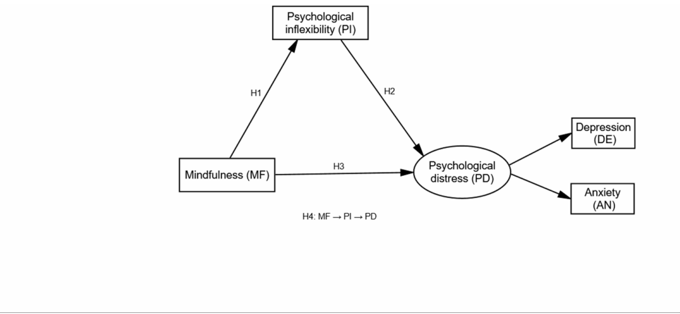
This cross-sectional SEM study of 364 Peruvian parents of school-age children found that psychological inflexibility partially mediates the link between mindfulness and psychological distress. The proposed model fit well and explained 58% of the variance in psychological distress.
## Key findings
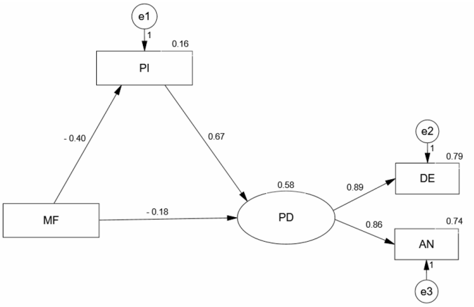
- Mindfulness was negatively associated with psychological inflexibility (β = -0.40, p < .001) and with psychological distress (β = -0.18, p < .001).
- Psychological inflexibility was positively associated with psychological distress (β = 0.67, p < .001).
- The indirect effect of mindfulness on psychological distress through psychological inflexibility was significant: a*b = -0.27, 95% CI [-1.22, -0.45], p < .001; the paper states this accounted for 60% of the total effect.
- The mediation model fit the data well (χ²/df = 1.85, CFI = 0.98, TLI = 0.98, SRMR = 0.04, RMSEA = 0.05) and explained 58% of the variance in psychological distress.
## Methods
- Explanatory cross-sectional design with mediation tested using Structural Equation Modeling (SEM) and bootstrapped indirect effects.
- Sample: 364 Peruvian adults who were parents of school-age children enrolled in a private educational institution; 412 were invited, 387 accessed the survey, and 23 were excluded for >20% missing data.
- Measures: mindfulness (MAAS-5), psychological inflexibility (AAQ-II; item 7 removed in the study’s CFA), depressive symptoms (PHQ-9), and anxiety symptoms (GAD-7); psychological distress was modeled as a latent factor indicated by depression and anxiety.
## Limitations
- The paper states that the cross-sectional design does not allow causal inference.
- The measures were exclusively self-reported, which may introduce social desirability and shared-method variance.
- The sample was drawn only from parents of children in private schools, limiting generalizability to public-school or rural parents; the sample was also heavily skewed toward mothers (82%), and the study notes it did not fully achieve the recommended SEM sample size.
Model-written summary. Check it against the paper before relying on it.
Integrity signals
Registry
Cites
Statistics
Figures
Verification
Claims the paper makes
5 Valid · 2 Not valid · 11 Not checked · 31 Own results and interpretations
A result the paper reports from its own data — it cites no other source for it, so there is none to check. The quote shows it is in the paper.
In the paper
“The model explained 58% of the variance in psychological distress (R² = .58).”
- Also stated in: § 4.4 Structure of the model · plain
“Importantly, the model explained 58% of the variance in psychological distress, indicating substantial explanatory power.”
plainstates an association- Asserted: passes — The authors put it forward as true.
- Checkable: passes — It can be checked against evidence.
- Load-bearing: passes — The paper’s conclusions depend on it.
- Based: passes — The paper gives a reason why it holds.
- Also stated in: § 4.4 Structure of the model · plain
A result the paper reports from its own data — it cites no other source for it, so there is none to check. The quote shows it is in the paper.
In the paper
“Mindfulness showed a negative association with psychological inflexibility (β = - 0.40, p < .001) and with psychological distress (β = - 0.18, p < .001).”
plainstates an association- Asserted: passes — The authors put it forward as true.
- Checkable: passes — It can be checked against evidence.
- Load-bearing: passes — The paper’s conclusions depend on it.
- Based: passes — The paper gives a reason why it holds.
A result the paper reports from its own data — it cites no other source for it, so there is none to check. The quote shows it is in the paper.
In the paper
“Both indicators showed strong standardized loadings (depression = 0.89; anxiety = 0.86), supporting the latent structure.”
- Also stated in: § 4.7 Direct effects and variance explained · plain
“Higher levels of psychological distress were associated with greater depressive (β = 0.89, p < .001) and anxiety symptoms (β = 0.86, p < .001).”
boostedstates an association- Asserted: passes — The authors put it forward as true.
- Checkable: passes — It can be checked against evidence.
- Load-bearing: passes — The paper’s conclusions depend on it.
- Based: passes — The paper gives a reason why it holds.
- Also stated in: § 4.7 Direct effects and variance explained · plain
A result the paper reports from its own data — it cites no other source for it, so there is none to check. The quote shows it is in the paper.
In the paper
“The proposed mediation model showed excellent fit to the data (χ²/df = 1.85, CFI = 0.98, TLI = 0.98, SRMR = 0.04, RMSEA = 0.05; see Table3).”
plain- Asserted: passes — The authors put it forward as true.
- Checkable: passes — It can be checked against evidence.
- Load-bearing: passes — The paper’s conclusions depend on it.
- Based: passes — The paper gives a reason why it holds.
A result the paper reports from its own data — it cites no other source for it, so there is none to check. The quote shows it is in the paper.
In the paper
“Our specific contribution is that psychological inflexibility explains approximately 60% of the covariation between mindfulness and total distress.”
plainstates an association- Asserted: passes — The authors put it forward as true.
- Checkable: passes — It can be checked against evidence.
- Load-bearing: passes — The paper’s conclusions depend on it.
- Based: passes — The paper gives a reason why it holds.
17 more claims
Create a free account to see all 49 claims and every source verdict.
- It may state two separate claims as one. 16
- Probably not a substantial claim. 11
- Borderline: one of the tests for a substantial claim is unclear. 1
Citations
Cites
lavaan : An R Package for Structural Equation Modeling
Rosseel, Y. (2012) · Journal of Statistical Software · doi:10.18637/jss.v048.i02 · Cited by 27,955
Wickham, H., Averick, M., Bryan, J., Chang, W., McGowan, L., François, R., Grolemund, G., Hayes, A., Henry, L., Hester, J., et al. (2019) · Journal of Open Source Software · doi:10.21105/joss.01686 · Cited by 22,138
Efron, B., & Tibshirani, R. (1986) · Statistical Science · doi:10.1214/ss/1177013815 · Cited by 6,033
Li, C.-H. (2016) · Behavior Research Methods · doi:10.3758/s13428-015-0619-7 · Cited by 3,031
Un sistema de clasificación de los diseños de investigación en psicología
Ato, M., López-García, J. J., & Benavente, A. (2013) · Anales de Psicología · doi:10.6018/analesps.29.3.178511 · Cited by 2,254 · cited 1×
“An explanatory cross-sectional design was employed to analyze a model examining the relationships between a set of variables, establishing causality based on underlying theoretical frameworks [8].”
A comparison of some methodologies for the factor analysis of non‐normal Likert variables
Muthén, B., & Kaplan, D. (1985) · British Journal of Mathematical and Statistical Psychology · doi:10.1111/j.2044-8317.1985.tb00832.x · Cited by 1,778 · cited 1×
“Skewness and kurtosis values fell within the acceptable ± 1.5 range [30].”
InfluentialEvans-Lacko, S., Aguilar-Gaxiola, S., Al-Hamzawi, A., Alonso, J., Benjet, C., Bruffaerts, R., Chiu, W. T., Florescu, S., de Girolamo, G., Gureje, O., et al. (2018) · Psychological Medicine · doi:10.1017/s0033291717003336 · Cited by 781
Alonso, J., Liu, Z., Evans-Lacko, S., Sadikova, E., Sampson, N., Chatterji, S., Abdulmalik, J., Aguilar-Gaxiola, S., Al-Hamzawi, A., Andrade, L. H., et al. (2018) · Depression and Anxiety · doi:10.1002/da.22711 · Cited by 716 · cited 2×
“These symptoms significantly interfere with people’s daily functioning, to the extent that depression and anxiety are leading causes of global disability [4, 14].”
InfluentialMeasurement for a Human Science
Mirowsky, J., & Ross, C. E. (2002) · Journal of Health and Social Behavior · doi:10.2307/3090194 · Cited by 378 · cited 1×
“Psychological distress is defined as an affective state characterized by the presence of depressive and anxious symptoms [28], including excessive worry, difficulty concentrating, and sleep disorders, among others [6].”
semPower: General power analysis for structural equation models
Moshagen, M., & Bader, M. (2023) · Behavior Research Methods · doi:10.3758/s13428-023-02254-7 · Cited by 308 · cited 1×
“Based on these parameters, the minimum required sample size was estimated at 342 participants [29].”
APROXIMACIÓN CONCEPTUAL Y PRÁCTICA A LOS MODELOS DE ECUACIONES ESTRUCTURALES
Medrano, L. A., & Muñoz‐Navarro, R. (2017) · Revista Digital de Investigación en Docencia Universitaria · doi:10.19083/ridu.11.486 · Cited by 272 · cited 1×
“Model fit was evaluated using standard criteria: CFI and TLI ≥ 0.90, RMSEA and SRMR ≤ 0.08, and χ²/df 3 [1, 27].”
InfluentialVillarreal-Zegarra, D., Copez-Lonzoy, A., Bernabé-Ortiz, A., Melendez-Torres, G. J., & Bazo-Alvarez, J. C. (2019) · PLOS ONE · doi:10.1371/journal.pone.0221717 · Cited by 191 · cited 1×
“Depressive symptoms were assessed using the Peruvian version of the PHQ-9 [45].”
McCracken, L. M., Badinlou, F., Buhrman, M., & Brocki, K. C. (2021) · Journal of Contextual Behavioral Science · doi:10.1016/j.jcbs.2020.11.003 · Cited by 146 · cited 1×
“Psychological inflexibility, its antithesis, has demonstrated a considerable predictive capacity for psychological distress [25, 26], explained by cognitive fusion with rigid thoughts and the inflexible avoidance of negative emotions.”
Multivariate outlier detection based on a robust Mahalanobis distance with shrinkage estimators
Cabana, E., Lillo, R. E., & Laniado, H. (2019) · Statistical Papers · doi:10.1007/s00362-019-01148-1 · Cited by 137
Depresión y ansiedad durante el aislamiento obligatorio por el COVID-19 en Lima Metropolitana
Universidad de Lima, P., Molinari, D. E. P., Bravo, G. L. A., Universidad de Lima, P., Pierola, I. D., Universidad de Lima, P., Bona, G. L. V.-D., Universidad de Lima, P., Silva, L. A. M., Universidad de Lima, P., et al. (2020) · Liberabit Revista Peruana de Psicología · doi:10.24265/liberabit.2020.v26n2.09 · Cited by 114
Woodruff, S. C., Glass, C. R., Arnkoff, D. B., Crowley, K. J., Hindman, R. K., & Hirschhorn, E. W. (2014) · Mindfulness · doi:10.1007/s12671-013-0195-9 · Cited by 89 · cited 2×
“Previous studies have shown that psychological inflexibility predicts well-being more robustly than mindfulness alone, suggesting that inflexibility could act as a mediating mechanism in the relationship between low mindfulness practice and the increase in anxious and depressive symptoms [49].”
Makriyianis, H. M., Adams, E. A., Lozano, L. L., Mooney, T. A., Morton, C., & Liss, M. (2019) · Journal of Contextual Behavioral Science · doi:10.1016/j.jcbs.2019.09.007 · Cited by 79 · cited 1×
“Psychological inflexibility, its antithesis, has demonstrated a considerable predictive capacity for psychological distress [25, 26], explained by cognitive fusion with rigid thoughts and the inflexible avoidance of negative emotions.”
Chilcot, J., Hudson, J. L., Moss-Morris, R., Carroll, A., Game, D., Simpson, A., & Hotopf, M. (2018) · General Hospital Psychiatry · doi:10.1016/j.genhosppsych.2017.09.007 · Cited by 77
Maddock, A., & Blair, C. (2023) · Current Psychology · doi:10.1007/s12144-021-02082-y · Cited by 68 · cited 1×
“In the empirical field, an inverse association has been consistently found between the capacity for full awareness of the present moment (mindfulness) and the presence of psychological distress [20, 24].”
Villarreal‐Zegarra, D., Paredes-Ángeles, R., Mayo‐Puchoc, N., Arenas-Minaya, E., Huarcaya-Victoria, J., & Copez-Lonzoy, A. J. E. (2024) · BMC Psychology · doi:10.1186/s40359-024-01688-8 · Cited by 64
Ho, C. Y. Y., Yu, B. C. L., & Mak, W. W. S. (2022) · Clinical Psychology Review · doi:10.1016/j.cpr.2022.102175 · Cited by 62
Dubey, N., Podder, P., & Pandey, D. (2020) · Frontiers in Psychology · doi:10.3389/fpsyg.2020.589365 · Cited by 56 · cited 2×
“Antecedents already exist that propose these mediated action pathways toward anxiety and depression in general populations [15, 43], with some of them proposing mindfulness action pathways mediated by psychological inflexibility [53, 7, 41]).”
Rogge, R. D., & Daks, J. S. (2021) · Mindfulness · doi:10.1007/s12671-020-01537-w · Cited by 50 · cited 3×
“Specifically, the Unified Model of Mindfulness and Flexibility (UFM) proposes that mindfulness levels act as the central mechanism for reducing psychological inflexibility, thus promoting well-being ([38, 52].”
Use of Structural Equation Modeling in Social Science Research
Rahman, W., Shah, F. A., & Rasli, A. M. (2015) · Asian Social Science · doi:10.5539/ass.v11n4p371 · Cited by 50
La depresión y su impacto en la salud pública
Corea Del Cid, M. T. (2021) · Revista Médica Hondureña · doi:10.5377/rmh.v89isupl.1.12047 · Cited by 38
Kulasinghe, K., Whittingham, K., & Mitchell, A. E. (2021) · Autism · doi:10.1177/1362361320984625 · Cited by 28 · cited 1×
“However, the scientific literature has begun to focus on parents [22, 32], and a crucial gap exists in understanding the dynamics among mindfulness, psychological inflexibil-ity, and psychological distress (anxiety and depression) in parents of school-aged children.”
Almendingen, A., & Pilkington, P. (2024) · Journal of Autism and Developmental Disorders · doi:10.1007/s10803-023-05939-2 · Cited by 27 · cited 1×
“In the context of parenting, research suggests that high levels of psychological distress are associated with lower parental self-efficacy [2, 3], a higher probability of aggressive behaviors toward children [47], and physical and psychological health problems in parents [31, 50], although these…”
AKTU, Y. (2024) · BMC Psychology · doi:10.1186/s40359-024-01980-7 · Cited by 27
Rogge, R. D., Lin, Y.-Y., Swanson, D. P., & Amaro, A. (2024) · Mindfulness · doi:10.1007/s12671-022-01886-8 · Cited by 25
Editorial: Parental influence on child social and emotional functioning
Zhu, X., Dou, D., & Karatzias, T. (2024) · Frontiers in Psychology · doi:10.3389/fpsyg.2024.1392772 · Cited by 25 · cited 1×
“This population faces unique demands in the development and education of their children, making optimal mental health essential [51].”
Caycho-Rodríguez, T., Tomás, J. M., Ventura- León, J., Carranza Esteban, R. F., Oblitas Guadalupe, L. A., Reyes-Bossio, M., García Cadena, C. H., & Cabrera-Orosco, I. (2021) · Aging & Mental Health · doi:10.1080/13607863.2020.1716685 · Cited by 23
Daks, J. S., Peltz, J. S., & Rogge, R. D. (2022) · Journal of Contextual Behavioral Science · doi:10.1016/j.jcbs.2022.08.011 · Cited by 22
Parker, S. F., Rogge, R. D., Drake, C. E., & Fogle, C. (2024) · Journal of Contextual Behavioral Science · doi:10.1016/j.jcbs.2024.100753 · Cited by 22
Ruiz, F. J. (2014) · Anales de Psicologia · doi:10.6018/analesps.30.3.150651 · Cited by 16 · cited 3×
“Antecedents already exist that propose these mediated action pathways toward anxiety and depression in general populations [15, 43], with some of them proposing mindfulness action pathways mediated by psychological inflexibility [53, 7, 41]).”
Feng, Y., Pei, J.-Y., Wang, Y., & Feng, X. (2024) · Journal of Affective Disorders · doi:10.1016/j.jad.2024.08.100 · Cited by 12
Wang, Z., Zhang, X., & Ye, Y. (2023) · Child & Family Social Work · doi:10.1111/cfs.13121 · Cited by 8 · cited 1×
“…of psychological distress are associated with lower parental self-efficacy [2, 3], a higher probability of aggressive behaviors toward children [47], and physical and psychological health problems in parents [31, 50], although these studies have mostly focused on parents of children with…”
Parental Stress in Raising a Child with Mental Health and Behavior Problems
Zeng, S., Yuan, L., Lee, Y., Guan, Y., Volk, K., O’Riordan, M., & Stone-MacDonald, A. K. (2023) · Autism and Child Psychopathology Series · doi:10.1007/978-3-031-24926-6_8 · Cited by 7
Apolinário-Hagen, J., Drüge, M., Guthardt, L., & Haller, E. (2024) · Advances in Experimental Medicine and Biology · doi:10.1007/978-981-97-4402-2_12 · Cited by 6 · cited 1×
“Antecedents already exist that propose these mediated action pathways toward anxiety and depression in general populations [15, 43], with some of them proposing mindfulness action pathways mediated by psychological inflexibility [53, 7, 41]).”
O'Boyle-Finnegan, Ú., Graham, C. D., Doherty, N., & Adair, P. (2022) · Journal of Contextual Behavioral Science · doi:10.1016/j.jcbs.2022.05.002 · Cited by 5 · cited 1×
“However, the scientific literature has begun to focus on parents [22, 32], and a crucial gap exists in understanding the dynamics among mindfulness, psychological inflexibil-ity, and psychological distress (anxiety and depression) in parents of school-aged children.”
Psychological Distress among Parents due to Their Children Having Cancer: A Systematic Review
Nurhidayah, I., Dewi, R. K., Hidayati, N. O., & Poddar, S. (2022) · Kesmas: Jurnal Kesehatan Masyarakat Nasional · doi:10.21109/kesmas.v17isp1.5938 · Cited by 4
Recent Advances and Challenges in the Treatment of Major Depressive Disorder
Kim, Y.-K. (2024) · Advances in experimental medicine and biology · doi:10.1007/978-981-97-4402-2 · Cited by 3
Research works printed but not linked: 11
- 1. Abad FJ, Olea J, Ponsoda V, García C. Medición en ciencias sociales y de la salud. Síntesis: Madrid; 2011.
- 5. Alonso M. Mindfulness en el tratamiento de los trastornos de ansiedad. En M. Miró & Simón, editors, Mindfulness en la práctica clínica. Desclée de Brouwer: Bilbao. 2012. pp. 81-139.
- American Psychiatric Association. Manual diagnóstico y estadístico de los trastornos mentales (DSM-5-TR). Bogota D.C.: Panamericana Editorial Ltda; 2023.
- 9. Bandalos D, Finney S. Factor analysis: exploratory and confirmatory. En G. R. Hancock y R. O. Mueller, editor, Reviewer's guide to quantitative methods. Routledge Member of the Taylor and Francis Group: London. 2010. pp. 93-114.
- Cebolla A. Mindfulness en terapia cognitiva para la depresión. En M. Miró & Simón, editors, Mindfulness en la práctica clínica. Desclée de Brouwer: Bilbao. 2012. pp. 141–168.
- 19. Hayes S, Strosahl K, Wilson K. Terapia de Aceptación y Compromiso. Proceso y práctica del cambio consciente (Mindfulness). Desclée de Brouwer: Bilbao; 2014.
- 37. Rodríguez M, Ruiz M. Atenuación de la asimetría y de la curtosis de las puntuaciones observadas mediante transformaciones de variables: Incidencia sobre la estructura factorial. Psicológica: Revista de Metodología y Psicología Experimental. 2008;29(2):205-27. h t t p s : / / d i a l n e t . u n i r i o j a . e s / s e r v l e t / a r t i c u l o ? c o d i g o = 2 7 1 8 3 7 2.
- 43. Santosh, Darolia S. Trait Mindfulness and its Role with Psychological Inflexibility and Subjective Well-being among Adults:
- 21. A Correlational Study. Indian J Health Wellbeing. 2022;13(2):143-8.
- 44. Valencia P , Falcón C. Validez y confiabilidad del Cuestionario de Aceptación y Acción II (AAQ-II) en universitarios de lima. PSIENCIA. 2022;14(1):176-219.
- 54. Kline RB. Principles andpractice of structural equation modeling. 4th ed. New York: Guilford Press; 2016.
Cited by
Digital Parenting Strategies for Children's Online Gaming and Healthy Development
Firmansyah, I. (2026) · IGI Global eBooks · doi:10.4018/979-8-2600-4654-8.ch002
Metadata
- Authors
- Seclén Uchuya, M. L., Angulo Salas, R. J., Serpa-Barrientos, A., & Saintila, J.
- Affiliations
- Universidad Señor de Sipán (PE)
- Corresponding author
- Saintila, Jacksaint
- ORCID
- Venue
- Discover Public Health
- Published
- 2026-02-26
- Volume
- 23
- Issue
- 1
- ISSN
- 3005-0774 (ISSN-L)
- OpenAlex
- W7131640641
- Cited by
- 1
- References
- 32
- Citations by year
- 2026: 1
- FWCI
- 8.16
- Type
- journal article
- Language
- en
- Open access
- diamond
- doi.org
- Licence
- cc-by-nc-nd
- creativecommons.org/licenses/by-nc-nd/4.0 (tdm)
- creativecommons.org/licenses/by-nc-nd/4.0 (vor)
- Locations
- Discover Public Health (publishedVersion, cc-by-nc-nd)
- Research Square (acceptedVersion, cc-by)
- DOAJ (DOAJ: Directory of Open Access Journals) (submittedVersion)
- Topics
- Social Sciences › Psychology › Clinical Psychology › Mindfulness and Compassion Interventions
- Social Sciences › Psychology › Clinical Psychology › COVID-19 and Mental Health
- Social Sciences › Psychology › Clinical Psychology › Psychology and Mental Health
- Keywords
- psychological inflexibility, mindfulness, psychological distress, parental mental health, parents of school-age children, depression, anxiety, mediation, acceptance and commitment therapy
About these checks
Registry, retraction, Cites and statistics results are computed, not judged, with one exception: a printed reference that no index lists is read once by a model before it counts as a citation error. Claims are extracted by a model and kept only when their quote appears verbatim in the text; each cited source is then checked, with a model’s help, for whether it says what the claim relies on. Those verdicts can be wrong — read the claim’s quote and the cited source before relying on one.
The claim verdicts this report counts are experimental: their accuracy is not yet measured.
A language model drew the claims from the paper on 2026-10-11, under version 3 of the claim definition (model deepseek-v4.1-flash, prompt extract-v3).
A second model labelled each claim on 2026-10-11 (model jev-1.13-20260917, definition revision gold-guideline-v0.2).
Statistics and arithmetic are recomputed, not judged.
Confidence bands are shown only for fields calibrated on our annotated test set. None is calibrated yet, so no band is shown.
What counts as a claim ›How we measure confidence ›How we check this ›
Are you an author, or do you see a problem with this page? Request a review
Data sources
Bibliographic data: Semantic Scholar, OpenAlex, Crossref.
Contains information from the Semantic Scholar Academic Graph Datasets, made available under the ODC Attribution License (ODC-BY 1.0).
Semantic Scholar’s data is described in: Kinney, R., et al. (2023). The Semantic Scholar Open Data Platform. arXiv:2301.10140.
