

Using theory of change to design and evaluate public health interventions: a systematic review
Open accessThe DOI matches its Crossref record; 71 of the 73 references it cites were found in a registry or an index; 5 of the 72 sources its claims cite were checked for support.
Abstract
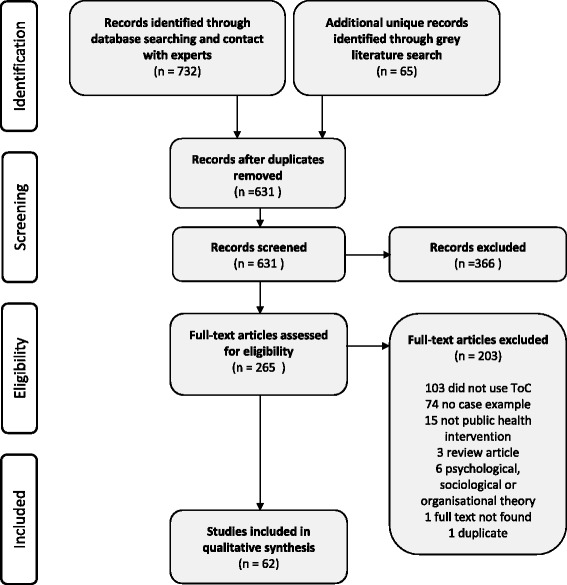
BACKGROUND: Despite the increasing popularity of the theory of change (ToC) approach, little is known about the extent to which ToC has been used in the design and evaluation of public health interventions. This review aims to determine how ToCs have been developed and used in the development and evaluation of public health interventions globally. METHODS: We searched for papers reporting the use of "theory of change" in the development or evaluation of public health interventions in databases of peer-reviewed journal articles such as Scopus, Pubmed, PsychInfo, grey literature databases, Google and websites of development funders. We included papers of any date, language or study design. Both abstracts and full text papers were double screened. Data were extracted and narratively and quantitatively summarised. RESULTS: A total of 62 papers were included in the review. Forty-nine (79 %) described the development of ToC, 18 (29 %) described the use of ToC in the development of the intervention and 49 (79 %) described the use of ToC in the evaluation of the intervention. Although a large number of papers were included in the review, their descriptions of the ToC development and use in intervention design and evaluation lacked detail. CONCLUSIONS: The use of the ToC approach is widespread in the public health literature. Clear reporting of the ToC process and outputs is important to strengthen the body of literature on practical application of ToC in order to develop our understanding of the benefits and advantages of using ToC. We also propose a checklist for reporting on the use of ToC to ensure transparent reporting and recommend that our checklist is used and refined by authors reporting the ToC approach.
Overview
CoChat Summary
TL;DR
This systematic review found that the theory of change (ToC) approach is widespread in public health literature, with 62 included papers, but descriptions of how ToCs were developed and used in intervention design and evaluation often lacked detail. The authors propose a checklist to improve transparent reporting of ToC processes and outputs.
Key findings
- Of 62 included papers, 49 (79%) described developing a ToC, 18 (29%) described using ToC in intervention development, and 49 (79%) described using ToC in evaluation.
- Among 44 papers where a ToC was displayed or described, long-term change was reported in 40 (90.9%), process/sequence of change in 33 (75%), context in 24 (54.5%), assumptions in 7 (15.9%), and indicators in 4 (9.1%).
- Few papers reported causal explanation elements: 4 (6.5%) identified breakdowns of programme theory, 3 (4.8%) identified unexpected consequences, 10 (16.1%) made cause-and-effect associations explicit, 2 (3.2%) described direction/strength of relationships, and 2 (3.2%) described mediation.
- Only 2 papers explicitly described using ToC to identify indicators for ongoing monitoring of implementation, and no studies used ToC alongside RCTs to unpack programme theory.
Methods
- Systematic review with a pre-agreed protocol; searched peer-reviewed databases (e.g., Scopus, PubMed, PsychInfo), grey literature databases, Google, funder websites, and evaluator mailing lists, with no limits by date, language, or study design.
- Included papers had to self-identify as using a ToC approach, specifically mention “theory of change,” and describe a public health intervention or ToC development; abstracts and full texts were double screened.
- Data were extracted by the first author onto a form covering ToC development, use in design/implementation/evaluation, context, and theory-driven evaluation principles; findings were summarised narratively and quantitatively using STATA 13, with no meta-analysis due to heterogeneity.
Limitations
- The paper states limitations including lack of double data extraction, inability to effectively measure the quality of included papers, and no agreed-upon quality criteria for ToC, compounded by the flexibility of the ToC approach.
- The paper also states it did not contact authors for additional information and did not assess quality of included papers.
- Evident from the text: most included papers provided little detail on ToC development and use, making it difficult to assess thoroughness; the review also notes that many papers did not define ToC and often overlapped with other approaches such as realist evaluation and logic models.
Model-written summary. Check it against the paper before relying on it.
Integrity signals
Registry
Cites
Statistics
Figures
Verification
Claims the paper makes
5 Valid · 1 Not valid · 36 Not checked · 65 Own results and interpretations
The sources with a verdict support this claim; the rest weren’t checked yet, have no full text we could read, or their verdicts aren’t rated yet.
In the paper
“Two papers reported that their evaluation was guided by testing the assumptions in the ToC [29, 34].”
§ Using theory of change to design and evaluate public health interventions: a systematic review > Results > Using ToCs to evaluate public health interventions
What the sources say
- Supportedcites [29] Bacchus LJ Bewley S Vitolas CT Aston G Jordan P Murray SF Evaluation of a domestic violence intervention in the maternity and sexual health services of a UK hospital Reprod Health Matters 2010 18 36 147 57 10.1016/S0968-8080(10)36526-8 21111359 source
The Methods section states the authors "chose a 'theory of change' approach" whose first stage is "articulating with stakeholders the assumptions made within the programme as to how they expect the intervention to change behaviour and outcomes", and lists the key programme assumptions whose findings are described. The Abstract reinforces this: an "assumption querying" approach was applied and "Programmatic assumptions were identified and tested" using interviews, record review and questionnaires; the Analysis subsection confirms themes "were examined in relation to the assumptions underpinning the intervention". So this paper is one of the evaluations guided by testing ToC assumptions. (LLM, conf=0.92)
- Not checked yetcites [34] Bhattacharjee P. Use of theory of change to guide the design and monitoring of an intervention intended to reduce partner violence and increase protected sex among sex workers. STRIVE Ann Meet. 2013.
plain- Asserted: passes — The authors put it forward as true.
- Checkable: passes — It can be checked against evidence.
- Load-bearing: unclear — It is unclear whether the paper’s conclusions depend on it.
- Based: passes — The paper gives a reason why it holds.
- Supported
The sources with a verdict support this claim; the rest weren’t checked yet, have no full text we could read, or their verdicts aren’t rated yet.
In the paper
“There were some exceptions [40, 56, 64, 72].”
§ Using theory of change to design and evaluate public health interventions: a systematic review > Results > Using ToCs to evaluate public health interventions
What the sources say
- Supportedcites [40] Chandani Y Noel M Pomeroy A Andersson S Pahl MK Williams T Factors affecting availability of essential medicines among community health workers in Ethiopia, Malawi, and Rwanda: solving the last mile puzzle Am J Trop Med Hyg 2012 87 5 120 6 10.4269/ajtmh.2012.11-0781 23136287 PMC3748512 source
The Methods section says the researchers developed country-specific theories of change to account for varying supply-chain contexts. The Discussion also says their framework accommodated country contexts and that the surveys were tailored to each country. This paper therefore supports its use as an example of research that explored context. Page numbers were not available in our copy. (LLM, conf=0.90)
- Not checked yetcites [56] Macfarlane F Greenhalgh T Humphrey C Hughes J Butler C Pawson R A new workforce in the making?: a case study of strategic human resource management in a whole-system change effort in healthcare J Health, Organ Manag 2011 25 1 55 72 10.1108/14777261111116824 21542462 source
- Not checked yetcites [64] Mookherji S LaFond A Strategies to maximize generalization from multiple case studies: lessons from the Africa Routine Immunization System Essentials (ARISE) project Evaluation 2013 19 3 284 303 10.1177/1356389013495212 source
plain- Asserted: passes — The authors put it forward as true.
- Checkable: passes — It can be checked against evidence.
- Load-bearing: unclear — It is unclear whether the paper’s conclusions depend on it.
- Based: passes — The paper gives a reason why it holds.
- Supported
The sources with a verdict support this claim; the rest weren’t checked yet, have no full text we could read, or their verdicts aren’t rated yet.
In the paper
“The quantitative data analysis methods were strongly linked to the types of data collected and included descriptive statistics [33], inferential statistics [27, 40, 42, 43, 74, 78], multilevel modelling [16] and path analysis [41].”
§ Using theory of change to design and evaluate public health interventions: a systematic review > Results > Using ToCs to evaluate public health interventions
What the sources say
- Not checked yetcites [33] Beeston C Robinson M Craig N Monitoring and evaluating Scotland’s alcohol strategy. Setting the scene: theory of change and baseline picture 2011 Edinburgh NHS Health Scotland
- Not checked yetcites [27] Andreas D Ja DY Wilson S Peers reach out supporting peers to embrace recovery (PROSPER): a center for substance abuse treatment recovery community services program Alcohol Treat Q 2010 28 3 326 38 10.1080/07347324.2010.488538 source
- Supportedcites [40] Chandani Y Noel M Pomeroy A Andersson S Pahl MK Williams T Factors affecting availability of essential medicines among community health workers in Ethiopia, Malawi, and Rwanda: solving the last mile puzzle Am J Trop Med Hyg 2012 87 5 120 6 10.4269/ajtmh.2012.11-0781 23136287 PMC3748512 source
The citation is attached to “descriptive statistics,” rather than to the citing authors’ broader characterization of how methods related to data types. In Materials and Methods, under “Analysis of survey results,” the source reports using frequencies and cross-tabulations to analyze its survey data. (LLM, conf=0.92)
boostedstates an association- Asserted: passes — The authors put it forward as true.
- Checkable: passes — It can be checked against evidence.
- Load-bearing: unclear — It is unclear whether the paper’s conclusions depend on it.
- Based: passes — The paper gives a reason why it holds.
A result the paper reports from its own data — it cites no other source for it, so there is none to check. The quote shows it is in the paper.
In the paper
“Secondly, piloting the initial broad search strategy (including all synonyms for ToC and programme logic) returned more than 20,000 hits in only three databases.”
§ Using theory of change to design and evaluate public health interventions: a systematic review > Methods > Inclusion and exclusion criteria
plain- Asserted: passes — The authors put it forward as true.
- Checkable: passes — It can be checked against evidence.
- Load-bearing: passes — The paper’s conclusions depend on it.
- Based: passes — The paper gives a reason why it holds.
A result the paper reports from its own data — it cites no other source for it, so there is none to check. The quote shows it is in the paper.
In the paper
“49 (79 %) described the use of ToC in the evaluation of the intervention.”
- Also stated in: § Included studies · plain
“Describes the use of ToC in the evaluation of the intervention | 49 (79.0 %)”
§ Using theory of change to design and evaluate public health interventions: a systematic review > Abstract > Results
plainn = 62- Asserted: passes — The authors put it forward as true.
- Checkable: passes — It can be checked against evidence.
- Load-bearing: unclear — It is unclear whether the paper’s conclusions depend on it.
- Based: passes — The paper gives a reason why it holds.
- Also stated in: § Included studies · plain
53 more claims
Create a free account to see all 107 claims and to verify the 67 references still open.
- It may state two separate claims as one. 27
- Probably not a substantial claim. 29
- The quote only partly states this claim. 1
Claims other papers make about this one
Each is checked against this paper’s own text: does it say what the citing paper says it does?
The source backs part of the claim, not all of it — or backs it for a different population, condition or comparison.
In the citing paper
“ToC frameworks offer distinct advantages for mental health integration by conceptualizing the interplay between clinical and community-level changes, fostering stakeholder ownership to enhance local relevance, and serving as implementation roadmaps that provide clarity on priorities, sequencing, and evaluation metrics [18, 19].”
From Co-creating systems change for mental health: a theory of change approach from the MeHPriC initiative in Lagos, Nigeria (2025) · cites this paper as [18]
Experimental — accuracy not yet measuredThe cited source says what the claim attributes to it.
In the citing paper
“Evaluations using ToCs are often criticised for not testing the causal logic of interventions fully (Breuer et al., 2016).”
From Promoting positive youth development with adolescent boys in UK schools: A theory-driven evaluation of the "Becoming a Man" programme (2026) · cites this paper as Breuer et al., 2016
Self-check
Percentages, sums and reported differences re-computed from the paper’s own numbers.
Each contradiction between two passages listed here was confirmed by an independent check.
Rated minor: it would not touch a result — a value no result rests on, a p-value that stays on the same side of the significance level, or a conflict that is clerical, resolved elsewhere in the paper, or outside its own findings.
In the paper
§ Using theory of change to design and evaluate public health interventions: a systematic review > Discussion
“Most authors present the long-term outcomes, sequence of change, beneficiaries and context.”
§ Using theory of change to design and evaluate public health interventions: a systematic review > Results > Development of ToCs
“| Beneficiaries | 20 (45.5 %) |”
Citations
Cites
Preferred Reporting Items for Systematic Reviews and Meta-Analyses: the PRISMA statement
Moher, D., Liberati, A., Tetzlaff, J., Altman, D. G., & for the PRISMA Group (2009) · BMJ · doi:10.1136/bmj.b2535 · Cited by 83,823
(1984) · Cited by 81,983
Preferred Reporting Items for Systematic Reviews and Meta-Analyses: The PRISMA Statement
Moher, D., Liberati, A., Tetzlaff, J., Altman, D. G., & The PRISMA Group (2009) · PLoS Medicine · doi:10.1371/journal.pmed.1000097 · Cited by 64,042 · cited 1×
“Figure 1 is adapted from the PRISMA guidelines [83] and summarises the search process and results.”
MethodPreferred reporting items for systematic reviews and meta-analyses: the PRISMA Statement.
(2009) · PubMed Central · Cited by 44,859
Preferred Reporting Items for Systematic Reviews and Meta-Analyses: The PRISMA Statement
Moher, D., Liberati, A., Tetzlaff, J., & Altman, D. G. (2009) · Journal of Clinical Epidemiology · doi:10.1016/j.jclinepi.2009.06.005 · Cited by 19,575
CONSORT 2010 Statement: updated guidelines for reporting parallel group randomised trials
the CONSORT Group, Schulz, K. F., Altman, D. G., & Moher, D. (2010) · BMC Medicine · doi:10.1186/1741-7015-8-18 · Cited by 13,371
Vandenbroucke, J. P., von Elm, E., Altman, D. G., Gøtzsche, P. C., Mulrow, C. D., Pocock, S. J., Poole, C., Schlesselman, J. J., Egger, M., & Initiative, F. T. S. (2007) · PLoS Medicine · doi:10.1371/journal.pmed.0040297 · Cited by 8,613 · cited 1×
“As ToC is method neutral, this checklist could also be used together with other existing checklists such as the CONSORT statement for RCTs [85], the STROBE guidelines for observational research [86] or CReDECI2 for complex intervention development and evaluation [87].”
MethodVandenbroucke, J. P., Elm, E. V., Altman, D. G., Gøtzsche, P. C., Mulrow, C. D., Pocock, S. J., Poole, C., Schlesselman, J. J., Egger, M., & initiative, F. T. S. (2007) · Annals of Internal Medicine · doi:10.7326/0003-4819-147-8-200710160-00010-w1 · Cited by 3,543
Criteria for evaluating evidence on public health interventions
Rychetnik, L., Frommer, M., Hawe, P., & Shiell, A. (2002) · Journal of Epidemiology and Community Health · doi:10.1136/jech.56.2.119 · Cited by 1,042 · cited 1×
“In summary, we included studies of public health interventions which were defined as interventions which are intended to protect health or prevent or treat ill health in communities or populations [21].”
MethodPurposeful Program Theory: Effective Use of Theories of Change and Logic Models
Funnell, S., & Rogers, P. (2011) · RMIT Research Repository (RMIT University Library) · Cited by 897
Research works printed but not linked: 10
- US Department of Health and Human Services, Centres for Disease Conrol and Prevention, Office of the Director, Office of Strategy and Innovation Introduction to program evaluation for public health programs: a self study guide 2011 Atlanta, GA Centres for Disease Control and Prevention
- Weiss C Connell JP Nothing as practical as good theory: exploring theory-based evaluation for comprehensive community initiatives for children and families New approaches to evaluating community initiatives: concepts, methods, and contexts 1995 Washington, DC Aspen Institute 65 92
- Andersen A A community builder’s approach to theory of change: a practical guide to theory development 2004 New York The Aspen Insitute
- James C. Theory of change review: a report comissioned by Comic Relief; 2011. http://mande.co.uk/2012/uncategorized/comic-relief-theory-of-change-review/.
- Statcorp STATA 2013 13 College Station Statcorp
- Andersen R Nesman T Hodges S Expressing your ideas: using a logic model to create system change USF logic model team, Tampa, Florida 2012 University of South Florida Tools for Creating and Sustaining Human Services: Theory of Change Logic Models
- Beeston C Robinson M Craig N Monitoring and evaluating Scotland’s alcohol strategy. Setting the scene: theory of change and baseline picture 2011 Edinburgh NHS Health Scotland
- Birkby BW The design and implementation of an evaluation for a comprehensive community-wide initiative on child maltreatment (Kentucky) 2001 Kentucky University, US ProQuest Information & Learning
- Goss-Power PJ Evaluation of a school-based program for youth with emotional and behavioral disabilities 2005 New England Graduate School, US ProQuest Information & Learning
- Henderson PM Program evaluation of a long-term substance abuse treatment program for homeless men 2004 US ProQuest Information & Learning
Cited by
Craig, P., Di Ruggiero, E., Frohlich, K. L., Mykhalovskiy, E., White, M., on behalf of the Canadian Institutes of Health Research (CIHR)–National Institute for Health Research (NIHR) Context Guidance Authors Group (listed alphabetically), Campbell, R., Cummins, S., Edwards, N., Hunt, K., et al. (2018) · doi:10.3310/cihr-nihr-01 · Cited by 370
“A recent review of the use of ToCs in public health evaluation found only a few studies in which contextual factors had been incorporated as possible explanations of variation in intervention delivery or outcomes.(61)”
O. B. O. T. C.-S. G., Grant, S., Mayo-Wilson, E., Montgomery, P., Macdonald, G., Michie, S., Hopewell, S., & Moher, D. (2018) · Trials · doi:10.1186/s13063-018-2735-z · Cited by 348
“For each intervention evaluated, authors should describe the 'mechanism of action' [51], also known as the 'theory of change' [52], 'programme theory' [53], or 'causal pathway' [54].”
MethodA small wins framework to overcome the evaluation paradox of governing wicked problems
Termeer, C. J. A. M., & Dewulf, A. (2019) · Policy and Society · doi:10.1080/14494035.2018.1497933 · Cited by 251
“The concept of policy perspective is related to the concept of programme-theory, defined as the underlying theory of change of a programme with the aim of guiding evaluation (Breuer et al., 2016; Donaldson, 2007; Rog, 2015).”
BackgroundZamboni, K., Baker, U., Tyagi, M., Schellenberg, J., Hill, Z., & Hanson, C. (2020) · Implementation Science · doi:10.1186/s13012-020-0978-z · Cited by 231
“2) in the form of a preliminary programme theory [21, 23].”
BackgroundFace-to-face interventions for informing or educating parents about early childhood vaccination
Kaufman, J., Ryan, R., Walsh, L., Horey, D., Leask, J., Robinson, P., & Hill, S. (2018) · Cochrane Database of Systematic Reviews · doi:10.1002/14651858.cd010038.pub3 · Cited by 206
Use of theory to plan or evaluate guideline implementation among physicians: a scoping review
Members of the Guidelines International Network Implementation Working Group, Liang, L., Bernhardsson, S., Vernooij, R. W. M., Armstrong, M. J., Bussières, A., Brouwers, M. C., & Gagliardi, A. R. (2017) · Implementation Science · doi:10.1186/s13012-017-0557-0 · Cited by 158
“systematic review of 62 studies that used theory to design or evaluate public health interventions, descriptions of theory development and use in intervention design and evaluation lacked detail [70].”
BackgroundPreconditions for successful advance care planning in nursing homes: A systematic review.
Gilissen, J., Pivodic, L., Smets, T., Gastmans, C., Vander Stichele, R., Deliens, L., & Van den Block, L. (2017) · International Journal of Nursing Studies · doi:10.1016/j.ijnurstu.2016.12.003 · Cited by 156
Minary, L., Trompette, J., Kivits, J., Cambon, L., Tarquinio, C., & Alla, F. (2019) · BMC Medical Research Methodology · doi:10.1186/s12874-019-0736-6 · Cited by 137
Morley, J., Murphy, L., Mishra, A., Joshi, I., & Karpathakis, K. (2022) · JMIR Formative Research · doi:10.2196/31623 · Cited by 139
“What is needed is a theory-led [41] recursive approach that does not separate technology and context but analyzes technologies in use to build theory (as opposed to testing).”
BackgroundAsher, L., Hanlon, C., Birhane, R., Habtamu, A., Eaton, J., Weiss, H. A., Patel, V., Fekadu, A., & De Silva, M. (2018) · BMC Psychiatry · doi:10.1186/s12888-018-1818-4 · Cited by 118
Self-citationTyler, N., Wright, N., & Waring, J. J. (2019) · BMC Health Services Research · doi:10.1186/s12913-019-4658-0 · Cited by 146
Mindfulness-Based Programs: Why, When, and How to Adapt?
Loucks, E. B., Crane, R. S., Sanghvi, M. A., Montero-Marin, J., Proulx, J., Brewer, J. A., & Kuyken, W. (2022) · Global Advances in Health and Medicine · doi:10.1177/21649561211068805 · Cited by 113
How to achieve the desired outcomes of advance care planning in nursing homes: a theory of change
Gilissen, J., Pivodic, L., Gastmans, C., Stichele, R. V., Deliëns, L., Breuer, E., & den Block, L. V. (2018) · BMC Geriatrics · doi:10.1186/s12877-018-0723-5 · Cited by 106
“As suggested in the Checklist for Reporting Theory of Change, we present i) impact, ii) ceiling of accountability, iii) long-term outcomes, iv) preconditions, v) interventions and vi) assumptions [44].”
MethodSelf-citationAllen, J., Wexler, L., & Rasmus, S. (2022) · Prevention Science · doi:10.1007/s11121-021-01265-0 · Cited by 93
Lin, C.-P., Evans, C. J., Koffman, J., Armes, J., Murtagh, F. E. M., & Harding, R. (2019) · Palliative Medicine · doi:10.1177/0269216318809582 · Cited by 77
Ebenso, B., Manzano, A., Uzochukwu, B. S. C., Etiaba, E., Huss, R., Ensor, T., Newell, J. N., Onwujekwe, O. E., Ezumah, N., Hicks, J. P., et al. (2018) · Evaluation and Program Planning · doi:10.1016/j.evalprogplan.2018.12.002 · Cited by 93
Maini, R., Mounier‐Jack, S., & Borghi, J. (2018) · BMJ Global Health · doi:10.1136/bmjgh-2017-000617 · Cited by 95
Chibanda, D. (2017) · Epidemiology and Psychiatric Sciences · doi:10.1017/s2045796016001128 · Cited by 71
“The ToC approach facilitates stake-holder participation, including communities through a collective iterative process, which enables explicit identification of causal pathways, and potential for linking indicators to the design of interventions (Hailemariam et al. 2015; Breuer et al. 2016).”
Kearney, C. A., Benoit, L., Gonzálvez, C., & Keppens, G. (2022) · Frontiers in Education · doi:10.3389/feduc.2022.1044608 · Cited by 71
“, grey/published literature, program/policy evaluation, stakeholder feedback), which makes the approach particularly amenable to the disparate area of school attendance/absenteeism (Breuer et al., 2015).”
BackgroundCrabbe, M., & Flood, M. (2021) · American Journal of Sexuality Education · doi:10.1080/15546128.2020.1856744 · Cited by 90
“Pornography education requires a detailed and well-informed understanding of the content area and a theory of how pornography education can create change (Breuer et al., 2015; Nation et al., 2003).”
BackgroundAbayneh, S., Lempp, H., Alem, A., Kohrt, B. A., Fekadu, A., & Hanlon, C. (2020) · International Journal of Mental Health Systems · doi:10.1186/s13033-020-00383-6 · Cited by 67
Rolfe, S. (2019) · Evaluation · doi:10.1177/1356389019835229 · Cited by 66
Soobiah, C., Cooper, M., Kishimoto, V., Bhatia, R. S., Scott, T., Maloney, S., Larsen, D., Wijeysundera, H. C., Zelmer, J., Gray, C. S., et al. (2020) · BMJ Open · doi:10.1136/bmjopen-2020-037643 · Cited by 72
Zinatsa, F., Engelbrecht, M., van Rensburg, A. J., & Kigozi, G. (2018) · BMC Health Services Research · doi:10.1186/s12913-018-3083-0 · Cited by 76
“Close engagement with theoretical frameworks promote intervention fidelity and effectiveness, by assisting researchers to identify mechanisms that influence intervention success, increasing understanding of the contextual factors that may drive actual implementation [32, 33].”
BackgroundHow to identify win–win interventions that benefit human health and conservation
Hopkins, S. R., Sokolow, S. H., Buck, J. C., Leo, G. A. D., Jones, I. J., Kwong, L. H., LeBoa, C., Lund, A. J., MacDonald, A. J., Nova, N., et al. (2020) · Nature Sustainability · doi:10.1038/s41893-020-00640-z · Cited by 75
Makleff, S., Garduño, J., Zavala, R. I., Barindelli, F., Valades, J., Billowitz, M., Márquez, V. I. S., & Marston, C. (2019) · Sexuality Research and Social Policy · doi:10.1007/s13178-019-00389-x · Cited by 77
Dulal, S., Prost, A., Karki, S., Saville, N. M., & Merom, D. (2021) · BMJ Global Health · doi:10.1136/bmjgh-2020-003872 · Cited by 72
Planning the scale up of brief psychological interventions using theory of change
Fuhr, D. C., Acartürk, C., Sijbrandij, M., Brown, F. L., Jordans, M. J. D., Woodward, A., McGrath, M., Sondorp, E., Ventevogel, P., Ikkursun, Z., et al. (2020) · BMC Health Services Research · doi:10.1186/s12913-020-05677-6 · Cited by 55
“ToC is a project planning tool which has increasingly been used in health research in recent years [38, 39].”
MethodText Message Interventions in Adolescent Mental Health and Addiction Services: Scoping Review
MacDougall, S., Jerrott, S., Clark, S., Campbell, L. A., Murphy, A., & Wozney, L. (2021) · JMIR Mental Health · doi:10.2196/16508 · Cited by 45
Stadnick, N. A., Cain, K. L., Oswald, W., Watson, P., Ibarra, M., Lagoc, R., Ayers, L. O., Salgin, L., Broyles, S. L., Laurent, L. C., et al. (2022) · Health Services Research · doi:10.1111/1475-6773.13910 · Cited by 47
Co-producing theory of change to operationalize integrated landscape approaches
Reed, J., Chervier, C., Borah, J. R., Gumbo, D., Moombe, K., Mbanga, T. M., O’Connor, A., Siangulube, F. S., Yanou, M. P., & Sunderland, T. (2022) · Sustainability Science · doi:10.1007/s11625-022-01190-3 · Cited by 66
Bonell, C. P., Warren, E. A., & Meléndez‐Torres, G. J. (2022) · Evaluation · doi:10.1177/13563890221086309 · Cited by 58
“In such studies, interventions are increasingly informed by theories of change but these are of variable sophistication and plausibility, often consisting of little more than strings of variables with no consideration of actual mechanisms or how these might interact with context to generate outcomes (Breuer et al., 20…”
BackgroundPEOPLE: International Journal of Social Sciences
Guntsadze, M. (2020) · PEOPLE International Journal of Social Sciences · doi:10.20319/pijss.2019.53.814821 · Cited by 43
Mengiste, S. A., Antypas, K., Johannessen, M. R., Klein, J., & Kazemi, G. (2023) · BMC Health Services Research · doi:10.1186/s12913-023-09325-7 · Cited by 69
Process evaluation of a district mental healthcare plan in Nepal: a mixed-methods case study
Luitel, N. P., Breuer, E., Adhikari, A., Kohrt, B. A., Lund, C., Komproe, I. H., & Jordans, M. J. D. (2020) · BJPsych Open · doi:10.1192/bjo.2020.60 · Cited by 41
Self-citationSocial enterprises’ impact on older people’s health and wellbeing: exploring Scottish experiences
Henderson, F., Steiner, A., Mazzei, M., & Docherty, C. (2019) · Health Promotion International · doi:10.1093/heapro/daz102 · Cited by 53
“Public health interventions are inherently complex (Rychetnik et al., 2002; Breuer et al., 2015) but can act upon the social determinants of health (Macaulay et al.”
BackgroundPineo, H., Glonti, K., Rutter, H., Zimmermann, N., Wilkinson, P., & Davies, M. (2019) · Journal of Urban Health · doi:10.1007/s11524-019-00378-w · Cited by 47
Sersli, S., DeVries, D. N., Gislason, M., Scott, N. A., & Winters, M. (2018) · Transportation Research Part A Policy and Practice · doi:10.1016/j.tra.2018.07.012 · Cited by 43
Kohrt, B. A., Pedersen, G. A., Schafer, A., Carswell, K., Rupp, F., Jordans, M. J. D., West, E., Akellot, J., Collins, P. Y., Contreras, C. C., et al. (2024) · The Lancet Psychiatry · doi:10.1016/s2215-0366(24)00183-4 · Cited by 59
Designing integrated interventions to improve nutrition and WASH behaviors in Kenya
Arriola, K. J., Ellis, A. S., Girard, A. W., Ogutu, E. A., McClintic, E. E., Caruso, B. A., & Freeman, M. C. (2020) · Pilot and Feasibility Studies · doi:10.1186/s40814-020-0555-x · Cited by 47
McIsaac, J. D., Warner, G., Lawrence, L. M., Urquhart, R., Price, S. L., Gahagan, J., McNally, M., & Jackson, L. A. (2018) · AIMS Public Health · doi:10.3934/publichealth.2018.1.13 · Cited by 40
“This is not to suggest that PHIR is atheoretical [6,7]; but rather the intent was to explore if recent theoretical developments in the field of IS might be of value to researchers and decision makers working within population health.”
Adedeji, T., Fraser, H., & Scott, P. (2022) · JMIR Medical Informatics · doi:10.2196/33491 · Cited by 35
“Certain authors have argued that theory-based evaluation such as the ToC is more a methodology than a theory because it uses different research methods (eg, randomized controlled trials, interviews, and workshops) for its development [30,44].”
BackgroundGirard, A. W., Waugh, E., Sawyer, S., Golding, L., & Ramakrishnan, U. (2019) · Maternal and Child Nutrition · doi:10.1111/mcn.12882 · Cited by 40
“Use of theory also enables comparison of interventions and aids intervention replication (Breuer, Lee, De Silva, & Lund, 2016; Mayne & Johnson, 2015).”
BackgroundRecommendations for Reporting on Rehabilitation Interventions
Whyte, J., Dijkers, M. P. J. M., Fasoli, S. E., Ferraro, M. K., Katz, L. W., Norton, S., Parent, É., Pinto, S. M., Sisto, S. A., Stan, J. H. V., et al. (2020) · American Journal of Physical Medicine & Rehabilitation · doi:10.1097/phm.0000000000001581 · Cited by 38
“Some also requested a report of the number of stakeholders, their demographics, what role they played, and what methods were used to elicit their feedback.(53,55) Stakeholder involvement generally intends to ensure that treatment is crafted around a need experienced by patients and that the treatment is likely to be a…”
MethodEdmunds, S. R., Frost, K. M., Sheldrick, R. C., Bravo, A., Straiton, D., Pickard, K. E., Grim, V., Drahota, A., Kuhn, J., Azad, G. F., et al. (2022) · Autism · doi:10.1177/13623613211064431 · Cited by 36
Ryan, C. G., Karran, E. L., Wallwork, S. B., Pate, J. W., O’Keeffe, M., Fullen, B. M., Livadas, N., Jones, N., Toumbourou, J. W., Gilchrist, P. N., et al. (2023) · Journal of Pain · doi:10.1016/j.jpain.2023.10.024 · Cited by 40
Gooding, K., Makwinja, R., Nyirenda, D., Vincent, R., & Sambakunsi, R. (2018) · Wellcome Open Research · doi:10.12688/wellcomeopenres.13790.1 · Cited by 39
Tougher, S., Dutt, V., Pereira, S. K., Haldar, K., Shukla, V., Singh, K., Kumar, P., Goodman, C. A., & Powell‐Jackson, T. (2017) · The Lancet Global Health · doi:10.1016/s2214-109x(17)30454-0 · Cited by 37
Global Alliance for the Promotion of Physical Activity: the Hamburg Declaration
Steinacker, J. M., van Mechelen, W., Bloch, W., Börjesson, M., Casasco, M., Wolfarth, B., Knoke, C., Papadopoulou, T., Wendt, J., Tunaiji, H. A., et al. (2023) · BMJ Open Sport & Exercise Medicine · doi:10.1136/bmjsem-2023-001626 · Cited by 43
Breuer, E., Subba, P., Luitel, N. P., Jordans, M. J. D., Silva, M. J. D., Marchal, B., & Lund, C. (2018) · BMJ Global Health · doi:10.1136/bmjgh-2018-001023 · Cited by 30
“Although the ToC provided us with a framework to develop the PRIME MHCPs, results from a recent systematic review found no papers that evaluated process and outcomes simultaneously.(18) Qualitative comparative analysis (QCA), a case-oriented method developed in the social sciences for analysis of data in comparative c…”
MethodSelf-citationBouaddi, O., Zbiri, S., & Belrhiti, Z. (2023) · BMJ Global Health · doi:10.1136/bmjgh-2023-011981 · Cited by 38
Daruwalla, N., Jaswal, S., Fernandes, P., Pinto, P., Hate, K., Ambavkar, G., Kakad, B., Gram, L., & Osrin, D. (2019) · Wellcome Open Research · doi:10.12688/wellcomeopenres.15128.1 · Cited by 43
HCI Contributions in Mental Health: A Modular Framework to Guide Psychosocial Intervention Design
Slovak, P., & Munson, S. A. (2024) · Proceedings of the CHI Conference on Human Factors in Computing Systems · doi:10.1145/3613904.3642624 · Cited by 34
“Role of theories of change in design: Theories of change have been used extensively to guide psychosocial intervention design and evaluation [18, 26, 32, 39].”
MethodKamvura, T. T., Turner, J., Chiriseri, E., Dambi, J. M., Verhey, R., & Chibanda, D. (2021) · BMC Health Services Research · doi:10.1186/s12913-021-06957-5 · Cited by 28
Poupaud, M., Putthana, V., Patriarchi, A., Caro, D., Agunos, A., Tansakul, N., & Goutard, F. L. (2021) · Acta Tropica · doi:10.1016/j.actatropica.2021.105943 · Cited by 40
Evaluation of cash transfer programs in sub-Saharan Africa: A methodological review
Owusu‐Addo, E., Renzaho, A. M. N., & Smith, B. J. (2018) · Evaluation and Program Planning · doi:10.1016/j.evalprogplan.2018.02.010 · Cited by 35
Lall, D., Engel, N., Srinivas, P. N., Devadasan, N., Horstman, K., & Criel, B. (2020) · BMJ Open · doi:10.1136/bmjopen-2020-040271 · Cited by 29
Cross, S. P. M., Nicholas, J., Mangelsdorf, S. N., Valentine, L., Baker, S. T. E., McGorry, P. D., Gleeson, J., & Álvarez‐Jiménez, M. (2023) · JMIR Formative Research · doi:10.2196/49846 · Cited by 28
“As a theory-driven evaluation technique, a ToC seeks to understand how and why a complex intervention works to guide evaluation and refinement [26].”
MethodHow Does the Gus Schumacher Nutrition Incentive Program Work? A Theory of Change
Leng, K. H., Yaroch, A. L., Nugent, N. B., STOTZ, S. A., & Krieger, J. W. (2022) · Nutrients · doi:10.3390/nu14102018 · Cited by 32
“The TOC development process followed best practices and included standard TOC elements (Table 2) [26,30].”
BackgroundMethodInfluentialCassetti, V., & Paredes-Carbonell, J. J. (2019) · Gaceta Sanitaria · doi:10.1016/j.gaceta.2019.06.002 · Cited by 86
Breuer, E., Silva, M. J. D., & Lund, C. (2018) · Cambridge Prisms Global Mental Health · doi:10.1017/gmh.2018.13 · Cited by 28
“ToC was initially developed by evaluators working in education and development sectors in the 1990s (Connell & Kubisch, 1998) and has been used for more than 20 years in public health research (Breuer et al. 2016b), mostly in high-income countries.”
BackgroundMethodSelf-citationTowards a systemic understanding of sustainable wellbeing for all in cities: A conceptual framework
Cash‐Gibson, L., Muntané, F., Martínez‐Herrera, E., Herrera, J. M., & Benach, J. (2022) · Cities · doi:10.1016/j.cities.2022.104143 · Cited by 29
Breuer, E., Comas‐Herrera, A., Freeman, E., Albanese, E., Alladi, S., Amour, R., Evans-Lacko, S. E., Ferri, C. P., Govia, I., Astudillo‐García, C. I., et al. (2021) · Dementia · doi:10.1177/14713012211029105 · Cited by 28
“Although ToC is increasingly being used to plan and evaluate health-related programmes, examples of how this can be done in practice to develop both a strategic direction for a specific area of health or social care, as well as a programme theory for a specific research project, are limited (Breuer et al., 2016).”
Self-citationHealth Intervention Evaluation Using Semantic Explainability and Causal Reasoning
Brenas, J. H., & Shaban-Nejad, A. (2020) · IEEE Access · doi:10.1109/access.2020.2964802 · Cited by 24
Dawson-Squibb, J.-J., & de Vries, P. J. (2019) · Journal of Autism and Developmental Disorders · doi:10.1007/s10803-019-04176-w · Cited by 31
An Approach to Providing Timely Mental Health Services to Diverse Youth Populations
Iyer, S. N., Boksa, P., Joober, R., Shah, J. L., Fuhrer, R., Andersson, N., Lal, S., D’Andrea, G., Morrison, N., Noel, V. A., et al. (2025) · JAMA Psychiatry · doi:10.1001/jamapsychiatry.2024.4880 · Cited by 39
Health and social outcomes in the Housing First model: Testing the theory of change
O'Campo, P. J., Stergiopoulos, V., Davis, O., Lachaud, J., Nisenbaum, R. A., Dunn, J. R., Ahmed, N., & Tsemberis, S. J. (2022) · EClinicalMedicine · doi:10.1016/j.eclinm.2022.101387 · Cited by 33
DuBow, W. M., & Litzler, E. (2018) · American Journal of Evaluation · doi:10.1177/1098214018778132 · Cited by 37
“rather than clarify the initiative (Breuer et al., 2016).”
Buck, E. D. J. D., Hannes, K., Cargo, M., Remoortel, H. V., Veegaete, A. V., Mosler, H., Govender, T., Vandekerckhove, P. G., & Young, T. (2017) · International Journal of Environmental Health Research · doi:10.1080/09603123.2017.1415306 · Cited by 27
“Of these, 29 % used a ToC to develop the intervention, while 79 % used the ToC in order to evaluate the intervention (Breuer et al. 2016).”
MethodInfluentialBernays, S., Lanyon, C., Tumwesige, E., Aswiime, A., Ngwenya, N. B., Nxumalo, V., Shahmanesh, M., & Seeley, J. (2021) · Global Public Health · doi:10.1080/17441692.2021.1953105 · Cited by 26
“We present our applied theory of change to demonstrate how the intervention seeks to e ff ectively foster protective factors in order to develop resilience in ‘ high-risk ’ settings, in ways that are locally pertinent (Breuer et al., 2016; De Silva et al., 2014; Fergus & Zimmerman, 2005).”
MethodPerry, A., Waterman, M. G., Dale, V., Moore, K., & House, A. O. (2021) · EClinicalMedicine · doi:10.1016/j.eclinm.2020.100702 · Cited by 26
“Little is known about the mechanisms underlying the impact of interventions on mental health and well-being in the prison environment [27-31].”
BackgroundMethodHui, Z., Cheng, K. M., Wijaya, L., & Zhang, S. (2024) · Higher Education Skills and Work-based Learning · doi:10.1108/heswbl-02-2024-0032 · Cited by 55
Guénin, M.-J., Studnitz, M., & Molia, S. (2023) · Preventive Veterinary Medicine · doi:10.1016/j.prevetmed.2023.106025 · Cited by 26
Romão, D. M. M., Setti, C., Arruda, L. H. M., de Melo, R. C., de Araújo, B. C., Tan, A. R., DeMaio, P., & Kuchenmüller, T. (2023) · PLoS ONE · doi:10.1371/journal.pone.0282808 · Cited by 26
Alonge, O., Chiumento, A., Hamoda, H. M., Gaber, E., Huma, Z., Abbasinejad, M., Hosny, W., Shakiba, A., Minhas, A., Saeed, K., et al. (2020) · Health Policy and Planning · doi:10.1093/heapol/czaa124 · Cited by 26
“Ensuring this breadth of consultation is critical for the ToC to fully capture hypothesized pathways for the large-scale implementation of the SMHP (Breuer et al., 2016); however, co-ordinating these consultations requires balancing trade-offs in arranging logistics.”
BackgroundStakeholder Engagement for Development Impact Evaluation and Evidence Synthesis
Oliver, S. R., Roche, C., Stewart, R. J., Bangpan, M., Dickson, K., Pells, K., Cartwright, N. D., Hargreaves, J., & Gough, D. (2018) · doi:10.51744/cip3 · Cited by 19
“, 2016) is captured by developing theories of change with stakeholders to design and evaluate public health interventions (Breuer et al., 2016), and developing logic models to frame systematic reviews of health or international development interventions (Kneale et al.”
BackgroundBooker, D., Petrou, G., Chatzidiakou, L., Das, D., Farooq, F., Ferguson, L., Jutila, O. I., Milczewska, K., Modlich, M., Moreno-Rangel, A., et al. (2025) · Building and Environment · doi:10.1016/j.buildenv.2025.112957 · Cited by 26
Creating space for theory when codesigning healthcare interventions
Harrison, R., Shé, É. N., Debono, D. S., Chauhan, A., & Newman, B. (2022) · Journal of Evaluation in Clinical Practice · doi:10.1111/jep.13720 · Cited by 17
de Nooijer, K., Pivodic, L., Noortgate, N. J. V. D., Pype, P. F., Evans, C., & den Block, L. V. (2021) · Palliative Medicine · doi:10.1177/02692163211040187 · Cited by 26
Using path analysis to test theory of change: a quantitative process evaluation of the MapSan trial
Bick, S., Buxton, H., Chase, R. P., Ross, I., Adriano, Z., Capone, D., Knee, J., Brown, J. M., Nalá, R., Cumming, O., et al. (2021) · BMC Public Health · doi:10.1186/s12889-021-11364-w · Cited by 17
“Each outcome in a ToC is measured by an indicator, and therefore the theory lends itself to testing using a range of analytic methods [9].”
BackgroundHamdani, S. U., Zill-e-Huma, Warraitch, A., Suleman, N., Muzzafar, N., Minhas, F. A., F.R.C.Psych, Nizami, A. T., F.C.P.S., Sikander, S., et al. (2020) · Psychiatric Services · doi:10.1176/appi.ps.202000005 · Cited by 19
Turner, A., Mulla, A., Booth, A., Aldridge, S., Stevens, S., Begum, M., & Malik, A. (2018) · Health Services and Delivery Research · doi:10.3310/hsdr06250 · Cited by 23
Juntos: A Support Program for Families Impacted by Congenital Zika Syndrome in Brazil
Duttine, A., Smythe, T., Calheiros de Sa, M. R., Ferrite, S., Moreira, M. E., & Kuper, H. (2020) · Global Health: Science and Practice · doi:10.9745/ghsp-d-20-00018 · Cited by 18
“The theory of change describes what changes are needed and the assumptions underlying the achievement of these changes.(18) Therefore, the theory of change linked outcomes with activities to explain how and why the desired change was expected to occur and was useful in providing a more comprehensive understanding of s…”
BackgroundLâm, S., Dodd, W., Wyngaarden, S., Skinner, K. A., Papadopoulos, A., & Harper, S. L. (2021) · Evaluation and Program Planning · doi:10.1016/j.evalprogplan.2021.102008 · Cited by 20
Turner, K., Jepson, R. G., MacDonald, B., Kelly, P., Biggs, H., & Baker, G. (2018) · Journal of Transport & Health · doi:10.1016/j.jth.2018.08.004 · Cited by 19
Baron, J., Sullivan, K., Swaine, J. M., Aspinall, A., Jaglal, S. B., Presseau, J., Wolfe, D. L., & Grimshaw, J. (2018) · Spinal Cord · doi:10.1038/s41393-018-0136-5 · Cited by 19
“Breuer and colleagues [47] propose a checklist to guide the comprehensive description of theories of change.”
South, J., Coan, S., Woodward, J., Bagnall, A., & Rippon, S. (2024) · SAGE Open · doi:10.1177/21582440241240836 · Cited by 60
“This supports wider arguments about its value as an approach in community-based evaluation (Breuer et al., 2015; Connell & Kubisch, 1988).”
Bamford, C., Wilcock, J., Brunskill, G., Wheatley, A., Dening, K. H., Manthorpe, J., Allan, L. M., Banerjee, S., Booi, L., Griffiths, S., et al. (2023) · PLoS ONE · doi:10.1371/journal.pone.0283818 · Cited by 18
Co‐design of dementia prevention program for Aboriginal Australians (DAMPAA)
Mateo‐Arriero, I., Lalović, A., Dowden, G., Markey, L., Cox, K. L., Flicker, L. A., Bessarab, D. C., Thompson, S., Kickett, C., Woods, D., et al. (2023) · Alzheimer s & Dementia · doi:10.1002/alz.13032 · Cited by 18
“31 This study addressed this deficit by com-prehensivelyreportingmethodsusedincreatingtheToCandDAMPAA protocol.”
BackgroundMethodInfluentialRad, D., & Rad, G. (2021) · Technium Social Sciences Journal · doi:10.47577/tssj.v21i1.3950 · Cited by 12
Norheim, O. F. (2018) · International Journal of Health Policy and Management · doi:10.15171/ijhpm.2018.60 · Cited by 33
Dohmen, P., Sanctis, T. D., Waiyaiya, E., Janssens, W., de Wit, T. R., Spieker, N., van der Graaf, M. H., & van Raaij, E. M. (2022) · Frontiers in Public Health · doi:10.3389/fpubh.2022.1040094 · Cited by 22
Guillaume, E., Rollet, Q., Launay, L., Beuriot, S., Dejardin, O., Notari, A., Crevel, E., Benhammouda, A., Verzaux, L., Quertier, M.-C., et al. (2022) · Trials · doi:10.1186/s13063-022-06480-w · Cited by 15
Roberton, T., & Sawadogo‐Lewis, T. (2022) · Global Health Action · doi:10.1080/16549716.2022.2067396 · Cited by 21
“Theories of change (ToC) are a common tool by which practitioners articulate how a project will achieve its impact [17].”
BackgroundAn inter-disciplinary perspective on evaluation of innovation to support care leavers’ transition
Lynch, A., Alderson, H., Kerridge, G., Johnson, R., McGovern, R., Newlands, F., Smart, D., Harrop, C., & Currie, G. (2021) · Journal of Children s Services · doi:10.1108/jcs-12-2020-0082 · Cited by 21
Moore, G., Michie, S., Anderson, J., Belesova, K., Crane, M. A., Deloly, C., Dimitroulopoulou, S., Gitau, H., Hale, J., Lloyd, S. J., et al. (2021) · Wellcome Open Research · doi:10.12688/wellcomeopenres.16542.2 · Cited by 22
Black, D., Ayres, S., Bondy, K., Brierley, R. C. M., Campbell, R. M., Carhart, N., Coggon, J., Eaton, E., Fichera, E., Gibson, A., et al. (2021) · Wellcome Open Research · doi:10.12688/wellcomeopenres.16382.1 · Cited by 28
Dolan, J. E., Lonsdale, H., Ahumada, L. M., Patel, A., Samuel, J., Jalali, A., Peck, J., DeRosa, J. C., Rehman, M., Varughese, A. M., et al. (2019) · Applied Clinical Informatics · doi:10.1055/s-0039-1693688 · Cited by 14
Bolton, N., Martin, S. J., Grace, C., & Harris, S. (2018) · International Journal of Sport Policy and Politics · doi:10.1080/19406940.2018.1476397 · Cited by 19
Williams, C. R., Bogdewic, S., Owen, M. D., Srofenyoh, E. K., & Ramaswamy, R. (2020) · Implementation Science · doi:10.1186/s13012-020-00992-2 · Cited by 10
“Developing a theory of change to guide program design is a key first step in public health planning and evaluation, but this language is not common in the implementation science literature [19].”
Background
Metadata
- Authors
- Breuer, E., Lee, L., De Silva, M., & Lund, C.
- Affiliations
- University of Cape Town (ZA)
- London School of Hygiene & Tropical Medicine (GB)
- Corresponding author
- Breuer, Erica
- Venue
- Implementation Science
- Published
- 2015-12
- Volume
- 11
- Issue
- 1
- Pages
- 63-63
- ISSN
- 1748-5908 (ISSN-L)
- PMC
- PMC4859947
- OpenAlex
- W2345472301
- Cited by
- 425
- References
- 73
- Citations by year
- 2026: 36 · 2025: 64 · 2024: 71 · 2023: 60 · 2022: 60 · 2021: 36 · 2020: 24 · 2019: 26 · 2018: 38 · 2017: 8 · 2016: 2
- FWCI
- 5.28
- Type
- journal article
- Language
- en
- Open access
- gold
- doi.org
- Licence
- cc-by
- Locations
- Implementation Science (publishedVersion, cc-by)
- PubMed Central (publishedVersion, cc-by)
- PubMed (publishedVersion)
- LSHTM Research Online (London School of Hygiene and Tropical Medicine) (acceptedVersion)
- Open University of Cape Town (University of Cape Town) (submittedVersion, cc-by)
- Open University of Cape Town (University of Cape Town) (submittedVersion)
- Funders
- Department for International Development (GB)
- London School of Hygiene and Tropical Medicine
- Grand Challenges Canada
- Department for International Development
- Topics
- Social Sciences › Public Administration › Evaluation and Performance Assessment
- Health Sciences › Health Professions › General Health Professions › Health Policy Implementation Science
- Social Sciences › Psychology › Applied Psychology › Behavioral Health and Interventions
- Keywords
- theory of change, public health interventions, intervention design, intervention evaluation, reporting checklist, reporting transparency, program theory
- MeSH terms
- Health Plan Implementation, Humans, Public Health, Research Design
About these checks
Registry, retraction, Cites and statistics results are computed, not judged, with one exception: a printed reference that no index lists is read once by a model before it counts as a citation error. Claims are extracted by a model and kept only when their quote appears verbatim in the text; each cited source is then checked, with a model’s help, for whether it says what the claim relies on. Those verdicts can be wrong — read the claim’s quote and the cited source before relying on one.
A language model drew the claims from the paper on 2026-10-04, under version 3 of the claim definition (model deepseek-v4.1-flash, prompt extract-v3).
A second model labelled each claim on 2026-10-04 (model jev-1.13-20260917, definition revision gold-guideline-v0.2).
Cited sources are checked with a language model’s help (qwen3.8-omni-flash and gpt-6-sol).
Statistics and arithmetic are recomputed, not judged.
Confidence bands are shown only for fields calibrated on our annotated test set. None is calibrated yet, so no band is shown.
What counts as a claim ›How we measure confidence ›How we check this ›
Are you an author, or do you see a problem with this page? Request a review
Data sources
Bibliographic data: Semantic Scholar, OpenAlex, Crossref.
Contains information from the Semantic Scholar Academic Graph Datasets, made available under the ODC Attribution License (ODC-BY 1.0).
Semantic Scholar’s data is described in: Kinney, R., et al. (2023). The Semantic Scholar Open Data Platform. arXiv:2301.10140.
