

Using theory of change to design and evaluate public health interventions: a systematic review
Open accessThe DOI matches its Crossref record; 71 of the 73 references it cites were found in a registry or an index; 5 of the 72 sources its claims cite were checked for support.
Abstract
BACKGROUND: Despite the increasing popularity of the theory of change (ToC) approach, little is known about the extent to which ToC has been used in the design and evaluation of public health interventions. This review aims to determine how ToCs have been developed and used in the development and evaluation of public health interventions globally. METHODS: We searched for papers reporting the use of "theory of change" in the development or evaluation of public health interventions in databases of peer-reviewed journal articles such as Scopus, Pubmed, PsychInfo, grey literature databases, Google and websites of development funders. We included papers of any date, language or study design. Both abstracts and full text papers were double screened. Data were extracted and narratively and quantitatively summarised. RESULTS: A total of 62 papers were included in the review. Forty-nine (79 %) described the development of ToC, 18 (29 %) described the use of ToC in the development of the intervention and 49 (79 %) described the use of ToC in the evaluation of the intervention. Although a large number of papers were included in the review, their descriptions of the ToC development and use in intervention design and evaluation lacked detail. CONCLUSIONS: The use of the ToC approach is widespread in the public health literature. Clear reporting of the ToC process and outputs is important to strengthen the body of literature on practical application of ToC in order to develop our understanding of the benefits and advantages of using ToC. We also propose a checklist for reporting on the use of ToC to ensure transparent reporting and recommend that our checklist is used and refined by authors reporting the ToC approach.
Overview
CoChat Summary
TL;DR
This systematic review found that the theory of change (ToC) approach is widespread in public health literature, with 62 included papers, but descriptions of how ToCs were developed and used in intervention design and evaluation often lacked detail. The authors propose a checklist to improve transparent reporting of ToC processes and outputs.
Key findings
- Of 62 included papers, 49 (79%) described developing a ToC, 18 (29%) described using ToC in intervention development, and 49 (79%) described using ToC in evaluation.
- Among 44 papers where a ToC was displayed or described, long-term change was reported in 40 (90.9%), process/sequence of change in 33 (75%), context in 24 (54.5%), assumptions in 7 (15.9%), and indicators in 4 (9.1%).
- Few papers reported causal explanation elements: 4 (6.5%) identified breakdowns of programme theory, 3 (4.8%) identified unexpected consequences, 10 (16.1%) made cause-and-effect associations explicit, 2 (3.2%) described direction/strength of relationships, and 2 (3.2%) described mediation.
- Only 2 papers explicitly described using ToC to identify indicators for ongoing monitoring of implementation, and no studies used ToC alongside RCTs to unpack programme theory.
Methods
- Systematic review with a pre-agreed protocol; searched peer-reviewed databases (e.g., Scopus, PubMed, PsychInfo), grey literature databases, Google, funder websites, and evaluator mailing lists, with no limits by date, language, or study design.
- Included papers had to self-identify as using a ToC approach, specifically mention “theory of change,” and describe a public health intervention or ToC development; abstracts and full texts were double screened.
- Data were extracted by the first author onto a form covering ToC development, use in design/implementation/evaluation, context, and theory-driven evaluation principles; findings were summarised narratively and quantitatively using STATA 13, with no meta-analysis due to heterogeneity.
Limitations
- The paper states limitations including lack of double data extraction, inability to effectively measure the quality of included papers, and no agreed-upon quality criteria for ToC, compounded by the flexibility of the ToC approach.
- The paper also states it did not contact authors for additional information and did not assess quality of included papers.
- Evident from the text: most included papers provided little detail on ToC development and use, making it difficult to assess thoroughness; the review also notes that many papers did not define ToC and often overlapped with other approaches such as realist evaluation and logic models.
Model-written summary. Check it against the paper before relying on it.
Integrity signals
Registry
Cites
Statistics
Figures
Verification
Claims the paper makes
5 Valid · 1 Not valid · 36 Not checked · 65 Own results and interpretations
The sources with a verdict support this claim; the rest weren’t checked yet, have no full text we could read, or their verdicts aren’t rated yet.
In the paper
“Two papers reported that their evaluation was guided by testing the assumptions in the ToC [29, 34].”
§ Using theory of change to design and evaluate public health interventions: a systematic review > Results > Using ToCs to evaluate public health interventions
What the sources say
- Supportedcites [29] Bacchus LJ Bewley S Vitolas CT Aston G Jordan P Murray SF Evaluation of a domestic violence intervention in the maternity and sexual health services of a UK hospital Reprod Health Matters 2010 18 36 147 57 10.1016/S0968-8080(10)36526-8 21111359 source
The Methods section states the authors "chose a 'theory of change' approach" whose first stage is "articulating with stakeholders the assumptions made within the programme as to how they expect the intervention to change behaviour and outcomes", and lists the key programme assumptions whose findings are described. The Abstract reinforces this: an "assumption querying" approach was applied and "Programmatic assumptions were identified and tested" using interviews, record review and questionnaires; the Analysis subsection confirms themes "were examined in relation to the assumptions underpinning the intervention". So this paper is one of the evaluations guided by testing ToC assumptions. (LLM, conf=0.92)
- Not checked yetcites [34] Bhattacharjee P. Use of theory of change to guide the design and monitoring of an intervention intended to reduce partner violence and increase protected sex among sex workers. STRIVE Ann Meet. 2013.
plain- Asserted: passes — The authors put it forward as true.
- Checkable: passes — It can be checked against evidence.
- Load-bearing: unclear — It is unclear whether the paper’s conclusions depend on it.
- Based: passes — The paper gives a reason why it holds.
- Supported
The sources with a verdict support this claim; the rest weren’t checked yet, have no full text we could read, or their verdicts aren’t rated yet.
In the paper
“There were some exceptions [40, 56, 64, 72].”
§ Using theory of change to design and evaluate public health interventions: a systematic review > Results > Using ToCs to evaluate public health interventions
What the sources say
- Supportedcites [40] Chandani Y Noel M Pomeroy A Andersson S Pahl MK Williams T Factors affecting availability of essential medicines among community health workers in Ethiopia, Malawi, and Rwanda: solving the last mile puzzle Am J Trop Med Hyg 2012 87 5 120 6 10.4269/ajtmh.2012.11-0781 23136287 PMC3748512 source
The Methods section says the researchers developed country-specific theories of change to account for varying supply-chain contexts. The Discussion also says their framework accommodated country contexts and that the surveys were tailored to each country. This paper therefore supports its use as an example of research that explored context. Page numbers were not available in our copy. (LLM, conf=0.90)
- Not checked yetcites [56] Macfarlane F Greenhalgh T Humphrey C Hughes J Butler C Pawson R A new workforce in the making?: a case study of strategic human resource management in a whole-system change effort in healthcare J Health, Organ Manag 2011 25 1 55 72 10.1108/14777261111116824 21542462 source
- Not checked yetcites [64] Mookherji S LaFond A Strategies to maximize generalization from multiple case studies: lessons from the Africa Routine Immunization System Essentials (ARISE) project Evaluation 2013 19 3 284 303 10.1177/1356389013495212 source
plain- Asserted: passes — The authors put it forward as true.
- Checkable: passes — It can be checked against evidence.
- Load-bearing: unclear — It is unclear whether the paper’s conclusions depend on it.
- Based: passes — The paper gives a reason why it holds.
- Supported
The sources with a verdict support this claim; the rest weren’t checked yet, have no full text we could read, or their verdicts aren’t rated yet.
In the paper
“The quantitative data analysis methods were strongly linked to the types of data collected and included descriptive statistics [33], inferential statistics [27, 40, 42, 43, 74, 78], multilevel modelling [16] and path analysis [41].”
§ Using theory of change to design and evaluate public health interventions: a systematic review > Results > Using ToCs to evaluate public health interventions
What the sources say
- Not checked yetcites [33] Beeston C Robinson M Craig N Monitoring and evaluating Scotland’s alcohol strategy. Setting the scene: theory of change and baseline picture 2011 Edinburgh NHS Health Scotland
- Not checked yetcites [27] Andreas D Ja DY Wilson S Peers reach out supporting peers to embrace recovery (PROSPER): a center for substance abuse treatment recovery community services program Alcohol Treat Q 2010 28 3 326 38 10.1080/07347324.2010.488538 source
- Supportedcites [40] Chandani Y Noel M Pomeroy A Andersson S Pahl MK Williams T Factors affecting availability of essential medicines among community health workers in Ethiopia, Malawi, and Rwanda: solving the last mile puzzle Am J Trop Med Hyg 2012 87 5 120 6 10.4269/ajtmh.2012.11-0781 23136287 PMC3748512 source
The citation is attached to “descriptive statistics,” rather than to the citing authors’ broader characterization of how methods related to data types. In Materials and Methods, under “Analysis of survey results,” the source reports using frequencies and cross-tabulations to analyze its survey data. (LLM, conf=0.92)
boostedstates an association- Asserted: passes — The authors put it forward as true.
- Checkable: passes — It can be checked against evidence.
- Load-bearing: unclear — It is unclear whether the paper’s conclusions depend on it.
- Based: passes — The paper gives a reason why it holds.
A result the paper reports from its own data — it cites no other source for it, so there is none to check. The quote shows it is in the paper.
In the paper
“Secondly, piloting the initial broad search strategy (including all synonyms for ToC and programme logic) returned more than 20,000 hits in only three databases.”
§ Using theory of change to design and evaluate public health interventions: a systematic review > Methods > Inclusion and exclusion criteria
plain- Asserted: passes — The authors put it forward as true.
- Checkable: passes — It can be checked against evidence.
- Load-bearing: passes — The paper’s conclusions depend on it.
- Based: passes — The paper gives a reason why it holds.
A result the paper reports from its own data — it cites no other source for it, so there is none to check. The quote shows it is in the paper.
In the paper
“49 (79 %) described the use of ToC in the evaluation of the intervention.”
- Also stated in: § Included studies · plain
“Describes the use of ToC in the evaluation of the intervention | 49 (79.0 %)”
§ Using theory of change to design and evaluate public health interventions: a systematic review > Abstract > Results
plainn = 62- Asserted: passes — The authors put it forward as true.
- Checkable: passes — It can be checked against evidence.
- Load-bearing: unclear — It is unclear whether the paper’s conclusions depend on it.
- Based: passes — The paper gives a reason why it holds.
- Also stated in: § Included studies · plain
53 more claims
Create a free account to see all 107 claims and to verify the 67 references still open.
- It may state two separate claims as one. 27
- Probably not a substantial claim. 29
- The quote only partly states this claim. 1
Claims other papers make about this one
Each is checked against this paper’s own text: does it say what the citing paper says it does?
The source backs part of the claim, not all of it — or backs it for a different population, condition or comparison.
In the citing paper
“ToC frameworks offer distinct advantages for mental health integration by conceptualizing the interplay between clinical and community-level changes, fostering stakeholder ownership to enhance local relevance, and serving as implementation roadmaps that provide clarity on priorities, sequencing, and evaluation metrics [18, 19].”
From Co-creating systems change for mental health: a theory of change approach from the MeHPriC initiative in Lagos, Nigeria (2025) · cites this paper as [18]
Experimental — accuracy not yet measuredThe cited source says what the claim attributes to it.
In the citing paper
“Evaluations using ToCs are often criticised for not testing the causal logic of interventions fully (Breuer et al., 2016).”
From Promoting positive youth development with adolescent boys in UK schools: A theory-driven evaluation of the "Becoming a Man" programme (2026) · cites this paper as Breuer et al., 2016
Self-check
Percentages, sums and reported differences re-computed from the paper’s own numbers.
Each contradiction between two passages listed here was confirmed by an independent check.
Rated minor: it would not touch a result — a value no result rests on, a p-value that stays on the same side of the significance level, or a conflict that is clerical, resolved elsewhere in the paper, or outside its own findings.
In the paper
§ Using theory of change to design and evaluate public health interventions: a systematic review > Discussion
“Most authors present the long-term outcomes, sequence of change, beneficiaries and context.”
§ Using theory of change to design and evaluate public health interventions: a systematic review > Results > Development of ToCs
“| Beneficiaries | 20 (45.5 %) |”
Citations
Cites
Preferred Reporting Items for Systematic Reviews and Meta-Analyses: the PRISMA statement
Moher, D., Liberati, A., Tetzlaff, J., Altman, D. G., & for the PRISMA Group (2009) · BMJ · doi:10.1136/bmj.b2535 · Cited by 83,823
(1984) · Cited by 81,983
Preferred Reporting Items for Systematic Reviews and Meta-Analyses: The PRISMA Statement
Moher, D., Liberati, A., Tetzlaff, J., Altman, D. G., & The PRISMA Group (2009) · PLoS Medicine · doi:10.1371/journal.pmed.1000097 · Cited by 64,042 · cited 1×
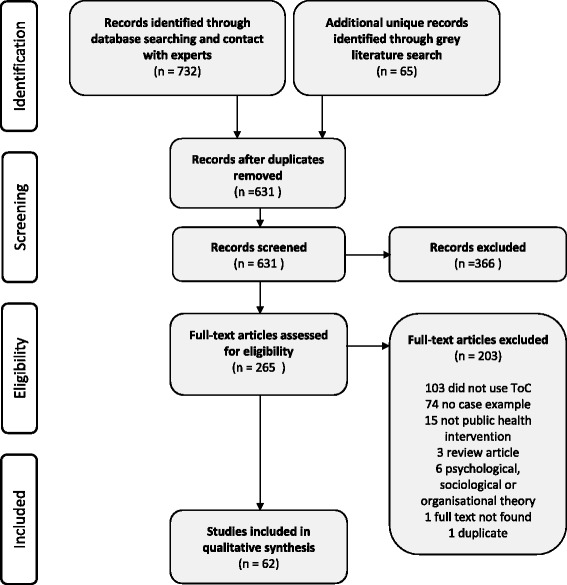
“Figure 1 is adapted from the PRISMA guidelines [83] and summarises the search process and results.”
MethodPreferred reporting items for systematic reviews and meta-analyses: the PRISMA Statement.
(2009) · PubMed Central · Cited by 44,859
Preferred Reporting Items for Systematic Reviews and Meta-Analyses: The PRISMA Statement
Moher, D., Liberati, A., Tetzlaff, J., & Altman, D. G. (2009) · Journal of Clinical Epidemiology · doi:10.1016/j.jclinepi.2009.06.005 · Cited by 19,575
CONSORT 2010 Statement: updated guidelines for reporting parallel group randomised trials
the CONSORT Group, Schulz, K. F., Altman, D. G., & Moher, D. (2010) · BMC Medicine · doi:10.1186/1741-7015-8-18 · Cited by 13,371
Vandenbroucke, J. P., von Elm, E., Altman, D. G., Gøtzsche, P. C., Mulrow, C. D., Pocock, S. J., Poole, C., Schlesselman, J. J., Egger, M., & Initiative, F. T. S. (2007) · PLoS Medicine · doi:10.1371/journal.pmed.0040297 · Cited by 8,613 · cited 1×
“As ToC is method neutral, this checklist could also be used together with other existing checklists such as the CONSORT statement for RCTs [85], the STROBE guidelines for observational research [86] or CReDECI2 for complex intervention development and evaluation [87].”
MethodVandenbroucke, J. P., Elm, E. V., Altman, D. G., Gøtzsche, P. C., Mulrow, C. D., Pocock, S. J., Poole, C., Schlesselman, J. J., Egger, M., & initiative, F. T. S. (2007) · Annals of Internal Medicine · doi:10.7326/0003-4819-147-8-200710160-00010-w1 · Cited by 3,543
Criteria for evaluating evidence on public health interventions
Rychetnik, L., Frommer, M., Hawe, P., & Shiell, A. (2002) · Journal of Epidemiology and Community Health · doi:10.1136/jech.56.2.119 · Cited by 1,042 · cited 1×
“In summary, we included studies of public health interventions which were defined as interventions which are intended to protect health or prevent or treat ill health in communities or populations [21].”
MethodPurposeful Program Theory: Effective Use of Theories of Change and Logic Models
Funnell, S., & Rogers, P. (2011) · RMIT Research Repository (RMIT University Library) · Cited by 897
De Silva, M. J., Breuer, E., Lee, L., Asher, L., Chowdhary, N., Lund, C., & Patel, V. (2014) · Trials · doi:10.1186/1745-6215-15-267 · Cited by 738 · cited 5×
“Logic models are conceptually similar to ToC but are usually presented in a linear form with boxes for inputs, activities, outputs and outcomes with little explanation of the causal pathways linking them [3].”
BackgroundMethodInfluentialSelf-citationExplaining Michigan: Developing an Ex Post Theory of a Quality Improvement Program
DIXON-WOODS, M., BOSK, C. L., AVELING, E. L., GOESCHEL, C. A., & PRONOVOST, P. J. (2011) · Milbank Quarterly · doi:10.1111/j.1468-0009.2011.00625.x · Cited by 603 · cited 4×
“Data collected for the evaluation included routinely collected data [33, 44], customdesigned surveys [13, 16, 32, 72, 76, 79] and qualitative data.”
BackgroundMethodInfluentialLund, C., Tomlinson, M., De Silva, M., Fekadu, A., Shidhaye, R., Jordans, M., Petersen, I., Bhana, A., Kigozi, F., Prince, M., et al. (2012) · PLoS Medicine · doi:10.1371/journal.pmed.1001359 · Cited by 584 · cited 4×
“used stakeholder workshops to develop their ToC and then used this to refine the substance and delivery of integrated district mental healthcare plans in five low- and middle-income countries [55].”
BackgroundMethodInfluentialSelf-citationA Systematic Review of Theory-Driven Evaluation Practice From 1990 to 2009
Coryn, C. L. S., Noakes, L. A., Westine, C. D., & Schröter, D. C. (2011) · American Journal of Evaluation · doi:10.1177/1098214010389321 · Cited by 531
Marchal, B., van Belle, S., van Olmen, J., Hoerée, T., & Kegels, G. (2012) · Evaluation · doi:10.1177/1356389012442444 · Cited by 476 · cited 3×
“Despite some fundamental differences in their theoretical underpinnings, many of these approaches are used interchangeably or together [18, 20].”
BackgroundInfluentialKubisch, J. P. C. A. A. C. (1998) · Cited by 461
Theories of Change and Realistic Evaluation: Peas in a Pod or Apples and Oranges?
Blamey, A., & Mackenzie, M. (2007) · Evaluation · doi:10.1177/1356389007082129 · Cited by 383
Möhler, R., Köpke, S., & Meyer, G. (2015) · Trials · doi:10.1186/s13063-015-0709-y · Cited by 317 · cited 1×
“As ToC is method neutral, this checklist could also be used together with other existing checklists such as the CONSORT statement for RCTs [85], the STROBE guidelines for observational research [86] or CReDECI2 for complex intervention development and evaluation [87].”
MethodReview of the use of ‘Theory of Change’ in international development
Vogel, I. (2012) · Cited by 285
Do health improvement programmes fit with MRC guidance on evaluating complex interventions?
Mackenzie, M., O'Donnell, C., Halliday, E., Sridharan, S., & Platt, S. (2010) · BMJ · doi:10.1136/bmj.c185 · Cited by 127 · cited 4×
“Inclusion criteria: • Describes or evaluates a public health intervention defined as any intervention which is intended to protect health or prevent or treat ill health in communities or populations [1] • Self-identifies as using a ToC approach and specifically mentions “theory of change” • Describes how a ToC was dev…”
BackgroundMethodInfluentialEvaluating complex and unfolding interventions in real time
Ling, T. (2012) · Evaluation · doi:10.1177/1356389011429629 · Cited by 110 · cited 1×
“Some researchers propose that understanding the public health intervention’s underlying theory of change (ToC) and its related uncertainties may improve the evaluation of complex health interventions [1–3].”
BackgroundPromoting Social Change: The Experience of Health Action Zones in England
BAULD, L., JUDGE, K., BARNES, M., BENZEVAL, M., MACKENZIE, M., & SULLIVAN, H. (2005) · Journal of Social Policy · doi:10.1017/s0047279405008858 · Cited by 106 · cited 5×
“(2005) [32] UK Health action zones: a multi-area study in 26 local health areas aiming to identify and address the public health needs of the local area, to increase effectiveness and efficiency of services and develop partnerships Improved health and reduced inequality.”
BackgroundMethodInfluentialWho Owns the Theory of Change?
Sullivan, H., & Stewart, M. (2006) · Evaluation · doi:10.1177/1356389006066971 · Cited by 94 · cited 2×
“Sullivan and Stewart [10] argue that although participation of all stakeholders in the development of ToC is the ideal presented by Weiss and colleagues [7], this is not always practical or feasible.”
BackgroundBreuer, E., De Silva, M. J., Fekadu, A., Luitel, N. P., Murhar, V., Nakku, J., Petersen, I., & Lund, C. (2014) · International Journal of Mental Health Systems · doi:10.1186/1752-4458-8-15 · Cited by 93 · cited 1×
“For example, some ToCs are developed through a series of workshops and meetings with a wide range of stakeholders including service users [11, 12] whereas others are developed by evaluators and funders using programme documentation [13, 14].”
BackgroundSelf-citationClarke, D. J., Godfrey, M., Hawkins, R., Sadler, E., Harding, G., Forster, A., McKevitt, C., Dickerson, J., & Farrin, A. (2013) · Implementation Science · doi:10.1186/1748-5908-8-96 · Cited by 88 · cited 1×
“The indicators were often developed from the short-, medium- or long-term outcomes described in the ToC [27, 35, 38, 58, 65, 74, 81, 84].”
BackgroundThe Practice and the Theory: Lessons from the Application of a Theories of Change Approach
Mackenzie, M., & Blamey, A. (2005) · Evaluation · doi:10.1177/1356389005055538 · Cited by 85
Visual data in applied qualitative research: lessons from experience
Mason, P. (2005) · Qualitative Research · doi:10.1177/1468794105054458 · Cited by 75 · cited 4×
“Mason (2005) [62] UK The Timely Tales: a community development and community arts project (part of a larger Health Action Zone Project) None described X X”
BackgroundMethodInfluentialChandani, Y., Noel, M., Pomeroy, A., Andersson, S., Pahl, M. K., & Williams, T. (2012) · The American Journal of Tropical Medicine and Hygiene · doi:10.4269/ajtmh.2012.11-0781 · Cited by 74 · cited 8×
“The quantitative data analysis methods were strongly linked to the types of data collected and included descriptive statistics [33], inferential statistics [27, 40, 42, 43, 74, 78], multilevel modelling [16] and path analysis [41].”
BackgroundMethodInfluentialTheories of change: what works in improving health in mid-life?
Secker, J., Bowers, H., Webb, D., & Llanes, M. (2004) · Health Education Research · doi:10.1093/her/cyg133 · Cited by 68 · cited 5×
“The ToCs were developed using workshops [28, 34, 47, 48, 55, 63, 64, 72, 76] and working groups [12, 53, 54, 61, 68, 69, 82], document reviews [16, 35, 44, 56, 67, 71], interviews and discussions [16, 27, 29, 35, 40, 44, 47, 56, 57, 62, 65, 66, 73, 80], surveys [31, 67], programme observation [16, 44, 45, 56, 67], lit…”
BackgroundMethodInfluentialBetween logframes and theory of change: reviewing debates and a practical experience
Prinsen, G., & Nijhof, S. (2015) · Development in Practice · doi:10.1080/09614524.2015.1003532 · Cited by 68 · cited 1×
“Similarly, although logframes were initially developed to summarise discussions with stakeholders, funder-driven formats have largely reduced logframes to a results-based management tool [17].”
BackgroundSchierhout, G., Hains, J., Si, D., Kennedy, C., Cox, R., Kwedza, R., O’Donoghue, L., Fittock, M., Brands, J., Lonergan, K., et al. (2013) · Implementation Science · doi:10.1186/1748-5908-8-119 · Cited by 67 · cited 4×
“Other methods included case study approaches [16, 33, 36, 64] and iterative thematic analysis [71] whereas others did not explicitly state their specific data analysis approach [14, 77].”
BackgroundMethodInfluentialPrevention System Mediation of Communities That Care Effects on Youth Outcomes
Brown, E. C., Hawkins, J. D., Rhew, I. C., Shapiro, V. B., Abbott, R. D., Oesterle, S., Arthur, M. W., Briney, J. S., & Catalano, R. F. (2014) · Prevention Science · doi:10.1007/s11121-013-0413-7 · Cited by 64 · cited 2×
“[37] reports using a ToC approach to evaluate a health promotion intervention for adolescents.”
BackgroundMethodMacfarlane, F., Greenhalgh, T., Humphrey, C., Hughes, J., Butler, C., & Pawson, R. (2011) · Journal of Health Organization and Management · doi:10.1108/14777261111116824 · Cited by 62 · cited 3×
“However, there were clear overlaps with other theory-driven evaluation approaches, in particular, realist approaches [32, 36, 38, 56] and logic models [12, 26, 31, 52, 54, 61, 65, 66, 68, 69, 76, 82].”
BackgroundMethodFamilies as full research partners: What's in it for us?
Stoep, A. V., Williams, M., Jones, R., Green, L., & Trupin, E. (1999) · The Journal of Behavioral Health Services & Research · doi:10.1007/bf02287277 · Cited by 61 · cited 3×
“Other methods included case study approaches [16, 33, 36, 64] and iterative thematic analysis [71] whereas others did not explicitly state their specific data analysis approach [14, 77].”
BackgroundMethodBacchus, L. J., Bewley, S., Vitolas, C. T., Aston, G., Jordan, P., & Murray, S. F. (2010) · Reproductive Health Matters · doi:10.1016/s0968-8080(10)36526-8 · Cited by 58 · cited 4×
“(2010) [29] UK Guidelines, staff training, inclusion of routine enquiry for domestic violence with all patients, and referral of women disclosing violence to an on-site advocacy service.”
BackgroundMethodInfluentialProtegiendo Nuestra Comunidad: Empowerment Participatory Education for HIV Prevention
McQuiston, C. M., Choi-Hevel, S., & Clawson, M. (2001) · Journal of Transcultural Nursing · doi:10.1177/104365960101200402 · Cited by 55 · cited 2×
“(2001) [63] USA A culture specific programme to empower lay health advisers to promote sexual health and reduce sexually transmitted diseases Promotion of sexual health and reduction of sexually transmitted diseases including HIV X X”
BackgroundMethodUsing a Theory of Change to Drive Human Resource Development for Wraparound
Walker, J. S., & Matarese, M. (2011) · Journal of Child and Family Studies · doi:10.1007/s10826-011-9532-6 · Cited by 54 · cited 3×
“The ToCs were developed using workshops [28, 34, 47, 48, 55, 63, 64, 72, 76] and working groups [12, 53, 54, 61, 68, 69, 82], document reviews [16, 35, 44, 56, 67, 71], interviews and discussions [16, 27, 29, 35, 40, 44, 47, 56, 57, 62, 65, 66, 73, 80], surveys [31, 67], programme observation [16, 44, 45, 56, 67], lit…”
BackgroundMethodKemp, L., Harris, E., McMahon, C., Matthey, S., Vimpani, G., Anderson, T., Schmied, V., & Aslam, H. (2013) · Journal of Advanced Nursing · doi:10.1111/jan.12052 · Cited by 53 · cited 1×
“(2013) [51] Australia An ante- and post-natal home visiting program X X Buer et al.”
BackgroundWeitzman, B. C., Silver, D., & Dillman, K.-N. (2002) · American Journal of Evaluation · doi:10.1177/109821400202300402 · Cited by 52 · cited 7×
“(2002) [13] Urban Health Initiative: a citywide multi-sector planning initiative Improved health and safety outcomes for children and youth”
BackgroundMethodInfluentialAndreas, D., Ja, D. Y., & Wilson, S. (2010) · Alcoholism Treatment Quarterly · doi:10.1080/07347324.2010.488538 · Cited by 43 · cited 7×
“The quantitative data analysis methods were strongly linked to the types of data collected and included descriptive statistics [33], inferential statistics [27, 40, 42, 43, 74, 78], multilevel modelling [16] and path analysis [41].”
BackgroundMethodInfluentialApplying a Theory of Change Approach to Interagency Planning in Child Mental Health
Hernandez, M., & Hodges, S. (2006) · American Journal of Community Psychology · doi:10.1007/s10464-006-9079-7 · Cited by 42 · cited 11×
“The majority of these reported that they used the ToC as a framework for the intervention [12, 31, 42, 43, 70] or as a basis for a strategic plan [61, 68, 69, 76, 82].”
BackgroundMethodInfluentialThe Aligning Forces for Quality initiative: background and evolution from 2005 to 2012.
Scanlon, D. P., Beich, J., Alexander, J. A., et al. (2012) · PubMed · Cited by 35
Reaching the Hard-to-Reach: Conceptual Puzzles and Challenges for Policy and Practice
Mackenzie, M., Reid, M., Turner, F., Wang, Y., Clarke, J., Sridharan, S., Platt, S. D., & O’Donnell, C. A. (2012) · Journal of Social Policy · doi:10.1017/s0047279412000074 · Cited by 35 · cited 2×
“(2012) [60] UK Keep Well: the programme to identify those at risk of ill health and offered health checks and preventative services within primary and secondary care Decreasing inequalities in cardiovascular morbidity and mortality in Scotland”
BackgroundMethodUsing theory-based evaluation to build evidence-based health and social care policy and practice
Bonner, L. (2003) · Critical Public Health · doi:10.1080/0958159031000100224 · Cited by 33 · cited 6×
“However, there were clear overlaps with other theory-driven evaluation approaches, in particular, realist approaches [32, 36, 38, 56] and logic models [12, 26, 31, 52, 54, 61, 65, 66, 68, 69, 76, 82].”
BackgroundMethodInfluentialReducing musculoskeletal burden through ergonomic program implementation in a large newspaper
Cole, D. C., Hogg‐Johnson, S., Manno, M., Ibrahim, S. A., Wells, R. P., & Ferrier, S. E. (2006) · International Archives of Occupational and Environmental Health · doi:10.1007/s00420-006-0107-6 · Cited by 33 · cited 2×
“(2006) [41] Canada Workplace economic program Reduction in pain intensity and disability X”
BackgroundMethodKreger, M., Sargent, K., Arons, A., Standish, M. B., & Brindis, C. D. (2011) · American Journal of Public Health · doi:10.2105/ajph.2011.300188 · Cited by 30 · cited 3×
“However, there were clear overlaps with other theory-driven evaluation approaches, in particular, realist approaches [32, 36, 38, 56] and logic models [12, 26, 31, 52, 54, 61, 65, 66, 68, 69, 76, 82].”
BackgroundBenefits of Increased Home-Visitation Services: Exploring a Case Management Model
de la Rosa, I. A., Perry, J., & Johnson, V. (2009) · Family & Community Health · doi:10.1097/01.fch.0000342817.95390.7e · Cited by 28
Weitzman, B. C., Mijanovich, T., Silver, D., & Brecher, C. (2009) · American Journal of Evaluation · doi:10.1177/1098214009347555 · Cited by 27 · cited 6×
“The indicators were often developed from the short-, medium- or long-term outcomes described in the ToC [27, 35, 38, 58, 65, 74, 81, 84].”
BackgroundMethodInfluentialMackenzie, M., Blamey, A., Halliday, E. C., Maxwell, M., McCollam, A., McDaid, D., MacLean, J., Woodhouse, A., & Platt, S. D. (2007) · BMC Public Health · doi:10.1186/1471-2458-7-146 · Cited by 27
The REACH 2010 logic model: an illustration of expected performance.
Tucker, P., Liao, Y., Giles, W. H., et al. (2006) · PubMed · Cited by 26
Evaluation of a community-level health policy intervention
Knesebeck, O. V. D., Joksimović, L., Badura, B., & Siegrist, J. (2002) · Health Policy · doi:10.1016/s0168-8510(01)00221-4 · Cited by 25 · cited 4×
“(2002) [79] Germany Systems interventions to improve local coordination of health and social care Improved health care, health monitoring and health promotion X”
BackgroundMethodInfluentialSuarez‐Balcazar, Y. (2005) · OTJR Occupational Therapy Journal of Research · doi:10.1177/153944920502500402 · Cited by 23 · cited 1×
“…approach to prevention of ill health Improved quality of life, reduced social exclusion and reduced need for acute hospital care for older people X X Suarez-Balcazar (2005) [74] USA A community intervention to assist community members in accessing health resources through the project’s home web…”
BackgroundThe Aligning Forces for Quality initiative: background and evolution from 2005 to 2015.
Scanlon, D. P., Beich, J., Leitzell, B., Shaw, B. W., Alexander, J. A., Christianson, J. B., Farley, D. C., Greene, J., Jean‐Jacques, M., McHugh, M., et al. (2016) · PubMed · Cited by 20
Dixon‐Woods, M., Tarrant, C., Willars, J., & Suokas, A. K. (2010) · BMJ Quality & Safety · doi:10.1136/qshc.2008.029504 · Cited by 19
Mookherji, S., & LaFond, A. (2013) · Evaluation · doi:10.1177/1356389013495212 · Cited by 18 · cited 10×
“Mookherji and LaFond used a case study approach to explore what worked within and between immunisation programme contexts to identify common factors influencing immunisation performance in Ghana, Ethiopia and Cameroon [64].”
BackgroundMethodInfluentialThe Implementation of Families First in the Netherlands: A One Year Follow-Up
Veerman, J. W., de Kemp, R. A. T., ten Brink, L. T., et al. (2003) · Child Psychiatry & Human Development · doi:10.1023/a:1021456630670 · Cited by 16
de la Rosa, I. A., Perry, J., Dalton, L. E., & Johnson, V. (2005) · Research on Social Work Practice · doi:10.1177/1049731505277004 · Cited by 16 · cited 4×
“The quantitative data analysis methods were strongly linked to the types of data collected and included descriptive statistics [33], inferential statistics [27, 40, 42, 43, 74, 78], multilevel modelling [16] and path analysis [41].”
BackgroundMethodInfluentialMackenzie, M. (2006) · Health and Social Care in the Community · doi:10.1111/j.1365-2524.2006.00640.x · Cited by 15 · cited 5×
“The ToCs were developed using workshops [28, 34, 47, 48, 55, 63, 64, 72, 76] and working groups [12, 53, 54, 61, 68, 69, 82], document reviews [16, 35, 44, 56, 67, 71], interviews and discussions [16, 27, 29, 35, 40, 44, 47, 56, 57, 62, 65, 66, 73, 80], surveys [31, 67], programme observation [16, 44, 45, 56, 67], lit…”
BackgroundMethodInfluentialGray, P. S., & Seddon, T. (2005) · Health Education · doi:10.1108/09654280510572312 · Cited by 14 · cited 5×
“Increased patient safety in hospitals X Goss-Power (2005) [46] USA VASE: a school for adolescents with emotional and behavioural disturbances Nil specific X Gray and Seddon (2005) [47] UK Two programmes aimed at children in “trouble” at school, truancy and risk of social exclusion.”
BackgroundMethodInfluentialSmith, N., & Barnes, M. (2012) · Health & Social Care in the Community · doi:10.1111/j.1365-2524.2012.01089.x · Cited by 10 · cited 1×
“…and preventive care X X Secker, Bowers et al. (2005) [72] UK Preretirement health advice and services for people aged 50–65 years Nil mentioned X X Smith and Barnes (2013) [73] UK A whole systems approach to prevention of ill health Improved quality of life, reduced social exclusion and reduced…”
BackgroundEmpowerment evaluation applied to public health practice
Carr, S. M., Lhussier, M., Wilkinson, J., & Gleadhill, S. (2008) · Critical Public Health · doi:10.1080/09581590701499327 · Cited by 10 · cited 4×
“However, there were clear overlaps with other theory-driven evaluation approaches, in particular, realist approaches [32, 36, 38, 56] and logic models [12, 26, 31, 52, 54, 61, 65, 66, 68, 69, 76, 82].”
BackgroundMethodInfluential[Plan to improve malaria control towards its elimination in Mesoamerica].
Rodriguez, M. H., & Betanzos-Reyes, Á. F. (2011) · PubMed · Cited by 9
Carroll, M., David, M., Jacobs, B., Judge, K., & Wilkes, B. (2005) · Social Policy and Society · doi:10.1017/s147474640500254x · Cited by 8 · cited 4×
“(2005) [39] UK Workplace wellness program Improved well-being of women clothing factory workers X X”
BackgroundMethodInfluentialWorkplace wellness for HIV/AIDS-affected nurses in South Africa
Basson, H. A., & Roets, L. (2013) · British Journal of Nursing · doi:10.12968/bjon.2013.22.1.38 · Cited by 8 · cited 5×
“However, there were clear overlaps with other theory-driven evaluation approaches, in particular, realist approaches [32, 36, 38, 56] and logic models [12, 26, 31, 52, 54, 61, 65, 66, 68, 69, 76, 82].”
BackgroundMethodInfluentialFrom complexity to reality: Providing useful frameworks for defining systems of care
Levison-Johnson, J., & Wenz-Gross, M. (2009) · Evaluation and Program Planning · doi:10.1016/j.evalprogplan.2009.05.005 · Cited by 8 · cited 6×
“However, there were clear overlaps with other theory-driven evaluation approaches, in particular, realist approaches [32, 36, 38, 56] and logic models [12, 26, 31, 52, 54, 61, 65, 66, 68, 69, 76, 82].”
BackgroundMethodInfluentialRivera, J. Á., Martorell, R., González, W., Lutter, C. K., de Cossío, T. G., Flores‐Ayala, R. C., Uauy, R. D., & Delgado, H. L. (2011) · Salud Pública de México · Cited by 7
Reid, M., & Botma, Y. (2012) · African Journal of AIDS Research · doi:10.2989/16085906.2012.698054 · Cited by 5
Evaluating a Comprehensive Community Initiative for Children, Youth, and Families
Barton, W. H., Powers, G., Morris, E., et al. (2001) · Cited by 5
Rivera, J. A., Martorell, R., González, W., Lutter, C. K., de Cossío, T. G., Ayala, R. F., Uauy, R. D., Delgado, H. L., & Grupo Técnico de Nutrición del, S. M. S. (2011) · LA Referencia (Red Federada de Repositorios Institucionales de Publicaciones Científicas) · Cited by 5
Riley, A. J., Byng, R., White, C., & Smith, S. (2008) · PubMed · Cited by 4
Corporate Giving Gets Smarter: ConAgra Foods Foundation Fights Childhood Hunger
Knowlton, L. W., & Phillips, C. (2012) · The Foundation Review · doi:10.4087/foundationreview-d-11-00034.1 · Cited by 3 · cited 5×
“Knowlton and Phillips (2012) [14] USA A five-arm strategic funding model to improve food security for children in the USA Improved US food security X X”
BackgroundMethodInfluential
Research works printed but not linked: 10
- US Department of Health and Human Services, Centres for Disease Conrol and Prevention, Office of the Director, Office of Strategy and Innovation Introduction to program evaluation for public health programs: a self study guide 2011 Atlanta, GA Centres for Disease Control and Prevention
- Weiss C Connell JP Nothing as practical as good theory: exploring theory-based evaluation for comprehensive community initiatives for children and families New approaches to evaluating community initiatives: concepts, methods, and contexts 1995 Washington, DC Aspen Institute 65 92
- Andersen A A community builder’s approach to theory of change: a practical guide to theory development 2004 New York The Aspen Insitute
- James C. Theory of change review: a report comissioned by Comic Relief; 2011. http://mande.co.uk/2012/uncategorized/comic-relief-theory-of-change-review/.
- Statcorp STATA 2013 13 College Station Statcorp
- Andersen R Nesman T Hodges S Expressing your ideas: using a logic model to create system change USF logic model team, Tampa, Florida 2012 University of South Florida Tools for Creating and Sustaining Human Services: Theory of Change Logic Models
- Beeston C Robinson M Craig N Monitoring and evaluating Scotland’s alcohol strategy. Setting the scene: theory of change and baseline picture 2011 Edinburgh NHS Health Scotland
- Birkby BW The design and implementation of an evaluation for a comprehensive community-wide initiative on child maltreatment (Kentucky) 2001 Kentucky University, US ProQuest Information & Learning
- Goss-Power PJ Evaluation of a school-based program for youth with emotional and behavioral disabilities 2005 New England Graduate School, US ProQuest Information & Learning
- Henderson PM Program evaluation of a long-term substance abuse treatment program for homeless men 2004 US ProQuest Information & Learning
Cited by
Craig, P., Di Ruggiero, E., Frohlich, K. L., Mykhalovskiy, E., White, M., on behalf of the Canadian Institutes of Health Research (CIHR)–National Institute for Health Research (NIHR) Context Guidance Authors Group (listed alphabetically), Campbell, R., Cummins, S., Edwards, N., Hunt, K., et al. (2018) · doi:10.3310/cihr-nihr-01 · Cited by 370
“A recent review of the use of ToCs in public health evaluation found only a few studies in which contextual factors had been incorporated as possible explanations of variation in intervention delivery or outcomes.(61)”
O. B. O. T. C.-S. G., Grant, S., Mayo-Wilson, E., Montgomery, P., Macdonald, G., Michie, S., Hopewell, S., & Moher, D. (2018) · Trials · doi:10.1186/s13063-018-2735-z · Cited by 348
“For each intervention evaluated, authors should describe the 'mechanism of action' [51], also known as the 'theory of change' [52], 'programme theory' [53], or 'causal pathway' [54].”
MethodA small wins framework to overcome the evaluation paradox of governing wicked problems
Termeer, C. J. A. M., & Dewulf, A. (2019) · Policy and Society · doi:10.1080/14494035.2018.1497933 · Cited by 251
“The concept of policy perspective is related to the concept of programme-theory, defined as the underlying theory of change of a programme with the aim of guiding evaluation (Breuer et al., 2016; Donaldson, 2007; Rog, 2015).”
BackgroundZamboni, K., Baker, U., Tyagi, M., Schellenberg, J., Hill, Z., & Hanson, C. (2020) · Implementation Science · doi:10.1186/s13012-020-0978-z · Cited by 231
“2) in the form of a preliminary programme theory [21, 23].”
BackgroundFace-to-face interventions for informing or educating parents about early childhood vaccination
Kaufman, J., Ryan, R., Walsh, L., Horey, D., Leask, J., Robinson, P., & Hill, S. (2018) · Cochrane Database of Systematic Reviews · doi:10.1002/14651858.cd010038.pub3 · Cited by 206
Metadata
- Authors
- Breuer, E., Lee, L., De Silva, M., & Lund, C.
- Affiliations
- University of Cape Town (ZA)
- London School of Hygiene & Tropical Medicine (GB)
- Corresponding author
- Breuer, Erica
- Venue
- Implementation Science
- Published
- 2015-12
- Volume
- 11
- Issue
- 1
- Pages
- 63-63
- ISSN
- 1748-5908 (ISSN-L)
- PMC
- PMC4859947
- OpenAlex
- W2345472301
- Cited by
- 425
- References
- 73
- Citations by year
- 2026: 36 · 2025: 64 · 2024: 71 · 2023: 60 · 2022: 60 · 2021: 36 · 2020: 24 · 2019: 26 · 2018: 38 · 2017: 8 · 2016: 2
- FWCI
- 5.28
- Type
- journal article
- Language
- en
- Open access
- gold
- doi.org
- Licence
- cc-by
- Locations
- Implementation Science (publishedVersion, cc-by)
- PubMed Central (publishedVersion, cc-by)
- PubMed (publishedVersion)
- LSHTM Research Online (London School of Hygiene and Tropical Medicine) (acceptedVersion)
- Open University of Cape Town (University of Cape Town) (submittedVersion, cc-by)
- Open University of Cape Town (University of Cape Town) (submittedVersion)
- Funders
- Department for International Development (GB)
- London School of Hygiene and Tropical Medicine
- Grand Challenges Canada
- Department for International Development
- Topics
- Social Sciences › Public Administration › Evaluation and Performance Assessment
- Health Sciences › Health Professions › General Health Professions › Health Policy Implementation Science
- Social Sciences › Psychology › Applied Psychology › Behavioral Health and Interventions
- Keywords
- theory of change, public health interventions, intervention design, intervention evaluation, reporting checklist, reporting transparency, program theory
- MeSH terms
- Health Plan Implementation, Humans, Public Health, Research Design
About these checks
Registry, retraction, Cites and statistics results are computed, not judged, with one exception: a printed reference that no index lists is read once by a model before it counts as a citation error. Claims are extracted by a model and kept only when their quote appears verbatim in the text; each cited source is then checked, with a model’s help, for whether it says what the claim relies on. Those verdicts can be wrong — read the claim’s quote and the cited source before relying on one.
A language model drew the claims from the paper on 2026-10-04, under version 3 of the claim definition (model deepseek-v4.1-flash, prompt extract-v3).
A second model labelled each claim on 2026-10-04 (model jev-1.13-20260917, definition revision gold-guideline-v0.2).
Cited sources are checked with a language model’s help (qwen3.8-omni-flash and gpt-6-sol).
Statistics and arithmetic are recomputed, not judged.
Confidence bands are shown only for fields calibrated on our annotated test set. None is calibrated yet, so no band is shown.
What counts as a claim ›How we measure confidence ›How we check this ›
Are you an author, or do you see a problem with this page? Request a review
Data sources
Bibliographic data: Semantic Scholar, OpenAlex, Crossref.
Contains information from the Semantic Scholar Academic Graph Datasets, made available under the ODC Attribution License (ODC-BY 1.0).
Semantic Scholar’s data is described in: Kinney, R., et al. (2023). The Semantic Scholar Open Data Platform. arXiv:2301.10140.
