

Conceptualizing outcomes for use with the Consolidated Framework for Implementation Research (CFIR): the CFIR Outcomes Addendum
Open accessThe DOI matches its Crossref record; 61 of the 61 references it cites were found in a registry or an index.
Abstract
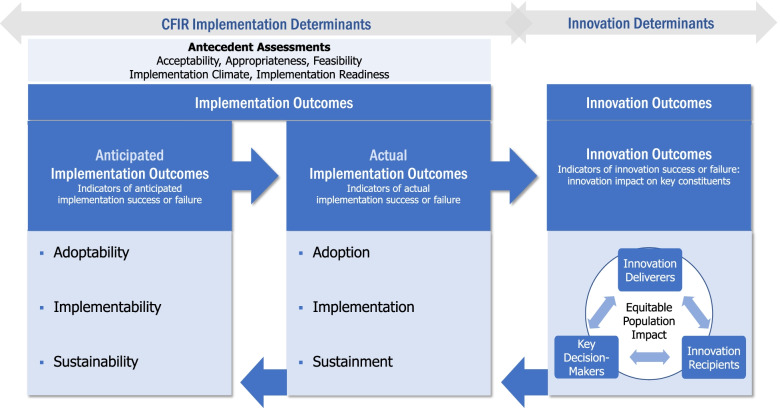
Background: The challenges of implementing evidence-based innovations (EBIs) are widely recognized among practitioners and researchers. Context, broadly defined as everything outside the EBI, includes the dynamic and diverse array of forces working for or against implementation efforts. The Consolidated Framework for Implementation Research (CFIR) is one of the most widely used frameworks to guide assessment of contextual determinants of implementation. The original 2009 article invited critique in recognition for the need for the framework to evolve. As implementation science has matured, gaps in the CFIR have been identified and updates are needed. Our team is developing the CFIR 2.0 based on a literature review and follow-up survey with authors. We propose an Outcomes Addendum to the CFIR to address recommendations from these sources to include outcomes in the framework. Main text: We conducted a literature review and surveyed corresponding authors of included articles to identify recommendations for the CFIR. There were recommendations to add both implementation and innovation outcomes from these sources. Based on these recommendations, we make conceptual distinctions between (1) anticipated implementation outcomes and actual implementation outcomes, (2) implementation outcomes and innovation outcomes, and (3) CFIR-based implementation determinants and innovation determinants. Conclusion: An Outcomes Addendum to the CFIR is proposed. Our goal is to offer clear conceptual distinctions between types of outcomes for use with the CFIR, and perhaps other determinant implementation frameworks as well. These distinctions can help bring clarity as researchers consider which outcomes are most appropriate to evaluate in their research. We hope that sharing this in advance will generate feedback and debate about the merits of our proposed addendum.
Overview
The claims and statistics of this paper haven’t been checked yet.
Free: it reads the open-access text and checks the first 5 claims that cite a source we can check. Create a free account to check every claim.
Integrity signals
Registry
Cites
Statistics
Figures
Verification
Claims the paper makes
The claims and statistics of this paper haven’t been checked yet.
Free: it reads the open-access text and checks the first 5 claims that cite a source we can check. Create a free account to check every claim.
Claims other papers make about this one
Each is checked against this paper’s own text: does it say what the citing paper says it does?
The cited source says what the claim attributes to it.
In the citing paper
“An updated Consolidated Framework for Implementation Research (CFIR) distinguished between anticipated (forward-looking) and actual (backward-looking) implementation outcomes [8].”
From Ten years of implementation outcomes research: a scoping review (2023) · cites this paper as [8]
The cited source says what the claim attributes to it.
In the citing paper
“we have reclassified these constructs to more appropriately position them as antecedent assessments [55], on the pathway between implementation determinants and outcomes in the CFIR Outcomes Addendum [19].”
From The updated consolidated framework for implementation research based on user feedback (2022) · cites this paper as [19]
The cited source says what the claim attributes to it.
In the citing paper
“several users suggested that the CFIR be expanded to include (1) implementation and innovation outcomes and (2) determinants to innovation outcomes collected from recipients [19].”
From The updated consolidated framework for implementation research based on user feedback (2022) · cites this paper as [19]
Self-check
Percentages, sums and reported differences re-computed from the paper’s own numbers.
The self-check needs the paper’s full text.
Citations
Cites
Damschroder, L. J., Aron, D. C., Keith, R. E., Kirsh, S. R., Alexander, J. A., & Lowery, J. C. (2009) · Implementation Science · doi:10.1186/1748-5908-4-50 · Cited by 14,496 · cited 2×
“The original 2009 article invited critique in recognition of the need for the framework to evolve [2].”
BackgroundSelf-citationValente, T. W. (2003) · Genetics in Medicine · doi:10.1097/01.gim.0000061743.67794.c4 · Cited by 13,723
Proctor, E., Silmere, H., Raghavan, R., Hovmand, P., Aarons, G., Bunger, A., Griffey, R., & Hensley, M. (2011) · Administration and Policy in Mental Health and Mental Health Services Research · doi:10.1007/s10488-010-0319-7 · Cited by 8,721 · cited 11×
“Proctor et al.’s Implementation Outcomes Framework (IOF) defines Adoption as “the intention, initial decision, or action to try or employ an innovation” [13].”
BackgroundMethodInfluentialThe Triple Aim: Care, Health, And Cost
Berwick, D. M., Nolan, T. W., & Whittington, J. (2008) · Health Affairs · doi:10.1377/hlthaff.27.3.759 · Cited by 5,136 · cited 1×
“Consideration of clinicians (and other employees) motivated evolution of the “Triple Aim” (enhancing patient experience, improving population health, and reducing costs) [35] to the “Quadruple Aim,” which added an aim of improving the work-life and well-being of clinicians and staff [36].”
BackgroundMaking sense of implementation theories, models and frameworks
Nilsen, P. (2015) · Implementation Science · doi:10.1186/s13012-015-0242-0 · Cited by 4,447 · cited 1×
“Theories that guide conceptualization of context abound and are often encapsulated within determinant frameworks [4, 5]; these frameworks delineate determinants (i.”
BackgroundCurran, G. M., Bauer, M., Mittman, B., Pyne, J. M., & Stetler, C. (2012) · Medical Care · doi:10.1097/mlr.0b013e3182408812 · Cited by 4,058 · cited 1×
“, clinical trialists versus implementation scientists) to translate innovations more quickly into practice [49].”
BackgroundFrom Triple to Quadruple Aim: Care of the Patient Requires Care of the Provider
Bodenheimer, T., & Sinsky, C. (2014) · The Annals of Family Medicine · doi:10.1370/afm.1713 · Cited by 3,462 · cited 1×
“Consideration of clinicians (and other employees) motivated evolution of the “Triple Aim” (enhancing patient experience, improving population health, and reducing costs) [35] to the “Quadruple Aim,” which added an aim of improving the work-life and well-being of clinicians and staff [36].”
BackgroundPsychometric assessment of three newly developed implementation outcome measures
Weiner, B. J., Lewis, C. C., Stanick, C., Powell, B. J., Dorsey, C. N., Clary, A. S., Boynton, M. H., & Halko, H. (2017) · Implementation Science · doi:10.1186/s13012-017-0635-3 · Cited by 2,819 · cited 1×
“developed measures for acceptability, appropriateness, and feasibility of an innovation and highlighted their role as potential predictors of adoption or implementation [27].”
BackgroundRE-AIM Planning and Evaluation Framework: Adapting to New Science and Practice With a 20-Year Review
Glasgow, R. E., Harden, S. M., Gaglio, B., Rabin, B., Smith, M. L., Porter, G. C., Ory, M. G., & Estabrooks, P. A. (2019) · Frontiers in Public Health · doi:10.3389/fpubh.2019.00064 · Cited by 2,528
The sociology of expectations in science and technology
Borup, M., Brown, N., Konrad, K., & Van Lente, H. (2006) · Technology Analysis & Strategic Management · doi:10.1080/09537320600777002 · Cited by 1,902 · cited 2×
“They give definition to role, clarify duties, offer some shape of what to expect and how to prepare for opportunities and risks” [17].”
Background
Research works printed but not linked: 1
- 46. Petit-McClure SH, Stinson C. Disrupting dis/abilization: a critical explora- tion of research methods to combat white supremacy and ableism in education. Intersect Cri Issues Educ. 2019;3:4.
Cited by
Items 501–600 of 941
Implementing psilocybin-assisted therapy in palliative care settings: A survey of stakeholders
Plourde, L., Chang, S.-L., Nguyen, O., Garel, N., Farzin, H., Stephan, J.-F., Fallu, J., & Dorval, M. (2026) · Palliative Medicine · doi:10.1177/02692163261446141 · Cited by 1
“Drawing on constructs from implementation science, 41 such as the updated Consolidated Framework for Implementation Research 42,43 and the Implementation Outcomes Framework, 44 this study was designed to assess acceptability and identify perceived barriers and key facilitators that could support…”
Lalani, M., Chu, I. Y., Pacho, A., Matuluko, A., Hussain, B., Anderson, C., Mays, N., & Glover, R. E. (2026) · International Journal of Health Policy and Management · doi:10.34172/ijhpm.9442 · Cited by 1
“The second framework, the Consolidated Framework for Implementation Research (CFIR) 13,14 provides a systematic exploration of the organisational factors that influence how the PF policy is enacted.”
Wong, K. L. Y., Hung, L., Wong, J., Adekoya, A., Wong, J. O. Y., Young, E., Acosta, C. G., & Vàsàrhelyi, K. (2026) · The Gerontologist · doi:10.1093/geront/gnag126 · Cited by 1
“CFIR was applied because it is a widely adopted framework in implementation science that provides guidance for identifying and analyzing contextual factors influencing the implementation of interventions (Damschroder et al., 2022).”
Hey, M.-L., Torroella, M. R., Mohan, D., Patel, S., Kansiime, W. K., Maiteki‐Sebuguzi, C., Shodhan, A., Yazdi, Y., Waiswa, P., & Acharya, S. (2026) · JMIR Public Health and Surveillance · doi:10.2196/99717 · Cited by 1
Triece, T., Awogboro, I., Basurto, S. G. A., Sisson, L. N., Martin, E. M., Sherman, S. G., Owczarzak, J., & Schneider, K. E. (2026) · Journal of Substance Use and Addiction Treatment · doi:10.1016/j.josat.2026.210056 · Cited by 1
True, G., Cusack, M. C., Cullen, S. W., Dichter, M. E., Blosnich, J. R., Brecht, T., & Montgomery, A. E. (2026) · Journal of General Internal Medicine · doi:10.1007/s11606-026-10612-2 · Cited by 1
Cardiac Nurses’ Self-Rated Confidence and Knowledge in Patient Education: A Mixed-Methods Study
Astrera-Sgro, M., Beauchamp, A., Do, C., Ross, E., Tate, G., Naismith, C., Driscoll, A. L., & Cartledge, S. H. (2026) · Heart Lung and Circulation · doi:10.1016/j.hlc.2026.04.120 · Cited by 1
Kierkegaard, P., Su, B., Moghul, M. R., Cahill, D., & James, N. D. (2026) · Implementation Science Communications · doi:10.1186/s43058-026-01041-7 · Cited by 1
Paull, S., Smith, S., Bill, J., Moullin, J. C., Harris, T., & Anderson, Y. C. (2026) · Health Expectations · doi:10.1111/hex.70754 · Cited by 2
Kierkegaard, P., Su, B., Gujral, D. M., Liesching-Schroder, K., Lagergren, P., McGregor, A. H., & Grayer, J. (2026) · npj Health Systems · doi:10.1038/s44401-026-00125-9 · Cited by 1
White, G. L., Kennedy, M. A., Chan, B. A., Wright, H., & Rose, G. L. (2026) · Asia-Pacific Journal of Clinical Oncology · doi:10.1111/ajco.70158 · Cited by 1
“However, the updated framework positions these as pre-implementation predictors shaped by multiple contextual determinants and referred to as antecedent assessments [ 17, 31 ].”
Quasdorf, T., Brenner, S., Kramer, I., Basinska, K., & Gutenberg, J. (2026) · BMJ Open · doi:10.1136/bmjopen-2026-123820 · Cited by 1
Warren, A. (2026) · Frontiers in Psychiatry · doi:10.3389/fpsyt.2026.1863015 · Cited by 1
“Implementation science frameworks such as CFIR offer a structured way to anticipate the work fl ow, training, and referral-capacity barriers that determine whether such integration succeeds in practice (76).”
Voluntary Knowledge Brokering to Promote Evidence‐Based Nursing Practice: A Qualitative Study
Akasaki, F., & Hosoda, Y. (2026) · Nursing and Health Sciences · doi:10.1111/nhs.70417 · Cited by 1
“In this field, CFIR 2.0 (Damschroder et al. 2022) helps explain what makes it difficult or easy to put new ideas into practice by focusing on “relational connections” and “communications” in organizations.”
InfluentialBarakat‐Johnson, M., Mak, C., Lai, M., Baharudin, P., Rosa, D. D., Heuer, K., Ko, N., Leong, T., Low-Clarke, V., Vaccari, A. R.-L., et al. (2026) · International Wound Journal · doi:10.1111/iwj.71016 · Cited by 1
Tuckey, N., Iasiello, M. P., Cantley, M. D., van Agteren, J. E., Beer, H., Fassnacht, D. B., Ramsey, I., Edney, L. C., Moussa, R., Grundy, L., et al. (2026) · Supportive Care in Cancer · doi:10.1007/s00520-026-11163-2 · Cited by 1
Chisale, P. K., & Kayeyi, N. (2026) · Texila international journal of academic research · doi:10.21522/tijar.2014.13.04.art031 · Cited by 1
Izudi, J., Bajunirwe, F., & Cattamanchi, A. (2024) · BMJ Public Health · doi:10.1136/bmjph-2024-001136 · Cited by 1
Tonkikh, O., Young, H. M., Bell, J. F., Famula, J., Whitney, R. L., Mongoven, J. M., & Kelly, K. (2024) · JMIR Aging · doi:10.2196/63355 · Cited by 1
Morris, H., Melder, A., Ng, E., Skouteris, H., Chong, W., & Yang, J. (2024) · Journal of Clinical and Translational Science · doi:10.1017/cts.2024.656 · Cited by 1
“The authors ’ knowledge of implementation informing this lens included frameworks such as the Consolidated Framework for Implementation Research [2,18], strategy lists such as Expert Recommendations for Implementing Change (ERIC) [13], competencies [19], drivers and timeframes [20].”
Implementierungsforschung im Gesundheitswesen
Wensing, M. (2024) · Springer eBooks · doi:10.1007/978-3-658-42863-1_24 · Cited by 1
Exner‐Cortens, D., Conde, C. F., Haines‐Saah, R., Lee, M., Pawluk, C., & Owens, J. S. (2025) · Global Implementation Research and Applications · doi:10.1007/s43477-024-00145-3 · Cited by 2
“Initial identification of meaning and patterns together with use of the CFIR led to the creation of 16 broad codes to organize and characterize the data (see Supplemental Material).”
InfluentialImplementing Active Offer of Services in Both Official Languages in a Hospital Setting in Ontario
Sauvé-Schenk, K., Savard, J., & Durand, F. (2024) · Healthcare policy · doi:10.12927/hcpol.2024.27485 · Cited by 1
Schemmer, J., Krafft, H. S., Maurer, T., Lange, S., Emgenbroich, A., Monks, S., Martin, D. D., & Schwarz, S. (2025) · PLoS ONE · doi:10.1371/journal.pone.0324012 · Cited by 1
“The process evaluation, based on the two frameworks RE-AIM [27,28] and Consolidated Framework for Implementation Research (CFIR) [29,30].”
Advancing digital equity: a qualitative case study using the Implementation Research Logic Model
Santilli, J., Leedahl, S. N., Juris, J. J., McGregor, C. M., & Liebermann, E. (2026) · Implementation Science Communications · doi:10.1186/s43058-026-00880-8 · Cited by 1
360 Thinking in Local Governance Advances Sustainability, Economic Prosperity, and Equity
Brown, L. D. (2023) · Oxford University Press eBooks · doi:10.1093/acrefore/9780190625979.013.831 · Cited by 1
Herranz, C., Gómez-López, A., Hernández, C., González, R., Contel, J. C., Cano, I., Piera-Jiménez, J., & Roca, J. (2023) · medRxiv · doi:10.1101/2023.08.03.23293537 · Cited by 1
“a pragmatic modification of the Consolidated Framework for Implementation Research (CFIR) approach (34).”
BackgroundMethodInfluentialOry, M. G., Nsobundu, C., & Nmadu, Y. W. (2023) · Oxford University Press eBooks · doi:10.1093/acrefore/9780190632366.013.375 · Cited by 1
Annerstedt, K. S., Kwak, L., Andermo, S., Patterson, E., Norman, Å., Raposo, S., Stattin, N. S., & Elinder, L. S. (2024) · Research Square · doi:10.21203/rs.3.rs-4274322/v1 · Cited by 1
Vos, K., van Essen, J. T., Ista, E., Staals, L. M., & Hinrichs, S. (2024) · medRxiv · doi:10.1101/2024.10.03.24314775 · Cited by 1
Zamantakis, A., Chandra, S., Donoso, V. A., Paton, M. J., Powers, A., Mustanski, B. S., & Benbow, N. (2025) · medRxiv · doi:10.1101/2025.01.02.25319901 · Cited by 1
Barkley, C., Nyakonda, C. N., Kuthyola, K., Lee, D., Kofi-Armah, D., Obeng, P., Dallos, A., Ndlovu, P., & Merrill, K. (2025) · doi:10.2196/preprints.77524 · Cited by 1
Strengthening Tuberculosis-Diabetes Mellitus Programme in Indonesia
author, & Saraswati, L. D. (2025) · Queensland University of Technology · doi:10.5204/thesis.eprints.259942 · Cited by 1
Matifary, C. R., Ngaruiya, C., & Kinuthia, J. (2025) · Research Square · doi:10.21203/rs.3.rs-7084096/v1 · Cited by 1
van der Laag, P. J., Dorhout, B. G., Zuithoff, N. P. A., Veenhof, C., Barten, D., & Schoonhoven, L. (2026) · Implementation Science Communications · doi:10.21203/rs.3.rs-8057231/v1 · Cited by 1
Tuckey, N., Iasiello, M. P., Cantley, M. D., van Agteren, J. E., Beer, H., Fassnacht, D. B., Ramsey, I., Edney, L. C., Moussa, R. S., Grundy, L., et al. (2025) · Research Square · doi:10.21203/rs.3.rs-8139630/v1 · Cited by 1
Senn, K. C. (2024) · EPub Bayreuth (University of Bayreuth) · doi:10.15495/epub_ubt_00007342 · Cited by 1
Optimising delivery of the Childsmile nursery supervised toothbrushing programme in Scotland
Eaves, J. (2023) · Enlighten: Theses (The University of Glasgow) · doi:10.5525/gla.thesis.83895 · Cited by 1
Jansson, A. (2023) · Mspace (University of Manitoba) · Cited by 1
Blaschke, S., Sterr, K., Heß, D., Lux, L., Brandmeier, A., & Mess, F. (2026) · medRxiv · doi:10.64898/2026.05.23.26353928 · Cited by 1
Implementation of rapid COVID-19 testing at Massachusetts trial courts
Ngassa, Y., Smyth, E., Pickard, B., Maner, M., Brinkley‐Rubinstein, L., & Wurcel, A. G. (2023) · Health & Justice · doi:10.1186/s40352-023-00220-1
“We selected adoptability and implementability as the primary implementation outcomes, drawn from the CFIR Outcomes Adendum (Damschroder et al., 2022; Proctor et al., Mar 2011).”
MethodCarrasco, M., Muñoz, B., Villablanca, V., Araya, I., Aranda, C., & Brown, J. (2023) · Global Implementation Research and Applications · doi:10.1007/s43477-023-00099-y
“Other outcome taxonomies describe six outcomes and chrono-logically categorize them between anticipated and present outcomes (Damschroder et al., 2022).”
Experts' Opinions on Aging and Public Health
Ory, M. G., & Smith, M. L. (2024) · Frontiers research topics · doi:10.3389/978-2-8325-4287-3
Noll, A., Chang, C. K., Bamporiki, J., Piscitello, G. M., & Rogal, S. S. (2024) · Current Hepatology Reports · doi:10.1007/s11901-024-00651-w
“1) [36].”
Knowledge Implementation and Dissemination
Stevens, B., Swift, A., & Harrison, D. M. (2024) · Wiley eBooks · doi:10.1002/9781119645641.ch16
O'Connor, S. R., Brown, D., Cleland, I., Wilson, V., & McCance, T. (2024) · medRxiv · doi:10.1101/2024.05.02.24306741
Kelan sydänkuntoutuksen ydinelementit asiakkaan näkökulmasta
Seppänen‐Järvelä, R. (2024) · Kuntoutus · doi:10.37451/kuntoutus.146319
Implementation Science to Promote Equity in Women’s Behavioral Health
Vroom, E. B., & Sharp, A. (2024) · Springer eBooks · doi:10.1007/978-3-031-58293-6_11
Practical Strategies for Nurse Leaders to De-Implement Low-Value Nursing Practices
Morris, A. (2024) · Journal of Nursing Care Quality · doi:10.1097/ncq.0000000000000796
Implementation of Rapid COVID-19 Testing in Criminal Justice Residential Reentry Sites
Ngassa, Y., Finn, J., Brinkley‐Rubinstein, L., & Wurcel, A. G. (2024) · Journal of Correctional Health Care · doi:10.1089/jchc.23.09.0077
“We selected two primary implementation outcomes: (1) adoption and (2) implementability (Damschroder et al., 2022; Proctor et al., 2011).”
Knepper, A. K., Zocchi, A., Haider, S., & Caskey, R. N. (2024) · Journal of Primary Care & Community Health · doi:10.1177/21501319241277421
Corcuff, M., Routhier, F., & Lamontagne, M. (2024) · medRxiv · doi:10.1101/2024.09.17.24313810
Implementation of interventions to enhance quality use of medicines
van Dijk, L., & Vervloet, M. (2024) · Wiley eBooks · doi:10.1002/9781119911685.ch51
Godbee, K., Palmer, V. J., Gunn, J. M., Lautenschlager, N. T., & Francis, J. (2024) · Australian Journal of Primary Health · doi:10.1071/py24063
Kuske, S., & Znotka, M. (2024) · Prävention und Gesundheitsförderung · doi:10.1007/s11553-024-01158-4
The Making of a Medical-Legal Partnership in a Level I Trauma Center: Recovery Legal Care
Zakrison, T. L., Pillai, R., Sen-Gupta, N., Chavez, J., Perez, E., Loughran, C., Green, I., Goggins, C., Custon, K., Cosey-Gay, F. N., et al. (2024) · Springer eBooks · doi:10.1007/978-3-031-66524-0_25
Jungbluth, N. J., Bolden, C. R., Schoenfelder, E. N., Metzger, I. W., & Blossom, J. B. (2024) · Cognitive and Behavioral Practice · doi:10.1016/j.cbpra.2024.10.003
The road towards implementation of biologic dose reduction in psoriasis care
van der Sloot, L. S. (2023) · Radboud University Press eBooks · doi:10.54195/9789493296220
Recherche sur ou recherche de la mise en œuvre ?
Ridde, V., & Dagenais, C. (2024) · Global Health Promotion · doi:10.1177/17579759241283746
“…comme celui du Consolidated Framework For Implementation Research (CFIR) qui dispose de cinq domaines (les caractéristiques de l'intervention, le contexte externe, le contexte interne, les caractéristiques des personnes impliquées et le processus de mise en œuvre) et de multiples dimensions (22).”
Dhaiban, M., Basaleem, H. O., & Purohit, N. (2024) · medRxiv · doi:10.1101/2024.12.30.24319744
Goodacre, D., Menzies, J. C., Ray, S., Ritchie, D., & Manning, J. C. (2025) · BMJ Paediatrics Open · doi:10.1136/bmjpo-2025-gosh.69
Boulton, A. P. R., Broughton, E., Sheth, S., O’Sullivan, J., Chigaru, L., & da Costa, C. S. (2025) · BMJ Paediatrics Open · doi:10.1136/bmjpo-2025-gosh.68
Williams, S., Keogh, S. J., HERD, D. W., Riggall, S., Glass, R., Slaughter, E., Jones, L. V., & Douglas, C. (2025) · Journal of Advanced Nursing · doi:10.1111/jan.16741
Ali, A., Pirie, K., Hughes, C., Jacob, B. M., Doyle, F., Brain, K. E., Bonniec, A. L., Cotter, S., Walsh, K. R., McCutchan, G. M., et al. (2025) · HRB Open Research · doi:10.12688/hrbopenres.13931.1
Shi, Z., Gainforth, H. L., Thomas, A., Bloom, G. A., & Sweet, S. N. (2025) · Disability and Rehabilitation · doi:10.1080/09638288.2025.2471569
Agarwal, A., Valente, J., Buenrostro, K., Macholl, K., Mehta, J., Reddy, K., Manayan, K., Parang, K., Sparks, A., Li, K., et al. (2025) · medRxiv · doi:10.1101/2025.03.31.25324723
Mhando, F., Conserve, D. F., & Marwa, N. W. (2025) · doi:10.2196/preprints.74165
Martinez, M. C., Bouskill, K., Yan, X. S., Kirkegaard, A., Doctor, J. N., & Watkins, K. E. (2025) · BMC Health Services Research · doi:10.1186/s12913-025-12651-7
Chalwe, M., Nshinka, N., & Mulenga, M. (2025) · Journal of Global Surgery (ONE) · doi:10.52648/jogs.1205
Arntz, A. R., Schulz, R. J., Conrad, G., & Grüneberg, C. (2025) · physioscience · doi:10.1055/s-0045-1808112
Ekelöf, K., Sæther, E., Andersson, O., Svedenkrans, J., & Lindén, K. (2025) · Sexual & Reproductive Healthcare · doi:10.1016/j.srhc.2025.101114
Butler, J. M., Childs, E., Barlam, T. F., Drainoni, M., Reardon, C. M., Zhang, Y., Damschroder, L. J., Taber, P. A., Madaras‐Kelly, K., Goetz, M. B., et al. (2025) · Antimicrobial Stewardship & Healthcare Epidemiology · doi:10.1017/ash.2025.65
“35 construct.”
Self-citationKartalova‐O’Doherty, Y., Cannon, M., Sheaf, G., Higgins, A., Keogh, B., Watters, S., Longe, O., Anand-Vembar, S., Staines, L., McEvoy, D., et al. (2025) · HRB Open Research · doi:10.12688/hrbopenres.14184.1
Pre-Implementation Assessment of a Sexual Health eClinic in Canadian Oncology Care
Incze, T., Peres, D., Guirguis, S., Neil‐Sztramko, S., Bender, J. L., Elterman, D., Alibhai, S. M. H., Finelli, A., Bach, P. V., Belita, E., et al. (2025) · Current Oncology · doi:10.3390/curroncol32070395
“CFIR 2.0 is regularly utilized in health care settings to support the identification of specific barriers and facilitators, allowing for the development of tailored strategies to optimize the adoption and sustainability of interventions [16].”
InfluentialImplementation of Evidence-Based Advocacy and Lobbying Toolkit
Magerer, D., Fitzpatrick, S. S., Bode, C., & WISE, B. V. (2025) · The Journal for Nurse Practitioners · doi:10.1016/j.nurpra.2025.105401
Corcuff, M., Routhier, F., & Lamontagne, M. (2025) · Cities · doi:10.1016/j.cities.2025.106238
Hawes, M. R., Chakravarty, D., Cheng, J., Handley, M. A., Tsoh, J. Y., Lin, T. K., Hiatt, R. A., & Vijayaraghavan, M. (2025) · PLoS ONE · doi:10.1371/journal.pone.0328786
Coulibaly, A., & Ridde, V. (2025) · Research Square · doi:10.21203/rs.3.rs-8454940/v1
Izudi, J., Bajunirwe, F., Cattamanchi, A., & West, N. (2025) · PLOS Global Public Health · doi:10.1371/journal.pgph.0004539
“The Consolidated Framework for Implementation Research (CFIR) [14,15] guided the data collection.”
Opening the Black Box: A Causal Pathway Methodology for Precise Implementation Strategy DesignPreprint
Pouzols, S., Raisaro, J. L., & Mabire, C. (2025) · Research Square · doi:10.21203/rs.3.rs-7396236/v1
Gyarmathy, S., Riguzzi, M., & Naef, R. (2025) · Palliative Care and Social Practice · doi:10.1177/26323524251369119
“37 Most PCPs rated the implementation of the BCG as highly acceptable (AIM) and appropriate (IAM) before it started, which is known to lead to better implementation, 25,38 but to a slightly lesser extent as feasible (FIM).”
Bedingar, E. K. N. (2025) · BMJ Open · doi:10.1136/bmjopen-2025-101146
“69 72 These next steps are planned Open access as part of a separate implementation research phase that builds directly on the results of the current study.”
Analysis of Arrester Usage as Over Voltage Protection at 150 kV Mantang Substation, Indonesia
Muhtari, H., Sultan, A. S., Pavković, I., Feng, X., Ali, S. A., Velikova, N., & Mohamed, Y. S. (2025) · Frontier Advances in Applied Science and Engineering · doi:10.59535/faase.v3i1.426
“When compared to previous studies, these results are in line with the findings of Damshroder et al. [12] who emphasized the importance of the distance of the arrester installation from critical equipment [13].”
TRIVEDI, R. B., Tran, N., Manja, V., Singh, N. K., Desai, S., Schapira, L., Gallagher-Thompson, D. E., Asch, S. M., & Lorenz, K. (2025) · Journal of Pain and Symptom Management · doi:10.1016/j.jpainsymman.2025.09.013
Santos, M. E. M., Ferreira, R. C., Pinheiro, E. L., Vieira, S. S. A., & Senna, M. I. B. (2025) · Epidemiologia e Serviços de Saúde · doi:10.1590/s2237-96222025v34e20240802.en
Ponstein, K., Erkens, P. M. G., van Breukelen, G., Hamers, J. P. H., & Bleijlevens, M. H. C. (2025) · BMC Geriatrics · doi:10.1186/s12877-025-06508-1
Schøler, P. N., Nilsén, P., Rasmussen, S., Søndergaard, J., & Nielsen, A. S. (2025) · Addiction Science & Clinical Practice · doi:10.1186/s13722-025-00613-7
“Our analyses were guided by The Consolidated Framework for Implementation Science (CFIR) [17, 47] and The Framework for Reporting Adaptations and Modifications to Evidence-based interventions (FRAME) [18, 20].”
Ibrahim, A. M., Mohamed, L. M., Khanna, A., Fuje, M. M. A., Jimale, L. H., Dewelbait, R. M., & Omer, M. A. (2025) · medRxiv · doi:10.1101/2025.10.27.25338921
“The Consolidated Framework for Implementation Research (CFIR) 2.0 was used as the guiding framework to evaluate and improve visceral leishmaniasis (VL) service delivery in Somalia [38– 40].”
InfluentialBevens, W., Stoeckl, S. E., Eikey, E. V., Schneider, M. L., Stadnick, N. A., Zheng, K., Mukamel, D. B., Sorkin, D. H., & Schueller, S. M. (2026) · Implementation Science Communications · doi:10.1186/s43058-026-01053-3
“The evaluation team used the CFIR Interview Guide Creator to develop the initial semi-structured interview guide, selecting constructs relevant to the implementation phase across CFIR domains and adapting questions to the project context [17, 18].”
Non-pharmacological symptom self-management in non-malignant chronic disease: A scoping review
Farrant, L., Buchanan, H., Ellis-Smith, C. I., Gaunt, O., Gwyther, L., Harding, R., Krause, R., Moors, A., Naidoo, N., Ngcowa, S., et al. (2025) · African Journal of Primary Health Care & Family Medicine · doi:10.4102/phcfm.v17i1.5095
“26,27”
Optimising adherence to inpatient rehabilitation trial protocols: A mixed-methods systematic review
Logan, A., Marsden, J. F., Freeman, J. A., Cork, E., & Kent, B. (2025) · Clinical Trials · doi:10.1177/17407745251358262
Nurturing Sustainable Organizations: Psychological Foundations of Modern ManagementPreprint
Westover, J. (2025) · Preprints.org · doi:10.20944/preprints202511.0615.v1
Kamarajah, S. K., Dhesi, J. K., Khunti, K., Nirantharakumar, K., Cockwell, P., Hughes, C., Stern, P., Yeung, J., Morton, D. G., Bhangu, A. A., et al. (2025) · British journal of surgery · doi:10.1093/bjs/znaf246
“Responses were systemically reviewed, with emergent themes grouped inductively and deductively, guided by the updated CFIR 2.0 framework, including ‘intervention characteristics’, ‘inner and outer setting’, ‘individuals’, and ‘implementation processes’.”
InfluentialAdapting Intervention Mapping to Improve Patient-Centeredness of Mental Health Services
Domlyn, A. M., Dedert, E. A., & Wilson, S. M. (2025) · Prevention Science · doi:10.1007/s11121-025-01850-7
“Anticipated implementation outcomes refer to the expected likelihood that an innovation will be successfully implemented based on internal knowledge (Damschroder et al., 2022).”
Suitt, K. G., Verges, A. J., Huidobro, R. P., & Vargas, B. D. (2025) · JMIR Research Protocols · doi:10.2196/75628
“The research team systematically documents insights by recording meeting notes, gathering practitioner feedback, and identifying barriers, misinformation, and implementation challenges that inform future research and practices [54].”
Gubser, I., Bauer, G. F., & Bagehorn, J. (2025) · Research Square · doi:10.21203/rs.3.rs-7805102/v1
Matifary, C. R., Kinuthiia, J., & Ngaruiya, C. (2025) · Research Square · doi:10.21203/rs.3.rs-8092586/v1
Metadata
- Authors
- Damschroder, L. J., Reardon, C. M., Opra Widerquist, M. A., & Lowery, J.
- Affiliations
- VA Ann Arbor Healthcare System (US)
- Corresponding author
- Damschroder, Laura J.
- Venue
- Implementation Science
- Published
- 2022-01-22
- Volume
- 17
- Issue
- 1
- Pages
- 7-7
- ISSN
- 1748-5908 (ISSN-L)
- PMC
- PMC8783408
- OpenAlex
- W4206949803
- Semantic Scholar
- 08521891e3bcd553697352db930b1de39027da07
- Cited by
- 784
- References
- 61
- Citations by year
- 2026: 227 · 2025: 177 · 2024: 218 · 2023: 117 · 2022: 45
- FWCI
- 27.08
- Type
- journal article
- Language
- en
- Open access
- gold
- doi.org
- Licence
- cc-by
- creativecommons.org/licenses/by/4.0 (tdm)
- creativecommons.org/licenses/by/4.0 (vor)
- Locations
- Implementation Science (publishedVersion, cc-by)
- PubMed Central (publishedVersion, cc-by)
- PubMed (publishedVersion)
- DOAJ (DOAJ: Directory of Open Access Journals) (submittedVersion, cc-by-sa)
- Funders
- Quality Enhancement Research Initiative (QUE 15-286)
- Health Services Research and Development (LIP 20-116)
- Topics
- Health Sciences › Health Professions › General Health Professions › Health Policy Implementation Science
- Health Sciences › Health Professions › General Health Professions › Health Sciences Research and Education
- Health Sciences › Medicine › Public Health, Environmental and Occupational Health › Clinical practice guidelines implementation
- Keywords
- Consolidated Framework for Implementation Research, implementation outcomes, innovation outcomes, implementation factors, innovation determinants, evidence-based innovation, implementation context, framework evolution
- MeSH terms
- Implementation Science, Humans, Motivation
About these checks
Registry, retraction, Cites and statistics results are computed, not judged, with one exception: a printed reference that no index lists is read once by a model before it counts as a citation error. Claims are extracted by a model and kept only when their quote appears verbatim in the text; each cited source is then checked, with a model’s help, for whether it says what the claim relies on. Those verdicts can be wrong — read the claim’s quote and the cited source before relying on one.
Statistics and arithmetic are recomputed, not judged.
Confidence bands are shown only for fields calibrated on our annotated test set. None is calibrated yet, so no band is shown.
What counts as a claim ›How we measure confidence ›How we check this ›
Are you an author, or do you see a problem with this page? Request a review
Data sources
Bibliographic data: Semantic Scholar, OpenAlex, Crossref.
Contains information from the Semantic Scholar Academic Graph Datasets, made available under the ODC Attribution License (ODC-BY 1.0).
Semantic Scholar’s data is described in: Kinney, R., et al. (2023). The Semantic Scholar Open Data Platform. arXiv:2301.10140.
