

Conceptualizing outcomes for use with the Consolidated Framework for Implementation Research (CFIR): the CFIR Outcomes Addendum
Open accessThe DOI matches its Crossref record; 61 of the 61 references it cites were found in a registry or an index.
Abstract
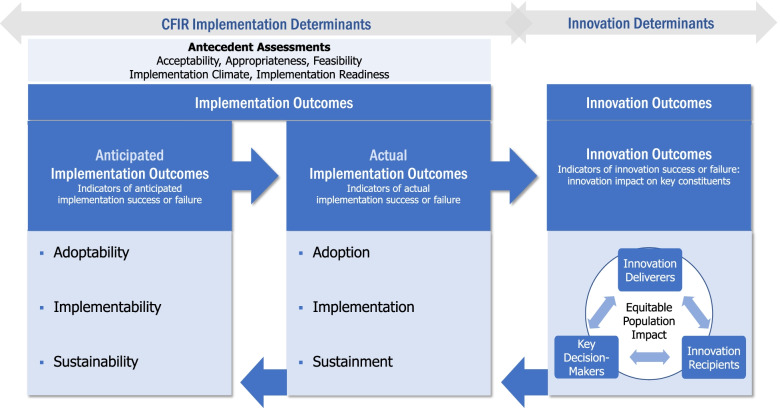
Background: The challenges of implementing evidence-based innovations (EBIs) are widely recognized among practitioners and researchers. Context, broadly defined as everything outside the EBI, includes the dynamic and diverse array of forces working for or against implementation efforts. The Consolidated Framework for Implementation Research (CFIR) is one of the most widely used frameworks to guide assessment of contextual determinants of implementation. The original 2009 article invited critique in recognition for the need for the framework to evolve. As implementation science has matured, gaps in the CFIR have been identified and updates are needed. Our team is developing the CFIR 2.0 based on a literature review and follow-up survey with authors. We propose an Outcomes Addendum to the CFIR to address recommendations from these sources to include outcomes in the framework. Main text: We conducted a literature review and surveyed corresponding authors of included articles to identify recommendations for the CFIR. There were recommendations to add both implementation and innovation outcomes from these sources. Based on these recommendations, we make conceptual distinctions between (1) anticipated implementation outcomes and actual implementation outcomes, (2) implementation outcomes and innovation outcomes, and (3) CFIR-based implementation determinants and innovation determinants. Conclusion: An Outcomes Addendum to the CFIR is proposed. Our goal is to offer clear conceptual distinctions between types of outcomes for use with the CFIR, and perhaps other determinant implementation frameworks as well. These distinctions can help bring clarity as researchers consider which outcomes are most appropriate to evaluate in their research. We hope that sharing this in advance will generate feedback and debate about the merits of our proposed addendum.
Overview
The claims and statistics of this paper haven’t been checked yet.
Free: it reads the open-access text and checks the first 5 claims that cite a source we can check. Create a free account to check every claim.
Integrity signals
Registry
Cites
Statistics
Figures
Verification
Claims the paper makes
The claims and statistics of this paper haven’t been checked yet.
Free: it reads the open-access text and checks the first 5 claims that cite a source we can check. Create a free account to check every claim.
Claims other papers make about this one
Each is checked against this paper’s own text: does it say what the citing paper says it does?
The cited source says what the claim attributes to it.
In the citing paper
“An updated Consolidated Framework for Implementation Research (CFIR) distinguished between anticipated (forward-looking) and actual (backward-looking) implementation outcomes [8].”
From Ten years of implementation outcomes research: a scoping review (2023) · cites this paper as [8]
The cited source says what the claim attributes to it.
In the citing paper
“we have reclassified these constructs to more appropriately position them as antecedent assessments [55], on the pathway between implementation determinants and outcomes in the CFIR Outcomes Addendum [19].”
From The updated consolidated framework for implementation research based on user feedback (2022) · cites this paper as [19]
The cited source says what the claim attributes to it.
In the citing paper
“several users suggested that the CFIR be expanded to include (1) implementation and innovation outcomes and (2) determinants to innovation outcomes collected from recipients [19].”
From The updated consolidated framework for implementation research based on user feedback (2022) · cites this paper as [19]
Self-check
Percentages, sums and reported differences re-computed from the paper’s own numbers.
The self-check needs the paper’s full text.
Citations
Cites
Damschroder, L. J., Aron, D. C., Keith, R. E., Kirsh, S. R., Alexander, J. A., & Lowery, J. C. (2009) · Implementation Science · doi:10.1186/1748-5908-4-50 · Cited by 14,496 · cited 2×
“The original 2009 article invited critique in recognition of the need for the framework to evolve [2].”
BackgroundSelf-citationValente, T. W. (2003) · Genetics in Medicine · doi:10.1097/01.gim.0000061743.67794.c4 · Cited by 13,723
Proctor, E., Silmere, H., Raghavan, R., Hovmand, P., Aarons, G., Bunger, A., Griffey, R., & Hensley, M. (2011) · Administration and Policy in Mental Health and Mental Health Services Research · doi:10.1007/s10488-010-0319-7 · Cited by 8,721 · cited 11×
“Proctor et al.’s Implementation Outcomes Framework (IOF) defines Adoption as “the intention, initial decision, or action to try or employ an innovation” [13].”
BackgroundMethodInfluentialThe Triple Aim: Care, Health, And Cost
Berwick, D. M., Nolan, T. W., & Whittington, J. (2008) · Health Affairs · doi:10.1377/hlthaff.27.3.759 · Cited by 5,136 · cited 1×
“Consideration of clinicians (and other employees) motivated evolution of the “Triple Aim” (enhancing patient experience, improving population health, and reducing costs) [35] to the “Quadruple Aim,” which added an aim of improving the work-life and well-being of clinicians and staff [36].”
BackgroundMaking sense of implementation theories, models and frameworks
Nilsen, P. (2015) · Implementation Science · doi:10.1186/s13012-015-0242-0 · Cited by 4,447 · cited 1×
“Theories that guide conceptualization of context abound and are often encapsulated within determinant frameworks [4, 5]; these frameworks delineate determinants (i.”
BackgroundCurran, G. M., Bauer, M., Mittman, B., Pyne, J. M., & Stetler, C. (2012) · Medical Care · doi:10.1097/mlr.0b013e3182408812 · Cited by 4,058 · cited 1×
“, clinical trialists versus implementation scientists) to translate innovations more quickly into practice [49].”
BackgroundFrom Triple to Quadruple Aim: Care of the Patient Requires Care of the Provider
Bodenheimer, T., & Sinsky, C. (2014) · The Annals of Family Medicine · doi:10.1370/afm.1713 · Cited by 3,462 · cited 1×
“Consideration of clinicians (and other employees) motivated evolution of the “Triple Aim” (enhancing patient experience, improving population health, and reducing costs) [35] to the “Quadruple Aim,” which added an aim of improving the work-life and well-being of clinicians and staff [36].”
BackgroundPsychometric assessment of three newly developed implementation outcome measures
Weiner, B. J., Lewis, C. C., Stanick, C., Powell, B. J., Dorsey, C. N., Clary, A. S., Boynton, M. H., & Halko, H. (2017) · Implementation Science · doi:10.1186/s13012-017-0635-3 · Cited by 2,819 · cited 1×
“developed measures for acceptability, appropriateness, and feasibility of an innovation and highlighted their role as potential predictors of adoption or implementation [27].”
BackgroundRE-AIM Planning and Evaluation Framework: Adapting to New Science and Practice With a 20-Year Review
Glasgow, R. E., Harden, S. M., Gaglio, B., Rabin, B., Smith, M. L., Porter, G. C., Ory, M. G., & Estabrooks, P. A. (2019) · Frontiers in Public Health · doi:10.3389/fpubh.2019.00064 · Cited by 2,528
The sociology of expectations in science and technology
Borup, M., Brown, N., Konrad, K., & Van Lente, H. (2006) · Technology Analysis & Strategic Management · doi:10.1080/09537320600777002 · Cited by 1,902 · cited 2×
“They give definition to role, clarify duties, offer some shape of what to expect and how to prepare for opportunities and risks” [17].”
Background
Research works printed but not linked: 1
- 46. Petit-McClure SH, Stinson C. Disrupting dis/abilization: a critical explora- tion of research methods to combat white supremacy and ableism in education. Intersect Cri Issues Educ. 2019;3:4.
Cited by
Items 701–800 of 941
Schmitt, M. E. (2024) · UWM Digital Commons (University of Wisconsin–Milwaukee)
Santos, M. E., Ferreira, R. C., Pinheiro, E. L., Vieira, S. S. A., & Senna, M. I. B. (2025) · Epidemiologia e Serviços de Saúde · doi:10.1590/s2237-96222025v34e20240802.pt
Culture, barriers, and enablers of primary health care quality improvement in Kenya
Odhus, C. O. (2025) · Lancaster EPrints (Lancaster University) · doi:10.17635/lancaster/thesis/3031
Dlamini, Z. C. (2025) · Open University of Cape Town (University of Cape Town)
Ngeny, T. (2025) · Theseus (Ammattikorkeakoulujen)
Weiss, M. (2025) · eScholarship@McGill (McGill) · doi:10.82308/54546
Organizational Culture and PeerOnCall App Implementation
Goraya, N. K. (2023) · MacSphere (McMaster University) · doi:10.71548/19420
Lim, J. N., Khalafi, M., & Abdulghaffar, R. (2025) · Alzheimer s & Dementia Behavior & Socioeconomics of Aging · doi:10.1002/bsa3.70053
Wagner, J. A., Akyirem, S., Lipson, J., Chen, H. N., & Whittemore, R. (2026) · Frontiers in Clinical Diabetes and Healthcare · doi:10.3389/fcdhc.2025.1689830
Santos, M. E. (2024) · LA Referencia (Red Federada de Repositorios Institucionales de Publicaciones Científicas)
Updated Consolidated Framework for Implementation Research
島津太一, 齋藤, 順., 小田原, 幸., 奥山, 絢., & 安福, 祐. (2025) · Institutional Repositories DataBase (IRDB)
SEELY, A. J. E., Barnaby, D. P., Hudek, N., Herry, C. L., Scales, N. B., Fernando, S. M., Brehaut, J. C., & Perry, J. J. (2026) · BioMed Research International · doi:10.1155/bmri/3778740
“…aloud of the data entry screens (nurses only) and SA report (both physicians and nurses) based on UCD; and (3) detailed questions about barriers and drivers to implementation, informed by the theoretical domain framework [21] and the consolidated framework for implementation research [22, 23].”
Hailemariam, M., Brown, G., Ng, T. J., Weinstock, L. M., Sneed, R. S., Nguyen, C., Simon, J., Hayes, T., Bustos, T. E., Corrigan, P. W., et al. (2026) · Pilot and Feasibility Studies · doi:10.1186/s40814-025-01758-7
Fu, M., Zhang, Y., Zhao, X., Wang, S., Xu, Z., Li, K., & Lv, C. (2026) · Complementary Therapies in Medicine · doi:10.1016/j.ctim.2026.103318
Xiao, J., Huang, S., Chen, L., Wang, Q., Wang, Y., Xie, W., Liu, T., Sai, K., & Xu, P. (2026) · Journal of Evaluation in Clinical Practice · doi:10.1111/jep.70357
Altemani, A. H. O., Alanazi, A. I. S., Alanazi, M. A., Alzahrani, Y. A. A., AlMalki, H. M. A., Bdiwi, A. M. A., Alenezi, M. Z., Alanazi, S. M., Salami, F. H. Y., Alanazi, K. S. H., et al. (2024) · International Journal of Computational and Experimental Science and Engineering · doi:10.22399/ijcesen.4764
“The World Health Organization (WHO) has repeatedly emphasized the critical role of collaborative practice in strengthening health systems and improving health outcomes, particularly for chronic conditions [5].”
Butscher, F., Gebhard, D., Singer, M., & van Nassau, F. (2026) · Health Education Research · doi:10.1093/her/cyaf064
“The procedure of content-related structuring was applied to the data following the CFIR constructs and outcome addendum [33] as deductive category system.”
Developing the LIFE Monitor to Assess Fidelity of MULTI+ for Inpatients with Mental Illness
van Schothorst, M. M. E., den Bleijker, N. M., Hendriksen, I. J. M., Cahn, W., van Harten, P. N., de Vries, N. K., & Deenik, J. (2026) · Global Implementation Research and Applications · doi:10.1007/s43477-025-00201-6
“Patients are considered the “recipients” (i.e. those for whom the intervention is designed to benefit), and healthcare profession - als are considered the “deliverers” (i.e., those who are (in) directly involved in delivering the intervention) of MULTI+ (Damschroder et al., 2022 ).”
Martin, C. L., Truong, L., Evenson, K. R., Wolf, J., Moore, J. B., Urban, J. E., Marshall, S. W., Shanley, E., Nicholson, K., & Bullock, G. S. (2026) · International Journal of Sports Physical Therapy · doi:10.26603/001c.155478
He, Y. (2023) · ResearchWorks at the University of Washington (University of Washington)
A Framework and Method for Measuring the Implementation of Data Science in Critical Care
Woznica, D. M., Al-Hakim, T., Kumar, V. K., Cobb, J. P., Kamaleswaran, R., Khanna, A. K., Laudański, K., Zimmerman, J. J., & Reuter‐Rice, K. (2026) · Critical Care Explorations · doi:10.1097/cce.0000000000001372 · Cited by 1
Yudkin, J. S., Owens, C., Gilbreath, J. N., & Martyn‐Dickens, C. (2026) · Sage Open Pediatrics · doi:10.1177/30502225261421700
Avaliação da prática clínica: estudo de implementação
Caramori, U. (2025) · doi:10.47749/t/unicamp.2025.1523447
Bringing Interventions to Scale
Shrestha, G., & Cooper, B. R. (2026) · Wiley eBooks · doi:10.1002/9781119880851.ch17
Gustafson, E. L., Ignoffo, S., McCabe, K., Seals, G., Woodberry, M., Kidambi, A., Staszko, G., & Margellos-Anast, H. (2026) · Translational Behavioral Medicine · doi:10.1093/tbm/ibag004
Embrett, M. G., Martin‐Misener, R., Sampalli, T., Elliott, M. A., & Mehrpooya, S. (2026) · Research Square · doi:10.21203/rs.3.rs-8289805/v1
Rahayu, T. S. M., Darusman, K. R., Kamaruddin, M. I., Deneska, R. S., Tjoeng, E., Basrowi, R. W., & Moeloek, N. F. (2026) · Journal of Education and Health Promotion · doi:10.4103/jehp.jehp_124_25
“Implementation science approaches, as described by Damschroder et al ., [46] would be particularly valuable for understanding contextual adaptations needed across Indonesia’s diverse geographic and socioeconomic landscape.”
Li, X. Y. (.-A. (2023) · TSpace (University of Toronto)
Lloy, B. (2024) · TSpace (University of Toronto)
Henderson, N. L., Padalkar, T. V., Jansen, J., Carr, P. M., Stover, A. M., Williams, C., Wheeler, S. B., O’Leary, M. C., Boyke, K., Crist, S., et al. (2026) · Implementation Science Communications · doi:10.1186/s43058-026-00889-z · Cited by 2
“Published codebooks were used to operationalize definitions for both CFIR 2.0 and ERIC, and research team discussion settled disagreements [35, 36].”
InfluentialMontesanti, S. R., Bradley, N. L., Demedeiros, S., & McKay, R. C. (2026) · Frontiers in Health Services · doi:10.3389/frhs.2026.1743548
“Several CFIR domains/constructs and Proctor outcomes stood out across the findings.”
InfluentialA Conceptual Framework for Improving the Oral Health of Children with Disabilities
AlMashhadani, S. (2026) · PEARL (University of Plymouth) · doi:10.24382/d9dx-zc87
Birru, E., Mekonnen, W., Sherr, K., Nigatu, D., Dixon, E., Wanje, G., & Enquobahrie, D. A. (2026) · Global Implementation Research and Applications · doi:10.21203/rs.3.rs-8663550/v1
Abdouni, S. E., Phan, T. A., Flint, R. B., Simons, S. H. P., Ista, E., & van Rosse, F. (2026) · International Journal of Evidence-Based Healthcare · doi:10.1097/xeb.0000000000000566
Yu, T., Yingjie, W., Xiaoting, S., Xinyu, Z., Kaiwen, Z., Zhifeng, Z., & Lei, L. (2025) · The Journal of Cardiovascular Nursing · doi:10.1097/jcn.0000000000001261
Becker, R., Bonnet, K. R., Shah, M. V., Dang, E., Ancker, J. S., Malone, D., Trinkley, K. E., Gómez-Lumbreras, A., Fiol, G. D., Kawamoto, K., et al. (2026) · BMJ Open · doi:10.1136/bmjopen-2025-110074
Rotter, T., Petrovic, M., Zarzycki, M., Allenhof, C., Schnitzspahn, K. M., Toczyski, P., Justicia, A., Leal, S. A., Chan, J., Leimhofer, J., et al. (2026) · PLoS ONE · doi:10.1371/journal.pone.0343982
“It considers 39 constructs in five areas or domains [23].”
Arnold, T. L., Elwy, A. R., Parent, H., Gashi, E., Martin, H., Rogers, B. G., Lee, J., Chan, P. A., & Rusley, J. C. (2026) · AIDS Patient Care and STDs · doi:10.1177/10872914261432744
“The lead and senior authors developed an a priori coding framework using the CFIR 2.0 27,28 with a focus on identifying themes and site-speci fi c insights that would inform the development and future implementation planning of the PrEP tool-kit.”
InfluentialGago, C. M., León, E. D., Zhang, L., Lopez, J. A., Egede, J. K., Gallager, R. P., Hopkins, K. A., & Schoenthaler, A. (2026) · BMC Health Services Research · doi:10.1186/s12913-026-14351-2
“Given that this study focuses on determinants underlying HRSN self-navigation implementation, we lever-aged the Consolidated Framework for Implementation Research 2.0 (CFIR) [56], to inform interview guide design and, ultimately, thematic analysis.”
InfluentialSoler, M., Rodriguez, G. C., Ayala, J., Alfaro, K. M., Novoa, R., MASCH, R. J., & Cremer, M. (2026) · Global Implementation Research and Applications · doi:10.1007/s43477-026-00219-4
“Acceptability is a crucial outcome of implementation research (Proctor et al., 2010) particularly at the early stages of developing or evaluating an intervention (Damschroder et al., 2022; Reilly et al., 2020).”
Canfield, S. M., Rolbiecki, A. J., Ghosh, P., Montgomery, E., Shaffer, V. A., Bobo, M., Storer, M., Ghumman, A., Michaels, L. C., Dorr, D. A., et al. (2026) · Applied Clinical Informatics · doi:10.1055/a-2823-4533
Factors influencing clinical decision-making in inpatient rehabilitation: A scoping review
Dobson, C. G., Carrington, H., Hernandez, G. M., Go, H. C., Hameed, S., & Cogan, A. M. (2026) · Clinical Rehabilitation · doi:10.1177/02692155261435521
Thompson, Z. E., Turner, B., Laughter, J., Yen, A., Ganesh, S. S., Samra, S. S., Chong, V. E., Haque, S., Garibay, J., Afable, W., et al. (2026) · Journal of Urban Health · doi:10.1007/s11524-026-01059-1
高橋, 佳. (2025) · Institutional Repositories DataBase (IRDB)
Kim, T. V., Dao, D., Pham, T. N. D., Phan, L. T. B., Le, L. H. H., Le, T. T., Ly, C. Q., Vo, H. T., Do, T. B., Tran, T. Q. P., et al. (2026) · Research Square · doi:10.21203/rs.3.rs-9200793/v1
Morton, C. M., Alexander, L. H., Alvarez, L. N., Toto, L., Addison, S. M., & Thiruvenkadam, N. (2026) · Children and Youth Services Review · doi:10.1016/j.childyouth.2026.108945
Olavesen, E. S., Helseth, S., Haga, S. M., Sundrehagen, T., & Drozd, F. (2026) · PLOS Digital Health · doi:10.1371/journal.pdig.0001348
“Complex innovations especially benefit from such stepwise adoption, allowing practitioners time to work, learn, and build confidence through early successes [11,33].”
Chays‐Amania, A. (2023) · theses.fr (ABES) · doi:10.70675/0025b0a4z898dz458az9c8aza15c0fd073fb
Vincenzo, J. L., Wingood, M., Scott, A. J., Caulley, J. M., Kocurek, E. G., Brach, J. S., & Curran, G. M. (2026) · Innovation in Aging · doi:10.1093/geroni/igag036
“28 This study builds on our previous post implementation evaluations of outcomes and barriers and facilitators to STEADI adoption in outpatient physical therapy in a large health sys-tem.”
Toomey, C., Bhardwaj, A., Kennedy, N., MacFarlane, A. E., Grealis, S., Browne, J., Maher, B., Blake, M., Hayes, P., Cassar-Gheiti, A. J., et al. (2026) · Translational Behavioral Medicine · doi:10.1093/tbm/ibag017
“Acceptability, appropriateness and feasibility are sometimes considered antecedent assessments to the success of adoption [38].”
He, Y., AbuShweimeh, R., Kouabenan, Y.-R., Assoa, P. H., Puttkammer, N. H., Gloyd, S. S., Wagenaar, B. H., Hoffman, N. G., Komena, P., Kamelan, N. P. F., et al. (2026) · Implementation Science Communications · doi:10.1186/s43058-026-01064-0
Healthcare practitioners’ engagement with non-specialists: A scoping review
Newell, E., Hawkins, E., Deshpande, S., Chandler‐Mather, N., & Shanley, D. C. (2026) · Public Health · doi:10.1016/j.puhe.2026.106292
Fakhfakh, M., Murenzi, G., Niyonsenga, S. P., Hagenimana, J. D., Felix, K., Condo, J., Absolomon, G., Ruzindana, K. B., Hagenimana, M., Kabukye, J. K., et al. (2026) · Research Square · doi:10.21203/rs.3.rs-9418957/v1
Tian, R., Zheng, L., Gao, N., Yang, D., wang, F., Wang, M., Liu, H., & Guo, H. (2026) · International Journal of Nursing Sciences · doi:10.1016/j.ijnss.2026.04.009
Lawrason, S., Ross, H. J., Simard, A., Abdelhalim, T., & Silverstein, W. K. (2026) · Digital Health · doi:10.1177/20552076261433263
“15 To guide this research, the updated Consolidated Framework for Implementation Research (CFIR);, 16 the most highly cited implementation science framework, 17 was employed.”
Aldana-López, J. A., (11622220), R. S.-A., Durand-Arias, S., Carmona-Huerta, J., Cárdenas-García, E., Arámbula-Román, J. C., Metcalfe, J. D., Swanson, S., Keleher, J., Villafuerte-Jacob, E., et al. (2026) · Pilot and Feasibility Studies · doi:10.1186/s40814-026-01809-7
“Similarly, adoption is not measured as a primary outcome; instead, we document contextual factors and early indicators that may influence subsequent uptake of IPS within the Jalisco mental health system [36].”
Palmer, S., Shaw, E., Grocke-Dewey, M., Corlew, K., Flournoy, L., & Balis, L. E. (2026) · International Journal of Behavioral Nutrition and Physical Activity · doi:10.1186/s12966-026-01927-8
Hu, Y., Wortham, W. K., & Stanhope, V. (2026) · The Journal of Behavioral Health Services & Research · doi:10.1007/s11414-026-09994-2
“…the updated Consolidated Framework for Implementation (CFIR), a conceptual framework that identifies 48 constructs and 19 subconstructs in five domains that influence the implementation of interventions: innovation, outer setting, inner setting, individuals, and the process of implementation 40 .”
‘Amazing and Daunting’: Providers’ Perspectives on the Implementation of Neurofeedback
Norris, W. K., Allison, M. K., Shaw-Smith, E., Pro, G. C., Curran, G. M., & Rojo, M. O. (2026) · Global Implementation Research and Applications · doi:10.1007/s43477-026-00237-2
Aguilar, A.-Z. (2026) · The Journal for Nurse Practitioners · doi:10.1016/j.nurpra.2026.105819
Muin, F., & Nugraha, A. E. (2026) · JURNAL ILMU KEFARMASIAN INDONESIA · doi:10.35814/jifi.v24i1.2026
“Intervention planning, organizational preparedness, external policy pressures, personal views and expertise, and implementation strategies have all been systematically identified as either helping or hindering factors using this framework [12], [13].”
Beltran, S. J., Chisholm, L., & Jaijairam, E. (2026) · International Journal of Older People Nursing · doi:10.1111/opn.70081
Allen, C. G., Cragun, D., Hallquist, M. L. G., Buchanan, A. H., Whitcomb, C., Bosch, R., Wagner, I., Marable, J., Foss, K., Craig, D. W., et al. (2026) · Implementation Science Communications · doi:10.21203/rs.3.rs-9418493/v1
Subramaniam, A., Tan, W. S., Tan, H. T. R., Wang, Q., Ding, Y. Y., Hum, A. Y. M., PRO-MADE Implementation Group, Kaur, P., Neo, H. Y., Goh, W. Y., et al. (2026) · BMC Palliative Care · doi:10.1186/s12904-026-02138-5
“The updated Consolidated Framework for Implementation Research and its Outcomes (CFIR) and Outcomes Addendum (CFIR-OA) were used as a guiding framework for data collection, coding, and analysis [32, 33].”
Aldawood, A., Field, B., Rushton, S., & Hind, D. (2026) · White Rose Research Online (University of Leeds, The University of Sheffield, University of York) · doi:10.6084/m9.figshare.32270099
Braga, V., Ramos, A., & Braga, R. J. V. D. A. (2026) · Research Square · doi:10.21203/rs.3.rs-9671043/v1
Wirahadikusumah, R. D., Viqolbi, M. A., & Kardhana, H. (2026) · International Sustainable Energy Conference - Proceedings · doi:10.52825/isec.v2i.3267
“First, interview and artefact evidence were coded using the Consolidated Framework for Implementation Research (CFIR 2.0) to identify barriers and enablers across intervention characteristics, outer/inner setting, individual characteristics, and implementation process [13].”
InfluentialThumm, E. B., Smith, D. C., Page, K., & Huebschmann, A. G. (2026) · Journal of Midwifery & Women s Health · doi:10.1111/jmwh.70136
Huang, S., Ning, X., Lian, R., Suo, R., Liu, X., & Liu, X. (2026) · BMC Nursing · doi:10.1186/s12912-026-04777-8
“CFIR enables researchers to examine a broad range of factors that may influence the success or failure of implementation efforts across five domains: intervention characteristics, outer setting, inner setting, characteristics of individuals, and implementation processes [23].”
Shifting Perspectives: Harm Reduction Staff Perceptions of Drug Checking Implementation
Jaffe, K., Ludwig, W., Alsum, S., DeHaan, N., Shuman, C. J., Ploutz-Snyder, R. J., Dwan, M., & Dahlem, C. H. (2026) · Substance Use & Addiction Journal · doi:10.1177/29767342261444522
“31,32”
Mac, R., Saliba‐Gustafsson, E. A., Anger, Å., Sundberg, C. J., Martinsson, L., Bergström, A., & Salomonsson, S. (2026) · PLoS ONE · doi:10.1371/journal.pone.0348234
“Determinant frameworks, such as the Consolidated Framework for Implementation Research (CFIR), can help delineate contextual factors that influence the outcomes of implementation efforts [34,35].”
Wyles, C. L., Preddie, A. K., Chavez, M., Monterusso, C., & Damush, T. M. (2026) · Journal of Nursing Care Quality · doi:10.1097/ncq.0000000000000977
Fan Therapy for Alleviating Dyspnea in Adults: A Systematic Review and Meta‐Analysis
Yu, T., Li, Y., Liu, S., Hu, Z., Wang, C., & Jiang, Y. (2026) · Journal of Clinical Nursing · doi:10.1111/jocn.70347
van Grondelle, S. E., Ede, A. V., ter Braake, J. G., van Bruggen, S., Rutten, G. E. H. M., Bots, M. L., Vos, H. M. M., Numans, M. E., & Vos, R. C. (2026) · medRxiv · doi:10.64898/2026.05.14.26352728
Strategic value and implementation challenges of NaCaRe-KE in Kenya
Melly, E., Amrit, C., de Mast, J., & Kaspers, G. J. L. (2026) · Journal of Decision System · doi:10.1080/12460125.2026.2666612
Shin, H. D., Payne, K., Haskell, H. W., Wade, C. G., Glatard, T., Bates, D. W., Dykes, P. C., & Syrowatka, A. (2016) · JBI Evidence Synthesis · doi:10.11124/jbies-25-00463
McGowan, L. J., Nichol, B., Lecouturier, J., Banks, H., Dhami, R., Kelly, M. P., Sniehotta, F. F., & Graham, F. (2026) · BMC Health Services Research · doi:10.1186/s12913-026-14740-7
“In addition, the CFIR has been extended to include outcomes of implementation [33].”
Kokorelias, K. M., & Robitaille, A. (2026) · PLoS ONE · doi:10.1371/journal.pone.0350032
“…will be mapped to CFIR 2.0 domains and constructs, including characteristics of the innovation, outer setting influences, inner setting features such as leadership or culture, characteristics of individuals involved, and processes used to plan, implement, or adapt the childcare model [17].”
InfluentialSupporting Responsive Practice: Training Dietitians to Meet Clients' Interactional Needs
Barkmeijer, A., Lamerichs, J., van Burgsteden, L., Molder, H. T., & Jager‐Wittenaar, H. (2026) · Journal of Human Nutrition and Dietetics · doi:10.1111/jhn.70283
Calzavara‐Pinton, P., Iemoli, E., Saraswat, P., Chapman‐Rothe, N., Bonavita, O., Raftery, T. C., Nallasamy, V., Zahid, M., Sprecher, V., Herbst, A., et al. (2026) · World Allergy Organization Journal · doi:10.1016/j.waojou.2026.101404
Seitz, K. P., Muhs, A. L., Lloyd, B. D., Boehm, L. M., Palakshappa, J. A., DeMasi, S. C., Qian, E. T., Rice, T. W., Semler, M. W., Casey, J. D., et al. (2026) · BMC Health Services Research · doi:10.1186/s12913-026-14835-1
“Barriers to delivery of the assigned treatment include factors related to the intervention itself and to the clinical context in which the pragmatic trial is embedded [8, 9].”
Psychedelic-Assisted Interventions in Palliative Care: A Narrative Overview and Critical Evaluation
Soares, D. A., & Campolina, A. G. (2026) · Healthcare · doi:10.3390/healthcare14111550
From policy to practice: strategies to overcome barriers in early autism care pathways
Saad, K., Al-Atram, A. A., Elhoufey, A. A., Ragab, M. F., Elgenidi, A., Sherif, A., & Mahmoud, R. R. (2026) · Pediatric Research · doi:10.1038/s41390-026-05177-z
Laurila, K. A., Cunningham, S., Stevenson, L., Tarasenko, M. A., Ramsey, L. M., Noboa, C., Matos-Jiménez, K., Dania, A., & Sy, A. U. (2026) · International Journal of Environmental Research and Public Health · doi:10.3390/ijerph23060747
“For example, evaluators’ descriptions of contextual barriers, institutional readiness, and the influence of settings on RCB reflect CFIR’s [55] emphasis on understanding the multilevel determinants of implementation success.”
Rachlinski, R. (2026) · ScholarWorks @ The University of New Orleans (The University of New Orleans)
Gustafson, E. L., Quezada, N., Blaisdell, K. N., Bobadilla, G., Stiles‐Shields, C., McCabe, K., Ignoffo, S., Kidambi, A., Staszko, G., Medina, B., et al. (2026) · Implementation Science Communications · doi:10.1186/s43058-026-00980-5
“…(i.e [50], frame feasibility, acceptability, and appropriateness as implementation outcomes in themselves, here we align with Damschroder et al.’s conceptualization of these constructs as antecedent assessments that are predictors of implementation outcomes such as adoption and implementation [51].”
Iwelunmor, J., Arinze, C., Okwuzu, J. O., Akinsolu, F. T., Gbaja-Biamila, T. A., Ojo, T., Olusanya, O. A., Abodunrin, O. R., Nwaozuru, U., Musa, A. Z., et al. (2026) · Implementation Science · doi:10.1186/s13012-026-01507-1
“Consolidated Framework for Implementation Research [48] Cost-effectiveness evaluation”
McDaniel, J. T., Haun, J. N., McMahon-Grenz, J., Schneider, T., Skop, K. M., Barton, S. J., Sandoval, R., Samson, K., Nakase‐Richardson, R., Wells, K., et al. (2026) · Archives of Rehabilitation Research and Clinical Translation · doi:10.1016/j.arrct.2026.100664
“…Evaluation Initiative of the IETP was established in 2021 to conduct evidence-based evaluations of the 5 IETP sites 2,3 using implementation frameworks such as the Consolidated Framework for Implementation Research 4 and the Reach, Effectiveness, Adoption, Implementation, and Maintenance framework.”
Williams, C. R., Rushwan, S., Mammoliti, K., Gulmezoglu, A. M., Chinery, L., Coomarasamy, A., Althabe, F., Widmer, M., Moran, A., Syed, U., et al. (2026) · Implementation Science Communications · doi:10.1186/s43058-026-00912-3
“Within implementation science, barriers to implementation are defined as those determinant factors that can slow, stall, or derail the uptake or sustainment of an intervention [15].”
Merle, J. L., Golden, C. A., Simmons, R., Sloss, E. A., Sanuade, O. A., Verry, T. W., Nixon, A. J., McFarland, M., Lengnick‐Hall, R., Meza, R. D., et al. (2026) · Implementation Science · doi:10.1186/s13012-026-01514-2
“EPIS and CFIR outcomes addendum [51] were each cited once ( 1%), and 42 studies (36”
From CXR to ultrasound: a multi-framework approach to advancing De-implementation in acute care
Ablordeppey, E., Powell, B. J., Rosenzweig, T., Lengnick‐Hall, R., James, A. S., Griffey, R. T., & Geng, E. H. (2026) · Implementation Science Communications · doi:10.1186/s43058-026-00963-6
“Building on the established CIFR codes, we linked them to COM-B domains, capability, opportunity, and motivation through consensus building [39].”
Nagy, E., Alvarado, B., Kamotho, M., Szumlanski, N., Guan, T. H., & Martínez-Cajas, J. (2026) · Journal of the International Association of Providers of AIDS Care (JIAPAC) · doi:10.1177/23259582261458932
Karume, A. K., Ngumbau, N. M., Ongeri, L., Neema, A., Kaggiah, A., Owaga, D., Maina, C. N., Ndambuki, C., Wang, Y., Pothan, L. C., et al. (2026) · PLoS ONE · doi:10.1371/journal.pone.0349732
Fayolle, E., Baudot, A., Chanelière-Sauvant, A.-F., Favier, E., Rambaud, F., Torche, F., Célarier, T., & Hupin, D. (2026) · BMC Geriatrics · doi:10.1186/s12877-026-07821-z
“An interview guide will be developed based on the Consolidated Framework for Implementation Research (CFIR) [23], allowing for a structured exploration of the following themes: 1.”
Broeck, N. V., Schoenmakers, B., Boeckxstaens, P., VRIENDT, P. D., VELDE, D. V. D., & Anthierens, S. (2026) · Implementation Science Communications · doi:10.1186/s43058-026-01003-z
“World café sessions are organized around both anticipated implementation outcomes (sustainability) and observed outcomes in practice (sustain-ment), providing a more comprehensive understanding of what it means to sustain a values-driven innovation [45].”
Afzal, A., Stanworth, S. J., & Crawshaw, J. (2026) · Journal of Thrombosis and Haemostasis · doi:10.1016/j.jtha.2026.06.004
Martins, V., de Pinho, L. G., da Silva, R. C. G., Giménez‐Díez, D., Tomás, M. A. R., Vidal, A. C., Soares, M., & Lopes, M. J. (2026) · JBI Evidence Synthesis · doi:10.11124/jbies-25-00391
Metadata
- Authors
- Damschroder, L. J., Reardon, C. M., Opra Widerquist, M. A., & Lowery, J.
- Affiliations
- VA Ann Arbor Healthcare System (US)
- Corresponding author
- Damschroder, Laura J.
- Venue
- Implementation Science
- Published
- 2022-01-22
- Volume
- 17
- Issue
- 1
- Pages
- 7-7
- ISSN
- 1748-5908 (ISSN-L)
- PMC
- PMC8783408
- OpenAlex
- W4206949803
- Semantic Scholar
- 08521891e3bcd553697352db930b1de39027da07
- Cited by
- 784
- References
- 61
- Citations by year
- 2026: 227 · 2025: 177 · 2024: 218 · 2023: 117 · 2022: 45
- FWCI
- 27.08
- Type
- journal article
- Language
- en
- Open access
- gold
- doi.org
- Licence
- cc-by
- creativecommons.org/licenses/by/4.0 (tdm)
- creativecommons.org/licenses/by/4.0 (vor)
- Locations
- Implementation Science (publishedVersion, cc-by)
- PubMed Central (publishedVersion, cc-by)
- PubMed (publishedVersion)
- DOAJ (DOAJ: Directory of Open Access Journals) (submittedVersion, cc-by-sa)
- Funders
- Quality Enhancement Research Initiative (QUE 15-286)
- Health Services Research and Development (LIP 20-116)
- Topics
- Health Sciences › Health Professions › General Health Professions › Health Policy Implementation Science
- Health Sciences › Health Professions › General Health Professions › Health Sciences Research and Education
- Health Sciences › Medicine › Public Health, Environmental and Occupational Health › Clinical practice guidelines implementation
- Keywords
- Consolidated Framework for Implementation Research, implementation outcomes, innovation outcomes, implementation factors, innovation determinants, evidence-based innovation, implementation context, framework evolution
- MeSH terms
- Implementation Science, Humans, Motivation
About these checks
Registry, retraction, Cites and statistics results are computed, not judged, with one exception: a printed reference that no index lists is read once by a model before it counts as a citation error. Claims are extracted by a model and kept only when their quote appears verbatim in the text; each cited source is then checked, with a model’s help, for whether it says what the claim relies on. Those verdicts can be wrong — read the claim’s quote and the cited source before relying on one.
Statistics and arithmetic are recomputed, not judged.
Confidence bands are shown only for fields calibrated on our annotated test set. None is calibrated yet, so no band is shown.
What counts as a claim ›How we measure confidence ›How we check this ›
Are you an author, or do you see a problem with this page? Request a review
Data sources
Bibliographic data: Semantic Scholar, OpenAlex, Crossref.
Contains information from the Semantic Scholar Academic Graph Datasets, made available under the ODC Attribution License (ODC-BY 1.0).
Semantic Scholar’s data is described in: Kinney, R., et al. (2023). The Semantic Scholar Open Data Platform. arXiv:2301.10140.
