

Conceptualizing outcomes for use with the Consolidated Framework for Implementation Research (CFIR): the CFIR Outcomes Addendum
Open accessThe DOI matches its Crossref record; 61 of the 61 references it cites were found in a registry or an index.
Abstract
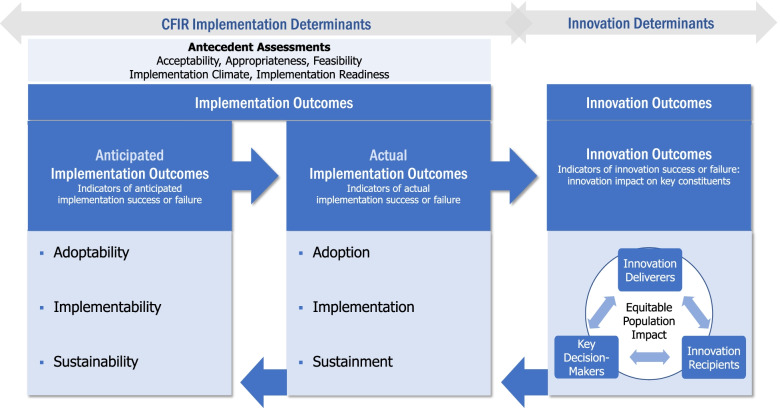
Background: The challenges of implementing evidence-based innovations (EBIs) are widely recognized among practitioners and researchers. Context, broadly defined as everything outside the EBI, includes the dynamic and diverse array of forces working for or against implementation efforts. The Consolidated Framework for Implementation Research (CFIR) is one of the most widely used frameworks to guide assessment of contextual determinants of implementation. The original 2009 article invited critique in recognition for the need for the framework to evolve. As implementation science has matured, gaps in the CFIR have been identified and updates are needed. Our team is developing the CFIR 2.0 based on a literature review and follow-up survey with authors. We propose an Outcomes Addendum to the CFIR to address recommendations from these sources to include outcomes in the framework. Main text: We conducted a literature review and surveyed corresponding authors of included articles to identify recommendations for the CFIR. There were recommendations to add both implementation and innovation outcomes from these sources. Based on these recommendations, we make conceptual distinctions between (1) anticipated implementation outcomes and actual implementation outcomes, (2) implementation outcomes and innovation outcomes, and (3) CFIR-based implementation determinants and innovation determinants. Conclusion: An Outcomes Addendum to the CFIR is proposed. Our goal is to offer clear conceptual distinctions between types of outcomes for use with the CFIR, and perhaps other determinant implementation frameworks as well. These distinctions can help bring clarity as researchers consider which outcomes are most appropriate to evaluate in their research. We hope that sharing this in advance will generate feedback and debate about the merits of our proposed addendum.
Overview
The claims and statistics of this paper haven’t been checked yet.
Free: it reads the open-access text and checks the first 5 claims that cite a source we can check. Create a free account to check every claim.
Integrity signals
Registry
Cites
Statistics
Figures
Verification
Claims the paper makes
The claims and statistics of this paper haven’t been checked yet.
Free: it reads the open-access text and checks the first 5 claims that cite a source we can check. Create a free account to check every claim.
Claims other papers make about this one
Each is checked against this paper’s own text: does it say what the citing paper says it does?
The cited source says what the claim attributes to it.
In the citing paper
“An updated Consolidated Framework for Implementation Research (CFIR) distinguished between anticipated (forward-looking) and actual (backward-looking) implementation outcomes [8].”
From Ten years of implementation outcomes research: a scoping review (2023) · cites this paper as [8]
The cited source says what the claim attributes to it.
In the citing paper
“we have reclassified these constructs to more appropriately position them as antecedent assessments [55], on the pathway between implementation determinants and outcomes in the CFIR Outcomes Addendum [19].”
From The updated consolidated framework for implementation research based on user feedback (2022) · cites this paper as [19]
The cited source says what the claim attributes to it.
In the citing paper
“several users suggested that the CFIR be expanded to include (1) implementation and innovation outcomes and (2) determinants to innovation outcomes collected from recipients [19].”
From The updated consolidated framework for implementation research based on user feedback (2022) · cites this paper as [19]
Self-check
Percentages, sums and reported differences re-computed from the paper’s own numbers.
The self-check needs the paper’s full text.
Citations
Cites
Damschroder, L. J., Aron, D. C., Keith, R. E., Kirsh, S. R., Alexander, J. A., & Lowery, J. C. (2009) · Implementation Science · doi:10.1186/1748-5908-4-50 · Cited by 14,496 · cited 2×
“The original 2009 article invited critique in recognition of the need for the framework to evolve [2].”
BackgroundSelf-citationValente, T. W. (2003) · Genetics in Medicine · doi:10.1097/01.gim.0000061743.67794.c4 · Cited by 13,723
Proctor, E., Silmere, H., Raghavan, R., Hovmand, P., Aarons, G., Bunger, A., Griffey, R., & Hensley, M. (2011) · Administration and Policy in Mental Health and Mental Health Services Research · doi:10.1007/s10488-010-0319-7 · Cited by 8,721 · cited 11×
“Proctor et al.’s Implementation Outcomes Framework (IOF) defines Adoption as “the intention, initial decision, or action to try or employ an innovation” [13].”
BackgroundMethodInfluentialThe Triple Aim: Care, Health, And Cost
Berwick, D. M., Nolan, T. W., & Whittington, J. (2008) · Health Affairs · doi:10.1377/hlthaff.27.3.759 · Cited by 5,136 · cited 1×
“Consideration of clinicians (and other employees) motivated evolution of the “Triple Aim” (enhancing patient experience, improving population health, and reducing costs) [35] to the “Quadruple Aim,” which added an aim of improving the work-life and well-being of clinicians and staff [36].”
BackgroundMaking sense of implementation theories, models and frameworks
Nilsen, P. (2015) · Implementation Science · doi:10.1186/s13012-015-0242-0 · Cited by 4,447 · cited 1×
“Theories that guide conceptualization of context abound and are often encapsulated within determinant frameworks [4, 5]; these frameworks delineate determinants (i.”
BackgroundCurran, G. M., Bauer, M., Mittman, B., Pyne, J. M., & Stetler, C. (2012) · Medical Care · doi:10.1097/mlr.0b013e3182408812 · Cited by 4,058 · cited 1×
“, clinical trialists versus implementation scientists) to translate innovations more quickly into practice [49].”
BackgroundFrom Triple to Quadruple Aim: Care of the Patient Requires Care of the Provider
Bodenheimer, T., & Sinsky, C. (2014) · The Annals of Family Medicine · doi:10.1370/afm.1713 · Cited by 3,462 · cited 1×
“Consideration of clinicians (and other employees) motivated evolution of the “Triple Aim” (enhancing patient experience, improving population health, and reducing costs) [35] to the “Quadruple Aim,” which added an aim of improving the work-life and well-being of clinicians and staff [36].”
BackgroundPsychometric assessment of three newly developed implementation outcome measures
Weiner, B. J., Lewis, C. C., Stanick, C., Powell, B. J., Dorsey, C. N., Clary, A. S., Boynton, M. H., & Halko, H. (2017) · Implementation Science · doi:10.1186/s13012-017-0635-3 · Cited by 2,819 · cited 1×
“developed measures for acceptability, appropriateness, and feasibility of an innovation and highlighted their role as potential predictors of adoption or implementation [27].”
BackgroundRE-AIM Planning and Evaluation Framework: Adapting to New Science and Practice With a 20-Year Review
Glasgow, R. E., Harden, S. M., Gaglio, B., Rabin, B., Smith, M. L., Porter, G. C., Ory, M. G., & Estabrooks, P. A. (2019) · Frontiers in Public Health · doi:10.3389/fpubh.2019.00064 · Cited by 2,528
The sociology of expectations in science and technology
Borup, M., Brown, N., Konrad, K., & Van Lente, H. (2006) · Technology Analysis & Strategic Management · doi:10.1080/09537320600777002 · Cited by 1,902 · cited 2×
“They give definition to role, clarify duties, offer some shape of what to expect and how to prepare for opportunities and risks” [17].”
Background
Research works printed but not linked: 1
- 46. Petit-McClure SH, Stinson C. Disrupting dis/abilization: a critical explora- tion of research methods to combat white supremacy and ableism in education. Intersect Cri Issues Educ. 2019;3:4.
Cited by
Items 801–900 of 941
Calcaterra, S. L., Lockhart, S., Binswanger, I. A., & Holtrop, J. S. (2026) · Journal of General Internal Medicine · doi:10.1007/s11606-026-10518-z
Endehabtu, B. F., Lealem, E. B., Teshome, D. F., Amare, G., Gurmu, K. K., Nambiar, B., Aliye, M., Tilahun, B. C., & Alemu, K. (2026) · Implementation Science Communications · doi:10.1186/s43058-026-00989-w
“Determinant frameworks help researchers identify specific barriers and facilitators to successful implementation, which is crucial for tailoring strategies and increasing the likelihood of desired outcomes [133].”
Mygind, L., Amholt, T. T., Siemsen, N., Bjerre, K. S., & Schiøtz, M. L. (2026) · BMC Public Health · doi:10.1186/s12889-026-28013-9
“Understanding implementation mechanisms and feasibility is therefore crucial [13, 14], especially as many interventions face implementation challenges when adapted to new settings [15].”
Developing an Implementation Guide for Digital Workplace Mental Health Interventions
Thomson, L., & Vaughan, B. (n.d.) · Repository@Nottingham (University of Nottingham)
Godoy, P. B. G., Windlin, I. C., Cardoso, L. M. D. S., Yoshida, J., Lopes, D. C. P., Arruda, K. D. S., Junior, P. C. P. D. O., de Aquino, I. F., Alves, R. P., Constancio, T. N., et al. (2026) · medRxiv · doi:10.64898/2026.06.18.26355880
Research and Development Management Practices of Local Colleges in the Davao Region
Almagro, R. E., & Junsay, M. D. (2026) · International Journal of Research and Innovation in Social Science · doi:10.47772/ijriss.2026.100600179
Schoberer, D., Pock, E. M. L., Eglseer, D., & Hoedl, M. (2026) · Zeitschrift für Evidenz Fortbildung und Qualität im Gesundheitswesen · doi:10.1016/j.zefq.2026.05.002
Liu, T. T., Li, J. S., Zhang, L., Hou, Y., Zhang, M., Huang, T., Li, Y., Gu, J., Guo, Y., & Chen, O. (2026) · Research Square · doi:10.21203/rs.3.rs-9734654/v1
Fu, E. S., Tovar, A., Tsado, N., Guzman, L. E., Albanese, A. M., Dunklee, B., Scott, K., & Frank, H. E. (2026) · Translational Behavioral Medicine · doi:10.1093/tbm/ibag039
Hoben, M., Ginsburg, L. R., Kehler, L. R., Khodabandehloo, N., Pietracci, J., Easterbrook, A., Saj, D., Estabrooks, C. A., Wagg, A., Berta, W. B., et al. (2026) · Research Square · doi:10.21203/rs.3.rs-10145976/v1
Quimby, A. E., Inglis-Jenson, M., Hirschfeld, M. J., Volkheimer, J., Mortenson, R., Lane, H., Bettger, J. P., Emmett, S. D., & Robler, S. K. (2026) · Ear and Hearing · doi:10.1097/aud.0000000000001860
Perspectives on harm reduction kit implementation in heterogeneous outpatient clinics
Jawa, R., Shang, M., Markus, A., Hamm, M., Luiggi-Hernández, J. G., Cameron, F. D. A., McMurtrie, G., Studnicki, O., Hawk, M. E., Check, D., et al. (2026) · Substance Abuse Treatment Prevention and Policy · doi:10.1186/s13011-026-00746-1
“Using a qualitative description approach guided by the Consolidated Framework for Implementation Research 2.0 (CFIR), we aimed to accurately describe participants’ thoughts and experiences [20–22].”
InfluentialAshcraft, L. E., Watson, M. A., Vaughan, C., Lee, S., Yang, S., & Lane-Fall, M. B. (2026) · Frontiers in Health Services · doi:10.3389/frhs.2026.1782980
“Determinant frameworks such as the TICD Checklist (13) and the Consolidated Framework for Implementation Research provide a list of potential implementation determinants (14, 15).”
Day, J., Frost, J., Stirzaker, A., Richards, D., Gibson, J., Pinfold, V., & Byng, R. (2026) · BMC Health Services Research · doi:10.1186/s12913-026-14959-4
“…the community resources of the local system could be mobilised [19] we employed a qualitative realist evaluation informed by the Consolidated Framework for Implementation Research (CFIR) to guide our assessment of the contextual determinants helping and hindering the implementation process [20–22].”
Sasnal, M., Giannitrapani, K. F., Langston, A. H., Doruk, R. N., Morris, A. M., Harris, A. H. S., & Arya, S. (2026) · Annals of Surgery Open · doi:10.1097/as9.0000000000000690
“This article demonstrates the use of rapid qualitative methods guided by CFIR 2.0 17 and the CFIR Outcomes Addendum 18 to identify factors influencing intervention acceptability and feasibility and guide pre-implementation adaptations.”
InfluentialHogue, A., Porter, N., Bobek, M., MacLean, A., & Jensen‐Doss, A. (2026) · SSRN Electronic Journal · doi:10.2139/ssrn.7042993
Al‐Anati, A., Molloy, L., Elmir, H., Watts, G., Lafleur, C., & Frost, S. A. (2026) · International Journal of Evidence-Based Healthcare · doi:10.1097/xeb.0000000000000623
Antia, K., Bogdanov, S., Biklian, O., Качай, В., van der Boor, C., Roberts, B., Dumchev, K. V., & Fuhr, D. C. (2026) · PLOS mental health. · doi:10.1371/journal.pmen.0000639 · Cited by 1
Duarte-Zoilan, D., Arbeláez, M. P., & Benjumea‐Bedoya, D. (2026) · Revista Peruana de Medicina Experimental y Salud Pública · doi:10.17843/rpmesp.2026.432.15170
“These results are consistent with the implementation science literature, which indicates that knowledge of guidelines, on its own, is insufficient to ensure faithful implementation, especially in complex and multicomponent interventions developed in fragmented healthcare systems (14,16, 20) .”
InfluentialShamsuddin, A., Lee, L. H., Atherton, I., Kiely, S., Villani, D., Olanrewaju, S. A., Moronski, L. S., & Lake, E. T. (2026) · Nursing Management · doi:10.7748/nm.2026.e2203
Arons, A., Baalbaki, M., Ozuna-Resendiz, N., Lyles, C. R., & Beck, A. L. (2026) · Diabetes Obesity and Cardiometabolic CARE · doi:10.2337/doc26-0070
“This includes recommendations to pre-assess essential elements of an organization’s context prior to implementation, namely, appropriateness, acceptability, and feasibility of an intervention (37–39).”
Kokorelias, K. M., Valentine, D., Eaton, A. D., Wasilewski, M. B., Cameron, J. I., Hatzifilalithis, S., Carusone, S. C., Sheppard, C. L., McMillan, J. M., Landy, R., et al. (2026) · JMIR Research Protocols · doi:10.2196/94520
“Data will be collected through 3 to 4 virtual Experience Focus Group sessions, each 2 to 3 hours long, structured using the Experience Group Methodology and guided by the Consolidated Framework for Implementation Research (CFIR) [93,94].”
Promoting palliative care for people with heart failure: the P3HF study protocol
Men, Y., Wright, N., O’Connor, G., Han, L., Kaur, H., Suh, E. Y. J., Chen, J., Kadhim, B. A., Ahmad, T., Beasley, M., et al. (2026) · BMC Palliative Care · doi:10.1186/s12904-026-02206-w
“We will employ a qualitative descriptive approach and directed content analysis informed by the domains of CFIR to analyze transcripts [20, 34].”
InfluentialNawaz, S., Bee, P., & Faija, C. (2026) · BMC Psychiatry · doi:10.1186/s12888-026-08135-5
“The interview schedule was informed by (but not limited to) the domains within the Consolidated Framework for Implementation Research (CFIR) [43, 44].”
de Bekker, A., Lemmens, L. C., Reckman, P., van der Heide, J., van der Veen, R., Kuiper, J. I., & Baâdoudi, F. (2026) · Age and Ageing · doi:10.1093/ageing/afag205
“The Consolidated Framework for Implementation Research (CFIR) was used to organise and interpret the results [ 14].”
Liljenwall, H., Patterson, E. H., Decker, S. V., Prohaska, N., Hunter, J., Hoffman, E. O. G., Burgess, S. G., Shanmugan, S., Close, J. S., & Peebles, R. (2026) · Journal of Eating Disorders · doi:10.1186/s40337-026-01708-5
“These teams adapted existing protocols from the CHOP and C.S. Mott Children’s Hospital for an adult population and processes were subsequently analyzed and compared using the updated Consolidated Framework for Implementation Research (CFIR) lens [13, 14].”
Fengjiao, P. U., Liu, H., Li, M., Wang, H., & Li, X. (2026) · BMC Geriatrics · doi:10.1186/s12877-026-08004-6
“The updated CFIR 2.0 organizes implementation determinants into five domains: innovation, outer setting, inner setting, individuals, and implementation process [8, 9].”
InfluentialTrang, N. T., Thúy, Đ. T. T., Nguyen, H. H., Hòe, H. Đ., Anh, N. H., Diệp, N. B., Vu, M. A., Giang, N. T., Li, M. J., Li, L., et al. (2026) · International Journal of Drug Policy · doi:10.1016/j.drugpo.2026.105433
Róin, T., Shabnam, J., Roikjær, S. G., Steenfeldt, V. Ø., Egholm, C. L., & Bergenholtz, H. (2026) · Palliative Medicine · doi:10.1177/02692163261465770
“24 As a meta-theoretical framework, the CFIR was selected to provide a systematic structure to distinguish between the attributes of the tools (e.g., complexity, design) and the contextual factors influencing their implementation.”
Challenges when measuring person-centred dementia care in nursing homes: a discussion paper
Hoffmann, A. L., Palm, R., Holle, B., & Roes, M. (2026) · International Journal of Nursing Studies Advances · doi:10.1016/j.ijnsa.2026.100638
Hoyt, C. R., Moore, H. G., Housten, A. J., Baumann, A. A., & King, A. A. (2026) · JMIR Research Protocols · doi:10.2196/104084
“To identify determinants that influence caregiver participation in developmental screening and the SCCCD intervention, we will use a mixed methods (QUAL → quan) approach guided by the Consolidated Framework for Implementation Research 2.0 (CFIR) [56-58].”
InfluentialSerhal, S., Mielke, J., Shamuratova, K., Boisier, T., Allemann, S. S., Barbati, S., Wälti, L. S., Haller, D. M., Pfarrwaller, E., Lanier, C., et al. (2026) · Research in Social and Administrative Pharmacy · doi:10.1016/j.sapharm.2026.07.007
Kinney, A. R., Nance, M., Penzenik, M. E., Forster, J. E., O’Donnell, F., & Bahraini, N. H. (2026) · Archives of Physical Medicine and Rehabilitation · doi:10.1016/j.apmr.2026.07.017
Role of trust and trustworthiness in implementation science studies: a systematic review protocol
Irie, W. C., Maritim, P., Chongo, M., & Bradley, C. (2026) · BMJ Open · doi:10.1136/bmjopen-2026-122563
“2 24 Similarly, Proctor et al ’s 1 4 influential taxonomy of implementation outcomes—acceptability, adoption, appropriateness, feasibility, fidelity, penetration, sustainability and cost— does not directly address trust, though trust likely influences multiple outcomes.”
Mann, C., Lindley, R., Kendrick, D., Radford, K., Holmes, J. A., Këllezi, B., das Nair, R., Anwar, F., Graham, L., Moghaddam, N. G., et al. (2026) · BMJ Open · doi:10.1136/bmjopen-2026-118198
“Initially, the intervention was intended to be delivered across eight NHS sites by locally based staff working within multidisciplinary teams (MDTs).”
Kirchner‐Heklau, U., Ritter‐Herschbach, M., Lehmann, A., Hinko, S., Klein, E., Drahtfach, L., & Jahn, P. (2026) · Pflege · doi:10.1024/1012-5302/a001086
Gunawan, G., Dedi, B., Pujianto, T. I., & Muhlasin, A. (2026) · JURNAL KEPERAWATAN SUAKA INSAN (JKSI) · doi:10.51143/jksi.v11i1.944
Merle, J. L., Pelt, A. E. V., Sanuade, O. A., Levengood, T. W., Swan, M., Pachicano, A. M., Zamantakis, A., Tetteh, E. K., Smith, J. D., McKay, V., et al. (2026) · Implementation Science Communications · doi:10.1186/s43058-026-01063-1
“…considered as bundled or multifaceted) when: (a) strategies were deployed together, either effect on implementation outcome(s) or antecedents [22], (b) only assessed determinants to HIV testing/linkage-to-care and did not implement and evaluate a new intervention or change method [10], (c)…”
Fenton, S., Brennan, A., Fleming, A., Livingstone, V., Murphy, B. P., Murphy, A., Dempsey, E., & Heavin, C. (2026) · JPGN Reports · doi:10.1002/jpr3.70213
Karlsson, I., Kwak, L., Bültmann, U., Bergström, G., Axén, I., & Brämberg, E. B. (2026) · Journal of Occupational Rehabilitation · doi:10.1007/s10926-026-10441-4
Nwechi, V., Adaka, A. U., Ezenwa-Ahanene, S. A., Umar, M. A., Oweh, O. T., Zubairu, Z. D., & Madaki, P. D. (2026) · BMC Public Health · doi:10.1186/s12889-026-28831-x
“…of incentive mechanisms and feedback loops in current IDSR implementation is a correctable implementation failure: integrating structured feedback from district to facility level and aligning performance recognition with reporting obligations are low-cost, high-impact strategies [18, 19].”
InfluentialThe Future of Open Science in Shaping Educational Policy
Selvakumar, P. (2026) · IGI Global eBooks · doi:10.4018/979-8-3373-4052-4.ch010
Seim, A. R., Alassoum, Z., Ousmane, N., Hamidou, O., Mounkaila, A., & Ahmed, L. A. (2026) · International Health · doi:10.1093/inthealth/ihag075
Liu, L., Ye, Z., Tang, Y., Fan, Y., Tang, Z., Zhang, X., & Jing, L. (2026) · International Journal for Equity in Health · doi:10.1186/s12939-026-02985-x
Johnson‐Lawrence, V., Elgin, D. J., Johnson, K. L., Counts, J., Khan, S. S., Gibbons, B., Wondimagegnehu, F., & Graham, P. (2026) · RTI Press Occasional Papers · doi:10.3768/rtipress.2026.op.0101.2608
“The study is anchored in the Consolidated Framework for Implementation Research (CFIR) to explore implementation barriers and facilitators by identifying strategies that facilitate implementation of family advocates within SFP (Damschroder et al., 2022; Kirk et al., 2016).”
Stakeholders' perspectives on an autonomous brain MRI: An interview study
Mensinga, C. N., Visser, L. N. C., Ebbers, J., Winters, S. A. C. M., Klomp, D. W. J., Emmelot‐Vonk, M. H., & Koek, H. L. (2026) · PEC Innovation · doi:10.1016/j.pecinn.2026.100496
Christe, G., Darlow, B., Hartvigsen, J., Stanic, J., Rosa, M., Virdee, J., Martel, M., Lötscher-Stamm, M., Wieser, S., Schaller, D., et al. (2026) · Contemporary Clinical Trials Communications · doi:10.1016/j.conctc.2026.101679
Mansfield, M. E., Mohanty, K., Chama, J., Volpi, C. R., Adebiyi, R., Bawa, Y. J., Kolawole, K. E., Ononaku, U., Olaomi, O. O., Goldstone, S. E., et al. (2026) · Global Implementation Research and Applications · doi:10.1007/s43477-026-00247-0
Makasa, M., Mangala, B., Lambwe, K., & Munakampe, M. (2026) · Research Square · doi:10.21203/rs.3.rs-10360844/v1
Almubark, S. (2026) · White Rose eTheses Online (University of Leeds, The University of Sheffield, University of York)
Chari, U., Beniwal, R. P., Chandran, S., Sreedaran, P., Bhatia, T., & Deshpande, S. N. (2026) · Indian Journal of Psychiatry · doi:10.4103/indianjpsychiatry_1188_24
“[30] Our study ‑through its detailed description‑gives a model to design and study similar psychosocial and behavioral interventions with respect to their outcomes and implementation.”
Salek, M., Busby, K. M., Webb, N., Graetz, D. E., Mullighan, C. G., Alexander, T., Bhakta, N. H., Roberts, M. C., & Wang, L. (2026) · Frontiers in Oncology · doi:10.3389/fonc.2026.1885970
“…to develop an initial process map, along with broader questions to identify barriers and facilitators across CFIR domains: inner setting (e.g., hospital environment), outer setting (e.g., policies), innovation characteristics (e.g., cost), and individual-level factors (e.g., motivation) (15, 16).”
Bird, H., Vargas, M. L. F. P., Baines, D., Gussy, M. G., Knight, H., Orton, E., Rees, P., Lauren Sherar, B., Clements, K., & Varela-Mato, V. (2026) · Health & Social Care in the Community · doi:10.1155/hsc/4094909
Randolph, S. D., Johnson, R., Jeter, E., Fray, N., Relf, M. V., Lane, H., Pan, W., Jemmott, J. S., & Harris, L. K. (2026) · Trials · doi:10.1186/s13063-026-09926-7
Devarshi, R., & Myers, C. (2026) · BMC Health Services Research · doi:10.1186/s12913-026-15100-1
“CFIR 2.0 has been widely applied across health services and digital health research to identify barriers and facilitators, support structured evidence synthesis and strengthen implementation planning [26–28].”
InfluentialKinderknecht, K. L., Caballero-González, A., Zimmer, M., Ipince, J., & Kenney, E. L. (2026) · Current Developments in Nutrition · doi:10.1016/j.cdnut.2026.109518
“The protocol was organized using the CFIR [22] and also built upon prior findings about barriers and facilitators to accessing CACFP [16,17,19,26], as well as a pilot qualitative study about implementing CACFP nutrition standards that had been conducted earlier by the research team among…”
InfluentialFrom Influence to Impact: Supporting Quality Improvement in Independent Primary Care Practices
Maulick, N., Stoeckle, J. J., Stephens, W., Kelly, C., Pamela, F., & Stephens, J. (2026) · Population Health Management · doi:10.1177/19427891261481310
Pereira, J. L., Hosseini, S., Klinger, C. A., Finn, H., Sherbino, J., & Howard, M. (2026) · Palliative Care and Social Practice · doi:10.1177/26323524261479750 · Cited by 1
“37,38,85,91”
Fu, E. S., Guzman, L. E., Berlyand, Y., Garbern, S. C., Banerjee, D., Durkin, K., & Frank, H. E. (2026) · Journal of the American College of Emergency Physicians Open · doi:10.1016/j.acepjo.2026.100501
Sa’ad, M. I., Elvira, V. F., Anggraini, F. D. P., Sjamsir, H., Salim, N. A., & Muhlis, M. (2026) · Disability and Rehabilitation Assistive Technology · doi:10.1080/17483107.2026.2726077
McElfish, P. A., Andersen, J. A., Pollack, S., Rowland, B., Selig, J. P., Caldwell, A. R., Short, E., Chang, T., Willis, D. E., George, C., et al. (2026) · Contemporary Clinical Trials · doi:10.1016/j.cct.2026.108454
A MULTI-METHOD EXAMINATION OF PARTNERSHIPS IN KNOWLEDGE MOBILIZATION FOR PEDIATRIC PAIN
MacKenzie, N. E. (2024) · DalSpace (Dalhousie University)
Solomon, S. R., Abaya, R., Kaplan, K. C., & Davey-Rothwell, M. A. (2026) · Implementation Research and Practice · doi:10.1177/26334895261450993
“Speci fi cally, we followed Hamilton ’ s guidelines for rapid qualitative analysis by creating summary sheet with pre-determined domains guided by the RE-AIM and CFIR frameworks (Damschroder et al., 2022; Kessler et al., 2012) as well as an “ other ” category.”
Saaka, S. A. (2026) · Scholarship@Western (Western University)
Manggo, B. A., Tebay, V., & Kuntag, J. R. (2026) · Research Horizon · doi:10.54518/rh.6.3.2026.1423
Dincelli, E., & Zhou, X. (2026) · The Journal of Strategic Information Systems · doi:10.1016/j.jsis.2026.101980
Sanjani, M. A. F., & Abu Hasan Agus, R. (2025) · GEMEINSCHAFT Journal of Social and Community Engagement · doi:10.71392/gjsce.v3i1.149
“Despite positive outcomes, several challenges were identified during implementation (Damschroder et al., 2022; Proctor et al., 2023).”
Nilsén, P., Hald, K., & Neher, M. (2026) · Implementation Science Communications · doi:10.1186/s43058-026-01103-w
“” The CFIR Outcomes Addendum [56] helps clarify this by distinguishing implementation outcomes, such as acceptability, adoption, appropriateness, feasibility, fidelity, cost, penetration and sustainability, from outcomes related to the innovation itself, service delivery, patients, effectiveness,…”
Ali, U., Pasha, M. S. K., Kumar, R., Samo, R. N., Tirmizi, R. H., & Wali, S. (2026) · PLOS Global Public Health · doi:10.1371/journal.pgph.0005994
“CFIR is a key framework used in implementation science to evaluate complex interventions, including public health interventions [13–15].”
Wong, K. L. Y., Hung, L., Pan, D., Liao, D., Wang, C., Ren, L. H., Berndt, A., & Wong, L. (2026) · Dementia · doi:10.1177/14713012261489380
Sharman, A. R., Clark, J. R., & Venchiarutti, R. L. (2026) · Asia-Pacific Journal of Clinical Oncology · doi:10.1111/ajco.70182
Egeland, K. M., Borge, R. H., Ehrhart, M. G., Aarons, G. A., Sklar, M., Braathu, N., Wentzel‐Larsen, T., Peters, N., Bækkelund, H., Endsjø, M., et al. (2026) · Implementation Science · doi:10.1186/s13012-026-01538-8
Reframing knowledge translation for health policy-making in Kenya
Guleid, F. H. (2026) · Open Research Online (The Open University) · doi:10.21954/ou.ro.00111880
Champion, K. E., Gardner, L. A., Osman, B., O’Dean, S., Hunter, E., Thornton, L. K., Chapman, C., Slade, T. N., MCBRIDE, N. T., Stewart, C., et al. (2026) · Translational Behavioral Medicine · doi:10.1093/tbm/ibag060
“…therefore plays a critical role in informing ongoing optimization of program delivery, with the aim of strengthening implementation, increasing engagement, and supporting sustained delivery in real-world school contexts, which is consistent with CFIR’s focus on sustainment of interventions [31].”
Omundo, J., Stiehl, S. A., Föcker, M., Schulz, M., Miah, S., Löhr, M., Zuaboni, G., Stitz, L.-B., Kronmüller, K., & Okan, O. (2026) · European Child & Adolescent Psychiatry · doi:10.1007/s00787-026-03178-1
Nienstedt, L., Gromis, A. R., Faherty, L. J., & Korn, A. R. (2026) · Journal of School Health · doi:10.1111/josh.70232
“…school nurses’ perceptions of implementation determinants were informed by the Consolidated Framework for Implementation Research (CFIR), a widely used implementation science frame - work that conceptualizes links between implementation determinants and implementation effectiveness [ 43 – 45].”
Verry, T. W., Eisen, S., Farabi, S., Lengnick‐Hall, R., & Dell, N. A. (2026) · Community Mental Health Journal · doi:10.1007/s10597-026-01709-3
He, Q., Tan, Y., Qian, X., Sun, Q., Zheng, M., & Yin, J. (2026) · Patient · doi:10.1007/s40271-026-00839-w
Advancing School Behavioral Health Implementation: A Critical Review Using ISF 2.0
Litvitskiy, N. S., Figas, K., Hall, M. D., Resnick, M., Wandersman, A., & Flaspohler, P. D. (2026) · Behavioral Sciences · doi:10.3390/bs16091663
“For example, the Consolidated Framework for Implementation Research (CFIR) integrates components from multiple models and theories to catalog determinants–barriers and facilitators–of implementation (Damschroder et al., 2022).”
Liu, J. B., Chen, Y.-J., Edelen, M. O., Pusic, A. L., Martin, N. E., & Zeng, C. (2026) · Quality of Life Research · doi:10.1007/s11136-026-04383-w
“[16,19,21,22,24] Supplemental Table 1 outlines the factors in detail along with corresponding implementation domains.”
Rupcic, S., Mitchell, S., Griesemer, I., Taboas, A., Davis, S., Dichter, M. E., Borrero, S. B., & Quinn, D. (2026) · Journal of General Internal Medicine · doi:10.1007/s11606-026-10785-w
Luo, T. (2026) · eScholarship (California Digital Library)
Conroy, K., Albright, M. G., Roberts, K. B., Costello, M. A., Jannetti, A. J., Wing, A., & Schuster, R. M. (2026) · American Journal of Community Psychology · doi:10.1002/ajcp.70107
Getting the Right Fit: The Early Implementation of Youth Initiated Mentoring in Ireland
Brady, B., & Duffy, L. M. (2026) · Child & Youth Services · doi:10.1080/0145935x.2026.2733172
Lebron, C. N., Morales, V., Parra, A., & Litten, S. (2026) · Maternal and Child Health Journal · doi:10.1007/s10995-026-04319-3
Urakawa, R., Kubota, K., Urakawa, R. M., & Tanaka, R. (2026) · Exploratory Research in Clinical and Social Pharmacy · doi:10.1016/j.rcsop.2026.100850
“…essential to the analysis of Japan's pharmacy reform trajectory, 6 – 8 the primary analytical and supplementary framework references [1, 2, 14, 16, 20], methodological literature supporting the narrative review design, 17 – 19 a historical analysis of the Japanese pharmacist's role during the…”
Altawil, F. M., Alghalban, S. H., Almanirawi, M. Y., & Alsharif, S. M. (2026) · International Orthodontics · doi:10.1016/j.ortho.2026.101251
Employing Implementation Science to Move from Paper to Practice
Stern, J., Buscemi-Kimmins, T., & Pappalardo, A. A. (2026) · Immunology and Allergy Clinics of North America · doi:10.1016/j.iac.2026.08.012
Anand, P. K., Raika, G. R., Gautam, J., & Bhardwaj, P. (2026) · Clinical Epidemiology and Global Health · doi:10.1016/j.cegh.2026.102488
Fernández‐Fernández, I., Castro‐Sánchez, E., Llodrá, E. B., García, R. F., Ulle, E. G., & Blanco‐Mavillard, I. (2026) · BMJ Open · doi:10.1136/bmjopen-2026-120995
Alvfeldt, G., Aspelin, P., Nedar, L., & Sellberg, N. (2026) · Research Square · doi:10.21203/rs.3.rs-10958661/v1
From acute care to chronic disease management: integrating physical exercise into hospital settings
Barrera-Garcimartín, A., Pérez‐Calzado, E., Nieto, M. M., Refoyo, I., & Martín, A. L. (2026) · International Journal of Qualitative Studies on Health and Well-Being · doi:10.1080/17482631.2026.2719061
“From an implementation science perspective, these findings illustrate how the integration of evidence-based practices may be influenced by interacting determinants operating at professional, organisational and wider system levels (Damschroder et al., 2022).”
Chambers, E., Leaver-Schmidt, E., Rattelman, C. R., Ciemins, E. L., Kennedy, J. W., Casanova, D. F., & Levin, T. R. (2026) · Population Health Management · doi:10.1177/19427891261491274
Barakat‐Johnson, M., Lai, M., Wilson, A., Howell, M., Stephenson, J., Chow, J., Twigg, S., White, K., Frotjold, A., Leahy, C., et al. (2026) · BMJ Open · doi:10.1136/bmjopen-2026-123987
Toste, J. R., Chandler, B. W., Hardeman, E. B., Maclay, M., & Price, A. D. (2026) · Scientific Studies of Reading · doi:10.1080/10888438.2026.2742872
Harris, M., Blue, C. M., Choi, Y., Whitt, O. R., Dictus, C., Shepherd‐Banigan, M. E., Miller, K. E. M., Majette, N. T., Brown, A., McMillian, D., et al. (2026) · The Gerontologist · doi:10.1093/geront/gnag234
Bakari, T. S., Muhanga, M. I., & Ngowi, E. E. (2026) · The East African Journal of social Sciences and Humanities
Metadata
- Authors
- Damschroder, L. J., Reardon, C. M., Opra Widerquist, M. A., & Lowery, J.
- Affiliations
- VA Ann Arbor Healthcare System (US)
- Corresponding author
- Damschroder, Laura J.
- Venue
- Implementation Science
- Published
- 2022-01-22
- Volume
- 17
- Issue
- 1
- Pages
- 7-7
- ISSN
- 1748-5908 (ISSN-L)
- PMC
- PMC8783408
- OpenAlex
- W4206949803
- Semantic Scholar
- 08521891e3bcd553697352db930b1de39027da07
- Cited by
- 784
- References
- 61
- Citations by year
- 2026: 227 · 2025: 177 · 2024: 218 · 2023: 117 · 2022: 45
- FWCI
- 27.08
- Type
- journal article
- Language
- en
- Open access
- gold
- doi.org
- Licence
- cc-by
- creativecommons.org/licenses/by/4.0 (tdm)
- creativecommons.org/licenses/by/4.0 (vor)
- Locations
- Implementation Science (publishedVersion, cc-by)
- PubMed Central (publishedVersion, cc-by)
- PubMed (publishedVersion)
- DOAJ (DOAJ: Directory of Open Access Journals) (submittedVersion, cc-by-sa)
- Funders
- Quality Enhancement Research Initiative (QUE 15-286)
- Health Services Research and Development (LIP 20-116)
- Topics
- Health Sciences › Health Professions › General Health Professions › Health Policy Implementation Science
- Health Sciences › Health Professions › General Health Professions › Health Sciences Research and Education
- Health Sciences › Medicine › Public Health, Environmental and Occupational Health › Clinical practice guidelines implementation
- Keywords
- Consolidated Framework for Implementation Research, implementation outcomes, innovation outcomes, implementation factors, innovation determinants, evidence-based innovation, implementation context, framework evolution
- MeSH terms
- Implementation Science, Humans, Motivation
About these checks
Registry, retraction, Cites and statistics results are computed, not judged, with one exception: a printed reference that no index lists is read once by a model before it counts as a citation error. Claims are extracted by a model and kept only when their quote appears verbatim in the text; each cited source is then checked, with a model’s help, for whether it says what the claim relies on. Those verdicts can be wrong — read the claim’s quote and the cited source before relying on one.
Statistics and arithmetic are recomputed, not judged.
Confidence bands are shown only for fields calibrated on our annotated test set. None is calibrated yet, so no band is shown.
What counts as a claim ›How we measure confidence ›How we check this ›
Are you an author, or do you see a problem with this page? Request a review
Data sources
Bibliographic data: Semantic Scholar, OpenAlex, Crossref.
Contains information from the Semantic Scholar Academic Graph Datasets, made available under the ODC Attribution License (ODC-BY 1.0).
Semantic Scholar’s data is described in: Kinney, R., et al. (2023). The Semantic Scholar Open Data Platform. arXiv:2301.10140.
