

Psychological interventions for individuals with Ehlers-Danlos syndrome and hypermobility spectrum disorder: a scoping review
Open accessThe DOI matches its Crossref record; 67 of the 68 references it cites were found in a registry or an index; 15 of the 58 sources its claims cite were checked for support.
Abstract
Purpose: To identify the nature and extent of the evidence on psychological interventions among individuals with Ehlers-Danlos Syndrome (EDS) and Hypermobility Spectrum Disorder (HSD). Materials and methods: Eligible studies reported on psychological interventions for individuals of all ages with EDS and/or HSD. All studies published in English were included, with no restrictions to publication year or status. MEDLINE, CINAHL, EMBASE, and PsycINFO were searched. Two reviewers independently screened studies and abstracted data. Results: This scoping review included 10 studies reporting on EDS, HSD, or both. Only cohort studies and case studies were identified. Four studies investigated Cognitive Behavioural Therapy (CBT), one investigated Dialectical Behavioural Therapy (DBT), two investigated psychoeducation, two investigated Intensive Interdisciplinary Pain Treatment (IIPT), and one investigated Acceptance Commitment Therapy (ACT). Interventions targeted pain management, self-destructive behaviours, and related psychological issues (e.g., depression/anxiety). Sample sizes were small (n < 50) for most studies and interventions were generally poorly described. Conclusions: There is a critical need for high-quality research surrounding psychological interventions for individuals with EDS/HSD. Psychological interventions for these individuals are understudied and existing studies lack validity. Researchers should investigate psychological interventions for individuals with all types of EDS/HSD with high-quality studies to validate findings from the existing studies. © 2023, Institut National de la Santé et de la Recherche Médicale (INSERM).
Overview
CoChat Summary
## TL;DR
This scoping review found only 10 studies on psychological interventions for individuals with EDS and/or HSD, and all were cohort studies, case reports, or a paper with two case reports, so the evidence base is very limited. The most common approaches were CBT, with interventions generally aimed at pain management and related psychological issues, but the authors conclude that high-quality research is still urgently needed.
## Key findings
- The review included 10 studies published between 2011 and 2021, with 258 total participants; sample sizes ranged from 1 to 95.
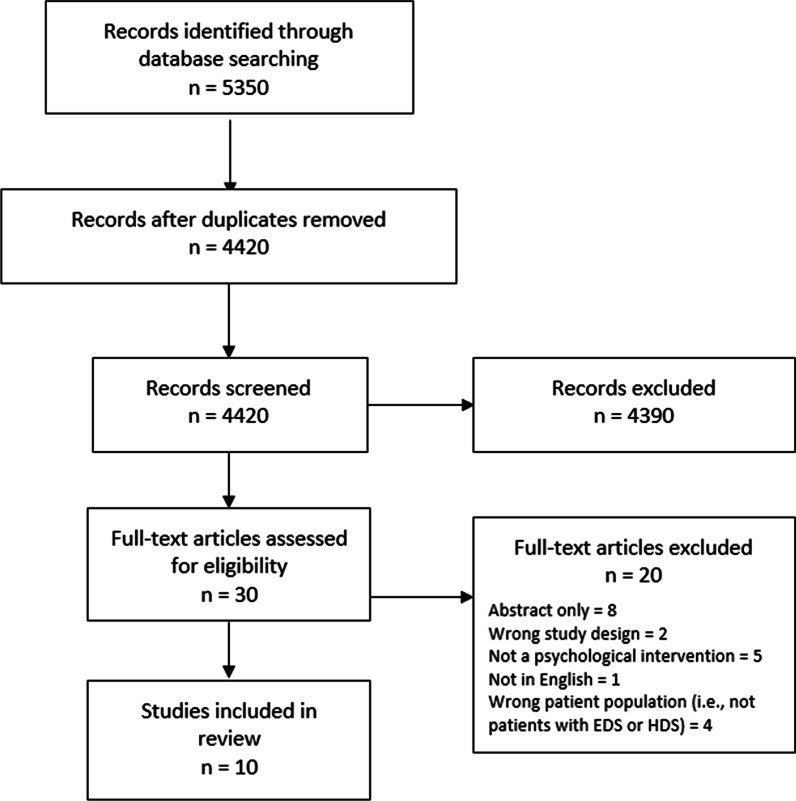
- Only cohort studies and case studies/case reports were identified: 4 case reports, 5 cohort studies, and 1 study with two case reports and a literature review.
- The most common intervention was CBT: 4 studies used CBT techniques; 1 investigated DBT; 2 psychoeducation; 2 IIPT; and 1 ACT.
- Most studies reported improvements in outcomes such as pain, depression, anxiety, quality of life, function, and self-harm-related behaviors, but the paper says these results are inconclusive because the studies were generally small and low quality.
## Methods
- Scoping review design using the Joanna Briggs Institute framework and PRISMA-ScR reporting guidance, with an integrated knowledge translation approach and patient partners involved.
- Searched MEDLINE, CINAHL, EMBASE, and PsycINFO plus targeted grey literature sources; searches were run on March 28, 2021.
- Included English-language studies of psychological interventions for individuals of all ages with EDS and/or HSD; two reviewers independently screened and abstracted data, and results were summarized using numerical counts and content analysis.
## Limitations
- The paper states several limitations: English-language only studies, grey literature limited to three websites, only four databases searched, and the search date (March 28, 2021) means later studies were not included.
- The authors also state that 9 of 10 studies were multidisciplinary, so outcomes cannot be attributed to the psychological component alone, and many interventions were poorly described with missing details on intensity, duration, frequency, and provider training.
- Evident from the text: the evidence base is weakened by small sample sizes (most n < 50), no RCTs, and frequent reliance on case reports, limiting generalizability and validity.
Model-written summary. Check it against the paper before relying on it.
Integrity signals
Registry
Cites
Statistics
Figures
Verification
Claims the paper makes
15 Valid · 0 Not valid · 44 Not checked · 84 Own results and interpretations
Every source the paper cites for this claim was checked and supports it.
In the paper
“there is a lack of high-quality clinical guidelines for managing the psychosocial complexities associated with pain in EDS, limiting evidence-based practice [34].”
§ Psychological interventions for individuals with Ehlers-Danlos syndrome and hypermobility spectrum disorder: a scoping review > Introduction > Gaps in research on psychological interventions
What the sources say
- Supportedcites [34] Sulli A Talarico R Scirè CA Ehlers-Danlos syndromes: state of the art on clinical practice guidelines RMD Open 2018 4 Suppl 1 e000790 30402275 PMC6203099 source
The Results (Identification of existing CPGs; page unavailable) report no good-quality EDS guidelines and say clinical decisions rely on limited evidence. Patients’ unmet needs (page unavailable) describes pain care as multidisciplinary, including psychology, and notes anxiety and depression associated with delayed diagnosis and treatment. Together, these passages support the claim. (LLM, conf=0.88)
plainstates a cause- Asserted: passes — The authors put it forward as true.
- Checkable: passes — It can be checked against evidence.
- Load-bearing: passes — The paper’s conclusions depend on it.
- Based: passes — The paper gives a reason why it holds.
- Supported
The cited sources support only part of this claim — read each source’s verdict below.
In the paper
“Zhou, Rewari, and Shanthanna’s two case reports [52] investigated a 6-session pain management program for individuals with EDS.”
§ Psychological interventions for individuals with Ehlers-Danlos syndrome and hypermobility spectrum disorder: a scoping review > Results > Psychological treatment component characteristics
What the sources say
- Partly supportedcites [52] Zhou Z Rewari A Shanthanna H Management of chronic pain in Ehlers-Danlos syndrome: two case reports and a review of literature Medicine (Baltimore) 2018 97 45 e13115 30407326 PMC6250522 sourceExperimental — accuracy not yet measured
The Case 2 pain-clinic-management section describes a self-management group with six dedicated sessions. The Abstract (Interventions) says both patients participated in pain self-management sessions, but the Case 1 account does not establish that the first patient attended the six-session program. Our copy therefore supports the two-case-report description, but not the six-session detail for both patients. (LLM, conf=0.85)
plainn = 2- Asserted: passes — The authors put it forward as true.
- Checkable: passes — It can be checked against evidence.
- Load-bearing: unclear — It is unclear whether the paper’s conclusions depend on it.
- Based: passes — The paper gives a reason why it holds.
- Partly supported
Every source the paper cites for this claim was checked and supports it.
In the paper
“MBSR has been previously investigated as a treatment for pain in individuals with chronic lower back pain, headache, and fibromyalgia [66].”
§ Psychological interventions for individuals with Ehlers-Danlos syndrome and hypermobility spectrum disorder: a scoping review > Discussion The purpose of this scoping review was to identify the nature and extent of studies investigating psychological interventions for individuals with EDS and HSD (formerly known as JHS). This review included five cohort studies, four case reports, and one study with two case reports. All included studies evaluated psychological interventions for patients with EDS and/or HSD. The most reported intervention was CBT. Notably, majority of participants were female across all studies. This is aligned with the prevalence of EDS and HSD in males and females; a UK cohort study showed that out of 6021 individuals diagnosed with EDS or HSD, roughly 70% were women [53]. We also found that the majority of the treatment paradigms for EDS and/or HSD were multidisciplinary. It should be noted that the psychological components of the treatment plans were poorly described; many of the studies did not provide information detailing the intensity, duration, and/or frequency of interventions. Additionally, the results of case studies may not be generalizable to others within the cohort, and many of the cohort studies had relatively small sample sizes (n < 50). Overall, our findings show that there is a lack of high-quality research on psychological interventions for individuals with EDS and HSD. This is especially problematic because of the high prevalence of psychiatric disorders among individuals with EDS and HSD, which is becoming increasingly evident [54, 55]. Our review adds to the existing commentary about the significance of psychological burden for these individuals while emphasizing the alarming lack of research in this area despite a critical need for appropriate treatments. > Potential psychological interventions not explored in our included studies
What the sources say
- Supportedcites [66] Sturgeon JA Psychological therapies for the management of chronic pain Psychol Res Behav Manag 2014 7 115 124 24748826 PMC3986332 source
The Mindfulness-based stress reduction section reports MBSR findings for back pain, headache, and fibromyalgia. Its cited reference on mindfulness after multidisciplinary treatment specifically concerns chronic low back pain. Our copy provides no page numbers for these passages. (LLM, conf=0.88)
plain- Asserted: passes — The authors put it forward as true.
- Checkable: passes — It can be checked against evidence.
- Load-bearing: unclear — It is unclear whether the paper’s conclusions depend on it.
- Based: passes — The paper gives a reason why it holds.
- Supported
The cited sources support only part of this claim — read each source’s verdict below.
In the paper
“We acknowledge that we may have missed interventions that were subsequently conducted and published, such as the online RCT by Kalisch and colleagues [70].”
§ Psychological interventions for individuals with Ehlers-Danlos syndrome and hypermobility spectrum disorder: a scoping review > Discussion The purpose of this scoping review was to identify the nature and extent of studies investigating psychological interventions for individuals with EDS and HSD (formerly known as JHS). This review included five cohort studies, four case reports, and one study with two case reports. All included studies evaluated psychological interventions for patients with EDS and/or HSD. The most reported intervention was CBT. Notably, majority of participants were female across all studies. This is aligned with the prevalence of EDS and HSD in males and females; a UK cohort study showed that out of 6021 individuals diagnosed with EDS or HSD, roughly 70% were women [53]. We also found that the majority of the treatment paradigms for EDS and/or HSD were multidisciplinary. It should be noted that the psychological components of the treatment plans were poorly described; many of the studies did not provide information detailing the intensity, duration, and/or frequency of interventions. Additionally, the results of case studies may not be generalizable to others within the cohort, and many of the cohort studies had relatively small sample sizes (n < 50). Overall, our findings show that there is a lack of high-quality research on psychological interventions for individuals with EDS and HSD. This is especially problematic because of the high prevalence of psychiatric disorders among individuals with EDS and HSD, which is becoming increasingly evident [54, 55]. Our review adds to the existing commentary about the significance of psychological burden for these individuals while emphasizing the alarming lack of research in this area despite a critical need for appropriate treatments. > Strengths and limitations To our knowledge, this is the only existing scoping review that examines the literature on psychological interventions for individuals with EDS/HSD and identifies various gaps in existing research. It is strengthened by using an experienced information specialist to conduct an exhaustive literature search, as well as multiple reviewers to conduct screening and data extraction independently, in duplicate. The multidisciplinary expertise of our research team (e.g., EDS content experts, methodology experts) helped to strengthen the review, as well as our lifespan approach (e.g., we broadened our search and inclusion criteria to investigate individuals of all ages, rather than just adult or pediatric patients). We also acknowledge some limitations. Since this review included English-language studies only, there may have been a bias toward the inclusion of studies from English-speaking countries. Additionally, we limited our grey literature to three websites (Ehlers-Danlos Society, Ehlers-Danlos Support UK, and Marfan Foundation) on the recommendation of the research team; consequently, we may have excluded important and relevant studies from other sources. Another possible limitation is the search of only MEDLINE, CINAHL, EMBASE, and PsycINFO databases; a wider array of databases may have yielded more articles for inclusion. Additionally, our literature search was conducted on March 28, 2021; thus, we were only able to include articles that had been published by this date, all of which happened to investigate in-person psychological interventions. We acknowledge that we may have missed interventions that were subsequently conducted and published, such as the online RCT by Kalisch and colleagues [70]. It should also be noted that nine of the ten studies were multidisciplinary, meaning that the psychological intervention was only one part of the treatment plan. As a result, it is impossible to ascertain that the outcomes of the treatments were a result of the psychological interventions alone, meaning that the included studies in our review may not accurately reflect the effectiveness of psychological interventions (e.g., the outcomes may have been more influenced by other components of the treatment such as medication or physiotherapy). Overall, more studies are needed that focus on individuals with EDS/HSD to verify the effectiveness of such interventions.
What the sources say
- Partly supportedcites [70] Kalisch L Boniwell I Osin E Baeza-Velasco C Feeling good despite EDS: the effects of a 5-week online positive psychology programme for Ehlers-Danlos-syndromes patients J Contemp Psychother 2022 52 1 79 87 10.1007/s10879-021-09521-8 34667333 PMC8517566 sourceExperimental — accuracy not yet measured
The Method section (Participants, Design, and Procedure; page unavailable) identifies this as an online intervention study with two intervention groups and a waitlist control. It says participants were systematically allocated to groups based on their order of inclusion, not randomly assigned, so the description of it as an RCT is not supported. Whether the citing review missed the study is the citing authors’ own qualification, not a claim this source can establish. (LLM, conf=0.88)
hedged- Asserted: passes — The authors put it forward as true.
- Checkable: passes — It can be checked against evidence.
- Load-bearing: unclear — It is unclear whether the paper’s conclusions depend on it.
- Based: passes — The paper gives a reason why it holds.
- Partly supported
A result the paper reports from its own data — it cites no other source for it, so there is none to check. The quote shows it is in the paper.
In the paper
“one investigated Dialectical Behavioural Therapy (DBT)”
- Also stated in: § Psychological treatment component characteristics · plain
“one study investigated a DBT approach”
§ Psychological interventions for individuals with Ehlers-Danlos syndrome and hypermobility spectrum disorder: a scoping review > Abstract > Results
plain- Asserted: passes — The authors put it forward as true.
- Checkable: passes — It can be checked against evidence.
- Load-bearing: unclear — It is unclear whether the paper’s conclusions depend on it.
- Based: passes — The paper gives a reason why it holds.
- Also stated in: § Psychological treatment component characteristics · plain
53 more claims
Create a free account to see all 143 claims and to verify the 4 references still open.
- It may state two separate claims as one. 60
- Probably not a substantial claim. 38
- The quote only partly states this claim. 1
Citations
Cites
PRISMA Extension for Scoping Reviews (PRISMA-ScR): Checklist and Explanation
Tricco, A. C., Lillie, E., Zarin, W., O'Brien, K. K., Colquhoun, H., Levac, D., Moher, D., Peters, M. D. J., Horsley, T., Weeks, L., et al. (2018) · Annals of Internal Medicine · doi:10.7326/m18-0850 · Cited by 43,565 · cited 1×
“The PRISMA-ScR checklist guided the reporting of this review [38].”
MethodScoping studies: towards a methodological framework
Arksey, H., & O'Malley, L. (2005) · International Journal of Social Research Methodology · doi:10.1080/1364557032000119616 · Cited by 36,742 · cited 2×
“This review used the Joanna Briggs Institute methodological framework for the current scoping review with reference to Arksey and O’Malley’s framework as well [35, 36].”
BackgroundMethodHoffmann, T. C., Glasziou, P. P., Boutron, I., Milne, R., Perera, R., Moher, D., Altman, D. G., Barbour, V., Macdonald, H., Johnston, M., et al. (2014) · BMJ · doi:10.1136/bmj.g1687 · Cited by 10,548 · cited 1×
“We used the Template for Intervention Description and Replication (TIDieR) checklist and guide [42] to inform the data abstraction on the psychological interventions.”
MethodUpdated methodological guidance for the conduct of scoping reviews
Peters, M. D. J., Marnie, C., Tricco, A. C., Pollock, D., Munn, Z., Alexander, L., McInerney, P., Godfrey, C. M., & Khalil, H. (2020) · JBI Evidence Synthesis · doi:10.11124/jbies-20-00167 · Cited by 9,046 · cited 1×
“This review used the Joanna Briggs Institute methodological framework for the current scoping review with reference to Arksey and O’Malley’s framework as well [35, 36].”
MethodPRESS Peer Review of Electronic Search Strategies: 2015 Guideline Statement
McGowan, J., Sampson, M., Salzwedel, D. M., Cogo, E., Foerster, V., & Lefebvre, C. (2016) · Journal of Clinical Epidemiology · doi:10.1016/j.jclinepi.2016.01.021 · Cited by 5,700
The global prevalence of common mental disorders: a systematic review and meta-analysis 1980–2013
Steel, Z., Marnane, C., Iranpour, C., Chey, T., Jackson, J. W., Patel, V., & Silove, D. (2014) · International Journal of Epidemiology · doi:10.1093/ije/dyu038 · Cited by 2,846 · cited 1×
“This is notably higher compared to 17.6% of psychiatric disorders in the general population [23].”
BackgroundInfluentialThe 2017 international classification of the Ehlers–Danlos syndromes
Malfait, F., Francomano, C., Byers, P., Belmont, J., Berglund, B., Black, J., Bloom, L., Bowen, J. M., Brady, A. F., Burrows, N. P., et al. (2017) · American Journal of Medical Genetics Part C: Seminars in Medical Genetics · doi:10.1002/ajmg.c.31552 · Cited by 1,936 · cited 1×
“These difficulties often lead to a greater time to diagnosis compared to other diagnoses with similar symptom profiles (e.g., Marfan syndrome), which may be easily identified clinically and genetically [14, 15].”
BackgroundPsychological therapies for the management of chronic pain (excluding headache) in adults
Williams, A. C. D. C., Eccleston, C., & Morley, S. (2012) · Cochrane Database of Systematic Reviews · doi:10.1002/14651858.cd007407.pub3 · Cited by 1,634 · cited 1×
“Williams et al.’s systematic review [59] demonstrated that when compared with active controls, some small improvements were observed for CBT in terms of pain, disability, and distress for adults with chronic pain, but these improvements were not significant.”
BackgroundEhde, D. M., Dillworth, T. M., & Turner, J. A. (2014) · American Psychologist · doi:10.1037/a0035747 · Cited by 879 · cited 1×
“Such findings parallel those seen in patients with chronic pain [33], suggesting that such interventions may be readily adapted to meet the needs of patients with EDS and HSD.”
Psychological therapies for the management of chronic pain (excluding headache) in adults
Williams, A. C. D. C., Fisher, E., Hearn, L., & Eccleston, C. (2020) · Cochrane Database of Systematic Reviews · doi:10.1002/14651858.cd007407.pub4 · Cited by 605
A framework for the classification of joint hypermobility and related conditions
Castori, M., Tinkle, B., Levy, H., Grahame, R., Malfait, F., & Hakim, A. (2017) · American Journal of Medical Genetics Part C: Seminars in Medical Genetics · doi:10.1002/ajmg.c.31539 · Cited by 602 · cited 1×
“Many symptoms of EDS and HSD are also shared with other diagnoses, such as chronic fatigue syndrome, Marfan syndrome, and osteogenesis imperfecta [12, 13].”
BackgroundTinkle, B., Castori, M., Berglund, B., Cohen, H., Grahame, R., Kazkaz, H., & Levy, H. (2017) · American Journal of Medical Genetics Part C: Seminars in Medical Genetics · doi:10.1002/ajmg.c.31538 · Cited by 499 · cited 1×
“Classical, hypermobile and vascular EDS are the most prevalent, accounting for 79% of the EDS population [6], while hypermobile EDS (formerly EDS type III) is the most common subtype overall [7].”
BackgroundAlperstein, D., & Sharpe, L. (2016) · The Journal of Pain · doi:10.1016/j.jpain.2015.10.021 · Cited by 342
Psychological interventions for coronary heart disease: Cochrane systematic review and meta-analysis
Richards, S. H., Anderson, L., Jenkinson, C. E., Whalley, B., Rees, K., Davies, P., Bennett, P., Liu, Z., West, R., Thompson, D. R., et al. (2018) · European Journal of Preventive Cardiology · doi:10.1177/2047487317739978 · Cited by 319 · cited 2×
“This definition was previously used for a Cochrane systematic review and meta-analysis on psychological interventions for coronary heart disease [39].”
MethodMalfait, F., Castori, M., Francomano, C. A., Giunta, C., Kosho, T., & Byers, P. H. (2020) · Nature Reviews Disease Primers · doi:10.1038/s41572-020-0194-9 · Cited by 316 · cited 2×
“Ehlers-Danlos Syndrome (EDS) comprises a group of rare hereditary connective tissue disorders characterized by several shared clinical features such as joint hypermobility and hyper-extensible skin [1].”
BackgroundAbbott, R. A., Whear, R., Rodgers, L. R., Bethel, A., Thompson Coon, J., Kuyken, W., Stein, K., & Dickens, C. (2014) · Journal of Psychosomatic Research · doi:10.1016/j.jpsychores.2014.02.012 · Cited by 313 · cited 1×
“[68] found similar results for patients with vascular disease in that MBSR was effective in improving depression, anxiety, and psychosocial stress.”
ResultTurk, D. C., Swanson, K. S., & Tunks, E. R. (2008) · The Canadian Journal of Psychiatry · doi:10.1177/070674370805300402 · Cited by 298 · cited 1×
“In accordance with these results, several meta-analyses and reviews have demonstrated the efficacy of CBT for managing pain and improving daily functioning and independence in patients with chronic pain disorders [56, 57].”
ResultClinical and genetic aspects of Ehlers-Danlos syndrome, classic type
Malfait, F., Wenstrup, R. J., & De Paepe, A. (2010) · Genetics in Medicine · doi:10.1097/gim.0b013e3181eed412 · Cited by 293 · cited 1×
“These difficulties often lead to a greater time to diagnosis compared to other diagnoses with similar symptom profiles (e.g., Marfan syndrome), which may be easily identified clinically and genetically [14, 15].”
BackgroundDemmler, J. C., Atkinson, M. D., Reinhold, E. J., Choy, E., Lyons, R. A., & Brophy, S. T. (2019) · BMJ Open · doi:10.1136/bmjopen-2019-031365 · Cited by 271 · cited 1×
“This is aligned with the prevalence of EDS and HSD in males and females; a UK cohort study showed that out of 6021 individuals diagnosed with EDS or HSD, roughly 70% were women [53].”
BackgroundPsychological therapies for the management of chronic pain
Sturgeon, J. (2014) · Psychology Research and Behavior Management · doi:10.2147/prbm.s44762 · Cited by 259
Defining Integrated Knowledge Translation and Moving Forward: A Response to Recent Commentaries
Kothari, A., McCutcheon, C., & Graham, I. D. (2017) · International Journal of Health Policy and Management · doi:10.15171/ijhpm.2017.15 · Cited by 259 · cited 1×
“The overall project uses a collaborative iKT approach that engages all relevant knowledge users and stakeholders (i.e., researchers, clinicians, and patient partners) in the full spectrum of research activities such as setting the objectives and methods and implementation of the research [37].”
Systematic review on intensive interdisciplinary pain treatment of children with chronic pain
Hechler, T., Kanstrup, M., Holley, A. L., Simons, L. E., Wicksell, R., Hirschfeld, G., & Zernikow, B. (2015) · Pediatrics · doi:10.1542/peds.2014-3319 · Cited by 230 · cited 1×
“These findings are consistent with results from a systematic review investigating IIPTs for children with chronic pain [63], which found IIPTs may significantly improve pain symptoms as well as disability short-term; however, the review revealed that there is a lack of well-designed clinical trials…”
ResultLeFort, S. M., Gray-Donald, K., Rowat, K. M., & Jeans, M. E. (1998) · Pain · doi:10.1016/s0304-3959(97)00190-5 · Cited by 211 · cited 1×
“These results are supported by studies investigating psychoeducation for individuals with chronic pain [61, 62].”
ResultChronic Pain and Cognitive Behavioral Therapy: An Integrative Review
Knoerl, R., Lavoie Smith, E. M., & Weisberg, J. (2016) · Western Journal of Nursing Research · doi:10.1177/0193945915615869 · Cited by 194
Mindfulness-based stress reduction: A non-pharmacological approach for chronic illnesses
Niazi, A., & Niazi, S. (2011) · North American Journal of Medical Sciences · doi:10.4297/najms.2011.320 · Cited by 170 · cited 1×
“A 2011 systematic review [67] found that MBSR may significantly decrease anxiety, stress, and depression while improving the quality of life of patients with diseases such as cancer as well as chronic pain disorders.”
BackgroundJoint Hypermobility Syndrome: Recognizing a Commonly Overlooked Cause of Chronic Pain
Kumar, B., & Lenert, P. (2017) · The American Journal of Medicine · doi:10.1016/j.amjmed.2017.02.013 · Cited by 153 · cited 2×
“HSD/JHS is occasionally classified as a milder variant of hypermobile EDS by health authorities because the two conditions share many clinical features, although this classification is not widely used [9].”
BackgroundPsychiatric and psychological aspects in the Ehlers–Danlos syndromes
Bulbena, A., Baeza‐Velasco, C., Bulbena‐Cabré, A., Pailhez, G., Critchley, H., Chopra, P., Mallorquí‐Bagué, N., Frank, C., & Porges, S. (2017) · American Journal of Medical Genetics Part C: Seminars in Medical Genetics · doi:10.1002/ajmg.c.31544 · Cited by 149 · cited 1×
“This is especially problematic because of the high prevalence of psychiatric disorders among individuals with EDS and HSD, which is becoming increasingly evident [54, 55].”
BackgroundMallorquÃ-Bagué, N., Garfinkel, S. N., Engels, M., Eccles, J. A., Pailhez, G., Bulbena, A., & Critchley, H. D. (2014) · Frontiers in Psychology · doi:10.3389/fpsyg.2014.01162 · Cited by 126 · cited 1×
“[24] found that hypermobile individuals experienced significantly higher state anxiety compared to those who were not hypermobile and that this relationship was mediated by interoceptive sensitivity (i.”
BackgroundOutcome of invasive treatment modalities on back pain and sciatica: an evidence-based review
van Tulder, M. W., Koes, B., Seitsalo, S., & Malmivaara, A. (2006) · European Spine Journal · doi:10.1007/s00586-005-1049-5 · Cited by 124 · cited 1×
“In accordance with these results, several meta-analyses and reviews have demonstrated the efficacy of CBT for managing pain and improving daily functioning and independence in patients with chronic pain disorders [56, 57].”
ResultBulbena, A., Gago, J., Pailhez, G., Sperry, L., Fullana, M. A., & Vilarroya, O. (2011) · General Hospital Psychiatry · doi:10.1016/j.genhosppsych.2011.03.004 · Cited by 113
Joint hypermobility syndrome pain
Grahame, R. (2009) · Current Pain and Headache Reports · doi:10.1007/s11916-009-0070-5 · Cited by 111 · cited 2×
“Complications associated with HSD may inlude central and peripheral nervous system abnormalities; for example, many experience increased pain, resistance to local anesthetics, and gastrointestinal complications [10].”
BackgroundScheper, M., de Vries, J. E., Verbunt, J., & Engelbert, R. H. H. (2015) · Journal of Pain Research · doi:10.2147/jpr.s64251 · Cited by 105 · cited 1×
“Thus, it has been suggested that psychological approaches [30, 31], particularly to address chronic pain observed among individuals with EDS, may be helpful for recovery and rehabilitation.”
BackgroundRombaut, L., Malfait, F., De Paepe, A., Rimbaut, S., Verbruggen, G., De Wandele, I., & Calders, P. (2011) · Arthritis & Rheumatism · doi:10.1002/art.30337 · Cited by 91 · cited 2×
“However, previous studies by Rombaut and colleagues [26] and Grahame [27] highlighted limitations of common pharmacological and physical interventions, noting that analgesics, non-steroidal anti-inflammatory drugs, psychotropics, and physiotherapy are often ineffective to address pain among…”
BackgroundPsychosocial functioning in the Ehlers–Danlos syndrome
Lumley, M. A., Jordan, M., Rubenstein, R., Tsipouras, P., & Evans, M. I. (1994) · American Journal of Medical Genetics · doi:10.1002/ajmg.1320530206 · Cited by 90 · cited 2×
“For example, many patients are misdiagnosed for years or accused of malingering, leading to mistrust of the medical/health care system and self-doubt [19].”
BackgroundSinibaldi, L., Ursini, G., & Castori, M. (2015) · American Journal of Medical Genetics Part C: Seminars in Medical Genetics · doi:10.1002/ajmg.c.31430 · Cited by 87 · cited 2×
“…psychiatric disorders and psychosocial impairment are also common among individuals with EDS and HSD. Specifically, EDS and HSD have been associated with increased risk of conditions such as depression and anxiety as well as interpersonal issues when compared to the general population [17–21].”
BackgroundBathen, T., Hångmann, A. B., Hoff, M., Andersen, L. Ø., & Rand‐Hendriksen, S. (2013) · American Journal of Medical Genetics Part A · doi:10.1002/ajmg.a.36060 · Cited by 86 · cited 9×
“There were four case reports [44–47], five cohort studies [32, 48–51], and one study that featured two case reports and a literature review [52].”
BackgroundMethodResultInfluentialHershenfeld, S. A., Wasim, S., McNiven, V., Parikh, M., Majewski, P., Faghfoury, H., & So, J. (2016) · Rheumatology International · doi:10.1007/s00296-015-3375-1 · Cited by 81 · cited 1×
“In a cohort study of 106 patients with hypermobility-type EDS, Hershenfeld et al. [22] determined that psychiatric disorders were found in 42.5% of the cohort, with 22.7% of patients affected with 2 or more psychiatric diagnoses.”
BackgroundInfluentialBaeza-Velasco, C., Pailhez, G., Bulbena, A., & Baghdadli, A. (2015) · General Hospital Psychiatry · doi:10.1016/j.genhosppsych.2014.10.002 · Cited by 67 · cited 1×
“…psychiatric disorders and psychosocial impairment are also common among individuals with EDS and HSD. Specifically, EDS and HSD have been associated with increased risk of conditions such as depression and anxiety as well as interpersonal issues when compared to the general population [17–21].”
Halverson, C. M. E., Clayton, E. W., Garcia Sierra, A., & Francomano, C. (2021) · American Journal of Medical Genetics Part C: Seminars in Medical Genetics · doi:10.1002/ajmg.c.31935 · Cited by 64 · cited 2×
“In a qualitative study of adults with EDS, it was revealed that many had shown symptoms as children that were overlooked and misdiagnosed by their families and healthcare professionals [16].”
BackgroundZernikow, B., Ruhe, A.-K., Stahlschmidt, L., Schmidt, P., Staratzke, T., Frosch, M., & Wager, J. (2018) · Pain Medicine · doi:10.1093/pm/pnx067 · Cited by 61 · cited 1×
“An observational study published by Zernikow et al. [64] investigated IIPTs for adolescents and children with chronic pain.”
Castori, M., Celletti, C., Camerota, F., & Grammatico, P. (2011) · PubMed · Cited by 59
Pasquini, M., Celletti, C., Berardelli, I., Roselli, V., Mastroeni, S., Castori, M., Biondi, M., & Camerota, F. (2014) · Rheumatology International · doi:10.1007/s00296-013-2901-2 · Cited by 51 · cited 1×
“The exact reasons for the high rates of psychiatric disorders are unclear, but it is likely that the aforementioned physical symptoms (e.g., chronic pain and other medically unexplained symptoms) play a major role [20].”
BackgroundBaeza-Velasco, C., Bulbena, A., Polanco-Carrasco, R., & Jaussaud, R. (2019) · Disability and Rehabilitation · doi:10.1080/09638288.2017.1419294 · Cited by 51 · cited 2×
“Despite these promising outcomes, it has been suggested that more research is needed on relevant psychosocial strategies for individuals with EDS [31].”
BackgroundPain in Ehlers-Danlos syndromes: manifestations, therapeutic strategies and future perspectives
Castori, M. (2016) · Expert Opinion on Orphan Drugs · doi:10.1080/21678707.2016.1238302 · Cited by 46 · cited 1×
“In addition, individuals with EDS experience increased side effects of pain medications [28]; orthopedic procedures are indicated for pain relief in only selected patients [29].”
BackgroundManagement of chronic pain in Ehlers–Danlos syndrome: Two case reports and a review of literature
Zhou, Z., Rewari, A., & Shanthanna, H. (2018) · Medicine · doi:10.1097/md.0000000000013115 · Cited by 46
Ehlers-Danlos syndromes: state of the art on clinical practice guidelines
Sulli, A., Talarico, R., Scirè, C. A., Avcin, T., Castori, M., Ferraris, A., Frank, C., Grunert, J., Paolino, S., Bombardieri, S., et al. (2018) · RMD Open · doi:10.1136/rmdopen-2018-000790 · Cited by 44 · cited 2×
“Similarly, there is a lack of high-quality clinical guidelines for managing the psychosocial complexities associated with pain in EDS, limiting evidence-based practice [34].”
BackgroundBulbena‐Cabré, A., Baeza‐Velasco, C., Rosado‐Figuerola, S., & Bulbena, A. (2021) · American Journal of Medical Genetics Part C: Seminars in Medical Genetics · doi:10.1002/ajmg.c.31955 · Cited by 41 · cited 1×
“This is especially problematic because of the high prevalence of psychiatric disorders among individuals with EDS and HSD, which is becoming increasingly evident [54, 55].”
BackgroundPalmer, S., Davey, I., Oliver, L., Preece, A., Sowerby, L., & House, S. (2020) · Clinical Rheumatology · doi:10.1007/s10067-020-05284-0 · Cited by 40 · cited 1×
“…headings and text words related to psychological interventions for individuals with EDS and/or HSD were developed from two systematic reviews [39, 40], as well as the search strategy used by our research team on psychological interventions for adults with cerebral palsy, childhood-onset acquired…”
MethodEhlers-Danlos Syndrome: An Analysis of the Current Treatment Options
Song, B., Yeh, P., Nguyen, D., Ikpeama, U., Epstein, M., & Harrell, J. (2020) · Pain Physician · doi:10.36076/ppj.2020/23/429 · Cited by 38
Randall, E. T., Smith, K. R., Conroy, C., Smith, A. M., Sethna, N., & Logan, D. E. (2018) · The Clinical Journal of Pain · doi:10.1097/ajp.0000000000000616 · Cited by 37 · cited 7×
“It may include nutrition, recreation, and expressive art therapies in addition to physical/ occupational/CBT therapies [50].”
BackgroundMethodInfluentialEffects of a psychoeducational program for chronic pain management
Salvetti, M. D. G., Cobelo, A., Vernalha, P. D. M., Vianna, C. I. D. A., Canarezi, L. C. C. C. C., & Calegare, R. G. L. (2012) · Revista Latino-Americana de Enfermagem · doi:10.1590/s0104-11692012000500011 · Cited by 35 · cited 1×
“These results are supported by studies investigating psychoeducation for individuals with chronic pain [61, 62].”
ResultRevivo, G., Amstutz, D. K., Gagnon, C. M., & McCormick, Z. L. (2019) · PM&R · doi:10.1016/j.pmrj.2018.06.018 · Cited by 33 · cited 9×
“There were four case reports [44–47], five cohort studies [32, 48–51], and one study that featured two case reports and a literature review [52].”
BackgroundMethodResultInfluentialMiklovic, T., & Sieg, V. (2019) · StatPearls · Cited by 29
Mittal, N., Mina, D. S., McGillis, L., Weinrib, A., Slepian, P. M., Rachinsky, M., Buryk-Iggers, S., Laflamme, C., Lopez-Hernandez, L., Hussey, L., et al. (2021) · Orphanet Journal of Rare Diseases · doi:10.1186/s13023-021-01962-7 · Cited by 28 · cited 1×
“While some individuals are asymptomatic for their entire lives, many others experience multi-systemic and multi-factorial complications, including neurological, gastrointestinal, and cardiovascular complications, breathing difficulties, organ rupture, joint dislocation, and chronic pain [2–5].”
BackgroundSelf-citationEfficacy of an out-patient pain management programme for people with joint hypermobility syndrome
Rahman, A., Daniel, C., & Grahame, R. (2014) · Clinical Rheumatology · doi:10.1007/s10067-014-2539-9 · Cited by 26 · cited 9×
“Rahman, Daniel, and Grahame’s cohort study [49] investigated a 6-week multidisciplinary pain management program that used CBT techniques for individuals with JHS-related pain.”
BackgroundMethodInfluentialPsychoeducation for Patients with Fibromyalgia: A Systematic Review
Gómez-de-Regil, L. (2021) · Healthcare · doi:10.3390/healthcare9060737 · Cited by 22 · cited 2×
“A 2021 systematic review by Gómez-de-Regil [60] on psychoeducational interventions for patients with fibromyalgia revealed that interventions were able to significantly improve patients’ pain intensity, fatigue, sleep quality, depression, anxiety, functional ability cognitive impairment, and quality of life.”
Ehlers-Danlos Syndrome, classical type: case management.
Whitelaw, S. E. (2004) · PubMed · Cited by 20
Jefferies, M., Peart, T., Perrier, L., Lauzon, A., & Munce, S. (2022) · Frontiers in Pediatrics · doi:10.3389/fped.2022.782104 · Cited by 20 · cited 1×
“…psychological interventions for individuals with EDS and/or HSD were developed from two systematic reviews [39, 40], as well as the search strategy used by our research team on psychological interventions for adults with cerebral palsy, childhood-onset acquired brain injury, and spina bifida [41].”
BackgroundSelf-citationManaging Chronic Pain in a Young Adolescent Girl with Ehlers-Danlos Syndrome
Branson, J. A., Kozlowska, K., Kaczynski, K. J., & Roesler, T. A. (2011) · Harvard Review of Psychiatry · doi:10.3109/10673229.2011.614484 · Cited by 19 · cited 9×
“In terms of outcome measures, two of the studies did not outline clear outcome measures [44, 45], while the other eight listed multiple outcome measures which included at least one that measured pain levels.”
BackgroundMethodResultInfluentialChronic pain management issues in the primary care setting and the utility of long-acting opioids
Zorba Paster, R. (2010) · Expert Opinion on Pharmacotherapy · doi:10.1517/14656566.2010.491510 · Cited by 17
Chaleat-Valayer, E., Amélie, Z., Marie-Hélène, B., Perretant, I., Monique, B., Pauline, O., & Sandrine, T. (2019) · Education Thérapeutique du Patient - Therapeutic Patient Education · doi:10.1051/tpe/2019002 · Cited by 17 · cited 10×
“Notably, Chaleat-Valayer et al.’s cohort study [48] found significant improvements in the patients’ self-image as well as the knowledge and skills of patients and their relatives.”
BackgroundMethodResultInfluentialKalisch, L., Boniwell, I., Osin, E., & Baeza-Velasco, C. (2022) · Journal of Contemporary Psychotherapy · doi:10.1007/s10879-021-09521-8 · Cited by 12 · cited 1×
“We acknowledge that we may have missed interventions that were subsequently conducted and published, such as the online RCT by Kalisch and colleagues [70].”
MethodCornelia de Lange and Ehlers-Danlos: comorbidity of two rare syndromes
Cravero, C., Guinchat, V., Barete, S., & Consoli, A. (2016) · BMJ Case Reports · doi:10.1136/bcr-2015-210925 · Cited by 11 · cited 8×
“In terms of outcome measures, two of the studies did not outline clear outcome measures [44, 45], while the other eight listed multiple outcome measures which included at least one that measured pain levels.”
BackgroundMethodInfluentialKnowlton, C. N., Kryvanos, A., Poole, M., Christopher, M., & Lafavor, T. (2019) · Clinical Case Studies · doi:10.1177/1534650119839156 · Cited by 11 · cited 10×
“There were four case reports [44–47], five cohort studies [32, 48–51], and one study that featured two case reports and a literature review [52].”
BackgroundMethodResultInfluentialHamonet, C., Gompel, A., Raffray, Y., Zeitoun, J. D., Delarue, M., Vlamynck, E., Haidar, R., & Mazaltarine, G. (2014) · Douleurs : Evaluation - Diagnostic - Traitement · doi:10.1016/j.douler.2014.09.003 · Cited by 11
Henry, J., Collins, E., Griffin, A., & Zimbron, J. (2021) · Case Reports in Psychiatry · doi:10.1155/2021/6664666 · Cited by 5 · cited 14×
“The ten studies included participants with EDS (hypermobile [32, 44, 48, 51, 52], classic [45], vascular [47], or unspecified [46, 50, 52] subtype) and/or JHS [32, 44, 49, 51].”
BackgroundMethodResultInfluential(2000) · PubMed
Research works printed but not linked: 3
- Levy HP Adam MP Everman DB Mirzaa GM Pagon RA Wallace SE Bean LJH Gripp KW Amemiya A Hypermobile Ehlers-Danlos syndrome GeneReviews® [internet] 2004 Seattle University of Washington 1993 2022
- Malfait F Wenstrup R De Paepe A Adam MP Everman DB Mirzaa GM Classic Ehlers-Danlos syndrome GeneReviews® [internet] 2007 Seattle University of Washington 1993 2022
- Hamonet C Gompel A Raffray Y Multiple pains in Ehlers-Danlos syndrome. Description and proposal of a therapy protocol Douleurs 2014 15 264 277
Cited by
Udugampolage, N. S., Taurino, J., Bassotti, A., Pini, A., Caruso, R., Callus, E., Magon, A., Conte, G., Angeli, G. D., Paglione, G., et al. (2025) · BMJ Open · doi:10.1136/bmjopen-2024-087298 · Cited by 5
Slepian, P. M., Axenova, K., McCarthy, M., Siegal, R., Gobin, K. C., Weinrib, A., Buryk-Iggers, S., Mina, D. S., McGillis, L., Mittal, N., et al. (2025) · Orphanet Journal of Rare Diseases · doi:10.1186/s13023-025-03550-5 · Cited by 6
Self-citationChew, M. T., İlhan, E., Nicholson, L. L., Kobayashi, S., & Chan, C. L. (2024) · Disability and Rehabilitation · doi:10.1080/09638288.2024.2351180 · Cited by 3
“Based on a recent scoping review, there is little research into the use of psychological interventions in hEDS/ HSD and not enough high-quality evidence to support their routine use [54].”
Hauser, R. A., Griffiths, M., Watterson, A., Matias, D. P., & Rawlings, B. R. (2026) · Journal of Clinical Medicine · doi:10.3390/jcm15062212 · Cited by 5
Flegge, L. G., Estrella, E., Harris, E. K., Hirsh, A. T., & Bushey, M. A. (2025) · Frontiers in Pain Research · doi:10.3389/fpain.2025.1472160
Metadata
- Authors
- Song, J. Z., Luong, D., Feldman, E. C. H., Tran, S., Perrier, L., Eubanks, K., Bayley, M., Kastner, M., Slepian, M., & Munce, S. E. P.
- Affiliations
- University Health Network (CA)
- Cincinnati Children's Hospital Medical Center (US)
- DePaul University (US)
- University of Toronto (CA)
- Corresponding author
- Song, Jessica Z.
- ORCID
- Venue
- Orphanet Journal of Rare Diseases
- Published
- 2023-08-31
- Volume
- 18
- Issue
- 1
- Pages
- 254-254
- ISSN
- 1750-1172 (ISSN-L)
- PMC
- PMC10472575
- OpenAlex
- W4386325928
- Semantic Scholar
- 69609183d45e7c313b3cb4bea0152a7826ef8a78
- Cited by
- 9
- References
- 68
- Citations by year
- 2026: 4 · 2025: 4 · 2024: 1
- FWCI
- 0.35
- Type
- journal article
- Language
- en
- Open access
- gold
- doi.org
- Licence
- cc-by
- creativecommons.org/licenses/by/4.0 (tdm)
- creativecommons.org/licenses/by/4.0 (vor)
- Locations
- Orphanet Journal of Rare Diseases (publishedVersion, cc-by)
- PubMed Central (publishedVersion, cc-by)
- PubMed (publishedVersion)
- DOAJ (DOAJ: Directory of Open Access Journals) (submittedVersion, cc-by-sa)
- Funders
- 2020 GoodHope Ehlers-Danlos Syndrome Foundation Grant (Toronto General & Western Hospital Foundation). (2020 GoodHope Ehlers-Danlos Syndrome Foundation Grant (Toronto General & Western Hospital Foundation).)
- Topics
- Life Sciences › Biochemistry, Genetics and Molecular Biology › Genetics › Connective tissue disorders research
- Health Sciences › Health Professions › Physical Therapy, Sports Therapy and Rehabilitation › Musculoskeletal pain and rehabilitation
- Social Sciences › Psychology › Experimental and Cognitive Psychology › Anxiety, Depression, Psychometrics, Treatment, Cognitive Processes
- Keywords
- Ehlers-Danlos syndrome, hypermobility spectrum disorders, psychological intervention, cognitive behavioral therapy, dialectical behavior therapy, psychoeducation, acceptance and commitment therapy, chronic pain management, self-destructive behaviour, depression, anxiety
- MeSH terms
- Psychosocial Intervention, Ehlers-Danlos Syndrome, Humans, Pain, Sample Size
About these checks
Registry, retraction, Cites and statistics results are computed, not judged, with one exception: a printed reference that no index lists is read once by a model before it counts as a citation error. Claims are extracted by a model and kept only when their quote appears verbatim in the text; each cited source is then checked, with a model’s help, for whether it says what the claim relies on. Those verdicts can be wrong — read the claim’s quote and the cited source before relying on one.
The claim verdicts this report counts are experimental: their accuracy is not yet measured.
A language model drew the claims from the paper on 2026-10-11, under version 3 of the claim definition (model deepseek-v4.1-flash, prompt extract-v3).
A second model labelled each claim on 2026-10-11 (model jev-1.13-20260917, definition revision gold-guideline-v0.2).
Cited sources are checked with a language model’s help (gpt-6-sol).
Statistics and arithmetic are recomputed, not judged.
Confidence bands are shown only for fields calibrated on our annotated test set. None is calibrated yet, so no band is shown.
What counts as a claim ›How we measure confidence ›How we check this ›
Are you an author, or do you see a problem with this page? Request a review
Data sources
Bibliographic data: Semantic Scholar, OpenAlex, Crossref.
Contains information from the Semantic Scholar Academic Graph Datasets, made available under the ODC Attribution License (ODC-BY 1.0).
Semantic Scholar’s data is described in: Kinney, R., et al. (2023). The Semantic Scholar Open Data Platform. arXiv:2301.10140.
