

TREM2 in CNS homeostasis and neurodegenerative disease
Open accessThe DOI matches its Crossref record; 86 of the 86 references it cites were found in a registry or an index.
Abstract
Myeloid-lineage cells accomplish a myriad of homeostatic tasks including the recognition of pathogens, regulation of the inflammatory milieu, and mediation of tissue repair and regeneration. The innate immune receptor and its adaptor protein—triggering receptor expressed on myeloid cells 2 (TREM2) and DNAX-activating protein of 12 kDa (DAP12)—possess the ability to modulate critical cellular functions via crosstalk with diverse signaling pathways. As such, mutations in TREM2 and DAP12 have been found to be associated with a range of disease phenotypes. In particular, mutations in TREM2 increase the risk for Alzheimer's disease and other neurodegenerative disorders. The leading hypothesis is that microglia, the resident immune cells of the central nervous system, are the major myeloid cells affected by dysregulated TREM2-DAP12 function. Here, we review how impaired signaling by the TREM2-DAP12 pathway leads to altered immune responses in phagocytosis, cytokine production, and microglial proliferation and survival, thus contributing to disease pathogenesis.
Overview
The claims and statistics of this paper haven’t been checked yet.
Free: it reads the open-access text and checks the first 5 claims that cite a source we can check. Create a free account to check every claim.
Integrity signals
Registry
Cites
Statistics
Figures
Verification
Claims the paper makes
The claims and statistics of this paper haven’t been checked yet.
Free: it reads the open-access text and checks the first 5 claims that cite a source we can check. Create a free account to check every claim.
Claims other papers make about this one
Each is checked against this paper’s own text: does it say what the citing paper says it does?
The source backs part of the claim, not all of it — or backs it for a different population, condition or comparison.
In the citing paper
“In microglia, TREM2-DAP12 induces an M2-like activation44 and participates in recognition of membrane debris and amyloid deposits resulting in microglial activation and proliferation45-47.”
From Rare coding variants in PLCG2, ABI3, and TREM2 implicate microglial-mediated innate immunity in Alzheimer's disease (2017) · cites this paper as [45]
Experimental — accuracy not yet measuredThe cited source says what the claim attributes to it.
In the citing paper
“One of the downstream pathways of TREM2-TYROBP is small GTPases in the Ras-homologous (Rho) family (e.g., Cdc42, Rac) (49, 50).”
From The effect of Abi3 locus deletion on the progression of Alzheimer’s disease-related pathologies (2023) · cites this paper as [50]
In the citing paper
“TREM2 inhibits pro-inflammatory cytokine production, facilitates phagocytosis and promotes cell survival. Thus, TREM2 dysfunction could induce the loss of the homeostasis in the tissue (Painter et al., 2015).”
From The role of microglia in retinal neurodegeneration: Alzheimer’s disease, parkinson, and glaucoma. (2017) · cites this paper as Painter et al., 2015
Self-check
Percentages, sums and reported differences re-computed from the paper’s own numbers.
The self-check needs the paper’s full text.
Citations
Cites
The Amyloid Hypothesis of Alzheimer’s Disease: Progress and Problems on the Road to Therapeutics
Hardy, J., & Selkoe, D. J. (2002) · Science · doi:10.1126/science.1072994 · Cited by 13,864
Amyloid oligomers exacerbate tau pathology in a mouse model of tauopathy
Selenica, M.-L. B., Brownlow, M., Jimenez, J. P., Lee, D. C., Pena, G., Dickey, C. A., Gordon, M. N., & Morgan, D. (2013) · Neurodegenerative Diseases · doi:10.1159/000337230 · Cited by 10,359
The role of pattern-recognition receptors in innate immunity: update on Toll-like receptors
Kawai, T., & Akira, S. (2010) · Nature Immunology · doi:10.1038/ni.1863 · Cited by 9,304
Goate, A., Chartier-Harlin, M.-C., Mullan, M., Brown, J., Crawford, F., Fidani, L., Giuffra, L., Haynes, A., Irving, N., James, L., et al. (1991) · Nature · doi:10.1038/349704a0 · Cited by 4,659 · cited 1×
“Familial, earlyonset AD (EOAD; <65 years) accounts for <1 % of total cases [39] and are caused by mutations in the APP, PSEN1, or PSEN2 genes [40–42].”
BackgroundJack, C. R., Knopman, D. S., Jagust, W. J., Petersen, R. C., Weiner, M. W., Aisen, P. S., Shaw, L. M., Vemuri, P., Wiste, H. J., Weigand, S. D., et al. (2013) · The Lancet Neurology · doi:10.1016/s1474-4422(12)70291-0 · Cited by 4,396
Strittmatter, W. J., Saunders, A. M., Schmechel, D., Pericak-Vance, M., Enghild, J., Salvesen, G. S., & Roses, A. D. (1993) · Proceedings of the National Academy of Sciences · doi:10.1073/pnas.90.5.1977 · Cited by 4,268 · cited 2×
“In independent patient cohorts, both research groups found that the TREM2 SNP rs75932628-T, encoding the putative p.R47H variant, conferred a significantly increased risk of LOAD with odds ratios of 5.05 [18] and 2.92 [19]—which are comparable to that of APOE ε4 [46].”
BackgroundInfluentialCloning of a gene bearing missense mutations in early-onset familial Alzheimer's disease
Sherrington, R., Rogaev, E. I., Liang, Y., Rogaeva, E. A., Levesque, G., Ikeda, M., Chi, H., Lin, C., Li, G., Holman, K., et al. (1995) · Nature · doi:10.1038/375754a0 · Cited by 4,051 · cited 1×
“Familial, earlyonset AD (EOAD; <65 years) accounts for <1 % of total cases [39] and are caused by mutations in the APP, PSEN1, or PSEN2 genes [40–42].”
BackgroundVassar, R., Bennett, B. D., Babu-Khan, S., Kahn, S., Mendiaz, E. A., Denis, P., Teplow, D. B., Ross, S., Amarante, P., Loeloff, R., et al. (1999) · Science · doi:10.1126/science.286.5440.735 · Cited by 3,876
Apolipoprotein E and Alzheimer disease: risk, mechanisms and therapy
Liu, C.-C., Kanekiyo, T., Xu, H., & Bu, G. (2013) · Nature Reviews Neurology · doi:10.1038/nrneurol.2012.263 · Cited by 3,459 · cited 2×
“In independent patient cohorts, both research groups found that the TREM2 SNP rs75932628-T, encoding the putative p.R47H variant, conferred a significantly increased risk of LOAD with odds ratios of 5.05 [18] and 2.92 [19]—which are comparable to that of APOE ε4 [46].”
BackgroundInfluentialSelf-citationHarold, D., Abraham, R., Hollingworth, P., Sims, R., Gerrish, A., Hamshere, M. L., Pahwa, J. S., Moskvina, V., Dowzell, K., Williams, A., et al. (2009) · Nature Genetics · doi:10.1038/ng.440 · Cited by 3,326 · cited 3×
“org/publicdomain/ze and immunological disease phenotypes [1–7].”
BackgroundTREM2 Variants in Alzheimer's Disease
Guerreiro, R., Wojtas, A., Bras, J., Carrasquillo, M., Rogaeva, E., Majounie, E., Cruchaga, C., Sassi, C., Kauwe, J. S. K., Younkin, S., et al. (2013) · New England Journal of Medicine · doi:10.1056/nejmoa1211851 · Cited by 3,020 · cited 8×
“been shown to increase the risk of developing neurological diseases [10–25, 1, 5–7].”
BackgroundResultInfluentialSelf-citationScheuner, D., Eckman, C., Jensen, M., Song, X., Citron, M., Suzuki, N., Bird, T. D., Hardy, J., Hutton, M., Kukull, W., et al. (1996) · Nature Medicine · doi:10.1038/nm0896-864 · Cited by 2,599 · cited 1×
“tations found in patients with familial EOAD—APP, or PSEN1 and PSEN2, components of the γ-secretase complex—result in overproduction of amyloidogenic Aβ [50].”
BackgroundVariant of TREM2 Associated with the Risk of Alzheimer's Disease
Jonsson, T., Stefansson, H., Steinberg, S., Jonsdottir, I., Jonsson, P. V., Snaedal, J., Bjornsson, S., Huttenlocher, J., Levey, A. I., Lah, J. J., et al. (2013) · New England Journal of Medicine · doi:10.1056/nejmoa1211103 · Cited by 2,558 · cited 2×
“[19] performed genome-wide association analysis with variants that were predicted to affect protein function.”
MethodIdentification of a unique TGF-β–dependent molecular and functional signature in microglia
Butovsky, O., Jedrychowski, M. P., Moore, C. S., Cialic, R., Lanser, A. J., Gabriely, G., Koeglsperger, T., Dake, B., Wu, P. M., Doykan, C. E., et al. (2014) · Nature Neuroscience · doi:10.1038/nn.3599 · Cited by 2,543 · cited 1×
“Cell culture experiments using primary microglia expanded in conditioned media with colony-stimulating factor (CSF-1), which mimics the in vivo microenvironment [79], demonstrated that glia from 5XFAD-Trem2 −/− mice were significantly less viable than controls [62].”
MethodGenome-wide association study identifies variants at CLU and CR1 associated with Alzheimer's disease
the European Alzheimer's Disease Initiative Investigators, Lambert, J.-C., Heath, S., Even, G., Campion, D., Sleegers, K., Hiltunen, M., Combarros, O., Zelenika, D., Bullido, M. J., et al. (2009) · Nature Genetics · doi:10.1038/ng.439 · Cited by 2,234
Immune attack: the role of inflammation in Alzheimer disease
Heppner, F. L., Ransohoff, R. M., & Becher, B. (2015) · Nature Reviews Neuroscience · doi:10.1038/nrn3880 · Cited by 2,134 · cited 2×
“Aβ aggregates can activate classical innate immune microbial receptors [48].”
BackgroundRogaev, E. I., Sherrington, R., Rogaeva, E. A., Levesque, G., Ikeda, M., Liang, Y., Chi, H., Lin, C., Holman, K., Tsuda, T., et al. (1995) · Nature · doi:10.1038/376775a0 · Cited by 2,052
Initiative, T. A. D. N., Hollingworth, P., CHARGE consortium, EADI1 consortium, Harold, D., Sims, R., Gerrish, A., Lambert, J.-C., Carrasquillo, M. M., Abraham, R., et al. (2011) · Nature Genetics · doi:10.1038/ng.803 · Cited by 1,997 · cited 2×
“Hollingworth P, Harold D, Sims R, Gerrish A, Lambert J-C, Carrasquillo MM, et al. Common variants at ABCA7, MS4A6A/MS4A4E, EPHA1, CD33 and CD2AP are associated with Alzheimer’s disease.”
BackgroundNaj, A. C., Jun, G., Beecham, G. W., Wang, L.-S., Vardarajan, B. N., Buros, J., Gallins, P. J., Buxbaum, J. D., Jarvik, G. P., Crane, P. K., et al. (2011) · Nature Genetics · doi:10.1038/ng.801 · Cited by 1,901 · cited 2×
“Hollingworth P, Harold D, Sims R, Gerrish A, Lambert J-C, Carrasquillo MM, et al. Common variants at ABCA7, MS4A6A/MS4A4E, EPHA1, CD33 and CD2AP are associated with Alzheimer’s disease.”
BackgroundTREM2 Lipid Sensing Sustains the Microglial Response in an Alzheimer’s Disease Model
Wang, Y., Cella, M., Mallinson, K., Ulrich, J. D., Young, K. L., Robinette, M. L., Gilfillan, S., Krishnan, G. M., Sudhakar, S., Zinselmeyer, B. H., et al. (2015) · Cell · doi:10.1016/j.cell.2015.01.049 · Cited by 1,736
The microglial sensome revealed by direct RNA sequencing
Hickman, S. E., Kingery, N. D., Ohsumi, T. K., Borowsky, M. L., Wang, L.-C., Means, T. K., & El Khoury, J. (2013) · Nature Neuroscience · doi:10.1038/nn.3554 · Cited by 1,511
Bouchon, A., Dietrich, J., & Colonna, M. (2000) · The Journal of Immunology · doi:10.4049/jimmunol.164.10.4991 · Cited by 1,284 · cited 1×
“It contains an extracellular domain, a transmembrane domain, and a short cytoplasmic tail [26].”
BackgroundTakahashi, K., Rochford, C. D. P., & Neumann, H. (2005) · The Journal of Experimental Medicine · doi:10.1084/jem.20041611 · Cited by 1,124
Microglial cell origin and phenotypes in health and disease
Saijo, K., & Glass, C. K. (2011) · Nature Reviews Immunology · doi:10.1038/nri3086 · Cited by 1,100 · cited 1×
“of the TLR subtypes [54].”
Immunoreceptor DAP12 bearing a tyrosine-based activation motif is involved in activating NK cells
Lanier, L. L., Corliss, B. C., Wu, J., Leong, C., & Phillips, J. H. (1998) · Nature · doi:10.1038/35642 · Cited by 904
Innate immunity in Alzheimer's disease
Heneka, M. T., Golenbock, D. T., & Latz, E. (2015) · Nature Immunology · doi:10.1038/ni.3102 · Cited by 902
TREM2 mutations implicated in neurodegeneration impair cell surface transport and phagocytosis
Kleinberger, G., Yamanishi, Y., Suárez-Calvet, M., Czirr, E., Lohmann, E., Cuyvers, E., Struyfs, H., Pettkus, N., Wenninger-Weinzierl, A., Mazaheri, F., et al. (2014) · Science Translational Medicine · doi:10.1126/scitranslmed.3009093 · Cited by 798 · cited 9×
“To date, numerous studies have investigated the genetic link between TREM2 variants and neurodegenerative diseases [10–25]; however only two studies have empirically tested the functional outcome of these mutations [62, 72].”
BackgroundResultInfluentialTREMs in the immune system and beyond
Colonna, M. (2003) · Nature Reviews Immunology · doi:10.1038/nri1106 · Cited by 701
Cutting Edge: TREM-2 Attenuates Macrophage Activation
Turnbull, I. R., Gilfillan, S., Cella, M., Aoshi, T., Miller, M., Piccio, L., Hernandez, M., & Colonna, M. (2006) · The Journal of Immunology · doi:10.4049/jimmunol.177.6.3520 · Cited by 688 · cited 2×
“In both macrophage populations, pro-inflammatory TNF-α and IL-6 were significantly increased in the absence of TREM2 [30].”
BackgroundPaloneva, J., Manninen, T., Christman, G., Hovanes, K., Mandelin, J., Adolfsson, R., Bianchin, M., Bird, T., Miranda, R., Salmaggi, A., et al. (2002) · The American Journal of Human Genetics · doi:10.1086/342259 · Cited by 683 · cited 3×
“erative phenotypes including NHD/PLOSL [10, 11], FTD”
BackgroundJay, T. R., Miller, C. M., Cheng, P. J., Graham, L. C., Bemiller, S., Broihier, M. L., Xu, G., Margevicius, D., Karlo, J. C., Sousa, G. L., et al. (2015) · Journal of Experimental Medicine · doi:10.1084/jem.20142322 · Cited by 682 · cited 1×
“activation in brain lysates of four-month old mice [70].”
BackgroundClinical, genetic and pathological heterogeneity of frontotemporal dementia: A review
Seelaar, H., Rohrer, J. D., Pijnenburg, Y. A. L., Fox, N. C., & van Swieten, J. C. (2011) · Journal of Neurology, Neurosurgery & Psychiatry · doi:10.1136/jnnp.2010.212225 · Cited by 609 · cited 1×
“FTD encompasses a spectrum of disorders that share pathological features of frontal and temporal lobe atrophy, and depending on the cerebral region most affected, clinical symptoms can include language deficits and altered behavior [37].”
BackgroundHuman amyloid-β synthesis and clearance rates as measured in cerebrospinal fluid in vivo
Bateman, R. J., Munsell, L. Y., Morris, J. C., Swarm, R., Yarasheski, K. E., & Holtzman, D. M. (2006) · Nature Medicine · doi:10.1038/nm1438 · Cited by 599 · cited 6×
“Numerous studies in different ethnic populations have since confirmed this pivotal finding that the p.R47H variant of TREM2 is associated with LOAD [13, 17, 20–23].”
BackgroundInfluentialRice, G. I., del Toro Duany, Y., Jenkinson, E. M., Forte, G. M. A., Anderson, B. H., Ariaudo, G., Bader-Meunier, B., Baildam, E. M., Battini, R., Beresford, M. W., et al. (2014) · Nature Genetics · doi:10.1038/ng.2933 · Cited by 591
CD14 and Toll-Like Receptors 2 and 4 Are Required for Fibrillar Aβ-Stimulated Microglial Activation
Reed-Geaghan, E. G., Savage, J. C., Hise, A. G., & Landreth, G. E. (2009) · The Journal of Neuroscience · doi:10.1523/jneurosci.3158-09.2009 · Cited by 591 · cited 1×
“dogenic proteins have been shown to activate canonical pathogen-associated signal transduction cascades via TLR4 ligation [55–57].”
BackgroundRademakers, R., Baker, M., Nicholson, A. M., Rutherford, N. J., Finch, N., Soto-Ortolaza, A., Lash, J., Wider, C., Wojtas, A., DeJesus-Hernandez, M., et al. (2012) · Nature Genetics · doi:10.1038/ng.1027 · Cited by 571 · cited 1×
“org/publicdomain/ze and immunological disease phenotypes [1–7].”
Self-citationCD33 Alzheimer's disease locus: altered monocyte function and amyloid biology
Initiative, T. A. D. N., Bradshaw, E. M., Chibnik, L. B., Keenan, B. T., Ottoboni, L., Raj, T., Tang, A., Rosenkrantz, L. L., Imboywa, S., Lee, M., et al. (2013) · Nature Neuroscience · doi:10.1038/nn.3435 · Cited by 570
Role of the Toll-Like Receptor 4 in Neuroinflammation in Alzheimer’s Disease
Walter, S., Letiembre, M., Liu, Y., Heine, H., Penke, B., Hao, W., Bode, B., Manietta, N., Walter, J., Schulz-Schüffer, W., et al. (2007) · Cellular Physiology and Biochemistry · doi:10.1159/000110455 · Cited by 543
TREM2 sustains microglial expansion during aging and response to demyelination
Poliani, P. L., Wang, Y., Fontana, E., Robinette, M. L., Yamanishi, Y., Gilfillan, S., & Colonna, M. (2015) · Journal of Clinical Investigation · doi:10.1172/jci77983 · Cited by 525 · cited 3×
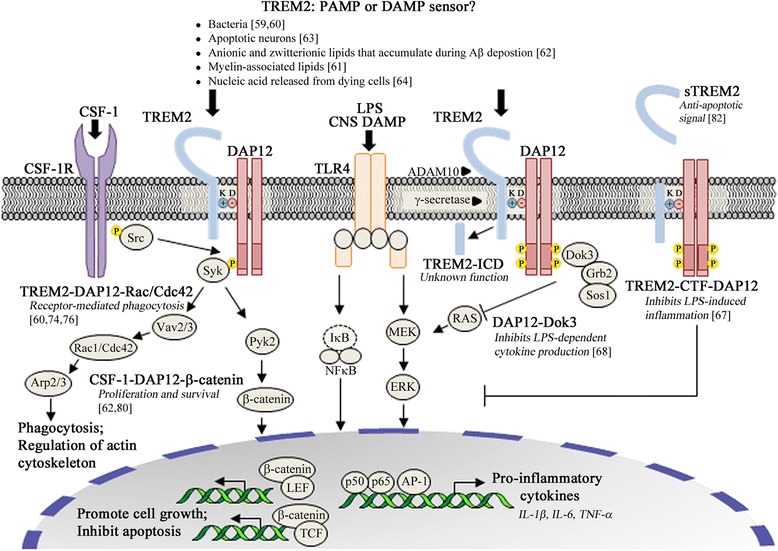
“Similar to TLR4, TREM2 has been described as both a PAMP [59, 60] and a DAMP [61–64] sensor; TREM2 is capable of binding gram-positive and gram-negative bacteria [59, 60] as well as a number of ligands exposed during CNS degeneration including anionic, zwitterionic, and myelin-associated lipids [61, 62], and nucleic a…”
BackgroundA role for TREM2 ligands in the phagocytosis of apoptotic neuronal cells by microglia
Hsieh, C. L., Koike, M., Spusta, S. C., Niemi, E. C., Yenari, M., Nakamura, M. C., & Seaman, W. E. (2009) · Journal of Neurochemistry · doi:10.1111/j.1471-4159.2009.06042.x · Cited by 475 · cited 1×
“with apoptotic Neuro2A cells [73] showed a signifi-”
BackgroundLoss-of-function mutations in TYROBP (DAP12) result in a presenile dementia with bone cysts
Paloneva, J., Kestilä, M., Wu, J., Salminen, A., Böhling, T., Ruotsalainen, V., Hakola, P., Bakker, A. B. H., Phillips, J. H., Pekkarinen, P., et al. (2000) · Nature Genetics · doi:10.1038/77153 · Cited by 460 · cited 1×
“Shortly after the discoveries that linked genetic variants of DAP12 [9] and TREM2 [10] to the neurodegenerative disease NHD/PLOSL, Takahashi et al.”
BackgroundBouchon, A., Hernández-Munain, C., Cella, M., & Colonna, M. (2001) · The Journal of Experimental Medicine · doi:10.1084/jem.194.8.1111 · Cited by 460 · cited 1×
“In the periphery, macrophages, immature DCs, and osteoclasts are the primary TREM2-expressing cells in vivo [26, 29–31].”
BackgroundRice, G. I., Forte, G. M. A., Szynkiewicz, M., Chase, D. S., Aeby, A., Abdel-Hamid, M. S., Ackroyd, S., Allcock, R., Bailey, K. M., Balottin, U., et al. (2013) · The Lancet Neurology · doi:10.1016/s1474-4422(13)70258-8 · Cited by 443
Takahashi, K., Prinz, M., Stagi, M., Chechneva, O., & Neumann, H. (2007) · PLoS Medicine · doi:10.1371/journal.pmed.0040124 · Cited by 414
Rayaprolu, S., Mullen, B., Baker, M., Lynch, T., Finger, E., Seeley, W. W., Hatanpaa, K. J., Lomen-Hoerth, C., Kertesz, A., Bigio, E. H., et al. (2013) · Molecular Neurodegeneration · doi:10.1186/1750-1326-8-19 · Cited by 404
Self-citationKawabori, M., Kacimi, R., Kauppinen, T., Calosing, C., Kim, J. Y., Hsieh, C. L., Nakamura, M. C., & Yenari, M. A. (2015) · The Journal of Neuroscience · doi:10.1523/jneurosci.2620-14.2015 · Cited by 375 · cited 1×
“Similar to TLR4, TREM2 has been described as both a PAMP [59, 60] and a DAMP [61–64] sensor; TREM2 is capable of binding gram-positive and gram-negative bacteria [59, 60] as well as a number of ligands exposed during CNS degeneration including anionic, zwitterionic, and myelin-associated lipids [61, 62], and nucleic a…”
BackgroundGuerreiro, R. J., Lohmann, E., Brás, J. M., Gibbs, J. R., Rohrer, J. D., Gurunlian, N., Dursun, B., Bilgic, B., Hanagasi, H., Gurvit, H., et al. (2013) · JAMA Neurology · doi:10.1001/jamaneurol.2013.579 · Cited by 374 · cited 11×
“(non-NHD/PLOSL) clinical presentation [12].”
BackgroundInfluentialSalminen, A., Ojala, J., Kauppinen, A., Kaarniranta, K., & Suuronen, T. (2009) · Progress in Neurobiology · doi:10.1016/j.pneurobio.2009.01.001 · Cited by 346
Osteopetrosis and thalamic hypomyelinosis with synaptic degeneration in DAP12-deficient mice
Kaifu, T., Nakahara, J., Inui, M., Mishima, K., Momiyama, T., Kaji, M., Sugahara, A., Koito, H., Ujike-Asai, A., Nakamura, A., et al. (2003) · Journal of Clinical Investigation · doi:10.1172/jci16923 · Cited by 343
Jiang, T., Tan, L., Zhu, X.-C., Zhang, Q.-Q., Cao, L., Tan, M.-S., Gu, L.-Z., Wang, H.-F., Ding, Z.-Z., Zhang, Y.-D., et al. (2014) · Neuropsychopharmacology · doi:10.1038/npp.2014.164 · Cited by 320 · cited 2×
“Other experiments in vitro have yielded similar results; TREM2- or DAP12-deficient microglia incubated with Aβ [69, 72], Trem2 peri-”
BackgroundResultEnhanced Toll-like receptor responses in the absence of signaling adaptor DAP12
Hamerman, J. A., Tchao, N. K., Lowell, C. A., & Lanier, L. L. (2005) · Nature Immunology · doi:10.1038/ni1204 · Cited by 318
Otero, K., Turnbull, I. R., Poliani, P. L., Vermi, W., Cerutti, E., Aoshi, T., Tassi, I., Takai, T., Stanley, S. L., Miller, M., et al. (2009) · Nature Immunology · doi:10.1038/ni.1744 · Cited by 315
VAV proteins as signal integrators for multi-subunit immune-recognition receptors
Turner, M., & Billadeau, D. D. (2002) · Nature Reviews Immunology · doi:10.1038/nri840 · Cited by 313
Wunderlich, P., Glebov, K., Kemmerling, N., Tien, N. T., Neumann, H., & Walter, J. (2013) · Journal of Biological Chemistry · doi:10.1074/jbc.m113.517540 · Cited by 296
Pattern Recognition by TREM-2: Binding of Anionic Ligands
Daws, M. R., Sullam, P. M., Niemi, E. C., Chen, T. T., Tchao, N. K., & Seaman, W. E. (2003) · The Journal of Immunology · doi:10.4049/jimmunol.171.2.594 · Cited by 291 · cited 11×
“However, it is also possible that the p.R47H mutation encodes a TREM2 receptor that no longer interacts with PAMPs/DAMPs and instead ectopically engages a novel ligand(s).”
BackgroundInfluentialJin, J.-J., Kim, H.-D., Maxwell, J. A., Li, L., & Fukuchi, K.-I. (2008) · Journal of Neuroinflammation · doi:10.1186/1742-2094-5-23 · Cited by 275
Activating and inhibitory functions of DAP12
Turnbull, I. R., & Colonna, M. (2007) · Nature Reviews Immunology · doi:10.1038/nri2014 · Cited by 273
TREM2 Variant p.R47H as a Risk Factor for Sporadic Amyotrophic Lateral Sclerosis
Cady, J., Koval, E. D., Benitez, B. A., Zaidman, C., Jockel-Balsarotti, J., Allred, P., Baloh, R. H., Ravits, J., Simpson, E., Appel, S. H., et al. (2014) · JAMA Neurology · doi:10.1001/jamaneurol.2013.6237 · Cited by 262
TREM-2 (triggering receptor expressed on myeloid cells 2) is a phagocytic receptor for bacteria
N'Diaye, E.-N., Branda, C. S., Branda, S. S., Nevarez, L., Colonna, M., Lowell, C., Hamerman, J. A., & Seaman, W. E. (2009) · Journal of Cell Biology · doi:10.1083/jcb.200808080 · Cited by 239
TREM2 and the neuroimmunology of Alzheimer's disease
Hickman, S. E., & El Khoury, J. (2014) · Biochemical Pharmacology · doi:10.1016/j.bcp.2013.11.021 · Cited by 221
TREM-2 promotes macrophage survival and lung disease after respiratory viral infection
Wu, K., Byers, D. E., Jin, X., Agapov, E., Alexander-Brett, J., Patel, A. C., Cella, M., Gilfilan, S., Colonna, M., Kober, D. L., et al. (2015) · Journal of Experimental Medicine · doi:10.1084/jem.20141732 · Cited by 207 · cited 3×
“Since differentially cleaved forms of TREM2 are biologically active (including the plasma-membrane-bound TREM2-CTF [67] and the sTREM2 ectodomain [82]), insight into how TREM2 is transported to the cell surface and processed is necessary.”
BackgroundNasu, T., Tsukahara, Y., & Terayama, K. (1973) · Acta Pathologica Japonica · doi:10.1111/j.1440-1827.1973.tb01223.x · Cited by 185
Cuyvers, E., Bettens, K., Philtjens, S., Van Langenhove, T., Gijselinck, I., van der Zee, J., Engelborghs, S., Vandenbulcke, M., Van Dongen, J., Geerts, N., et al. (2014) · Neurobiology of Aging · doi:10.1016/j.neurobiolaging.2013.09.009 · Cited by 182
Insights into TREM2 biology by network analysis of human brain gene expression data
Forabosco, P., Ramasamy, A., Trabzuni, D., Walker, R., Smith, C., Bras, J., Levine, A. P., Hardy, J., Pocock, J. M., Guerreiro, R., et al. (2013) · Neurobiology of Aging · doi:10.1016/j.neurobiolaging.2013.05.001 · Cited by 180 · cited 2×
“Although events need to be sequentially validated in myeloid cells that express endogenous TREM2, it is tempting to speculate that TREM2-DAP12 mediated phagocytosis can occur via Src-Syk-Vav2/3-Rac1/Cdc42Arp2/3 (Fig.”
BackgroundVariant TREM2 as Risk Factor for Alzheimer's Disease
Neumann, H., & Daly, M. J. (2013) · New England Journal of Medicine · doi:10.1056/nejme1213157 · Cited by 177 · cited 1×
“92 [19]—which are comparable to that of APOE ε4 [46].”
Udan, M. L. D., Ajit, D., Crouse, N. R., & Nichols, M. R. (2008) · Journal of Neurochemistry · doi:10.1111/j.1471-4159.2007.05001.x · Cited by 174
Heterozygous TREM2 mutations in frontotemporal dementia
Borroni, B., Ferrari, F., Galimberti, D., Nacmias, B., Barone, C., Bagnoli, S., Fenoglio, C., Piaceri, I., Archetti, S., Bonvicini, C., et al. (2014) · Neurobiology of Aging · doi:10.1016/j.neurobiolaging.2013.09.017 · Cited by 173 · cited 10×
“Unlike non-mutated TREM2, expression of the TREM2 variants p.T66M and p.Y38C (associated with genetic risk of FTD [12, 16]) in HEK293 or BV2 microglial cells, led to accumulation of immature, membrane-bound TREM2 species (~36 kDa).”
BackgroundInfluentialIto, H., & Hamerman, J. A. (2012) · European Journal of Immunology · doi:10.1002/eji.201141679 · Cited by 173 · cited 3×
“Cells of the myeloid lineage, including macrophages and dendritic cells (DCs), play a pivotal role in both sectors of immunity—they are vital in direct microbe sensing and localized attenuation, and are also responsible for recruitment of other myeloid and lympohocyte effector populations.”
BackgroundTREM2 is associated with the risk of Alzheimer's disease in Spanish population
Benitez, B. A., Cooper, B., Pastor, P., Jin, S.-C., Lorenzo, E., Cervantes, S., & Cruchaga, C. (2013) · Neurobiology of Aging · doi:10.1016/j.neurobiolaging.2012.12.018 · Cited by 163 · cited 7×
“been shown to increase the risk of developing neurological diseases [10–25, 1, 5–7].”
BackgroundResultInfluentialHakola, H. P. (1972) · PubMed · Cited by 159
TREM2 is associated with increased risk for Alzheimer’s disease in African Americans
Jin, S. C., Carrasquillo, M. M., Benitez, B. A., Skorupa, T., Carrell, D., Patel, D., Lincoln, S., Krishnan, S., Kachadoorian, M., Reitz, C., et al. (2015) · Molecular Neurodegeneration · doi:10.1186/s13024-015-0016-9 · Cited by 153 · cited 7×
“been shown to increase the risk of developing neurological diseases [10–25, 1, 5–7].”
BackgroundResultInfluentialGiraldo, M., Lopera, F., Siniard, A. L., Corneveaux, J. J., Schrauwen, I., Carvajal, J., Muñoz, C., Ramirez-Restrepo, M., Gaiteri, C., Myers, A. J., et al. (2013) · Neurobiology of Aging · doi:10.1016/j.neurobiolaging.2013.02.016 · Cited by 147 · cited 8×
“been shown to increase the risk of developing neurological diseases [10–25, 1, 5–7].”
BackgroundResultInfluentialKorvatska, O., Leverenz, J. B., Jayadev, S., McMillan, P., Kurtz, I., Guo, X., Rumbaugh, M., Matsushita, M., Girirajan, S., Dorschner, M. O., et al. (2015) · JAMA Neurology · doi:10.1001/jamaneurol.2015.0979 · Cited by 137 · cited 7×
“been shown to increase the risk of developing neurological diseases [10–25, 1, 5–7].”
BackgroundResultInfluentialZhong, L., Chen, X.-F., Zhang, Z.-L., Wang, Z., Shi, X.-Z., Xu, K., Zhang, Y.-W., Xu, H., & Bu, G. (2015) · Journal of Biological Chemistry · doi:10.1074/jbc.m115.645986 · Cited by 133 · cited 3×
“The membrane-bound CTF stub can still associate with and signal through DAP12 [67], but this fragment can also serve as a substrate for intramembrane-mediated γ-secretase cleavage [83] yielding an intracellular domain (ICD) with unknown function.”
BackgroundSelf-citationDifferential Requirements for Vav Proteins in DAP10- and ITAM-mediated NK Cell Cytotoxicity
Cella, M., Fujikawa, K., Tassi, I., Kim, S., Latinis, K., Nishi, S., Yokoyama, W., Colonna, M., & Swat, W. (2004) · The Journal of Experimental Medicine · doi:10.1084/jem.20031847 · Cited by 121
Heterogeneity of presenile dementia with bone cysts (Nasu–Hakola disease): Three genetic forms
Kondo, T., Takahashi, K., Kohara, N., Takahashi, Y., Hayashi, S., Takahashi, H., Matsuo, H., Yamazaki, M., Inoue, K., Miyamoto, K., et al. (2002) · Neurology · doi:10.1212/wnl.59.7.1105 · Cited by 106
Homozygous TREM2 mutation in a family with atypical frontotemporal dementia
Le Ber, I., De Septenville, A., Guerreiro, R., Bras, J., Camuzat, A., Caroppo, P., Lattante, S., Couarch, P., Kabashi, E., Bouya-Ahmed, K., et al. (2014) · Neurobiology of Aging · doi:10.1016/j.neurobiolaging.2014.04.010 · Cited by 99
Verloes, A., Maquet, P., Sadzot, B., Vivario, M., Thiry, A., & Franck, G. (1997) · Journal of Medical Genetics · doi:10.1136/jmg.34.9.753 · Cited by 78
Gawish, R., Martins, R., Böhm, B., Wimberger, T., Sharif, O., Lakovits, K., Schmidt, M., & Knapp, S. (2015) · The FASEB Journal · doi:10.1096/fj.14-260067 · Cited by 71
Meta-analysis of linkage studies for Alzheimer's disease—A web resource
Butler, A. W., Ng, M., Hamshere, M. L., Forabosco, P., Wroe, R., Al‐Chalabi, A., Lewis, C. M., & Powell, J. F. (2009) · Neurobiology of Aging · doi:10.1016/j.neurobiolaging.2009.03.013 · Cited by 68
Peng, Q., Long, C. L., Malhotra, S., & Humphrey, M. B. (2013) · Science Signaling · doi:10.1126/scisignal.2003801 · Cited by 62
More evidence for association of a rare TREM2 mutation (R47H) with Alzheimer's disease risk
Rosenthal, S. L., Bamne, M. N., Wang, X., Berman, S., Snitz, B. E., Klunk, W. E., Sweet, R. A., Demirci, F. Y., Lopez, O. L., & Kamboh, M. I. (2015) · Neurobiology of Aging · doi:10.1016/j.neurobiolaging.2015.04.012 · Cited by 53
Assignment of the Locus for PLO-SL, a Frontal-Lobe Dementia with Bone Cysts, to 19q13
Pekkarinen, P., Hovatta, I., Hakola, P., Järvi, O., Kestilä, M., Lenkkeri, U., Adolfsson, R., Holmgren, G., Nylander, P.-O., Tranebjærg, L., et al. (1998) · The American Journal of Human Genetics · doi:10.1086/301722 · Cited by 44
TREM2 R47H variant and risk of essential tremor: A cross-sectional international multicenter study
Ortega-Cubero, S., Lorenzo-Betancor, O., Lorenzo, E., Agúndez, J. A. G., Jiménez-Jiménez, F. J., Ross, O. A., Wurster, I., Mielke, C., Lin, J.-J., Coria, F., et al. (2015) · Parkinsonism & Related Disorders · doi:10.1016/j.parkreldis.2014.12.010 · Cited by 32
CSF-1R, DAP12 and β-catenin: a ménage à trois
McVicar, D. W., & Trinchieri, G. (2009) · Nature Immunology · doi:10.1038/ni0709-681 · Cited by 20
Regulation of dynamic BACE1 trafficking in neurons
Buggia-Prévot, V., Fernandez, C., Riordan, S. M., Vetrivel, K. S., Udayar, V., Elie, A., Lefkow, M., Roseman, J., Meckler, X., Bhattacharyya, S., et al. (2013) · Molecular Neurodegeneration · doi:10.1186/1750-1326-8-s1-o8 · Cited by 10
Cited by
A Unique Microglia Type Associated with Restricting Development of Alzheimer’s Disease
Keren-Shaul, H., Spinrad, A., Weiner, A., Matcovitch-Natan, O., Dvir-Szternfeld, R., Ulland, T. K., David, E., Baruch, K., Lara-Astaiso, D., Toth, B., et al. (2017) · Cell · doi:10.1016/j.cell.2017.05.018 · Cited by 5,493
“…we identified Tyrobp (Tyro protein tyrosine kinase binding protein) and Trem2 (triggering receptor expressed on myeloid cells 2), which form a signaling complex; both components are strongly induced in DAM (Figure 1E; Table S1) (Colonna and Wang, 2016; Painter et al., 2015; Wang et al., 2015).”
InfluentialARUK Consortium, Sims, R., GERAD/PERADES, C., van der Lee, S. J., Naj, A. C., Bellenguez, C., Badarinarayan, N., Jakobsdottir, J., Kunkle, B. W., Boland, A., et al. (2017) · Nature Genetics · doi:10.1038/ng.3916 · Cited by 1,012
Inflammatory Response in the CNS: Friend or Foe?
Sochocka, M., Diniz, B. S., & Leszek, J. (2017) · Molecular Neurobiology · doi:10.1007/s12035-016-0297-1 · Cited by 573
The role of microglia in retinal neurodegeneration: Alzheimer’s disease, parkinson, and glaucoma.
Ramirez, A. I., de Hoz, R., Salobrar-Garcia, E., Salazar, J. J., Rojas, B., Ajoy, D., López-Cuenca, I., Rojas, P., Triviño, A., & Ramírez, J. M. (2017) · Frontiers in Aging Neuroscience · doi:10.3389/fnagi.2017.00214 · Cited by 466
“Thus, TREM2 dysfunction could induce the loss of the homeostasis in the tissue (Painter et al., 2015).”
BackgroundThe role of astrocytes in amyloid production and Alzheimer's disease
Frost, G. R., & Li, Y.-M. (2017) · Open Biology · doi:10.1098/rsob.170228 · Cited by 435
Metadata
- Authors
- Painter, M. M., Atagi, Y., Liu, C.-C., Rademakers, R., Xu, H., Fryer, J. D., & Bu, G.
- Affiliations
- Mayo Clinic (US)
- Xiamen University (CN)
- Corresponding author
- Bu, Guojun
- Venue
- Molecular Neurodegeneration
- Published
- 2015-09-04
- Volume
- 10
- Issue
- 1
- Pages
- 43-43
- ISSN
- 1750-1326 (ISSN-L)
- PMC
- PMC4560063
- OpenAlex
- W2117601071
- Cited by
- 169
- References
- 86
- Citations by year
- 2026: 12 · 2025: 19 · 2024: 19 · 2023: 11 · 2022: 22 · 2021: 20 · 2020: 7 · 2019: 11 · 2018: 18 · 2017: 22 · 2016: 7 · 2015: 1
- FWCI
- 1.28
- Type
- journal article
- Language
- en
- Open access
- gold
- doi.org
- Licence
- cc-by
- creativecommons.org/licenses/by/4.0/ (tdm)
- creativecommons.org/licenses/by/4.0/ (vor)
- Locations
- Molecular Neurodegeneration (publishedVersion, cc-by)
- Europe PMC (PubMed Central) (publishedVersion, cc-by)
- PubMed Central (publishedVersion, cc-by)
- PubMed (publishedVersion)
- Rare & Special e-Zone (The Hong Kong University of Science and Technology) (submittedVersion)
- Funders
- National Institutes of Health (ID0EHHAE325, R01AG035355, ID0EDQAE327, ID0ERUAE328, ID0E6YAE329, ID0EN4AE330)
- Alzheimer's Association (ID0E3BAG331)
- Cure Alzheimer's Fund (ID0EIGAG332)
- Topics
- Life Sciences › Neuroscience › Neurology › Neuroinflammation and Neurodegeneration Mechanisms
- Life Sciences › Immunology and Microbiology › Immunology › Phagocytosis and Immune Regulation
- Life Sciences › Biochemistry, Genetics and Molecular Biology › Molecular Biology › Inflammasome and immune disorders
- Keywords
- TREM2, DAP12, microglia, neurodegenerative diseases, Alzheimer's disease, innate immunity, phagocytosis, cytokine production, myeloid cells, CNS homeostasis
- MeSH terms
- Alzheimer Disease, Animals, Central Nervous System, Homeostasis, Humans, Immunity, Innate, Membrane Glycoproteins, Membrane Proteins, Models, Biological, Mutation, Nerve Tissue Proteins, Receptors, Immunologic, Regeneration, Wound Healing, Cytokines, Microglia, Neurodegenerative Diseases, Myeloid Cells, Adaptor Proteins, Signal Transducing, Toll-Like Receptors, Mice
About these checks
Registry, retraction, Cites and statistics results are computed, not judged, with one exception: a printed reference that no index lists is read once by a model before it counts as a citation error. Claims are extracted by a model and kept only when their quote appears verbatim in the text; each cited source is then checked, with a model’s help, for whether it says what the claim relies on. Those verdicts can be wrong — read the claim’s quote and the cited source before relying on one.
Statistics and arithmetic are recomputed, not judged.
Confidence bands are shown only for fields calibrated on our annotated test set. None is calibrated yet, so no band is shown.
What counts as a claim ›How we measure confidence ›How we check this ›
Are you an author, or do you see a problem with this page? Request a review
Data sources
Bibliographic data: Semantic Scholar, OpenAlex, Crossref.
Contains information from the Semantic Scholar Academic Graph Datasets, made available under the ODC Attribution License (ODC-BY 1.0).
Semantic Scholar’s data is described in: Kinney, R., et al. (2023). The Semantic Scholar Open Data Platform. arXiv:2301.10140.
