

Ten things you should know about transposable elements
Open accessThe DOI matches its Crossref record; 203 of the 203 references it cites were found in a registry or an index.
Abstract
Transposable elements (TEs) are major components of eukaryotic genomes. However, the extent of their impact on genome evolution, function, and disease remain a matter of intense interrogation. The rise of genomics and large-scale functional assays has shed new light on the multi-faceted activities of TEs and implies that they should no longer be marginalized. Here, we introduce the fundamental properties of TEs and their complex interactions with their cellular environment, which are crucial to understanding their impact and manifold consequences for organismal biology. While we draw examples primarily from mammalian systems, the core concepts outlined here are relevant to a broad range of organisms.
Overview
The claims and statistics of this paper haven’t been checked yet.
Free: it reads the open-access text and checks the first 5 claims that cite a source we can check. Create a free account to check every claim.
Integrity signals
Registry
Cites
Statistics
Figures
Verification
Claims the paper makes
The claims and statistics of this paper haven’t been checked yet.
Free: it reads the open-access text and checks the first 5 claims that cite a source we can check. Create a free account to check every claim.
Claims other papers make about this one
Each is checked against this paper’s own text: does it say what the citing paper says it does?
The source backs part of the claim, not all of it — or backs it for a different population, condition or comparison.
In the citing paper
“Constituting ~45% of the human and rodent genomes, transposable elements are routinely repressed in somatic cells to prevent their mobilization, which otherwise can have deleterious effects [119,120].”
From What would it take to prove that a chronic infection is a causal agent in Alzheimer’s disease? (2025) · cites this paper as [119]
Experimental — accuracy not yet measuredThe cited source says what the claim attributes to it.
In the citing paper
“First, these elements are significantly overrepresented (31).”
From DNA language models are powerful predictors of genome-wide variant effects (2023) · cites this paper as [31]
Self-check
Percentages, sums and reported differences re-computed from the paper’s own numbers.
The self-check needs the paper’s full text.
Citations
Cites
Ultrafast and memory-efficient alignment of short DNA sequences to the human genome.
Langmead, B., Trapnell, C., Pop, M., & Salzberg, S. L. (2009) · Genome Biology · doi:10.1186/gb-2009-10-3-r25 · Cited by 21,849
An integrated encyclopedia of DNA elements in the human genome
The ENCODE Project Consortium (2012) · Nature · doi:10.1038/nature11247 · Cited by 18,072
The B73 Maize Genome: Complexity, Diversity, and Dynamics
Schnable, P. S., Ware, D., Fulton, R. S., Stein, J. C., Wei, F., Pasternak, S., Liang, C., Zhang, J., Fulton, L., Graves, T. A., et al. (2009) · Science · doi:10.1126/science.1178534 · Cited by 4,046
A unified classification system for eukaryotic transposable elements
Wicker, T., Sabot, F., Hua-Van, A., Bennetzen, J. L., Capy, P., Chalhoub, B., Flavell, A., Leroy, P., Morgante, M., Panaud, O., et al. (2007) · Nature Reviews Genetics · doi:10.1038/nrg2165 · Cited by 3,054
Britten, R. J., & Kohne, D. E. (1968) · Science · doi:10.1126/science.161.3841.529 · Cited by 2,802
An integrated map of structural variation in 2,504 human genomes
Sudmant, P. H., Rausch, T., Gardner, E. J., Handsaker, R. E., Abyzov, A., Huddleston, J., Zhang, Y., Ye, K., Jun, G., Hsi-Yang Fritz, M., et al. (2015) · Nature · doi:10.1038/nature15394 · Cited by 2,354
Chiappinelli, K. B., Strissel, P. L., Desrichard, A., Li, H., Henke, C., Akman, B., Hein, A., Rote, N. S., Cope, L. M., Snyder, A., et al. (2015) · Cell · doi:10.1016/j.cell.2015.07.011 · Cited by 2,022
The impact of retrotransposons on human genome evolution
Cordaux, R., & Batzer, M. A. (2009) · Nature Reviews Genetics · doi:10.1038/nrg2640 · Cited by 1,703
Roulois, D., Loo Yau, H., Singhania, R., Wang, Y., Danesh, A., Shen, S. Y., Han, H., Liang, G., Jones, P. A., Pugh, T. J., et al. (2015) · Cell · doi:10.1016/j.cell.2015.07.056 · Cited by 1,527
Regulatory activities of transposable elements: from conflicts to benefits
Chuong, E. B., Elde, N. C., & Feschotte, C. (2017) · Nature Reviews Genetics · doi:10.1038/nrg.2016.139 · Cited by 1,489
Self-citation
Cited by
RepeatModeler2 for automated genomic discovery of transposable element families
Flynn, J. M., Hubley, R., Goubert, C., Rosen, J., Clark, A. G., Feschotte, C., & Smit, A. F. (2020) · Proceedings of the National Academy of Sciences · doi:10.1073/pnas.1921046117 · Cited by 3,848
“Within each class, TE sequences are extremely diverse and evolve rapidly (4, 10, 17).”
BackgroundSelf-citationA Field Guide to Eukaryotic Transposable Elements
Wells, J. N., & Feschotte, C. (2020) · Annual Review of Genetics · doi:10.1146/annurev-genet-040620-022145 · Cited by 686
“In everything from the size and structure of genomes to the proteins they encode and the regulation of such,TEs play a critical role (1, 10, 13, 25, 27, 44, 49, 137).”
BackgroundInfluentialSelf-citationThe role of retrotransposable elements in ageing and age-associated diseases
Gorbunova, V., Seluanov, A., Mita, P., McKerrow, W., Fenyö, D., Boeke, J. D., Linker, S. B., Gage, F. H., Kreiling, J. A., Petrashen, A. P., et al. (2021) · Nature · doi:10.1038/s41586-021-03542-y · Cited by 446
Self-citationDNA damage and repair in age-related inflammation
Zhao, Y., Simon, M., Seluanov, A., & Gorbunova, V. (2023) · Nature Reviews Immunology · doi:10.1038/s41577-022-00751-y · Cited by 372
Self-citationMechanisms of enhancer action: the known and the unknown
Panigrahi, A., & O’Malley, B. W. (2021) · Genome Biology · doi:10.1186/s13059-021-02322-1 · Cited by 350
“Additionally, enhancers also emerge from transposable elements (TE) [44, 45]; nearly half of the human gen-”
BackgroundNéron, B., Littner, E., Haudiquet, M., Perrin, A., Cury, J., & Rocha, E. (2022) · Microorganisms · doi:10.3390/microorganisms10040700 · Cited by 319
“Once novel genes are acquired by the abovementioned processes, their integration in the novel host genome and subsequent expression is facilitated by the action of mobile genetic elements (MGEs) that rearrange genetic information within genomes [3,4].”
Host–transposon interactions: conflict, cooperation, and cooption
Cosby, R. L., Chang, N.-C., & Feschotte, C. (2019) · Genes & Development · doi:10.1101/gad.327312.119 · Cited by 290
Self-citationEvolutionary constraint and innovation across hundreds of placental mammals
Christmas, M. J., Kaplow, I. M., Genereux, D. P., Dong, M. X., Hughes, G. M., Li, X., Sullivan, P. F., Hindle, A. G., Andrews, G., Armstrong, J. C., et al. (2023) · Science · doi:10.1126/science.abn3943 · Cited by 292
“Despite their potential to influence genome structure and function ( 111 , 112 ), they are difficult to analyze, and most studies have focused on human and mouse ( 113 ).”
BackgroundTransposable elements shape the evolution of mammalian development
Senft, A. D., & Macfarlan, T. S. (2021) · Nature Reviews Genetics · doi:10.1038/s41576-021-00385-1 · Cited by 286
Self-citationBeyond the RNA-dependent function of LncRNA genes
Ali, T., & Grote, P. (2020) · eLife · doi:10.7554/elife.60583 · Cited by 279
“These mobile genomic elements make up more than 44% of the human genome ( Lander et al., 2001 ) and attracted attention as important regulators of gene and genome activity ( Bourque et al., 2018 ).”
BackgroundEarl Grey: A Fully Automated User-Friendly Transposable Element Annotation and Analysis Pipeline
Baril, T., Galbraith, J., & Hayward, A. (2024) · Molecular Biology and Evolution · doi:10.1093/molbev/msae068 · Cited by 236
“For example, many TEs contain protein-coding regions that could be incorrectly annotated as host genes (Bourque et al. 2018), while repetitive host gene families can be mistaken for TEs.”
BackgroundCoassin, S., & Kronenberg, F. (2022) · Atherosclerosis · doi:10.1016/j.atherosclerosis.2022.04.003 · Cited by 219
Yan, H., Bombarely, A., & Li, S. (2020) · Bioinformatics · doi:10.1093/bioinformatics/btaa519 · Cited by 210
He, J., Babarinde, I. A., Sun, L., Xu, S., Chen, R., Shi, J., Wei, Y., Li, Y., Ma, G., Zhuang, Q., et al. (2021) · Nature Communications · doi:10.1038/s41467-021-21808-x · Cited by 200
Repetitive DNA sequence detection and its role in the human genome
Liao, X., Zhu, W., Zhou, J., Li, H., Xu, X., Zhang, B., & Gao, X. (2023) · Communications Biology · doi:10.1038/s42003-023-05322-y · Cited by 175
“Another experimental study found that ~10 – 15% of inherited mutant phenotypes in the mouse genome are caused by the autonomous activity of a family of persistently active LTR retransposons 8 .”
BackgroundSilencing and Transcriptional Regulation of Endogenous Retroviruses: An Overview
Geis, F. K., & Goff, S. P. (2020) · Viruses · doi:10.3390/v12080884 · Cited by 178
“In order to permanently persist in the host, TEs have achieved an efficiency of propagation, giving an appropriate balance of disadvantageous and advantageous consequences for the host [4].”
BackgroundLosing DNA methylation at repetitive elements and breaking bad
Pappalardo, X. G., & Barra, V. (2021) · Epigenetics & Chromatin · doi:10.1186/s13072-021-00400-z · Cited by 179
Centromere Repeats: Hidden Gems of the Genome
Hartley, G., & O’Neill, R. J. (2019) · Genes · doi:10.3390/genes10030223 · Cited by 162
“Unlike TEs that are capable of moving within a genome and thus are often found dispersed (albeit not randomly; reviewed in [4]), satellite DNA consists of short stationary DNA sequences that tandemly repeat to form a larger array, often restricted to specific sub-regions of chromosomes [1,5].”
BackgroundSIRT7 antagonizes human stem cell aging as a heterochromatin stabilizer
Bi, S., Liu, Z., Wu, Z., Wang, Z., Liu, X., Wang, S., Ren, J., Yao, Y., Zhang, W., Song, M., et al. (2020) · Protein & Cell · doi:10.1007/s13238-020-00728-4 · Cited by 157
Peona, V., Blom, M. P. K., Xu, L., Burri, R., Sullivan, S. T., Bunikis, I., Liachko, I., Haryoko, T., Jønsson, K. A., Zhou, Q., et al. (2020) · Molecular Ecology Resources · doi:10.1111/1755-0998.13252 · Cited by 176
“More generally, repetitive elements can play important roles in many molecular and cellular mechanisms, and as a source of genetic variability (Bourque et al., 2018).”
Review on the Computational Genome Annotation of Sequences Obtained by Next-Generation Sequencing
Ejigu, G. F., & Jung, J. (2020) · Biology · doi:10.3390/biology9090295 · Cited by 176
DNA language models are powerful predictors of genome-wide variant effects
Benegas, G., Batra, S. S., & Song, Y. S. (2023) · Proceedings of the National Academy of Sciences · doi:10.1073/pnas.2311219120 · Cited by 157
Transposable elements as essential elements in the control of gene expression
Gebrie, A. (2023) · Mobile DNA · doi:10.1186/s13100-023-00297-3 · Cited by 174
“The average difference between the two haploid human genomes of the same person is thought to be around 1000 TE insertions [6].”
BackgroundTaming transposable elements in vertebrates: from epigenetic silencing to domestication
Almeida, M. V., Vernaz, G., Putman, A. L. K., & Miska, E. A. (2022) · Trends in Genetics · doi:10.1016/j.tig.2022.02.009 · Cited by 144
On the Population Dynamics of Junk: A Review on the Population Genomics of Transposable Elements
Bourgeois, Y., & Boissinot, S. (2019) · Genes · doi:10.3390/genes10060419 · Cited by 161
Ramakrishnan, M., Yrjälä, K., Vinod, K. K., Sharma, A., Cho, J., Satheesh, V., & Zhou, M. (2020) · Food and Energy Security · doi:10.1002/fes3.229 · Cited by 167
“Although their specific functions within the genome remain enigmatic, TEs are known to create spontaneous genomic variations by their transposition behavior (Bourque et al., 2018).”
BackgroundInfluentialTransposable Elements and the Evolution of Insects
Gilbert, C., Peccoud, J., & Cordaux, R. (2020) · Annual Review of Entomology · doi:10.1146/annurev-ento-070720-074650 · Cited by 141
Insights into mammalian TE diversity through the curation of 248 genome assemblies
Osmanski, A. B., Paulat, N. S., Korstian, J., Grimshaw, J. R., Halsey, M., Sullivan, K. A. M., Moreno-Santillán, D. D., Crookshanks, C., Roberts, J., Garcia, C., et al. (2023) · Science · doi:10.1126/science.abn1430 · Cited by 127
“Class I elements can be sorted further into three subcategories: short interspersed elements (SINEs), long interspersed elements (LINEs), and long terminal repeat (LTR) retrotransposons (5).”
Genomic architecture of phenotypic extremes in a wild cervid
Anderson, S. J., Côté, S. D., Richard, J. H., & Shafer, A. B. A. (2022) · BMC Genomics · doi:10.1186/s12864-022-08333-x · Cited by 133
“The latter aspect, broadly speaking, is particularly relevant for genotype-phenotype correlations as most causative SNPs occur outside coding regions [3, 20], and there is evidence of TE insertions causing phenotypic differences [21] that are adaptive [22].”
BackgroundTransposable elements in mammalian chromatin organization
Lawson, H. A., Liang, Y., & Wang, T. (2023) · Nature Reviews Genetics · doi:10.1038/s41576-023-00609-6 · Cited by 144
Diseases of the nERVous system: retrotransposon activity in neurodegenerative disease
Tam, O. H., Ostrow, L. W., & Gale Hammell, M. (2019) · Mobile DNA · doi:10.1186/s13100-019-0176-1 · Cited by 117
Self-citationOsakabe, A., Jamge, B., Axelsson, E., Montgomery, S. A., Akimcheva, S., Kuehn, A. L., Pisupati, R., Lorković, Z. J., Yelagandula, R., Kakutani, T., et al. (2021) · Nature Cell Biology · doi:10.1038/s41556-021-00658-1 · Cited by 139
Pedigree-based estimation of human mobile element retrotransposition rates
Feusier, J. E., Watkins, W. S., Thomas, J., Farrell, A., Witherspoon, D. J., Baird, L. M., Ha, H., Xing, J., & Jorde, L. B. (2019) · Genome Research · doi:10.1101/gr.247965.118 · Cited by 136
“Non–long terminal repeat (non-LTR) retrotransposonshaveplayed a large role in shaping the human genome by creating structural variation and influencing gene expression (Elbarbary et al. 2016; Bourque et al. 2018).”
BackgroundHorizontal transfer and evolution of transposable elements in vertebrates
Zhang, H.-H., Peccoud, J., Xu, M.-R.-X., Zhang, X.-G., & Gilbert, C. (2020) · Nature Communications · doi:10.1038/s41467-020-15149-4 · Cited by 118
Programmable gene insertion in human cells with a laboratory-evolved CRISPR-associated transposase
Witte, I. P., Lampe, G. D., Eitzinger, S., Miller, S. M., Berríos, K. N., McElroy, A. N., King, R. T., Stringham, O. G., Gelsinger, D. R., Vo, P. L. H., et al. (2025) · Science · doi:10.1126/science.adt5199 · Cited by 125
“We speculate that PseTnsB natively evolved conditional or restrained activity to avoid incurring a substantial host fitness penalty (45).”
Transposable Elements: A Common Feature of Neurodevelopmental and Neurodegenerative Disorders
Jönsson, M. E., Garza, R., Johansson, P. A., & Jakobsson, J. (2020) · Trends in Genetics · doi:10.1016/j.tig.2020.05.004 · Cited by 122
“lation and that any two human haploid genomes differ by around a thousand polyTEs [103,104].”
BackgroundShort Tandem Repeat Expansions and RNA-Mediated Pathogenesis in Myotonic Dystrophy
Sznajder, Ł. J., & Swanson, M. S. (2019) · International Journal of Molecular Sciences · doi:10.3390/ijms20133365 · Cited by 118
“Repetitive DNA sequence elements compose 50–70% of the human genome [1,2].”
BackgroundChromosome-scale assemblies reveal the structural evolution of African cichlid genomes
Conte, M. A., Joshi, R., Moore, E. C., Nandamuri, S. P., Gammerdinger, W., Roberts, R. B., Carleton, K. L., Lien, S., & Kocher, T. D. (2019) · GigaScience · doi:10.1093/gigascience/giz030 · Cited by 120
“The role of various TE families in the formation of genomic rearrangements has been previously demonstrated in a variety of organisms [64–68].”
Genome size evolution: towards new model systems for old questions
Blommaert, J. (2020) · Proceedings of the Royal Society B: Biological Sciences · doi:10.1098/rspb.2020.1441 · Cited by 116
“Harmful effects from transposon activity include interruption of functional genes and loss of function, overall increased mutation rates and disruption of gene expression [75,76].”
BackgroundMendez‐Dorantes, C., & Burns, K. H. (2023) · Genes & Development · doi:10.1101/gad.351051.123 · Cited by 125
“TEs are classified as DNA transposons or retrotransposons (Wicker et al. 2007; Bourque et al. 2018).”
BackgroundSelf-citationAntiaging agents: safe interventions to slow aging and healthy life span extension
Liu, J.-K. (2022) · Natural Products and Bioprospecting · doi:10.1007/s13659-022-00339-y · Cited by 105
“The major parts of res are transposons (Tes), which include DNA transposons and retrotransposons, which have the ability to multiply, proliferate, and change genomic positions [264].”
BackgroundTransposable elements contribute to fungal genes and impact fungal lifestyle
Muszewska, A., Steczkiewicz, K., Stepniewska-Dziubinska, M. M., & Ginalski, K. (2019) · Scientific Reports · doi:10.1038/s41598-019-40965-0 · Cited by 126
Mutant IDH1 inhibition induces dsDNA sensing to activate tumor immunity
Wu, M., Kondo, H., Kammula, A. V., Shi, L., Xiao, Y., Dhiab, S., Xu, Q., Slater, C. J., Avila, O. I., Merritt, J., et al. (2024) · Science · doi:10.1126/science.adl6173 · Cited by 116
“Where-asTEsarelargelynotconservedbetweenthe humanandmousegenome,therearestruc-turallyanalogousERV1,ERVK,ERVL,SINE, andLINEsuperfamilies( 47 , 48 ).”
Epigenetic Reprogramming in Early Animal Development
Du, Z., Zhang, K., & Xie, W. (2021) · Cold Spring Harbor Perspectives in Biology · doi:10.1101/cshperspect.a039677 · Cited by 114
Ratcliff, J., & Simmonds, P. (2021) · Virology · doi:10.1016/j.virol.2020.12.018 · Cited by 108
“the genome via one of two methods (Boeke et al., 1985; Bourque et al., 2018; Rubin et al., 1982).”
Liu, F., Li, Y., Yu, H., Zhang, L., Hu, J., Bao, Z., & Wang, S. (2020) · Nucleic Acids Research · doi:10.1093/nar/gkaa918 · Cited by 111
“Transposable elements (TEs) are major components of eukaryotic genomes, with significant impacts on genome evolution, function and disease (42).”
BackgroundSun, T., Xu, Y., Xiang, Y., Ou, J., Soderblom, E. J., & Diao, Y. (2023) · Nature Genetics · doi:10.1038/s41588-023-01452-5 · Cited by 106
Sensing of transposable elements by the antiviral innate immune system
Gázquez-Gutiérrez, A., Witteveldt, J., Heras, S. R., & Macías, S. (2021) · RNA · doi:10.1261/rna.078721.121 · Cited by 109
“3 Introduction Transposable elements (TEs) are a driving force in evolution but pose a potential threat to the fitness of the host by disrupting the function and/or expression of genes surrounding novel insertions or by promoting chromosomal rearrangements (Garcia-Perez et al. 2016; Bourque et al. 2018).”
BackgroundTransposon-triggered innate immune response confers cancer resistance to the blind mole rat
Zhao, Y., Oreskovic, E., Zhang, Q., Lu, Q., Gilman, A., Lin, Y. S., He, J., Zheng, Z., Lu, J. Y., Lee, J., et al. (2021) · Nature Immunology · doi:10.1038/s41590-021-01027-8 · Cited by 99
Self-citationA population-level invasion by transposable elements triggers genome expansion in a fungal pathogen
Oggenfuss, U., Badet, T., Wicker, T., Hartmann, F. E., Singh, N. K., Abraham, L., Karisto, P., Vonlanthen, T., Mundt, C. C., McDonald, B. A., et al. (2021) · eLife · doi:10.7554/elife.69249 · Cited by 98
Hayward, A., & Gilbert, C. (2022) · Current Biology · doi:10.1016/j.cub.2022.07.044 · Cited by 100
Chemotherapy-induced transposable elements activate MDA5 to enhance haematopoietic regeneration
Clapes, T., Polyzou, A., Prater, P., Sagar, Morales‐Hernández, A., Ferrarini, M. G., Kehrer, N., Lefkopoulos, S., Bergo, V., Hummel, B., et al. (2021) · Nature Cell Biology · doi:10.1038/s41556-021-00707-9 · Cited by 94
Structural basis of seamless excision and specific targeting by piggyBac transposase
Chen, Q., Luo, W., Veach, R. A., Hickman, A. B., Wilson, M. H., & Dyda, F. (2020) · Nature Communications · doi:10.1038/s41467-020-17128-1 · Cited by 85
Long non-coding RNAs and transposable elements: A functional relationship
Fort, V., Khelifi, G., & Hussein, S. M. I. (2020) · Biochimica et Biophysica Acta (BBA) - Molecular Cell Research · doi:10.1016/j.bbamcr.2020.118837 · Cited by 99
The Evolutionary Significance of RNAi in the Fungal Kingdom
Lax, C., Tahiri, G., Patiño-Medina, J. A., Cánovas-Márquez, J. T., Pérez-Ruiz, J. A., Osorio-Concepción, M., Navarro, E., & Calo, S. (2020) · International Journal of Molecular Sciences · doi:10.3390/ijms21249348 · Cited by 90
Transposable element-derived sequences in vertebrate development
Etchegaray, E., Naville, M., Volff, J.-N., & Haftek-Terreau, Z. (2021) · Mobile DNA · doi:10.1186/s13100-020-00229-5 · Cited by 80
Role of Polycomb in the control of transposable elements
Déléris, A., Berger, F., & Duharcourt, S. (2021) · Trends in Genetics · doi:10.1016/j.tig.2021.06.003 · Cited by 84
The Dynamism of Transposon Methylation for Plant Development and Stress Adaptation
Ramakrishnan, M., Satish, L., Kalendar, R. N., Narayanan, M., Kandasamy, S., Sharma, A., Emamverdian, A., Wei, Q., & Zhou, M. (2021) · International Journal of Molecular Sciences · doi:10.3390/ijms222111387 · Cited by 96
“Although all active genes contain at least a promoter and many are influenced by enhanc‐ ers, TE insertion still causes heritable mutations or alters gene activity [1].”
BackgroundInfluentialThe important contribution of transposable elements to phenotypic variation and evolution
Catlin, N. S., & Josephs, E. B. (2021) · Current Opinion in Plant Biology · doi:10.1016/j.pbi.2021.102140 · Cited by 91
Transposable Elements: Major Players in Shaping Genomic and Evolutionary Patterns
Romano, N. C., & Fanti, L. (2022) · Cells · doi:10.3390/cells11061048 · Cited by 93
“This is because at least some TEs remain active and maintain the capacity to invade new species through horizontal transfer [25,26].”
BackgroundChénais, B. (2022) · International Journal of Molecular Sciences · doi:10.3390/ijms23052551 · Cited by 85
“The LINE-1 elements are active in the germline making LINE-1, Alu and SVA integrations common and segregating DNA markers in populations [4,6,7].”
BackgroundLong‐term and rapid evolution in powdery mildew fungi
Kusch, S., Qian, J., Loos, A., Kümmel, F., Spanu, P. D., & Panstruga, R. (2023) · Molecular Ecology · doi:10.1111/mec.16909 · Cited by 84
“By contrast, DNA transposons spread via a “cut- and-paste” mechanism: the transposon is excised from the original place in the genome and then integrates at another location (Bourque et al., 2018; Wicker et al., 2007).”
BackgroundStructures of virus-like capsids formed by the Drosophila neuronal Arc proteins
Erlendsson, S., Morado, D. R., Cullen, H. B., Feschotte, C., Shepherd, J. D., & Briggs, J. A. G. (2020) · Nature Neuroscience · doi:10.1038/s41593-019-0569-y · Cited by 85
Self-citationEndogenous Double-Stranded RNA
Sadeq, S., Al-Hashimi, S., Cusack, C. M., & Werner, A. (2021) · Non-Coding RNA · doi:10.3390/ncrna7010015 · Cited by 70
“First, the insertion of an ERV into the host genome affects transcriptional activity around the insertion site, thus creating the pressure to mitigate the overwhelmingly deleterious consequences of the interference [10].”
BackgroundThe sound of silence: mechanisms and implications of HUSH complex function
Seczyńska, M., & Lehner, P. J. (2023) · Trends in Genetics · doi:10.1016/j.tig.2022.12.005 · Cited by 85
Transposable elements as tissue-specific enhancers in cancers of endodermal lineage
Karttunen, K., Patel, D., Xia, J., Fei, L., Palin, K., Aaltonen, L. A., & Sahu, B. (2023) · Nature Communications · doi:10.1038/s41467-023-41081-4 · Cited by 84
Regulatory transposable elements in the encyclopedia of DNA elements
Du, A. Y., Chobirko, J. D., Zhuo, X., Feschotte, C., & Wang, T. (2024) · Nature Communications · doi:10.1038/s41467-024-51921-6 · Cited by 84
Self-citationCai, X., Lin, R., Liang, J., King, G. J. W., Wu, J., & Wang, X. (2022) · Plant Biotechnology Journal · doi:10.1111/pbi.13807 · Cited by 87
“They have contributed to rapid adaptation and the domestication of crops through generation of novel traits (Bourque et al., 2018; Catlin and Josephs, 2021; Chuong et al., 2017; Niu et al., 2019; Quadrana et al., 2019; Sultana et al., 2017; Zhang et al., 2015).”
BackgroundThe brain–body energy conservation model of aging
Shaulson, E. D., Cohen, A. A., & Picard, M. A. (2024) · Nature Aging · doi:10.1038/s43587-024-00716-x · Cited by 85
Gene clustering and copy number variation in alkaloid metabolic pathways of opium poppy
Li, Q., Ramasamy, S., Singh, P., Hagel, J. M., Dunemann, S. M., Chen, X., Chen, R., Yu, L. X., Tucker, J. E., Facchini, P. J., et al. (2020) · Nature Communications · doi:10.1038/s41467-020-15040-2 · Cited by 84
Towards targeting transposable elements for cancer therapy
Liang, Y., Qu, X., Shah, N. M., & Wang, T. (2024) · Nature reviews. Cancer · doi:10.1038/s41568-023-00653-8 · Cited by 83
“TEs are nonrandomly located in intergenic and intronic regions, and expression assigned to a specific locus may be influenced by its genomic context 167 .”
BackgroundAment, I. H., DeBruyne, N., Wang, F., & Lin, L. (2024) · Molecular Therapy · doi:10.1016/j.ymthe.2024.11.025 · Cited by 85
“11 While some of these non-canonical transcripts are protein coding, most are likely non-coding RNAs that play regulatory roles in gene expression.”
Repetitive elements as a transcriptomic marker of aging: Evidence in multiple datasets and models
LaRocca, T. J., Cavalier, A. N., & Wahl, D. (2020) · Aging Cell · doi:10.1111/acel.13167 · Cited by 78
Sproul, J. S., Hotaling, S., Heckenhauer, J., Powell, A., Marshall, D., Larracuente, A. M., Kelley, J. L., Pauls, S. U., & Frandsen, P. B. (2023) · Genome Research · doi:10.1101/gr.277387.122 · Cited by 93
“Repetitive elements (REs) comprise large proportions of eukaryotic genomes and are fundamental to the evolutionary process (Bourque et al. 2018; Gilbert et al. 2021).”
Recombination of repeat elements generates somatic complexity in human genomes
Pascarella, G., Hon, C. C., Hashimoto, K., Busch, A., Luginbühl, J., Parr, C., Hin Yip, W., Abe, K., Kratz, A., Bonetti, A., et al. (2022) · Cell · doi:10.1016/j.cell.2022.06.032 · Cited by 77
Transposable elements as new players in neurodegenerative diseases
Ravel‐Godreuil, C., Znaidi, R., Bonnifet, T., Joshi, R. L., & Fuchs, J. (2021) · FEBS Letters · doi:10.1002/1873-3468.14205 · Cited by 68
Role of Transposable Elements in Gene Regulation in the Human Genome
Ali, A., Han, K., & Liang, P. (2021) · Life · doi:10.3390/life11020118 · Cited by 82
“It is estimated that two haploid human genomes differ by about 1000 TEs insertions, and thus the reference human genome does not represent a complete archive of human TEs (Bourque et al., 2018).”
BackgroundEstablishment and evolution of heterochromatin
Liu, J., Ali, M., & Zhou, Q. (2020) · Annals of the New York Academy of Sciences · doi:10.1111/nyas.14303 · Cited by 91
Order and disorder: abnormal 3D chromatin organization in human disease
Anania, C., & Lupiáñez, D. G. (2020) · Briefings in Functional Genomics · doi:10.1093/bfgp/elz028 · Cited by 82
Human Endogenous Retroviruses and Type 1 Diabetes
Levet, S., Charvet, B., Bertin, A., Deschaumes, A., Perron, H., & Hober, D. (2019) · Current Diabetes Reports · doi:10.1007/s11892-019-1256-9 · Cited by 75
Lorrain, C., Feurtey, A., Möller, M., Haueisen, J., & Stukenbrock, E. H. (2021) · G3 Genes Genomes Genetics · doi:10.1093/g3journal/jkab068 · Cited by 74
Roller, M., Stamper, E., Villar, D., Izuogu, O., Martin, F., Redmond, A. M., Ramachanderan, R., Harewood, L., Odom, D. T., & Flicek, P. (2021) · Genome Biology · doi:10.1186/s13059-021-02260-y · Cited by 76
Evolutionary and mechanistic diversity of Type I-F CRISPR-associated transposons
Klompe, S. E., Jaber, N., Beh, L. Y., Mohabir, J. T., Bernheim, A., & Sternberg, S. H. (2022) · Molecular Cell · doi:10.1016/j.molcel.2021.12.021 · Cited by 71
The transposable element-rich genome of the cereal pest Sitophilus oryzae
Parisot, N., Vargas-Chávez, C., Goubert, C., Bâa-Puyoulet, P., Balmand, S., Beranger, L., Blanc, C., Bonnamour, A., Boulesteix, M., Burlet, N., et al. (2021) · BMC Biology · doi:10.1186/s12915-021-01158-2 · Cited by 73
“may facilitate host adaptation (for reviews see (Rebollo et al. 2012; Bourque et al. 2018; Chuong et al. 2017)).”
BackgroundRecent advances in CRISPR-Cas9-based genome insertion technologies
Chen, X., Du, J., Yun, S., Xue, C., Yao, Y., & Rao, S. (2024) · Molecular Therapy — Nucleic Acids · doi:10.1016/j.omtn.2024.102138 · Cited by 73
“109 The principles underlying the functionality of retrotransposons have been adopted by prime editing, as discussed above.”
BackgroundThe genomes of all lungfish inform on genome expansion and tetrapod evolution
Schartl, M., Woltering, J. M., Irisarri, I., Du, K., Kneitz, S., Pippel, M., Brown, T., Franchini, P., Li, J., Li, M., et al. (2024) · Nature · doi:10.1038/s41586-024-07830-1 · Cited by 76
“It has been argued that TEs contribute significantly to genome rear-rangements 17 .”
Deneweth, J., de Peer, Y. V., & Vermeirssen, V. (2022) · BMC Genomics · doi:10.1186/s12864-021-08215-8 · Cited by 76
“Both classes of TEs can have autonomous and non-autonomous elements, where autonomous TEs encode all necessary products required for transposition [1, 5].”
BackgroundHisanaga, T., Romani, F., Wu, S., Kowar, T., Wu, Y., Lintermann, R., Fridrich, A., Cho, C. H., Chaumier, T., Jamge, B., et al. (2023) · Current Biology · doi:10.1016/j.cub.2023.08.073 · Cited by 68
Li, Y., Wei, H., Yang, J., Du, K., Li, J., Zhang, Y., Qiu, T., Liu, Z., Ren, Y., Song, L., et al. (2020) · Horticulture Research · doi:10.1038/s41438-020-00406-w · Cited by 66
Conversion of DNA Sequences: From a Transposable Element to a Tandem Repeat or to a Gene
Paço, A., Freitas, R., & Vieira-da-Silva, A. (2019) · Genes · doi:10.3390/genes10121014 · Cited by 72
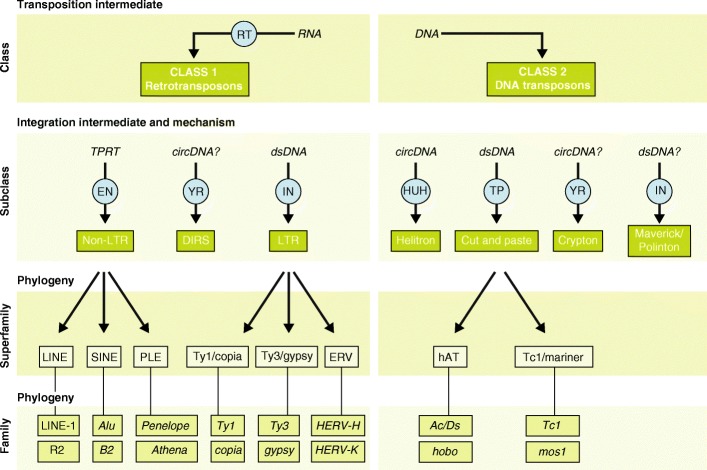
“Despite this diversity, it was possible to group them into two major classes according to their modes of transposition (mobilization in genomes): retrotransposons (RE, class I elements) and DNA transposons (class II elements) (Figure 1) [60,61].”
BackgroundHu, K., Ni, P., Xu, M., Zou, Y. F., Chang, J., Gao, X., Li, Y., Ruan, J., Hu, B., & Wang, J. (2024) · Nature Communications · doi:10.1038/s41467-024-49912-8 · Cited by 65
Specificities and Dynamics of Transposable Elements in Land Plants
Mhiri, C., Borges, F., & Grandbastien, M. (2022) · Biology · doi:10.3390/biology11040488 · Cited by 68
“, sequences over 80 bp sharing at least 80% sequence identity in at least 80% of their internal domain or terminal repeats (or both) [16,18,19].”
BackgroundPark, E. G., Ha, H., Lee, D. H., Kim, W. R., Lee, Y. J., Bae, W. H., & Kim, H. (2022) · International Journal of Molecular Sciences · doi:10.3390/ijms23168950 · Cited by 68
“The major superfamilies of the LTR retrotransposons are Ty3/gypsy, Ty1/copia, and endogenous retrovirus (ERV) elements, and in the case of the DNA transposons, Tc1/mariner, hAT (hobo-Ac-Tam3), and MULEs (mutator-like elements) are the three major superfamilies that are typically identified across the eukaryotic specie…”
BackgroundTransposable element exonization generates a reservoir of evolving and functional protein isoforms
Arribas, Y. A., Baudon, B., Rotival, M., Suárez, G., Bonté, P., Casas, V., Roubert, A., Klein, P., Bonnin, E., Mchich, B., et al. (2024) · Cell · doi:10.1016/j.cell.2024.11.011 · Cited by 66
“10,11 TEs, which cover around 45% of the genome, are mobile entities 12 that represent a reservoir of polymorphic sites upon which evolution can act.”
AthCNV: A Map of DNA Copy Number Variations in the Arabidopsis Genome
Żmieńko, A., Marszałek-Zeńczak, M., Wojciechowski, P., Samelak-Czajka, A., Łuczak, M., Kozłowski, P., Karlowski, W. M., & Figlerowicz, M. (2020) · The Plant Cell · doi:10.1105/tpc.19.00640 · Cited by 75
Widespread and tissue-specific expression of endogenous retroelements in human somatic tissues
Larouche, J., Trofimov, A., Hesnard, L., Ehx, G., Zhao, Q., Vincent, K., Durette, C., Gendron, P., Laverdure, J., Bonneil, É., et al. (2020) · Genome Medicine · doi:10.1186/s13073-020-00740-7 · Cited by 77
The current revolution in transposable element biology enabled by long reads
Shahid, S., & Slotkin, R. K. (2020) · Current Opinion in Plant Biology · doi:10.1016/j.pbi.2019.12.012 · Cited by 66
Gao, B., Wang, Y., Diaby, M., Zong, W., Shen, D., Wang, S., Chen, C., Wang, X., & Song, C. (2020) · Mobile DNA · doi:10.1186/s13100-020-00220-0 · Cited by 74
Two-speed genome evolution drives pathogenicity in fungal pathogens of animals
Wacker, T., Helmstetter, N., Wilson, D., Fisher, M. C., Studholme, D. J., & Farrer, R. A. (2023) · Proceedings of the National Academy of Sciences · doi:10.1073/pnas.2212633120 · Cited by 62
“In contrast, humans have half a million Class 1 TE’s, of which 0.1% are functional/mobile due to various mutations (60).”
InfluentialExtreme Y chromosome polymorphism corresponds to five male reproductive morphs of a freshwater fish
Sandkam, B. A., Almeida, P., Darolti, I., Furman, B. L. S., van der Bijl, W., Morris, J., Bourne, G. R., Breden, F. J., & Mank, J. E. (2021) · Nature Ecology & Evolution · doi:10.1038/s41559-021-01452-w · Cited by 60
Metadata
- Authors
- Bourque, G., Burns, K. H., Gehring, M., Gorbunova, V., Seluanov, A., Hammell, M., Imbeault, M., Izsvák, Z., Levin, H. L., Macfarlan, T. S., Mager, D. L., & Feschotte, C.
- Affiliations
- McGill University (CA)
- Johns Hopkins University (US)
- Whitehead Institute for Biomedical Research (US)
- University of Rochester (US)
- Cold Spring Harbor Laboratory (US)
- University of Cambridge (GB)
- Max Delbrück Center (DE)
- National Institutes of Health (US)
- BC Cancer Agency (CA)
- Cornell University (US)
- Corresponding author
- Bourque, Guillaume
- Feschotte, Cédric
- ORCID
- Venue
- Genome Biology
- Published
- 2018-11-19
- Volume
- 19
- Issue
- 1
- Pages
- 199-199
- ISSN
- 1465-6906 (ISSN-L)
- 1474-760X
- PMC
- PMC6240941
- OpenAlex
- W2901901698
- Cited by
- 1,430
- References
- 203
- Citations by year
- 2026: 167 · 2025: 243 · 2024: 236 · 2023: 199 · 2022: 202 · 2021: 190 · 2020: 133 · 2019: 58
- FWCI
- 10.00
- Type
- journal article
- Language
- en
- Open access
- gold
- doi.org
- Licence
- cc-by
- creativecommons.org/licenses/by/4.0/ (tdm)
- creativecommons.org/licenses/by/4.0/ (vor)
- Locations
- Genome biology (publishedVersion, cc-by)
- Europe PMC (PubMed Central) (publishedVersion, cc-by)
- PubMed Central (publishedVersion, cc-by)
- PubMed (publishedVersion)
- Cold Spring Harbor Laboratory Institutional Repository (Cold Spring Harbor Laboratory) (acceptedVersion)
- MDC Repository (Max-Delbrueck-Center for Molecular Medicine) (acceptedVersion)
- Apollo (University of Cambridge) (submittedVersion, cc-by)
- cIRcle (University of British Columbia) (submittedVersion, cc-by)
- DOAJ (DOAJ: Directory of Open Access Journals) (submittedVersion, cc-by-sa)
- DSpace@MIT (Massachusetts Institute of Technology) (submittedVersion, cc-by-nc)
- Apollo
- Apollo (cc-by)
- Funders
- Canadian Institutes of Health Research (CIHR-MOP-115090, CIHR-CEE-151618)
- Fonds de Recherche du Québec - Santé (FRSQ-25348, FRSQ-35279)
- European Commission (ERC-2011-AdG 294742)
- National Institutes of Health
- National Science Foundation
- Topics
- Life Sciences › Biochemistry, Genetics and Molecular Biology › Genetics › Chromosomal and Genetic Variations
- Life Sciences › Biochemistry, Genetics and Molecular Biology › Molecular Biology › Genomics and Chromatin Dynamics
- Life Sciences › Biochemistry, Genetics and Molecular Biology › Genetics › Genomic variations and chromosomal abnormalities
- Keywords
- transposable elements, genome evolution, eukaryotic genomes, transposon-host interactions, genome plasticity
- MeSH terms
- Animals, DNA Transposable Elements, Humans, Mutation, Polymorphism, Genetic, Gene Rearrangement
About these checks
Registry, retraction, Cites and statistics results are computed, not judged, with one exception: a printed reference that no index lists is read once by a model before it counts as a citation error. Claims are extracted by a model and kept only when their quote appears verbatim in the text; each cited source is then checked, with a model’s help, for whether it says what the claim relies on. Those verdicts can be wrong — read the claim’s quote and the cited source before relying on one.
Statistics and arithmetic are recomputed, not judged.
Confidence bands are shown only for fields calibrated on our annotated test set. None is calibrated yet, so no band is shown.
What counts as a claim ›How we measure confidence ›How we check this ›
Are you an author, or do you see a problem with this page? Request a review
Data sources
Bibliographic data: Semantic Scholar, OpenAlex, Crossref.
Contains information from the Semantic Scholar Academic Graph Datasets, made available under the ODC Attribution License (ODC-BY 1.0).
Semantic Scholar’s data is described in: Kinney, R., et al. (2023). The Semantic Scholar Open Data Platform. arXiv:2301.10140.
