

Cerebrospinal fluid soluble TREM2 levels in frontotemporal dementia differ by genetic and pathological subgroup
Open accessThe DOI matches its Crossref record; 48 of the 48 references it cites were found in a registry or an index.
Abstract
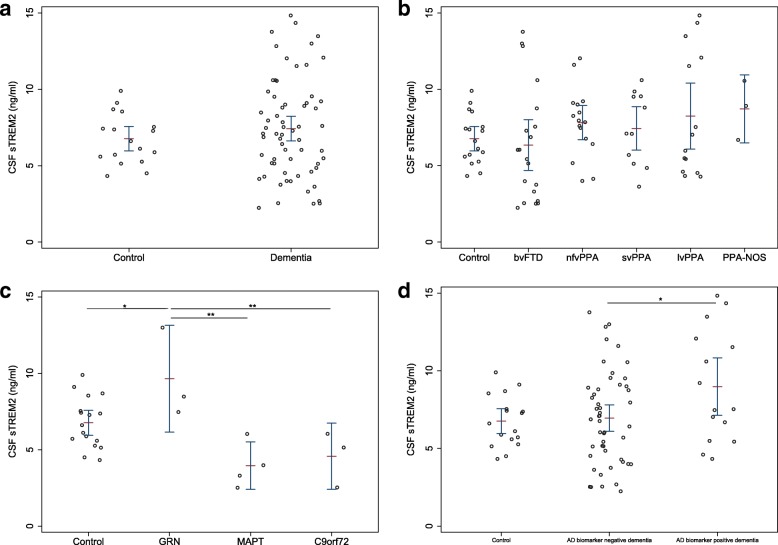
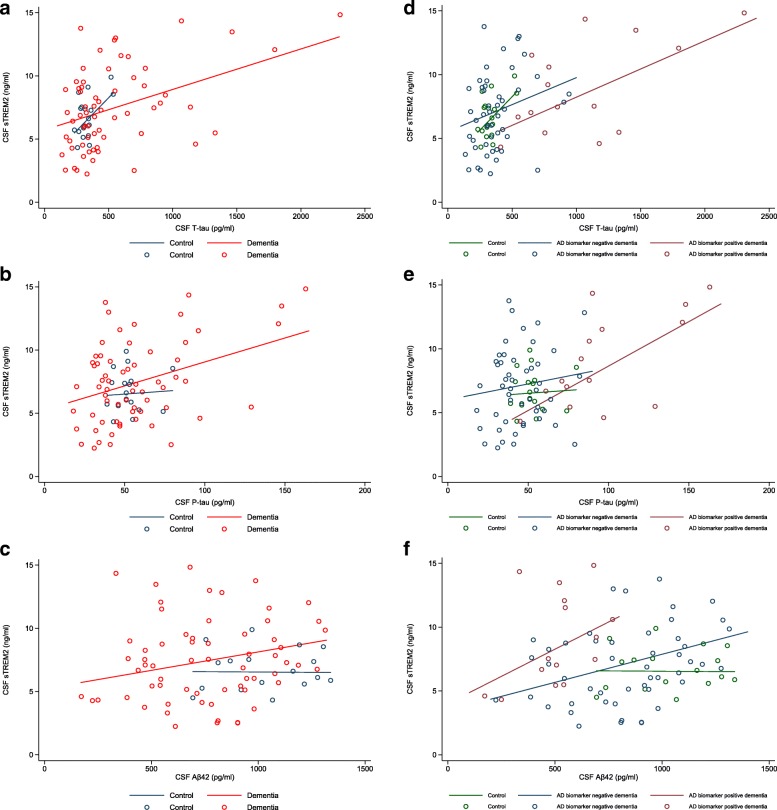
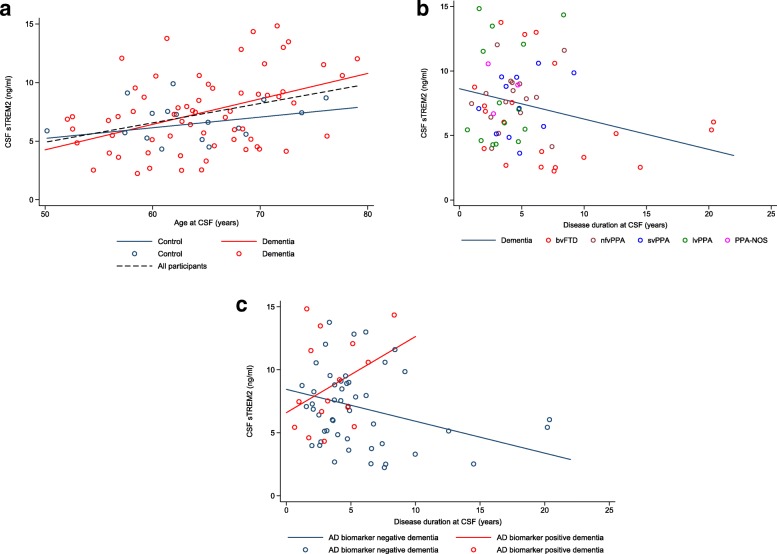
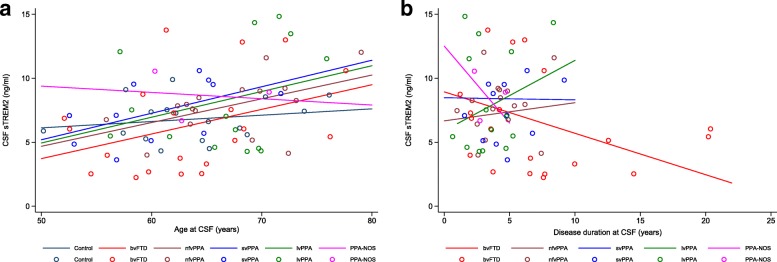
BACKGROUND: Reliable biomarkers of frontotemporal dementia (FTD) are currently lacking. FTD may be associated with chronic immune dysfunction, microglial activation and raised inflammatory markers, particularly in progranulin (GRN) mutation carriers. Levels of soluble triggering receptor expressed on myeloid cells 2 (sTREM2) are elevated in Alzheimer's disease (AD), but they have not been fully explored in FTD. METHODS: We investigated whether cerebrospinal fluid (CSF) sTREM2 levels differ between FTD and controls, across different clinical and genetic subtypes of FTD, or between individuals with FTD due to AD versus non-AD pathology (based on CSF neurodegenerative biomarkers). We also assessed relationships between CSF sTREM2 and other CSF biomarkers (total tau [T-tau], tau phosphorylated at position threonine-181 [P-tau] and β-amyloid 1-42 [Aβ42]) and age and disease duration. Biomarker levels were measured using immunoassays in 17 healthy controls and 64 patients with FTD (behavioural variant FTD, n = 20; primary progressive aphasia, n = 44). Ten of 64 had familial FTD, with mutations in GRN (n = 3), MAPT (n = 4), or C9orf72 (n = 3). Fifteen of 64 had neurodegenerative biomarkers consistent with AD pathology (11 of whom had logopenic variant PPA). Levels were compared using multivariable linear regressions. RESULTS: CSF sTREM2 levels did not differ between FTD and controls or between clinical subgroups. However, GRN mutation carriers had higher levels than controls (mean ([SD] = 9.7 [2.9] vs. 6.8 [1.6] ng/ml; P = 0.028) and MAPT (3.9 [1.5] ng/ml; P = 0.003] or C9orf72 [4.6 [1.8] ng/ml; P = 0.006) mutation carriers. Individuals with AD-like CSF had higher sTREM2 levels than those with non-AD-like CSF (9.0 [3.6] vs. 6.9 [3.0] ng/ml; P = 0.029). CSF sTREM2 levels were associated with T-tau levels in control and FTD groups and also with P-tau in those with FTD and AD-like CSF. CSF sTREM2 levels were influenced by both age and disease duration in FTD. CONCLUSIONS: Although CSF sTREM2 levels are not raised in FTD overall or in a particular clinical subtype of FTD, levels are raised in familial FTD associated with GRN mutations and in FTD syndromes due to AD pathology. Because CSF sTREM2 levels correlate with a marker of neuronal injury (T-tau), sTREM2 should be explored as a biomarker of disease intensity in future longitudinal studies of FTD.
Overview
The claims and statistics of this paper haven’t been checked yet.
Free: it reads the open-access text and checks the first 5 claims that cite a source we can check. Create a free account to check every claim.
Integrity signals
Registry
Cites
Statistics
Figures
Verification
Claims the paper makes
The claims and statistics of this paper haven’t been checked yet.
Free: it reads the open-access text and checks the first 5 claims that cite a source we can check. Create a free account to check every claim.
Claims other papers make about this one
Each is checked against this paper’s own text: does it say what the citing paper says it does?
In the citing paper
“first cross-sectional results showed CSF sTREM2 levels increased during neuro-inflammation in familial bvFTD associated with GRN mutations (N = 3) (Woollacott et al., 2018)”
From The pursuit for markers of disease progression in behavioral variant frontotemporal dementia: a scoping review to optimize outcome measures for clinical trials (2024) · cites this paper as Woollacott et al., 2018
Self-check
Percentages, sums and reported differences re-computed from the paper’s own numbers.
The self-check needs the paper’s full text.
Citations
Cites
Sensitivity of revised diagnostic criteria for the behavioural variant of frontotemporal dementia
Rascovsky, K., Hodges, J. R., Knopman, D., Mendez, M. F., Kramer, J. H., Neuhaus, J., van Swieten, J. C., Seelaar, H., Dopper, E. G. P., Onyike, C. U., et al. (2011) · Brain · doi:10.1093/brain/awr179 · Cited by 5,221
Self-citationClassification of primary progressive aphasia and its variants
Gorno-Tempini, M. L., Hillis, A. E., Weintraub, S., Kertesz, A., Mendez, M., Cappa, S. F., Ogar, J. M., Rohrer, J. D., Black, S., Boeve, B. F., et al. (2011) · Neurology · doi:10.1212/wnl.0b013e31821103e6 · Cited by 5,141
Self-citationAppelhof, B., Bakker, C., Van Duinen-van den Ijssel, J. C. L., Zwijsen, S. A., Smalbrugge, M., Verhey, F. R. J., de Vugt, M. E., Zuidema, S. U., & Koopmans, R. T. C. M. (2017) · Dementia and Geriatric Cognitive Disorders · doi:10.1159/000477087 · Cited by 2,760
Qualitative Assessment of Verbal Fluency Performance in Frontotemporal Dementia
van den Berg, E., Jiskoot, L. C., Grosveld, M. J. H., van Swieten, J. C., & Papma, J. M. (2017) · Dementia and Geriatric Cognitive Disorders · doi:10.1159/000477538 · Cited by 2,046
TREM2 Lipid Sensing Sustains the Microglial Response in an Alzheimer’s Disease Model
Wang, Y., Cella, M., Mallinson, K., Ulrich, J. D., Young, K. L., Robinette, M. L., Gilfillan, S., Krishnan, G. M., Sudhakar, S., Zinselmeyer, B. H., et al. (2015) · Cell · doi:10.1016/j.cell.2015.01.049 · Cited by 1,736
The microglial sensome revealed by direct RNA sequencing
Hickman, S. E., Kingery, N. D., Ohsumi, T. K., Borowsky, M. L., Wang, L.-C., Means, T. K., & El Khoury, J. (2013) · Nature Neuroscience · doi:10.1038/nn.3554 · Cited by 1,511
Takahashi, K., Rochford, C. D. P., & Neumann, H. (2005) · The Journal of Experimental Medicine · doi:10.1084/jem.20041611 · Cited by 1,124
TREM2 mutations implicated in neurodegeneration impair cell surface transport and phagocytosis
Kleinberger, G., Yamanishi, Y., Suárez-Calvet, M., Czirr, E., Lohmann, E., Cuyvers, E., Struyfs, H., Pettkus, N., Wenninger-Weinzierl, A., Mazaheri, F., et al. (2014) · Science Translational Medicine · doi:10.1126/scitranslmed.3009093 · Cited by 798
Self-citationLui, H., Zhang, J., Makinson, S. R., Cahill, M. K., Kelley, K. W., Huang, H.-Y., Shang, Y., Oldham, M. C., Martens, L. H., Gao, F., et al. (2016) · Cell · doi:10.1016/j.cell.2016.04.001 · Cited by 729
Suárez‐Calvet, M., Kleinberger, G., Araque Caballero, M. Á., Brendel, M., Rominger, A., Alcolea, D., Fortea, J., Lleó, A., Blesa, R., Gispert, J. D., et al. (2016) · EMBO Molecular Medicine · doi:10.15252/emmm.201506123 · Cited by 522
Self-citationExaggerated inflammation, impaired host defense, and neuropathology in progranulin-deficient mice
Yin, F., Banerjee, R., Thomas, B., Zhou, P., Qian, L., Jia, T., Ma, X., Ma, Y., Iadecola, C., Beal, M. F., et al. (2010) · Journal of Experimental Medicine · doi:10.1084/jem.20091568 · Cited by 480
Loss-of-function mutations in TYROBP (DAP12) result in a presenile dementia with bone cysts
Paloneva, J., Kestilä, M., Wu, J., Salminen, A., Böhling, T., Ruotsalainen, V., Hakola, P., Bakker, A. B. H., Phillips, J. H., Pekkarinen, P., et al. (2000) · Nature Genetics · doi:10.1038/77153 · Cited by 460
Sjögren, M., Vanderstichele, H., Ågren, H., Zachrisson, O., Edsbagge, M., Wikkelsø, C., Skoog, I., Wallin, A., Wahlund, L.-O., Marcusson, J., et al. (2001) · Clinical Chemistry · doi:10.1093/clinchem/47.10.1776 · Cited by 436
Serum neurofilament light chain protein is a measure of disease intensity in frontotemporal dementia
Rohrer, J. D., Woollacott, I. O. C., Dick, K. M., Brotherhood, E., Gordon, E., Fellows, A., Toombs, J., Druyeh, R., Cardoso, M. J., Ourselin, S., et al. (2016) · Neurology · doi:10.1212/wnl.0000000000003154 · Cited by 432
Self-citationSoluble TREM2 induces inflammatory responses and enhances microglial survival
Zhong, L., Chen, X.-F., Wang, T., Wang, Z., Liao, C., Wang, Z., Huang, R., Wang, D., Li, X., Wu, L., et al. (2017) · Journal of Experimental Medicine · doi:10.1084/jem.20160844 · Cited by 362
Schmid, C. D., Sautkulis, L. N., Danielson, P. E., Cooper, J., Hasel, K. W., Hilbush, B. S., Sutcliffe, J. G., & Carson, M. J. (2002) · Journal of Neurochemistry · doi:10.1046/j.1471-4159.2002.01243.x · Cited by 351
TREM2 deficiency impairs chemotaxis and microglial responses to neuronal injury
Mazaheri, F., Snaidero, N., Kleinberger, G., Madore, C., Daria, A., Werner, G., Krasemann, S., Capell, A., Trümbach, D., Wurst, W., et al. (2017) · The EMBO Reports · doi:10.15252/embr.201743922 · Cited by 351
Cerebrospinal fluid soluble TREM2 is higher in Alzheimer disease and associated with mutation status
Piccio, L., Deming, Y., Del-Águila, J. L., Ghezzi, L., Holtzman, D. M., Fagan, A. M., Fenoglio, C., Galimberti, D., Borroni, B., & Cruchaga, C. (2016) · Acta Neuropathologica · doi:10.1007/s00401-016-1533-5 · Cited by 337
Progranulin deficiency promotes neuroinflammation and neuron loss following toxin-induced injury
Martens, L. H., Zhang, J., Barmada, S. J., Zhou, P., Kamiya, S., Sun, B., Min, S.-W., Gan, L., Finkbeiner, S., Huang, E. J., et al. (2012) · Journal of Clinical Investigation · doi:10.1172/jci63113 · Cited by 315
Piccio, L., Buonsanti, C., Cella, M., Tassi, I., Schmidt, R. E., Fenoglio, C., Rinker, J., Naismith, R. T., Panina-Bordignon, P., Passini, N., et al. (2008) · Brain · doi:10.1093/brain/awn217 · Cited by 307
Increased cerebrospinal fluid soluble TREM2 concentration in Alzheimer’s disease
Heslegrave, A., Heywood, W., Paterson, R., Magdalinou, N., Svensson, J., Johansson, P., Öhrfelt, A., Blennow, K., Hardy, J., Schott, J., et al. (2016) · Molecular Neurodegeneration · doi:10.1186/s13024-016-0071-x · Cited by 303
Self-citationBlockade of TREM‐2 exacerbates experimental autoimmune encephalomyelitis
Piccio, L., Buonsanti, C., Mariani, M., Cella, M., Gilfillan, S., Cross, A. H., Colonna, M., & Panina‐Bordignon, P. (2007) · European Journal of Immunology · doi:10.1002/eji.200636837 · Cited by 284
Suárez-Calvet, M., Araque Caballero, M. Á., Kleinberger, G., Bateman, R. J., Fagan, A. M., Morris, J. C., Levin, J., Danek, A., Ewers, M., Haass, C., et al. (2016) · Science Translational Medicine · doi:10.1126/scitranslmed.aag1767 · Cited by 272
Neurofilament light chain: a biomarker for genetic frontotemporal dementia
Meeter, L. H., Dopper, E. G., Jiskoot, L. C., Sanchez‐Valle, R., Graff, C., Benussi, L., Ghidoni, R., Pijnenburg, Y. A., Borroni, B., Galimberti, D., et al. (2016) · Annals of Clinical and Translational Neurology · doi:10.1002/acn3.325 · Cited by 263
Self-citationKleinberger, G., Brendel, M., Mracsko, E., Wefers, B., Groeneweg, L., Xiang, X., Focke, C., Deußing, M., Suárez‐Calvet, M., Mazaheri, F., et al. (2017) · The EMBO Journal · doi:10.15252/embj.201796516 · Cited by 251
TREM-2 (triggering receptor expressed on myeloid cells 2) is a phagocytic receptor for bacteria
N'Diaye, E.-N., Branda, C. S., Branda, S. S., Nevarez, L., Colonna, M., Lowell, C., Hamerman, J. A., & Seaman, W. E. (2009) · Journal of Cell Biology · doi:10.1083/jcb.200808080 · Cited by 239
Lashley, T., Rohrer, J. D., Mead, S., & Revesz, T. (2015) · Neuropathology and Applied Neurobiology · doi:10.1111/nan.12250 · Cited by 220
Self-citationTREM2 deficiency reduces the efficacy of immunotherapeutic amyloid clearance
Xiang, X., Werner, G., Bohrmann, B., Liesz, A., Mazaheri, F., Capell, A., Feederle, R., Knuesel, I., Kleinberger, G., & Haass, C. (2016) · EMBO Molecular Medicine · doi:10.15252/emmm.201606370 · Cited by 183
Insights into TREM2 biology by network analysis of human brain gene expression data
Forabosco, P., Ramasamy, A., Trabzuni, D., Walker, R., Smith, C., Bras, J., Levine, A. P., Hardy, J., Pocock, J. M., Guerreiro, R., et al. (2013) · Neurobiology of Aging · doi:10.1016/j.neurobiolaging.2013.05.001 · Cited by 180
Yin, F., Dumont, M., Banerjee, R., Ma, Y., Li, H., Lin, M. T., Beal, M. F., Nathan, C., Thomas, B., & Ding, A. (2010) · The FASEB Journal · doi:10.1096/fj.10-161471 · Cited by 180
TDP-43 frontotemporal lobar degeneration and autoimmune disease
Miller, Z. A., Rankin, K. P., Graff-Radford, N. R., Takada, L. T., Sturm, V. E., Cleveland, C. M., Criswell, L. A., Jaeger, P. A., Stan, T., Heggeli, K. A., et al. (2013) · Journal of Neurology, Neurosurgery & Psychiatry · doi:10.1136/jnnp-2012-304644 · Cited by 170
Guerreiro, R., Bilgic, B., Guven, G., Brás, J., Rohrer, J., Lohmann, E., Hanagasi, H., Gurvit, H., & Emre, M. (2013) · Neurobiology of Aging · doi:10.1016/j.neurobiolaging.2013.06.005 · Cited by 158
Self-citationLue, L., Schmitz, C. T., Serrano, G., Sue, L. I., Beach, T. G., & Walker, D. G. (2015) · Brain Pathology · doi:10.1111/bpa.12190 · Cited by 154
The clinical spectrum of sporadic and familial forms of frontotemporal dementia
Woollacott, I. O. C., & Rohrer, J. D. (2016) · Journal of Neurochemistry · doi:10.1111/jnc.13654 · Cited by 149 · cited 1×
“ated most commonly with mutations in progranulin (GRN), microtubule-associated protein tau (MAPT) or chromosome 9 open reading frame 72 (C9orf72) [1].”
BackgroundSelf-citationGiraldo, M., Lopera, F., Siniard, A. L., Corneveaux, J. J., Schrauwen, I., Carvajal, J., Muñoz, C., Ramirez-Restrepo, M., Gaiteri, C., Myers, A. J., et al. (2013) · Neurobiology of Aging · doi:10.1016/j.neurobiolaging.2013.02.016 · Cited by 147
Cerebrospinal fluid soluble TREM2 in aging and Alzheimer’s disease
Henjum, K., Almdahl, I. S., Årskog, V., Minthon, L., Hansson, O., Fladby, T., & Nilsson, L. N. G. (2016) · Alzheimer's Research & Therapy · doi:10.1186/s13195-016-0182-1 · Cited by 143
Progranulin: a new avenue towards the understanding and treatment of neurodegenerative disease
Chitramuthu, B. P., Bennett, H. P. J., & Bateman, A. (2017) · Brain · doi:10.1093/brain/awx198 · Cited by 138
Tanaka, Y., Matsuwaki, T., Yamanouchi, K., & Nishihara, M. (2012) · Neuroscience · doi:10.1016/j.neuroscience.2012.11.032 · Cited by 126
Mutations in TREM2 lead to pure early-onset dementia without bone cysts
Chouery, E., Delague, V., Bergougnoux, A., Koussa, S., Serre, J.-L., & Mégarbané, A. (2008) · Human Mutation · doi:10.1002/humu.20836 · Cited by 124
Gispert, J. D., Suárez‐Calvet, M., Monté, G. C., Tucholka, A., Falcon, C., Rojas, S., Rami, L., Sánchez‐Valle, R., Lladó, A., Kleinberger, G., et al. (2016) · Alzheimer's & Dementia · doi:10.1016/j.jalz.2016.06.005 · Cited by 115
Homozygous TREM2 mutation in a family with atypical frontotemporal dementia
Le Ber, I., De Septenville, A., Guerreiro, R., Bras, J., Camuzat, A., Caroppo, P., Lattante, S., Couarch, P., Kabashi, E., Bouya-Ahmed, K., et al. (2014) · Neurobiology of Aging · doi:10.1016/j.neurobiolaging.2014.04.010 · Cited by 99
Öhrfelt, A., Axelsson, M., Malmeström, C., Novakova, L., Heslegrave, A., Blennow, K., Lycke, J., & Zetterberg, H. (2016) · Multiple Sclerosis Journal · doi:10.1177/1352458515624558 · Cited by 98
Self-citationBossù, P., Salani, F., Alberici, A., Archetti, S., Bellelli, G., Galimberti, D., Scarpini, E., Spalletta, G., Caltagirone, C., Padovani, A., et al. (2011) · Journal of Neuroinflammation · doi:10.1186/1742-2094-8-65 · Cited by 91
Initiative, F. T. A. D. N., Takahashi, H., Klein, Z. A., Bhagat, S. M., Kaufman, A. C., Kostylev, M. A., Ikezu, T., & Strittmatter, S. M. (2017) · Acta Neuropathologica · doi:10.1007/s00401-017-1668-z · Cited by 83 · cited 1×
“GRN-knockout mice have upregulated TREM2 gene expression [3, 35] and excessive synaptic pruning mediated by aberrantly activated microglia [3].”
BackgroundGalimberti, D., Bonsi, R., Fenoglio, C., Serpente, M., Cioffi, S., Fumagalli, G., Arighi, A., Ghezzi, L., Arcaro, M., Mercurio, M., et al. (2015) · Brain Behavior and Immunity · doi:10.1016/j.bbi.2015.05.006 · Cited by 70
Paterson, R. W., Heywood, W. E., Heslegrave, A. J., Magdalinou, N. K., Andreasson, U., Sirka, E., Bliss, E., Slattery, C. F., Toombs, J., Svensson, J., et al. (2016) · Translational Psychiatry · doi:10.1038/tp.2016.194 · Cited by 66
Self-citationPaternicò, D., Galluzzi, S., Drago, V., Bocchio‐Chiavetto, L., Zanardini, R., Pedrini, L., Baronio, M., Amicucci, G., & Frisoni, G. B. (2012) · Alzheimer's & Dementia · doi:10.1016/j.jalz.2011.10.003 · Cited by 35
Minami, S. S., Shen, V., Le, D., Krabbe, G., Asgarov, R., Perez-Celajes, L., Lee, C.-H., Li, J., Donnelly-Roberts, D., & Gan, L. (2015) · Biochemical Pharmacology · doi:10.1016/j.bcp.2015.07.016 · Cited by 14
Cited by
Neurofilament light chain as a biomarker in neurological disorders
Gaetani, L., Blennow, K., Calabresi, P., Di Filippo, M., Parnetti, L., & Zetterberg, H. (2019) · Journal of Neurology, Neurosurgery & Psychiatry · doi:10.1136/jnnp-2018-320106 · Cited by 1,334
Self-citationThe Physiology, Pathology, and Potential Therapeutic Applications of the TREM2 Signaling Pathway
Deczkowska, A., Weiner, A., & Amit, I. (2020) · Cell · doi:10.1016/j.cell.2020.05.003 · Cited by 648
An update on genetic frontotemporal dementia
Greaves, C. V., & Rohrer, J. D. (2019) · Journal of Neurology · doi:10.1007/s00415-019-09363-4 · Cited by 500
Self-citationThe complexity of tau in Alzheimer’s disease
Naseri, N. N., Wang, H., Guo, J., Sharma, M., & Luo, W. (2019) · Neuroscience Letters · doi:10.1016/j.neulet.2019.04.022 · Cited by 373
Immune Signaling in Neurodegeneration
Hammond, T. R., Marsh, S. E., & Stevens, B. (2019) · Immunity · doi:10.1016/j.immuni.2019.03.016 · Cited by 336
Metadata
- Authors
- Woollacott, I. O. C., Nicholas, J. M., Heslegrave, A., Heller, C., Foiani, M. S., Dick, K. M., Russell, L. L., Paterson, R. W., Keshavan, A., Fox, N. C., Warren, J. D., Schott, J. M., Zetterberg, H., & Rohrer, J. D.
- Affiliations
- UCL Queen Square Institute of Neurology (GB)
- London School of Hygiene & Tropical Medicine (GB)
- UK Dementia Research Institute (GB)
- Sahlgrenska University Hospital (SE)
- Corresponding author
- Rohrer, Jonathan D.
- ORCID
- Venue
- Alzheimer's Research & Therapy
- Published
- 2018-08-16
- Volume
- 10
- Issue
- 1
- Pages
- 79-79
- ISSN
- 1758-9193 (ISSN-L)
- PMC
- PMC6094471
- OpenAlex
- W2885700079
- Cited by
- 62
- References
- 48
- Citations by year
- 2026: 1 · 2025: 7 · 2024: 6 · 2023: 9 · 2022: 9 · 2021: 5 · 2020: 10 · 2019: 13 · 2018: 2
- FWCI
- 5.90
- Type
- journal article
- Language
- en
- Open access
- gold
- doi.org
- Licence
- cc-by
- creativecommons.org/licenses/by/4.0/ (tdm)
- Locations
- Alzheimer s Research & Therapy (publishedVersion, cc-by)
- Europe PMC (PubMed Central) (publishedVersion, other-oa)
- PubMed Central (publishedVersion, cc-by)
- PubMed (publishedVersion)
- LSHTM Research Online (London School of Hygiene and Tropical Medicine) (acceptedVersion)
- DOAJ (DOAJ: Directory of Open Access Journals) (submittedVersion)
- UCL Discovery (University College London) (submittedVersion)
- Funders
- Medical Research Council
- Topics
- Health Sciences › Medicine › Psychiatry and Mental health › Dementia and Cognitive Impairment Research
- Life Sciences › Neuroscience › Cellular and Molecular Neuroscience › Alzheimer's disease research and treatments
- Life Sciences › Neuroscience › Neurology › Neuroinflammation and Neurodegeneration Mechanisms
- Keywords
- soluble TREM2, frontotemporal dementia, cerebrospinal fluid biomarkers, progranulin mutations, MAPT mutations, C9orf72 mutation, Alzheimer's disease pathology, primary progressive aphasia, behavioral variant frontotemporal dementia, tau phosphorylation, amyloid-beta 42, microglial activation, neuroinflammation, familial frontotemporal dementia
- MeSH terms
- C9orf72 Protein, Age Factors, Aged, Female, Gene Expression Regulation, Humans, Male, Membrane Glycoproteins, Middle Aged, Peptide Fragments, Phosphorylation, Receptors, Immunologic, Cohort Studies, Amyloid beta-Peptides, tau Proteins, Statistics, Nonparametric, Aphasia, Primary Progressive, Frontotemporal Dementia
About these checks
Registry, retraction, Cites and statistics results are computed, not judged, with one exception: a printed reference that no index lists is read once by a model before it counts as a citation error. Claims are extracted by a model and kept only when their quote appears verbatim in the text; each cited source is then checked, with a model’s help, for whether it says what the claim relies on. Those verdicts can be wrong — read the claim’s quote and the cited source before relying on one.
Statistics and arithmetic are recomputed, not judged.
Confidence bands are shown only for fields calibrated on our annotated test set. None is calibrated yet, so no band is shown.
What counts as a claim ›How we measure confidence ›How we check this ›
Are you an author, or do you see a problem with this page? Request a review
Data sources
Bibliographic data: Semantic Scholar, OpenAlex, Crossref.
Contains information from the Semantic Scholar Academic Graph Datasets, made available under the ODC Attribution License (ODC-BY 1.0).
Semantic Scholar’s data is described in: Kinney, R., et al. (2023). The Semantic Scholar Open Data Platform. arXiv:2301.10140.
