

FDG-PET as an independent biomarker for Alzheimer’s biological diagnosis: a longitudinal study
Open accessThe DOI matches its Crossref record; 49 of the 50 references it cites were found in a registry or an index.
Abstract
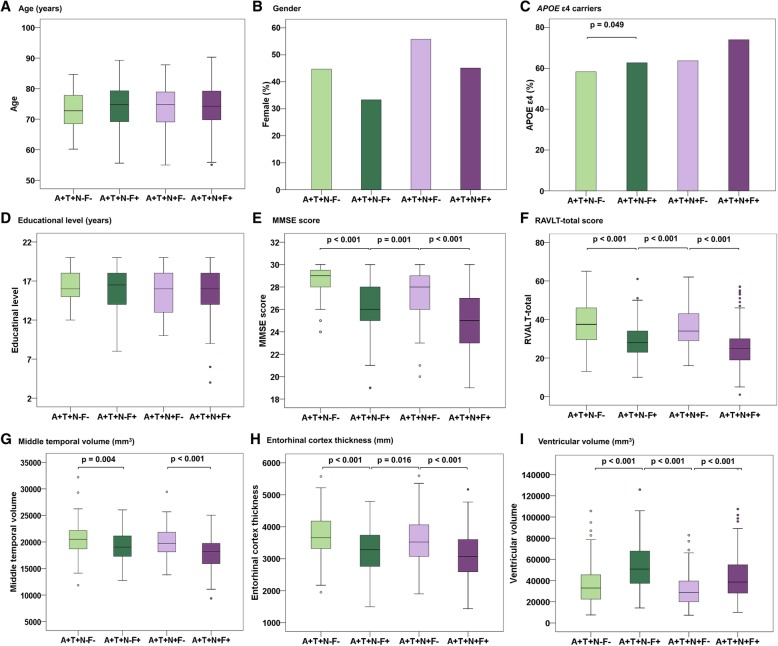
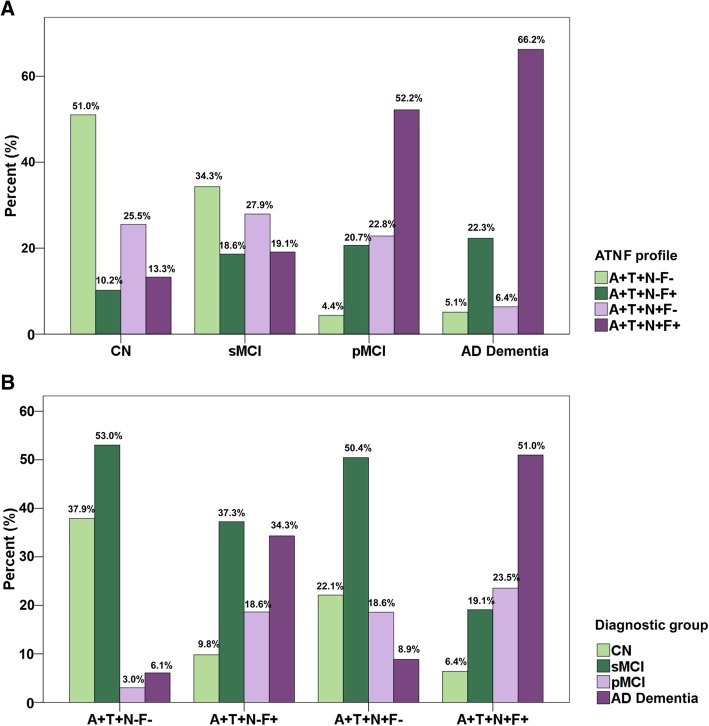
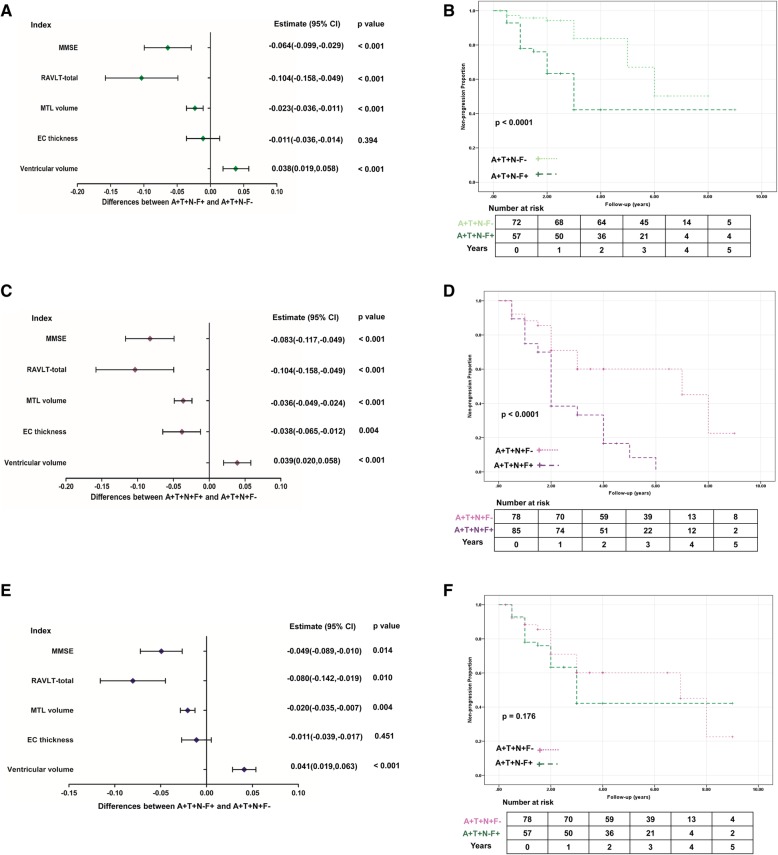
BACKGROUND: F-fluorodeoxyglucose-positron emission tomography (FDG-PET) brain metabolism was recognized as a biomarker of neurodegeneration in the recently proposed ATN framework for Alzheimer's disease (AD) biological definition. However, accumulating evidence suggested it is an independent biomarker, which is denoted as "F" in the very study. METHODS: A total of 551 A+T+ individuals from the Alzheimer's Disease Neuroimaging Initiative database were recruited and then further divided into four groups based on the biomarker positivity as 132 A+T+N-F-, 102 A+T+N-F+, 113 A+T+N+F-, and 204 A+T+N+F+. Frequency distributions of the groups were compared, as well as the clinical progression [measured by the longitudinal changes in cognition and brain structure, and mild cognitive impairment (MCI) to AD dementia conversion] between every pair of F+ and F- groups. RESULTS: The prevalence of A+T+N+F+ profile was 66.24% in clinically diagnosed AD dementia patients; similarly, the majority of individuals with reduced FDG-PET were AD dementia subjects. Among the 551 individuals that included, 537 had at least one follow-up (varied from 1 to 8 years). Individuals in F+ groups performed worse and dropped faster in Mini-Mental State Examination scale and had faster shrinking middle temporal lobe than those in F- groups (all p < 0.05). Moreover, in MCI patients, reduced FDG-PET exerted 2.47 to 4.08-fold risk of AD dementia progression compared with those without significantly impaired FDG-PET (both p < 0.001). CONCLUSIONS: Based on the analyses, separating FDG-PET from "N" biomarker to build the ATN(F) system is necessary and well-founded. The analysis from this study could be a complement to the original ATN framework for AD's biological definition.
Overview
The claims and statistics of this paper haven’t been checked yet.
Free: it reads the open-access text and checks the first 5 claims that cite a source we can check. Create a free account to check every claim.
Integrity signals
Registry
Cites
Statistics
Figures
Verification
Claims the paper makes
The claims and statistics of this paper haven’t been checked yet.
Free: it reads the open-access text and checks the first 5 claims that cite a source we can check. Create a free account to check every claim.
Claims other papers make about this one
Each is checked against this paper’s own text: does it say what the citing paper says it does?
The source backs part of the claim, not all of it — or backs it for a different population, condition or comparison.
In the citing paper
“Since CSF collection is invasive, positron emission tomography (PET) and magnetic resonance imaging (MRI) scans are used as noninvasive methods to detect metabolic and structural brain changes associated with AD [221,222,223].”
From The Impact of Neurotoxin Proteins Trafficked by Primary Cilia and Extracellular Vesicles in Neurodegenerative Diseases (2025) · cites this paper as [222]
Experimental — accuracy not yet measuredIn the citing paper
“AD patients exhibit decreased uptake of FDG on PET [220]”
From Genetic architecture of Alzheimer's disease (2020) · cites this paper as [220]
In the citing paper
“PET imaging can also be used to measure glucose metabolism in the brain through the utilization of a radiolabeled alternate form of glucose, 18F-fluorodeoxyglucose (FDG) [220].”
From Genetic architecture of Alzheimer's disease (2020) · cites this paper as [220]
Self-check
Percentages, sums and reported differences re-computed from the paper’s own numbers.
The self-check needs the paper’s full text.
Citations
Cites
McKhann, G. M., Knopman, D. S., Chertkow, H., Hyman, B. T., Jack, C. R., Kawas, C. H., Klunk, W. E., Koroshetz, W. J., Manly, J. J., Mayeux, R., et al. (2011) · Alzheimer's & Dementia · doi:10.1016/j.jalz.2011.03.005 · Cited by 18,657
Neuropathological stageing of Alzheimer-related changes.
Braak, H., & Braak, E. (1991) · Acta Neuropathologica · doi:10.1007/bf00308809 · Cited by 16,123
NIA‐AA Research Framework: Toward a biological definition of Alzheimer's disease
Jack, C. R., Bennett, D. A., Blennow, K., Carrillo, M. C., Dunn, B., Haeberlein, S. B., Holtzman, D. M., Jagust, W., Jessen, F., Karlawish, J., et al. (2018) · Alzheimer's & Dementia · doi:10.1016/j.jalz.2018.02.018 · Cited by 10,537
Sperling, R. A., Aisen, P. S., Beckett, L. A., Bennett, D. A., Craft, S., Fagan, A. M., Iwatsubo, T., Jack, C. R., Kaye, J., Montine, T. J., et al. (2011) · Alzheimer's & Dementia · doi:10.1016/j.jalz.2011.03.003 · Cited by 7,155
Sokoloff, L., Reivich, M., Kennedy, C., Rosiers, M. H. D., Patlak, C. S., Pettigrew, K. D., Sakurada, O., & Shinohara, M. (1977) · Journal of Neurochemistry · doi:10.1111/j.1471-4159.1977.tb10649.x · Cited by 6,000
Current concepts in mild cognitive impairment
Petersen, R. C., Doody, R., Kurz, A., Mohs, R. C., Morris, J. C., Rabins, P. V., Ritchie, K., Rossor, M., Thal, L., & Winblad, B. (2001) · Archives of Neurology · doi:10.1001/archneur.58.12.1985 · Cited by 4,781
Alzheimer's Disease Neuroimaging Initiative (ADNI): Clinical characterization
Petersen, R. C., Aisen, P. S., Beckett, L. A., Donohue, M. C., Gamst, A. C., Harvey, D. J., Jack, C. R., Jagust, W. J., Shaw, L. M., Toga, A. W., et al. (2010) · Neurology · doi:10.1212/wnl.0b013e3181cb3e25 · Cited by 3,060
Squire, L. R., Stark, C. E. L., & Clark, R. E. (2004) · Annual Review of Neuroscience · doi:10.1146/annurev.neuro.27.070203.144130 · Cited by 2,680
Buckner, R. L., Snyder, A. Z., Shannon, B. J., LaRossa, G., Sachs, R., Fotenos, A. F., Sheline, Y. I., Klunk, W. E., Mathis, C. A., Morris, J. C., et al. (2005) · The Journal of Neuroscience · doi:10.1523/jneurosci.2177-05.2005 · Cited by 2,140
Jack, C. R., Albert, M. S., Knopman, D. S., McKhann, G. M., Sperling, R. A., Carrillo, M. C., Thies, B., & Phelps, C. H. (2011) · Alzheimer's & Dementia · doi:10.1016/j.jalz.2011.03.004 · Cited by 2,042
Blood–brain barrier breakdown is an early biomarker of human cognitive dysfunction
Nation, D. A., Sweeney, M. D., Montagne, A., Sagare, A. P., D’Orazio, L. M., Pachicano, M., Sepehrband, F., Nelson, A. R., Buennagel, D. P., Harrington, M. G., et al. (2019) · Nature Medicine · doi:10.1038/s41591-018-0297-y · Cited by 1,728
Functional brain abnormalities in young adults at genetic risk for late-onset Alzheimer's dementia
Reiman, E. M., Chen, K., Alexander, G. E., Caselli, R. J., Bandy, D., Osborne, D., Saunders, A. M., & Hardy, J. (2004) · Proceedings of the National Academy of Sciences · doi:10.1073/pnas.2635903100 · Cited by 977
Self-citationMosconi, L. (2005) · European Journal of Nuclear Medicine and Molecular Imaging · doi:10.1007/s00259-005-1762-7 · Cited by 898
Associations between cognitive, functional, and FDG-PET measures of decline in AD and MCI
Landau, S. M., Harvey, D., Madison, C. M., Koeppe, R. A., Reiman, E. M., Foster, N. L., Weiner, M. W., & Jagust, W. J. (2011) · Neurobiology of Aging · doi:10.1016/j.neurobiolaging.2009.07.002 · Cited by 750
Cerebral hypoperfusion and clinical onset of dementia: the Rotterdam Study
Ruitenberg, A., den Heijer, T., Bakker, S. L. M., van Swieten, J. C., Koudstaal, P. J., Hofman, A., & Breteler, M. M. B. (2005) · Annals of Neurology · doi:10.1002/ana.20493 · Cited by 733
Vascular dysfunction—The disregarded partner of Alzheimer's disease
Sweeney, M. D., Montagne, A., Sagare, A. P., Nation, D. A., Schneider, L. S., Chui, H. C., Harrington, M. G., Pa, J., Law, M., Wang, D. J. J., et al. (2019) · Alzheimer's & Dementia · doi:10.1016/j.jalz.2018.07.222 · Cited by 711
de Leon, M. J., Convit, A., Wolf, O. T., Tarshish, C. Y., DeSanti, S., Rusinek, H., Tsui, W., Kandil, E., Scherer, A. J., Roche, A., et al. (2001) · Proceedings of the National Academy of Sciences · doi:10.1073/pnas.191044198 · Cited by 629
Comparing predictors of conversion and decline in mild cognitive impairment
Landau, S. M., Harvey, D., Madison, C. M., Reiman, E. M., Foster, N. L., Aisen, P. S., Petersen, R. C., Shaw, L. M., Trojanowski, J. Q., Jack, C. R., et al. (2010) · Neurology · doi:10.1212/wnl.0b013e3181e8e8b8 · Cited by 616
Tabert, M. H., Manly, J. J., Liu, X., Pelton, G. H., Rosenblum, S., Jacobs, M., Zamora, D., Goodkind, M., Bell, K., Stern, Y., et al. (2006) · Archives of General Psychiatry · doi:10.1001/archpsyc.63.8.916 · Cited by 600
A Deep Learning Model to Predict a Diagnosis of Alzheimer Disease by Using 18 F-FDG PET of the Brain
Ding, Y., Sohn, J. H., Kawczynski, M. G., Trivedi, H., Harnish, R., Jenkins, N. W., Lituiev, D., Copeland, T. P., Aboian, M. S., Mari Aparici, C., et al. (2019) · Radiology · doi:10.1148/radiol.2018180958 · Cited by 577
Hippocampal formation glucose metabolism and volume losses in MCI and AD
De Santi, S., de Leon, M. J., Rusinek, H., Convit, A., Tarshish, C. Y., Roche, A., Tsui, W. H., Kandil, E., Boppana, M., Daisley, K., et al. (2001) · Neurobiology of Aging · doi:10.1016/s0197-4580(01)00230-5 · Cited by 548
Simpson, I. A., Chundu, K. R., Davies‐Hill, T., Honer, W. G., & Davies, P. (1994) · Annals of Neurology · doi:10.1002/ana.410350507 · Cited by 490
Relationships between biomarkers in aging and dementia
Jagust, W. J., Landau, S. M., Shaw, L. M., Trojanowski, J. Q., Koeppe, R. A., Reiman, E. M., Foster, N. L., Petersen, R. C., Weiner, M. W., Price, J. C., et al. (2009) · Neurology · doi:10.1212/wnl.0b013e3181bc010c · Cited by 456
Saykin, A. J., Shen, L., Foroud, T. M., Potkin, S. G., Swaminathan, S., Kim, S., Risacher, S. L., Nho, K., Huentelman, M. J., Craig, D. W., et al. (2010) · Alzheimer's & Dementia · doi:10.1016/j.jalz.2010.03.013 · Cited by 442
Limbic hypometabolism in Alzheimer's disease and mild cognitive impairment
Nestor, P. J., Fryer, T. D., Smielewski, P., & Hodges, J. R. (2003) · Annals of Neurology · doi:10.1002/ana.10669 · Cited by 412
[18F]FDG PET signal is driven by astroglial glutamate transport
Zimmer, E. R., Parent, M. J., Souza, D. G., Leuzy, A., Lecrux, C., Kim, H.-I., Gauthier, S., Pellerin, L., Hamel, E., & Rosa-Neto, P. (2017) · Nature Neuroscience · doi:10.1038/nn.4492 · Cited by 343
Reduced Glucose Transporter at the Blood‐Brain Barrier and in Cerebral Cortex in Alzheimer Disease
Kalaria, R. N., & Harik, S. I. (1989) · Journal of Neurochemistry · doi:10.1111/j.1471-4159.1989.tb07399.x · Cited by 338
Reduced hippocampal metabolism in MCI and AD: Automated FDG-PET image analysis
Mosconi, L., Tsui, W. H., De Santi, S., Li, J., Rusinek, H., Convit, A., Li, Y., Boppana, M., & de Leon, M. J. (2005) · Neurology · doi:10.1212/01.wnl.0000163856.13524.08 · Cited by 336
Self-citationMormino, E. C., Betensky, R. A., Hedden, T., Schultz, A. P., Amariglio, R. E., Rentz, D. M., Johnson, K. A., & Sperling, R. A. (2014) · JAMA Neurology · doi:10.1001/jamaneurol.2014.2031 · Cited by 328
Neuropsychological tests accurately predict incident Alzheimer disease after 5 and 10 years
Tierney, M. C., Yao, C., Kiss, A., & McDowell, I. (2005) · Neurology · doi:10.1212/01.wnl.0000163773.21794.0b · Cited by 274
Reviews: Current Concepts in Alzheimer's Disease: A Multidisciplinary Review
Minati, L., Edginton, T., Grazia Bruzzone, M., & Giaccone, G. (2009) · American Journal of Alzheimer's Disease & Other Dementias® · doi:10.1177/1533317508328602 · Cited by 268
Neuropsychological Measures in Normal Individuals That Predict Subsequent Cognitive Decline
Blacker, D., Lee, H., Muzikansky, A., Martin, E. C., Tanzi, R., McArdle, J. J., Moss, M., & Albert, M. (2007) · Archives of Neurology · doi:10.1001/archneur.64.6.862 · Cited by 261
GLUT-1 Expression in the Cerebra of Patients with Alzheimer’s Disease
Mooradian, A. D., Chung, H. C., & Shah, G. N. (1997) · Neurobiology of Aging · doi:10.1016/s0197-4580(97)00111-5 · Cited by 199
Matsuda, H., Kitayama, N., Ohnishi, T., Asada, T., Nakano, S., Sakamoto, S., Imabayashi, E., & Katoh, A. (2002) · PubMed · Cited by 174
Protas, H. D., Chen, K., Langbaum, J. B. S., Fleisher, A. S., Alexander, G. E., Lee, W., Bandy, D., de Leon, M. J., Mosconi, L., Buckley, S., et al. (2013) · JAMA Neurology · doi:10.1001/2013.jamaneurol.286 · Cited by 161
Self-citationBailly, M., Destrieux, C., Hommet, C., Mondon, K., Cottier, J.-P., Beaufils, E., Vierron, E., Vercouillie, J., Ibazizene, M., Voisin, T., et al. (2015) · BioMed Research International · doi:10.1155/2015/583931 · Cited by 124
Early identification of MCI converting to AD: a FDG PET study
Pagani, M., Nobili, F., Morbelli, S., Arnaldi, D., Giuliani, A., Öberg, J., Girtler, N., Brugnolo, A., Picco, A., Bauckneht, M., et al. (2017) · European Journal of Nuclear Medicine and Molecular Imaging · doi:10.1007/s00259-017-3761-x · Cited by 109
Horwood, N., & Davies, D. C. (1994) · Virchows Archiv · doi:10.1007/bf00193951 · Cited by 97
Mosconi, L., Santi, S. D., Li, Y., Li, J., Zhan, J., Tsui, W. H., Boppana, M., Pupi, A., & de Leon, M. J. (2005) · European Journal of Nuclear Medicine and Molecular Imaging · doi:10.1007/s00259-005-1956-z · Cited by 93
Self-citationSamuraki, M., Matsunari, I., Chen, W.-P., Yajima, K., Yanase, D., Fujikawa, A., Takeda, N., Nishimura, S., Matsuda, H., & Yamada, M. (2007) · European Journal of Nuclear Medicine and Molecular Imaging · doi:10.1007/s00259-007-0454-x · Cited by 92
Mosconi, L., Pupi, A., Cristofaro, M. T. D., Fayyaz, M., Sorbi, S., & Herholz, K. (2004) · PubMed · Cited by 82
Hippocampal hypometabolism in older adults with memory complaints and increased amyloid burden
Vannini, P., Hanseeuw, B., Munro, C. E., Amariglio, R. E., Marshall, G. A., Rentz, D. M., Pascual-Leone, A., Johnson, K. A., & Sperling, R. A. (2017) · Neurology · doi:10.1212/wnl.0000000000003889 · Cited by 61
Initiative, A. D. N., Arbizu, J., Prieto, E., Martínez‐Lage, P., Martí-Climent, J. M., García‐Granero, M., Lamet, I., Pástor, P., Riverol, M., Gómez‐Isla, T., et al. (2013) · European Journal of Nuclear Medicine and Molecular Imaging · doi:10.1007/s00259-013-2458-z · Cited by 55
Shokouhi, S., Claassen, D., Kang, H., Ding, Z., Rogers, B., Mishra, A., Riddle, W. R., & Initiative, F. T. A. D. N. (2013) · Journal of Nuclear Medicine · doi:10.2967/jnumed.112.116137 · Cited by 54
Prediction of Outcomes in Mild Cognitive Impairment by Using 18F-FDG-PET: A Multicenter Study
Ito, K., SEAD-J Study Group, Fukuyama, H., Senda, M., Ishii, K., Maeda, K., Yamamoto, Y., Ouchi, Y., Ishii, K., Okumura, A., et al. (2015) · Journal of Alzheimer's Disease · doi:10.3233/jad-141338 · Cited by 53
Schmand, B., Initiative, F. T. A. D. N., Eikelenboom, P., & van Gool, W. A. (2012) · Journal of Alzheimer's Disease · doi:10.3233/jad-2012-111703 · Cited by 41
Initiative, A. D. N., Carli, F. D., Nobili, F. M., Pagani, M., Bauckneht, M., Massa, F., Grazzini, M., Jonsson, C., Peira, E., Morbelli, S. D., et al. (2018) · European Journal of Nuclear Medicine and Molecular Imaging · doi:10.1007/s00259-018-4197-7 · Cited by 26
McDougal, D. B., Ferrendelli, J. A., Yip, V, Pusateri, M. E., Carter, J. G., Chi, M. M., Norris, B., Manchester, J., & Lowry, O. H. (1990) · Proceedings of the National Academy of Sciences · doi:10.1073/pnas.87.4.1357 · Cited by 19
La neuro-imagerie au service de la maladie d’Alzheimer
Chételat, G. (2011) · médecine/sciences · doi:10.1051/medsci/2011272193 · Cited by 14
Cited by
EANM procedure guidelines for brain PET imaging using [18F]FDG, version 3
Guedj, E., Varrone, A., Boellaard, R., Albert, N. L., Barthel, H., van Berckel, B., Brendel, M., Cecchin, D., Ekmekcioglu, O., Garibotto, V., et al. (2022) · European Journal of Nuclear Medicine and Molecular Imaging · doi:10.1007/s00259-021-05603-w · Cited by 300
“A recent study suggests that [18F] FDG-PET is an independent biomarker to predict AD conversion in patients with mild cognitive impairment (MCI) along with amyloid-β and tau, independently of hippocampal volume [12] and of amyloid PET status [13, 14].”
BackgroundHu, H.-Y., Ou, Y.-N., Shen, X.-N., Qu, Y., Ma, Y.-H., Wang, Z.-T., Dong, Q., Tan, L., & Yu, J.-T. (2021) · Neuroscience & Biobehavioral Reviews · doi:10.1016/j.neubiorev.2020.11.007 · Cited by 279
Self-citationvan Oostveen, W. M., & de Lange, E. C. M. (2021) · International Journal of Molecular Sciences · doi:10.3390/ijms22042110 · Cited by 297
“because, as mentioned before, FDG uptake is likely to reflect the glucose consumption by astrocytes instead of neurons [80,174].”
BackgroundSafiri, S., Ghaffari Jolfayi, A., Fazlollahi, A., Morsali, S., Sarkesh, A., Daei Sorkhabi, A., Golabi, B., Aletaha, R., Motlagh Asghari, K., Hamidi, S., et al. (2024) · Frontiers in Medicine · doi:10.3389/fmed.2024.1474043 · Cited by 200
The Key Role of Mitochondrial Function in Health and Disease
San-Millán, I. (2023) · Antioxidants · doi:10.3390/antiox12040782 · Cited by 218
Metadata
- Authors
- Initiative, O. B. O. A. D. N., Ou, Y.-N., Xu, W., Li, J.-Q., Guo, Y., Cui, M., Chen, K.-L., Huang, Y.-Y., Dong, Q., Tan, L., & Yu, J.-T.
- Affiliations
- Qingdao University (CN)
- Shanghai Medical College of Fudan University (CN)
- Corresponding author
- Yu, Jin-Tai
- Venue
- Alzheimer's Research & Therapy
- Published
- 2019-06-29
- Volume
- 11
- Issue
- 1
- Pages
- 57-57
- ISSN
- 1758-9193 (ISSN-L)
- PMC
- PMC6599313
- OpenAlex
- W2953750178
- Cited by
- 155
- References
- 50
- Citations by year
- 2026: 10 · 2025: 23 · 2024: 25 · 2023: 28 · 2022: 26 · 2021: 26 · 2020: 16 · 2019: 1
- FWCI
- 13.72
- Type
- journal article
- Language
- en
- Open access
- gold
- doi.org
- Licence
- cc-by
- creativecommons.org/licenses/by/4.0/ (tdm)
- creativecommons.org/licenses/by/4.0/ (vor)
- Locations
- Alzheimer s Research & Therapy (publishedVersion, cc-by)
- PubMed Central (publishedVersion, cc-by)
- PubMed (publishedVersion)
- DOAJ (DOAJ: Directory of Open Access Journals) (submittedVersion, cc-by-sa)
- Funders
- U.S. Department of Defense (U01 AG024904, W81XWH, W81XWH-12-2-, W81XWH-12, W81XWH1220012, AG024904)
- Foundation for the National Institutes of Health (W81XWH-12-2-0012, U01AG024904, Grant U01 AG024904, AG024904)
- Alzheimer's Association (U01 AG024904, W81XWH-12-2-0012)
- Bristol-Myers Squibb (U01 AG024904, AG024904, W81XWH-12-2-0012)
- Eli Lilly and Company (U01 AG024904, AG024904, W81XWH-12-2-0012)
- Pfizer (AG024904, W81XWH-12-2-0012, U01 AG024904)
- Biogen (W81XWH-12-2-0012, U01 AG024904, AG024904)
- University of Southern California (W81XWH-12-2-0012, U01 AG024904)
- F. Hoffmann-La Roche (W81XWH-12-2-0012, AG024904, U01 AG024904)
- Meso Scale Diagnostics (U01 AG024904, AG024904, W81XWH-12-2-0012)
- Alzheimer's Disease Neuroimaging Initiative (W81XWH-12-2–0012, U01AG024904, AG024904, W81XWH-12-2-, Department of Defense award number W81XWH-12-2-0012)
- BioClinica (U01 AG024904, W81XWH-12-2-0012, AG024904)
- Novartis Pharmaceuticals Corporation (W81XWH-12-2-0012, U01 AG024904, AG024904)
- Northern California Institute for Research and Education (U01 AG024904, W81XWH-12-2-0012)
- National Natural Science Foundation of China (81771148, 2018YFC1314700, 91849126, U01 AG024904, W81XWH-12-2-0012, 2018SHZDZX01, 81571245)
- Fudan University (2018SHZDZX01)
- Eisai (W81XWH-12-2-0012, U01 AG024904, AG024904)
- Servier (AG024904, W81XWH-12-2-0012, U01 AG024904)
- H. Lundbeck A/S (U01 AG024904, AG024904, W81XWH-12-2-0012)
- IXICO (AG024904, W81XWH-12-2-0012, U01 AG024904)
- National Institutes of Health (3u01ag024904-10s2, W81XWH, W81XWH-12-2-0012, U01-AG024904, Grant U01 AG024904, AG024904)
- Genentech (W81XWH-12-2-0012, AG024904, U01 AG024904)
- Canadian Institutes of Health Research (U01 AG024904, W81XWH-12-2-0012)
- National Institute on Aging (U01-AG-024904, W81XWH-12-2–0012, AG 024904)
- National Institute of Biomedical Imaging and Bioengineering (W81XWH-12-2-0012, U01 AG024904, AG024904)
- Topics
- Health Sciences › Medicine › Psychiatry and Mental health › Dementia and Cognitive Impairment Research
- Life Sciences › Neuroscience › Cellular and Molecular Neuroscience › Alzheimer's disease research and treatments
- Health Sciences › Medicine › Radiology, Nuclear Medicine and Imaging › Medical Imaging Techniques and Applications
- Keywords
- FDG-PET, Alzheimer's disease, biological diagnosis, neurodegeneration biomarkers, brain glucose metabolism, mild cognitive impairment, conversion to dementia, cognitive decline, Alzheimer's Disease Neuroimaging Initiative
- MeSH terms
- Aged, Alzheimer Disease, Brain, Female, Humans, Longitudinal Studies, Male, Biomarkers, Disease Progression, Fluorodeoxyglucose F18, Positron-Emission Tomography, Cognitive Dysfunction
About these checks
Registry, retraction, Cites and statistics results are computed, not judged, with one exception: a printed reference that no index lists is read once by a model before it counts as a citation error. Claims are extracted by a model and kept only when their quote appears verbatim in the text; each cited source is then checked, with a model’s help, for whether it says what the claim relies on. Those verdicts can be wrong — read the claim’s quote and the cited source before relying on one.
Statistics and arithmetic are recomputed, not judged.
Confidence bands are shown only for fields calibrated on our annotated test set. None is calibrated yet, so no band is shown.
What counts as a claim ›How we measure confidence ›How we check this ›
Are you an author, or do you see a problem with this page? Request a review
Data sources
Bibliographic data: Semantic Scholar, OpenAlex, Crossref.
Contains information from the Semantic Scholar Academic Graph Datasets, made available under the ODC Attribution License (ODC-BY 1.0).
Semantic Scholar’s data is described in: Kinney, R., et al. (2023). The Semantic Scholar Open Data Platform. arXiv:2301.10140.
