

Effects of 40-Hz transcranial alternating current stimulation on cognition and neural markers in Alzheimer’s disease: a randomized, sham-controlled trial
Open accessThe DOI matches its Crossref record; 77 of the 77 references it cites were found in a registry or an index; none of the 73 sources its claims cite is checked for support yet.
Abstract
BACKGROUND: Alzheimer’s disease (AD) is characterized by cognitive decline. Gamma-frequency (40 Hz) transcranial alternating current stimulation (tACS) may enhance cognition, although its efficacy and neural mechanisms remain unclear. This study evaluated whether 40-Hz tACS improves cognition in individuals with AD and explored the associated neural correlates using resting-state electroencephalography (rs-EEG) and plasma phosphorylated tau. METHODS: In a randomized, double-blind, sham-controlled trial, 39 participants with AD received either 40-Hz tACS (n = 20) or sham stimulation (n = 19) targeting the left dorsolateral prefrontal cortex (2.0 mA, 30 min/day, 2 weeks). Cognitive and mood outcomes and rs-EEG spectral and connectivity measures were assessed. RESULTS: Compared with sham, 40-Hz tACS was associated with a trajectory-level signal favoring improved global cognition, reduced depressive symptoms, increased frontal–central theta power, enhanced theta band hippocampal–prefrontal connectivity, stronger low-gamma connectivity at the ROI level, and exploratory reductions in plasma p-tau217 and p-tau181. CONCLUSION: Two weeks of low-intensity 40-Hz tACS showed target engagement and a trajectory-level cognitive signal in patients with AD. Biomarker changes were exploratory and require confirmation. TRIAL REGISTRATION: ClinicalTrials.gov NCT06565143 Date: 2024.08.19.
Overview
CoChat Summary
TL;DR
In a randomized, double-blind, sham-controlled trial, 2 weeks of 40-Hz tACS (2.0 mA, 30 min/day) targeting the left DLPFC produced a trajectory-level ADAS-Cog signal and EEG target-engagement changes in participants with mild Alzheimer’s disease. Exploratory plasma p-tau217 and p-tau181 reductions were observed but require confirmation.
Key findings
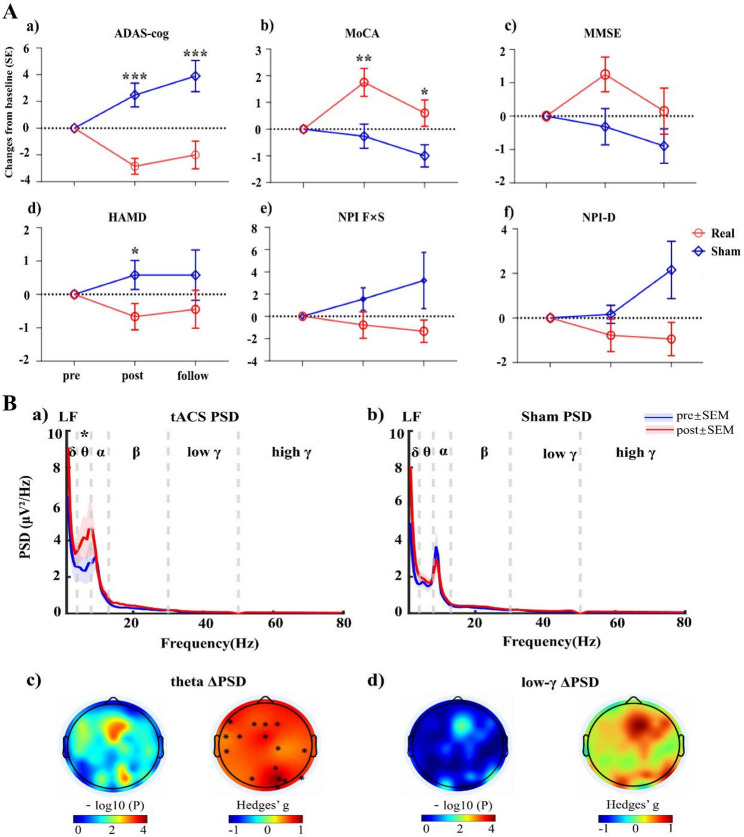
- Primary ADAS-Cog: linear mixed models showed group×time interactions from baseline to post-treatment (β = 0.531, p < 0.001) and baseline to 3-month follow-up (β = 0.587, p < 0.001), but adjusted post hoc between-group contrasts were not significant at post-treatment (p = 0.897) or follow-up (p = 0.791); change-score effect sizes were moderate (Δreal − Δsham: d = −0.548 post; d = −0.607 follow-up).
- MoCA showed group×time effects at post-treatment (p = 0.008) and 3-month follow-up (p = 0.016); HAMD decreased at post-treatment (p = 0.036) but not at follow-up (p = 0.368); MMSE and other cognitive/behavioral measures were not significant.
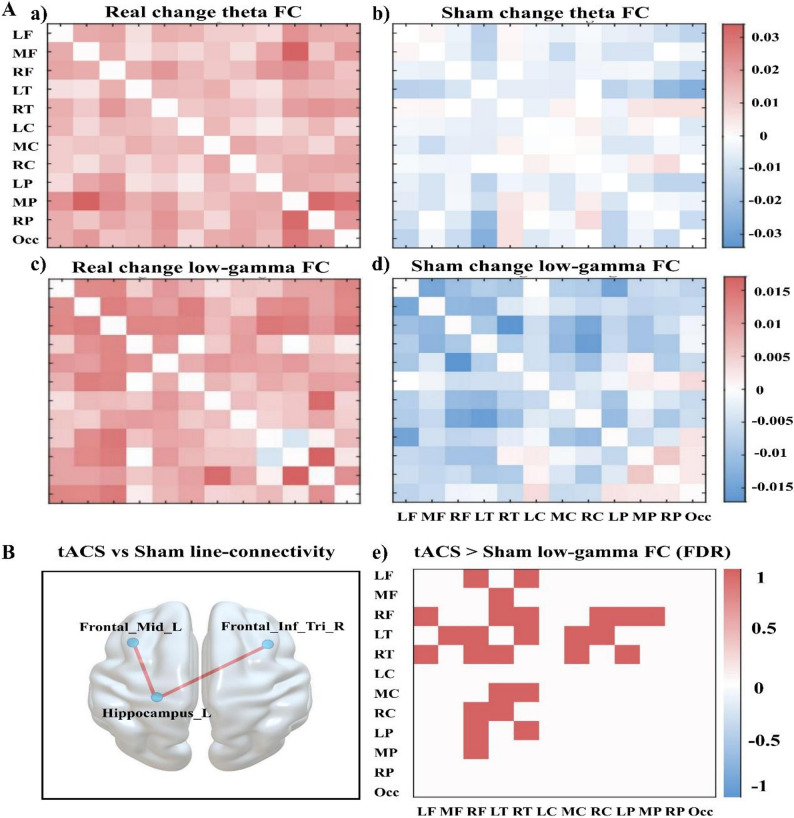
- EEG: real tACS increased frontal–central theta power, with FDR-significant between-group ΔPSD in LC (Z = 2.693, Pcorr = 0.042) and MC (Z = 2.820, Pcorr = 0.029); low-gamma ROI connectivity increased along frontotemporal and frontoparietal/central pathways (q < 0.05); eLORETA showed enhanced theta connectivity between left hippocampus and frontal regions (p < 0.05).
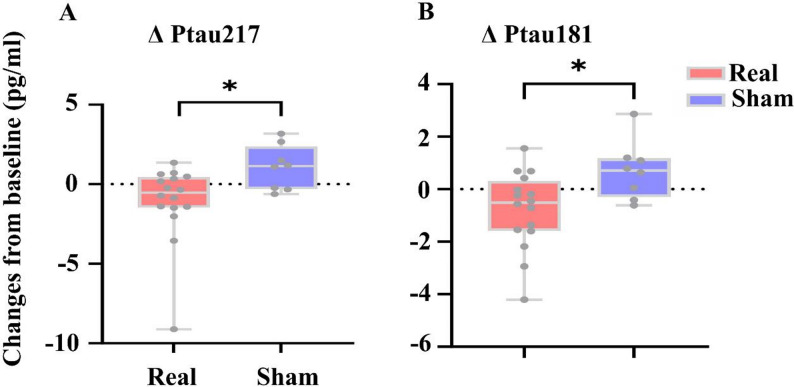
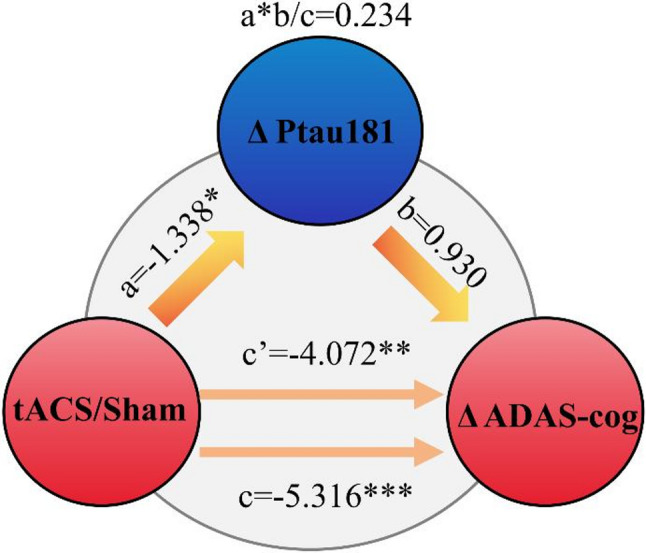
- Exploratory plasma analyses showed greater reductions in p-tau217 (p = 0.014) and p-tau181 (p = 0.012) versus sham, with a non-significant GFAP trend (p = 0.076); mediation via Δp-tau181 was indirect effect −1.244 (95% CI −3.369 to −0.008; p = 0.047), proportion mediated 0.234, but no ACME survived FDR correction (all q > 0.05). No serious adverse events occurred; sensory effects were mild and transient.
Methods
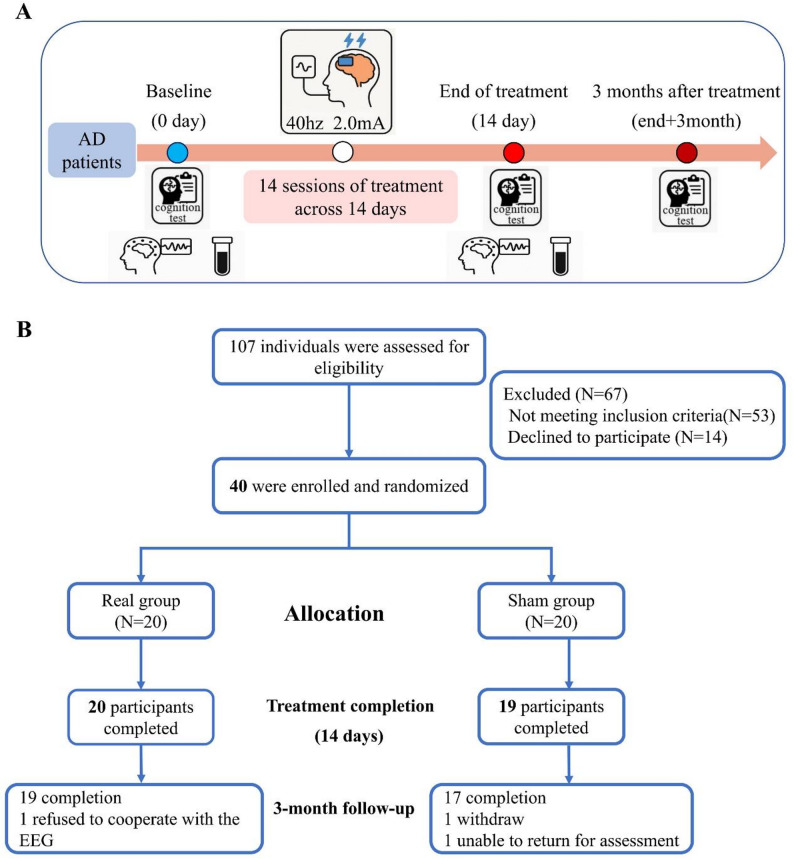
- Single-center, randomized, double-blind, sham-controlled trial at Anhui Medical University; 107 individuals were screened, 40 were randomized 1:1, and 39 contributed post-treatment outcome data (real n = 20; sham n = 19). Participants had mild AD, were aged 50–85 years, had CDR 0.5–1, and were on stable cholinesterase inhibitor or memantine for ≥ 3 months.
- Intervention used a 4 × 1 HD montage targeting the left DLPFC (center F3; returns AFz, FCz, F7, C5), with 40-Hz tACS at 2.0 mA peak-to-peak for 30 min/day over 14 days; sham reproduced ramp periods without sustained current. Assessments occurred at baseline, end of treatment (~48 h after Day 14), and 3-month follow-up, including ADAS-Cog primary outcome, secondary cognitive/mood scales, rs-EEG, and plasma p-tau181, p-tau217, and GFAP.
- Primary and neuropsychological outcomes used intention-to-treat linear mixed-effects models with group, time, and group×time fixed effects, participant random intercept, and age/sex covariates; EEG PSD/wPLI/eLORETA analyses used FDR correction; mediation used complete cases with 10,000 bootstrap resamples. The trial was powered for ADAS-Cog assuming Cohen’s d ≈ 0.8, α = 0.05 two-sided, 80% power, and ~15% attrition, targeting N = 40.
Limitations
- The paper states that the sample size was powered for primary cognitive outcomes, but some secondary electrophysiological measures, particularly gamma-band parameters, may require larger cohorts; causal inferences remain limited; and the dose–response relationship is unresolved, noting that TRANSFORM-AD’s 15 mA protocol did not improve global cognition despite increasing left hippocampal theta–gamma coupling, whereas this 2.0 mA protocol produced comparable benefits, suggesting a possible non-linear association.
- The paper states that plasma biomarker analyses were exploratory in a small and unbalanced subsample, used only two time points (pre–post), cannot establish temporal precedence, and may reflect peripheral biomarker kinetics, assay variability, or regression to the mean; the sham group also showed post-intervention p-tau increases, and the mediation signal did not survive FDR correction.
- Evident from the text: this was a single-center trial with a short 2-week intervention and 3-month follow-up, a modest analyzed sample (39), a smaller unbalanced plasma subsample (real n = 16; sham n = 8), and non-significant adjusted post hoc primary contrasts despite group×time interactions, all of which limit confirmatory strength and generalizability.
Model-written summary. Check it against the paper before relying on it.
Integrity signals
Registry
Cites
Statistics
Figures
Verification
Claims the paper makes
0 Valid · 0 Not valid · 36 Not checked · 90 Own results and interpretations
A result the paper reports from its own data — it cites no other source for it, so there is none to check. The quote shows it is in the paper.
In the paper
“No significant between-group differences were observed in other cognitive or behavioral measures, including MMSE, CDT, AVLT, NPI, ADL, GDS, VFT, BNT, and HVOT (all p > 0.05) (Table 2; Fig. 2A).”
§ Effects of 40-Hz transcranial alternating current stimulation on cognition and neural markers in Alzheimer’s disease: a randomized, sham-controlled trial > Results > Secondary cognitive and emotional outcomes
plain- Asserted: passes — The authors put it forward as true.
- Checkable: passes — It can be checked against evidence.
- Load-bearing: passes — The paper’s conclusions depend on it.
- Based: passes — The paper gives a reason why it holds.
A result the paper reports from its own data — it cites no other source for it, so there is none to check. The quote shows it is in the paper.
In the paper
“In between-group analyses of change scores calculated as post minus pre, the real group showed a larger increase in theta band PSD (Fig. 2B(c)).”
§ Effects of 40-Hz transcranial alternating current stimulation on cognition and neural markers in Alzheimer’s disease: a randomized, sham-controlled trial > Results > Secondary cognitive and emotional outcomes
plainstates a causen = 19- Asserted: passes — The authors put it forward as true.
- Checkable: passes — It can be checked against evidence.
- Load-bearing: passes — The paper’s conclusions depend on it.
- Based: passes — The paper gives a reason why it holds.
A result the paper reports from its own data — it cites no other source for it, so there is none to check. The quote shows it is in the paper.
In the paper
“In this randomized, sham-controlled trial, 40-Hz tACS over the DLPFC was associated with a group-by-time pattern on ADAS-Cog.”
- Also stated in: § Conclusions · plain
“Two weeks of low-intensity 40-Hz tACS targeting the DLPFC was associated with a trajectory-level global-cognition signal among individuals with mild AD.”
§ Effects of 40-Hz transcranial alternating current stimulation on cognition and neural markers in Alzheimer’s disease: a randomized, sham-controlled trial > Discussion
plainstates an association- Asserted: passes — The authors put it forward as true.
- Checkable: passes — It can be checked against evidence.
- Load-bearing: passes — The paper’s conclusions depend on it.
- Based: passes — The paper gives a reason why it holds.
- Also stated in: § Conclusions · plain
A result the paper reports from its own data — it cites no other source for it, so there is none to check. The quote shows it is in the paper.
In the paper
“Cognitive changes were accompanied by electrophysiological target-engagement signals, including increased theta power, strengthened low-gamma connectivity, enhanced prefrontal–hippocampal theta coupling, and exploratory reductions in plasma p-tau217 and p-tau181.”
- Also stated in: § Conclusions · hedged
“Electrophysiological findings indicate target engagement, with increased frontal-central theta power, enhanced theta band hippocampal-prefrontal connectivity, and stronger low-gamma connectivity at the ROI level; reductions in plasma p-tau217 and p-tau181 were exploratory.”
§ Effects of 40-Hz transcranial alternating current stimulation on cognition and neural markers in Alzheimer’s disease: a randomized, sham-controlled trial > Discussion
plainstates an association- Asserted: passes — The authors put it forward as true.
- Checkable: passes — It can be checked against evidence.
- Load-bearing: passes — The paper’s conclusions depend on it.
- Based: passes — The paper gives a reason why it holds.
- Also stated in: § Conclusions · hedged
A result the paper reports from its own data — it cites no other source for it, so there is none to check. The quote shows it is in the paper.
In the paper
“The eLORETA analysis revealed that linear connectivity in the theta band increased after tACS, showing enhanced coupling between Frontal_Mid_L/Frontal_Inf_Tri_R and Hippocampus_L compared with both the baseline and sham groups. Following treatment, the tACS group exhibited greater theta band connectivity between Frontal_Mid_L/Frontal_Inf_Tri_R and Hippocampus_L. (p < 0.05) (Fig. 3B).”
§ Effects of 40-Hz transcranial alternating current stimulation on cognition and neural markers in Alzheimer’s disease: a randomized, sham-controlled trial > Results > Secondary cognitive and emotional outcomes
plainstates a cause- Asserted: passes — The authors put it forward as true.
- Checkable: passes — It can be checked against evidence.
- Load-bearing: passes — The paper’s conclusions depend on it.
- Based: passes — The paper gives a reason why it holds.
48 more claims
Create a free account to see all 126 claims and to verify the 73 references still open.
- It may state two separate claims as one. 59
- Probably not a substantial claim. 33
- The quote only partly states this claim. 1
Self-check
Percentages, sums and reported differences re-computed from the paper’s own numbers.
Each contradiction between two passages listed here was confirmed by an independent check.
Rated major: it would touch a result — a value a result rests on, reported and recomputed p-values on opposite sides of the significance level, two passages that conflict with no sign which is right, or a cited work retracted before this paper was published.
In the paper
§ Effects of 40-Hz transcranial alternating current stimulation on cognition and neural markers in Alzheimer’s disease: a randomized, sham-controlled trial > Results > Secondary cognitive and emotional outcomes
“In the active stimulation group, MoCA scores significantly increased from baseline after treatment (p = 0.008) and at the 3-month follow-up (p = 0.016) (Fig. 2A(b)).”
§ Effects of 40-Hz transcranial alternating current stimulation on cognition and neural markers in Alzheimer’s disease: a randomized, sham-controlled trial > Results > Secondary cognitive and emotional outcomes
“whereas changes in the active group during the same period were non-significant (p = 0.194).”
Rated minor: it would not touch a result — a value no result rests on, a p-value that stays on the same side of the significance level, or a conflict that is clerical, resolved elsewhere in the paper, or outside its own findings.
In the paper
§ Effects of 40-Hz transcranial alternating current stimulation on cognition and neural markers in Alzheimer’s disease: a randomized, sham-controlled trial > Methods > Visit schedule and assessments
“Visits were held at baseline (Day 0), end of treatment (~ 48 h after Day 14), and 3-month follow-up (Fig. 1A).”
§ Effects of 40-Hz transcranial alternating current stimulation on cognition and neural markers in Alzheimer’s disease: a randomized, sham-controlled trial > Methods > Visit schedule and assessments
“post-treatment assessment on Day 14, and the 3-month follow-up.”
Rated minor: it would not touch a result — a value no result rests on, a p-value that stays on the same side of the significance level, or a conflict that is clerical, resolved elsewhere in the paper, or outside its own findings.
In the paper
§ Effects of 40-Hz transcranial alternating current stimulation on cognition and neural markers in Alzheimer’s disease: a randomized, sham-controlled trial > Results > Secondary cognitive and emotional outcomes
“A single sensor pair (FPZ–FT7) showed a significant increase in wPLI in the theta band only (q < 0.05, FDR within band), whereas no other electrode pairs survived the correction (Additional File Table S6). Heat maps of ΔwPLI for the tACS and sham groups are shown in Fig. 3A(a–d), and FDR-significant masks are shown in Fig. 3A(e).”
§ Effects of 40-Hz transcranial alternating current stimulation on cognition and neural markers in Alzheimer’s disease: a randomized, sham-controlled trial > Results > Secondary cognitive and emotional outcomes
“(e) Between-group comparison of low-gamma FC changes, highlighting connections with significantly greater increases in the real tACS group after FDR correction (q < 0.05).”
Citations
Cites
McKhann, G. M., Knopman, D. S., Chertkow, H., Hyman, B. T., Jack, C. R., Kawas, C. H., Klunk, W. E., Koroshetz, W. J., Manly, J. J., Mayeux, R., et al. (2011) · Alzheimer's & Dementia · doi:10.1016/j.jalz.2011.03.005 · Cited by 18,657 · cited 1×
“The inclusion criteria were age 50–85 years; diagnosis of AD according to NIA-AA criteria [25]; CDR 0.5–1 [26]; ≥3 years of education; and stable use of a cholinesterase inhibitor or memantine for ≥ 3 months.”
InfluentialNeuronal Oscillations in Cortical Networks
Buzsáki, G., & Draguhn, A. (2004) · Science · doi:10.1126/science.1099745 · Cited by 6,576 · cited 1×
“In patients with AD, disruption of gamma power is well established and primarily results from impaired inhibitory circuitry, especially in networks involving parvalbumin-positive (PV ⁺ ) interneurons [38–40].”
Scheltens, P., De Strooper, B., Kivipelto, M., Holstege, H., Chételat, G., Teunissen, C. E., Cummings, J., & van der Flier, W. M. (2021) · The Lancet · doi:10.1016/s0140-6736(20)32205-4 · Cited by 5,465
A new rating scale for Alzheimer's disease
(1984) · American Journal of Psychiatry · doi:10.1176/ajp.141.11.1356 · Cited by 4,175 · cited 1×
“The primary outcome was global cognition measured by the Alzheimer’s Disease Assessment Scale–Cognitive Subscale (ADAS-Cog) [29].”
Alzheimer Disease: An Update on Pathobiology and Treatment Strategies
Long, J. M., & Holtzman, D. M. (2019) · Cell · doi:10.1016/j.cell.2019.09.001 · Cited by 3,204 · cited 1×
“Pathologically, AD is characterized by β-amyloid (Aβ) plaque deposition and neurofibrillary tangles arising from tau hyperphosphorylation [5].”
Mechanisms of Gamma Oscillations
Buzsáki, G., & Wang, X.-J. (2012) · Annual Review of Neuroscience · doi:10.1146/annurev-neuro-062111-150444 · Cited by 2,796 · cited 1×
“Gamma-band (25–140 Hz) neural oscillations underlie higher cognitive processes, such as attention, working memory, and learning [36, 37].”
Rhythms for cognition: communication through coherence
Fries, P. (2015) · Neuron · doi:10.1016/j.neuron.2015.09.034 · Cited by 2,725 · cited 1×
“Gamma-band (25–140 Hz) neural oscillations underlie higher cognitive processes, such as attention, working memory, and learning [36, 37].”
ICLabel: An automated electroencephalographic independent component classifier, dataset, and website
Pion-Tonachini, L., Kreutz-Delgado, K., & Makeig, S. (2019) · NeuroImage · doi:10.1016/j.neuroimage.2019.05.026 · Cited by 2,267
Synaptic mechanisms of synchronized gamma oscillations in inhibitory interneuron networks
Bartos, M., Vida, I., & Jonas, P. (2007) · Nature Reviews Neuroscience · doi:10.1038/nrn2044 · Cited by 2,070 · cited 1×
“Gamma oscillations, which are essential for large-scale coordination and memory encoding [9, 10], depend on parvalbumin-positive (PV+) interneurons and GABAergic inhibition, both of which exhibit early dysfunction in AD [11].”
Regression to the mean: what it is and how to deal with it
Barnett, A. G. (2004) · International Journal of Epidemiology · doi:10.1093/ije/dyh299 · Cited by 1,988 · cited 1×
“This biologically unexpected pattern may reflect assay variability, regression to the mean, or sampling noise, and it warrants cautious interpretation [71].”
Vinck, M., Oostenveld, R., van Wingerden, M., Battaglia, F., & Pennartz, C. M. A. (2011) · NeuroImage · doi:10.1016/j.neuroimage.2011.01.055 · Cited by 1,753 · cited 1×
“Phase synchrony was quantified with the weighted phase-lag index (wPLI) computed on FIR band-pass-filtered [33] Hilbert-transformed signals; the first and last 10% of the samples were trimmed to minimize edge effects.”
Palop, J. J., Chin, J., Roberson, E. D., Wang, J., Thwin, M. T., Bien-Ly, N., Yoo, J., Ho, K. O., Yu, G.-Q., Kreitzer, A., et al. (2007) · Neuron · doi:10.1016/j.neuron.2007.07.025 · Cited by 1,653
Palmqvist, S., Janelidze, S., Quiroz, Y. T., Zetterberg, H., Lopera, F., Stomrud, E., Su, Y., Chen, Y., Serrano, G. E., Leuzy, A., et al. (2020) · JAMA · doi:10.1001/jama.2020.12134 · Cited by 1,603 · cited 2×
“Multiple studies have established that plasma p-tau shows excellent diagnostic accuracy in differentiating AD from non-AD tauopathies, highlighting its strong clinical potential [66–68].”
Antal, A., Alekseichuk, I., Bikson, M., Brockmöller, J., Brunoni, A. R., Chen, R., Cohen, L. G., Dowthwaite, G., Ellrich, J., Flöel, A., et al. (2017) · Clinical Neurophysiology · doi:10.1016/j.clinph.2017.06.001 · Cited by 1,301 · cited 1×
“A pragmatic advantage of 2.0 mA is feasibility and tolerability in symptomatic populations, which may support adherence and scalability [63].”
InfluentialJanelidze, S., Mattsson, N., Palmqvist, S., Smith, R., Beach, T. G., Serrano, G. E., Chai, X., Proctor, N. K., Eichenlaub, U., Zetterberg, H., et al. (2020) · Nature Medicine · doi:10.1038/s41591-020-0755-1 · Cited by 1,247 · cited 1×
“Among the various phosphorylated tau biomarkers, p-tau217 and p-tau181 appear to offer superior dynamic range, predictive capacity for tau-PET positivity, and diagnostic accuracy in symptomatic individuals [66, 68, 70].”
Palmqvist, S., Schöll, M., Strandberg, O., Mattsson, N., Stomrud, E., Zetterberg, H., Blennow, K., Landau, S., Jagust, W., & Hansson, O. (2017) · Nature Communications · doi:10.1038/s41467-017-01150-x · Cited by 911
Hippocampal GABAergic Inhibitory Interneurons
Pelkey, K. A., Chittajallu, R., Craig, M. T., Tricoire, L., Wester, J. C., & McBain, C. J. (2017) · Physiological Reviews · doi:10.1152/physrev.00007.2017 · Cited by 889
Benchenane, K., Peyrache, A., Khamassi, M., Tierney, P. L., Gioanni, Y., Battaglia, F. P., & Wiener, S. I. (2010) · Neuron · doi:10.1016/j.neuron.2010.05.013 · Cited by 872 · cited 1×
“Theta oscillations establish a temporal scaffold for prefrontal–hippocampal communication during learning by synchronizing neuronal discharges across distributed regions [50–54].”
Multi-sensory Gamma Stimulation Ameliorates Alzheimer’s-Associated Pathology and Improves Cognition
Martorell, A. J., Paulson, A. L., Suk, H.-J., Abdurrob, F., Drummond, G. T., Guan, W., Young, J. Z., Kim, D. N.-W., Kritskiy, O., Barker, S. J., et al. (2019) · Cell · doi:10.1016/j.cell.2019.02.014 · Cited by 798
Advancing Research and Treatment for Frontotemporal Lobar Degeneration (ARTFL) investigators, Thijssen, E. H., La Joie, R., Wolf, A., Strom, A., Wang, P., Iaccarino, L., Bourakova, V., Cobigo, Y., Heuer, H., et al. (2020) · Nature Medicine · doi:10.1038/s41591-020-0762-2 · Cited by 761
Amyloid β-Induced Neuronal Hyperexcitability Triggers Progressive Epilepsy
Minkeviciene, R., Rheims, S., Dobszay, M. B., Zilberter, M., Hartikainen, J., Fülöp, L., Penke, B., Zilberter, Y., Harkany, T., Pitkänen, A., et al. (2009) · The Journal of Neuroscience · doi:10.1523/jneurosci.5215-08.2009 · Cited by 652 · cited 1×
“In patients with AD, disruption of gamma power is well established and primarily results from impaired inhibitory circuitry, especially in networks involving parvalbumin-positive (PV ⁺ ) interneurons [38–40].”
Fox, M. D., Buckner, R. L., Liu, H., Chakravarty, M. M., Lozano, A. M., & Pascual-Leone, A. (2014) · Proceedings of the National Academy of Sciences · doi:10.1073/pnas.1405003111 · Cited by 617 · cited 1×
“In line with this network perspective, optimal targets for both invasive and non-invasive neuromodulation align with intrinsic resting-state networks, supporting connectivity-oriented interventions [8].”
Immediate neurophysiological effects of transcranial electrical stimulation
Liu, A., Vöröslakos, M., Kronberg, G., Henin, S., Krause, M. R., Huang, Y., Opitz, A., Mehta, A., Pack, C. C., Krekelberg, B., et al. (2018) · Nature Communications · doi:10.1038/s41467-018-07233-7 · Cited by 589 · cited 1×
“Transcranial alternating current stimulation (tACS) delivers weak oscillatory currents that interact with endogenous brain rhythms to modulate cortical excitability and network synchronization [13, 14].”
Tau biomarkers in Alzheimer's disease: towards implementation in clinical practice and trials
Ossenkoppele, R., van der Kant, R., & Hansson, O. (2022) · The Lancet Neurology · doi:10.1016/s1474-4422(22)00168-5 · Cited by 557
Theta Oscillations in Human Memory
Herweg, N. A., Solomon, E. A., & Kahana, M. J. (2020) · Trends in Cognitive Sciences · doi:10.1016/j.tics.2019.12.006 · Cited by 550 · cited 1×
“In contrast, the theta rhythm (4–8 Hz) is strongly associated with memory formation and inter-regional communication [47].”
Lee, H., Cashin, A. G., Lamb, S. E., Hopewell, S., Vansteelandt, S., VanderWeele, T. J., MacKinnon, D. P., Mansell, G., Collins, G. S., Golub, R. M., et al. (2021) · JAMA · doi:10.1001/jama.2021.14075 · Cited by 548
Vossen, A., Gross, J., & Thut, G. (2015) · Brain Stimulation · doi:10.1016/j.brs.2014.12.004 · Cited by 514
Gamma Entrainment Binds Higher-Order Brain Regions and Offers Neuroprotection
Adaikkan, C., Middleton, S. J., Marco, A., Pao, P.-C., Mathys, H., Kim, D. N.-W., Gao, F., Young, J. Z., Suk, H.-J., Boyden, E. S., et al. (2019) · Neuron · doi:10.1016/j.neuron.2019.04.011 · Cited by 469 · cited 1×
“In AD models, sensory or electrical 40-Hz stimulation reduces amyloid deposition, mitigates tau hyperphosphorylation, and enhances synaptic plasticity and memory [17–19].”
Hölscher, C., Anwyl, R., & Rowan, M. J. (1997) · The Journal of Neuroscience · doi:10.1523/jneurosci.17-16-06470.1997 · Cited by 411 · cited 1×
“In rodents, elevated hippocampal theta activity during behavioral tasks correlates with superior memory performance [48, 49].”
Age-related changes in the default mode network are more advanced in Alzheimer disease
Jones, D. T., Machulda, M. M., Vemuri, P., McDade, E. M., Zeng, G., Senjem, M. L., Gunter, J. L., Przybelski, S. A., Avula, R. T., Knopman, D. S., et al. (2011) · Neurology · doi:10.1212/wnl.0b013e318233b33d · Cited by 370
Babiloni, C., Barry, R. J., Başar, E., Blinowska, K. J., Cichocki, A., Drinkenburg, W. H. I. M., Klimesch, W., Knight, R. T., Lopes da Silva, F., Nunez, P., et al. (2020) · Clinical Neurophysiology · doi:10.1016/j.clinph.2019.06.234 · Cited by 314
Elyamany, O., Leicht, G., Herrmann, C. S., & Mulert, C. (2021) · European Archives of Psychiatry and Clinical Neuroscience · doi:10.1007/s00406-020-01209-9 · Cited by 310 · cited 1×
“The observed decline in p-tau levels aligns with evidence from preclinical and early clinical investigations suggesting that 40-Hz stimulation can modulate microglial activity and influence tau phosphorylation [45, 69].”
O'Neill, P.-K., Gordon, J. A., & Sigurdsson, T. (2013) · Journal of Neuroscience · doi:10.1523/jneurosci.2378-13.2013 · Cited by 294
Guidelines for Reporting Outcomes in Trial Protocols: The SPIRIT-Outcomes 2022 Extension
Butcher, N. J., Monsour, A., Mew, E. J., Chan, A.-W., Moher, D., Mayo-Wilson, E., Terwee, C. B., Chee-A-Tow, A., Baba, A., Gavin, F., et al. (2022) · JAMA · doi:10.1001/jama.2022.21243 · Cited by 288
Alzheimer’s Disease: An Update and Insights Into Pathophysiology
Abubakar, M. B., Sanusi, K. O., Ugusman, A., Mohamed, W., Kamal, H., Ibrahim, N. H., Khoo, C. S., & Kumar, J. (2022) · Frontiers in Aging Neuroscience · doi:10.3389/fnagi.2022.742408 · Cited by 279 · cited 1×
“As neuropathological changes precede clinical symptoms by 1–2 decades, early, mechanism-guided strategies addressing tau pathology and gamma-rhythm disruption are critically needed [12].”
Wischnewski, M., Alekseichuk, I., & Opitz, A. (2023) · Trends in Cognitive Sciences · doi:10.1016/j.tics.2022.11.013 · Cited by 246 · cited 1×
“Mechanistically, gamma tACS likely engages in both online modulation of network coupling and offline plasticity processes [74–77].”
Transcranial Alternating Current Stimulation (tACS) Mechanisms and Protocols
Tavakoli, A. V., & Yun, K. (2017) · Frontiers in Cellular Neuroscience · doi:10.3389/fncel.2017.00214 · Cited by 236 · cited 1×
“Transcranial alternating current stimulation (tACS) delivers weak oscillatory currents that interact with endogenous brain rhythms to modulate cortical excitability and network synchronization [13, 14].”
Chan, D., Suk, H.-J., Jackson, B. L., Milman, N. P., Stark, D., Klerman, E. B., Kitchener, E., Fernandez Avalos, V. S., de Weck, G., Banerjee, A., et al. (2022) · PLOS ONE · doi:10.1371/journal.pone.0278412 · Cited by 234 · cited 1×
“In AD models, sensory or electrical 40-Hz stimulation reduces amyloid deposition, mitigates tau hyperphosphorylation, and enhances synaptic plasticity and memory [17–19].”
Schmid, L. C., Mittag, M., Poll, S., Steffen, J., Wagner, J., Geis, H.-R., Schwarz, I., Schmidt, B., Schwarz, M. K., Remy, S., et al. (2016) · Neuron · doi:10.1016/j.neuron.2016.08.034 · Cited by 213 · cited 2×
“…local-to-system cascade,” in which exogenous 40-Hz stimulation, precisely overlapping the low-gamma range, preferentially entrains oscillations that resonate within this band, thereby stabilizing PV ⁺ interneuron network activity [42, 44–46] and restoring local excitatory–inhibitory balance.”
Gillespie, A. K., Jones, E. A., Lin, Y.-H., Karlsson, M. P., Kay, K., Yoon, S. Y., Tong, L. M., Nova, P., Carr, J. S., Frank, L. M., et al. (2016) · Neuron · doi:10.1016/j.neuron.2016.04.009 · Cited by 187
A meta-analysis suggests that tACS improves cognition in healthy, aging, and psychiatric populations
Grover, S., Fayzullina, R., Bullard, B. M., Levina, V., & Reinhart, R. M. G. (2023) · Science Translational Medicine · doi:10.1126/scitranslmed.abo2044 · Cited by 179
Benussi, A., Cantoni, V., Cotelli, M. S., Cotelli, M., Brattini, C., Datta, A., Thomas, C., Santarnecchi, E., Pascual-Leone, A., & Borroni, B. (2021) · Brain Stimulation · doi:10.1016/j.brs.2021.03.007 · Cited by 172 · cited 1×
“…early trials in MCI and AD report memory gains and strengthened network connectivity, though systematic reviews emphasize variability, small cohorts, short intervention durations, limited follow-up, and insufficient correlation between electrophysiological changes and fluid biomarkers [21–24].”
Control of working memory by phase–amplitude coupling of human hippocampal neurons
Daume, J., Kamiński, J., Schjetnan, A. G. P., Salimpour, Y., Khan, U., Kyzar, M., Reed, C. M., Anderson, W. S., Valiante, T. A., Mamelak, A. N., et al. (2024) · Nature · doi:10.1038/s41586-024-07309-z · Cited by 167
Benussi, A., Cantoni, V., Grassi, M., Brechet, L., Michel, C. M., Datta, A., Thomas, C., Gazzina, S., Cotelli, M. S., Bianchi, M., et al. (2022) · Annals of Neurology · doi:10.1002/ana.26411 · Cited by 163 · cited 1×
“In humans, Benussi et al. demonstrated that a single 1-h session of gamma tACS increases gamma power and improves episodic memory in individuals with AD [22].”
Soula, M., Martín-Ávila, A., Zhang, Y., Dhingra, A., Nitzan, N., Sadowski, M. J., Gan, W.-B., & Buzsáki, G. (2023) · Nature Neuroscience · doi:10.1038/s41593-023-01270-2 · Cited by 162 · cited 1×
“To date, some studies have reported weak entrainment or inconsistent pathological effects, suggesting circuit-and parameter-dependent responses [20, 21].”
What is the clinically relevant change on the ADAS-Cog?
Schrag, A., Schott, J. M., & Initiative, A. D. N. (2012) · Journal of Neurology, Neurosurgery & Psychiatry · doi:10.1136/jnnp-2011-300881 · Cited by 143
Oscillatory activity during maintenance of spatial and temporal information in working memory
Roberts, B. M., Hsieh, L.-T., & Ranganath, C. (2013) · Neuropsychologia · doi:10.1016/j.neuropsychologia.2012.10.009 · Cited by 141 · cited 1×
“Theta oscillations establish a temporal scaffold for prefrontal–hippocampal communication during learning by synchronizing neuronal discharges across distributed regions [50–54].”
Wang, H.-X., Wang, L., Zhang, W.-R., Xue, Q., Mao, P., Sun, Z.-C., Li, L.-P., Wang, K., Yang, X.-T., Jia, Y., et al. (2019) · Psychotherapy and Psychosomatics · doi:10.1159/000504609 · Cited by 119 · cited 1×
“…instance, a randomized study in Parkinson’s disease found that a single 20-min session of tACS or transcranial direct current stimulation enhances beta activity and reduces rigidity and bradykinesia [15], whereas multisession gamma tACS improves sleep duration and quality in chronic insomnia [16].”
Self-citationVentral hippocampal OLM cells control type 2 theta oscillations and response to predator odor
Mikulovic, S., Restrepo, C. E., Siwani, S., Bauer, P., Pupe, S., Tort, A. B. L., Kullander, K., & Leão, R. N. (2018) · Nature Communications · doi:10.1038/s41467-018-05907-w · Cited by 114 · cited 2×
“…local-to-system cascade,” in which exogenous 40-Hz stimulation, precisely overlapping the low-gamma range, preferentially entrains oscillations that resonate within this band, thereby stabilizing PV ⁺ interneuron network activity [42, 44–46] and restoring local excitatory–inhibitory balance.”
Kurudenkandy, F. R., Zilberter, M., Biverstål, H., Presto, J., Honcharenko, D., Strömberg, R., Johansson, J., Winblad, B., & Fisahn, A. (2014) · The Journal of Neuroscience · doi:10.1523/jneurosci.1195-14.2014 · Cited by 112 · cited 1×
“Aβ exacerbates this dysfunction by disturbing the excitatory–inhibitory balance within hippocampal circuits, thereby reducing gamma synchrony and impairing theta–gamma PAC, a key mechanism supporting memory encoding and long-term potentiation (LTP) [41–43].”
The role of the hippocampus in the consolidation of emotional memories during sleep
Pronier, É., Morici, J. F., & Girardeau, G. (2023) · Trends in Neurosciences · doi:10.1016/j.tins.2023.08.003 · Cited by 102 · cited 2×
“Given the central role of this long-range circuit in coordinating memory processes [56, 57], its reinforcement likely represents the primary electrophysiological mechanism underlying the observed cognitive improvements, particularly in memory-related domains.”
Chetty, C. A., Bhardwaj, H., Kumar, G. P., Devanand, T., Sekhar, C. S. A., Aktürk, T., Kiyi, I., Yener, G., Güntekin, B., Joseph, J., et al. (2024) · Alzheimer's Research & Therapy · doi:10.1186/s13195-024-01582-w · Cited by 91 · cited 2×
“In this study, we observed co-enhancement of theta and gamma connectivity following tACS, aligning with the evidence that frequency-specific network integration supports cognitive improvement in AD [58, 60].”
The emerging field of non-invasive brain stimulation in Alzheimer’s disease
Koch, G., Altomare, D., Benussi, A., Bréchet, L., Casula, E. P., Dodich, A., Pievani, M., Santarnecchi, E., & Frisoni, G. B. (2024) · Brain · doi:10.1093/brain/awae292 · Cited by 90 · cited 2×
“Given the central role of this long-range circuit in coordinating memory processes [56, 57], its reinforcement likely represents the primary electrophysiological mechanism underlying the observed cognitive improvements, particularly in memory-related domains.”
EPOS: EEG Processing Open-Source Scripts
Rodrigues, J., Weiss, M. H., Hewig, J. S., & Allen, J. J. B. (2021) · Frontiers in Neuroscience · doi:10.3389/fnins.2021.660449 · Cited by 87 · cited 1×
“…included zero-phase FIR band-pass 1–80 Hz, zero-phase notch 48–52 Hz, ICA-based artifact component removal (ocular, muscular, and cardiac) [30, 31], bad-channel interpolation, average reference, down-sampling to 500 Hz, segmentation into non-overlapping 2-s epochs, and manual quality control.”
Modulation of large-scale cortical coupling by transcranial alternating current stimulation
Schwab, B. C., Misselhorn, J., & Engel, A. K. (2019) · Brain Stimulation · doi:10.1016/j.brs.2019.04.013 · Cited by 87
Jung, Y. H., Jang, H., Park, S., Kim, H. J., Seo, S. W., Kim, G. B., Shon, Y.-M., Kim, S., & Na, D. L. (2024) · JAMA Network Open · doi:10.1001/jamanetworkopen.2024.9220 · Cited by 86
Park, K., Lee, J., Jang, H. J., Richards, B. A., Kohl, M. M., & Kwag, J. (2020) · BMC Biology · doi:10.1186/s12915-019-0732-7 · Cited by 85
Dhaynaut, M., Sprugnoli, G., Cappon, D., Macone, J., Sanchez, J. S., Normandin, M. D., Guehl, N. J., Koch, G., Paciorek, R., Connor, A., et al. (2022) · Journal of Alzheimer’s Disease · doi:10.3233/jad-215072 · Cited by 78 · cited 1×
“The observed decline in p-tau levels aligns with evidence from preclinical and early clinical investigations suggesting that 40-Hz stimulation can modulate microglial activity and influence tau phosphorylation [45, 69].”
Modulation of Long-Range Connectivity Patterns via Frequency-Specific Stimulation of Human Cortex
Weinrich, C. A., Brittain, J.-S., Nowak, M., Salimi-Khorshidi, R., Brown, P., & Stagg, C. J. (2017) · Current Biology · doi:10.1016/j.cub.2017.08.075 · Cited by 72
Kucewicz, M. T., Cimbalnik, J., Garcia-Salinas, J. S., Brazdil, M., & Worrell, G. A. (2024) · Brain · doi:10.1093/brain/awae159 · Cited by 64 · cited 2×
“This synchronous strengthening of theta and gamma functional networks suggests a hierarchical rebalancing of network organization, consistent with oscillatory frameworks that propose multi-scale neural integration through the coordination of slower theta rhythms with faster gamma processes [60].”
Place-learning, but not cue-learning training, modifies the hippocampal theta rhythm in rats
Olvera-Cortés, E., Cervantes, M., & González-Burgos, I. (2002) · Brain Research Bulletin · doi:10.1016/s0361-9230(02)00769-4 · Cited by 59 · cited 1×
“In rodents, elevated hippocampal theta activity during behavioral tasks correlates with superior memory performance [48, 49].”
Rockwood, K., Fay, S., & Gorman, M. (2010) · International Journal of Geriatric Psychiatry · doi:10.1002/gps.2319 · Cited by 59 · cited 1×
“The 2-mA protocol was non-inferior to the 15-mA protocol at a pre-specified margin of Δ = 4 ADAS-Cog points [64, 65], supporting the clinical utility of lower-intensity stimulation (Additional File Figure S3) and highlighting the need for systematic dose-optimization studies to identify the most…”
Paitel, E. R., Otteman, C. B. D., Polking, M. C., Licht, H. J., & Nielson, K. A. (2025) · Frontiers in Aging Neuroscience · doi:10.3389/fnagi.2025.1496235 · Cited by 58 · cited 1×
“…AD is increasingly conceptualized as a disconnection syndrome: resting-state electroencephalography (rs-EEG) reveals reduced functional connectivity, most notably in the alpha band, whereas individuals with mild cognitive impairment (MCI) often exhibit compensatory theta enhancement [7].”
Effects of HD-tDCS on memory and metamemory for general knowledge questions that vary by difficulty
Chua, E. F., Ahmed, R., & Garcia, S. M. (2016) · Brain stimulation · doi:10.1016/j.brs.2016.10.013 · Cited by 48 · cited 1×
“Stimulation targeted the DLPFC using a 4 × 1 HD montage (center: F3; returns: AFz, FCz, F7, and C5; Soterix Medical, New York, NY, USA) [27].”
Gruber, M. J., Hsieh, L.-T., Staresina, B. P., Elger, C. E., Fell, J., Axmacher, N., & Ranganath, C. (2018) · Journal of Cognitive Neuroscience · doi:10.1162/jocn_a_01302 · Cited by 46
Tang, Y., Xing, Y., Sun, L., Wang, Z., Wang, C., Yang, K., Zhu, W., Shi, X., Xie, B., Yin, Y., et al. (2024) · Alzheimer's Research & Therapy · doi:10.1186/s13195-024-01570-0 · Cited by 44
van den Berg, M., Toen, D., Verhoye, M., & Keliris, G. A. (2023) · Frontiers in Aging Neuroscience · doi:10.3389/fnagi.2023.1081058 · Cited by 43
De Paolis, M. L., Paoletti, I., Zaccone, C., Capone, F., D’Amelio, M., & Krashia, P. (2024) · Translational Neurodegeneration · doi:10.1186/s40035-024-00423-y · Cited by 42
Mystery of gamma wave stimulation in brain disorders
Deng, Q., Wu, C., Parker, E., Zhu, J., Liu, T. C.-Y., Duan, R., & Yang, L. (2024) · Molecular Neurodegeneration · doi:10.1186/s13024-024-00785-x · Cited by 35 · cited 1×
“…at the systems level as aberrant electrophysiological activity, including reduced gamma power (typically 30–80 Hz), excess slow-wave oscillations, and disrupted cross-frequency coupling (CFC; e.g., theta–gamma phase-amplitude coupling [PAC]), all of which correlate with cognitive deficits [6].”
Novel methodology for detection and prediction of mild cognitive impairment using resting‐state EEG
Deng, J., Sun, B., Kavcic, V., Liu, M., Giordani, B., & Li, T. (2023) · Alzheimer s & Dementia · doi:10.1002/alz.13411 · Cited by 32 · cited 1×
“Frequency bands: delta 1–4 Hz, theta 4–8 Hz, alpha 8–13 Hz, beta 13–30 Hz, low-gamma 30–50 Hz, and high-gamma 50–80 Hz [32].”
Theta and gamma connectivity is linked with affective and cognitive symptoms in Parkinson's disease
Iyer, K. K., Au, T. R., Angwin, A. J., Copland, D. A., & Dissanayaka, N. N. (2020) · Journal of Affective Disorders · doi:10.1016/j.jad.2020.08.086 · Cited by 32
Auditory gamma-band entrainment enhances default mode network connectivity in dementia patients
Lahijanian, M., Aghajan, H., & Vahabi, Z. (2024) · Scientific Reports · doi:10.1038/s41598-024-63727-z · Cited by 29 · cited 1×
“…40-Hz gamma entrainment restores disrupted default mode network connectivity by enhancing synchrony between the prefrontal and parietal regions [61], supporting the hypothesis that 40-Hz stimulation confers cognitive benefits partly by reorganizing theta– gamma interactions within large-scale…”
Liu, J., Zhu, Y., Chen, B., Meng, Q., Hu, P., Chen, X., & Bu, J. (2025) · Cell Reports Medicine · doi:10.1016/j.xcrm.2025.102044 · Cited by 29
Self-citationWilson, C. A., Fouda, S., & Sakata, S. (2020) · Scientific Reports · doi:10.1038/s41598-020-72421-9 · Cited by 28 · cited 2×
“To date, some studies have reported weak entrainment or inconsistent pathological effects, suggesting circuit-and parameter-dependent responses [20, 21].”
Kidder, K. S., Miles, J. T., Baker, P. M., Hones, V. I., Gire, D. H., & Mizumori, S. J. Y. (2021) · Hippocampus · doi:10.1002/hipo.23306 · Cited by 26
Hou, M., & Yang, L. (2025) · Frontiers in Public Health · doi:10.3389/fpubh.2025.1616232 · Cited by 12 · cited 1×
“In the United States, > 6 million individuals are affected, with projections reaching 13.8 million by 2060, while China alone accounts for over 12 million cases—nearly one-quarter of the global total—with estimates exceeding 20 million by 2035 [3, 4].”
InfluentialZhu, W., Yu, X., Huang, C., Deng, S., Ren, M., Li, M., Zhou, X., Shen, Z., Cai, G., Zhu, X., et al. (2025) · BMC Public Health · doi:10.1186/s12889-025-24097-x · Cited by 11 · cited 2×
“Worldwide, approximately 55–57 million people live with dementia, two-thirds of whom have AD [2–4].”
Influential
Research works printed but not linked: 2
- Long S, Weidner W, editors. World Alzheimer Report 2023: Reducing dementia risk: never too early, never too late. London: Alzheimer’s Disease International; 2023.
- Berg L. Clinical Dementia Rating (CDR). Psychopharmacol Bull. 1988;24:637–9. 3249765
Cited by
Cantoni, V., Grassi, M., Premi, E., Cupidi, C., Zummo, E., Cotelli, M. S., Benussi, A., & Borroni, B. (2026) · Journal of Alzheimer s Disease · doi:10.1177/13872877261461248 · Cited by 2
Guo, R., Li, X., Zou, C., Zheng, C., Wu, X., Lu, X., Yan, J., Zhang, J., Luo, X., Ye, S., et al. (2026) · Advanced Science · doi:10.1002/advs.77851
Self-citationTang, Y., Wang, Y., Li, W., Su, R., Gao, T., & Ma, Y. (2026) · Neurological Sciences · doi:10.1007/s10072-026-09406-5
Self-citation
Metadata
- Authors
- Fang, M., Yan, Y., Song, W., Geng, Z., Wang, L., Hu, C., Li, W., Song, B., Chen, M., Dai, Y., Hu, Y., Zhou, S., Guo, H., Ji, G., Hu, P., Wang, K., & Wu, X.
- Affiliations
- Anhui Medical University (CN)
- Corresponding author
- Hu, Panpan
- Wang, Kai
- Wu, Xingqi
- Venue
- Alzheimer's Research & Therapy
- Published
- 2026-04-01
- Volume
- 18
- Issue
- 1
- Pages
- 115
- ISSN
- 1758-9193 (ISSN-L)
- PMC
- PMC13188469
- OpenAlex
- W7147303183
- Cited by
- 4
- References
- 77
- Citations by year
- 2026: 4
- FWCI
- 6.37
- Type
- journal article
- Language
- en
- Open access
- gold
- doi.org
- Licence
- cc-by-nc-nd
- creativecommons.org/licenses/by-nc-nd/4.0 (tdm)
- creativecommons.org/licenses/by-nc-nd/4.0 (vor, 48 d)
- Locations
- Alzheimer s Research & Therapy (publishedVersion, cc-by-nc-nd)
- PubMed Central (publishedVersion, cc-by-nc-nd)
- PubMed (publishedVersion)
- DOAJ (DOAJ: Directory of Open Access Journals) (submittedVersion)
- Funders
- Ministry of Science and Technology of the People's Republic of China (No.2022ZD0214100)
- Innovative Research Group Project of the National Natural Science Foundation of China (82171917 and 82471271, 82090034 and 31970979, 82101498)
- Topics
- Life Sciences › Neuroscience › Neurology › Transcranial Magnetic Stimulation Studies
- Life Sciences › Neuroscience › Cellular and Molecular Neuroscience › Alzheimer's disease research and treatments
- Health Sciences › Medicine › Psychiatry and Mental health › Dementia and Cognitive Impairment Research
- Keywords
- Alzheimer's disease, transcranial alternating current stimulation, gamma oscillations, dorsolateral prefrontal cortex, cognitive decline, resting-state EEG, depressive symptoms, non-invasive brain stimulation
- MeSH terms
- Cognitive Enhancement, Aged, Alzheimer Disease, Cognition, Double-Blind Method, Electroencephalography, Female, Humans, Male, Biomarkers, tau Proteins, Transcranial Direct Current Stimulation
About these checks
Registry, retraction, Cites and statistics results are computed, not judged, with one exception: a printed reference that no index lists is read once by a model before it counts as a citation error. Claims are extracted by a model and kept only when their quote appears verbatim in the text; each cited source is then checked, with a model’s help, for whether it says what the claim relies on. Those verdicts can be wrong — read the claim’s quote and the cited source before relying on one.
A language model drew the claims from the paper on 2026-11-27, under version 3 of the claim definition (model deepseek-v4.1-flash, prompt extract-v3).
A second model labelled each claim on 2026-11-27 (model jev-1.13-20260917, definition revision gold-guideline-v0.2).
Statistics and arithmetic are recomputed, not judged.
Confidence bands are shown only for fields calibrated on our annotated test set. None is calibrated yet, so no band is shown.
What counts as a claim ›How we measure confidence ›How we check this ›
Are you an author, or do you see a problem with this page? Request a review
Data sources
Bibliographic data: Semantic Scholar, OpenAlex, Crossref.
Contains information from the Semantic Scholar Academic Graph Datasets, made available under the ODC Attribution License (ODC-BY 1.0).
Semantic Scholar’s data is described in: Kinney, R., et al. (2023). The Semantic Scholar Open Data Platform. arXiv:2301.10140.
