

Selection bias on intellectual ability in autism research: a cross-sectional review and meta-analysis
Open accessThe DOI matches its Crossref record; 51 of the 51 references it cites were found in a registry or an index.
Abstract
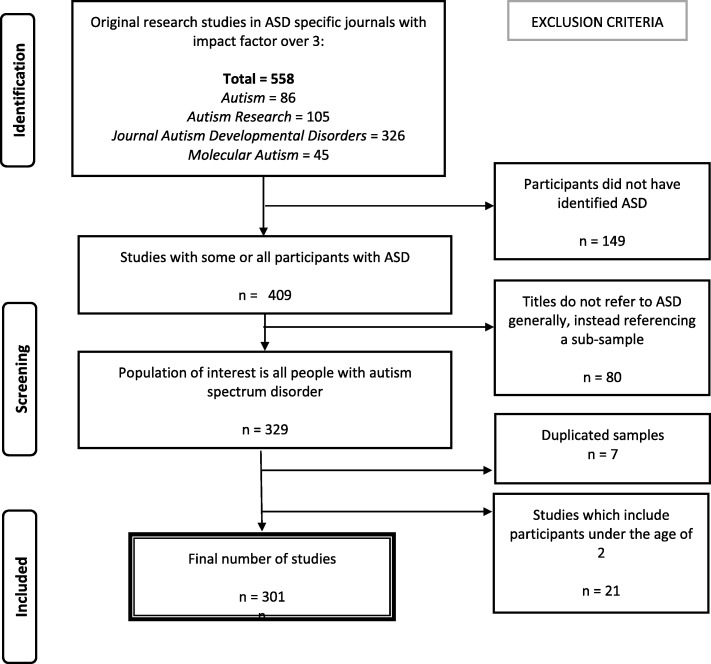
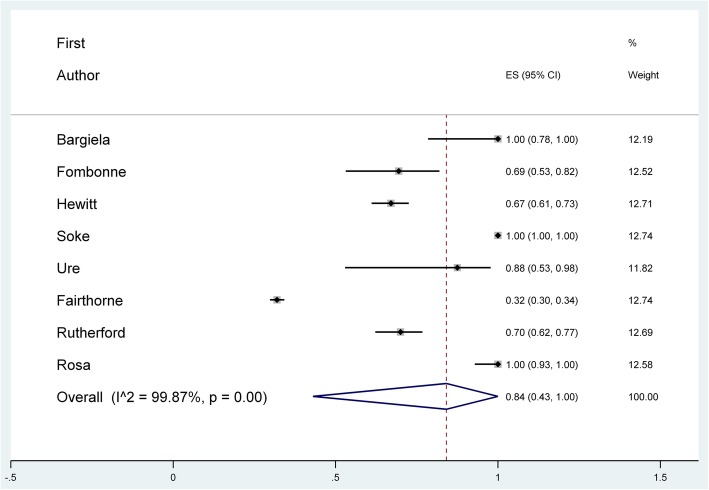
Current global estimates suggest the proportion of the population with autism spectrum disorder (ASD) who have intellectual disability (ID) is approximately 50%. Our objective was to ascertain the existence of selection bias due to under-inclusion of populations with ID across all fields of autism research. A sub-goal was to evaluate inconsistencies in reporting of findings. This review covers all original research published in 2016 in autism-specific journals with an impact factor greater than 3. Across 301 included studies, 100,245 participants had ASD. A random effects meta-analysis was used to estimate the proportion of participants without ID. Selection bias was defined as where more than 75% of participants did not have ID. Meta-analysis estimated 94% of all participants identified as being on the autism spectrum in the studies reviewed did not have ID (95% CI 0.91–0.97). Eight out of ten studies demonstrated selection bias against participants with ID. The reporting of participant characteristics was generally poor: information about participants’ intellectual ability was absent in 38% of studies ( n = 114). Where there was selection bias on ID, only 31% of studies mentioned lack of generalisability as a limitation. We found selection bias against ID throughout all fields of autism research. We recommend transparent reporting about ID and strategies for inclusion for this much marginalised group.
Overview
The claims and statistics of this paper haven’t been checked yet.
Free: it reads the open-access text and checks the first 5 claims that cite a source we can check. Create a free account to check every claim.
Integrity signals
Registry
Cites
Statistics
Figures
Verification
Claims the paper makes
The claims and statistics of this paper haven’t been checked yet.
Free: it reads the open-access text and checks the first 5 claims that cite a source we can check. Create a free account to check every claim.
Claims other papers make about this one
Each is checked against this paper’s own text: does it say what the citing paper says it does?
The source backs part of the claim, not all of it — or backs it for a different population, condition or comparison.
In the citing paper
“Russell et al. (2019), examining autism research papers published in 2016, covering 301 studies and more than 100,000 participants, estimated that 94% of all ASD participants had IQ in the average range, and 80% of studies showed selection bias against participants with intellectual disability.”
From Annual Research Review: Looking back to look forward – changes in the concept of autism and implications for future research (2020) · cites this paper as Russell et al. (2019)
Experimental — accuracy not yet measuredThe cited source says what the claim attributes to it.
In the citing paper
“Beyond specific genetic syndromes (for example, FXS), there is little research on sex/gender effects in intellectual disabilities, which is also reflected in the autism literature insofar as autistic people with intellectual disabilities are disproportionately under-represented304,305.”
From Sex and gender in neurodevelopmental conditions (2023) · cites this paper as [304]
The cited source says what the claim attributes to it.
In the citing paper
“The authors contrast this with an estimated 50 -55% of the autistic population that have intellectual disability.”
From Annual Research Review: Looking back to look forward – changes in the concept of autism and implications for future research (2020) · cites this paper as Russell et al. (2019)
Self-check
Percentages, sums and reported differences re-computed from the paper’s own numbers.
The self-check needs the paper’s full text.
Citations
Cites
Baio, J., Wiggins, L., Christensen, D. L., Maenner, M. J., Daniels, J., Warren, Z., Kurzius-Spencer, M., Zahorodny, W., Robinson, C., Rosenberg, et al. (2018) · MMWR. Surveillance Summaries · doi:10.15585/mmwr.ss6706a1 · Cited by 6,078
What Is the Male-to-Female Ratio in Autism Spectrum Disorder? A Systematic Review and Meta-Analysis
Loomes, R., Hull, L., & Mandy, W. P. L. (2017) · Journal of the American Academy of Child & Adolescent Psychiatry · doi:10.1016/j.jaac.2017.03.013 · Cited by 2,804
Self-citationGlobal Prevalence of Autism and Other Pervasive Developmental Disorders
Elsabbagh, M., Divan, G., Koh, Y., Kim, Y. S., Kauchali, S., Marcín, C., Montiel‐Nava, C., Patel, V., Paula, C. S., Wang, C., et al. (2012) · Autism Research · doi:10.1002/aur.239 · Cited by 2,636
Autism spectrum disorders: developmental disconnection syndromes
Geschwind, D. H., & Levitt, P. (2007) · Current Opinion in Neurobiology · doi:10.1016/j.conb.2007.01.009 · Cited by 1,411
Naarden Braun, K. V., Lopez, M., White, T., et al. (2023) · Carolina Digital Repository (University of North Carolina at Chapel Hill) · doi:10.17615/y3kk-5x30 · Cited by 1,381
The Epidemiology of Autism Spectrum Disorders
Newschaffer, C. J., Croen, L. A., Daniels, J., Giarelli, E., Grether, J. K., Levy, S. E., Mandell, D. S., Miller, L. A., Pinto-Martin, J., Reaven, J., et al. (2007) · Annual Review of Public Health · doi:10.1146/annurev.publhealth.28.021406.144007 · Cited by 1,228
A Systematic Review of Early Intensive Intervention for Autism Spectrum Disorders
Warren, Z., McPheeters, M. L., Sathe, N., Foss-Feig, J. H., Glasser, A., & Veenstra-VanderWeele, J. (2011) · Pediatrics · doi:10.1542/peds.2011-0426 · Cited by 790
IQ in children with autism spectrum disorders: Data from the special needs and autism project (SNAP)
Charman, T., Pickles, A., Simonoff, E., Chandler, S., Loucas, T., & Baird, G. (2011) · Psychological Medicine · doi:10.1017/s0033291710000991 · Cited by 599
“We’re tired, not sad”: Benefits and burdens of mothering a child with a disability
Green, S. E. (2007) · Social Science & Medicine · doi:10.1016/j.socscimed.2006.08.025 · Cited by 542
The Tyranny of Diagnosis: Specific Entities and Individual Experience
Rosenberg, C. E. (2002) · The Milbank Quarterly · doi:10.1111/1468-0009.t01-1-00003 · Cited by 526
Einfeld, S. L., Ellis, L. A., & Emerson, E. (2011) · Journal of Intellectual & Developmental Disability · doi:10.1080/13668250.2011.572548 · Cited by 507
Conceptualizing Inclusive Research with People with Intellectual Disability
Bigby, C., Frawley, P., & Ramcharan, P. (2014) · Journal of Applied Research in Intellectual Disabilities · doi:10.1111/jar.12083 · Cited by 348
Woodall, A., Morgan, C., Sloan, C., & Howard, L. (2010) · BMC Psychiatry · doi:10.1186/1471-244x-10-103 · Cited by 281
Doing research inclusively: bridges to multiple possibilities in inclusive research
Nind, M., & Vinha, H. (2014) · British Journal of Learning Disabilities · doi:10.1111/bld.12013 · Cited by 248
Persico, A. M., & Napolioni, V. (2013) · Behavioural Brain Research · doi:10.1016/j.bbr.2013.06.012 · Cited by 238
Asperger syndrome and high-functioning autism
Gillberg, C. (1998) · British Journal of Psychiatry · doi:10.1192/bjp.172.3.200 · Cited by 235
Beating the barriers: recruitment of people with intellectual disability to participate in research
Lennox, N., Taylor, M., Rey‐Conde, T., Bain, C., Purdie, D. M., & Boyle, F. (2005) · Journal of Intellectual Disability Research · doi:10.1111/j.1365-2788.2005.00618.x · Cited by 224
Defining the Intellectual Profile of Asperger Syndrome: Comparison with High-Functioning Autism
Ghaziuddin, M., & Mountain-Kimchi, K. (2004) · Journal of Autism and Developmental Disorders · doi:10.1023/b:jadd.0000029550.19098.77 · Cited by 199
Mothers Who Care: Gender, Disability, and Family Life
TRAUSTADOTTIR, R. (1991) · Journal of Family Issues · doi:10.1177/019251391012002005 · Cited by 194
Variability in outcome for children with an ASD diagnosis at age 2
Turner, L. M., & Stone, W. L. (2007) · Journal of Child Psychology and Psychiatry · doi:10.1111/j.1469-7610.2007.01744.x · Cited by 190
Abbott, R. A., Whear, R., Thompson-Coon, J., Ukoumunne, O. C., Rogers, M., Bethel, A., Hemsley, A., & Stein, K. (2013) · Ageing Research Reviews · doi:10.1016/j.arr.2013.06.002 · Cited by 174
Jack, A., & A. Pelphrey, K. (2017) · Journal of Child Psychology and Psychiatry · doi:10.1111/jcpp.12687 · Cited by 159
Sharing Heterogeneous Data: The National Database for Autism Research
Hall, D., Huerta, M. F., McAuliffe, M. J., & Farber, G. K. (2012) · Neuroinformatics · doi:10.1007/s12021-012-9151-4 · Cited by 152
Happé, F. G., Mansour, H., Barrett, P., Brown, T., Abbott, P., & Charlton, R. A. (2016) · Journal of Autism and Developmental Disorders · doi:10.1007/s10803-016-2886-2 · Cited by 145
Keyes, K. M., Susser, E., Cheslack-Postava, K., Fountain, C., Liu, K., & Bearman, P. S. (2012) · International Journal of Epidemiology · doi:10.1093/ije/dyr193 · Cited by 122
Bergström, H., Hagströmer, M., Hagberg, J., & Elinder, L. S. (2013) · Research in Developmental Disabilities · doi:10.1016/j.ridd.2013.07.019 · Cited by 119
Flynn, S., Vereenooghe, L., Hastings, R. P., Adams, D., Cooper, S.-A., Gore, N., Hatton, C., Hood, K., Jahoda, A., Langdon, P. E., et al. (2017) · Clinical Psychology Review · doi:10.1016/j.cpr.2017.08.006 · Cited by 112
Autism in flux: a history of the concept from Leo Kanner to DSM-5
Verhoeff, B. (2013) · History of Psychiatry · doi:10.1177/0957154x13500584 · Cited by 111
Recruitment to intellectual disability research: a qualitative study
Nicholson, L., Colyer, M., & Cooper, S. (2012) · Journal of Intellectual Disability Research · doi:10.1111/j.1365-2788.2012.01573.x · Cited by 109
Tuffrey‐Wijne, I., Bernal, J., & Hollins, S. C. (2008) · British Journal of Learning Disabilities · doi:10.1111/j.1468-3156.2008.00519.x · Cited by 101
Retico, A., Giuliano, A., Tancredi, R., Cosenza, A., Apicella, F., Narzisi, A., Biagi, L., Tosetti, M., Muratori, F., & Calderoni, S. (2016) · Molecular Autism · doi:10.1186/s13229-015-0067-3 · Cited by 99
Bishop, S. L., Farmer, C., & Thurm, A. (2015) · Journal of Autism and Developmental Disorders · doi:10.1007/s10803-014-2250-3 · Cited by 92
Bias in psychiatric case–control studies: Literature survey
Lee, W., Bindman, J., Ford, T., Glozier, N., Moran, P., Stewart, R., & Hotopf, M. (2007) · British Journal of Psychiatry · doi:10.1192/bjp.bp.106.027250 · Cited by 92
Self-citationLittlewood, E., Duarte, A., Hewitt, C., Knowles, S., Palmer, S., Walker, S., Andersen, P., Araya, R., Barkham, M., Bower, P., et al. (2015) · Health Technology Assessment · doi:10.3310/hta191010 · Cited by 90
Richardson, M., Moore, D. A., Gwernan-Jones, R., Thompson-Coon, J., Ukoumunne, O., Rogers, M., Whear, R., Newlove-Delgado, T. V., Logan, S., Morris, C., et al. (2015) · Health Technology Assessment · doi:10.3310/hta19450 · Cited by 89
Self-citationThe genetic landscape of autism spectrum disorders
Rosti, R. O., Sadek, A. A., Vaux, K. K., & Gleeson, J. G. (2014) · Developmental Medicine & Child Neurology · doi:10.1111/dmcn.12278 · Cited by 88
Becker, H., Roberts, G., Morrison, J., & Silver, J. (2004) · Mental Retardation · doi:10.1352/0047-6765(2004)42<471:rpwdar>2.0.co;2 · Cited by 87
Defining Precision Medicine Approaches to Autism Spectrum Disorders: Concepts and Challenges
Loth, E., Murphy, D. G., & Spooren, W. (2016) · Frontiers in Psychiatry · doi:10.3389/fpsyt.2016.00188 · Cited by 86
Zeedyk, S. M., Cohen, S. R., Eisenhower, A., & Blacher, J. (2015) · Journal of Autism and Developmental Disorders · doi:10.1007/s10803-015-2575-6 · Cited by 83
Participation in intellectual disability research: a review of 20 years of studies
Cleaver, S., Ouellette‐Kuntz, H., & Sakar, A. (2010) · Journal of Intellectual Disability Research · doi:10.1111/j.1365-2788.2010.01256.x · Cited by 82
Brooker, K., van Dooren, K., Tseng, C.-H., McPherson, L., Lennox, N., & Ware, R. S. (2014) · Perspectives in Public Health · doi:10.1177/1757913914552583 · Cited by 82
Understanding Autism: Parents and Pediatricians in Historical Perspective
Silverman, C., & Brosco, J. P. (2007) · Archives of Pediatrics & Adolescent Medicine · doi:10.1001/archpedi.161.4.392 · Cited by 80
Caplan, B., Feldman, M. S., Eisenhower, A., & Blacher, J. (2016) · Journal of Autism and Developmental Disorders · doi:10.1007/s10803-016-2915-1 · Cited by 75
Brief Report: The Go/No-Go Task Online: Inhibitory Control Deficits in Autism in a Large Sample
Uzefovsky, F., Allison, C. L., Smith, P. L., & Baron‐Cohen, S. (2016) · Journal of Autism and Developmental Disorders · doi:10.1007/s10803-016-2788-3 · Cited by 68
Mulhall, P., Taggart, L., COATES, V. E., McAloon, T., & Hassiotis, A. (2018) · Social Science & Medicine · doi:10.1016/j.socscimed.2018.01.032 · Cited by 68
Altered Gesture and Speech Production in ASD Detract from In-Person Communicative Quality
Morett, L. M., O’Hearn, K. M., Luna, B., & Ghuman, A. S. (2015) · Journal of Autism and Developmental Disorders · doi:10.1007/s10803-015-2645-9 · Cited by 54
Kalb, L. G., Vasa, R. A., Ballard, E. D., Woods, S. W., Goldstein, M. A., & Wilcox, H. C. (2016) · Journal of Autism and Developmental Disorders · doi:10.1007/s10803-016-2820-7 · Cited by 42
Practical Psychiatric Epidemiology
(2003) · doi:10.1093/med/9780198515517.001.0001 · Cited by 33
Russell, G., Starr, S., Elphick, C., Rodogno, R., & Singh, I. (2018) · Health Expectations · doi:10.1111/hex.12637 · Cited by 23
Self-citationNind, M., & Vinha, H. G. (2013) · ePrints Soton (University of Southampton) · Cited by 12
Cited by
The Lancet Commission on the future of care and clinical research in autism
Lord, C., Charman, T., Havdahl, A., Carbone, P., Anagnostou, E., Boyd, B., Carr, T., de Vries, P. J., Dissanayake, C., Divan, G., et al. (2022) · The Lancet · doi:10.1016/s0140-6736(21)01541-5 · Cited by 924
Camouflaging in autism: A systematic review
Cook, J., Hull, L., Crane, L., & Mandy, W. (2021) · Clinical Psychology Review · doi:10.1016/j.cpr.2021.102080 · Cited by 554
Self-citationHappé, F., & Frith, U. (2020) · Journal of Child Psychology and Psychiatry · doi:10.1111/jcpp.13176 · Cited by 438
“Russell et al. (2019), examining autism research papers published in 2016, covering 301 studies and more than 100,000 participants, estimated that 94% of all ASD participants had IQ in the average range, and 80% of studies showed selection bias against participants with intellectual disability.”
BackgroundUnderstanding Camouflaging as a Response to Autism-Related Stigma: A Social Identity Theory Approach
Perry, E., Mandy, W., Hull, L., & Cage, E. (2022) · Journal of Autism and Developmental Disorders · doi:10.1007/s10803-021-04987-w · Cited by 274
Self-citation
Metadata
- Authors
- Russell, G., Mandy, W., Elliott, D., White, R., Pittwood, T., & Ford, T.
- Affiliations
- University of Exeter (GB)
- University College London (GB)
- Corresponding author
- Russell, Ginny
- Venue
- Molecular Autism
- Published
- 2019-03-01
- Volume
- 10
- Issue
- 1
- Pages
- 9-9
- ISSN
- 2040-2392 (ISSN-L)
- PMC
- PMC6397505
- OpenAlex
- W2927010782
- Cited by
- 366
- References
- 50
- Citations by year
- 2026: 47 · 2025: 60 · 2024: 56 · 2023: 52 · 2022: 57 · 2021: 44 · 2020: 38 · 2019: 11
- FWCI
- 4.75
- Type
- journal article
- Language
- en
- Open access
- gold
- doi.org
- Licence
- cc-by
- creativecommons.org/licenses/by/4.0/ (tdm)
- Locations
- Molecular Autism (publishedVersion, cc-by)
- Europe PMC (PubMed Central) (publishedVersion, cc-by)
- PubMed Central (publishedVersion, cc-by)
- PubMed (publishedVersion)
- DOAJ (DOAJ: Directory of Open Access Journals) (submittedVersion)
- UCL Discovery (University College London) (submittedVersion)
- Figshare (submittedVersion, cc-by)
- Open Research Exeter (University of Exeter) (submittedVersion, cc-by)
- Funders
- Wellcome Trust (108676/Z/1 SfZ)
- Topics
- Life Sciences › Neuroscience › Cognitive Neuroscience › Autism Spectrum Disorder Research
- Social Sciences › Decision Sciences › Statistics, Probability and Uncertainty › Meta-analysis and systematic reviews
- Health Sciences › Medicine › Public Health, Environmental and Occupational Health › Down syndrome and intellectual disability research
- Keywords
- autism spectrum disorder, intellectual disability, selection bias, underrepresentation in research, research generalisability, marginalised populations
- MeSH terms
- Autism Spectrum Disorder, Humans, Intellectual Disability, Selection Bias, Patient Selection, Biomedical Research
About these checks
Registry, retraction, Cites and statistics results are computed, not judged, with one exception: a printed reference that no index lists is read once by a model before it counts as a citation error. Claims are extracted by a model and kept only when their quote appears verbatim in the text; each cited source is then checked, with a model’s help, for whether it says what the claim relies on. Those verdicts can be wrong — read the claim’s quote and the cited source before relying on one.
Statistics and arithmetic are recomputed, not judged.
Confidence bands are shown only for fields calibrated on our annotated test set. None is calibrated yet, so no band is shown.
What counts as a claim ›How we measure confidence ›How we check this ›
Are you an author, or do you see a problem with this page? Request a review
Data sources
Bibliographic data: Semantic Scholar, OpenAlex, Crossref.
Contains information from the Semantic Scholar Academic Graph Datasets, made available under the ODC Attribution License (ODC-BY 1.0).
Semantic Scholar’s data is described in: Kinney, R., et al. (2023). The Semantic Scholar Open Data Platform. arXiv:2301.10140.
