

Genetic and morphological estimates of androgen exposure predict social deficits in multiple neurodevelopmental disorder cohorts
Open accessPublished version of a preprint
The DOI matches its Crossref record; 102 of the 103 references it cites were found in a registry or an index.
Abstract
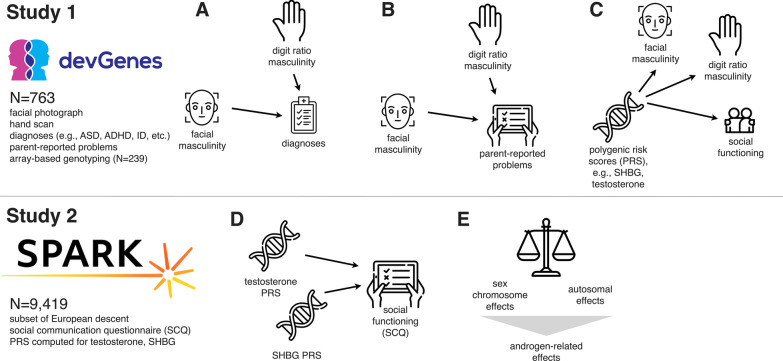
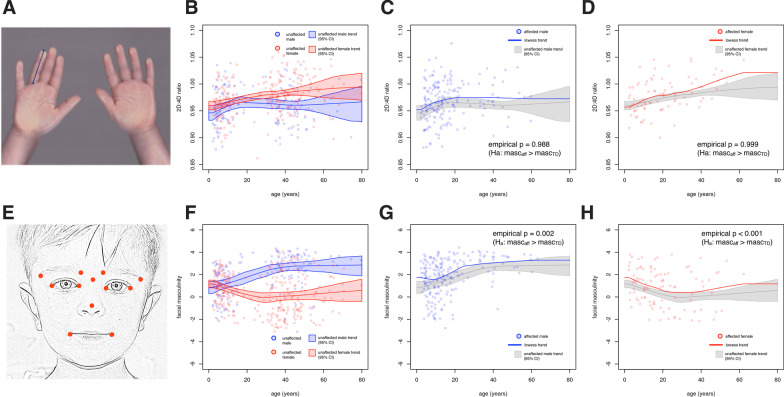
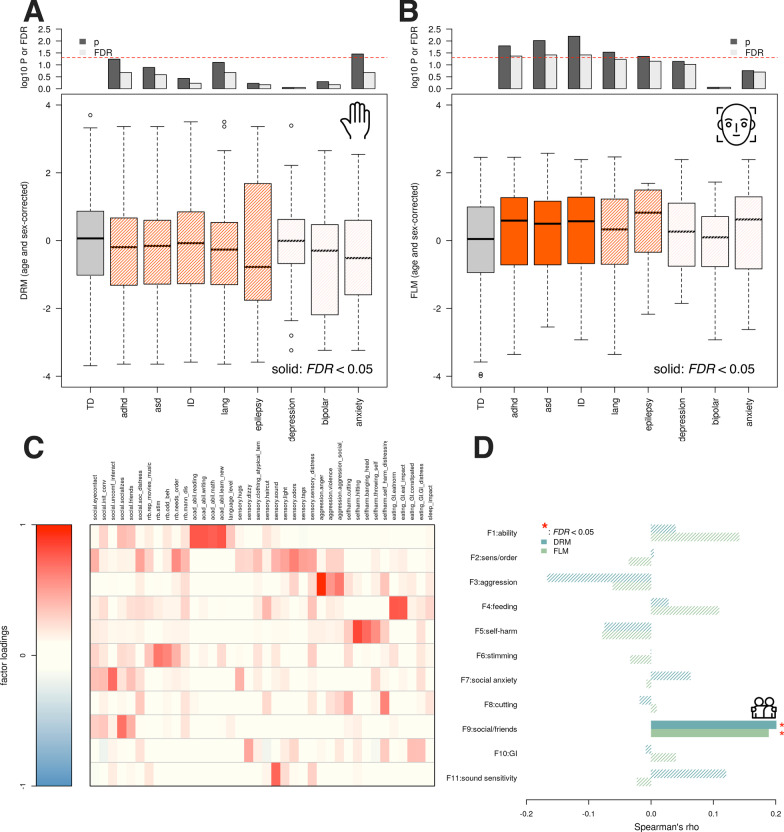
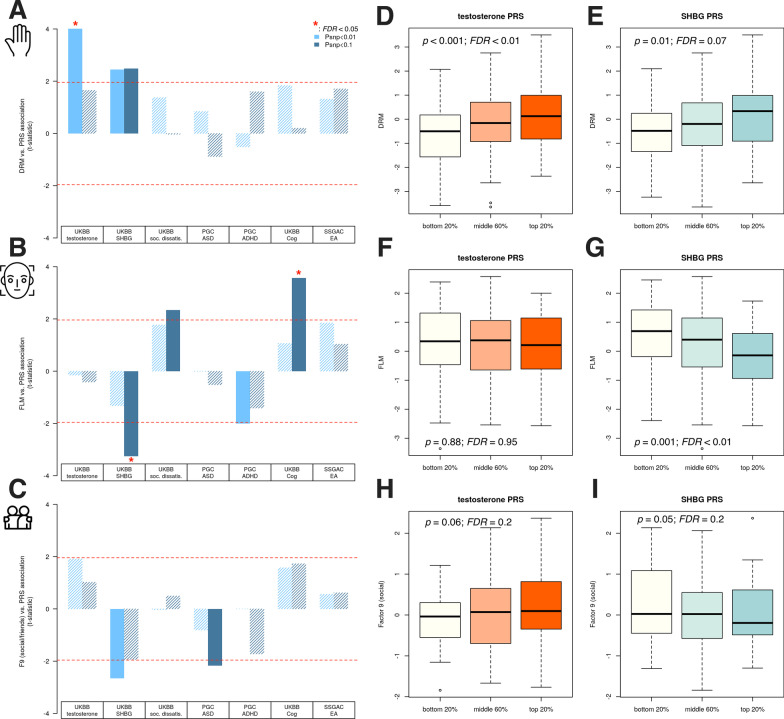
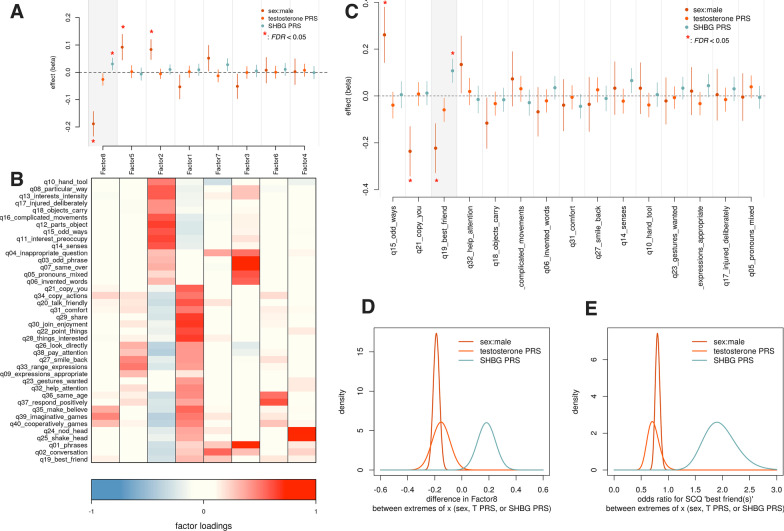
Background: Neurodevelopmental disorders (NDDs) such as autism spectrum disorder (ASD) display a strong male bias. Androgen exposure is profoundly increased in typical male development, but it also varies within the sexes, and previous work has sought to connect morphological proxies of androgen exposure, including digit ratio and facial morphology, to neurodevelopmental outcomes. The results of these studies have been mixed, and the relationships between androgen exposure and behavior remain unclear. Methods: Here, we measured both digit ratio masculinity (DRM) and facial landmark masculinity (FLM) in the same neurodevelopmental cohort ( N = 763) and compared these proxies of androgen exposure to clinical and parent-reported features as well as polygenic risk scores. Results: We found that FLM was significantly associated with NDD diagnosis (ASD, ADHD, ID; all $$p<0.05$$ p < 0.05 ), while DRM was not. When testing for association with parent-reported problems, we found that both FLM and DRM were positively associated with concerns about social behavior ( $$\rho =0.19$$ ρ = 0.19 , $$p=0.004$$ p = 0.004 ; $$\rho =0.2$$ ρ = 0.2 , $$p=0.004$$ p = 0.004 , respectively). Furthermore, we found evidence via polygenic risk scores (PRS) that DRM indexes masculinity via testosterone levels ( $$t=4.0$$ t = 4.0 , $$p=8.8\times 10^{-5}$$ p = 8.8 × 10 - 5 ), while FLM indexes masculinity through a negative relationship with sex hormone binding globulin (SHBG) levels ( $$t=-3.3$$ t = - 3.3 , $$p=0.001$$ p = 0.001 ). Finally, using the SPARK cohort ( N = 9419) we replicated the observed relationship between polygenic estimates of testosterone, SHBG, and social functioning ( $$t=-2.3$$ t = - 2.3 , $$p=0.02$$ p = 0.02 , and $$t=4.2$$ t = 4.2 , $$p={3.2\times 10^{-5}}$$ p = 3.2 × 10 - 5 for testosterone and SHBG, respectively). Remarkably, when considered over the extremes of each variable, these quantitative sex effects on social functioning were comparable to the effect of binary sex itself (binary male: $$-0.22\pm 0.05$$ - 0.22 ± 0.05 ; testosterone: $$-0.35\pm 0.15$$ - 0.35 ± 0.15 from 0.1%-ile to 99.9%-ile; SHBG: $$0.64\pm 0.15$$ 0.64 ± 0.15 from 0.1%-ile to 99.9%-ile). Limitations: In the devGenes and SPARK cohorts, our analyses rely on indirect, rather than direct measurement of androgens and related molecules. Conclusions: These findings and their replication in the large SPARK cohort lend support to the hypothesis that increasing net androgen exposure diminishes capacity for social functioning in both males and females.
Overview
The claims and statistics of this paper haven’t been checked yet.
Free: it reads the open-access text and checks the first 5 claims that cite a source we can check. Create a free account to check every claim.
Integrity signals
Registry
Cites
Statistics
Figures
Verification
Claims the paper makes
The claims and statistics of this paper haven’t been checked yet.
Free: it reads the open-access text and checks the first 5 claims that cite a source we can check. Create a free account to check every claim.
Claims other papers make about this one
Each is checked against this paper’s own text: does it say what the citing paper says it does?
In the citing paper
“Supporting these theories, physical markers of in utero androgen exposure such as lower 2D to 4D digit ratio260 or increased facial landmark masculinity261 are associated with increased prevalence of autism and ADHD diagnoses.”
From Sex and gender in neurodevelopmental conditions (2023) · cites this paper as [261]
Self-check
Percentages, sums and reported differences re-computed from the paper’s own numbers.
The self-check needs the paper’s full text.
Citations
Cites
Breiman, L. (2001) · Machine Learning · doi:10.1023/a:1010933404324 · Cited by 133,538
Harris, P. A., Taylor, R., Thielke, R., Payne, J., Gonzalez, N., & Conde, J. G. (2009) · Journal of Biomedical Informatics · doi:10.1016/j.jbi.2008.08.010 · Cited by 51,384 · cited 1×
“All devGenes data were stored in a REDCap database [47, 48].”
MethodPLINK: a tool set for whole-genome association and population-based linkage analyses.
Purcell, S., Neale, B., Todd-Brown, K., Thomas, L., Ferreira, M. A. R., Bender, D., Maller, J., Sklar, P., de Bakker, P. I. W., Daly, M. J., et al. (2007) · The American Journal of Human Genetics · doi:10.1086/519795 · Cited by 34,089
The REDCap consortium: building an international community of software platform partners
Harris, P. A., Taylor, R., Minor, B. L., Elliott, V., Fernandez, M., O'Neal, L., McLeod, L., Delacqua, G., Delacqua, F., Kirby, J., et al. (2019) · Journal of Biomedical Informatics · doi:10.1016/j.jbi.2019.103208 · Cited by 24,013
Classification and Regression by randomForest
Liaw, A. I., & Wiener, M. C. (2007) · Cited by 18,594
A global reference for human genetic variation
The 1000 Genomes Project Consortium, authors, C., Auton, A., Abecasis, G. R., Steering committee, Altshuler, D. M., Durbin, R. M., Abecasis, G. R., Bentley, D. R., Chakravarti, A., et al. (2015) · Nature · doi:10.1038/nature15393 · Cited by 18,247
R: A Language for Data Analysis and Graphics
Ihaka, R., & Gentleman, R. (1996) · Journal of Computational and Graphical Statistics · doi:10.1080/10618600.1996.10474713 · Cited by 11,220
ImageJ2: ImageJ for the next generation of scientific image data
Rueden, C. T., Schindelin, J., Hiner, M. C., DeZonia, B. E., Walter, A. E., Arena, E. T., & Eliceiri, K. W. (2017) · BMC Bioinformatics · doi:10.1186/s12859-017-1934-z · Cited by 5,980 · cited 2×
“, fourth digits [4D]) on both hands were measured manually using Image-J [49] (Fig.”
MethodHowie, B. N., Donnelly, P., & Marchini, J. (2009) · PLoS Genetics · doi:10.1371/journal.pgen.1000529 · Cited by 3,928
Dlib-ml: A Machine Learning Toolkit
King, D. E. (2009) · doi:10.5555/1577069.1755843 · Cited by 2,777
Murray, D. D., Suzuki, K., Law, M., Trebicka, J., Neuhaus, J., Wentworth, D., Johnson, M., Vjecha, M. J., Kelleher, A. D., Emery, S., et al. (2015) · PLOS ONE · doi:10.1371/journal.pone.0139981 · Cited by 2,740
23andMe Research Team, Lee, J. J., COGENT (Cognitive Genomics Consortium), Social Science Genetic Association Consortium, Wedow, R., Okbay, A., Kong, E., Maghzian, O., Zacher, M., Nguyen-Viet, T. A., et al. (2018) · Nature Genetics · doi:10.1038/s41588-018-0147-3 · Cited by 2,470
Biodiversity on the Rocks: Macrofauna Inhabiting Authigenic Carbonate at Costa Rica Methane Seeps
Levin, L. A., Mendoza, G. F., Grupe, B. M., Gonzalez, J. P., Jellison, B., Rouse, G., Thurber, A. R., & Waren, A. (2015) · PLOS ONE · doi:10.1371/journal.pone.0131080 · Cited by 2,167
The extreme male brain theory of autism
Baron-Cohen, S. (2002) · Trends in Cognitive Sciences · doi:10.1016/s1364-6613(02)01904-6 · Cited by 2,007 · cited 1×
“However, despite the evidence that male sex—and masculinity more generally, as posited by the “extreme male brain” theory [2]—is a strong risk factor for ASD, the cause of this sex bias is not yet well understood.”
BackgroundTutorial: a guide to performing polygenic risk score analyses
Choi, S. W., Mak, T. S.-H., & O’Reilly, P. F. (2020) · Nature Protocols · doi:10.1038/s41596-020-0353-1 · Cited by 1,946
A linear complexity phasing method for thousands of genomes
Delaneau, O., Marchini, J., & Zagury, J.-F. (2012) · Nature Methods · doi:10.1038/nmeth.1785 · Cited by 1,850
Modelling the COVID-19 epidemic and implementation of population-wide interventions in Italy
Giordano, G., Blanchini, F., Bruno, R., Colaneri, P., Di Filippo, A., Di Matteo, A., & Colaneri, M. (2020) · Nature Medicine · doi:10.1038/s41591-020-0883-7 · Cited by 1,740
Manning, J. T., Scutt, D., Wilson, J., & Lewis-Jones, D. I. (1998) · Human Reproduction · doi:10.1093/humrep/13.11.3000 · Cited by 1,467
The Extreme Male-Brain Theory of Autism
Baron-Cohen, S. (1999) · Neurodevelopmental Disorders · doi:10.7551/mitpress/4945.003.0023 · Cited by 1,413
PRSice: Polygenic Risk Score software
Euesden, J., Lewis, C. M., & O’Reilly, P. F. (2015) · Bioinformatics · doi:10.1093/bioinformatics/btu848 · Cited by 1,191
2nd to 4th digit ratios, fetal testosterone and estradiol
Lutchmaya, S., Baron-Cohen, S., Raggatt, P., Knickmeyer, R., & Manning, J. T. (2004) · Early Human Development · doi:10.1016/j.earlhumdev.2003.12.002 · Cited by 919
A tutorial on conducting genome‐wide association studies: Quality control and statistical analysis
Marees, A. T., de Kluiver, H., Stringer, S., Vorspan, F., Curis, E., Marie‐Claire, C., & Derks, E. M. (2018) · International Journal of Methods in Psychiatric Research · doi:10.1002/mpr.1608 · Cited by 828
Why are autism spectrum conditions more prevalent in males?
Baron-Cohen, S., Lombardo, M. V., Auyeung, B., Ashwin, E., Chakrabarti, B., & Knickmeyer, R. (2011) · PLoS Biology · doi:10.1371/journal.pbio.1001081 · Cited by 754 · cited 1×
“, testosterone) exposure during critical periods of fetal development, as the brain undergoes substantial organization and sexual differentiation [3, 4].”
BackgroundUsing human genetics to understand the disease impacts of testosterone in men and women
The Endometrial Cancer Association Consortium, Ruth, K. S., Day, F. R., Tyrrell, J., Thompson, D. J., Wood, A. R., Mahajan, A., Beaumont, R. N., Wittemans, L., Martin, S., et al. (2020) · Nature Medicine · doi:10.1038/s41591-020-0751-5 · Cited by 720
DeMyer, W., Zeman, W., & Palmer, C. G. (1964) · Pediatrics · doi:10.1542/peds.34.2.256 · Cited by 683
Psychiatric Genomics: An Update and an Agenda
Sullivan, P. F., Agrawal, A., Bulik, C. M., Andreassen, O. A., Børglum, A. D., Breen, G., Cichon, S., Edenberg, H. J., Faraone, S. V., Gelernter, J., et al. (2018) · American Journal of Psychiatry · doi:10.1176/appi.ajp.2017.17030283 · Cited by 676
Rutter, M., Caspi, A., & Moffitt, T. E. (2003) · Journal of Child Psychology and Psychiatry · doi:10.1111/1469-7610.00194 · Cited by 672
A General Approach for Haplotype Phasing across the Full Spectrum of Relatedness
O'Connell, J., Gurdasani, D., Delaneau, O., Pirastu, N., Ulivi, S., Cocca, M., Traglia, M., Huang, J., Huffman, J. E., Rudan, I., et al. (2014) · PLoS Genetics · doi:10.1371/journal.pgen.1004234 · Cited by 593
The Autism Spectrum Disorders Working Group of The Psychiatric Genomics Consortium (2017) · Molecular Autism · doi:10.1186/s13229-017-0137-9 · Cited by 587
Elevated fetal steroidogenic activity in autism
Baron-Cohen, S., Auyeung, B., Nørgaard-Pedersen, B., Hougaard, D. M., Abdallah, M. W., Melgaard, L., Cohen, A. S., Chakrabarti, B., Ruta, L., & Lombardo, M. V. (2015) · Molecular Psychiatry · doi:10.1038/mp.2014.48 · Cited by 471
SPARK: A US Cohort of 50,000 Families to Accelerate Autism Research
Feliciano, P., Daniels, A. M., Green Snyder, L., Beaumont, A., Camba, A., Esler, A., Gulsrud, A. G., Mason, A., Gutierrez, A., Nicholson, A., et al. (2018) · Neuron · doi:10.1016/j.neuron.2018.01.015 · Cited by 455
Self-citationBos, P. A., Panksepp, J., Bluthé, R.-M., & Honk, J. V. (2012) · Frontiers in Neuroendocrinology · doi:10.1016/j.yfrne.2011.01.002 · Cited by 429
Social cognition in attention-deficit hyperactivity disorder (ADHD)
Uekermann, J., Kraemer, M., Abdel-Hamid, M., Schimmelmann, B. G., Hebebrand, J., Daum, I., Wiltfang, J., & Kis, B. (2010) · Neuroscience & Biobehavioral Reviews · doi:10.1016/j.neubiorev.2009.10.009 · Cited by 419
Delaneau, O., Marchini, J., The 1000 Genomes Project Consortium, McVean, G. A., Donnelly, P., Lunter, G., Marchini, J. L., Myers, S., Gupta-Hinch, A., Iqbal, Z., et al. (2014) · Nature Communications · doi:10.1038/ncomms4934 · Cited by 406
The 2nd to 4th digit ratio and autism
Manning, J. T., Baron-Cohen, S., Wheelwright, S., & Sanders, G. (2001) · Developmental Medicine and Child Neurology · doi:10.1017/s0012162201000317 · Cited by 383
Dopaminergic-neuropeptide interactions in the social brain
Skuse, D. H., & Gallagher, L. (2009) · Trends in Cognitive Sciences · doi:10.1016/j.tics.2008.09.007 · Cited by 340
Fetal Testosterone Predicts Sexually Differentiated Childhood Behavior in Girls and in Boys
Auyeung, B., Baron-Cohen, S., Ashwin, E., Knickmeyer, R., Taylor, K., Hackett, G., & Hines, M. (2009) · Psychological Science · doi:10.1111/j.1467-9280.2009.02279.x · Cited by 314
Chakrabarti, B., Dudbridge, F., Kent, L., Wheelwright, S., Hill‐Cawthorne, G., Allison, C., Banerjee‐Basu, S., & Baron‐Cohen, S. (2009) · Autism Research · doi:10.1002/aur.80 · Cited by 295
Foetal testosterone, social relationships, and restricted interests in children
Knickmeyer, R., Baron‐Cohen, S., Raggatt, P., & Taylor, K. (2005) · Journal of Child Psychology and Psychiatry · doi:10.1111/j.1469-7610.2004.00349.x · Cited by 281
Sex Hormone Binding Globulin: Origin, Function and Clinical Significance
Selby, C. (1990) · Annals of Clinical Biochemistry: International Journal of Laboratory Medicine · doi:10.1177/000456329002700603 · Cited by 278 · cited 1×
“Testosterone becomes inactive when it is bound to SHBG, and studies show that low levels of SHBG are found in individuals with excessive androgen activity [41].”
BackgroundExome sequencing of 457 autism families recruited online provides evidence for autism risk genes
Feliciano, P., Zhou, X., Astrovskaya, I., Turner, T. N., Wang, T., Brueggeman, L., Barnard, R., Hsieh, A., Snyder, L. G., Muzny, D. M., et al. (2019) · npj Genomic Medicine · doi:10.1038/s41525-019-0093-8 · Cited by 247
Self-citationBaron-Cohen, S., Bowen, D. C., Holt, R. J., Allison, C., Auyeung, B., Lombardo, M. V., Smith, P., & Lai, M.-C. (2015) · PLOS ONE · doi:10.1371/journal.pone.0136521 · Cited by 238
Topical Review: Fetal Testosterone and Sex Differences in Typical Social Development and in Autism
Knickmeyer, R. C., & Baron-Cohen, S. (2006) · Journal of Child Neurology · doi:10.1177/08830738060210101601 · Cited by 230
Doherty, J. L., & Owen, M. J. (2014) · Genome Medicine · doi:10.1186/gm546 · Cited by 228
Baribeau, D. A., & Anagnostou, E. (2015) · Frontiers in Neuroscience · doi:10.3389/fnins.2015.00335 · Cited by 222
Exogenous Testosterone Rapidly Increases Aggressive Behavior in Dominant and Impulsive Men
Carré, J. M., Geniole, S. N., Ortiz, T. L., Bird, B. M., Videto, A., & Bonin, P. L. (2017) · Biological Psychiatry · doi:10.1016/j.biopsych.2016.06.009 · Cited by 208
A Genetic Investigation of Sex Bias in the Prevalence of Attention-Deficit/Hyperactivity Disorder
Martin, J., Walters, R. K., Demontis, D., Mattheisen, M., Lee, S. H., Robinson, E., Brikell, I., Ghirardi, L., Larsson, H., Lichtenstein, P., et al. (2018) · Biological Psychiatry · doi:10.1016/j.biopsych.2017.11.026 · Cited by 199 · cited 1×
“We first examined parent-reported social interaction frequency and its associations with polygenic estimates of total serum testosterone (UK Biobank field ID 30850), sex hormone binding globulin (SHBG, UK Biobank field ID 30830), an item from the UK Biobank measuring satisfaction with friendships (UK Biobank field ID…”
BackgroundParker, K. J., Oztan, O., Libove, R. A., Mohsin, N., Karhson, D. S., Sumiyoshi, R. D., Summers, J. E., Hinman, K. E., Motonaga, K. S., Phillips, J. M., et al. (2019) · Science Translational Medicine · doi:10.1126/scitranslmed.aau7356 · Cited by 185
Fetal testosterone and empathy
Knickmeyer, R., Baron-Cohen, S., Raggatt, P., Taylor, K., & Hackett, G. (2006) · Hormones and Behavior · doi:10.1016/j.yhbeh.2005.08.010 · Cited by 182
Prenatal testosterone exposure is related to sexually dimorphic facial morphology in adulthood
Whitehouse, A. J. O., Gilani, S. Z., Shafait, F., Mian, A., Tan, D. W., Maybery, M. T., Keelan, J. A., Hart, R., Handelsman, D. J., Goonawardene, M., et al. (2015) · Proceedings of the Royal Society B: Biological Sciences · doi:10.1098/rspb.2015.1351 · Cited by 180
Social cognition and language in children with specific language impairment (SLI)
Marton, K., Abramoff, B., & Rosenzweig, S. (2004) · Journal of Communication Disorders · doi:10.1016/j.jcomdis.2004.06.003 · Cited by 174 · cited 1×
“That this convergence on social impairment was found in a mixed NDD cohort is noteworthy: although ASD is most prominently characterized by deficits in social functioning, other NDDs are also marked by elevated rates of social dysfunction [79, 80], underscoring the fact that key features of NDDs, and psychopathology m…”
BackgroundSex-specific serum biomarker patterns in adults with Asperger's syndrome
Schwarz, E., Guest, P. C., Rahmoune, H., Wang, L., Levin, Y., Ingudomnukul, E., Ruta, L., Kent, L., Spain, M., Baron-Cohen, S., et al. (2011) · Molecular Psychiatry · doi:10.1038/mp.2010.102 · Cited by 171 · cited 1×
“Postnatal studies utilizing clinical and community samples of adults have also identified links between testosterone levels and ASD-related traits [11, 12], although postnatal studies of children show mixed results [13, 14].”
BackgroundWilliams, J. H. G., Greenhalgh, K. D., & Manning, J. T. (2003) · Early Human Development · doi:10.1016/s0378-3782(03)00012-4 · Cited by 170
The extreme male brain revisited: gender coherence in adults with autism spectrum disorder
Bejerot, S., Eriksson, J. M., Bonde, S., Carlström, K., Humble, M. B., & Eriksson, E. (2012) · British Journal of Psychiatry · doi:10.1192/bjp.bp.111.097899 · Cited by 161 · cited 3×
“This is not the first study to find that androgynous features are associated with NDDs [33] and that males with ASD demonstrate more feminine digit ratios [36].”
BackgroundResultAltered gaze following during live interaction in infants at risk for autism: an eye tracking study
The EASE Team, Thorup, E., Nyström, P., Gredebäck, G., Bölte, S., & Falck‐Ytter, T. (2016) · Molecular Autism · doi:10.1186/s13229-016-0069-9 · Cited by 156
Milne, E., White, S., Campbell, R., Swettenham, J., Hansen, P., & Ramus, F. (2006) · Journal of Autism and Developmental Disorders · doi:10.1007/s10803-005-0052-3 · Cited by 144
Craniofacial Development The Tissue and Molecular Interactions That Control Development of the Head
Francis‐West, P. H., Robson, L. G., & Evans, D. J. R. (2003) · Advances in anatomy, embryology and cell biology · doi:10.1007/978-3-642-55570-1 · Cited by 129
de Bruin, E. I., Verheij, F., Wiegman, T., & Ferdinand, R. F. (2006) · Developmental Medicine & Child Neurology · doi:10.1017/s0012162206002118 · Cited by 123
Whitehouse, A., Mattes, E., Maybery, M. T., SAWYER, M. G., Jacoby, P. A., Keelan, J. A., & Hickey, M. (2012) · Journal of Child Psychology and Psychiatry · doi:10.1111/j.1469-7610.2011.02523.x · Cited by 116
Increased serum androstenedione in adults with autism spectrum conditions
Ruta, L., Ingudomnukul, E., Taylor, K., Chakrabarti, B., & Baron-Cohen, S. (2011) · Psychoneuroendocrinology · doi:10.1016/j.psyneuen.2011.02.007 · Cited by 110
Kung, K. T. F., Spencer, D., Pasterski, V., Neufeld, S., Glover, V., O'Connor, T. G., Hindmarsh, P. C., Hughes, I. A., Acerini, C. L., & Hines, M. (2016) · Journal of Child Psychology and Psychiatry · doi:10.1111/jcpp.12602 · Cited by 97
High-Dose Testosterone Treatment Increases Serotonin Transporter Binding in Transgender People
Kranz, G. S., Wadsak, W., Kaufmann, U., Savli, M., Baldinger, P., Gryglewski, G., Haeusler, D., Spies, M., Mitterhauser, M., Kasper, S., et al. (2015) · Biological Psychiatry · doi:10.1016/j.biopsych.2014.09.010 · Cited by 89
Martel, M. M., Gobrogge, K. L., Breedlove, S. M., & Nigg, J. T. (2008) · Behavioral Neuroscience · doi:10.1037/0735-7044.122.2.273 · Cited by 88
A Critical Review of the Research on the Extreme Male Brain Theory and Digit Ratio (2D:4D)
Teatero, M. L., & Netley, C. (2013) · Journal of Autism and Developmental Disorders · doi:10.1007/s10803-013-1819-6 · Cited by 86 · cited 1×
“However, quantitative reviews have supported the association between masculine digit ratio and ASD [71, 72], so the literature on DRM remains mixed.”
BackgroundThe Bull of Wall Street: Experimental Analysis of Testosterone and Asset Trading
Nadler, A., Jiao, P., Johnson, C. J., Alexander, V., & Zak, P. J. (2017) · Management Science · doi:10.1287/mnsc.2017.2836 · Cited by 85
Male predominance in autism: neuroendocrine influences on arousal and social anxiety
Pfaff, D. W., Rapin, I., & Goldman, S. (2011) · Autism Research · doi:10.1002/aur.191 · Cited by 84
Bodo, C., & Rissman, E. F. (2008) · Endocrinology · doi:10.1210/en.2008-0183 · Cited by 83
PanTools: representation, storage and exploration of pan-genomic data
Sheikhizadeh, S., Schranz, M. E., Akdel, M., de Ridder, D., & Smit, S. (2016) · Bioinformatics · doi:10.1093/bioinformatics/btw455 · Cited by 81
Whitehouse, A. J., Mattes, E., Maybery, M. T., Dissanayake, C., Sawyer, M., Jones, R. M., Pennell, C. E., Keelan, J. A., & Hickey, M. (2012) · Journal of Neurodevelopmental Disorders · doi:10.1186/1866-1955-4-25 · Cited by 78
Hönekopp, J. (2012) · Autism Research · doi:10.1002/aur.1230 · Cited by 76
Zhao, H., & Nyholt, D. R. (2016) · Human Genetics · doi:10.1007/s00439-016-1755-6 · Cited by 75
Hickey, M., Doherty, D. A., Hart, R. J., Norman, R. J., Mattes, E., Atkinson, H. C., & Sloboda, D. M. (2010) · Psychoneuroendocrinology · doi:10.1016/j.psyneuen.2010.02.013 · Cited by 74
Anthoni, H., Sucheston, L. E., Lewis, B. A., Tapia-Páez, I., Fan, X., Zucchelli, M., Taipale, M., Stein, C. M., Hokkanen, M.-E., Castrén, E., et al. (2012) · Behavior Genetics · doi:10.1007/s10519-012-9532-3 · Cited by 71
Lawson, L. P., Keelan, J. A., Jamnadass, E. S. L., Maybery, M. T., Hickey, M., & Whitehouse, A. (2015) · Early Human Development · doi:10.1016/j.earlhumdev.2014.12.011 · Cited by 71
Facial Structure Analysis Separates Autism Spectrum Disorders into Meaningful Clinical Subgroups
Obafemi-Ajayi, T., Miles, J. H., Takahashi, T., Qi, W., Aldridge, K. J., Zhang, M., Xin, S.-Q., He, Y., & Duan, Y. (2014) · Journal of Autism and Developmental Disorders · doi:10.1007/s10803-014-2290-8 · Cited by 64 · cited 1×
“The Euclidean distance between landmark pairs coordinates was then computed and used to provide 66 distance features [51].”
MethodWhitehouse, A., Maybery, M. T., Hart, R. J., Mattes, E., Newnham, J. P., Sloboda, D. M., Stanley, F. J., & Hickey, M. (2010) · Psychoneuroendocrinology · doi:10.1016/j.psyneuen.2010.02.007 · Cited by 55
Diewert, V. M., Lozanoff, S., & Choy, V. (1993) · PubMed · Cited by 55
Nadler, A., Camerer, C. F., Zava, D. T., Ortiz, T. L., Watson, N. V., Carré, J. M., & Nave, G. (2019) · Proceedings of the Royal Society B: Biological Sciences · doi:10.1098/rspb.2019.1062 · Cited by 53 · cited 1×
“Studies of short-term testosterone exposure have demonstrated significant effects on some behaviors such as risk taking [90] and aggression [91] but not others, such as empathizing [92].”
BackgroundTan, D. W., Gilani, S. Z., Maybery, M. T., Mian, A. S., Hunt, A. M., Walters, M., & Whitehouse, A. (2017) · Scientific Reports · doi:10.1038/s41598-017-09939-y · Cited by 51
Genotype calling and phasing using next-generation sequencing reads and a haplotype scaffold
Menelaou, A., & Marchini, J. (2013) · Bioinformatics · doi:10.1093/bioinformatics/bts632 · Cited by 47
Sexual dimorphism of oxytocin and vasopressin in social cognition and behavior
Lu, Q., Lai, J., Du, Y., Huang, T., Prukpitikul, P., Xu, Y., & Hu, S. (2019) · Psychology Research and Behavior Management · doi:10.2147/prbm.s192951 · Cited by 46 · cited 1×
“The more immediate behavioral effects of androgens might be explained by their interactions with signaling pathways involving the neuropeptides oxytocin and vasopressin, which have been well-established as key mechanisms in social behavior [87, 88], and have recently shown promise in clinical trials for their influenc…”
BackgroundHennessy, R. J., McLearie, S., Kinsella, A., & Waddington, J. L. (2006) · Journal of Neuropsychiatry · doi:10.1176/jnp.18.1.73 · Cited by 43
Kung, K. T. F., Constantinescu, M., Browne, W. V., Noorderhaven, R. M., & Hines, M. (2016) · Molecular Autism · doi:10.1186/s13229-016-0078-8 · Cited by 40 · cited 1×
“Postnatal studies utilizing clinical and community samples of adults have also identified links between testosterone levels and ASD-related traits [11, 12], although postnatal studies of children show mixed results [13, 14].”
BackgroundDamiano, C. R., Cockrell, D. C., Dunlap, K., Hanna, E. K., Miller, S., Bizzell, J., Kovac, M., Turner‐Brown, L., Sideris, J. H., Kinard, J. L., et al. (2015) · Journal of Neurodevelopmental Disorders · doi:10.1186/s11689-015-9107-8 · Cited by 39
Associations between polymorphisms in sex steroid related genes and autistic-like traits
Zettergren, A., Jönsson, L., Johansson, D., Melke, J., Lundström, S., Anckarsäter, H. S., Lichtenstein, P., & Westberg, L. (2013) · Psychoneuroendocrinology · doi:10.1016/j.psyneuen.2013.06.004 · Cited by 38
Martel, M. M. (2009) · Journal of Child Psychology and Psychiatry · doi:10.1111/j.1469-7610.2009.02065.x · Cited by 36
genipe: an automated genome-wide imputation pipeline with automatic reporting and statistical tools
Perreault, L. L., Legault, M., Asselin, G., & Dubé, M. (2016) · Bioinformatics · doi:10.1093/bioinformatics/btw487 · Cited by 35
The ratio of 2nd and 4th digit length in autistic children.
Noipayak, P. (2009) · PubMed · Cited by 33
Serum testosterone concentration in male autistic youngsters.
Croonenberghs, J., Grieken, S. V., Wauters, A., West, D. V., Brouw, L., Maes, M. H. J., & Deboutte, D. (2010) · PubMed · Cited by 33
Polymorphisms in Genes Involved in Testosterone Metabolism in Slovak Autistic Boys
Schmidtova, E., Kelemenova, S., Celec, P., Ficek, A., & Ostatnikova, D. (2010) · The Endocrinologist · doi:10.1097/ten.0b013e3181f661d2 · Cited by 32
Gilani, S. Z., Tan, D. W., Russell-Smith, S. N., Maybery, M. T., Mian, A. S., Eastwood, P. R., Shafait, F., Goonewardene, M. S., & Whitehouse, A. (2015) · Journal of Neurodevelopmental Disorders · doi:10.1186/s11689-015-9109-6 · Cited by 30
A broad autism phenotype expressed in facial morphology
Tan, D. W., Maybery, M. T., Gilani, S. Z., Alvares, G. A., Mian, A. S., Suter, D., & Whitehouse, A. (2020) · Translational Psychiatry · doi:10.1038/s41398-020-0695-z · Cited by 28
Peila, R., Arthur, R., & Rohan, T. E. (2020) · Cancer Epidemiology Biomarkers & Prevention · doi:10.1158/1055-9965.epi-20-0246 · Cited by 28
Tan, D. W., Russell-Smith, S. N., Simons, J. M., Maybery, M. T., Leung, D., Ng, H. L. H., & Whitehouse, A. J. O. (2015) · PLOS ONE · doi:10.1371/journal.pone.0131780 · Cited by 27 · cited 1×
“Moreover, recent studies have found that facial masculinity predicts ASD traits in a variety of populations including children with ASD [31], siblings of individuals with ASD [32], as well as non-clinical samples [33, 34].”
Background2D:4D finger ratio in Slovak autism spectrum population.
Krajmer, P., Špajdel, M., Kubranská, A., & Ostatníková, D. (2011) · PubMed · Cited by 26
Manning, J. T. (2012) · Springer eBooks · doi:10.1007/978-1-4419-1788-1_48 · Cited by 23 · cited 1×
“, becomes more feminine) across puberty [73, 74], however the rank order of inter-individual differences remain stable.”
BackgroundMarečková, K., Chakravarty, M. M., Lawrence, C., Leonard, G. T., Pérusse, D., Perron, M., Pike, G. B., Richer, L., Veillette, S., Pausová, Z., et al. (2014) · Brain Structure and Function · doi:10.1007/s00429-014-0852-3 · Cited by 21 · cited 2×
“A twin study found that females with a male twin, who were presumably exposed to greater fetal testosterone levels, exhibited greater facial masculinity than those with a female twin [29] and another study showed that greater umbilical cord testosterone levels were associated with greater adult facial masculinity in b…”
BackgroundKrálík, M., Ingrová, P., Kozieł, S. M., Hupková, A., & Klíma, O. (2017) · American Journal of Physical Anthropology · doi:10.1002/ajpa.23153 · Cited by 20 · cited 1×
“, becomes more feminine) across puberty [73, 74], however the rank order of inter-individual differences remain stable.”
BackgroundThe Extreme Male Brain Theory of Autism: The Role of Fetal Androgens
Baron‐Cohen, S., Auyeung, B., Ashwin, E., Knickmeyer, R. C., Lombardo, M. V., & Chakrabarti, B. (2011) · Oxford University Press eBooks · doi:10.1093/med/9780195371826.003.0062 · Cited by 13 · cited 1×
“, testosterone) exposure during critical periods of fetal development, as the brain undergoes substantial organization and sexual differentiation [3, 4].”
BackgroundGökçen, C., Erbağcı, A. B., Mutluer, T., Örkmez, M., & Correll, C. U. (2019) · International Journal of Psychiatry in Clinical Practice · doi:10.1080/13651501.2019.1602657 · Cited by 12
Zettergren, A., Karlsson, S. A., Hovey, D., Jönsson, L., Melke, J., Anckarsäter, H. S., Lichtenstein, P., Lundström, S., & Westberg, L. (2016) · Psychoneuroendocrinology · doi:10.1016/j.psyneuen.2016.02.020 · Cited by 10
Tan, D. W., Maybery, M. T., Ewing, L., Tay, J., Eastwood, P. R., & Whitehouse, A. (2019) · British Journal of Psychology · doi:10.1111/bjop.12436 · Cited by 10 · cited 1×
“However, these studies provide inconsistent support for the “extreme male brain” theory [35, 36].”
Result
Research works printed but not linked: 2
- Rutter M Bailey A Lord C The social communication questionnaire: manual 2003 Los Angeles Western Psychological Services
- Ross I Robert G R: a language and environment for statistical computing. R foundation for statistical computing J Comput Graph Stat 2008 5 299 314
Cited by
Sex and gender in neurodevelopmental conditions
Bölte, S., Neufeld, J., Marschik, P. B., Williams, Z. J., Gallagher, L., & Lai, M.-C. (2023) · Nature Reviews Neurology · doi:10.1038/s41582-023-00774-6 · Cited by 249
Analysis of salivary steroid hormones in boys with autism spectrum disorder
He, Q. P., Wang, Y., Liu, Z., Xia, J., Heng, Y., Qiu, Z., Wang, H., Xu, W., Xu, Z., & Xie, J. (2023) · BMC Psychiatry · doi:10.1186/s12888-023-04586-2 · Cited by 10
The Placental Steroid Hypothesis of Human Brain Evolution
Tsompanidis, A., Burton, G. J., Baron‐Cohen, S., & Dunbar, R. (2025) · Evolutionary Anthropology Issues News and Reviews · doi:10.1002/evan.70003 · Cited by 4
“When the female offspring become pregnant themselves, they utilise their ‘ conditioned ’ HPA/G axis in a new cycle of steroid production and foetal neurodevelopment of their own offspring.”
Tan, D. W., Gilani, S. Z., Alvares, G. A., Mian, A. S., Whitehouse, A., & Maybery, M. T. (2022) · Proceedings of the Royal Society B Biological Sciences · doi:10.1098/rspb.2022.0143 · Cited by 7
Excess Neonatal Testosterone Causes Male-Specific Social and Fear Memory Deficits in Wild-Type Mice
Quiñones-Labernik, P., Blocklinger, K. L., Bruce, M. R., Hagan, E., Preuschl, D., Tesar, C., & Ferri, S. L. (2025) · eneuro · doi:10.1523/eneuro.0020-25.2025 · Cited by 8
“…disorder diagnosis (Manning et al., 2001; Lutchmaya et al., 2002a,b; Chapman et al., 2006; De Bruin et al., 2006; Knickmeyer and Baron-Cohen, 2006; Milne et al., 2006; Auyeung et al., 2010, 2012; Baron-Cohen et al., 2015; Park et al., 2017; McKenna et al., 2021; Firestein et al., 2022).”
Metadata
- Authors
- McKenna, B. G., Huang, Y., Vervier, K., Hofammann, D., Cafferata, M., Al-Momani, S., Lowenthal, F., Zhang, A., Koh, J.-Y., Thenuwara, S., Brueggeman, L., Bahl, E., Koomar, T., Pottschmidt, N., Kalmus, T., Casten, L., Thomas, T. R., & Michaelson, J. J.
- Affiliations
- Emory University (US)
- University of Iowa (US)
- Wellcome Sanger Institute (GB)
- University of Nebraska at Omaha (US)
- University of Washington (US)
- Iowa State University (US)
- Pennsylvania State University (US)
- Corresponding author
- Michaelson, Jacob J.
- ORCID
- Venue
- Molecular Autism
- Published
- 2021-06-09
- Volume
- 12
- Issue
- 1
- Pages
- 43-43
- ISSN
- 2040-2392 (ISSN-L)
- PMC
- PMC8190870
- OpenAlex
- W3166706317
- Cited by
- 11
- References
- 103
- Citations by year
- 2026: 3 · 2025: 3 · 2024: 1 · 2023: 2 · 2022: 2
- FWCI
- 0.39
- Type
- journal article
- Language
- en
- Open access
- gold
- doi.org
- Licence
- cc-by
- creativecommons.org/licenses/by/4.0 (tdm)
- creativecommons.org/licenses/by/4.0 (vor)
- Locations
- Molecular Autism (publishedVersion, cc-by)
- medRxiv (acceptedVersion, cc-by-nc-nd)
- PubMed Central (publishedVersion, cc-by)
- PubMed (publishedVersion)
- DOAJ (DOAJ: Directory of Open Access Journals) (submittedVersion, cc-by-sa)
- Funders
- National Institute on Deafness and Other Communication Disorders (DC014489)
- National Institute of Mental Health (MH105527)
- Simons Foundation (US (516716)
- Topics
- Health Sciences › Medicine › Endocrinology, Diabetes and Metabolism › Sexual Differentiation and Disorders
- Life Sciences › Neuroscience › Cognitive Neuroscience › Autism Spectrum Disorder Research
- Life Sciences › Biochemistry, Genetics and Molecular Biology › Genetics › Genetics and Neurodevelopmental Disorders
- Keywords
- androgen exposure, neurodevelopmental disorders, autism spectrum disorder, 2D:4D digit ratio, facial masculinity, sex differences, social functioning, testosterone, sex hormone-binding globulin, polygenic risk score, attention deficit hyperactivity disorder, intellectual disability, SPARK cohort
- MeSH terms
- Autism Spectrum Disorder, Androgens, Female, Humans, Male, Testosterone, Cohort Studies, Multifactorial Inheritance
About these checks
Registry, retraction, Cites and statistics results are computed, not judged, with one exception: a printed reference that no index lists is read once by a model before it counts as a citation error. Claims are extracted by a model and kept only when their quote appears verbatim in the text; each cited source is then checked, with a model’s help, for whether it says what the claim relies on. Those verdicts can be wrong — read the claim’s quote and the cited source before relying on one.
Statistics and arithmetic are recomputed, not judged.
Confidence bands are shown only for fields calibrated on our annotated test set. None is calibrated yet, so no band is shown.
What counts as a claim ›How we measure confidence ›How we check this ›
Are you an author, or do you see a problem with this page? Request a review
Data sources
Bibliographic data: Semantic Scholar, OpenAlex, Crossref.
Contains information from the Semantic Scholar Academic Graph Datasets, made available under the ODC Attribution License (ODC-BY 1.0).
Semantic Scholar’s data is described in: Kinney, R., et al. (2023). The Semantic Scholar Open Data Platform. arXiv:2301.10140.
