

Adipose-derived and bone marrow mesenchymal stem cells: a donor-matched comparison
Open accessThe DOI matches its Crossref record; 62 of the 62 references it cites were found in a registry or an index.
Abstract
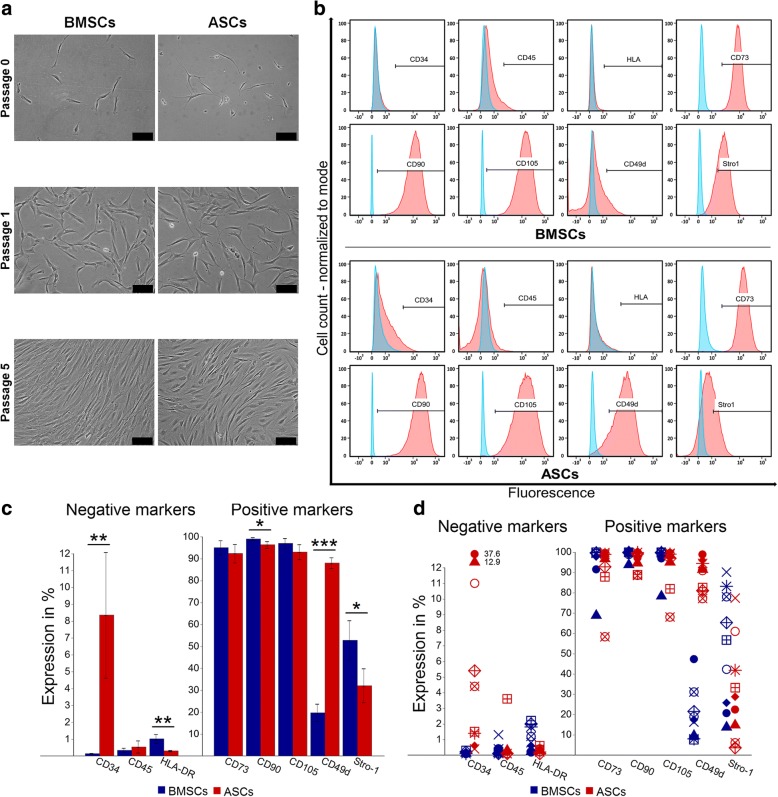
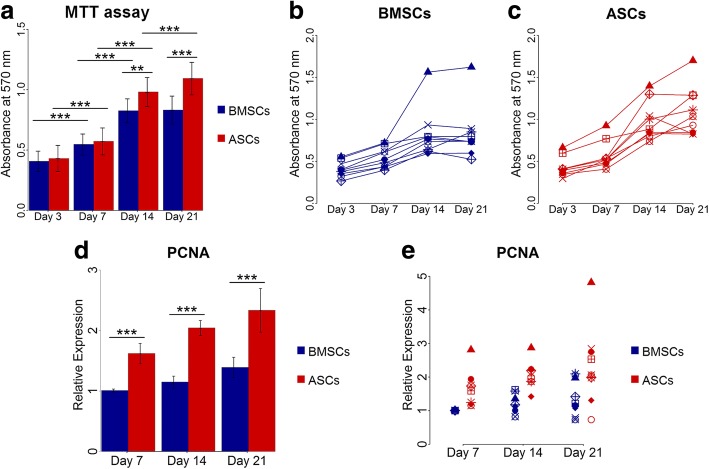
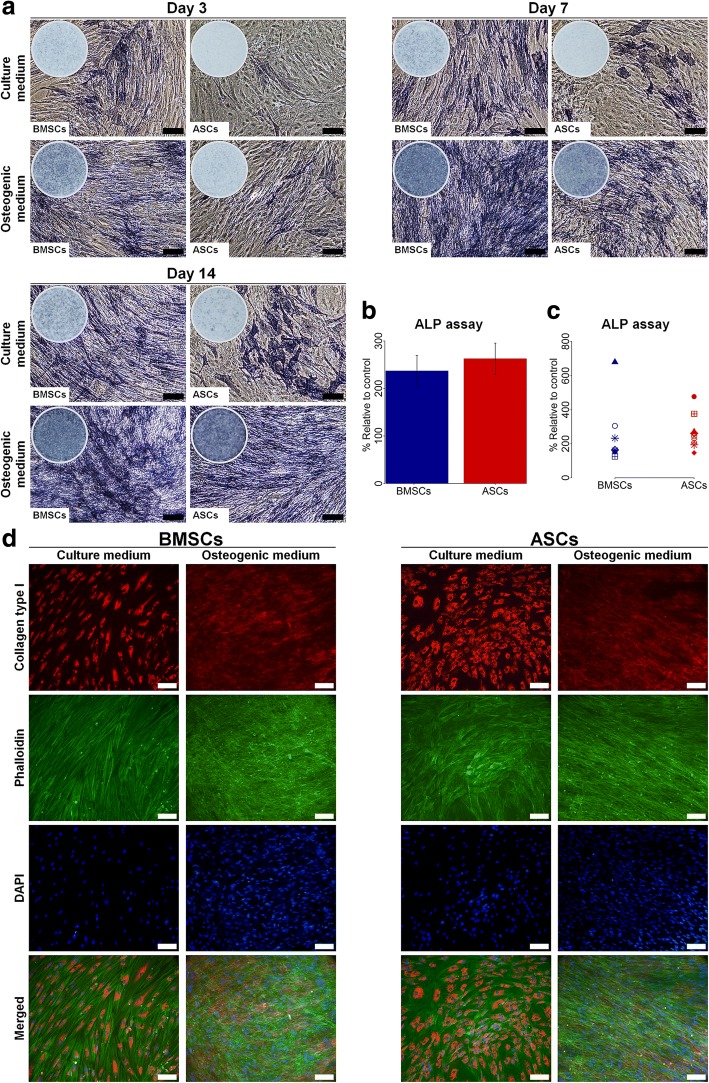
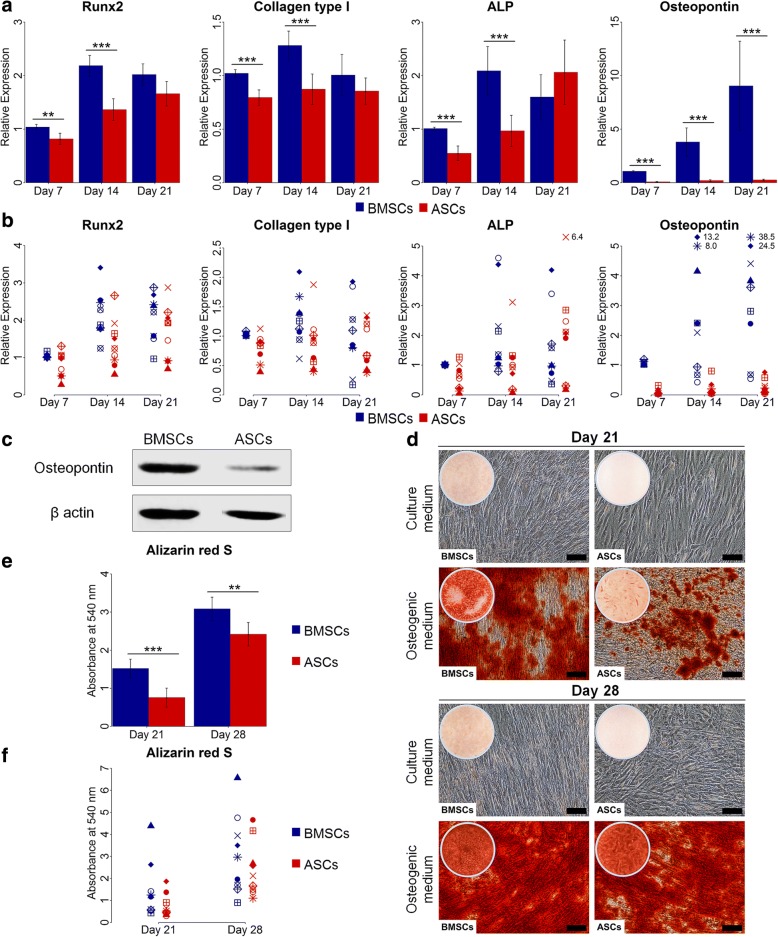
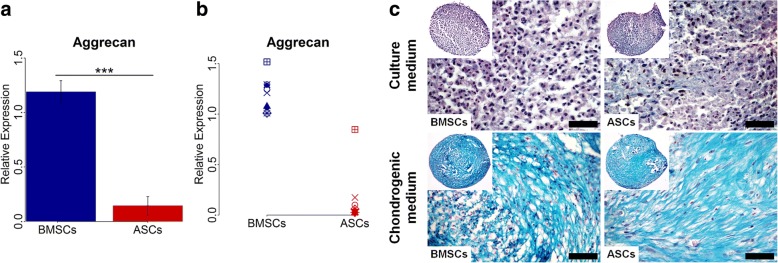
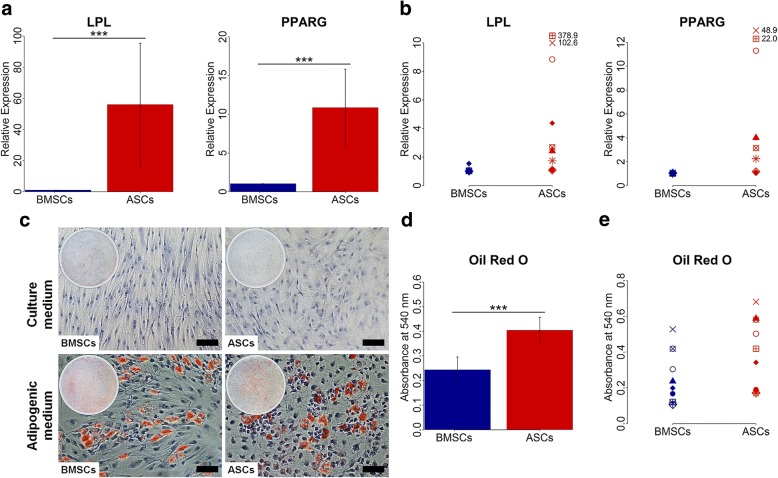
BACKGROUND: Adipose-derived stem cells (ASCs) have been introduced as an alternative to bone marrow mesenchymal stem cells (BMSCs) for cell-based therapy. However, different studies comparing ASCs and BMSCs have shown conflicting results. In fact, harvesting ASCs and BMSCs from different individuals might influence the results, making comparison difficult. Therefore, this study aimed to characterize donor-matched ASCs and BMSCs in order to investigate proliferation, differentiation potential and possible effects of donor variation on these mesenchymal stem cells (MSCs). METHODS: Human bone marrow and adipose tissue samples were obtained from nine donors aged 8-14. ASCs and BMSCs were isolated and characterized based on expression of surface markers using flow cytometry. The proliferation up to 21 days was investigated. Multi-lineage differentiation was induced using osteogenic, chondrogenic and adipogenic differentiation media. Alkaline phosphatase (ALP) activity was monitored and collagen type I formation was evaluated by immunofluorescence staining. In vitro multi-potency was studied using tissue-specific stains and lineage-specific gene expression. In addition, the osteogenic lineage was evaluated at protein level. RESULTS: Isolated ASCs and BMSCs from all donors demonstrated morphologic and immunophenotypic characteristics of MSCs, with expression of MSCs markers and negative expression of hematopoietic markers. Unlike BMSCs, ASCs showed high expression of CD49d and low expression of Stro-1. In general, ASCs showed significantly higher proliferation and adipogenic capacity with more lipid vesicle formation and expression of the adipogenesis-related genes than BMSCs. In contrast, BMSCs showed significantly higher osteogenic and chondrogenic capacity compared to ASCs. BMSCs had earlier and higher ALP activity, calcium deposition, and expression of the osteogenesis- and chondrogenesis-related genes and the osteogenesis-related protein osteopontin. Proliferation and differentiation capacity of ASCs and BMSCs varied significantly among the donors. CONCLUSIONS: ASCs and BMSCs showed tissue-specific differentiation abilities, but with significant variation between donors. The similarities and differences in the properties of ASCs and BMSCs should be taken into consideration when planning stem cell-based therapy.
Overview
The claims and statistics of this paper haven’t been checked yet.
Free: it reads the open-access text and checks the first 5 claims that cite a source we can check. Create a free account to check every claim.
Integrity signals
Registry
Cites
Statistics
Figures
Verification
Claims the paper makes
The claims and statistics of this paper haven’t been checked yet.
Free: it reads the open-access text and checks the first 5 claims that cite a source we can check. Create a free account to check every claim.
Claims other papers make about this one
Each is checked against this paper’s own text: does it say what the citing paper says it does?
The cited source says what the claim attributes to it.
In the citing paper
“Regarding bone tissue engineering, studies comparing the osteogenic potential of human BM-MSCs and ASCs have yielded mixed results.”
From Mesenchymal Stem/Stromal Cells: Immunomodulatory and Bone Regeneration Potential after Tumor Excision in Osteosarcoma Patients (2023) · cites this paper as [58]
The cited source says what the claim attributes to it.
In the citing paper
“Additionally, harvesting BM-MSCs is limited by the potential pain and morbidity associated with bone marrow aspiration, and only a small fraction (0.001–0.01%) of harvested bone marrow cells are MSCs [58,67].”
From Mesenchymal Stem/Stromal Cells: Immunomodulatory and Bone Regeneration Potential after Tumor Excision in Osteosarcoma Patients (2023) · cites this paper as [58]
The cited source says what the claim attributes to it.
In the citing paper
“Some suggest that BM-MSCs exhibit greater osteogenic capacity [58,59,60,61,62], while others propose that ASCs have equal or superior potential [58,63,64,65,66].”
From Mesenchymal Stem/Stromal Cells: Immunomodulatory and Bone Regeneration Potential after Tumor Excision in Osteosarcoma Patients (2023) · cites this paper as [58]
Self-check
Percentages, sums and reported differences re-computed from the paper’s own numbers.
The self-check needs the paper’s full text.
Citations
Cites
Multilineage potential of adult human mesenchymal stem cells
Pittenger, M. F., Mackay, A. M., Beck, S. C., Jaiswal, R. K., Douglas, R., Mosca, J. D., Moorman, M. A., Simonetti, D. W., Craig, S., & Marshak, D. R. (1999) · Science · doi:10.1126/science.284.5411.143 · Cited by 21,052 · cited 1×
“01%) of the harvested bone marrow cells are MSCs [5].”
BackgroundDominici, M., Le Blanc, K., Mueller, I., Slaper-Cortenbach, I., Marini, F. C., Krause, D. S., Deans, R. J., Keating, A., Prockop, D. J., & Horwitz, E. M. (2006) · Cytotherapy · doi:10.1080/14653240600855905 · Cited by 17,766 · cited 1×
“to a tissue culture flask), must express the surface markers CD73, CD90 and CD105 (≥ 90%), not express the hematopoietic markers CD14, CD34, CD45, CD19 and HLA-DR (≤ 2%), and should be able to undergo multi-lineage differentiation (osteogenic, adipogenic and chondrogenic) [4].”
BackgroundStöckl, S., Göttl, C., Grifka, J., & Grässel, S. (2013) · Cellular Physiology and Biochemistry · doi:10.1159/000350089 · Cited by 4,656
Komori, T., Yagi, H., Nomura, S., Yamaguchi, A., Sasaki, K., Deguchi, K., Shimizu, Y., Bronson, R. T., Gao, Y.-H., Inada, M., et al. (1997) · Cell · doi:10.1016/s0092-8674(00)80258-5 · Cited by 4,244 · cited 1×
“Runx2-deficient mice are reported to lack bone formation due to absence of osteoblasts [50].”
BackgroundMesenchymal stem cells reside in virtually all post-natal organs and tissues
Meirelles, L. D. S., Chagastelles, P. C., & Nardi, N. B. (2006) · Journal of Cell Science · doi:10.1242/jcs.02932 · Cited by 2,485 · cited 1×
“Discussion Adult MSCs, isolated from different connective tissues, have a fundamental role in maintenance and regeneration of body tissues [30].”
BackgroundChamberlain, G., Fox, J., Ashton, B., & Middleton, J. (2007) · Stem Cells · doi:10.1634/stemcells.2007-0197 · Cited by 2,381
Bourin, P., Bunnell, B. A., Casteilla, L., Dominici, M., Katz, A. J., March, K. L., Redl, H., Rubin, J. P., Yoshimura, K., & Gimble, J. M. (2013) · Cytotherapy · doi:10.1016/j.jcyt.2013.02.006 · Cited by 1,890 · cited 1×
“Although significant biologic differences have been shown in MSCs derived from different sources [12–14], ASCs and BMSCs have comparable characteristics when it comes to morphology and surface proteins [15].”
BackgroundLiang, H., Liang, P., Xu, Y., Wu, J., Liang, T., & Xu, X. (2009) · Journal of Neurotrauma · doi:10.1089/neu.2008.0850 · Cited by 1,750
Hass, R., Kasper, C., Böhm, S., & Jacobs, R. (2011) · Cell Communication and Signaling · doi:10.1186/1478-811x-9-12 · Cited by 1,748
Stolzing, A., Jones, E., McGonagle, D., & Scutt, A. (2008) · Mechanisms of Ageing and Development · doi:10.1016/j.mad.2007.12.002 · Cited by 1,195 · cited 1×
“It has been reported that stem cell yield, proliferation and differentiation properties of BMSCs and ASCs are negatively affected by age [31, 32].”
Background
Cited by
Items 301–400 of 540
Dec, P., Żyłka, M., Burszewski, P., Modrzejewski, A., & Pawlik, A. (2024) · International Journal of Molecular Sciences · doi:10.3390/ijms25084498 · Cited by 6
“stem cells (MSCs), including TSPCs, are obtained from 17–22].”
BackgroundYuan, Y., & Liu, T. (2024) · Experimental Cell Research · doi:10.1016/j.yexcr.2024.114263 · Cited by 8
Rusch, R., Ogawa, Y., Sato, S., Morikawa, S., Inagaki, E., Shimizu, E., Tsubota, K., & Shimmura, S. (2021) · International Journal of Molecular Sciences · doi:10.3390/ijms22094895 · Cited by 6
Teufelsbauer, M., Lang, C., Plangger, A., Rath, B., Moser, D., Staud, C. J., Radtke, C., Neumayer, C., & Hamilton, G. (2022) · Medical Oncology · doi:10.1007/s12032-022-01655-6 · Cited by 6
“Donor-matched ADSCs and BM-MSCs populations exhibited characteristics of MSCs, with expression of the typical MSCs markers [19].”
BackgroundNam, H. Y., Yusof, M. R. D., & Kamarul, T. (2023) · Stem Cells International · doi:10.1155/2023/4907230 · Cited by 6
Xeno-free culture and proliferation of hPSCs on 2D biomaterials
Wang, T., Yu, T., Tsai, C.-Y., Hong, Z.-Y., Chao, W.-H., Su, Y.-S., Subbiah, S. K., Renuka, R. R., Hsu, S.-T., Wu, G., et al. (2023) · Progress in molecular biology and translational science · doi:10.1016/bs.pmbts.2023.02.008 · Cited by 6
Taming of Covid-19: potential and emerging application of mesenchymal stem cells
Najafi-Ghalehlou, N., Roudkenar, M. H., Langerodi, H. Z., & Roushandeh, A. M. (2021) · Cytotechnology · doi:10.1007/s10616-021-00461-8 · Cited by 6
Osteogenic Differentiation from Mouse Adipose-Derived Stem Cells and Bone Marrow Stem Cells
Huang, C.-P., Hsu, K.-C., Wu, C., & Wu, H. (2022) · The Chinese Journal of Physiology · doi:10.4103/cjp.cjp_64_21 · Cited by 8
Bernardino, P. N., Smith, W. A., Galuppo, L. D., Mur, P. E., & Cassano, J. M. (2022) · American Journal of Veterinary Research · doi:10.2460/ajvr.22.04.0072 · Cited by 6
Sayegh, S., Atat, O. E., Diallo, K., Rauwel, B., Degboé, Y., Cavaignac, É., Constantin, A., Cantagrel, A. G., Trak-Smayra, V. E., Alaaeddine, N., et al. (2019) · Frontiers in Immunology · doi:10.3389/fimmu.2019.01961 · Cited by 7
Aswin, A., Susilowati, H., Yudaniayanti, I. S., Susanti, L., Diyantoro, D., Rodprasert, W., & Kuncorojakti, S. (2024) · Open Veterinary Journal · doi:10.5455/ovj.2024.v14.i12.16 · Cited by 5
Targeting Stem Cells in Chronic Inflammatory Diseases
van de Vyver, M., Powrie, Y. S. L., & Smith, C. (2021) · Advances in experimental medicine and biology · doi:10.1007/978-3-030-55035-6_12 · Cited by 8
Chang, M., Hong, Y., Hsu, C., Harn, H. I., Huang, B., Liu, Y., Lu, F., Hsueh, Y., Lin, S., & Wu, C. (2023) · Stem Cells Translational Medicine · doi:10.1093/stcltm/szad090 · Cited by 6
“3,4 With similar differentiation ability to BMMSCs, the transplantation of ASCs has been reported to promote repair and regeneration in neural, 5–7 bone, 8,9 vocal fold, 10 and cardiovascular tissues.”
BackgroundXu, J., Shao, Z., Jia, S., Sha, J., Li, J., Gao, F., Shi, X., Wang, J., Jin, C., Jiang, M. H., et al. (2024) · Biochemistry and Molecular Biology Education · doi:10.1002/bmb.21812 · Cited by 5
“5,6,10 This laboratory module enables students to understand the tissue-specific properties of stem cells with more clarity.”
BackgroundThe role of cells and their derivatives in otorhinolaryngologic diseases treatment
Ou, H., Yang, Q., Zhang, Y., Tang, X., Xiao, M., Li, S., Lei, L., & Xie, Z. (2024) · Life Sciences · doi:10.1016/j.lfs.2024.122898 · Cited by 5
Application of Nanomaterials in Regulating the Fate of Adipose-derived Stem Cells
Wang, L., Li, Y., Zhang, M., Huang, K., Peng, S., & Xiao, J. (2020) · Current Stem Cell Research & Therapy · doi:10.2174/1574888x15666200502000343 · Cited by 5
Zhang, N., Hu, L., Liu, J., Yang, W., Li, Y., & Pan, J. (2021) · Cellular Reprogramming · doi:10.1089/cell.2020.0058 · Cited by 5
“For example, BM-MSCs are more likely to differentiate into osteogenic lineage cells, while ADSCs are more likely to differentiate into adipocytes (Mohamed-Ahmed et al., 2018; Shen et al., 2019).”
Lee, E., Moon, J.-Y., Ko, J., Park, S., & Im, G. (2023) · Journal of Bone and Mineral Research · doi:10.1002/jbmr.4893 · Cited by 5
“tage, various methods have been employed to enhance osteogenic differentiation of ASCs.((10,11)) Soluble factors such as bone”
BackgroundMethodAli, H. R. W., Suliman, S., Osman, T., Carrasco, M., Bruland, O., Costea, D. E., Ræder, H., & Mustafa, K. (2023) · Stem Cell Research & Therapy · doi:10.1186/s13287-023-03403-7 · Cited by 6
Self-citationTrotta, M. C., Itro, A., Lepre, C. C., Russo, M., Guida, F., Moretti, A., Braile, A., Tarantino, U., D’Amico, M., & Toro, G. (2024) · Therapeutic Advances in Musculoskeletal Disease · doi:10.1177/1759720x231214903 · Cited by 5
“39,40 This was measured by using the 3-(4,5-dimethyl-thiazol-2-yl)-2,5-diphenyltetrazolium bromide (MTT) assay.”
MethodAdipose stromal cells in the human rotator cuff are resistant to fibrotic microenvironmental cues
Kamm, D. R., Shaji, A., Bohnert, K. L., Keener, J. D., Pathak, A., & Meyer, G. A. (2025) · The Journal of Physiology · doi:10.1113/jp286563 · Cited by 5
Lynn, J. V., Ranganathan, K., Luby, A. O., Urlaub, K. M., Donneys, A., Nelson, N. S., & Buchman, S. R. (2022) · Annals of Plastic Surgery · doi:10.1097/sap.0000000000003301 · Cited by 5
“Future studies utilizing donor-matched ASCs and BMSCs are warranted to fully control for potential donor variation.(41,42) Third, whereas previous studies propose that mesenchymal stem cells influence local microenvironments through a paracrine mechanism, the present study does not offer significant insight into the s…”
Ren, G., Peng, Q., Emmersen, J., Zachar, V., Fink, T., & Porsborg, S. R. (2022) · Pharmaceutics · doi:10.3390/pharmaceutics14102126 · Cited by 5
Outlook of Adipose-Derived Stem Cells: Challenges to Their Clinical Application in Horses
Petrova, V., & Vachkova, Е. (2023) · Veterinary Sciences · doi:10.3390/vetsci10050348 · Cited by 6
Influence of Rho/ROCK inhibitor Y-27632 on proliferation of equine mesenchymal stromal cells
Melzer, M., Burk, J., Guest, D. J., & Dudhia, J. (2023) · Frontiers in Veterinary Science · doi:10.3389/fvets.2023.1154987 · Cited by 5
Graw, C. L., Waletzko‐Hellwig, J., Saß, J., Jackszis, M., Frerich, B., Bader, R., & Dau, M. (2023) · Materials Testing · doi:10.1515/mt-2023-0004 · Cited by 5
Potential Marker Genes for Predicting Adipogenic Differentiation of Mesenchymal Stromal Cells
Kanawa, M., Igarashi, A., Fujimoto, K., Ronald, V. S., Higashi, Y., Kurihara, H., Kato, Y., & Kawamoto, T. (2019) · Applied Sciences · doi:10.3390/app9142942 · Cited by 5
Site-specific periosteal cells with distinct osteogenic and angiogenic characteristics
Xu, Y., Zhuo, J., Wang, Q., Xu, X., He, M., Zhang, L., Liu, Y., Wu, X., Luo, K., & Chen, Y. (2023) · Clinical Oral Investigations · doi:10.1007/s00784-023-05333-3 · Cited by 4
“Although adipose tissue is more abundant and easier to harvest, the osteogenic ability of MSCs derived from adipose tissue is weaker [13, 14].”
BackgroundVentura, A., Libonati, A., Marcozzi, S., Ucci, M. A., Salvatore, G., Galgani, A., Pirro, S., Massimiani, M., Picozza, M., Russo, R., et al. (2025) · Biology Direct · doi:10.1186/s13062-025-00697-w · Cited by 7
CRISPRa genome-wide screen identifies novel gene targets for osteogenic cell engineering
Weston, J. D., Levis, H., Lawrence, B. D., Somoza, R. A., & Bowles, R. D. (2025) · Journal of Tissue Engineering · doi:10.1177/20417314251390038 · Cited by 4
Arab, F. L., Yousefi, F., Naderi‐Meshkin, H., Mirahmadi, M., Faraji, F., Nikkhah, K., Amiri, H., Erfani, M., Ayoobi, F., Tabasi, N. S., et al. (2026) · Stem Cell Research & Therapy · doi:10.1186/s13287-026-04933-6 · Cited by 5
“Adipose tissue-derived MSCs (AT-MSCs) thus represent a suitable alternative to BM-MSCs, offering high abundance, rapid proliferation, easy accessibility, and resistance to oxidative stress [9, 18].”
Hansen, J., Carlander, A. F., Jakobsen, K. K., Grønhøj, C., & von Buchwald, C. (2024) · Systematic Reviews · doi:10.1186/s13643-024-02674-2 · Cited by 4
“BM-MSCs are shown to have greater chondrogenic and osteogenic capacities [17].”
BackgroundIto, F., & Kitani, T. (2024) · Current Treatment Options in Cardiovascular Medicine · doi:10.1007/s11936-024-01057-z · Cited by 4
“Although significant biological differences have been observed between MSCs derived from different sources, AD-MSCs have characteristics similar to BM-MSCs in terms of morphology, surface marker expression, and differentiation potential, making them a viable alternative for therapeutic use [50].”
FKBP5 Regulates the Osteogenesis of Human Adipose-derived Mesenchymal Stem Cells
Tian, X.-Y., Zhu, B., Fang, W.-C., Zhou, X., Wu, N., Li, H., Wen, N., & Li, J. (2024) · Current Medical Science · doi:10.1007/s11596-024-2941-8 · Cited by 4
Yanuarso, Dandan, K. L., Putranto, T. A., Sartika, C. R., Wijaya, A., Mulyadi, D., Defi, I. R., Haifa, R., Naura, N. F. F., Kalasuba, K., et al. (2025) · Orthopedic Reviews · doi:10.52965/001c.137660 · Cited by 5
Barkat, M. A. M. M., El-Agwany, A., Khanfor, A., Kelada, M. N. B., Abdelmonsif, D. A., Dief, A. E., & Nabil, I. (2019) · The Egyptian Journal of Histology · doi:10.21608/ejh.2019.13731.1129 · Cited by 8
“Additionally, AD-MSCs are known to undergo senescence later than BM-MSCs and have a higher proliferative capacity[27].”
BackgroundThe Co-Use of Stromal Vascular Fraction and Bone Marrow Concentrate for Tendon Healing
Aydın, E. Y., Aşık, M., Aydın, H. M., Çay, N., Gümüşkaya, B., Çağlayan, A. D., Torabi, A., Yüksel, S., Veizi, E., & Bozkurt, M. (2023) · Current Stem Cell Research & Therapy · doi:10.2174/1574888x18666230221141743 · Cited by 4
Maroquenne, M., Bourguignon, M., Larochette, N., El‐Hafci, H., Margottin, M., Potier, E., & Logeart‐Avramoglou, D. (2023) · Stem Cell Reviews and Reports · doi:10.1007/s12015-023-10614-1 · Cited by 4
Wang, Y., Liu, Z., Pan, C., Zheng, Y., Chen, Y., Lian, X., Jiang, Y., Chen, C., Xue, K., Zhang, Y., et al. (2023) · Biomedicines · doi:10.3390/biomedicines11102836 · Cited by 5
“Although BMSCs exhibit strong chondrogenic abilities [8], their acquisition process is invasive [9]; during in vitro chondrogenesis, they are prone to hypertrophy, forming fibrotic cartilage [10].”
BackgroundJohansen, Å., Lin, J., Yamada, S., Mohamed‐Ahmed, S., Yassin, M. A., Gjerde, C., Hutchinson, D. J., Mustafa, K., & Malkoch, M. (2024) · Advanced Healthcare Materials · doi:10.1002/adhm.202401202 · Cited by 4
Self-citationCell-Derived Materials for Wound Healing
Golchin, A., Shaikhnia, F., Heidari, F., Mahdi, D., Hemmati, Y., & Tayebi, L. (2024) · Springer eBooks · doi:10.1007/978-3-031-56363-8_36 · Cited by 4
Genetic deletion of ITIH5 leads to increased development of adipose tissue in mice
Sessler, T. M., Beier, J. P., Villwock, S., Jonigk, D. D., Dahl, E., & Ruhl, T. (2024) · Biological Research · doi:10.1186/s40659-024-00530-0 · Cited by 4
“ASCs belong to the family of mesenchymal stem cells (MSCs), which also include bone marrow (bm) stem cells; thus, they share several characteristics, including the ability to undergo multi-differentiation along the mesodermal lineage [46, 47].”
BackgroundA Museum of Stem Cells Points to Muse Cells as Robust Transplantable Cells for Stroke: Review
Park, Y. J., Farooq, J., Cho, J., Cozene, B., Gonzales‐Portillo, B., Sadanandan, N., Saft, M., Lee, J.-Y., & Borlongan, C. V. (2020) · Advances in experimental medicine and biology · doi:10.1007/5584_2020_596 · Cited by 4
Establishing the adipose stem cell identity: Characterization assays and functional properties
Harrison, M. A. A., Al-Ghadban, S. I., O’Donnell, B. T., Mohiuddin, O. A., Wise, R. M., Sullivan, B. N., & Bunnell, B. A. (2021) · Elsevier eBooks · doi:10.1016/b978-0-12-819376-1.00002-0 · Cited by 7
Ling, S., Xu, T., Sun, J., Chen, Y., Lv, B., Wang, H., Zhao, H., & Huang, K. (2022) · Evidence-based Complementary and Alternative Medicine · doi:10.1155/2022/2590055 · Cited by 4
RetractedVij, R., Tripathy, M., Kim, H., Park, H., Cheng, T., Lotfi, D., & Chang, D. (2022) · Journal of Translational Autoimmunity · doi:10.1016/j.jtauto.2022.100166 · Cited by 4
Lee, M. F., Steffens, D., Chung, J. H.-Y., Posniak, S., Cheng, K., Clark, J. R., Wallace, G. G., & Mukherjee, P. (2024) · Cells Tissues Organs · doi:10.1159/000538461 · Cited by 4
“This is supported in the literature which notes that bone marrow SCs tend to exhibit higher chondrogenic potential than adipose-derived SCs [39].”
Non-coding RNA in cartilage regeneration: regulatory mechanism and therapeutic strategies
Wen, M., Guo, X., Zhang, J., Li, Y., Li, J., Fan, Z., & Ren, W. (2025) · Frontiers in Bioengineering and Biotechnology · doi:10.3389/fbioe.2025.1522303 · Cited by 3
Jiang, Y., Zhang, Z., Ren, K.-K., Zhou, S., Yang, Q., Huang, W., Zhang, N., Xu, H., Xu, X., Wen, B., et al. (2025) · Journal of Biological Engineering · doi:10.1186/s13036-025-00524-w · Cited by 3
Rijkx, M., van der Venne, W. B. W., Hommes, J. E., Kuijlaars, Z. M. A., van Kuijk, S. M. J., Moossdorff, M., Heuts, E. M., & Piatkowski, A. A. (2025) · Journal of Plastic Reconstructive & Aesthetic Surgery · doi:10.1016/j.bjps.2025.06.002 · Cited by 3
The sole use of stem cells in treating fracture nonunion: a scoping review
Hansen, M. R., Ding, M. L., Folkvardsen, S. S., Sækmose, S. G., Kold, S., Viberg, B. L., & Dreyer, C. H. (2025) · Archives of Orthopaedic and Trauma Surgery · doi:10.1007/s00402-025-05922-9 · Cited by 4
“%) of the harvested bone marrow cells are MSCs [44].”
Merzlikin, N., Gerunov, T. V., Герунова, Л. К., Chigrinski, E. A., Tian, H., Gao, J., & Hua, J. (2025) · Tissue and Cell · doi:10.1016/j.tice.2025.103059 · Cited by 4
Zhu, J., Bao, M., Shan, Y., Lü, Y., Shen, Z., Chen, W., Chen, H., Guo, L., & Shi, H. (2025) · Stem Cell Research & Therapy · doi:10.1186/s13287-025-04770-z · Cited by 3
Dam, P. T. M., Nguyen, D. D., Ngo, A. T. T., Tran, A. M., Nguyen, T. T., Nguyen, P. V., Nguyen, C. Q., Nguyen, A. T. T., Pham, Q.-T. T., & Than, U. T. T. (2026) · World Journal of Stem Cells · doi:10.4252/wjsc.v18.i1.110470 · Cited by 4
“These characteristics of AD-MSCs have been reported previously and are consistent with our results[6,7,21].”
Basic Science of Autologous Orthobiologics
Everts, P. A., & Panero, A. J. (2022) · Physical Medicine and Rehabilitation Clinics of North America · doi:10.1016/j.pmr.2022.08.004 · Cited by 4
Trends in Adipose-Derived Stem Cell-Conditioned Medium: A Bibliometric and Visualized Review
Yu, C., & Liu, G. (2024) · Tissue Engineering Part B Reviews · doi:10.1089/ten.teb.2023.0107 · Cited by 3
Banu, S. A., Sharun, K., Mamachan, M., Manjusha, K. M., Emmanuel, R. S., Tomy, A., Chandra, V., Sharma, G. K., PAWDE, A. M., Maiti, S. K., et al. (2025) · The Journal of Basic and Applied Zoology · doi:10.1186/s41936-025-00462-5 · Cited by 3
“This was in alignment with other studies using adult MSCs (Mohamed-Ahmed et al., 2018; Tawon-sawatruk et al., 2016).”
Totlis, T., Emfietzis, P., Niti, A., Achlatis, V., Vonk, L. A., Terzidis, I. P., & Kouzi‐Koliakou, K. (2025) · Journal of Experimental Orthopaedics · doi:10.1002/jeo2.70378 · Cited by 4
“Particularly, they are characterised by their ability to differentiate into adipogenic, osteogenic and chondrogenic lineages (trilineage differentiation) [23, 31, 37].”
Gupta, A., Rodriguez, H. C., Delfino, K. R., Levy, H. J., El‐Amin, S. F., & Gaines, R. (2021) · Contemporary Clinical Trials Communications · doi:10.1016/j.conctc.2021.100790 · Cited by 3
“BMA is one of the most studied sources with limitations associated with increased pain and morbidity due to the bone marrow aspiration procedure involved in obtaining BMA (34).”
BackgroundInfluentialLiu, Z., Shui, C., Huang, L., & Qu, Y. (2021) · Materials Express · doi:10.1166/mex.2021.2083 · Cited by 3
Sharar, N., Mahasneh, A., Belharazem, D., Ababneh, N. A., & Awidi, A. (2022) · Asian Pacific Journal of Cancer Prevention · doi:10.31557/apjcp.2022.23.5.1635 · Cited by 3
“…provides a more convenient source of MSCs; due to the higher yield of primary cells that is provided by adipose tissue, and the collection of adipose tissue by a minimally invasive procedure (Alonsogoulart et al., 2017; Berebichez-Fridman and MonteroOlvera, 2018; Mohamed-Ahmed et al., 2018).”
BackgroundJayaram, P., Yeh, P. C., Epstein, M., & Patel, S. (2022) · Elsevier eBooks · doi:10.1016/b978-0-323-75514-6.00007-8 · Cited by 4
Hussein, N. M. S., Meade, J. L., Pandit, H. G., Jones, E., & El-Gendy, R. (2024) · International Journal of Molecular Sciences · doi:10.3390/ijms25052851 · Cited by 3
Izawa, H., Xiang, C. C., Ogawa, S., Hisanaga, I., & Yoshimoto, T. (2025) · Regenerative Therapy · doi:10.1016/j.reth.2025.03.009 · Cited by 3
“These methods are physically demanding for patients and carry risks such as infection and pain at the collection site [39,40].”
Electrical Phenotyping of Aged Human Mesenchymal Stem Cells Using Dielectrophoresis
Simpkins, L. L. C., Tsai, T., Egun, E., & Adams, T. N. G. (2025) · Micromachines · doi:10.3390/mi16040435 · Cited by 3
Li, Z., Liu, Y., Zhao, X., & Xu, G. (2025) · Connective Tissue Research · doi:10.1080/03008207.2025.2496832 · Cited by 3
“BMSCs are mainly located in the bone marrow lumen and are a type of pluripotent stem cells possess self-renewal and multi-differentiation proficiency 5,6 .”
Nováková, S., Hatoková, Z., Danchenko, M., Beke, G., Kľúčár, Ľ., Slovinská, L., Harvanová, D., Baráth, P., Strnádel, J., Halášová, E., et al. (2025) · Stem Cell Reviews and Reports · doi:10.1007/s12015-025-10926-4 · Cited by 3
“Many studies used passages 3‒5 [53 – 55 ].”
Efficacy of Biologics for Ligamentous and Tendon Healing
Chen, X. T., FANG, W. H., & Vangsness, C. T. (2020) · Operative Techniques in Sports Medicine · doi:10.1016/j.otsm.2020.150755 · Cited by 3
Ren, B., Betz, O. B., Seitz, D., Thirion, C., Salomon, M., Jansson, V., Müller, P. E., & Betz, V. M. (2022) · International Journal of Molecular Sciences · doi:10.3390/ijms23052712 · Cited by 3
“Hence, human adipose-derived stem cells (hADSCs) have been investigated extensively with respect to their ability for osteogenic differentiation [18,19].”
BackgroundTrebinjac, S., & Nair, M. K. (2020) · Springer eBooks · doi:10.1007/978-981-15-6783-4_11 · Cited by 3
Mayfield, C. K., Lechtholz-Zey, E. A., Ayad, M. E., Sugiyama, O., & Lieberman, J. R. (2023) · Journal of Tissue Engineering and Regenerative Medicine · doi:10.1155/2023/8061890 · Cited by 3
“Our results represent the largest human cohort of ASCs and BMSCs evaluated in the literature and greatly expand upon previous studies comparing the potential of ASCs for use in ex vivo gene therapy in bone healing [1, 13, 16].”
Xu, E., Meng, X., Wang, T., Wu, S., Liu, H., & Lang, J. (2024) · World Journal of Otorhinolaryngology - Head and Neck Surgery · doi:10.1002/wjo2.215 · Cited by 2
“10 Bone marrow MSCs (BMMSCs) have been reported extensively, and as an appropriate method that can increase the migration of MSCs into wound areas.”
Shih, J.-H., & Chern, E. (2025) · Stem Cell Reviews and Reports · doi:10.1007/s12015-025-10875-y · Cited by 3
“The transcriptome analysis results indicated that the hiMSCs derived through our protocol were found to closely resemble hADSCs, which are known for their low immunogenicity and strong immunoregulatory capabilities [40, 51].”
Montero-Del-Toro, J. A., Serralta-Interian, A. A., Nic-Can, G. I., Lamas, M., Rivera-Solís, R. A., & Rodas-Junco, B. A. (2025) · Epigenomes · doi:10.3390/epigenomes9020015 · Cited by 2
Анатольевна, Р. О., Melnikova, E. V., & Меркулов, В. А. (2025) · Antibiot Khimioter = Antibiotics and Chemotherapy · doi:10.37489/0235-2990-2025-70-1-2-58-75 · Cited by 2
Nie, M., Li, X., Xiao, Y., Lei, S., & Wu, D. (2025) · The FASEB Journal · doi:10.1096/fj.202502341r · Cited by 2
Hu, X., Liang, A., Zhao, T., Ling, Y., Wei, Y., Zuo, Y., & Li, H. (2025) · PLoS ONE · doi:10.1371/journal.pone.0330078 · Cited by 2
“Compared to traditional bone marrow mesenchymal stem cells, ADSCs are easier to extract and can be obtained in larger quantities with minimal bodily harm [34].”
Lai, M. (2025) · American Journal of Translational Research · doi:10.62347/vvpn2529 · Cited by 2
Goksøyr, Ø., Yassin, M. A., Kivijärvi, T., Suliman, S., Rosén, A., Finne‐Wistrand, A., & Mustafa, K. (2026) · Frontiers in Bioengineering and Biotechnology · doi:10.3389/fbioe.2026.1740154 · Cited by 3
Self-citationWang, J., Yan, Y., Sheng, L., Zheng, Y., Liu, Y., & Jung, I. (2026) · Journal of Magnesium and Alloys · doi:10.1016/j.jma.2026.101991 · Cited by 2
Mesenchymal stem cells and the central nervous system: historical perspectives and future directions
Mazurek, C. Y., Kaniuk, J. K., & Ahuja, C. S. (2026) · Frontiers in Molecular Neuroscience · doi:10.3389/fnmol.2026.1742864 · Cited by 3
Li, T., Yang, X., Liu, Y., Wang, A., Zhu, S., Chen, X., & Ding, Z. (2026) · International Endodontic Journal · doi:10.1111/iej.70122 · Cited by 2
Recapitulating Endochondral Ossification for Bone Repair: From Development to Engineering Strategy
Su, Y., He, Z., Chen, Q., Chen, L., Wei, C., Zhou, Z., Lin, J., Li, H., & Xing, D. (2026) · Advanced Healthcare Materials · doi:10.1002/adhm.71155 · Cited by 2
Ligotti, M. E., Scalia, E., Scilabra, S. D., Pinto, M. L., Gallo, A., Vazzana, R., Cuscino, N., Re, O. L., Pipia, C., Amico, G., et al. (2026) · Stem Cell Reviews and Reports · doi:10.1007/s12015-026-11122-8 · Cited by 2
Zhou, S., Xu, C., Wang, L., Zhang, Y., Zhong, J., & Zhang, Y. (2021) · Current Stem Cell Research & Therapy · doi:10.2174/1574888x16666211007092055 · Cited by 2
Stem Cells and Their Application in Orthopedics
Li, X., Zhu, X., Sun, J., Yung, P. S., Tuan, R. S., & Jiang, Y. (2022) · Wiley eBooks · doi:10.1002/9783527831371.ch4 · Cited by 2
Bone marrow vasculature advanced in vitro models for cancer and cardiovascular research
Campanile, M., Bettinelli, L., Cerutti, C., & Spinetti, G. (2023) · Frontiers in Cardiovascular Medicine · doi:10.3389/fcvm.2023.1261849 · Cited by 3
The Efficacy of Bone Marrow Stem Cell Therapy in Hip Osteoarthritis: A Scoping Review
Perez, O. F., Warburton, C., Philippon, M. C., Philippon, M. J., & Best, T. M. (2024) · HSS Journal® The Musculoskeletal Journal of Hospital for Special Surgery · doi:10.1177/15563316241259035 · Cited by 2
“Bone marrow– derived mesenchymal stem cells, a specific subtype of MSCs, demonstrated longer proliferation as well as substantial chondrogenic capacity and regenerative potential when compared to other subtypes such as adipose-derived MSCs [27,29,35,44].”
Su, Z., Xu, T., Sun, J.-Y., Sun, W. Y., & Kong, X. (2024) · American Journal of Physiology-Cell Physiology · doi:10.1152/ajpcell.00044.2024 · Cited by 2
Current Advances in Stem Cell-Based Therapies: Adult Stem Cell Applications
Şanlı, N. M., & Timuroğlu, A. (2024) · Biochemistry · doi:10.5772/intechopen.1007380 · Cited by 2
Gurel, M., Zomer, H. D., McFetridge, C., Murfee, W. L., & McFetridge, P. S. (2025) · Microcirculation · doi:10.1111/micc.70007 · Cited by 2
Eskandar, K. (2025) · Revista de Osteoporosis y Metabolismo Mineral · doi:10.20960/revosteoporosmetabminer.00078 · Cited by 3
Mesenchymal Stem Cells to Treat Digestive System Disorders: Progress Made and Future Directions
Romano, B., Lleò, A., Sala, E., D’Amico, G., Marino, D. I., Ciccocioppo, R., & Vetrano, S. (2019) · Current Transplantation Reports · doi:10.1007/s40472-019-00238-1 · Cited by 2
Bone Marrow Stromal Cells Sorted by Semiconducting Polymer Nanodots for Bone Repair
Wang, Z., Mi, F., Li, J., Chen, D., Lin, M., Wang, X., Wu, S., Wu, C., & Liu, C. (2023) · ACS Biomaterials Science & Engineering · doi:10.1021/acsbiomaterials.3c00575 · Cited by 2
Shanbhag, S., Al‐Sharabi, N., Kampleitner, C., Mohamed‐Ahmed, S., Kristoffersen, E. K., Tangl, S., Mustafa, K., Gruber, R., & Sanz, M. (2023) · Research Square · doi:10.21203/rs.3.rs-2714099/v1 · Cited by 2
Self-citationChen, B., Zhang, B., & Cenador, M. B. G. (2024) · American Journal of Cancer Research · doi:10.62347/bofp2157 · Cited by 1
“They play a critical role in 2445 Am J Cancer Res 2024;14(5):2439-2452 ) that support hematopoiesis [25]. hBMSCs have been widely used in tissue engineering, cell therapy and gene therapy because of their robust proliferative and immunomodulatory properties [26, 27].”
BackgroundEverts, P. A., Podesta, L., & Alexander, R. W. (2024) · IntechOpen eBooks · doi:10.5772/intechopen.1006741 · Cited by 1
Wu, B., Liu, C., Wang, T., Wei, J., Wen, C., Liao, Z., Zhang, D., & Li, C. (2025) · Aesthetic Plastic Surgery · doi:10.1007/s00266-025-04802-2 · Cited by 1
“…type of MSCs [12], not only show strong multilineage differentiation potential and paracrine activity, but also have the advantages of less invasive access source, more number of cells obtained from per unit volume, and stronger proliferation capacity versus bone marrow mesenchymal stem cells [34].”
Sun, Z., Amjad, N., Muhammad, M., & Li, Z. (2026) · International Journal of Molecular Medicine · doi:10.3892/ijmm.2026.5731 · Cited by 1
“For instance, adipose‑derived MSCs gener‑ ally have more substantial adipogenic potential, whereas bone marrow‑derived MScs may be more adept at osteogenic differentiation (157).”
Siyam, D., Parajuli, H., Herch, I. E., Kummer, D., Larios-Salazar, L., Mohamed‐Ahmed, S., Ræder, H., Mustafa, K. B. E., Costea, D. E., & Dongre, H. (2026) · Scientific Reports · doi:10.1038/s41598-026-38370-5 · Cited by 1
“Previously isolated human BMMSCs from three different donors were used in this study 12 .”
Self-citation
Metadata
- Authors
- Mohamed-Ahmed, S., Fristad, I., Lie, S. A., Suliman, S., Mustafa, K., Vindenes, H., & Idris, S. B.
- Affiliations
- University of Bergen (NO)
- Corresponding author
- Fristad, Inge
- Venue
- Stem Cell Research & Therapy
- Published
- 2018-06-19
- Volume
- 9
- Issue
- 1
- Pages
- 168-168
- ISSN
- 1757-6512 (ISSN-L)
- PMC
- PMC6008936
- OpenAlex
- W2809170199
- Semantic Scholar
- 481cffff8d86ecf5060bbbddc949bb0dbf210be1
- Cited by
- 515
- References
- 62
- Citations by year
- 2026: 34 · 2025: 52 · 2024: 95 · 2023: 106 · 2022: 84 · 2021: 60 · 2020: 49 · 2019: 30 · 2018: 4
- FWCI
- 20.27
- Type
- journal article
- Language
- en
- Open access
- gold
- doi.org
- Licence
- cc-by
- creativecommons.org/licenses/by/4.0/ (tdm)
- Locations
- Stem Cell Research & Therapy (publishedVersion, cc-by)
- Europe PMC (PubMed Central) (publishedVersion, other-oa)
- PubMed Central (publishedVersion, cc-by)
- PubMed (publishedVersion)
- NORA - Norwegian Open Research Archives (submittedVersion, cc-by)
- DOAJ (DOAJ: Directory of Open Access Journals) (submittedVersion, cc-by-sa)
- Funders
- Universitetet i Bergen
- Helse Vest (912048, 302077)
- Topics
- Life Sciences › Biochemistry, Genetics and Molecular Biology › Cell Biology › Mesenchymal stem cell research
- Health Sciences › Dentistry › Periodontics › Periodontal Regeneration and Treatments
- Health Sciences › Medicine › Hematology › Hematopoietic Stem Cell Transplantation
- Keywords
- adipose-derived stem cells, bone marrow mesenchymal stem cells, donor variability, multilineage differentiation, osteogenic differentiation, chondrogenic differentiation, adipogenesis, cell proliferation, alkaline phosphatase activity, osteopontin, CD49d, STRO-1, stem cell therapy
- MeSH terms
- Adipose Tissue, Cell Differentiation, Humans, Tissue Donors, Cell Proliferation, Adipogenesis, Mesenchymal Stem Cells
About these checks
Registry, retraction, Cites and statistics results are computed, not judged, with one exception: a printed reference that no index lists is read once by a model before it counts as a citation error. Claims are extracted by a model and kept only when their quote appears verbatim in the text; each cited source is then checked, with a model’s help, for whether it says what the claim relies on. Those verdicts can be wrong — read the claim’s quote and the cited source before relying on one.
Statistics and arithmetic are recomputed, not judged.
Confidence bands are shown only for fields calibrated on our annotated test set. None is calibrated yet, so no band is shown.
What counts as a claim ›How we measure confidence ›How we check this ›
Are you an author, or do you see a problem with this page? Request a review
Data sources
Bibliographic data: Semantic Scholar, OpenAlex, Crossref.
Contains information from the Semantic Scholar Academic Graph Datasets, made available under the ODC Attribution License (ODC-BY 1.0).
Semantic Scholar’s data is described in: Kinney, R., et al. (2023). The Semantic Scholar Open Data Platform. arXiv:2301.10140.
