

Adipose-derived and bone marrow mesenchymal stem cells: a donor-matched comparison
Open accessThe DOI matches its Crossref record; 62 of the 62 references it cites were found in a registry or an index.
Abstract
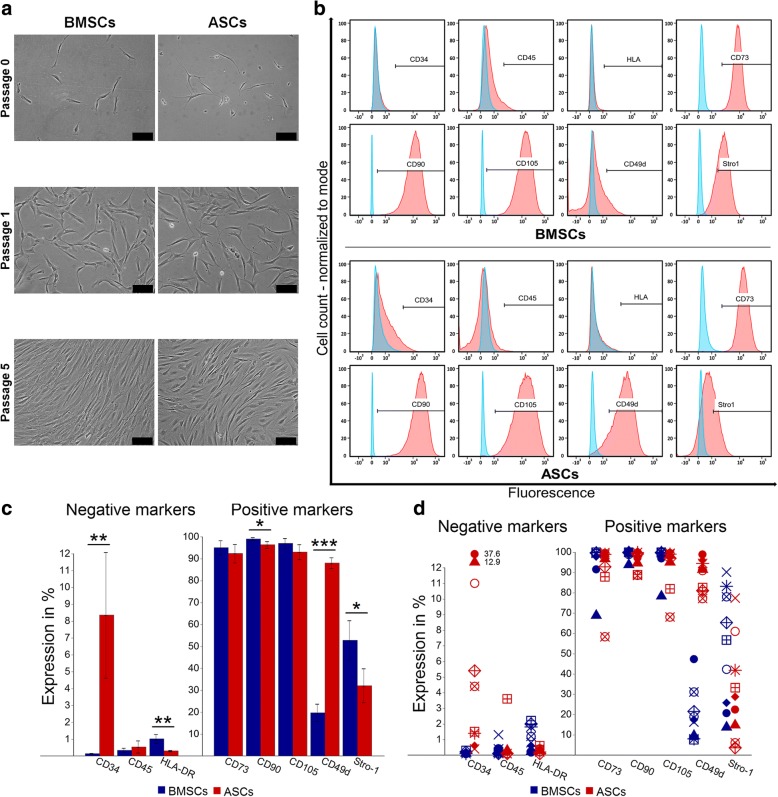
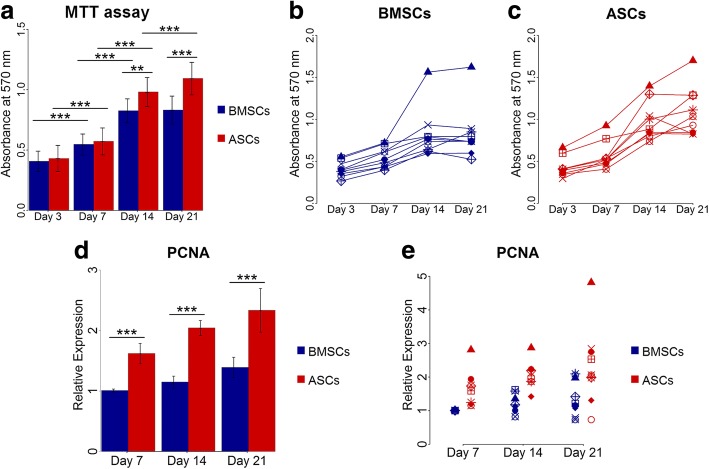
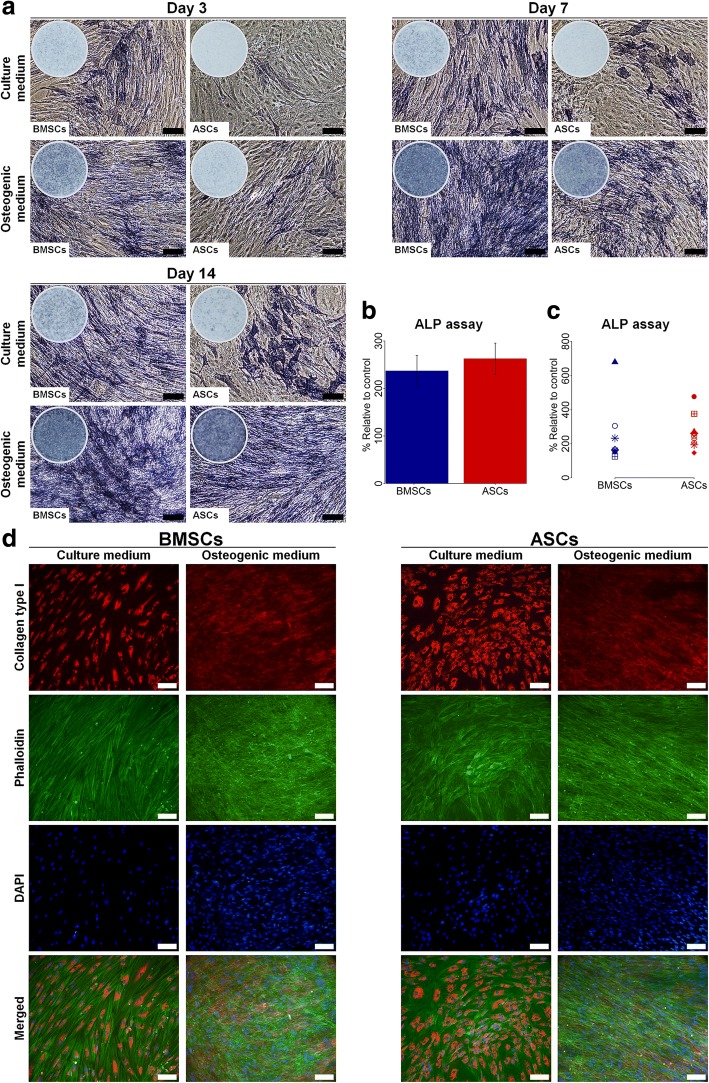
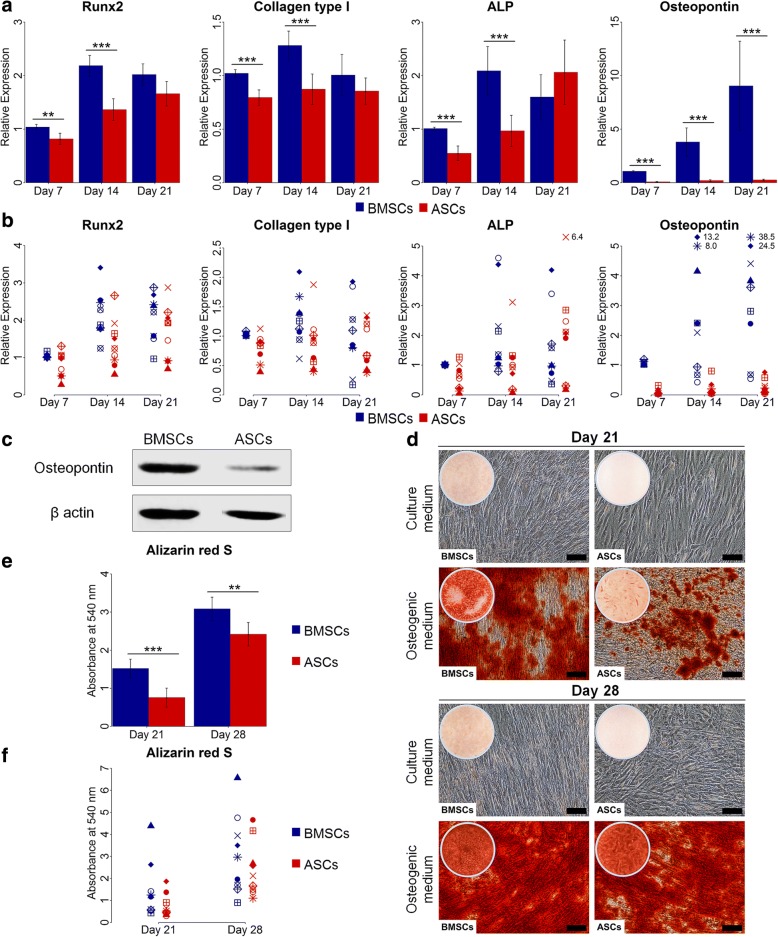
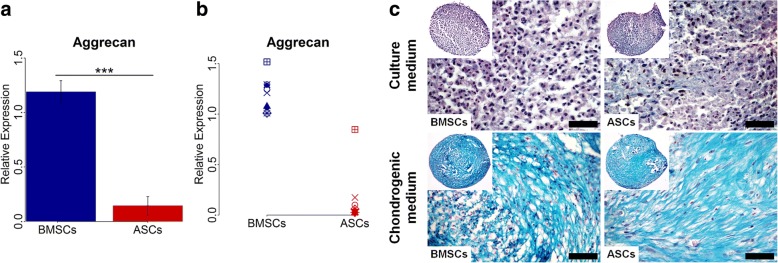
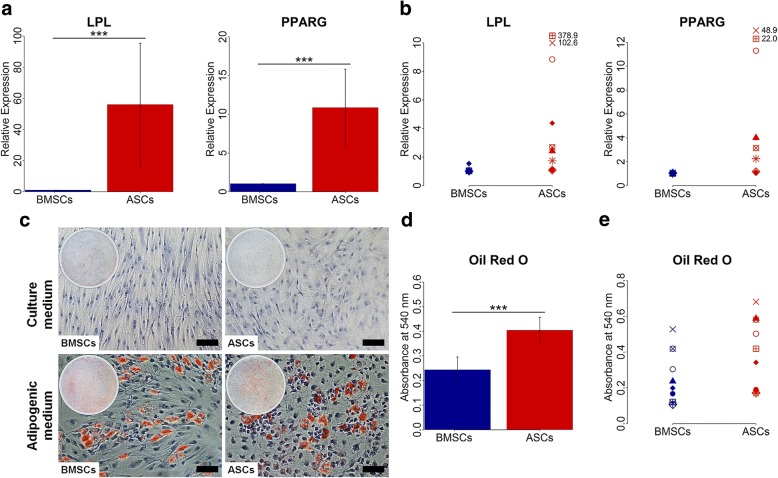
BACKGROUND: Adipose-derived stem cells (ASCs) have been introduced as an alternative to bone marrow mesenchymal stem cells (BMSCs) for cell-based therapy. However, different studies comparing ASCs and BMSCs have shown conflicting results. In fact, harvesting ASCs and BMSCs from different individuals might influence the results, making comparison difficult. Therefore, this study aimed to characterize donor-matched ASCs and BMSCs in order to investigate proliferation, differentiation potential and possible effects of donor variation on these mesenchymal stem cells (MSCs). METHODS: Human bone marrow and adipose tissue samples were obtained from nine donors aged 8-14. ASCs and BMSCs were isolated and characterized based on expression of surface markers using flow cytometry. The proliferation up to 21 days was investigated. Multi-lineage differentiation was induced using osteogenic, chondrogenic and adipogenic differentiation media. Alkaline phosphatase (ALP) activity was monitored and collagen type I formation was evaluated by immunofluorescence staining. In vitro multi-potency was studied using tissue-specific stains and lineage-specific gene expression. In addition, the osteogenic lineage was evaluated at protein level. RESULTS: Isolated ASCs and BMSCs from all donors demonstrated morphologic and immunophenotypic characteristics of MSCs, with expression of MSCs markers and negative expression of hematopoietic markers. Unlike BMSCs, ASCs showed high expression of CD49d and low expression of Stro-1. In general, ASCs showed significantly higher proliferation and adipogenic capacity with more lipid vesicle formation and expression of the adipogenesis-related genes than BMSCs. In contrast, BMSCs showed significantly higher osteogenic and chondrogenic capacity compared to ASCs. BMSCs had earlier and higher ALP activity, calcium deposition, and expression of the osteogenesis- and chondrogenesis-related genes and the osteogenesis-related protein osteopontin. Proliferation and differentiation capacity of ASCs and BMSCs varied significantly among the donors. CONCLUSIONS: ASCs and BMSCs showed tissue-specific differentiation abilities, but with significant variation between donors. The similarities and differences in the properties of ASCs and BMSCs should be taken into consideration when planning stem cell-based therapy.
Overview
The claims and statistics of this paper haven’t been checked yet.
Free: it reads the open-access text and checks the first 5 claims that cite a source we can check. Create a free account to check every claim.
Integrity signals
Registry
Cites
Statistics
Figures
Verification
Claims the paper makes
The claims and statistics of this paper haven’t been checked yet.
Free: it reads the open-access text and checks the first 5 claims that cite a source we can check. Create a free account to check every claim.
Claims other papers make about this one
Each is checked against this paper’s own text: does it say what the citing paper says it does?
The cited source says what the claim attributes to it.
In the citing paper
“Regarding bone tissue engineering, studies comparing the osteogenic potential of human BM-MSCs and ASCs have yielded mixed results.”
From Mesenchymal Stem/Stromal Cells: Immunomodulatory and Bone Regeneration Potential after Tumor Excision in Osteosarcoma Patients (2023) · cites this paper as [58]
The cited source says what the claim attributes to it.
In the citing paper
“Additionally, harvesting BM-MSCs is limited by the potential pain and morbidity associated with bone marrow aspiration, and only a small fraction (0.001–0.01%) of harvested bone marrow cells are MSCs [58,67].”
From Mesenchymal Stem/Stromal Cells: Immunomodulatory and Bone Regeneration Potential after Tumor Excision in Osteosarcoma Patients (2023) · cites this paper as [58]
The cited source says what the claim attributes to it.
In the citing paper
“Some suggest that BM-MSCs exhibit greater osteogenic capacity [58,59,60,61,62], while others propose that ASCs have equal or superior potential [58,63,64,65,66].”
From Mesenchymal Stem/Stromal Cells: Immunomodulatory and Bone Regeneration Potential after Tumor Excision in Osteosarcoma Patients (2023) · cites this paper as [58]
Self-check
Percentages, sums and reported differences re-computed from the paper’s own numbers.
The self-check needs the paper’s full text.
Citations
Cites
Multilineage potential of adult human mesenchymal stem cells
Pittenger, M. F., Mackay, A. M., Beck, S. C., Jaiswal, R. K., Douglas, R., Mosca, J. D., Moorman, M. A., Simonetti, D. W., Craig, S., & Marshak, D. R. (1999) · Science · doi:10.1126/science.284.5411.143 · Cited by 21,052 · cited 1×
“01%) of the harvested bone marrow cells are MSCs [5].”
BackgroundDominici, M., Le Blanc, K., Mueller, I., Slaper-Cortenbach, I., Marini, F. C., Krause, D. S., Deans, R. J., Keating, A., Prockop, D. J., & Horwitz, E. M. (2006) · Cytotherapy · doi:10.1080/14653240600855905 · Cited by 17,766 · cited 1×
“to a tissue culture flask), must express the surface markers CD73, CD90 and CD105 (≥ 90%), not express the hematopoietic markers CD14, CD34, CD45, CD19 and HLA-DR (≤ 2%), and should be able to undergo multi-lineage differentiation (osteogenic, adipogenic and chondrogenic) [4].”
BackgroundStöckl, S., Göttl, C., Grifka, J., & Grässel, S. (2013) · Cellular Physiology and Biochemistry · doi:10.1159/000350089 · Cited by 4,656
Komori, T., Yagi, H., Nomura, S., Yamaguchi, A., Sasaki, K., Deguchi, K., Shimizu, Y., Bronson, R. T., Gao, Y.-H., Inada, M., et al. (1997) · Cell · doi:10.1016/s0092-8674(00)80258-5 · Cited by 4,244 · cited 1×
“Runx2-deficient mice are reported to lack bone formation due to absence of osteoblasts [50].”
BackgroundMesenchymal stem cells reside in virtually all post-natal organs and tissues
Meirelles, L. D. S., Chagastelles, P. C., & Nardi, N. B. (2006) · Journal of Cell Science · doi:10.1242/jcs.02932 · Cited by 2,485 · cited 1×
“Discussion Adult MSCs, isolated from different connective tissues, have a fundamental role in maintenance and regeneration of body tissues [30].”
BackgroundChamberlain, G., Fox, J., Ashton, B., & Middleton, J. (2007) · Stem Cells · doi:10.1634/stemcells.2007-0197 · Cited by 2,381
Bourin, P., Bunnell, B. A., Casteilla, L., Dominici, M., Katz, A. J., March, K. L., Redl, H., Rubin, J. P., Yoshimura, K., & Gimble, J. M. (2013) · Cytotherapy · doi:10.1016/j.jcyt.2013.02.006 · Cited by 1,890 · cited 1×
“Although significant biologic differences have been shown in MSCs derived from different sources [12–14], ASCs and BMSCs have comparable characteristics when it comes to morphology and surface proteins [15].”
BackgroundLiang, H., Liang, P., Xu, Y., Wu, J., Liang, T., & Xu, X. (2009) · Journal of Neurotrauma · doi:10.1089/neu.2008.0850 · Cited by 1,750
Hass, R., Kasper, C., Böhm, S., & Jacobs, R. (2011) · Cell Communication and Signaling · doi:10.1186/1478-811x-9-12 · Cited by 1,748
Stolzing, A., Jones, E., McGonagle, D., & Scutt, A. (2008) · Mechanisms of Ageing and Development · doi:10.1016/j.mad.2007.12.002 · Cited by 1,195 · cited 1×
“It has been reported that stem cell yield, proliferation and differentiation properties of BMSCs and ASCs are negatively affected by age [31, 32].”
Background
Cited by
Items 501–540 of 540
Generation and Characterization of Mesenchymal Cell Lines for Osteorchondral Regeneration Research
Piñeiro-Ramil, M. (2021) · RUC (Universidade Da Coruña) · Cited by 1
Martín, V. (2024) · Portuguese National Funding Agency for Science, Research and Technology (RCAAP Project by FCT) · doi:10.34626/kzxv-ng20
Rivera, L. (2024) · Repositorio Digital Institucional de la Universidad de Buenos Aires (Universidad de Buenos Aires)
From initiation to maturation: Mesenchymal stem cells as key facilitators in organoid development
Yi, S., Wen, J., Wang, T., Yu, W., Liao, Y., Liu, Z., & Wang, H. (2026) · Cells and Development · doi:10.1016/j.cdev.2026.204071
Baysal, E., Margiotta, A., Yamada, S., Furriol, J., Mohamed‐Ahmed, S., Marek, N., Al‐Sharabi, N., Costea, D. E., Brennan, M. Á., & Suliman, S. (2026) · bioRxiv (Cold Spring Harbor Laboratory) · doi:10.64898/2026.01.16.699899
“BMSC were isolated from the iliac crest bone marrow aspirates, as previously described (Mohamed-Ahmed et al., 2018), expanded in Dulbecco’s Modified Eagle’s medium (DMEM) (Invitrogen, USA) supplemented with 10% (v/v) fetal bovine serum (FBS) (GE Healthcare, USA) and 1% (v/v) penicillin/streptomycin…”
Self-citationDevelopment and characterization of decellularized meniscus-derived bioscaffolds
Doherty, S., Zhao, X., Kornmuller, A., Martin, P. M., & Flynn, L. E. (2026) · Materials Research Express · doi:10.1088/2053-1591/ae3cec
Therapeutic small extracellular vesicles from key human stem and immune cellular sources: A review
Goh, W. X., Wong, C.-Y., & Kok, Y.-Y. (2026) · Journal of Biomedical Research · doi:10.7555/jbr.39.20250424
Ye, S., Zhang, D., Shi, X., Wang, Z., Hu, J., Zhao, S., Li, W., Wang, J., Guan, W., Ma, L., et al. (2026) · Regenerative Biomaterials · doi:10.1093/rb/rbag057
“Adipose-derived stem cells (ADSCs) are considered an ideal cell source due to their accessibility, abundance and ease of isolation [23, 24].”
Hansen, J. W., Carlander, A. F., Jakobsen, K. K., Skjoldbirk, J., Grønhøj, C., & von Buchwald, C. (2026) · Stem Cell Reviews and Reports · doi:10.1007/s12015-026-11105-9
“BM-MSCs are shown to have greater chondrogenic and osteogenic capacities [61 ].”
Traitement par thérapie cellulaire de la cystite radique chez le rat
Brossard, C. (2022) · theses.fr (ABES) · doi:10.70675/1aba9e7czf5cdz4ff3z84bbza7a5cb84f4aa
Vallet, L. (2023) · theses.fr (ABES) · doi:10.70675/840648aaz2d82z49adz90e5zb460d6133704 · Cited by 1
López-Serrano, C. (2024) · theses.fr (ABES) · doi:10.70675/b46c90f6z5615z42f3zb4ebzde597cc14977
Keban, A., Tank, E., Erdem, B., & Cetin, E. A. (2026) · Trakya University Journal of Natural Sciences · doi:10.23902/trkjnat.2025121
Kohlhauser, M., Lüttschwager, S., Pignet, A.-L., Schellnegger, M., Moshammer, M., & Kamolz, L. (2026) · International Wound Journal · doi:10.1111/iwj.70899 · Cited by 1
Yuan, L.-Y., Yuan, Q., Guo, D.-W., Tan, H.-L., & Guan, X. (2026) · Frontiers in Cell and Developmental Biology · doi:10.3389/fcell.2026.1821763
Phase-separated hierarchical porous PLLA/Gelatin scaffolds for stem cell–mediated bone regeneration
Liu, H., He, L., Liu, X., Tang, Y., Cheng, Y. Y., Kang, Y., Li, X., Gao, H., & Song, K. (2026) · Tissue and Cell · doi:10.1016/j.tice.2026.103567
Kubo, S., Takeuchi, Y., Sonoda, E., Ogawa, N., Shinoda, S., Nakano‐Doi, A., Nakagomi, T., Funaki, S., & Kasahara, N. (2026) · Cancer Gene Therapy · doi:10.1038/s41417-026-01047-2
Matthews, C., Johnson, L., Holden, W., & Benecke, J. P. V. (2026) · Bone and Joint Research · doi:10.1302/2046-3758.156.bjr-2025-0400.r2
Wu, Y., Wang, H., Yu, M., Liu, J., Jin, Y., & Cai, H. (2026) · Current Pharmaceutical Biotechnology · doi:10.2174/0113892010411073260420204626
Bar, J. K., Klimczak, A., Grelewski, P. G., Lis-Nawara, A., Stamnitz, S., Kowalczyk, T., Demska, K., Paprocka, M., & Gerber, H. (2026) · Cells · doi:10.3390/cells15131168
“Additionally, the chondrogenic capacity of hAD-MSCs and hDPSCs on PLCL was confirmed with Alcian Blue strong staining, suggesting the production of sulphated proteoglycans as an effective indicator of hDPSC and hAD-MSC chondrogenic differentiation, as was reported by other authors [35,67,87].”
Maekawa, K., Yokoyama, F., Tsutsumi, R., Tateishi, A., Maeda, A., & Tateishi, N. (2026) · Adipocyte · doi:10.1080/21623945.2026.2682671
“First, hADSCs derived from different donors may exhibit variability due to factors such as age, sex, body mass index, and genetic background, all of which can influence differentiation capacity [25].”
Adipose-derived products: from volumetric restoration to microenvironment remodeling
Lu, L., Lu, C., & Dong, Z. (2026) · Plastic and Aesthetic Research · doi:10.20517/2347-9264.2026.45
Liu, Y., Cheng, Y., Johnston, E., Jiang, S., Cherif, H., Juncker, D., Li‐Jessen, N. Y. K., Haglund, L., & Li, J. (2026) · ACS Biomaterials Science & Engineering · doi:10.1021/acsbiomaterials.5c02074
Lankford, K. L., Nakazaki, M., Hirota, R., & Kocsis, J. D. (2026) · Journal of Neurotrauma · doi:10.1177/08977151261483981
Biology and Therapeutic Potential of Exosomes, Targeted Drug Delivery
Mateos-Ramírez, F. A. G., Hernández‐Ortega, L. D., Gurrola‐Díaz, C. M., Gasca-Lozano, L. E., Sánchez-Orozco, L. V., & Salazar-Montes, A. M. (2026) · International Journal of Molecular Sciences · doi:10.3390/ijms27188145
Dede, E. Ç., Çam, S. B., Korkusuz, F., Erdem, E., Bakan, F., & Korkusuz, P. (2026) · Journal of Biomedical Materials Research Part A · doi:10.1002/jbm.a.70159
Allogeneic stem cell strategies in bone regeneration: A systematic review and meta-analysis
Vågen, P. Å., Loro, L. L., Mohamed‐Ahmed, S., Lie, S. A., Yassin, M. A., & Gjerde, C. (2026) · Journal of Tissue Engineering · doi:10.1177/20417314261488564
Self-citationZuliani, C. C., Damas, I. I., de Andrade, K. C., Kharmandayan, P., Moraes, Â. M., Mobasheri, A., & Coimbra, I. B. (2026) · Journal of Molecular Histology · doi:10.1007/s10735-026-10977-y
“The ability to proliferate and differentiate into various mesenchymal lineages makes hAD-MSC a potentially less invasive sub - stitute for hBM-MSC in cell-based therapeutic applications (Mohamed-Ahmed et al. 2018).”
Rivera, J. A. T., Jaraba-Álvarez, W. V., Calle-Ramírez, A. M., Franco-Salazar, J. P., Palacio, L. A., Martínez-Peñaloza, D., España, J., Halpert-Correa, K., Ortega-Arellano, H., & Gómez, V. (2026) · Biomedicines · doi:10.3390/biomedicines14102235
Elmaraezy, A., Zhu, X.-Y., Eirin, A., & Lerman, L. O. (2026) · Metabolism and Target Organ Damage · doi:10.20517/mtod.2026.85
From mesenchymal roots to pluripotent reprogramming: exosomal crossroads in regenerative medicine
Vardhan, M. H., & Srivastava, P. (2026) · SLAS TECHNOLOGY · doi:10.1016/j.slast.2026.100474
Circulating FABP4 promotes obesity-associated breast cancer lung metastasis through PIP2
Liu, S., Hao, J., Yu, J., Jiang, X., Yu, L., Reusch, D., Xu, Z., Schnicker, N., Avellino, A., Han, X., et al. (2026) · Cell Reports · doi:10.1016/j.celrep.2026.117788
Peveri, E., Beiner, D., Huang, A., Ma, J.-X., Asthana, A., Atala, A., Orlando, G., & Zhang, Y. (2026) · International Journal of Molecular Sciences · doi:10.3390/ijms27219837
Metadata
- Authors
- Mohamed-Ahmed, S., Fristad, I., Lie, S. A., Suliman, S., Mustafa, K., Vindenes, H., & Idris, S. B.
- Affiliations
- University of Bergen (NO)
- Corresponding author
- Fristad, Inge
- Venue
- Stem Cell Research & Therapy
- Published
- 2018-06-19
- Volume
- 9
- Issue
- 1
- Pages
- 168-168
- ISSN
- 1757-6512 (ISSN-L)
- PMC
- PMC6008936
- OpenAlex
- W2809170199
- Semantic Scholar
- 481cffff8d86ecf5060bbbddc949bb0dbf210be1
- Cited by
- 515
- References
- 62
- Citations by year
- 2026: 34 · 2025: 52 · 2024: 95 · 2023: 106 · 2022: 84 · 2021: 60 · 2020: 49 · 2019: 30 · 2018: 4
- FWCI
- 20.27
- Type
- journal article
- Language
- en
- Open access
- gold
- doi.org
- Licence
- cc-by
- creativecommons.org/licenses/by/4.0/ (tdm)
- Locations
- Stem Cell Research & Therapy (publishedVersion, cc-by)
- Europe PMC (PubMed Central) (publishedVersion, other-oa)
- PubMed Central (publishedVersion, cc-by)
- PubMed (publishedVersion)
- NORA - Norwegian Open Research Archives (submittedVersion, cc-by)
- DOAJ (DOAJ: Directory of Open Access Journals) (submittedVersion, cc-by-sa)
- Funders
- Universitetet i Bergen
- Helse Vest (912048, 302077)
- Topics
- Life Sciences › Biochemistry, Genetics and Molecular Biology › Cell Biology › Mesenchymal stem cell research
- Health Sciences › Dentistry › Periodontics › Periodontal Regeneration and Treatments
- Health Sciences › Medicine › Hematology › Hematopoietic Stem Cell Transplantation
- Keywords
- adipose-derived stem cells, bone marrow mesenchymal stem cells, donor variability, multilineage differentiation, osteogenic differentiation, chondrogenic differentiation, adipogenesis, cell proliferation, alkaline phosphatase activity, osteopontin, CD49d, STRO-1, stem cell therapy
- MeSH terms
- Adipose Tissue, Cell Differentiation, Humans, Tissue Donors, Cell Proliferation, Adipogenesis, Mesenchymal Stem Cells
About these checks
Registry, retraction, Cites and statistics results are computed, not judged, with one exception: a printed reference that no index lists is read once by a model before it counts as a citation error. Claims are extracted by a model and kept only when their quote appears verbatim in the text; each cited source is then checked, with a model’s help, for whether it says what the claim relies on. Those verdicts can be wrong — read the claim’s quote and the cited source before relying on one.
Statistics and arithmetic are recomputed, not judged.
Confidence bands are shown only for fields calibrated on our annotated test set. None is calibrated yet, so no band is shown.
What counts as a claim ›How we measure confidence ›How we check this ›
Are you an author, or do you see a problem with this page? Request a review
Data sources
Bibliographic data: Semantic Scholar, OpenAlex, Crossref.
Contains information from the Semantic Scholar Academic Graph Datasets, made available under the ODC Attribution License (ODC-BY 1.0).
Semantic Scholar’s data is described in: Kinney, R., et al. (2023). The Semantic Scholar Open Data Platform. arXiv:2301.10140.
