

Psychological impact of COVID-19 on medical care workers in China
Open accessPublished version of a preprint
The DOI matches its Crossref record; 38 of the 38 references it cites were found in a registry or an index.
Abstract
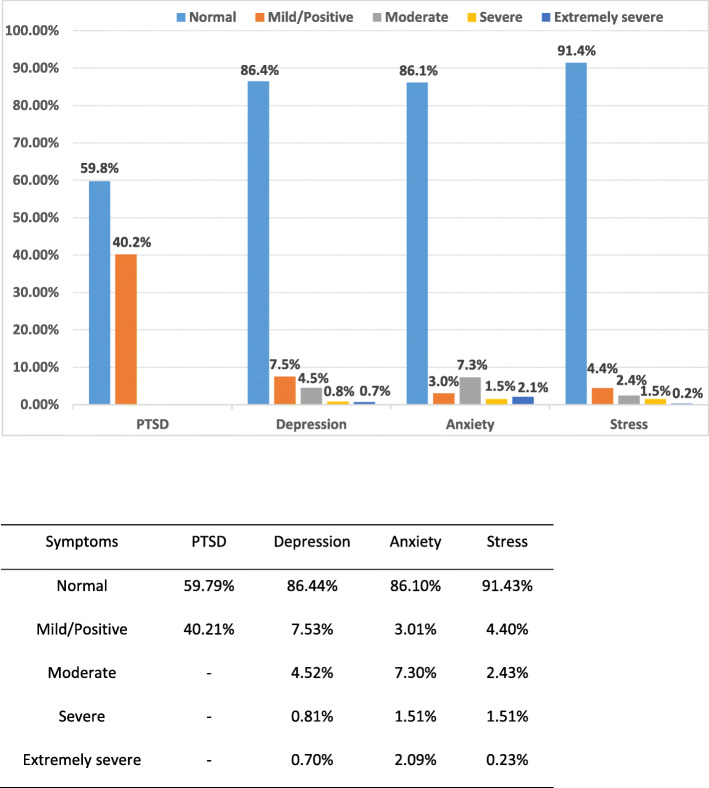
Background: Medical care workers experienced unprecedented levels of workload and pressure since the outbreak of coronavirus disease 2019 (COVID-19). Little is known about its exact impact on medical care workers and related factors in China. This study aims to identify the psychological impact of COVID-19 on medical care workers in China. Methods: From February 23 to March 5, 2020, a cross-sectional survey was conducted among 863 medical care workers from seven provinces in China using standard questionnaires measuring adverse psychological outcomes including Impact of Event Scale-6 (IES-6), Depression, Anxiety and Stress Scale(DASS)and related psychosocial factors like perceived threat, social support and coping strategies. Exploratory Factor analysis was performed to identify the dimensions of perceived threat by study participants. Multivariate regression was used to examine the determinants of adverse psychological outcomes. Results: Posttraumatic stress (PTS) were prevalent in this sample of health care professionals, and 40.2% indicated positive screens for significant posttraumatic stress disorder symptoms. The proportion of having mild to extremely severe symptoms of depression, anxiety and stress were 13.6, 13.9 and 8.6%, respectively. Perceived threat and passive coping strategies were positively correlated to PTS and DASS scores, while perceived social support and active coping strategies were negatively correlated to DASS scores. Nurses were more likely to be anxious than others among medical care workers during the COVID-19 epidemic. Conclusions: Adverse psychological symptoms were prevalent among medical care workers in China during the COVID-19 epidemic. Screening for adverse psychological outcomes and developing corresponding preventive measures would be beneficial in decreasing negative psychological outcomes.
Overview
The claims and statistics of this paper haven’t been checked yet.
Free: it reads the open-access text and checks the first 5 claims that cite a source we can check. Create a free account to check every claim.
Integrity signals
Registry
Cites
Statistics
Figures
Verification
Claims the paper makes
The claims and statistics of this paper haven’t been checked yet.
Free: it reads the open-access text and checks the first 5 claims that cite a source we can check. Create a free account to check every claim.
Claims other papers make about this one
Each is checked against this paper’s own text: does it say what the citing paper says it does?
The source backs part of the claim, not all of it — or backs it for a different population, condition or comparison.
In the citing paper
“Evidence suggests that this disease has psychological consequences on healthcare workers, students, psychiatric patients and general workers, especially for COVID-19 patients [4–13].”
From Mindfulness-based online intervention on mental health and quality of life among COVID-19 patients in China: an intervention design (2021) · cites this paper as [5]
Experimental — accuracy not yet measuredThe cited source says what the claim attributes to it.
In the citing paper
“The prevalence of PTSS in the current sample seemed higher than that recently reported in two other studies [6,35] and was similar to another recent study conducted among HCWs [36].”
From Associations between COVID-19 Work-Related Stressors and Posttraumatic Stress Symptoms among Chinese Doctors and Nurses: Application of Stress-Coping Theory (2022) · cites this paper as [36]
In the citing paper
“As revealed by Si et al. [21], a supportive work environment is a buffering factor of negative psychological health among HCWs and protects them from PTSS during the COVID-19 pandemic;”
From Post-Traumatic Stress Symptoms in Healthcare Workers Dealing with the COVID-19 Pandemic: A Systematic Review (2021) · cites this paper as [21]
Self-check
Percentages, sums and reported differences re-computed from the paper’s own numbers.
The self-check needs the paper’s full text.
Citations
Cites
The Psychological Impact of Quarantine and How to Reduce It: Rapid Review of the Evidence
Brooks, S. K., Webster, R. K., Smith, L. E., Woodland, L., Wessely, S., Greenberg, N., & Rubin, G. J. (2020) · doi:10.2139/ssrn.3532534 · Cited by 16,394
The psychological impact of quarantine and how to reduce it: Rapid review of the evidence
Brooks, S. K., Webster, R. K., Smith, L. E., Woodland, L., Wessely, S., Greenberg, N., & Rubin, G. J. (2020) · The Lancet · doi:10.1016/s0140-6736(20)30460-8 · Cited by 16,378
Lovibond, P. F., & Lovibond, S. H. (1995) · Behaviour Research and Therapy · doi:10.1016/0005-7967(94)00075-u · Cited by 14,523
Psychometric Characteristics of the Multidimensional Scale of Perceived Social Support
Zimet, G. D., Powell, S. S., Farley, G. K., Werkman, S., & Berkoff, K. A. (1990) · Journal of Personality Assessment · doi:10.1080/00223891.1990.9674095 · Cited by 4,855
Psychometric Characteristics of the Multidimensional Scale of Perceived Social Support
Zimet, G., Powell, S., Farley, G., Werkman, S., & Berkoff, K. (1990) · Journal of Personality Assessment · doi:10.1207/s15327752jpa5503&4_17 · Cited by 4,854
A First Course in Factor Analysis
Comrey, A. L., & Lee, H. B. (2013) · doi:10.4324/9781315827506 · Cited by 4,546
Coping as a mediator of emotion
Folkman, S., & Lazarus, R. S. (1988) · Journal of Personality and Social Psychology · doi:10.1037/0022-3514.54.3.466 · Cited by 2,103
Online mental health services in China during the COVID-19 outbreak
Liu, S., Yang, L., Zhang, C., Xiang, Y.-T., Liu, Z., Hu, S., & Zhang, B. (2020) · The Lancet Psychiatry · doi:10.1016/s2215-0366(20)30077-8 · Cited by 1,992
International Journal of Nursing Studies
(2000) · Nursing Older People · doi:10.7748/nop.11.10.26.s15 · Cited by 1,932
Maunder, R., Hunter, J., Vincent, L. H., Bennett, J. P., Peladeau, N., Leszcz, M., Sadavoy, J., Verhaeghe, L. M., Steinberg, R. J., & Mazzulli, T. (2003) · Europe PMC (PubMed Central) · Cited by 1,781
Chew, N. W. S., Lee, G. K. H., Tan, B. Y. Q., Jing, M., Goh, Y., Ngiam, N. J. H., Yeo, L. L. L., Ahmad, A., Ahmed Khan, F., Napolean Shanmugam, G., et al. (2020) · Brain, Behavior, and Immunity · doi:10.1016/j.bbi.2020.04.049 · Cited by 1,650 · cited 1×
“Compared to the results of a multinational study on psychological impact of COVID-19 outbreak among health care professionals using the similar measurements, the proportion of PTSD symptoms, depression, anxiety, and stress were relatively higher in this study than in Singapore and in India, especially the prevalence o…”
Wu, P., Fang, Y., Guan, Z., Fan, B., Kong, J., Yao, Z., Liu, X., Fuller, C. J., Susser, E., Lu, J., et al. (2009) · The Canadian Journal of Psychiatry · doi:10.1177/070674370905400504 · Cited by 1,647
A First Course in Factor Analysis 2nd Ed
Comrey, A. L., & Lee, H. B. (1973) · Cited by 1,367
Social Psychiatry and Psychiatric Epidemiology
(2013) · Social Psychiatry and Psychiatric Epidemiology · doi:10.1007/127.1433-9285 · Cited by 1,307
Lee, S. M., Kang, W. S., Cho, A.-R., Kim, T., & Park, J. K. (2018) · Comprehensive Psychiatry · doi:10.1016/j.comppsych.2018.10.003 · Cited by 1,112
Survey of Stress Reactions Among Health Care Workers Involved With the SARS Outbreak
Bai, Y., Lin, C.-C., Lin, C.-Y., Chen, J.-Y., Chue, C.-M., & Chou, P. (2004) · Psychiatric Services · doi:10.1176/appi.ps.55.9.1055 · Cited by 1,092
TAM, C. W. C., PANG, E. P. F., LAM, L. C. W., & CHIU, H. F. K. (2004) · Psychological Medicine · doi:10.1017/s0033291704002247 · Cited by 735
Cross-cultural validation of the Depression Anxiety Stress Scale–21 in China.
Wang, K., Shi, H.-S., Geng, F.-L., Zou, L.-Q., Tan, S.-P., Wang, Y., Neumann, D. L., Shum, D. H. K., & Chan, R. C. K. (2016) · Psychological Assessment · doi:10.1037/pas0000207 · Cited by 635
Brooks, S. K., Dunn, R., Amlôt, R., Rubin, G. J., & Greenberg, N. (2018) · Journal of Occupational & Environmental Medicine · doi:10.1097/jom.0000000000001235 · Cited by 546
Chou, K.-L. (2000) · Personality and Individual Differences · doi:10.1016/s0191-8869(99)00098-7 · Cited by 507
Impact of Ebola experiences and risk perceptions on mental health in Sierra Leone, July 2015
Jalloh, M. F., Li, W., Bunnell, R. E., Ethier, K. A., O’Leary, A., Hageman, K. M., Sengeh, P., Jalloh, M. B., Morgan, O., Hersey, S., et al. (2018) · BMJ Global Health · doi:10.1136/bmjgh-2017-000471 · Cited by 433
Lancee, W. J., Maunder, R. G., & Goldbloom, D. S. (2008) · Psychiatric Services · doi:10.1176/ps.2008.59.1.91 · Cited by 391 · cited 2×
“It has been shown that the medical care workers experienced a high level of emotional stress, anxiety, depression and PTS during or even after the outbreak of the infectious diseases [6].”
Alcohol Abuse/Dependence Symptoms Among Hospital Employees Exposed to a SARS Outbreak: Table 1
Wu, P., Liu, X., Fang, Y., Fan, B., Fuller, C. J., Guan, Z., Yao, Z., Kong, J., Lu, J., & Litvak, I. J. (2008) · Alcohol and Alcoholism · doi:10.1093/alcalc/agn073 · Cited by 367
A Systematic Review of the Impact of Disaster on the Mental Health of Medical Responders
Naushad, V. A., Bierens, J. J., Nishan, K. P., Firjeeth, C. P., Mohammad, O. H., Maliyakkal, A. M., ChaliHadan, S., & Schreiber, M. D. (2019) · Prehospital and Disaster Medicine · doi:10.1017/s1049023x19004874 · Cited by 333
Brief measure of posttraumatic stress reactions: Impact of Event Scale-6
Thoresen, S., Tambs, K., Hussain, A., Heir, T., Johansen, V. A., & Bisson, J. I. (2010) · Social Psychiatry and Psychiatric Epidemiology · doi:10.1007/s00127-009-0073-x · Cited by 313
Acute Stress Disorder as a Predictor of Posttraumatic Stress Disorder: A Systematic Review
Bryant, R. A. (2011) · The Journal of Clinical Psychiatry · doi:10.4088/jcp.09r05072blu · Cited by 294
Burden of depression in China, 1990–2017: Findings from the global burden of disease study 2017
Ren, X., Yu, S., Dong, W., Yin, P., Xu, X., & Zhou, M. (2020) · Journal of Affective Disorders · doi:10.1016/j.jad.2020.03.011 · Cited by 234
Garrosa, E., Rainho, C., Moreno-Jiménez, B., & Monteiro, M. J. (2010) · International Journal of Nursing Studies · doi:10.1016/j.ijnurstu.2009.05.014 · Cited by 229
Raven, J., Wurie, H., & Witter, S. (2018) · BMC Health Services Research · doi:10.1186/s12913-018-3072-3 · Cited by 223
Mental health during and after the COVID‐19 emergency in Italy
Sani, G., Janiri, D., Di Nicola, M., Janiri, L., Ferretti, S., & Chieffo, D. (2020) · Psychiatry and Clinical Neurosciences · doi:10.1111/pcn.13004 · Cited by 207
Chan, R. C. K., Xu, T., Huang, J., Wang, Y., Zhao, Q., Shum, D. H. K., O’Gorman, J., & Potangaroa, R. (2012) · Psychiatry Research · doi:10.1016/j.psychres.2012.06.041 · Cited by 185
Astill Wright, L., Sijbrandij, M., Sinnerton, R., Lewis, C., Roberts, N. P., & Bisson, J. I. (2019) · Translational Psychiatry · doi:10.1038/s41398-019-0673-5 · Cited by 125
Core Self-Evaluation and Burnout among Nurses: The Mediating Role of Coping Styles
Li, X., Guan, L., Chang, H., & Zhang, B. (2014) · PLoS ONE · doi:10.1371/journal.pone.0115799 · Cited by 107
The Joint Effects of Stress, Coping, and Coping Resources on Depressive Symptoms in the Elderly
Kraaij, V., Garnefski, N., & Maes, S. (2002) · Anxiety, Stress & Coping · doi:10.1080/10615800290028468 · Cited by 79
Zhang, M. W., Ho, C. S., Fang, P., Lu, Y., & Ho, R. C. (2014) · JMIR mhealth and uhealth · doi:10.2196/mhealth.2827 · Cited by 74
Brand, S., Ahmadian, A., Mirzaee, J., Omidbeygi, M., & Holsboer-Trachsler, E. (2015) · Neuropsychiatric Disease and Treatment · doi:10.2147/ndt.s85959 · Cited by 36
Trajectories of posttraumatic stress in patients with confirmed and rule-out acute coronary syndrome
Meli, L., Birk, J. L., Edmondson, D. E., & Bonanno, G. A. (2019) · General Hospital Psychiatry · doi:10.1016/j.genhosppsych.2019.11.006 · Cited by 30
Fani, N., Jain, J., Hudak, L. A., ROTHBAUM, B. O., Ressler, K. J., & Michopoulos, V. (2020) · Psychiatry Research · doi:10.1016/j.psychres.2020.112777 · Cited by 18
Research works printed but not linked: 3
- WHO Situation report-101 of Coronavirus disease 2019 (COVID-19) 2020
- Taouk M Lovibond P Laube R Psychometric properties of a Chinese version of the 21-item Depression Anxiety Stress Scales(DASS21) 2001 Sydney Transcultural Mental Health Centre. Cumberland Hospital [N]
- Xie Y Reliability and validity of the simplified Coping Style Questionnaire. [Reliability and validity of the simplified Coping Style Questionnaire] Chinese J Clin Psychol 1998 6 2 114 115 10.16128/j.cnki.1005-3611.2018.05.015 · doi:10.16128/j.cnki.1005-3611.2018.05.015
Cited by
Li, Y., Scherer, N., Felix, L., & Kuper, H. (2021) · PLOS ONE · doi:10.1371/journal.pone.0246454 · Cited by 536
Marvaldi, M., Mallet, J., Dubertret, C., Moro, M. R., & Guessoum, S. B. (2021) · Neuroscience & Biobehavioral Reviews · doi:10.1016/j.neubiorev.2021.03.024 · Cited by 517
Yuan, K., Gong, Y.-M., Liu, L., Sun, Y.-K., Tian, S.-S., Wang, Y.-J., Zhong, Y., Zhang, A.-Y., Su, S.-Z., Liu, X.-X., et al. (2021) · Molecular Psychiatry · doi:10.1038/s41380-021-01036-x · Cited by 300
d’Ettorre, G., Ceccarelli, G., Santinelli, L., Vassalini, P., Innocenti, G. P., Alessandri, F., Koukopoulos, A. E., Russo, A., d’Ettorre, G., & Tarsitani, L. (2021) · International Journal of Environmental Research and Public Health · doi:10.3390/ijerph18020601 · Cited by 270
COVID-19 is having a destructive impact on health-care workers’ mental well-being
Vanhaecht, K., Seys, D., Bruyneel, L., Cox, B., Kaesemans, G., Cloet, M., Van Den Broeck, K., Cools, O., De Witte, A., Lowet, K., et al. (2021) · International Journal for Quality in Health Care · doi:10.1093/intqhc/mzaa158 · Cited by 222
Metadata
- Authors
- Si, M.-Y., Su, X.-Y., Jiang, Y., Wang, W.-J., Gu, X.-F., Ma, L., Li, J., Zhang, S.-K., Ren, Z.-F., Ren, R., Liu, Y.-L., & Qiao, Y.-L.
- Affiliations
- Chinese Academy of Medical Sciences & Peking Union Medical College (CN)
- Xinjiang Medical University (CN)
- Dalian Medical University (CN)
- Sichuan University (CN)
- Zhengzhou University (CN)
- Sun Yat-sen University (CN)
- Corresponding author
- Jiang, Yu
- Qiao, You-Lin
- Venue
- Infectious Diseases of Poverty
- Published
- 2020-08-12
- Volume
- 9
- Issue
- 1
- Pages
- 113-113
- ISSN
- 2049-9957 (ISSN-L)
- PMC
- PMC7422468
- OpenAlex
- W3048812103
- Cited by
- 243
- References
- 37
- Citations by year
- 2026: 4 · 2025: 12 · 2024: 23 · 2023: 40 · 2022: 66 · 2021: 91 · 2020: 7
- FWCI
- 20.42
- Type
- journal article
- Language
- en
- Open access
- gold
- doi.org
- Licence
- cc-by
- creativecommons.org/licenses/by/4.0 (tdm)
- creativecommons.org/licenses/by/4.0 (vor)
- Locations
- Infectious Diseases of Poverty (publishedVersion, cc-by)
- Research Square (acceptedVersion, cc-by)
- PubMed Central (publishedVersion, cc-by)
- PubMed (publishedVersion)
- DOAJ (DOAJ: Directory of Open Access Journals) (submittedVersion, cc-by-sa)
- Funders
- Asian Regional Special Cooperation Fund of National Health Commission of the People’s Republic of China
- the Innovative Engineering Program on global health policy sponsored by Chinese Academy of Medical Sciences (2017-I2M-B&R-17)
- Topics
- Social Sciences › Psychology › Clinical Psychology › COVID-19 and Mental Health
- Health Sciences › Health Professions › General Health Professions › Healthcare professionals’ stress and burnout
- Health Sciences › Medicine › Public Health, Environmental and Occupational Health › Occupational Health and Burnout
- Keywords
- COVID-19 pandemic, psychological impact, healthcare workers, post-traumatic stress, depression, anxiety, stress, threat perception, social support, coping strategies, nurses, workplace mental health, China
- MeSH terms
- COVID-19, Adaptation, Psychological, Adult, Anxiety, China, Cross-Sectional Studies, Depression, Female, Health Personnel, Humans, Male, Middle Aged, Nurses, Pneumonia, Viral, Psychological Tests, Psychometrics, Surveys and Questionnaires, Social Support, Stress Disorders, Post-Traumatic, Workload, Coronavirus Infections, Pandemics
About these checks
Registry, retraction, Cites and statistics results are computed, not judged, with one exception: a printed reference that no index lists is read once by a model before it counts as a citation error. Claims are extracted by a model and kept only when their quote appears verbatim in the text; each cited source is then checked, with a model’s help, for whether it says what the claim relies on. Those verdicts can be wrong — read the claim’s quote and the cited source before relying on one.
Statistics and arithmetic are recomputed, not judged.
Confidence bands are shown only for fields calibrated on our annotated test set. None is calibrated yet, so no band is shown.
What counts as a claim ›How we measure confidence ›How we check this ›
Are you an author, or do you see a problem with this page? Request a review
Data sources
Bibliographic data: Semantic Scholar, OpenAlex, Crossref.
Contains information from the Semantic Scholar Academic Graph Datasets, made available under the ODC Attribution License (ODC-BY 1.0).
Semantic Scholar’s data is described in: Kinney, R., et al. (2023). The Semantic Scholar Open Data Platform. arXiv:2301.10140.
