

Race and gender differences in how sense of belonging influences decisions to major in STEM
Open accessThe DOI matches its Crossref record; 28 of the 30 references it cites were found in a registry or an index; none of the 25 sources its claims cite is checked for support yet.
Abstract
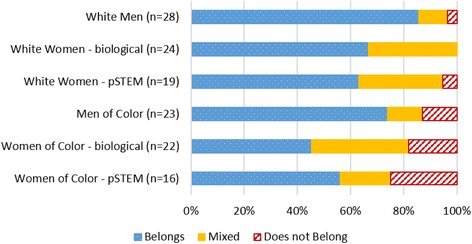
BACKGROUND: Women and students of color are widely underrepresented in most STEM fields. In order to investigate this underrepresentation, we interviewed 201 college seniors, primarily women and people of color, who either majored in STEM or started but dropped a STEM major. Here we discuss one section of the longer interview that focused on students' sense of belonging, which has been found to be related to retention. In our analysis, we examine the intersections of race and gender with students' sense of belonging, a topic largely absent from the current literature. RESULTS: We found that white men were most likely to report a sense of belonging whereas women of color were the least likely. Further, we found that representation within one's STEM sub-discipline, namely biology versus the physical sciences, impacts sense of belonging for women. Four key factors were found to contribute to sense of belonging for all students interviewed: interpersonal relationships, perceived competence, personal interest, and science identity. CONCLUSIONS: Our findings indicate that students who remain in STEM majors report a greater sense of belonging than those who leave STEM. Additionally, we found that students from underrepresented groups are less likely to feel they belong. These findings highlight structural and cultural features of universities, as well as STEM curricula and pedagogy, that continue to privilege white males.
Overview
CoChat Summary
TL;DR
This interview study of 201 college seniors examines how sense of belonging in STEM varies by race, gender, and their intersections, comparing STEM majors and leavers. It finds white men most likely and women of color least likely to report belonging, with belonging linked to interpersonal relationships, competence, interest, and science identity.
Key findings
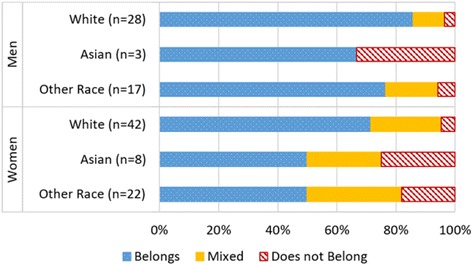
- White men were the most likely to report a sense of belonging compared with all other students (Z = 2.37, p ≤ 0.01), while women of color were the least likely (Z = 3.62, p ≤ 0.01).
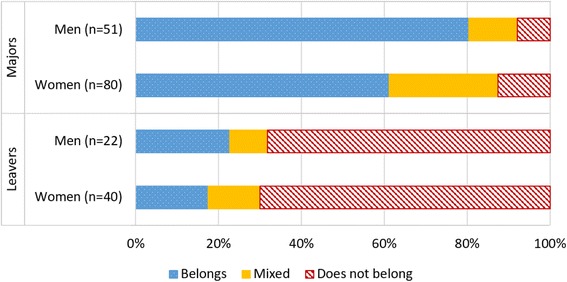
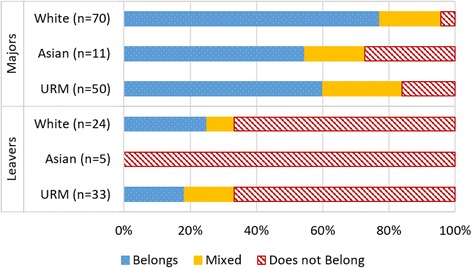
- Female STEM majors were significantly less likely than male majors to report belonging (Z = 2.41, p ≤ 0.01), and students of color who majored in STEM were significantly less likely than white majors to report belonging (Z = 2.23, p ≤ 0.01); leavers across demographic groups were more likely to report not belonging.
- Representation in a STEM subfield mattered: women of color in physical sciences (pSTEM), where they are highly underrepresented, reported belonging significantly less frequently than white men (Z = 2.17, p ≤ 0.05).
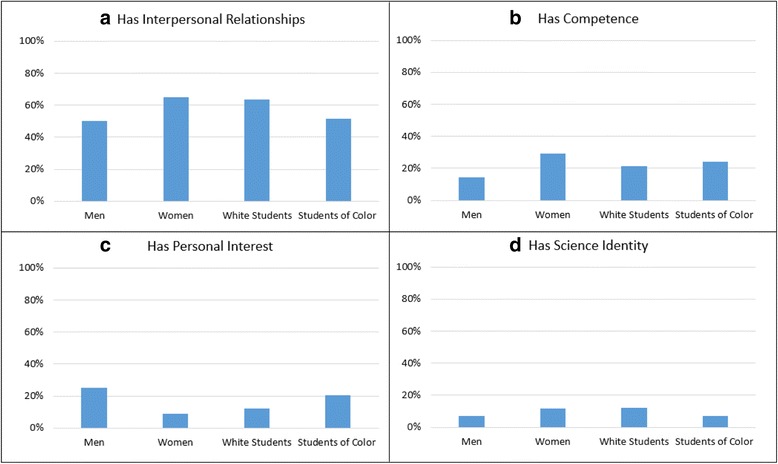
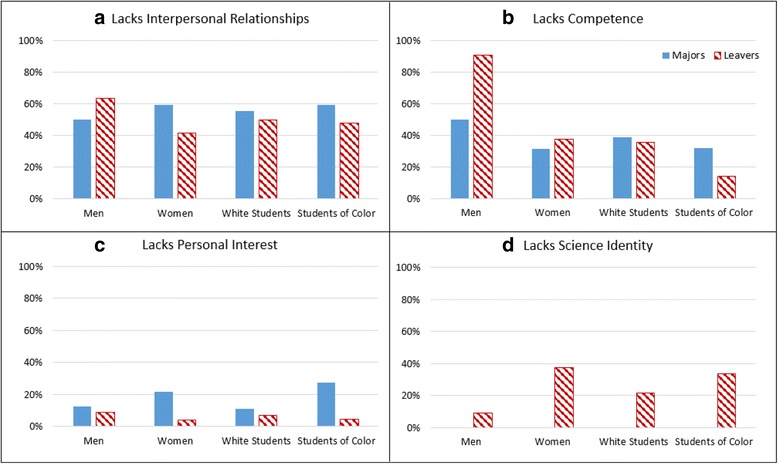
- Four themes explained belonging or lack of belonging: interpersonal relationships, perceived competence, personal interest, and science identity. Interpersonal relationships were the largest factor cited for each demographic group; competence was second. No majors cited a lack of science identity as a reason for not belonging, whereas approximately one quarter of leavers did.
Methods
- Qualitative interview study using a subset of 201 interviews from the larger Roots of STEM Success Project, which conducted more than 300 interviews with college seniors in 2013. Participants attended 1 of the 16 public University of North Carolina campuses, had attended North Carolina public school, were younger than 30, and were either STEM majors or STEM leavers.
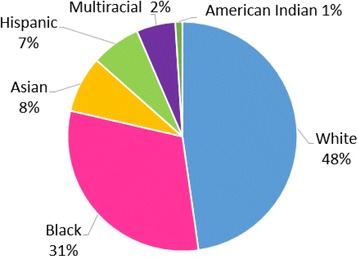
- The purposive sample oversampled students underrepresented in STEM: 66% women and 34% men; 48% white and 52% students of color. Students were recruited via email survey and interviewed for 30–60 min by Skype, phone, or in person.
- Analysis used a partial grounded theory approach: two researchers independently coded interviews, compared codes, and resolved discrepancies through discussion. Belonging explanations were coded into interpersonal relationships, science identity, personal interest, and competence; comparisons used tests of proportions and Z-scores.
Limitations
- The paper states the sample is self-selected and purposive, limited to college seniors in North Carolina who graduated from a North Carolina high school and attended one of the 16 UNC campuses, so findings are not generalizable beyond the sample. It also states only two axes of identity—race and gender—could be investigated.
- The paper acknowledges small subsample sizes, cautioning that some comparisons should be made with caution, and notes debate about using quantitative tests on qualitative data.
- Evident from the text: Asian students were collapsed with other students of color because of low numbers; competence was based on students’ self-perception, not actual grades or course performance; and the data are correlational, so causal direction cannot be determined.
Model-written summary. Check it against the paper before relying on it.
Integrity signals
Registry
Cites
Statistics
Figures
Verification
Claims the paper makes
0 Valid · 0 Not valid · 14 Not checked · 107 Own results and interpretations
A result the paper reports from its own data — it cites no other source for it, so there is none to check. The quote shows it is in the paper.
In the paper
“We find that women of color in pSTEM, where they are highly underrepresented, report belonging significantly less frequently than white men (Z = 2.17, p ≤ 0.05).”
§ Race and gender differences in how sense of belonging influences decisions to major in STEM > Results > The intersection of race and gender in students’ sense of belonging
plainstates an association- Asserted: passes — The authors put it forward as true.
- Checkable: passes — It can be checked against evidence.
- Load-bearing: passes — The paper’s conclusions depend on it.
- Based: passes — The paper gives a reason why it holds.
A result the paper reports from its own data — it cites no other source for it, so there is none to check. The quote shows it is in the paper.
In the paper
“We found that female majors were significantly less likely than male majors to report they felt they belonged in STEM (Z = 2.41, p ≤ 0.01)”
§ Race and gender differences in how sense of belonging influences decisions to major in STEM > Results > The intersection of race and gender in students’ sense of belonging
plainstates an associationn = 51 ·- Asserted: passes — The authors put it forward as true.
- Checkable: passes — It can be checked against evidence.
- Load-bearing: passes — The paper’s conclusions depend on it.
- Based: passes — The paper gives a reason why it holds.
A result the paper reports from its own data — it cites no other source for it, so there is none to check. The quote shows it is in the paper.
In the paper
“we found that students of color who major in STEM are significantly less likely to report a sense of belonging than white majors (Z = 2.23, p ≤ 0.01)”
§ Race and gender differences in how sense of belonging influences decisions to major in STEM > Results > The intersection of race and gender in students’ sense of belonging
plainstates an association- Asserted: passes — The authors put it forward as true.
- Checkable: passes — It can be checked against evidence.
- Load-bearing: passes — The paper’s conclusions depend on it.
- Based: passes — The paper gives a reason why it holds.
A result the paper reports from its own data — it cites no other source for it, so there is none to check. The quote shows it is in the paper.
In the paper
“white men were the most likely to report a sense of belonging when compared to all other students (Z = 2.37, p ≤ 0.01)”
- Also stated in: § Results · plain
“white men were most likely to report a sense of belonging”
§ Race and gender differences in how sense of belonging influences decisions to major in STEM > Results > The intersection of race and gender in students’ sense of belonging
plainstates an association- Asserted: passes — The authors put it forward as true.
- Checkable: passes — It can be checked against evidence.
- Load-bearing: passes — The paper’s conclusions depend on it.
- Based: passes — The paper gives a reason why it holds.
- Also stated in: § Results · plain
A result the paper reports from its own data — it cites no other source for it, so there is none to check. The quote shows it is in the paper.
In the paper
“the patterns for Asian students match those of URMs’ more closely than those of white students”
§ Race and gender differences in how sense of belonging influences decisions to major in STEM > Results > The intersection of race and gender in students’ sense of belonging
plainstates an association- Asserted: passes — The authors put it forward as true.
- Checkable: passes — It can be checked against evidence.
- Load-bearing: passes — The paper’s conclusions depend on it.
- Based: passes — The paper gives a reason why it holds.
87 more claims
Create a free account to see all 121 claims and to verify the 25 references still open.
- The quote only partly states this claim. 2
- It may state two separate claims as one. 18
- Probably not a substantial claim. 14
Claims other papers make about this one
Each is checked against this paper’s own text: does it say what the citing paper says it does?
The source backs part of the claim, not all of it — or backs it for a different population, condition or comparison.
In the citing paper
“In a qualitative study contrasting students that persisted with those who left STEM, Rainey etal. (2018) found that while all students expressed the importance of sense of belonging, those that left their STEM major were lacking science identity.”
From "It Just Makes It Feel Like You're Not Alone": A Qualitative Study of a Social Support Group for High-Achieving, Low-Income STEM Majors (2024) · cites this paper as Rainey et al., 2018
Experimental — accuracy not yet measuredThe source backs part of the claim, not all of it — or backs it for a different population, condition or comparison.
In the citing paper
“More recent research focused specifically on STEM students suggests that institutional practices that promote STEM students' interpersonal relationships, perceived competence, personal interest, and science identity contribute to feelings of belonging (Rainey et al., 2018).”
From The Importance of STEM Sense of Belonging and Academic Hope in Enhancing Persistence for Low-Income, Underrepresented STEM Students (2024) · cites this paper as Rainey et al., 2018
Experimental — accuracy not yet measuredThe source backs part of the claim, not all of it — or backs it for a different population, condition or comparison.
In the citing paper
“Understanding representation matters and youth need to see people that look like them in leadership roles in science in order for them to visualize themselves in these fields (Indian University 2019; Rainey et al. 2018).”
From Creating Community and Engaging Community: The Foundations of the Estate Little Princess Archaeology Project in St. Croix, United States Virgin Islands (2022) · cites this paper as Rainey et al. 2018
Experimental — accuracy not yet measuredThe cited source says what the claim attributes to it.
In the citing paper
“Additionally, in their qualitative investigation, Rainey et al. found that STEM students' perceptions of sense of belonging affected their decisions to persist or withdraw from their STEM major.”
From The Importance of STEM Sense of Belonging and Academic Hope in Enhancing Persistence for Low-Income, Underrepresented STEM Students (2024) · cites this paper as Rainey et al., 2018
Self-check
Percentages, sums and reported differences re-computed from the paper’s own numbers.
Each contradiction between two passages listed here was confirmed by an independent check.
Rated minor: it would not touch a result — a value no result rests on, a p-value that stays on the same side of the significance level, or a conflict that is clerical, resolved elsewhere in the paper, or outside its own findings.
In the paper
§ Race and gender differences in how sense of belonging influences decisions to major in STEM > Results > The intersection of race and gender in students’ sense of belonging
“We have responses from 22 men and 40 women who were leavers.”
§ Race and gender differences in how sense of belonging influences decisions to major in STEM > Results > The intersection of race and gender in students’ sense of belonging
“We have responses from 24 white students, 5 Asian students, and 35 URMs who were leavers.”
Citations
Cites
Mapping the Margins: Intersectionality, Identity Politics, and Violence against Women of Color
Crenshaw, K. (1991) · Stanford Law Review · doi:10.2307/1229039 · Cited by 32,792 · cited 5×
“Intersectionality refers to the idea that aspects of one’s identity (e.g., race, gender, class, sexual orientation) are not unitary and mutually exclusive, but instead interact to construct one’s identity (Crenshaw 1991; Collins 2015).”
InfluentialThe Journal of College Science Teaching
(1971) · Journal of Chemical Education · doi:10.1021/ed048p284 · Cited by 3,332
Women, Minorities, and Persons with Disabilities in Science and Engineering: 2013: (558442013-001)
(2013) · PsycEXTRA Dataset · doi:10.1037/e558442013-001 · Cited by 2,471
Carlone, H. B., & Johnson, A. (2007) · Journal of Research in Science Teaching · doi:10.1002/tea.20237 · Cited by 2,433 · cited 5×
“There exist other intersectional works that investigate women of color’s experiences (e.g., Carlone and Johnson 2007; Crenshaw 1991), but we had difficulty finding literature that focused on women of color’s sense of belonging.”
InfluentialIntersectionality's Definitional Dilemmas
Collins, P. H. (2015) · Annual Review of Sociology · doi:10.1146/annurev-soc-073014-112142 · Cited by 2,419
Mattley, C., Strauss, A., & Corbin, J. (1999) · Contemporary Sociology · doi:10.2307/2655359 · Cited by 2,408 · cited 1×
“Using a partial grounded theory approach to qualitative data analysis (Strauss and Corbin 1997), two researchers independently read the responses and coded under broad categories, some of which were determined a priori and others that emerged from the data.”
A question of belonging: Race, social fit, and achievement.
Walton, G. M., & Cohen, G. L. (2007) · Journal of Personality and Social Psychology · doi:10.1037/0022-3514.92.1.82 · Cited by 2,163
Bowleg, L. (2008) · Sex Roles · doi:10.1007/s11199-008-9400-z · Cited by 2,004 · cited 1×
“For example, considering race and gender as single axes of identity without analysis of the intersections of those groups can lead to the erasure of some identities, such as for women of color (Bowleg 2008; Crenshaw 1991).”
A Brief Social-Belonging Intervention Improves Academic and Health Outcomes of Minority Students
Walton, G. M., & Cohen, G. L. (2011) · Science · doi:10.1126/science.1198364 · Cited by 1,992
Classroom Belonging among Early Adolescent Students: Relationships to Motivation and Achievement
Goodenow, C. (1993) · The Journal of Early Adolescence · doi:10.1177/0272431693013001002 · Cited by 1,614 · cited 1×
“Sense of belonging refers to “students’ sense of being accepted, valued, included, and encouraged by others (teachers and peers) in the academic classroom setting and of feeling oneself to be an important part of the life and activity of the class” (Goodenow 1993, p. 80).”
Research works printed but not linked: 6
- Meiners, E., Fuller, L., McCullough, L., Newell, D., Bartsch, I., & Daly, C. (2004). Special Issue: Women in Science Vol. 5,# 4, May 2004 Editor, Heidi Fencl, University of Wisconsin Green Bay, Department of Physics. Journal of International Women’s Studies, 5, 1.
- Mickelson RA Parker A Stearns E Moller S Dancy M Ruiz-Smith Lawson Clark S Family matters: familial support and African American female success Contemporary African American families: achievements, challenges, and empowerment strategies in the 21st century 2015 New York Routledge-Taylor & Francis
- National Research Council (2013). Seeking solutions: maximizing American talent by advancing women of color in academia: summary of a conference. Washington: National Academies Press.
- National Science Foundation National Center for Science and Engineering Statistics Women, minorities, and persons with disabilities in science and engineering: 2017 2017 Arlington Special Report NSF 17–310
- Shain, C. H. (2002). Revisiting the problem of engineering school persistence in African-American women students. Doctoral dissertation. Retrieved from ProQuest Dissertations and Theses database. (Publication No. 304798888).
- Valenzuela, Y. (2006). Mi fuerza/my strength. The academic and personal experiences of Chicana/Latina transfer students in math and science. Doctoral dissertation. Retrieved from Pro-Quest Dissertation and Theses database. (Publication No. 304916976).
Cited by
Items 301–400 of 708
Farra, A., Anantharaman, A., Swanson, S. E., Wilkins‐Yel, K. G., Bekki, J., Yel, N., Randall, A. K., & Bernstein, B. L. (2023) · Journal of Women and Minorities in Science and Engineering · doi:10.1615/jwomenminorscieneng.2023045669 · Cited by 9
Yahnke, C. J., Dizney, L. J., Varner, J., Duggan, J., Lanier, H. C., Erb, L. P., Flaherty, E. A., Connors, P. K., & Hanson, J. D. (2020) · CourseSource · doi:10.24918/cs.2020.30 · Cited by 6
“Participating in CUREs, like SquirrelNet, has been shown to have significant impacts on students’ sense of self-efficacy as a scientist and may promote retention in science, particularly for students from under-represented groups (20).”
BackgroundGriffin, C. R. (2023) · Journal of Research in Science Mathematics and Technology Education · doi:10.31756/jrsmte.622 · Cited by 8
“Research indicates that students with a stronger sense of belonging in STEM are more likely to persist in STEM, and that women are less likely than men to develop a strong sense of belonging in STEM (Rainey et al., 2018; Seymour & Hunter, 2019; Shapiro & Sax, 2011; Thoman et al., 2013).”
BackgroundMcLaughlin, J. E., Bachelder, J. M., & Ainslie, K. M. (2023) · Molecular Pharmaceutics · doi:10.1021/acs.molpharmaceut.3c00328 · Cited by 5
Student Autonomy in Collaborative Learning: Effects of Meeting Time and Team Consistency
Chen, H., Fong, M. M., Herman, G. L., & Silva, M. (2023) · IEEE Frontiers in Education Conference (FIE) · doi:10.1109/fie58773.2023.10343523 · Cited by 6
“Prior work on sense of belonging in STEM contexts have found that female students tend to have lower sense of belonging compared to their male peers, and this lower sense of belonging may discourage students from persisting in STEM in undergraduate education [51], [52].”
BackgroundBelongingness of Chilean Engineering Students: A Gender Perspective Approach
Becerra-Cid, M., Quezada-Espinoza, M., & Truyol, M. E. (2024) · ASEE Annual Conference & Exposition · doi:10.18260/1-2--42358 · Cited by 9
Bustamante, V. P., Blomgren, H. E., Walker, D. K., Edwards, J. D., & Frey, R. F. (2024) · Physical Review Physics Education Research · doi:10.1103/physrevphyseducres.20.020112 · Cited by 5
Beverly, S. P., Clark, Q. M., Hill, L. B., & Gillian‐Daniel, D. L. (2025) · Education Sciences · doi:10.3390/educsci15010077 · Cited by 7
Kleemola, K., Toom, A., Hyytinen, H., Tuononen, T., Karaçay, İ., Kroezen, T., Kogan, I., & Alieva, A. (2025) · Frontiers in Education · doi:10.3389/feduc.2025.1502115 · Cited by 9
A Mentoring Program for First Year Engineering Graduate Students
Mastronardi, M., Contreras, L. M., & Borrego, M. J. (2025) · doi:10.18260/3-1-1153-36070 · Cited by 5
Kataeva, Z., Durrani, N., Izekenova, Z., & Roshka, V. (2025) · SAGE Open · doi:10.1177/21582440251338191 · Cited by 8
“Additionally, the table includes studies on the persistence and success of women of color in STEM higher education (Ong et al., 2018), the influence of a sense of belonging on STEM major decisions (Rainey et al., 2018), and hiring preferences in STEM tenure track positions (Williams & Ceci, 2015).”
Conceptualization and Enactment of Equity in Active Learning: STEM Instructors’ Perspectives
Choi, Y. H., Theobald, E. J., & Eddy, S. L. (2025) · Journal for STEM Education Research · doi:10.1007/s41979-025-00153-4 · Cited by 6
Steele, A. L., Parson, L. J., & Wilkins, E. B. (2020) · Journal for STEM Education Research · doi:10.1007/s41979-020-00036-w · Cited by 7
“…hard for all students, research shows that women face additional challenges beyond their difficult coursework that can impact sense of belonging and influence attrition from STEM (Barthelemy et al. 2015; Blackburn 2017; De Welde and Laursen 2011; Good et al. 2012; Goldman 2012; Rainey et al. 2018).”
BackgroundConfronting Failure: Building Confidence and Resilience in Undergraduate Researchers
(2022) · Council on Undergraduate Research eBooks · doi:10.18833/cf/20 · Cited by 9
Howell, A. A., Jordan, M. E., McKelvy, M., Wahi-Singh, B., & Shadmany, H. (2023) · International Journal of Science Education · doi:10.1080/09500693.2022.2164473 · Cited by 6
“Such demonstrations also offer an opportunity to highlight representation of women and ethnic minorities in STEM, which can impact audience members’ sense of belonging and, in turn, influence self-efficacy and perceptions of who can be a scientist (Rainey et al., 2018).”
BackgroundBlack Lives Matter and other signs of solidarity: Perspectives from Black STEM graduate students
Stone‐Sabali, S., Mills, K. J., Mallory, A. B., & Alexander, E. (2023) · Journal of Research in Science Teaching · doi:10.1002/tea.21896 · Cited by 7
Lacey, M. M., Capper-Parkin, K., Schwartz‐Narbonne, R., Hargreaves, K., Higham, C., Duckett, C. J., Forbes, S., & Rawlinson, K. E. (2023) · Access Microbiology · doi:10.1099/acmi.0.000534.v3 · Cited by 5
“People from underrepresented groups tend to feel a lower sense of belonging in science [13, 16, 17] and report increased accessibility barriers leading to social exclusion from engagement with science public engagement events [10].”
DeWeese, D. E., Nardo, J. E., Applebaum, I., Sundrani, S. C., Zur, A., Waymouth, R. M., Poehlmann, J. S., & Salehi, S. (2023) · Journal of Chemical Education · doi:10.1021/acs.jchemed.3c01020 · Cited by 7
UCLA, Barber, P. H., Martinez, C., Garza, C. D., Gibson, D., & Davis, A. C. D. (2023) · Oceanography · doi:10.5670/oceanog.2024.140 · Cited by 7
“…academic fields, including STEM, URM students are less likely to feel a sense of belonging and to develop a positive STEM identity than students from well-represented groups (Walton and Cohen, 2007; Zaniewski and Reinholz, 2016; Ito and McPherson, 2018; Rainey et al., 2018; Cooper et al., 2019).”
BackgroundMartinez, B. L., Allred, Z. D. R., & Underwood, S. M. (2024) · Journal of Chemical Education · doi:10.1021/acs.jchemed.4c00334 · Cited by 6
Preparing STEM Students for Leading Positions through Supervising Younger Students
Rich, B. M., Worlitz, J., Goldmann, C., Schulze, M., Kazula, S., & Woll, R. (2018) · IEEE International Conference on Teaching, Assessment, and Learning for Engineering · doi:10.1109/tale.2018.8615359 · Cited by 7
“In addition, one of the teachers' tasks is to draw the students' (especially in STEM subjects) attention to diversity and to use the individuality of the people as an opportunity for successful projects [8][9].”
BackgroundPeng, R. J., Glass, J., & Sassler, S. L. (2022) · Social Currents · doi:10.1177/23294965221089912 · Cited by 5
“Gender differences may also be smaller among Asian students who experience less sense of belonging and more exclusion than more well-represented white students (Rainey et al. 2018).”
BackgroundTorres, D., Pulukuri, S. V., & Abrams, B. (2023) · Journal of Chemical Education · doi:10.1021/acs.jchemed.3c00193 · Cited by 5
SENSE OF BELONGING TO SCIENCE – ENTWICKLUNG EINES ERHEBUNGSINSTRUMENTS FÜR LEHRAMTSSTUDIERENDE
Feser, M. S. (2020) · Progress in Science Education (PriSE) · doi:10.25321/prise.2020.968 · Cited by 7
“-marginalisierter Gruppen (z. B. Cech & Rothwell, 2018; Rainey et al., 2018; Strayhorn, 2019, S. 87ff.).”
BackgroundGavaldon, L., Nieto-Gavaldon, S., D’Arcy, C. E., & Olimpo, J. T. (2022) · Journal of Microbiology and Biology Education · doi:10.1128/jmbe.00251-21 · Cited by 5
Student pedagogical partnerships to advance inclusive teaching during the COVID-19 pandemic
Addy, T. M., Berkove, E., Borzone, M., Butler, M., Cham, F., deSaussure, A., Exarhos, A. L., Mancuso, M. E., Rizk, M., Rossmann, T., et al. (2022) · International Journal for Students as Partners · doi:10.15173/ijsap.v6i1.4869 · Cited by 5
“These modifications build on findings in STEM pedagogy showing gains from discussion topics that resonate with students (Rainey et al., 2018).”
BackgroundCuing disparities: The consequences of race‐based social stressors for academic achievement
Green, D. J.-A., Kroeper, K. M., & Murphy, M. C. (2023) · Journal of Community & Applied Social Psychology · doi:10.1002/casp.2747 · Cited by 6
Enhancing Students’ Self-Confidence through Supplementary Laboratory Training Workshops
Latif, M. A., Livezey, M. R., Lanigan, K. C., Yousif, M., Mio, M. J., Geragosian, E. K., & Nyutu, E. N. (2024) · Journal of Chemical Education · doi:10.1021/acs.jchemed.4c00612 · Cited by 4
Gülşen, F. U. (2024) · European Journal of Higher Education · doi:10.1080/21568235.2024.2339223 · Cited by 5
Yeldell, J., Wilkins‐Yel, K. G., Bharaj, P. K., Francis, D. C., Mahmud, A., Walters, R., & Bryson, T. (2024) · London Review of Education · doi:10.14324/lre.22.1.28 · Cited by 5
“Increasedparticipation in STEM practices has been found to increase marginalised students’ sense of belonging in STEM and to increase their self-recognition as part of the STEM community of practice, thus strengthening their STEM identity (Carlone and Johnson, 2007; Rainey et al., 2018).”
McNeil, W. S. (2025) · Journal of Chemical Education · doi:10.1021/acs.jchemed.4c00852 · Cited by 5
A Coaching-Based Training for Underrepresented Mentors in STEM
Tuck, M. E., Palomino, K. A., Bradley, J. A., Mohr‐Schroeder, M. J., & Bradley, L. H. (2025) · Education Sciences · doi:10.3390/educsci15030289 · Cited by 4
“In addition, negative and limited authentic learning experiences lead to a loss of students’ sense of belonging, eventually increasing their overall disinterest in STEM (Rainey et al., 2018; Vela et al., 2020; Jackson et al., 2021).”
Li, T., & Liu, Y. (2025) · Research in Science Education · doi:10.1007/s11165-025-10257-x · Cited by 5
“Notably, Rainey et al. (2018) examine gender segregation in STEM by studying underrepresented university students, particularly women of color, finding that they experience a weaker sense of belonging and are more likely to leave STEM disciplines.”
InfluentialSteel, J., & Kelling, I. (2025) · MAST. Maritime studies/Maritime studies · doi:10.1007/s40152-025-00431-2 · Cited by 6
“These findings are concerning given that recent research has emphasised the importance of feeling a sense of belonging within a field as a predictor of women’s success and retention (Good et al. 2012; Rainey et al. 2018; Banchefsky et al. 2019).”
Pre-collegiate factors contributing to the choice of a chemistry major: the role of science capital
Mickelson, R. A., Allen, D., Bottía, M. C., Stearns, E., Dancy, M., & Möller, S. (2025) · Chemistry Education Research and Practice · doi:10.1039/d4rp00229f · Cited by 4
Self-citationPoole, A. K., Hibbard, S. T., Bell, K. A., Blood, K. M., Condran, C. W., Covington, K., Cusson, M., Waddell, C. A., & Brown, D. S. (2025) · Journal of Physical Therapy Education · doi:10.1097/jte.0000000000000463 · Cited by 4
Reimagining chemistry education for a sustainable future
Tobias, R. A., Nemerovski, A. N., Collins, M. A., Bella, S., Louthain, E. G., Sojka, A. A., Ryu, A., & Morin, J. B. (2026) · RSC Sustainability · doi:10.1039/d5su00963d · Cited by 4
Building a Community of Practice: a Case Study of Introductory College Chemistry Students
Hall, J. L., Whitaker, K. R., Seals, S. R., & Benz, P. P. (2022) · Journal for STEM Education Research · doi:10.1007/s41979-022-00073-7 · Cited by 5
Figueiredo, D. (2023) · Sustainable development · doi:10.5772/intechopen.111538 · Cited by 7
Wang, X., Okur, A., Zhu, X., & Lee, Y. (2023) · The Journal of Higher Education · doi:10.1080/00221546.2023.2251865 · Cited by 4
“…Gault et al., 2014), racial diversity and equity remain thorny issues of concern, with Students of Color often experiencing a lack of representation (Baber et al., 2019), hostile environments (Rainey et al., 2018), and disparate access and outcomes (Malcom-Piqueux & Bensimon, 2017; Wang, 2020).”
BackgroundHalf a mathematician? How preservice teachers are connected to their studied discipline
Guse, S., Kienhues, D., & Jucks, R. (2023) · Journal of Curriculum Studies · doi:10.1080/00220272.2023.2268144 · Cited by 5
“The literature on the two constructs in our theoretical framework (i.e. task value and sense of belonging) provide myriad intervention methods (e.g. Canning et al., 2019; Chen et al., 2021; Harackiewicz et al., 2015; Rainey et al., 2018).”
Oral History in Evaluation: A New Partnership to Expand and Enhance Both Fields
Sharp, S. R., Lin, J. C. P., Kwan, P. P., Mason, S., Wilkerson, J., & Grayson, A. (2024) · The Oral History Review · doi:10.1080/00940798.2023.2284391 · Cited by 6
Diaz‐Vallejo, E. J., Keefover‐Ring, K., Hennessy, E., & Marín-Spiotta, E. (2024) · Earth Science Systems and Society · doi:10.3389/esss.2024.10114 · Cited by 5
Murray, M. D., Spinks, H., Besen‐Cassino, Y., Emery, E., Johnson, B., Perez, E., Wang, Y., Lopatto, D. E., Goodey, N. M., & Tuininga, A. R. (2024) · Journal of Environmental Studies and Sciences · doi:10.1007/s13412-024-00966-6 · Cited by 6
“Previous findings show that confidence in STEM plays a major part in one’s ability to pursue an STEM education and participate in the STEM workforce, and that diversity within a STEM space helps to build confidence among URGS in STEM (Hilts et al. 2018; Taylor 2017; Rainey et al. 2018).”
Gender, Racial-Ethnic, and Cohort Effects on STEM Interests: A Fourteen-Year Comparison
Elmer, J. W., Schmiedeler, A., Rottinghaus, P. J., & Morris, M. L. (2024) · Journal of Career Assessment · doi:10.1177/10690727241296093 · Cited by 5
“Rainey et al. (2018) interviewed 201 college students, primarily women and people of color, and found that intersections of race and gender affected participants ’ sense of belonging in STEM disciplines.”
Lemma, A., Maldonado, P. M., Goberville, L., Donnelly, J., & Legron-Rodriguez, T. (2025) · College Teaching · doi:10.1080/87567555.2025.2450709 · Cited by 4
Tadimalla, S. Y., Maher, M. L., Rorrer, A. S., Dorodchi, M., Mejias, M., & Najjar, N. A. (2025) · ACM Technical Symposium on Computer Science Education (SIGCSE) · doi:10.1145/3641554.3701930 · Cited by 4
“According to Rainey, four key factors contribute to students’ sense of belonging: interpersonal relationships, perceived competence, personal interest, and science identity [50].”
Marjadi, M. N., Smith, R., Tu, H. F., Ajmani, A. M., Holland, A. R., Lopez, B. E., Morelli, T. L., & Bradley, B. A. (2025) · PLoS ONE · doi:10.1371/journal.pone.0318438 · Cited by 4
Dancy, M. (2025) · Physical Review Physics Education Research · doi:10.1103/physrevphyseducres.21.010142 · Cited by 5
Self-citationFostering Inclusion and Teaching Equity in a Modern Physics for Engineers Course
Hoehn, J. R., & Finkelstein, N. D. (2020) · ASEE Annual Conference & Exposition · doi:10.18260/1-2--34684 · Cited by 5
Belongingness and National Belonging among Youth in Hong Kong
Jang, S. T., Halse, C. M., Lee, D. H. L., & Hon, Q. C. K. (2021) · Youth & Society · doi:10.1177/0044118x211022393 · Cited by 4
“Third, quantitative intersectionality studies have revealed that these three social factors are particularly prevalent intersectional factors that affect belongingness among youth (e.g., Rainey et al., 2018).”
BackgroundBilow, F., DeWaters, J., & Hoople, G. D. (2024) · ASEE Annual Conference & Exposition · doi:10.18260/1-2--38155 · Cited by 4
BMEntored: Enhancing the First-Year Experience in a BME Doctoral Program
White, L., Lewis, M. M., Mastronardi, M., Borrego, M. J., Rylander, H. G., & Markey, M. K. (2022) · Biomedical Engineering Education · doi:10.1007/s43683-022-00075-2 · Cited by 5
Brown, N. P., Zipf, S. T., Pagoto, S., Waring, M. E., Hatfield, N. J., Palmer, L., Lewis, K. A., & Workman, D. (2022) · Frontiers in Education · doi:10.3389/feduc.2022.915789 · Cited by 5
“Consistent with prior research contexts (Rainey et al., 2018; Seymour and Hunter, 2019), our results suggest differential impacts of emergency remote instruction during the COVID19 pandemic by gender, race/ethnicity, and SES.”
ResultVega, Y., & Meaders, C. L. (2023) · Journal of Research in Science Mathematics and Technology Education · doi:10.31756/jrsmte.621 · Cited by 5
“Gender-related differences in student sense of belonging in STEM are well documented (Rainey et al., 2018), and influence student persistence.”
BackgroundArdura, D., Zamora, Á., & Pérez‐Bitrián, A. (2023) · Chemistry Education Research and Practice · doi:10.1039/d3rp00070b · Cited by 5
Ofori-Boadu, A. N., Deng, D., Stevens, C., Gore, K., & Borders-Taylor, I. (2020) · ASEE Annual Conference & Exposition · doi:10.18260/1-2--33051 · Cited by 4
Celebrating Transformations Through STEM Storytelling
Leggett-Robinson, P. M. (2020) · Advances in human and social aspects of technology book series · doi:10.4018/978-1-7998-4858-5.ch003 · Cited by 4
Minority Status and Belonging: Engineering Math as a Vehicle to Build Community
Bielefeldt, A. R., Tsai, J. Y., Myers, B., Godrick, D. A., & Sullivan, J. F. (2024) · Collaborative Network for Engineering and Computing Diversity Conference (CoNECD) · doi:10.18260/1-2--36109 · Cited by 5
“[22] found the lowest sense of belonging in STEM among women of color.”
BackgroundChallenges of STEM Approach in Higher Education: A Bibliometric Analysis
Kundu, A., Mondal, G. C., Mandal, A., & Sau, S. (2022) · International Journal of Smart Education and Urban Society · doi:10.4018/ijseus.307114 · Cited by 7
Race and the Ivory Tower: An Antiracism Exercise for an Undergraduate Neuroscience Classroom.
Roth, J. R., & Gavin, C. F. (2021) · PubMed Central · Cited by 4
Understanding the Impact of Collaborative Learning on Sense of Belonging
Fong, M. M. (2023) · ACM Conference on International Computing Education Research (ICER) · doi:10.1145/3568812.3603449 · Cited by 3
“Cultural stereotypes and hostile learning environments can signal to students from historically underrepresented groups that they don’t belong in science, technology, engineering, and math (STEM) and computing [19, 34].”
BackgroundFranklin, T. J., Godwin, A., & Berger, E. (2023) · IEEE Frontiers in Education Conference (FIE) · doi:10.1109/fie58773.2023.10343325 · Cited by 3
“The results for Asian students mirrors a mixed methods study indicating that Asian students (both men and women) were more likely to indicate lower or no belonging in engineering and were more likely to leave engineering than their peers [66].”
ResultSpaducci, G., Freiderikos, T., Nevins, T., Edwards, J., Oates, J., Dickinson, T., Foster, J., & Hashmi, S. (2024) · Psychology Teaching Review · doi:10.53841/bpsptr.2024.30.1.32 · Cited by 4
Changing Classroom Ecology to Support Continued Engineering Enrollment
Bahnson, M., McChesney, E., DeAngelo, L., & Godwin, A. (2024) · Trends in Higher Education · doi:10.3390/higheredu3020025 · Cited by 3
“Experiences of being marginalized reduce the sense of belonging [53], and racial and gender disparities in engineering [54,55] often reflect the lack of belonging felt by many engineering students.”
BackgroundHjelm, L. L., Francis, C. D., & Antolin, N. (2025) · Evaluation and Program Planning · doi:10.1016/j.evalprogplan.2025.102563 · Cited by 3
Han, S., Liu, M., Cai, Y. C., & Shao, P. (2025) · Instructional Science · doi:10.1007/s11251-025-09731-w · Cited by 3
“Future work should explore this racial moderation in greater depth, potentially examining the extent to which cultural context, school resources, or perceived support in STEM influence how motivation translates into learning for different racial groups (Rainey et al., 2018 ).”
Not “Fitting the Mold”: Latina Archaeologists Confront Intersecting Inequalities
Westendorff, M., Bardolph, D. N., & Schuller, M. (2025) · American Antiquity · doi:10.1017/aaq.2025.20 · Cited by 3
Belonging in Surgical Residency: A Nationwide Cohort Study
Acker, R. C., Barry, C., Sharpe, J. E., & Kelz, R. R. (2025) · Annals of Surgery Open · doi:10.1097/as9.0000000000000614 · Cited by 3
Sibisi, N. T., Lefalatsa, L., Mamabolo, J. K., Jokazi, S., Dienga, A. M., & Nkhumise, B. (2025) · Perspectives in Education · doi:10.38140/pie.v43i4.9442 · Cited by 4
Bustamante, V. P., & Frey, R. F. (2026) · Chemistry Education Research and Practice · doi:10.1039/d5rp00295h · Cited by 4
Henrich, J., Sickle, L. L. V., & Frey, R. F. (2026) · Chemistry Education Research and Practice · doi:10.1039/d6rp00023a · Cited by 4
Kolker, M. (2024) · ASEE Annual Conference & Exposition · doi:10.18260/1-2--37890 · Cited by 3
Short, early field research courses as a model to increase equity in ecology
Ruskin, K. J., Wood, Z. T., White, H. C., O'Brien, S., & Allen, D. M. (2024) · Ecosphere · doi:10.1002/ecs2.4912 · Cited by 4
Identity Shifting as Resilience for Black Women in STEM
Dickens, D. D., & Hall, N. M. (2024) · Nebraska Symposium on Motivation/The Nebraska symposium on motivation · doi:10.1007/978-3-031-61969-4_2 · Cited by 3
STEM Pathways in a Global Online Course: Are Male and Female Learners Motivated the Same?
Lin, Y., & Nixon, N. (2024) · ACM Conference on Learning @ Scale (L@S) · doi:10.1145/3657604.3662045 · Cited by 4
“Sense of belonging is a driving factor to motivation and career interest [30], academic achievement [35], performance [8] and intent to pursue STEM fields[23].”
Todd, K., Chandler-Campbell, I. L., Blake, P. R., Anderson, A. M., & Fyler, R. (2024) · Journal of Applied Developmental Psychology · doi:10.1016/j.appdev.2024.101711 · Cited by 4
Goings, R. B., & Boyd, B. (2024) · Education Sciences · doi:10.3390/educsci14101076 · Cited by 4
Rutherford, T. A., Lee, H. R., Bart, A. C., Rodrigues, A., & Englert, M. (2024) · Computer Science Education · doi:10.1080/08993408.2024.2429058 · Cited by 7
“Belonging’s role in performance and persistence raises issues regarding equity and inclusion, as women and students from racial/ethnic groups underrepresented in CS are less likely to report belonging in CS and other STEM contexts (Rainey et al., 2018; Xu & Lastrapes, 2021).”
InfluentialSedlacek, Q. C., Villa, A. M., Friend, M., Perez, G. A., Dozier, S. J., Haeger, H. A., Lomelí, K., & Mejia, J. A. (2025) · Educational Psychology Review · doi:10.1007/s10648-025-10021-7 · Cited by 8
Gremillion, S., Zingales, S. K., Baird, W. H., Hunter, N., Durden, A., & Hessinger, S. A. (2019) · Georgia Educational Researcher · doi:10.20429/ger.2019.160201 · Cited by 4
“…schooling, from grade school to secondary education, and include feelings of exclusion or negative stereotypes in STEM culture (Marra et al., 2009; Rainey et al., 2018; Strayhorn et al., 2013), low self-efficacy in STEM subjects (Bandura et al., 2001; Huang, 2013; MacPhee et al., 2013; Pajares,…”
BackgroundGaotlhobogwe, M. (2023) · Contemporary issues in technology education · doi:10.1007/978-981-99-1396-1_2 · Cited by 4
Student belonging in STEM courses that use group work
Emigh, P. J., Krishna, S., Liao, J., Kita, K., Casey, J. R., & Nissen, J. (2023) · Physics Education Research Conference (PERC) · doi:10.1119/perc.2023.pr.emigh · Cited by 4
“In both courses, men tended to report a higher belonging and lower belonging uncertainty than women both before and after instruction, in agreement with previous findings [11–13, 57, 58].”
ResultDiaz-Elsayed, N., Acuna, J. A., Henderson, M., Isaacs, W., Cantarino, D., Bosson, J. K., Polk, T., Robinson, P., Batson, B., & Zayas‐Castro, J. L. (2023) · Frontiers in Education · doi:10.3389/feduc.2023.1192853 · Cited by 4
Hasbullah, H. (2023) · IJGIE (International Journal of Graduate of Islamic Education) · doi:10.37567/ijgie.v4i2.2566 · Cited by 3
A Course Design for Remote Teaching Advanced Topics in Neuroscience
Ramos, R., & Rivera-Rodriguez, E. J. (2022) · Journal of Undergraduate Neuroscience Education · doi:10.59390/gsxq3224 · Cited by 3
“…and inclusive academic environments results in more positive learning experiences, ultimately to increase the retention of students from underrepresented backgrounds (Rainey et al., 2018; Stout et al., 2018; Linden, Kruskop, and Kitlen, 2020; Asai, 2020; Trent et al., 2021; Deanna, et al., 2022).”
BackgroundExtraordinary Darkness: A Participatory Approach to Assessing Animal Behavior During Eclipses
Hartstone‐Rose, A., Mulvey, K. L., Paciulli, L. M., Absher, R., Atkinson, N., Wilson, B., Hunter, D. E. L., Severino, M., & Cooper, C. B. (2024) · doi:10.3847/25c2cfeb.75395fbe · Cited by 3
In whose eyes am I technical? : Exploring the ‘problem’ of the (non)technical girl
Sultan, U. (2024) · Studies in science and technology education · doi:10.3384/9789180755979 · Cited by 9
Shockley, E. T., Ellis, V., & Ivy, K. K. (2024) · Journal for Multicultural Education · doi:10.1108/jme-08-2024-0095 · Cited by 3
Wagler, A. E., Nguyen-Rodriguez, S. T., Chavira, G., Lindwall, J., McCreath, H. E., McIntee, F., Ott, L. E., Ramirez, K. D., Snyder, K., & Mehta, K. M. (2024) · PLoS ONE · doi:10.1371/journal.pone.0312862 · Cited by 3
Tanner, R. L., Burnett, N. P., King, E. E., & Todgham, A. E. (2025) · Biochemistry and Molecular Biology Education · doi:10.1002/bmb.21881 · Cited by 3
Exploring Capital and Privilege in Computing and Engineering Education Through Gamification
Tadimalla, S. Y., & Kunkeler, T. (2024) · IEEE Frontiers in Education Conference (FIE) · doi:10.1109/fie61694.2024.10893030 · Cited by 3
“For example, research shows that when students experience a sense of belonging, they are more likely to persist through academic challenges and earn their degrees [16].”
Programmatic innovations that accord with the retention of women in STEM careers
Balasubramanian, R., Nostrand, D. F.-V., & Fleenor, M. C. (2023) · Frontiers in Education · doi:10.3389/feduc.2023.1018241 · Cited by 5
“For example, how students choose an undergraduate major is a recent, scholarly focus for economics (Wiswall, 2021), race and gender studies (Rainey et al., 2018), and social psychology (Denice, 2021).”
BackgroundChanges in Life Goals Over College: A Comparison Between Men and Women Majoring in STEM
Barth, J. M., & Yang, Y. (2022) · Sex Roles · doi:10.1007/s11199-022-01300-6 · Cited by 5
“, 2011) and typically found to be lower for women than men in STEM (Rainey et al., 2018).”
BackgroundCreativity and innovation in STEAM education
(2023) · Frontiers research topics · doi:10.3389/978-2-83251-157-2 · Cited by 3
Ruiz-Whalen, D. M., Aichele, C. P., Dyson, E. R., Gallen, K. C., Stark, J. V., Saunders, J. A., Simonet, J. C., Ventresca, E. M., Fuentes, I. M., Marmol, N., et al. (2023) · Methods in molecular biology · doi:10.1007/978-1-0716-2970-3_22 · Cited by 3
Tackett, M. A., Viel, S., & Manturuk, K. (2023) · Journal of University Teaching and Learning Practice · doi:10.53761/1.20.01.08 · Cited by 4
“Much work has been done to examine students’ sense of belonging in STEM fields at large (see, e.g., Wilson et al., 2015; Jackson 2016; Rainey et al., 2018), and more specifically in quantitative science (see, e.”
BackgroundCreative Choice in Fifth Grade Computing Curriculum
Mork, K., Wilcox, J., & Wood, Z. J. (2020) · ACM Conference on Innovation and Technology in Computer Science Education (ITiCSE) · doi:10.1145/3341525.3387405 · Cited by 3
Edwards, K. A., McCollester, M., Phillips, B., Acheson-Field, H., Leamon, I. M., Johnson, N., & Lytell, M. C. (2021) · RAND Corporation eBooks · doi:10.7249/rr4267 · Cited by 7
Upadhyay, B. R. (2021) · Springer international handbooks of education · doi:10.1007/978-3-030-37743-4_56-2 · Cited by 4
Metadata
- Authors
- Rainey, K., Dancy, M., Mickelson, R., Stearns, E., & Moller, S.
- Affiliations
- University of Colorado Boulder (US)
- University of North Carolina at Charlotte (US)
- Corresponding author
- Rainey, Katherine
- Venue
- International Journal of STEM Education
- Published
- 2018-04-10
- Volume
- 5
- Issue
- 1
- Pages
- 10-10
- ISSN
- 2196-7822 (ISSN-L)
- PMC
- PMC6310405
- OpenAlex
- W2806119487
- Cited by
- 681
- References
- 30
- Citations by year
- 2026: 75 · 2025: 118 · 2024: 141 · 2023: 109 · 2022: 84 · 2021: 74 · 2020: 61 · 2019: 16 · 2018: 2
- FWCI
- 76.00
- Type
- journal article
- Language
- en
- Open access
- gold
- doi.org
- Licence
- cc-by
- creativecommons.org/licenses/by/4.0 (tdm)
- creativecommons.org/licenses/by/4.0 (vor)
- Locations
- International Journal of STEM Education (publishedVersion, cc-by)
- Europe PMC (PubMed Central) (publishedVersion, cc-by)
- PubMed Central (publishedVersion, cc-by)
- PubMed (publishedVersion)
- DOAJ (DOAJ: Directory of Open Access Journals) (submittedVersion, cc-by-sa)
- Funders
- National Science Foundation (0969286)
- Topics
- Social Sciences › Psychology › Applied Psychology › Career Development and Diversity
- Social Sciences › Education › Higher Education Research Studies
- Social Sciences › Sociology and Political Science › Critical Race Theory in Education
- Keywords
- sense of belonging, STEM major choice, underrepresentation in STEM, women in STEM, students of color, gender and race intersection, STEM retention, science identity, perceived competence, interpersonal relationships, college seniors
About these checks
Registry, retraction, Cites and statistics results are computed, not judged, with one exception: a printed reference that no index lists is read once by a model before it counts as a citation error. Claims are extracted by a model and kept only when their quote appears verbatim in the text; each cited source is then checked, with a model’s help, for whether it says what the claim relies on. Those verdicts can be wrong — read the claim’s quote and the cited source before relying on one.
A language model drew the claims from the paper on 2026-10-05, under version 3 of the claim definition (model deepseek-v4.1-flash, prompt extract-v3).
A second model labelled each claim on 2026-10-05 (model jev-1.13-20260917, definition revision gold-guideline-v0.2).
Statistics and arithmetic are recomputed, not judged.
Confidence bands are shown only for fields calibrated on our annotated test set. None is calibrated yet, so no band is shown.
What counts as a claim ›How we measure confidence ›How we check this ›
Are you an author, or do you see a problem with this page? Request a review
Data sources
Bibliographic data: Semantic Scholar, OpenAlex, Crossref.
Contains information from the Semantic Scholar Academic Graph Datasets, made available under the ODC Attribution License (ODC-BY 1.0).
Semantic Scholar’s data is described in: Kinney, R., et al. (2023). The Semantic Scholar Open Data Platform. arXiv:2301.10140.
