

Race and gender differences in how sense of belonging influences decisions to major in STEM
Open accessThe DOI matches its Crossref record; 28 of the 30 references it cites were found in a registry or an index; none of the 25 sources its claims cite is checked for support yet.
Abstract
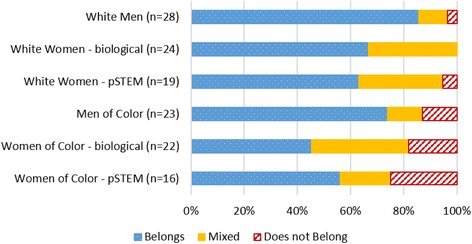
BACKGROUND: Women and students of color are widely underrepresented in most STEM fields. In order to investigate this underrepresentation, we interviewed 201 college seniors, primarily women and people of color, who either majored in STEM or started but dropped a STEM major. Here we discuss one section of the longer interview that focused on students' sense of belonging, which has been found to be related to retention. In our analysis, we examine the intersections of race and gender with students' sense of belonging, a topic largely absent from the current literature. RESULTS: We found that white men were most likely to report a sense of belonging whereas women of color were the least likely. Further, we found that representation within one's STEM sub-discipline, namely biology versus the physical sciences, impacts sense of belonging for women. Four key factors were found to contribute to sense of belonging for all students interviewed: interpersonal relationships, perceived competence, personal interest, and science identity. CONCLUSIONS: Our findings indicate that students who remain in STEM majors report a greater sense of belonging than those who leave STEM. Additionally, we found that students from underrepresented groups are less likely to feel they belong. These findings highlight structural and cultural features of universities, as well as STEM curricula and pedagogy, that continue to privilege white males.
Overview
CoChat Summary
TL;DR
This interview study of 201 college seniors examines how sense of belonging in STEM varies by race, gender, and their intersections, comparing STEM majors and leavers. It finds white men most likely and women of color least likely to report belonging, with belonging linked to interpersonal relationships, competence, interest, and science identity.
Key findings
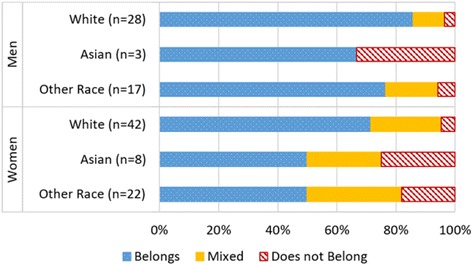
- White men were the most likely to report a sense of belonging compared with all other students (Z = 2.37, p ≤ 0.01), while women of color were the least likely (Z = 3.62, p ≤ 0.01).
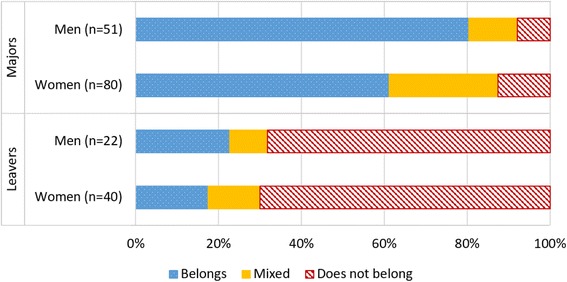
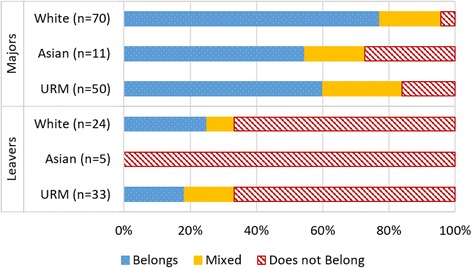
- Female STEM majors were significantly less likely than male majors to report belonging (Z = 2.41, p ≤ 0.01), and students of color who majored in STEM were significantly less likely than white majors to report belonging (Z = 2.23, p ≤ 0.01); leavers across demographic groups were more likely to report not belonging.
- Representation in a STEM subfield mattered: women of color in physical sciences (pSTEM), where they are highly underrepresented, reported belonging significantly less frequently than white men (Z = 2.17, p ≤ 0.05).
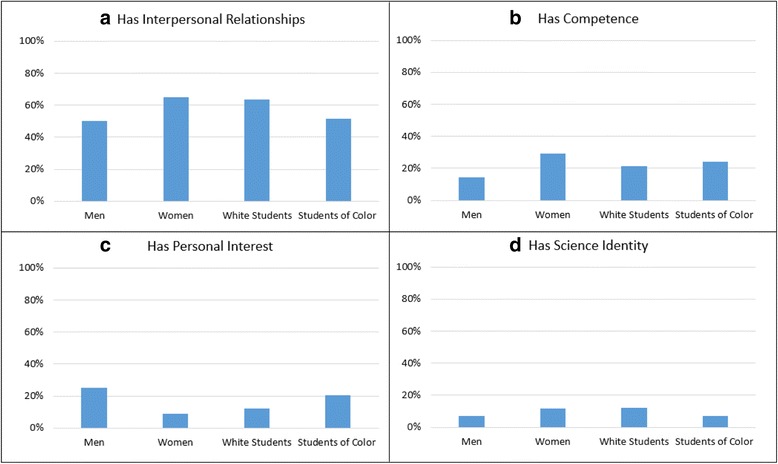
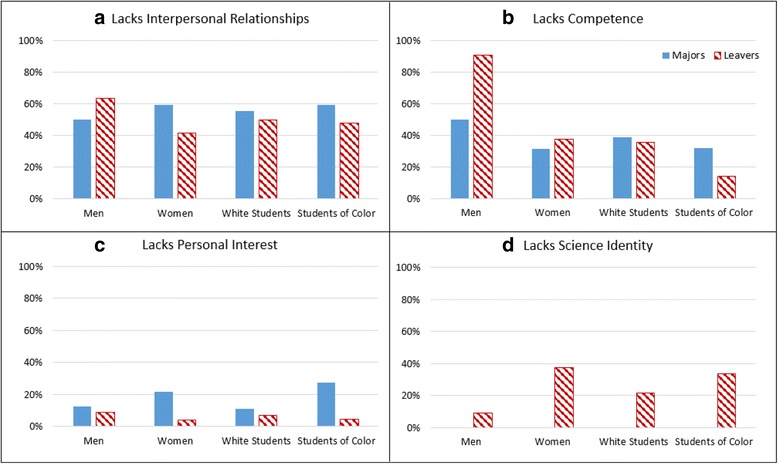
- Four themes explained belonging or lack of belonging: interpersonal relationships, perceived competence, personal interest, and science identity. Interpersonal relationships were the largest factor cited for each demographic group; competence was second. No majors cited a lack of science identity as a reason for not belonging, whereas approximately one quarter of leavers did.
Methods
- Qualitative interview study using a subset of 201 interviews from the larger Roots of STEM Success Project, which conducted more than 300 interviews with college seniors in 2013. Participants attended 1 of the 16 public University of North Carolina campuses, had attended North Carolina public school, were younger than 30, and were either STEM majors or STEM leavers.
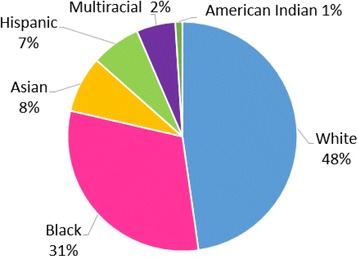
- The purposive sample oversampled students underrepresented in STEM: 66% women and 34% men; 48% white and 52% students of color. Students were recruited via email survey and interviewed for 30–60 min by Skype, phone, or in person.
- Analysis used a partial grounded theory approach: two researchers independently coded interviews, compared codes, and resolved discrepancies through discussion. Belonging explanations were coded into interpersonal relationships, science identity, personal interest, and competence; comparisons used tests of proportions and Z-scores.
Limitations
- The paper states the sample is self-selected and purposive, limited to college seniors in North Carolina who graduated from a North Carolina high school and attended one of the 16 UNC campuses, so findings are not generalizable beyond the sample. It also states only two axes of identity—race and gender—could be investigated.
- The paper acknowledges small subsample sizes, cautioning that some comparisons should be made with caution, and notes debate about using quantitative tests on qualitative data.
- Evident from the text: Asian students were collapsed with other students of color because of low numbers; competence was based on students’ self-perception, not actual grades or course performance; and the data are correlational, so causal direction cannot be determined.
Model-written summary. Check it against the paper before relying on it.
Integrity signals
Registry
Cites
Statistics
Figures
Verification
Claims the paper makes
0 Valid · 0 Not valid · 14 Not checked · 107 Own results and interpretations
A result the paper reports from its own data — it cites no other source for it, so there is none to check. The quote shows it is in the paper.
In the paper
“We find that women of color in pSTEM, where they are highly underrepresented, report belonging significantly less frequently than white men (Z = 2.17, p ≤ 0.05).”
§ Race and gender differences in how sense of belonging influences decisions to major in STEM > Results > The intersection of race and gender in students’ sense of belonging
plainstates an association- Asserted: passes — The authors put it forward as true.
- Checkable: passes — It can be checked against evidence.
- Load-bearing: passes — The paper’s conclusions depend on it.
- Based: passes — The paper gives a reason why it holds.
A result the paper reports from its own data — it cites no other source for it, so there is none to check. The quote shows it is in the paper.
In the paper
“We found that female majors were significantly less likely than male majors to report they felt they belonged in STEM (Z = 2.41, p ≤ 0.01)”
§ Race and gender differences in how sense of belonging influences decisions to major in STEM > Results > The intersection of race and gender in students’ sense of belonging
plainstates an associationn = 51 ·- Asserted: passes — The authors put it forward as true.
- Checkable: passes — It can be checked against evidence.
- Load-bearing: passes — The paper’s conclusions depend on it.
- Based: passes — The paper gives a reason why it holds.
A result the paper reports from its own data — it cites no other source for it, so there is none to check. The quote shows it is in the paper.
In the paper
“we found that students of color who major in STEM are significantly less likely to report a sense of belonging than white majors (Z = 2.23, p ≤ 0.01)”
§ Race and gender differences in how sense of belonging influences decisions to major in STEM > Results > The intersection of race and gender in students’ sense of belonging
plainstates an association- Asserted: passes — The authors put it forward as true.
- Checkable: passes — It can be checked against evidence.
- Load-bearing: passes — The paper’s conclusions depend on it.
- Based: passes — The paper gives a reason why it holds.
A result the paper reports from its own data — it cites no other source for it, so there is none to check. The quote shows it is in the paper.
In the paper
“white men were the most likely to report a sense of belonging when compared to all other students (Z = 2.37, p ≤ 0.01)”
- Also stated in: § Results · plain
“white men were most likely to report a sense of belonging”
§ Race and gender differences in how sense of belonging influences decisions to major in STEM > Results > The intersection of race and gender in students’ sense of belonging
plainstates an association- Asserted: passes — The authors put it forward as true.
- Checkable: passes — It can be checked against evidence.
- Load-bearing: passes — The paper’s conclusions depend on it.
- Based: passes — The paper gives a reason why it holds.
- Also stated in: § Results · plain
A result the paper reports from its own data — it cites no other source for it, so there is none to check. The quote shows it is in the paper.
In the paper
“the patterns for Asian students match those of URMs’ more closely than those of white students”
§ Race and gender differences in how sense of belonging influences decisions to major in STEM > Results > The intersection of race and gender in students’ sense of belonging
plainstates an association- Asserted: passes — The authors put it forward as true.
- Checkable: passes — It can be checked against evidence.
- Load-bearing: passes — The paper’s conclusions depend on it.
- Based: passes — The paper gives a reason why it holds.
87 more claims
Create a free account to see all 121 claims and to verify the 25 references still open.
- The quote only partly states this claim. 2
- It may state two separate claims as one. 18
- Probably not a substantial claim. 14
Claims other papers make about this one
Each is checked against this paper’s own text: does it say what the citing paper says it does?
The source backs part of the claim, not all of it — or backs it for a different population, condition or comparison.
In the citing paper
“In a qualitative study contrasting students that persisted with those who left STEM, Rainey etal. (2018) found that while all students expressed the importance of sense of belonging, those that left their STEM major were lacking science identity.”
From "It Just Makes It Feel Like You're Not Alone": A Qualitative Study of a Social Support Group for High-Achieving, Low-Income STEM Majors (2024) · cites this paper as Rainey et al., 2018
Experimental — accuracy not yet measuredThe source backs part of the claim, not all of it — or backs it for a different population, condition or comparison.
In the citing paper
“More recent research focused specifically on STEM students suggests that institutional practices that promote STEM students' interpersonal relationships, perceived competence, personal interest, and science identity contribute to feelings of belonging (Rainey et al., 2018).”
From The Importance of STEM Sense of Belonging and Academic Hope in Enhancing Persistence for Low-Income, Underrepresented STEM Students (2024) · cites this paper as Rainey et al., 2018
Experimental — accuracy not yet measuredThe source backs part of the claim, not all of it — or backs it for a different population, condition or comparison.
In the citing paper
“Understanding representation matters and youth need to see people that look like them in leadership roles in science in order for them to visualize themselves in these fields (Indian University 2019; Rainey et al. 2018).”
From Creating Community and Engaging Community: The Foundations of the Estate Little Princess Archaeology Project in St. Croix, United States Virgin Islands (2022) · cites this paper as Rainey et al. 2018
Experimental — accuracy not yet measuredThe cited source says what the claim attributes to it.
In the citing paper
“Additionally, in their qualitative investigation, Rainey et al. found that STEM students' perceptions of sense of belonging affected their decisions to persist or withdraw from their STEM major.”
From The Importance of STEM Sense of Belonging and Academic Hope in Enhancing Persistence for Low-Income, Underrepresented STEM Students (2024) · cites this paper as Rainey et al., 2018
Self-check
Percentages, sums and reported differences re-computed from the paper’s own numbers.
Each contradiction between two passages listed here was confirmed by an independent check.
Rated minor: it would not touch a result — a value no result rests on, a p-value that stays on the same side of the significance level, or a conflict that is clerical, resolved elsewhere in the paper, or outside its own findings.
In the paper
§ Race and gender differences in how sense of belonging influences decisions to major in STEM > Results > The intersection of race and gender in students’ sense of belonging
“We have responses from 22 men and 40 women who were leavers.”
§ Race and gender differences in how sense of belonging influences decisions to major in STEM > Results > The intersection of race and gender in students’ sense of belonging
“We have responses from 24 white students, 5 Asian students, and 35 URMs who were leavers.”
Citations
Cites
Mapping the Margins: Intersectionality, Identity Politics, and Violence against Women of Color
Crenshaw, K. (1991) · Stanford Law Review · doi:10.2307/1229039 · Cited by 32,792 · cited 5×
“Intersectionality refers to the idea that aspects of one’s identity (e.g., race, gender, class, sexual orientation) are not unitary and mutually exclusive, but instead interact to construct one’s identity (Crenshaw 1991; Collins 2015).”
InfluentialThe Journal of College Science Teaching
(1971) · Journal of Chemical Education · doi:10.1021/ed048p284 · Cited by 3,332
Women, Minorities, and Persons with Disabilities in Science and Engineering: 2013: (558442013-001)
(2013) · PsycEXTRA Dataset · doi:10.1037/e558442013-001 · Cited by 2,471
Carlone, H. B., & Johnson, A. (2007) · Journal of Research in Science Teaching · doi:10.1002/tea.20237 · Cited by 2,433 · cited 5×
“There exist other intersectional works that investigate women of color’s experiences (e.g., Carlone and Johnson 2007; Crenshaw 1991), but we had difficulty finding literature that focused on women of color’s sense of belonging.”
InfluentialIntersectionality's Definitional Dilemmas
Collins, P. H. (2015) · Annual Review of Sociology · doi:10.1146/annurev-soc-073014-112142 · Cited by 2,419
Mattley, C., Strauss, A., & Corbin, J. (1999) · Contemporary Sociology · doi:10.2307/2655359 · Cited by 2,408 · cited 1×
“Using a partial grounded theory approach to qualitative data analysis (Strauss and Corbin 1997), two researchers independently read the responses and coded under broad categories, some of which were determined a priori and others that emerged from the data.”
A question of belonging: Race, social fit, and achievement.
Walton, G. M., & Cohen, G. L. (2007) · Journal of Personality and Social Psychology · doi:10.1037/0022-3514.92.1.82 · Cited by 2,163
Bowleg, L. (2008) · Sex Roles · doi:10.1007/s11199-008-9400-z · Cited by 2,004 · cited 1×
“For example, considering race and gender as single axes of identity without analysis of the intersections of those groups can lead to the erasure of some identities, such as for women of color (Bowleg 2008; Crenshaw 1991).”
A Brief Social-Belonging Intervention Improves Academic and Health Outcomes of Minority Students
Walton, G. M., & Cohen, G. L. (2011) · Science · doi:10.1126/science.1198364 · Cited by 1,992
Classroom Belonging among Early Adolescent Students: Relationships to Motivation and Achievement
Goodenow, C. (1993) · The Journal of Early Adolescence · doi:10.1177/0272431693013001002 · Cited by 1,614 · cited 1×
“Sense of belonging refers to “students’ sense of being accepted, valued, included, and encouraged by others (teachers and peers) in the academic classroom setting and of feeling oneself to be an important part of the life and activity of the class” (Goodenow 1993, p. 80).”
Research works printed but not linked: 6
- Meiners, E., Fuller, L., McCullough, L., Newell, D., Bartsch, I., & Daly, C. (2004). Special Issue: Women in Science Vol. 5,# 4, May 2004 Editor, Heidi Fencl, University of Wisconsin Green Bay, Department of Physics. Journal of International Women’s Studies, 5, 1.
- Mickelson RA Parker A Stearns E Moller S Dancy M Ruiz-Smith Lawson Clark S Family matters: familial support and African American female success Contemporary African American families: achievements, challenges, and empowerment strategies in the 21st century 2015 New York Routledge-Taylor & Francis
- National Research Council (2013). Seeking solutions: maximizing American talent by advancing women of color in academia: summary of a conference. Washington: National Academies Press.
- National Science Foundation National Center for Science and Engineering Statistics Women, minorities, and persons with disabilities in science and engineering: 2017 2017 Arlington Special Report NSF 17–310
- Shain, C. H. (2002). Revisiting the problem of engineering school persistence in African-American women students. Doctoral dissertation. Retrieved from ProQuest Dissertations and Theses database. (Publication No. 304798888).
- Valenzuela, Y. (2006). Mi fuerza/my strength. The academic and personal experiences of Chicana/Latina transfer students in math and science. Doctoral dissertation. Retrieved from Pro-Quest Dissertation and Theses database. (Publication No. 304916976).
Cited by
Items 501–600 of 708
Verdín, D. (2026) · Journal of Engineering Education · doi:10.1002/jee.70070 · Cited by 1
“…feel as though they belong in their chosen STEM discipline (Dasgupta, 2011; Good et al., 2012; Herrera et al., 2022; Holland, 2019; Hunter, 2019; Rainey et al., 2018; Rodriguez & Blaney, 2020; Tate & Linn, 2005) and in engineering in particular (Camacho & Lord, 2013; Campbell-Montalvo et al.,…”
A comparative analysis between Brazil and Spain about perceptions on gender in STEM
Shzu, M. A. M., Verdugo-Castro, S., & García‐Holgado, A. (2026) · Discover Sustainability · doi:10.1007/s43621-026-03969-1 · Cited by 1
“Considering that, in Brazil, this pattern may be interpreted in light of previous studies on race, gender, and belonging, but the present data do not directly assess internalization processes [42].”
A systematic review of gender disparities in STEM education
Khodjaev, B. K., Khujamberdieva, S., Tashibekova, M. K., o'g'li, K. S. S., Rakhimova, D., & Рахматова, Х. А. (2026) · Eurasia Journal of Mathematics Science and Technology Education · doi:10.29333/ejmste/18965 · Cited by 1
“This corresponds with earlier research stressing the need for inclusive pedagogy in STEM education (Rainey et al., 2018).”
Martínez‐Orengo, N., Smith, M. R., Whitaker, D. T., & Castro‐Faix, M. (2021) · Journal of Science Policy & Governance · doi:10.38126/jspg190108 · Cited by 1
“…and mentorship (Miriti 2020), and feelings of isolation that come with being underrepresented in their graduate programs (also faced by international students who are dealing with a new culture and www.sciencepolicyjournal.org JSPG, Vol. 19, Issue 1, November 2021 language) (Rainey et al. 2018).”
BackgroundA Faculty-Led, Community-Building Program That Enhances Student-Faculty Connections within Biology
Schafer, J. L., Guenther, C. H., Stovall, D. B., Brown, L. N., Glasscock, L. N., & Stern, M. M. (2022) · Journal of Microbiology and Biology Education · doi:10.1128/jmbe.00007-22 · Cited by 1
“Between October 2019 and February 2020, the committee organized several community-building events within the biology department that provided opportunities for students and faculty to interact outside typical classroom or advising contexts: (1) biology BINGO game night, (2) town hall meeting (advising session), (3) tr…”
BackgroundThe Linkages Between Urban Green Spaces and Residents’ Wellbeing: A Conceptual Framework
Keh, A. W.-K., Hew, W. W.-L., Yeo, S. F., & Tan, C. L. (2023) · International Journal of Business and Technology Management · doi:10.55057/ijbtm.2023.5.1.32 · Cited by 2
A Summer Research Experience to Increase Diversity in Healthcare: a 4-Year Follow-up Study
Afghani, B., & Dayag, H. V. (2023) · Medical Science Educator · doi:10.1007/s40670-023-01940-7 · Cited by 1
“A lack of sense of belonging [7, 8] and absence of strong mentors and role models have underscored why females and minorities leave science, technology, engineering and mathematics (STEM) majors [9].”
BackgroundPerceptions of Gender in Classrooms and Associated Expectations of Belonging
Ralph, M. C., Pascutto, J., Wright, C., & Martínez, R. P. (2023) · Journal of Interior Design · doi:10.1177/10717641231211544 · Cited by 1
“Similar issues have been described in other science, technology, engineering, and math (STEM) fields (Lewis et al., 2016; Rainey et al., 2018; Steffens et al., 2010).”
BackgroundPerkins, H., Godwin, A., Berger, E., & Major, J. C. (2024) · ASEE Annual Conference & Exposition · doi:10.18260/1-2--41036 · Cited by 1
Work in Progress: Developing an Engineering Community in a Fablab
Edwards, J., & Pizano, A. C. (2024) · ASEE Annual Conference & Exposition · doi:10.18260/1-2--41084 · Cited by 1
Graven, B., Ralston, P. A. S., & Tretter, T. R. (2024) · ASEE Annual Conference & Exposition · doi:10.18260/1-2--43716 · Cited by 1
Increasing Inclusion Through Structured Active Learning
Schwarz, F. (2024) · Oxford University Press eBooks · doi:10.1093/oso/9780197755303.003.0017 · Cited by 1
Mesghina, A. (2024) · Education and human development · doi:10.5772/intechopen.114344 · Cited by 2
Thomas, V. G., Ricks, E., Johnson, B., & Baylor, R. E. (2024) · Journal of Women and Minorities in Science and Engineering · doi:10.1615/jwomenminorscieneng.2024049123 · Cited by 1
Work, A. (2024) · ASEE Annual Conference & Exposition · doi:10.18260/1-2--47614 · Cited by 2
Building Community and Developing Professionally through FUN Final Friday Sessions
Eaton, S. E., Donley, D. W., Lom, B., & Stavnezer, A. J. (2024) · Journal of Undergraduate Neuroscience Education · doi:10.59390/wmph6827 · Cited by 1
McClain, J., & Buck, G. A. (2024) · International Journal of Research in Education and Science · doi:10.46328/ijres.3407 · Cited by 1
“The absence of acknowledgment within the discipline might have implications for underrepresented students, particularly those from racial and ethnic minority backgrounds, in terms of their perceived inclusion in STEM disciplines that are unique to content areas (Rainey et al., 2018).”
Zhifeng, G., Singh, C. K. S., Eng, T. O., Charanjeet Singh, S. K. J., Bailey, R. P., & Tan, W. H. (2024) · Asian Journal of University Education · doi:10.24191/ajue.v20i2.27396 · Cited by 1
“…for inclusion and diversity via acquaintance to role models (Johnson, 2012); (b) a person’s feelings of belonging to schools, colleges and universities and to the STEM disciplines (Rainey et al., 2018); and (c) real-time learning exposure and experiences (Beier et al., 2019; Teoh et al., 2024).”
O’Keefe, P. A., Ramya, S. M., & Horberg, E. J. (2025) · Contemporary Educational Psychology · doi:10.1016/j.cedpsych.2025.102371 · Cited by 3
Gang, G. R., Rubio, J. R., Antich, M., Balmaceda, A., Candamil, A., Fogata, L., Salce, C., Zelaya, R. V., & Daher, N. S. (2025) · Health Professions Education · doi:10.55890/2452-3011.1332 · Cited by 1
“This, despite previous studies showing that students from underrepresented minority students are less likely to feel they belong [39].”
The role of higher education institutions as employers of apprentices
Wright, C. (2020) · Higher Education Skills and Work-based Learning · doi:10.1108/heswbl-02-2020-0025 · Cited by 1
MEASURING POSTSECONDARY STUDENTS’ SENSE OF BELONGING
Lingat, J. E. M. (2020) · UKnowledge (University of Kentucky) · doi:10.13023/etd.2020.301 · Cited by 3
Yalçınkaya, N. S., Gravelin, C. R., & Adams, G. (2021) · Social Psychology of Education · doi:10.1007/s11218-021-09618-x · Cited by 1
Keppetipola, N., & Patchen, T. (2021) · Journal of Microbiology and Biology Education · doi:10.1128/jmbe.v22i1.2603 · Cited by 4
“As faculty members who teach at a Hispanic Serving Institution, we are acutely aware of the disparities in STEM education (3, 4), as well as calls for reform in undergraduate STEM education (5), and the commensurate need to teach in ways that bolster diverse students’ academic advance (6).”
BackgroundThe Impact of Department Diversity on Student Persistence and Success in Engineering
Waller, D. R., Maeda, Y., Ohland, M., & Tay, L. (2024) · ASEE Annual Conference & Exposition · doi:10.18260/1-2--37869 · Cited by 1
“Noting that a lack of interpersonal relationships is the leading cause of a low sense of belonging (Corbett & Hill, 2015; Rainey, Dancy, Mickelson, Stearns, & Moller, 2018) and the negative relationship between ethnic heterogeneity and social cohesion (Van der Meer & Tolsma, 2014), underrepresented…”
BackgroundAdvancing Engineering Education Using a Teaching Focused Plan For Creating an Inclusive Classroom
Hammond, T., Richard, J. C., Patrick, C., White, L. L. A., Ray, S., Lightfoot, R., Watson, K. L., Brooks, R., & Jaison, D. (2024) · First-Year Engineering Experience Conference (FYEE) · doi:10.18260/1-2--38365 · Cited by 1
“A lack of a sense of belonging causes women and underrepresented minorities to not enter or leave STEM majors [23] and STEM professions.”
BackgroundAbdulahad, A. I., Privett, J. A., & Adams, M. R. (2021) · Journal of Chemical Education · doi:10.1021/acs.jchemed.1c00419 · Cited by 2
Johnson-Anderson, S., Lingutla, R., & Riley, M. (2022) · Elsevier eBooks · doi:10.1016/b978-0-323-90469-8.00002-0 · Cited by 1
Jefferies, L. R., & Jefferies, S. S. (2022) · Contributions from biology education research · doi:10.1007/978-3-030-98592-9_23 · Cited by 1
Austin, S. J., Dickerson, D. A., Freeman, A., Ainsworth, E., & Booth-Womack, V. (2022) · Advances in educational marketing, administration, and leadership book series · doi:10.4018/978-1-6684-4803-8.ch005 · Cited by 2
Indonesian preservice primary school teachers’ understanding of STEM education
Agustiningsih, A., Putra, P. D. A., Mahardika, I. K., Nuriman, & Hariyadi, S. (2023) · AIP conference proceedings · doi:10.1063/5.0112458 · Cited by 1
Sánchez‐Peña, M. L., Moore, K., McAlister, A. M., Kamal, S. A., & Epps, J. (2023) · IEEE Frontiers in Education Conference (FIE) · doi:10.1109/fie58773.2023.10343456 · Cited by 1
“Research shows that increased gender and ethnic representation within an individual ’ s STEM discipline positively influences belonging in all students especially for women [3].”
BackgroundInfluentialCate, R., & Nelson, A. (2024) · ASEE Annual Conference & Exposition · doi:10.18260/1-2--40379 · Cited by 1
Promoting Sense of Belonging and Interest in Geosciences among Undergraduate Women through Mentoring
Du, W. (2019) · The Research Repository @ WVU (West Virginia University) · doi:10.33915/etd.4054 · Cited by 2
Rosbrook, E. Y. S. (2020) · Digital Repository Service (Northeastern University) · doi:10.17760/d20394196 · Cited by 1
Paris, R. (2024) · PDXScholar (Portland State University) · doi:10.15760/honors.1473 · Cited by 1
Editorial Board Representation in Criminology: A Call to Address Racial Disparities
Breetzke, G. D. (2024) · Race and Justice · doi:10.1177/21533687241300259 · Cited by 1
“…are evident in a myriad of ways including academic faculty pro fi les (Breetzke et al., 2022), degree attainment (Bhopal, 2017), sense of belonging (Rainey et al., 2018), recipients of major grants (Chen et al., 2022; Ginther et al., 2011; Morris, 2023), and student loan debt (Addo et al.,…”
Pedagogies and Strategies in International Maritime Business
Ndlovu, F. P. (2020) · WMU studies in maritime affairs · doi:10.1007/978-3-030-31749-2_28
McWilliams, C., Nims, B., & Dwyer, K. M. (2020) · IRL - University of Missouri, St. Louis (University of Missouri–St. Louis) · Cited by 3
Lindwall, J. L. (2021) · PDXScholar (Portland State University) · doi:10.15760/etd.7626
Investigating students' course performance by groups' gender compositions
Smith, E. M., & Callan, K. E. (2021) · Physics Education Research Conference (PERC) · doi:10.1119/perc.2021.pr.smith
“For example Rainey et al. found that students who persist in a physics major report greater sense of belonging than those who choose to leave, with perceived competence as a contributor to belonging [13].”
BackgroundEnhancing Gender Diversity in STEM Requires Support from All
Bowman, K. J., & Rosser, S. V. (2020) · ASEE Annual Conference & Exposition · doi:10.18260/1-2--32746 · Cited by 2
Mercados As Healing Spaces for Latina/O/X Community
Vargas, A. Q. (2020) · doi:10.46569/20.500.12680/6682x9652
Williams, N. B. (2022) · Council on Undergraduate Research eBooks · doi:10.18833/cf/3
Friedrich, J. C., & Jenkins, T. S. (2021) · Journal of Urban Mathematics Education · doi:10.21423/jume-v14i2a424
McCollum, M. C. (2022) · San José State University ScholarWorks (San Jose State University) · doi:10.31979/etd.2pfw-32rt
Peer Mentorship In Interdisciplinary STEM Education: The Underrepresented Groups Experience
Saray, H. R. (2022) · doi:10.46569/20.500.12680/6m311w14s · Cited by 1
“I-STEM students’ sense of belonging is essential to their self-efficacy, self-perception, validation, and persistence in their interdisciplinary STEM education, and subsequently STEM education (Beier et al., 2016; Linares, 2011; Rainey et al., 2018).”
BackgroundInfluentialEmpowering Journey Making an Interactive Video Vignette
Ochoa-Madrid, E., Chau, L., & Wright, M. J. (2022) · The Physics Teacher · doi:10.1119/5.0046043
Increasing STEM Grit among Underrepresented Groups: Lessons from Our Fathers
Roberts, T., Bignall, O., & Moore, S. (2022) · OALib · doi:10.4236/oalib.1109418
“…as gender stereotypes (Bian, 2017 [9]), early STEM experiences (Dou, 2019 [10]), parental beliefs (Elliott, 2018 [11]), social belonging (Ito et al., 2018 [12]; Lewis et al., 2017 [13]; Rainey et al., 2018 [14]) and limited role models (Olsson, 2018 [15]) affect students’ attitudes towards STEM.”
BackgroundTinkering Towards Theories: The Role of Tinkering in Building Scientific Models
Moran, S. (2022) · ScholarWorks (Boise State University) · doi:10.18122/td.2032.boisestate
Latinx Students' Sense of Belonging: Role of Idea-Related Courses
Faudoa, A. (2023) · ISU Red - Research and eData (Illinois State University) · doi:10.30707/etd2023.20230711063201077808.999986
“Having the ability to influence and interact with students of diverse backgrounds may lead to increases in inclusivity, given that interpersonal relationships and perceived competence have been found to increase a student’s sense of belonging (Rainey et al., 2018).”
BackgroundCreating Inclusive Environments Through Peer Mentoring
Provenzano, N. O. (2023) · doi:10.46569/qr46r735t
Bridging the gap between education and employability in electrical engineering
Mahase, K. K. (2023) · Digital Repository Service (Northeastern University) · doi:10.17760/d20481314
(2023) · Frontiers research topics · doi:10.3389/978-2-8325-3977-4
Micro Communities of Safety: Perspectives from NOAA Employee Resource Group Member
Davis, J., Martinez, C., & Brown, V. (2023) · Oceanography · doi:10.5670/oceanog.2024.132
Cheung, O. L., & Fowler, S. (2023) · Journal of Teaching and Learning with Technology · doi:10.14434/jotlt.v12i1.36212
“These findings agree with those of Good et al. (2012), Hausmann et al. (2007), Rainey et al. (2018), Seymour and Hewitt (1997), and Tate and Linn (2005).”
BackgroundResultAn Exploration of Teaching Diverse Students in a Higher Education Context in the UK
Cantafio, G. U. (2023) · Advances in educational marketing, administration, and leadership book series · doi:10.4018/978-1-6684-8332-9.ch006
Stephens-Peace, K. J., Friedensen, R., Kimball, E. W., Forester, R., Miller, R. A., Vaccaro, A., Forsythe, D., & Jones, M. C. (2024) · Advances in higher education and professional development book series · doi:10.4018/978-1-6684-9914-6.ch005
An analytical study on the lower enrolment of female physicists in research and development in India
Chaudhary, V., Dhall, M., Thakur, R., Roets, L., Dhall, P., Chaudhary, V., Kaushik, A. K., Gautam, A., Kaur, I., & Batra, V. (2024) · SN Social Sciences · doi:10.1007/s43545-023-00828-y
“…trails behind males, and more female students switch out of STEM academic environments than male students (Ivie and Guo 2006; Abramzon et al. 2015; Ivie and White 2015; Carli et al. 2016; Blackburn 2017; Robnett and Thoman 2017; Funk and Parker 2018a; Rainey et al. 2018; Seyranian et al. 2018).”
InfluentialGonzález, E., & Perez, E. (2024) · ASEE Annual Conference & Exposition · doi:10.18260/1-2--41971
“Latinas, as minority female students, are among those to report a low sense of belonging in STEM [19].”
BackgroundBoard 39B: Navigating Intersectional Identities in Civil Engineering Education and Practice
Clement, E., & Desing, R. M. (2024) · ASEE Annual Conference & Exposition · doi:10.18260/1-2--43131
Godwin, L. (2024) · ASEE Annual Conference & Exposition · doi:10.18260/1-2--44139
“These scholars suggest that an intersectional approach, combining at least two social identities such as race/ ethnicity and gender, to understand the experiences of those within overlapping groups [11], [16], [20]–[28] is more accurate and avoids a monolithic approach and/ or assumptions.”
BackgroundReyes, D. (2024) · ASEE Annual Conference & Exposition · doi:10.18260/1-2--44498
Capper-Parkin, K. (2023) · Sheffield Hallam University · doi:10.7190/shu-thesis-00589
Community Cultural Wealth of Hispanic Engineering Students: A Study of Social Networks
Flores, B. C., Bañuelos, N., Gorbett, D., Arciero, A., & Benbow, R. J. (2024) · ASEE Gulf Southwest Section Conference · doi:10.18260/1-2--45368
Fieger, C. (2023) · Digital Repository Service (Northeastern University) · doi:10.17760/d20621611
How to design research-aligned diversity, equity, and inclusion interventions in physics
Johnson, A. C. (2026) · Physical Review Physics Education Research · doi:10.1103/q643-8928 · Cited by 1
“…to physics communities, as there is evidence that (i) a sense of belonging is associated with success in STEM [77,78] and physics [2,67,68,73 – 75] and (ii) members of minoritized groups often expcerience a lower sense of belonging than other students in STEM [78,79] and physics [2,21,50,57,68,69].”
Krum, D. M., Wood, Z. J., Kang, E.-Y., Kazerouni, A. M., Lehr, J., Hug, S. T., Inventado, P. S., Tang, F., Yoon, I., Kulkarni, A., et al. (2024) · ASEE Annual Conference & Exposition · doi:10.18260/1-2--46968
Trubenstein, B. P. (2024) · ASEE Annual Conference & Exposition · doi:10.18260/1-2--46871
Board 214: Building an Understanding of Black Families’ Engineering, Design, and Inventive Practices
Ejichukwu, E., Tolbert, D., & Matar, H. (2024) · ASEE Annual Conference & Exposition · doi:10.18260/1-2--46782
Cate, R., Field, J., & Sverdrup, S. (2024) · ASEE Annual Conference & Exposition · doi:10.18260/1-2--47940
Investigating Student Experiences of Inclusion and Exclusion to Guide Makerspace Development
Wigner, A., Nieusma, D., Corry, C., & Stevens, J. (2024) · ASEE Annual Conference & Exposition · doi:10.18260/1-2--47693
Experience of Women Undergraduates Attending a Trip to a Regional Women in Computing Celebration
Villani, M., Aydin, I., & Cullington, L. (2024) · ASEE Annual Conference & Exposition · doi:10.18260/1-2--47388
Henderson, T. S., & Higgins, C. (2024) · ASEE Annual Conference & Exposition · doi:10.18260/1-2--47382
Harley, L., May, V. V., & Holcombe, R. (2024) · ASEE Annual Conference & Exposition · doi:10.18260/1-2--47485
Moreno, S. C., Chance, S. M., & Bowe, B. W. (2024) · LACCEI International Multi-Conference for Engineering, Education and Technology (LACCEI) · doi:10.18687/laccei2024.1.1.1094 · Cited by 1
Alexander, R., Townsend, G. C., Stewart, K. J., & Johnson, A. (2023) · Research on Equity and Sustained Participation in Engineering, Computing, and Technology (RESPECT) · doi:10.1109/respect60069.2023.00024
“Belonging, as a term, captures a combination of sense of safety, identity connection, sense of purpose, comfort, and ownership in a classroom or field [37].”
BackgroundGerena, C. E., Minkoff, R. A., & Pilkay, S. R. (2024) · Journal of Ethnic & Cultural Diversity in Social Work · doi:10.1080/15313204.2024.2406248
“Both women and BIPOC students are often viewed as socially stigmatized groups, who often feel unsupported, isolated and out of place compared to white men on campus (Rainey et al., 2018).”
Zarifa, D., Sano, Y., & Milian, R. P. (2024) · Higher Education Quarterly · doi:10.1111/hequ.12578
Women's Reflexivity and Progress in Engineering Careers in Bangladesh
Islam, N., & Jirattikorn, A. (2024) · Women s Studies International Forum · doi:10.1016/j.wsif.2024.103015
The STEM gap: Overcoming obstacles and incorporating women globally
Lohgheswary, N., & Leelavathi, R. (2025) · Edelweiss Applied Science and Technology · doi:10.55214/25768484.v9i1.4104
“This includes a sense of belonging and a desire to participate [21-22].”
Enrolment Trend in STEM in Higher Education Level Among Disadvantaged Group Students in India
Nandi, A., Karmakar, S., Bala, A., Das, T., & Halder, T. (2025) · Advances in educational technologies and instructional design book series · doi:10.4018/979-8-3693-7408-5.ch014
ESA 2024 Meeting Review: Belonging and Identity in Ecology
White, H. C., O’Connell, K. B., Brown, J. L., Ou, S. X., Vonesh, J. R., Woods, N. N., Albert, S., Beltran, R. S., Borker, A. L., Carr, D., et al. (2025) · Bulletin of the Ecological Society of America · doi:10.1002/bes2.2228
Disciplinary appropriation at the beginning of a statistics major
Berens, F., Findley, K., Justice, N., & Kinson, C. (2024) · IASE Roundtable Conference · doi:10.52041/iase2023.408
A Latent Class Analysis Predicting STEM Career Interest and Perceptions of Barriers
Mulvey, K. L., Cerda‐Smith, J., Joy, A., & Ozturk, E. (2025) · Social Development · doi:10.1111/sode.12793 · Cited by 1
Driving STEM Education via Motorsports a Closer Look at Donk Racing – A Work in Process Paper
Donaldson, E. S. (2024) · IEEE Frontiers in Education Conference (FIE) · doi:10.1109/fie61694.2024.10893402
“This may discourage female students from participating or limit their engagement in motorsports-related STEM activities ( Rainey, K., Dancy, M., Mickelson, R. et al.”
Impact of a Wildlife Conservation Immersion Event on Youth of Color
Murphy, M., Diaz-Clark, E., Rodriguez, M., Morado, M. I., Stafford, N. T., Frierson, R., Bombaci, S., Balgopal, M. M., & Lavoie, A. (2025) · Connected Science Learning · doi:10.1080/24758779.2024.2436865
Driving STEM Education via Motorsports a Closer Look at Donk Racing — A Work in Process Paper
Donaldson, E. S. (2025) · Journal of Higher Education Theory and Practice · doi:10.33423/jhetp.v25i1.7560
Santana, L. M., Malespina, A., Cwik, S., & Singh, C. (2025) · The journal of college science teaching · doi:10.1080/0047231x.2025.2472137
Villarreal, C. G. (2024) · University of North Texas Digital Library (University of North Texas) · doi:10.12794/metadc2415925
Henson, K., & George, J. (2025) · Proceedings of the West Virginia Academy of Science · doi:10.55632/pwvas.v97i1.1108
Metadata
- Authors
- Rainey, K., Dancy, M., Mickelson, R., Stearns, E., & Moller, S.
- Affiliations
- University of Colorado Boulder (US)
- University of North Carolina at Charlotte (US)
- Corresponding author
- Rainey, Katherine
- Venue
- International Journal of STEM Education
- Published
- 2018-04-10
- Volume
- 5
- Issue
- 1
- Pages
- 10-10
- ISSN
- 2196-7822 (ISSN-L)
- PMC
- PMC6310405
- OpenAlex
- W2806119487
- Semantic Scholar
- e9675f21bd5a9f5ad7b5e612848342ead1fe76f3
- Cited by
- 681
- References
- 30
- Citations by year
- 2026: 75 · 2025: 118 · 2024: 141 · 2023: 109 · 2022: 84 · 2021: 74 · 2020: 61 · 2019: 16 · 2018: 2
- FWCI
- 76.00
- Type
- journal article
- Language
- en
- Open access
- gold
- doi.org
- Licence
- cc-by
- creativecommons.org/licenses/by/4.0 (tdm)
- creativecommons.org/licenses/by/4.0 (vor)
- Locations
- International Journal of STEM Education (publishedVersion, cc-by)
- Europe PMC (PubMed Central) (publishedVersion, cc-by)
- PubMed Central (publishedVersion, cc-by)
- PubMed (publishedVersion)
- DOAJ (DOAJ: Directory of Open Access Journals) (submittedVersion, cc-by-sa)
- Funders
- National Science Foundation (0969286)
- Topics
- Social Sciences › Psychology › Applied Psychology › Career Development and Diversity
- Social Sciences › Education › Higher Education Research Studies
- Social Sciences › Sociology and Political Science › Critical Race Theory in Education
- Keywords
- sense of belonging, STEM major choice, underrepresentation in STEM, women in STEM, students of color, gender and race intersection, STEM retention, science identity, perceived competence, interpersonal relationships, college seniors
About these checks
Registry, retraction, Cites and statistics results are computed, not judged, with one exception: a printed reference that no index lists is read once by a model before it counts as a citation error. Claims are extracted by a model and kept only when their quote appears verbatim in the text; each cited source is then checked, with a model’s help, for whether it says what the claim relies on. Those verdicts can be wrong — read the claim’s quote and the cited source before relying on one.
A language model drew the claims from the paper on 2026-10-05, under version 3 of the claim definition (model deepseek-v4.1-flash, prompt extract-v3).
A second model labelled each claim on 2026-10-05 (model jev-1.13-20260917, definition revision gold-guideline-v0.2).
Statistics and arithmetic are recomputed, not judged.
Confidence bands are shown only for fields calibrated on our annotated test set. None is calibrated yet, so no band is shown.
What counts as a claim ›How we measure confidence ›How we check this ›
Are you an author, or do you see a problem with this page? Request a review
Data sources
Bibliographic data: Semantic Scholar, OpenAlex, Crossref.
Contains information from the Semantic Scholar Academic Graph Datasets, made available under the ODC Attribution License (ODC-BY 1.0).
Semantic Scholar’s data is described in: Kinney, R., et al. (2023). The Semantic Scholar Open Data Platform. arXiv:2301.10140.
