

Race and gender differences in how sense of belonging influences decisions to major in STEM
Open accessThe DOI matches its Crossref record; 28 of the 30 references it cites were found in a registry or an index; none of the 25 sources its claims cite is checked for support yet.
Abstract
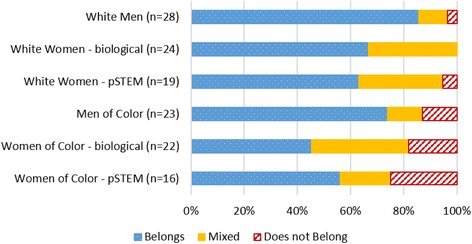
BACKGROUND: Women and students of color are widely underrepresented in most STEM fields. In order to investigate this underrepresentation, we interviewed 201 college seniors, primarily women and people of color, who either majored in STEM or started but dropped a STEM major. Here we discuss one section of the longer interview that focused on students' sense of belonging, which has been found to be related to retention. In our analysis, we examine the intersections of race and gender with students' sense of belonging, a topic largely absent from the current literature. RESULTS: We found that white men were most likely to report a sense of belonging whereas women of color were the least likely. Further, we found that representation within one's STEM sub-discipline, namely biology versus the physical sciences, impacts sense of belonging for women. Four key factors were found to contribute to sense of belonging for all students interviewed: interpersonal relationships, perceived competence, personal interest, and science identity. CONCLUSIONS: Our findings indicate that students who remain in STEM majors report a greater sense of belonging than those who leave STEM. Additionally, we found that students from underrepresented groups are less likely to feel they belong. These findings highlight structural and cultural features of universities, as well as STEM curricula and pedagogy, that continue to privilege white males.
Overview
CoChat Summary
TL;DR
This interview study of 201 college seniors examines how sense of belonging in STEM varies by race, gender, and their intersections, comparing STEM majors and leavers. It finds white men most likely and women of color least likely to report belonging, with belonging linked to interpersonal relationships, competence, interest, and science identity.
Key findings
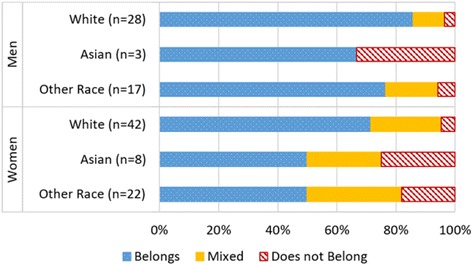
- White men were the most likely to report a sense of belonging compared with all other students (Z = 2.37, p ≤ 0.01), while women of color were the least likely (Z = 3.62, p ≤ 0.01).
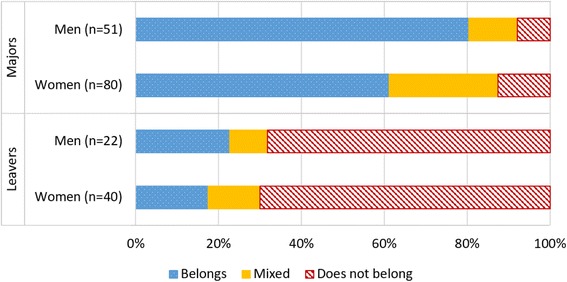
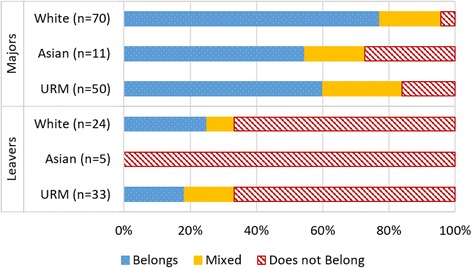
- Female STEM majors were significantly less likely than male majors to report belonging (Z = 2.41, p ≤ 0.01), and students of color who majored in STEM were significantly less likely than white majors to report belonging (Z = 2.23, p ≤ 0.01); leavers across demographic groups were more likely to report not belonging.
- Representation in a STEM subfield mattered: women of color in physical sciences (pSTEM), where they are highly underrepresented, reported belonging significantly less frequently than white men (Z = 2.17, p ≤ 0.05).
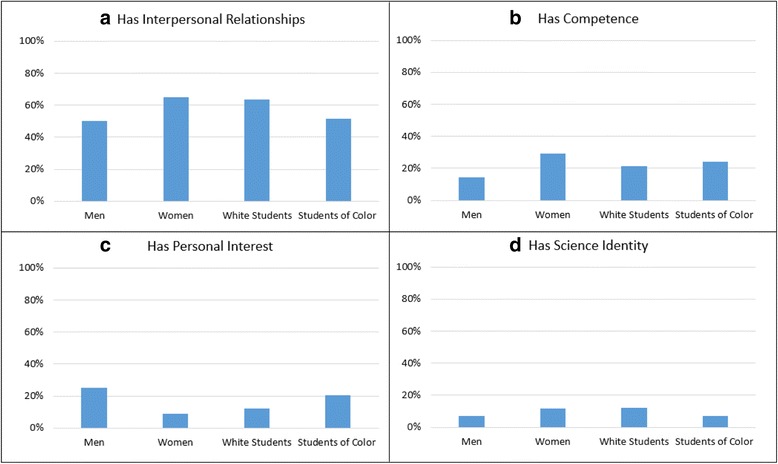
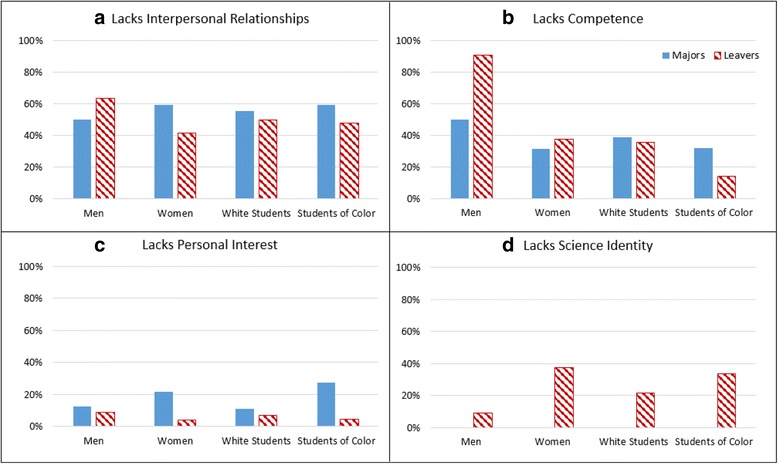
- Four themes explained belonging or lack of belonging: interpersonal relationships, perceived competence, personal interest, and science identity. Interpersonal relationships were the largest factor cited for each demographic group; competence was second. No majors cited a lack of science identity as a reason for not belonging, whereas approximately one quarter of leavers did.
Methods
- Qualitative interview study using a subset of 201 interviews from the larger Roots of STEM Success Project, which conducted more than 300 interviews with college seniors in 2013. Participants attended 1 of the 16 public University of North Carolina campuses, had attended North Carolina public school, were younger than 30, and were either STEM majors or STEM leavers.
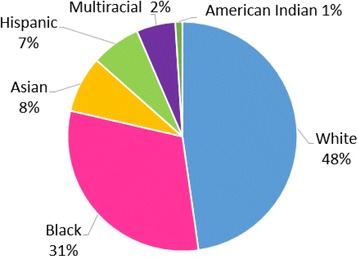
- The purposive sample oversampled students underrepresented in STEM: 66% women and 34% men; 48% white and 52% students of color. Students were recruited via email survey and interviewed for 30–60 min by Skype, phone, or in person.
- Analysis used a partial grounded theory approach: two researchers independently coded interviews, compared codes, and resolved discrepancies through discussion. Belonging explanations were coded into interpersonal relationships, science identity, personal interest, and competence; comparisons used tests of proportions and Z-scores.
Limitations
- The paper states the sample is self-selected and purposive, limited to college seniors in North Carolina who graduated from a North Carolina high school and attended one of the 16 UNC campuses, so findings are not generalizable beyond the sample. It also states only two axes of identity—race and gender—could be investigated.
- The paper acknowledges small subsample sizes, cautioning that some comparisons should be made with caution, and notes debate about using quantitative tests on qualitative data.
- Evident from the text: Asian students were collapsed with other students of color because of low numbers; competence was based on students’ self-perception, not actual grades or course performance; and the data are correlational, so causal direction cannot be determined.
Model-written summary. Check it against the paper before relying on it.
Integrity signals
Registry
Cites
Statistics
Figures
Verification
Claims the paper makes
0 Valid · 0 Not valid · 14 Not checked · 107 Own results and interpretations
A result the paper reports from its own data — it cites no other source for it, so there is none to check. The quote shows it is in the paper.
In the paper
“We find that women of color in pSTEM, where they are highly underrepresented, report belonging significantly less frequently than white men (Z = 2.17, p ≤ 0.05).”
§ Race and gender differences in how sense of belonging influences decisions to major in STEM > Results > The intersection of race and gender in students’ sense of belonging
plainstates an association- Asserted: passes — The authors put it forward as true.
- Checkable: passes — It can be checked against evidence.
- Load-bearing: passes — The paper’s conclusions depend on it.
- Based: passes — The paper gives a reason why it holds.
A result the paper reports from its own data — it cites no other source for it, so there is none to check. The quote shows it is in the paper.
In the paper
“We found that female majors were significantly less likely than male majors to report they felt they belonged in STEM (Z = 2.41, p ≤ 0.01)”
§ Race and gender differences in how sense of belonging influences decisions to major in STEM > Results > The intersection of race and gender in students’ sense of belonging
plainstates an associationn = 51 ·- Asserted: passes — The authors put it forward as true.
- Checkable: passes — It can be checked against evidence.
- Load-bearing: passes — The paper’s conclusions depend on it.
- Based: passes — The paper gives a reason why it holds.
A result the paper reports from its own data — it cites no other source for it, so there is none to check. The quote shows it is in the paper.
In the paper
“we found that students of color who major in STEM are significantly less likely to report a sense of belonging than white majors (Z = 2.23, p ≤ 0.01)”
§ Race and gender differences in how sense of belonging influences decisions to major in STEM > Results > The intersection of race and gender in students’ sense of belonging
plainstates an association- Asserted: passes — The authors put it forward as true.
- Checkable: passes — It can be checked against evidence.
- Load-bearing: passes — The paper’s conclusions depend on it.
- Based: passes — The paper gives a reason why it holds.
A result the paper reports from its own data — it cites no other source for it, so there is none to check. The quote shows it is in the paper.
In the paper
“white men were the most likely to report a sense of belonging when compared to all other students (Z = 2.37, p ≤ 0.01)”
- Also stated in: § Results · plain
“white men were most likely to report a sense of belonging”
§ Race and gender differences in how sense of belonging influences decisions to major in STEM > Results > The intersection of race and gender in students’ sense of belonging
plainstates an association- Asserted: passes — The authors put it forward as true.
- Checkable: passes — It can be checked against evidence.
- Load-bearing: passes — The paper’s conclusions depend on it.
- Based: passes — The paper gives a reason why it holds.
- Also stated in: § Results · plain
A result the paper reports from its own data — it cites no other source for it, so there is none to check. The quote shows it is in the paper.
In the paper
“the patterns for Asian students match those of URMs’ more closely than those of white students”
§ Race and gender differences in how sense of belonging influences decisions to major in STEM > Results > The intersection of race and gender in students’ sense of belonging
plainstates an association- Asserted: passes — The authors put it forward as true.
- Checkable: passes — It can be checked against evidence.
- Load-bearing: passes — The paper’s conclusions depend on it.
- Based: passes — The paper gives a reason why it holds.
87 more claims
Create a free account to see all 121 claims and to verify the 25 references still open.
- The quote only partly states this claim. 2
- It may state two separate claims as one. 18
- Probably not a substantial claim. 14
Claims other papers make about this one
Each is checked against this paper’s own text: does it say what the citing paper says it does?
The source backs part of the claim, not all of it — or backs it for a different population, condition or comparison.
In the citing paper
“In a qualitative study contrasting students that persisted with those who left STEM, Rainey etal. (2018) found that while all students expressed the importance of sense of belonging, those that left their STEM major were lacking science identity.”
From "It Just Makes It Feel Like You're Not Alone": A Qualitative Study of a Social Support Group for High-Achieving, Low-Income STEM Majors (2024) · cites this paper as Rainey et al., 2018
Experimental — accuracy not yet measuredThe source backs part of the claim, not all of it — or backs it for a different population, condition or comparison.
In the citing paper
“More recent research focused specifically on STEM students suggests that institutional practices that promote STEM students' interpersonal relationships, perceived competence, personal interest, and science identity contribute to feelings of belonging (Rainey et al., 2018).”
From The Importance of STEM Sense of Belonging and Academic Hope in Enhancing Persistence for Low-Income, Underrepresented STEM Students (2024) · cites this paper as Rainey et al., 2018
Experimental — accuracy not yet measuredThe source backs part of the claim, not all of it — or backs it for a different population, condition or comparison.
In the citing paper
“Understanding representation matters and youth need to see people that look like them in leadership roles in science in order for them to visualize themselves in these fields (Indian University 2019; Rainey et al. 2018).”
From Creating Community and Engaging Community: The Foundations of the Estate Little Princess Archaeology Project in St. Croix, United States Virgin Islands (2022) · cites this paper as Rainey et al. 2018
Experimental — accuracy not yet measuredThe cited source says what the claim attributes to it.
In the citing paper
“Additionally, in their qualitative investigation, Rainey et al. found that STEM students' perceptions of sense of belonging affected their decisions to persist or withdraw from their STEM major.”
From The Importance of STEM Sense of Belonging and Academic Hope in Enhancing Persistence for Low-Income, Underrepresented STEM Students (2024) · cites this paper as Rainey et al., 2018
Self-check
Percentages, sums and reported differences re-computed from the paper’s own numbers.
Each contradiction between two passages listed here was confirmed by an independent check.
Rated minor: it would not touch a result — a value no result rests on, a p-value that stays on the same side of the significance level, or a conflict that is clerical, resolved elsewhere in the paper, or outside its own findings.
In the paper
§ Race and gender differences in how sense of belonging influences decisions to major in STEM > Results > The intersection of race and gender in students’ sense of belonging
“We have responses from 22 men and 40 women who were leavers.”
§ Race and gender differences in how sense of belonging influences decisions to major in STEM > Results > The intersection of race and gender in students’ sense of belonging
“We have responses from 24 white students, 5 Asian students, and 35 URMs who were leavers.”
Citations
Cites
Mapping the Margins: Intersectionality, Identity Politics, and Violence against Women of Color
Crenshaw, K. (1991) · Stanford Law Review · doi:10.2307/1229039 · Cited by 32,792 · cited 5×
“Intersectionality refers to the idea that aspects of one’s identity (e.g., race, gender, class, sexual orientation) are not unitary and mutually exclusive, but instead interact to construct one’s identity (Crenshaw 1991; Collins 2015).”
InfluentialThe Journal of College Science Teaching
(1971) · Journal of Chemical Education · doi:10.1021/ed048p284 · Cited by 3,332
Women, Minorities, and Persons with Disabilities in Science and Engineering: 2013: (558442013-001)
(2013) · PsycEXTRA Dataset · doi:10.1037/e558442013-001 · Cited by 2,471
Carlone, H. B., & Johnson, A. (2007) · Journal of Research in Science Teaching · doi:10.1002/tea.20237 · Cited by 2,433 · cited 5×
“There exist other intersectional works that investigate women of color’s experiences (e.g., Carlone and Johnson 2007; Crenshaw 1991), but we had difficulty finding literature that focused on women of color’s sense of belonging.”
InfluentialIntersectionality's Definitional Dilemmas
Collins, P. H. (2015) · Annual Review of Sociology · doi:10.1146/annurev-soc-073014-112142 · Cited by 2,419
Mattley, C., Strauss, A., & Corbin, J. (1999) · Contemporary Sociology · doi:10.2307/2655359 · Cited by 2,408 · cited 1×
“Using a partial grounded theory approach to qualitative data analysis (Strauss and Corbin 1997), two researchers independently read the responses and coded under broad categories, some of which were determined a priori and others that emerged from the data.”
A question of belonging: Race, social fit, and achievement.
Walton, G. M., & Cohen, G. L. (2007) · Journal of Personality and Social Psychology · doi:10.1037/0022-3514.92.1.82 · Cited by 2,163
Bowleg, L. (2008) · Sex Roles · doi:10.1007/s11199-008-9400-z · Cited by 2,004 · cited 1×
“For example, considering race and gender as single axes of identity without analysis of the intersections of those groups can lead to the erasure of some identities, such as for women of color (Bowleg 2008; Crenshaw 1991).”
A Brief Social-Belonging Intervention Improves Academic and Health Outcomes of Minority Students
Walton, G. M., & Cohen, G. L. (2011) · Science · doi:10.1126/science.1198364 · Cited by 1,992
Classroom Belonging among Early Adolescent Students: Relationships to Motivation and Achievement
Goodenow, C. (1993) · The Journal of Early Adolescence · doi:10.1177/0272431693013001002 · Cited by 1,614 · cited 1×
“Sense of belonging refers to “students’ sense of being accepted, valued, included, and encouraged by others (teachers and peers) in the academic classroom setting and of feeling oneself to be an important part of the life and activity of the class” (Goodenow 1993, p. 80).”
Research works printed but not linked: 6
- Meiners, E., Fuller, L., McCullough, L., Newell, D., Bartsch, I., & Daly, C. (2004). Special Issue: Women in Science Vol. 5,# 4, May 2004 Editor, Heidi Fencl, University of Wisconsin Green Bay, Department of Physics. Journal of International Women’s Studies, 5, 1.
- Mickelson RA Parker A Stearns E Moller S Dancy M Ruiz-Smith Lawson Clark S Family matters: familial support and African American female success Contemporary African American families: achievements, challenges, and empowerment strategies in the 21st century 2015 New York Routledge-Taylor & Francis
- National Research Council (2013). Seeking solutions: maximizing American talent by advancing women of color in academia: summary of a conference. Washington: National Academies Press.
- National Science Foundation National Center for Science and Engineering Statistics Women, minorities, and persons with disabilities in science and engineering: 2017 2017 Arlington Special Report NSF 17–310
- Shain, C. H. (2002). Revisiting the problem of engineering school persistence in African-American women students. Doctoral dissertation. Retrieved from ProQuest Dissertations and Theses database. (Publication No. 304798888).
- Valenzuela, Y. (2006). Mi fuerza/my strength. The academic and personal experiences of Chicana/Latina transfer students in math and science. Doctoral dissertation. Retrieved from Pro-Quest Dissertation and Theses database. (Publication No. 304916976).
Cited by
Items 401–500 of 708
Tanner, R. L., & Moore, T. Y. (2022) · Integrative and Comparative Biology · doi:10.1093/icb/icac065 · Cited by 3
“…source nature of Virtual Expeditions works to break down perceptions of scientists, such as individualism, competition, and meritocracy, that have been shown to discour-age women and underrepresented groups from pursuing STEM careers (Tran et al. 2011; Rainey et al. 2018; Wegemer and Eccles 2019).”
Joseph, J. (2023) · Research Square · doi:10.21203/rs.3.rs-2754168/v1 · Cited by 3
Andrews, M., Kendall, M., Rodriguez, S. L., & Borrego, M. J. (2022) · Journal of Women and Minorities in Science and Engineering · doi:10.1615/jwomenminorscieneng.2022040409 · Cited by 5
Hazari, Z., & Rodriguez, I. (2024) · Journal of Research in Science Teaching · doi:10.1002/tea.21962 · Cited by 3
Sullivan, J. L., Moss‐Racusin, C. A., & Louis, K. (2025) · PLoS ONE · doi:10.1371/journal.pone.0312392 · Cited by 2
Belonging and longing to belong: being LGBTQ+ in the Church
Yih, C. (2025) · Practical Theology · doi:10.1080/1756073x.2024.2437282 · Cited by 3
“…who identify with outgroups (Walton and Brady 2017) including those from racial minorities, gender or sexually diverse, or those with mental and physical abilities that depart from social norms (Gardner et al. 2019; Harrist and Bradley 2002; Rainey et al. 2018; Stegnar and Kashdan 2009).”
Belonging and Gender in Four Student-Centered STEM Courses
Casey, J. R., Emigh, P. J., Kita, K., Krishna, S., Liao, J., & Nissen, J. (2025) · The journal of college science teaching · doi:10.1080/0047231x.2025.2493680 · Cited by 3
Harris-Thomas, B., & Roseth, C. J. (2025) · Urban Education · doi:10.1177/00420859251353786 · Cited by 2
“A few prior studies found belonging and competence to be associated with one another (Barbieri & Miller-Cotto, 2021; Berry et al., 2011; Rainey et al., 2018), but the nature or directionality of this association needs to be clari fi ed.”
Intersectional Software Engineering as a Field
Takaoka, A. J. W., Cutrupi, C. M., & Jaccheri, L. (2025) · Software · doi:10.3390/software4030018 · Cited by 4
“Being able to prioritize personal experience as a valued source of information helps marginalized individuals feel seen and supported [112], and these types of information have value in software engineering methods and research [40] as well as on computing careers.”
Imamura, J. L., Mau, T. L., Wildy, E. L., Povich, J., de Haan, P. J., Hazlehurst, J. A., Herrlinger, T. J., & Winters, J. M. (2025) · Journal of Microbiology and Biology Education · doi:10.1128/jmbe.00015-25 · Cited by 4
“These factors, among others, can contribute to creating a classroom culture where minoritized students do not feel a sense of belonging, which can raise doubt in their own STEM identities and affect persistence in STEM (44, 45).”
Opening the Pipeline to the Field of Communication Sciences and Disorders Through Career Counseling
Castro, N. M. (2025) · Perspectives of the ASHA Special Interest Groups · doi:10.1044/2025_persp-24-00291 · Cited by 2
McCurdy, A., Spence, J. C., Lamboglia, C. G., Stearns, J. A., & Lee, K. K. C. (2025) · Journal of Aging and Physical Activity · doi:10.1123/japa.2024-0328 · Cited by 3
Runa, S. N., Nadal, C., Santos, F. H., Kämpfen, F., & Mooney, C. (2025) · ACM Global Computing Education Conference (CompEd) · doi:10.1145/3736181.3747138 · Cited by 3
“However, not all students experience the same level of belonging, with those from historically under-represented groups, such as women and gender diverse individuals, often reporting lower belonging compared to their peers in science, technology, engineering, and mathematics (STEM) disciplines [31].”
Enhance Learning Environments Using Knowledge Flow: A Living Systems, Neuroscience-based Model
Clabough, E. B. D. (2025) · Journal of University Teaching and Learning Practice · doi:10.53761/s76ajr33 · Cited by 2
“Large lecture formats often contribute to feelings of anonymity, reduced interaction with instructors, limited peer engagement, and ultimately, a diminished sense of belonging among students from diverse backgrounds (Rainey et al., 2018).”
The Impact of AI Tools on the Student Programming Experience: Interactions, Attitudes & Perceptions
Tadimalla, S. Y., Maher, M. L., Najjar, N. A., & Simon, C. (2025) · IEEE Frontiers in Education Conference (FIE) · doi:10.1109/fie63693.2025.11328137 · Cited by 3
“Factors contributing to a student’s sense of belonging—such as interpersonal relationships, perceived competence, personal interest, and scientific identity—are linked to their likelihood of persisting in the field [22].”
Master, A., Patel, K. S., Weltzien, K., & Sharmin, S. (2026) · Educational Psychology Review · doi:10.1007/s10648-025-10093-5 · Cited by 2
“Additionally, sense of belonging can influence staying in or leaving STEM majors for women and students of color (Rainey et al., 2018).”
Bodas, A., & Kelemen, D. A. (2026) · Journal of Applied Developmental Psychology · doi:10.1016/j.appdev.2026.101948 · Cited by 5
Sense of belonging and academic outcomes among postsecondary students: a meta-analysis
Yang, X., Zhang, D., Wang, X., & Samsudin, S. (2026) · Frontiers in Psychology · doi:10.3389/fpsyg.2026.1841185 · Cited by 3
Carroll, L., & Finelli, C. (2024) · ASEE Annual Conference & Exposition · doi:10.18260/1-2--38129 · Cited by 3
Investigating the effects of course structure on students' sense of belonging and course performance
Lang, D. T., & Smith, E. M. (2022) · Physics Education Research Conference (PERC) · doi:10.1119/perc.2022.pr.lang · Cited by 2
“In physics education, studies indicate that students’ sense of belonging contributes to success in introductory physics courses and persistence in physics [3, 7].”
BackgroundSaniyazova, A., CohenMiller, A., Kadylova, A., & Rakisheva, A. (2022) · European Education · doi:10.1080/10564934.2022.2134029 · Cited by 2
“, 2020), in subjective well-being (Batz & Tay, 2018), in sense of belonging (Rainey et al., 2018).”
BackgroundDuncan, N. T., Balcazar, P., Gonzalez, D., Tamene, M., & Clawson, R. A. (2023) · PS Political Science & Politics · doi:10.1017/s1049096523000173 · Cited by 2
Effects of a Service-Learning Neuroscience Course on Mood and Intergroup Anxiety
Flanagan‐Cato, L. M., Plate, R. C., Steele, C., & Jenkins, A. C. (2023) · Journal of Undergraduate Neuroscience Education · doi:10.59390/hxtq3326 · Cited by 3
An Evaluation of Mathematical Models and Stability Analysis of Learning Based on Reaction Kinetics
Foss, M., Liu, Y., & Yarahmadian, S. (2023) · International Journal on Engineering Science and Technology · doi:10.46328/ijonest.121 · Cited by 2
Sullivan, P. A., Smith, C. L., Machuca, E., Figan, A., Mijares, S. H., Roman-Muniz, N., Cramer, C., Ahola, J. K., Stallones, L. F., & Edwards-Callaway, L. (2023) · Frontiers in Animal Science · doi:10.3389/fanim.2023.1268719 · Cited by 5
Increasing Secondary Education Students’ Understanding of the Information Systems Field
Vainionpää, F., Iivari, N., Kinnula, M., Hartikainen, H., & Rajala, J. M. (2023) · Communications of the Association for Information Systems · doi:10.17705/1cais.05323 · Cited by 4
Fostering an Equity-Minded Student Success Culture in STEM Through Faculty Development
Dang, T., Nguyen, T., Brewster, C., Lui-Martinez, K., & Carrion-Palomares, S. (2023) · IEEE Frontiers in Education Conference (FIE) · doi:10.1109/fie58773.2023.10343342 · Cited by 2
“In particular, URM students have consistently reported less sense of belonging than White students [6], [7].”
BackgroundAn Equity-minded Assessment of Belonging among Computing Students
Stewart, K. N., DeBruhl, B., & Wood, Z. J. (2024) · ASEE Annual Conference & Exposition · doi:10.18260/1-2--40987 · Cited by 2
Anticipated chilly climate for women: the development and validation of a measure
Puncheva-Michelotti, P. Y., Hudson, S. A., & Hennekam, S. (2024) · Employee Relations · doi:10.1108/er-01-2023-0017 · Cited by 3
Sense of Belonging of US Construction Students
Debs, L., Besiktepe, D., Talley, K. G., & Mosier, R. D. (2024) · International Journal of Construction Education and Research · doi:10.1080/15578771.2024.2384378 · Cited by 3
“In a large qualitative study with nearly 200 students in STEM and those who have left a STEM field, Rainey et al. (2018) identified four major factors affecting sense of belonging of students: (i) interpersonal relationships, (ii) science identity, (iii) personal interest, and (iv) competence.”
Exploring How Computing Courses Contribute to Sense of Belonging
Fong, M. M., Watkins, A., & Herman, G. L. (2024) · ACM Conference on International Computing Education Research (ICER) · doi:10.1145/3632621.3671423 · Cited by 2
Kazerouni, A. M., Lee, M. S. C., Cheuoua, A. H., Gautam, A., Hooshmand, S., Inventado, P. S., Kang, E.-Y., Lehr, J., Sun, Y., Wortman, K. A., et al. (2025) · ACM Transactions on Computing Education · doi:10.1145/3727988 · Cited by 2
“A wide array of literature addresses the complex issues that students face in STEM courses [21, 49, 61].”
Sense of Belonging and Underlying Concerns in Large Enrollment General Chemistry Courses
Torres, Z., Senespleda, C., Lemma, A., Muller, K., & Legron-Rodriguez, T. (2025) · Journal of Chemical Education · doi:10.1021/acs.jchemed.5c00408 · Cited by 3
Long-Term Impact of Teacher Professional Development on Black Female Students' Engagement in STEM
Fernández, C. H., Barr, C. D., Antoine, A., Alston, C., & Nichol, C. A. (2021) · The Journal of STEM Outreach · doi:10.15695/jstem/v6i1.01 · Cited by 2
“A factor critical to broadening STEM participation is having mentors and instructors that align with students’ social and cultural groups (Espinosa, 2011; Johnson, 2011; Rainey et al., 2018).”
Examining Factors That Influence BIPOC Students’ Enrollment in STEM Postsecondary Majors
Tran, T., Williams, J., Middleton, K. V., Clark-Taylor, A., & Priddie, C. (2023) · The AIR professional file · doi:10.34315/apf1602023 · Cited by 3
“This relates to students’ sense of belonging—in other words, to their connection with the discipline, which is integral to their decision to either stay in or leave STEM majors (Chen et al., 2020; Rainey et al., 2018).”
BackgroundFairfax, F. G., McFalls, E., Rogers, A., Kwesi, J., Washington, A. N., Daily, S. B., Peoples, C. E., Xiao, H., & Bonilla‐Silva, E. (2024) · ASEE Annual Conference & Exposition · doi:10.18260/1-2--44148 · Cited by 2
Palmer, K. M., Perkins, M. A., & Slater, T. F. (2024) · Education Sciences · doi:10.3390/educsci14030280 · Cited by 2
How and why physics faculty share their identities with students: Four personas
Hamdan, A., Bista, A., Newman, D. L., & Franklin, S. (2026) · Physical Review Physics Education Research · doi:10.1103/tg9n-wphd · Cited by 4
Huang, Z.-N., Chen, H.-W., & Lai, C. (2024) · Journal of Science Education and Technology · doi:10.1007/s10956-024-10120-0 · Cited by 2
“They provide an enjoyable experience that is either entertaining or artistic (Burns et al., 2003), and have been recognized as an effective model for the next generation of science learning (Price et al., 2015a, b; Rainey et al., 2018).”
Recognition experiences of women of color in chemistry: an intersectional study
Stephenson, N. S., & Abelsen, U. A. (2024) · Chemistry Education Research and Practice · doi:10.1039/d3rp00278k · Cited by 2
Promoting Diversity in Welding Engineering Technology through the Medium of Art
Foss, M., Baugh, M., & Liu, Y. (2024) · ASEE Annual Conference & Exposition · doi:10.18260/1-2--47891 · Cited by 2
Women in STEM professions: how can education experiences help?
Afshari, L., Young, S., & Custovic, E. (2024) · Journal of Education and Work · doi:10.1080/13639080.2024.2443760 · Cited by 3
“In this vein, studies have demonstrated that students’ perceptions of their ability to succeed are linked to psychosocial support offered to them in the educational systems (Olson, Huffman, and Litson 2021; Rainey et al. 2018).”
Gray, M. J., Yacobian, J. N., & Shortlidge, E. E. (2025) · Science Education · doi:10.1002/sce.21947 · Cited by 6
Distal outcomes of communal goal mismatch: a longitudinal study of underrepresented students in STEM
Bonilla, A., Schultz, W. P., Woodcock, A., & Hernandez, P. R. (2025) · Frontiers in Psychology · doi:10.3389/fpsyg.2025.1483396 · Cited by 2
Inclusive Teaching in Intermediate Microeconomics: All Flowers, No Weeds in the Hardest Core Class
Jacobson, S., & Viceisza, A. (2025) · The American Economist · doi:10.1177/05694345251353133 · Cited by 6
“…literature shows that weaker STEM identity for those with underrep-resented identities can impede sense of belonging and success in a fi eld (e.g., Rainey et al., 2018), and that interventions that improve STEM identity development can help students aspire to and achieve greater success in the fi…”
REACH: Extending reality for distributed collaborative making
Smith, C., & Tissenbaum, M. (2025) · Computers & Education X Reality · doi:10.1016/j.cexr.2025.100111 · Cited by 6
Lewenson, S. B., & Bear‐Lehman, J. (2020) · Quality Advancement in Nursing Education - Avancées en formation infirmière · doi:10.17483/2368-6669.1213 · Cited by 2
“A sense of belonging is another important concept that influences the success of students in terms of academic achievement and retention (Rainey et al., 2018).”
BackgroundInfluentialKodama, C. M., & Park, C. E. (2021) · About Campus Enriching the Student Learning Experience · doi:10.1177/1086482220969677 · Cited by 2
Henslee, E. A., Lowman, L. E. L., Gross, M. D., & McCauley, A. (2024) · ASEE Annual Conference & Exposition · doi:10.18260/1-2--37747 · Cited by 4
MAVAC: Mapping and Visualization of Academic Collaborations with a Focus on Diversity
McNichols, L., Pineda, S., Sauerborn, E., Tat, B., Yoo, K., Lehr, J., Wood, Z. J., & Migler, T. (2021) · Springer proceedings in complexity · doi:10.1007/978-3-030-81854-8_8 · Cited by 2
The Barriers Ethnically Diverse Girls Face in STEAM
Glimps-Smith, K. A. (2022) · Advances in educational technologies and instructional design book series · doi:10.4018/978-1-6684-5053-6.ch012 · Cited by 2
Social Connection and Belonging
Beck, A. R., Bennett, K., & Jones, B. L. (2022) · Springer eBooks · doi:10.1007/978-3-031-10843-3_12 · Cited by 2
Investigating High School Students’ Perception of Careers and Diversity Issues Within Physics
Parisi, E., Masia, G., Reynolds, C., & Richards, A. (2023) · The Physics Teacher · doi:10.1119/5.0054759 · Cited by 3
Promoting Women in Mathematics through Creating a Learning Community and Encouraging Double Majors
OShaughnessy, J. (2023) · PRIMUS · doi:10.1080/10511970.2023.2251155 · Cited by 3
“According to the literature, students who have a sense of belonging are more likely to persist in STEM fields, and this belonging involves meaningful social interaction with peers and faculty [14].”
BackgroundBilow, F., Meysami, M., & DeWaters, J. (2024) · ASEE Annual Conference & Exposition · doi:10.18260/1-2--43126 · Cited by 2
A Journey Worth Traveling: Mentoring and Role Models Matter
Scott‐Johnson, P. E., & Leggett-Robinson, P. M. (2020) · Advances in human and social aspects of technology book series · doi:10.4018/978-1-7998-4858-5.ch006 · Cited by 3
Replicating or franchising a STEM afterschool program model: core elements of programmatic integrity
Stevenson, N., Sommers, A. S., Grandgenett, N. F., Tapprich, W. E., McQuillan, J., Phillips, M., Jensen, R., & Cutucache, C. E. (2022) · International Journal of STEM Education · doi:10.1186/s40594-021-00320-0 · Cited by 2
“Students who have little exposure to STEM fields or to higher education prior to arriving at the academy can struggle to feel a sense of belonging and/or to navigate through the bureaucratic challenges and promising opportunities in college (Bangera & Brownell, 2014; Heim & Holt, 2019; Kinner & Lord, 2018; Lopatto et…”
BackgroundBuilding a Sense of Community Online: Rapport Building Activities for a Remote Learning Environment
Gulati, S. (2022) · Biomedical Engineering Education · doi:10.1007/s43683-022-00068-1 · Cited by 2
Spencer, B. M. (2023) · Sociological Focus · doi:10.1080/00380237.2023.2168811 · Cited by 3
“However, some White male STEM majors switch their degree programs because they feel uncomfortable in their social environments or do not see themselves as having a science identity (Rainey et al. 2018).”
BackgroundRandolph, M. (2019) · Deep Blue (University of Michigan) · Cited by 4
Building a GIS Workshop for High School StudentsPreprint
Meghan Orr, B. O. (2021) · RePEc: Research Papers in Economics · doi:10.7922/g20g3hf9 · Cited by 2
Sauer, A., & Gebken, R. J. (2022) · International Journal of Construction Education and Research · doi:10.1080/15578771.2022.2115172 · Cited by 1
“The fact that students of color consistently report lower SOC than white students (Rainey et al., 2018) has initiated multiple efforts to explore intervention programs to address and lessen this disparity (Benson et al., 2019; Liptow et al., 2016; Maton et al., 2016; Vasquez, 2018).”
BackgroundImproving Gender Diversity in STEM through an Inclusive Professional Framework
Knezz, S. N., Gillian‐Daniel, D. L., Calderón, C. I., Dukes, A. A., Greenler, R., & Macias, L. (2022) · Routledge eBooks · doi:10.4324/9781003286943-21 · Cited by 2
Film as a Powerful Tool for Increasing Awareness of the Importance of Belonging in STEM
Addy, T. M., Moore, K., Whitteck, E., & Rossmann, J. S. (2022) · CourseSource · doi:10.24918/cs.2022.47 · Cited by 1
“Interpersonal relationships, perceived competence, personal interest, and science identity were each found to contribute to a sense of belonging (3).”
BackgroundInfluentialChildren's and adolescents’ evaluations of wealth‐related STEM inequality
McGuire, L., Marlow, C. S., Hoffman, A. J., Joy, A., Law, F., Hartstone‐Rose, A., Rutland, A., Winterbottom, M., Balkwill, F. R., Burns, K. P., et al. (2023) · Social Development · doi:10.1111/sode.12710 · Cited by 2
A Game to Share the Story of LGBTQ+ Pioneers and Influential Computer Scientists
Mochetti, K. (2024) · ACM Technical Symposium on Computer Science Education (SIGCSE) · doi:10.1145/3626253.3635491 · Cited by 1
“Although the gender gap is indeed an important issue within the area, other minorities, such as People of Color and LBGTQ+, also feel excluded by an environment dominated by (straight) white men [6, 8].”
BackgroundFunk, R., Pai, L., & Cristobal, J. B. (2024) · ASEE Annual Conference & Exposition · doi:10.18260/1-2--46410 · Cited by 1
Haduong, P., & Brennan, K. A. (2024) · Computer Science Education · doi:10.1080/08993408.2024.2394284 · Cited by 2
“A sense of belonging has significant impact on success and persistence in computing and other STEM disciplines; this sense can vary by race and gender (Rainey et al., 2018; Rankin & Thomas, 2020).”
Buteau, C., Muller, E., Mgombelo, J., Sacristán, A. I., Sardella, J., & Santacruz-Rodríguez, M. (2025) · Canadian Journal of Science Mathematics and Technology Education · doi:10.1007/s42330-025-00368-y · Cited by 1
“It relates to the finding by Rainey et al. (2018) that an individual’s “personal inter-est” and “science identity” are two factors contributing to an individual’s development of a sense of belonging in STEM fields.”
Retention of Academically Talented STEM Scholarship Recipients in Community College
Meza, E. A., Espino, M. L., & Bragg, D. D. (2025) · Journal of Higher Education Theory and Practice · doi:10.33423/jhetp.v25i2.7674 · Cited by 2
Reimagining Chemistry by Engaging Students as Partners in Curriculum Development
Morin, J. B., Tobias, R. A., Louthain, E. G., Rubenstein, B. M., & Selengut, M. (2025) · IGI Global eBooks · doi:10.4018/979-8-3373-5342-5.ch013 · Cited by 1
Deiglmayr, A., Berkowitz, M., Rütsche, B., Dittmann-Domenichini, N., Schubert, R., & Stern, E. (2025) · Learning and Individual Differences · doi:10.1016/j.lindif.2025.102762 · Cited by 1
EMBRACING LATINA LEARNERS' ASSETS IN STEM (ELLAS) AT A HISPANIC SERVING INSTITUTION
Gonzalez, E. M., Perez, E. C., Deis, C., Hernandez, I. S., & Corral, J. (2025) · Journal of Women and Minorities in Science and Engineering · doi:10.1615/jwomenminorscieneng.2025051087 · Cited by 1
Griffin, C. R. (2026) · Education Sciences · doi:10.3390/educsci16020194 · Cited by 1
Effect of a liquid syllabus on student engagement and sense of belonging
Winpisinger, R. H., Riley, O. M., Veno, J., Navas, N., & Gazdik, M. A. (2026) · Journal of Microbiology and Biology Education · doi:10.1128/jmbe.00169-25 · Cited by 1
“In Introductory Biology and other STEM courses, a strong sense of belonging is a key factor for student success (16, 17, 19, 40).”
Strayhorn, T. L., & Johnson, R. M. (2026) · American Behavioral Scientist · doi:10.1177/00027642261431459 · Cited by 1
Use of LSAMP support to initiate institutional transformation at a small women's college and HSI
Frey, A., Ray, M. H., Lin, E. X., Klingler, R. H., & Mernitz, H. (2026) · Frontiers in Education · doi:10.3389/feduc.2026.1809411 · Cited by 1
AP STEM Coursetaking and STEM Degree Attainment
Ogut, B., Bohrnstedt, G. W., Bai, Y., Ruiz, R., Middlebrook, K., & Yee, D. (2026) · Research in Higher Education · doi:10.1007/s11162-026-09911-8 · Cited by 1
“This interpretation is consistent with qualitative research (e.g., Rainey et al., 2018) indicating that students’ sense of fit and advising experiences often shape their coursetaking decisions in ways that reflect early field alignment.”
Jolley, A., White, H. C., Cho, H., O’Connell, K. B., & Shaulskiy, S. (2026) · Journal of Geoscience Education · doi:10.1080/10899995.2026.2711446 · Cited by 1
Valenzuela, F. E. B. (2026) · Research in Post-Compulsory Education · doi:10.1080/13596748.2026.2721869 · Cited by 1
The Metamorphosing Professor: Adapting Teaching to Fulfill the Promise of Biology Education
García‐Ojeda, M. E., & Nishiguchi, M. K. (2022) · Integrative and Comparative Biology · doi:10.1093/icb/icac149 · Cited by 3
“…remains primarily white (Miriti 2020) and male (Griffith and Dasgupta 2018), often leading PEERs, women, and LGBTQIA + students to experience lack of interpersonal relationships with faculty, which contributes to low sense of belonging in STEM fields (Rainey et al. 2018; Cooper et al. 2020).”
BackgroundUNDOING GENDER: HOW YOUNG WOMEN DECIDE TO BECOME ENGINEERS
Blosser, E. (2023) · Journal of Women and Minorities in Science and Engineering · doi:10.1615/jwomenminorscieneng.2023043492 · Cited by 1
Bayles, T. M., Morrell, C., Staklis, S., & Jordan, K. (2024) · ASEE Annual Conference & Exposition · doi:10.18260/1-2--44121 · Cited by 1
GIFTS: Making Research Experiences Meaningful through Critical Self-Reflection
DeCrescenzo, P., & Jangha, S. (2024) · ASEE Annual Conference & Exposition · doi:10.18260/1-2--43807 · Cited by 2
Bilow, F., Adams, L., Meysami, M., & DeWaters, J. (2024) · ASEE Annual Conference & Exposition · doi:10.18260/1-2--47370 · Cited by 1
UNDERSTANDING AND FACILITATING WOMEN'S THRIVING IN STEM DOCTORAL PROGRAMS
Chen, J. M., Tao, K. W., Norman, J., Nam, Y., Neufeld, B., & GEERLING, D. M. (2024) · Journal of Women and Minorities in Science and Engineering · doi:10.1615/jwomenminorscieneng.2024048003 · Cited by 1
Burchett, C. O., Peña, T., Monahan, C., Bermejo, R. M., Sarwana, M., & London, B. E. (2025) · Journal for STEM Education Research · doi:10.1007/s41979-025-00148-1 · Cited by 2
“Indeed, an abundance of literature points to sense of belonging being positively associated with obtaining an undergraduate degree, as well as a STEM degree, specifically (Maghsoodi et al., 2023; Museus et al., 2017; Rainey et al., 2018; Raman, 2014; Xu & Lastrapes, 2022).”
Modeling Heterogeneity in the Long-Term Trajectories of Individuals’ Well-Being
Wollast, R., Phillips, J. B., Bracegirdle, C., Spiegler, O., Sibley, C. G., Lacourse, É., & Sengupta, N. K. (2025) · Personality and Social Psychology Bulletin · doi:10.1177/01461672251331654 · Cited by 2
“Research suggests that women often express a greater sense of belong-ingness, indicating a stronger feeling of connection and inclusion within social groups (Hagerty et al., 1992; McLaren et al., 2001, but see also Rainey et al., 2018).”
Kalainoff, M. Z., Bazouche, F., Couch, S., & Ott, J. M. (2025) · Frontiers in Education · doi:10.3389/feduc.2025.1527846 · Cited by 2
Academic Commitment in STEM: The Role of Socio-cognitive Factors
Truyol, M. E., Quezada-Espinoza, M., Grijalva-Quiñonez, C. S., Zavala, G., & Domínguez, Á. (2025) · IEEE World Engineering Education Conference (EDUNINE) · doi:10.1109/edunine62377.2025.10981344 · Cited by 1
“These interactions foster feelings of acceptance and support, enhancing student engagement and academic success [18], [19].”
InfluentialLe, K. T., Nguyen, C., Tran, T. N., Le, K.-M. A., Le, T.-B., Cao, P., & Cao, C. (2025) · International Journal of Educational Research · doi:10.1016/j.ijer.2025.102696 · Cited by 1
Ibrahim, A. F. A., McKellar, S. E., Yates, J. F., & Shah, P. (2025) · Frontiers in Education · doi:10.3389/feduc.2025.1465832 · Cited by 1
Zhuang, M., Kirby, C. K., Stoltzfus, J. R., Krueger, K., Liu, J., Mias, G. I., & Parkin, K. (2025) · Journal of Science Education and Technology · doi:10.1007/s10956-025-10281-6 · Cited by 3
“…and impact performance, as demonstrated by females (the majority in this class and at this institution) being predicted to have lower exam scores; interpersonal relationships, sci - ence identity development, and sense of competence can all impact sense of belonging in STEM (Rainey et al., 2018).”
Gardiner-Walsh, S. J. (2025) · Springer international handbooks of education · doi:10.1007/978-3-031-57286-9_33-1
Ramasamy, V., Kornreich‐Leshem, H., Reid, M., Tuttle, S. M., Solis, T., Ali, M., Jones, E. L., & Clarke, P. (2026) · ACM Technical Symposium on Computer Science Education (SIGCSE) · doi:10.1145/3770762.3772626 · Cited by 1
“Sense of belonging has been shown to support academic motivation and persistence, particularly among students from historically underrepresented backgrounds [12, 18, 30].”
Şenol, M. D. B., Özmen, K., & Özdemir, Ö. F. (2026) · Science & Education · doi:10.1007/s11191-026-00724-w · Cited by 1
Donham, C., Madison, M. J., & Andrews, T. C. (2026) · CBE—Life Sciences Education · doi:10.1187/cbe.25-08-0178 · Cited by 1
“In general, racism compromised students’ sense of belonging in biology classrooms, aligning with prior work demonstrating racialized inequities in STEM belonging more broadly (Nuñez, 2009; Museus, 2014; Ong et al. , 2018; Rainey et al. , 2018).”
InfluentialGall, M. D., & Touchon, J. C. (2026) · Journal of Comparative Physiology A · doi:10.1007/s00359-026-01809-1 · Cited by 1
“While there is surprisingly little recent work on the impact of introductory courses on major selection, there is a large body of work focused on feelings of belonging in STEM fields (e.g., Kessel and Nelson 2011 ; Rainey et al. 2018 ).”
Culturally responsive teaching can protect STEM identity among underrepresented students
Peterson, M. E., Miller, H. A., Hernandez, P. R., Woodcock, A., & Schultz, P. W. (2026) · Social Psychology of Education · doi:10.1007/s11218-026-10224-y · Cited by 1
“One explanation for the higher attrition rates of Latinx students from STEM majors is that they might feel they do not belong in STEM (Freeman et al., 2007; Hurtado & Carter, 1997 ; Rainey et al., 2018).”
The hidden burden: Impostor syndrome among women of color in STEM education
Guerin, A. (2026) · American Journal of STEM Education · doi:10.32674/4016nt20 · Cited by 2
Metadata
- Authors
- Rainey, K., Dancy, M., Mickelson, R., Stearns, E., & Moller, S.
- Affiliations
- University of Colorado Boulder (US)
- University of North Carolina at Charlotte (US)
- Corresponding author
- Rainey, Katherine
- Venue
- International Journal of STEM Education
- Published
- 2018-04-10
- Volume
- 5
- Issue
- 1
- Pages
- 10-10
- ISSN
- 2196-7822 (ISSN-L)
- PMC
- PMC6310405
- OpenAlex
- W2806119487
- Semantic Scholar
- e9675f21bd5a9f5ad7b5e612848342ead1fe76f3
- Cited by
- 681
- References
- 30
- Citations by year
- 2026: 75 · 2025: 118 · 2024: 141 · 2023: 109 · 2022: 84 · 2021: 74 · 2020: 61 · 2019: 16 · 2018: 2
- FWCI
- 76.00
- Type
- journal article
- Language
- en
- Open access
- gold
- doi.org
- Licence
- cc-by
- creativecommons.org/licenses/by/4.0 (tdm)
- creativecommons.org/licenses/by/4.0 (vor)
- Locations
- International Journal of STEM Education (publishedVersion, cc-by)
- Europe PMC (PubMed Central) (publishedVersion, cc-by)
- PubMed Central (publishedVersion, cc-by)
- PubMed (publishedVersion)
- DOAJ (DOAJ: Directory of Open Access Journals) (submittedVersion, cc-by-sa)
- Funders
- National Science Foundation (0969286)
- Topics
- Social Sciences › Psychology › Applied Psychology › Career Development and Diversity
- Social Sciences › Education › Higher Education Research Studies
- Social Sciences › Sociology and Political Science › Critical Race Theory in Education
- Keywords
- sense of belonging, STEM major choice, underrepresentation in STEM, women in STEM, students of color, gender and race intersection, STEM retention, science identity, perceived competence, interpersonal relationships, college seniors
About these checks
Registry, retraction, Cites and statistics results are computed, not judged, with one exception: a printed reference that no index lists is read once by a model before it counts as a citation error. Claims are extracted by a model and kept only when their quote appears verbatim in the text; each cited source is then checked, with a model’s help, for whether it says what the claim relies on. Those verdicts can be wrong — read the claim’s quote and the cited source before relying on one.
A language model drew the claims from the paper on 2026-10-05, under version 3 of the claim definition (model deepseek-v4.1-flash, prompt extract-v3).
A second model labelled each claim on 2026-10-05 (model jev-1.13-20260917, definition revision gold-guideline-v0.2).
Statistics and arithmetic are recomputed, not judged.
Confidence bands are shown only for fields calibrated on our annotated test set. None is calibrated yet, so no band is shown.
What counts as a claim ›How we measure confidence ›How we check this ›
Are you an author, or do you see a problem with this page? Request a review
Data sources
Bibliographic data: Semantic Scholar, OpenAlex, Crossref.
Contains information from the Semantic Scholar Academic Graph Datasets, made available under the ODC Attribution License (ODC-BY 1.0).
Semantic Scholar’s data is described in: Kinney, R., et al. (2023). The Semantic Scholar Open Data Platform. arXiv:2301.10140.
