

Race and gender differences in how sense of belonging influences decisions to major in STEM
Open accessThe DOI matches its Crossref record; 28 of the 30 references it cites were found in a registry or an index; none of the 25 sources its claims cite is checked for support yet.
Abstract
BACKGROUND: Women and students of color are widely underrepresented in most STEM fields. In order to investigate this underrepresentation, we interviewed 201 college seniors, primarily women and people of color, who either majored in STEM or started but dropped a STEM major. Here we discuss one section of the longer interview that focused on students' sense of belonging, which has been found to be related to retention. In our analysis, we examine the intersections of race and gender with students' sense of belonging, a topic largely absent from the current literature. RESULTS: We found that white men were most likely to report a sense of belonging whereas women of color were the least likely. Further, we found that representation within one's STEM sub-discipline, namely biology versus the physical sciences, impacts sense of belonging for women. Four key factors were found to contribute to sense of belonging for all students interviewed: interpersonal relationships, perceived competence, personal interest, and science identity. CONCLUSIONS: Our findings indicate that students who remain in STEM majors report a greater sense of belonging than those who leave STEM. Additionally, we found that students from underrepresented groups are less likely to feel they belong. These findings highlight structural and cultural features of universities, as well as STEM curricula and pedagogy, that continue to privilege white males.
Overview
CoChat Summary
TL;DR
This interview study of 201 college seniors examines how sense of belonging in STEM varies by race, gender, and their intersections, comparing STEM majors and leavers. It finds white men most likely and women of color least likely to report belonging, with belonging linked to interpersonal relationships, competence, interest, and science identity.
Key findings
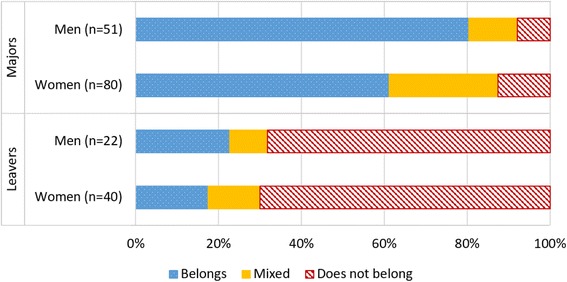
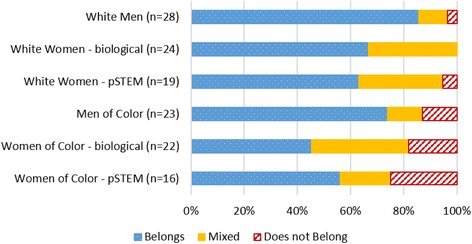
- White men were the most likely to report a sense of belonging compared with all other students (Z = 2.37, p ≤ 0.01), while women of color were the least likely (Z = 3.62, p ≤ 0.01).
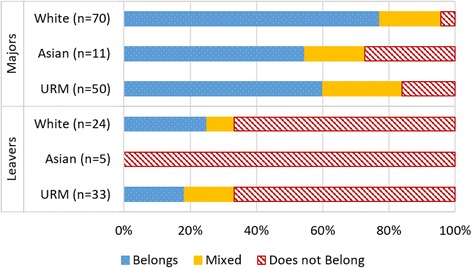
- Female STEM majors were significantly less likely than male majors to report belonging (Z = 2.41, p ≤ 0.01), and students of color who majored in STEM were significantly less likely than white majors to report belonging (Z = 2.23, p ≤ 0.01); leavers across demographic groups were more likely to report not belonging.
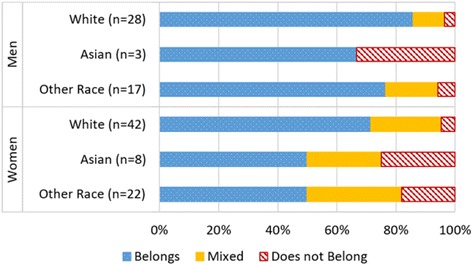
- Representation in a STEM subfield mattered: women of color in physical sciences (pSTEM), where they are highly underrepresented, reported belonging significantly less frequently than white men (Z = 2.17, p ≤ 0.05).
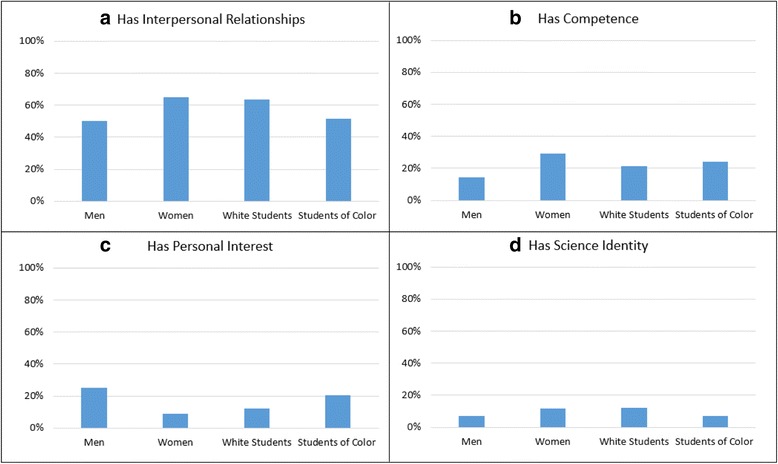
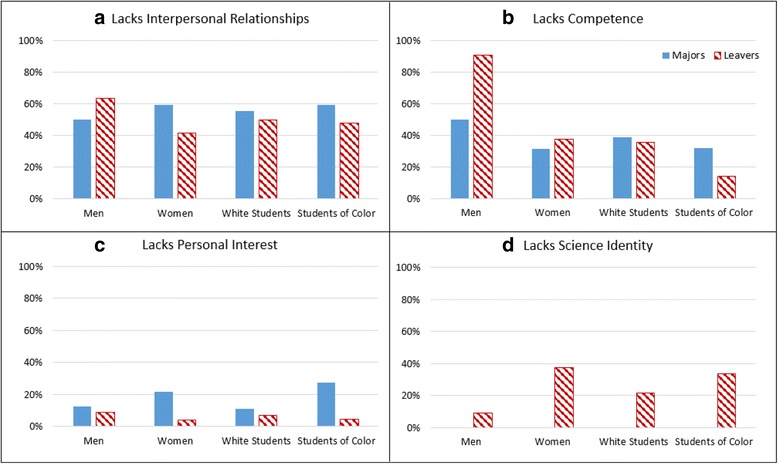
- Four themes explained belonging or lack of belonging: interpersonal relationships, perceived competence, personal interest, and science identity. Interpersonal relationships were the largest factor cited for each demographic group; competence was second. No majors cited a lack of science identity as a reason for not belonging, whereas approximately one quarter of leavers did.
Methods
- Qualitative interview study using a subset of 201 interviews from the larger Roots of STEM Success Project, which conducted more than 300 interviews with college seniors in 2013. Participants attended 1 of the 16 public University of North Carolina campuses, had attended North Carolina public school, were younger than 30, and were either STEM majors or STEM leavers.
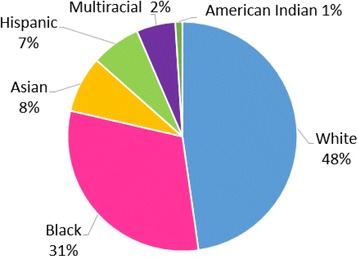
- The purposive sample oversampled students underrepresented in STEM: 66% women and 34% men; 48% white and 52% students of color. Students were recruited via email survey and interviewed for 30–60 min by Skype, phone, or in person.
- Analysis used a partial grounded theory approach: two researchers independently coded interviews, compared codes, and resolved discrepancies through discussion. Belonging explanations were coded into interpersonal relationships, science identity, personal interest, and competence; comparisons used tests of proportions and Z-scores.
Limitations
- The paper states the sample is self-selected and purposive, limited to college seniors in North Carolina who graduated from a North Carolina high school and attended one of the 16 UNC campuses, so findings are not generalizable beyond the sample. It also states only two axes of identity—race and gender—could be investigated.
- The paper acknowledges small subsample sizes, cautioning that some comparisons should be made with caution, and notes debate about using quantitative tests on qualitative data.
- Evident from the text: Asian students were collapsed with other students of color because of low numbers; competence was based on students’ self-perception, not actual grades or course performance; and the data are correlational, so causal direction cannot be determined.
Model-written summary. Check it against the paper before relying on it.
Integrity signals
Registry
Cites
Statistics
Figures
Verification
Claims the paper makes
0 Valid · 0 Not valid · 14 Not checked · 107 Own results and interpretations
A result the paper reports from its own data — it cites no other source for it, so there is none to check. The quote shows it is in the paper.
In the paper
“We find that women of color in pSTEM, where they are highly underrepresented, report belonging significantly less frequently than white men (Z = 2.17, p ≤ 0.05).”
§ Race and gender differences in how sense of belonging influences decisions to major in STEM > Results > The intersection of race and gender in students’ sense of belonging
plainstates an association- Asserted: passes — The authors put it forward as true.
- Checkable: passes — It can be checked against evidence.
- Load-bearing: passes — The paper’s conclusions depend on it.
- Based: passes — The paper gives a reason why it holds.
A result the paper reports from its own data — it cites no other source for it, so there is none to check. The quote shows it is in the paper.
In the paper
“We found that female majors were significantly less likely than male majors to report they felt they belonged in STEM (Z = 2.41, p ≤ 0.01)”
§ Race and gender differences in how sense of belonging influences decisions to major in STEM > Results > The intersection of race and gender in students’ sense of belonging
plainstates an associationn = 51 ·- Asserted: passes — The authors put it forward as true.
- Checkable: passes — It can be checked against evidence.
- Load-bearing: passes — The paper’s conclusions depend on it.
- Based: passes — The paper gives a reason why it holds.
A result the paper reports from its own data — it cites no other source for it, so there is none to check. The quote shows it is in the paper.
In the paper
“we found that students of color who major in STEM are significantly less likely to report a sense of belonging than white majors (Z = 2.23, p ≤ 0.01)”
§ Race and gender differences in how sense of belonging influences decisions to major in STEM > Results > The intersection of race and gender in students’ sense of belonging
plainstates an association- Asserted: passes — The authors put it forward as true.
- Checkable: passes — It can be checked against evidence.
- Load-bearing: passes — The paper’s conclusions depend on it.
- Based: passes — The paper gives a reason why it holds.
A result the paper reports from its own data — it cites no other source for it, so there is none to check. The quote shows it is in the paper.
In the paper
“white men were the most likely to report a sense of belonging when compared to all other students (Z = 2.37, p ≤ 0.01)”
- Also stated in: § Results · plain
“white men were most likely to report a sense of belonging”
§ Race and gender differences in how sense of belonging influences decisions to major in STEM > Results > The intersection of race and gender in students’ sense of belonging
plainstates an association- Asserted: passes — The authors put it forward as true.
- Checkable: passes — It can be checked against evidence.
- Load-bearing: passes — The paper’s conclusions depend on it.
- Based: passes — The paper gives a reason why it holds.
- Also stated in: § Results · plain
A result the paper reports from its own data — it cites no other source for it, so there is none to check. The quote shows it is in the paper.
In the paper
“the patterns for Asian students match those of URMs’ more closely than those of white students”
§ Race and gender differences in how sense of belonging influences decisions to major in STEM > Results > The intersection of race and gender in students’ sense of belonging
plainstates an association- Asserted: passes — The authors put it forward as true.
- Checkable: passes — It can be checked against evidence.
- Load-bearing: passes — The paper’s conclusions depend on it.
- Based: passes — The paper gives a reason why it holds.
87 more claims
Create a free account to see all 121 claims and to verify the 25 references still open.
- The quote only partly states this claim. 2
- It may state two separate claims as one. 18
- Probably not a substantial claim. 14
Claims other papers make about this one
Each is checked against this paper’s own text: does it say what the citing paper says it does?
The source backs part of the claim, not all of it — or backs it for a different population, condition or comparison.
In the citing paper
“In a qualitative study contrasting students that persisted with those who left STEM, Rainey etal. (2018) found that while all students expressed the importance of sense of belonging, those that left their STEM major were lacking science identity.”
From "It Just Makes It Feel Like You're Not Alone": A Qualitative Study of a Social Support Group for High-Achieving, Low-Income STEM Majors (2024) · cites this paper as Rainey et al., 2018
Experimental — accuracy not yet measuredThe source backs part of the claim, not all of it — or backs it for a different population, condition or comparison.
In the citing paper
“More recent research focused specifically on STEM students suggests that institutional practices that promote STEM students' interpersonal relationships, perceived competence, personal interest, and science identity contribute to feelings of belonging (Rainey et al., 2018).”
From The Importance of STEM Sense of Belonging and Academic Hope in Enhancing Persistence for Low-Income, Underrepresented STEM Students (2024) · cites this paper as Rainey et al., 2018
Experimental — accuracy not yet measuredThe source backs part of the claim, not all of it — or backs it for a different population, condition or comparison.
In the citing paper
“Understanding representation matters and youth need to see people that look like them in leadership roles in science in order for them to visualize themselves in these fields (Indian University 2019; Rainey et al. 2018).”
From Creating Community and Engaging Community: The Foundations of the Estate Little Princess Archaeology Project in St. Croix, United States Virgin Islands (2022) · cites this paper as Rainey et al. 2018
Experimental — accuracy not yet measuredThe cited source says what the claim attributes to it.
In the citing paper
“Additionally, in their qualitative investigation, Rainey et al. found that STEM students' perceptions of sense of belonging affected their decisions to persist or withdraw from their STEM major.”
From The Importance of STEM Sense of Belonging and Academic Hope in Enhancing Persistence for Low-Income, Underrepresented STEM Students (2024) · cites this paper as Rainey et al., 2018
Self-check
Percentages, sums and reported differences re-computed from the paper’s own numbers.
Each contradiction between two passages listed here was confirmed by an independent check.
Rated minor: it would not touch a result — a value no result rests on, a p-value that stays on the same side of the significance level, or a conflict that is clerical, resolved elsewhere in the paper, or outside its own findings.
In the paper
§ Race and gender differences in how sense of belonging influences decisions to major in STEM > Results > The intersection of race and gender in students’ sense of belonging
“We have responses from 22 men and 40 women who were leavers.”
§ Race and gender differences in how sense of belonging influences decisions to major in STEM > Results > The intersection of race and gender in students’ sense of belonging
“We have responses from 24 white students, 5 Asian students, and 35 URMs who were leavers.”
Citations
Cites
Mapping the Margins: Intersectionality, Identity Politics, and Violence against Women of Color
Crenshaw, K. (1991) · Stanford Law Review · doi:10.2307/1229039 · Cited by 32,792 · cited 5×
“Intersectionality refers to the idea that aspects of one’s identity (e.g., race, gender, class, sexual orientation) are not unitary and mutually exclusive, but instead interact to construct one’s identity (Crenshaw 1991; Collins 2015).”
InfluentialThe Journal of College Science Teaching
(1971) · Journal of Chemical Education · doi:10.1021/ed048p284 · Cited by 3,332
Women, Minorities, and Persons with Disabilities in Science and Engineering: 2013: (558442013-001)
(2013) · PsycEXTRA Dataset · doi:10.1037/e558442013-001 · Cited by 2,471
Carlone, H. B., & Johnson, A. (2007) · Journal of Research in Science Teaching · doi:10.1002/tea.20237 · Cited by 2,433 · cited 5×
“There exist other intersectional works that investigate women of color’s experiences (e.g., Carlone and Johnson 2007; Crenshaw 1991), but we had difficulty finding literature that focused on women of color’s sense of belonging.”
InfluentialIntersectionality's Definitional Dilemmas
Collins, P. H. (2015) · Annual Review of Sociology · doi:10.1146/annurev-soc-073014-112142 · Cited by 2,419
Mattley, C., Strauss, A., & Corbin, J. (1999) · Contemporary Sociology · doi:10.2307/2655359 · Cited by 2,408 · cited 1×
“Using a partial grounded theory approach to qualitative data analysis (Strauss and Corbin 1997), two researchers independently read the responses and coded under broad categories, some of which were determined a priori and others that emerged from the data.”
A question of belonging: Race, social fit, and achievement.
Walton, G. M., & Cohen, G. L. (2007) · Journal of Personality and Social Psychology · doi:10.1037/0022-3514.92.1.82 · Cited by 2,163
Bowleg, L. (2008) · Sex Roles · doi:10.1007/s11199-008-9400-z · Cited by 2,004 · cited 1×
“For example, considering race and gender as single axes of identity without analysis of the intersections of those groups can lead to the erasure of some identities, such as for women of color (Bowleg 2008; Crenshaw 1991).”
A Brief Social-Belonging Intervention Improves Academic and Health Outcomes of Minority Students
Walton, G. M., & Cohen, G. L. (2011) · Science · doi:10.1126/science.1198364 · Cited by 1,992
Classroom Belonging among Early Adolescent Students: Relationships to Motivation and Achievement
Goodenow, C. (1993) · The Journal of Early Adolescence · doi:10.1177/0272431693013001002 · Cited by 1,614 · cited 1×
“Sense of belonging refers to “students’ sense of being accepted, valued, included, and encouraged by others (teachers and peers) in the academic classroom setting and of feeling oneself to be an important part of the life and activity of the class” (Goodenow 1993, p. 80).”
Research works printed but not linked: 6
- Meiners, E., Fuller, L., McCullough, L., Newell, D., Bartsch, I., & Daly, C. (2004). Special Issue: Women in Science Vol. 5,# 4, May 2004 Editor, Heidi Fencl, University of Wisconsin Green Bay, Department of Physics. Journal of International Women’s Studies, 5, 1.
- Mickelson RA Parker A Stearns E Moller S Dancy M Ruiz-Smith Lawson Clark S Family matters: familial support and African American female success Contemporary African American families: achievements, challenges, and empowerment strategies in the 21st century 2015 New York Routledge-Taylor & Francis
- National Research Council (2013). Seeking solutions: maximizing American talent by advancing women of color in academia: summary of a conference. Washington: National Academies Press.
- National Science Foundation National Center for Science and Engineering Statistics Women, minorities, and persons with disabilities in science and engineering: 2017 2017 Arlington Special Report NSF 17–310
- Shain, C. H. (2002). Revisiting the problem of engineering school persistence in African-American women students. Doctoral dissertation. Retrieved from ProQuest Dissertations and Theses database. (Publication No. 304798888).
- Valenzuela, Y. (2006). Mi fuerza/my strength. The academic and personal experiences of Chicana/Latina transfer students in math and science. Doctoral dissertation. Retrieved from Pro-Quest Dissertation and Theses database. (Publication No. 304916976).
Cited by
Items 601–700 of 708
Petean, R., & Rincon, R. (2025) · Collaborative Network for Engineering and Computing Diversity Conference (CoNECD) · doi:10.18260/1-2--54080
de Sousa, B. F., Challco, G. C., Reis, M., Barbosa, J. F. S., Martins, F. R. D. N., Isotani, S., & Bittencourt, I. I. (2025) · Revista Brasileira de Informática na Educação · doi:10.5753/rbie.2025.4474
Environmental justice is geoscience. How should we teach it?
Jones, J. C., Figueroa, E., Uhr, Z., & Wyman, C. (2025) · Journal of Geoscience Education · doi:10.1080/10899995.2025.2506027 · Cited by 2
“Incorporating guests from a range of fields and backgrounds can help students to see themselves and their interests reflected in course content (Rainey et al., 2018; Rodriguez & Blaney, 2021).”
Adolescents’ Advanced STEM Course Intentions: Predictors and Reasoning
Cerda‐Smith, J., Ozturk, E., Joy, A., & Mulvey, K. L. (2025) · Sex Roles · doi:10.1007/s11199-025-01595-1 · Cited by 2
“…using adapted parents, teachers, and counselors, and STEM class belong - ing may be stronger predictors for girls (National Science Board, 2022 ; Rainey et al., 2018 ; Tai et al., 2006) whereas STEM class grades and encouragement from friends may be stronger predictors for boys (Crombie et al.,…”
InfluentialTancredi, S., Menzies, C. M., Bonnettte, R., Lambert, R., Harriss, E., Akdemir, Z., Zaghi, A. E., Syharat, C. M., & Lewis, K. (2025) · Proceedings. · doi:10.22318/icls2025.155078 · Cited by 1
A syllabus analysis tool to advance inclusive and equitable teaching
Thomas, R. C., Soicher, R. N., Baker, A. R., & BuGhanem, L. (2025) · To improve the academy · doi:10.3998/tia.7209
Ghadiri, M., McNaughtan, J. L., & Garza, T. (2025) · Community College Journal of Research and Practice · doi:10.1080/10668926.2025.2521640
“Generally, four factors were reported to be decisive in students’ sense of belonging, females in particular, making them persist or leave the program, namely “interpersonal relationships,” “personal interest,” “competence,” and “science identity” (Rainey et al., 2018, p. 7).”
Guiding Research, Building Belonging: Librarians' Role in Honors Undergraduate Research
Pierdinock-Weed, A., Gammons, R., & Carpenter, L. I. (2025) · IGI Global eBooks · doi:10.4018/979-8-3373-0644-5.ch013
Rethinking Sense of Belonging After the Pandemic: The Perspectives of Senior Housing Directors
Cawthon, T. W., Kniess, D. R., & Johnson, R. B. (2025) · The Journal of College and University Student Housing · doi:10.71348/001c.142691
Cáceres, C., English-Clarke, T., & Graham, J. (2025) · Integrative and Comparative Biology · doi:10.1093/icb/icaf144 · Cited by 1
Surveying Diverse Student Voices in Introductory Biology Courses Using Conceptual Metaphor AnalysisPreprint
Ramos, L., Zanzucchi, A., Squibb, S. D., & Beaster‐Jones, L. (2025) · SSRN Electronic Journal · doi:10.2139/ssrn.5385238
Ushering URM STEM teachers into STEM spaces: A model to increase STEM community access and belonging
Miller, B. K., & Burnett, C. S. (2025) · American Journal of STEM Education · doi:10.32674/apgaqn33
WIP: Students' Experiences with Engineering Classroom Exams
Li, T., Douglas, K. A., Nasiru, N., & Masta, S. (2025) · ASEE Annual Conference & Exposition · doi:10.18260/1-2--57448
Aligning Student Interest with Program Design in Engineering Education
Baldis, J., Phan, A., & Duerr, J. (2025) · ASEE Annual Conference & Exposition · doi:10.18260/1-2--57590
Jones, R., Barrios, M. S., & Luster-Teasley, S. (2025) · 2025 ASEE Annual Conference & Exposition Proceedings · doi:10.18260/1-2--57417
Reinventing Recruitment Strategies to Increase Attendance by Women
Casner, M., & Lollar, N. (2025) · ASEE Annual Conference & Exposition · doi:10.18260/1-2--57124
Bridging Pathways: Empowering Latinx STEM Students Through Belonging, Support, and Equity
Arellano, L., & Rodriguez, M. (2025) · ASEE Annual Conference & Exposition · doi:10.18260/1-2--56012
“However, literature shows that financial and gender disparities further influence a student’s access and belonging within STEM education (Rainey et al., 2018).”
Black Male STEM Identities as Motivators to Engage in a High School Academy of Engineering
Fletcher, E. C., Carroll, T., & Ford, D. Y. (2025) · Journal of Minority Achievement Creativity and Leadership · doi:10.5325/minoachicrealead.3.1-2.0111
Feminist and Trauma-Informed Approaches to Teaching Formal Philosophy
Calderón, F., Colclough, T. M., & Meskhidze, H. (2025) · Hypatia · doi:10.1017/hyp.2025.10025
Lee, S. W., Miyasato, H., Tirado, J., Dingwall, S., & Cardullo, R. A. (2025) · PLoS ONE · doi:10.1371/journal.pone.0332153
Gardiner-Walsh, S. J. (2025) · Springer international handbooks of education · doi:10.1007/978-3-031-60258-0_33
Dhopade, P., Tizard, J., Watson, P. W. S. J., Fox, A., Allen, T., Namik, H., Karan, A., Roy, R., & Blincoe, K. (2025) · Journal of Engineering Education · doi:10.1002/jee.70029 · Cited by 1
“Race and gender have impacted the sense of belonging in tertiary STEM education (Lewis et al., 2016; Rainey et al., 2018).”
Berlyn, A., Fall, R., Puvanendran, S., & Mutambuki, J. M. (2025) · Journal of Chemical Education · doi:10.1021/acs.jchemed.5c01119 · Cited by 2
Fitting in: A Black Woman’s Perception
Miles, R. (2025) · Contemporary trends and issues in science education · doi:10.1007/978-3-031-99382-4_8
Diverging pathways: first-year college courses and the gender gap in STEM degree attainment
Gelbgiser, D., & Mcdossi, O. (2025) · Social Forces · doi:10.1093/sf/soaf174
Ponjuán, L., Roberts-Gray, C., Cresswell, J., Allen, C., Sanchez, A., & Metoyer, S. K. (2025) · American Journal of STEM Education · doi:10.32674/k392sg06
Exploring Belonging in Higher Education Through Creativity: An Academic's Narrative
Beigi, R. (2025) · Belonging. · doi:10.1177/30290805251372613
“This invisibility is not just about being overlooked or disregarded; it is a deeper, more insidious experience, where my sense of belonging is continuously undermined by racial and gendered assumptions (Rainey et al., 2018).”
Developing Culturally Responsive Learning Environments in STEM Education
Ampaw, F. D., Hornak, A. M., Hamstra, C. A., & Nelson, T. (2024) · Emerald Group Publishing Limited eBooks · doi:10.1108/979-8-88730-467-020251027
Aquí Estamos: Latina/o/x Transfer Students Developing a Sense of Belonging as eSTEMos Scholars
Acevedo, N. (2023) · Emerald Group Publishing Limited eBooks · doi:10.1108/979-8-88730-360-420251009
Kloppers, M. M., Roux, A., & Potgieter, E. (2025) · doi:10.4102/aosis.2025.bk458.06
Chapter 10: Soft skills for English language teachers to thrive in a VUCA world
Kruger, J., & Kaiser, K. (2025) · doi:10.4102/aosis.2025.bk458.010
Allen, D., Dancy, M., Stearns, E., Mickelson, R. A., & Bottía, M. C. (2022) · Figshare · doi:10.6084/m9.figshare.19204545
Self-citationThomas, D. R., & Larwin, K. H. (2024) · Figshare · doi:10.6084/m9.figshare.26597477
Abe, E. N., & Chikoko, V. (2020) · Figshare · doi:10.6084/m9.figshare.13310296
Grigorian, K., Östberg, V., Raninen, J., & Brolin Låftman, S. (2024) · Figshare · doi:10.6084/m9.figshare.26687016
Lin, S., & Tse, A. W. C. (2025) · International Journal of Educational Research · doi:10.1016/j.ijer.2025.102851
Vanderbijlpark, C., & Gordon, S. (2025) · doi:10.4102/aosis.2025.bk458.00
Karim, A. H. A., & Kangani, K. (2026) · IIUM Journal of Educational Studies · doi:10.31436/ijes.v14i1.660
A 21st-century perspective on reading instruction
Pedro, S., Esterhuizen, S., & Koen, M. (2025) · doi:10.4102/aosis.2025.bk458.011
Design-a-scientist avatar: A new tool for analyzing gender and racial scientist stereotypes
Joy, A., Mathews, C. J., Mulvey, K. L., & Hartstone‐Rose, A. (2026) · PLoS ONE · doi:10.1371/journal.pone.0341309
Morales, D. X., Yao, K., Machabeli, M., Collins, T. W., & Grineski, S. E. (2026) · Annals of the New York Academy of Sciences · doi:10.1111/nyas.70227 · Cited by 1
Getting Bullied in College: Implications for Resilience, Belonging, and Personal Health
Donoghue, C., Espelage, D. L., Migliaccio, T. A., Bixter, M. T., Park, E. Y., Reinschmidt, R. S., & Siclari, R. (2026) · International Journal of Bullying Prevention · doi:10.1007/s42380-026-00344-6 · Cited by 1
Promoting Success for Latinas in STEM: Community of Care at Mount San Antonio College
Mejia, M. P., & Felix, D. (2026) · Emerald Group Publishing Limited eBooks · doi:10.1108/978-1-80592-991-820261010 · Cited by 1
Pathways to Advancing Latinas in STEM in Regional Contexts
(2026) · Emerald Group Publishing Limited eBooks · doi:10.1108/978-1-80592-991-820261019
Setia, A., Perkins, T. R., Laws, H. B., & Dasgupta, N. (2026) · Frontiers in Developmental Psychology · doi:10.3389/fdpys.2026.1708547
Aikawa, S. M., Pietri, E. S., Floyd, N., & Park, B. (2026) · Group Processes & Intergroup Relations · doi:10.1177/13684302261417969
“Consistent with these patterns, racially marginalized women report lower fit and higher threat in STEM compared to other students (Casad et al., 2019; Rainey et al., 2018), and report that race and gender impact their STEM experiences (Campbell-Montalvo et al., 2022; Dancy et al., 2020).”
Sense of Belonging, Trust and Anxiety in STEM in a regional Australian University
Mason, R., Seton, C., & Hendry, A. (2026) · Australasian Computing Education Conference · doi:10.1145/3786228.3786251
“Research across science disciplines reveals significant variations in belonging experiences, attributed partly to differences in collaborative learning opportunities and departmental culture [19].”
Arthur, L. C., Walker, I., Anderson, R., & Godinho, L. N. (2025) · International Journal of Innovation in Science and Mathematics Education · doi:10.30722/33.02.002
Elevating scientific training by building a Research Alliance for Inclusive STEM Education (RAISE)
Niepielko, M. G. (2026) · Journal of Microbiology and Biology Education · doi:10.1128/jmbe.00033-26
Jackson, B. D., Robinson, B. H., Madison, M. J., & Andrews, T. C. (2026) · CBE—Life Sciences Education · doi:10.1187/cbe.25-09-0199 · Cited by 1
“In this way, we avoided assuming that an instructional intervention equitably impacted all students, an assumption commonly made and repeatedly demonstrated to be false (e.g., Ballen et al. , 2018; Rainey et al. , 2018; Solanki et al. , 2019; Wilton et al. , 2019).”
InfluentialBusiness-led informal STEM outreach: bridging industry, education, and workforce development
Alston-Socha, W., Rogers, K., Hudson, K. N., & Campbell, T. (2026) · Disciplinary and Interdisciplinary Science Education Research · doi:10.1186/s43031-026-00161-3 · Cited by 1
STEM Identity Development: Leveraging Teacher STEM Identity to Design Activities for Students
Pallant, A., Lord, T., Lore, C., & Lee, H. (2026) · Journal of Science Teacher Education · doi:10.1080/1046560x.2026.2654360
“…identified several personal and experiential factors that help build student STEM identity: exposure to role models (Johnson, 2012); feelings of belonging (Maton et al., 2016; Rainey et al., 2018); and authentic learning experiences (Beier et al., 2019; Chi et al., 2015; Wallace & Bodzin, 2017).”
Saigo, H. (2026) · Research Square · doi:10.21203/rs.3.rs-5856948/v1
Redd, K., & Bräuer, M. (2026) · Frontiers in Education · doi:10.3389/feduc.2026.1798600 · Cited by 1
“On the other hand, when a sense of belonging is absent for students of color, they feel more isolated and less willing to persist (Ovink et al., 2024; Rainey et al., 2018).”
Heller, B., Pakala, K., Lowenthal, P. R., Hamby, A. M., & Jankowski, E. (2026) · Education Sciences · doi:10.3390/educsci16050710
Fong, M. M., Watkins, A., & Herman, G. L. (2026) · Computer Science Education · doi:10.1080/08993408.2026.2667870 · Cited by 1
Journey to Authenticity: Finding a Way for Women to Thrive in Engineering Technology
Dell, B. (2026) · Women in engineering and science · doi:10.1007/978-3-032-07645-8_4
di Buronzo, L. M. B. (2026) · OLYMPIADS IN INFORMATICS · doi:10.15388/ioi.2026.03
“…boost other aspects of a person’s life, like overall performance and persistence (Wigfield, 1994; Peterson, 2000; Emerick, 1992), and social identity, which is particularly important given that early sense of STEM-belonging predicts achievement, well-being, and resilience (Rainey et al. , 2018).”
Addressing Biases Through Decoloniality and Belonging in STEM: A Cross-Disciplinary Dialogue
Dei-Sharpe, J. A. Y., Crandall, K., Ford, J., Jreidini, N., Ozyonum, E., & Sidibé, H. (2026) · Critical studies of education · doi:10.1007/978-981-96-9136-4_8
Mualeite, A. R. U., & Heckler, V. (2026) · Revista Ibero-Americana de Humanidades, Ciências e Educação · doi:10.51891/rease.v12i6.26774
Price, R. (2026) · Integrative Organismal Biology · doi:10.1093/iob/obag028
Dukes, A. A., Gillian‐Daniel, D. L., Greenler, R., Parent, R., Bridgen, S., Esters, L. T., El-Sayed, J., & Hill, L. B. (2022) · Emerald Group Publishing Limited eBooks · doi:10.1108/979-8-88730-047-420251011
Fostering Belonging Through Introducing Diverse Scientists in Undergraduate Neuroscience Lectures
Northcutt, K. V. (2026) · Journal of Undergraduate Neuroscience Education · doi:10.59390/001c.161078
“Students from historically under-represented groups in STEM typically report less belonging (Barnes et al., 2021; Freeman, 2020; Lewis et al., 2017; Rainey et al., 2018), and belonging is one predictor of persistence in a STEM major (Hansen et al., 2024; Lewis et al., 2017; Rainey et al., 2018).”
Anonymous, & Stewart, J. C. (2026) · Physical Review Physics Education Research · doi:10.1103/lkdr-cz49
“For example, female students are more likely to report lower levels of belonging in physics than their peers [46,47].”
Audibert, K. (2026) · InSPIRe@Redlands (University of Redlands) · doi:10.26716/redlands/doctor/2026.11
Schusler, T. M., Jing, P., Dahal, D., Maertens, J., Zapata, I. B., Zhang, B., Sablan, O., Pollack, I. B., Hartnett, N., Bautista, O., et al. (2026) · Journal of Environmental Studies and Sciences · doi:10.1007/s13412-026-01121-z
Underserved and Underrepresented College Students’ Resilience During Covid-19
Tyler, J. M., Collins, J., Shannon, D., Carney, J. S., & LaPolla, M. (2025) · Emerald Group Publishing Limited eBooks · doi:10.1108/979-8-88730-897-520251014
Making college work: lessons from a bridge program for incoming students
Lin, E. X., Lisberg, A. E., Levas, S., & Hidayat, D. G. (2026) · Frontiers in Education · doi:10.3389/feduc.2026.1813008
Xu, X., & Tan, L. (2026) · European Journal of Engineering Education · doi:10.1080/03043797.2026.2671265
Unmasking Structural Inequities and Systemic Violence
(2026) · Emerald Group Publishing Limited eBooks · doi:10.1108/978-1-80686-595-620261015
The Violent Effects of the “Invisible Tax” on Black Students in K–12 Schools
Jones, D. L. (2026) · Emerald Group Publishing Limited eBooks · doi:10.1108/978-1-80686-595-620261004
Engineering technology through a constructivist lens: student motivations and experiences
Yang, J. X., Rodriguez, M. M., Boss, M. C., Lucietto, A. M., Mungo, M. H., Berhan, L. M., Kumar, R., Archer, J., & Chen, J. (2026) · Frontiers in Education · doi:10.3389/feduc.2026.1668377
Tran, M.-H. D., Fan, W., de la Rosa-Pohl, D., Master, A., Arbona, C., & Olvera, N. E. (2026) · International Journal of STEM Education · doi:10.1186/s40594-026-00636-9
“Although some studies report that women exhibit lower levels of STEM identity due to disparities in representation and climate (Cohen et al., 2021; Rainey et al., 2018), other work finds no significant gender differences in identity development (Li et al., 2021), and in some cases identity may…”
Lund, V. K., Broemmel, A. D., Rearden, K. T., & Broussard, J. (2026) · Children s Literature in Education · doi:10.1007/s10583-026-09705-7
Choi, J., Zahran, W., Ortagus, J. C., Rosinger, K. O., Allchin, H., & Kelchen, R. (2026) · Educational Evaluation and Policy Analysis · doi:10.3102/01623737261449256
Weckel, M., Gupta, P., Moore, K. S., Chaffee, R., Lee, I. A., Rabinowitz, G. S., & Ali, S. (2026) · Frontiers in Education · doi:10.3389/feduc.2026.1811339
Arora, E., Sadek, W., & Bielawski, J. P. (2026) · Canadian Journal of Science Mathematics and Technology Education · doi:10.1007/s42330-026-00492-3
“Enhanced ASB positively influences the decision of URM students to choose and stick with STEMM majors (Hausmann et al., 2007; Rainey et al., 2018).”
Mapping STEM Identity: Lived Experiences that Impact Student Attitudes toward STEM
Ironside, V., & Harris, J. (2026) · Proceedings of the Canadian Engineering Education Association (CEEA) · doi:10.24908/pceea.2026.21615
Cheng, K. C., Jung, S. E., Hokama, M. M., & Khalid, M. (2026) · The Journal of Experimental Education · doi:10.1080/00220973.2026.2719477
Why Not Me? A Photovoice Study of Belonging and Identity Formation Among Gender Minorities in STEM
Harcharik, D., Davishahl, J., & Stuart, L. S. L. (2026) · ASEE Annual Conference & Exposition · doi:10.18260/1-2--60781
Turpen, C., Marbach‐Ad, G., Jones, A. L., Thompson, K. V., Hammer, D., Hernandez, I., Kahn, J., Kodaiarasu, K., & Seo, E. S. (2026) · ASEE Annual Conference & Exposition · doi:10.18260/1-2--60849
A Mutual Benefit Approach to Address Systemic Underrepresentation in STEM Higher Education
Louis, G., Aufderheide, B., Nare, O., & Barnes, L. (2026) · ASEE Annual Conference & Exposition · doi:10.18260/1-2--59058
Swan, C., Kelly, J., Yismashewa, B., & Rochdi, S. (2026) · ASEE Annual Conference & Exposition · doi:10.18260/1-2--59556
Codere, S., & Murray, F. (2026) · ASEE Annual Conference & Exposition · doi:10.18260/1-2--59789
Larson, A., Allen, D., & Thorsen, D. (2026) · ASEE Annual Conference & Exposition · doi:10.18260/1-2--60476
A Mixed-Methods Analysis of Perceived Costs and Assets Among Underrepresented College Students
Corpus, J. H., & Mumo, J. (2026) · The Journal of Experimental Education · doi:10.1080/00220973.2026.2719479
Johns, C., & Gehrtz, J. (2026) · International Journal of Mathematical Education in Science and Technology · doi:10.1080/0020739x.2026.2719549
Gay, A., Bunch, Z., Ahmed, R., Jones, A., Wise, J., Ward, L., & Popova, M. (2026) · Journal of Chemical Education · doi:10.1021/acs.jchemed.5c01720
Krishnan, S., Cobb, I. D., Harsh, J. A., Mejia, M., & Corwin, L. A. (2026) · Science Education · doi:10.1002/sce.70097
Fadillah, M. A., Κaliampos, G., Samala, A. D., Hirahmah, A., & Usmeldi, U. (2026) · SN Social Sciences · doi:10.1007/s43545-026-01705-0
“Likewise, gender-related scholarship continues to document disparities in participation, belonging, and representation (Chiu et al. 2025 ; Kayan-Fadlelmula et al. 2022 ; Kricorian et al. 2020 ; Rainey et al. 2018 ).”
Silva, W. F., Fong-Amaris, W., & Ardila-Morales, L. M. (2026) · IPSA Scientia revista científica multidisciplinaria · doi:10.62580/ipsc.2026.11.236
Increasing equity, inclusion, and belonging for postbaccalaureate learners on the pre-health pathway
Martinez, C. (2026) · Digital Repository Service (Northeastern University) · doi:10.17760/d20862575
The role of holistic student mentorship in academia
Palomo-Muñoz, G., Rega‐Brodsky, C. C., & Lafferty, D. J. R. (2026) · Ecosphere · doi:10.1002/ecs2.70749
Ha, N. T. N., & Bao, N. V. (2026) · Higher Education Research & Development · doi:10.1080/07294360.2026.2730960
DeCuir‐Gunby, J. T., Schutz, P. A., & Modaressi, S. L. (2026) · Educational Psychology Review · doi:10.1007/s10648-026-10220-w
“…contexts that undermine their sense of belonging (DeCuir-Gunby et al., 2024; Graham et al., 2022; Hansen et al., 2024; Johnson, 2012, 2022, 2026; Mat-thews et al., 2024; Modaressi and DeCuir-Gunby, 2026; Schutz et al., 2020; Rainey et al., 2018; Rodriguez & Blaney, 2021; Strayhorn, 2018).”
Mazur, C. M., Førland, O., Gya, R., Holtermann, K., Pavlovic, Z., Saltskår, T. R., Sørensen, J. K., Thormodsæter, R. S., Hjelmborg, K. V. B., Balgopal, M. M., et al. (2026) · Education Sciences · doi:10.3390/educsci16101605
Chen, Y., & Knackmuhs, E. G. (2026) · International Journal of Physical Education Fitness and Sports · doi:10.54392/ijpefs2637
“Only a few collected data from a specific department such as biology, psychology, computing, and the collective field of science, technology, engineering and mathematics (STEM) (Knekta et al., 2020; Krafona 2014; Rainey et al., 2018; Runa et al., 2025; Wilson et al., 2015).”
Influential
Metadata
- Authors
- Rainey, K., Dancy, M., Mickelson, R., Stearns, E., & Moller, S.
- Affiliations
- University of Colorado Boulder (US)
- University of North Carolina at Charlotte (US)
- Corresponding author
- Rainey, Katherine
- Venue
- International Journal of STEM Education
- Published
- 2018-04-10
- Volume
- 5
- Issue
- 1
- Pages
- 10-10
- ISSN
- 2196-7822 (ISSN-L)
- PMC
- PMC6310405
- OpenAlex
- W2806119487
- Semantic Scholar
- e9675f21bd5a9f5ad7b5e612848342ead1fe76f3
- Cited by
- 681
- References
- 30
- Citations by year
- 2026: 75 · 2025: 118 · 2024: 141 · 2023: 109 · 2022: 84 · 2021: 74 · 2020: 61 · 2019: 16 · 2018: 2
- FWCI
- 76.00
- Type
- journal article
- Language
- en
- Open access
- gold
- doi.org
- Licence
- cc-by
- creativecommons.org/licenses/by/4.0 (tdm)
- creativecommons.org/licenses/by/4.0 (vor)
- Locations
- International Journal of STEM Education (publishedVersion, cc-by)
- Europe PMC (PubMed Central) (publishedVersion, cc-by)
- PubMed Central (publishedVersion, cc-by)
- PubMed (publishedVersion)
- DOAJ (DOAJ: Directory of Open Access Journals) (submittedVersion, cc-by-sa)
- Funders
- National Science Foundation (0969286)
- Topics
- Social Sciences › Psychology › Applied Psychology › Career Development and Diversity
- Social Sciences › Education › Higher Education Research Studies
- Social Sciences › Sociology and Political Science › Critical Race Theory in Education
- Keywords
- sense of belonging, STEM major choice, underrepresentation in STEM, women in STEM, students of color, gender and race intersection, STEM retention, science identity, perceived competence, interpersonal relationships, college seniors
About these checks
Registry, retraction, Cites and statistics results are computed, not judged, with one exception: a printed reference that no index lists is read once by a model before it counts as a citation error. Claims are extracted by a model and kept only when their quote appears verbatim in the text; each cited source is then checked, with a model’s help, for whether it says what the claim relies on. Those verdicts can be wrong — read the claim’s quote and the cited source before relying on one.
A language model drew the claims from the paper on 2026-10-05, under version 3 of the claim definition (model deepseek-v4.1-flash, prompt extract-v3).
A second model labelled each claim on 2026-10-05 (model jev-1.13-20260917, definition revision gold-guideline-v0.2).
Statistics and arithmetic are recomputed, not judged.
Confidence bands are shown only for fields calibrated on our annotated test set. None is calibrated yet, so no band is shown.
What counts as a claim ›How we measure confidence ›How we check this ›
Are you an author, or do you see a problem with this page? Request a review
Data sources
Bibliographic data: Semantic Scholar, OpenAlex, Crossref.
Contains information from the Semantic Scholar Academic Graph Datasets, made available under the ODC Attribution License (ODC-BY 1.0).
Semantic Scholar’s data is described in: Kinney, R., et al. (2023). The Semantic Scholar Open Data Platform. arXiv:2301.10140.
