

Race and gender differences in how sense of belonging influences decisions to major in STEM
Open accessThe DOI matches its Crossref record; 28 of the 30 references it cites were found in a registry or an index; none of the 25 sources its claims cite is checked for support yet.
Abstract
BACKGROUND: Women and students of color are widely underrepresented in most STEM fields. In order to investigate this underrepresentation, we interviewed 201 college seniors, primarily women and people of color, who either majored in STEM or started but dropped a STEM major. Here we discuss one section of the longer interview that focused on students' sense of belonging, which has been found to be related to retention. In our analysis, we examine the intersections of race and gender with students' sense of belonging, a topic largely absent from the current literature. RESULTS: We found that white men were most likely to report a sense of belonging whereas women of color were the least likely. Further, we found that representation within one's STEM sub-discipline, namely biology versus the physical sciences, impacts sense of belonging for women. Four key factors were found to contribute to sense of belonging for all students interviewed: interpersonal relationships, perceived competence, personal interest, and science identity. CONCLUSIONS: Our findings indicate that students who remain in STEM majors report a greater sense of belonging than those who leave STEM. Additionally, we found that students from underrepresented groups are less likely to feel they belong. These findings highlight structural and cultural features of universities, as well as STEM curricula and pedagogy, that continue to privilege white males.
Overview
CoChat Summary
TL;DR
This interview study of 201 college seniors examines how sense of belonging in STEM varies by race, gender, and their intersections, comparing STEM majors and leavers. It finds white men most likely and women of color least likely to report belonging, with belonging linked to interpersonal relationships, competence, interest, and science identity.
Key findings
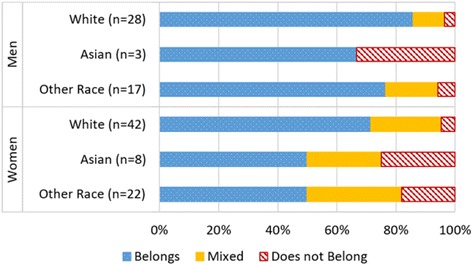
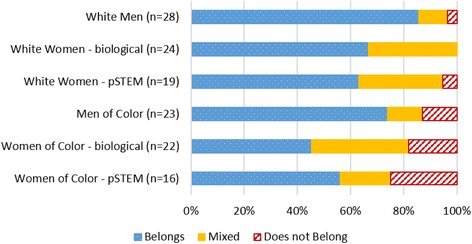
- White men were the most likely to report a sense of belonging compared with all other students (Z = 2.37, p ≤ 0.01), while women of color were the least likely (Z = 3.62, p ≤ 0.01).
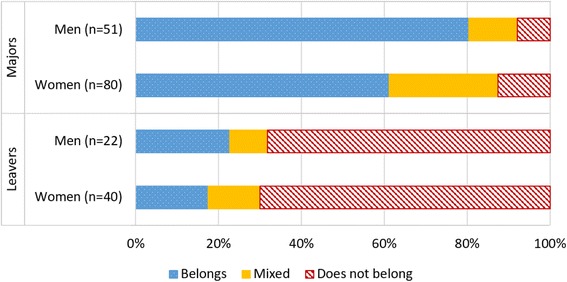
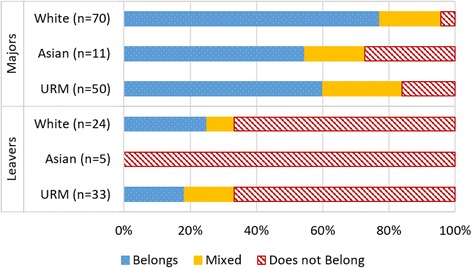
- Female STEM majors were significantly less likely than male majors to report belonging (Z = 2.41, p ≤ 0.01), and students of color who majored in STEM were significantly less likely than white majors to report belonging (Z = 2.23, p ≤ 0.01); leavers across demographic groups were more likely to report not belonging.
- Representation in a STEM subfield mattered: women of color in physical sciences (pSTEM), where they are highly underrepresented, reported belonging significantly less frequently than white men (Z = 2.17, p ≤ 0.05).
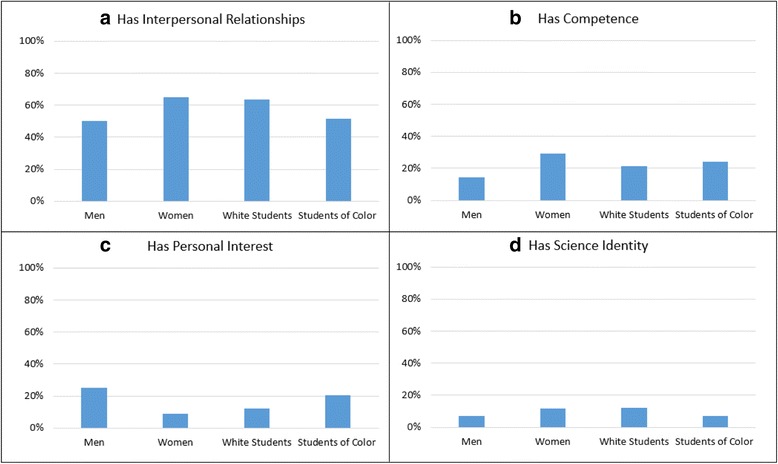
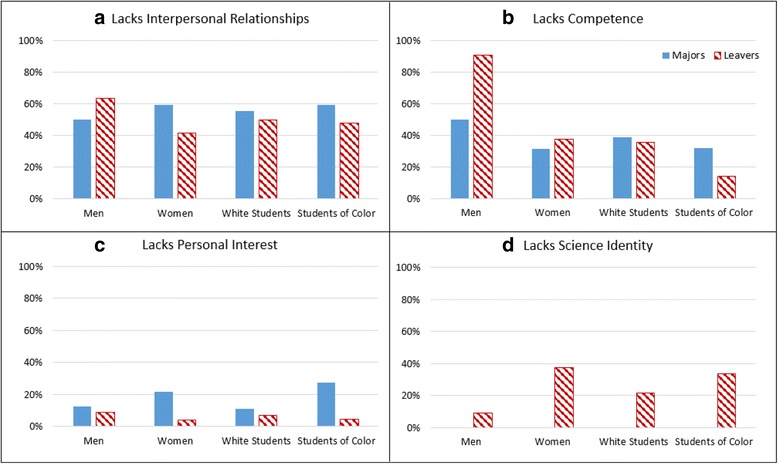
- Four themes explained belonging or lack of belonging: interpersonal relationships, perceived competence, personal interest, and science identity. Interpersonal relationships were the largest factor cited for each demographic group; competence was second. No majors cited a lack of science identity as a reason for not belonging, whereas approximately one quarter of leavers did.
Methods
- Qualitative interview study using a subset of 201 interviews from the larger Roots of STEM Success Project, which conducted more than 300 interviews with college seniors in 2013. Participants attended 1 of the 16 public University of North Carolina campuses, had attended North Carolina public school, were younger than 30, and were either STEM majors or STEM leavers.
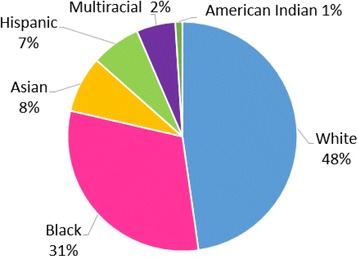
- The purposive sample oversampled students underrepresented in STEM: 66% women and 34% men; 48% white and 52% students of color. Students were recruited via email survey and interviewed for 30–60 min by Skype, phone, or in person.
- Analysis used a partial grounded theory approach: two researchers independently coded interviews, compared codes, and resolved discrepancies through discussion. Belonging explanations were coded into interpersonal relationships, science identity, personal interest, and competence; comparisons used tests of proportions and Z-scores.
Limitations
- The paper states the sample is self-selected and purposive, limited to college seniors in North Carolina who graduated from a North Carolina high school and attended one of the 16 UNC campuses, so findings are not generalizable beyond the sample. It also states only two axes of identity—race and gender—could be investigated.
- The paper acknowledges small subsample sizes, cautioning that some comparisons should be made with caution, and notes debate about using quantitative tests on qualitative data.
- Evident from the text: Asian students were collapsed with other students of color because of low numbers; competence was based on students’ self-perception, not actual grades or course performance; and the data are correlational, so causal direction cannot be determined.
Model-written summary. Check it against the paper before relying on it.
Integrity signals
Registry
Cites
Statistics
Figures
Verification
Claims the paper makes
0 Valid · 0 Not valid · 14 Not checked · 107 Own results and interpretations
A result the paper reports from its own data — it cites no other source for it, so there is none to check. The quote shows it is in the paper.
In the paper
“We find that women of color in pSTEM, where they are highly underrepresented, report belonging significantly less frequently than white men (Z = 2.17, p ≤ 0.05).”
§ Race and gender differences in how sense of belonging influences decisions to major in STEM > Results > The intersection of race and gender in students’ sense of belonging
plainstates an association- Asserted: passes — The authors put it forward as true.
- Checkable: passes — It can be checked against evidence.
- Load-bearing: passes — The paper’s conclusions depend on it.
- Based: passes — The paper gives a reason why it holds.
A result the paper reports from its own data — it cites no other source for it, so there is none to check. The quote shows it is in the paper.
In the paper
“We found that female majors were significantly less likely than male majors to report they felt they belonged in STEM (Z = 2.41, p ≤ 0.01)”
§ Race and gender differences in how sense of belonging influences decisions to major in STEM > Results > The intersection of race and gender in students’ sense of belonging
plainstates an associationn = 51 ·- Asserted: passes — The authors put it forward as true.
- Checkable: passes — It can be checked against evidence.
- Load-bearing: passes — The paper’s conclusions depend on it.
- Based: passes — The paper gives a reason why it holds.
A result the paper reports from its own data — it cites no other source for it, so there is none to check. The quote shows it is in the paper.
In the paper
“we found that students of color who major in STEM are significantly less likely to report a sense of belonging than white majors (Z = 2.23, p ≤ 0.01)”
§ Race and gender differences in how sense of belonging influences decisions to major in STEM > Results > The intersection of race and gender in students’ sense of belonging
plainstates an association- Asserted: passes — The authors put it forward as true.
- Checkable: passes — It can be checked against evidence.
- Load-bearing: passes — The paper’s conclusions depend on it.
- Based: passes — The paper gives a reason why it holds.
A result the paper reports from its own data — it cites no other source for it, so there is none to check. The quote shows it is in the paper.
In the paper
“white men were the most likely to report a sense of belonging when compared to all other students (Z = 2.37, p ≤ 0.01)”
- Also stated in: § Results · plain
“white men were most likely to report a sense of belonging”
§ Race and gender differences in how sense of belonging influences decisions to major in STEM > Results > The intersection of race and gender in students’ sense of belonging
plainstates an association- Asserted: passes — The authors put it forward as true.
- Checkable: passes — It can be checked against evidence.
- Load-bearing: passes — The paper’s conclusions depend on it.
- Based: passes — The paper gives a reason why it holds.
- Also stated in: § Results · plain
A result the paper reports from its own data — it cites no other source for it, so there is none to check. The quote shows it is in the paper.
In the paper
“the patterns for Asian students match those of URMs’ more closely than those of white students”
§ Race and gender differences in how sense of belonging influences decisions to major in STEM > Results > The intersection of race and gender in students’ sense of belonging
plainstates an association- Asserted: passes — The authors put it forward as true.
- Checkable: passes — It can be checked against evidence.
- Load-bearing: passes — The paper’s conclusions depend on it.
- Based: passes — The paper gives a reason why it holds.
87 more claims
Create a free account to see all 121 claims and to verify the 25 references still open.
- The quote only partly states this claim. 2
- It may state two separate claims as one. 18
- Probably not a substantial claim. 14
Claims other papers make about this one
Each is checked against this paper’s own text: does it say what the citing paper says it does?
The source backs part of the claim, not all of it — or backs it for a different population, condition or comparison.
In the citing paper
“In a qualitative study contrasting students that persisted with those who left STEM, Rainey etal. (2018) found that while all students expressed the importance of sense of belonging, those that left their STEM major were lacking science identity.”
From "It Just Makes It Feel Like You're Not Alone": A Qualitative Study of a Social Support Group for High-Achieving, Low-Income STEM Majors (2024) · cites this paper as Rainey et al., 2018
Experimental — accuracy not yet measuredThe source backs part of the claim, not all of it — or backs it for a different population, condition or comparison.
In the citing paper
“More recent research focused specifically on STEM students suggests that institutional practices that promote STEM students' interpersonal relationships, perceived competence, personal interest, and science identity contribute to feelings of belonging (Rainey et al., 2018).”
From The Importance of STEM Sense of Belonging and Academic Hope in Enhancing Persistence for Low-Income, Underrepresented STEM Students (2024) · cites this paper as Rainey et al., 2018
Experimental — accuracy not yet measuredThe source backs part of the claim, not all of it — or backs it for a different population, condition or comparison.
In the citing paper
“Understanding representation matters and youth need to see people that look like them in leadership roles in science in order for them to visualize themselves in these fields (Indian University 2019; Rainey et al. 2018).”
From Creating Community and Engaging Community: The Foundations of the Estate Little Princess Archaeology Project in St. Croix, United States Virgin Islands (2022) · cites this paper as Rainey et al. 2018
Experimental — accuracy not yet measuredThe cited source says what the claim attributes to it.
In the citing paper
“Additionally, in their qualitative investigation, Rainey et al. found that STEM students' perceptions of sense of belonging affected their decisions to persist or withdraw from their STEM major.”
From The Importance of STEM Sense of Belonging and Academic Hope in Enhancing Persistence for Low-Income, Underrepresented STEM Students (2024) · cites this paper as Rainey et al., 2018
Self-check
Percentages, sums and reported differences re-computed from the paper’s own numbers.
Each contradiction between two passages listed here was confirmed by an independent check.
Rated minor: it would not touch a result — a value no result rests on, a p-value that stays on the same side of the significance level, or a conflict that is clerical, resolved elsewhere in the paper, or outside its own findings.
In the paper
§ Race and gender differences in how sense of belonging influences decisions to major in STEM > Results > The intersection of race and gender in students’ sense of belonging
“We have responses from 22 men and 40 women who were leavers.”
§ Race and gender differences in how sense of belonging influences decisions to major in STEM > Results > The intersection of race and gender in students’ sense of belonging
“We have responses from 24 white students, 5 Asian students, and 35 URMs who were leavers.”
Citations
Cites
Mapping the Margins: Intersectionality, Identity Politics, and Violence against Women of Color
Crenshaw, K. (1991) · Stanford Law Review · doi:10.2307/1229039 · Cited by 32,792 · cited 5×
“Intersectionality refers to the idea that aspects of one’s identity (e.g., race, gender, class, sexual orientation) are not unitary and mutually exclusive, but instead interact to construct one’s identity (Crenshaw 1991; Collins 2015).”
InfluentialThe Journal of College Science Teaching
(1971) · Journal of Chemical Education · doi:10.1021/ed048p284 · Cited by 3,332
Women, Minorities, and Persons with Disabilities in Science and Engineering: 2013: (558442013-001)
(2013) · PsycEXTRA Dataset · doi:10.1037/e558442013-001 · Cited by 2,471
Carlone, H. B., & Johnson, A. (2007) · Journal of Research in Science Teaching · doi:10.1002/tea.20237 · Cited by 2,433 · cited 5×
“There exist other intersectional works that investigate women of color’s experiences (e.g., Carlone and Johnson 2007; Crenshaw 1991), but we had difficulty finding literature that focused on women of color’s sense of belonging.”
InfluentialIntersectionality's Definitional Dilemmas
Collins, P. H. (2015) · Annual Review of Sociology · doi:10.1146/annurev-soc-073014-112142 · Cited by 2,419
Mattley, C., Strauss, A., & Corbin, J. (1999) · Contemporary Sociology · doi:10.2307/2655359 · Cited by 2,408 · cited 1×
“Using a partial grounded theory approach to qualitative data analysis (Strauss and Corbin 1997), two researchers independently read the responses and coded under broad categories, some of which were determined a priori and others that emerged from the data.”
A question of belonging: Race, social fit, and achievement.
Walton, G. M., & Cohen, G. L. (2007) · Journal of Personality and Social Psychology · doi:10.1037/0022-3514.92.1.82 · Cited by 2,163
Bowleg, L. (2008) · Sex Roles · doi:10.1007/s11199-008-9400-z · Cited by 2,004 · cited 1×
“For example, considering race and gender as single axes of identity without analysis of the intersections of those groups can lead to the erasure of some identities, such as for women of color (Bowleg 2008; Crenshaw 1991).”
A Brief Social-Belonging Intervention Improves Academic and Health Outcomes of Minority Students
Walton, G. M., & Cohen, G. L. (2011) · Science · doi:10.1126/science.1198364 · Cited by 1,992
Classroom Belonging among Early Adolescent Students: Relationships to Motivation and Achievement
Goodenow, C. (1993) · The Journal of Early Adolescence · doi:10.1177/0272431693013001002 · Cited by 1,614 · cited 1×
“Sense of belonging refers to “students’ sense of being accepted, valued, included, and encouraged by others (teachers and peers) in the academic classroom setting and of feeling oneself to be an important part of the life and activity of the class” (Goodenow 1993, p. 80).”
Research works printed but not linked: 6
- Meiners, E., Fuller, L., McCullough, L., Newell, D., Bartsch, I., & Daly, C. (2004). Special Issue: Women in Science Vol. 5,# 4, May 2004 Editor, Heidi Fencl, University of Wisconsin Green Bay, Department of Physics. Journal of International Women’s Studies, 5, 1.
- Mickelson RA Parker A Stearns E Moller S Dancy M Ruiz-Smith Lawson Clark S Family matters: familial support and African American female success Contemporary African American families: achievements, challenges, and empowerment strategies in the 21st century 2015 New York Routledge-Taylor & Francis
- National Research Council (2013). Seeking solutions: maximizing American talent by advancing women of color in academia: summary of a conference. Washington: National Academies Press.
- National Science Foundation National Center for Science and Engineering Statistics Women, minorities, and persons with disabilities in science and engineering: 2017 2017 Arlington Special Report NSF 17–310
- Shain, C. H. (2002). Revisiting the problem of engineering school persistence in African-American women students. Doctoral dissertation. Retrieved from ProQuest Dissertations and Theses database. (Publication No. 304798888).
- Valenzuela, Y. (2006). Mi fuerza/my strength. The academic and personal experiences of Chicana/Latina transfer students in math and science. Doctoral dissertation. Retrieved from Pro-Quest Dissertation and Theses database. (Publication No. 304916976).
Cited by
Items 201–300 of 708
Factors Influencing Science Career Intention: The Power of Counterspace
Lin, J. C. P., Moon, S., Guan, S. A., Kwan, P. P., Flores, G. E., & Chavira, G. (2024) · Innovative Higher Education · doi:10.1007/s10755-024-09752-2 · Cited by 12
“Studies have also found that women, URG students, and first-generation college students in STEM fields in general report lower belonging than men, white students, and continuing-generation students, respectively (Lewis et al., 2017; Pratt et al., 2019; Rainey et al., 2018).”
Scheuermann, N. L., Idlebird, C., Kukday, S. S., McCracken, V. J., Bradley, R. E., & Bergan‐Roller, H. E. (2024) · CBE—Life Sciences Education · doi:10.1187/cbe.24-01-0013 · Cited by 13
Mkhize, Z. V., & Idahosa, G. E. (2025) · Gender and Education · doi:10.1080/09540253.2024.2445029 · Cited by 21
“Blackburn (2017) has argued that recruiting Black doctoral women in STEM will only be successful if the forerunners stay in the field and complete their studies (Rainey et al. 2018).”
Finding peers “like me”: Student strategies for increasing belonging and flourishing in STEM
Chaffee, R., Björklund, P., Braverman, C., Gupta, P., Hammerness, K. M., Daly, A. J., MacPherson, A. C., Adams, J. D., Abouelkheir, M., Francis, J., et al. (2025) · Journal of Applied Developmental Psychology · doi:10.1016/j.appdev.2025.101758 · Cited by 17
Factors that Influence Career Choice of Graduating Pharmacy Students
Gargalicano, C. A. G., Oca, P. R. D., Galicia, H. J. S., Arosa, A. A. M., Radadon, S. T. A., & Gargalicano, F. G. (2023) · International Journal of Multidisciplinary Applied Business and Education Research · doi:10.11594/ijmaber.04.02.32 · Cited by 11
Learning Analytics in Physics Education: Equity-Focused Decision-Making Lacks Guidance!
Grimm, A., Steegh, A., Kubsch, M., & Neumann, K. (2023) · Journal of Learning Analytics · doi:10.18608/jla.2023.7793 · Cited by 19
Stoddard, S. V. (2022) · Education Sciences · doi:10.3390/educsci12070498 · Cited by 14
Burrows, D., Pietri, E. S., Johnson, I. R., & Ashburn‐Nardo, L. (2021) · Sex Roles · doi:10.1007/s11199-021-01253-2 · Cited by 15
Google, A. N., Sekaya, G., McMullen, Z., & Henning, J. A. (2023) · Frontiers in Education · doi:10.3389/feduc.2023.1183907 · Cited by 12
LGBTQ+ faculty, queering health sciences classrooms: student perspectives
Moreira, J. D., Godley, S., & DeBiasse, M. A. (2024) · AJP Advances in Physiology Education · doi:10.1152/advan.00200.2023 · Cited by 11
Eslami, M., Denaro, K., Collins, P., Sumarsono, J. M., Dennin, M. B., & Sato, B. K. (2024) · PLoS ONE · doi:10.1371/journal.pone.0301331 · Cited by 12
Lucas, K. L., & Vandergon, T. L. (2024) · Education Sciences · doi:10.3390/educsci14060624 · Cited by 17
“…the past their teachers and current biology professors viewed them as science people, which was the median response on both pre-course and post-course surveys (see Figure 4). have been building a stronger sense of belonging, or have experienced other members from whom they felt encouraged [18,22].”
BackgroundResultInfluentialKattoum, R. N., Montenegro‐Montenegro, E., & Baillie, M. T. (2024) · Journal of Chemical Education · doi:10.1021/acs.jchemed.3c00971 · Cited by 13
Dost, G. (2024) · International Journal of Adolescence and Youth · doi:10.1080/02673843.2024.2394209 · Cited by 11
“However, female, and underrepresented students may have a lower sense of belonging in comparison to their male or white peers due to the historical dominance of men and white individuals in these fields (Lewis et al., 2019; Rainey et al., 2018).”
Masjutina, S., & Stearns, E. (2025) · International Journal of STEM Education · doi:10.1186/s40594-025-00531-9 · Cited by 16
“…2009; Wigfield & Eccles, 2000), and are closely tied to individual motivational beliefs, such as interest, abilities, self-efficacy, and science identity (Bottia et al., 2020; Eccles, 1994; Eccles et al., 1999; Rainey et al., 2018; Wang & Degol, 2013; Wille et al., 2020; Zhang et al., 2021).”
Self-citationWhite, H. C., Ruskin, K. J., Jolley, A., Flint, N., Allen, D. M., Pelletreau, K. N., Olsen, B. J., Ferrini‐Mundy, J., & Volin, J. C. (2025) · Research in Higher Education · doi:10.1007/s11162-025-09836-8 · Cited by 15
“Interpersonal relationships are critical to developing belonging (Rainey et al., 2018), highlighting the importance of small class sizes.”
McCurdy, R. P. (2025) · Journal of Research in Science Teaching · doi:10.1002/tea.70015 · Cited by 10
McLeod, C. L., Almquist, C. B., Ess, M. P., Zhang, J., Schultz, H., Nguyen, T., Tran, K. N., & Hughes, M. (2025) · Education Sciences · doi:10.3390/educsci15070838 · Cited by 17
Responsible education: what engages international postgraduate students – evidence from UK
Igwe, P. A., Rahman, M., Ohalehi, P., Amaugo, A. N., & Anigbo, J. A. (2020) · Journal of Global Responsibility · doi:10.1108/jgr-03-2020-0036 · Cited by 15
Leading Change in Gender and Diversity in Higher Education from Margins to Mainstream
CohenMiller, A., Hinton‐Smith, T., Samuel, N., & Mazanderani, F. H. (2022) · Routledge eBooks · doi:10.4324/9781003286943 · Cited by 17
Using homeplace to guide STEM identity development in Black males
Hines, E. M., Fletcher, E. C., Harris, P. C., Henderson, J. A., & Moore, J. L. (2023) · Theory Into Practice · doi:10.1080/00405841.2023.2287740 · Cited by 10
“Rainey et al. (2018) found that science identity was one of the factors that contributed to a sense of belonging in STEM among ethnically and racially diverse learners, and noted that many underrepresented groups had difficulties engaging in group work with predominantly White males.”
BackgroundGoodwin, E. C., Gin, L. E., Aeschliman, A., Afoakwa, A. K., Allred, B. A., Avalle, S. T., Bell, A., Berkheimer, J., Brzezinski, H., Campos, R., et al. (2024) · CBE—Life Sciences Education · doi:10.1187/cbe.23-07-0137 · Cited by 13
“…have pointed to a myriad of factors that influence student persistence in science, including a low sense of belonging and feelings of isolation (Rainey et al. , 2018), faculty instructors who are not approachable or are not perceived to care about students (Zydney et al. , 2002; Rainey et al.…”
Background“Why Not?”: How STEM Identity Development Promotes Black Transfer and Transition
García, Hotchkins, B. K., & McNaughtan (2020) · The Journal of Negro Education · doi:10.7709/jnegroeducation.88.3.0343 · Cited by 11
Rethinking CS0 to Improve Performance and Retention
Albarakati, N., DiPippo, L. C., & Fay-Wolfe, V. (2021) · Australasian Computing Education Conference · doi:10.1145/3441636.3442314 · Cited by 10
“Both women and URMs have consistently reported a lower sense of belonging within STEM than white men [34][17].”
BackgroundTen simple rules to cultivate belonging in collaborative data science research teams
Gaynor, K. M., Azevedo, T., Boyajian, C., Brun, J., Budden, A. E., Cole, A., Csik, S. R., DeCesaro, J. M., Do-Linh, H., Dudney, J. C., et al. (2022) · PLoS Computational Biology · doi:10.1371/journal.pcbi.1010567 · Cited by 10
“A sense of belonging among group members can promote collaborative, welcoming, and innovative research environments that foster the happiness, recruitment, and retention of diverse teams [29,30].”
BackgroundLaDue, N. D., Zocher, E., & Dugas, D. (2024) · Journal for STEM Education Research · doi:10.1007/s41979-024-00116-1 · Cited by 9
“An emergent theme from the focus group related to science identity (Potvin & Hazari, 2013; Rainey et al., 2018).”
InfluentialCantafio, G. U. (2024) · Equity in Education & Society · doi:10.1177/27526461231225240 · Cited by 10
“Sense of belonging is associated with academic achievement, retention, and persistence in college (Rainey et al., 2018).”
Exploring Computing Students' Sense of Belonging Before and After a Collaborative Learning Course
Fong, M. M., Huang, S., Alawini, A., Silva, M. O., & Herman, G. L. (2024) · ACM Technical Symposium on Computer Science Education (SIGCSE) · doi:10.1145/3626252.3630850 · Cited by 13
“This lowered sense of belonging may discour-age students from pursuing or persisting in STEM and computing, hindering efforts to promote diversity, equity, and inclusion [6, 19, 31, 40].”
BackgroundIdentifying as a “STEM Person”: Examining Students’ STEM-Focused High School Experiences
Villa, A. M., Monroe, X. J., Dyer, E., White, M. S., Britton, T., & Schneider, S. (2026) · Journal for STEM Education Research · doi:10.1007/s41979-025-00176-x · Cited by 10
“…how students describe their identification with STEM in terms of their sense of belonging or how they are recognized concerning academic disciplines or interactions within the STEM community (e.g., Carlone & Johnson, 2007 ; Master & Meltzoff, 2020 ; Rainey et al., 2018 ; Rodriguez & Blaney, 2021 ).”
Mosier, A. E., Pietri, E. S., & Johnson, I. R. (2022) · Group Processes & Intergroup Relations · doi:10.1177/13684302221105426 · Cited by 13
“Because of Black women’s intersecting marginalized identities, they are at unique risk of experiencing social identity threat, and report higher belonging concerns and invisibility relative to their White female and Black male counterparts (Rainey et al., 2018; Remedios & Snyder, 2018).”
BackgroundLewis, A. N., Pietri, E. S., & Johnson, I. R. (2022) · Journal of Experimental Social Psychology · doi:10.1016/j.jesp.2022.104399 · Cited by 12
Cerda‐Smith, J., Joy, A., Mathews, C. J., Knox, J. L., & Mulvey, K. L. (2023) · Science Education · doi:10.1002/sce.21784 · Cited by 11
Taking on a manager role can support women’s physics lab identity development
Stump, E. M., Dew, M., Jeon, S., & Holmes, N. G. (2023) · Physical Review Physics Education Research · doi:10.1103/physrevphyseducres.19.010107 · Cited by 12
Lee, M., Byers, T., & Powell, A. (2023) · International Journal of Sustainability in Higher Education · doi:10.1108/ijshe-02-2022-0058 · Cited by 10
Students’ perceptions of social issues in biology courses
Tran, S., Tirado, J., Miyasato, H., & Lee, S. W. (2024) · Journal of Microbiology and Biology Education · doi:10.1128/jmbe.00194-23 · Cited by 13
Affective Politics of Belonging to STEM: Some Conceptual and Methodological Considerations
Halwany, S. E., & Adams, J. D. (2025) · Science Education · doi:10.1002/sce.21951 · Cited by 13
College Chemistry Textbooks Aid and Abet Racial Disparity
Becker, M. L., & Nilsson, M. R. (2022) · Journal of Chemical Education · doi:10.1021/acs.jchemed.1c00968 · Cited by 9
Dumitru, O. D., Thorson, K. R., & West, T. V. (2022) · Contemporary Educational Psychology · doi:10.1016/j.cedpsych.2022.102088 · Cited by 13
Estimating the Effect of Single-Sex Education on Girls’ Mathematics and Science Achievement
Franklin, D., & Rangel, V. S. (2022) · Leadership and Policy in Schools · doi:10.1080/15700763.2022.2108461 · Cited by 12
“Women of color experience microaggressions both for being women and people of color (Grossman & Porche, 2014) and have a lower sense of belonging in STEM spaces than their White and Asian peers or men (Dortch & Patel, 2017; Johnson, 2011; Rainey et al., 2018; Ross et al., 2017).”
BackgroundUniversal pictures: A lithophane codex helps teenagers with blindness visualize nanoscopic systems
Alonzo, E. A., Lato, T. J., Gonzalez, M., Olson, T. L., Savage, Q. R., Garza, L. N., Green, M. T., Koone, J. C., Cook, N. E., Dashnaw, C. M., et al. (2024) · Science Advances · doi:10.1126/sciadv.adj8099 · Cited by 11
Kepple, C., & Coble, K. (2020) · Physics Education Research Conference (PERC) · doi:10.1119/perc.2019.pr.kepple · Cited by 12
“(2016) [8] in which they find that sense of belonging may be influenced by students’ interpersonal relationships (social relationships with peers/instructor [9]), perceived competence (feels like they understand subject matter [10,11]), personal interest (in the material), and their science identity (feels personal co…”
BackgroundSloane, J. D., Wheeler, L. B., & Manson, J. S. (2023) · PLoS ONE · doi:10.1371/journal.pone.0289680 · Cited by 8
Instructional Transparency: Just to Be Clear, It's a Good Thing
Ojha, V., Watkins, A., Perdriau, C., Isenegger, K., & Lewis, C. M. (2024) · ACM Conference on International Computing Education Research (ICER) · doi:10.1145/3632620.3671091 · Cited by 8
“Identifying as a woman or as a member of an underrepresented racial/ethnic group is correlated with a lower sense of belonging [9, 40], as is identifying as a first-generation college student [31, 32].”
Fletcher, E. C., & Carroll, T. (2024) · Education Sciences · doi:10.3390/educsci14080873 · Cited by 11
“Rainey et al. (2018) indicated that science identity is one of the factors that contribute to one’s STEM sense of belonging, particularly for ethnically and racially diverse students, and found that many students had challenges engaging in group work with White male students [48].”
BackgroundMuzamil, M., Shiraz, M., Iqbal, F., Shah, G. H., & Khan, M. A. (2024) · Cogent Education · doi:10.1080/2331186x.2024.2426976 · Cited by 8
Shankar, S., Lee, S. Y., Johnson, C. D., & Robinson, K. A. (2025) · Contemporary Educational Psychology · doi:10.1016/j.cedpsych.2025.102404 · Cited by 8
Aguirre‐Muñoz, Z., Viveros, M., Salazar, B., Tokman, M., Oka, L. G., Thompson, K., Rutter, E. M., Tran, K., Kim, C., de Sousa, C., et al. (2025) · International Journal of STEM Education · doi:10.1186/s40594-025-00586-8 · Cited by 9
“Numerous studies (e.g., Good et al., 2012; Rainey et al., 2018; Strayhorn, 2012; Tate & Linn, 2005; Walton et al., 2012) have documented the positive impacts of a strong sense of belonging on academic achievement and persistence in STEM majors as well as strong relationships with academic STEM…”
Mujeres estudiantes de ingeniería: Una revisión sistemática de Iberoamérica
Pérez, O. Z., & Valdés, G. I. V. (2021) · Innovaciones educativas · doi:10.22458/ie.v23i35.3571 · Cited by 15
STEM sense of belonging for 12-13 year-old talent search participants: Does gender matter?
Meadows, M. C., & Robinson, A. (2023) · Gifted Education International · doi:10.1177/02614294231162723 · Cited by 11
“The positive impacts of a strong sense of belonging on academic achievement and persistence in STEM majors are documented in numerous studies (Good et al., 2012; Rainey et al., 2018; Seymour & Hewitt, 1997; Strayhorn, 2012; Tate & Linn, 2005; Walton et al., 2012).”
BackgroundFairchild, E., Sexton, J., Newman, H. D., Hinerman, K., McKay, J., & Riggs, E. M. (2023) · Journal of Geoscience Education · doi:10.1080/10899995.2023.2215673 · Cited by 8
“…lead to a decreased likelihood of pursuing a discipline (Deemer et al., 2014), or vice versa, which may be accounted for by factors that influence student persistence, such as high levels of interest or identity with a discipline (Kortz et al., 2020) and a sense of belonging (Rainey et al., 2018).”
BackgroundHow did the landscape of student belonging shift during COVID ‐19?
Misra, S., Kardam, N., VanAntwerp, J. J., & Wilson, D. M. (2023) · Journal of Engineering Education · doi:10.1002/jee.20542 · Cited by 16
“Similarly, in interviewing over 200 college seniors from STEM fields, Rainey et al. (2018) found that students who had persisted in those fields expressed a higher sense of belonging than those who had left.”
BackgroundActioning social justice into the engineering curriculum
Hancock, P., & Turner, S. S. (2023) · International Journal of Engineering Social Justice and Peace · doi:10.24908/ijesjp.v9i2.15215 · Cited by 11
Academic Success of College Students with ADHD: The First Year of College
Carroll, L., Finelli, C., & DesJardins, S. L. (2024) · Collaborative Network for Engineering and Computing Diversity Conference (CoNECD) · doi:10.18260/1-2--39099 · Cited by 11
“I Don’t Back Away from a Fight”: Examining First Year Undergraduate Latinas’ Perseverance in STEM
Placa, N., Nick, C., & Lee, J. (2024) · Journal for STEM Education Research · doi:10.1007/s41979-024-00120-5 · Cited by 9
“It is associated with retention in STEM majors (Freeman et al., 2007; Pittman & Richmond, 2008; Johnson, 2012; Rainey et al., 2018; Master & Meltzoff, 2020).”
Precursors of students’ cost perceptions: Identifying proximal and distal predictors
Allen, E. C., Beymer, P. N., & Rosenzweig, E. Q. (2025) · Contemporary Educational Psychology · doi:10.1016/j.cedpsych.2025.102374 · Cited by 10
Mentoring and engaging undergraduate students in authentic research in mammalogy
Munroe, K. E. (2023) · Journal of Mammalogy · doi:10.1093/jmammal/gyad017 · Cited by 9
“Undergraduate students who feel less scientific belonging are less likely to persist in the pursuit of their discipline (Lewis et al. 2016; Puritty et al. 2017; Kim et al. 2018; Rainey et al. 2018).”
BackgroundZheng, E. J., Oakes, E., & Roden, J. A. (2023) · Biochemistry and Molecular Biology Education · doi:10.1002/bmb.21788 · Cited by 8
“23 Creating supportive learning communities and relationships between students and mentors are key factors in mitigating these psychological pitfalls, as the persistence of URM students in STEM is positively impacted by interacting with other students with whom they identify.”
BackgroundGonsalves, A. J., & Chestnutt, H. (2020) · The Physics Teacher · doi:10.1119/1.5145526 · Cited by 12
How Many Squirrels Are in the Shrubs? A Lesson Plan for Comparing Methods for Population Estimation
Varner, J., Lanier, H. C., Duggan, J., Dizney, L. J., Flaherty, E. A., Connors, P. K., Erb, L. P., Yahnke, C. J., & Hanson, J. D. (2020) · CourseSource · doi:10.24918/cs.2020.6 · Cited by 8
“Participating in a CURE like this Squirrel-Net module has been shown to have significant impacts on students’ sense of selfefficacy as a scientist and may promote retention in science, particularly for students from under-represented groups (14).”
BackgroundCommunity voices: sowing, germinating, flourishing as strategies to support inclusion in STEM
Diele‐Viegas, L. M., de Almeida, T. S., Amati-Martins, I., Bacon, C. D., Cássia‐Silva, C., Collevatti, R. G., Fenker, J., Cordeiro, T. E. F., Ferrari, G. C. P., Franco, A. C. S., et al. (2022) · Nature Communications · doi:10.1038/s41467-022-30981-6 · Cited by 11
Quarderer, N. A., Wasser, L. A., Gold, A. U., Montaño, P., Herwehe, L., Halama, K., Biggane, E., Logan, J., Parr, D. A., Brady, S. A., et al. (2024) · Journal of Statistics and Data Science Education · doi:10.1080/26939169.2024.2362886 · Cited by 9
“Similarly, we looked for evidence of growth in learners’ science identity and sense of belonging in science, two crucial aspects of recruiting and retaining learners from marginalized communities in STEM (Dortch and Patel 2017; Rainey et al. 2018; Rodriguez and Blaney 2021).”
Stearns, E., Mickelson, R. A., Bottía, M. C., Allen, D., Dancy, M., & Möller, S. (2024) · Community College Journal of Research and Practice · doi:10.1080/10668926.2024.2383204 · Cited by 7
“…perceived care from professors, peer interactions and support, self-confidence, and feelings of competence, to lead many women to developing a reduced sense of belonging in STEM coursework at four-year universities (Rainey et al., 2018, 2019; Good et al., 2012; Johnson, 2012; Smith et al., 2013).”
Self-citationYork, A. M., Miller, K. G., Cahill, M. J., Bernstein, M. A., Barber, A. M., Blomgren, H. E., & Frey, R. F. (2024) · CBE—Life Sciences Education · doi:10.1187/cbe.23-04-0055 · Cited by 9
“…performance and affective outcomes (e.g., belonging, growth mindset, and engagement) in these courses can greatly impact students’ interest and retention in STEM career paths (Good et al. , 2012; O’Keefe, 2013; Stout et al. , 2013; Sithole et al. , 2017; Rainey et al. , 2018; Wilton et al. , 2019).”
BackgroundLübeck, G., Seery, M. K., & Ryan, B. J. (2025) · Teaching in Higher Education · doi:10.1080/13562517.2025.2449660 · Cited by 8
“…and LGBTQIA+ students (Bloodhart et al. 2020; Marosi, Avraamidou, and López López 2024), resulting in their decreased identification with science (Bottomley et al. 2022) and difficulty fitting in (Rainey et al. 2018; Campbell-Montalvo et al. 2022), which increases the risk of premature attrition.”
Grit matters to biology doctoral students’ perception of barriers to degree completion
Sanchez, K. A., Zientek, A. J. B., Vita, A. A., Royse, E. A., Januszkiewicz, E., & Holt, E. A. (2023) · Journal of Biological Education · doi:10.1080/00219266.2023.2192731 · Cited by 9
“Specifically, we suspected gender and race/ethnicity would be strong predictors of perceived barriers to degree completion given that STEM fields have historically excluded groups based on gender, race, and ethnicity (Carter, Razo Dueñas, and Mendoza 2019).”
InfluentialVossen, T. E., Land‐Zandstra, A. M., Russo, P., Schut, A., van Vulpen, I., Watts, A. L., Booij, C., & Tupan-Wenno, M. (2023) · International Journal of Science Education · doi:10.1080/09500693.2023.2172693 · Cited by 10
“…solutions to make STEM education more inclusive Women’s and minorities’ perception of STEM professionals and their sense of belonging has been shown to be positively impacted by a number of factors, including peer relationships and support (Espinosa, 2011; Johnson, 2012; Rainey et al., 2018).”
BackgroundEscobedo, P., Moon, S., Moreno, K., Lin, J. C. P., Kwan, P. P., Flores, G. E., & Chavira, G. (2023) · Education Sciences · doi:10.3390/educsci13060579 · Cited by 7
“Undergraduates who report a greater sense of belonging are more likely to report interest and persist in STEM majors or careers than students who leave STEM [5,34,35].”
BackgroundFeser, M. S., Haak, I., & Rabe, T. (2023) · Eurasia Journal of Mathematics Science and Technology Education · doi:10.29333/ejmste/13656 · Cited by 8
“A domain-specific sense of belonging seems to be pivotal for explaining the representation gap between men and women—or, more broadly, the limited representation of marginalized groups (underrepresented student groups)—in STEM (Good et al., 2012; Lewis, 2016; Rainey et al., 2018).”
BackgroundStrayhorn, T. L. (2023) · Journal of Science Education and Technology · doi:10.1007/s10956-023-10076-7 · Cited by 9
“The SOB-STEM was designed to assess various aspects of three primary environments in STEM programs: class-rooms, laboratories (or related space), and departments, in keeping with prior research (NCSES, 2023; Rainey et al., 2018; Sax et al., 2017).”
Wu, S., Burleson, A., Islam, S., Gossen, D., & Oyelere, A. (2024) · Trends in Higher Education · doi:10.3390/higheredu3010005 · Cited by 8
“These observed disparities align with the existing literature [21–23], which attributed this to the lack of cultural and gender representation affecting students’ perceptions of inclusivity and sense of belonging For instance, Fan et al. [23] found that a lack of representation and a sense of…”
Walker, D. K., Bustamante, V. P., Blomgren, H. E., Edwards, J. D., & Frey, R. F. (2024) · Journal of Chemical Education · doi:10.1021/acs.jchemed.3c00781 · Cited by 7
Apkarian, N., Voigt, M., Hagman, J. E., Tremaine, R., Street, C., Martinez, A. E., & Guglielmo, J. (2024) · International Journal of Research in Undergraduate Mathematics Education · doi:10.1007/s40753-024-00242-6 · Cited by 10
“…mathematics and low ability beliefs contribute to even high-achieving students deciding to pursue non-STEM majors, an effect which is particularly pronounced among stu - dents from minoritized populations (Ellis et al., 2016; Rainey et al., 2018; Seymour & Hewitt, 1997; Seymour & Hunter, 2019 ).”
Pipeline Schmipeline: A New Survey to Examine Youth Pathways in Science
MacPherson, A. C., Chaffee, R., Björklund, P., Daly, A. J., Adams, J. D., Gupta, P., & Hammerness, K. M. (2024) · Teachers College Record The Voice of Scholarship in Education · doi:10.1177/01614681241263431 · Cited by 8
“Interpersonal relationships, perceived competence, personal interest, and science identity contribute to a sense of belonging for STEM students (Rainey et al., 2018).”
Koujel, N. K., & Major, J. C. (2024) · IEEE Frontiers in Education Conference (FIE) · doi:10.1109/fie61694.2024.10893500 · Cited by 10
Rokayah, R., & Rochman, C. (2019) · Journal of Physics Conference Series · doi:10.1088/1742-6596/1318/1/012049 · Cited by 9
Peng, A., Menold, J., & Miller, S. R. (2021) · Journal of Mechanical Design · doi:10.1115/1.4052659 · Cited by 7
Best Practices to Diversify Chemistry Faculty
Agan, M. L., Joseph, R., Rivera-Figueroa, A., Chan, B. C., O’Connor, A. R., Ondrechen, M. J., Jones, W. E., Dorhout, P. K., & Kimble-Hill, A. C. (2021) · Journal of Chemical Education · doi:10.1021/acs.jchemed.1c00508 · Cited by 7
Educational Enrichment: The Benefits of Near-Peer Mentoring for Undergraduate Engineering Students
Rayford, T., Ruedas‐Gracia, N., Goldstein, M. H., Schimpf, C., Hebert, L. H., Escamilla, L., & Zavala, J. (2024) · ASEE Annual Conference & Exposition · doi:10.18260/1-2--40697 · Cited by 7
Where Do Women of Color Complete Physics Degrees?
Johnson, A. C., Young, R., & Mulvey, E. (2020) · The Physics Teacher · doi:10.1119/10.0002725 · Cited by 11
Racial/ethnic and gender inequalities in third grade children’s self-perceived STEM competencies
Morales, D. X., Grineski, S. E., & Collins, T. W. (2021) · Educational Studies · doi:10.1080/03055698.2020.1871324 · Cited by 9
“First, HLM is the most appropriate statistical technique for analysing multilevel data (Raudenbush and Bryk 2002) because when examining effects at multiple levels, traditional regression techniques may result in inaccurate parameter estimates (Hahs-Vaughn and Onwuegbuzie 2006).”
MethodSulaiman, N., Werth, A., & Lewandowski, H. J. (2023) · Physical Review Physics Education Research · doi:10.1103/physrevphyseducres.19.010116 · Cited by 9
The Impact of COVID-19 on U.S. Computer Science Faculty’s Turnover Intentions: The Role of Gender
Lawson, K. M., Barrineau, M., Woodling, C. M., Ruggles, S. C., & Largent, D. L. (2023) · Sex Roles · doi:10.1007/s11199-023-01361-1 · Cited by 8
“However, increases in work-family conflict did not predict changes in sense of belonging – a variable found to be a lower among women in STEM relative to their men colleagues pre-pandemic and predictive of turnover intentions and attrition (Master & Meltzoff, 2020; Rainey et al., 2018; Stout & Blaney, 2017).”
BackgroundResultWheeler, L. B., & Gonczi, A. (2022) · Journal of Research in Science Teaching · doi:10.1002/tea.21840 · Cited by 7
Korhonen, J., Dahl, J., Dowtin, A. L., & Rathbun, L. C. (2025) · Forest Policy and Economics · doi:10.1016/j.forpol.2025.103438 · Cited by 6
An Analysis of Students Who Represent Missed Opportunity for Diversifying STEM Fields
Masjutina, S., Stearns, E., & Bottía, M. C. (2025) · Science Education · doi:10.1002/sce.21956 · Cited by 6
Self-citationChaabi, M. E., & Younes, R. (2025) · Eurasia Journal of Mathematics Science and Technology Education · doi:10.29333/ejmste/16220 · Cited by 7
“The masculine culture in STEM leads women to feel they do not belong, impacting their educational success and perseverance (Rainey et al., 2018).”
Head, M. L., & Wilson, S. B. (2025) · Studies in Higher Education · doi:10.1080/03075079.2025.2505927 · Cited by 6
“…highlighted that females, especially women of color, often report diminished feelings of belonging within STEM fields (Malone and Barabino 2009; Rainey et al. 2018), even if they feel a sense of belonging to the university (Seyranian et al. 2018), so the researchers were pleased to see that…”
Adlakha, V., Shinde, V. V., & Varma‐Nelson, P. (2026) · Chemistry Education Research and Practice · doi:10.1039/d5rp00206k · Cited by 7
Park, H. J., Turetsky, K. M., Dahl, J. L., Pasek, M. H., Germano, A. L., Harper, J. O., Greenaway, V. P., Cohen, G. L., & Cook, J. (2023) · Personality and Social Psychology Bulletin · doi:10.1177/01461672231188277 · Cited by 7
“The psychological experiences of STEM URM students in higher education can be a source of stress (Rainey et al., 2018) that undermines performance and persistence (Cook et al., 2012; Hatfield et al., 2022; Turetsky et al., 2020).”
Busch, C. A., Nadile, E. M., Mohammed, T. F., Gin, L. E., Brownell, S. E., & Cooper, K. M. (2024) · Journal of Research in Science Teaching · doi:10.1002/tea.21965 · Cited by 9
Empowered but afraid: do Saudi women have the capability to freely decide their university majors?
Aldossari, A. S. (2024) · British Journal of Sociology of Education · doi:10.1080/01425692.2024.2371891 · Cited by 10
“Rainey et al. (2018) investigated the under-representation of women and students of colour in STEM fields by interviewing 201 college seniors who either majored in STEM, or considered but dropped a STEM major.”
Lopez, I., & Dey, S. (2024) · ACM Conference on Innovation and Technology in Computer Science Education (ITiCSE) · doi:10.1145/3649217.3653591 · Cited by 7
“Existing studies have delved into various challenges in STEM education, addressing perceived barriers, sense of belonging, and identity [19, 20, 23] .”
BackgroundFematt, V. L., Puente, M., Garcia, K. A., & Mireles‐Rios, R. (2024) · Education Sciences · doi:10.3390/educsci14090979 · Cited by 7
Examining the Retention and Exodus of Women in Technology
Banton, C., Garza, J. L. E., Goods, A., Jones, T., & Langford, L. (2024) · American Journal of Qualitative Research · doi:10.29333/ajqr/15215 · Cited by 6
Lemma, A., Muller, K., Torres, Z., Senespleda, C., & Legron-Rodriguez, T. (2025) · Chemistry Education Research and Practice · doi:10.1039/d5rp00031a · Cited by 6
Considering the ethics of large machine learning models in the chemical sciences
Spotte-Smith, E. W. C. (2025) · Machine Learning: Science and Technology · doi:10.1088/2632-2153/adec3c · Cited by 6
Abordaje interdisciplinar para la enseñanza de las ciencias y la actualización de profesores
Lorenzo, M. G. (2020) · Revista Educación en Ciencias Biológicas · doi:10.36861/recb.5.1.2 · Cited by 6
Being counted: LGBTQ+ representation within the American College of Neuropsychopharmacology (ACNP)
Fisher, H. (2021) · Neuropsychopharmacology · doi:10.1038/s41386-021-01047-w · Cited by 6
“Representation increases a sense of belonging [1–4], retention [1], and success [4–6].”
BackgroundThe Spine Lab: A Short-Duration, Fully-Remote Course-Based Undergraduate Research Experience.
Wickham, R. J., Genné-Bacon, E. A., & Jacob, M. H. (2021) · PubMed Central · Cited by 7
Perceived social and academic roles of peer mentors in a pre-health college program
Heim, A. B., & Holt, E. A. (2022) · Mentoring & Tutoring Partnership in Learning · doi:10.1080/13611267.2022.2127257 · Cited by 8
Metadata
- Authors
- Rainey, K., Dancy, M., Mickelson, R., Stearns, E., & Moller, S.
- Affiliations
- University of Colorado Boulder (US)
- University of North Carolina at Charlotte (US)
- Corresponding author
- Rainey, Katherine
- Venue
- International Journal of STEM Education
- Published
- 2018-04-10
- Volume
- 5
- Issue
- 1
- Pages
- 10-10
- ISSN
- 2196-7822 (ISSN-L)
- PMC
- PMC6310405
- OpenAlex
- W2806119487
- Semantic Scholar
- e9675f21bd5a9f5ad7b5e612848342ead1fe76f3
- Cited by
- 681
- References
- 30
- Citations by year
- 2026: 75 · 2025: 118 · 2024: 141 · 2023: 109 · 2022: 84 · 2021: 74 · 2020: 61 · 2019: 16 · 2018: 2
- FWCI
- 76.00
- Type
- journal article
- Language
- en
- Open access
- gold
- doi.org
- Licence
- cc-by
- creativecommons.org/licenses/by/4.0 (tdm)
- creativecommons.org/licenses/by/4.0 (vor)
- Locations
- International Journal of STEM Education (publishedVersion, cc-by)
- Europe PMC (PubMed Central) (publishedVersion, cc-by)
- PubMed Central (publishedVersion, cc-by)
- PubMed (publishedVersion)
- DOAJ (DOAJ: Directory of Open Access Journals) (submittedVersion, cc-by-sa)
- Funders
- National Science Foundation (0969286)
- Topics
- Social Sciences › Psychology › Applied Psychology › Career Development and Diversity
- Social Sciences › Education › Higher Education Research Studies
- Social Sciences › Sociology and Political Science › Critical Race Theory in Education
- Keywords
- sense of belonging, STEM major choice, underrepresentation in STEM, women in STEM, students of color, gender and race intersection, STEM retention, science identity, perceived competence, interpersonal relationships, college seniors
About these checks
Registry, retraction, Cites and statistics results are computed, not judged, with one exception: a printed reference that no index lists is read once by a model before it counts as a citation error. Claims are extracted by a model and kept only when their quote appears verbatim in the text; each cited source is then checked, with a model’s help, for whether it says what the claim relies on. Those verdicts can be wrong — read the claim’s quote and the cited source before relying on one.
A language model drew the claims from the paper on 2026-10-05, under version 3 of the claim definition (model deepseek-v4.1-flash, prompt extract-v3).
A second model labelled each claim on 2026-10-05 (model jev-1.13-20260917, definition revision gold-guideline-v0.2).
Statistics and arithmetic are recomputed, not judged.
Confidence bands are shown only for fields calibrated on our annotated test set. None is calibrated yet, so no band is shown.
What counts as a claim ›How we measure confidence ›How we check this ›
Are you an author, or do you see a problem with this page? Request a review
Data sources
Bibliographic data: Semantic Scholar, OpenAlex, Crossref.
Contains information from the Semantic Scholar Academic Graph Datasets, made available under the ODC Attribution License (ODC-BY 1.0).
Semantic Scholar’s data is described in: Kinney, R., et al. (2023). The Semantic Scholar Open Data Platform. arXiv:2301.10140.
