

Recovering together: building resiliency in dyads of stroke patients and their caregivers at risk for chronic emotional distress; a feasibility study
Open accessThe DOI matches its Crossref record; 64 of the 65 references it cites were found in a registry or an index.
Abstract
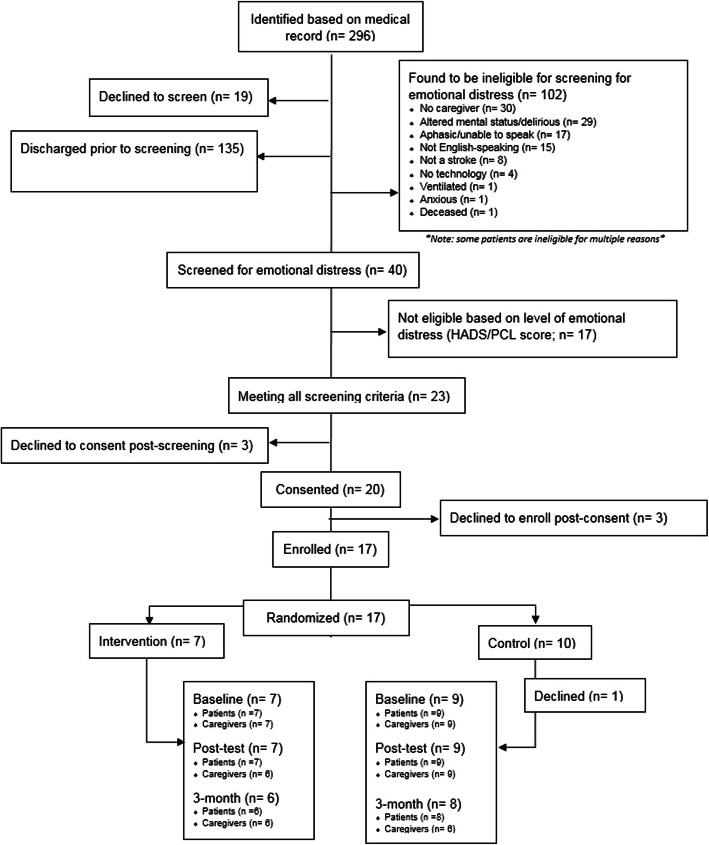
Background: A stroke is a sudden, life-altering event with potentially devastating consequences for survivors and their loved ones. Despite advances in endovascular and neurocritical care approaches to stroke treatment and recovery, there remains a considerable unmet need for interventions targeting the emotional impact of stroke for both patients and their informal caregivers. This is important because untreated emotional distress becomes chronic and negatively impacts quality of life in both patients and caregivers. Our team previously used mixed methods to iteratively develop a six-session modular dyadic intervention to prevent chronic emotional distress in patients with stroke and their informal caregivers called “Recovering Together” (RT) using feedback from dyads and the medical team. The aim of the current study is to test the feasibility of recruitment, acceptability of screening and randomization methods, acceptability of RT, satisfaction with RT, feasibility of the assessment process at all time points, and acceptability of outcome measures. Secondarily, we aimed to explore within-treatment effect sizes and change in clinically significant symptoms of depression, anxiety, and post-traumatic stress (PTS). The larger goal was to strengthen methodological rigor before a subsequent efficacy trial. Methods: We conducted a feasibility randomized controlled trial to evaluate the RT intervention relative to minimally enhanced usual care (MEUC) in stroke patients admitted to a Neurosciences Intensive Care Unit (Neuro-ICU). Dyads were enrolled within 1 week of hospitalization if they met specific eligibility criteria. Assessments were done via paper and pencil at baseline, and electronically via REDCap or over the phone at post-intervention (approximately 6 weeks after baseline), and 3 months later. Assessments included demographics, resiliency intervention targets (mindfulness, coping, self-efficacy, and interpersonal bond), and emotional distress (depression, anxiety, and PTS). Primary outcomes were feasibility and acceptability markers. Secondary outcomes were depression, anxiety, PTS, mindfulness, coping, self-efficacy, and interpersonal bond. Results: We consented 20 dyads, enrolled 17, and retained 16. Although many patients were missed before we could approach them, very few declined to participate or dropped out once study staff made initial contact. Feasibility of enrollment (87% of eligible dyads enrolled), acceptability of screening, and randomization (all RT dyads retained after randomization) were excellent. Program satisfaction (RT post-test M = 11.33/12 for patients M = 12/12 for caregivers), and adherence to treatment sessions (six of seven RT dyads attending 4/6 sessions) were high. There were no technical difficulties that affected the delivery of the intervention. There was minimal missing data. For both patients and caregivers, participation in RT was generally associated with clinically significant improvement in emotional distress symptoms from baseline to post-test. Participation in MEUC was associated with clinically significant worsening in emotional distress. Although some of the improvement in emotional distress symptoms decreased in the RT group between post-test to 3 months, these changes were not clinically significant. RT was also associated with substantial decrease in frequency of individuals who met criteria for clinically significant symptoms, while the opposite was true for MEUC. There were many lessons that informed current and future research. Conclusions: This study provided evidence of feasibility and signal of improvement in RT, as well as necessary methodological changes to increase recruitment efficiency before the future hybrid efficacy-effectiveness trial. Trial registration: NCT02797509.
Overview
The claims and statistics of this paper haven’t been checked yet.
Free: it reads the open-access text and checks the first 5 claims that cite a source we can check. Create a free account to check every claim.
Integrity signals
Registry
Cites
Statistics
Figures
Verification
Claims the paper makes
The claims and statistics of this paper haven’t been checked yet.
Free: it reads the open-access text and checks the first 5 claims that cite a source we can check. Create a free account to check every claim.
Claims other papers make about this one
Each is checked against this paper’s own text: does it say what the citing paper says it does?
The cited source says what the claim attributes to it.
In the citing paper
“Recovering Together intervention is feasible and acceptable in dyads.”
From Nursing Implications of Mindfulness-Informed Interventions for Stroke Survivors and Their Families. (2022) · cites this paper as Bannon et al, 2020
The cited source says what the claim attributes to it.
In the citing paper
“Findings suggest improved emotional distress symptoms in dyads who participated in Recovering Together intervention.”
From Nursing Implications of Mindfulness-Informed Interventions for Stroke Survivors and Their Families. (2022) · cites this paper as Bannon et al, 2020
The cited source says what the claim attributes to it.
In the citing paper
“Present research studies are focused on either the informal caregiver or the stroke survivor; however, given the symbiotic nature of this relationship, it is suggested that the stroke survivor and informal caregiver be addressed as a dyad.4,9,64,65”
From Nursing Implications of Mindfulness-Informed Interventions for Stroke Survivors and Their Families. (2022) · cites this paper as [9]
The cited source says what the claim attributes to it.
In the citing paper
“There is compelling evidence for the interdependence of psychological health poststroke in both informal caregivers and stroke survivors.4,9,64”
From Nursing Implications of Mindfulness-Informed Interventions for Stroke Survivors and Their Families. (2022) · cites this paper as [9]
Self-check
Percentages, sums and reported differences re-computed from the paper’s own numbers.
The self-check needs the paper’s full text.
Citations
Cites
Harris, P. A., Taylor, R., Thielke, R., Payne, J., Gonzalez, N., & Conde, J. G. (2009) · Journal of Biomedical Informatics · doi:10.1016/j.jbi.2008.08.010 · Cited by 51,384
The validity of the Hospital Anxiety and Depression Scale
Bjelland, I., Dahl, A. A., Haug, T. T., & Neckelmann, D. (2002) · Journal of Psychosomatic Research · doi:10.1016/s0022-3999(01)00296-3 · Cited by 9,779
Heart Disease and Stroke Statistics—2015 Update: A Report From the American Heart Association
Mozaffarian, D., Benjamin, E. J., Go, A. S., Arnett, D. K., Blaha, M. J., Cushman, M., de Ferranti, S., Després, J.-P., Fullerton, H. J., Howard, V. J., et al. (2015) · Circulation · doi:10.1161/cir.0000000000000152 · Cited by 5,797
Psychometric properties of the PTSD checklist (PCL)
Blanchard, E. B., Jones-Alexander, J., Buckley, T. C., & Forneris, C. A. (1996) · Behaviour Research and Therapy · doi:10.1016/0005-7967(96)00033-2 · Cited by 3,997
Feigin, V. L., Forouzanfar, M. H., Krishnamurthi, R., Mensah, G. A., Connor, M., Bennett, D. A., Moran, A. E., Sacco, R. L., Anderson, L., Truelsen, T., et al. (2014) · The Lancet · doi:10.1016/s0140-6736(13)61953-4 · Cited by 3,899
Validation of a New General Self-Efficacy Scale
Chen, G., Gully, S. M., & Eden, D. (2001) · Organizational Research Methods · doi:10.1177/109442810141004 · Cited by 3,542
Assessment of client/patient satisfaction: development of a general scale
Larsen, D. L., Attkisson, C. C., Hargreaves, W. A., & Nguyen, T. D. (1979) · Evaluation and Program Planning · doi:10.1016/0149-7189(79)90094-6 · Cited by 2,887
Design and analysis of pilot studies: recommendations for good practice
Lancaster, G. A., Dodd, S., & Williamson, P. R. (2004) · Journal of Evaluation in Clinical Practice · doi:10.1111/j..2002.384.doc.x · Cited by 2,572
Psychometric properties of the credibility/expectancy questionnaire
Devilly, G. J., & Borkovec, T. D. (2000) · Journal of Behavior Therapy and Experimental Psychiatry · doi:10.1016/s0005-7916(00)00012-4 · Cited by 2,295 · cited 3×
“Abbreviations RCT: Randomized controlled trial; RT: Recovering Together; PTS: Posttraumatic stress; Neuro-ICU: Neurosciences intensive care unit; MEUC: Minimally enhanced usual care; CBT: Cognitive behavioral therapy; DBT: Dialectical behavior therapy; HADS: Hospital Depression and Anxiety Scale; MCIDs: Minimally impo…”
MethodThe role and interpretation of pilot studies in clinical research
Leon, A. C., Davis, L. L., & Kraemer, H. C. (2011) · Journal of Psychiatric Research · doi:10.1016/j.jpsychires.2010.10.008 · Cited by 1,917
Feldman, G., Hayes, A., Kumar, S., Greeson, J., & Laurenceau, J.-P. (2007) · Journal of Psychopathology and Behavioral Assessment · doi:10.1007/s10862-006-9035-8 · Cited by 1,630
Pinquart, M., & Sörensen, S. (2003) · The Journals of Gerontology: Series B · doi:10.1093/geronb/58.2.p112 · Cited by 1,108
A validation study of the hospital anxiety and depression scale (HADS) in a Spanish population
Herrero, M. J., Blanch, J., Peri, J. M., De Pablo, J., Pintor, L., & Bulbena, A. (2003) · General Hospital Psychiatry · doi:10.1016/s0163-8343(03)00043-4 · Cited by 892
A Primer on Effectiveness and Efficacy Trials
Singal, A. G., Higgins, P. D. R., & Waljee, A. K. (2014) · Clinical and Translational Gastroenterology · doi:10.1038/ctg.2013.13 · Cited by 698
Mozaffarian, D., Benjamin, E. J., Go, A. S., Arnett, D. K., Blaha, M. J., Cushman, M., de Ferranti, S., Després, J.-P., Fullerton, H. J., Howard, V. J., et al. (2015) · Circulation · doi:10.1161/cir.0000000000000157 · Cited by 587
Puhan, M. A., Frey, M., Büchi, S., & Schünemann, H. J. (2008) · Health and Quality of Life Outcomes · doi:10.1186/1477-7525-6-46 · Cited by 586
Quality of life in adult survivors of critical illness: A systematic review of the literature
Dowdy, D. W., Eid, M. P., Sedrakyan, A., Mendez-Tellez, P. A., Pronovost, P. J., Herridge, M. S., & Needham, D. M. (2005) · Intensive Care Medicine · doi:10.1007/s00134-005-2592-6 · Cited by 544
How valid and reliable are patient satisfaction data? An analysis of 195 studies
Sitzia, J. (1999) · International Journal for Quality in Health Care · doi:10.1093/intqhc/11.4.319 · Cited by 515
Assessment of Mindfulness: Review on State of the Art
Sauer, S., Walach, H., Schmidt, S., Hinterberger, T., Lynch, S., Büssing, A., & Kohls, N. (2013) · Mindfulness · doi:10.1007/s12671-012-0122-5 · Cited by 464
Quality of Life after Stroke: The Importance of a Good Recovery
Carod-Artal, F. J., & Egido, J. A. (2009) · Cerebrovascular Diseases · doi:10.1159/000200461 · Cited by 446
Park, T., Reilly-Spong, M., & Gross, C. R. (2013) · Quality of Life Research · doi:10.1007/s11136-013-0395-8 · Cited by 370
Risk Factors for Potentially Harmful Informal Caregiver Behavior
Beach, S. R., Schulz, R., Williamson, G. M., Miller, L. S., Weiner, M. F., & Lance, C. E. (2005) · Journal of the American Geriatrics Society · doi:10.1111/j.1532-5415.2005.53111.x · Cited by 362
Smeets, R. J. E. M., Beelen, S., Goossens, M. E. J. B., Schouten, E. G. W., Knottnerus, J. A., & Vlaeyen, J. W. S. (2008) · The Clinical Journal of Pain · doi:10.1097/ajp.0b013e318164aa75 · Cited by 280
Lemay, K. R., Tulloch, H. E., Pipe, A. L., & Reed, J. L. (2019) · Journal of Cardiopulmonary Rehabilitation and Prevention · doi:10.1097/hcr.0000000000000379 · Cited by 280
Bakas, T., Clark, P. C., Kelly-Hayes, M., King, R. B., Lutz, B. J., & Miller, E. L. (2014) · Stroke · doi:10.1161/str.0000000000000033 · Cited by 258 · cited 5×
“Evidence for stroke family caregiver and dyad interventions: a statement for healthcare professionals from the American Heart Association and American Stroke Association.”
BackgroundMethodInfluentialThe development of a measure of intimate bonds
Wilhelm, K., & Parker, G. (1988) · Psychological Medicine · doi:10.1017/s0033291700002051 · Cited by 206
Hofhuis, J. G. M., Spronk, P. E., van Stel, H. F., Schrijvers, G. J. P., Rommes, J. H., & Bakker, J. (2008) · Chest · doi:10.1378/chest.07-1217 · Cited by 188
Family Function and Stroke Recovery: A Review.
Palmer, S., & Glass, T. A. (2003) · Rehabilitation Psychology · doi:10.1037/0090-5550.48.4.255 · Cited by 175
Preventing Chronic Emotional Distress in Stroke Survivors and Their Informal Caregivers
McCurley, J. L., Funes, C. J., Zale, E. L., Lin, A., Jacobo, M., Jacobs, J. M., Salgueiro, D., Tehan, T., Rosand, J., & Vranceanu, A.-M. (2019) · Neurocritical Care · doi:10.1007/s12028-018-0641-6 · Cited by 171
Self-citationDenno, M. S., Gillard, P. J., Graham, G. D., DiBonaventura, M. D., Goren, A., Varon, S. F., & Zorowitz, R. (2013) · Archives of Physical Medicine and Rehabilitation · doi:10.1016/j.apmr.2013.03.014 · Cited by 157
Carroll, K. M., & Rounsaville, B. J. (2003) · Psychiatric Services · doi:10.1176/appi.ps.54.3.333 · Cited by 155
Förster, A., Dickerson, J., Young, J. B., Patel, A. K., Kalra, L., Nixon, J., Smithard, D. G., Knapp, M. R. J., Holloway, I., Anwar, S., et al. (2013) · The Lancet · doi:10.1016/s0140-6736(13)61603-7 · Cited by 143
Update on the State of the Evidence for Stroke Family Caregiver and Dyad Interventions
Bakas, T., McCarthy, M., & Miller, E. T. (2017) · Stroke · doi:10.1161/strokeaha.117.016052 · Cited by 129 · cited 4×
“This contention is supported by two recent systematic reviews from the American Heart Association [24, 25] which included available psychosocial interventions for stroke patients and caregivers.”
MethodInfluentialCameron, J. I., Cheung, A. M., Streiner, D. L., Coyte, P. C., & Stewart, D. E. (2006) · Archives of Physical Medicine and Rehabilitation · doi:10.1016/j.apmr.2005.10.012 · Cited by 127
Dyadic Relationship Scale: A Measure of the Impact of the Provision and Receipt of Family Care
Sebern, M. D., & Whitlatch, C. J. (2007) · The Gerontologist · doi:10.1093/geront/47.6.741 · Cited by 127
Wade, D. M., Mouncey, P. R., Richards-Belle, A., Wulff, J., Harrison, D. A., Sadique, M. Z., Grieve, R. D., Emerson, L. M., Mason, A. J., Aaronovitch, D., et al. (2019) · JAMA · doi:10.1001/jama.2019.0073 · Cited by 124
Gitlin, L. N., Hodgson, N., Jutkowitz, E., & Pizzi, L. (2010) · The American Journal of Geriatric Psychiatry · doi:10.1097/jgp.0b013e3181c37d13 · Cited by 123
Nichols, L. O., Chang, C., Lummus, A., Burns, R., Martindale‐Adams, J., Graney, M. J., Coon, D. W., Czaja, S., & for the Resources for Enhancing Alzheimer's Caregivers Health II Investigators (2008) · Journal of the American Geriatrics Society · doi:10.1111/j.1532-5415.2007.01569.x · Cited by 116
Outcome assessment for clinical practice
Lambert, M. J. (1996) · Journal of Mental Health · doi:10.1080/09638239650037135 · Cited by 116
Bakas, T., & Burgener, S. C. (2002) · Topics in Stroke Rehabilitation · doi:10.1310/gn0j-exvx-kx0b-8x43 · Cited by 105
Roberts, S. B., Bonnici, D. M., Mackinnon, A. J., & Worcester, M. C. (2001) · British Journal of Health Psychology · doi:10.1348/135910701169278 · Cited by 104
Emotional and physical health of spouse caregivers of persons with Alzheimer’s disease and stroke
Wright, L. K., Hickey, J. V., Buckwalter, K. C., Hendrix, S. A., & Kelechi, T. (1999) · Journal of Advanced Nursing · doi:10.1046/j.1365-2648.1999.01124.x · Cited by 103
Long-Term Health-Related Quality of Life of Stroke Survivors and Their Spousal Caregivers
Godwin, K. M., Ostwald, S. K., Cron, S. G., & Wasserman, J. (2013) · Journal of Neuroscience Nursing · doi:10.1097/jnn.0b013e31828a410b · Cited by 91
Behavioral therapy research: A conceptualization of a process.
Onken, L. S., BLAINE, J. D., & Battjes, R. J. (1997) · Cited by 90
Choi, K. W., Shaffer, K. M., Zale, E. L., Funes, C. J., Koenen, K. C., Tehan, T., Rosand, J., & Vranceanu, A.-M. (2018) · Critical Care Medicine · doi:10.1097/ccm.0000000000002988 · Cited by 55
Self-citationTitler, M. G., Visovatti, M. A., Shuman, C., Ellis, K. R., Banerjee, T., Dockham, B., Yakusheva, O., & Northouse, L. (2017) · Supportive Care in Cancer · doi:10.1007/s00520-017-3758-9 · Cited by 54
Westenberg, R. F., Zale, E. L., Heinhuis, T. J., Özkan, S., Nazzal, A., Lee, S.-G., Chen, N. C., & Vranceanu, A.-M. (2018) · Clinical Orthopaedics & Related Research · doi:10.1007/s11999.0000000000000086 · Cited by 52
Self-citationShaffer, K. M., Riklin, E., Jacobs, J. M., Rosand, J., & Vranceanu, A.-M. (2016) · Journal of Critical Care · doi:10.1016/j.jcrc.2016.07.010 · Cited by 51
Self-citationShaffer, K. M., Riklin, E., Jacobs, J. M., Rosand, J., & Vranceanu, A.-M. (2016) · Critical Care Medicine · doi:10.1097/ccm.0000000000001855 · Cited by 50
Self-citationHwang, D. Y., Yagoda, D., Perrey, H. M., Currier, P. F., Tehan, T. M., Guanci, M. M., Ananian, L., Cobb, J. P., & Rosand, J. M. (2013) · Journal of Critical Care · doi:10.1016/j.jcrc.2013.11.022 · Cited by 47
Self-citationVatter, S., Stanmore, E., Clare, L., McDonald, K. R., McCormick, S. A., & Leroi, I. (2019) · Journal of Geriatric Psychiatry and Neurology · doi:10.1177/0891988719853043 · Cited by 45
Meyers, E. E., McCurley, J. L., Lester, E. G., Jacobo, M., Rosand, J. M., & Vranceanu, A. (2020) · Cognitive and Behavioral Practice · doi:10.1016/j.cbpra.2020.02.001 · Cited by 45
Self-citationShaffer, K. M., Jacobs, J. M., Coleman, J. N., Temel, J. S., Rosand, J. M., Greer, J. A., & Vranceanu, A. (2016) · Neurocritical Care · doi:10.1007/s12028-016-0358-3 · Cited by 42
Self-citationPerrin, P. B., Heesacker, M., Hinojosa, M. S., Uthe, C. E., & Rittman, M. (2009) · Rehabilitation Psychology · doi:10.1037/a0015964 · Cited by 39 · cited 1×
“In turn, caregivers’ poorer mental health lowers the quality of care to the patients [20, 21], which impacts patients' physical and mental health [22, 23].”
BackgroundMeyers, E. E., Shaffer, K. M., Gates, M., Lin, A., Rosand, J., & Vranceanu, A.-M. (2020) · Psychosomatics · doi:10.1016/j.psym.2019.11.007 · Cited by 38
Self-citationZale, E. L., Heinhuis, T. J., Tehan, T. M., Salgueiro, D., Rosand, J. M., & Vranceanu, A. (2018) · General Hospital Psychiatry · doi:10.1016/j.genhosppsych.2018.02.012 · Cited by 37
Self-citationA Systematic Review of the Posttraumatic Stress Disorder Checklist (PCL)
Bressler, R., Erford, B. T., & Dean, S. (2018) · Journal of Counseling & Development · doi:10.1002/jcad.12190 · Cited by 36
Meyers, E. E., Presciutti, A., Shaffer, K. M., Gates, M., Lin, A., Rosand, J., & Vranceanu, A.-M. (2020) · Neurocritical Care · doi:10.1007/s12028-020-00913-7 · Cited by 36
Self-citationMeyers, E. E., Lin, A. C., Lester, E. G., Shaffer, K. M., Rosand, J. M., & Vranceanu, A. (2019) · General Hospital Psychiatry · doi:10.1016/j.genhosppsych.2019.12.003 · Cited by 36
Self-citationFisher, J., Tran, T. D., Biggs, B., & Tran, T. (2014) · Asia-Pacific Psychiatry · doi:10.1111/appy.12011 · Cited by 21
Christensen, L. F., Gildberg, F. A., Sibbersen, C., Skjøth, M. M., Nielsen, C. T., & Hansen, J. P. (2019) · Telemedicine Journal and e-Health · doi:10.1089/tmj.2019.0055 · Cited by 18 · cited 1×
“The CSQ-3 has been used to measure psychotherapy treatment satisfaction among individuals with depression [57], chronic pain [58], and other physical conditions [59].”
MethodLin, A. C., Vranceanu, A., Guanci, M. M., Salgueiro, D., Rosand, J. M., & Zale, E. L. (2019) · Neurocritical Care · doi:10.1007/s12028-019-00772-x · Cited by 16 · cited 2×
“The substantial deterioration in symptoms observed in MEUC is consistent with prior studies which show that emotional distress at hospitalization predicts future emotional distress in both patients and caregivers [10, 16].”
ResultSelf-citationMcCusker, J., Cole, M. G., Yaffe⃰, M. J., Strumpf, E., Sewitch, M. J., Sussman, T., Ciampi, A., Lavoie, K., & Belzile, É. (2016) · Health Education Journal · doi:10.1177/0017896915622515 · Cited by 12
Burnout and Resiliency Among Neurocritical Care Staff; Potential Solutions to A Growing Problem
Vranceanu, A. (2019) · Neurocritical Care · doi:10.1007/s12028-019-00823-3 · Cited by 8
Self-citation
Research works printed but not linked: 1
- Schwarzer R Jerusalem M Generalized Self-Efficacy scale. In J. Weinman, S. Wright, & M. Johnston, Measures in health psychology: a user’s portfolio. Causal and control beliefs Windsor 1995 England Nfer-Nelson
Cited by
Vranceanu, A.-M., Bannon, S., Mace, R., Lester, E., Meyers, E., Gates, M., Popok, P., Lin, A., Salgueiro, D., Tehan, T., et al. (2020) · JAMA Network Open · doi:10.1001/jamanetworkopen.2020.20807 · Cited by 114
Self-citationSystematic review of the evidence for stroke family caregiver and dyad interventions
Bakas, T., McCarthy, M. J., & Miller, E. L. (2022) · Stroke · doi:10.1161/strokeaha.121.034090 · Cited by 109
Psychological Distress After Sudden Cardiac Arrest and Its Impact on Recovery
Agarwal, S., Birk, J. L., Abukhadra, S. L., Rojas, D. A., Cornelius, T. M., Bergman, M., Chang, B., Edmondson, D. E., & Kronish, I. M. (2022) · Current Cardiology Reports · doi:10.1007/s11886-022-01747-9 · Cited by 80
Mou, H., Lam, S. K. K., & Chien, W. T. (2023) · International Journal of Nursing Studies · doi:10.1016/j.ijnurstu.2023.104504 · Cited by 76
Rojas, D. A., DeForge, C. E., Abukhadra, S. L., Farrell, L. M., George, M., & Agarwal, S. (2023) · Resuscitation Plus · doi:10.1016/j.resplu.2023.100370 · Cited by 53
“involving patients and co-survivors are beneficial for recovery after other acute brain injuries.(54,55) Other opportunities for future observational research include a”
Background
Metadata
- Authors
- Bannon, S., Lester, E. G., Gates, M. V., McCurley, J., Lin, A., Rosand, J., & Vranceanu, A.-M.
- Affiliations
- Harvard University (US)
- Massachusetts General Hospital (US)
- Corresponding author
- Vranceanu, Ana-Maria
- ORCID
- Venue
- Pilot and Feasibility Studies
- Published
- 2020-05-25
- Volume
- 6
- Issue
- 1
- Pages
- 75-75
- ISSN
- 2055-5784 (ISSN-L)
- PMC
- PMC7249683
- OpenAlex
- W3032149014
- Semantic Scholar
- d641c8ce80af4dfb5b88d19171170c401d24e6c9
- Cited by
- 70
- References
- 65
- Citations by year
- 2026: 11 · 2025: 21 · 2024: 7 · 2023: 10 · 2022: 9 · 2021: 7 · 2020: 4
- FWCI
- 4.16
- Type
- journal article
- Language
- en
- Open access
- gold
- doi.org
- Licence
- cc-by
- creativecommons.org/licenses/by/4.0 (tdm)
- creativecommons.org/licenses/by/4.0 (vor)
- Locations
- Pilot and Feasibility Studies (publishedVersion, cc-by)
- PubMed Central (publishedVersion, cc-by)
- PubMed (publishedVersion)
- DOAJ (DOAJ: Directory of Open Access Journals) (submittedVersion, cc-by-sa)
- Funders
- American Heart Association
- National Institute of Nursing Research (5R21 NR017979)
- Henry and Allison McCance Center for Brain Health at Massachusetts General Hospital
- Topics
- Health Sciences › Medicine › Rehabilitation › Stroke Rehabilitation and Recovery
- Health Sciences › Medicine › Oncology › Cancer survivorship and care
- Health Sciences › Nursing › Research and Theory › Nursing care and research
- Keywords
- stroke, stroke patients, informal caregivers, dyadic intervention, depression, anxiety, post-traumatic stress, resilience, mindfulness, coping, self-efficacy, interpersonal relationships, neurocritical care, intensive care unit, treatment acceptability, feasibility, program satisfaction, caregiver burden, quality of life, intervention development, medication adherence
About these checks
Registry, retraction, Cites and statistics results are computed, not judged, with one exception: a printed reference that no index lists is read once by a model before it counts as a citation error. Claims are extracted by a model and kept only when their quote appears verbatim in the text; each cited source is then checked, with a model’s help, for whether it says what the claim relies on. Those verdicts can be wrong — read the claim’s quote and the cited source before relying on one.
Statistics and arithmetic are recomputed, not judged.
Confidence bands are shown only for fields calibrated on our annotated test set. None is calibrated yet, so no band is shown.
What counts as a claim ›How we measure confidence ›How we check this ›
Are you an author, or do you see a problem with this page? Request a review
Data sources
Bibliographic data: Semantic Scholar, OpenAlex, Crossref.
Contains information from the Semantic Scholar Academic Graph Datasets, made available under the ODC Attribution License (ODC-BY 1.0).
Semantic Scholar’s data is described in: Kinney, R., et al. (2023). The Semantic Scholar Open Data Platform. arXiv:2301.10140.
