

SANRA—a scale for the quality assessment of narrative review articles
Open accessThe DOI matches its Crossref record; 12 of the 13 references it cites were found in a registry or an index; 4 of the 12 sources its claims cite were checked for support.
Abstract
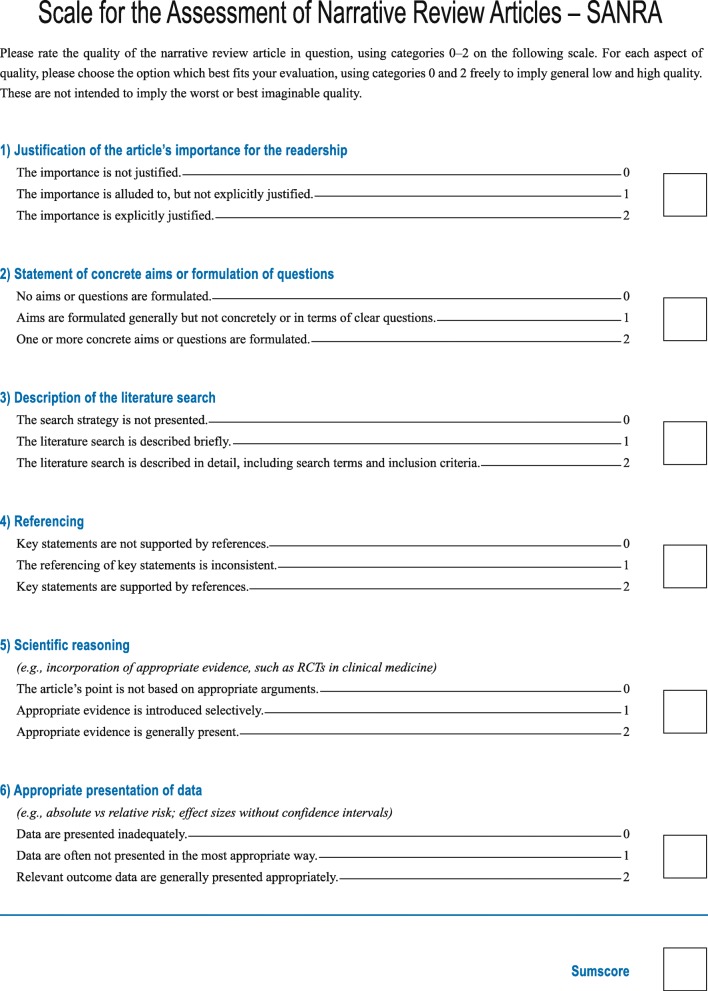
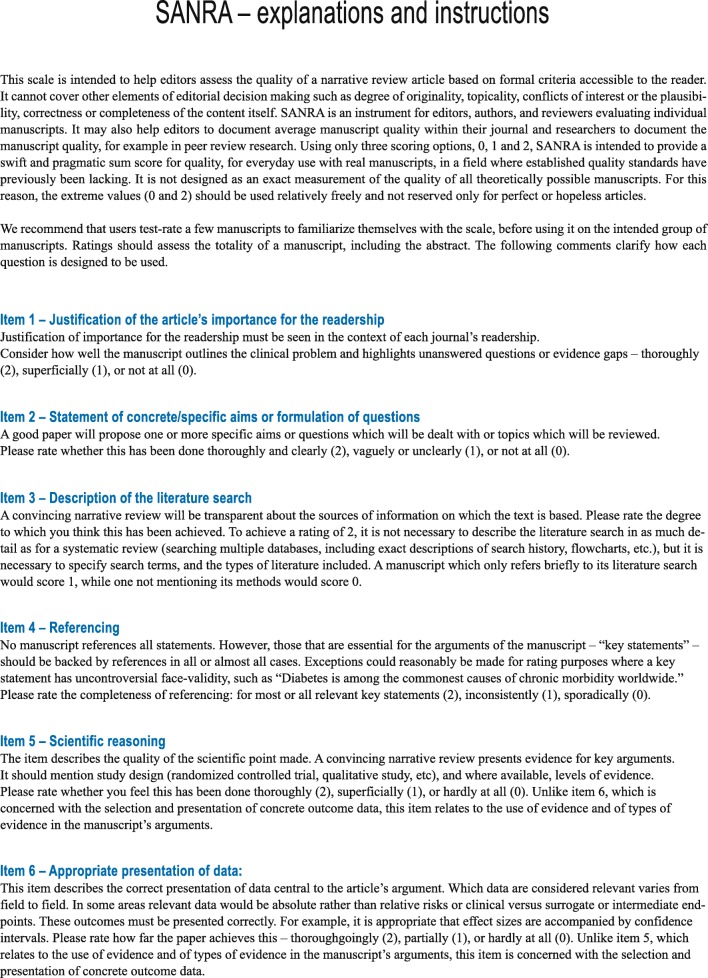
BACKGROUND: Narrative reviews are the commonest type of articles in the medical literature. However, unlike systematic reviews and randomized controlled trials (RCT) articles, for which formal instruments exist to evaluate quality, there is currently no instrument available to assess the quality of narrative reviews. In response to this gap, we developed SANRA, the Scale for the Assessment of Narrative Review Articles. METHODS: A team of three experienced journal editors modified or deleted items in an earlier SANRA version based on face validity, item-total correlations, and reliability scores from previous tests. We deleted an item which addressed a manuscript's writing and accessibility due to poor inter-rater reliability. The six items which form the revised scale are rated from 0 (low standard) to 2 (high standard) and cover the following topics: explanation of (1) the importance and (2) the aims of the review, (3) literature search and (4) referencing and presentation of (5) evidence level and (6) relevant endpoint data. For all items, we developed anchor definitions and examples to guide users in filling out the form. The revised scale was tested by the same editors (blinded to each other's ratings) in a group of 30 consecutive non-systematic review manuscripts submitted to a general medical journal. RESULTS: Raters confirmed that completing the scale is feasible in everyday editorial work. The mean sum score across all 30 manuscripts was 6.0 out of 12 possible points (SD 2.6, range 1-12). Corrected item-total correlations ranged from 0.33 (item 3) to 0.58 (item 6), and Cronbach's alpha was 0.68 (internal consistency). The intra-class correlation coefficient (average measure) was 0.77 [95% CI 0.57, 0.88] (inter-rater reliability). Raters often disagreed on items 1 and 4. CONCLUSIONS: SANRA's feasibility, inter-rater reliability, homogeneity of items, and internal consistency are sufficient for a scale of six items. Further field testing, particularly of validity, is desirable. We recommend rater training based on the "explanations and instructions" document provided with SANRA. In editorial decision-making, SANRA may complement journal-specific evaluation of manuscripts-pertaining to, e.g., audience, originality or difficulty-and may contribute to improving the standard of non-systematic reviews.
Overview
CoChat Summary
TL;DR
SANRA is a six-item, 0–2 scale (maximum 12) for assessing the quality of narrative review articles, developed and field-tested by three journal editors. In 30 consecutive non-systematic review manuscripts, it showed feasible use, sufficient internal consistency and inter-rater reliability, and a modest association with editorial acceptance.
Key findings
- Across 30 manuscripts (90 ratings), the mean SANRA sum score was 6.0 out of 12 (SD 2.6, range 1–12, median 6).
- Internal consistency was Cronbach’s alpha 0.68; corrected item-total correlations ranged from 0.33 (item 3) to 0.58 (item 6).
- Inter-rater reliability was an intra-class correlation coefficient (average measure) of 0.77 [95% CI 0.57, 0.88]; raters often disagreed on items 1 and 4.
- Average SANRA scores were modestly associated with editorial acceptance (mean 6.6, SD 1.9, n = 17) versus rejection (mean 5.1, SD 2.1, n = 13), point biserial correlation 0.37 (t = 2.09, df 28; two-sided p = 0.046).
Methods
- SANRA was developed between 2010 and 2017 by three experienced editors at Deutsches Ärzteblatt; the revised six-item version deleted an item on writing and accessibility due to poor inter-rater reliability.
- The revised scale was tested on 30 consecutive non-systematic review manuscripts submitted to Deutsches Ärzteblatt in 2015; three editor-raters scored them independently and blinded to each other’s ratings.
- Analyses included descriptive statistics, Cronbach’s alpha, corrected item-total correlations, average-measure intra-class correlation using a two-way random effects model (consistency definition), and a post hoc point biserial correlation between SANRA sum scores and acceptance/rejection.
Limitations
- The paper states the main limitation is sample size: 30 manuscripts was a compromise between representativeness, power, and feasibility, and took about 6 months to sample.
- The authors state that the scale’s authors were also the test-raters, so inter-rater reliability may be lower in groups less familiar with SANRA; the study also did not assess test-retest reliability, and results are study-specific.
- The paper acknowledges restricted content validity because SANRA is limited to six items and is a critical appraisal tool rather than a reporting guideline; criterion validity evidence is post hoc and weak, and no established cut-offs exist for comparing manuscripts across settings.
Model-written summary. Check it against the paper before relying on it.
Integrity signals
Registry
Cites
Statistics
Figures
Verification
Claims the paper makes
3 Valid · 0 Not valid · 5 Not checked · 27 Own results and interpretations
The cited sources support only part of this claim — read each source’s verdict below.
In the paper
“Bastian et al. found that they constitute the largest share of all text types in medicine and they concluded that they “remain the staple of medical literature” [1].”
- Also stated in: § Background · plain
“Narrative reviews are the commonest type of articles in the medical literature.”
§ SANRA—a scale for the quality assessment of narrative review articles > Background
What the sources say
- Partly supportedcites [1] Bastian H Glasziou P Chalmers I Seventy-five trials and eleven systematic reviews a day: how will we ever keep up? PLoS Med 2010 7 9 e1000326 10.1371/journal.pmed.1000326 20877712 PMC2943439 sourceExperimental — accuracy not yet measured
In “How Close Are We to Archie Cochrane’s Goal?” and the Summary Points (pages unavailable), the paper calls non-systematic narrative reviews the staple of medical literature synthesis. It does not say they constitute the largest share of all medical text types; that extends a claim about literature synthesis to medical literature as a whole. (LLM, conf=0.88)
plain- Asserted: passes — The authors put it forward as true.
- Checkable: passes — It can be checked against evidence.
- Load-bearing: unclear — It is unclear whether the paper’s conclusions depend on it.
- Based: passes — The paper gives a reason why it holds.
- Also stated in: § Background · plain
The sources with a verdict support this claim; the rest weren’t checked yet, have no full text we could read, or their verdicts aren’t rated yet.
In the paper
“non-systematic reviews or narrative reviews have been widely criticized as unreliable [1, 4].”
§ SANRA—a scale for the quality assessment of narrative review articles > Background
What the sources say
- Supportedcites [1] Bastian H Glasziou P Chalmers I Seventy-five trials and eleven systematic reviews a day: how will we ever keep up? PLoS Med 2010 7 9 e1000326 10.1371/journal.pmed.1000326 20877712 PMC2943439 source
In “How Close Are We to Archie Cochrane’s Goal?”, the paper describes reviews not conducted systematically as having great potential for error and calls them less reliable forms of information. Box 1 also says that articles and textbooks had highlighted the risk of bias and chance in reviews. Together, these passages support the broad characterization that narrative reviews have been criticized as unreliable; page numbers are not provided in our copy. (LLM, conf=0.89)
- Not checked — no full text of the sourcecites [4] Mulrow CD The medical review article: state of the science Ann Intern Med 1987 106 485 488 10.7326/0003-4819-106-3-485 3813259 source
plain- Asserted: passes — The authors put it forward as true.
- Checkable: passes — It can be checked against evidence.
- Load-bearing: passes — The paper’s conclusions depend on it.
- Based: passes — The paper gives a reason why it holds.
- Supported
A result the paper reports from its own data — it cites no other source for it, so there is none to check. The quote shows it is in the paper.
In the paper
“Cronbach’s alpha was 0.68 (internal consistency).”
- Also stated in: § Results · plain
“The scale’s internal consistency, measured as Cronbach’s alpha, was 0.68.”
§ SANRA—a scale for the quality assessment of narrative review articles > Abstract > Results
plainn = 90- Asserted: passes — The authors put it forward as true.
- Checkable: passes — It can be checked against evidence.
- Load-bearing: passes — The paper’s conclusions depend on it.
- Based: passes — The paper gives a reason why it holds.
- Also stated in: § Results · plain
A result the paper reports from its own data — it cites no other source for it, so there is none to check. The quote shows it is in the paper.
In the paper
“Raters often disagreed on items 1 and 4.”
- Also stated in: § Results · plain
“Disagreements most often occurred with regard to items 1 and 4.”
§ SANRA—a scale for the quality assessment of narrative review articles > Abstract > Results
plain- Asserted: passes — The authors put it forward as true.
- Checkable: passes — It can be checked against evidence.
- Load-bearing: unclear — It is unclear whether the paper’s conclusions depend on it.
- Based: passes — The paper gives a reason why it holds.
- Also stated in: § Results · plain
A result the paper reports from its own data — it cites no other source for it, so there is none to check. The quote shows it is in the paper.
In the paper
“The intra-class correlation coefficient (average measure) was 0.77 [95% CI 0.57, 0.88] (inter-rater reliability).”
- Also stated in: § Results · plain
“The intra-class correlation coefficient (average measure) amounted to 0.77 [95% CI 0.57, 0.88; F 4.3; df 29, 58].”
§ SANRA—a scale for the quality assessment of narrative review articles > Abstract > Results
plain- Asserted: passes — The authors put it forward as true.
- Checkable: passes — It can be checked against evidence.
- Load-bearing: passes — The paper’s conclusions depend on it.
- Based: passes — The paper gives a reason why it holds.
- Also stated in: § Results · plain
14 more claims
Create a free account to see all 35 claims and to verify the 3 references still open.
- Probably not a substantial claim. 11
- It may state two separate claims as one. 11
Claims other papers make about this one
Each is checked against this paper’s own text: does it say what the citing paper says it does?
The source backs part of the claim, not all of it — or backs it for a different population, condition or comparison.
In the citing paper
“The review was conducted and reported in accordance with the principles of the Scale for the Assessment of Narrative Review Articles (SANRA), which provides a validated framework for ensuring methodological transparency, scientific rigor, and balanced interpretation in narrative reviews [ 19 ].”
From Paracetamol: A History of Assumptions, Errors, and Evidence Reversals in Pain Management (2026) · cites this paper as [19]
Experimental — accuracy not yet measuredThe source backs part of the claim, not all of it — or backs it for a different population, condition or comparison.
In the citing paper
“As a narrative review, the present work does not include an aggregated quantitative assessment and is more exposed to selection subjectivity than a registered systematic review [124,125].”
From Berberine-Drug Interactions: Mechanisms, Clinical Relevance and Risk Stratification-A Narrative Review (2026) · cites this paper as [124]
Experimental — accuracy not yet measuredThe cited source says what the claim attributes to it.
In the citing paper
“This work is designed as a structured narrative review, with transparent reporting of the documentation strategy, guided by the quality criteria of the Scale for the Assessment of Narrative Review Articles (SANRA) [124].”
From Berberine-Drug Interactions: Mechanisms, Clinical Relevance and Risk Stratification-A Narrative Review (2026) · cites this paper as [124]
The cited source says what the claim attributes to it.
In the citing paper
“we used the following:-Cochrane Risk of Bias 2 (RoB 2) [29] and PEDRO scale tools for RCTs.-AMSTAR 2 [30] checklist for systematic review.-SANRA (Scale for the Assessment of Narrative Review Articles) [31] for narrative reviews.-JBI Checklist for Text and Opinion [32] for expert opinion papers.”
From Pelvic Floor Muscle Training Following Surgery for Pelvic Organ Prolapse: Recommendation from Scientific Literature (2026) · cites this paper as [31]
The cited source says what the claim attributes to it.
In the citing paper
“Data analysis employed a narrative and thematic synthesis methodology,adhering to the SANRA guidelines for narrative reviews (32).”
From Ethical issues in multi-agent AI systems for healthcare: a narrative review (2026) · cites this paper as [32]
12 more claims about this paper
Create a free account to see every claim other papers make about this one.
Citations
Cites
Shea, B. J., Reeves, B. C., Wells, G., Thuku, M., Hamel, C., Moran, J., Moher, D., Tugwell, P., Welch, V., Kristjansson, E., et al. (2017) · BMJ · doi:10.1136/bmj.j4008 · Cited by 10,636 · cited 2×
“Critical appraisal tools have been developed for systematic reviews (e.g., AMSTAR 2 [A MeaSurement Tool to Assess Systematic Reviews] [7]) and papers on RCTs (e.g., the CASP [Critical Appraisal Skills Program] checklist for randomized trials [8]) and other types of medical studies.”
BackgroundStreiner, D. L., & Norman, G. R. (2008) · doi:10.1093/acprof:oso/9780199231881.001.0001 · Cited by 2,631
Critical appraisal skills programme
Singh, J. (2013) · Journal of Pharmacology and Pharmacotherapeutics · doi:10.4103/0976-500x.107697 · Cited by 2,556
Guidelines for Reporting Reliability and Agreement Studies (GRRAS) were proposed
Kottner, J., Audigé, L., Brorson, S., Donner, A., Gajewski, B. J., Hróbjartsson, A., Roberts, C., Shoukri, M., & Streiner, D. L. (2011) · Journal of Clinical Epidemiology · doi:10.1016/j.jclinepi.2010.03.002 · Cited by 2,174
The Mass Production of Redundant, Misleading, and Conflicted Systematic Reviews and Meta‐analyses
IOANNIDIS, J. P. A. (2016) · The Milbank Quarterly · doi:10.1111/1468-0009.12210 · Cited by 1,483 · cited 1×
“While systematic reviews are not per se superior articles and while certain systematic reviews have been criticized lately [3], non-systematic reviews or narrative reviews have”
BackgroundSeventy-five trials and eleven systematic reviews a day: how will we ever keep up?
Bastian, H., Glasziou, P., & Chalmers, I. (2010) · PLoS Medicine · doi:10.1371/journal.pmed.1000326 · Cited by 1,188 · cited 2×
“found that they constitute the largest share of all text types in medicine and they concluded that they “remain the staple of medical literature” [1].”
BackgroundThe Medical Review Article: State of the Science
MULROW, C. D. (1987) · Annals of Internal Medicine · doi:10.7326/0003-4819-106-3-485 · Cited by 856 · cited 1×
“been widely criticized as unreliable [1, 4].”
Writing a narrative biomedical review: considerations for authors, peer reviewers, and editors
Gasparyan, A. Y., Ayvazyan, L., Blackmore, H., & Kitas, G. D. (2011) · Rheumatology International · doi:10.1007/s00296-011-1999-3 · Cited by 694 · cited 1×
“[13], for example, have provided guidance for writing narrative reviews, and Byrne [14] as well as Pautasso [15] has written, from different angles, thoughtful editorials on improving narrative reviews and presented lists of key features of writing a good review—lists that naturally overlap with SANRA items (e.”
BackgroundTen Simple Rules for Writing a Literature Review
Pautasso, M. (2013) · PLoS Computational Biology · doi:10.1371/journal.pcbi.1003149 · Cited by 272 · cited 3×
“[13], for example, have provided guidance for writing narrative reviews, and Byrne [14] as well as Pautasso [15] has written, from different angles, thoughtful editorials on improving narrative reviews and presented lists of key features of writing a good review—lists that naturally overlap with SANRA items (e.”
BackgroundImproving the peer review of narrative literature reviews
Byrne, J. A. (2016) · Research Integrity and Peer Review · doi:10.1186/s41073-016-0019-2 · Cited by 159 · cited 3×
“[13], for example, have provided guidance for writing narrative reviews, and Byrne [14] as well as Pautasso [15] has written, from different angles, thoughtful editorials on improving narrative reviews and presented lists of key features of writing a good review—lists that naturally overlap with SANRA items (e.”
Background
Research works printed but not linked: 3
- Higgins JPT, Green S. (eds.). Cochrane Handbook for Systematic Reviews and Interventions. Version 5.1.0. The Cochrane Collaboration 2011, section 1.2.2., www.handbook.cochrane.org, retrieved on Oct 31, 2018.
- Baethge C Mertens S Goldbeck-Wood S Development of a quality score for the assessment of non-systematic review articles (SANRA) Poster, Seventh International Congress on Peer Review and Biomedical Publication 2013 USA Chicago, Illinois
- Baethge C Goldbeck-Wood S Mertens S A scale for the assessment of non-systematic review articles (SANRA) Poster, Eighth International Congress on Peer and Biomedical Publication 2017 USA Chicago, Illinois
Cited by
Items 3,101–3,200 of 4,334
Nanova, P. (2026) · Frontiers in Human Neuroscience · doi:10.3389/fnhum.2026.1777556
Yang, S., Li, Q., Shi, W., & Liu, X. (2026) · Frontiers in Psychiatry · doi:10.3389/fpsyt.2026.1919035
“This structured narrative review was prepared with reference to the Scale for the Assessment of Narrative Review Articles (SANRA) (4).”
Ying, W., Guo, C., Zhang, M., & Zhao, Y. (2026) · Frontiers in Public Health · doi:10.3389/fpubh.2026.1865508
“Because this is a narrative rather than a quantitative synthesis, the strength and consistency of the evidence were appraised qualitatively [informed by SANRA; (21)] rather than through formal meta-analytic pooling; accordingly, no pooled or statistically weighted effect sizes are reported.”
Shabut, A. M., Sangvikar, V., Lu, X., KARIMU, A. Y., & Nwoko, C. (2026) · Information · doi:10.3390/info17090853
“Narrative and non-systematic reviews were examined using SANRA-informed domains, including the importance and aims of the review, description of the literature search, referencing, scientific reasoning and presentation of evidence limitations [31].”
Clinical use of ozone therapy: a critical appraisal of evidence, safety, and methodological quality
Galassi, F. M., Zauli, E., Vaccarezza, M., & Varotto, E. (2026) · Frontiers in Medicine · doi:10.3389/fmed.2026.1893156
Xia, J., & Pei, S. (2026) · Frontiers in Neurology · doi:10.3389/fneur.2026.1886974
“Voluntary and reflexive swallowing require coordinated bilateral cortical activity, corticobulbar projections, basal ganglia and cerebellar circuits, brainstem swallowing pattern generation, cranial nerve nuclei, and peripheral sensory feedback (14–16).”
Lamba, J., Shaw, J., Zimmerman, J., Kavin, B., Pattilachan, T. M., Trevelyan, C., & Koh, S. (2026) · Healthcare · doi:10.3390/healthcare14172826
“This review utilized the Scale for the Assessment of Narrative Review Articles to ensure a high quality narrative review [7].”
Farshchi, I. (2026) · Asian Journal of Education and Social Studies · doi:10.9734/ajess/2026/v52i93311
Boahene, K. K. (2026) · Journal of the American Medical Directors Association · doi:10.1016/j.jamda.2026.106467
Noor, T. N. E. B. T. A., Khurshid, Z., Nugraha, A. P., Ramadhani, N. F., & Noor, E. (2026) · European Journal of Dentistry · doi:10.1055/s-0046-1827029
“14 A narrative design was chosen deliberately, rather than a systematic or scoping review, for three reasons.”
Liu, W., Zhao, J., Zhang, D., Dang, C., Lu, Y., & Du, X. (2026) · Frontiers in Endocrinology · doi:10.3389/fendo.2026.1955223
“The synthesis is therefore representative and clinically oriented rather than exhaustive (15).”
Integrative Nutritional Strategies for Performance, Recovery, and Weight Management in Taekwondo
Amawi, A. T., Alkasasbeh, W. J., Grivas, G. V., Jalali, P., & Mohammadi, A. (2026) · Nutrients · doi:10.3390/nu18172894
CANQUI, L. G. P., Sebastián, M. G. M., Márquez, G. B., Bardales, J. D. P., Atahualpa, R. L. C., & Bardales, Z. E. P. (2026) · Prohominum · doi:10.47606/acven/ph0548
Sarma, N. (2026) · Asian Journal of Education and Social Studies · doi:10.9734/ajess/2026/v52i93314
Lin, C., & Lin, J. (2026) · Dermatological Reviews · doi:10.1002/der2.70095
Li, B., Che, H., & 宋燕丰 (2026) · Frontiers in Pharmacology · doi:10.3389/fphar.2026.1942034
“SANRA was used to support transparency and scientific reasoning (Baethge et al., 2019), but it was not treated as a systematic-review method.”
Hasimoto, T. F. C. (2026) · RCMOS - Revista Científica Multidisciplinar O Saber · doi:10.51473/rcmos.v1i2.2026.2854
Micronutrient supplementation in pregnancy after bariatric surgery: a narrative review
Amorim, M. M. R., de Carvalho-Filho, A. F. P., Farias, J. L. B., Coutinho, I., & Frank, T. C. (2026) · Revista Brasileira de Saúde Materno Infantil · doi:10.1590/1806-9304202620250450-en
Aslan, M., Altındiş, M., & Ovalı, F. (2026) · Journal of Pediatric Infectious Diseases · doi:10.53391/1305-7707.1080
Xu, S., Li, X., Li, W., & Huang, R. (2026) · Frontiers in Dental Medicine · doi:10.3389/fdmed.2026.1897947
Kithinji, D., Onyambu, M. O., Gikonyo, N., Magutu, P., Rajkumar, R., Mwangi, Z. M., Kinyua, P. K., Thuranira, S., & Nsarhaza, K. (2026) · Health Research in Africa · doi:10.67260/hra.v4i9.7965
FERREIRA, L. S. (2026) · RCMOS - Revista Científica Multidisciplinar O Saber · doi:10.51473/rcmos.v1i1.2026.2856
Габдулхаков, Р. М., Takalova, A. R., Tupikina, E. A., Nurmatov, M. M., Khotamov, I. B., Akatyeva, M. A., Pulatov, L. O., Tilloev, F. I., Mukhamadalieva, R. N., Shamsiev, U. A., et al. (2026) · Antibiot Khimioter = Antibiotics and Chemotherapy · doi:10.37489/0235-2990-2026-71-5-6-97-110
Hasimoto, T. F. C. (2026) · RCMOS - Revista Científica Multidisciplinar O Saber · doi:10.51473/rcmos.v1i1.2026.2853
Ikhsan, A. A. A.-Z., Hisyam, A., Nasution, R. H., & Ardiansyah, M. Z. (2026) · SCRIPTA SCORE Scientific Medical Journal · doi:10.32734/scripta.v8i1.25984
“[13] A structured literature search was conducted in PubMed, Scopus, and ScienceDirect to identify relevant studies published between 2016 and 2026.”
Robot-assisted CT-guided interventions: Where are we now and where are we going?
O’Dwyer, M., Temperley, H. C., O’Sullivan, N. J., & Sheahan, K. P. (2026) · European Radiology · doi:10.1007/s00330-026-12850-8
Nurse–patient communication and inpatient satisfaction: A narrative review
Iscasari, Y., & Purnamawati, D. (2026) · Lentera Perawat · doi:10.52235/lp.v7i3.906
“Reporting was informed by SANRA, which addresses the importance of the topic, statement of aims, description of the literature search, referencing, scienti8ic reasoning, and presentation of relevant evidence (Baethge et al., 2019).”
Mahajan, V. V. R., & Dakhore, A. A. (2026) · International Journal of Research Publication and Reviews · doi:10.55248/gengpi.07.0826.2624
What are acupoints? From local microenvironments to systemic networks: A clinical review
Chen, D. T.-L., Liao, H.-Y., Su, K., & Lin, Y. (2026) · Brain Behavior and Immunity Integrative · doi:10.1016/j.bbii.2026.100187
Kurmashev, R. (2026) · International Journal of Developmental Disabilities · doi:10.1080/20473869.2026.2726331
CONFINEMENT AND REFLECTIVE PROCESSING: A CRITICAL NARRATIVE REVIEW
Mahlangu, V. P. (2026) · Journal of Southwest Jiaotong University · doi:10.35741/issn.0258-2724.61.3.5
FERREIRA, L. S. (2025) · RCMOS - Revista Científica Multidisciplinar O Saber · doi:10.51473/rcmos.v1i2.2025.2855
The Defensible Framework: A Conceptual Model for Physician-Led Clinical Documentation Integrity
Ahmed, A. M., Almessabi, A., AlZaabi, H., Khaddam, O., & Mohamed, S. (2026) · International Journal of Academic Research in Business and Social Sciences · doi:10.6007/ijarbss/v16-i8/28960
Ugwu, O. P.-C., Okon, M. B., Ogenyi, F. C., Ugwu, J. N., & Ugwu, C. N. (2026) · Vaccine · doi:10.1016/j.vaccine.2026.129131
Wen, Y., Zhang, P., Liao, X., Liu, J., Zhang, Y., & Liu, X. (2026) · Antioxidants · doi:10.3390/antiox15091134
“Its authors state that it is an instrument for critical appraisal rather than a reporting guideline [20], and it is cited here in that spirit, as a self-assessment aid and not as a standard the article claims to meet.”
GESTAÇÃO E CUIDADO PSICANALÍTICO PERINATAL: POR UMA CLÍNICA SITUADA, RELACIONAL E ANTIMATERNALISTA
Andrade, P. B. D. A., Conceição, F. O. D. F. P., & Benincasa, M. (2026) · Revista Tópicos. · doi:10.70773/revistatopicos/788586097
Cui, H., Piao, Z., & Zhang, S. (2026) · Frontiers in Medicine · doi:10.3389/fmed.2026.1954076
“This narrative review was planned and reported with reference to the SANRA criteria (8).”
Paternò, D. S., Via, L. L., Maniaci, A., Lentini, M., Cordalonga, A., Testa, C. M., Piccitto, F., Provinzano, E., Tummino, P., Giudice, E. C. L., et al. (2026) · Sinusitis · doi:10.3390/sinusitis10020021
Music Enjoyment in Hearing Loss: Beyond Auditory Perception
Kossoff, M., Bryan, K., Zhang, V., Gao, E., & Chern, A. (2026) · Brain Sciences · doi:10.3390/brainsci16090945
“In keeping with narrative review methodology, a comprehensive review of published literature was conducted [36,37].”
Kaltsas, A., Markou, E., Zachariou, A., Dimitriadis, F., & Sofikitis, N. (2026) · Genes · doi:10.3390/genes17091074
“The Scale for the Assessment of Narrative Review Articles (SANRA) informed drafting but was not used as a conduct or reporting guideline, and no score was assigned [25].”
Gisal, M., Koźlak, J., Sokół, M., Wróblewska, K., Leszczyński, F., & Stopyra, L. (2026) · Journal of Pre-Clinical and Clinical Research · doi:10.26444/jpccr/235860
“The review was prepared with reference to the Scale for the Assessment of Narrative Review Articles (SANRA) [12].”
Zajączkowska, J., Wardecki, S. M., Domańska, N., Galińska, D., Krupa, N., Marzec, A., Cherek, M., Praska, W., Román, A. B., & Marzec, N. (2026) · International Journal of Innovative Technologies in Social Science · doi:10.31435/ijitss.3(51).2026.6474
“The reporting approach was informed by the principles underlying the Scale for the Assessment of Narrative Review Articles (SANRA), particularly the need to state the review’s importance, objectiv es, search approach, evidence reasoning, and relevant endpoint data (Baethge et al., 2019).”
Lu, W., Jiang, N., Zhang, J., Wang, J., Wu, Z., & Jin, J. (2026) · Frontiers in Endocrinology · doi:10.3389/fendo.2026.1882669
“The asterisk beside “ local Per2::Luc support ” denotes preclinical fracture-site rhythmicity observed around postoperative days 14 – 21; it does not indicate a demonstrated bene fi t in hard-callus formation.”
InfluentialTabassum, N., Javaid, A., Karthikeyan, A., Kim, M., Kim, Y., & Khan, F. (2026) · Antibiotics · doi:10.3390/antibiotics15090874
Song, A., Jia, P., Luo, J., Pang, X. L., He, Y., & Tang, Y. (2026) · Emerging Microbes & Infections · doi:10.1080/22221751.2026.2731499
“H i g h [ 11 , 83 , 84 ] † SANRA scale, which requires narrative reviews to report their literature search [86].”
Bănică, D. A., Zamfirescu, V. I., Rusu, M. C., & Brezean, I. (2026) · Tomography · doi:10.3390/tomography12090127
“The review was prepared with reference to the SANRA criteria for narrative review articles [25], which informed the description of the search strategy, the explicit grading of evidence level, and the presentation of quantitative endpoint data.”
Caturano, A., Mocini, E., Titi, L., Leva, F., Cannavaro, D., Tarsitano, M. G., & Conte, C. (2026) · Nutrients · doi:10.3390/nu18172933
“A structured narrative search of MEDLINE via PubMed was conducted from database inception to 14 August 2026, with reporting guided by SANRA [16].”
Elucidating the transformative role of large language models in advancing anesthesiology education
Zhu, Y., Xie, D., Liang, R., Yang, J.-J., Du, X.-Y., & Zhou, C.-M. (2026) · Journal of International Medical Research · doi:10.1177/03000605261483195
Torrejano, L. D. M., Beltrán, M. C. J., & Ortiz, L. A. O. (2026) · Ciencia Latina Revista Científica Multidisciplinar · doi:10.37811/cl_rcm.v10i4.25491
Retherford, K. (2026) · Journal of Leadership for Basic and Higher Education · doi:10.66074/a7b2c9d4e1
Emergency Electrocardiography: The 10-step Cognitive Framework for Clinical Mastery
Agrawal, N., & Mathew, R. (2026) · Journal of Acute Care Trauma and Emergency Medicine · doi:10.5005/jactem-11048-0042
Ispas, S., Maggio, V., Rabbani, S. A., Wali, A. F., Bhongade, B. A., Talath, S., Rangraze, I. R., Satyam, S. M., Арманович, А. А., Hoffmann, K., et al. (2026) · Biomedicines · doi:10.3390/biomedicines14092017
“…included in the final review, 50 were directly retrieved through the PubMed electronic search strategy, while the remaining 27 were identified through citation cross-referencing and targeted retrieval of relevant foundational publications, consistent with SANRA guidance for narrative reviews [18].”
Amiri, D., Briziarelli, L., Amiri, S., Karlsson, B., Shah, S. J., & Danesh, H. R. (2026) · World Journal of Psychiatry · doi:10.5498/wjp.124924
Mikulewicz, M., & Chojnacka, K. (2026) · Materials · doi:10.3390/ma19183816
“Reporting, therefore, follows the standard appropriate to the narrative genre, the Scale for the Assessment of Narrative Review Articles (SANRA) [6], rather than PRISMA.”
Leitão, V. R., Santiago, D. T. D. J. D. S., dos Santos, I. I. A., Alpharol, D. L. M., dos Anjos, A. M., & da Costa, S. B. (2026) · Brazilian Journal of One Health · doi:10.70164/bjoh.v3i3.298
From Colonies to Copies: Integrating PCR, Culture, and AST in Bacterial Diagnostics
Carpenter, R. E., Krouse, A. R., & Vincent, A. (2026) · Applied Microbiology · doi:10.3390/applmicrobiol6090107
Problem-based Learning for Emergency and Critical Care Professionals: A Narrative Review
Mozzarelli, F., Bertuol, M., Parozzi, M., Guasconi, M., Malfa, E. L., & Bonacaro, A. (2026) · Journal of Acute Care Trauma and Emergency Medicine · doi:10.5005/jactem-11048-0044
A evolução histórica da esquizofrenia e seus tratamentos: uma revisão narrativa crítica
Matias, E. N. S., Sá, I. G., Barbosa, S. L., Rossi, A. C. D. A., & Brandão, C. A. L. (2026) · Revista JRG de Estudos Acadêmicos · doi:10.55892/jrg.v9i21.3707
Gujral, J., Gandhi, O. H., Bhogale, T., Amanullah, A. A., Srivastava, A., Singh, S. B., Werner, T. J., Høilund‐Carlsen, P. F., & Alavi, A. A. (2026) · Journal of Imaging · doi:10.3390/jimaging12090423
“The manuscript was checked against the Scale for the Assessment of Narrative Review Articles (SANRA) during revision [25].”
Barseghyan, L., Munir, I., Chrysafides, S., Simental, A., & Khan, S. (2026) · Journal of Clinical Medicine · doi:10.3390/jcm15207834
“This review was structured with reference to the SANRA (Scale for the Assessment of Narrative Review Articles) criteria [5] as a general standard of transparency for narrative reviews, without adopting a systematic-review protocol.”
Diagnostic imaging and emerging image-guided neurointervention in brain tumors: a narrative review
Alam, Z., Messer, T., Maddali, A., Heath, J., Desai, K., Sundararajan, S., Monoky, D., & Reddy, B. (2026) · Frontiers in Radiology · doi:10.3389/fradi.2026.1914188
“This narrative review was developed with reference to the Scale for the Assessment of Narrative Review Articles (SANRA) (9).”
Uncertain Pretest Probabilities in Diagnostic Reasoning: The Prevalence Threshold as a Tipping Point
Nadler, M., & Balayla, J. (2026) · Journal of Evaluation in Clinical Practice · doi:10.1111/jep.70582
Tudor, S. S., Tupu, A. E., Munteanu, A. E., Ștefan, C. S., & Ferţu, D. I. (2026) · Healthcare · doi:10.3390/healthcare14182894
“This article is a narrative review, prepared following established guidance on narrative review methodology and reporting [22–24].”
Rectus Femoris Tendon Autograft in Anterior Cruciate Ligament Reconstruction: Narrative Review
Kolar, M., Vrgoč, G., & Martinčič, D. (2026) · Journal of Clinical Medicine · doi:10.3390/jcm15186935
“A narrative literature review was performed in accordance with the principles of the Scale for the Assessment of Narrative Review Articles (SANRA) to ensure a transparent and structured literature search [17].”
Aderoju, R. O., Ayodele, O., Falowo, M., & Anisere, O. (2026) · International Journal of Innovative Science and Research Technology (IJISRT) · doi:10.38124/ijisrt/26aug1167
“1) with a quality gate adapted from the Scale for the Assessment of Narrative Review Articles (SANRA) [43], consistent with the reporting approach used in our prior storage-and geochemistry-focused reviews.”
Can Micro- and Nanoplastics Modify Food-Allergy-Relevant Pathways?—A Comprehensive Narrative Review
Rutkowska, N., Wisniewski, D., Rogala, P., Ostrowski, M., & Smolińska, S. (2026) · International Journal of Molecular Sciences · doi:10.3390/ijms27187997
“To improve methodological transparency, the review process was informed by the Scale for the Assessment of Narrative Review Articles (SANRA), including explicit search concepts, relevance-based study selection, and clear separation of direct and indirect evidence [22].”
Ribeiro, J. G., Garcia, N. B., Viana, A. L. M., Paulino, F. P., Cavalcante, A. L., Duarte, M. L. G., de Siqueira, C. E., Santiago, D. L., & Sales, M. D. S. (2026) · Editora Omnis Scietia eBooks · doi:10.47094/978-65-284-0598-5/19-36
Marzado, D. (2026) · Journal of Leadership for Basic and Higher Education · doi:10.66074/r8s3t6v9w2
Gotmare, S. S., Pereira, T., Sachdev, S. S., & Shetty, S. (2026) · Cureus · doi:10.7759/cureus.115951
Ganancial, I. J. (2026) · Journal of Leadership for Basic and Higher Education · doi:10.66074/x1y4z7a5b8
Speaking Anxiety and Communicative Competence in the Post-Pandemic Classroom: A Narrative Review
Leopardas, R. (2026) · Journal of Leadership for Basic and Higher Education · doi:10.66074/f5g8h3j6k9
Malik, A. S., Hassan, A. H., Rasheed, W., & Bashir, S. (2026) · doi:10.33774/coe-2026-h1smp
Dai, H., Ji, L., Gao, J., Zhang, H., Ge, S., & Yuan, C. (2026) · Diagnostic Microbiology and Infectious Disease · doi:10.1016/j.diagmicrobio.2026.117654
Olszewska, N., & Zielińska-Dąbkowska, K. M. (2026) · Buildings · doi:10.3390/buildings16183582
Schaller, S. J., Cardoso, T., Eggmann, S., Hermann, M., Hickmann, C., Naef, R., van Mol, M. M. C., Piva, S., Rodríguez‐Ruiz, E., Sadjadi, M., et al. (2026) · Intensive Care Medicine · doi:10.1007/s00134-026-08600-5
Clobazam in pediatric drug-resistant epilepsy: from pharmacology to clinical practice
Wan, J., Yu, Y., Liu, X., Zeng, M., Xie, X., Deng, T., Zhao, M., & Wang, X. (2026) · European Journal of Clinical Pharmacology · doi:10.1007/s00228-026-04181-w
“For this narrative review, we adhered to the SANRA (Scale for the Assessment of Narrative Review Articles) guidelines to ensure methodological quality and transparency [18].”
Feng, G., Chen, C., & Li, T. (2026) · Frontiers in Pharmacology · doi:10.3389/fphar.2026.1787613
“Narrative synthesis was selected because interventions, experimental systems, and outcome measures were too heterogeneous for a single quantitative analysis (Sukhera, 2022; Baethge et al., 2019).”
Hassan, F.-F. (2026) · Research Square · doi:10.21203/rs.3.rs-10961740/v1
Salman, A., & Salman, M. A. (2026) · Artificial Intelligence in Gastrointestinal Endoscopy · doi:10.37126/aige.125741
Fatigue and fatigability in Parkinson’s disease: a neurophysiological perspective
Pauletti, C., Zampogna, A., Patera, M., Falletti, M., Fattapposta, F., & Suppa, A. (2026) · Clinical Neurophysiology · doi:10.1016/j.clinph.2026.2112402
Konstantinidis, I. K., Tsokkou, S., Keramas, A., & Papamitsou, T. (2026) · Life · doi:10.3390/life16091506
Danilczuk, D., Półchłopek, S., Szpanelewski, K., Kołodziej, R., Kołodziej, A., Lulek, S., Klecha, J., Kucab, E., Dziki, K., Kula, I. K., et al. (2026) · International Journal of Innovative Technologies in Social Science · doi:10.31435/ijitss.2(50).2026.5713
Piraccini, B. M., Brunetti, T., Cedirian, S., Tosti, A., Rinaldi, F., & Pinto, D. (2026) · Journal of Aesthetic Medicine · doi:10.3390/jaestheticmed2030018
“The manuscript was developed and self-assessed against the Scale for the Assessment of Narrative Review Articles (SANRA), and the completed checklist is provided as Supplementary Table S1 [10].”
Athlete Development and Sporting Contribution in Indian Boxing: A Critical Narrative Review
Sujata, & Sharma, A. K. (2024) · African Journal of Biomedical Research · doi:10.65327/bveerk73
Yang, S., Ma, X., Zhao, Y., & Ma, J. (2026) · Cancer Control · doi:10.1177/10732748261481943
“12”
Lenkiewicz, J., Trzciński, M., Lenkiewicz, O., Kotłowska, A., Chmielewska, Z., Napiórkowska, W., Masłowska, A. I., Gwóźdź-Broczkowska, A., & Luba, G. (2026) · International Journal of Innovative Technologies in Social Science · doi:10.31435/ijitss.3(51).2026.6488
Xu, J., Yu, X., Fang, Z., Wang, X., Zhang, L., & Cai, Y. (2026) · Frontiers in Medicine · doi:10.3389/fmed.2026.1947067
“This explicit SANRA alignment is reported to meet the methodological transparency expected of contemporary narrative reviews.”
InfluentialVillani, C., & Monte, M. (2026) · Healthcare Management Forum · doi:10.1177/08404704261481489
The opioid flexion phenotype: postural flexion and nodding in the fentanyl era
Albert, O. M., Aboud, H., Arthur, A., & Orukpe, I. O. (2026) · Frontiers in Neuroscience · doi:10.3389/fnins.2026.1910436 · Cited by 1
“…was informed by published guidance on narrative review methodology (Agarwal et al., 2023; Gasparyan et al., 2011; Green et al., 2006), and reporting quality was self-assessed using the Scale for the Assessment of Narrative Review Articles (SANRA; Supplementary Material 3) (Baethge et al., 2019).”
Medeiros, R. D. O., Abrão, F., Abrão, L., Pozenato, C. G. D. A., Buzeto, C. A. C., de Brito, M. L., de Freitas, I. C. Z., do Santo, V. A., Ponciano, G. H. D. P. R., Marques, B., et al. (2026) · Biomedicines · doi:10.3390/biomedicines14092039
“The body of literature ultimately selected for qualitative synthesis is discussed throughout the manuscript, in accordance with reporting considerations recommended for narrative reviews [8].”
Yang, F., & Cheng, J. (2026) · Journal of the Formosan Medical Association · doi:10.1016/j.jfma.2026.09.007
Sanchis‐Gimeno, J. A., Zuld, A., León-Rojas, J. E., Valenzuela‐Fuenzalida, J. J., Bruna-Mejías, A., Oyanedel-Amaro, G., & Orellana‐Donoso, M. (2026) · Nursing Reports · doi:10.3390/nursrep16090333
“The manuscript was structured with reference to the six SANRA domains [35].”
Abbasi, N., & Fiaschi, M. (2026) · Qeios · doi:10.32388/on9iun
Shah, J., Ceron, E. L., Payan‐Schober, F., Hechanova, L. A., Clegg, D. J., & Palmer, B. F. (2026) · American Journal of Nephrology · doi:10.1159/ajn/ablag011
Ispas, S., Maggio, V., Wali, A. F., Talath, S., Rabbani, S. A., Bhongade, B. A., Rangraze, I. R., Satyam, S. M., Арманович, А. А., Hoffmann, K., et al. (2026) · Nutrients · doi:10.3390/nu18182967
Wu, Z., Wang, B., Lin, H., Liu, L., & Li, D. (2026) · Therapeutic Advances in Respiratory Disease · doi:10.1177/17534666261488597 · Cited by 1
“Following the methodological guidelines of the Scale for the Assessment of Narrative Review Articles, 12 this narrative review was conducted through a comprehensive literature search in of PubMed, Web of Science, Embase and the Cochrane Library for studies published up to June 2026.”
Yao, R., Huang, H., Wan, J., Guo, H., Ming, Y., Miao, L., Wu, Y., Yuan, Y., Wang, T., Chen, Y. H., et al. (2026) · Science Progress · doi:10.1177/00368504261460270
Yang, F., Wu, B., Lin, S., Liang, Y., Chen, Z., & Zhang, C. (2026) · International Dental Journal · doi:10.1016/j.identj.2026.111109
Metadata
- Authors
- Baethge, C., Goldbeck-Wood, S., & Mertens, S.
- Affiliations
- University of Cologne (DE)
- BMJ Group (United Kingdom) (GB)
- Corresponding author
- Baethge, Christopher
- ORCID
- Baethge, Christopher
- Venue
- Research Integrity and Peer Review
- Published
- 2019-03-26
- Volume
- 4
- Issue
- 1
- Pages
- 5-5
- ISSN
- 2058-8615 (ISSN-L)
- PMC
- PMC6434870
- OpenAlex
- W2922577842
- Semantic Scholar
- ea7f35b3069b53791c3b746c5c4b3c72a83a526b
- Cited by
- 3,469
- References
- 13
- Citations by year
- 2026: 1823 · 2025: 551 · 2024: 379 · 2023: 309 · 2022: 218 · 2021: 152 · 2020: 32 · 2019: 4
- FWCI
- 20.57
- Type
- journal article
- Language
- en
- Open access
- gold
- doi.org
- Licence
- cc-by
- creativecommons.org/licenses/by/4.0/ (tdm)
- Locations
- Research Integrity and Peer Review (publishedVersion, cc-by)
- Europe PMC (PubMed Central) (publishedVersion, other-oa)
- PubMed Central (publishedVersion, cc-by)
- PubMed (publishedVersion)
- Kölner Universitäts PublikationsServer (Universität zu Köln) (publishedVersion)
- DOAJ (DOAJ: Directory of Open Access Journals) (submittedVersion, cc-by-sa)
- Topics
- Social Sciences › Decision Sciences › Statistics, Probability and Uncertainty › Meta-analysis and systematic reviews
- Social Sciences › Library and Information Sciences › Academic Writing and Publishing
- Social Sciences › Library and Information Sciences › scientometrics and bibliometrics research
- Keywords
- quality assessment scale, manuscript review, inter-rater reliability, level of evidence, scale development
About these checks
Registry, retraction, Cites and statistics results are computed, not judged, with one exception: a printed reference that no index lists is read once by a model before it counts as a citation error. Claims are extracted by a model and kept only when their quote appears verbatim in the text; each cited source is then checked, with a model’s help, for whether it says what the claim relies on. Those verdicts can be wrong — read the claim’s quote and the cited source before relying on one.
The claim verdicts this report counts are experimental: their accuracy is not yet measured.
A language model drew the claims from the paper on 2026-11-10, under version 3 of the claim definition (model deepseek-v4.1-flash, prompt extract-v3).
A second model labelled each claim on 2026-11-10 (model jev-1.13-20260917, definition revision gold-guideline-v0.2).
Cited sources are checked with a language model’s help (gpt-6-sol).
Statistics and arithmetic are recomputed, not judged.
Confidence bands are shown only for fields calibrated on our annotated test set. None is calibrated yet, so no band is shown.
What counts as a claim ›How we measure confidence ›How we check this ›
Are you an author, or do you see a problem with this page? Request a review
Data sources
Bibliographic data: Semantic Scholar, OpenAlex, Crossref.
Contains information from the Semantic Scholar Academic Graph Datasets, made available under the ODC Attribution License (ODC-BY 1.0).
Semantic Scholar’s data is described in: Kinney, R., et al. (2023). The Semantic Scholar Open Data Platform. arXiv:2301.10140.
