

SANRA—a scale for the quality assessment of narrative review articles
Open accessThe DOI matches its Crossref record; 12 of the 13 references it cites were found in a registry or an index; 4 of the 12 sources its claims cite were checked for support.
Abstract
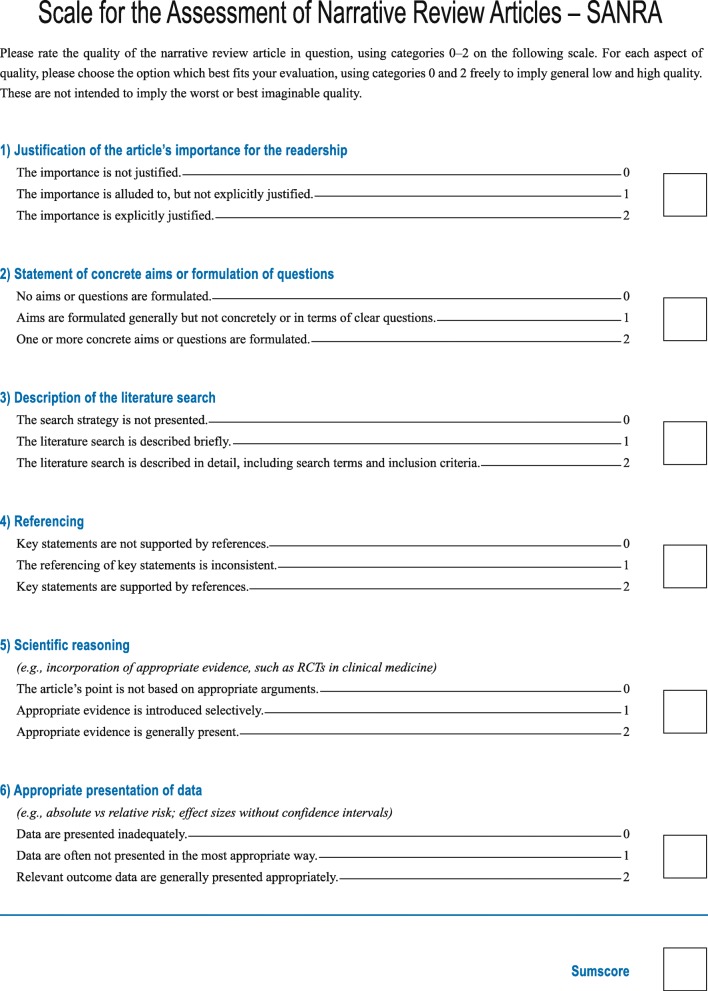
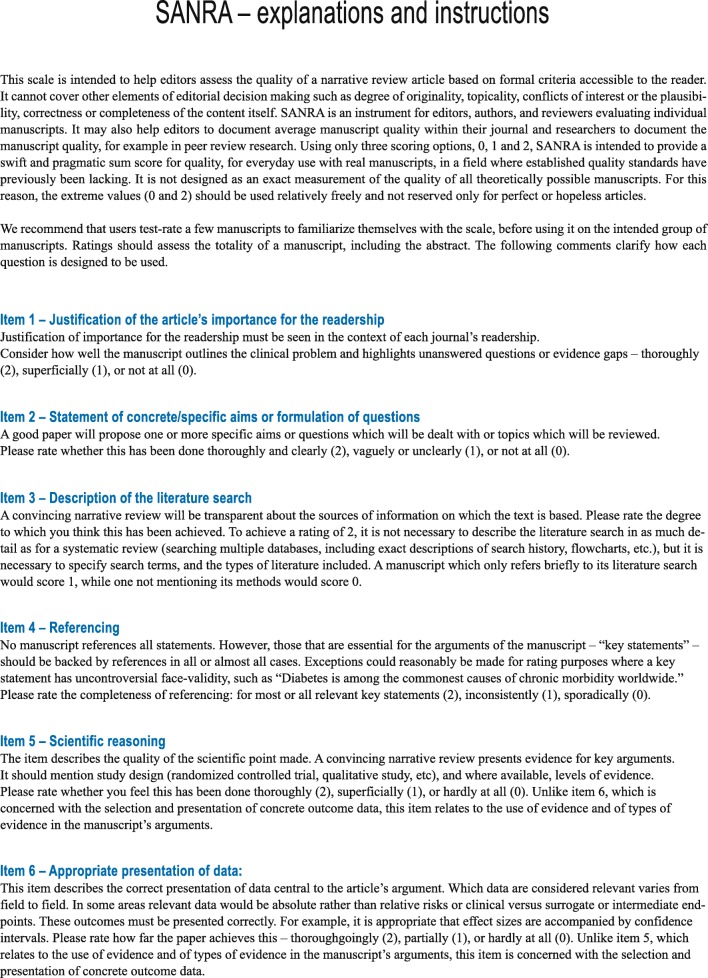
BACKGROUND: Narrative reviews are the commonest type of articles in the medical literature. However, unlike systematic reviews and randomized controlled trials (RCT) articles, for which formal instruments exist to evaluate quality, there is currently no instrument available to assess the quality of narrative reviews. In response to this gap, we developed SANRA, the Scale for the Assessment of Narrative Review Articles. METHODS: A team of three experienced journal editors modified or deleted items in an earlier SANRA version based on face validity, item-total correlations, and reliability scores from previous tests. We deleted an item which addressed a manuscript's writing and accessibility due to poor inter-rater reliability. The six items which form the revised scale are rated from 0 (low standard) to 2 (high standard) and cover the following topics: explanation of (1) the importance and (2) the aims of the review, (3) literature search and (4) referencing and presentation of (5) evidence level and (6) relevant endpoint data. For all items, we developed anchor definitions and examples to guide users in filling out the form. The revised scale was tested by the same editors (blinded to each other's ratings) in a group of 30 consecutive non-systematic review manuscripts submitted to a general medical journal. RESULTS: Raters confirmed that completing the scale is feasible in everyday editorial work. The mean sum score across all 30 manuscripts was 6.0 out of 12 possible points (SD 2.6, range 1-12). Corrected item-total correlations ranged from 0.33 (item 3) to 0.58 (item 6), and Cronbach's alpha was 0.68 (internal consistency). The intra-class correlation coefficient (average measure) was 0.77 [95% CI 0.57, 0.88] (inter-rater reliability). Raters often disagreed on items 1 and 4. CONCLUSIONS: SANRA's feasibility, inter-rater reliability, homogeneity of items, and internal consistency are sufficient for a scale of six items. Further field testing, particularly of validity, is desirable. We recommend rater training based on the "explanations and instructions" document provided with SANRA. In editorial decision-making, SANRA may complement journal-specific evaluation of manuscripts-pertaining to, e.g., audience, originality or difficulty-and may contribute to improving the standard of non-systematic reviews.
Overview
CoChat Summary
TL;DR
SANRA is a six-item, 0–2 scale (maximum 12) for assessing the quality of narrative review articles, developed and field-tested by three journal editors. In 30 consecutive non-systematic review manuscripts, it showed feasible use, sufficient internal consistency and inter-rater reliability, and a modest association with editorial acceptance.
Key findings
- Across 30 manuscripts (90 ratings), the mean SANRA sum score was 6.0 out of 12 (SD 2.6, range 1–12, median 6).
- Internal consistency was Cronbach’s alpha 0.68; corrected item-total correlations ranged from 0.33 (item 3) to 0.58 (item 6).
- Inter-rater reliability was an intra-class correlation coefficient (average measure) of 0.77 [95% CI 0.57, 0.88]; raters often disagreed on items 1 and 4.
- Average SANRA scores were modestly associated with editorial acceptance (mean 6.6, SD 1.9, n = 17) versus rejection (mean 5.1, SD 2.1, n = 13), point biserial correlation 0.37 (t = 2.09, df 28; two-sided p = 0.046).
Methods
- SANRA was developed between 2010 and 2017 by three experienced editors at Deutsches Ärzteblatt; the revised six-item version deleted an item on writing and accessibility due to poor inter-rater reliability.
- The revised scale was tested on 30 consecutive non-systematic review manuscripts submitted to Deutsches Ärzteblatt in 2015; three editor-raters scored them independently and blinded to each other’s ratings.
- Analyses included descriptive statistics, Cronbach’s alpha, corrected item-total correlations, average-measure intra-class correlation using a two-way random effects model (consistency definition), and a post hoc point biserial correlation between SANRA sum scores and acceptance/rejection.
Limitations
- The paper states the main limitation is sample size: 30 manuscripts was a compromise between representativeness, power, and feasibility, and took about 6 months to sample.
- The authors state that the scale’s authors were also the test-raters, so inter-rater reliability may be lower in groups less familiar with SANRA; the study also did not assess test-retest reliability, and results are study-specific.
- The paper acknowledges restricted content validity because SANRA is limited to six items and is a critical appraisal tool rather than a reporting guideline; criterion validity evidence is post hoc and weak, and no established cut-offs exist for comparing manuscripts across settings.
Model-written summary. Check it against the paper before relying on it.
Integrity signals
Registry
Cites
Statistics
Figures
Verification
Claims the paper makes
3 Valid · 0 Not valid · 5 Not checked · 27 Own results and interpretations
The cited sources support only part of this claim — read each source’s verdict below.
In the paper
“Bastian et al. found that they constitute the largest share of all text types in medicine and they concluded that they “remain the staple of medical literature” [1].”
- Also stated in: § Background · plain
“Narrative reviews are the commonest type of articles in the medical literature.”
§ SANRA—a scale for the quality assessment of narrative review articles > Background
What the sources say
- Partly supportedcites [1] Bastian H Glasziou P Chalmers I Seventy-five trials and eleven systematic reviews a day: how will we ever keep up? PLoS Med 2010 7 9 e1000326 10.1371/journal.pmed.1000326 20877712 PMC2943439 sourceExperimental — accuracy not yet measured
In “How Close Are We to Archie Cochrane’s Goal?” and the Summary Points (pages unavailable), the paper calls non-systematic narrative reviews the staple of medical literature synthesis. It does not say they constitute the largest share of all medical text types; that extends a claim about literature synthesis to medical literature as a whole. (LLM, conf=0.88)
plain- Asserted: passes — The authors put it forward as true.
- Checkable: passes — It can be checked against evidence.
- Load-bearing: unclear — It is unclear whether the paper’s conclusions depend on it.
- Based: passes — The paper gives a reason why it holds.
- Also stated in: § Background · plain
The sources with a verdict support this claim; the rest weren’t checked yet, have no full text we could read, or their verdicts aren’t rated yet.
In the paper
“non-systematic reviews or narrative reviews have been widely criticized as unreliable [1, 4].”
§ SANRA—a scale for the quality assessment of narrative review articles > Background
What the sources say
- Supportedcites [1] Bastian H Glasziou P Chalmers I Seventy-five trials and eleven systematic reviews a day: how will we ever keep up? PLoS Med 2010 7 9 e1000326 10.1371/journal.pmed.1000326 20877712 PMC2943439 source
In “How Close Are We to Archie Cochrane’s Goal?”, the paper describes reviews not conducted systematically as having great potential for error and calls them less reliable forms of information. Box 1 also says that articles and textbooks had highlighted the risk of bias and chance in reviews. Together, these passages support the broad characterization that narrative reviews have been criticized as unreliable; page numbers are not provided in our copy. (LLM, conf=0.89)
- Not checked — no full text of the sourcecites [4] Mulrow CD The medical review article: state of the science Ann Intern Med 1987 106 485 488 10.7326/0003-4819-106-3-485 3813259 source
plain- Asserted: passes — The authors put it forward as true.
- Checkable: passes — It can be checked against evidence.
- Load-bearing: passes — The paper’s conclusions depend on it.
- Based: passes — The paper gives a reason why it holds.
- Supported
A result the paper reports from its own data — it cites no other source for it, so there is none to check. The quote shows it is in the paper.
In the paper
“Cronbach’s alpha was 0.68 (internal consistency).”
- Also stated in: § Results · plain
“The scale’s internal consistency, measured as Cronbach’s alpha, was 0.68.”
§ SANRA—a scale for the quality assessment of narrative review articles > Abstract > Results
plainn = 90- Asserted: passes — The authors put it forward as true.
- Checkable: passes — It can be checked against evidence.
- Load-bearing: passes — The paper’s conclusions depend on it.
- Based: passes — The paper gives a reason why it holds.
- Also stated in: § Results · plain
A result the paper reports from its own data — it cites no other source for it, so there is none to check. The quote shows it is in the paper.
In the paper
“Raters often disagreed on items 1 and 4.”
- Also stated in: § Results · plain
“Disagreements most often occurred with regard to items 1 and 4.”
§ SANRA—a scale for the quality assessment of narrative review articles > Abstract > Results
plain- Asserted: passes — The authors put it forward as true.
- Checkable: passes — It can be checked against evidence.
- Load-bearing: unclear — It is unclear whether the paper’s conclusions depend on it.
- Based: passes — The paper gives a reason why it holds.
- Also stated in: § Results · plain
A result the paper reports from its own data — it cites no other source for it, so there is none to check. The quote shows it is in the paper.
In the paper
“The intra-class correlation coefficient (average measure) was 0.77 [95% CI 0.57, 0.88] (inter-rater reliability).”
- Also stated in: § Results · plain
“The intra-class correlation coefficient (average measure) amounted to 0.77 [95% CI 0.57, 0.88; F 4.3; df 29, 58].”
§ SANRA—a scale for the quality assessment of narrative review articles > Abstract > Results
plain- Asserted: passes — The authors put it forward as true.
- Checkable: passes — It can be checked against evidence.
- Load-bearing: passes — The paper’s conclusions depend on it.
- Based: passes — The paper gives a reason why it holds.
- Also stated in: § Results · plain
14 more claims
Create a free account to see all 35 claims and to verify the 3 references still open.
- Probably not a substantial claim. 11
- It may state two separate claims as one. 11
Claims other papers make about this one
Each is checked against this paper’s own text: does it say what the citing paper says it does?
The source backs part of the claim, not all of it — or backs it for a different population, condition or comparison.
In the citing paper
“The review was conducted and reported in accordance with the principles of the Scale for the Assessment of Narrative Review Articles (SANRA), which provides a validated framework for ensuring methodological transparency, scientific rigor, and balanced interpretation in narrative reviews [ 19 ].”
From Paracetamol: A History of Assumptions, Errors, and Evidence Reversals in Pain Management (2026) · cites this paper as [19]
Experimental — accuracy not yet measuredThe source backs part of the claim, not all of it — or backs it for a different population, condition or comparison.
In the citing paper
“As a narrative review, the present work does not include an aggregated quantitative assessment and is more exposed to selection subjectivity than a registered systematic review [124,125].”
From Berberine-Drug Interactions: Mechanisms, Clinical Relevance and Risk Stratification-A Narrative Review (2026) · cites this paper as [124]
Experimental — accuracy not yet measuredThe cited source says what the claim attributes to it.
In the citing paper
“This work is designed as a structured narrative review, with transparent reporting of the documentation strategy, guided by the quality criteria of the Scale for the Assessment of Narrative Review Articles (SANRA) [124].”
From Berberine-Drug Interactions: Mechanisms, Clinical Relevance and Risk Stratification-A Narrative Review (2026) · cites this paper as [124]
The cited source says what the claim attributes to it.
In the citing paper
“we used the following:-Cochrane Risk of Bias 2 (RoB 2) [29] and PEDRO scale tools for RCTs.-AMSTAR 2 [30] checklist for systematic review.-SANRA (Scale for the Assessment of Narrative Review Articles) [31] for narrative reviews.-JBI Checklist for Text and Opinion [32] for expert opinion papers.”
From Pelvic Floor Muscle Training Following Surgery for Pelvic Organ Prolapse: Recommendation from Scientific Literature (2026) · cites this paper as [31]
The cited source says what the claim attributes to it.
In the citing paper
“Data analysis employed a narrative and thematic synthesis methodology,adhering to the SANRA guidelines for narrative reviews (32).”
From Ethical issues in multi-agent AI systems for healthcare: a narrative review (2026) · cites this paper as [32]
12 more claims about this paper
Create a free account to see every claim other papers make about this one.
Citations
Cites
Shea, B. J., Reeves, B. C., Wells, G., Thuku, M., Hamel, C., Moran, J., Moher, D., Tugwell, P., Welch, V., Kristjansson, E., et al. (2017) · BMJ · doi:10.1136/bmj.j4008 · Cited by 10,636 · cited 2×
“Critical appraisal tools have been developed for systematic reviews (e.g., AMSTAR 2 [A MeaSurement Tool to Assess Systematic Reviews] [7]) and papers on RCTs (e.g., the CASP [Critical Appraisal Skills Program] checklist for randomized trials [8]) and other types of medical studies.”
BackgroundStreiner, D. L., & Norman, G. R. (2008) · doi:10.1093/acprof:oso/9780199231881.001.0001 · Cited by 2,631
Critical appraisal skills programme
Singh, J. (2013) · Journal of Pharmacology and Pharmacotherapeutics · doi:10.4103/0976-500x.107697 · Cited by 2,556
Guidelines for Reporting Reliability and Agreement Studies (GRRAS) were proposed
Kottner, J., Audigé, L., Brorson, S., Donner, A., Gajewski, B. J., Hróbjartsson, A., Roberts, C., Shoukri, M., & Streiner, D. L. (2011) · Journal of Clinical Epidemiology · doi:10.1016/j.jclinepi.2010.03.002 · Cited by 2,174
The Mass Production of Redundant, Misleading, and Conflicted Systematic Reviews and Meta‐analyses
IOANNIDIS, J. P. A. (2016) · The Milbank Quarterly · doi:10.1111/1468-0009.12210 · Cited by 1,483 · cited 1×
“While systematic reviews are not per se superior articles and while certain systematic reviews have been criticized lately [3], non-systematic reviews or narrative reviews have”
BackgroundSeventy-five trials and eleven systematic reviews a day: how will we ever keep up?
Bastian, H., Glasziou, P., & Chalmers, I. (2010) · PLoS Medicine · doi:10.1371/journal.pmed.1000326 · Cited by 1,188 · cited 2×
“found that they constitute the largest share of all text types in medicine and they concluded that they “remain the staple of medical literature” [1].”
BackgroundThe Medical Review Article: State of the Science
MULROW, C. D. (1987) · Annals of Internal Medicine · doi:10.7326/0003-4819-106-3-485 · Cited by 856 · cited 1×
“been widely criticized as unreliable [1, 4].”
Writing a narrative biomedical review: considerations for authors, peer reviewers, and editors
Gasparyan, A. Y., Ayvazyan, L., Blackmore, H., & Kitas, G. D. (2011) · Rheumatology International · doi:10.1007/s00296-011-1999-3 · Cited by 694 · cited 1×
“[13], for example, have provided guidance for writing narrative reviews, and Byrne [14] as well as Pautasso [15] has written, from different angles, thoughtful editorials on improving narrative reviews and presented lists of key features of writing a good review—lists that naturally overlap with SANRA items (e.”
BackgroundTen Simple Rules for Writing a Literature Review
Pautasso, M. (2013) · PLoS Computational Biology · doi:10.1371/journal.pcbi.1003149 · Cited by 272 · cited 3×
“[13], for example, have provided guidance for writing narrative reviews, and Byrne [14] as well as Pautasso [15] has written, from different angles, thoughtful editorials on improving narrative reviews and presented lists of key features of writing a good review—lists that naturally overlap with SANRA items (e.”
BackgroundImproving the peer review of narrative literature reviews
Byrne, J. A. (2016) · Research Integrity and Peer Review · doi:10.1186/s41073-016-0019-2 · Cited by 159 · cited 3×
“[13], for example, have provided guidance for writing narrative reviews, and Byrne [14] as well as Pautasso [15] has written, from different angles, thoughtful editorials on improving narrative reviews and presented lists of key features of writing a good review—lists that naturally overlap with SANRA items (e.”
Background
Research works printed but not linked: 3
- Higgins JPT, Green S. (eds.). Cochrane Handbook for Systematic Reviews and Interventions. Version 5.1.0. The Cochrane Collaboration 2011, section 1.2.2., www.handbook.cochrane.org, retrieved on Oct 31, 2018.
- Baethge C Mertens S Goldbeck-Wood S Development of a quality score for the assessment of non-systematic review articles (SANRA) Poster, Seventh International Congress on Peer Review and Biomedical Publication 2013 USA Chicago, Illinois
- Baethge C Goldbeck-Wood S Mertens S A scale for the assessment of non-systematic review articles (SANRA) Poster, Eighth International Congress on Peer and Biomedical Publication 2017 USA Chicago, Illinois
Cited by
Items 3,201–3,300 of 4,334
Asowe, H. A., Moalim, S. A., Adam, M. H., Mohamed, A. M. S., Mahamud, M. A., Garba, B., & Mohamoud, J. H. (2026) · Local and Regional Anesthesia · doi:10.2147/lra.s627136
Serban, D.-V., Mateescu, D.-M., Crainic, D., Ivanovic, N., Fericean, R. M., Bojin, F. M., Toma, A.-O., Jurj, E.-D., Clej, E. E., & Păunescu, V. (2026) · Journal of Clinical Medicine · doi:10.3390/jcm15187022
“This critical narrative review was developed according to the Scale for the Assessment of Narrative Review Articles (SANRA) [5].”
Kaltsas, A., Kyrgiafini, M.-A., Markou, E., & Chrisofos, M. (2026) · Genes · doi:10.3390/genes17091088
“The synthesis was prepared with reference to the Scale for the Assessment of Narrative Review Articles (SANRA) [12].”
Depboylu, B., & Önder, H. (2026) · Journal of Clinical and Translational Research · doi:10.36922/jctr026260061
The Hurdles of Virtual Reality and Generative Artificial Intelligence in Education
Vasser, M., Rozgonjuk, D., & Aru, J. (2026) · Sustainability · doi:10.3390/su18189368
Embodied cognition and the neural basis of syntax: Reinterpreting Kant, Chomsky, and Humboldt
Rodrigues, G. A., Castanheira, F. M., & Caixeta, M. E. (2026) · Research Society and Development · doi:10.33448/rsd-v15i9.51684
Chen, Q., Waleed, K., Peng, A., Cai, S., Xia, Y., Zheng, Z., Waqar, K., Arooj, A., Jiang, S., Junwei, Z., et al. (2026) · Frontiers in Cellular and Infection Microbiology · doi:10.3389/fcimb.2026.1879154
da Silva, J. P., & Ladvocat, M. (2026) · Scientia Generalis · doi:10.22289/sg.v7n2a37
Torreão, R. M. G., Almeida, B. R., Rodrigues, A. A. D. C., Pacifico, D. V., de Azeredo, D. A. B., Correa, C. J., Sousa, A. R., & Costa, G. R. D. C. E. (2026) · Revista Acadêmica Online · doi:10.36238/2359-5787.2026.v12n65.2429
Okoń, P., Niczyporuk, J., Wójtowicz, B., Skrzypek, S., & Cholewa, J. (2026) · International Journal of Innovative Technologies in Social Science · doi:10.31435/ijitss.3(51).2026.6454
Akram, A. (2026) · European Gynecology & Obstetrics · doi:10.11138/ego.6
“…and reported in accordance with the Scale for the Assessment of Narrative Review Articles (SANRA), a validated six-item quality framework for narrative reviews that evaluates justification of the review, literature search, referencing, scientific reasoning, and appropriate presentation of data [2].”
Yetkin, O., Baykan, B. B., & Żarowski, M. (2026) · Current Issues in Molecular Biology · doi:10.3390/cimb48090931
“The manuscript was assessed by the authors against the six items of the Scale for the Assessment of Narrative Review Articles (SANRA) [19].”
Linares, Y. M., Vélez-Slimani, H., & Salazar, L. A. (2026) · Antioxidants · doi:10.3390/antiox15091158
Ahad, A., & Hullon, D. (2026) · Cardiovascular Toxicology · doi:10.1007/s12012-026-10187-8
Rocha, N. D. B., Filgueiras, G. V., Costa, A. M. M., Gomes, G. D. S., Aniceto, B. F., Galito, P. F., Falabella, M. E. V., & Mattos, T. B. (2026) · Revista Multidisciplinar do Nordeste Mineiro · doi:10.66104/v1s20g56
Biswas, P., Sukumar, T. K., & Arnold, A. (2026) · MedEdPublish · doi:10.12688/mep.21825.1
Zmysłowska, K., Kiersztyn, J. M., Szatkowska, A., Kwaśniewska, M., Hajdaniak, A., Grabowska, A., Seńcio, N., & Stadnik, K. A. (2026) · International Journal of Innovative Technologies in Social Science · doi:10.31435/ijitss.3(51).2026.6630
“The review was guided by SANRA domains, including a stated aim, a described search, appropriate referencing, evidence-level interpretation, and use of relevant endpoint data [3].”
Zhang, R., Yang, L., Jing, D., & Chen, L. (2026) · International Journal of COPD · doi:10.2147/copd.s629169
Cosare, N. G. (2026) · Journal of Leadership for Basic and Higher Education · doi:10.66074/c9d2e6f3g7
CONTEMPORARY APPROACHES AND CHALLENGES TO TALENT IDENTIFICATION IN YOUTH SPORTS: A REVIEW.
Adeyemo, T. C. (2026) · Open Journal of Social Science and Humanities · doi:10.52417/ojssh.v7i1.1232
Alredha, R. D. A., Ali, Z. A., Haddawi, K. H., Jawad, A., Ibrahim, H. F., & Abduljabbar, H. A. (2026) · Middle East Fertility Society Journal · doi:10.1186/s43043-026-00365-7
“The review follows the principles of the Scale for the Assessment of Narrative Review Articles (SANRA) [8], and a completed SANRA self-appraisal is provided as Supplementary Table S4; the checklist is retained as a reporting aid rather than as an independent quality assessment, and no total score…”
Apollaro, G., bishop, C., Kons, R. L., Franchini, É., Detanico, D., Ruggeri, P., Falcó, C., & Faelli, E. L. (2026) · Sports · doi:10.3390/sports14100425
“This brief review was conducted in accordance with the SANRA (Scale for the Assessment of Narrative Review Articles) checklist to ensure methodological transparency and rigor [46].”
Günther, A., Bednarczyk–Cwynar, B., & Tomczyk, M. (2026) · Molecules · doi:10.3390/molecules31183232
“The SANRA domains were used as a quality-appraisal framework for the narrative synthesis, particularly with respect to the formulation of the review aims, description of the literature search, referencing of key statements, and presentation of the strength of the underlying evidence [32].”
Sukhanova, M. A., Akulov, Z. A., Pilipenko, M. O., Berikkhanov, Z. G. M., Shestakov, A. L., Tarabrin, E. А., Nikolaev, A. M., Rakintsev, V. S., Nourmahal, S., & Muraviev, S. Y. (2026) · International Journal of Translational Medicine · doi:10.3390/ijtm6030041
“The structure of the manuscript was checked against the SANRA criteria for narrative reviews [10].”
Chrono-Nutritional Disruption as a Potential Modifiable Factor in Bipolar Disorder
Mazza, M., & Marano, G. (2026) · Nutrients · doi:10.3390/nu18183011
Cristino, M. A. (2026) · NURSE EDUCATORS AND PRACTITIONERS JOURNAL · doi:10.64397/nepj.v02i01.2026.a44
Klimas, P., Wysokiński, P., Szmeja, S., Masalska, J., Toczydłowski, K. R., Król, P. A., Michalik, M., Mamczak, M., Strzępek, S. F., & Mazek, N. (2026) · Journal of Education Health and Sport · doi:10.12775/jehs.2026.95.73695
Valdovinos-García, L. R., Vieyra-Vega, M., & Torres‐Villalobos, G. (2026) · Revista Colombiana de Gastroenterología · doi:10.22516/25007440.1636
Lygouras, D., Tsinakos, A. A., Vadikolias, K., & Seimenis, I. (2026) · Digital Health and Innovation · doi:10.3390/dhi1010006
“The reporting approach was informed by principles outlined in the Scale for the Assessment of Narrative Review Articles (SANRA) [25], with emphasis on transparent justification of the literature identification process, clear description of evidence synthesis procedures, and explicit explanation of…”
Iannella, G., Caputo, P. P., Maniaci, A., Lechien, J. R., Cammaroto, G., Chiesa-Estomba, C. M., Guarino, P., Salzano, G., Vaira, L. A., Gargula, S., et al. (2026) · Healthcare · doi:10.3390/healthcare14183001
“…was therefore developed to preserve full compliance with SANRA methodology through transparent reporting, balanced interpretation of the available evidence and a clinically oriented discussion highlighting current knowledge gaps and priorities for future research in geriatric otology [16].”
InfluentialMikroplastik und männliche Urogenitalgesundheit: Aktuelle Evidenz und klinische Implikationen
Klotz, T. (2026) · Die Urologie · doi:10.1007/s00120-026-02932-2
Poulios, E., Papadopoulou, S. Κ., Angelakou, E.-P., Tsourouflis, G., Serdari, A., & Giaginis, C. (2026) · Current Issues in Molecular Biology · doi:10.3390/cimb48090937
Ripon, L. I. (2026) · International Journal of Innovative Science and Research Technology (IJISRT) · doi:10.38124/ijisrt/26aug1619
“Its organization follows widely used principles for improving narrative-review quality, including a clear purpose, transparent source use, appropriate referencing, attention to evidence strength, and reasoned synthesis [12].”
Li, X., Li, M., Song, H., Liu, X., Jia, F., Tang, Y., Wu, P., & Wen, Q. (2026) · Ultrasonics Sonochemistry · doi:10.1016/j.ultsonch.2026.108063
“Therefore, we conducted a qualitative narrative synthesis organized around three themes: mechanisms of permeability enhancement, engineering design and integration, and clinical translation challenges [19].”
Ishitsuka, N., Utsumi, T., Ikeda, R., Sugimoto, T., Kadono, Y., Noro, T., Suzuki, Y., Iijima, S., Sugizaki, Y., Somoto, T., et al. (2026) · Applied Sciences · doi:10.3390/app16189055
Cellular Senescence in Oral Lichen Planus: Evidence, Limitations, and Future Perspectives
Falco, D. D., Lucchese, A., Pannone, G., & Petruzzi, M. (2026) · Immuno · doi:10.3390/immuno6030058
“Reporting was informed by SANRA principles [19].”
Banala, M., Ezuddin, S., Makanji, R. J., & Foley, M. (2026) · Annals of Nuclear Medicine · doi:10.1007/s12149-026-02282-1
Mora-Delgado, J., Jiménez, V. R., & Lojo-Cruz, C. (2026) · Healthcare · doi:10.3390/healthcare14182998
“The reporting quality of this manuscript was self-assessed against the SANRA criteria for narrative reviews [24].”
Immunopeptidomics-guided cancer vaccine design: Advances, challenges, and emerging opportunities
Behzadifar, M., Shadkam, M., Kazemi, S., Mirsamiei, E., Hoseinzadeh, A., Nickho, H., & Baharlou, R. (2026) · Biomedicine & Pharmacotherapy · doi:10.1016/j.biopha.2026.119926
史, 会. (2026) · Service Science and Management · doi:10.12677/ssem.2026.155121
Artificial Intelligence in Medicine: Current Threats, Risk Dimensions and Future Challenges
Koshiya, H. R., Gehlawat, M., Girdhar, S., & Kumar, P. (2026) · IntechOpen eBooks · doi:10.5772/intechopen.1017724
Gürmen, M. S. (2026) · Journal of Dependence · doi:10.51982/bagimli.625
Mindfulness and Spirituality: Conceptual Boundaries, Empirical Synergies, and Clinical Implications
Popa, E. (2026) · International Journal of Research and Innovation in Applied Science · doi:10.51584/ijrias.2026.11080118
Sun, L., Xue, L., Ye, T., & Zhang, X. (2026) · Frontiers in Neurology · doi:10.3389/fneur.2026.1920170
Vascularized free flaps based oral reconstruction: a narrative review of dental functional outcomes
Alotaibi, S. (2026) · The Saudi Dental Journal · doi:10.1007/s44445-026-00238-9
“The methodological quality and reporting of the present narrative review were evaluated using the Scale for the Assessment of Narrative Review Articles (SANRA) (Baethge et al. 2019 ).”
InfluentialPeripheral TDP-43 pathology in amyotrophic lateral sclerosis: toward a systemic proteinopathy
Codron, P., Miranda, M., Garnier, M., He, S., Gouju, J., Cassereau, J., Leblanc, P., & Letournel, F. (2026) · Acta Neuropathologica · doi:10.1007/s00401-026-03086-3
Karacan, D. B., & Takaki, J. D. T. (2026) · Frontiers in Research Metrics and Analytics · doi:10.3389/frma.2026.1898634
“…instead on the interpretive synthesis of the existing academic and policy literature, rather than on a reproducible search protocol such as PRISMA, which is designed for systematic reviews of empirical studies and is not intended for narrative or discursive policy reviews (Baethge et al., 2019).”
Shrivastava, N., Gaonkar, S. L., & Mahammad, F. S. (2026) · Therapeutic Advances in Drug Safety · doi:10.1177/20420986261454205
Dai, Q., & Shu, R. (2026) · Pharmaceuticals · doi:10.3390/ph19091469
“As a narrative review, this article adheres to the principles of the Scale for the Assessment of Narrative Review Articles (SANRA) [99].”
Khan, K. T., Khan, S. S., & Mumtaz, A. (2026) · Responsible Education Learning and Teaching in Emerging Economies · doi:10.26710/relate.v8i2.3960
“…was written with quality domains from the Scale for the Assessment of Narrative Review Articles (SANRA) in mind: Clear rationale, explicit aims, transparent search description, appropriate referencing, discussion of level of evidence, presentation of relevant outcome data (Baethge et al., 2019).”
ALIAmides and pediatric health: a structured narrative review
Vittori, A., Mascilini, I., Valeriani, M., Cascella, M., Nardo, G. D., Stadio, A. D., Bove, D., Ferretti, A., Papetti, L., & Francia, E. (2026) · Frontiers in Pharmacology · doi:10.3389/fphar.2026.1900560
“The review was conducted as a structured narrative review, adhering to the Scale for Assessment of Narrative Review Articles (SANRA) guidelines (Baethge et al., 2019).”
Deng, H., Wang, Y.-Q., Sun, Y.-F., Zhou, Z.-H., & Zhou, Z.-H. (2026) · World Journal of Psychiatry · doi:10.5498/wjp.124324
Giurazza, R., Cosenza, G., Fiore., M., Notaro, S., Sansone, P., Pota, V., Coppolino, F., Piccialli, F., & Pace, M. C. (2026) · Journal of Clinical Medicine · doi:10.3390/jcm15197697
“The methodological quality of this narrative review was assessed using the Scale for the Assessment of Narrative Review Articles (SANRA) [30], self-assessed by R.G., as a guiding checklist during manuscript preparation, to ensure structural and scientific completeness.”
Zeng, Q., Cui, H., Guo, S., Li, C., & Zhang, Y. (2026) · Frontiers in Medicine · doi:10.3389/fmed.2026.1910274
“The Scale for the Assessment of Narrative Review Articles (SANRA) was used as a reporting aid (12).”
Daniilidis, A., Saponara, S., Roussos, N. S., Vagioni, I., Delis, M., Demiri, C. D., & Grimbizis, G. F. (2026) · Facts Views and Vision in ObGyn · doi:10.52054/fvvo.2026.306
Gersdorff, G., Camby, S., & Lefebvre, P. P. (2026) · Frontiers in Audiology and Otology · doi:10.3389/fauot.2026.1939453
Wu, X., Xing, Y., Ma, J., Wang, X., & Xiong, X. (2026) · Biomolecules · doi:10.3390/biom16091346
“The revised reporting structure was informed by the Scale for the Assessment of Narrative Review Articles (SANRA) [7]; no formal item-by-item SANRA score was assigned.”
Klimas, P., Witaszczyk, M., Sołtan, A., Wiktorzak, N., Lipska, J., Prządka, J., Kochan-Olszewska, D., Rudnicki, L., Pawlicki, J., Koźma, G., et al. (2026) · Quality in Sport · doi:10.12775/qs.2026.72.74894
Costigan, S. A., Ridgeway, C. D., & Vlcek, S. (2026) · Children · doi:10.3390/children13091249
“The quality and reporting of the narrative review were also considered with reference to the Scale for the Assessment of Narrative Review Articles (SANRA) [16].”
Bawadi, H. A., Abuhijleh, H., Nofal, M., Zakaria, Z. Z., & Al‐Asmakh, M. (2026) · Endocrinology Diabetes & Metabolism · doi:10.1002/edm2.70338
“The review approach was guided by established principles for high-quality narrative synthesis, aligned with the Scale for the Assessment of Narrative Review Articles (SANRA), to ensure a clear focus, transparent study selection and balanced interpretation of evidence [10].”
Ercan, S., & Öngel, Ö. (2026) · Open Journal of Orthopedics and Rheumatology · doi:10.17352/ojor.000057
Li, W., Chi, D., Hu, X., Liu, Y., Li, Z., Li, Y., Li, Y., & Li, Y. (2026) · Foods · doi:10.3390/foods15183265
Aniokete, U. C., Obasi, D. C., Uzor, S., Akwari, A. A., Okoroh, P. N., Emeruwa, A. P., Amadi, E. B., Eji, M. O., & Alum, E. U. (2026) · Human Nutrition & Metabolism · doi:10.1016/j.hnm.2026.200386
Zhang, W., Wang, L., Ren, S., Yang, Z., Wu, G., & Gao, K. (2026) · Frontiers in Neurology · doi:10.3389/fneur.2026.1889300
Covașă, C. T., & Grădinaru, A. C. (2026) · Life · doi:10.3390/life16091544
Soltani, H. R., Toolabi, K., Safavi, S. A. S., Najjari, K., & Latif, A. (2026) · Obesity Surgery · doi:10.1007/s11695-026-08933-6
“Selection bias is an inherent risk, as the choice and weighting of included literature reflects reviewer judgment rather than formal systematic protocols [ 9 , 10].”
Vandy, J., Agu, P. C., & Xiangqing, S. (2026) · Biomedical Research and Therapy · doi:10.15419/bmrat.v13i8.1097
Madkoor, M., Ahmed, R. A., Hany, R., Abdelnaby, M., Hagar, Z., Ahmed, A., Akl, H., Elshorbagy, D., Emad, A., Elsayed, J., et al. (2026) · Pharmacological Research · doi:10.1016/j.phrs.2026.108455 · Cited by 1
Khan, W., & Lahri, S. (2026) · African Journal of Emergency Medicine · doi:10.1016/j.afjem.2026.101014
“Reporting follows the Scale for the Quality Assessment of Narrative Review Articles (SANRA) checklist [14].”
Chimeric Antigen Receptor T-cell (CAR-T) Therapy in Autoimmune Diseases: A Narrative Review
Molina-Garcia, I. A., Oliveros-Perez, J. G., Molina-Garcia, S. D., Guevara-Ostos, A. P., Blanco-Contreras, M. F., Camacho-Flores, L. M., & Rodriguez, L. S. (2026) · Cureus · doi:10.7759/cureus.116377
“This is a structured narrative review conducted in accordance with the Scale for the Assessment of Narrative Review Articles principles rather than as a systematic review [12].”
Scridon, A., Halațiu, V.-B., & Cozac, D. A. (2026) · Medicina · doi:10.3390/medicina62091783
Developmental Postural Modeling: A Historical and Conceptual Narrative Review of Posture Assessment
Glinkowski, W., & Sitnik, R. (2026) · Journal of Clinical Medicine · doi:10.3390/jcm15187197
“The review was prepared with reference to the SANRA domains for narrative reviews, particularly the explicit justification of importance and aims, transparent description of literature searching, appropriate referencing, and clear separation of evidence from author interpretation [37].”
Inflammatory breast cancer in the era of effective systemic therapy: Is surgical de-escalation safe?
Venkataraman, J., Massad, A. M., & Mokbel, K. (2026) · Surgical Oncology Insight · doi:10.1016/j.soi.2026.100292
Du, Y., Li, X., Zheng, K., Sun, Y., Zhu, J., Chen, Y., & He, C. (2026) · Critical Reviews in Oncology/Hematology · doi:10.1016/j.critrevonc.2026.105592
Fibromyalgia beyond pain: a multisystemic dysregulation framework
Serrat, M., Estanyol, S., Cifre, D., Lizama-Lefno, A., Araya‐Quintanilla, F., Nieto, R., Suso‐Ribera, C., & Almirall, M. (2026) · Pain Management · doi:10.1080/17581869.2026.2734039
Liberati, L., Moriconi, F., Marfoli, A., Dall’Olio, G., & Chieffo, D. P. R. (2026) · Neurochirurgie · doi:10.1016/j.neuchi.2026.101883
Hung, M., Jensen, A., Strickler, I., Vu, S., Arapovic, A. E., & El‐Othmani, M. M. (2026) · Journal of Clinical Medicine · doi:10.3390/jcm15187220
“It also translates evidence into actionable frameworks designed to standardize how clinicians assess risk, document modifiable decisions, and counsel young women in a repeatable, reviewable way [111].”
Chuwa, A. H., & Mvunta, D. H. (2026) · Journal of International Medical Research · doi:10.1177/03000605261476189
“12 This acidic microenvironment suppresses cytotoxic immune effector functions, including those of cluster of differentiation 8 (CD8) + T cells and natural killer (NK) cells, and promotes polarization of tumor-associated macrophages (TAMs) toward an M2-like, pro-tumorigenic phenotype.”
Eisenmenger, B. T., Rappaport, A. S., Connell, L. H., Petruc, V. T., Riordan, E. J., Wakefield, M. R., & Fang, Y. (2026) · Cancers · doi:10.3390/cancers18183019
“SANRA informed the narrative review appraisal, rather than serving as a reporting guideline or evidence-certainty grade [22].”
Gailot, A., Banihani, N., & Muhammad, N. (2026) · Cureus · doi:10.7759/cureus.116451
“The review was revised with attention to the Scale for the Assessment of Narrative Review Articles (SANRA) [8].”
Gao, J., Xie, R., Rao, C., Jiao, J., Zhang, W., Hu, Y., Yang, B., Zhao, H., Yuan, P., Xie, T., et al. (2026) · Journal of International Medical Research · doi:10.1177/03000605261483860
Caetano, K. P. D. S., Mancini, A. C. A., Fiuza, M. C. P., Alves, M. P. P., Araújo, I. G. D. M., Santos, D. B. B., Raul Souza da, C. R. U. Z., de Sousa, D. M., Dias, R. B., do Nascimento, A. C. A., et al. (2026) · Revista Multidisciplinar do Nordeste Mineiro · doi:10.66104/fcq3ac23
Rodrigues, L. T. R., Mezacasa, J. C. F. B., Moreira, J. D. S. V., Aranha, V. L. D. S., Vignardi, I. E. A., Rodrigues, S. F., Artuzi, T. D. O., Almada, K. A. D. S., Rocha, L. A., Spaziani, A. O., et al. (2026) · Revista Multidisciplinar do Nordeste Mineiro · doi:10.66104/r60h9881
Alanazi, F. S., Abusoliman, A. K., Alamri, A. N., Abutaleb, M. Y., Khan, A. H., Khulaif, L. M. A., Ragab, R. E., Alabdali, R. A., Albassam, A. A., Hakami, R. A., et al. (2026) · DawnMed Journal of Medical Science · doi:10.64039/djms.2026.2402
Rodríguez-Camacho, A., García-Bitar, A., Guinto, G., Polito-Salazar, E., Blasco, X., Meraz-Soto, J. M., Torres-Ríos, J. A., Moscardini-Martelli, J., Flores-Vázquez, J. G., Hernández-Sánchez, L. C., et al. (2026) · Brain Sciences · doi:10.3390/brainsci16111157
Piguave-Mero, C. R., Velázquez, T., Ramírez, V. V. C., & Chávez, A. M. C. (2026) · Revista Multidisciplinaria Voces de América y el Caribe · doi:10.69821/remuvac.v3i3.338
Soriano, L. S. (2026) · Athena Latino-Americana · doi:10.69720/3086-5182.2026.000058
Li, H., Xing, H., Zhang, S., Zhang, L., & Kang, J. (2026) · Frontiers in Bioengineering and Biotechnology · doi:10.3389/fbioe.2026.1883349
“Consistent with the Scale for the Assessment of Narrative Review Articles (SANRA) framework for non-systematic reviews (Baethge et al., 2019), we searched PubMed, Scopus, and Web of science from database inception to 13 April 2026 using combinations of the terms “autologous protein solution,”…”
Opioid withdrawal syndrome‐associated cognitive impairment: A narrative review
Khan, M. F., Tunalı, N., & Chambers, R. A. (2026) · American Journal on Addictions · doi:10.1111/ajad.70201
“9 Below, we provide a brief clinical and scientific contextualization of the OWSCI literature, followed by a description, summary, and discussion of the core target papers identified.”
San‐Juan, D., Blasco, X., Polito-Salazar, E., Velasco-Hernandez, A., Galindo-Bustamante, H. F., Sousa-Oliva, G., Rosa, N. A. T.-D. L., Valentín, A., & Stavropoulos, I. (2026) · Frontiers in Neurology · doi:10.3389/fneur.2026.1950268
“Methodological transparency and reporting quality were guided by the Scale for the Assessment of Narrative Review Articles (SANRA) (13), a validated framework that strengthens literature justification, critical appraisal, transparency, and balanced interpretation in narrative reviews.”
Diaconu, R., Pădureanu, V., Radu, R. I., Iovănescu, M. L., Mirea, O., Hădăreanu, D.-R., & Donoiu, I. (2026) · Frontiers in Cardiovascular Medicine · doi:10.3389/fcvm.2026.1885898
Bozada, F. A. T., Cañarte, M. K. M., Lucero, D. E. G., & Toala, F. J. C. (2026) · Revista Multidisciplinaria Voces de América y el Caribe · doi:10.69821/remuvac.v3i3.410
Moreira, F. M. R., Roben, D. R. L., Rodríguez, P. K. P., & Gutiérrez, G. G. V. (2026) · Revista Multidisciplinaria Voces de América y el Caribe · doi:10.69821/remuvac.v3i3.421
Sornoza, R. J. B., Vélez, L. A. C., Peñafiel, J. V. P., & Solano, B. J. A. (2026) · Revista Multidisciplinaria Voces de América y el Caribe · doi:10.69821/remuvac.v3i3.366
Evolution of Surgical Flap Delay and Conditioning in Reconstructive Surgery
Basheva, M. (2026) · Cureus · doi:10.7759/cureus.116456
“The review was informed by the six Scale for the Assessment of Narrative Review Articles (SANRA) domains: justification, aims, description of the literature search, referencing, scientific reasoning, and appropriate presentation of data [3].”
Taking a spiritual history in the oral oncology setting
Santos‐Silva, A. R., Magalhaes, M., Calderipe, C. B., Lopes, M. A., Pires, E. V. Á., & Epstein, J. B. (2026) · Supportive Care in Cancer · doi:10.1007/s00520-026-11215-7
“This brief narrative review used the SANRA criteria [24].”
Castro, W. F., & Fernández, D. S. N. (2026) · Revista Multidisciplinaria Voces de América y el Caribe · doi:10.69821/remuvac.v3i2.335
Metadata
- Authors
- Baethge, C., Goldbeck-Wood, S., & Mertens, S.
- Affiliations
- University of Cologne (DE)
- BMJ Group (United Kingdom) (GB)
- Corresponding author
- Baethge, Christopher
- ORCID
- Baethge, Christopher
- Venue
- Research Integrity and Peer Review
- Published
- 2019-03-26
- Volume
- 4
- Issue
- 1
- Pages
- 5-5
- ISSN
- 2058-8615 (ISSN-L)
- PMC
- PMC6434870
- OpenAlex
- W2922577842
- Semantic Scholar
- ea7f35b3069b53791c3b746c5c4b3c72a83a526b
- Cited by
- 3,469
- References
- 13
- Citations by year
- 2026: 1823 · 2025: 551 · 2024: 379 · 2023: 309 · 2022: 218 · 2021: 152 · 2020: 32 · 2019: 4
- FWCI
- 20.57
- Type
- journal article
- Language
- en
- Open access
- gold
- doi.org
- Licence
- cc-by
- creativecommons.org/licenses/by/4.0/ (tdm)
- Locations
- Research Integrity and Peer Review (publishedVersion, cc-by)
- Europe PMC (PubMed Central) (publishedVersion, other-oa)
- PubMed Central (publishedVersion, cc-by)
- PubMed (publishedVersion)
- Kölner Universitäts PublikationsServer (Universität zu Köln) (publishedVersion)
- DOAJ (DOAJ: Directory of Open Access Journals) (submittedVersion, cc-by-sa)
- Topics
- Social Sciences › Decision Sciences › Statistics, Probability and Uncertainty › Meta-analysis and systematic reviews
- Social Sciences › Library and Information Sciences › Academic Writing and Publishing
- Social Sciences › Library and Information Sciences › scientometrics and bibliometrics research
- Keywords
- quality assessment scale, manuscript review, inter-rater reliability, level of evidence, scale development
About these checks
Registry, retraction, Cites and statistics results are computed, not judged, with one exception: a printed reference that no index lists is read once by a model before it counts as a citation error. Claims are extracted by a model and kept only when their quote appears verbatim in the text; each cited source is then checked, with a model’s help, for whether it says what the claim relies on. Those verdicts can be wrong — read the claim’s quote and the cited source before relying on one.
The claim verdicts this report counts are experimental: their accuracy is not yet measured.
A language model drew the claims from the paper on 2026-11-10, under version 3 of the claim definition (model deepseek-v4.1-flash, prompt extract-v3).
A second model labelled each claim on 2026-11-10 (model jev-1.13-20260917, definition revision gold-guideline-v0.2).
Cited sources are checked with a language model’s help (gpt-6-sol).
Statistics and arithmetic are recomputed, not judged.
Confidence bands are shown only for fields calibrated on our annotated test set. None is calibrated yet, so no band is shown.
What counts as a claim ›How we measure confidence ›How we check this ›
Are you an author, or do you see a problem with this page? Request a review
Data sources
Bibliographic data: Semantic Scholar, OpenAlex, Crossref.
Contains information from the Semantic Scholar Academic Graph Datasets, made available under the ODC Attribution License (ODC-BY 1.0).
Semantic Scholar’s data is described in: Kinney, R., et al. (2023). The Semantic Scholar Open Data Platform. arXiv:2301.10140.
