

SANRA—a scale for the quality assessment of narrative review articles
Open accessThe DOI matches its Crossref record; 12 of the 13 references it cites were found in a registry or an index; 4 of the 12 sources its claims cite were checked for support.
Abstract
BACKGROUND: Narrative reviews are the commonest type of articles in the medical literature. However, unlike systematic reviews and randomized controlled trials (RCT) articles, for which formal instruments exist to evaluate quality, there is currently no instrument available to assess the quality of narrative reviews. In response to this gap, we developed SANRA, the Scale for the Assessment of Narrative Review Articles. METHODS: A team of three experienced journal editors modified or deleted items in an earlier SANRA version based on face validity, item-total correlations, and reliability scores from previous tests. We deleted an item which addressed a manuscript's writing and accessibility due to poor inter-rater reliability. The six items which form the revised scale are rated from 0 (low standard) to 2 (high standard) and cover the following topics: explanation of (1) the importance and (2) the aims of the review, (3) literature search and (4) referencing and presentation of (5) evidence level and (6) relevant endpoint data. For all items, we developed anchor definitions and examples to guide users in filling out the form. The revised scale was tested by the same editors (blinded to each other's ratings) in a group of 30 consecutive non-systematic review manuscripts submitted to a general medical journal. RESULTS: Raters confirmed that completing the scale is feasible in everyday editorial work. The mean sum score across all 30 manuscripts was 6.0 out of 12 possible points (SD 2.6, range 1-12). Corrected item-total correlations ranged from 0.33 (item 3) to 0.58 (item 6), and Cronbach's alpha was 0.68 (internal consistency). The intra-class correlation coefficient (average measure) was 0.77 [95% CI 0.57, 0.88] (inter-rater reliability). Raters often disagreed on items 1 and 4. CONCLUSIONS: SANRA's feasibility, inter-rater reliability, homogeneity of items, and internal consistency are sufficient for a scale of six items. Further field testing, particularly of validity, is desirable. We recommend rater training based on the "explanations and instructions" document provided with SANRA. In editorial decision-making, SANRA may complement journal-specific evaluation of manuscripts-pertaining to, e.g., audience, originality or difficulty-and may contribute to improving the standard of non-systematic reviews.
Overview
CoChat Summary
TL;DR
SANRA is a six-item, 0–2 scale (maximum 12) for assessing the quality of narrative review articles, developed and field-tested by three journal editors. In 30 consecutive non-systematic review manuscripts, it showed feasible use, sufficient internal consistency and inter-rater reliability, and a modest association with editorial acceptance.
Key findings
- Across 30 manuscripts (90 ratings), the mean SANRA sum score was 6.0 out of 12 (SD 2.6, range 1–12, median 6).
- Internal consistency was Cronbach’s alpha 0.68; corrected item-total correlations ranged from 0.33 (item 3) to 0.58 (item 6).
- Inter-rater reliability was an intra-class correlation coefficient (average measure) of 0.77 [95% CI 0.57, 0.88]; raters often disagreed on items 1 and 4.
- Average SANRA scores were modestly associated with editorial acceptance (mean 6.6, SD 1.9, n = 17) versus rejection (mean 5.1, SD 2.1, n = 13), point biserial correlation 0.37 (t = 2.09, df 28; two-sided p = 0.046).
Methods
- SANRA was developed between 2010 and 2017 by three experienced editors at Deutsches Ärzteblatt; the revised six-item version deleted an item on writing and accessibility due to poor inter-rater reliability.
- The revised scale was tested on 30 consecutive non-systematic review manuscripts submitted to Deutsches Ärzteblatt in 2015; three editor-raters scored them independently and blinded to each other’s ratings.
- Analyses included descriptive statistics, Cronbach’s alpha, corrected item-total correlations, average-measure intra-class correlation using a two-way random effects model (consistency definition), and a post hoc point biserial correlation between SANRA sum scores and acceptance/rejection.
Limitations
- The paper states the main limitation is sample size: 30 manuscripts was a compromise between representativeness, power, and feasibility, and took about 6 months to sample.
- The authors state that the scale’s authors were also the test-raters, so inter-rater reliability may be lower in groups less familiar with SANRA; the study also did not assess test-retest reliability, and results are study-specific.
- The paper acknowledges restricted content validity because SANRA is limited to six items and is a critical appraisal tool rather than a reporting guideline; criterion validity evidence is post hoc and weak, and no established cut-offs exist for comparing manuscripts across settings.
Model-written summary. Check it against the paper before relying on it.
Integrity signals
Registry
Cites
Statistics
Figures
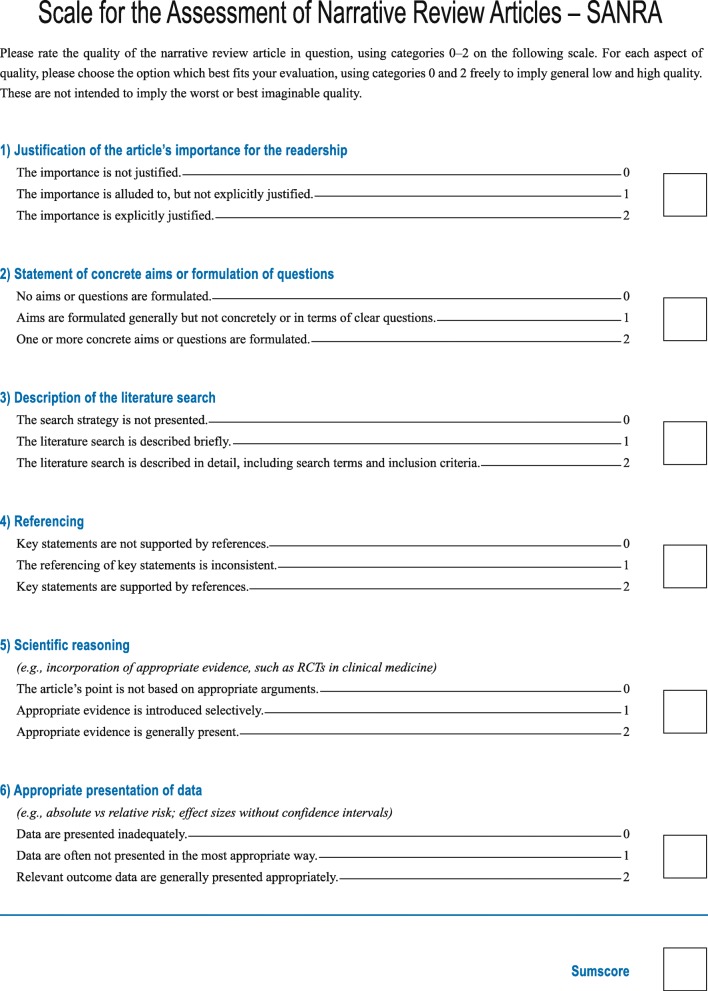
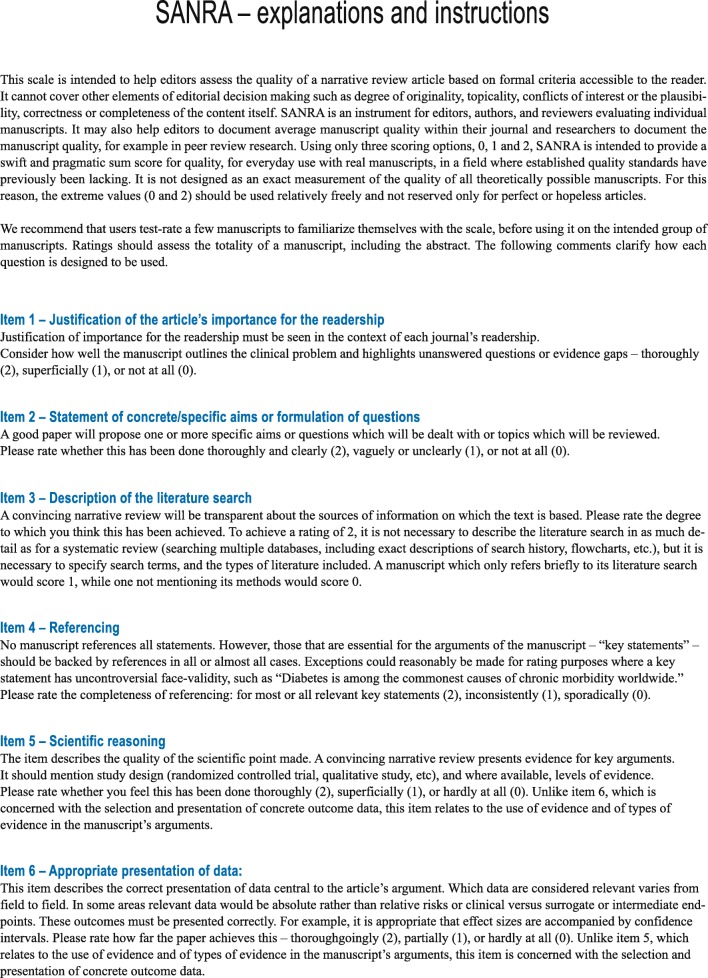
Verification
Claims the paper makes
3 Valid · 0 Not valid · 5 Not checked · 27 Own results and interpretations
The cited sources support only part of this claim — read each source’s verdict below.
In the paper
“Bastian et al. found that they constitute the largest share of all text types in medicine and they concluded that they “remain the staple of medical literature” [1].”
- Also stated in: § Background · plain
“Narrative reviews are the commonest type of articles in the medical literature.”
§ SANRA—a scale for the quality assessment of narrative review articles > Background
What the sources say
- Partly supportedcites [1] Bastian H Glasziou P Chalmers I Seventy-five trials and eleven systematic reviews a day: how will we ever keep up? PLoS Med 2010 7 9 e1000326 10.1371/journal.pmed.1000326 20877712 PMC2943439 sourceExperimental — accuracy not yet measured
In “How Close Are We to Archie Cochrane’s Goal?” and the Summary Points (pages unavailable), the paper calls non-systematic narrative reviews the staple of medical literature synthesis. It does not say they constitute the largest share of all medical text types; that extends a claim about literature synthesis to medical literature as a whole. (LLM, conf=0.88)
plain- Asserted: passes — The authors put it forward as true.
- Checkable: passes — It can be checked against evidence.
- Load-bearing: unclear — It is unclear whether the paper’s conclusions depend on it.
- Based: passes — The paper gives a reason why it holds.
- Also stated in: § Background · plain
The sources with a verdict support this claim; the rest weren’t checked yet, have no full text we could read, or their verdicts aren’t rated yet.
In the paper
“non-systematic reviews or narrative reviews have been widely criticized as unreliable [1, 4].”
§ SANRA—a scale for the quality assessment of narrative review articles > Background
What the sources say
- Supportedcites [1] Bastian H Glasziou P Chalmers I Seventy-five trials and eleven systematic reviews a day: how will we ever keep up? PLoS Med 2010 7 9 e1000326 10.1371/journal.pmed.1000326 20877712 PMC2943439 source
In “How Close Are We to Archie Cochrane’s Goal?”, the paper describes reviews not conducted systematically as having great potential for error and calls them less reliable forms of information. Box 1 also says that articles and textbooks had highlighted the risk of bias and chance in reviews. Together, these passages support the broad characterization that narrative reviews have been criticized as unreliable; page numbers are not provided in our copy. (LLM, conf=0.89)
- Not checked — no full text of the sourcecites [4] Mulrow CD The medical review article: state of the science Ann Intern Med 1987 106 485 488 10.7326/0003-4819-106-3-485 3813259 source
plain- Asserted: passes — The authors put it forward as true.
- Checkable: passes — It can be checked against evidence.
- Load-bearing: passes — The paper’s conclusions depend on it.
- Based: passes — The paper gives a reason why it holds.
- Supported
A result the paper reports from its own data — it cites no other source for it, so there is none to check. The quote shows it is in the paper.
In the paper
“Cronbach’s alpha was 0.68 (internal consistency).”
- Also stated in: § Results · plain
“The scale’s internal consistency, measured as Cronbach’s alpha, was 0.68.”
§ SANRA—a scale for the quality assessment of narrative review articles > Abstract > Results
plainn = 90- Asserted: passes — The authors put it forward as true.
- Checkable: passes — It can be checked against evidence.
- Load-bearing: passes — The paper’s conclusions depend on it.
- Based: passes — The paper gives a reason why it holds.
- Also stated in: § Results · plain
A result the paper reports from its own data — it cites no other source for it, so there is none to check. The quote shows it is in the paper.
In the paper
“Raters often disagreed on items 1 and 4.”
- Also stated in: § Results · plain
“Disagreements most often occurred with regard to items 1 and 4.”
§ SANRA—a scale for the quality assessment of narrative review articles > Abstract > Results
plain- Asserted: passes — The authors put it forward as true.
- Checkable: passes — It can be checked against evidence.
- Load-bearing: unclear — It is unclear whether the paper’s conclusions depend on it.
- Based: passes — The paper gives a reason why it holds.
- Also stated in: § Results · plain
A result the paper reports from its own data — it cites no other source for it, so there is none to check. The quote shows it is in the paper.
In the paper
“The intra-class correlation coefficient (average measure) was 0.77 [95% CI 0.57, 0.88] (inter-rater reliability).”
- Also stated in: § Results · plain
“The intra-class correlation coefficient (average measure) amounted to 0.77 [95% CI 0.57, 0.88; F 4.3; df 29, 58].”
§ SANRA—a scale for the quality assessment of narrative review articles > Abstract > Results
plain- Asserted: passes — The authors put it forward as true.
- Checkable: passes — It can be checked against evidence.
- Load-bearing: passes — The paper’s conclusions depend on it.
- Based: passes — The paper gives a reason why it holds.
- Also stated in: § Results · plain
14 more claims
Create a free account to see all 35 claims and to verify the 3 references still open.
- Probably not a substantial claim. 11
- It may state two separate claims as one. 11
Claims other papers make about this one
Each is checked against this paper’s own text: does it say what the citing paper says it does?
The source backs part of the claim, not all of it — or backs it for a different population, condition or comparison.
In the citing paper
“The review was conducted and reported in accordance with the principles of the Scale for the Assessment of Narrative Review Articles (SANRA), which provides a validated framework for ensuring methodological transparency, scientific rigor, and balanced interpretation in narrative reviews [ 19 ].”
From Paracetamol: A History of Assumptions, Errors, and Evidence Reversals in Pain Management (2026) · cites this paper as [19]
Experimental — accuracy not yet measuredThe source backs part of the claim, not all of it — or backs it for a different population, condition or comparison.
In the citing paper
“As a narrative review, the present work does not include an aggregated quantitative assessment and is more exposed to selection subjectivity than a registered systematic review [124,125].”
From Berberine-Drug Interactions: Mechanisms, Clinical Relevance and Risk Stratification-A Narrative Review (2026) · cites this paper as [124]
Experimental — accuracy not yet measuredThe cited source says what the claim attributes to it.
In the citing paper
“This work is designed as a structured narrative review, with transparent reporting of the documentation strategy, guided by the quality criteria of the Scale for the Assessment of Narrative Review Articles (SANRA) [124].”
From Berberine-Drug Interactions: Mechanisms, Clinical Relevance and Risk Stratification-A Narrative Review (2026) · cites this paper as [124]
The cited source says what the claim attributes to it.
In the citing paper
“we used the following:-Cochrane Risk of Bias 2 (RoB 2) [29] and PEDRO scale tools for RCTs.-AMSTAR 2 [30] checklist for systematic review.-SANRA (Scale for the Assessment of Narrative Review Articles) [31] for narrative reviews.-JBI Checklist for Text and Opinion [32] for expert opinion papers.”
From Pelvic Floor Muscle Training Following Surgery for Pelvic Organ Prolapse: Recommendation from Scientific Literature (2026) · cites this paper as [31]
The cited source says what the claim attributes to it.
In the citing paper
“Data analysis employed a narrative and thematic synthesis methodology,adhering to the SANRA guidelines for narrative reviews (32).”
From Ethical issues in multi-agent AI systems for healthcare: a narrative review (2026) · cites this paper as [32]
12 more claims about this paper
Create a free account to see every claim other papers make about this one.
Citations
Cites
Shea, B. J., Reeves, B. C., Wells, G., Thuku, M., Hamel, C., Moran, J., Moher, D., Tugwell, P., Welch, V., Kristjansson, E., et al. (2017) · BMJ · doi:10.1136/bmj.j4008 · Cited by 10,636 · cited 2×
“Critical appraisal tools have been developed for systematic reviews (e.g., AMSTAR 2 [A MeaSurement Tool to Assess Systematic Reviews] [7]) and papers on RCTs (e.g., the CASP [Critical Appraisal Skills Program] checklist for randomized trials [8]) and other types of medical studies.”
BackgroundStreiner, D. L., & Norman, G. R. (2008) · doi:10.1093/acprof:oso/9780199231881.001.0001 · Cited by 2,631
Critical appraisal skills programme
Singh, J. (2013) · Journal of Pharmacology and Pharmacotherapeutics · doi:10.4103/0976-500x.107697 · Cited by 2,556
Guidelines for Reporting Reliability and Agreement Studies (GRRAS) were proposed
Kottner, J., Audigé, L., Brorson, S., Donner, A., Gajewski, B. J., Hróbjartsson, A., Roberts, C., Shoukri, M., & Streiner, D. L. (2011) · Journal of Clinical Epidemiology · doi:10.1016/j.jclinepi.2010.03.002 · Cited by 2,174
The Mass Production of Redundant, Misleading, and Conflicted Systematic Reviews and Meta‐analyses
IOANNIDIS, J. P. A. (2016) · The Milbank Quarterly · doi:10.1111/1468-0009.12210 · Cited by 1,483 · cited 1×
“While systematic reviews are not per se superior articles and while certain systematic reviews have been criticized lately [3], non-systematic reviews or narrative reviews have”
BackgroundSeventy-five trials and eleven systematic reviews a day: how will we ever keep up?
Bastian, H., Glasziou, P., & Chalmers, I. (2010) · PLoS Medicine · doi:10.1371/journal.pmed.1000326 · Cited by 1,188 · cited 2×
“found that they constitute the largest share of all text types in medicine and they concluded that they “remain the staple of medical literature” [1].”
BackgroundThe Medical Review Article: State of the Science
MULROW, C. D. (1987) · Annals of Internal Medicine · doi:10.7326/0003-4819-106-3-485 · Cited by 856 · cited 1×
“been widely criticized as unreliable [1, 4].”
Writing a narrative biomedical review: considerations for authors, peer reviewers, and editors
Gasparyan, A. Y., Ayvazyan, L., Blackmore, H., & Kitas, G. D. (2011) · Rheumatology International · doi:10.1007/s00296-011-1999-3 · Cited by 694 · cited 1×
“[13], for example, have provided guidance for writing narrative reviews, and Byrne [14] as well as Pautasso [15] has written, from different angles, thoughtful editorials on improving narrative reviews and presented lists of key features of writing a good review—lists that naturally overlap with SANRA items (e.”
BackgroundTen Simple Rules for Writing a Literature Review
Pautasso, M. (2013) · PLoS Computational Biology · doi:10.1371/journal.pcbi.1003149 · Cited by 272 · cited 3×
“[13], for example, have provided guidance for writing narrative reviews, and Byrne [14] as well as Pautasso [15] has written, from different angles, thoughtful editorials on improving narrative reviews and presented lists of key features of writing a good review—lists that naturally overlap with SANRA items (e.”
BackgroundImproving the peer review of narrative literature reviews
Byrne, J. A. (2016) · Research Integrity and Peer Review · doi:10.1186/s41073-016-0019-2 · Cited by 159 · cited 3×
“[13], for example, have provided guidance for writing narrative reviews, and Byrne [14] as well as Pautasso [15] has written, from different angles, thoughtful editorials on improving narrative reviews and presented lists of key features of writing a good review—lists that naturally overlap with SANRA items (e.”
Background
Research works printed but not linked: 3
- Higgins JPT, Green S. (eds.). Cochrane Handbook for Systematic Reviews and Interventions. Version 5.1.0. The Cochrane Collaboration 2011, section 1.2.2., www.handbook.cochrane.org, retrieved on Oct 31, 2018.
- Baethge C Mertens S Goldbeck-Wood S Development of a quality score for the assessment of non-systematic review articles (SANRA) Poster, Seventh International Congress on Peer Review and Biomedical Publication 2013 USA Chicago, Illinois
- Baethge C Goldbeck-Wood S Mertens S A scale for the assessment of non-systematic review articles (SANRA) Poster, Eighth International Congress on Peer and Biomedical Publication 2017 USA Chicago, Illinois
Cited by
Items 3,301–3,400 of 4,334
DUSHENKOV, V., GLOZMAN, L., & DUSHENKOV, A. (2026) · МИКРОБИОЛОГИЯ ЖӘНЕ ВИРУСОЛОГИЯ · doi:10.53729/mv-as.2026.03.04
Eom, Y., Kim, J. A., Yoo, E., Park, H. Y., Kim, E. J., & Jung, M.-Y. (2026) · British Journal of Occupational Therapy · doi:10.1177/03080226261476517
García-Bitar, A., Moreno‐Jiménez, S., Gutiérrez-Aceves, G. A., Polito-Salazar, E., Blasco, X., Castañeda-Saucedo, E., Hernández-Sánchez, L. C., Celis, M. A., Torres-Ríos, J. A., Ramírez-Ordás, M., et al. (2026) · Brain Sciences · doi:10.3390/brainsci16111165
Behavioral preparation for awake oral hygiene and calculus reduction in dogs
Gerasimova, V. (2026) · American Impact Review · doi:10.66308/air.e2026078
Song, Y., Xing, Y., Liu, Y., & Zhang, X. (2026) · Frontiers in Microbiology · doi:10.3389/fmicb.2026.1947173
Agostinho, I. M. O., Bernardes, R. A., & Sousa, L. (2026) · Revista Portuguesa de Enfermagem de Reabilitação · doi:10.33194/rper.2026.46355
Kusnadi, E., Ramdaniati, S., Raharjo, B. B., & Yuniastuti, A. (2026) · Glosains Jurnal Sains Global Indonesia · doi:10.59784/glosains.v7i4.882
Parikh, B. (2026) · International Journal of Science and Research (IJSR) · doi:10.21275/mr26917085623
Climate change health impacts on children in Canada: a systematic review
Helldén, D., Sjonnesen, K., Virla, L. D., Harper, S. L., Bernier, F., Bryant, S. L., & Hallgrímsson, B. (2026) · BMJ Paediatrics Open · doi:10.1136/bmjpo-2026-004559
Yonathan, Y., & Purwanti, R. (2026) · Targeted Cancer Therapy Connect · doi:10.69709/crct.2026.334455
Beyond formation: Ensuring the sustainability of self-help groups
Moyo, T. N., Paramasivam, C., Singh, V., & Mashingaidze, T. M. (2026) · Social Sciences & Humanities Open · doi:10.1016/j.ssaho.2026.103548
Ispas, S., Gupta, A., Diaz-Gutierrez, M., Velásquez‐Rimachi, V., Calderon, Z. A. M., Rabbani, S. A., Madera, D., Santos, A. C. F. D. F., Kumar, S., Li, Y., et al. (2026) · Biomolecules · doi:10.3390/biom16111543
Beyond the generic tumor: Engineering patient-specific immune ecosystems for cancer
Anvari, S., Naghinezhad, J., Farokhi, R., Rahnama, M. A., Hoseinzadeh, S., Nikbakht, M., & Ahmadvand, M. (2026) · Critical Reviews in Oncology/Hematology · doi:10.1016/j.critrevonc.2026.105611 · Cited by 1
Pathogenic mechanisms of adult degenerative scoliosis
Deng, H., Ji, P., Wang, X., Cheng, Y., Wang, P., & Liu, W. (2026) · Frontiers in Cell and Developmental Biology · doi:10.3389/fcell.2026.1949453
“…accordingly, methodological guidance for narrative reviews (e.g., SANRA) does not require multi-database searching or PRISMA-style documentation (Baethge et al., 2019), and a dedicated evaluation of orthopedic meta-analyses found that MEDLINE alone achieved 90% recall against the gold-standard…”
Cavalheiro, J. R. F. (2026) · Revista Tópicos · doi:10.70773/revistatopicos/789872130
Mănescu, D. C., Casals, C., Piotrowska, A., de Carvalho, T. S., Petcu, C., Băltarețu, C., Bidiugan, R., Dragomir, A., Amzulescu, O., Bidiugan, S., et al. (2026) · Nutrients · doi:10.3390/nu18203337
Onego, P. R. (2026) · WAMDEVIN International Journal of Management Development and Computing · doi:10.68124/wamdevin-ijmdc/20092607
Bereda, G., & Ahamad, J. (2026) · Journal of Applied Toxicology · doi:10.1002/jat.70407
Cogato, A., & Bortolini, L. (2026) · Agronomy · doi:10.3390/agronomy16181853
Rostevanov, I. S., Damri, O., Azab, A. N., & Agam, G. (2026) · Pharmaceuticals · doi:10.3390/ph19091483
“This article is a narrative review which was prepared in accordance with the recommendations of the Scale for the Assessment of Narrative Review Articles (SANRA) [44].”
Pai, U., Nagarsekar, A., Gaunkar, R. B., & Volvaikar, P. R. (2026) · International Journal of Dentistry · doi:10.1155/ijod/3425087
“A narrative review was undertaken in accordance with established methodological guidance, including the scale for the assessment of narrative review articles (SANRA) [8].”
Adhithya, P. B., Jinu, A., & Sheeja, P. S. (2026) · International Journal of Environment and Climate Change · doi:10.9734/ijecc/2026/v16i105691
Allelopathy in Sustainable Weed Management: From Chemical Interference to Field-scale Integration
Kumari, N., Roy, P., Pandey, A. K., Shukla, P., & Singh, A. (2026) · International Journal of Environment and Climate Change · doi:10.9734/ijecc/2026/v16i105693
Frimpong, I., & Hlormenu, B. A. (2026) · Frontiers in Digital Health · doi:10.3389/fdgth.2026.1958597
Rho, N., Jeon, H. D., & Park, H.-J. (2026) · Cosmetics · doi:10.3390/cosmetics13050248
Nursing Capability in Lean-Oriented Hospital Improvement: Narrative Review
Ayoub, M. Y., Lazim, H. M., & Lamsali, H. (2026) · Nursing Reports · doi:10.3390/nursrep16110394
Sharma, D., Singh, A., & Mahgoub, A. (2026) · Cureus · doi:10.7759/cureus.116639
Savvides, A. (2026) · Land · doi:10.3390/land15091746
“The item-level assessment and rationale are provided in Appendix A [20].”
Deodato, M. B. L., Ferreira, J. E. D. S. M., Menezes, G. M. D., Araripe, S. M. A., Coelho, M. D. M. F., & de Menezes, L. C. G. (2026) · Journal of Vascular Nursing · doi:10.1016/j.jvn.2026.09.001
Mahgoub, A., Singh, A., Mahgoub, A., & Sharma, D. (2026) · Cureus · doi:10.7759/cureus.116649
“As a manuscript-level reporting check, the review was also assessed against the six SANRA domains [17].”
Exploring criteria for return to sport in athletes with non-specific low back pain: A scoping review
Marco, G. D., Magni, L., Santangelo, L., Cavazzuti, L., & Laca, A. (2026) · Journal of Bodywork and Movement Therapies · doi:10.1016/j.jbmt.2026.09.021
Chaudhari, H. R., & Tonde, T. (2026) · Medical Journal Armed Forces India · doi:10.1016/j.mjafi.2026.08.003
Anil, S., Sweety, V. K., Mol, A., Singh, A., Suresh, N., & Suresh, N. (2026) · Journal of International Medical Research · doi:10.1177/03000605261489355
“The review was guided by the Scale for the Assessment of Narrative Review Articles (SANRA), 20 and each SANRA item — justi fi cation of importance, statement of aims, description of the literature search, referencing, scienti fi c reasoning, and appropriate presentation of data — was addressed during…”
Saharia, B., & Deka, N. (2026) · Asian Journal of Agricultural Extension Economics & Sociology · doi:10.9734/ajaees/2026/v44i93019
Vagholkar, K. (2026) · Asian Journal of Research in Medical and Pharmaceutical Sciences · doi:10.9734/ajrimps/2026/v15i4417
Bober, J., & Gaszyńska, E. (2026) · Frontiers in Nutrition · doi:10.3389/fnut.2026.1892494
“To maintain methodological rigor, the search and reporting processes were structured in accordance with the Scale for the Assessment of Narrative Review Articles (SANRA) guidelines (13).”
Role of sex and gender in autoimmune thyroid diseases: mechanisms and knowledge gaps
Ruggeri, R. M., Scala, R., Scalise, S., Trimarchi, F., & Cannavò, S. (2026) · Reviews in Endocrine and Metabolic Disorders · doi:10.1007/s11154-026-10087-w
Thriveni, M. (2026) · Asian Journal of Advances in Research · doi:10.56557/ajoair/2026/v9i1573
Jiang, Y. (2026) · Journal of Mental Health · doi:10.63808/jmh.v2i1.431
“Reporting was guided by the SANRA criteria (Baethge et al., 2019); we note that SANRA is a tool for appraising the reporting quality of narrative reviews rather than a method for synthesizing evidence, and here it was used to structure and check the justification, aims, literature coverage, and…”
Dimitropoulou, P., Fytros, F., Charisi, C., Syrioti, A., Spantidakis, N., Poulopoulos, K., Fasoula, M., Karagiannidis, E., Poulopoulos, A. K., & Zisis, V. (2026) · Reports — Medical Cases Images and Videos · doi:10.3390/reports9030316
“This study was conducted as a structured narrative review and is reported with reference to the Scale for the Assessment of Narrative Review Articles (SANRA) [6].”
Perinati, L., Bottussi, A., Ursoleo, J. D., Ripoll, J. G., Cerchierini, E., Roncarati, V., Luca, D. D., Merren, M. P., Elmadhoun, O., Gargiulo, M., et al. (2026) · Journal of Cardiothoracic and Vascular Anesthesia · doi:10.1053/j.jvca.2026.09.033
Enaregha, E. B., Nnodim, L. C., Onyeche, J. C., Osakuade, F. O., Amadi-Ikpa, C. N., Iwoh, E. F., & Uzah, G. A. (2026) · Journal of Scientific Research and Reports · doi:10.9734/jsrr/2026/v32i104530
Vazquez-Ojeda, A., de Rivera, M. W. G.-N., & García‐Contreras, R. (2026) · Periodontal and Implant Research · doi:10.1007/s41894-026-00190-1
Kučerová, P., & Schraml, J. (2026) · Česká urologie · doi:10.48095/cccu2026017
Tamfuh, P. A., Kenzong, B., Mfouapon, H. Y., Nayah, C. N., Ful, C. K., Moundjeu, E., Kouedeu, G. S. K., Ibrahim, A., Vounang, J. G., & Bitom, D. (2026) · doi:10.9734/ajoger/2026/v9i3302
Sezer, S. S. (2026) · Qeios · doi:10.32388/nd1psw
Malavika, A. P., Priyakumari, I., Rafeekher, M., Manju, P. R., & Chitra, N. (2026) · Journal of Advances in Biology & Biotechnology · doi:10.9734/jabb/2026/v29i104450
Joshi, A., Kumar, A., Prateek, Choudhary, R., & Goel, S. (2026) · European Journal of Nutrition & Food Safety · doi:10.9734/ejnfs/2026/v18i102158
Melgarejo-Martínez, P., López–Gómez, A., Acosta‐Motos, J. R., Martínez–Hernández, G. B., Franco‐Navarro, J. D., & Perez-Lopez, A. J. (2026) · Foods · doi:10.3390/foods15183299
Mazumdar, S., Hussain, A., Moreno‐Serra, R., Mukhopadhyay, I., Roy, S., Hone, T., Flamand, L., & Paschoalotto, M. A. C. (2026) · Health Policy and Planning · doi:10.1093/heapol/czag111
Krynicka, P., Piotrowska, A. H., & Kłopocka, M. (2026) · Metabolites · doi:10.3390/metabo16090696
“…principles consistent with the Scale for the Assessment of Narrative Review Articles (SANRA), including justification of the review’s importance, statement of aims, description of literature identification, appropriate referencing, scientific reasoning and balanced presentation of evidence [19].”
Current Concepts and Advances in the Management of Diabetes in Liver Cirrhosis
Supriya, M. (2026) · Asian Journal of Advances in Research · doi:10.56557/ajoair/2026/v9i1574
Avram, C., Avram, A. C., Craciun, M.-L., Pah, A.-M., Mateescu, D.-M., Popa, D. I., Isacov, I., & Dușe, A. O. (2026) · Journal of Clinical Medicine · doi:10.3390/jcm15187283
“The reporting approach was informed by the Scale for the Assessment of Narrative Review Articles (SANRA) [9].”
Manikandan, R. A. (2026) · Research Square · doi:10.21203/rs.3.rs-10907162/v1
Berikkhanov, Z. G. M., Akulov, Z. A., Pilipenko, M. O., Sukhanova, M. A., Tarabrin, E. А., Shestakov, A. I., Nikolaev, A., Kotelnikov, A., Razumovsky, V. S., Ivanova, M. Y., et al. (2026) · Healthcare · doi:10.3390/healthcare14193136
“SANRA was used as an editorial checklist covering importance, aims, search description, referencing, scientific reasoning, and presentation of relevant data [47].”
Wu, Z., Ghag, S. A., Shihab, M. H. I., Vasoya, A. P., Sharma, V., Hickman, J. P., Wang, Y., Huang, X., & Huang, M. (2026) · Proteomes · doi:10.3390/proteomes14030049
“…this review was designed as a narrative synthesis, rather than a systematic review or meta-analysis, studies were selected according to their relevance to the review questions and their methodological or translational contributions, rather than through a formal systematic review protocol [35].”
The Thoracic Footprint of Hepatocellular Carcinoma: A Mechanism-Based Imaging Narrative Review
Pitusac, G., Cadar, R., Lupașcu, C., Toma, D. D., Pintilie, A.-L., Bîrladeanu, T., Stirbu, R., Tiron, R., Cobzariu, R., Crișan-Dabija, R. A., et al. (2026) · Diagnostics · doi:10.3390/diagnostics16193072
“Reporting follows the principles of the Scale for the Assessment of Narrative Review Articles (SANRA), with study populations and limitations stated next to the findings [23].”
Sreenivas, M. (2026) · Journal of Experimental Agriculture International · doi:10.9734/jeai/2026/v48i104525
One Health Molecular Surveillance for Emerging and Zoonotic Parasitic Diseases
Onosakponome, E. O., Ndukwu, C. L. C., & Bodensibari, S. D. (2026) · South Asian Journal of Research in Microbiology · doi:10.9734/sajrm/2026/v20i10529
Therapeutic inertia near the end of life in advanced cancer: a narrative review and framework
Leal, M. H., Funk, R., Camargo, L. L., Rêgo, F. M. P. D. S., & Nunes, R. (2026) · Academia oncology. · doi:10.20935/acadonco8525
Sreenivas, M. (2026) · International Journal of Plant & Soil Science · doi:10.9734/ijpss/2026/v38i106341
Oladipo, E. K., Olasinde, O. T., Akinpelu, O. S., Babarinde, J. M., Olakanmi, O. D., Christiana, O. O., Hezekiah, O. O., Aguoru, C. C., Diovu, C. C., Obinna, A. E., et al. (2026) · JSFA reports · doi:10.1002/jsf2.70098
Akujuobi, O. M., Azu, J. C., Uzoigwe, S. O., Ezeihekaibee, C. C., & Eronmwon, O. M. (2026) · International Neuropsychiatric Disease Journal · doi:10.9734/indj/2026/v23i5586
Capturing Change in Everyday Life: The Evolution of Time-Use Studies in India (1998–2024)
Rai, T., & Mukherjee, S. R. (2026) · South Asian Journal of Social Studies and Economics · doi:10.9734/sajsse/2026/v23i91386
Xia, S., Wu, Y., Asif, H., SAIFANE, Z., & Sheng, W. (2026) · Journal of International Medical Research · doi:10.1177/03000605261489329
Koszałka, F., Gałan, A., Bułdak, O., Świąder, M., Góra, J., Kuliniec, I., Zakrocka, I. N., Mitura, P., & Załuska, W. (2026) · Journal of Clinical Medicine · doi:10.3390/jcm15187281
Choudhary, P., Kumar, A., Joshi, A., Choudhary, R., & Goel, S. (2026) · European Journal of Nutrition & Food Safety · doi:10.9734/ejnfs/2026/v18i102159
Kaltsas, A., Gkioxaris, V., Giannakas, T., Zachariou, A., Dimitriadis, F., Sofikitis, N., & Chrisofos, M. (2026) · Journal of Clinical Medicine · doi:10.3390/jcm15187313
“…review, meta-analysis, or scoping review, and Preferred Reporting Items for Systematic Reviews and Meta-Analyses (PRISMA) reporting was not applied [25]; the work was structured a priori and guided by the Scale for the Assessment of Narrative Review Articles (SANRA) quality criteria [26].”
Liu, W., Zhang, D., Dang, C., Lu, Y., & Song, Y. (2026) · Frontiers in Oncology · doi:10.3389/fonc.2026.1944198
Campuzano-Donoso, M., Fonseca-Lascano, Y. D., Galárraga-Taco, P. F., Ubidia-Terán, J. A., Flores-Reimundo, I. A., Insuasti-Veintimilla, A. E., Proaño-Hernández, J. S., Zapata-Nuñez, J. P., Barrera-Meza, J. J., Parise-Vasco, J. M., et al. (2026) · Dentistry Journal · doi:10.3390/dj14090605 · Cited by 1
“Narrative-review transparency principles were used to improve clarity of scope, search reporting, evidence presentation, and cautious interpretation of cited evidence [20].”
Sun, X., & Estiva, E. A. Z. (2026) · Frontiers in Public Health · doi:10.3389/fpubh.2026.1924348
A Review on Pore-Structure-Macro-Mechanical Coupling of Cement-Based Materials under Freeze-Thaw
Xie, Y. J. (2026) · Advances in Research · doi:10.9734/air/2026/v27i51736
Sampson, S., Rauf, R. I., Petgrave, G., Erezi, E., Uwatt, E., Akpojaro, E., Ihuoma, J., & Atobatele, S. (2026) · CABI Agriculture and Bioscience · doi:10.1079/ab.2026.0072
Caruso, D. P., & Fernandes, R. P. (2026) · International Journal of Oral and Maxillofacial Surgery · doi:10.1016/j.ijom.2026.09.011
Swartbooi, B., & Saunders, Y. (2026) · Journal of Social Work in End-of-Life & Palliative Care · doi:10.1080/15524256.2026.2736201
Jagiełło, W., Le-Hong, N., Dymel, N., Jankowska, N., Kukuczka, K., Karpińska, G., Kędzior, K., & Krzykawska, S. (2026) · Quality in Sport · doi:10.12775/qs.2026.75.75915
Yamani, O. B., Alghamdi, M. M., Zagzoog, A. M., Noorwali, E. A., Alotaibi, R. A., Alghannam, A. F., Aljaloud, K. S., Aragon, A. A., & Elsahoryi, N. A. (2026) · Current Research in Food Science · doi:10.1016/j.crfs.2026.101568
“The narrative review was performed according to the Scale for the Assessment of Narrative Review Articles (SANRA), a validated instrument to ensure methodological transparency, clear purpose, and quality of the narrative review (Baethge et al., 2019).”
Hejran, A. B., Niazi, P., & Sangin, M. Y. (2026) · Frontiers in Virology · doi:10.3389/fviro.2026.1926007
Raičević, M., & Nikolovski, S. S. (2026) · Brain Sciences · doi:10.3390/brainsci16090998
“To ensure a comprehensive, rigorous, and reproducible synthesis of the literature, this narrative review was structured in alignment with the Scale for the Assessment of Narrative Review Articles guidelines [18].”
The intrinsic value of self-organized sport and physical activity: a narrative review
Fosstveit, S. H. (2026) · Frontiers in Sports and Active Living · doi:10.3389/fspor.2026.1911210
Braga, G. M., Vilaça, A. J. M., Caixeta, F. T. F., de Castro, J. M. G., Carneiro, M. T., Barros, L. P., Scharf, I. P. B., Martins, M. V., Waechter, J., & Cavalcante, M. G. D. (2026) · Brazilian Journal of Health Review · doi:10.34119/bjhrv9n5-049
Viterbo, R. G., Tritto, R., Sardella, D., Iaffaldano, P., & GIACOMO, A. D. (2026) · International Journal of Molecular Sciences · doi:10.3390/ijms27188407
“The overall approach was informed by the SANRA recommendations for narrative reviews [10].”
Siloşi, C. A., Silosi, I., Ruscu, M.-A., & Rotaru-Zăvăleanu, A. D. (2026) · Gels · doi:10.3390/gels12090852
“The manuscript follows the Scale for the Assessment of Narrative Review Articles (SANRA) [22].”
Calabrò, R. S., Luca, R. D., Ruberto, R. R., Calderone, A., Milardi, D., & Tomaiuolo, F. (2026) · Brain Sciences · doi:10.3390/brainsci16090995
Kaltsas, A., Markou, E., Kyrgiafini, M.-A., Mamuris, Z., & Chrisofos, M. (2026) · Current Issues in Molecular Biology · doi:10.3390/cimb48100970 · Cited by 1
“The Scale for the Assessment of Narrative Review Articles (SANRA) criteria informed the narrative review, including transparent description of the search and evidence [10].”
İleri Meme Kanserinde ESR1 Mutasyon Çokluğunun Klinik Yorumu: Güncel Kanıtlar ve Pratik Yaklaşım
Gökmen, İ., & Özer, E. (2026) · Arşiv Kaynak Tarama Dergisi · doi:10.17827/aktd.2002468
Pergantis, P., Konstantinos, G., Bardis, N. G., Skianis, C. A., & Drigas, A. S. (2026) · Multimodal Technologies and Interaction · doi:10.3390/mti10090095
Wang, Y., Chen, S., & Lin, Z. (2026) · Acta Psychologica · doi:10.1016/j.actpsy.2026.107826
Oliveira, V. W. Q., Carneiro, M. T., Scharf, I. P. B., Borges, F. R., Faria, Y. O. B., & de Souza, K. K. F. (2026) · Brazilian Journal of Health Review · doi:10.34119/bjhrv9n5-043
Fatima, A., Soulaymani, A., Ablad, N., Halima, I., Chebabe, M., & Aslaou, N. E. H. (2026) · International Journal of Scientific Research and Innovative Studies · doi:10.63883/ijsrisjournal.v5i4.932
Solomon-Condriuc, I. P., Mogoş, R. A., Costachescu, G., Cărăuleanu, A., Scripcariu, I. S., Socolov, R. V., & Socolov, D. G. (2026) · Antibiotics · doi:10.3390/antibiotics15090926
“Reporting was guided by the SANRA criteria for narrative review articles [10].”
MULTIDISCIPLINARY DIAGNOSIS AND THERAPEUTIC INTERVENTIONS FOR BULIMIA NERVOSA
Severino, C. P., Gonçalves, G. M. A., ANTUNES, H. B., Figueiredo, I. M., Medeiros, A. C. M., Donaduzzi, D. S. D. S., Silva, M. J. T. C. E., Jesus, V. S. D. O., Travasso, E. A. D. S., Speroto, A. P., et al. (2026) · International Journal of Health Management Review · doi:10.47172/ijhmreview.v12i3.636
Pedagogía de la inferencia activa y minimización de energía libre cerebral
Ruiz, P. S. C., & Astudillo, E. G. A. (2026) · Dominio de las Ciencias · doi:10.23857/dc.v12i3.5033
Le-Hong, N., Jagiełło, W., Dymel, N., Kukuczka, K., Karpińska, G., Kędzior, K., & Krzykawska, S. (2026) · Quality in Sport · doi:10.12775/qs.2026.75.75899
A Narrative Review of Local Therapies in Diabetic Foot Ulcers: Promises, Limitations and Unmet Needs
Dardari, D. (2026) · Journal of Diabetes Research · doi:10.1155/jdr/9428774
“The review was structured in accordance with principles of transparent narrative synthesis and was informed by the Scale for the Assessment of Narrative Review Articles (SANRA) [9].”
Carollo, A., Puzzilli, D., Longo, P., Conforti, A., Businco, L. D. R., & Brandimarte, B. (2026) · Life · doi:10.3390/life16101588
“The manuscript was developed with reference to the Scale for the Assessment of Narrative Review Articles (SANRA), emphasizing a justified scope, explicit aims, a transparent search description, appropriate referencing, scientific reasoning, and evidence-calibrated presentation [10].”
Amghari, M. A. E., Aqodad, N., Sofia, I., & Tahiri, M. E. H. (2026) · OALib · doi:10.4236/oalib.1115899
Ugochukwu, F. B., Okere, G. N., Ugwuoke, A. P. A. C., & Ojo, D. M. (2026) · doi:10.9734/ajrnh/2026/v9i1410
Tanwieh, E. R., Kaur, K., Adebayo, U. O., Adebayo, U. O., Ivan, M. K., Ndzi, S. F., Ricky, J., Paul, M., Gyampoh, S., Gumbo, I., et al. (2026) · Science Progress · doi:10.1177/00368504261492492
“15 To synthesize the evidence regarding the syndemic interactions between HIV, HSV-2, syphilis, and HPV, a targeted narrative review of the literature was conducted.”
Metadata
- Authors
- Baethge, C., Goldbeck-Wood, S., & Mertens, S.
- Affiliations
- University of Cologne (DE)
- BMJ Group (United Kingdom) (GB)
- Corresponding author
- Baethge, Christopher
- ORCID
- Baethge, Christopher
- Venue
- Research Integrity and Peer Review
- Published
- 2019-03-26
- Volume
- 4
- Issue
- 1
- Pages
- 5-5
- ISSN
- 2058-8615 (ISSN-L)
- PMC
- PMC6434870
- OpenAlex
- W2922577842
- Semantic Scholar
- ea7f35b3069b53791c3b746c5c4b3c72a83a526b
- Cited by
- 3,469
- References
- 13
- Citations by year
- 2026: 1823 · 2025: 551 · 2024: 379 · 2023: 309 · 2022: 218 · 2021: 152 · 2020: 32 · 2019: 4
- FWCI
- 20.57
- Type
- journal article
- Language
- en
- Open access
- gold
- doi.org
- Licence
- cc-by
- creativecommons.org/licenses/by/4.0/ (tdm)
- Locations
- Research Integrity and Peer Review (publishedVersion, cc-by)
- Europe PMC (PubMed Central) (publishedVersion, other-oa)
- PubMed Central (publishedVersion, cc-by)
- PubMed (publishedVersion)
- Kölner Universitäts PublikationsServer (Universität zu Köln) (publishedVersion)
- DOAJ (DOAJ: Directory of Open Access Journals) (submittedVersion, cc-by-sa)
- Topics
- Social Sciences › Decision Sciences › Statistics, Probability and Uncertainty › Meta-analysis and systematic reviews
- Social Sciences › Library and Information Sciences › Academic Writing and Publishing
- Social Sciences › Library and Information Sciences › scientometrics and bibliometrics research
- Keywords
- quality assessment scale, manuscript review, inter-rater reliability, level of evidence, scale development
About these checks
Registry, retraction, Cites and statistics results are computed, not judged, with one exception: a printed reference that no index lists is read once by a model before it counts as a citation error. Claims are extracted by a model and kept only when their quote appears verbatim in the text; each cited source is then checked, with a model’s help, for whether it says what the claim relies on. Those verdicts can be wrong — read the claim’s quote and the cited source before relying on one.
The claim verdicts this report counts are experimental: their accuracy is not yet measured.
A language model drew the claims from the paper on 2026-11-10, under version 3 of the claim definition (model deepseek-v4.1-flash, prompt extract-v3).
A second model labelled each claim on 2026-11-10 (model jev-1.13-20260917, definition revision gold-guideline-v0.2).
Cited sources are checked with a language model’s help (gpt-6-sol).
Statistics and arithmetic are recomputed, not judged.
Confidence bands are shown only for fields calibrated on our annotated test set. None is calibrated yet, so no band is shown.
What counts as a claim ›How we measure confidence ›How we check this ›
Are you an author, or do you see a problem with this page? Request a review
Data sources
Bibliographic data: Semantic Scholar, OpenAlex, Crossref.
Contains information from the Semantic Scholar Academic Graph Datasets, made available under the ODC Attribution License (ODC-BY 1.0).
Semantic Scholar’s data is described in: Kinney, R., et al. (2023). The Semantic Scholar Open Data Platform. arXiv:2301.10140.
