

Creating visual explanations improves learning
Open accessThe DOI matches its Crossref record; 56 of the 56 references it cites were found in a registry or an index.
Abstract
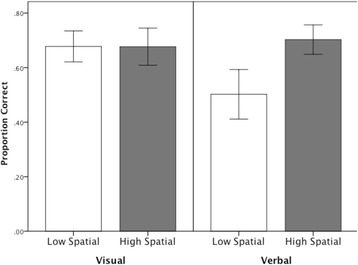
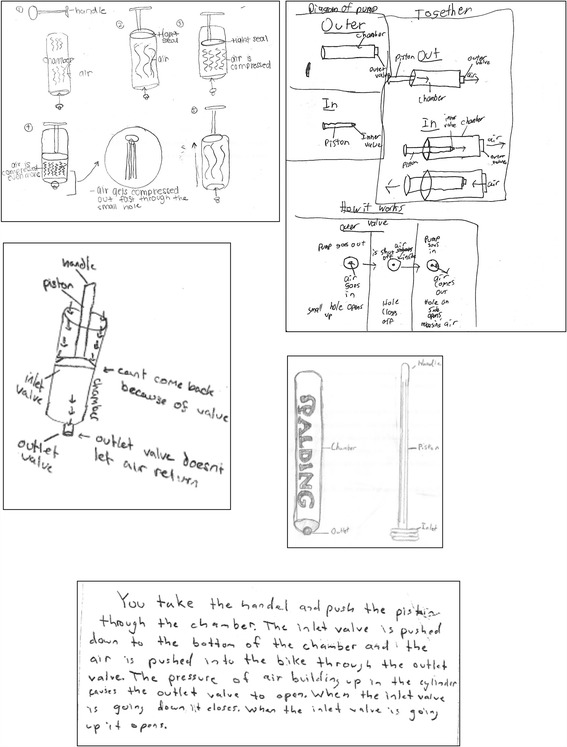
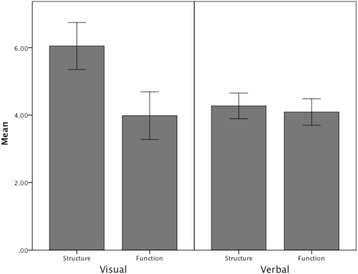
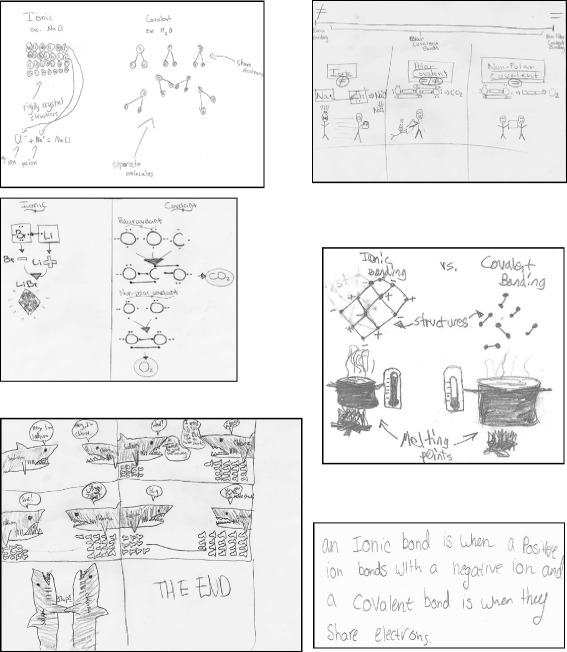
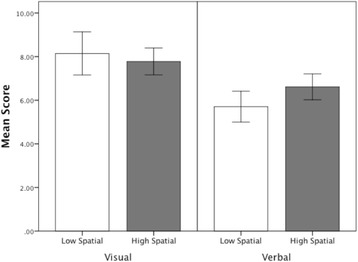
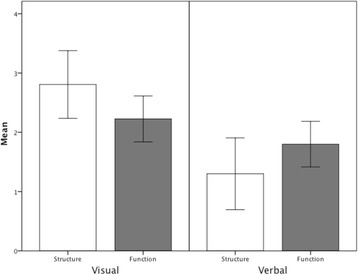
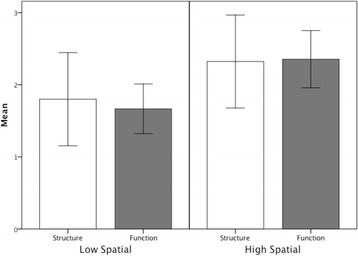
Many topics in science are notoriously difficult for students to learn. Mechanisms and processes outside student experience present particular challenges. While instruction typically involves visualizations, students usually explain in words. Because visual explanations can show parts and processes of complex systems directly, creating them should have benefits beyond creating verbal explanations. We compared learning from creating visual or verbal explanations for two STEM domains, a mechanical system (bicycle pump) and a chemical system (bonding). Both kinds of explanations were analyzed for content and learning assess by a post-test. For the mechanical system, creating a visual explanation increased understanding particularly for participants of low spatial ability. For the chemical system, creating both visual and verbal explanations improved learning without new teaching. Creating a visual explanation was superior and benefitted participants of both high and low spatial ability. Visual explanations often included crucial yet invisible features. The greater effectiveness of visual explanations appears attributable to the checks they provide for completeness and coherence as well as to their roles as platforms for inference. The benefits should generalize to other domains like the social sciences, history, and archeology where important information can be visualized. Together, the findings provide support for the use of learner-generated visual explanations as a powerful learning tool.
Overview
The claims and statistics of this paper haven’t been checked yet.
Free: it reads the open-access text and checks the first 5 claims that cite a source we can check. Create a free account to check every claim.
Integrity signals
Registry
Cites
Statistics
Figures
Verification
Claims the paper makes
The claims and statistics of this paper haven’t been checked yet.
Free: it reads the open-access text and checks the first 5 claims that cite a source we can check. Create a free account to check every claim.
Claims other papers make about this one
Each is checked against this paper’s own text: does it say what the citing paper says it does?
The cited source says what the claim attributes to it.
In the citing paper
“Representational transformations (e.g., turning a diagram into a paragraph of text or vice versa ) are a useful part of knowledge work (e.g., [6, 8, 26]), but they take additional effort.”
From Accessibility-Driven Information Transformations in Mixed-Visual Ability Work Teams (2026) · cites this paper as [8]
The cited source says what the claim attributes to it.
In the citing paper
“While student representational drawing is backed by research (e.g., Bobek and Tversky, 2016) and occasionally recommended (Fiorella and Mayer, 2016), the research also indicates implementation can be difficult (Fiorella and Zhang, 2018).”
From Moving the Needle: Evidence of an Effective Study Strategy Intervention in a Community College Biology Course (2022) · cites this paper as Bobek and Tversky, 2016
The cited source says what the claim attributes to it.
In the citing paper
“Bobek and Tversky (2016) found an improvement in middle school students who created visual explanations of a bicycle pump and chemical bonding.”
From Moving the Needle: Evidence of an Effective Study Strategy Intervention in a Community College Biology Course (2022) · cites this paper as Bobek and Tversky (2016)
Self-check
Percentages, sums and reported differences re-computed from the paper’s own numbers.
The self-check needs the paper’s full text.
Citations
Cites
Levels of processing: A framework for memory research
Craik, F. I. M., & Lockhart, R. S. (1972) · Journal of Verbal Learning and Verbal Behavior · doi:10.1016/s0022-5371(72)80001-x · Cited by 9,566 · cited 2×
“Translating verbal information from the text into a visual explanation may promote deeper processing of the material and more complete and comprehensive mental models (Craik & Lockhart, 1972).”
BackgroundMethod(1991) · Choice Reviews Online · doi:10.5860/choice.28-5764 · Cited by 6,847
Why a Diagram is (Sometimes) Worth Ten Thousand Words
Larkin, J. H., & Simon, H. A. (1987) · Cognitive Science · doi:10.1016/s0364-0213(87)80026-5 · Cited by 3,733 · cited 2×
“They also help to draw inferences (Larkin & Simon, 1987), find routes in maps (Levine, 1982), spot trends in graphs (Kessell & Tversky, 2011; Zacks & Tversky, 1999), imagine traffic flow or seasonal changes in light from architectural sketches (e.g. Tversky & Suwa, 2009), and determine the…”
BackgroundVoyer, D., Voyer, S., & Bryden, M. P. (1995) · Psychological Bulletin · doi:10.1037/0033-2909.117.2.250 · Cited by 2,868
Test-Enhanced Learning: Taking Memory Tests Improves Long-Term Retention
Roediger, H. L., & Karpicke, J. D. (2006) · Psychological Science · doi:10.1111/j.1467-9280.2006.01693.x · Cited by 2,867
The Psychology of Learning and Motivation
Ross, B. H. (2012) · Cited by 2,633
Mental Rotations, a Group Test of Three-Dimensional Spatial Visualization
Vandenberg, S. G., & Kuse, A. R. (1978) · Perceptual and Motor Skills · doi:10.2466/pms.1978.47.2.599 · Cited by 2,620
The malleability of spatial skills: A meta-analysis of training studies.
Uttal, D. H., Meadow, N. G., Tipton, E., Hand, L. L., Alden, A. R., Warren, C., & Newcombe, N. S. (2013) · Psychological Bulletin · doi:10.1037/a0028446 · Cited by 1,899
Active‐Constructive‐Interactive: A Conceptual Framework for Differentiating Learning Activities
Chi, M. T. H. (2009) · Topics in Cognitive Science · doi:10.1111/j.1756-8765.2008.01005.x · Cited by 1,597 · cited 2×
“Visual explanations often included crucial yet invisible features.”
BackgroundWhy is science difficult to learn? Things are seldom what they seem
Johnstone, A. H. (1991) · Journal of Computer Assisted Learning · doi:10.1111/j.1365-2729.1991.tb00230.x · Cited by 1,321 · cited 3×
“o reproduction in any medium, provided you giv the Creative Commons license, and indicate if Dynamic systems such as those in science and engineering, but also in history, politics, and other domains, are notoriously difficult to learn (e.g. Chi, DeLeeuw, Chiu, & Lavancher, 1994; Hmelo-Silver & Pfeffer, 2004; Johnston…”
Background
Cited by
Items 201–300 of 380
Embodied Cognition in Education: Possibilities and Limitations of Hybrid Representations
Loginov, N., Madni, A. O., & Spiridonov, V. F. (2022) · Cultural-Historical Psychology · doi:10.17759/chp.2022180202 · Cited by 3
Contreras-Rodríguez, L. E., Sandoval, A., Hoyos, M. M., & Soto, C. Y. (2022) · Journal of e-learning Research · doi:10.33422/jelr.v1i3.17 · Cited by 2
Assessing Learning Outcomes for Sustainability in Primary and Secondary Schools in the UK
Kioupi, V., & Voulvoulis, N. (2022) · Sustainable development goals series · doi:10.1007/978-3-031-09112-4_16 · Cited by 2
Increasing joy of reading and the impact of scientific articles– the benefits of RadioComics
Molwitz, I., & Boehm, I. (2024) · European Journal of Radiology · doi:10.1016/j.ejrad.2024.111862 · Cited by 2
Application of BAPER Learning Media on Student Learning Outcomes
Kartini, N. H. (2020) · Journal of Physics Conference Series · doi:10.1088/1742-6596/1477/4/042006 · Cited by 1
Deep Learning in Biology: 3D Representation of Online and Reality
Suprapto, P. K., Ardiansyah, R., Chaidir, D. M., Baiq, B., & Meylani, V. (2022) · International Journal of Multidisciplinary Applied Business and Education Research · doi:10.11594/ijmaber.03.04.09 · Cited by 1
Sedlar, A. R., Rončević, T. N., & Horvat, S. A. (2023) · International Baltic Symposium on Science and Technology Education (BalticSTE) · doi:10.33225/balticste/2023.210 · Cited by 1
Using Emotion Regulation to Support Informed Literacy
VanDonkelaar, R. (2023) · Journal of Educational Research and Practice · doi:10.5590/jerap.2023.13.1.08 · Cited by 1
DEVELOPMENT OF TEXTBOOKS FOR EXPORT-IMPORT COURSES BASED ON PROJECT BASE LEARNING APPROACH
Wulandari, S. S., Pahlevi, T., Panduwinata, L. F., Puspasari, D., & Nugraha, J. (2023) · Jurnal Pendidikan Ilmu Sosial · doi:10.23917/jpis.v33i1.20860 · Cited by 1
“This is in line with the opinion Jurnal Pendidikan Ilmu Sosial, Vol. 33, No.1, Juni 2023, p-ISSN: 1412-3835; e-ISSN: 2541-4569 (Bobek & Tversky, 2016) explaining that material accompanied by visual images will make it easier for students to understand the material in a holistic way.”
ResultLi, Y., Myers, P. L., Geary, D. C., Robertson, T., & Popov, V. (2023) · Springer eBooks · doi:10.1007/978-3-319-17461-7_173 · Cited by 1
Prime effects in metaphor comprehension: comparing congruent and opposite schematic primes
Khatin‐Zadeh, O., Farsani, D., Eskandari, Z., Lin, L. C., & Banaruee, H. (2024) · Frontiers in Psychology · doi:10.3389/fpsyg.2024.1355045 · Cited by 1
Sebopelo, P. (2025) · Review of Artificial Intelligence in Education · doi:10.37497/rev.artif.intell.educ.v6ii.36 · Cited by 1
Jaeger, A. J. (2025) · Learning and Individual Differences · doi:10.1016/j.lindif.2025.102632 · Cited by 1
Parker, H. K., Zizzamia, B., & Pollock, J. A. (2025) · Journal of Chemical Education · doi:10.1021/acs.jchemed.4c01279 · Cited by 1
Foley, E. A., Liu, Y., & Wilkerson, M. H. (2025) · Proceedings. · doi:10.22318/icls2025.663874 · Cited by 1
Attendance and learning platforms in college course success
Chang, I. (2025) · Active Learning in Higher Education · doi:10.1177/14697874251347189 · Cited by 2
“Creating visual explanations advanced students’ spatial thinking skills (Bobek & Tversky, 2016) and enhanced STEM success (Novoa et al., 2020; Schmidgall et al., 2019).”
Ruby, K. N., Dzik, S., Collins, J. J., Tang, H., Ela, S., & Makar, R. S. J. (2025) · Transfusion · doi:10.1111/trf.18332 · Cited by 1
Debrah, R. D., Rahman, A., Antwi, S., Digi, A. K.-A., & Armah, J. (2024) · Journal of Medical and Health Studies · doi:10.32996/jmhs.2024.5.3.12 · Cited by 1
Ibrahim, R. K., & Khalaf, A. (2025) · Dubai Medical Journal · doi:10.18502/dmj.v8i3.19858 · Cited by 2
Vankit, S. A., Shama, N. S., Diaz, D., & Volonte, M. (2025) · ACM International Conference on Intelligent Virtual Agents (IVA) · doi:10.1145/3717511.3747059 · Cited by 2
“This approach draws on insights from visual explanation research, which suggests that translating complex or abstract information into visual formats such texts or images, can enhance comprehension, lessen cognitive load, and foster deeper learning [12].”
Unifying concepts in information-theoretic time-series analysis
Bryant, A. G., Cliff, O. M., Shine, J. M., Fulcher, B., & Lizier, J. T. (2026) · Journal of The Royal Society Interface · doi:10.1098/rsif.2025.0969 · Cited by 1
Tlili, S., Mahfoudh, H. B., & Zoudji, B. (2025) · Perceptual and Motor Skills · doi:10.1177/00315125251391658 · Cited by 1
“Research has shown that VSA signi fi cantly moderate the impact of drawing on learning, particularly when drawing is used as a generative learning strategy (Bobek & Tversky, 2016).”
The effect of spatial structures on analogical problem solving
Hashemi, A., & Tubau, E. (2025) · Memory & Cognition · doi:10.3758/s13421-025-01817-7 · Cited by 1
“Prior research suggests that drawing can help individuals construct schematic spatial representations of a situation (Bobek & Tversky, 2016; Gagnier et al., 2017; Tversky, 2005).”
Sari, S. Y., Bakar, S. A., Daud, A. N. M., & Usmeldi (2026) · Revista Mexicana de Física E · doi:10.31349/revmexfise.23.010218 · Cited by 1
Günüç, A. H. (2025) · Cukurova Anestezi ve Cerrahi Bilimler Dergisi · doi:10.36516/jocass.1806384 · Cited by 2
SAC interactive e-modules: A step toward green economy for elementary students
Khasanah, U., Adibah, I. Z., Isnaini, & Trisnawati, S. N. I. (2026) · International Journal of Education and Practice · doi:10.18488/61.v14i1.4766 · Cited by 1
“In multimedia learning theory, effective visuals should not only enhance the display aesthetically but also serve clear instructional functions: reinforcing understanding (Eilam & Gilbert, 2014), explaining processes (Bobek & Tversky, 2016) and reducing cognitive load (Mayer & Moreno, 2003).”
Yılmaz, Y., Yıldız, G., & Turhan, A. E. (2026) · International Journal of Human-Computer Interaction · doi:10.1080/10447318.2026.2633217 · Cited by 1
Phan, H. P., Ngu, B. H., Hsu, C.-S., Chen, S.-C., Usop, H. H., & Anding, P. N. (2026) · 유교문화연구 (중국어판) · doi:10.22916/jcpc.2026..45.117 · Cited by 1
Williams, A. E., & Denaro, K. (2026) · CBE—Life Sciences Education · doi:10.1187/cbe.25-04-0074 · Cited by 1
Schoenherr, J., Baumann, O., Gödecke, P., Quarder, J., Schindler, M., & Schukajlow, S. (2026) · ZDM · doi:10.1007/s11858-026-01794-4 · Cited by 1
“The quality of drawing products and processes is shaped by students’ dispositions, including spatial abilities (Bobek & Tversky, 2016) and domain-specific knowledge (Stylianou, 2011).”
Educational Media and Maternal Behavioral Change in Fetal Brain Health Stimulation
Winarsih, W., & Elmeida, I. F. (2026) · Jurnal Kesehatan · doi:10.26630/jk.v17i1.5601 · Cited by 1
“Visualizations and animations help respondents grasp abstract concepts and complex processes (Bobek & Tversky, 2016).”
TEKİN, E., İlhan, G. O., & Kır, D. B. (2026) · Serials Review · doi:10.1080/00987913.2026.2662866 · Cited by 1
“Studies on the power of visual learning show that visual elements accelerate the learning process and help information become more permanent (Bobek & Tversky, 2016; Cronin & Myers, 1997; Dunlosky et al., 2013; Guo et al., 2020).”
Rujiani, R., Suharini, E., Widiyatmoko, A., & Isdaryanti, B. (2025) · DWIJA CENDEKIA Jurnal Riset Pedagogik · doi:10.20961/jdc.v9i3.112292 · Cited by 1
Project-based learning with canva advances students’ critical thinking in digestive physiology
Sembiring, A. K., Ramadansur, R., Dinata, M., & Julia, D. (2026) · Biosfer · doi:10.21009/biosferjpb.66028 · Cited by 1
Gestures Can Create Models that Help Thinking
Liu, Y. (2019) · doi:10.7916/d8-mdj8-7637 · Cited by 1
“There was considerable variability in the detailed ways gestures modeled, similar to variability in people’s diagrams of STEM systems (Bobek & Tversky, 2016; Kang & Tversky, 2016).”
BackgroundVisualizing constructive alignment in the process of course design
Laperrouza, M., Lanarés, J., & Sylvestre, E. (2019) · International Conference on Higher Education Advances (HEAd) · doi:10.4995/head19.2019.9330 · Cited by 1
Heinsch, M., Agllias, K., Tickner, C., Wells, H., Cootes, H., Sampson, D. L., & KAY‐LAMBKIN, F. J. (2019) · Social Work Education · doi:10.1080/02615479.2019.1648409 · Cited by 1
“The potential for visual research data to facilitate student learning is supported by interdisciplinary research on the pedagogical benefits of visual communication (see for example, Bobek & Tversky, 2016; Dewan, 2015).”
BackgroundAugmented Reality for education (Diversity)
Shahmir, N. S., & Rai, S. (2020) · ASEE Annual Conference & Exposition · doi:10.18260/1-2--34197 · Cited by 1
Multimedia Interaktif dengan Penstimulasian Intelegensi Visual Spasial pada submateri Ikatan Kovalen
Ainyn, Q., & Dwiningsih, K. (2021) · JRPK - Jurnal Riset Pendidikan Kimia · doi:10.21009/jrpk.102.09 · Cited by 1
Dinâmicas colaborativas de discussão visual: um mapeamento sistemático
Bertoso, L. D. S., de Moraes, R. P., & Padovani, S. (2021) · doi:10.5151/cidicongic2021-006-355052-cidi-comunicacao_a.pdf · Cited by 1
(2021) · Issues in Information Systems · doi:10.48009/4_iis_2021_191-207 · Cited by 1
Joshi, Y., Vyas, Y., Ghone, T., Soni, V., & Kanani, P. (2022) · IEEE International Conference for Convergence in Technology (I2CT) · doi:10.1109/i2ct54291.2022.9824937 · Cited by 1
Exploring the Argumentation Level in Inquiry Learning of Force and Motion
Sari, D. P., & Madlazim, M. (2022) · Jurnal Inovasi Pendidikan Sains (JIPS) · doi:10.37729/jips.v3i2.2264 · Cited by 1
Temircan, Z. (2022) · Muş Alparslan Üniversitesi Eğitim Fakültesi Dergisi · Cited by 1
Freehand drawing – a learning and teaching perspective
Harrison, O., & Monahan, M. (2023) · Compass Journal of Learning and Teaching · doi:10.21100/compass.v16i1.1406 · Cited by 1
Haryanti, S. S., Herlina, K., & Abdurrahman, A. (2023) · Momentum Physics Education Journal · doi:10.21067/mpej.v7i1.8096 · Cited by 7
Żammit, J. (2023) · International Journal of Language and Literary Studies · doi:10.36892/ijlls.v5i4.1479 · Cited by 1
“The use of creative texts described in the Common European Framework of Reference has a motivational value for international students, and it also provides an easy integration of language skills from a linguistic perspective (Camilleri Grima and Mantellato, 2021; Bobek and Tversky, 2016).”
BackgroundKaharuddin, A. L., Bakar, A. A., & Saidin, S. (2023) · International Journal of Academic Research in Business and Social Sciences · doi:10.6007/ijarbss/v13-i12/20041 · Cited by 1
“Studies have shown that visual aids, such as pictures, diagrams, and animations, and color can enhance the learning process and increase student engagement (Shabiralyani et al., 2015; Bobek, & Tversky, 2016; Cheung, & Ng, 2021; Cook et al., 2023).”
Soliva, S. L., Galang, K., Bajada, C. G., Corsino, J., Trinidad, R., & Faller, E. M. (2024) · International Journal of Research Publication and Reviews · doi:10.55248/gengpi.5.0124.0120 · Cited by 1
Li, J., & Avalos, K. (2024) · International Conference on Artificial Intelligence and Big Data (AIBD) · doi:10.5121/csit.2024.140432 · Cited by 1
Using Brightspace to Create Multi-Format Lab Manuals to Enhance Student Performance
Li, J. (2024) · ASEE Annual Conference & Exposition · doi:10.18260/1-2--48228 · Cited by 1
A Way Diagrams Explain: Analysis Based on Consequence Matching
Shimojima, A., & Barker-Plummer, D. (2024) · Lecture notes in computer science · doi:10.1007/978-3-031-71291-3_8 · Cited by 1
Visual versus Tabular Scheduling Programs
Tuscano, T. Z., & Asl, B. A. (2024) · Buildings · doi:10.3390/buildings14103084 · Cited by 1
Rejeki, S., Adnan, M., Ahmad, C. N. C., & Murtiyasa, B. (2025) · EDUCATUM Journal of Science Mathematics and Technology · doi:10.37134/ejsmt.vol12.sp.10.2025 · Cited by 1
Roemmele, C. M., & Rainear, A. M. (2025) · The journal of college science teaching · doi:10.1080/0047231x.2025.2520789 · Cited by 1
Directional Reflection : stimulating the evaluative thinking of students at the university level
Brownhill, S. P. (2025) · Pedagogies An International Journal · doi:10.1080/1554480x.2025.2545207 · Cited by 1
“Each group was invited to use the three arrows (as per Table 1) as “visual elements” (Bobek & Tversky, 2016, p. 2) to initially stimulate an evaluative oral discussion about the unit as a whole, the intention being that students were to specifically think about the Table 1.”
Optimizing Diorama Media to Improve Student Learning Outcomes in Elementary Madrasahs
Lusianti, A., Karim, A., & Fitriyah, M. (2025) · Journal of Student-Centered Learning · doi:10.63687/jscl.v2i1.28 · Cited by 2
Improving Causal Reasoning in a College Science Course
Harrington, M. B. (2019) · Deep Blue (University of Michigan) · Cited by 1
Sukserm, P. (2022) · Chula Digiverse · doi:10.58837/chula.the.2022.146 · Cited by 3
Contreras-Rodríguez, L. E., Sandoval-Hernández, A. G., Maya-Hoyos, M., & Soto, C. Y. (2020) · Research Square · doi:10.21203/rs.3.rs-72902/v1 · Cited by 1
“Nowadays, college students rely signi cantly on their visual abilities for the learning process [19, 20].”
BackgroundMedia Arts: Visual Culture and Numeracy
Grushka, K., & Sellars, M. (2017) · Springer eBooks · doi:10.1007/978-981-10-5736-6_13
Students Interactivity with Digital Content Makes Difference in Learning
Dağ, H., ILI, I., & Yenidogan, I. (2015) · International Conference on Advances in Information Processing and Communication Technology (IPCT) · doi:10.15224/978-1-63248-044-6-121
“[14] suggestion or for the generation Z as the refs in [10-13] suggestions, it is also good for improving the learning for grownups.”
BackgroundOwen, H. C. (2019) · The University of Queensland · doi:10.14264/uql.2019.382
Incorporating Writing into College Biology Using Student-Created Open Educational Resources
Roper, L. K., Belk, J., & Smith, R. J. (2020) · The American Biology Teacher · doi:10.1525/abt.2020.82.5.344
Biswas, A., & Bisaria, A. (2020) · Pure Mathematical Sciences · doi:10.12988/pms.2020.91215
“Frequent association with common objects is important for learners [7, 12, 24].”
BackgroundMedical Web-Based Role Play Enhances Teaching of Medical Terms
Ting, K.-Y. (2020) · IEEE Eurasia Conference on Biomedical Engineering, Healthcare and Sustainability (ECBIOS) · doi:10.1109/ecbios50299.2020.9203715
“Further, visual representation is easily recognized and provides a support for developing language [6].”
BackgroundKen-Opurum, W., Ken-Opurum, B., & Idahosa, A. (2020) · IEEE Global Humanitarian Technology Conference (GHTC) · doi:10.1109/ghtc46280.2020.9342872
Writing by Hand - A Journey of Creative Self Discovery
Reed, E. M. (2021) · Griffith Research Online · doi:10.25904/1912/4189
Young, S. J. (2021) · Digital Commons (Liberty University) · Cited by 3
A manipulative activity for exploring effective nuclear charge (Zeff)Preprint
Kasman, J., Slouka, T., Kiste, A. L., & Oza, J. P. (2021) · doi:10.33774/chemrxiv-2021-3x8p2-v2 · Cited by 1
Opening the black-box of artificial intelligence predictions on clinical decision support systems
das Neves, M. I. L. (2021) · Portuguese National Funding Agency for Science, Research and Technology (RCAAP Project by FCT)
Shrestha, A., Saichaie, K., Johnson, T., Brown, W., Altier, L., Goorahoo, D., & Mitchell, J. P. (2022) · Journal of Higher Education Theory and Practice · doi:10.33423/jhetp.v22i2.5056 · Cited by 1
A manipulative activity for exploring effective nuclear charge (Zeff)Preprint
Kasman, J., Slouka, T., Kiste, A. L., & Oza, J. P. (2021) · ChemRxiv · doi:10.26434/chemrxiv-2021-3x8p2-v2
A manipulative activity for exploring effective nuclear charge (Zeff)Preprint
Kasman, J., Slouka, T., Kiste, A. L., & Oza, J. P. (2021) · doi:10.33774/chemrxiv-2021-3x8p2
A manipulative activity for exploring effective nuclear charge (Zeff)Preprint
Kasman, J., Slouka, T., Kiste, A. L., & Oza, J. P. (2021) · ChemRxiv · doi:10.26434/chemrxiv-2021-3x8p2
Learner-Generated Visualizations and Their Evaluation: A Generative Learning Perspective
Cerreto, F. A., & Lee, J. (2022) · doi:10.52917/ivlatbsr.2022.015
Isa, W. A. R. W. M., Harun, A. F., Suhaimi, A. I. H., Noordin, N., Misron, M. M., Awang, N., Ismail, J., Sabri, M. A. M., Yusuf, P. Y. M., Amin, F. A., et al. (2022) · International Journal of Academic Research in Progressive Education and Development · doi:10.6007/ijarped/v11-i2/13870
Lin, Z., Zhang, C., Pan, H., Xu, W., Hong, Y., & Huang, P. (2023) · Research Square · doi:10.21203/rs.3.rs-2430462/v1
Streamlining models with explanations in the learning loop
Lomuscio, F., Bajardi, P., Perotti, A., & Amparore, E. G. (2022) · IEEE International Conference on Data Science and Advanced Analytics (DSAA) · doi:10.1109/dsaa54385.2022.10032380
“Inspired by well-established contributions in cognitive psychology research and education [8], [9], [5], a different but compelling idea consists in reusing post-hoc explanations generated by a model to improve the learning process.”
BackgroundAusterschmidt, K. L., Kerkhoff, D., Bebermeier, S., & Hagemann, A. (2021) · Psychology Teaching Review · doi:10.53841/bpsptr.2021.27.2.5
Elicitação de requisitos com dinâmicas colaborativas de discussão visual
de Moraes, R. P., & Padovani, S. (2023) · DAT Journal · doi:10.29147/datjournal.v8i2.674
Li, Y., Myers, P. L., Geary, D. C., Robertson, T., & Popov, V. (2023) · Springer eBooks · doi:10.1007/978-3-319-17727-4_173-1
(2023) · Frontiers research topics · doi:10.3389/978-2-8325-3977-4
Complete Manuscript Title: Podcasts in Interventional Radiology: Where do we Currently Stand?
K, M. S. M. N., & Sunaina, R. K. (2024) · International Journal of Radiology and Imaging Technology · doi:10.23937/2572-3235.1510119
Sachdeva, S., & Rajadurai, S. (2024) · Global Journal of Medical Research · doi:10.34257/gjmrjvol23is4pg9
Peran Referensi Visual Untuk Meningkatkan Efektivitas Belajar Desain Interior Jarak Jauh
Utami, A. E., & Wardono, P. (2023) · Jurnal Visual Ideas · doi:10.33197/visualideas.vol3.iss1.2023.1109
THE LATEST TECHNOLOGIES IN THE DEVELOPMENT OF SCIENCE, BUSINESS AND EDUCATION
International Science Group, & Vladlenov, D. (2024) · doi:10.46299/isg.p.2024.1.17
Jennings, J. (2024) · Carleton University's Institutional Repository (MacOdrum Library, Carleton University) · doi:10.22215/etd/2024-15867
Ushakova, O. M., Strelnikov, S. S., Леонидовна, К. А., & Сергеевич, Т. Р. (2024) · Russian Journal of Education and Psychology · doi:10.12731/2658-4034-2024-15-1-485
Sofian, M. A., Punsu, L., Doloksaribu, J. I., Miah, L., & Prabowo, N. K. (2024) · ChemRxiv · doi:10.26434/chemrxiv-2024-17397
Ferreira, F. H. A., Silva, L. V., Pessoa, R. A. L., de Araújo, M. M., Jayawardene, W. P., & Beinner, M. A. (2024) · JMIR Serious Games · doi:10.2196/60145
Banzer, D., Riel, J., & Sheridan, K. (2024) · International Journal of Designs for Learning · doi:10.14434/ijdl.v15i3.36624
Tlili, S., Zoudji, B., & Mahfoudh, H. B. (2025) · Journal of Imagery Research in Sport and Physical Activity · doi:10.1515/jirspa-2024-0031 · Cited by 1
Teaching and Learning Python by Comparative Visualization
Izbassova, G., Minhaj, S. U., & Pinsky, E. (2025) · Lecture notes of the Institute for Computer Sciences, Social Informatics and Telecommunications Engineering · doi:10.1007/978-3-031-84312-9_21
Storythat Comic Based on the Ngideri Dhisah Tradition to Enhance Students’ Visual Perceptual Skills
Triyanto, J. R., & Na’im, M. (2025) · Diakronika · doi:10.24036/diakronika/vol24-iss2/439
“Well designed visual based learning can enhance students' understanding and memory (Bobek & Tversky, 2016; Fiorella & Kuhlmann, 2020; Guo et al., 2020).”
Fahmi, M. N., Madlazim, M., Realita, A., Prastowo, T., Kusumawati, D. H., & Manggartika, N. M. A. S. (2024) · Journal of Dedication in Community · doi:10.26740/jodic.v2n2.p25-34
Enhancing Message Sequence Charts with Spatial Knowledge
Ramrakhiyani, N., Pawar, S. S., Palshikar, G. K., & Varma, V. (2025) · Lecture notes in computer science · doi:10.1007/978-981-96-8186-0_18
You Cannot Find the Calm Without the Storm: Creating Spaces for Embracing Change
Rizvi, S., & Noreen, A. (2025) · LEARNing Landscapes · doi:10.36510/learnland.vi29.1151
LLM powered Spatial Enrichment of Message Sequence Charts and its Applications
Ramrakhiyani, N., Pawar, S. S., Palshikar, G. K., & Varma, V. (2025) · Expert Systems with Applications · doi:10.1016/j.eswa.2025.129103
From Visual To Understanding: Analysis Of The Effect Of Canva Learning Media On Phbs Motivation
Aprilia, N. H., Prihanto, J. B., & Ridwan, M. (2025) · Jurnal Pendidikan Jasmani (JPJ) · doi:10.55081/jpj.v6i1.4023
Metadata
- Authors
- Bobek, E., & Tversky, B.
- Affiliations
- University of Massachusetts Lowell (US)
- Columbia University (US)
- Corresponding author
- Bobek, Eliza
- Venue
- Cognitive Research: Principles and Implications
- Published
- 2016-12
- Volume
- 1
- Issue
- 1
- Pages
- 27-27
- ISSN
- 2365-7464 (ISSN-L)
- PMC
- PMC5256450
- OpenAlex
- W2560277832
- Cited by
- 298
- References
- 55
- Citations by year
- 2026: 25 · 2025: 54 · 2024: 53 · 2023: 33 · 2022: 42 · 2021: 32 · 2020: 32 · 2019: 14 · 2018: 5 · 2017: 5
- FWCI
- 11.39
- Type
- journal article
- Language
- en
- Open access
- gold
- doi.org
- Licence
- cc-by
- creativecommons.org/licenses/by/4.0 (tdm)
- creativecommons.org/licenses/by/4.0 (vor, 6 d)
- Locations
- Cognitive Research Principles and Implications (publishedVersion, cc-by)
- Europe PMC (PubMed Central) (publishedVersion, cc-by)
- PubMed Central (publishedVersion, cc-by)
- PubMed (publishedVersion)
- eScholarship (California Digital Library) (submittedVersion)
- Funders
- National Science Foundation (CHS-1513841, HHC 0905417, IIS-0725223, IIS-0855995, REC 0440103)
- Topics
- Social Sciences › Psychology › Experimental and Cognitive Psychology › Visual and Cognitive Learning Processes
- Social Sciences › Education › Science Education and Pedagogy
- Social Sciences › Psychology › Developmental and Educational Psychology › Innovative Teaching and Learning Methods
- Keywords
- visual explanations, verbal explanation, science learning, spatial ability, mechanical systems, chemical bonding, inference, complex systems, STEM education
About these checks
Registry, retraction, Cites and statistics results are computed, not judged, with one exception: a printed reference that no index lists is read once by a model before it counts as a citation error. Claims are extracted by a model and kept only when their quote appears verbatim in the text; each cited source is then checked, with a model’s help, for whether it says what the claim relies on. Those verdicts can be wrong — read the claim’s quote and the cited source before relying on one.
Statistics and arithmetic are recomputed, not judged.
Confidence bands are shown only for fields calibrated on our annotated test set. None is calibrated yet, so no band is shown.
What counts as a claim ›How we measure confidence ›How we check this ›
Are you an author, or do you see a problem with this page? Request a review
Data sources
Bibliographic data: Semantic Scholar, OpenAlex, Crossref.
Contains information from the Semantic Scholar Academic Graph Datasets, made available under the ODC Attribution License (ODC-BY 1.0).
Semantic Scholar’s data is described in: Kinney, R., et al. (2023). The Semantic Scholar Open Data Platform. arXiv:2301.10140.
