

An examination of teachers’ strategies to foster student engagement in blended learning in higher education
Open accessThe DOI matches its Crossref record; 85 of the 86 references it cites were found in a registry or an index.
Abstract
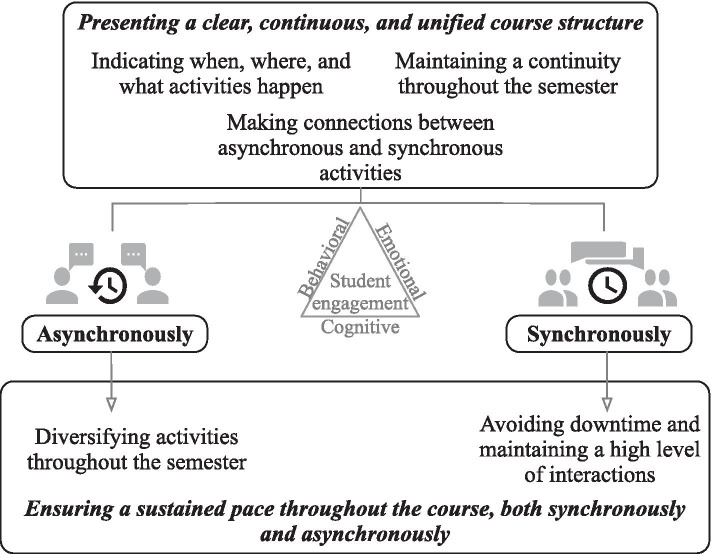
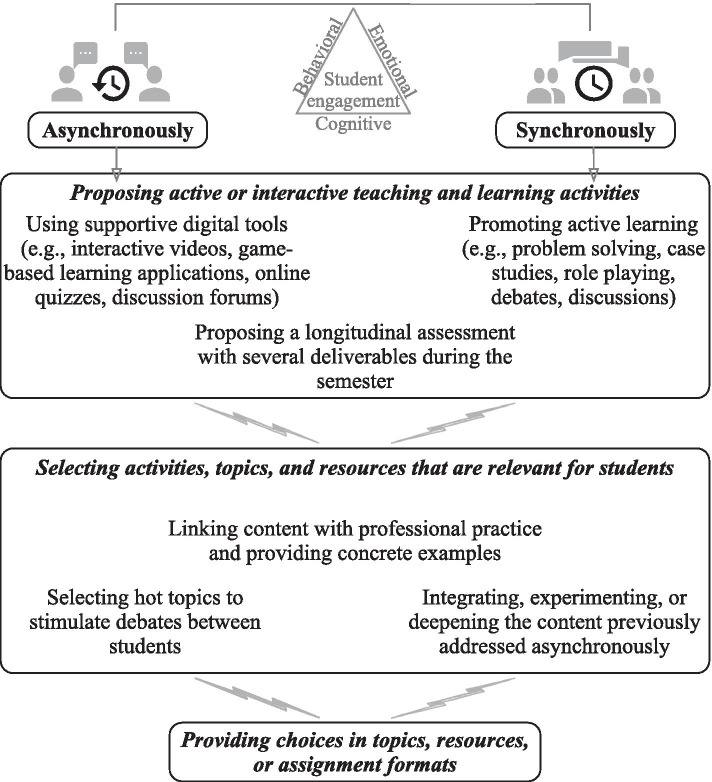
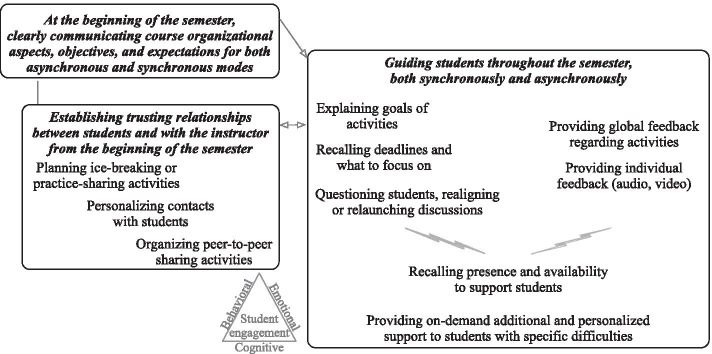
This qualitative study examined how teachers fostered student engagement in blended learning (BL), i.e., blended, blended online, and blended synchronous courses that combine synchronous and asynchronous activities. Twenty semi-structured interviews with teachers in various disciplines, at the undergraduate or graduate level in four universities, were conducted and analyzed using an inductive approach. Therefore, the study proposed a broad and comprehensive picture of teachers’ strategies to enhance student engagement in BL, that were classified in three meta-categories concerning (i) the course structure and pace; (ii) the selection of teaching and learning activities; and (iii) the teacher’s role and course relationships. Strategies were also linked with student engagement dimensions (behavioral, emotional, cognitive), whenever possible. The findings particularly emphasized the importance of a well-structured and -paced course, fully exploiting and integrating synchronous and asynchronous modes of BL. Clearly communicating how the course would unfold and corresponding expectations as well as establishing trusting relationships at the beginning of the semester also appeared as key to foster student engagement in BL. The use of various digital tools was also highlighted to promote student behavioral and emotional engagement at the undergraduate level, whereas cognitive and emotional engagement of graduate students was mainly targeted through experience-sharing and learning co-construction between students.
Overview
The claims and statistics of this paper haven’t been checked yet.
Free: it reads the open-access text and checks the first 5 claims that cite a source we can check. Create a free account to check every claim.
Integrity signals
Registry
Cites
Statistics
Figures
Verification
Claims the paper makes
The claims and statistics of this paper haven’t been checked yet.
Free: it reads the open-access text and checks the first 5 claims that cite a source we can check. Create a free account to check every claim.
Claims other papers make about this one
Each is checked against this paper’s own text: does it say what the citing paper says it does?
The source backs part of the claim, not all of it — or backs it for a different population, condition or comparison.
In the citing paper
“Although they may still be emerging in some contexts, these teaching and learning models are now accepted by a greater number of institutions [64].”
From Digital Learning and Digital Institution in Higher Education (2023) · cites this paper as [64]
Experimental — accuracy not yet measuredThe cited source says what the claim attributes to it.
In the citing paper
“Presenting a clear course structure and working at a particular pace, engaging learners with interactive activities, and providing additional support and constant feedback will help in improving overall student engagement.”
From Impact of online learning on student's performance and engagement: a systematic review (2024) · cites this paper as [56]
Self-check
Percentages, sums and reported differences re-computed from the paper’s own numbers.
The self-check needs the paper’s full text.
Citations
Cites
(2009) · Cited by 21,330
Qualitative Data Analysis: A Methods Sourcebook
Miles, M. B., Huberman, A. M., & Saldaña, J. (1988) · Cited by 20,701
School Engagement: Potential of the Concept, State of the Evidence
Fredricks, J. A., Blumenfeld, P. C., & Paris, A. H. (2004) · Review of Educational Research · doi:10.3102/00346543074001059 · Cited by 12,581
A General Inductive Approach for Analyzing Qualitative Evaluation Data
Thomas, D. R. (2006) · American Journal of Evaluation · doi:10.1177/1098214005283748 · Cited by 10,858 · cited 3×
“Specifically, Thomas (2006) described the following coding steps: initial reading of transcripts, identification of data segments related to objectives, labelling segments into emerging categories, refining categories to avoid redundancies, highlighting the main categories.”
BackgroundMethodHandbook of Research on Student Engagement
(2012) · doi:10.1007/978-1-4614-2018-7 · Cited by 3,050
The Handbook of Blended Learning: Global Perspectives, Local Designs
Bonk, C. J., Graham, C. R., Cross, J., & Moore, M. G. (2005) · Cited by 2,928
Framing student engagement in higher education
Kahu, E. R. (2013) · Studies in Higher Education · doi:10.1080/03075079.2011.598505 · Cited by 2,103 · cited 3×
“Often described as a multidimensional psycho-social process, numerous authors (Bond et al., 2020; Chris-tenson et al., 2012; Fredricks et al., 2019; Kahu, 2013; Lawson & Lawson, 2013; Manwar-ing et al., 2017; Schindler et al., 2017) refer to the definition provided by Fredricks et al. (2004) based…”
BackgroundBlended Learning in Higher Education: Framework, Principles, and Guidelines
Garrison, D. R., & Vaughan, N. D. (2007) · Wiley eBooks · doi:10.1002/9781118269558 · Cited by 1,609
Challenges in the online component of blended learning: A systematic review
Rasheed, R. A., Kamsin, A., & Abdullah, N. A. (2020) · Computers & Education · doi:10.1016/j.compedu.2019.103701 · Cited by 1,472
Blended Learning in Higher Education: Framework, Principles, and Guidelines.
Wainwright, S. (2011) · Journal of Physical Therapy Education · doi:10.1097/00001416-201110000-00013 · Cited by 1,438 · cited 5×
“…BL aims at “extending thinking and discourse over time and space” and is “specifically directed to enhancing [student] engagement” (Vaughan et al., 2013, p. 9) while leveraging digital technology opportunities in a learner-centered approach (Garrison & Vaughan, 2008; Taylor et al., 2018).”
BackgroundInfluential
Research works printed but not linked: 1
- Siemens, G., Gašević, D., & Dawson, S. (2015). Preparing for the digital university: A review of the history and current state of distance, blended, and online learning. http://linkresearchlab.org/PreparingDigitalUniversity.pdf
Cited by
Items 301–381 of 381
Balino, A. S., Flores, J. M. L., Estalilla, S. G. M., Jaranilla, C. A. B., Ramos, K., Maxino, D. S., & Galay-Limos, J. A. (2025) · International Journal of Research Studies in Education · doi:10.5861/ijrse.2025.25506 · Cited by 1
ASLAMI, F., & Sripian, P. (2025) · International Symposium on Affective Science and Engineering · doi:10.5057/isase.2025-c000029
Sumugat, B. S. (2025) · Psychology and Education A Multidisciplinary Journal · doi:10.70838/pemj.380904
Engaging post-compulsory education students in online language courses: a systematic review
Peltola, K., Veermans, M., Routarinne, S., & Jaaksola, S. (2025) · Journal of Computers in Education · doi:10.1007/s40692-025-00359-w · Cited by 3
“Research has also shown that engagement has an important role in both how satisfied students are with a course and how effective they perceive their learning to be (Dahlstrom-Hakki et al., 2020; Heilporn et al., 2021).”
Odit-Dookhan, K. (2025) · IGI Global eBooks · doi:10.4018/979-8-3693-8402-2.ch009
Sánchez, J. G. Á., Zamudio, M. C., & López, C. Q. (2025) · Institute for the Future of Education Conference (IFE) · doi:10.1109/ife63672.2025.11024689
“Digital technologies have significantly improved student participation and academic performance, as well as facilitated access to high-quality educational resources [1], [2].”
Multimodal Learning Preference and Styles in Acquiring a Second Language in HyFlex Class
Melon-Galvez, S. (2025) · British Journal of English Language Linguistics · doi:10.37745/bjel.2013/vol13n16371
Bingölbalı, A., Aslan, A., Batdı, V., & Cinkara, E. (2025) · SAGE Open · doi:10.1177/21582440251336646 · Cited by 11
Designing Virtual Teamwork for Creativity: Strategies for Higher Education
Asrifan, A., & Syahruddin, S. (2025) · IGI Global eBooks · doi:10.4018/979-8-3373-0375-8.ch003
Metaverse as an Alternative Tool for Learning Ancient Chinese Architecture (ACA) Course
Cui, J. (2025) · IEEE Symposium on Computer Applications & Industrial Electronics (ISCAIE) · doi:10.1109/iscaie64985.2025.11080841
Exploring Innovative Pedagogical Approaches to Foster Sustainability in Online Learning Environments
Anmary, A. S. (2025) · IGI Global eBooks · doi:10.4018/979-8-3373-0112-9.ch007
Personalized Learning Through Intelligent Assessment Systems: Enhancing Student Engagement
Yasin, Z., Utina, S. S., & Asrifan, A. (2025) · Advances in computational intelligence and robotics book series · doi:10.4018/979-8-3373-1062-6.ch006
Ebrahimi, A. (2025) · International Journal of Curriculum Development and Learning Measurement · doi:10.4018/ijcdlm.386524 · Cited by 2
Palacios-Jiménez, N., & Carreño-Vélez, C. M. (2025) · Cognopolis Revista de educación y pedagogía · doi:10.62574/17z8gm21
Automatic Measurement and Visual Analysis of Students’ Cognitive Engagement in Course Learning
Zhao, Y., Huang, W., He, Z., & Chen, J. (2025) · International Conference on Computer Science and Technologies in Education (CSTE) · doi:10.1109/cste64638.2025.11092203
“…should focus on designing and implementing learning activities that require deeper levels of CE [13] , such as case analysis, critical thinking, group inquiry, problem-solving, experience-sharing and learning co-construction between students, especially for complex learning content [18, 19] .”
Educational Technology Training: A Mixed Methods Study of Complex Thinking Development
Alvarez-Icaza, I., Zúñiga, M. L. V., Ramírez-García, J. D. J., & Martínez-Pérez, S. (2025) · International Conference on Education and Training Technologies (ICETT) · doi:10.1109/icett66247.2025.11137338
“…be investigated what would be the results that these teachers and other teachers would have if they applied the complex thinking framework in their classrooms to engage students' cognitive, behavioral and emotional attitudes through active or interactive activities and relevance of content [24].”
Innovative Active Blended Learning Pedagogy in Software Requirements Engineering Education
Silva, W., Garcia, R. D. S., Cargnelutti, R., & Bernardino, M. (2025) · IEEE Revista Iberoamericana de Tecnologias del Aprendizaje · doi:10.1109/rita.2025.3605317
“Blended learning models are classified according to the degree and mode of interaction between students and instructors [15].”
Heilporn, G., Lucazeau, B., & Diallo, I. (2025) · Revue internationale de pédagogie de l’enseignement supérieur · doi:10.4000/14kwk · Cited by 1
Self-citationTeacher Competence and Student Learning Outcomes: A Correlational Study in Primary Education
Mardiana, M., Roslenv, & Azis, M. (2025) · Journal of Literacy Education · doi:10.64780/jole.v1i3.88 · Cited by 7
The Problem of Estimating the Teacher’s Time Spent on Preparing Digital Educational Content
Sosnovskiy, Y., Milyukov, V., Schostak, R., Ilyina, V., & Lapin, V. G. (2025) · Lecture notes in networks and systems · doi:10.1007/978-3-032-04365-8_42
Aini, Y., & Zakiah, W. (2025) · Schrödinger Journal of Physics Education · doi:10.37251/sjpe.v6i3.2132
“Blended learning can create a more meaningful learning experience because it combines direct interaction with the use of technology [15]-[17].”
Storytelling Techniques Enhance Confidence and Team Collaboration in Online Courses
Borja, K., & Rodriguez, S. (2025) · American Journal of Distance Education · doi:10.1080/08923647.2025.2577515 · Cited by 1
Students’ Engagement in Blended Learning: An Examination Using Self-determination Theory
Odit-Dookhan, K. (2025) · Springer eBooks · doi:10.1007/978-981-95-0687-3_5
Song, J., Liu, J., & Li, L. (2025) · Journal of Language Teaching · doi:10.54475/jlt.2025.012
“…teaching methodologies, blended teaching, which integrates the strengths of real-time interactions with the flexibility of online settings, has emerged as a methodology that reflects the constructivist call and meets teachers’ instructional needs in a digital environment (Heilporn et al., 2021).”
Leveraging Student Feedback to Enhance a Blended/Hybrid Model in Intermediate Accounting
Krivacek, G. J. (2025) · International Journal of Innovative Teaching and Learning in Higher Education · doi:10.4018/ijitlhe.393621
Inclusive ODeL: Ensuring the Highest Possible Standards in Disability Access and Support
Maguvhe, M. O. (2025) · Emerald Group Publishing Limited eBooks · doi:10.1108/978-1-80592-359-620251003
Building Capacity for Student Engagement
Miguel, D., Imelda, L. N., Marco, A. N., Blanca, G., & Rosalba, V. (2024) · Emerald Group Publishing Limited eBooks · doi:10.1108/979-8-88730-449-620251024
Dai, W.-A., Wu, L., & Fuller, C. (2025) · Higher Education Research & Development · doi:10.1080/07294360.2025.2591259
“For instance, creating a supportive course learning environment where students feel valued and understood can foster greater emotional connection to their coursework (Heilporn et al., 2021).”
Nisa, A. R., & Maryani, I. (2025) · Jurnal Praktik Baik Pembelajaran Sekolah dan Pesantren · doi:10.56741/pbpsp.v4i02.885 · Cited by 2
“This encompasses the teacher’s efforts to effectively implement lesson plans through the utilization of various instructional components that enhance student comprehension and ensure the achievement of learning outcomes as intended [12], [13].”
Abdulkareem, M. N. (2025) · مجلة بوابة الباحثين للدراسات والأبحاث · doi:10.64337/rgj.v1i3.109
Delina, L. L., & Rondilla, A. D. R. (2025) · Interactive Learning Environments · doi:10.1080/10494820.2025.2604259 · Cited by 2
“Recent research confirms this, indicating that peer and instructor interactions encourage deeper cognitive engagement (Heilporn et al., 2021; Jin et al., 2022).”
Revolutionizing Financial Accounting: Student Engagement in a Blended Learning Approach
Kottara, C., Asonitou, S., Kavalieraki-Foka, D., Gkikas, G., & Georgios, G. (2025) · WSEAS TRANSACTIONS ON BUSINESS AND ECONOMICS · doi:10.37394/23207.2025.22.206 · Cited by 2
Blended Learning and Higher Education: Pros and Cons
Moletsane, R. I. (2026) · Smart innovation, systems and technologies · doi:10.1007/978-981-95-1361-1_3
Thakur, S. S., Svirskis, D. M., & Curley, L. E. (2026) · Currents in Pharmacy Teaching and Learning · doi:10.1016/j.cptl.2025.102567 · Cited by 1
Okwara, V. U. (2026) · Canadian Journal of Science Mathematics and Technology Education · doi:10.1007/s42330-026-00438-9
“It also refers to the degree of attention, curiosity, interest, optimism, and passion students show when learning or being taught (Heilporn et al., 2021) and the frequency with which students participate in activities representing effective educational practices.”
InfluentialDíaz-Freire, F. M., Vieites, T., Rodríguez, S., Valle, A., & Rodríguez-Llorente, C. (2026) · Psychology Society & Education · doi:10.21071/pse.v18i1.18323 · Cited by 2
“Despite being a short intervention, the results suggest that the format and design of the tool have a notable influence on cognitive engagement (Anthonysamy et al., 2020; Heilporn et al., 2021).”
Bashri, A., Susantini, E., Rahayu, Y. S., & Suaidah, H. L. (2026) · The journal of college science teaching · doi:10.1080/0047231x.2026.2617999 · Cited by 1
Alomery, M. K., Hazaymeh, W. A., Faqeeh, M. H., Aqtash, S. K. A., & Musleh, O. A. (2025) · International Conference on Social Networks Analysis, Management and Security (SNAMS) · doi:10.1109/snams67467.2025.11391237
“Thus, there is a pressing need to explore how social media can be strategically and pedagogically employed to enrich the teaching–learning process, promote student engagement, and improve communication between instructors and learners in higher education [3], [4].”
Kalelıoğlu, F., & Çelik, S. A. (2026) · Large-scale Assessments in Education · doi:10.1186/s40536-026-00292-z · Cited by 2
Alreshidi, S. M., Almutairi, A. A., Malti, W. E., Jomaa, L., Dankar, M. J., & Fawaz, M. A. (2026) · Acta Psychologica · doi:10.1016/j.actpsy.2026.106629 · Cited by 2
Blended English Teaching Model for Vocational Colleges Under Digital Transformation
Huang, X. (2026) · International Journal of Web-Based Learning and Teaching Technologies · doi:10.4018/ijwltt.405237
Enhancing Institutional Resilience Through Inclusive Blended Learning in Crisis Contexts
Yadav, M. S., Kosuri, S., Eeday, S., Padmaja, R., Ketepalli, G., & Ragam, K. N. (2026) · IGI Global eBooks · doi:10.4018/979-8-2600-0747-1.ch008
Studentisches Engagement an Hochschulen: Ein systematischer Überblick über die Forschungslandschaft
Matischek-Jauk, M., Stöckl, C., Reicher, H., Koschmieder, C., & Krammer, G. (2026) · Zeitschrift für Pädagogische Psychologie · doi:10.1024/1010-0652/a000406 · Cited by 1
Chenchen, W. (2026) · Thinking Skills and Creativity · doi:10.1016/j.tsc.2026.102212 · Cited by 2
Students' perceived sense of community in blended learning
Pei, L., Poortman, C., Schildkamp, K., & Benes, N. E. (2026) · Learning Culture and Social Interaction · doi:10.1016/j.lcsi.2026.101011
Factors Influencing the Active Engagement of Undergraduate Students in Blended Learning
Maryono, M., Puspitasari, D., & Purwanto, P. (2026) · Suranaree Journal of Social Science · doi:10.55766/sjss282320 · Cited by 4
“These findings mirror the conclusions of Heilporn et al. (2021), whose work demonstrates that intention acts as a powerful catalyst for amplifying student participation within blended learning modalities.”
A Social Perspective on Hybrid Learning
Kreijns, K., Santos, P. J. M., & Weinberger, A. (2026) · Springer eBooks · doi:10.1007/978-3-031-99743-3_1
Mazuruse, G., Nyagadza, B., Mpofu-Hamadziripi, N., Chifurira, R., & Muvuti, A. (2026) · Cogent Education · doi:10.1080/2331186x.2026.2664813
Dakhlan, B. I. A. W., & Ary, D. D. (2025) · Jurnal Imiah Pendidikan dan Pembelajaran · doi:10.23887/jipp.v9i3.95635
Perspectives and Readiness of Fijian Secondary School Teachers to Teach Using Blended Learning
Qabale, I. D., & Chand, S. P. (2026) · Educational Practice and Theory · doi:10.7459/ept/480104
Tikhonova, E. A., & Raitskaya, L. (2026) · Journal of language and Education · doi:10.17323/jle.2026.33523
“…(n=21) Bygstad et al., 2022; Chan & Hu, 2023; Chan & Lee, 2023; Chiu, 2024; Cotton et al., 2024; Cox, 2021; Crawford et al., 2023; Firat, 2023; Heilporn et al., 2021; Jin et al., 2025; Kim et al., 2025; Kohnke et al., 2023; Lee et al., 2024; Lodge et al., 2023; Michel-Villarreal et al., 2023;…”
Gülen, E., & Göktaş, Y. (2026) · Educational Technology Research and Development · doi:10.1007/s11423-026-10631-0 · Cited by 1
“Moreover, examples provided by instructors to enhance clarity in lectures have been shown to help students maintain focus and foster positive emotions (Heilporn et al., 2021).”
Trends, impact, and thematic evolution of research on university teaching in blended models
Polanía, L. R., Forero, F. E. M., & Castillo, V. S. (2024) · Data & Metadata · doi:10.56294/dm2024340
Optimization of blended teaching mode for college courses based on deep learning and BOPPPS model
Lv, Y., Liu, G., & Yin, Z. (2026) · Discover Artificial Intelligence · doi:10.1007/s44163-026-01377-y · Cited by 1
“Current BT approaches struggle with issues such as inadequate technology integration, uneven participation in learning, and limited adaptability to individual needs [6].”
Ashari, D. P., Nugroho, I. A., Ekantini, A., Febriyani, U., Sembiring, Y. K., Fatimah, W. S., & Rahman, A. R. (2026) · Jurnal Penelitian Pendidikan IPA · doi:10.29303/jppipa.v12i5.13581
“…three dimensions contributes significantly to academic achievement and the development of 21st-century competencies (Alshammari & Alrashidi, 2024; Bowden et al., 2021; Destiny & Lator, 2022; Heilporn et al., 2021; Laranjeira & Teixeira, 2024; Pearson, 2024; Safitri et al., 2024; Xu et al., 2023).”
Heilporn, G., Diallo, I., & Cano, C. (2026) · International Journal of Educational Research Open · doi:10.1016/j.ijedro.2026.100574
Self-citationYusoff, S. M., Marzaini, A. F. M., Muhaimin, A., & Zynuddin, S. N. (2026) · Asia Pacific Education Review · doi:10.1007/s12564-026-10129-7 · Cited by 1
Chen, F., Mei, L., 葛福鸿, Liu, Q., & Zhang, S. (2026) · Distance Education · doi:10.1080/01587919.2026.2679533
Yan, S., Xu, Q., & Hu, D. (2026) · Studies in Higher Education · doi:10.1080/03075079.2026.2696022
The Influence of Digital Transformation on Teachers’ Job Performance in Nigerian Secondary Schools
Lawal, M., Ayoku, O. B., Mahmoud-kasandubu, G., Fajenyo, R. A., Odumosu, F., & Are, G. (2026) · Journal of Education Technology · doi:10.23887/jet.v10i01.104954
Educational Process Management in E-Learning in Bachelor of Education Training Practices
Xiao, M. (2026) · Проблеми сучасних трансформацій Серія педагогіка · doi:10.54929/2786-9199-2026-13-01-02
Development of Digital Teaching Scenarios on Advanced STEM Topics for Teacher Education
Stavrou, D., Κοκολάκη, Α., Avraamidou, L., Μπιτσάκη, Χ., Μποτζάκη, Ε., Brockmann-Behnsen, D., Friege, G., Gammell, S., McLoughlin, E., Michailidi, E., et al. (2026) · Challenges in physics education · doi:10.1007/978-3-032-27385-7_21
Wong, L. (2026) · Journal of Higher Education Policy and Management · doi:10.1080/1360080x.2026.2708377
Maslin, K., Murcia, K., Blackley, S. E., & Lowe, G. M. (2026) · Early Childhood Education Journal · doi:10.1007/s10643-026-02303-8
“For instance, online educators report classroom strategies, such as use of engaging body language, to be ineffective due to the small screen size and inability to see full bodies (Heilporn et al., 2021).”
Gupta, O. J., & Bariar, S. (2026) · International Journal of Educational Reform · doi:10.1177/10567879261472821
Bade, L. J. D., & ESPINOSA, F. (2026) · Psychology and Education A Multidisciplinary Journal · doi:10.70838/pemj.600710
Adedeji, A. S., Babalola, J. A., Odeh, O. O., Ikpeamanam, E. U., & Odeode, E. A. (2026) · Research Square · doi:10.21203/rs.3.rs-10553243/v1
Mubarika, M. P., & Saniah, L. (2026) · IJORER International Journal of Recent Educational Research · doi:10.46245/ijorer.v7i4.1392
Rohmana, W. I. M., Siwa, Y. N., Widiati, U., Basthomi, Y., Basori, & Djehatu, M. G. (2026) · Multidisciplinary Science Journal · doi:10.31893/multiscience.2027136
“In this sense, instructional practices can be understood as practical expressions of teachers’ emotional competence (Heilporn et al., 2021) , through which teachers shape students’ emotional experiences during learning.”
Brown, A., Cohen, J., Lawrence, J., Redmond, P., Foote, S. M., & Kimber, M. (2026) · Online Learning · doi:10.24059/olj.v30i3.5032
Meriyati, M., Romlah, R., Hadiati, E., Jatmiko, A., & Erwanto, E. (2026) · Online Learning · doi:10.24059/olj.v30i3.4991
Zhang, C., & Shi, Y. (2026) · Research Square · doi:10.21203/rs.3.rs-9748439/v1
Li, L., & Fan, Q. (2026) · Frontiers in Public Health · doi:10.3389/fpubh.2026.1876692 · Cited by 1
Nyanga, S., Gobingca, B. Z., & Ngqunguza, A. (2026) · Journal of Education and Learning Technology · doi:10.38159/jelt.2026777
Engagement stability in online learning: can supporting attendance disrupt the Matthew effect?
Getman, A., Адамович, К., Pekeleu, M., & Costley, J. (2026) · Educational Technology Research and Development · doi:10.1007/s11423-026-10707-x
Practical E-Module Using Flipbook Maker as A Solution For Visual Learner Type Students
Kharisma, M. (2026) · FWU Journal of Social Sciences · doi:10.51709/19951272/september2026/3
Vlasenko, O. O. (2026) · Academic Visions · doi:10.66556/2786-586x.59.vlasenko-o
McCarthy, S., Palmer, E., Falkner, N., Ngiam, W. X. Q., & Double, K. S. (2026) · Higher Education Research & Development · doi:10.1080/07294360.2026.2739891
AL-Qadri, A. H., Al-khresheh, M. H., Abdelhadi, A., Saraa, N., 张君婷, Alruwaili, S. F., & Almayez, M. (2026) · SN Social Sciences · doi:10.1007/s43545-026-01794-x
“…applications, social networking platforms, and collaborative tools may support particular aspects of learning, such as real-time communication, peer interaction, feedback, or independent study, without serving as the primary platform through which the course is delivered (Heilporn et al. 2021).”
刘, 德., Wang, Y., 陈, 乐., Li, X., Sun, J., Yang, Z., Gu, X., Yuan, B., Liu, X., 冯羽欣, et al. (2026) · Behaviour and Information Technology · doi:10.1080/0144929x.2026.2746446
Metadata
- Authors
- Heilporn, G., Lakhal, S., & Bélisle, M.
- Affiliations
- Université de Sherbrooke (CA)
- Corresponding author
- Heilporn, Géraldine
- Venue
- International Journal of Educational Technology in Higher Education
- Published
- 2021-05-10
- Volume
- 18
- Issue
- 1
- Pages
- 25-25
- ISSN
- 2365-9440 (ISSN-L)
- PMC
- PMC8591686
- OpenAlex
- W3162288571
- Cited by
- 381
- References
- 86
- Citations by year
- 2026: 54 · 2025: 93 · 2024: 102 · 2023: 67 · 2022: 50 · 2021: 14
- FWCI
- 102.43
- Type
- journal article
- Language
- en
- Open access
- diamond
- doi.org
- Licence
- cc-by
- creativecommons.org/licenses/by/4.0 (tdm)
- creativecommons.org/licenses/by/4.0 (vor)
- Locations
- International Journal of Educational Technology in Higher Education (publishedVersion, cc-by)
- PubMed Central (publishedVersion, cc-by)
- PubMed (publishedVersion)
- DOAJ (DOAJ: Directory of Open Access Journals) (submittedVersion, cc-by-sa)
- Funders
- Social Sciences and Humanities Research Council of Canada (Doctoral Fellowship)
- Topics
- Social Sciences › Education › Online and Blended Learning
- Social Sciences › Education › Innovative Teaching Methods
- Social Sciences › Education › English Language Learning and Teaching
- Keywords
- blended learning, student engagement, teacher strategies, university teaching, synchronous and asynchronous activities, teacher role, teacher-student relationship, digital tools, behavioral engagement, emotional engagement, cognitive engagement, undergraduate students, graduate students, experience sharing
About these checks
Registry, retraction, Cites and statistics results are computed, not judged, with one exception: a printed reference that no index lists is read once by a model before it counts as a citation error. Claims are extracted by a model and kept only when their quote appears verbatim in the text; each cited source is then checked, with a model’s help, for whether it says what the claim relies on. Those verdicts can be wrong — read the claim’s quote and the cited source before relying on one.
Statistics and arithmetic are recomputed, not judged.
Confidence bands are shown only for fields calibrated on our annotated test set. None is calibrated yet, so no band is shown.
What counts as a claim ›How we measure confidence ›How we check this ›
Are you an author, or do you see a problem with this page? Request a review
Data sources
Bibliographic data: Semantic Scholar, OpenAlex, Crossref.
Contains information from the Semantic Scholar Academic Graph Datasets, made available under the ODC Attribution License (ODC-BY 1.0).
Semantic Scholar’s data is described in: Kinney, R., et al. (2023). The Semantic Scholar Open Data Platform. arXiv:2301.10140.
