

An examination of teachers’ strategies to foster student engagement in blended learning in higher education
Open accessThe DOI matches its Crossref record; 85 of the 86 references it cites were found in a registry or an index.
Abstract
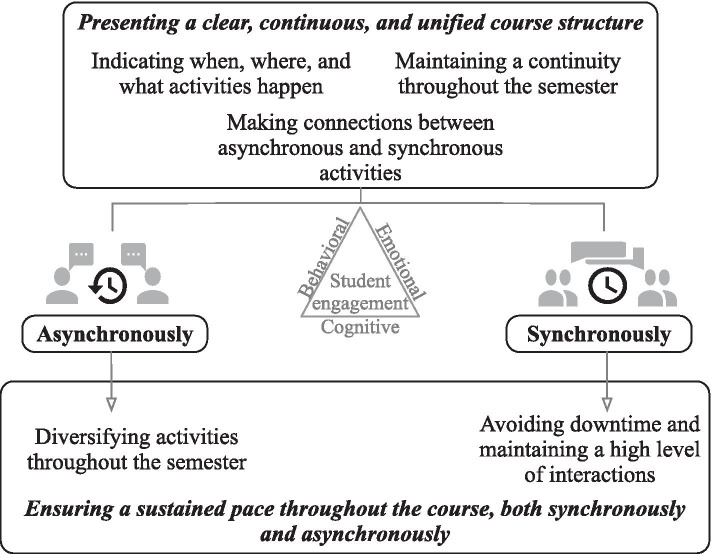
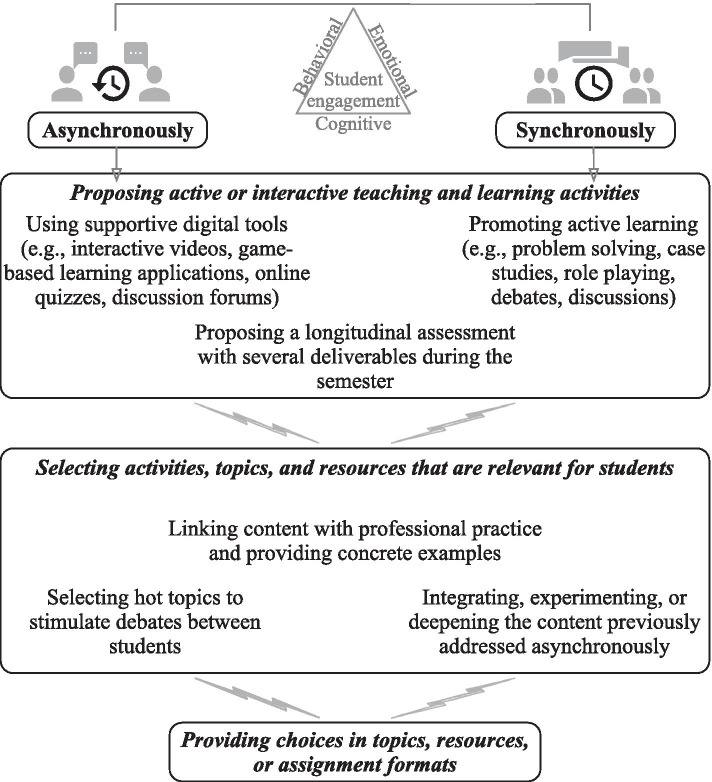
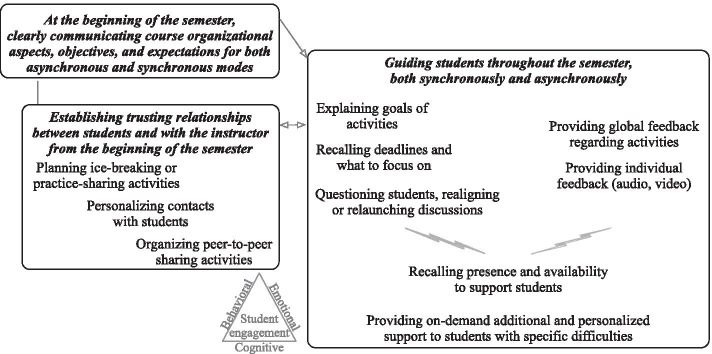
This qualitative study examined how teachers fostered student engagement in blended learning (BL), i.e., blended, blended online, and blended synchronous courses that combine synchronous and asynchronous activities. Twenty semi-structured interviews with teachers in various disciplines, at the undergraduate or graduate level in four universities, were conducted and analyzed using an inductive approach. Therefore, the study proposed a broad and comprehensive picture of teachers’ strategies to enhance student engagement in BL, that were classified in three meta-categories concerning (i) the course structure and pace; (ii) the selection of teaching and learning activities; and (iii) the teacher’s role and course relationships. Strategies were also linked with student engagement dimensions (behavioral, emotional, cognitive), whenever possible. The findings particularly emphasized the importance of a well-structured and -paced course, fully exploiting and integrating synchronous and asynchronous modes of BL. Clearly communicating how the course would unfold and corresponding expectations as well as establishing trusting relationships at the beginning of the semester also appeared as key to foster student engagement in BL. The use of various digital tools was also highlighted to promote student behavioral and emotional engagement at the undergraduate level, whereas cognitive and emotional engagement of graduate students was mainly targeted through experience-sharing and learning co-construction between students.
Overview
The claims and statistics of this paper haven’t been checked yet.
Free: it reads the open-access text and checks the first 5 claims that cite a source we can check. Create a free account to check every claim.
Integrity signals
Registry
Cites
Statistics
Figures
Verification
Claims the paper makes
The claims and statistics of this paper haven’t been checked yet.
Free: it reads the open-access text and checks the first 5 claims that cite a source we can check. Create a free account to check every claim.
Claims other papers make about this one
Each is checked against this paper’s own text: does it say what the citing paper says it does?
The source backs part of the claim, not all of it — or backs it for a different population, condition or comparison.
In the citing paper
“Although they may still be emerging in some contexts, these teaching and learning models are now accepted by a greater number of institutions [64].”
From Digital Learning and Digital Institution in Higher Education (2023) · cites this paper as [64]
Experimental — accuracy not yet measuredThe cited source says what the claim attributes to it.
In the citing paper
“Presenting a clear course structure and working at a particular pace, engaging learners with interactive activities, and providing additional support and constant feedback will help in improving overall student engagement.”
From Impact of online learning on student's performance and engagement: a systematic review (2024) · cites this paper as [56]
Self-check
Percentages, sums and reported differences re-computed from the paper’s own numbers.
The self-check needs the paper’s full text.
Citations
Cites
(2009) · Cited by 21,330
Qualitative Data Analysis: A Methods Sourcebook
Miles, M. B., Huberman, A. M., & Saldaña, J. (1988) · Cited by 20,701
School Engagement: Potential of the Concept, State of the Evidence
Fredricks, J. A., Blumenfeld, P. C., & Paris, A. H. (2004) · Review of Educational Research · doi:10.3102/00346543074001059 · Cited by 12,581
A General Inductive Approach for Analyzing Qualitative Evaluation Data
Thomas, D. R. (2006) · American Journal of Evaluation · doi:10.1177/1098214005283748 · Cited by 10,858 · cited 3×
“Specifically, Thomas (2006) described the following coding steps: initial reading of transcripts, identification of data segments related to objectives, labelling segments into emerging categories, refining categories to avoid redundancies, highlighting the main categories.”
BackgroundMethodHandbook of Research on Student Engagement
(2012) · doi:10.1007/978-1-4614-2018-7 · Cited by 3,050
The Handbook of Blended Learning: Global Perspectives, Local Designs
Bonk, C. J., Graham, C. R., Cross, J., & Moore, M. G. (2005) · Cited by 2,928
Framing student engagement in higher education
Kahu, E. R. (2013) · Studies in Higher Education · doi:10.1080/03075079.2011.598505 · Cited by 2,103 · cited 3×
“Often described as a multidimensional psycho-social process, numerous authors (Bond et al., 2020; Chris-tenson et al., 2012; Fredricks et al., 2019; Kahu, 2013; Lawson & Lawson, 2013; Manwar-ing et al., 2017; Schindler et al., 2017) refer to the definition provided by Fredricks et al. (2004) based…”
BackgroundBlended Learning in Higher Education: Framework, Principles, and Guidelines
Garrison, D. R., & Vaughan, N. D. (2007) · Wiley eBooks · doi:10.1002/9781118269558 · Cited by 1,609
Challenges in the online component of blended learning: A systematic review
Rasheed, R. A., Kamsin, A., & Abdullah, N. A. (2020) · Computers & Education · doi:10.1016/j.compedu.2019.103701 · Cited by 1,472
Blended Learning in Higher Education: Framework, Principles, and Guidelines.
Wainwright, S. (2011) · Journal of Physical Therapy Education · doi:10.1097/00001416-201110000-00013 · Cited by 1,438 · cited 5×
“…BL aims at “extending thinking and discourse over time and space” and is “specifically directed to enhancing [student] engagement” (Vaughan et al., 2013, p. 9) while leveraging digital technology opportunities in a learner-centered approach (Garrison & Vaughan, 2008; Taylor et al., 2018).”
BackgroundInfluential
Research works printed but not linked: 1
- Siemens, G., Gašević, D., & Dawson, S. (2015). Preparing for the digital university: A review of the history and current state of distance, blended, and online learning. http://linkresearchlab.org/PreparingDigitalUniversity.pdf
Cited by
Items 101–200 of 381
Leveraging lecturers’ intelligence for student engagement enrichment in blended learning courses
Huy, P. Q., & Phuc, V. K. (2024) · Cogent Education · doi:10.1080/2331186x.2024.2334930 · Cited by 10
“Taken together, the notion for BLCs employed in the present research rested on the suggestion of Heilporn et al. (2021) which was an integration of face-to-face and online learning practices covering with a contraction in the amount of face-to-face learning activities.”
Blond, N., Bodard, A., Hascoët, E., Lesclous, P., & Cloître, A. (2024) · European Journal Of Dental Education · doi:10.1111/eje.13030 · Cited by 5
The role of engagement strategies and path-dependency in online learning
Getman, A., Boitcov, M., Адамович, К., & Costley, J. (2024) · Innovations in Education and Teaching International · doi:10.1080/14703297.2024.2413440 · Cited by 8
“This is to be done using various educational settings (Linden et al. (2019), selecting appropriate activities (Heilporn et al., 2021), or through teachers’ cognitive flexibility (Stein et al., 2018).”
Kim, S. K., Lee, M., Lee, Y., Go, Y., & Park, M. H. (2024) · Education and Information Technologies · doi:10.1007/s10639-024-13102-2 · Cited by 9
“Teaching methodologies for active engagement should aim to facilitate and assist learners to achieve a deeper understanding of their findings by exploring their own experiences (Matzembacher et al., 2019; Heilporn et al., 2021).”
Arthur, F., Yidana, M. B., & Acquah, B. Y. S. (2025) · SAGE Open · doi:10.1177/21582440251342212 · Cited by 11
“At its core, student engagement in a higher education course signifies the energy and effort students invest in their learning and course-related activities; it embodies ‘‘how students act, feel, and think’’ within the academic context (Ajabshir, 2024; Heilporn et al., 2020, 2021).”
How to Implement Efficient Blended Learning: The Effects of Teacher Support and Task Difficulty
Chen, A., Li, W., Chen, L., Wei, J., & Fu, W. (2022) · International Symposium on Educational Technology · doi:10.1109/iset55194.2022.00057 · Cited by 6
Exploring Students’ Online Learning Interaction Behaviors and Experiences: A Case Study
Chen, C. J., & Teh, C. S. (2022) · Teaching & Learning Inquiry The ISSOTL Journal · doi:10.20343/teachlearninqu.10.38 · Cited by 10
“Heilporn, Lakhal, and Bélisle (2021) highlight the importance of providing guidance and support to students from the beginning and throughout the semester, either in a large group or individually, to foster their emotional and cognitive engagement.”
BackgroundMethodStudent need analysis of problem-based learning model with blended learning in EFL academic reading
Ismail, H., & Edi (2023) · International Journal of English Language and Literature Studies · doi:10.55493/5019.v12i1.4698 · Cited by 5
Exploring the Type and Quality of Peer Feedback in a Graduate-Level Blended Course
Erbilgin, E., Robinson, J. M., Jarrah, A. M., Johnson, J. D., & Gningue, S. M. (2023) · Education Sciences · doi:10.3390/educsci13060548 · Cited by 8
case study on effective teaching strategies for attaining course learning outcomes
Ahmed, A. O. A., & Ibrahim, I. Z. A. (2021) · Linguistics and Culture Review · doi:10.21744/lingcure.v5ns4.2272 · Cited by 5
Feubli, P., MacKevett, D., & Schwarz, J. (2023) · Journal of Computer Assisted Learning · doi:10.1111/jcal.12913 · Cited by 5
An Examination of the Advantages and Disadvantages of Blended Learning
Mustafa, A. N. (2023) · International Journal of Research Publication and Reviews · doi:10.55248/gengpi.4.1223.123405 · Cited by 5
Üstün, A. G., Kurşun, E., & Kayaduman, H. (2024) · Turkish Online Journal of Distance Education · doi:10.17718/tojde.1175726 · Cited by 6
Baskıcı, Ç., Aytar, A., Ersoy, H., Wikström‐Grotell, C., Arell-Sundberg, M., Neves, H. L., Coutinho, V. R. D., Blaževičienė, A., Vaškelytė, A., Söderlund, A., et al. (2024) · Heliyon · doi:10.1016/j.heliyon.2024.e24275 · Cited by 11
Predictor of low academic achievement among Dilla university students, southern Ethiopia, 2024
Kassaw, C., & Демарева, В. (2024) · Frontiers in Education · doi:10.3389/feduc.2024.1438322 · Cited by 6
Instructional management strategies for addressing low student engagement in mathematics
Verdeflor, R. N., Tenedero, E. Q., Bordios, A. G., Panit, N. M., & Espinosa, C. (2024) · Environment and Social Psychology · doi:10.59429/esp.v9i12.3229 · Cited by 20
“Further, student engagement is affected by context-specific variations, including the learning environments and the strategies employed by teachers [7] .”
Arneson, J. B., Woodbury, J., & Offerdahl, E. G. (2022) · Journal of Microbiology and Biology Education · doi:10.1128/jmbe.00337-21 · Cited by 8
Hasim, M. A., Jabar, J. B., Sufian, A., & Ibrahim, N. F. (2022) · International Journal of Learning Teaching and Educational Research · doi:10.26803/ijlter.21.10.9 · Cited by 25
“Studies indicate that another critical area of effort for E-learning in higher education is overcoming implementation problems (Heilporn et al., 2021).”
BackgroundSu, F., Zou, D., & Wang, L. (2023) · Asia Pacific Education Review · doi:10.1007/s12564-023-09918-1 · Cited by 12
Predictors of pre-service teachers’ learning engagement in blended teaching
Ma, K., & Hao, T. (2024) · Distance Education · doi:10.1080/01587919.2024.2387035 · Cited by 5
“Little is known about how learning engagement changes throughout a more extended period, especially with the alternation of teaching formats between online and offline among PSTs (Graham et al., 2019; Heilporn et al., 2021).”
Wang, Y., Fan, S., Douglas, T., Parks, M., Coleman, B., Muir, T., Richey, S., McCarthy, R., Hicks, D., Li, W., et al. (2025) · Education Sciences · doi:10.3390/educsci15091165 · Cited by 12
Fadillah, M. A., Iyamuremye, A., Κaliampos, G., Ravanis, K., Usmeldi, & Asrizal, A. (2026) · Social Sciences & Humanities Open · doi:10.1016/j.ssaho.2026.102439 · Cited by 7
Baigi, F., Yeganeh, M., & Bemanian, M. (2024) · Frontiers in Built Environment · doi:10.3389/fbuil.2024.1463658 · Cited by 9
Bustard, J., & Ghisoiu, M. (2025) · doi:10.3390/proceedings2025114001 · Cited by 7
Yuan, Y., Harun, J., Wong, B. Y., & Li, L. (2025) · SAGE Open · doi:10.1177/21582440251329687 · Cited by 19
“In conclusion, these findings highlight and support the previous research (Bedenlier et al., 2020; Heilporn et al., 2021; Yu et al., 2022) about the effectiveness of technology in promoting student behavioural engagement, while also providing insight into CL approach that requires further…”
Yan-jun, Y., & Tan, J. (2025) · SAGE Open · doi:10.1177/21582440251336512 · Cited by 10
“This result is aligned with prior research by Heilporn et al. (2021), who revealed that regardless of gender, an autonomous learning environment can promote students’ AE in online learning.”
Álvarez, E. F., Pérez‐Calzado, E., & Coterón, J. (2025) · Acta Psychologica · doi:10.1016/j.actpsy.2025.105627 · Cited by 13
Kuliukas, L. J., Brown, J. A., Bosco, A. M., & Bradfield, Z. (2022) · Women and Birth · doi:10.1016/j.wombi.2022.10.005 · Cited by 6
Future Trends in Education Post COVID-19: Teaching, Learning and Skills Driven Curriculum
Al-Naimiy, H. M. K., Bettayeb, M., Elmehdi, H. M., & Shehadi, I. (2023) · Springer eBooks · doi:10.1007/978-981-99-1927-7 · Cited by 7
The Effect of Group Size on Cognitive and Behavioural Students' Engagement
Laaziz, Y., Chemsi, G., & Radid, M. (2023) · International Journal of Emerging Technologies in Learning (iJET) · doi:10.3991/ijet.v18i15.40665 · Cited by 6
Construction of vocational undergraduate education teacher team based on deep learning
Tang, H. (2024) · Journal of Computational Methods in Sciences and Engineering · doi:10.3233/jcm-237041 · Cited by 11
“Deep learning models are able to extract effective information from complex, high-dimensional, unstructured data and perform effective analysis and prediction [10].”
O’Rourke, M., & Doyon, A. (2024) · International Journal of Educational Technology in Higher Education · doi:10.1186/s41239-024-00483-0 · Cited by 16
“Strategies to ensure this include strong teacher-student relationships (Heilporn et al., 2021; Reeve, 2012) through regular communications and ensuring that assessment is a focus of the curriculum.”
BackgroundKitching, N. (2024) · Irish Educational Studies · doi:10.1080/03323315.2024.2394396 · Cited by 9
“Further, through discussions with my peer partner as part of the professional development programme, establishing trusting relationships with the students at the beginning of the semester was important, as indicated by Heilporn, Lakhal, and Bélisle (2021).”
Laubscher, D. J., & Bosch, C. (2025) · Springer eBooks · doi:10.1007/978-981-96-0722-8_9 · Cited by 7
BLENDED LEARNING: THE “NEW NORMAL” IN EDUCATION DELIVERY
Foley, T., & Curtin, A. J. (2022) · International Journal of Distance Education and E-Learning · doi:10.36261/ijdeel.v7i2.2435 · Cited by 10
Peer Assessment-based Digital Literacy, EFL Students’ Reading Competency, and Engagement
Lailiyah, L., Ratminingsih, N. M., Utami, I. L. P., Artini, L. P., Padmadewi, N. N., & Marsakawati, N. P. E. (2022) · Journal of Education Research and Evaluation · doi:10.23887/jere.v6i4.53012 · Cited by 10
Sonji, G. M., Halat, D. H., Mourad, N., Sonji, N. M., Mehyou, Z., & Rahal, M. K. (2023) · Pharmacy Education · doi:10.46542/pe.2023.231.269282 · Cited by 7
Exploring Students' Perceptions and Engagement in Hybrid Flexible Courses
Battestilli, L., Bohórquez, E., Khan, S., & Meral, C. (2023) · ACM Conference on Learning @ Scale (L@S) · doi:10.1145/3573051.3593383 · Cited by 7
“HyFlex learning may increase students’ involvement in large courses due to its flexibility in time and space and by allowing students to have a better balance between their academic, personal, and professional lives [16].”
BackgroundThe Impacts of College Students’ Professional Values and Identity on Learning Engagement in China
Long, T., & Tien, L.-C. (2024) · Journal of Law and Sustainable Development · doi:10.55908/sdgs.v12i1.2587 · Cited by 5
White, M., Kupin, A., Inzerillo, S., Banerjee, N. K., & Banerjee, S. (2024) · IEEE International Conference on Artificial Intelligence and eXtended and Virtual Reality (AIxVR) · doi:10.1109/aixvr59861.2024.00027 · Cited by 4
“During the pandemic, a shift to remote learning using synchronous or asynchronous video-based platforms brought forth challenges with mental fatigue, lack of engagement, and interaction [6]– [8], eventually leading to a decline in student satisfaction, persistence, and academic success [9], [10].”
BackgroundStudents' perspectives of a hybrid learning system in Kazakhstani higher education: A case study
Amirova, A., Zhumabayeva, A., Жунусбекова, А., Arenova, A., & Nygymanova, N. (2024) · Journal of Education and e-Learning Research · doi:10.20448/jeelr.v11i2.5546 · Cited by 12
Development of higher education institutions in the current conditions
Kubitskyi, S., Shorobur, I., Yevdokymova, N., Власюк, Т., & Shevchuk, L. M. (2024) · Cadernos de Educação Tecnologia e Sociedade · doi:10.14571/brajets.v16.nse2.119-128 · Cited by 10
Disrupting the College Classroom Experience: Avoiding Technology Pitfalls
Torres, K. M. (2022) · Advances in higher education and professional development book series · doi:10.4018/978-1-7998-9243-4.ch011 · Cited by 5
García-Hirschfeld, E. C., Santos, M. Á. R., & López-Martín, C. (2025) · The International Journal of Management Education · doi:10.1016/j.ijme.2024.101124 · Cited by 8
Microlearning in Immersive Virtual Reality: A User-Centered Analysis of Learning Interfaces
Gill, A. S., Irwin, D. S., Sun, L., Towey, D., Zhang, G., & Zhang, Y. (2025) · IEEE Transactions on Learning Technologies · doi:10.1109/tlt.2025.3533360 · Cited by 6
“This has prompted educators and researchers to explore innovative pedagogies and technologies to enhance knowledge retention and classroom engagement [9], [10].”
Keulemans, T., Depaepe, F., & Raes, A. (2025) · Learning and Instruction · doi:10.1016/j.learninstruc.2025.102189 · Cited by 8
Ateş, H., & Kölemen, C. Ş. (2025) · Education and Information Technologies · doi:10.1007/s10639-025-13731-1 · Cited by 8
“However, traditional teaching methods often fall short of capturing students’ interest or making learning relatable, which can lead to disengagement, low motivation, and suboptimal participation in learning activities (Heilporn et al., 2021 ).”
Shen, D., & Chang, C.-S. (2022) · International Journal of Technology and Human Interaction · doi:10.4018/ijthi.313184 · Cited by 7
“For instance, actively monitoring learning processes and using appropriate strategies boosts learning content comprehension (Heilporn et al., 2021), and reflective practice encourages rational decision-making and positive learning behavior (Colomer et al., 2020).”
BackgroundInfluentialHybrid Learning System: Analysis, Opportunities, Challenges, and Prospects
Ajagbe, S. A., Olagunju, K. M., Osunade, O., Awokola, J. A., Oladosu, J. B., & Omidiora, E. O. (2023) · Contributions to environmental sciences & innovative business technology · doi:10.1007/978-981-99-3497-3_2 · Cited by 7
Tomas, N., Munangatire, T., & Haita, S. L. (2024) · SAGE Open Nursing · doi:10.1177/23779608241228494 · Cited by 7
“…synchronous and asynchronous activities and are situated on a continuum between face-to-face and online teaching and learning, are of particular interest to the fi eld of nursing education since the literature suggests they have the potential to optimize student engagement (Heilporn et al., 2021).”
BackgroundHuang, M. J., & Kuang, F. (2024) · Theory and Practice in Language Studies · doi:10.17507/tpls.1405.29 · Cited by 5
“Heilporn et al. (2021) extended the previous study by conducting twenty semi-structured interviews with teachers from four universities in the province of Quebec (Canada).”
BackgroundLi, B., Zeng, Y., & Pawlak, M. (2025) · Language Learning Journal · doi:10.1080/09571736.2024.2445252 · Cited by 8
“Moreover, teachers’ emotional support, such as fostering a positive learning environment and providing encouragement, has been shown to significantly enhance students’ emotional engagement in blended learning contexts (Heilporn, Lakhal, and Bélisle 2021).”
Alon, L., Sung, S., & Kizilcec, R. F. (2023) · Lecture notes in computer science · doi:10.1007/978-3-031-28035-1_33 · Cited by 5
“To construct a sustainable, well-designed, blended learning course, instructors should consider the course structure (i.e., the balance of in-person and online instruction), the selection of activities within the course, and their own role in building relationships with the students [17].”
BackgroundResultSTUDENTS’ PERCEPTION REGARDING TEACHERS’ TEACHING PRACTICES AT UNIVERSITY LEVEL
Kamran, F., Afzal, A., & Rafiq, S. (2022) · Journal of Social Sciences Development · doi:10.53664/jssd/01-01-2022-02-13-26 · Cited by 3
Blended online courses: students’ learning experiences and engaging instructional strategies
Heilporn, G., Lakhal, S., & Bélisle, M. (2023) · Pedagogies An International Journal · doi:10.1080/1554480x.2023.2219255 · Cited by 9
“…importance of instructor explanations and feedback, both in clarifying goals and expectations and in guiding students through the blended online course, consistent with various scholarly writings in blended and online learning (e.g. Boelens et al., 2017; Heilporn et al., 2021; Lee et al., 2021).”
BackgroundMethodResultInfluentialSelf-citationSocially Connected Learning Harnessing Digital Platforms for Educational Engagement
Gupta, D., Khan, A. A., Kumar, A., Baghel, M. S., & Tiwar, A. (2024) · Advances in educational technologies and instructional design book series · doi:10.4018/979-8-3693-5370-7.ch010 · Cited by 3
Parenting styles and teacher interaction on self-regulated learning and academic performance
Isufi, A., & Haskuka, M. (2024) · International Journal of Adolescence and Youth · doi:10.1080/02673843.2024.2365881 · Cited by 17
“When teachers provide freedom without offering choices to students, it predisposes students not to become active and productive processors of information (Heilporn et al., 2021).”
Xu, X., Thien, L. M., Lin, J., & Li, Y. (2025) · Education and Information Technologies · doi:10.1007/s10639-025-13594-6 · Cited by 5
“According to Heilporn et al. (2021), when teachers employed digital tools to create interactive and collaborative learning experiences, students exhibited enhanced behavioral engagement.”
Educational strategy in digital environment
Stikhina, I. A. (2021) · E3S Web of Conferences · doi:10.1051/e3sconf/202129608030 · Cited by 3
Madanat, H. M., Tarawnah, M., & Khzouz, A. (2023) · Springer eBooks · doi:10.1007/978-981-99-1927-7_24 · Cited by 5
JEJARING TEKNOLOGI METAVERSEPreprint
Wijayanto, A. (2022) · OSF Preprints (OSF Preprints) · doi:10.31219/osf.io/24fjw · Cited by 6
Xu, A., & Zhang, Y. (2025) · Asia Pacific Journal of Education · doi:10.1080/02188791.2025.2505665 · Cited by 2
Kirchmeyer, N., & Knauff, K. (2023) · Language Learning in Higher Education · doi:10.1515/cercles-2023-2021 · Cited by 2
Fostering empathy in Chinese medical students: the role of Balint groups facilitation
Zhang, X., Samsudin, N., & Sun, H. (2024) · Cogent Education · doi:10.1080/2331186x.2024.2344371 · Cited by 2
“Some scholars believe that teaching methods can arouse students ’ interest in learning (Heilporn et al., 2021).”
Yan, T., Yu, H., & Tang, J. (2024) · Behavioral Sciences · doi:10.3390/bs14111073 · Cited by 9
“Student engagement refers to the time, effort, and resources that students invest to enhance their academic experience at a university [65].”
Teacher Academic Training Systems in Greece and Serbia
Kotsis, K. Τ., Randjelovic, B. M., Tsiouri, E., & Ilibašić, S. (2025) · EIKI Journal of Effective Teaching Methods · doi:10.59652/jetm.v3i1.311 · Cited by 2
Besonia, B. E. A., Arabia, J. A. S., Babas, R. P., Luena, A. N., Banico-Villaruel, R., Daquin, C. G. D., Decrepito, M. A. L., Jardenil, K. C., Baclagon, C. M. B., Espora, S. M. H., et al. (2025) · International Journal of ADVANCED AND APPLIED SCIENCES · doi:10.21833/ijaas.2025.05.023 · Cited by 5
Funding Models for AI in Education: Ensuring Sustainability and Impact
Rahmawati, R., Rismawati, R., Duriani, D., & Yunus, Y. (2025) · Advances in computational intelligence and robotics book series · doi:10.4018/979-8-3373-5781-2.ch009 · Cited by 2
McLoughlin, E. (2025) · Challenges in physics education · doi:10.1007/978-3-031-94207-5_3 · Cited by 5
O’Neill, E. J., Fulton, C., Matthews, J., & Hensey, C. (2025) · Educational Technology Research and Development · doi:10.1007/s11423-025-10574-y · Cited by 12
Shi, Y., Chen, M. F., Wei, Y., Zhang, X., & Zhu, K. (2026) · European Journal of Education · doi:10.1111/ejed.70507 · Cited by 5
Wu, X., Zeng, Y., Li, Z., Li, X., Chen, S., Sun, L., Zhu, L., & Xie, Y. (2026) · Frontiers in Psychology · doi:10.3389/fpsyg.2026.1729241 · Cited by 3
“Psychological engagement, as a core construct in educational psychology, encompasses behavioral manifestations, cognitive processes, and emotional responses that collectively demonstrate strong associations with learning outcomes (Heilporn et al., 2021).”
Kholis, A. (2022) · Lingua Didaktika Jurnal Bahasa dan Pembelajaran Bahasa · doi:10.24036/ld.v16i1.114328 · Cited by 3
Pratiques pédagogiques inclusives en enseignement postsecondaire, en contexte pandémique
Heilporn, G., Larose, S., Beaulieu, C., Janosz, M., Cellard, C., Bureau, J. S., & Côté, S. M. (2023) · Revue internationale de pédagogie de l’enseignement supérieur · doi:10.4000/ripes.4661 · Cited by 9
Self-citationChanaa, A., & Faddouli, N.-E. E. (2024) · Journal of Education and Learning (EduLearn) · doi:10.11591/edulearn.v18i2.20948 · Cited by 8
“…then used the models to categorize postings in a private Facebook group into topics connected to statistics and those that weren't. Heilporn et al. [23] provided a thorough and all-encompassing picture of the methods used by instructors to improve student engagement in blended learning, based on…”
Ramanathan, S., Shum, S. B., & Lim, L.-A. (2024) · International Conference on Learning Analytics and Knowledge (LAK) · doi:10.1145/3636555.3636916 · Cited by 2
“Heilporn, Lakhal and Bélisle [12], in their research established the importance of successful learning methodologies that promote critical reflection and collaboration among learners.”
BackgroundRespati, T. K., Wicaksono, B. H., & Widodo, E. (2024) · Journal of Languages and Language Teaching · doi:10.33394/jollt.v12i2.10689 · Cited by 10
“This aligns with previous research that found (Heilporn et al., 2021; Khalil et al., 2021; Muzata, 2020; Ulyawati and Sugito, 2022).”
ResultAnalysis of Factors that Influence Students' Enjoyable Learning in Class: A Literature Review
Taufiqurohman, T., Nurihsan, J., & Rachmawati, Y. (2022) · QALAMUNA Jurnal Pendidikan Sosial dan Agama · doi:10.37680/qalamuna.v14i1.4360 · Cited by 2
“This finding aligns with the results of a second study, which emphasizes the importance of teacher involvement in creating a supportive and enjoyable environment (Heilporn et al., 2021).”
ResultPELATIHAN PELAKSANAAN PENDEKATAN TEACHING AT THE RIGHT LEVEL PADA GURU SEKOLAH DASAR
Wahira, W., Hasan, H., & Hamid, A. (2024) · JURNAL PENGABDIAN MASYARAKAT AKADEMISI · doi:10.59024/jpma.v2i2.697 · Cited by 2
“Hasil pelatihan sesuai dengan penelitian dari (Heilporn et al., 2021; Noh & Karim, 2021) memberikan konsep adanya hubungan keahlian dengan perencanaan instruksional dan kemajuan profesional guru dalam menangani kebutuhan Pendidikan.”
BackgroundChinese Teachers’ Perceptions on Perceived Teacher Support and Student Engagement
Shu, Z., Mottan, K., Chen, H., & Pang, Y. (2024) · Environment-Behaviour Proceedings Journal · doi:10.21834/e-bpj.v9i30.6197 · Cited by 3
Gamble, J. H., Li, H.-M., Liao, X.-L., Cao, C.-H., Chen, X.-M., & Chen, I. (2024) · Scientific Reports · doi:10.1038/s41598-024-79418-8 · Cited by 2
Walas-Trębacz, J., Krzyżak, J., Herdan, A., Setyohadi, D. B., Jeyanathan, J. S., & Nair, A. (2025) · The TQM Journal · doi:10.1108/tqm-09-2024-0335 · Cited by 4
Mobile Platforms, Designs, and Applications for Web3 Towards Reducing Students' Cognitive Load
Heerden, D. V., & Goosen, L. (2025) · Advances in web technologies and engineering book series · doi:10.4018/979-8-3693-2973-3.ch007 · Cited by 2
Enhancing Grade 8 Proficiency in Analyzing Ohm’s Law Concepts through the GameMapPro Method
Bande, R. J., Cabahit, J. D., Macatual, K. M., Enero, C., Denden, R., & Bellen, J. A. (2025) · Journal of interdisciplinary perspectives · doi:10.69569/jip.2025.428 · Cited by 4
Effectiveness and learning outcomes of hybrid learning in Malaysian undergraduate courses
Adamu, A. A., Sathappan, M., Adeyinka-Ojo, S., Sathappan, R., Ahmad, G. I., & Kalam, M. A. (2025) · Asian Education and Development Studies · doi:10.1108/aeds-07-2024-0157 · Cited by 2
Delgado, D. A. G., & Cabiles, R. C. (2024) · Isabela State University Linker Journal of Education Social Sciences and Allied Health · doi:10.65141/jessah.v1i2.n6 · Cited by 2
Reyes-Rojas, J., & Barahona, M. (2021) · Revista Internacional de Pedagogía e Innovación Educativa · doi:10.51660/ripie.v2i1.86 · Cited by 5
The relationship between student engagement and their perception of success in online learning
Krismiyati, K., & Yulia, H. (2022) · Jurnal Pendidikan Teknologi dan Kejuruan · doi:10.21831/jptk.v29i1.53966 · Cited by 8
SYNCHRONOUS AND ASYNCHRONOUS INTEGRATED PROJECT-BASED LEARNING IN ENGLISH LANGUAGE LEARNING
Suryani, N. Y., Rahayu, A. P., Rohani, T., & Adiyono, A. (2024) · JURNAL SMART · doi:10.52657/js.v10i1.2249 · Cited by 4
“Teachers should promote student participation in blended learning (BL), online, and synchronous courses that combine synchronous and asynchronous activities, claim (Heilporn et al., 2021).”
BackgroundINTEGRATING BLENDED LEARNING IN PROGRAMMING COURSE: A COMPREHENSIVE SYSTEMATIC REVIEW
Bakar, E. E. A., Halim, N. D. A., & Hanid, M. F. A. (2024) · Quantum Journal of Social Sciences and Humanities · doi:10.55197/qjssh.v5isi1.566 · Cited by 2
Poornesh, M. (2024) · Research Square · doi:10.21203/rs.3.rs-4625252/v1 · Cited by 2
Social Media: An Elixir to Boost Student Engagement in Higher Education Learning
Koul, S., & Jasrotia, S. S. (2023) · Business and Professional Communication Quarterly · doi:10.1177/23294906231202437 · Cited by 7
“Social media as a learning environment is not new and has been embraced by university classrooms to enable the instructor to develop a culture of knowledge cocre-ation (Zhang et al., 2020), create real-world connections (Dragseth, 2020), and foster student engagement (SE) (Heilporn et al., 2021).”
Implementation of Ethno-Edugames Application to Improve Student Learning Outcomes
Sari, N. P., Pertiwi, K. R., & Pratama, A. T. (2025) · Jurnal Penelitian Pendidikan IPA · doi:10.29303/jppipa.v11i2.10100 · Cited by 2
“…technology that can be modified into a more effective learning method and is more helpful in meeting students' learning needs, one of which is information related to learning that students can get without being limited by space and time (Heilporn et al., 2021; Nugroho, 2021; Marey et al., 2022).”
Roy, A. P., Anand, K., Elangovan, N., & Halaswamy, D. (2025) · Advances in marketing, customer relationship management, and e-services book series · doi:10.4018/979-8-3693-9122-8.ch007 · Cited by 1
21st Century Skills Development in Secondary Schools: A Systematic Literature Review
Amanulloh, M. J. A., Marbun, M., Sobri, A. Y., & Ubaidillah, A. F. (2024) · Education and Human Development Journal · doi:10.33086/ehdj.v9i3.5522 · Cited by 1
“By leveraging everyday objects in learning activities, educators can foster a more dynamic and interactive educational experience, promoting deeper engagement and skill acquisition among young learners (Alexis et al., 2023; Heilporn et al., 2021).”
Humanizing the Digital Classroom: The Educator's Role in Fostering Connection Amidst Technology
Asrifan, A., Wajdi, F., Ishak, S., & Alwi, A. (2025) · IGI Global eBooks · doi:10.4018/979-8-3373-0771-8.ch005 · Cited by 5
Hung, L.-L., Chang, C.-Y., Yang, B.-C., Fu, W.-T., Wu, S.-L., Chen, Y.-L., Chang, M., Wang, S.-C., Weng, M.-R., & Wu, T. (2025) · Nurse Education in Practice · doi:10.1016/j.nepr.2025.104422 · Cited by 4
Virtual Tools and Student Engagement: Insights from Engineering Education
Hakobyan, L., Lee, R., & Webber, T. (2025) · IEEE Global Engineering Education Conference (EDUCON) · doi:10.1109/educon62633.2025.11016523 · Cited by 2
“Together, these dimensions provide a comprehensive view of what it means to be fully engaged in an educational setting [11].”
Fu, C., & Niu, X. (2025) · Current Psychology · doi:10.1007/s12144-025-08234-8 · Cited by 1
“A combination of high-level teaching skills and a broad knowledge base can engage PSTs’ academic curiosity, thereby stimulating their interest, enthusiasm and participation for learning (Heilporn et al., 2021).”
Kumar, A. (2025) · Journal of Higher Education Policy And Leadership Studies · doi:10.61882/johepal.6.2.24 · Cited by 4
Metadata
- Authors
- Heilporn, G., Lakhal, S., & Bélisle, M.
- Affiliations
- Université de Sherbrooke (CA)
- Corresponding author
- Heilporn, Géraldine
- Venue
- International Journal of Educational Technology in Higher Education
- Published
- 2021-05-10
- Volume
- 18
- Issue
- 1
- Pages
- 25-25
- ISSN
- 2365-9440 (ISSN-L)
- PMC
- PMC8591686
- OpenAlex
- W3162288571
- Cited by
- 381
- References
- 86
- Citations by year
- 2026: 54 · 2025: 93 · 2024: 102 · 2023: 67 · 2022: 50 · 2021: 14
- FWCI
- 102.43
- Type
- journal article
- Language
- en
- Open access
- diamond
- doi.org
- Licence
- cc-by
- creativecommons.org/licenses/by/4.0 (tdm)
- creativecommons.org/licenses/by/4.0 (vor)
- Locations
- International Journal of Educational Technology in Higher Education (publishedVersion, cc-by)
- PubMed Central (publishedVersion, cc-by)
- PubMed (publishedVersion)
- DOAJ (DOAJ: Directory of Open Access Journals) (submittedVersion, cc-by-sa)
- Funders
- Social Sciences and Humanities Research Council of Canada (Doctoral Fellowship)
- Topics
- Social Sciences › Education › Online and Blended Learning
- Social Sciences › Education › Innovative Teaching Methods
- Social Sciences › Education › English Language Learning and Teaching
- Keywords
- blended learning, student engagement, teacher strategies, university teaching, synchronous and asynchronous activities, teacher role, teacher-student relationship, digital tools, behavioral engagement, emotional engagement, cognitive engagement, undergraduate students, graduate students, experience sharing
About these checks
Registry, retraction, Cites and statistics results are computed, not judged, with one exception: a printed reference that no index lists is read once by a model before it counts as a citation error. Claims are extracted by a model and kept only when their quote appears verbatim in the text; each cited source is then checked, with a model’s help, for whether it says what the claim relies on. Those verdicts can be wrong — read the claim’s quote and the cited source before relying on one.
Statistics and arithmetic are recomputed, not judged.
Confidence bands are shown only for fields calibrated on our annotated test set. None is calibrated yet, so no band is shown.
What counts as a claim ›How we measure confidence ›How we check this ›
Are you an author, or do you see a problem with this page? Request a review
Data sources
Bibliographic data: Semantic Scholar, OpenAlex, Crossref.
Contains information from the Semantic Scholar Academic Graph Datasets, made available under the ODC Attribution License (ODC-BY 1.0).
Semantic Scholar’s data is described in: Kinney, R., et al. (2023). The Semantic Scholar Open Data Platform. arXiv:2301.10140.
