

An examination of teachers’ strategies to foster student engagement in blended learning in higher education
Open accessThe DOI matches its Crossref record; 85 of the 86 references it cites were found in a registry or an index.
Abstract
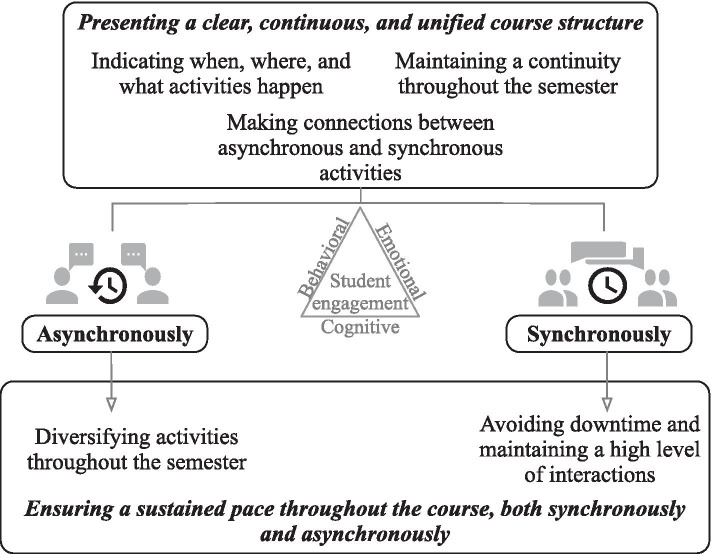
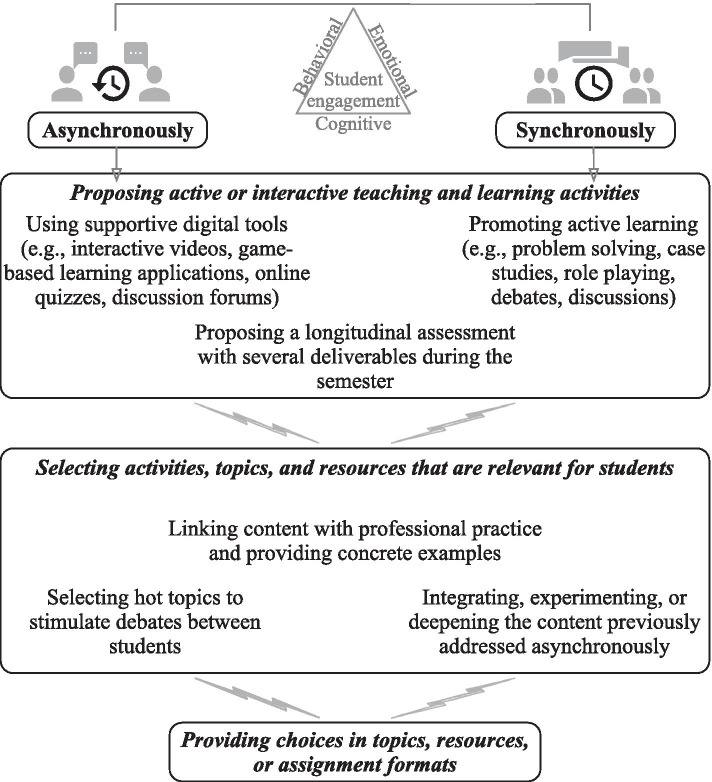
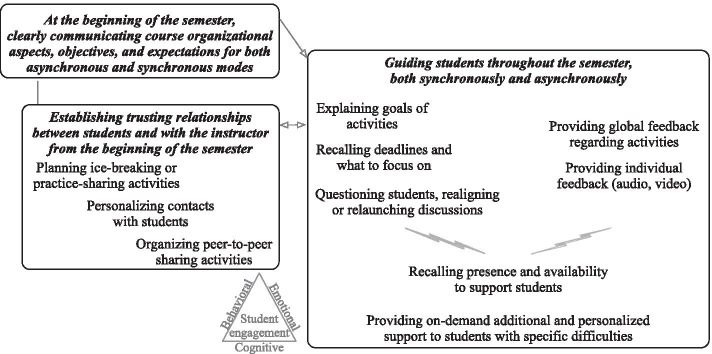
This qualitative study examined how teachers fostered student engagement in blended learning (BL), i.e., blended, blended online, and blended synchronous courses that combine synchronous and asynchronous activities. Twenty semi-structured interviews with teachers in various disciplines, at the undergraduate or graduate level in four universities, were conducted and analyzed using an inductive approach. Therefore, the study proposed a broad and comprehensive picture of teachers’ strategies to enhance student engagement in BL, that were classified in three meta-categories concerning (i) the course structure and pace; (ii) the selection of teaching and learning activities; and (iii) the teacher’s role and course relationships. Strategies were also linked with student engagement dimensions (behavioral, emotional, cognitive), whenever possible. The findings particularly emphasized the importance of a well-structured and -paced course, fully exploiting and integrating synchronous and asynchronous modes of BL. Clearly communicating how the course would unfold and corresponding expectations as well as establishing trusting relationships at the beginning of the semester also appeared as key to foster student engagement in BL. The use of various digital tools was also highlighted to promote student behavioral and emotional engagement at the undergraduate level, whereas cognitive and emotional engagement of graduate students was mainly targeted through experience-sharing and learning co-construction between students.
Overview
The claims and statistics of this paper haven’t been checked yet.
Free: it reads the open-access text and checks the first 5 claims that cite a source we can check. Create a free account to check every claim.
Integrity signals
Registry
Cites
Statistics
Figures
Verification
Claims the paper makes
The claims and statistics of this paper haven’t been checked yet.
Free: it reads the open-access text and checks the first 5 claims that cite a source we can check. Create a free account to check every claim.
Claims other papers make about this one
Each is checked against this paper’s own text: does it say what the citing paper says it does?
The source backs part of the claim, not all of it — or backs it for a different population, condition or comparison.
In the citing paper
“Although they may still be emerging in some contexts, these teaching and learning models are now accepted by a greater number of institutions [64].”
From Digital Learning and Digital Institution in Higher Education (2023) · cites this paper as [64]
Experimental — accuracy not yet measuredThe cited source says what the claim attributes to it.
In the citing paper
“Presenting a clear course structure and working at a particular pace, engaging learners with interactive activities, and providing additional support and constant feedback will help in improving overall student engagement.”
From Impact of online learning on student's performance and engagement: a systematic review (2024) · cites this paper as [56]
Self-check
Percentages, sums and reported differences re-computed from the paper’s own numbers.
The self-check needs the paper’s full text.
Citations
Cites
(2009) · Cited by 21,330
Qualitative Data Analysis: A Methods Sourcebook
Miles, M. B., Huberman, A. M., & Saldaña, J. (1988) · Cited by 20,701
School Engagement: Potential of the Concept, State of the Evidence
Fredricks, J. A., Blumenfeld, P. C., & Paris, A. H. (2004) · Review of Educational Research · doi:10.3102/00346543074001059 · Cited by 12,581
A General Inductive Approach for Analyzing Qualitative Evaluation Data
Thomas, D. R. (2006) · American Journal of Evaluation · doi:10.1177/1098214005283748 · Cited by 10,858 · cited 3×
“Specifically, Thomas (2006) described the following coding steps: initial reading of transcripts, identification of data segments related to objectives, labelling segments into emerging categories, refining categories to avoid redundancies, highlighting the main categories.”
BackgroundMethodHandbook of Research on Student Engagement
(2012) · doi:10.1007/978-1-4614-2018-7 · Cited by 3,050
The Handbook of Blended Learning: Global Perspectives, Local Designs
Bonk, C. J., Graham, C. R., Cross, J., & Moore, M. G. (2005) · Cited by 2,928
Framing student engagement in higher education
Kahu, E. R. (2013) · Studies in Higher Education · doi:10.1080/03075079.2011.598505 · Cited by 2,103 · cited 3×
“Often described as a multidimensional psycho-social process, numerous authors (Bond et al., 2020; Chris-tenson et al., 2012; Fredricks et al., 2019; Kahu, 2013; Lawson & Lawson, 2013; Manwar-ing et al., 2017; Schindler et al., 2017) refer to the definition provided by Fredricks et al. (2004) based…”
BackgroundBlended Learning in Higher Education: Framework, Principles, and Guidelines
Garrison, D. R., & Vaughan, N. D. (2007) · Wiley eBooks · doi:10.1002/9781118269558 · Cited by 1,609
Challenges in the online component of blended learning: A systematic review
Rasheed, R. A., Kamsin, A., & Abdullah, N. A. (2020) · Computers & Education · doi:10.1016/j.compedu.2019.103701 · Cited by 1,472
Blended Learning in Higher Education: Framework, Principles, and Guidelines.
Wainwright, S. (2011) · Journal of Physical Therapy Education · doi:10.1097/00001416-201110000-00013 · Cited by 1,438 · cited 5×
“…BL aims at “extending thinking and discourse over time and space” and is “specifically directed to enhancing [student] engagement” (Vaughan et al., 2013, p. 9) while leveraging digital technology opportunities in a learner-centered approach (Garrison & Vaughan, 2008; Taylor et al., 2018).”
BackgroundInfluential
Research works printed but not linked: 1
- Siemens, G., Gašević, D., & Dawson, S. (2015). Preparing for the digital university: A review of the history and current state of distance, blended, and online learning. http://linkresearchlab.org/PreparingDigitalUniversity.pdf
Cited by
Items 201–300 of 381
Yupelmi, M., Ambiyar, A., Yulastri, A., & Reflianto, R. (2025) · European Journal of Educational Research · doi:10.12973/eu-jer.15.1.1 · Cited by 7
Avelino, Z. L. (2025) · Integrated Science Education Journal · doi:10.37251/isej.v6i3.2133 · Cited by 3
How COVID-19 Shaped University Students’ Perspectives of Poor Teaching
Rayner, G. M., & Papakonstantinou, T. (2025) · College Teaching · doi:10.1080/87567555.2025.2571630 · Cited by 1
Guo, Y. (2025) · International Journal of Inclusive Education · doi:10.1080/13603116.2025.2552930 · Cited by 2
“Moşteanu (2021) and Heilporn, Lakhal, and Bélisle (2021) pointed out that unique ways should be used to engage students and encourage them to care about literature.”
Filho, W. L., Mapar, M., Trevisan, L. V., Caeiro, S., Pretorius, R., Nicolau, M. D., Nicolau, P. B., & Lambrechts, W. (2025) · Discover Sustainability · doi:10.1007/s43621-025-02319-x · Cited by 3
“Strategies to enhance engagement may include interactive content, regular feedback, and fostering a solid online community [29].”
Gül, F. Ö. (2025) · Journal of Educational Technology and Online Learning · doi:10.31681/jetol.1781815 · Cited by 1
R’boul, H., & Yazidi, R. E. (2026) · International Journal of Educational Development · doi:10.1016/j.ijedudev.2026.103524 · Cited by 8
Liu, D., Saunders, S., & Paracha, S. (2026) · Innovations in Education and Teaching International · doi:10.1080/14703297.2026.2641475 · Cited by 1
Marulanda, J. F. F., Collazos, C. A., Alegría, J. A. H., & Sturm, C. (2026) · IEEE Revista Iberoamericana de Tecnologias del Aprendizaje · doi:10.1109/rita.2026.3670086 · Cited by 1
“• IVC Interactions: In a VCS-mediated synchronous lecture, instructors conduct a typical lecture class with instructor-student and student-student interactions, depending on the teaching model [59].”
Xu, Y., Tong, M., Gao, Q., Xu, J., Zhang, C., & Long, T. (2026) · Journal of Science Education and Technology · doi:10.1007/s10956-026-10305-9 · Cited by 3
Lakhal, S., Ziam, S., Beaudoin, M., & Heilporn, G. (2026) · SAGE Open · doi:10.1177/21582440261433463 · Cited by 1
“However, little has been written about the pedagogical activities used in blended courses (Choy & Lee, 2020), especially those that increase students’ cognitive engagement and the achievement of high-level learning objectives (Heilporn et al., 2021b).”
Self-citationEnhancing Student Engagement with Digital Badges: A Mock Micro-Credentialing Approach
Bartha, G. B., & Kele, J. J. (2026) · The journal of college science teaching · doi:10.1080/0047231x.2026.2685833 · Cited by 1
CHEMICAL AND MICROSTRUCTURAL ANALYSIS OF TAILINGS AND WASTE ROCK FROM A PHOSPHATE MINING
Silva, G. G., Diniz-Pinto, H. S., Mendes, M. V. A., Pereira, P. E. C., & Silva, R. C. (2022) · doi:10.22533/at.ed.6282207123 · Cited by 1
MODERN HIGHER EDUCATION IN THE UKRAINIAN EDUCATIONAL SYSTEM
Buhlai, N., Parkhomenko, V., Pyskach, O. D., Rusakova, O., & Dziamko, V. (2023) · Conhecimento & Diversidade · doi:10.18316/rcd.v15i36.10971 · Cited by 3
Maposa, A. M., & Chakanyuka, V. B. (2023) · Springer eBooks · doi:10.1007/978-3-031-42402-1_8 · Cited by 3
‘Virtual café’ sessions: supporting medical sonography students learning anatomy online
Fenech, M., Mead, N., & Fenech, N. (2023) · Reflective Practice · doi:10.1080/14623943.2023.2297673 · Cited by 2
“The sessions were recorded for those that could not attend and also allow students to watch again if needed for revision (Heilporn et al., 2021).”
BackgroundOng, K. L., Jalil, K. F. A., Hisham, H. D., Kasim, N. S. M., Idris, F., & Adam, S. K. (2023) · Malaysian Journal of Medicine and Health Sciences · doi:10.47836/mjmhs.19.s12.4 · Cited by 1
Do Students Read Instructor Emails? A Case Study of Intervention Email Open Rates
Bernuy, A. Z., Ye, R., Tran, E., Sibia, N., Mandal, A., Shaikh, H., Simion, B., Liut, M., Petersen, A., & Williams, J. J. (2023) · Koli Calling International Conference on Computing Education Research · doi:10.1145/3631802.3631813 · Cited by 5
“Communicating clearly at the beginning of a semester can reduce student anxiety and negative emotional reactions while fostering their participation in activities [32].”
BackgroundInfluentialWWC: Leveraging Extreme Events in Teaching
George, J. J., & Aasi, P. (2024) · Information Systems Education Journal · doi:10.62273/pxxn4147 · Cited by 1
Relational Coaching and Learning for Effective Leadership Education
Stewart, A., & Dunbar-Morris, H. (2024) · Advances in logistics, operations, and management science book series · doi:10.4018/979-8-3693-1086-1.ch010 · Cited by 1
Perceptions of University Teachers and Students on Hybrid Teaching in Morocco
Bouayad, A. (2024) · International Journal of Information and Education Technology · doi:10.18178/ijiet.2024.14.5.2089 · Cited by 4
“Hybrid teaching consists of courses in which activities take place face-to-face in a physical classroom and online in a synchronous or asynchronous manner [4, 9, 10].”
BackgroundLiang, J., Zhao, Z., Ma, S., & Wang, J. (2024) · Journal of Computational Methods in Sciences and Engineering · doi:10.3233/jcm-247160 · Cited by 1
“The blended teaching mode is divided into three types based on the learning style: offline-oriented, online-oriented, and online/offline-coordinated [8], and promotes assessment of students’ learning status primarily through the analysis of classroom learning behaviours.”
Penerapan Media Wordwall Gameshow Quiz untuk Meningkatkan Minat dan Hasil Belajar IPAS Kelas IV
Rahma, A. L., & Suratno, S. (2024) · Jurnal Penelitian Pendidikan IPA · doi:10.29303/jppipa.v10i8.8257 · Cited by 5
Development of Technological Learning Media to Increase Students' Civic Knowledge
Purnama, M. R., Adha, M. M., Perdana, R., & Maulina, D. (2024) · IJORER International Journal of Recent Educational Research · doi:10.46245/ijorer.v5i5.670 · Cited by 1
“Ideally, the use of digital media in education should serve as a basis for increasing students' interest and engagement in their learning (Chiu, 2021; Heilporn et al., 2021; Murillo-Zamorano et al., 2021; Rahmatullah et al., 2022; Wekerle et al., 2022).”
BackgroundNyirongo, D. K., & Mbano, N. (2024) · Open Journal of Social Sciences · doi:10.4236/jss.2024.1210042 · Cited by 3
A Conceptual Framework for Open Distance Learning of Economics in Malaysia
Ming, L. S., & Ann, L. C. (2024) · Proceeding of The International Seminar on Business Economics Social Science and Technology (ISBEST) · doi:10.33830/isbest.v4i1.4840 · Cited by 1
“To maintain high levels of engagement, ODL programs should incorporate a blend of synchronous and asynchronous learning activities (Heilporn, Lakhal & Bélisle, 2021; Giesbers, Rienties, Tempelaar & Gijselaers, 2014).”
Exploring the barriers to implementing hybrid learning in rural primary schools
Shanmugam, S. K. S., Veloo, A., Boon, N. S., & Revindran, S. (2025) · Cogent Education · doi:10.1080/2331186x.2025.2569691 · Cited by 11
“By leveraging technology, hybrid learning can serve as an effective strategy for enhancing educational outcomes and broadening access to quality instruction (Heilporn et al., 2021; Raes, 2022).”
Astra, I. M., Henukh, A., Irvani, A. I., & Jua, S. K. (2025) · Journal of Physics Conference Series · doi:10.1088/1742-6596/3139/1/012096 · Cited by 1
“Previous research revealed that relevant and well-structured materials, as reflected in lesson plans (LP) and student worksheets are able to improve students' understanding and engagement in the learning process [26,27] .”
BLENDED LEARNING INTEGRATION AT SABAH’S TERTIARY INSTITUTIONS, MALAYSIA
Stanlee, T. J., Din, W. A., Pudin, C. S. J., & Swanto, S. (2021) · International Journal of Education Psychology and Counseling · doi:10.35631/ijepc.643024 · Cited by 2
Immersive Virtual Classroom Model for a Synchronous Blended Learning Environment
Juan Fernando Flórez, M. (2022) · Congreso de Tecnología, Aprendizaje y Enseñanza de la Electrónica (TAEE) · doi:10.1109/taee54169.2022.9840734 · Cited by 1
An Empirical Studying: Blended Teaching Design Based on Deep Learning
Jin, W. (2023) · Creative Education · doi:10.4236/ce.2023.143035 · Cited by 1
Marantz, Z. (2023) · IEEE World Engineering Education Conference (EDUNINE) · doi:10.1109/edunine57531.2023.10102853 · Cited by 1
“Some published literature fails to clarify which courses are taught in HyFlex/blended mode [4], [14].”
BackgroundDe Docent als Schakel: Helpende en Belemmerende Docentovertuigingen bij Blended Onderwijs
Gremmen, M., & van der Stappen, E. (2023) · Tijdschrift OnderwijsPraktijk Studies · doi:10.54657/tops.13369 · Cited by 2
Stabilizing Student Engagement in Teaching English at SDIT At-Taqwa Surabaya
Hasanah, S. U. (2022) · Education and Human Development Journal · doi:10.33086/ehdj.v7i01.2715
“…identify that student involvement in hybrid classes, online classes and blended classes (advancement of the education system) will be a future research avenue (Drysdale et al., 2013; Halverson et al., 2014; Heilporn et al., 2021; Henrie et al., 2015; Siemens et al., 2015; Taylor et al., 2018).”
BackgroundMETİN, Y., Metin, N. O., Kalcan, S., Çolakoğlu, M. K., Taşçı, F., Özdemir, O., & Küpeli, A. (2022) · Namık Kemal Tıp Dergisi · doi:10.4274/nkmj.galenos.2021.43153
Pedagogical Adaptation in Higher Learning Institutions During the COVID-19 Pandemic in Tanzania
Kihwele, J. E., & Ngao, A. I. (2022) · Advances in educational marketing, administration, and leadership book series · doi:10.4018/978-1-6684-3600-4.ch003
Learning Engagement Effect on Satisfaction, and Future Preferences of Online Tax Brevet
Agustina, K. D., & Saragih, A. H. (2022) · Dinamika Pendidikan · doi:10.15294/dp.v17i1.33479 · Cited by 3
“The teacher’s role in reminding students of their presence and availability, especially in asynchronous learning can also encourage students’ emotional and cognitive engagement (Heilporn et al., 2021).”
BackgroundSalem, M., El-Dohdar, M., Enshasy, H., Serdah, K., & Qazaer, R. (2022) · Lecture notes in networks and systems · doi:10.1007/978-3-031-08954-1_20 · Cited by 1
González, M. T. G., Franco, M. S. C., Payo, J. F., del Pino, M. A. A., Mena, Á. C., Gallego-Preciado, M. C. L., Marchante, C. M. F., & Benitez, L. R. (2022) · doi:10.22533/at.ed.6282207124
Ingeniería: Investigación, desarrollo e innovación
da Silva, A. F. P. (2022) · doi:10.22533/at.ed.628220712
EL MEZCAL ANCESTRAL, ARTESANAL E INDUSTRIAL DE OAXACA:CONTRASTES
de Gante, A. V., & Morales-López, M. A. (2022) · doi:10.22533/at.ed.6282207125
González, G. O. M., & Muratuka, J. B. (2022) · doi:10.22533/at.ed.6282207127
LAS TIC EN LA PLANIFICACIÓN ENERGÉTICA SOSTENIBLE DE LA PROVINCIA DE MANABÍ
Gámez, M. R., Pérez, A. V., Falcones, V. A. M., Alcivar, M. S. G., Arévalo, O. E. C., Arvelo, M. G. V., & Viteri, C. G. V. (2022) · doi:10.22533/at.ed.6282207128
ANÁLISIS DE LAS PROPIEDADES Y APLICACIONES DEL HORMIGÓN TRANSLÚCIDO
Veloso, C. K. D. S., & da Silva, A. F. P. (2022) · doi:10.22533/at.ed.6282207122
Heilporn, G., Larose, S., & Beaulieu, C. (2022) · The Open/Technology in Education Society and Scholarship Association Conference · doi:10.18357/otessac.2022.1.1.26
Self-citationPoster: Language Education for Engineering Students – A Multi-dimensional Teaching Model
Kirchmeyer, N., & Knauff, K. (2023) · Lecture notes in networks and systems · doi:10.1007/978-3-031-26876-2_81
Rhamayanti, Y., Harahap, H. H., Dewi, N. C., & Mandopa, A. S. (2023) · AIP conference proceedings · doi:10.1063/5.0131107
USING A BOOKLET IN STUDENT’S UNDERSTANDING OF THE BOOK NOLI ME TANGERE
EDEZA, R. P. (2023) · International Journal of Research Publications · doi:10.47119/ijrp1001251520234897
دور الإدارة المدرسية في تحقيق الاندماج المدرسي في التعليم عن بعد لدى طالبات المرحلة الثانوية بالرياض
الشهري, ر. ب. ح. ع. آ. م. (2023) · International Journal of Learning Management Systems · doi:10.21608/ijlms.2023.299929
Hung, G.-T., Seet, C.-H., Hong, H., & Chen, M. (2023) · Higher education in Asia · doi:10.1007/978-981-99-1874-4_11
Ismail, H., & Edi, E. (2022) · English Review Journal of English Education · doi:10.25134/erjee.v10i3.6807
“Meanwhile, according to Horn et al. (2021), reading is also defined as recognizing text and word symbols in the daily environment.”
BackgroundСилина, С. Н., & Новоселов, К. А. (2023) · THE TIDINGS of the Baltic State Fishing Fleet Academy Psychological and pedagogical sciences (Theory and methods of professional education) · doi:10.46845/10.46845/2071-5331-2023-2-64-17-25
Nurhalizah, A., & Widyastuti, F. (2023) · Jurnal Psikologi Integratif · doi:10.14421/jpsi.v11i1.2829 · Cited by 13
Zhang, L., & Yu, Y. (2023) · IntechOpen eBooks · doi:10.5772/intechopen.1001345 · Cited by 1
Capabilities of Blended Learning as a Teaching and Learning Tool in Tikrit University
Ibraheem, A. (2023) · Tikrit Journal of Pure Science · doi:10.25130/tjps.v28i4.1527
Shalahuddin, A., Devanti, Y. M., & Nurkamilah, N. (2023) · Pubmedia Jurnal Pendidikan Bahasa Inggris · doi:10.47134/jpbi.v1i2.50
dfg dfg dfg6r7i r67i 76 i67 6 6767 67 qr ry jqr
g, F. D. G. D. D. D., & a, D. D. G. G. G. D. G. D. (2023) · Revista de Gestão e Secretariado (Management and Administrative Professional Review) · doi:10.7769/gesec.v14i10.2981
“That is why the role of higher education is not only growing rapidly but also changing, as sustainable skills and abilities to work with new knowledge and information are formed during studying at the HEI (Heilporn, Lakhal & Bélisle, 2021).”
BackgroundValenzuela, L. S., Rodríguez, Y. E., Quenguan, H. A. T., Velásquez, J. R. C., Ayala, A. M., & Romero-García, L. (2023) · Tuning Journal for Higher Education · doi:10.18543/tjhe.2358
Siason, N. D. (2023) · Journal of Propulsion Technology · doi:10.52783/tjjpt.v44.i4.1463
Singh, B. K. (2023) · University of North Texas Digital Library (University of North Texas) · doi:10.12794/metadc2179291
A Practical Exploration of Variable Evaluation Methods in Student-Centered Projects
Oliabunomo, O. (2023) · International Journal Papier Public Review · doi:10.47667/ijppr.v4i4.251
“These results are consistent with the research of Heilporn et al. (2021), which highlights the beneficial relationship between enhanced learning outcomes and high levels of student involvement.”
ResultLearning-Teaching Aspects of Blended Learning among Nursing Students at Faculty of Nursing
Abdelrazek, F., Allawy, M. E. A., & Mohamed, M. F. (2023) · Trends in Nursing and Health Care Journal · doi:10.21608/tnhcj.2023.253545.1041
New Normal Era: Blended Learning Experience from the Lens of the Student Nurses
-, K. C. E., -, A. L. A. S., Migallos, S. F., -, C. M. M. M., -, J. C. C. Y., & -, M. R. Y. C. (2023) · International Journal For Multidisciplinary Research · doi:10.36948/ijfmr.2023.v05i06.10322 · Cited by 1
Promoting Personalized and Blended Learning for Pre-service Teachers
Deng, L., Lau, M., & Zhou, Y. (2024) · Springer briefs in education · doi:10.1007/978-981-99-8418-3_5
Ghalkhani, M., & Mehrtash, M. (2024) · Lecture notes in networks and systems · doi:10.1007/978-3-031-51979-6_56
Mixed Method Study on Community College Instruction in Blended Social Science Courses
Eggenberger, A. L. B. (2023) · Louisiana State University · doi:10.31390/gradschool_dissertations.6329
Face-to-Face Instruction and Blended Learning Related to Students’ Commitment in Science Courses
Lavenia, J., & Tiarani, V. A. (2023) · Indonesian Journal Of Educational Research and Review · doi:10.23887/ijerr.v6i3.67182
Su, D. (2024) · International Journal of Research Studies in Language Learning · doi:10.5861/ijrsll.2024.006
Fostering Engagement and Community in Online Higher Education Programs to Combat Social Isolation
Clarey, E. L. (2024) · Advances in higher education and professional development book series · doi:10.4018/979-8-3693-5483-4.ch015
Zurita, G., & Álvarez-Gómez, C. (2024) · El Profesional de la Informacion · doi:10.3145/epi.2024.0001 · Cited by 5
Student Engagement Across Course Teaching Modalities
VanBeselaere, C., & Roberts, T. (2024) · The Canadian Journal for the Scholarship of Teaching and Learning · doi:10.5206/cjsotlrcacea.2024.1.15059 · Cited by 1
Reading Engagement Strategies in Blended Learning Context
-, S. R. C. (2024) · International Journal For Multidisciplinary Research · doi:10.36948/ijfmr.2024.v06i03.19771 · Cited by 3
The Benefits of Spiritualism on the Life of Teaching Professionals
Basu, A. (2024) · International Journal of Science and Research (IJSR) · doi:10.21275/sr24513122309
Khumyoo, T., Suwannasri, N., Wongthitikun, A., Jitsupa, J., & Jampeetong, J. (2024) · rEFLections · doi:10.61508/refl.v31i2.273538
Serious Game Adventure for Learning Data Exploration Skills
Palomo‐Duarte, M., Caballero-Hernández, J. A., Díaz-Brotons, F., Balderas, A., Ortega, J. A., & Dodero, J. M. (2024) · Lecture notes in educational technology · doi:10.1007/978-981-97-2468-0_13
Exploring English Major Students' Perspectives on Blended Learning: A Multiple Case Study
Escandallo, J. C., & Escandallo, L. E. (2024) · International Journal of Asian Education · doi:10.46966/ijae.v5i2.375 · Cited by 10
Navigating Educational Reforms: Urban-Rural Divergence in Indonesian Teachers' ExperiencesPreprint
Baharuddin, B., & Burhan, B. (2024) · SSRN Electronic Journal · doi:10.2139/ssrn.4885503
NAMALATA, J. L. (2024) · International Journal of Education and Social Science Research · doi:10.37500/ijessr.2024.7317
“Student engagement, as defined by Heilporn, Lakhal, and Belisle (2021), is a construct that encompasses both academic and non-academic aspects of the student experience, including active and collaborative learning, participation in challenging academic activities, formative communication with…”
The Benefits and Practical Application Value of Spiritualism in Teacher's Life
Eze, C. (2024) · Journal of Research in Vocational Education · doi:10.53469/jrve.2024.06(07).02
Synchronous Online Teaching Practices: A Scoping Review
Lee, Y. K., Zaid, N. M., & Tasir, Z. (2024) · Innovative Teaching and Learning Journal · doi:10.11113/itlj.v8.160 · Cited by 1
“(Heilporn, Lakhal, & Bélisle, 2021; Purarjomandlangrudi & Chen, 2019).”
El-Masri, O., & Tanaka, H. (2024) · Elementary · doi:10.55210/elementary.v2i1.438 · Cited by 5
“In addition, competence in classroom management was also found to be an important factor in maintaining student discipline and motivation to learn, which directly correlates with improving the quality of education (Heilporn et al., 2021).”
BackgroundMathematics Teachers’ Perceptions of The Positives of Blended Learning In Jordan
Ghunaimat, M. A., & Alawneh, E. (2024) · Indonesian Journal of Education Research (IJoER) · doi:10.37251/ijoer.v5i4.1008 · Cited by 2
“The BL teaching approach is one of these educational practices that is becoming more and more popular [8].”
BackgroundAddressing Challenges in Engineering Education: A Case Study of Materials Technology Course
Islam, M. M. (2024) · Educational Research Applications · doi:10.29011/2575-7032.100232
Heat E-Teaching Material Assisted by Augmented Reality and CTL Model to Promote Students' 4C Skills
Ridha, H., Virijai, F., & Asrizal, A. (2024) · Jurnal Penelitian dan Pengembangan Pendidikan · doi:10.23887/jppp.v8i2.66837 · Cited by 2
Lin, Y., Zhang, Y., & Chen, D. (2024) · International Symposium on Educational Technology · doi:10.1109/iset61814.2024.00086
“Engagement is a key factor in promoting student learning success [1], with emotional engagement (e.g., motivation, flow) and social engagement (e.g., interaction) being important components of engagement [2].”
BackgroundChiappe, A., Rivas, E. O. D., Carlier, S. I., & Sáez-Delgado, F. (2024) · Ensaio Avaliação e Políticas Públicas em Educação · doi:10.1590/s0104-40362024003204845
Strategic Management of Online Higher Education Institutions
Okpala, P. (2024) · Advances in educational marketing, administration, and leadership book series · doi:10.4018/979-8-3693-6967-8.ch020 · Cited by 2
Nimmo, F. (2024) · New language learning and teaching environments · doi:10.1007/978-3-031-66241-6_8 · Cited by 1
The Role of Blended Learning International Cooperation in Increasing Students’ Employability
Bleicher, J., & Велинов, Е. (2024) · Media Literacy and Academic Research · doi:10.34135/mlar-24-02-05
“This aligns with findings from Heilporn, Lakhal & Bélisle (2021), who emphasized the importance of educator support in blended learning environments.”
Ma, G., & Shi, Y. (2024) · Social Education Research · doi:10.37256/ser.6120255882
Enhancing Potential: Performance Evaluation of Arabic Language Teachers
Misra, M., Sahraini, S., & Kartini, K. (2024) · International Journal of Asian Education · doi:10.46966/ijae.v5i4.446 · Cited by 3
Gonowon, R. R. (2024) · Sinaya A Philippine Journal for Senior High School Teachers and Students · doi:10.59588/3027-9283.1132 · Cited by 2
Asrifan, A., Junaedah, J., Ghofur, A., & Nashirudin, M. (2024) · Advances in educational technologies and instructional design book series · doi:10.4018/979-8-3693-5633-3.ch010 · Cited by 2
The long-term impact of lecturer talk on student learning: Japanese students’ reflections
Bao, D. (2024) · Neofilolog · doi:10.14746/n.2024.63.2.7 · Cited by 3
Alkhuwaylidee, A. R., Gatea, A. K., & Alomari, M. F. (2025) · Studies in computational intelligence · doi:10.1007/978-3-031-75091-5_5 · Cited by 1
Zulham, Riyanto, P., & Wasan, A. (2024) · Mimbar Ilmu · doi:10.23887/mi.v29i2.83615
“Teachers must be able to understand the needs and characteristics of their students, as well as use appropriate communication techniques to increase student engagement and participation in physical activities (Harris et al., 2022; Heilporn et al., 2021).”
Sitompul, N. C., & Nurjati, N. (2024) · Journal for Lesson and Learning Studies · doi:10.23887/jlls.v7i3.81192
“Student readiness to engage in online learning, which includes factors such as self-regulation and competence in information and communication technology (ICT), plays a crucial role in determining the effectiveness of online education (Alzahrani et al., 2023; Heilporn et al., 2021).”
Transformative Teaching Practices: Real-Time Feedback for Dynamic Classroom Engagement
Salimi, S., & Mohammadzad, F. (2025) · Creative Nursing · doi:10.1177/10784535251340117 · Cited by 5
“Clear learning objectives provide direction and focus, while varied instructional strategies actively engage students in the learning process (Heilporn et al., 2021).”
Villadiego, M. E. L. (2025) · International Journal of Research Publications · doi:10.47119/ijrp1001721520257821
Metadata
- Authors
- Heilporn, G., Lakhal, S., & Bélisle, M.
- Affiliations
- Université de Sherbrooke (CA)
- Corresponding author
- Heilporn, Géraldine
- Venue
- International Journal of Educational Technology in Higher Education
- Published
- 2021-05-10
- Volume
- 18
- Issue
- 1
- Pages
- 25-25
- ISSN
- 2365-9440 (ISSN-L)
- PMC
- PMC8591686
- OpenAlex
- W3162288571
- Cited by
- 381
- References
- 86
- Citations by year
- 2026: 54 · 2025: 93 · 2024: 102 · 2023: 67 · 2022: 50 · 2021: 14
- FWCI
- 102.43
- Type
- journal article
- Language
- en
- Open access
- diamond
- doi.org
- Licence
- cc-by
- creativecommons.org/licenses/by/4.0 (tdm)
- creativecommons.org/licenses/by/4.0 (vor)
- Locations
- International Journal of Educational Technology in Higher Education (publishedVersion, cc-by)
- PubMed Central (publishedVersion, cc-by)
- PubMed (publishedVersion)
- DOAJ (DOAJ: Directory of Open Access Journals) (submittedVersion, cc-by-sa)
- Funders
- Social Sciences and Humanities Research Council of Canada (Doctoral Fellowship)
- Topics
- Social Sciences › Education › Online and Blended Learning
- Social Sciences › Education › Innovative Teaching Methods
- Social Sciences › Education › English Language Learning and Teaching
- Keywords
- blended learning, student engagement, teacher strategies, university teaching, synchronous and asynchronous activities, teacher role, teacher-student relationship, digital tools, behavioral engagement, emotional engagement, cognitive engagement, undergraduate students, graduate students, experience sharing
About these checks
Registry, retraction, Cites and statistics results are computed, not judged, with one exception: a printed reference that no index lists is read once by a model before it counts as a citation error. Claims are extracted by a model and kept only when their quote appears verbatim in the text; each cited source is then checked, with a model’s help, for whether it says what the claim relies on. Those verdicts can be wrong — read the claim’s quote and the cited source before relying on one.
Statistics and arithmetic are recomputed, not judged.
Confidence bands are shown only for fields calibrated on our annotated test set. None is calibrated yet, so no band is shown.
What counts as a claim ›How we measure confidence ›How we check this ›
Are you an author, or do you see a problem with this page? Request a review
Data sources
Bibliographic data: Semantic Scholar, OpenAlex, Crossref.
Contains information from the Semantic Scholar Academic Graph Datasets, made available under the ODC Attribution License (ODC-BY 1.0).
Semantic Scholar’s data is described in: Kinney, R., et al. (2023). The Semantic Scholar Open Data Platform. arXiv:2301.10140.
