

The impact of artificial intelligence on learner–instructor interaction in online learning
Open accessThe DOI matches its Crossref record; 64 of the 64 references it cites were found in a registry or an index.
Abstract
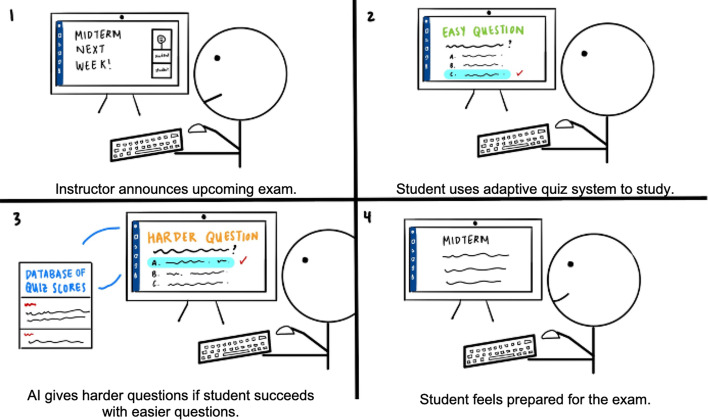
Artificial intelligence (AI) systems offer effective support for online learning and teaching, including personalizing learning for students, automating instructors’ routine tasks, and powering adaptive assessments. However, while the opportunities for AI are promising, the impact of AI systems on the culture of, norms in, and expectations about interactions between students and instructors are still elusive. In online learning, learner–instructor interaction (inter alia, communication, support, and presence) has a profound impact on students’ satisfaction and learning outcomes. Thus, identifying how students and instructors perceive the impact of AI systems on their interaction is important to identify any gaps, challenges, or barriers preventing AI systems from achieving their intended potential and risking the safety of these interactions. To address this need for forward-looking decisions, we used Speed Dating with storyboards to analyze the authentic voices of 12 students and 11 instructors on diverse use cases of possible AI systems in online learning. Findings show that participants envision adopting AI systems in online learning can enable personalized learner–instructor interaction at scale but at the risk of violating social boundaries. Although AI systems have been positively recognized for improving the quantity and quality of communication, for providing just-in-time, personalized support for large-scale settings, and for improving the feeling of connection, there were concerns about responsibility, agency, and surveillance issues. These findings have implications for the design of AI systems to ensure explainability, human-in-the-loop, and careful data collection and presentation. Overall, contributions of this study include the design of AI system storyboards which are technically feasible and positively support learner–instructor interaction, capturing students’ and instructors’ concerns of AI systems through Speed Dating, and suggesting practical implications for maximizing the positive impact of AI systems while minimizing the negative ones.
Overview
The claims and statistics of this paper haven’t been checked yet.
Free: it reads the open-access text and checks the first 5 claims that cite a source we can check. Create a free account to check every claim.
Integrity signals
Registry
Cites
Statistics
Figures
Verification
Claims the paper makes
The claims and statistics of this paper haven’t been checked yet.
Free: it reads the open-access text and checks the first 5 claims that cite a source we can check. Create a free account to check every claim.
Claims other papers make about this one
Each is checked against this paper’s own text: does it say what the citing paper says it does?
The source backs part of the claim, not all of it — or backs it for a different population, condition or comparison.
In the citing paper
“This observation demonstrates the potential of AI as a tool for just-in-time learning in project-based contexts [8, 18], where students can quickly acquire specific expertise needed for their individual projects within compressed timelines.”
From Scaffolding Creativity: Integrating Generative AI Tools and Real-World Experiences in Business Education (2025) · cites this paper as [18]
Experimental — accuracy not yet measuredThe source backs part of the claim, not all of it — or backs it for a different population, condition or comparison.
In the citing paper
“However, teachers may not be digitally ready to use AI-driven educational applications for teaching and learning purposes (e.g., Ally, 2019;Seo et al., 2021).”
From Teachers’ AI digital competencies and twenty-first century skills in the post-pandemic world (2023) · doi:10.1007/s11423-023-10203-6 · cites this paper as Seo et al., 2021
Experimental — accuracy not yet measuredThe cited source says what the claim attributes to it.
In the citing paper
“Interaction between students and instructors has a significant influence on students' happiness and learning results in online learning [92].”
From Adaptive Learning Using Artificial Intelligence in e-Learning: A Literature Review (2023) · cites this paper as [92]
In the citing paper
“They may lack technological experience to conduct data analysis, or to set rules to automatically generate assignments and feedback for students via AI-driven tools (Seo et al., 2021).”
From Teachers’ AI digital competencies and twenty-first century skills in the post-pandemic world (2023) · doi:10.1007/s11423-023-10203-6 · cites this paper as Seo et al., 2021
In the citing paper
“For example, Seo et al. (2021) proposed that AI could facilitate teachers' generation of repetitive questions, and offer students learner-instruction connections, just-in-time personalized support and meaningful automatic communication for classmates.”
From Teachers’ AI digital competencies and twenty-first century skills in the post-pandemic world (2023) · doi:10.1007/s11423-023-10203-6 · cites this paper as Seo et al., 2021
Self-check
Percentages, sums and reported differences re-computed from the paper’s own numbers.
The self-check needs the paper’s full text.
Citations
Cites
Using thematic analysis in psychology
Braun, V., & Clarke, V. (2006) · Qualitative Research in Psychology · doi:10.1191/1478088706qp063oa · Cited by 194,414 · cited 1×
“We used a Reflexive Thematic Analysis approach (Braun & Clarke, 2006; Nowell et al., 2017).”
S., N. L. (2017) · doi:10.1177/1609406917733847 · Cited by 14,051
Zawacki-Richter, O., Marín, V. I., Bond, M., & Gouverneur, F. (2019) · International Journal of Educational Technology in Higher Education · doi:10.1186/s41239-019-0171-0 · Cited by 7,242
What is AI Literacy? Competencies and Design Considerations
Long, D., & Magerko, B. (2020) · Proceedings of the 2020 CHI Conference on Human Factors in Computing Systems · doi:10.1145/3313831.3376727 · Cited by 3,241 · cited 1×
“To address this, it is important to foster AI literacy in students and instructors without a technical background (Long & Magerko, 2020).”
BackgroundAnderson, J. R., Boyle, C. F., & Reiser, B. J. (1985) · Science · doi:10.1126/science.228.4698.456 · Cited by 3,119
Editorial: Three types of interaction
Moore, M. G. (1989) · American Journal of Distance Education · doi:10.1080/08923648909526659 · Cited by 2,471 · cited 1×
“Moore (1989) classified these interactions in online learning into three types: learner–content, learner–learner, and learner–instructor.”
BackgroundVanLEHN, K. (2011) · Educational Psychologist · doi:10.1080/00461520.2011.611369 · Cited by 2,323 · cited 1×
“…artificial intelligence (AI) in online learning and teaching are broad (Anderson et al., 1985; Baker, 2016; Roll et al., 2018; Seo et al., 2020b; VanLehn, 2011), ranging from personalized learning for students and automation of instructors’ routine tasks to AI-powered assessments (Popenici &…”
BackgroundExploring the impact of artificial intelligence on teaching and learning in higher education
Popenici, S. A. D., & Kerr, S. (2017) · Research and Practice in Technology Enhanced Learning · doi:10.1186/s41039-017-0062-8 · Cited by 2,019 · cited 3×
“…intelligence (AI) in online learning and teaching are broad (Anderson et al., 1985; Baker, 2016; Roll et al., 2018; Seo et al., 2020b; VanLehn, 2011), ranging from personalized learning for students and automation of instructors’ routine tasks to AI-powered assessments (Popenici & Kerr, 2017).”
BackgroundMoore, M. G. (1993) · Cited by 1,817
Can we open the black box of AI?
Castelvecchi, D. (2016) · Nature · doi:10.1038/538020a · Cited by 1,773 · cited 1×
“For instance, when communicating with an AI Teaching Assistant, the black-box nature of the AI system leaves no choices for students to check whether the answers from AI are right or wrong (Castelvecchi, 2016).”
Background
Research works printed but not linked: 3
- Shackelford, J. L., & Maxwell, M. (2012). Contribution of learner–instructor interaction to sense of community in graduate online education. MERLOT Journal of Online Learning and Teaching, 8 (4), 248–260.
- Walker, C. H. (2016). The correlation between types of instructor-student communication in online graduate courses and student satisfaction levels in the private university setting. Doctoral dissertation. Carson-Newman University, Tennessee.
- Wogu, I. A. P., Misra, S., Olu-Owolabi, E. F., Assibong, P. A., Udoh, O. D., Ogiri, S. O., & Damasevicius, R. (2018). Artificial intelligence, artificial teachers and the fate of learners in the 21st century education sector: Implications for theory and practice. International Journal of Pure and Applied Mathematics, 119 (16), 2245–2259.
Cited by
Items 401–500 of 787
Challenges of University Communication Teaching in the Artificial Intelligence Age
Rosa, A. L. (2023) · Bridging human and machine: future education with intelligence · doi:10.1007/978-981-19-8641-3_7 · Cited by 3
Exploring the Profound Impact of AI on Higher Education and Students: Shaping Tomorrow's Workforce
Emanuel, A., & Stone, D. H. (2024) · Advances in educational marketing, administration, and leadership book series · doi:10.4018/979-8-3693-0240-8.ch007 · Cited by 4
Unveiling the Synergy: Inclusive Coaching Practices in Leadership
Singha, S. (2024) · Advances in logistics, operations, and management science book series · doi:10.4018/979-8-3693-5242-7.ch010 · Cited by 3
ChatGPT — A Threat or an Aid in Teaching and Learning
Magtoto, G., Bagnol, F., & Abunda, R. (2024) · International Journal on Open and Distance e-Learning · doi:10.58887/ijodel.v9i2.250 · Cited by 5
Yoandita, & Hasnah, Y. (2024) · Esteem Journal of English Education Study Programme · doi:10.31851/esteem.v7i2.15254 · Cited by 18
“By automating routine chores for teachers, customizing learning for students, and enabling adaptive evaluations, AI systems effectively assist online learning and teaching (Seo et al., 2021).”
BackgroundArtificial Intelligence and Education: An Insight Through Bibliometric Analysis
Uysal, M., Topal, M., & Kaymak, Z. D. (2024) · Van Yüzüncü Yıl Üniversitesi Eğitim Fakültesi dergisi/Yüzüncü Yıl Üniversitesi Eğitim Fakültesi dergisi · doi:10.33711/yyuefd.1381074 · Cited by 4
AI as a Key Stakeholder for Course Design
Shchaveleva, E. N., Tolstykh, O. M., Saulembekova, G. S., & Kuznetsov, A. N. (2024) · Advances in educational technologies and instructional design book series · doi:10.4018/979-8-3693-5518-3.ch009 · Cited by 6
Enhancing AI Through Statistical Methods for Improved Decision-Making
Habeeb, H. Q. A., & Radhy, Z. H. (2024) · Journal of Al-Qadisiyah for Computer Science and Mathematics · doi:10.29304/jqcsm.2024.16.41800 · Cited by 3
“(Hoffmann, 2022)(Seo et al.2021) Taking this on board, the next question we should ask is "How can we automate rational decision-making?"”
Quid pro Quo: Information disclosure for AI feedback in Human-AI collaboration
Cvetković, I., Grashoff, I., Jovančević, A., & Bittner, E. A. C. (2025) · Computers in Human Behavior Artificial Humans · doi:10.1016/j.chbah.2025.100137 · Cited by 6
Dijk, W. V. (2025) · International Journal For Multidisciplinary Research · doi:10.36948/ijfmr.2025.v07i02.42748 · Cited by 8
“Seo et al. (2021) further emphasized that the anonymity provided by AI tools lowered self-consciousness, making learners more willing to take risks in language production.”
Artificial Intelligence and Human Society (Artificial Intelligence and Education)Preprint
Das, S., & Das, S. (2023) · TechRxiv · doi:10.36227/techrxiv.24313456 · Cited by 4
Xiao, B. (2024) · International Journal of Research Studies in Management · doi:10.5861/ijrsm.2024.1037 · Cited by 2
Cloud Technology Impact on Human Behavior Based on Cognitive Theory
Wiryawan, D., Rattanto, B., Shaharudin, M. S., Suhartono, J., Mailangkay, A. B. L., & Rumangkit, S. (2024) · International Conference on Electrical, Computer and Energy Technologies (ICECET) · doi:10.1109/icecet61485.2024.10698637 · Cited by 3
Future expectations for faculty roles at Yarmouk University in light of AI-based learning
Azam, M. F. M. A. (2024) · International Journal of ADVANCED AND APPLIED SCIENCES · doi:10.21833/ijaas.2024.11.003 · Cited by 2
Train the Trainer: Using an AI Teacher to Upskill Teachers in India
Otermans, P. C. J., & Aditya, D. (2025) · SciComm Report · doi:10.32457/scr.v4i1.2826 · Cited by 2
Importance of Human Judgment in Artificial Intelligence: A Panoramic Overview
Bahadure, N. B., Khomane, R. B., Shafaq, Pathan, S., Sharma, A., & Satokar, P. (2025) · Advances in Science, Technology & Innovation/Advances in science, technology & innovation · doi:10.1007/978-3-031-72747-4_34 · Cited by 3
Sayangan, Y. V. (2024) · International Journal of Elementary Education · doi:10.23887/ijee.v8i3.84158 · Cited by 5
“Further, the role of media helps teachers in attracting students' interest (Avando Bastari et al., 2021; Seo et al., 2021).”
AI Teacherbots: the lure driving migration from offline to online learning
Shi, Y., Li, W., & He, F. (2025) · Current Psychology · doi:10.1007/s12144-025-07888-8 · Cited by 3
“Moreover, there is a concern that overly standardized AI support might impede effective learning (Seo et al., 2021).”
The Significance of AI Ethics and Its Implications for Higher Education: Systematic Review
AlDhaen, F. S. (2025) · Emerald Group Publishing Limited eBooks · doi:10.1108/978-1-83608-036-720251005 · Cited by 3
Moufida, B., & Amira, S. (2025) · South Florida Journal of Development · doi:10.46932/sfjdv6n5-098 · Cited by 3
Rosmayanti, V. (2025) · Advances in computational intelligence and robotics book series · doi:10.4018/979-8-3373-1952-0.ch008 · Cited by 3
On Large Language Models’ capacity to replace human teachers: a lesson from the Mahabharata
Calvert, I., Frame, M., & Ashcraft, J. (2025) · Journal of Philosophy of Education · doi:10.1093/jopedu/qhaf039 · Cited by 4
OKATAN, S. (2025) · İstanbul Üniversitesi Çeviribilim Dergisi / Istanbul University Journal of Translation Studies · doi:10.26650/iujts.2025.1611407 · Cited by 6
Factors influencing readiness for the incorporation of artificial intelligence at school context
Karan, B., & Angadi, G. R. (2025) · African Journal of Science Technology Innovation and Development · doi:10.1080/20421338.2025.2490321 · Cited by 5
The impact of AI-Based educational counseling on teaching effectiveness
Alenezi, A. R., & Alenezi, A. (2025) · EDUWEB · doi:10.46502/issn.1856-7576/2025.19.02.2 · Cited by 2
Muhammad, Y., & Yahaya, W. A. J. W. (2025) · Advances in Science, Technology & Innovation/Advances in science, technology & innovation · doi:10.1007/978-3-031-56848-0_7 · Cited by 4
Salhab, R. A. (2025) · Advances in Science, Technology & Innovation/Advances in science, technology & innovation · doi:10.1007/978-3-031-56848-0_5 · Cited by 3
AI-Supported Reading Mentorship
Liao, C.-Y. (2025) · International Journal of Artificial Intelligence in Education · doi:10.1007/s40593-025-00499-1 · Cited by 9
“These models can assist in generating personalized book recommenda - tions, crafting discussion prompts, and summarizing the key points of teacher-student conversations (Seo et al., 2021).”
Grand Challenges in AI and Education Beyond 2030
Woolf, B. P., Allessio, D., Arroyo, I., Gattupalli, S., & Zhang, B. (2025) · Interaction design & architecture(s)/ID&A Interaction design & architecture(s) · doi:10.55612/s-5002-064-001sp · Cited by 2
Back to the future via human-centered artificial intelligence
Lee, D. H., & Gottlieb, U. R. (2025) · Asia Pacific Journal of Marketing and Logistics · doi:10.1108/apjml-02-2025-0284 · Cited by 3
Abramenka‐Lachheb, V., & Özoğul, G. (2025) · Educational Technology Research and Development · doi:10.1007/s11423-025-10556-0 · Cited by 2
“While Artificial intelligence (AI) systems in online learning are anticipated to significantly impact learner-instructor interaction (Seo et al., 2021), there is still a great deal of consideration to be given to its ethical uses, restrictions on independent learning, and potential infringement on…”
Mariñoso, P. E., García, P. Á. C., Jareño, I. M., & Rodriguez, E. C. (2025) · Frontiers in Psychology · doi:10.3389/fpsyg.2025.1604414 · Cited by 8
AI Adoption to Enhance Quality Education for Sustainable Education and Lifelong Learning
Almukharreq, Z., & Sengupta, N. (2025) · Studies in big data · doi:10.1007/978-3-031-97609-4_44 · Cited by 3
Unveiling The Effectiveness Of Utilizing AI As Tool for Language Learning and Teaching
Williams-Onyeji, P. O. (2025) · J-LELC Journal of Language Education Linguistics and Culture · doi:10.25299/j-lelc.2025.21624 · Cited by 4
Rojas, S. G., Alvino, F. P., Hinostroza, W. C. S., & Zevallos, F. O. C. (2025) · Scientia Andes · doi:10.64230/sca.v1i4.22 · Cited by 6
Enhancing mathematical modeling competencies through AI-powered VR
Gürefe, N., ÖKSÜZ, H., & Aktaş, G. S. (2025) · PLoS ONE · doi:10.1371/journal.pone.0326440 · Cited by 4
“Artificial intelligence-powered (AI-p) applications enhance instructional methodologies and the knowledge acquiring process [13–15].”
Macasawang, J. M. (2025) · Advances in Psychological Sciences and Applications · doi:10.56741/apsa.v1i03.1297 · Cited by 8
“Similarly, regarding behavioural change in social interaction, learning about AI’s effects in this dimension can help educators create a learning experience that improves interpersonal skills and lifts collaborative learning [13].”
AI-assisted language learning: ChatGPT's impact on mastering English tenses at the university level
Lukešová, A., & Jennings, P. (2026) · Social Sciences & Humanities Open · doi:10.1016/j.ssaho.2026.102532 · Cited by 13
Yu, J., Dai, X., Qiu, B., Guo, W., Wang, R., & Na, M. (2026) · Frontiers in Psychology · doi:10.3389/fpsyg.2026.1707116 · Cited by 3
“In AI-mediated environments, such violations may also trigger concerns about deper-sonalization, surveillance, or erosion of pedagogical boundaries (Seo et al., 2021).”
Melchior, C., & Farinosi, M. (2026) · Innovation The European Journal of Social Science Research · doi:10.1080/13511610.2026.2636830 · Cited by 5
Xu, S., Rahim, N., & Siyuan, Z. (2026) · Frontiers in Education · doi:10.3389/feduc.2026.1756945 · Cited by 2
Uncovering Youth’s Needs and Concerns About AI Through Art-Based Participatory Design
Lee, S., Choi, D., Im, H., Choi, Y. J., Lee, M., Hong, H., & Lee, S. (2026) · International Journal of Human-Computer Interaction · doi:10.1080/10447318.2026.2648805 · Cited by 2
You, D., Monteiro, D., & Seo, K. (2026) · Interactive Learning Environments · doi:10.1080/10494820.2026.2662461 · Cited by 2
Self-citationZhao, J., & Yang, X. (2026) · Discover Education · doi:10.1007/s44217-026-01611-w · Cited by 6
“In K-12 settings, nascent research and practitioner reports suggest transformative applications, such as assisting teachers in automating lesson planning [14], generating diverse teaching materials [21], and designing personalized learning activities [1].”
Resolving Artificial Intelligence Hallucination in Personalized Adaptive Learning System
Susanto, D., Halim, E., Richard, R., Gui, A., & Nelly, N. (2023) · International Conference on Informatics and Computing (ICIC) · doi:10.1109/icic60109.2023.10382000 · Cited by 6
“However, this is merely one aspect of the complex human experience [9].”
BackgroundChatGPT in education: A comparative study of media framing in Japan and Malaysia
Freeman, B. C., & Aoki, K. (2023) · International Conference on Education and E-Learning (ICEEL) · doi:10.1145/3637989.3638020 · Cited by 8
“However, researchers have raised concerns about its potential negative impact on human interaction and cheating (Serholt, 2017; Seo et al., 2021; Ravshanbek, 2022; Zulunov, 2022).”
BackgroundInteligencia artificial en la enseñanza-aprendizaje universitaria: una revisión semi-sistemática
Principal, M., & Orellana, A. (2024) · EVSOS · doi:10.57175/evsos.v2i4.157 · Cited by 3
Almarzooqi, F. A., & Abouassar, R. M. E. (2024) · Journal of Research in Curriculum Instruction and Educational Technology · doi:10.21608/jrciet.2024.363642 · Cited by 2
Innovations in Project-Based Learning (PBL) Strategies for Elementary School Students
Tisna, Nugraha, M. T., & Mardiyati, I. (2024) · International Journal of Basic Education Research · doi:10.14421/ijber.v1i2.9645 · Cited by 5
“( Seo et al., 2021).”
Automated Handwritten Essay Evaluation in Moodle: Leveraging Google Vision OCR and Mistral 7b
Baclayon, C. A. L., Costelo, K. O. R., Flores, J. J. L., & Romana, C. L. C. S. (2024) · International Conference on Digital Technology in Education (ICDTE) · doi:10.1145/3696230.3696256 · Cited by 3
“In addition, AI effectively supports online learning and teaching, including personalization in learning for students, automation of routine tasks from instructors, and powering adaptive assessments [5].”
An Overview of Incorporating Artificial Intelligence Tools for Promoting Learners’ Reading Skills
Jose, J., & Jose, B. J. (2024) · Studies in systems, decision and control · doi:10.1007/978-3-031-70399-7_46 · Cited by 4
LA INTELIGENCIA ARTIFICIAL Y SU INFLUENCIA EN EL COMPORTAMIENTO DE LOS ESTUDIANTES
Calle, G. P. R., Tivillin-Gutama, D. M., & Bonisoli, L. (2025) · KAIRÓS REVISTA DE CIENCIAS ECONÓMICAS JURÍDICAS Y ADMINISTRATIVAS · doi:10.37135/kai.03.14.04 · Cited by 5
Leveraging ChatGPT-4 for Enhanced Education: Personalized Problem-Solving and Consistent Learning
Khan, I. M., Chohan, M. I., & Malik, S. I. (2024) · International Conference on Computing and Data Analytics (ICCDA) · doi:10.1109/iccda64887.2024.10867340 · Cited by 4
“The emergence of innovative tools, particularly in the realms of Artificial Intelligence (AI) and Natural Language Processing (NLP), has created unprecedented opportunities to enhance the learning process [4, 5].”
Polinar, M. A. N., Mahipos, A. M. N., Rabanes, B. G., & Ato, J. M. U. (2025) · Diversitas Journal · doi:10.48017/dj.v10i2.3345 · Cited by 6
Qassrawi, R. (2025) · Springer eBooks · doi:10.1007/978-981-96-2532-1_20 · Cited by 6
Wairisal, P. L. (2023) · Jurnal Penelitian Pendidikan IPA · doi:10.29303/jppipa.v9i8.4944 · Cited by 3
“, 2023) Make a thesis abstract (Seo et al., 2021); (Kılınç, 2023) Create a script background (Elkhodr et al.”
BackgroundSemeniuk, R., Holovnia, Y., Huda, O., & Савастру, Н. (2024) · Futurity Education · doi:10.57125/fed.2024.03.25.02 · Cited by 15
“Interact ive approach is based on students’ active participation ( Fan & Li, 2023; Seo et al., 2021) and incorporates AI technologies (Ukenova & Bekmanova, 2023).”
Ensuring Cyber Resilience: A Thorough Guide to Securing Virtual Classrooms
Zamfir, M., Barbu, M., Marinescu, I. A., Iordache, D. D., & Cîrnu, C. E. (2024) · Euromicro International Conference on Parallel, Distributed and Network-Based Processing (PDP) · doi:10.1109/pdp62718.2024.00031 · Cited by 4
Artificial Intelligence and Human Society (Artificial Intelligence and Education)Preprint
Das, S., & Das, S. (2023) · doi:10.36227/techrxiv.24313456.v1 · Cited by 3
Chukhlomin, V. (2024) · SSRN Electronic Journal · doi:10.2139/ssrn.4820332 · Cited by 4
AI Driven Advertisement Transforming Consumer Behavior in Digital EraPreprint
Singh, M. R., Bala, P., & Jain, A. K. (2025) · SSRN Electronic Journal · doi:10.2139/ssrn.5239003 · Cited by 2
Hosseinkhani, N. T. (2025) · SSRN Electronic Journal · doi:10.2139/ssrn.5385537 · Cited by 2
أحمد, د. ع. ح. (2023) · مجلة كلية التربية جامعة بنها · doi:10.21608/jfeb.2023.246785.1781 · Cited by 2
Learn History Using the Rupiah Currency Utilizing Augmented Reality Technology
Saputra, M. R. U., & Zakariyah, M. (2023) · Jurnal Penelitian Pendidikan IPA · doi:10.29303/jppipa.v9i12.5800 · Cited by 1
“Students and teachers can easily understand the content of the learning material and understand this application system (Keiler, 2018; Seo et al., 2021; Almusaed et al., 2023).”
BackgroundKharib, N. A. Z., Dahlan, A., Ibrahim, S. A. S., & Pratiwi, A. (2024) · Environment-Behaviour Proceedings Journal · doi:10.21834/e-bpj.v9i28.5787 · Cited by 1
Sathisha, H. K., Sowmya, G. S., & Hemanth Kumar, S. (2024) · Research Bulletin · doi:10.33516/rb.v49i4.140-150p · Cited by 1
Muhaimin, A., & Pahlevi, T. (2024) · SCAFFOLDING Jurnal Pendidikan Islam dan Multikulturalisme · doi:10.37680/scaffolding.v6i1.5067 · Cited by 3
“Supporting this, previous research explains that educators who have good TPACK knowledge are able to provide direct feedback to students (Seo et al., 2021).”
BackgroundSteering Generative AI Toward Beneficence
Amini, M., Tewari, V., Morandé, S., Kukreti, M., & Mishra, A. (2024) · Advances in information security, privacy, and ethics book series · doi:10.4018/979-8-3693-5298-4.ch014 · Cited by 1
Han, J.-S., & Kim, H. (2024) · Journal of Science Education and Technology · doi:10.1007/s10956-024-10186-w · Cited by 1
“Recently, research using AI are also being actively conducted in the field of education (Seo, et al., 2021; Erduran & Levrini, 2024; Kubsch et al., 2023; Martin et al., 2023; Zekaj, 2023; Crompton & Burke, 2023).”
Gayathiri, G. R. (2025) · Journal of Information Systems Engineering & Management · doi:10.52783/jisem.v10i3.7772 · Cited by 5
PracticeDAPR: An AI-based Education-Supported System for Art Therapy
Yang, M., Park, C., Kang, J., Kim, J., Kim, T., Song, H., & Han, J. (2025) · Proceedings of the ACM on Human-Computer Interaction · doi:10.1145/3711112 · Cited by 4
Enhancing Critical Thinking: The Role of AI in Modern Education
Asrifan, A., Khristianto, K., Budiman, A., Astuti, P. I., & Rossydi, A. (2025) · Advances in computational intelligence and robotics book series · doi:10.4018/979-8-3373-4576-5.ch012 · Cited by 8
Factors shaping the adoption of artificial intelligence in education
Milutinović, V., Đorđević, S. M., & Obradović, I. (2025) · Metodicka praksa · doi:10.5937/metpra28-56242 · Cited by 3
Araka, E., Wario, R. D., & Maina, E. M. (2025) · IST-Africa Conference (IST-Africa) · doi:10.23919/ist-africa67297.2025.11060534 · Cited by 1
“While a loss of social interaction is a known drawback of online learning [27] , Artificial Intelligence (AI) presents a promising solution to support a large number of students.”
English Teachers’ Experiences with Artificial Intelligence-Driven Students’ Outputs in the Classroom
Bandao, R. B. (2025) · International Journal of Innovative Science and Research Technology · doi:10.38124/ijisrt/25jul299 · Cited by 2
Garcia, M. B., Metwally, A. H. S., Wang, T., Ofosu‐Ampong, K., Alasgarova, R., Nerantzi, C., Nixon, J., & Bozkurt, A. (2025) · Advances in computational intelligence and robotics book series · doi:10.4018/979-8-3373-6007-2.ch003 · Cited by 1
Bioresource of small salivary glands for the study of sialadenitis in Sjorgen's syndrome
Radenska-Lopovok, S. G., Светов, Д., & Polovikov, I. P. (2025) · Cifra. Клиническая медицина. · doi:10.62993/cmed.2025.5.4 · Cited by 1
Massouti, A. (2025) · IGI Global eBooks · doi:10.4018/979-8-3373-0837-1.ch009 · Cited by 2
The Impact of AI Tools on Student Engagement and Academic Performance
Tamayo, J. D., Sotto, J. C. O., Vicente, C. P., & Lim, M. T. (2025) · GEO Academic Journal · doi:10.56738/issn29603986.geo2025.6.94 · Cited by 6
Fuzzy Logic with a Human Touch: Rethinking the Role of AI in Education
Oshchepkova, T., & Tolstykh, O. M. (2025) · Lecture notes in networks and systems · doi:10.1007/978-3-031-98565-2_15 · Cited by 1
Tohir, A., Muslim, S., & Situmorang, R. (2025) · International Journal of Computational and Experimental Science and Engineering · doi:10.22399/ijcesen.3474 · Cited by 15
Designing a Teacher Recommender System: A Thematic Literature Review of Teacher Evaluation Systems
Ortiz, M. G., & Dumlao, M. F. (2025) · Journal of interdisciplinary perspectives · doi:10.69569/jip.2025.513 · Cited by 1
Migdalia Barría, G., & O., C. E. B. (2025) · Estudios y Perspectivas Revista Científica y Académica · doi:10.61384/r.c.a..v5i3.1410 · Cited by 1
A Bibliometric Study of Mapping Youth and Family in Artificial Intelligence Contexts
Zhang, X., & Kamarudin, S. (2025) · Advances in computational intelligence and robotics book series · doi:10.4018/979-8-3373-2170-7.ch016 · Cited by 1
Arias, D. P., Arias, B. I. I., Lastra, M. A. M., Camino, L. X. A., & Sani, V. E. M. (2025) · ASCE MAGAZINE · doi:10.70577/asce/2231.2251/2025 · Cited by 4
Lin, S.-K., & Chung, H.-C. (2025) · SAGE Open · doi:10.1177/21582440251377226 · Cited by 3
“Seo et al. (2021) pointed out that age impacts the development and application of AI technology, as age differences significantly affect the use and acceptance of AI systems.”
Artificial Intelligence in Education: Partner or Replacement for Teachers?
Abualgasim, S. D., & Ahmed, Z. E. (2025) · Advances in computational intelligence and robotics book series · doi:10.4018/979-8-3373-0396-3.ch010 · Cited by 1
Social innovation capital in the digital social enterprise context
Scuotto, V., Taranto, E. D., & Corte, V. D. (2025) · Journal of Intellectual Capital · doi:10.1108/jic-08-2025-0322 · Cited by 2
Aprilia, P., Ijudin, M. F., Manda, A., & Adela, D. (2025) · International Global Conference Series on ICT Integration in Technical Education & Smart Society · doi:10.3390/engproc2025107135 · Cited by 5
“AI systems improve instructional communication due to the anonymity it can provide for students, students were concerned about responsibility issues that could arise when AI’s unreliable and unexplained answers lead to negative consequences [19].”
Zheng, Y., Tu, F., Shu, F., Shang, C., Chen, L., & Meng, J. (2025) · Computer Standards & Interfaces · doi:10.1016/j.csi.2025.104094 · Cited by 3
Controlling or directing? Text mining to decode supervisor-graduate student relationship
Yin, M., Xu, W. Z., & Wang, Y. (2025) · Acta Psychologica · doi:10.1016/j.actpsy.2025.106030 · Cited by 4
Generative AI in Education and its Future Possibilities
Sindhu, M., Sarita, Raghav, Y. Y., & Kundu, K. (2025) · doi:10.1109/cises66934.2025.11265181 · Cited by 1
“The table III below provides an organized summary of widely used AI platforms and tools in education, with a special focus on their primary use cases, features, technical frameworks and usability[27].”
Balasoto, R. L., de la Peña, M. T. C., & Domingo, J. F. C. (2025) · International Journal of Research and Review · doi:10.52403/ijrr.20251144 · Cited by 3
Not a Swiss Army Knife: Academics' Perceptions of Trade‐Offs around Generative AI Use
Razi, A., Bouzoubaa, L. A., Pessianzadeh, A., Seberger, J. S., & Rezapour, R. (2025) · Proceedings of the Association for Information Science and Technology · doi:10.1002/pra2.1277 · Cited by 5
“These findings are in line with current literature that explored the use of AI in the classroom (Dakakni and Safa, 2023; Seo et al., 2021).”
ATHOS: Ferramenta computacional para avaliação automatizada da escrita de projetos de pesquisa
Meira, R. R., & Reategui, E. B. (2025) · Anais ... Workshops do Congresso Brasileiro de Informática na Educação · doi:10.5753/cbie_estendido.2025.13779 · Cited by 1
PREDICTIVE MODELS FOR CREATIVE TALENT IDENTIFICATION
Behera, D. B., Singh, P., Patil, S., Mahajan, S., Jain, R., & Khurana, D. S. (2025) · ShodhKosh Journal of Visual and Performing Arts · doi:10.29121/shodhkosh.v6.i1s.2025.6666 · Cited by 1
Vo, T. Q. N., & Tran, K. M. A. (2025) · ICTE Conference Proceedings · doi:10.54855/979-8-9870112-9-4_2 · Cited by 3
“Although more recent research has noted the positive impact of AI, including learner autonomy and adaptive learning (Sun & Chen, 2016; Seo et al., 2021), others draw attention to the inability of AI to mimic the nuance that occurs in the interaction between a human learner and another human teacher…”
InfluentialYapay Zekâ Destekli Gözetim ile İlgili Çalışmaların Bibliyometrik Analizi
Asıl, S. (2025) · Afyon Kocatepe Üniversitesi Sosyal Bilimler Dergisi · doi:10.32709/akusosbil.1675072 · Cited by 1
Identity in Transition: How Teachers Learn, Adapt, and Evolve with AI
Bennett, V. A., & Royce, C. A. (2025) · Journal of Research in Science Mathematics and Technology Education · doi:10.31756/jrsmte.914 · Cited by 1
“Educators recognize that while AI can handle large amounts of information, human flexibility and intelligence remain essential for complex contexts (Seo et al., 2021).”
Meylani, R. (2025) · Buca eğitim fakültesi dergisi (Online)/Buca Eğitim Fakültesi dergisi · doi:10.53444/deubefd.1527781 · Cited by 4
Metadata
- Authors
- Seo, K., Tang, J., Roll, I., Fels, S., & Yoon, D.
- Affiliations
- Seoul National University of Science and Technology (KR)
- University of British Columbia (CA)
- Technion – Israel Institute of Technology (IL)
- Corresponding author
- Seo, Kyoungwon
- Venue
- International Journal of Educational Technology in Higher Education
- Published
- 2021-10-26
- Volume
- 18
- Issue
- 1
- Pages
- 54-54
- ISSN
- 2365-9440 (ISSN-L)
- PMC
- PMC8545464
- OpenAlex
- W3209912268
- Cited by
- 788
- References
- 64
- Citations by year
- 2026: 158 · 2025: 283 · 2024: 235 · 2023: 105 · 2022: 7
- FWCI
- 78.45
- Type
- journal article
- Language
- en
- Open access
- diamond
- doi.org
- Licence
- cc-by
- creativecommons.org/licenses/by/4.0 (tdm)
- creativecommons.org/licenses/by/4.0 (vor)
- Locations
- International Journal of Educational Technology in Higher Education (publishedVersion, cc-by)
- Europe PMC (PubMed Central) (publishedVersion, other-oa)
- PubMed Central (publishedVersion, cc-by)
- PubMed (publishedVersion)
- cIRcle (University of British Columbia) (submittedVersion, cc-by)
- DOAJ (DOAJ: Directory of Open Access Journals) (submittedVersion, cc-by-sa)
- Open Collections
- Funders
- seoul national university of science and technology
- Topics
- Social Sciences › Education › Artificial Intelligence in Education
- Social Sciences › Education › Online and Blended Learning
- Physical Sciences › Computer Science › Artificial Intelligence › Intelligent Tutoring Systems and Adaptive Learning
- Keywords
- artificial intelligence in education, learner-instructor interaction, online learning, student perceptions, instructor perceptions, speed dating, personalized learning, adaptive testing, social boundaries, surveillance, human-in-the-loop, explainability, student satisfaction
About these checks
Registry, retraction, Cites and statistics results are computed, not judged, with one exception: a printed reference that no index lists is read once by a model before it counts as a citation error. Claims are extracted by a model and kept only when their quote appears verbatim in the text; each cited source is then checked, with a model’s help, for whether it says what the claim relies on. Those verdicts can be wrong — read the claim’s quote and the cited source before relying on one.
Statistics and arithmetic are recomputed, not judged.
Confidence bands are shown only for fields calibrated on our annotated test set. None is calibrated yet, so no band is shown.
What counts as a claim ›How we measure confidence ›How we check this ›
Are you an author, or do you see a problem with this page? Request a review
Data sources
Bibliographic data: Semantic Scholar, OpenAlex, Crossref.
Contains information from the Semantic Scholar Academic Graph Datasets, made available under the ODC Attribution License (ODC-BY 1.0).
Semantic Scholar’s data is described in: Kinney, R., et al. (2023). The Semantic Scholar Open Data Platform. arXiv:2301.10140.
