

The impact of artificial intelligence on learner–instructor interaction in online learning
Open accessThe DOI matches its Crossref record; 64 of the 64 references it cites were found in a registry or an index.
Abstract
Artificial intelligence (AI) systems offer effective support for online learning and teaching, including personalizing learning for students, automating instructors’ routine tasks, and powering adaptive assessments. However, while the opportunities for AI are promising, the impact of AI systems on the culture of, norms in, and expectations about interactions between students and instructors are still elusive. In online learning, learner–instructor interaction (inter alia, communication, support, and presence) has a profound impact on students’ satisfaction and learning outcomes. Thus, identifying how students and instructors perceive the impact of AI systems on their interaction is important to identify any gaps, challenges, or barriers preventing AI systems from achieving their intended potential and risking the safety of these interactions. To address this need for forward-looking decisions, we used Speed Dating with storyboards to analyze the authentic voices of 12 students and 11 instructors on diverse use cases of possible AI systems in online learning. Findings show that participants envision adopting AI systems in online learning can enable personalized learner–instructor interaction at scale but at the risk of violating social boundaries. Although AI systems have been positively recognized for improving the quantity and quality of communication, for providing just-in-time, personalized support for large-scale settings, and for improving the feeling of connection, there were concerns about responsibility, agency, and surveillance issues. These findings have implications for the design of AI systems to ensure explainability, human-in-the-loop, and careful data collection and presentation. Overall, contributions of this study include the design of AI system storyboards which are technically feasible and positively support learner–instructor interaction, capturing students’ and instructors’ concerns of AI systems through Speed Dating, and suggesting practical implications for maximizing the positive impact of AI systems while minimizing the negative ones.
Overview
The claims and statistics of this paper haven’t been checked yet.
Free: it reads the open-access text and checks the first 5 claims that cite a source we can check. Create a free account to check every claim.
Integrity signals
Registry
Cites
Statistics
Figures
Verification
Claims the paper makes
The claims and statistics of this paper haven’t been checked yet.
Free: it reads the open-access text and checks the first 5 claims that cite a source we can check. Create a free account to check every claim.
Claims other papers make about this one
Each is checked against this paper’s own text: does it say what the citing paper says it does?
The source backs part of the claim, not all of it — or backs it for a different population, condition or comparison.
In the citing paper
“This observation demonstrates the potential of AI as a tool for just-in-time learning in project-based contexts [8, 18], where students can quickly acquire specific expertise needed for their individual projects within compressed timelines.”
From Scaffolding Creativity: Integrating Generative AI Tools and Real-World Experiences in Business Education (2025) · cites this paper as [18]
Experimental — accuracy not yet measuredThe source backs part of the claim, not all of it — or backs it for a different population, condition or comparison.
In the citing paper
“However, teachers may not be digitally ready to use AI-driven educational applications for teaching and learning purposes (e.g., Ally, 2019;Seo et al., 2021).”
From Teachers’ AI digital competencies and twenty-first century skills in the post-pandemic world (2023) · doi:10.1007/s11423-023-10203-6 · cites this paper as Seo et al., 2021
Experimental — accuracy not yet measuredThe cited source says what the claim attributes to it.
In the citing paper
“Interaction between students and instructors has a significant influence on students' happiness and learning results in online learning [92].”
From Adaptive Learning Using Artificial Intelligence in e-Learning: A Literature Review (2023) · cites this paper as [92]
In the citing paper
“They may lack technological experience to conduct data analysis, or to set rules to automatically generate assignments and feedback for students via AI-driven tools (Seo et al., 2021).”
From Teachers’ AI digital competencies and twenty-first century skills in the post-pandemic world (2023) · doi:10.1007/s11423-023-10203-6 · cites this paper as Seo et al., 2021
In the citing paper
“For example, Seo et al. (2021) proposed that AI could facilitate teachers' generation of repetitive questions, and offer students learner-instruction connections, just-in-time personalized support and meaningful automatic communication for classmates.”
From Teachers’ AI digital competencies and twenty-first century skills in the post-pandemic world (2023) · doi:10.1007/s11423-023-10203-6 · cites this paper as Seo et al., 2021
Self-check
Percentages, sums and reported differences re-computed from the paper’s own numbers.
The self-check needs the paper’s full text.
Citations
Cites
Using thematic analysis in psychology
Braun, V., & Clarke, V. (2006) · Qualitative Research in Psychology · doi:10.1191/1478088706qp063oa · Cited by 194,414 · cited 1×
“We used a Reflexive Thematic Analysis approach (Braun & Clarke, 2006; Nowell et al., 2017).”
S., N. L. (2017) · doi:10.1177/1609406917733847 · Cited by 14,051
Zawacki-Richter, O., Marín, V. I., Bond, M., & Gouverneur, F. (2019) · International Journal of Educational Technology in Higher Education · doi:10.1186/s41239-019-0171-0 · Cited by 7,242
What is AI Literacy? Competencies and Design Considerations
Long, D., & Magerko, B. (2020) · Proceedings of the 2020 CHI Conference on Human Factors in Computing Systems · doi:10.1145/3313831.3376727 · Cited by 3,241 · cited 1×
“To address this, it is important to foster AI literacy in students and instructors without a technical background (Long & Magerko, 2020).”
BackgroundAnderson, J. R., Boyle, C. F., & Reiser, B. J. (1985) · Science · doi:10.1126/science.228.4698.456 · Cited by 3,119
Editorial: Three types of interaction
Moore, M. G. (1989) · American Journal of Distance Education · doi:10.1080/08923648909526659 · Cited by 2,471 · cited 1×
“Moore (1989) classified these interactions in online learning into three types: learner–content, learner–learner, and learner–instructor.”
BackgroundVanLEHN, K. (2011) · Educational Psychologist · doi:10.1080/00461520.2011.611369 · Cited by 2,323 · cited 1×
“…artificial intelligence (AI) in online learning and teaching are broad (Anderson et al., 1985; Baker, 2016; Roll et al., 2018; Seo et al., 2020b; VanLehn, 2011), ranging from personalized learning for students and automation of instructors’ routine tasks to AI-powered assessments (Popenici &…”
BackgroundExploring the impact of artificial intelligence on teaching and learning in higher education
Popenici, S. A. D., & Kerr, S. (2017) · Research and Practice in Technology Enhanced Learning · doi:10.1186/s41039-017-0062-8 · Cited by 2,019 · cited 3×
“…intelligence (AI) in online learning and teaching are broad (Anderson et al., 1985; Baker, 2016; Roll et al., 2018; Seo et al., 2020b; VanLehn, 2011), ranging from personalized learning for students and automation of instructors’ routine tasks to AI-powered assessments (Popenici & Kerr, 2017).”
BackgroundMoore, M. G. (1993) · Cited by 1,817
Can we open the black box of AI?
Castelvecchi, D. (2016) · Nature · doi:10.1038/538020a · Cited by 1,773 · cited 1×
“For instance, when communicating with an AI Teaching Assistant, the black-box nature of the AI system leaves no choices for students to check whether the answers from AI are right or wrong (Castelvecchi, 2016).”
BackgroundVision, challenges, roles and research issues of Artificial Intelligence in Education
Hwang, G.-J., Xie, H., Wah, B. W., & Gašević, D. (2020) · Computers and Education: Artificial Intelligence · doi:10.1016/j.caeai.2020.100001 · Cited by 1,435 · cited 1×
“For example, AI tutoring systems can provide personalized guidance, support, or feedback by tailoring learning content based on student-specific learning patterns or knowledge levels (Hwang et al., 2020).”
BackgroundMartin, F., & Bolliger, D. U. (2018) · Online Learning · doi:10.24059/olj.v22i1.1092 · Cited by 1,424 · cited 3×
“Instructors can improve student engagement and learning by providing a variety of communication channels, support, encouragement, and timely feedback (Martin et al., 2018).”
BackgroundEvolution and Revolution in Artificial Intelligence in Education
Roll, I., & Wylie, R. (2016) · International Journal of Artificial Intelligence in Education · doi:10.1007/s40593-016-0110-3 · Cited by 1,229 · cited 1×
“For example, Roll and Wylie (2016) call for more involvement of AI systems in the communication between students and instructors, and in education applications outside school context.”
BackgroundSelf-citationHistorical threads, missing links, and future directions in AI in education
Williamson, B., & Eynon, R. (2020) · Learning, Media and Technology · doi:10.1080/17439884.2020.1798995 · Cited by 981 · cited 1×
“Although several ethical frameworks and professional codes of conduct have been developed to mitigate the potential dangers and risks of AI in education, significant debates continue about their specific impact on students and instructors (Williamson & Eynon, 2020).”
BackgroundEnvisioning AI for K-12: What Should Every Child Know about AI?
Touretzky, D., Gardner-McCune, C., Martin, F., & Seehorn, D. (2019) · Proceedings of the AAAI Conference on Artificial Intelligence · doi:10.1609/aaai.v33i01.33019795 · Cited by 918 · cited 1×
“For example, recent studies have published guides on how to incorporate AI into K-12 curricula (Touretzky et al., 2019), and researchers are exploring how to engage young learners in creative programming activities involving AI (Zimmermann-Niefield et al., 2019).”
BackgroundRichardson, J. C., Maeda, Y., Lv, J., & Caskurlu, S. (2017) · Computers in Human Behavior · doi:10.1016/j.chb.2017.02.001 · Cited by 787 · cited 1×
“Richardson et al. (2017) added that the perceived presence during learner– instructor interaction positively influences student motivation, satisfaction, learning, and retention in online courses.”
BackgroundThere is a blind spot in AI research
Crawford, K., & Calo, R. (2016) · Nature · doi:10.1038/538311a · Cited by 580 · cited 1×
“The behavior of AI agents that do not take into account the risk of data bias or algorithmic bias can be perceived by students as discriminatory (Crawford & Calo, 2016; Murphy, 2019).”
BackgroundExplainable Artificial Intelligence (XAI)
Hossain, M. (2021) · Zenodo (CERN European Organization for Nuclear Research) · doi:10.5281/zenodo.6371435 · Cited by 541
Stupid tutoring systems, intelligent humans
Baker, R. S. (2016) · International Journal of Artificial Intelligence in Education · doi:10.1007/s40593-016-0105-0 · Cited by 425 · cited 3×
“In this context, Baker (2016, p. 603) tried to reconcile humans with AI systems by combining “stupid tutoring systems and intelligent humans.””
BackgroundMartin, F., Wang, C., & Sadaf, A. (2018) · The Internet and Higher Education · doi:10.1016/j.iheduc.2018.01.003 · Cited by 388
Towards artificial intelligence-based assessment systems
Luckin, R. (2017) · Nature Human Behaviour · doi:10.1038/s41562-016-0028 · Cited by 303 · cited 13×
“Additionally, I9 was concerned that AI Facial Analytics might force students to smile to get a good engagement score, which could adversely affect online learning itself.”
BackgroundInfluentialStoryboarding: an empirical determination of best practices and effective guidelines
Truong, K. N., Hayes, G. R., & Abowd, G. D. (2006) · Proceedings of the 6th conference on Designing Interactive systems · doi:10.1145/1142405.1142410 · Cited by 296 · cited 1×
“We styl-ized the characters in a single visual style and as flat cartoon shades in order to reduce gender and ethnic clues and enable participants to put themselves in the shoes of the characters in each storyboard (Truong et al., 2006; Zimmerman & Forlizzi, 2017).”
MethodNguyen, T. D., Cannata, M., & Miller, J. (2018) · The Journal of Educational Research · doi:10.1080/00220671.2016.1220359 · Cited by 252 · cited 1×
“Interaction is paramount for successful online learning (Banna et al., 2015; Nguyen et al., 2018).”
BackgroundAI and education: the importance of teacher and student relations
Guilherme, A. (2019) · AI & SOCIETY · doi:10.1007/s00146-017-0693-8 · Cited by 252 · cited 2×
“AI systems are likely to affect the way learner–instructor interaction occurs in online learning environments (Guilherme, 2019).”
BackgroundUnderstanding, evaluating, and supporting self-regulated learning using learning analytics
Roll, I., & Winne, P. H. (2015) · Journal of Learning Analytics · doi:10.18608/jla.2015.21.2 · Cited by 232 · cited 1×
“AI analytics allows instructors to understand students’ performance, progress, and potential by decrypting their clickstream data (Roll & Winne, 2015; Fong et al., 2019; Seo et al., 2021; Holstein et al., 2018).”
BackgroundSelf-citationKang, M., & Im, T. (2013) · Journal of Computer Assisted Learning · doi:10.1111/jcal.12005 · Cited by 216 · cited 9×
“The goal of this study is to gain insight on students’ and instructors’ perception of the impact of AI systems on learner–instructor interaction (inter alia, communication, support, and presence; Kang & Im, 2013) in online learning.”
BackgroundMethodInfluentialEffects of different interactions on students' sense of community in e-learning environment
Luo, N., Zhang, M., & Qi, D. (2017) · Computers & Education · doi:10.1016/j.compedu.2017.08.006 · Cited by 202 · cited 1×
“These interactions help students become active and more engaged in their online courses (Seo et al., 2021; Martin et al., 2018), and by doing so strengthen their sense of community which is essential for the continuous usage of online learning platforms (Luo et al., 2017).”
Background(2015) · PubMed · Cited by 199
A Conceptual Framework for Human–AI Hybrid Adaptivity in Education
Holstein, K., Aleven, V., & Rummel, N. (2020) · Lecture Notes in Computer Science · doi:10.1007/978-3-030-52237-7_20 · Cited by 168 · cited 1×
“In practice, adaptive support is often jointly enacted by AI systems and human facilitators, such as instructors or peers (Holstein et al., 2020).”
BackgroundActive learning with online video: The impact of learning context on engagement
Seo, K., Dodson, S., Harandi, N. M., Roberson, N., Fels, S., & Roll, I. (2021) · Computers & Education · doi:10.1016/j.compedu.2021.104132 · Cited by 158 · cited 2×
“AI analytics allows instructors to understand students’ performance, progress, and potential by decrypting their clickstream data (Roll & Winne, 2015; Fong et al., 2019; Seo et al., 2021; Holstein et al., 2018).”
BackgroundSelf-citationInfluence of avatar appearance on presence in social VR
Heidicker, P., Langbehn, E., & Steinicke, F. (2017) · 2017 IEEE Symposium on 3D User Interfaces (3DUI) · doi:10.1109/3dui.2017.7893357 · Cited by 152 · cited 4×
“…Quiz (Ross et al., 2018) AI provides students with a personalized set of exercise problems that suits their level of knowledge Presence Virtual Avatar (Heidicker et al., 2017) AI communicates facial expressions and body language without explicitly using a student’s camera feed through a virtual…”
BackgroundInfluentialGoel, A. K., & Polepeddi, L. (2018) · Learning Engineering for Online Education · doi:10.4324/9781351186193-7 · Cited by 146
Rapidly exploring application design through speed dating
Davidoff, S., Lee, M. K., Dey, A. K., & Zimmerman, J. (2007) · doi:10.5555/1771592.1771617 · Cited by 145
Shè Jì: The Journal of Design, Economics, and Innovation
Friedman, K., Lou, Y., & Ma, J. (2015) · She ji · doi:10.1016/j.sheji.2015.09.002 · Cited by 142
Ross, B., Chase, A., Robbie, D., Oates, G., & Absalom, Y. (2018) · International Journal of Educational Technology in Higher Education · doi:10.1186/s41239-018-0113-2 · Cited by 142 · cited 6×
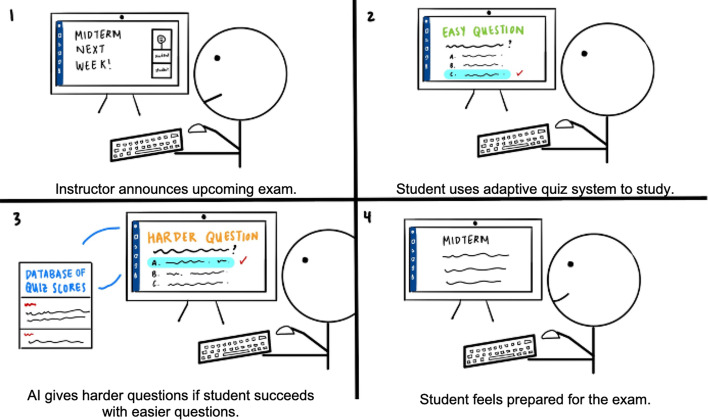
“Ross et al. (2018) developed online adaptive quizzes to support students by providing learning contents tailored to each student’s individual needs, which improved student motivation and engagement.”
BackgroundMethodInfluentialWoolf, B. P., Arroyo, I., Müldner, K., Burleson, W., Cooper, D. G., Dolan, R., & Christopherson, R. M. (2010) · Lecture notes in computer science · doi:10.1007/978-3-642-13388-6_37 · Cited by 140 · cited 4×
“Communication AI Teaching Assistant (Goel & Polepeddi, 2016) AI answers student questions before, during, or after online courses based on answers to questions gathered in previous courses AI Companion (Woolf et al., 2010) AI emotionally supports students who are concerned about their grades and workload, and provides…”
BackgroundInfluentialThe Role of the Teacher and AI in Education
Felix, C. V. (2020) · International Perspectives on the Role of Technology in Humanizing Higher Education · doi:10.1108/s2055-364120200000033003 · Cited by 135 · cited 2×
“If students and instructors have strong concerns about the impact of AI systems on their interactions, then they would not use such systems, in spite of perceived benefits (Felix, 2020).”
BackgroundFacial recognition is the plutonium of AI
Stark, L. (2019) · XRDS: Crossroads, The ACM Magazine for Students · doi:10.1145/3313129 · Cited by 134 · cited 1×
“Stark (2019) described facial recognition as the plutonium of AI: “[facial recognition] is dangerous, racializing, and has few legitimate uses; facial recognition needs regulation and control on par with nuclear waste.””
BackgroundYouth Learning Machine Learning through Building Models of Athletic Moves
Zimmermann-Niefield, A., Turner, M., Murphy, B., Kane, S. K., & Shapiro, R. B. (2019) · Proceedings of the 18th ACM International Conference on Interaction Design and Children · doi:10.1145/3311927.3323139 · Cited by 133 · cited 2×
“For example, recent studies have published guides on how to incorporate AI into K-12 curricula (Touretzky et al., 2019), and researchers are exploring how to engage young learners in creative programming activities involving AI (Zimmermann-Niefield et al., 2019).”
BackgroundThe classroom as a dashboard: co-designing wearable cognitive augmentation for K-12 teachers
Holstein, K., Hong, G., Tegene, M., McLaren, B. M., & Aleven, V. (2018) · Proceedings of the 8th International Conference on Learning Analytics and Knowledge · doi:10.1145/3170358.3170377 · Cited by 129 · cited 1×
“AI analytics allows instructors to understand students’ performance, progress, and potential by decrypting their clickstream data (Roll & Winne, 2015; Fong et al., 2019; Seo et al., 2021; Holstein et al., 2018).”
BackgroundMurphy, R. (2019) · doi:10.7249/pe315 · Cited by 112 · cited 1×
“The behavior of AI agents that do not take into account the risk of data bias or algorithmic bias can be perceived by students as discriminatory (Crawford & Calo, 2016; Murphy, 2019).”
BackgroundRapidly Exploring Application Design Through Speed Dating
Davidoff, S., Lee, M. K., Dey, A. K., & Zimmerman, J. (2007) · Springer eBooks · doi:10.1007/978-3-540-74853-3_25 · Cited by 101
Aslan, S., Alyuz, N., Tanriover, C., Mete, S. E., Okur, E., D'Mello, S. K., & Arslan Esme, A. (2019) · Proceedings of the 2019 CHI Conference on Human Factors in Computing Systems · doi:10.1145/3290605.3300534 · Cited by 96 · cited 8×
“Additionally, I9 was concerned that AI Facial Analytics might force students to smile to get a good engagement score, which could adversely affect online learning itself.”
BackgroundInfluentialEffect of a blended learning environment on student critical thinking and knowledge transformation
Jou, M., Lin, Y.-T., & Wu, D.-W. (2014) · Interactive Learning Environments · doi:10.1080/10494820.2014.961485 · Cited by 91
Care, Communication, Support: Core for Designing Meaningful Online Collaborative Learning
Robinson, H. A., Kilgore, W., & Warren, S. J. (2017) · Online Learning · doi:10.24059/olj.v21i4.1240 · Cited by 89 · cited 1×
“Robinson et al. (2017) found that communication and support are key factors of the learner–instructor interaction for designing meaningful online collaborative learning.”
BackgroundThe privacy paradox and its implications for learning analytics
Tsai, Y.-S., Whitelock-Wainwright, A., & Gašević, D. (2020) · Proceedings of the Tenth International Conference on Learning Analytics & Knowledge · doi:10.1145/3375462.3375536 · Cited by 84 · cited 1×
“Establishing clear, simple, and transparent data norms and agreements about the nature of data being collected from students and what kind of data is okay to be presented to instructors are important considerations for future research (Ferguson, 2019; Tsai et al., 2020).”
BackgroundSpeed Dating: Providing a Menu of Possible Futures
Zimmerman, J., & Forlizzi, J. (2017) · She Ji: The Journal of Design, Economics, and Innovation · doi:10.1016/j.sheji.2017.08.003 · Cited by 75 · cited 2×
“We styl-ized the characters in a single visual style and as flat cartoon shades in order to reduce gender and ethnic clues and enable participants to put themselves in the shoes of the characters in each storyboard (Truong et al., 2006; Zimmerman & Forlizzi, 2017).”
MethodCruz-Benito, J., Sánchez‐Prieto, J. C., Therón, R., & García‐Peñalvo, F. J. (2019) · Lecture notes in computer science · doi:10.1007/978-3-030-21814-0_2 · Cited by 68 · cited 1×
“It is important to examine how students and instructors perceive the impact of AI systems in online learning environments (Cruz-Benito et al., 2019).”
BackgroundSocial Boundaries for Personal Agents in the Interpersonal Space of the Home
Luria, M., Zheng, R., Huffman, B., Huang, S., Zimmerman, J., & Forlizzi, J. (2020) · Proceedings of the 2020 CHI Conference on Human Factors in Computing Systems · doi:10.1145/3313831.3376311 · Cited by 66 · cited 2×
“Previous studies showed that Speed Dating works well without any prior knowledge or experience with AI systems, so no special knowledge or experience was required to participate in this study (Luria et al., 2020; Zimmerman & Forlizzi, 2017).”
BackgroundAssessing Text-Based Writing of Low-Skilled College Students
Perin, D., & Lauterbach, M. (2018) · International Journal of Artificial Intelligence in Education · doi:10.1007/s40593-016-0122-z · Cited by 65
Ethical Challenges for Learning Analytics
Ferguson, R. (2019) · Journal of Learning Analytics · doi:10.18608/jla.2019.63.5 · Cited by 62 · cited 1×
“Establishing clear, simple, and transparent data norms and agreements about the nature of data being collected from students and what kind of data is okay to be presented to instructors are important considerations for future research (Ferguson, 2019; Tsai et al., 2020).”
Background(2020) · Journal of Learning Analytics · doi:10.18608/jla · Cited by 61
Jill Watson: A Virtual Teaching Assistant for Online Education
Goel, A. K., & Polepeddi, L. (2016) · SMARTech Repository (Georgia Institute of Technology) · Cited by 53
Andersen, J. C., Lampley, J., & Good, D. W. (2013) · Digital Commons - East Tennessee State University (East Tennessee State University) · Cited by 50
Role of Instructors' Forum Interactions With Students in Promoting MOOC Continuance
Zhang, C., Chen, H., & Phang, C. W. (2018) · Journal of Global Information Management · doi:10.4018/jgim.2018070108 · Cited by 50
Roll, I., Russell, D. M., & Gašević, D. (2018) · International Journal of Artificial Intelligence in Education · doi:10.1007/s40593-018-0170-7 · Cited by 49 · cited 1×
“The opportunities for artificial intelligence (AI) in online learning and teaching are broad (Anderson et al., 1985; Baker, 2016; Roll et al., 2018; Seo et al., 2020b; VanLehn, 2011), ranging from personalized learning for students and automation of instructors’ routine tasks to AI-powered…”
BackgroundSelf-citationSeo, K., Fels, S., 강무진, Jung, C., & Ryu, H. B. (2020) · Human-Computer Interaction · doi:10.1080/07370024.2020.1744145 · Cited by 42 · cited 3×
“The opportunities for artificial intelligence (AI) in online learning and teaching are broad (Anderson et al., 1985; Baker, 2016; Roll et al., 2018; Seo et al., 2020b; VanLehn, 2011), ranging from personalized learning for students and automation of instructors’ routine tasks to AI-powered…”
BackgroundSelf-citationCo-designing AI Futures: Integrating AI Ethics, Social Computing, and Design
Loi, D., Wolf, C. T., Blomberg, J. L., Arar, R., & Brereton, M. (2019) · Companion Publication of the 2019 on Designing Interactive Systems Conference 2019 Companion · doi:10.1145/3301019.3320000 · Cited by 38 · cited 1×
“Researchers have requested clear ethical guidelines for future research to prevent AI systems from accidently harming people (Loi et al., 2019).”
BackgroundEffectiveness of Brainwriting Techniques: Comparing Nominal Groups to Real Teams
Linsey, J., & Becker, B. (2010) · Springer eBooks · doi:10.1007/978-0-85729-224-7_22 · Cited by 29 · cited 1×
“To create AI system storyboards which are technically feasible and positively support learner–instructor interaction, we ran an online brainwriting activity (Linsey & Becker, 2011) in which we asked a team of designers to come up with scenarios about possible AI systems in online learning.”
MethodArtificial Intelligence for Video-based Learning at Scale
Seo, K., Fels, S., Yoon, D., Roll, I., Dodson, S., & Fong, M. (2020) · ACM Conference on Learning @ Scale (L@S) · doi:10.1145/3386527.3405937 · Cited by 29 · cited 3×
“The opportunities for artificial intelligence (AI) in online learning and teaching are broad (Anderson et al., 1985; Baker, 2016; Roll et al., 2018; Seo et al., 2020b; VanLehn, 2011), ranging from personalized learning for students and automation of instructors’ routine tasks to AI-powered…”
BackgroundSelf-citationThe technologisation of education: philosophical reflections on being too plugged in
Laura, R. S., & Chapman, A. (2009) · International Journal of Children s Spirituality · doi:10.1080/13644360903086554 · Cited by 27 · cited 1×
“The learner–instructor interaction further affects students’ self-esteem, motivation to learn, and confidence in facing new challenges (Laura & Chapman, 2009).”
Background(2017) · NORA - Norwegian Open Research Archives · Cited by 25
Fong, M., Dodson, S., Harandi, N. M., Seo, K., Yoon, D., Roll, I., & Fels, S. (2019) · ACM Conference on Learning @ Scale (L@S) · doi:10.1145/3330430.3333618 · Cited by 15 · cited 1×
“AI analytics allows instructors to understand students’ performance, progress, and potential by decrypting their clickstream data (Roll & Winne, 2015; Fong et al., 2019; Seo et al., 2021; Holstein et al., 2018).”
BackgroundSelf-citationKang, M., & Park, I. (2010) · Journal of Educational Technology · doi:10.17232/kset.26.2.187 · Cited by 6
Research works printed but not linked: 3
- Shackelford, J. L., & Maxwell, M. (2012). Contribution of learner–instructor interaction to sense of community in graduate online education. MERLOT Journal of Online Learning and Teaching, 8 (4), 248–260.
- Walker, C. H. (2016). The correlation between types of instructor-student communication in online graduate courses and student satisfaction levels in the private university setting. Doctoral dissertation. Carson-Newman University, Tennessee.
- Wogu, I. A. P., Misra, S., Olu-Owolabi, E. F., Assibong, P. A., Udoh, O. D., Ogiri, S. O., & Damasevicius, R. (2018). Artificial intelligence, artificial teachers and the fate of learners in the 21st century education sector: Implications for theory and practice. International Journal of Pure and Applied Mathematics, 119 (16), 2245–2259.
Cited by
Adaptive Learning Using Artificial Intelligence in e-Learning: A Literature Review
Gligorea, I., Cioca, M., Oancea, R., Gorski, A.-T., Gorski, H., & Tudorache, P. (2023) · Education Sciences · doi:10.3390/educsci13121216 · Cited by 980
Teachers’ AI digital competencies and twenty-first century skills in the post-pandemic world
(2023) · doi:10.1007/s11423-023-10203-6 · Cited by 734
“However, teachers may not be digitally ready to use AI-driven educational applications for teaching and learning purposes (e.g., Ally, 2019; Seo et al., 2021).”
BackgroundInfluentialFan, Y., Tang, L., Le, H., Shen, K., Tan, S., Zhao, Y., Shen, Y., Li, X., & Gašević, D. (2025) · British Journal of Educational Technology · doi:10.1111/bjet.13544 · Cited by 805
The role of ChatGPT in higher education: Benefits, challenges, and future research directions
(2023) · Journal of Applied Learning & Teaching · doi:10.37074/jalt.2023.6.1.29 · Cited by 561
“Nonetheless, the use of ChatGPT and similar AI models may impact the development of certain graduate skills, such as critical thinking and problem-solving, if it is used for rapid and superficial learning (Seo et al., 2021).”
BackgroundImpact of AI assistance on student agency
Darvishi, A., Khosravi, H., Sadiq, S., Gašević, D., & Siemens, G. (2024) · Computers & Education · doi:10.1016/j.compedu.2023.104967 · Cited by 548
“…concerns about responsibility, agency, and surveillance issues, and challenge traditional notions of ethics and authenticity in education (Celik, Dindar, Muukkonen, & J ¨ arvel ¨ a, 2022; Darvishi, Khosravi, Sadiq, & Weber, 2022; Fyfe, 2022; Molenaar, 2022a; Seo, Tang, Roll, Fels, & Yoon, 2021).”
Metadata
- Authors
- Seo, K., Tang, J., Roll, I., Fels, S., & Yoon, D.
- Affiliations
- Seoul National University of Science and Technology (KR)
- University of British Columbia (CA)
- Technion – Israel Institute of Technology (IL)
- Corresponding author
- Seo, Kyoungwon
- Venue
- International Journal of Educational Technology in Higher Education
- Published
- 2021-10-26
- Volume
- 18
- Issue
- 1
- Pages
- 54-54
- ISSN
- 2365-9440 (ISSN-L)
- PMC
- PMC8545464
- OpenAlex
- W3209912268
- Cited by
- 788
- References
- 64
- Citations by year
- 2026: 158 · 2025: 283 · 2024: 235 · 2023: 105 · 2022: 7
- FWCI
- 78.45
- Type
- journal article
- Language
- en
- Open access
- diamond
- doi.org
- Licence
- cc-by
- creativecommons.org/licenses/by/4.0 (tdm)
- creativecommons.org/licenses/by/4.0 (vor)
- Locations
- International Journal of Educational Technology in Higher Education (publishedVersion, cc-by)
- Europe PMC (PubMed Central) (publishedVersion, other-oa)
- PubMed Central (publishedVersion, cc-by)
- PubMed (publishedVersion)
- cIRcle (University of British Columbia) (submittedVersion, cc-by)
- DOAJ (DOAJ: Directory of Open Access Journals) (submittedVersion, cc-by-sa)
- Open Collections
- Funders
- seoul national university of science and technology
- Topics
- Social Sciences › Education › Artificial Intelligence in Education
- Social Sciences › Education › Online and Blended Learning
- Physical Sciences › Computer Science › Artificial Intelligence › Intelligent Tutoring Systems and Adaptive Learning
- Keywords
- artificial intelligence in education, learner-instructor interaction, online learning, student perceptions, instructor perceptions, speed dating, personalized learning, adaptive testing, social boundaries, surveillance, human-in-the-loop, explainability, student satisfaction
About these checks
Registry, retraction, Cites and statistics results are computed, not judged, with one exception: a printed reference that no index lists is read once by a model before it counts as a citation error. Claims are extracted by a model and kept only when their quote appears verbatim in the text; each cited source is then checked, with a model’s help, for whether it says what the claim relies on. Those verdicts can be wrong — read the claim’s quote and the cited source before relying on one.
Statistics and arithmetic are recomputed, not judged.
Confidence bands are shown only for fields calibrated on our annotated test set. None is calibrated yet, so no band is shown.
What counts as a claim ›How we measure confidence ›How we check this ›
Are you an author, or do you see a problem with this page? Request a review
Data sources
Bibliographic data: Semantic Scholar, OpenAlex, Crossref.
Contains information from the Semantic Scholar Academic Graph Datasets, made available under the ODC Attribution License (ODC-BY 1.0).
Semantic Scholar’s data is described in: Kinney, R., et al. (2023). The Semantic Scholar Open Data Platform. arXiv:2301.10140.
