

The impact of artificial intelligence on learner–instructor interaction in online learning
Open accessThe DOI matches its Crossref record; 64 of the 64 references it cites were found in a registry or an index.
Abstract
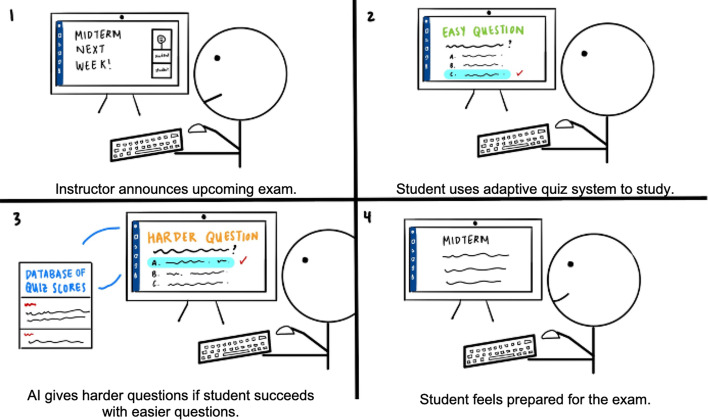
Artificial intelligence (AI) systems offer effective support for online learning and teaching, including personalizing learning for students, automating instructors’ routine tasks, and powering adaptive assessments. However, while the opportunities for AI are promising, the impact of AI systems on the culture of, norms in, and expectations about interactions between students and instructors are still elusive. In online learning, learner–instructor interaction (inter alia, communication, support, and presence) has a profound impact on students’ satisfaction and learning outcomes. Thus, identifying how students and instructors perceive the impact of AI systems on their interaction is important to identify any gaps, challenges, or barriers preventing AI systems from achieving their intended potential and risking the safety of these interactions. To address this need for forward-looking decisions, we used Speed Dating with storyboards to analyze the authentic voices of 12 students and 11 instructors on diverse use cases of possible AI systems in online learning. Findings show that participants envision adopting AI systems in online learning can enable personalized learner–instructor interaction at scale but at the risk of violating social boundaries. Although AI systems have been positively recognized for improving the quantity and quality of communication, for providing just-in-time, personalized support for large-scale settings, and for improving the feeling of connection, there were concerns about responsibility, agency, and surveillance issues. These findings have implications for the design of AI systems to ensure explainability, human-in-the-loop, and careful data collection and presentation. Overall, contributions of this study include the design of AI system storyboards which are technically feasible and positively support learner–instructor interaction, capturing students’ and instructors’ concerns of AI systems through Speed Dating, and suggesting practical implications for maximizing the positive impact of AI systems while minimizing the negative ones.
Overview
The claims and statistics of this paper haven’t been checked yet.
Free: it reads the open-access text and checks the first 5 claims that cite a source we can check. Create a free account to check every claim.
Integrity signals
Registry
Cites
Statistics
Figures
Verification
Claims the paper makes
The claims and statistics of this paper haven’t been checked yet.
Free: it reads the open-access text and checks the first 5 claims that cite a source we can check. Create a free account to check every claim.
Claims other papers make about this one
Each is checked against this paper’s own text: does it say what the citing paper says it does?
The source backs part of the claim, not all of it — or backs it for a different population, condition or comparison.
In the citing paper
“This observation demonstrates the potential of AI as a tool for just-in-time learning in project-based contexts [8, 18], where students can quickly acquire specific expertise needed for their individual projects within compressed timelines.”
From Scaffolding Creativity: Integrating Generative AI Tools and Real-World Experiences in Business Education (2025) · cites this paper as [18]
Experimental — accuracy not yet measuredThe source backs part of the claim, not all of it — or backs it for a different population, condition or comparison.
In the citing paper
“However, teachers may not be digitally ready to use AI-driven educational applications for teaching and learning purposes (e.g., Ally, 2019;Seo et al., 2021).”
From Teachers’ AI digital competencies and twenty-first century skills in the post-pandemic world (2023) · doi:10.1007/s11423-023-10203-6 · cites this paper as Seo et al., 2021
Experimental — accuracy not yet measuredThe cited source says what the claim attributes to it.
In the citing paper
“Interaction between students and instructors has a significant influence on students' happiness and learning results in online learning [92].”
From Adaptive Learning Using Artificial Intelligence in e-Learning: A Literature Review (2023) · cites this paper as [92]
In the citing paper
“They may lack technological experience to conduct data analysis, or to set rules to automatically generate assignments and feedback for students via AI-driven tools (Seo et al., 2021).”
From Teachers’ AI digital competencies and twenty-first century skills in the post-pandemic world (2023) · doi:10.1007/s11423-023-10203-6 · cites this paper as Seo et al., 2021
In the citing paper
“For example, Seo et al. (2021) proposed that AI could facilitate teachers' generation of repetitive questions, and offer students learner-instruction connections, just-in-time personalized support and meaningful automatic communication for classmates.”
From Teachers’ AI digital competencies and twenty-first century skills in the post-pandemic world (2023) · doi:10.1007/s11423-023-10203-6 · cites this paper as Seo et al., 2021
Self-check
Percentages, sums and reported differences re-computed from the paper’s own numbers.
The self-check needs the paper’s full text.
Citations
Cites
Using thematic analysis in psychology
Braun, V., & Clarke, V. (2006) · Qualitative Research in Psychology · doi:10.1191/1478088706qp063oa · Cited by 194,414 · cited 1×
“We used a Reflexive Thematic Analysis approach (Braun & Clarke, 2006; Nowell et al., 2017).”
S., N. L. (2017) · doi:10.1177/1609406917733847 · Cited by 14,051
Zawacki-Richter, O., Marín, V. I., Bond, M., & Gouverneur, F. (2019) · International Journal of Educational Technology in Higher Education · doi:10.1186/s41239-019-0171-0 · Cited by 7,242
What is AI Literacy? Competencies and Design Considerations
Long, D., & Magerko, B. (2020) · Proceedings of the 2020 CHI Conference on Human Factors in Computing Systems · doi:10.1145/3313831.3376727 · Cited by 3,241 · cited 1×
“To address this, it is important to foster AI literacy in students and instructors without a technical background (Long & Magerko, 2020).”
BackgroundAnderson, J. R., Boyle, C. F., & Reiser, B. J. (1985) · Science · doi:10.1126/science.228.4698.456 · Cited by 3,119
Editorial: Three types of interaction
Moore, M. G. (1989) · American Journal of Distance Education · doi:10.1080/08923648909526659 · Cited by 2,471 · cited 1×
“Moore (1989) classified these interactions in online learning into three types: learner–content, learner–learner, and learner–instructor.”
BackgroundVanLEHN, K. (2011) · Educational Psychologist · doi:10.1080/00461520.2011.611369 · Cited by 2,323 · cited 1×
“…artificial intelligence (AI) in online learning and teaching are broad (Anderson et al., 1985; Baker, 2016; Roll et al., 2018; Seo et al., 2020b; VanLehn, 2011), ranging from personalized learning for students and automation of instructors’ routine tasks to AI-powered assessments (Popenici &…”
BackgroundExploring the impact of artificial intelligence on teaching and learning in higher education
Popenici, S. A. D., & Kerr, S. (2017) · Research and Practice in Technology Enhanced Learning · doi:10.1186/s41039-017-0062-8 · Cited by 2,019 · cited 3×
“…intelligence (AI) in online learning and teaching are broad (Anderson et al., 1985; Baker, 2016; Roll et al., 2018; Seo et al., 2020b; VanLehn, 2011), ranging from personalized learning for students and automation of instructors’ routine tasks to AI-powered assessments (Popenici & Kerr, 2017).”
BackgroundMoore, M. G. (1993) · Cited by 1,817
Can we open the black box of AI?
Castelvecchi, D. (2016) · Nature · doi:10.1038/538020a · Cited by 1,773 · cited 1×
“For instance, when communicating with an AI Teaching Assistant, the black-box nature of the AI system leaves no choices for students to check whether the answers from AI are right or wrong (Castelvecchi, 2016).”
Background
Research works printed but not linked: 3
- Shackelford, J. L., & Maxwell, M. (2012). Contribution of learner–instructor interaction to sense of community in graduate online education. MERLOT Journal of Online Learning and Teaching, 8 (4), 248–260.
- Walker, C. H. (2016). The correlation between types of instructor-student communication in online graduate courses and student satisfaction levels in the private university setting. Doctoral dissertation. Carson-Newman University, Tennessee.
- Wogu, I. A. P., Misra, S., Olu-Owolabi, E. F., Assibong, P. A., Udoh, O. D., Ogiri, S. O., & Damasevicius, R. (2018). Artificial intelligence, artificial teachers and the fate of learners in the 21st century education sector: Implications for theory and practice. International Journal of Pure and Applied Mathematics, 119 (16), 2245–2259.
Cited by
Items 501–600 of 787
Bashir, S., & Beydoun, A. R. (2026) · Springer eBooks · doi:10.1007/978-3-031-99068-7_7 · Cited by 4
Rahman, M. S., & Alam, M. M. (2026) · Journal of International Business and Economics · doi:10.15640/jibe.v13p3
Aydemir, M., & Başman, M. (2026) · Springer eBooks · doi:10.1007/978-981-95-4871-2_10 · Cited by 2
Samaty, H. S. E., & Albadi, N. (2026) · Alexandria Engineering Journal · doi:10.1016/j.aej.2026.01.012 · Cited by 4
Utilizing Educational Technology for Formative Assessment in Nursing Education: A Scoping Review
Shin, S., Hong, E., Lee, M., & Lee, M. (2026) · Korean Journal of Adult Nursing · doi:10.7475/kjan.2025.0730 · Cited by 4
“Seo et al. [30] reported that although AI can improve the scale and timeliness of communication, participants expressed concerns regarding violations of social boundaries, shifts in responsibility, and unclear authority structures when human instructors are less involved.”
Predicting adaptability of students in online entrepreneurship education using deep learning
Yin, M., & Sun, S. (2026) · PeerJ Computer Science · doi:10.7717/peerj-cs.3581 · Cited by 1
INTEGRATING AI IN ONLINE LEARNING IN HIGHER EDUCATION: A LITERATURE REVIEW
Lock, J., Arteaga, S., & Johnson, C. (2025) · International journal on innovations in online education · doi:10.1615/intjinnovonlineedu.2026060433 · Cited by 1
Lavigne, A. L., & Ocran, P. (2026) · Journal of School Leadership · doi:10.1177/10526846261425739 · Cited by 1
“…their studies on students ’ use of AI and how AI can be integrated into the instructional process, with a signi fi cant emphasis on higher education (Hinojo-Lucena et al., 2019; Zawacki-Richter et al., 2019), and e-learning or web-based learning settings (Dogan et al., 2023; Seo et al., 2021).”
AI detectors, student anxiety, and authorial alienation: a qualitative study of affective control
Ardana, S. G., & Christiana, M. (2026) · Teaching in Higher Education · doi:10.1080/13562517.2026.2643825 · Cited by 3
“Studies show that these technologies create risk-averse, distrustful environments in schools and universities, making it difficult for genuine teaching relationships to form (Ross & Macleod 2018; Seo et al. 2021; Zhang et al. 2025).”
PERFORMING ARTS AND EMOTIONAL INTELLIGENCE DEVELOPMENT
Damodaran, B., Monisha, J., Shanthi, V., Abhinaya, B., Thiruchenduran, M., & Yang, Y. (2026) · ShodhKosh Journal of Visual and Performing Arts · doi:10.29121/shodhkosh.v7.i3s.2026.7321 · Cited by 1
Oleribe, O. O., Sabado, P., Begum, K. T., Mutchler, M. G., Piccoli, B., Taylor-Robinson, A. W., Denaro, C. A., Izurieta, R., & Taylor-Robinson, S. D. (2026) · BMC Medical Education · doi:10.1186/s12909-026-09291-8 · Cited by 4
Improving Course Registration Efficiency Through LINE Chatbot with LLM Integration
Onuean, K., Chaikot, A., Samanchuen, T., & Pookkaman, W. (2025) · Technology Innovation Management and Engineering Science International Conference (TIMES-iCON) · doi:10.1109/times-icon67125.2025.11488156 · Cited by 1
“In online learning and teaching, such as AI personalized learning courses for students, automating instructors’ routine tasks, etc. [1].”
Explicit and Implicit Learning Mechanisms in AI Educational Assistants: A Systematic Review
Alqarni, F., Alhirabi, N., RANA, O. F., & Perera, C. (2026) · AI · doi:10.3390/ai7050160 · Cited by 2
Uses of AI in Children’s Education: A Literature Review and Future Research Agenda
Bhuiyan, M. M., Gbadegeshin, G. F., & Gbadegeshin, S. A. (2026) · Lecture notes in networks and systems · doi:10.1007/978-3-032-00264-8_18 · Cited by 2
Rashid, S., & Malik, S. (2026) · Cogent Education · doi:10.1080/2331186x.2026.2661437 · Cited by 3
Hasanah, U., Jabu, B., & Baa, S. (2025) · International Conference on Education and E-Learning (ICEEL) · doi:10.1145/3789859.3789886 · Cited by 4
“The increased reliance on AI in online settings required careful guidance to ensure responsible use, particularly in areas such as authorship and the originality of student work [19], [24].”
Alfarizi, M., Ngatindriatun, N., Noer, L. R., Widiharjanti, I., Megawati, S., & Zalika, Z. (2026) · AAOU Journal/AAOU journal · doi:10.1108/aaouj-08-2025-0106 · Cited by 1
Alvero, J. C., & Saldua, M. (2026) · Journal of interdisciplinary perspectives · doi:10.69569/jip.2026.150 · Cited by 5
Verma, A. (2026) · Rural Society · doi:10.1080/10371656.2026.2673474 · Cited by 1
“Research consistently demonstrates the potential of digital tools to improve educational outcomes (Bansal & Choudhary, 2024) through enhanced engagement, accessibility, and personalised learning experiences (Schmitz et al., 2023; Seo et al., 2021).”
Lin, Q., Zhou, Q., Long, Q., Zhu, M., & Ma, H. (2026) · Education and Information Technologies · doi:10.1007/s10639-026-14036-7 · Cited by 5
“This absence of support significantly hinders teachers’ self-growth in AI technology, further affecting their teaching content delivery, instructional design, and assessment quality (Seo et al., 2021; Torda, 2020).”
CHATGTP AND ITS INFLUENCE ON MODERN HIGHER EDUCATION
Golub, T. P., Zhygzhytova, L. M., Kovalenko, O. O., & Nazarenko, O. I. (2023) · Innovate Pedagogy · doi:10.32782/2663-6085/2023/58.1.40 · Cited by 1
AI Game Activities for Teaching and Learning
Kanja, M. W., & Paschal, M. J. (2023) · Advances in educational technologies and instructional design book series · doi:10.4018/979-8-3693-0205-7.ch008 · Cited by 3
Mitra, A. (2023) · Advances in higher education and professional development book series · doi:10.4018/978-1-6684-9472-1.ch001 · Cited by 1
ІНТЕГРАЦІЯ ШТУЧНОГО ІНТЕЛЕКТУ В ПРОЦЕС ОНЛАЙН-НАВЧАННЯ
Кім, А., Алєксєєва, Г. М., Хоменко, В., Висильович, Н. О., & Matviichuk-Yudina, O. (2024) · Молодь і ринок · doi:10.24919/2308-4634.2023.292867 · Cited by 1
-, M. M., -, R. A. M., -, D. M. M., & -, M. B. (2024) · International Journal For Multidisciplinary Research · doi:10.36948/ijfmr.2024.v06i01.12894 · Cited by 2
Role of Artificial Intelligence in the Future Educational Paradigm
Amalanathan, G. M. (2024) · Advances in educational marketing, administration, and leadership book series · doi:10.4018/979-8-3693-1536-1.ch012 · Cited by 1
“Better Than Human” in Partnership With AI: Enhancing Social Presence Through the Use of Technology
McCleskey, J. A., & Melton, R. M. (2024) · Advances in mobile and distance learning book series · doi:10.4018/979-8-3693-0762-5.ch002 · Cited by 1
Diloy, M. A., Comparativo, C. P. E., Reyes, J., Eusebio, B. J. M., & Morona, L. I. C. (2023) · Artificial Intelligence and Cloud Computing Conference (AICCC) · doi:10.1145/3639592.3639629 · Cited by 11
“According to Seo, AI offers numerous opportunities in learning and teaching, including personalized learning, automation of tasks, and AI-powered assessments, enabling instructors to focus on high-value work and understand students’ performance [8].”
BackgroundNazim, M. (2024) · International Journal of English Linguistics · doi:10.5539/ijel.v14n3p93 · Cited by 10
“In addition, some scholars have expressed reservations regarding the potential drawbacks or unintended consequences associated with these tools (Akgun & Greenhow, 2021; Ally, 2019; Lund & Wang, 2023; Seo et al., 2021; Sijing & Lan, 2018; Liu et al., 2023).”
BackgroundRuano, A. C. B., Inca, U. R. G., Carrera, J. E. R., Oña, J. E. C., & Guamán, M. B. G. (2024) · Ciencia Latina Revista Científica Multidisciplinar · doi:10.37811/cl_rcm.v8i3.11539 · Cited by 1
Atoi, E. N. (2024) · UJAH Unizik Journal of Arts and Humanities · doi:10.4314/ujah.v25i1.5 · Cited by 5
Matari, A. S. A., udhubi, K. H. S. A., Saadi, S. A., Albalushi, W. S. A., & Albalushi, S. O. (2024) · The International Journal for Talent Development · doi:10.20428/ijtd.v14i2.2358 · Cited by 3
Zahrou, Y., Zidani, Y., Nissabouri, S., & Mansouri, K. (2024) · Springer eBooks · doi:10.1007/978-3-031-65691-0_9 · Cited by 1
Changes in Academic Assessment Due to the Use of Artificial Intelligence
Ojeda-Zamalloa, I., & Arias, S. T. C. (2024) · Communications in computer and information science · doi:10.1007/978-3-031-75431-9_24 · Cited by 4
Ocaña, L. A. L., Viscaino-Naranjo, F. A., Toapanta, W. V. C., & Torres, E. F. L. (2025) · Dilemas contemporáneos Educación Política y Valores · doi:10.46377/dilemas.v12i2.4532 · Cited by 5
Introduction Changing Roles of Educational Managers
Hoque, K. E. (2025) · Springer eBooks · doi:10.1007/978-981-96-1086-0_1 · Cited by 3
林, 雅. (2025) · Advances in Psychology · doi:10.12677/ap.2025.152060 · Cited by 1
Karafli, K. E. (2025) · Advances in computational intelligence and robotics book series · doi:10.4018/979-8-3373-1827-1.ch014 · Cited by 2
Sposato, M. (2025) · Leadership & Organization Development Journal · doi:10.1108/lodj-02-2025-0104 · Cited by 2
The Impact of Artificial Intelligence on Fostering Student Creativity in Kazakhstan
Narikbayeva, L., Akhmetova, A., Шиндаулова, Р. Б., & Бекмухамедов, Б. М. (2025) · Open Education Studies · doi:10.1515/edu-2025-0113 · Cited by 1
Impact of AI on Student Learning Outcomes: Measuring Success and Identifying Challenges
Kayyali, M. (2025) · Advances in computational intelligence and robotics book series · doi:10.4018/979-8-3693-8382-7.ch004 · Cited by 6
Perceptions of Students Using E-Learning Application in Learning Science
Mulyadi, M., Ridwan, R., Lisabe, C. M., Lasino, & Alfiyanto, A. (2023) · Jurnal Penelitian Pendidikan IPA · doi:10.29303/jppipa.v9i6.3849 · Cited by 5
“…for students to interact with lecturers, especially in terms of discussing the subject matter, subject assignments, and submitting subject assignments (Aswir et al., 2021) Learning interactions with students by lecturers must be based on the principle of educative interaction (Seo et al., 2021).”
BackgroundNoua revoluție în învățarea limbilor străine: puterea Inteligenței Artificiale și Educația 4.0
CHISEGA-NEGRILĂ, A.-M. (2023) · Buletinul Universității Naționale de Apărare „Carol I” · doi:10.53477/2065-8281-23-16
STRATEGIES, TECHNIQUES, APPLICATIONS AND RESOURCES
Volpato, A. N., Balaji, B., Karthikeyan, S., & Panjwani, D. R. (2023) · Jupiter Publications Consortium eBooks · doi:10.47715/jpc.b.978-93-91303-83-9
Msomi, A. M., & Davies, T. C. (2023) · Research Square · doi:10.21203/rs.3.rs-3307567/v1 · Cited by 3
Online Learning in Supporting Students' Procedural Abilities Viewed from a Constructivist ApproachPreprint
Asmara, J. (2023) · Research Square · doi:10.21203/rs.3.rs-3466684/v1 · Cited by 1
Sorour, S. E., Ahmed, H. M. M., Amin, A. E. A., & Abdelkader, H. E. (2024) · Research Square · doi:10.21203/rs.3.rs-4180848/v1 · Cited by 1
RetractedExploring Challenges and Impacts: Insights from School Teachers in Virtual Learning EnvironmentsPreprint
Journal, A. W. E. (2024) · SocArXiv (OSF Preprints) · doi:10.31235/osf.io/85anw · Cited by 1
Batdı, V., & Jibril, S. (2024) · Research Square · doi:10.21203/rs.3.rs-5387274/v1 · Cited by 7
4 ways that AI can help students
O’Byrne, W. I. (2023) · doi:10.64628/aai.hdncjr4tu · Cited by 1
AI Usage as a Mediator Between Study Habits, Academic Procrastination, and Academic Self-EsteemPreprint
Chakraborty, D., & Subramani, D. (2026) · Research Square · doi:10.21203/rs.3.rs-9043305/v1 · Cited by 1
Sofiadin, A. (2022) · Journal of Social Science and Humanities · doi:10.26666/rmp.jssh.2022.6.2
Singh, B. R., Gajabe, U., Jangir, K., & Bandre, G. R. (2023) · doi:10.2196/preprints.49960
Design and Development of Hybrid Instructional Materials: A Theoretical Framework
Şendurur, E., & Şendurur, P. (2023) · Advances in higher education and professional development book series · doi:10.4018/978-1-6684-8656-6.ch002 · Cited by 1
Billy, I., & Anush, H. (2023) · The Business & Management Review · doi:10.24052/bmr/v14nu02/art-13
“Further according to Seo, et. al (2021) in the online learning of the future, AI systems and humans will work closely together, and for this, it is important to use these systems with consideration about perceived advantages and disadvantages.”
BackgroundInfluentialPeer-reviewed visuals and auditory – isn’t it time to incorporate?
Soliman, K., Thongprayoon, C., & Cheungpasitporn, W. (2023) · Renal Failure · doi:10.1080/0886022x.2023.2274507
“Similarly, Seo et al. emphasized the role of artificial intelligence in tailoring educational content to individual students, thereby increasing its effectiveness and engagement [7].”
BackgroundTHE ROLE OF ARTIFICIAL INTELLIGENCE IN ENHANCING ONLINE LEARNING
Алєксєєва, Г. М., Khomenko, V. Н., & Khomenko, V. V. (2023) · Innovate Pedagogy · doi:10.32782/2663-6085/2023/63.2.36
Debnath, P., Deyasi, A., & Mukherjee, A. (2023) · International Conference on Electronics, Materials Engineering & Nano-Technology (IEMENTech) · doi:10.1109/iementech60402.2023.10423396
“Guideline of restricting facilitator-learner interaction within social and ethical territories [9] are made realizable using discussion forum, and thus brings positive impact of the courses, as exhibited in monotonically increasing adaptability over the semesters [10].”
BackgroundSequential Prompts and AI to Illustrate a Mexican Legend Using Syntography
Nava, I. M. (2024) · Smart innovation, systems and technologies · doi:10.1007/978-981-99-7210-4_6
Laubscher, M. C. (2024) · Advances in educational technologies and instructional design book series · doi:10.4018/979-8-3693-1066-3.ch014 · Cited by 4
Impacts on Education and Teaching from the Advance of Artificial Intelligence in Secondary Schools
Aletras, K. (2023) · European Journal of Engineering and Technology Research · doi:10.24018/ejeng.2023.1.cie.3133
Freed, A. L., Huffling, L. D., Scott, H. C., & Benavides, A. W. (2024) · Advances in mobile and distance learning book series · doi:10.4018/979-8-3693-0762-5.ch010
Chamisijatin, L., & Zaenab, S. (2024) · Research and Development in Education (RaDEn) · doi:10.22219/raden.v4i1.32558 · Cited by 3
أبازيـد, أ. م., & سليمان, أ. م. أ. (2024) · المجلة التربوية لکلية التربية بسوهاج · doi:10.21608/edusohag.2024.277240.1447
Shaping Education: Maori Perspectives, Cultural Foundations, Ethics, and AI Development
Koh, J. (2024) · Advances in educational marketing, administration, and leadership book series · doi:10.4018/979-8-3693-2802-6.ch004 · Cited by 1
Online learning in supporting students' procedural abilities viewed from a constructivist approach
Universitas Negeri Surabaya, I., Asmara, J., Rusijono, R., Universitas Negeri Surabaya, I., Kristanto, A., & Universitas Negeri Surabaya, I. (2024) · Journal of Educational Sciences & Psychology · doi:10.51865/jesp.2024.1.06 · Cited by 3
“(Seo et al ., 2021) [40] .”
Widianti, R. I. L., & Sukawati, S. (2024) · Jurnal Muara Pendidikan · doi:10.52060/mp.v9i1.2042
РОЗРАХУНОК ЕКОНОМІЇ ЧАСУ ПРИ СТВОРЕННІ ТЕСТУ ЗА ДОПОМОГОЮ ШТУЧНОГО ІНТЕЛЕКТУ
Tiahunova, M. Y., Киричек, Г. Г., & Костецький, Д. В. (2024) · Systems and Technologies · doi:10.32782/2521-6643-2024-1-67.10
Paľová, D., Štofa, J., & Vejačka, M. (2024) · International Convention on Information and Communication Technology, Electronics and Microelectronics · doi:10.1109/mipro60963.2024.10569638
“[18], [19] By using the right mix of AI tools, we can make education more personal, more responsive to the needs of the learner.”
MethodSusilawati, S., Ranti, N., Hanif, M., Ridwan, I. R., & Sundari, N. (2024) · Jurnal Ilmiah Sekolah Dasar · doi:10.23887/jisd.v8i2.58854
Utilizing Machine Learning to Increase Online Learning Instructors' Efficiency
Das, S., & Acharjya, P. P. (2024) · Advances in systems analysis, software engineering, and high performance computing book series · doi:10.4018/979-8-3693-3033-3.ch003
Choi, M.-S., & Kim, D. K. (2024) · Advances in educational technologies and instructional design book series · doi:10.4018/979-8-3693-2885-9.ch008
Journal, A. W. E. (2024) · SocArXiv (OSF Preprints) · doi:10.31235/osf.io/7e48b
Technical and Ethical Challenges and Opportunities
Chakraborty, S., Misra, B., & Dey, N. (2024) · SpringerBriefs in applied sciences and technology · doi:10.1007/978-981-97-2574-8_6
Phaengkham, S., Junpeng, P., & Tang, K. N. (2024) · Pertanika journal of social science & humanities · doi:10.47836/pjssh.32.3.02 · Cited by 1
“As a result, the real-time digital learning platform will allow a much faster turnaround of results, which is crucial for mathematics teachers when making instructional decisions at the individual student and instructional unit levels (Seo et al., 2021).”
BackgroundPan, X. (2024) · International Journal of e-Collaboration · doi:10.4018/ijec.356491
“For example, Seo et al. (2021) proposed a parallel technology for similarity comparison and visual feature extraction that can be adapted to audio data for improved retrieval performance.”
BackgroundErita, Y., Hevria, S., Miaz, Y., Jupriani, J., Fauzi, R., & Fadillah, N. A. (2024) · AIP conference proceedings · doi:10.1063/5.0234735 · Cited by 3
The Dynamic Impact of Neuroscience and Artificial Intelligence on Education
Karmakar, S., & Das, S. (2024) · Information systems engineering and management · doi:10.1007/978-3-031-72410-7_13 · Cited by 2
The Impact of AI Assistance on Student Learning: A Cross-Disciplinary Study in STEM Education
Fried, M., & Alshibli, M. (2024) · ASEE Middle Atlantic Section Spring Conference · doi:10.18260/1-2--49457
Lanham, J., & Smith, G. (2024) · Advances in educational technologies and instructional design book series · doi:10.4018/979-8-3373-1017-6.ch013 · Cited by 2
Comparing Inclusive Education Practices Implemented in Schools According to Stages of Education
Karaman, H. S., & Maya, İ. (2024) · Özgür Yayınları eBooks · doi:10.58830/ozgur.pub590.c2456
Yapay Zeka ile Eğitimde Dönüşüm: Fırsatlar, Zorluklar ve Yeni Dinamikler
Özdere, M. (2024) · Özgür Yayınları eBooks · doi:10.58830/ozgur.pub590.c2455
Güncel Eğitim Yönetimi Uygulamaları
Erdemir, B., Özdere, M., Karaman, H. S., Maya, İ., Yılmaz, Z., Kılçık, F., Serin, H., Dörterler, S. Ö., Uslu, S., Gezmen, R., et al. (2024) · Özgür Yayınları eBooks · doi:10.58830/ozgur.pub590
Mutlu, A. (2024) · Özgür Yayınları eBooks · doi:10.58830/ozgur.pub590.c2460
Yılmaz, Z., Kılçık, F., & Serin, H. (2024) · Özgür Yayınları eBooks · doi:10.58830/ozgur.pub590.c2457
Yazıcı, S. Ç., & Kaya, G. (2024) · Özgür Yayınları eBooks · doi:10.58830/ozgur.pub590.c2603
Sosyal Bilgiler Öğretmen Adaylarının Coğrafi İşaretli Ürünleri Satın Almaya Yönelik Tutumları
Uslu, S., Gezmen, R., & Özalp, A. (2024) · Özgür Yayınları eBooks · doi:10.58830/ozgur.pub590.c2459
Erken Çocukluk Eğitiminde Yönetim
Dörterler, S. Ö. (2024) · Özgür Yayınları eBooks · doi:10.58830/ozgur.pub590.c2458
GEN Z DIGITAL COMMUNICATION PATTERNS IN LEARNING MANAGEMENT SYSTEM LEARNING
Rahayu, H. S., Chrisulianti, R., Albar, F. M., & Subiakto, V. U. (2024) · IKOMIK Jurnal Ilmu Komunikasi dan Informasi · doi:10.33830/ikomik.v4i2.10272 · Cited by 2
APLIKASI “STOP HIVA” UNTUK MENINGKATKAN PENGETAHUAN REMAJA DI KOTA SEMARANG TAHUN 2024
Maharani, A., Handayani, O. W. K., & Cahyati, W. H. (2024) · PREPOTIF Jurnal Kesehatan Masyarakat · doi:10.31004/prepotif.v8i3.37332 · Cited by 2
Analysis of the application of artificial intelligence in social work teaching
Galetin, M., & Škorić, J. (2024) · Pravo - teorija i praksa · doi:10.5937/ptp2404165g · Cited by 1
Gupta, A., Singh, M., & Sharma, K. (2024) · International Conference on Technological Advancements in Computational Sciences (ICTACS) · doi:10.1109/ictacs62700.2024.10841325 · Cited by 2
“Modern tools with teaching pedagogies like augmented Reality (AR), wine apps, etc. Make the learning process simple and engaging [12].”
Leveraging Smart Video-Based Learning to Enhance Student Engagement and Collaboration
Serasinghe, C., Perera, N., Samarasinghe, D., Muthusinghe, M., & Wijesundara, M. N. (2024) · International Conference on Advancements in Computing (ICAC) · doi:10.1109/icac64487.2024.10850940
“As per Dimitriadou et al. [4], AI-powered video segmentation algorithms divide lengthy instructional videos into shorter, topic-specific segments.”
AbdAlgane, M., & Elkot, M. A. (2025) · SSRN Electronic Journal · doi:10.2139/ssrn.5082088 · Cited by 1
Yaseen, K. N., & Dweikat, K. (2025) · Advances in computational intelligence and robotics book series · doi:10.4018/979-8-3693-9811-1.ch012
Educational Technology and Its Impact on Learning
Tal, S. A. (2025) · Springer eBooks · doi:10.1007/978-981-96-1721-0_3 · Cited by 4
Cherradi, B., Jamea, A., Boukhair, A., & Deschepper, C. (2025) · SHS Web of Conferences · doi:10.1051/shsconf/202521400001
Face recognition build system in online learning
Jufriansah, A., Sulisworo, D., Prayitno, H. J., Khusnani, A., Fatmawati, F., & Tudor, C. I. (2025) · AIP conference proceedings · doi:10.1063/5.0262596
Gao, Y. (2024) · International Conference on Distributed Systems, Computer Networks and Cybersecurity (ICDSCNC) · doi:10.1109/icdscnc62492.2024.10939927
“Nevertheless, Artificial Intelligence (AI) teaching assistance assists instructors in saving time in answering students' simple, tedious questions in the medium of online discussion, and instead, instructors dedicate their time to higher-value work [3].”
AI-Driven CSR in East Asia: Navigating Leadership and Ethical Challenges
Portillo, J. P. V. (2025) · Advances in computational intelligence and robotics book series · doi:10.4018/979-8-3693-9894-4.ch008
Metadata
- Authors
- Seo, K., Tang, J., Roll, I., Fels, S., & Yoon, D.
- Affiliations
- Seoul National University of Science and Technology (KR)
- University of British Columbia (CA)
- Technion – Israel Institute of Technology (IL)
- Corresponding author
- Seo, Kyoungwon
- Venue
- International Journal of Educational Technology in Higher Education
- Published
- 2021-10-26
- Volume
- 18
- Issue
- 1
- Pages
- 54-54
- ISSN
- 2365-9440 (ISSN-L)
- PMC
- PMC8545464
- OpenAlex
- W3209912268
- Cited by
- 788
- References
- 64
- Citations by year
- 2026: 158 · 2025: 283 · 2024: 235 · 2023: 105 · 2022: 7
- FWCI
- 78.45
- Type
- journal article
- Language
- en
- Open access
- diamond
- doi.org
- Licence
- cc-by
- creativecommons.org/licenses/by/4.0 (tdm)
- creativecommons.org/licenses/by/4.0 (vor)
- Locations
- International Journal of Educational Technology in Higher Education (publishedVersion, cc-by)
- Europe PMC (PubMed Central) (publishedVersion, other-oa)
- PubMed Central (publishedVersion, cc-by)
- PubMed (publishedVersion)
- cIRcle (University of British Columbia) (submittedVersion, cc-by)
- DOAJ (DOAJ: Directory of Open Access Journals) (submittedVersion, cc-by-sa)
- Open Collections
- Funders
- seoul national university of science and technology
- Topics
- Social Sciences › Education › Artificial Intelligence in Education
- Social Sciences › Education › Online and Blended Learning
- Physical Sciences › Computer Science › Artificial Intelligence › Intelligent Tutoring Systems and Adaptive Learning
- Keywords
- artificial intelligence in education, learner-instructor interaction, online learning, student perceptions, instructor perceptions, speed dating, personalized learning, adaptive testing, social boundaries, surveillance, human-in-the-loop, explainability, student satisfaction
About these checks
Registry, retraction, Cites and statistics results are computed, not judged, with one exception: a printed reference that no index lists is read once by a model before it counts as a citation error. Claims are extracted by a model and kept only when their quote appears verbatim in the text; each cited source is then checked, with a model’s help, for whether it says what the claim relies on. Those verdicts can be wrong — read the claim’s quote and the cited source before relying on one.
Statistics and arithmetic are recomputed, not judged.
Confidence bands are shown only for fields calibrated on our annotated test set. None is calibrated yet, so no band is shown.
What counts as a claim ›How we measure confidence ›How we check this ›
Are you an author, or do you see a problem with this page? Request a review
Data sources
Bibliographic data: Semantic Scholar, OpenAlex, Crossref.
Contains information from the Semantic Scholar Academic Graph Datasets, made available under the ODC Attribution License (ODC-BY 1.0).
Semantic Scholar’s data is described in: Kinney, R., et al. (2023). The Semantic Scholar Open Data Platform. arXiv:2301.10140.
